




1 Introduction
Consider a countable group G and two subshifts X and Y over G. We are interested in conditions that guarantee the existence of a continuous, shift-commuting map $\phi : X \to Y$
, known as a homomorphism. The study of subshifts via the homomorphisms between them has played a central role in symbolic dynamics (see [Reference Lind and Marcus20] for an introduction). Indeed, when G is the group of integers, the coding results known as Krieger’s embedding theorem [Reference Krieger17, Theorem 3] and Boyle’s lower entropy factor theorem [Reference Boyle3, Theorem 2.5] serve as cornerstone results in the study of subshifts of finite type (SFTs).
$\phi : X \to Y$
, known as a homomorphism. The study of subshifts via the homomorphisms between them has played a central role in symbolic dynamics (see [Reference Lind and Marcus20] for an introduction). Indeed, when G is the group of integers, the coding results known as Krieger’s embedding theorem [Reference Krieger17, Theorem 3] and Boyle’s lower entropy factor theorem [Reference Boyle3, Theorem 2.5] serve as cornerstone results in the study of subshifts of finite type (SFTs).
Several more recent results have developed the coding theory of SFTs over increasingly general classes of groups (see, for example, [Reference Bland1, Reference Briceño, McGoff and Pavlov5, Reference Huczek and Kopacz14, Reference Lightwood18, Reference Lightwood19, Reference Meyerovitch23]), and the present work can be viewed as continuing in this direction. More specifically, we are largely motivated by recent efforts to generalize Krieger’s embedding theorem to more general groups. The first such result, due to Lightwood [Reference Lightwood18], holds for $G = \mathbb {Z}^d$
. For notation, we let
$G = \mathbb {Z}^d$
. For notation, we let $h(X)$
denote the topological entropy of a subshift X.
$h(X)$
denote the topological entropy of a subshift X.
Theorem 1.1. (Lightwood [Reference Lightwood18])
If X is an aperiodic $\mathbb {Z}^d$
subshift, Y is a
$\mathbb {Z}^d$
subshift, Y is a $\mathbb {Z}^d$
square-mixing SFT which contains a finite orbit, and there exists a homomorphism
$\mathbb {Z}^d$
square-mixing SFT which contains a finite orbit, and there exists a homomorphism $\phi : X \to Y$
, then there exists an embedding of X into Y if and only if
$\phi : X \to Y$
, then there exists an embedding of X into Y if and only if $h(X) < h(Y)$
.
$h(X) < h(Y)$
.
Observe that in addition to the structural assumptions on X (aperiodicity) and Y (square-mixing SFT with a finite orbit), this result contains the hypothesis that there exists a homomorphism $\phi : X \to Y$
. In an effort to find sufficient conditions to guarantee that this hypothesis holds, Lightwood went on to establish the following complementary theorem for
$\phi : X \to Y$
. In an effort to find sufficient conditions to guarantee that this hypothesis holds, Lightwood went on to establish the following complementary theorem for $G = \mathbb {Z}^2$
.
$G = \mathbb {Z}^2$
.
Theorem 1.2. (Lightwood [Reference Lightwood19])
If X is an aperiodic $\mathbb {Z}^2$
subshift and Y is a
$\mathbb {Z}^2$
subshift and Y is a $\mathbb {Z}^2$
square-filling mixing SFT, then there exists a homomorphism
$\mathbb {Z}^2$
square-filling mixing SFT, then there exists a homomorphism $\phi : X \to Y$
.
$\phi : X \to Y$
.
Combining these two theorems, Lightwood obtained a $\mathbb {Z}^2$
generalization of Krieger’s result in the setting where X is aperiodic and Y is square-filling mixing. We are not aware of any other results that address the case
$\mathbb {Z}^2$
generalization of Krieger’s result in the setting where X is aperiodic and Y is square-filling mixing. We are not aware of any other results that address the case $G = \mathbb {Z}^d$
for
$G = \mathbb {Z}^d$
for $d \geq 3$
.
$d \geq 3$
.
In more recent work, the first author established the following theorem for all countable amenable groups with the comparison property [Reference Downarowicz and Zhang10, Definition 6.1], an algebraic property based on the idea of dynamical comparison [Reference Kerr15, Definition 3.2]. Many groups have been shown to have the comparison property, including all countable ‘subexponential’ groups (that is, those not containing a finitely generated subgroup of exponential growth) [Reference Downarowicz and Zhang10, Theorem 6.33].
Theorem 1.3. (Bland [Reference Bland1])
Let G be a countable amenable group with the comparison property. Let X be a non-empty aperiodic G subshift, and let Y be a strongly irreducible SFT with no global period. If $h(X) < h(Y)$
and there exists a homomorphism
$h(X) < h(Y)$
and there exists a homomorphism $\phi : X \to Y$
, then there exists an embedding of X into Y.
$\phi : X \to Y$
, then there exists an embedding of X into Y.
Observe that this theorem also contains the hypothesis that there exists a homomorphism $\phi : X \to Y$
. In an effort to establish sufficient conditions for this hypothesis to hold, we establish the following theorem, which is our main result. For definitions, see §2.
$\phi : X \to Y$
. In an effort to establish sufficient conditions for this hypothesis to hold, we establish the following theorem, which is our main result. For definitions, see §2.
Theorem 1.4. Let G be a countable locally virtually nilpotent group. Let X be a non-empty aperiodic G-subshift, and let Y be a non-empty G-subshift with the finite extension property. Then there exists a homomorphism $\phi : X \to Y$
.
$\phi : X \to Y$
.
The proof of this result appears in §5. We remark that this theorem provides conditions for the existence of homomorphisms when $G = \mathbb {Z}^d$
, for all
$G = \mathbb {Z}^d$
, for all $d \in {\mathbb N}$
, and in this sense it can be viewed as a generalization of Lightwood’s result for
$d \in {\mathbb N}$
, and in this sense it can be viewed as a generalization of Lightwood’s result for $\mathbb {Z}^2$
(Theorem 1.2 above). We remark that although the finite extension property (FEP) is similar in spirit to Lightwood’s square-filling mixing property, the FEP is a stronger condition, and therefore Theorem 1.4 is not a proper generalization of Lightwood’s result.
$\mathbb {Z}^2$
(Theorem 1.2 above). We remark that although the finite extension property (FEP) is similar in spirit to Lightwood’s square-filling mixing property, the FEP is a stronger condition, and therefore Theorem 1.4 is not a proper generalization of Lightwood’s result.
By combining Theorem 1.4 with Theorem 1.3, we obtain the following embedding theorem.
Corollary 1.5. Let G be a countable locally virtually nilpotent group. Suppose X is a non-empty aperiodic G-subshift and Y is a G-subshift with the finite extension property and no global period. If $h(X) < h(Y)$
, then X embeds into Y.
$h(X) < h(Y)$
, then X embeds into Y.
We note that the condition that Y has no global period is equivalent to the condition that the shift action on Y is faithful. Additionally, we mention that if Y is a strongly irreducible subshift with at least two points, then Y can only have a finite subgroup of global periods (indeed, if K is a finite set witnessing the strong irreducibility of Y, then $\{g \in G : \text { for all } y \in Y, \, \sigma ^g(y) = y \} \subset K$
).
$\{g \in G : \text { for all } y \in Y, \, \sigma ^g(y) = y \} \subset K$
).
The FEP has previously been defined for $\mathbb {Z}^d$
subshifts [Reference Briceño, McGoff and Pavlov5], and it may be viewed as a particularly strong mixing condition. Indeed, if X has the FEP, then X must be a strongly irreducible SFT (Proposition 3.2). Nonetheless, there are many previously considered systems that have the FEP, including full shifts, SFTs with a safe symbol, and SFTs with single-site fillability (such as ‘checkerboard’ systems with sufficiently many colors). See [Reference Briceño4, Reference Briceño, McGoff and Pavlov5, Reference Marcus and Pavlov21] for additional examples and discussion. It is known in general that if G is a countable amenable group and X is a strongly irreducible SFT, then X is entropy minimal (see [Reference Ceccherini-Silberstein, Coornaert and Li7, Proposition 1.2]). As a result, one may replace the last sentence of Corollary 1.5 with the following statement: X is conjugate to a strict subsystem of Y if and only if
$\mathbb {Z}^d$
subshifts [Reference Briceño, McGoff and Pavlov5], and it may be viewed as a particularly strong mixing condition. Indeed, if X has the FEP, then X must be a strongly irreducible SFT (Proposition 3.2). Nonetheless, there are many previously considered systems that have the FEP, including full shifts, SFTs with a safe symbol, and SFTs with single-site fillability (such as ‘checkerboard’ systems with sufficiently many colors). See [Reference Briceño4, Reference Briceño, McGoff and Pavlov5, Reference Marcus and Pavlov21] for additional examples and discussion. It is known in general that if G is a countable amenable group and X is a strongly irreducible SFT, then X is entropy minimal (see [Reference Ceccherini-Silberstein, Coornaert and Li7, Proposition 1.2]). As a result, one may replace the last sentence of Corollary 1.5 with the following statement: X is conjugate to a strict subsystem of Y if and only if $h(X) < h(Y)$
.
$h(X) < h(Y)$
.
Let us briefly discuss our hypotheses on the group G. It is a classical theorem of Gromov that a finitely generated group G is virtually nilpotent if and only if G has polynomial growth [Reference Gromov12]. In our proofs, we use that a finitely generated virtually nilpotent group has polynomial growth, and therefore it satisfies a property known as the doubling property (see §2.1 for details). Although the doubling property appears similar in spirit to the Tempelman condition [Reference Hochman13, Definition 1.1], we do not know how to make our proofs work with only the Tempelman condition in place of the doubling property. Additionally, we do not know whether the conclusion of Theorem 1.4 holds for groups that are not locally virtually nilpotent.
Finally, we mention that Meyerovitch has recently established an embedding theorem for a class of subshifts of finite type over countable abelian groups [Reference Meyerovitch23]. In particular, [Reference Meyerovitch23] defines a property called the map extension property and then gives necessary and sufficient conditions for embedding an arbitrary G-subshift into a G-SFT with the map extension property. We note that by results of Poirier and Salo [Reference Poirier and Salo25], the finite extension property is strictly more general than the map extension property (that is, the map extension property implies the finite extension property, but the reverse is not true).
The paper is organized as follows. In §2 we provide all necessary definitions and background. Section 3 contains our results concerning systems with the FEP. In §4 we prove several preliminary results, in §5 we present the proof of Theorem 1.4, and in §6 we provide a short proof of Corollary 1.5.
2 Background and notation
2.1 Countable groups
Let G be a countable group. If $K \subset G$
is a finite, symmetric set, then we let
$K \subset G$
is a finite, symmetric set, then we let $\rho _K$
denote the standard left-invariant word metric on the subgroup generated by K, denoted by
$\rho _K$
denote the standard left-invariant word metric on the subgroup generated by K, denoted by $\langle K \rangle $
, and we let
$\langle K \rangle $
, and we let $B_n(K)$
denote the ball of radius n centered at the identity with respect to
$B_n(K)$
denote the ball of radius n centered at the identity with respect to $\rho _K$
. Note that if K contains the identity, then
$\rho _K$
. Note that if K contains the identity, then $B_n(K) = K^n$
. We extend
$B_n(K) = K^n$
. We extend $\rho _K$
to all of G by setting
$\rho _K$
to all of G by setting $\rho _K(g,h) = \rho _K(e,g^{-1}h)$
if
$\rho _K(g,h) = \rho _K(e,g^{-1}h)$
if $g^{-1}h \in $ $\langle K\rangle $
and
$\langle K\rangle $
and $\rho _K(g,h) = \infty $
otherwise. For any
$\rho _K(g,h) = \infty $
otherwise. For any $g \in G$
and any non-empty finite set
$g \in G$
and any non-empty finite set $S \subset G$
, we also define
$S \subset G$
, we also define
 $$ \begin{align*} \operatorname{\mathrm{dist}}_K(g,S) = \min \{ \rho_K(g,s) : s \in S\}. \end{align*} $$
A group G is finitely generated if there exists a finite subset K such that $G = \langle K \rangle $
, in which case we say that K is a generating set. Furthermore, a finitely generated group G is said to have polynomial growth if there exist a finite generating set K and constants
$G = \langle K \rangle $
, in which case we say that K is a generating set. Furthermore, a finitely generated group G is said to have polynomial growth if there exist a finite generating set K and constants $C,d> 0$
such that
$C,d> 0$
such that $|B_n(K)| \leq Cn^d$
for all
$|B_n(K)| \leq Cn^d$
for all $n \geq 1$
. The infimum
$n \geq 1$
. The infimum $d_0 \geq 0$
of all such d for which this holds is called the order of the polynomial growth of G. Though the growth function
$d_0 \geq 0$
of all such d for which this holds is called the order of the polynomial growth of G. Though the growth function $f(n) = |B_n(K)|$
depends on the generating set K, neither the property of having polynomial growth nor the order of growth depends on the specific choice of generating set.
$f(n) = |B_n(K)|$
depends on the generating set K, neither the property of having polynomial growth nor the order of growth depends on the specific choice of generating set.
As a consequence of Gromov’s theorem characterizing finitely generated groups with polynomial growth as virtually nilpotent, it follows that the order $d_0$
must be an integer and, moreover, there exists a
$d_0$
must be an integer and, moreover, there exists a $C> 0$
such that
$C> 0$
such that $n^{d_0}/C \leq |B_n(K)| \leq Cn^{d_0}$
for all
$n^{d_0}/C \leq |B_n(K)| \leq Cn^{d_0}$
for all $n \geq 1$
.
$n \geq 1$
.
Definition 2.1. Suppose G is finitely generated. We say that G has the doubling property if for any finite symmetric generating set $K \subset G$
, there exists a constant C depending on K such that for any
$K \subset G$
, there exists a constant C depending on K such that for any $n \geq 1$
, we have
$n \geq 1$
, we have
 $$ \begin{align*} |B_{2n}(K)|\leq C |B_n(K)|. \end{align*} $$
Remark 2.2. It is easy to see that if G has polynomial growth, then G satisfies the doubling property. Indeed, if $n^d/C \leq |B_n(K)| \leq Cn^d$
for all n, then
$n^d/C \leq |B_n(K)| \leq Cn^d$
for all n, then
 $$ \begin{align*} |B_{2n}(K)| \leq C(2n)^d = 2^dC^2(n^d/C) \leq 2^dC^2|B_n(K)|. \end{align*} $$
In fact, the converse is also true: if G satisfies the doubling property, then G must have polynomial growth, by the following argument. Suppose $|B_{2n}(K)| \leq C |B_n(K)|$
for all
$|B_{2n}(K)| \leq C |B_n(K)|$
for all ${n \geq 1}$
, and suppose without loss of generality that
${n \geq 1}$
, and suppose without loss of generality that $C \geq |B_1(K)|$
. By induction,
$C \geq |B_1(K)|$
. By induction, ${|B_{2^n}(K)| \leq C^{n+1}}$
for all
${|B_{2^n}(K)| \leq C^{n+1}}$
for all $n \geq 0$
. Now let
$n \geq 0$
. Now let $m \geq 1$
be arbitrary and set
$m \geq 1$
be arbitrary and set $n = \lfloor \log _2 m\rfloor $
. We then have that
$n = \lfloor \log _2 m\rfloor $
. We then have that
 $$ \begin{align*} |B_m(K)| \leq |B_{2^{n+1}}(K)| \leq C^{n+2} = C^2(2^n)^{\log_2 C} \leq C^2m^{\log_2 C}. \end{align*} $$
This demonstrates that G must have polynomial growth of order at most $\lfloor \log _2 C \rfloor $
. We conclude that the doubling property is equivalent to polynomial growth.
$\lfloor \log _2 C \rfloor $
. We conclude that the doubling property is equivalent to polynomial growth.
We conclude this subsection with a final bit of notation. For any countable group G, if $K \subset G$
is finite and
$K \subset G$
is finite and $E \subset G$
, then we let
$E \subset G$
, then we let
 $$ \begin{align*} \operatorname{\mathrm{int}}_K(E) = \{ g \in E : gK \subset E\}. \end{align*} $$
2.2 Symbolic dynamics
Let G be a countable group. For any finite non-empty set $\mathcal {A}$
endowed with the discrete topology, we endow
$\mathcal {A}$
endowed with the discrete topology, we endow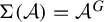 $\Sigma (\mathcal {A}) = \mathcal {A}^G$
with the product topology and refer to it as the full shift on alphabet
$\Sigma (\mathcal {A}) = \mathcal {A}^G$
with the product topology and refer to it as the full shift on alphabet $\mathcal {A}$
. This makes
$\mathcal {A}$
. This makes $\Sigma (\mathcal {A})$
into a compact, metrizable space. For each
$\Sigma (\mathcal {A})$
into a compact, metrizable space. For each $g \in G$
, we define
$g \in G$
, we define $\sigma ^g : \Sigma (\mathcal {A}) \to \Sigma (\mathcal {A})$
by the following rule: for all
$\sigma ^g : \Sigma (\mathcal {A}) \to \Sigma (\mathcal {A})$
by the following rule: for all ${x \in \mathcal {A}^G}$
and
${x \in \mathcal {A}^G}$
and $h \in G$
, let
$h \in G$
, let
 $$ \begin{align*} \sigma^gx (h) = x(g^{-1} h). \end{align*} $$
For each $g \in G$
the map
$g \in G$
the map $\sigma ^g : \Sigma (\mathcal {A}) \to \Sigma (\mathcal {A})$
is a homeomorphism, and this collection of maps
$\sigma ^g : \Sigma (\mathcal {A}) \to \Sigma (\mathcal {A})$
is a homeomorphism, and this collection of maps $\{\sigma ^g : g \in G\}$
defines an action of G, called the shift action. Note that we use the left action, which differs from some other work in symbolic dynamics on groups, such as [Reference Bland1, Reference Bland, McGoff and Pavlov2, Reference Downarowicz and Huczek8]. All results cited in this work can be stated equivalently in terms of right actions or left actions. A set
$\{\sigma ^g : g \in G\}$
defines an action of G, called the shift action. Note that we use the left action, which differs from some other work in symbolic dynamics on groups, such as [Reference Bland1, Reference Bland, McGoff and Pavlov2, Reference Downarowicz and Huczek8]. All results cited in this work can be stated equivalently in terms of right actions or left actions. A set $Z \subset \Sigma (\mathcal {A})$
is a subshift if it is closed and shift-invariant (meaning that
$Z \subset \Sigma (\mathcal {A})$
is a subshift if it is closed and shift-invariant (meaning that $\sigma ^g(Z) = Z$
for all
$\sigma ^g(Z) = Z$
for all $g \in G$
).
$g \in G$
).
For $S \subset G$
, we refer to elements of
$S \subset G$
, we refer to elements of $\mathcal {A}^S$
as patterns, and if
$\mathcal {A}^S$
as patterns, and if $w \in \mathcal {A}^S$
, then we say that w has shape S. If
$w \in \mathcal {A}^S$
, then we say that w has shape S. If $S' \subset S \subset G$
and
$S' \subset S \subset G$
and $w \in \mathcal {A}^S$
, then we let
$w \in \mathcal {A}^S$
, then we let $w(S')$
denote the pattern
$w(S')$
denote the pattern ${u \in \mathcal {A}^{S'}}$
such that
${u \in \mathcal {A}^{S'}}$
such that $u(s) = w(s)$
for all
$u(s) = w(s)$
for all $s \in S'$
. Additionally, for patterns
$s \in S'$
. Additionally, for patterns $u \in \mathcal {A}^E$
and
$u \in \mathcal {A}^E$
and $v \in \mathcal {A}^F$
such that
$v \in \mathcal {A}^F$
such that $u(g) = v(g)$
for all
$u(g) = v(g)$
for all $g \in E \cap F$
, we let
$g \in E \cap F$
, we let $u \cup v$
be the pattern in
$u \cup v$
be the pattern in $\mathcal {A}^{E \cup F}$
such that
$\mathcal {A}^{E \cup F}$
such that ${(u \cup v)(g) = u(g)}$
for all
${(u \cup v)(g) = u(g)}$
for all $g \in E$
and
$g \in E$
and $(u \cup v) (g) = v(g)$
for all
$(u \cup v) (g) = v(g)$
for all $g \in F$
. If
$g \in F$
. If $E \cap F = \varnothing $
, then we may write
$E \cap F = \varnothing $
, then we may write $u \sqcup v$
.
$u \sqcup v$
.
Let Z be a subshift. For a given pattern $w \in {\mathcal A}^S$
we define the cylinder set
$w \in {\mathcal A}^S$
we define the cylinder set $[w] = \{z\in Z : z(S) = w\}$
. Next we define
$[w] = \{z\in Z : z(S) = w\}$
. Next we define
 $$ \begin{align*} \mathcal{L}_S(Z) = \{ z(S) : z \in Z\} \end{align*} $$
and
 $$ \begin{align*} \mathcal{L}(Z) = \bigcup_{S \subset G} \mathcal{L}_S(Z). \end{align*} $$
We refer to $\mathcal {L}(Z)$
as the language of Z. Note that we allow
$\mathcal {L}(Z)$
as the language of Z. Note that we allow $S = \varnothing $
, so that the empty word
$S = \varnothing $
, so that the empty word $\unicode{x3bb} $
is in
$\unicode{x3bb} $
is in $\mathcal {L}(Z)$
, and we allow S to be infinite, which differs from some definitions of the language of a subshift. We also define an action of G on
$\mathcal {L}(Z)$
, and we allow S to be infinite, which differs from some definitions of the language of a subshift. We also define an action of G on $\mathcal {L}(Z)$
as follows: for
$\mathcal {L}(Z)$
as follows: for $g \in G$
and
$g \in G$
and $w \in \mathcal {A}^S$
, we let
$w \in \mathcal {A}^S$
, we let $g \cdot w$
be the element of
$g \cdot w$
be the element of $\mathcal {A}^{gS}$
such that
$\mathcal {A}^{gS}$
such that $(g \cdot w)(gs) = w(s)$
for all
$(g \cdot w)(gs) = w(s)$
for all $s\in S$
.
$s\in S$
.
Let $\mathcal {A}$
and
$\mathcal {A}$
and $\mathcal {B}$
be alphabets, and let Z be a subshift on
$\mathcal {B}$
be alphabets, and let Z be a subshift on $\mathcal {A}$
. For any non-empty finite subset
$\mathcal {A}$
. For any non-empty finite subset $R \subset G$
, a block map with shape R is any function
$R \subset G$
, a block map with shape R is any function $\Phi : \mathcal {L}_R(Z) \to \mathcal {B}$
. To ease notation, if
$\Phi : \mathcal {L}_R(Z) \to \mathcal {B}$
. To ease notation, if $S \subset G$
and
$S \subset G$
and $u \in \mathcal {A}^{SR}$
, then we may let
$u \in \mathcal {A}^{SR}$
, then we may let $\Phi (u)$
denote the pattern with shape S such that
$\Phi (u)$
denote the pattern with shape S such that $\Phi (u)(s) = \Phi (s^{-1} \cdot u(sR))$
for all
$\Phi (u)(s) = \Phi (s^{-1} \cdot u(sR))$
for all $s \in S$
. A function
$s \in S$
. A function $\phi : Z \to \Sigma (\mathcal {B})$
is called a sliding block code if there exists a block map
$\phi : Z \to \Sigma (\mathcal {B})$
is called a sliding block code if there exists a block map $\Phi $
with some shape R such that for all
$\Phi $
with some shape R such that for all $z \in Z$
and all
$z \in Z$
and all $g \in G$
, we have
$g \in G$
, we have
 $$ \begin{align*} (\phi (z)) (g) = \Phi( (g^{-1}\cdot z)(R)). \end{align*} $$
If a block map $\Phi $
can be selected with shape
$\Phi $
can be selected with shape $R = \{e\}$
(in other words, if
$R = \{e\}$
(in other words, if $\Phi $
may be viewed as a function on the alphabets
$\Phi $
may be viewed as a function on the alphabets $\Phi : \mathcal {A} \to \mathcal {B}$
), then
$\Phi : \mathcal {A} \to \mathcal {B}$
), then $\phi $
is said to be a
$\phi $
is said to be a $1$
-block code.
$1$
-block code.
A map $\phi : Z \to \Sigma (\mathcal {B})$
is shift-commuting if
$\phi : Z \to \Sigma (\mathcal {B})$
is shift-commuting if $\sigma ^g \circ \phi = \phi \circ \sigma ^g$
for all
$\sigma ^g \circ \phi = \phi \circ \sigma ^g$
for all $g \in G$
. By the Curtis–Hedlund–Lyndon theorem [Reference Ceccherini-Silberstein and Coornaert6, Theorem 1.8.1], a map
$g \in G$
. By the Curtis–Hedlund–Lyndon theorem [Reference Ceccherini-Silberstein and Coornaert6, Theorem 1.8.1], a map $\phi : Z \to \Sigma (\mathcal {B})$
is a homomorphism (continuous and shift-commuting) if and only if
$\phi : Z \to \Sigma (\mathcal {B})$
is a homomorphism (continuous and shift-commuting) if and only if $\phi $
is a sliding block code.
$\phi $
is a sliding block code.
Suppose X and Y are subshifts and $\phi : X \to Y$
is a homomorphism. We say that
$\phi : X \to Y$
is a homomorphism. We say that $\phi $
is a factor map whenever it is surjective, and we say that
$\phi $
is a factor map whenever it is surjective, and we say that $\phi $
is an embedding whenever it is injective.
$\phi $
is an embedding whenever it is injective.
For a finite shape $K \subset G$
and a collection
$K \subset G$
and a collection $\mathcal {F} \subset \mathcal {A}^K$
, we let
$\mathcal {F} \subset \mathcal {A}^K$
, we let
 $$ \begin{align*} X_{\mathcal{F}} = \{ x\in \mathcal{A}^G : \text{for all } g \in G, \, \sigma^g x (K) \notin \mathcal{F}\}. \end{align*} $$
A subshift $X \subset \mathcal {A}^G$
is a shift of finite type if there exist a finite shape
$X \subset \mathcal {A}^G$
is a shift of finite type if there exist a finite shape $K \subset G$
and a collection
$K \subset G$
and a collection $\mathcal {F} \subset \mathcal {A}^K$
such that
$\mathcal {F} \subset \mathcal {A}^K$
such that $X = X_{\mathcal {F}}$
.
$X = X_{\mathcal {F}}$
.
A subshift X is strongly irreducible if there exists a finite set $K \subset G$
such that for all shapes
$K \subset G$
such that for all shapes $E, F \subset G$
and all patterns
$E, F \subset G$
and all patterns $u \in \mathcal {L}_E(X)$
and
$u \in \mathcal {L}_E(X)$
and $v \in \mathcal {L}_F(X)$
, if
$v \in \mathcal {L}_F(X)$
, if $EK \cap F = \varnothing $
, then
$EK \cap F = \varnothing $
, then $u \cup v \in \mathcal {L}_{E \cup F}(X)$
.
$u \cup v \in \mathcal {L}_{E \cup F}(X)$
.
For any point $x \in \mathcal {A}^G$
and any
$x \in \mathcal {A}^G$
and any $g \in G \setminus \{e\}$
, we say that x has g as a period if
$g \in G \setminus \{e\}$
, we say that x has g as a period if $\sigma ^g x = x$
. On the other hand, if
$\sigma ^g x = x$
. On the other hand, if $\sigma ^g x = x$
implies that
$\sigma ^g x = x$
implies that $g = e$
, then we say that x is aperiodic. Furthermore, if a subshift X consists entirely of aperiodic points, then we refer to the subshift as aperiodic. We note that some authors refer to such subshifts as strongly aperiodic. Lastly, if there exists
$g = e$
, then we say that x is aperiodic. Furthermore, if a subshift X consists entirely of aperiodic points, then we refer to the subshift as aperiodic. We note that some authors refer to such subshifts as strongly aperiodic. Lastly, if there exists $g \in G \setminus \{e\}$
such that every point of x has g as a period, then we say that X has a global period.
$g \in G \setminus \{e\}$
such that every point of x has g as a period, then we say that X has a global period.
Next we define the FEP for subshifts over countable groups G. We note that this definition extends the definition of the FEP for $\mathbb {Z}^d$
-subshifts given in [Reference Briceño, McGoff and Pavlov5, Definition 2.11].
$\mathbb {Z}^d$
-subshifts given in [Reference Briceño, McGoff and Pavlov5, Definition 2.11].
Definition 2.3. Suppose G is a countable group. A G-subshift X with alphabet $\mathcal {A}$
has the finite extension property if there exists a finite set
$\mathcal {A}$
has the finite extension property if there exists a finite set $K \subset G$
containing the identity element e and a collection
$K \subset G$
containing the identity element e and a collection $\mathcal {F} \subset \mathcal {A}^K$
such that
$\mathcal {F} \subset \mathcal {A}^K$
such that $X = X_{\mathcal {F}}$
and for any
$X = X_{\mathcal {F}}$
and for any $F \subset G$
and any pattern
$F \subset G$
and any pattern $w \in \mathcal {A}^{F}$
, if there exists
$w \in \mathcal {A}^{F}$
, if there exists $w' \in \mathcal {A}^{FK}$
such that
$w' \in \mathcal {A}^{FK}$
such that $w'(F) = w(F)$
and
$w'(F) = w(F)$
and $g^{-1} \cdot w(gK) \notin \mathcal {F}$
for all
$g^{-1} \cdot w(gK) \notin \mathcal {F}$
for all $g \in F$
, then there exists
$g \in F$
, then there exists $x \in X$
such that
$x \in X$
such that $x(F) = w(F)$
.
$x(F) = w(F)$
.
The FEP is a very strong property. Indeed, if X has the FEP, then X must be a strongly irreducible G-SFT (Proposition 3.2). Additionally, we note that the FEP is invariant under conjugacy (Proposition 3.1).
Remark 2.4. Here we mention a useful restatement of the FEP. Suppose G is a countable group, the set $K \subset G$
is finite and contains the identity element e,
$K \subset G$
is finite and contains the identity element e, $\mathcal {F} \subset \mathcal {A}^{K}$
, and
$\mathcal {F} \subset \mathcal {A}^{K}$
, and $X = X_{\mathcal {F}}$
. Then the following assertions are equivalent:
$X = X_{\mathcal {F}}$
. Then the following assertions are equivalent:
-
(i) X has the finite extension property with shape K and forbidden set $\mathcal {F}$
;
$\mathcal {F}$
; -
(ii) for any
$S \subset G$
and any
$w \in \mathcal {A}^S$
, if
$w(S)$
contains no patterns from
$\mathcal {F}$
(meaning
$g^{-1} \cdot w(gK) \notin \mathcal {F}$
for all
$g \in \operatorname {\mathrm {int}}_K(S)$
), then
$w(\operatorname {\mathrm {int}}_K(S)) \in \mathcal {L}(X)$
.





2.3 Entropy and invariant measures
Let G be an amenable group, and fix a Følner sequence $\{F_n\}_{n=1}^{\infty }$
. Then for any non-empty G-subshift X, the topological entropy of X is given by
$\{F_n\}_{n=1}^{\infty }$
. Then for any non-empty G-subshift X, the topological entropy of X is given by
 $$ \begin{align*} h(X) = \lim_{n \to \infty} \frac{1}{|F_n|} \log |\mathcal{L}_{F_n}(X)|. \end{align*} $$
We note that this limit exists and is independent of the choice of Følner sequence (see the book [Reference Kerr and Li16]). A subshift X is entropy minimal if all of its proper subsystems have strictly less entropy, that is, for all subshifts $Y \subsetneq X$
, we have
$Y \subsetneq X$
, we have $h(Y) < h(X)$
.
$h(Y) < h(X)$
.
Let X be a G-subshift. We let $M(X,\sigma )$
denote the set of Borel probability measures
$M(X,\sigma )$
denote the set of Borel probability measures $\mu $
on X such that
$\mu $
on X such that $\mu (\sigma ^g(A)) = \mu (A)$
for all
$\mu (\sigma ^g(A)) = \mu (A)$
for all $g \in G$
and all Borel sets A. Recall that for any pattern
$g \in G$
and all Borel sets A. Recall that for any pattern $u \in \mathcal {L}_F(X)$
, we let
$u \in \mathcal {L}_F(X)$
, we let $[u]$
denote the cylinder set defined by the condition
$[u]$
denote the cylinder set defined by the condition $x(F) = u$
. For such a measure
$x(F) = u$
. For such a measure $\mu $
, the entropy of
$\mu $
, the entropy of $\mu $
is given by
$\mu $
is given by
 $$ \begin{align*} h(\mu) = \lim_{n \to \infty} \frac{1}{|F_n|} \sum_{u \in \mathcal{L}_{F_n}(X)} - \mu([u]) \log \mu([u]), \end{align*} $$
where again the limit exists and is independent of the choice of Følner sequence (see [Reference Kerr and Li16]). By the variational principle (see [Reference Kerr and Li16]), we have
 $$ \begin{align*} h(X) = \sup_{\mu \in M(X,\sigma)} h(\mu). \end{align*} $$
Moreover, since X is a subshift, it is known that there exists $\mu \in M(X,\sigma )$
such that
$\mu \in M(X,\sigma )$
such that ${h(\mu ) = h(X)}$
(see [Reference Kerr and Li16]). Such measures are called measures of maximal entropy.
${h(\mu ) = h(X)}$
(see [Reference Kerr and Li16]). Such measures are called measures of maximal entropy.
3 Properties of subshifts with the finite extension property
In this section we establish some basic properties of subshifts with the FEP. First, we show that the FEP is invariant under conjugacy.
Proposition 3.1. Suppose G is a countable group, X and Y are G-subshifts, and X and Y are topologically conjugate. Then X has the finite extension property if and only if Y has the finite extension property.
Proof. Suppose X has the FEP with shape K and forbidden set $\mathcal {F} \subset \mathcal {A}_X^K$
. Suppose
$\mathcal {F} \subset \mathcal {A}_X^K$
. Suppose $\phi : X \to Y$
is a topological conjugacy. Suppose
$\phi : X \to Y$
is a topological conjugacy. Suppose $\phi $
has a block map
$\phi $
has a block map $\Phi _0$
with block shape
$\Phi _0$
with block shape $R_0$
and
$R_0$
and $\phi ^{-1}$
has a block map
$\phi ^{-1}$
has a block map $\Phi _1$
with block shape
$\Phi _1$
with block shape $R_1$
. We suppose without loss of generality that
$R_1$
. We suppose without loss of generality that $R_0$
and
$R_0$
and $R_1$
each contain the identity.
$R_1$
each contain the identity.
Let $K' = R_0KR_1$
, and let
$K' = R_0KR_1$
, and let $\mathcal {F}' \subset \mathcal {A}_Y^{K'}$
be the set of all patterns u such that there exists
$\mathcal {F}' \subset \mathcal {A}_Y^{K'}$
be the set of all patterns u such that there exists $g \in R_0$
with the property that
$g \in R_0$
with the property that $\Phi _1(g^{-1} \cdot u(gK)) \in \mathcal {F}$
. We claim that Y has the FEP with shape
$\Phi _1(g^{-1} \cdot u(gK)) \in \mathcal {F}$
. We claim that Y has the FEP with shape $K'$
and forbidden set
$K'$
and forbidden set $\mathcal {F}'$
.
$\mathcal {F}'$
.
To establish this claim, let $E \subset G$
, and suppose that
$E \subset G$
, and suppose that $u \in \mathcal {A}_Y^{EK'}$
has the property that for all
$u \in \mathcal {A}_Y^{EK'}$
has the property that for all $g \in E$
, we have
$g \in E$
, we have $g^{-1} \cdot u(gK') \notin \mathcal {F}'$
. Let
$g^{-1} \cdot u(gK') \notin \mathcal {F}'$
. Let $v = \Phi _1(u) \in \mathcal {A}_X^{ER_0K}$
. By the definition of
$v = \Phi _1(u) \in \mathcal {A}_X^{ER_0K}$
. By the definition of $\mathcal {F}'$
and our assumption on u, for all
$\mathcal {F}'$
and our assumption on u, for all $g \in ER_0$
, we have
$g \in ER_0$
, we have $g^{-1} \cdot v(gK) = \Phi _1(g^{-1} \cdot u(g K') ) \notin \mathcal {F}$
. Since X has the FEP with shape K and forbidden set
$g^{-1} \cdot v(gK) = \Phi _1(g^{-1} \cdot u(g K') ) \notin \mathcal {F}$
. Since X has the FEP with shape K and forbidden set $\mathcal {F}$
, there exists a point
$\mathcal {F}$
, there exists a point $x \in X$
such that
$x \in X$
such that $x(ER_0) = v(ER_0)$
. Now let
$x(ER_0) = v(ER_0)$
. Now let $y = \phi (x) \in Y$
. Furthermore, observe that
$y = \phi (x) \in Y$
. Furthermore, observe that $y(E) = \Phi _0(v(ER_0)) = \Phi _0( \Phi _1(u(ER_0R_1))) = u(E)$
, where we have used that
$y(E) = \Phi _0(v(ER_0)) = \Phi _0( \Phi _1(u(ER_0R_1))) = u(E)$
, where we have used that $\Phi _0$
and
$\Phi _0$
and $\Phi _1$
are the block codes for the inverse maps
$\Phi _1$
are the block codes for the inverse maps $\phi $
and
$\phi $
and $\phi ^{-1}$
, respectively. Hence
$\phi ^{-1}$
, respectively. Hence $u(E) \in \mathcal {L}(Y)$
, and thus we have established that Y has the FEP, which concludes the proof.
$u(E) \in \mathcal {L}(Y)$
, and thus we have established that Y has the FEP, which concludes the proof.
Next we establish that any subshift with the FEP is a strongly irreducible SFT.
Proposition 3.2. If X is a G-subshift with the finite extension property, then X is a strongly irreducible G-SFT.
Proof. Suppose X has the FEP witnessed by a shape K (containing the identity) and a set of forbidden patterns $\mathcal {F} \subset \mathcal {A}^K$
. Passing to a larger shape (with a corresponding set of forbidden patterns) if necessary, we assume without loss of generality that K is symmetric. Note that X is a G-SFT since
$\mathcal {F} \subset \mathcal {A}^K$
. Passing to a larger shape (with a corresponding set of forbidden patterns) if necessary, we assume without loss of generality that K is symmetric. Note that X is a G-SFT since $X = X_{\mathcal {F}}$
.
$X = X_{\mathcal {F}}$
.
Next we claim that X is strongly irreducible with shape $K^4$
. Let
$K^4$
. Let $E,F \subset G$
be shapes such that
$E,F \subset G$
be shapes such that $EK^4 \cap F = \varnothing $
. Let
$EK^4 \cap F = \varnothing $
. Let $u \in \mathcal {L}_E(X)$
and
$u \in \mathcal {L}_E(X)$
and $v \in \mathcal {L}_F(X)$
. Since u and v are in the language of the subshift, there exist extensions
$v \in \mathcal {L}_F(X)$
. Since u and v are in the language of the subshift, there exist extensions $u' \in \mathcal {L}_{EK}(X)$
and
$u' \in \mathcal {L}_{EK}(X)$
and $v' \in \mathcal {L}_{FK}(X)$
. Note that
$v' \in \mathcal {L}_{FK}(X)$
. Note that $EK \cap FK = \varnothing $
, since
$EK \cap FK = \varnothing $
, since $EK^2 \cap F = \varnothing $
. Therefore
$EK^2 \cap F = \varnothing $
. Therefore $w = u' \cup v'$
is a well-defined pattern on
$w = u' \cup v'$
is a well-defined pattern on $EK \cup FK = (E \cup F) K$
. We claim that every pattern in w of shape
$EK \cup FK = (E \cup F) K$
. We claim that every pattern in w of shape $gK$
is in the language of X, and therefore w contains no (translates of) patterns from
$gK$
is in the language of X, and therefore w contains no (translates of) patterns from $\mathcal {F}$
. Let
$\mathcal {F}$
. Let $gK \subset EK \cup FK$
. If
$gK \subset EK \cup FK$
. If $gK \subset EK$
, then
$gK \subset EK$
, then $w(gK) = u'(gK) \in \mathcal {L}(X)$
, and similarly if
$w(gK) = u'(gK) \in \mathcal {L}(X)$
, and similarly if $gK \subset FK$
, then
$gK \subset FK$
, then $w(gK) = v'(gK) \in \mathcal {L}(X)$
. If
$w(gK) = v'(gK) \in \mathcal {L}(X)$
. If $gK \cap EK \neq \varnothing $
and
$gK \cap EK \neq \varnothing $
and $gK \cap FK \neq \varnothing $
, then
$gK \cap FK \neq \varnothing $
, then $g \in EK^2$
and there exists
$g \in EK^2$
and there exists $f \in F$
such that
$f \in F$
such that $f \in gK^2 \subset EK^4$
, which is impossible since
$f \in gK^2 \subset EK^4$
, which is impossible since $EK^4 \cap F = \varnothing $
. Thus, w contains no (translates of) forbidden patterns from
$EK^4 \cap F = \varnothing $
. Thus, w contains no (translates of) forbidden patterns from $\mathcal {F}$
. By the FEP,
$\mathcal {F}$
. By the FEP, $u \cup v = w(E \cup F) \in \mathcal {L}(X)$
, and hence there is a point
$u \cup v = w(E \cup F) \in \mathcal {L}(X)$
, and hence there is a point $x \in X$
such that
$x \in X$
such that $x(E) = u$
and
$x(E) = u$
and $x(F) = v$
, as desired.
$x(F) = v$
, as desired.
Next we turn our attention to entropy minimality. It is known that strongly irreducible SFTs are entropy minimal in great generality [Reference Ceccherini-Silberstein, Coornaert and Li7, Proposition 1.2]. However, in our setting we only need the following case.
Proposition 3.3. If G is a countable amenable group and X is a strongly irreducible G-SFT, then X is entropy minimal. In particular, if X has the finite extension property, then X is entropy minimal.
4 Preliminary quasi-tiling results
Quasi-tilings have played a significant role in recent work on symbolic dynamics (see, for example, [Reference Bland1, Reference Bland, McGoff and Pavlov2, Reference Downarowicz and Huczek8–Reference Frisch and Tamuz11, Reference Huczek and Kopacz14, Reference McGoff and Pavlov22]). Here we present the following general definition of quasi-tilings, which is suitable for our purposes.
Definition 4.1. Let $\mathcal {S} = \{S_1,\ldots ,S_r\}$
be a finite collection of non-empty, finite subsets of G, referred to as shapes. A quasi-tiling of G is an assignment of each shape
$\mathcal {S} = \{S_1,\ldots ,S_r\}$
be a finite collection of non-empty, finite subsets of G, referred to as shapes. A quasi-tiling of G is an assignment of each shape $S \in \mathcal {S}$
to a subset
$S \in \mathcal {S}$
to a subset $C_S \subset G$
, referred to as the center set for S, such that the collection of sets
$C_S \subset G$
, referred to as the center set for S, such that the collection of sets $\{C_S : S \in \mathcal {S}\}$
is pairwise disjoint and the map
$\{C_S : S \in \mathcal {S}\}$
is pairwise disjoint and the map $(S,c) \to cS$
is injective over
$(S,c) \to cS$
is injective over $\{(S,c) : S \in \mathcal {S} \text { and } c \in C_S\}$
. For
$\{(S,c) : S \in \mathcal {S} \text { and } c \in C_S\}$
. For $S \in \mathcal {S}$
and
$S \in \mathcal {S}$
and $c \in C_S$
, the set
$c \in C_S$
, the set $cS$
is called the tile with center c and shape S.
$cS$
is called the tile with center c and shape S.
In this work we only require quasi-tilings with a single shape, and therefore we introduce some more specific notation. Recall that there is a standard bijection between subsets of G and elements of the full shift $\Sigma (\{0,1\})$
, given by mapping a subset
$\Sigma (\{0,1\})$
, given by mapping a subset $\mathcal {C} \subset G$
to its characteristic function
$\mathcal {C} \subset G$
to its characteristic function $\chi _{\mathcal {C}}$
(viewed as an element of
$\chi _{\mathcal {C}}$
(viewed as an element of $\Sigma (\{0,1\})$
). Also, we note that
$\Sigma (\{0,1\})$
). Also, we note that $\max (\chi _{A}, \chi _B) = \chi _{A \cup B}$
and
$\max (\chi _{A}, \chi _B) = \chi _{A \cup B}$
and $\min (\chi _A, \chi _B) = \chi _{A \cap B}$
, and therefore the operations of taking unions or intersections of sets can be viewed as
$\min (\chi _A, \chi _B) = \chi _{A \cap B}$
, and therefore the operations of taking unions or intersections of sets can be viewed as $1$
-block codes from
$1$
-block codes from $\Sigma \times \Sigma $
to
$\Sigma \times \Sigma $
to $\Sigma $
.
$\Sigma $
.
Definition 4.2. Let F be a finite subset of G. For any $z = \chi _{\mathcal {C}} \in \Sigma (\{0,1\})$
, we say that z is F-disjoint if the collection
$z = \chi _{\mathcal {C}} \in \Sigma (\{0,1\})$
, we say that z is F-disjoint if the collection $\{c F\}_{c \in \mathcal {C}}$
is pairwise disjoint, and z is F-covering if the collection
$\{c F\}_{c \in \mathcal {C}}$
is pairwise disjoint, and z is F-covering if the collection $\{c F \}_{c \in \mathcal {C}}$
covers G. Furthermore, for any subshift
$\{c F \}_{c \in \mathcal {C}}$
covers G. Furthermore, for any subshift $Z \subset \Sigma (\{0,1\})$
, we say that Z is F-disjoint if each element of Z is F-disjoint, and similarly Z is F-covering if each element of Z is F-covering.
$Z \subset \Sigma (\{0,1\})$
, we say that Z is F-disjoint if each element of Z is F-disjoint, and similarly Z is F-covering if each element of Z is F-covering.
The use of quasi-tilings for the purposes of studying the dynamics of amenable group actions dates back to the fundamental construction of Ornstein and Weiss [Reference Ornstein and Weiss24, I.§2 Theorem 6]. A dynamical version of this construction was recently obtained by Downarowicz and Huczek [Reference Downarowicz and Huczek8, Lemma 3.4], which derives a system of quasi-tilings as a factor of a given aperiodic subshift. In the following proposition we construct quasi-tilings suitable for our purposes, adapting the first part of the proof of [Reference Downarowicz and Huczek8, Lemma 3.4] (here we require strict disjointness of the tiles, whereas in [Reference Downarowicz and Huczek8] some small overlap is allowed). We provide a detailed proof for clarity and convenience.
Proposition 4.3. Let G be a countable group. Suppose X is a non-empty aperiodic G-subshift and $F \subset G$
is a non-empty finite subset. Then there exists a homomorphism
$F \subset G$
is a non-empty finite subset. Then there exists a homomorphism $\phi : X \to \Sigma (\{0,1\})$
such that
$\phi : X \to \Sigma (\{0,1\})$
such that $\phi (X)$
is F-disjoint and
$\phi (X)$
is F-disjoint and $FF^{-1}$
-covering.
$FF^{-1}$
-covering.
Proof. Let $x_0\in X$
be arbitrary. Since
$x_0\in X$
be arbitrary. Since $x_0$
is aperiodic, there must exist a finite subset
$x_0$
is aperiodic, there must exist a finite subset $S_0$
such that
$S_0$
such that $x_0(S_0) \neq \sigma ^fx_0(S_0)$
for all
$x_0(S_0) \neq \sigma ^fx_0(S_0)$
for all $f\in FF^{-1}\setminus \{e\}$
. Then choose
$f\in FF^{-1}\setminus \{e\}$
. Then choose $S_1 = FF^{-1}S_0$
and let
$S_1 = FF^{-1}S_0$
and let $u_{x_0} = x_0(S_1)$
. For any
$u_{x_0} = x_0(S_1)$
. For any $x_1 \in [u_{x_0}]$
it must therefore hold that
$x_1 \in [u_{x_0}]$
it must therefore hold that $x_1(S_0) \neq \sigma ^fx_1(S_0)$
for all
$x_1(S_0) \neq \sigma ^fx_1(S_0)$
for all $f\in FF^{-1}\setminus \{e\}$
, and hence
$f\in FF^{-1}\setminus \{e\}$
, and hence $[u_{x_0}] \cap \sigma ^{f^{-1}}[u_{x_0}] = \varnothing $
for all
$[u_{x_0}] \cap \sigma ^{f^{-1}}[u_{x_0}] = \varnothing $
for all $f\in FF^{-1}\setminus \{e\}$
. Repeat this construction for all possible
$f\in FF^{-1}\setminus \{e\}$
. Repeat this construction for all possible $x = x_0$
; the collection
$x = x_0$
; the collection $\{[u_x] : x\in X\}$
is an open cover of X, and therefore by compactness we may find a finite subcover
$\{[u_x] : x\in X\}$
is an open cover of X, and therefore by compactness we may find a finite subcover $\mathcal {U} = \{[u_1],\ldots ,[u_n]\}$
for some
$\mathcal {U} = \{[u_1],\ldots ,[u_n]\}$
for some $n \geq 1$
.
$n \geq 1$
.
Now let $x\in X$
be fixed. We shall construct a corresponding point
$x\in X$
be fixed. We shall construct a corresponding point $z \in \Sigma (\{0,1\})$
. Let
$z \in \Sigma (\{0,1\})$
. Let $\mathcal {C}_0 = \varnothing $
and for each
$\mathcal {C}_0 = \varnothing $
and for each $i\in [1,n]$
inductively define
$i\in [1,n]$
inductively define
 $$ \begin{align*} \mathcal{C}_{i} = \{g\in G : \sigma^{g^{-1}}x\in[u_i] \text{ and } gFF^{-1} \cap \mathcal{C}_{i-1} = \varnothing\} \cup \mathcal{C}_{i-1}. \end{align*} $$
Let $z = \chi _{\mathcal {C}_n} \in \Sigma (\{0,1\})$
. We claim that the map
$z = \chi _{\mathcal {C}_n} \in \Sigma (\{0,1\})$
. We claim that the map $\phi : X \to \Sigma (\{0,1\})$
given by
$\phi : X \to \Sigma (\{0,1\})$
given by $\phi (x) = z$
satisfies the conditions in the conclusion of the theorem. It remains to prove that z is F-disjoint, z is
$\phi (x) = z$
satisfies the conditions in the conclusion of the theorem. It remains to prove that z is F-disjoint, z is $FF^{-1}$
-covering, and
$FF^{-1}$
-covering, and $\phi $
is a sliding block code.
$\phi $
is a sliding block code.
To prove that z is F-disjoint, let $g_1 \neq g_2 \in \mathcal {C}_n$
be arbitrary. We claim that
$g_1 \neq g_2 \in \mathcal {C}_n$
be arbitrary. We claim that ${g_1 F \cap g_2 F = \varnothing }$
. Suppose to the contrary that there exist some
${g_1 F \cap g_2 F = \varnothing }$
. Suppose to the contrary that there exist some $f_1, f_2 \in F$
such that
$f_1, f_2 \in F$
such that $g_1f_1 = g_2f_2$
(note that
$g_1f_1 = g_2f_2$
(note that $f_1 \neq f_2$
). Given that
$f_1 \neq f_2$
). Given that $g_1, g_2 \in \mathcal {C}_n$
, there must exist a minimal
$g_1, g_2 \in \mathcal {C}_n$
, there must exist a minimal $n_1, n_2 \geq 1$
such that
$n_1, n_2 \geq 1$
such that $g_1 \in \mathcal {C}_{n_1}$
and
$g_1 \in \mathcal {C}_{n_1}$
and $g_2 \in \mathcal {C}_{n_2}$
. Without loss of generality, assume that
$g_2 \in \mathcal {C}_{n_2}$
. Without loss of generality, assume that $n_1 \leq n_2$
. If
$n_1 \leq n_2$
. If $n_1 < n_2$
(in which case
$n_1 < n_2$
(in which case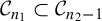 $\mathcal {C}_{n_1} \subset \mathcal {C}_{n_2-1}$
by construction), then by construction it must hold that
$\mathcal {C}_{n_1} \subset \mathcal {C}_{n_2-1}$
by construction), then by construction it must hold that $g_2FF^{-1}\cap \mathcal {C}_{n_2-1} = \varnothing $
, but this contradicts the fact that
$g_2FF^{-1}\cap \mathcal {C}_{n_2-1} = \varnothing $
, but this contradicts the fact that $g_2f_1f_2^{-1} = g_1 \in \mathcal {C}_{n_1}$
. Otherwise, if
$g_2f_1f_2^{-1} = g_1 \in \mathcal {C}_{n_1}$
. Otherwise, if $n_1 = n_2$
, then
$n_1 = n_2$
, then $\sigma ^{g_1^{-1}}x, \sigma ^{g_2^{-1}}x \in [u_{n_1}]$
. Moreover, from
$\sigma ^{g_1^{-1}}x, \sigma ^{g_2^{-1}}x \in [u_{n_1}]$
. Moreover, from $g_1f_1 = g_2f_2$
we see that
$g_1f_1 = g_2f_2$
we see that $g_2^{-1} = f_2f_1^{-1}g_1^{-1}$
. Set
$g_2^{-1} = f_2f_1^{-1}g_1^{-1}$
. Set $x_0 = \sigma ^{g_1^{-1}}x \in [u_{n_1}]$
, and notice that
$x_0 = \sigma ^{g_1^{-1}}x \in [u_{n_1}]$
, and notice that $\sigma ^{f_2f_1^{-1}}x_0 =\sigma ^{g_2^{-1}}x \in [u_{n_1}]$
; however, this contradicts the fact that
$\sigma ^{f_2f_1^{-1}}x_0 =\sigma ^{g_2^{-1}}x \in [u_{n_1}]$
; however, this contradicts the fact that $[u_{n_1}] \cap \sigma ^{f^{-1}}[u_{n_1}] = \varnothing $
for all
$[u_{n_1}] \cap \sigma ^{f^{-1}}[u_{n_1}] = \varnothing $
for all $f\in FF^{-1}\setminus \{e\}$
by construction of
$f\in FF^{-1}\setminus \{e\}$
by construction of $\mathcal {U}$
. We derive a contradiction in either case, and therefore
$\mathcal {U}$
. We derive a contradiction in either case, and therefore $g_1F\cap g_2F = \varnothing $
must hold. We conclude that z is F-disjoint.
$g_1F\cap g_2F = \varnothing $
must hold. We conclude that z is F-disjoint.
To prove that z is $FF^{-1}$
-covering, let
$FF^{-1}$
-covering, let $g\in G$
be arbitrary. Because
$g\in G$
be arbitrary. Because $\mathcal {U}$
covers X, there must exist an
$\mathcal {U}$
covers X, there must exist an $i \in [1,n]$
such that
$i \in [1,n]$
such that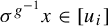 $\sigma ^{g^{-1}}x \in [u_i]$
; choose and fix a minimal such i. If
$\sigma ^{g^{-1}}x \in [u_i]$
; choose and fix a minimal such i. If ${g\in \mathcal {C}_n}$
, then note that
${g\in \mathcal {C}_n}$
, then note that $g\in gFF^{-1}$
(since
$g\in gFF^{-1}$
(since $e\in FF^{-1}$
), and hence
$e\in FF^{-1}$
), and hence $g \in \bigcup _{c \in C_n} c FF^{-1}$
, as desired. Otherwise, we must have that
$g \in \bigcup _{c \in C_n} c FF^{-1}$
, as desired. Otherwise, we must have that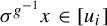 $\sigma ^{g^{-1}}x \in [u_i]$
and
$\sigma ^{g^{-1}}x \in [u_i]$
and $gFF^{-1}\cap \mathcal {C}_{i-1} \neq \varnothing $
. In this case, there exists a
$gFF^{-1}\cap \mathcal {C}_{i-1} \neq \varnothing $
. In this case, there exists a $c\in \mathcal {C}_{i-1}$
such that
$c\in \mathcal {C}_{i-1}$
such that $c\in gFF^{-1}$
, which gives
$c\in gFF^{-1}$
, which gives $g\in cFF^{-1}$
, as desired. In either case, we see that there must exist a
$g\in cFF^{-1}$
, as desired. In either case, we see that there must exist a $c\in \mathcal {C}_n$
such that
$c\in \mathcal {C}_n$
such that $g\in cFF^{-1}$
, and we conclude that z is
$g\in cFF^{-1}$
, and we conclude that z is $FF^{-1}$
-covering.
$FF^{-1}$
-covering.
Finally, let us show that $\phi : X \to \Sigma (\{0,1\})$
is a sliding block code. Suppose the patterns
$\phi : X \to \Sigma (\{0,1\})$
is a sliding block code. Suppose the patterns $\{u_1,\ldots , u_n\}$
that make up
$\{u_1,\ldots , u_n\}$
that make up $\mathcal {U}$
have corresponding shapes
$\mathcal {U}$
have corresponding shapes $S_1, \ldots , S_n \subset G$
. Let
$S_1, \ldots , S_n \subset G$
. Let $R_0 = \varnothing $
, and for each
$R_0 = \varnothing $
, and for each $i \in [1,n]$
, inductively define
$i \in [1,n]$
, inductively define $R_i = S_i \cup FF^{-1}R_{i-1}$
. We shall argue inductively that for each
$R_i = S_i \cup FF^{-1}R_{i-1}$
. We shall argue inductively that for each $i \geq 1$
, there is a block map
$i \geq 1$
, there is a block map $\Phi _i : \mathcal {L}_{R_i}(X)\to \{0,1\}$
that witnesses the sliding block code property for the map
$\Phi _i : \mathcal {L}_{R_i}(X)\to \{0,1\}$
that witnesses the sliding block code property for the map $x \mapsto \chi _{\mathcal {C}_i}$
. We note that the existence of such a block map is equivalent to the existence of a procedure which correctly decides, for each fixed x and g, whether
$x \mapsto \chi _{\mathcal {C}_i}$
. We note that the existence of such a block map is equivalent to the existence of a procedure which correctly decides, for each fixed x and g, whether $g\in \mathcal {C}_i$
based solely on the pattern
$g\in \mathcal {C}_i$
based solely on the pattern $\sigma ^{g^{-1}}x(R_i)$
. Below we describe such a procedure.
$\sigma ^{g^{-1}}x(R_i)$
. Below we describe such a procedure.
For $i = 1$
, note that
$i = 1$
, note that $g \in \mathcal {C}_1$
if and only if
$g \in \mathcal {C}_1$
if and only if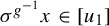 $\sigma ^{g^{-1}}x\in [u_1]$
, which can be determined from the pattern
$\sigma ^{g^{-1}}x\in [u_1]$
, which can be determined from the pattern $\sigma ^{g^{-1}}x(R_1) = \sigma ^{g^{-1}}x(S_1)$
. Now suppose for induction that
$\sigma ^{g^{-1}}x(R_1) = \sigma ^{g^{-1}}x(S_1)$
. Now suppose for induction that $i> 1$
is fixed and there is a procedure to decide whether
$i> 1$
is fixed and there is a procedure to decide whether $g\in \mathcal {C}_{i-1}$
from
$g\in \mathcal {C}_{i-1}$
from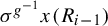 $\sigma ^{g^{-1}}x(R_{i-1})$
for each x and g. Note that
$\sigma ^{g^{-1}}x(R_{i-1})$
for each x and g. Note that $g\in \mathcal {C}_i$
if and only if
$g\in \mathcal {C}_i$
if and only if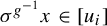 $\sigma ^{g^{-1}}x\in [u_i]$
and
$\sigma ^{g^{-1}}x\in [u_i]$
and $gFF^{-1}\mathcal {C}_{i-1} = \varnothing $
. The first condition can be decided from
$gFF^{-1}\mathcal {C}_{i-1} = \varnothing $
. The first condition can be decided from $\sigma ^{g^{-1}}x(S_i)$
. To decide the second, it is sufficient to check whether
$\sigma ^{g^{-1}}x(S_i)$
. To decide the second, it is sufficient to check whether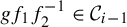 $gf_1f_2^{-1}\in \mathcal {C}_{i-1}$
for each
$gf_1f_2^{-1}\in \mathcal {C}_{i-1}$
for each $f_1,f_2\in F$
. By induction, this condition can be determined from
$f_1,f_2\in F$
. By induction, this condition can be determined from $\sigma ^{(gf_1f_2^{-1})^{-1}}x(R_{i-1})$
, and therefore knowledge of
$\sigma ^{(gf_1f_2^{-1})^{-1}}x(R_{i-1})$
, and therefore knowledge of $\sigma ^{g^{-1}}(FF^{-1}R_{i-1})$
suffices. Hence it is possible to determine whether
$\sigma ^{g^{-1}}(FF^{-1}R_{i-1})$
suffices. Hence it is possible to determine whether $g\in \mathcal {C}_i$
based on knowledge of
$g\in \mathcal {C}_i$
based on knowledge of $\sigma ^{g^{-1}}x(R_i) = \sigma ^{g^{-1}}x(S_i \cup FF^{-1}R_{i-1})$
, completing the induction and the proof.
$\sigma ^{g^{-1}}x(R_i) = \sigma ^{g^{-1}}x(S_i \cup FF^{-1}R_{i-1})$
, completing the induction and the proof.
The following key lemma uses the doubling property to control the number of balls with large disjoint interiors that can intersect at a single group element. We apply this lemma in our proof of Theorem 1.4 to bound the number of stages necessary for our inductive argument.
Lemma 4.4. Suppose G is a countable group and K is a finite symmetric set that contains the identity and satisfies the doubling property (for the subgroup $\langle K \rangle $
) with constant
$\langle K \rangle $
) with constant ${C_0 = C_0(K)}$
. Let
${C_0 = C_0(K)}$
. Let $m_0 \geq C_0^2$
and
$m_0 \geq C_0^2$
and $n_0 \in {\mathbb N}$
. Suppose
$n_0 \in {\mathbb N}$
. Suppose $Z \subset \Sigma (\{0,1\})$
is a subshift that is
$Z \subset \Sigma (\{0,1\})$
is a subshift that is $K^{n_0}$
-disjoint. Then for all
$K^{n_0}$
-disjoint. Then for all $z = \chi _{\mathcal {C}} \in Z$
, for all
$z = \chi _{\mathcal {C}} \in Z$
, for all $n \in [0,n_0]$
, and for all
$n \in [0,n_0]$
, and for all $g \in G$
, we have
$g \in G$
, we have
 $$ \begin{align*} | \{ c \in \mathcal{C} : \operatorname{\mathrm{dist}}_K(g,c K^{2n_0}) \leq n \} | \leq m_0. \end{align*} $$
Proof. Let $S = \{ c \in \mathcal {C} : \operatorname {\mathrm {dist}}_K(g, cK^{2n_0}) \leq n\}$
, and suppose
$S = \{ c \in \mathcal {C} : \operatorname {\mathrm {dist}}_K(g, cK^{2n_0}) \leq n\}$
, and suppose $|S| = m$
. Then for each
$|S| = m$
. Then for each ${c \in S}$
, we have
${c \in S}$
, we have $\rho _K(g,c) \leq 2n_0 + n \leq 3n_0$
(where we have used the hypothesis that
$\rho _K(g,c) \leq 2n_0 + n \leq 3n_0$
(where we have used the hypothesis that $n \leq n_0$
). Since z is
$n \leq n_0$
). Since z is $K^{n_0}$
-disjoint, the collection
$K^{n_0}$
-disjoint, the collection $\{c K^{n_0}\}_{c \in S}$
is a disjoint collection of balls of radius
$\{c K^{n_0}\}_{c \in S}$
is a disjoint collection of balls of radius $n_0$
with respect to
$n_0$
with respect to $\rho _K$
, and they are contained in the ball
$\rho _K$
, and they are contained in the ball $g K^{4n_0}$
. Hence we have
$g K^{4n_0}$
. Hence we have
 $$ \begin{align*} m |B_{n_0}(K)| \leq |B_{4n_0}(K)|. \end{align*} $$
Dividing by $|B_{n_0}(K)|$
and using the hypotheses on
$|B_{n_0}(K)|$
and using the hypotheses on $C_0$
and
$C_0$
and $m_0$
, we conclude that
$m_0$
, we conclude that
 $$ \begin{align*} m & \leq \frac{ |B_{4n_0}(K)|}{ |B_{n_0}(K)| } \\ & \leq \frac{ |B_{2n_0}(K)|}{ |B_{n_0}(K)| } \cdot \frac{ |B_{4n_0}(K)|}{ |B_{2n_0}(K)| } \\ & \leq C_0^2 \\ & \leq m_0.\\[-2.7pc] \end{align*} $$
5 Proof of Theorem 1.4
Here we begin the proof of Theorem 1.4. For convenience, we provide a restatement of the theorem.
Theorem 1.4. Let G be a countable locally virtually nilpotent group. Let X be a non-empty aperiodic G-subshift, and let Y be a non-empty G-subshift with the finite extension property. Then there exists a homomorphism $\phi : X \to Y$
.
$\phi : X \to Y$
.
Suppose G, X and Y satisfy the hypotheses of the theorem. Let $K \subset G$
be a finite symmetric set containing the identity and witnessing both the FEP and the strong irreducibility of Y. Let
$K \subset G$
be a finite symmetric set containing the identity and witnessing both the FEP and the strong irreducibility of Y. Let $\mathcal {F} \subset \mathcal {A}^K$
be a set of forbidden patterns witnessing the FEP of Y. Since the group generated by K is a finitely generated subgroup of G, it has polynomial growth (by Gromov’s theorem) and therefore satisfies the doubling property. Let
$\mathcal {F} \subset \mathcal {A}^K$
be a set of forbidden patterns witnessing the FEP of Y. Since the group generated by K is a finitely generated subgroup of G, it has polynomial growth (by Gromov’s theorem) and therefore satisfies the doubling property. Let ${C_0 = C_0(K)}$
be a constant witnessing the doubling property on
${C_0 = C_0(K)}$
be a constant witnessing the doubling property on $\langle K \rangle $
. Choose a natural number
$\langle K \rangle $
. Choose a natural number $m_0$
such that
$m_0$
such that $m_0 \geq C_0^2$
, and let
$m_0 \geq C_0^2$
, and let $n_0 = 3m_0$
.
$n_0 = 3m_0$
.
Let $F = K^{n_0}$
, and note that by the symmetry of K we have
$F = K^{n_0}$
, and note that by the symmetry of K we have $F^{-1} = K^{n_0}$
. By Proposition 4.3, there exists a homomorphism
$F^{-1} = K^{n_0}$
. By Proposition 4.3, there exists a homomorphism $\phi _0 : X \to \Sigma (\{0,1\})$
such that
$\phi _0 : X \to \Sigma (\{0,1\})$
such that $\phi _0(X)$
is
$\phi _0(X)$
is $K^{n_0}$
-disjoint and
$K^{n_0}$
-disjoint and $K^{2n_0}$
-covering. Let
$K^{2n_0}$
-covering. Let $Z = \phi _0(X)$
.
$Z = \phi _0(X)$
.
The remainder of the proof involves constructing a homomorphism $\phi _1 : Z \to Y$
, which we organize as follows. First, given
$\phi _1 : Z \to Y$
, which we organize as follows. First, given $z \in Z$
, we inductively construct pairs of sets
$z \in Z$
, we inductively construct pairs of sets $(U_1,V_1),\ldots ,(U_{m_0},V_{m_0})$
, where
$(U_1,V_1),\ldots ,(U_{m_0},V_{m_0})$
, where $U_m,V_m \subset G$
for each
$U_m,V_m \subset G$
for each $m = 1,\ldots ,m_0$
and
$m = 1,\ldots ,m_0$
and ${U_{m_0} = {V_{m_0} = G}}$
. Then we use the FEP to construct patterns on each
${U_{m_0} = {V_{m_0} = G}}$
. Then we use the FEP to construct patterns on each $U_m$
and
$U_m$
and $V_m$
, and we define
$V_m$
, and we define $\phi _1(z)$
to be the pattern constructed on
$\phi _1(z)$
to be the pattern constructed on $V_{m_0}$
.
$V_{m_0}$
.
5.1 The sets
$U_m$
and
$V_m$


The construction of the sets $U_m$
and
$U_m$
and $V_m$
proceeds by induction on m, with
$V_m$
proceeds by induction on m, with $m_0$
stages in total, but first we define some helpful notation. For each
$m_0$
stages in total, but first we define some helpful notation. For each ${z = \chi _{\mathcal {C}} \in Z}$
,
${z = \chi _{\mathcal {C}} \in Z}$
, $g \in G$
, and
$g \in G$
, and $n \geq 0$
, let
$n \geq 0$
, let
 $$ \begin{align*} \deg^z_{n}(g) = | \{ c \in \mathcal{C} : \operatorname{\mathrm{dist}}_K(g,cK^{2n_0}) \leq n\}|. \end{align*} $$
We easily observe that $\deg ^z_n(g) \leq \deg ^z_{n+1}(g)$
, and since z is
$\deg ^z_n(g) \leq \deg ^z_{n+1}(g)$
, and since z is $K^{2n_0}$
-covering, we have
$K^{2n_0}$
-covering, we have $\deg ^z_{0}(g) \geq 1$
for all
$\deg ^z_{0}(g) \geq 1$
for all $g \in G$
. Next, for each
$g \in G$
. Next, for each $n \geq 0$
and
$n \geq 0$
and $m \geq 0$
, we define the set
$m \geq 0$
, we define the set
 $$ \begin{align*} E^z_{m,n} = \{ g \in G : \deg^z_{n}(g) \leq m\}. \end{align*} $$
Observe that by Lemma 4.4, we have $E^z_{m_0,n_0} = G$
for all
$E^z_{m_0,n_0} = G$
for all $z \in Z$
.
$z \in Z$
.
Now let $z = \chi _{\mathcal {C}} \in Z$
be fixed, and let us inductively construct some sets
$z = \chi _{\mathcal {C}} \in Z$
be fixed, and let us inductively construct some sets $U_m = U_m(z)$
and
$U_m = U_m(z)$
and $V_m = V_m(z)$
for
$V_m = V_m(z)$
for $m = 1,\ldots , m_0$
. To ease notation, let
$m = 1,\ldots , m_0$
. To ease notation, let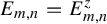 $E_{m,n} = E_{m,n}^z$
and
$E_{m,n} = E_{m,n}^z$
and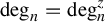 $\deg _n = \deg _n^z$
. For all
$\deg _n = \deg _n^z$
. For all $c \in \mathcal {C}$
, we let
$c \in \mathcal {C}$
, we let
 $$ \begin{align*} T_c = cK^{2n_0} \cap E_{1,2}. \end{align*} $$
For $m=1$
, we set
$m=1$
, we set
 $$ \begin{align*} U_1 & = \bigcup_{c \in \mathcal{C}} T_c \end{align*} $$
and
 $$ \begin{align*} V_1 & = \operatorname{\mathrm{int}}_K(U_1). \end{align*} $$
Now suppose by induction that $1 < m \leq m_0$
and
$1 < m \leq m_0$
and $U_{m-1}$
and
$U_{m-1}$
and $V_{m-1}$
have been defined. For notation, let
$V_{m-1}$
have been defined. For notation, let $\mathcal {C}_m = \mathcal {C}_m(z)$
denote the set of subsets of
$\mathcal {C}_m = \mathcal {C}_m(z)$
denote the set of subsets of $\mathcal {C}$
of cardinality exactly m. For each
$\mathcal {C}$
of cardinality exactly m. For each $S \in \mathcal {C}_m$
, we let
$S \in \mathcal {C}_m$
, we let
 $$ \begin{align*} \tilde{T}_{S} = \bigcap_{c \in S} c K^{2n_0 + 3m-3} \end{align*} $$
and
 $$ \begin{align*} T_{S} = \tilde{T}_S \cap E_{m,3m-1}. \end{align*} $$
Then we define
 $$ \begin{align*} U_{m} & = \bigg( \bigcup_{S \in \mathcal{C}_m} T_{S} \bigg) \cup V_{m-1} \end{align*} $$
and
 $$ \begin{align*} V_{m} & = \operatorname{\mathrm{int}}_K(U_{m}). \end{align*} $$
This completes the inductive definition of the sets $U_m$
and
$U_m$
and $V_m$
for
$V_m$
for $m = 1,\ldots ,m_0$
. For an illustration of the construction, see Figure 1. The following three lemmas describe some properties of these sets.
$m = 1,\ldots ,m_0$
. For an illustration of the construction, see Figure 1. The following three lemmas describe some properties of these sets.
An illustration of the construction of $U_1$
,
$U_1$
, $V_1$
,
$V_1$
, $U_2$
,
$U_2$
, $V_2$
, and
$V_2$
, and $U_3$
in a hypothetical case where
$U_3$
in a hypothetical case where $G = \mathbb {Z}^2$
is tiled by circles.
$G = \mathbb {Z}^2$
is tiled by circles.

Lemma 5.1. For each $m \in [1,m_0]$
, the collection
$m \in [1,m_0]$
, the collection $\{T_{S} K\}_{S \in \mathcal {C}_m}$
is pairwise disjoint.
$\{T_{S} K\}_{S \in \mathcal {C}_m}$
is pairwise disjoint.
Proof. Suppose $1 \leq m \leq m_0$
and we have
$1 \leq m \leq m_0$
and we have $T_{S} K \cap T_{S'} K \neq \varnothing $
for some
$T_{S} K \cap T_{S'} K \neq \varnothing $
for some $S, S' \in \mathcal {C}_m$
. Then there exists
$S, S' \in \mathcal {C}_m$
. Then there exists $g \in T_{S}$
such that
$g \in T_{S}$
such that $g \in T_{S'}K^2$
. Since
$g \in T_{S'}K^2$
. Since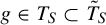 $g \in T_S \subset \tilde {T}_{S}$
, we see that
$g \in T_S \subset \tilde {T}_{S}$
, we see that $\operatorname {\mathrm {dist}}_K(g,cK^{2n_0}) \leq 3m-3$
for all
$\operatorname {\mathrm {dist}}_K(g,cK^{2n_0}) \leq 3m-3$
for all $c \in S$
, and thus
$c \in S$
, and thus $m \leq \deg _{3m-3}(g) \leq \deg _{3m-1}(g)$
. Furthermore, since
$m \leq \deg _{3m-3}(g) \leq \deg _{3m-1}(g)$
. Furthermore, since $g \in T_S \subset E_{m,3m-1}$
, we have that
$g \in T_S \subset E_{m,3m-1}$
, we have that $\deg _{3m-1}(g) \leq m$
, and therefore
$\deg _{3m-1}(g) \leq m$
, and therefore $\deg _{3m-1}(g) = m$
. By definition, this means that there are exactly m elements
$\deg _{3m-1}(g) = m$
. By definition, this means that there are exactly m elements $c \in \mathcal {C}$
such that
$c \in \mathcal {C}$
such that $\operatorname {\mathrm {dist}}(g,cK^{2n_0}) \leq 3m-1$
. Now since
$\operatorname {\mathrm {dist}}(g,cK^{2n_0}) \leq 3m-1$
. Now since $g \in T_{S'}K^2$
, for each
$g \in T_{S'}K^2$
, for each $c \in S'$
, we get
$c \in S'$
, we get $\operatorname {\mathrm {dist}}_K(g,cK^{2n_0}) \leq (3m-3)+2=3m-1$
. Since
$\operatorname {\mathrm {dist}}_K(g,cK^{2n_0}) \leq (3m-3)+2=3m-1$
. Since $|S| = |S'| = m$
and
$|S| = |S'| = m$
and $\operatorname {\mathrm {dist}}(g,cK^{2n_0}) \leq 3m-1$
for all
$\operatorname {\mathrm {dist}}(g,cK^{2n_0}) \leq 3m-1$
for all $c \in S \cup S'$
, we must have that
$c \in S \cup S'$
, we must have that $S = S'$
.
$S = S'$
.
Lemma 5.2. For each $m \in [1,m_0]$
, we have
$m \in [1,m_0]$
, we have
 $$ \begin{align} U_m \supset E_{m,3m-1} \end{align} $$
and
 $$ \begin{align} V_m \supset E_{m,3m}. \end{align} $$
Proof. We proceed by induction on m. For the base case ( $m=1$
), since
$m=1$
), since $\{cK^{2n_0}\}_{c \in \mathcal {C}}$
covers G, we get
$\{cK^{2n_0}\}_{c \in \mathcal {C}}$
covers G, we get
 $$ \begin{align*} U_1 = \bigcup_{c \in \mathcal{C}} T_c = \bigcup_{c \in \mathcal{C}} cK^{2n_0} \cap E_{1,2} = \bigg( \bigcup_{c \in \mathcal{C}} cK^{2n_0} \bigg) \cap E_{1,2} = E_{1,2}. \end{align*} $$
Furthermore, for each $c \in \mathcal {C}$
, we have
$c \in \mathcal {C}$
, we have
 $$ \begin{align*} \operatorname{\mathrm{int}}_K(cK^{2n_0} \cap E_{1,2}) \supset cK^{2n_0} \cap E_{1,3}. \end{align*} $$
Then we obtain that
 $$ \begin{align*} V_1 &= \operatorname{\mathrm{int}}_K(U_1)\\&\supset \bigcup_{c \in \mathcal{C}} \operatorname{\mathrm{int}}_K(cK^{2n_0} \cap E_{1,2})\\&\supset \bigcup_{c \in \mathcal{C}} cK^{2n_0} \cap E_{1,3}\\&= \bigg( \bigcup_{c \in \mathcal{C}} cK^{2n_0} \bigg) \cap E_{1,3} \\[-3pt]&= E_{1,3}, \end{align*} $$
where we have again used that $\{cK^{2n_0}\}_{c \in \mathcal {C}}$
covers G.
$\{cK^{2n_0}\}_{c \in \mathcal {C}}$
covers G.
Now assume by induction that (1) and (2) hold for some $m < m_0$
. Then
$m < m_0$
. Then
 $$ \begin{align} U_{m+1} = \bigg( \bigcup_{S \in \mathcal{C}_{m+1}} T_{S} \bigg) \cup V_m \supset \bigg( \bigcup_{S \in \mathcal{C}_{m+1}} \tilde{T}_{S} \cap E_{m+1,3m+2}\bigg) \cup E_{m,3m}, \end{align} $$
where we have used the inductive hypothesis (2).
Let $g \in E_{m+1,3m+2}$
. If
$g \in E_{m+1,3m+2}$
. If $\deg _{3m}(g) \leq m$
, then
$\deg _{3m}(g) \leq m$
, then $g \in E_{m,3m} \subset U_{m+1}$
by (3). Suppose instead that
$g \in E_{m,3m} \subset U_{m+1}$
by (3). Suppose instead that $\deg _{3m}(g)> m$
. Then we have that
$\deg _{3m}(g)> m$
. Then we have that $\deg _{3m}(g) = m+1$
, since
$\deg _{3m}(g) = m+1$
, since $\deg _{3m}(g) \leq \deg _{3m+2}(g) \leq m+1$
. Then there exists
$\deg _{3m}(g) \leq \deg _{3m+2}(g) \leq m+1$
. Then there exists $S \in \mathcal {C}_{m+1}$
such that
$S \in \mathcal {C}_{m+1}$
such that
 $$ \begin{align*} g \in \bigg( \bigcap_{c \in S} cK^{2n_0+ 3m} \bigg) \cap E_{m+1,3m+2} = \tilde{T}_{S} \cap E_{m+1,3m+2} \subset U_{m+1}, \end{align*} $$
where we have again used (3). This verifies (1) for $m+1$
.
$m+1$
.
Finally, let $g \in E_{m+1,3m+3}$
. Then
$g \in E_{m+1,3m+3}$
. Then $gK \subset E_{m+1,3m+2} \subset U_{m+1}$
. Hence
$gK \subset E_{m+1,3m+2} \subset U_{m+1}$
. Hence $g \in \operatorname {\mathrm {int}}_K(U_{m+1})$
, which establishes (2) for
$g \in \operatorname {\mathrm {int}}_K(U_{m+1})$
, which establishes (2) for $m+1$
and completes the induction.
$m+1$
and completes the induction.
Lemma 5.3. $V_{m_0} = G$
.
$V_{m_0} = G$
.





5.2 The homomorphism
$\phi _1 : Z \to Y$

In this section we describe how to use the FEP and the sets constructed in the previous section to define the desired homomorphism. To begin, we construct a type of block map to be used in the construction that follows. Let D be the set of all tuples $(A,F,v)$
such that
$(A,F,v)$
such that $e \in A \subset K^{6n_0}$
,
$e \in A \subset K^{6n_0}$
, $F \subset K^{6n_0}$
, and
$F \subset K^{6n_0}$
, and $v \in \mathcal {L}_F(Y)$
. Note that we allow tuples of the form
$v \in \mathcal {L}_F(Y)$
. Note that we allow tuples of the form $(A,\varnothing , \unicode{x3bb} )$
, where
$(A,\varnothing , \unicode{x3bb} )$
, where $\unicode{x3bb} $
is the empty word. We now construct a map that extends globally allowed patterns on F to globally allowed patterns on
$\unicode{x3bb} $
is the empty word. We now construct a map that extends globally allowed patterns on F to globally allowed patterns on $A \cup F$
. More precisely, we claim that there is a map
$A \cup F$
. More precisely, we claim that there is a map $\Phi : D \to \mathcal {L}(Y)$
satisfying the following conditions:
$\Phi : D \to \mathcal {L}(Y)$
satisfying the following conditions:
-
(i) if
$(A,F,v) \in D$
, then
$\Phi (A,F,v)$
is in
$\mathcal {L}_A(Y)$
; -
(ii) the concatenation
$\Phi (A,F,v) \cup v$
is well defined and contained in
$\mathcal {L}_{A \cup F}(Y)$
; -
(iii) if
$(A,F,v)$
and
$(gA,gF,g \cdot v)$
are both in D, then
$\Phi (gA,gF,g\cdot v) = g \cdot \Phi (A,F,v)$
.








Let us construct such a map. First note that $K^{10n_0}$
is a finite set, and therefore D is a finite set. Next, define an equivalence relation on D as follows: for
$K^{10n_0}$
is a finite set, and therefore D is a finite set. Next, define an equivalence relation on D as follows: for $(A_1,F_1,v_1)$
and
$(A_1,F_1,v_1)$
and $(A_2,F_2,v_2) \in D$
, we set
$(A_2,F_2,v_2) \in D$
, we set $(A_1,F_1,v_1) \sim (A_2,F_2,v_2)$
whenever there exists
$(A_1,F_1,v_1) \sim (A_2,F_2,v_2)$
whenever there exists $g \in G$
such that
$g \in G$
such that $(A_1,F_1,v_1) = (gA_2,gF_2,g \cdot v_2)$
. Note that this is indeed an equivalence relation. Let
$(A_1,F_1,v_1) = (gA_2,gF_2,g \cdot v_2)$
. Note that this is indeed an equivalence relation. Let $\{C_1,\ldots ,C_{r_0}\}$
be the partition of D into equivalence classes. For each
$\{C_1,\ldots ,C_{r_0}\}$
be the partition of D into equivalence classes. For each $r \in \{1,\ldots ,r_0\}$
, choose
$r \in \{1,\ldots ,r_0\}$
, choose $(A_r,F_r,v_r)$
from
$(A_r,F_r,v_r)$
from $C_r$
arbitrarily. Since
$C_r$
arbitrarily. Since $v_r \in \mathcal {L}(Y)$
, there exists a point
$v_r \in \mathcal {L}(Y)$
, there exists a point $y_r \in Y$
such that
$y_r \in Y$
such that $y_r(F_r) = v_r$
. Define
$y_r(F_r) = v_r$
. Define $\Phi (A_r,F_r,v_r) = y_r(A_r)$
. Now let
$\Phi (A_r,F_r,v_r) = y_r(A_r)$
. Now let $(gA_r, gF_r, g \cdot v_r)$
be an arbitrary element of
$(gA_r, gF_r, g \cdot v_r)$
be an arbitrary element of $C_r$
. We define
$C_r$
. We define $\Phi (g A_r, gF_r, g \cdot v_r) = g \cdot \Phi (A_r,F_r,v_r)$
. This defines
$\Phi (g A_r, gF_r, g \cdot v_r) = g \cdot \Phi (A_r,F_r,v_r)$
. This defines $\Phi $
on all of D, and we note that properties (i)–(iii) hold by construction.
$\Phi $
on all of D, and we note that properties (i)–(iii) hold by construction.
Now we define a map $\phi _1 : Z \to Y$
. For each
$\phi _1 : Z \to Y$
. For each $z = \chi _{\mathcal {C}} \in Z$
, the map is defined inductively in
$z = \chi _{\mathcal {C}} \in Z$
, the map is defined inductively in $m_0$
stages. At stage m, we first define a configuration on
$m_0$
stages. At stage m, we first define a configuration on $U_m = U_m(z)$
that contains no forbidden patterns from Y (that is, it is locally allowed), and then we define a configuration on
$U_m = U_m(z)$
that contains no forbidden patterns from Y (that is, it is locally allowed), and then we define a configuration on $V_m = V_m(z)$
that appears in a point in Y (that is, it is globally allowed).
$V_m = V_m(z)$
that appears in a point in Y (that is, it is globally allowed).
To begin the induction, let $m = 1$
. Note that for each
$m = 1$
. Note that for each $c \in \mathcal {C}$
, we have
$c \in \mathcal {C}$
, we have $e \in c^{-1} T_c \subset K^{2 n_0}$
. Let
$e \in c^{-1} T_c \subset K^{2 n_0}$
. Let $A_c = c^{-1} T_c$
. Then
$A_c = c^{-1} T_c$
. Then $(A_c,\varnothing ,\unicode{x3bb} ) \in D$
, and we let
$(A_c,\varnothing ,\unicode{x3bb} ) \in D$
, and we let $p_c = c \cdot \Phi (A_c,\varnothing ,\unicode{x3bb} ) \in \mathcal {L}_{T_c}(Y)$
. By the disjointness of
$p_c = c \cdot \Phi (A_c,\varnothing ,\unicode{x3bb} ) \in \mathcal {L}_{T_c}(Y)$
. By the disjointness of $\{T_c K \}_{c \in \mathcal {C}}$
(Lemma 5.1), the concatenation
$\{T_c K \}_{c \in \mathcal {C}}$
(Lemma 5.1), the concatenation $u_1 = \sqcup p_c$
is well defined and contains no forbidden patterns. Note that
$u_1 = \sqcup p_c$
is well defined and contains no forbidden patterns. Note that $u_1$
has domain
$u_1$
has domain $U_1$
and
$U_1$
and $V_1 = \operatorname {\mathrm {int}}_K(U_1)$
. Then by the FEP there is a point
$V_1 = \operatorname {\mathrm {int}}_K(U_1)$
. Then by the FEP there is a point $y_1 \in Y$
such that
$y_1 \in Y$
such that $y_1(V_1) = u_1(V_1)$
(where we have used the equivalent characterization of the FEP in Remark 2.4). Let
$y_1(V_1) = u_1(V_1)$
(where we have used the equivalent characterization of the FEP in Remark 2.4). Let $v_1 = u_1(V_1)$
, and note that
$v_1 = u_1(V_1)$
, and note that $v_1 \in \mathcal {L}_{V_1}(Y)$
.
$v_1 \in \mathcal {L}_{V_1}(Y)$
.
Now suppose by induction that for some $1 < m \leq m_0$
we have constructed a configuration
$1 < m \leq m_0$
we have constructed a configuration $v_{m-1} \in \mathcal {L}_{V_{m-1}}(Y)$
. Consider an arbitrary non-empty
$v_{m-1} \in \mathcal {L}_{V_{m-1}}(Y)$
. Consider an arbitrary non-empty $T_{S}$
with
$T_{S}$
with $S \in \mathcal {C}_m$
. Choose
$S \in \mathcal {C}_m$
. Choose $g \in T_{S}$
arbitrarily. (We argue below that the definition of the pattern
$g \in T_{S}$
arbitrarily. (We argue below that the definition of the pattern $p_S$
does not depend on this choice.) Let
$p_S$
does not depend on this choice.) Let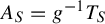 $A_{S} = g^{-1}T_{S}$
, and let
$A_{S} = g^{-1}T_{S}$
, and let
 $$ \begin{align*} F_{S} = \bigg( \bigcup_{c \in S} cK^{2n_0 + 3m-3} \bigg) \cap V_{m-1}. \end{align*} $$
Let $w_{S} = v_{m-1}(F_S)$
. We claim that
$w_{S} = v_{m-1}(F_S)$
. We claim that $(A_S,g^{-1}F_S, g^{-1} \cdot w_S) \in D$
. To prove the claim, first note that by definition of
$(A_S,g^{-1}F_S, g^{-1} \cdot w_S) \in D$
. To prove the claim, first note that by definition of $T_S$
, for all
$T_S$
, for all $g' \in T_S$
and
$g' \in T_S$
and $c \in S$
, we have
$c \in S$
, we have $\rho _K(g',c) \leq 2 n_0 + 3m-3 \leq 3n_0$
. Then by the triangle inequality for
$\rho _K(g',c) \leq 2 n_0 + 3m-3 \leq 3n_0$
. Then by the triangle inequality for $\rho _K$
, for all
$\rho _K$
, for all $g' \in T_S$
we have
$g' \in T_S$
we have $\rho _K(g,g') \leq 6n_0$
, and hence
$\rho _K(g,g') \leq 6n_0$
, and hence $\rho _K(e,g^{-1} g') \leq 6n_0$
. This inequality gives that
$\rho _K(e,g^{-1} g') \leq 6n_0$
. This inequality gives that $A_S \subset K^{6n_0}$
. Now let
$A_S \subset K^{6n_0}$
. Now let $g' \in F_S$
. Then there exists
$g' \in F_S$
. Then there exists $c \in S$
such that
$c \in S$
such that $\rho _K(c,g') \leq 2n_0 + 3m-3 \leq 3n_0$
. Again using the triangle inequality for
$\rho _K(c,g') \leq 2n_0 + 3m-3 \leq 3n_0$
. Again using the triangle inequality for $\rho _K$
, we get
$\rho _K$
, we get $\rho _K(g,g') \leq 6n_0$
, and therefore
$\rho _K(g,g') \leq 6n_0$
, and therefore $\rho _K(e,g^{-1}g') \leq 6n_0$
. This inequality gives that
$\rho _K(e,g^{-1}g') \leq 6n_0$
. This inequality gives that $F_S \subset K^{6n_0}$
. Since
$F_S \subset K^{6n_0}$
. Since $w_S$
is in
$w_S$
is in $\mathcal {L}_{F_S}(Y)$
, we have now verified our claim that
$\mathcal {L}_{F_S}(Y)$
, we have now verified our claim that $(A_S,g^{-1}F_S, g^{-1} \cdot w_S) \in D$
.
$(A_S,g^{-1}F_S, g^{-1} \cdot w_S) \in D$
.
Now let $p_S = g \cdot \Phi (A_S,g^{-1}F_S, g^{-1} \cdot w_S)$
, and note that the concatenation
$p_S = g \cdot \Phi (A_S,g^{-1}F_S, g^{-1} \cdot w_S)$
, and note that the concatenation ${p_S \cup w_S}$
is well defined and contained in
${p_S \cup w_S}$
is well defined and contained in $\mathcal {L}_{T_S \cup F_S}(Y)$
by properties (i) and (ii) of
$\mathcal {L}_{T_S \cup F_S}(Y)$
by properties (i) and (ii) of $\Phi $
. Furthermore, we claim that
$\Phi $
. Furthermore, we claim that $p_S$
is independent of the choice of
$p_S$
is independent of the choice of $g \in T_S$
. To prove the claim, first observe that for
$g \in T_S$
. To prove the claim, first observe that for $h \in T_S$
, the argument in the previous paragraph gives that
$h \in T_S$
, the argument in the previous paragraph gives that $(h^{-1}T_S, h^{-1}F_S, h^{-1} \cdot w_S) \in D$
. Then by property (iii) of
$(h^{-1}T_S, h^{-1}F_S, h^{-1} \cdot w_S) \in D$
. Then by property (iii) of $\Phi $
, we get
$\Phi $
, we get $\Phi ( h^{-1}T_S, h^{-1}F_S, h^{-1} \cdot w_S) = h^{-1}g \cdot \Phi ( g^{-1}T_S, g^{-1}F_S, g^{-1} \cdot w_S)$
, and therefore
$\Phi ( h^{-1}T_S, h^{-1}F_S, h^{-1} \cdot w_S) = h^{-1}g \cdot \Phi ( g^{-1}T_S, g^{-1}F_S, g^{-1} \cdot w_S)$
, and therefore $h \cdot \Phi ( h^{-1}T_S, h^{-1}F_S, h^{-1} \cdot w_S) = g \cdot \Phi ( g^{-1}T_S, g^{-1}F_S, g^{-1} \cdot w_S) = p_S$
.
$h \cdot \Phi ( h^{-1}T_S, h^{-1}F_S, h^{-1} \cdot w_S) = g \cdot \Phi ( g^{-1}T_S, g^{-1}F_S, g^{-1} \cdot w_S) = p_S$
.
Now observe that the concatenation
 $$ \begin{align*} u_m = \bigcup_{S \in \mathcal{C}_m} p_S \cup w_S = \bigg( \bigcup_{S \in \mathcal{C}_m} p_S \bigg) \cup v_{m-1} \end{align*} $$
is well defined and contains no forbidden patterns (using Lemma 5.1). Also, the shape of $u_m$
is
$u_m$
is $U_m$
and we have
$U_m$
and we have $V_m = \operatorname {\mathrm {int}}_K(U_m)$
. Then by the FEP, there exists
$V_m = \operatorname {\mathrm {int}}_K(U_m)$
. Then by the FEP, there exists $y_m \in Y$
such that
$y_m \in Y$
such that $y_m(V_m) = u_m(V_m)$
. Let
$y_m(V_m) = u_m(V_m)$
. Let $v_m = u_m(V_m)$
, and note that
$v_m = u_m(V_m)$
, and note that $v_m \in \mathcal {L}(Y)$
. This completes the induction.
$v_m \in \mathcal {L}(Y)$
. This completes the induction.
Finally, to define the map $\phi _1 : Z \to Y$
at the point z, we set
$\phi _1 : Z \to Y$
at the point z, we set $\phi _1(z) = v_{m_0}$
, which is defined on all of G by Lemma 5.3 and contained in Y by construction. It remains to show that
$\phi _1(z) = v_{m_0}$
, which is defined on all of G by Lemma 5.3 and contained in Y by construction. It remains to show that $\phi _1$
is continuous and shift-commuting.
$\phi _1$
is continuous and shift-commuting.
Lemma 5.4. The map $\phi _1 : Z \to Y$
constructed in this manner is a homomorphism.
$\phi _1 : Z \to Y$
constructed in this manner is a homomorphism.
Proof. First, observe that for all $n \in [0,n_0]$
, we have
$n \in [0,n_0]$
, we have $\operatorname {\mathrm {dist}}_K(g,cK^{2n_0}) \leq n$
if and only if
$\operatorname {\mathrm {dist}}_K(g,cK^{2n_0}) \leq n$
if and only if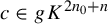 $c \in gK^{2n_0+n}$
, and therefore the map
$c \in gK^{2n_0+n}$
, and therefore the map $z \mapsto \deg ^z_n$
can be written as a sliding block code with shape
$z \mapsto \deg ^z_n$
can be written as a sliding block code with shape $K^{3n_0}$
. Hence, for all
$K^{3n_0}$
. Hence, for all $m \in [1,m_0]$
and
$m \in [1,m_0]$
and $n \in [0,n_0]$
, the map
$n \in [0,n_0]$
, the map $z \mapsto \chi _{E^z_{m,n}}$
can be written as a sliding block code with shape
$z \mapsto \chi _{E^z_{m,n}}$
can be written as a sliding block code with shape $K^{3n_0}$
. Next, since
$K^{3n_0}$
. Next, since $\sigma ^g z = \chi _{g \mathcal {C}}$
, we have that
$\sigma ^g z = \chi _{g \mathcal {C}}$
, we have that $\mathcal {C}_m(\sigma ^gz) = g \, \mathcal {C}_m(z)$
. Furthermore, for all
$\mathcal {C}_m(\sigma ^gz) = g \, \mathcal {C}_m(z)$
. Furthermore, for all $n \in [0,n_0]$
and all
$n \in [0,n_0]$
and all $g \in G$
, for any collection of
$g \in G$
, for any collection of $m \leq m_0$
group elements
$m \leq m_0$
group elements $g_1,\ldots ,g_m \in G$
, we have
$g_1,\ldots ,g_m \in G$
, we have
 $$ \begin{align*} g \in \bigcap_{j=1}^m g_j K^{2n_0 + n}\!\iff \text{ for all } j=1,\ldots,m,\quad g_j \in gK^{2n_0+n}. \end{align*} $$
Since the latter condition is determined by $gK^{3n_0}$
, we conclude by induction on m that the maps
$gK^{3n_0}$
, we conclude by induction on m that the maps $z \mapsto \chi _{U_m(z)}$
and
$z \mapsto \chi _{U_m(z)}$
and $z \mapsto \chi _{V_m(z)}$
can be written as sliding block codes. Finally, we note that at each stage of the induction, any symbol defined in
$z \mapsto \chi _{V_m(z)}$
can be written as sliding block codes. Finally, we note that at each stage of the induction, any symbol defined in $u_m$
and
$u_m$
and $v_m$
at
$v_m$
at $g \in G$
is determined in a shift-commuting manner by the sets
$g \in G$
is determined in a shift-commuting manner by the sets $\mathcal {C}_m$
,
$\mathcal {C}_m$
, $U_m$
, and
$U_m$
, and $V_m$
, along with the pattern
$V_m$
, along with the pattern $v_{m-1}$
, all restricted to the shape
$v_{m-1}$
, all restricted to the shape $g K^{6n_0}$
. Since there are only
$g K^{6n_0}$
. Since there are only $m_0$
stages of the induction (for all
$m_0$
stages of the induction (for all $z \in Z$
), we obtain that the map
$z \in Z$
), we obtain that the map $\phi _1$
is a sliding block code and hence a homomorphism.
$\phi _1$
is a sliding block code and hence a homomorphism.
6 Proof of Corollary 1.5
Finally, we present a short proof of Corollary 1.5 by combining Theorems 1.3 and 1.4. We only need to quickly check that the hypotheses of Theorem 1.3 are implied by the hypotheses and the conclusion of Theorem 1.4. For convenience, we provide a restatement of Corollary 1.5.
Corollary 1.5. Let G be a countable locally virtually nilpotent group. Suppose X is a non-empty aperiodic G-subshift and Y is a G-subshift with the finite extension property and no global period. If $h(X) < h(Y)$
, then X embeds into Y.
$h(X) < h(Y)$
, then X embeds into Y.
Proof. We claim first that the hypotheses imply that G is amenable. First, note that a group is amenable if and only if all of its finitely generated subgroups are amenable, since amenability is preserved under taking subgroups and directed unions; and that any finitely generated group of subexponential growth is amenable. Thus, G is amenable since every finitely generated subgroup of G is of subexponential growth (by Gromov’s theorem). Furthermore, since every finitely generated subgroup of G has subexponential growth, G also satisfies the comparison property [Reference Downarowicz and Zhang10, Theorem 6.33].
Next we note that since Y satisfies the FEP, it follows that Y is a strongly irreducible SFT (Proposition 3.2). Given that X is aperiodic, Theorem 1.4 gives a homomorphism $\phi : X \to Y$
. Given also that
$\phi : X \to Y$
. Given also that $h(X) < h(Y)$
and Y has no global period, we see that every hypothesis of Theorem 1.3 is satisfied. Thus, there exists an embedding of X into Y.
$h(X) < h(Y)$
and Y has no global period, we see that every hypothesis of Theorem 1.3 is satisfied. Thus, there exists an embedding of X into Y.
Acknowledgments
The authors thank Ronnie Pavlov for productive conversations, Mike Boyle for many helpful comments, and the anonymous referee for their suggestions. KM acknowledges the support of the National Science Foundation through the grants DMS-1847144 and DMS-2113676.


 Open access

