

Popular support for Islamism, defined as an ideology that locates political legitimacy in the application of shari‘a, has long been a subject of immense interest and intense debate for scholars and practitioners of politics in the Muslim world. A consequential component of this debate is the relationship between individuals’ adherence to Islam and support for democratic values and politics. Critics claim an inherent incompatibility between Islam and democracy (Gellner, Reference Gellner1983; Kamrava, Reference Kamrava1998; Kedourie, Reference Kedourie1994; Lewis, Reference Kedourie1994), while proponents advocate Islamic tenets as being fully compatible with democratic practices and preferences (Ciftci, Reference Ciftci2021; Tessler, Reference Tessler2015), largely based on different interpretations of Islamic political theology. However, empirical studies using public opinion data from the Muslim world to test the relationship between preferences for a shari‘a-based government and preferences for democracy are inconclusive (Berger, Reference Berger2019; Ciftci Reference Ciftci2013; The World’s Muslims 2013).
Yet, rather than being evidence of no correlation or a complex relationship between preferences for Islamism and preferences for democracy, we argue that these inconclusive results are more likely an issue of measurement. The conception of Islamism derives from religion, a discursive tradition that is highly variable and possibly contradictory across individual practitioners (Asad, Reference Asad1986). As such, Islam—like all religions—means different things to different people, and thus, so does its politicized version (Azmah, Reference Azmah1993). However, most studies operationalize support for Islamism by asking respondents’ support for the implementation of Islamic law generally or the implementation of specific Islamic tenets or prescriptions. With few exceptions, existing studies fail to capture respondents’ interpretation of Islamic law when measuring support for Islamism.
In order to understand whether and how support for Islamism matters for politics, scholars need to first know what respondents think of when they are asked about a shari‘a-based government. In a previous piece (Fair et al., Reference Fair, Littman and Nugent2018), we introduced a four-question battery designed to measure what Islamism and a shari‘a-based government mean to survey respondents. Using survey data from Pakistan, we found that commonly-held conceptions of shari‘a-based government vary in predictable ways across two distinct components of this concept: whether respondents consider a shari‘a-based government to be the one that provides services and is free of corruption or one that imposes restrictive Islamic social and legal norms.
In this research note, we demonstrate the consistency, generalizability, and utility of the battery. The Arab Barometer included our battery in its wave 5 instrument, conducted in 2018 and 2019, resulting in a sample of 11,849 respondents in 11 Muslim-majority countries (Algeria, Egypt, Iraq, Jordan, Lebanon, Libya, Morocco, Palestine, Sudan, Tunisia, and Yemen). We find that defining a shari‘a-based government to be one that provides is positively correlated with support for democracy, while defining it as a government that imposes is negatively correlated with it, and that general support for shari‘a is uncorrelated across the entire sample. We reintroduce this succinct battery as a necessary and useful tool for scholars collecting public opinion data related to Islamism in a variety of Muslim-majority contexts.
In the remainder of the note, we first review scholarly work on popular support for Islamism, highlighting conceptual components that form the basis of contemporary conceptions of shari‘a as well as major measurement issues when these concepts are operationalized on surveys. We then introduce the question battery and employ our data to demonstrate that it captures meaningful variation on conceptions of Islamism within sampled populations remarkably consistently across sampled countries. Next, we return to the normative implications that motivate scholarly and policy interest in Islamism. Analyses reveal that how respondents construe shari‘a-based governments determines whether their preferences for shari‘a are positively correlated with preferences for democracy; those who conceptualize a shari‘a-based government as providing are significantly more supportive of democracy, while those who conceptualize a shari‘a-based government as imposing are significantly less supportive. The inclusion of variables measuring support for a delineated definition of shari‘a offers more explanatory power than variables measuring support for a shari‘a-based government. These results confirm that capturing the meaning of shari‘a-based government in addition to measuring support is necessary to accurately assess how preferences regarding religion in politics correlate with other political preferences.
Measuring conceptions of Shari‘a
The study of the relationship between Islam and democracy is linked to contemporary geopolitics. As the third wave of democracy spread across much of the world, the countries of the Middle East and North Africa remained steadfastly authoritarian. While there were important democratic examples elsewhere in the Muslim world, such as in Bangladesh, Pakistan, Turkey, and Albania, many scholars and practitioners pointed to Islam as the reason why the Middle East remained undemocratic and an exception to broader global trends. More recently, the failure of democracy to take root in the Middle East and North Africa after the 2010–2011 Arab Spring uprisings, and the salience of the religious-secular divide in the ill-fated early elections, constitution drafting processes, and transitional justice attempts during nascent democratic transitions, have continued the debate about the compatibility of Islam and democracy.
Proponents of Islamic exceptionalism focus on the incompatibility of Islam’s central tenets with democracy—much like earlier literature on the supposed incompatibility between Catholicism and democracy. One common claim was that by its very nature, shari‘a, as religious law, was incompatible with the secular law necessary for democracy to take root. The logic of the argument centered on Islam’s central role in adherents’ lives in shaping not just politics but also prescribing rules for culture and society (Kamrava, Reference Kamrava1998). In effect, it represents a “blueprint of a social order” which is effectively inescapable (Gellner, Reference Gellner1983, 1). Moreover, although countries with a Christian heritage were not immune to this challenge, scholars argued that Islam had no concept equivalent to “Render unto Caesar the things that are Caesar’s, and unto God the things that are God’s” that creates a theological basis for the separation of church and state, a key characteristic of modern democracies (Lewis, Reference Lewis1994). According to this argument, Islam has been inseparable from the state since the religion’s earliest days; the model Islamic state is one under religious leadership, making this system incompatible with rule by the will of the people. As a result, “the ideas of the security of the state, of society being composed of a multitude of self-activating groups and associations—all of these are profoundly alien to the Muslim political tradition” (Kedourie, Reference Kedourie1994, 6). Because of the theorized outsized influence of Islamic tenets, scholars also pointed to the public at large as a substantial barrier to democracy, due to their adherence to shari‘a, preference for rule by religious leaders, and antipathy towards democracy as the rule of the people. This revived earlier arguments centered on civic culture, in which populations’ values and beliefs were integral to the establishment and flourishing of democracy (Almond and Verba, Reference Almond and Verba1989; Inglehart and Welzel, Reference Inglehart and Welzel2005). Here, scholars argued that Islam did not promote values that created pluralistic preferences among Muslims, most notably the protection of basic civil rights for all citizens, including women and ethnic or religious minorities (Diamond and Morlino, Reference Diamond and Morlino2004).
On the other side of the argument are those scholars and practitioners who believe that Islam and democracy are compatible. They put forward scriptural or religious-based counter-arguments, such as identifying clear examples where democracy can be accommodated within Islamic ideological discourses; instances of egalitarian behavior of the prophet; Islamic concepts that are generally democratic, such as the notion of shura (consultative deliberation in decision-making) or the notion of ijtihad, which references the continuing ability of religious scholars to interpret religious texts. Many studies also observe that preferences for democracy are high in many Muslim countries. Scholars mobilize a variety of theoretical frameworks to advance claims about Muslims’ taste for democracy, including cultural claims, political-economic arguments, theories about modernization, social capital, and arguments about government performance under different regime types, among others (Spierings, Reference Spierings2014).Footnote 1
For much of its history, the scholarship on the relationship between Islam and democracy was produced without empirical evidence that actually measured Muslims’ support for shari‘a-based governments and democracy, instead relying heavily on analysis of religious texts, interpretations, and practices. However, in the late 1990s and early 2000s, scholars began to test these claims empirically with evidence produced by ambitious survey projects run across the Middle East. However, the empirical evidence produced has provided inconclusive evidence on the compatibility of Islam and democracy. Overall, scholarship finds a limited or insignificant relationship between variables measuring support for political Islam and those measuring support for democracy (Tessler, Reference Tessler2002).
At the same time, public opinion research revealed that stated support for democracy was among the highest in the MENA of any world region in the early 2000s. These results held across a range of contexts and definitions. Of nine predominantly Muslim countries surveyed by the World Value Survey in its fourth wave (1999–2004), in all but one, at least 86 percent expressed support for democracy when asked about it directly and were not especially likely to support strongman rule (Inglehart, Reference Inglehart2003). Tessler and Gao (Reference Tessler and Gao2005) found similar results in another set of surveys across MENA, with at least 90 percent of citizens favoring democracy in their country and support for secular versus Islamic democracy roughly evenly split. By implication, there may be a difference in the type of support for the democratic system that citizens want vis-a-vis the role of religion. It is nevertheless clear that the vast majority of those who support political Islam also support democracy.
Measurement issues
We find that one of the biggest challenges to conclusively understanding the relationship between support for Islamism and support for democracy is how support for shari‘a has been measured in existing studies. In fact, we believe it explains our collective inconclusive findings on the relationship between support for Islamism and support for democracy.Footnote 2
Many scholars rely on cross-national datasets that ask similar questions about respondents’ support for Islam in politics. For example, a Pew survey asks respondents about the extent to which they want their government to implement shari‘a and in which areas, including penal laws, personal status laws, and inheritance laws (The World’s Muslims, 2012), while the World Values Survey asks about support for a “greater role of religion in politics” in Muslim countries (Inglehart et al., Reference Inglehart, Haerpfer, Moreno, Welzel, Kizilova, Diez-Medrano, Lagos, Norris, Ponarin and Puranen2018). Other scholars employ survey questions about the extent to which respondents prefer that shari‘a should be the source of law; possible answers range from shari‘a being the only source to shari‘a being considered alongside other religious, secular, and civil sources (Ciftci, Reference Ciftci2010; Ciftci, Reference Ciftci2013; Ciftci et al., Reference Ciftci, Wuthrich and Shamaileh2019; Dzutsati and Warner, Reference Dzutsati and Warner2021; Rheault and Mogahed, Reference Rheault and Mogahed2008). Some employ surveys that ask about respondents’ support for religious influence on the government, but in the form of a formal role for religious leaders or politicians who hold strong religious beliefs (Breznau et al., Reference Breznau, Lykes, Kelley and Evans2011; Buckley, Reference Buckley2016; Driessen, Reference Driessen2018). Still others ask about respondents’ beliefs surrounding the creation of shari‘a—whether the Qur’an is the literal and direct word of God, or authored by mortals—and whether it is open to interpretation, multiple interpretations, or should be understood literally (Berger, Reference Berger2019). A final set of studies measures respondents’ level of agreement that governments or parties (both generally and specific governments/parties) that implement shari‘a are normatively good (Davis and Robinson, Reference Davis and Robinson2006; Moaddel, Reference Moaddel2006), or choosing to vote for an Islamist party (García-Rivero and Kotzé, Reference García-Rivero and Kotzé2007; Kurzman and Naqvi, Reference Kurzman and Naqvi2010; Wegner and Cavatorta, Reference Wegner and Cavatorta2019). We leave aside those studies that operationalize aspects of religiosity as a proxy for support for Islam in politics, as this erroneously conflates religious behavior with religious beliefs in line with earlier scholarship.Footnote 3
These are all undoubtedly interesting and important aspects of how religious beliefs may affect those in the political realm. However, these questions do not capture what respondents understand to substantively comprise shari‘a. This is arguably the most important aspect of Islam for politics—how adherents understand the concept, what it means to them (particularly in the political realm), and thus what they are supporting when they say they support its implementation or a political actor advocating for its implementation. In our previous research, differentiating between aspects of shari‘a, when asking about support, we find a conditional and nuanced relationship between conceptions of shari‘a and support for democracy (Fair et al., Reference Fair, Littman and Nugent2018; Fair and Patel, Reference Fair and Patel2022). This fits an understanding of both Islam specifically and religion generally that allows for multifacetedness: some aspects promote support for democracy, while others diminish it. For example, Islam has a strong egalitarian emphasis, which might contribute to support for a political system that promotes equality at the ballot box (Ciftci, Reference Ciftci2013). The importance Islam places on providing for the poor through zakat could be translated into a political system that promotes redistribution, which is common in many democracies (Davis and Robinson, Reference Davis and Robinson2006). Yet, as with any religion, there are also teachings that may prove more challenging for democratic governance, such as general social conservatism. Restrictions related to full gender equality, for example, may be inhibitors to democratic development (Ciftci, Reference Ciftci2013).Footnote 4 As such, as in any religious tradition, there may be aspects of Islam that foster support for democracy and others that limit it.
In the next section, we outline the battery which permits scholars to accurately test for a link between Islam and support for democracy and help resolve inconclusive empirical findings by allowing for Islamic or Islamist orientations to, in some instances, hinder democracy while in other instances be fully compatible with it.
Data and methods
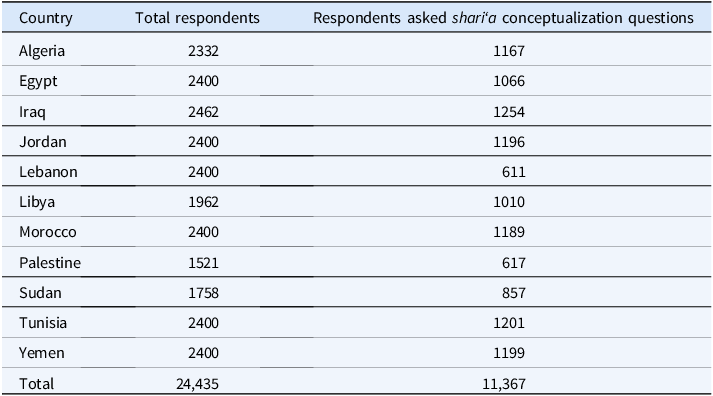
We explore the relationship between conceptions of shari‘a and support for democracy among a nationally representative sample of Arab citizens aged 18 and above, surveyed face-to-face by the Arab Barometer in 2018 and 2019.Footnote 5 The Arab Barometer asked questions about shari‘a to Muslim respondents only, so the analysis is limited to members of this faith. Additionally, our battery was administered to a split sample, meaning only respondents randomly chosen to participate in form B of the survey instrument were asked to answer these questions. It also only includes observations for which data about the survey enumerator was available. As a result, our sample of respondents includes approximately half of the total Muslim population sampled across 11 countries (see Table 1).Footnote 6
Survey respondents by country

Key variables of interest
Our first variables of interest capture respondents’ level of agreement with different conceptions of shari‘a. They are intended to capture in the abstract the degree to which a respondent believes that a government implementing shari‘a would align with the following:
-
Q605a. Here is a list of things some people say about the shari‘a government. How much do you agree or disagree with each of the following statements?
-
1. A government that provides basic services such as health facilities, schools, garbage collection, and road maintenance.
-
2. A government that does not have corruption.
-
3. A government that uses physical punishments to make people obey the law.
-
4. A government that restricts women’s roles in public.
-
Each respondent was presented with each of the four statements above, in succession, and asked to choose the statement that best characterized his or her own agreement with the statement: “I strongly agree,” “I agree,” “I disagree,” or “I strongly disagree.” Respondents could also refuse the question or respond with “don’t know,” though the enumerator did not read out these possible responses. In our coding of 1–4, higher responses indicate more agreement, and don’t know/refuse are treated as missing.
We first constructed simple indices from the responses to these four questions. As expected, answers to questions 605A_1 and 605A_2 and answers to questions 605A_3 and 605A_4 loaded onto the same factor.Footnote 7 To generate our index for a “provides” conception of shari‘a, we took the mean of respondents’ agreement with questions 605A_1 and 605A_2. To generate our “imposes” index, we took the mean of respondents’ agreement with questions 605A_3 and 605A_4.
Our next variables of interest measure respondents’ preferences over the extent to which laws governing their country are based on shari‘a, similar to the type of question typically used in survey-based research to measure support for shari‘a:
-
Q605: From your point of view, should the laws of our country…
-
1. …entirely be based on the shari‘a;
-
2. …mostly be based on the shari‘a;
-
3. …equally be based on shari‘a and the will of the people;
-
4. …mostly be based on the will of the people; or
-
5. …entirely be based on the will of the people?
-
High scores indicate strong support for a system based on shari‘a, middle scores indicate a mix of Islam and the will of the people, and lower scores indicate support for a system based exclusively on the will of the people. We treat refusals and non-responses as missing.
Finally, we measure respondents’ preferences for democracy:
-
Q516. To what extent do you agree or disagree with the following statements?
-
4. Democratic systems may have problems, yet they are better than other systems.
-
Again, respondents were asked to choose the level of agreement that best characterized their own agreement with the statement: “I strongly agree,” “I agree,” “I disagree,” or “I strongly disagree.” In our recoding of the question, greater values indicate higher levels of support for democracy. Refusals and non-responses were coded as missing.
In addition, in our full model, we include controls based on existing studies of support for shari‘a and political preferences in the Middle East: demographic characteristics, including age, gender, education, employment status, income insecurity, as well as marital and parental status; individuals’ reported levels of religiosity as measured by the strength of self-identification as a religious person and frequency of individual prayer; gender and religious appearance of the enumerator (Blaydes and Gillum, Reference Blaydes and Gillum2013); and country-level fixed effects. All of these attributes have been found in existing studies to have an independent effect on support for religion in politics. The full text of each question from which our measurements are generated is included in the appendix under Variable Descriptions.
Cross-national conceptions of Shari‘a
To begin, we ask: how do Muslim respondents in different countries conceptualize shari‘a? There is significant variation across countries in respondents’ agreement that a shari‘a-based government is defined as one that provides basic services, is without corruption, uses physical punishments to induce compliance, or restricts women’s role in public. Figure 1 demonstrates that most respondents understand shari‘a to be strongly related to government service provision. In all countries except Lebanon, the median respondent “agrees” with this understanding of shari‘a. In Iraq and Yemen, the response is “strongly agree.” Lebanon is the only country where most Muslims disagree. Only in Tunisia do at least a quarter of respondents disagree or disagree strongly.
Perceptions of Shari‘a: Response patterns by country to different conceptions of the Shari‘a.

There is a greater variation in whether a government under shari‘a has corruption. In most countries, the median respondent “agrees” that there is no corruption when shari‘a is implemented. However, in Algeria, the median response is “disagree.” The perception that there is no corruption under shari‘a government is particularly strong in Iraq, Morocco, and Yemen, where the modal response is “strongly agree.” Algerians, Sudanese, Tunisians, and Lebanese are far less likely to hold this perception.
There is a far weaker link among ordinary Muslims between shari‘a and imposition. In all but two countries (Yemen and Sudan), the median respondent disagrees that shari‘a government includes the use of physical punishments. Iraqis, Tunisians, and Libyans are especially likely to say that physical punishments are not a part of shari‘a government. There is greater uniformity across countries on the perception that shari‘a government restricts women in public. In all countries, the median response is “disagree,” but Yemenis and Sudanese are somewhat more likely to associate shari‘a with restrictions on women in public than those in other countries.
In summary, despite general agreement, there are clear country-specific differences across the region. Yemenis in particular are more likely to see all four aspects, including interpretations that both provide and impose, compared with those in other countries. Lebanese Muslims are comparatively unlikely to associate any of these definitions with the shari‘a government. Other nuanced differences also exist: Algerians are the least likely to say government under shari‘a is free of corruption, while Egyptians are relatively likely to understand shari‘a government as imposing physical punishments.
Preferences for Shari‘a and democracy
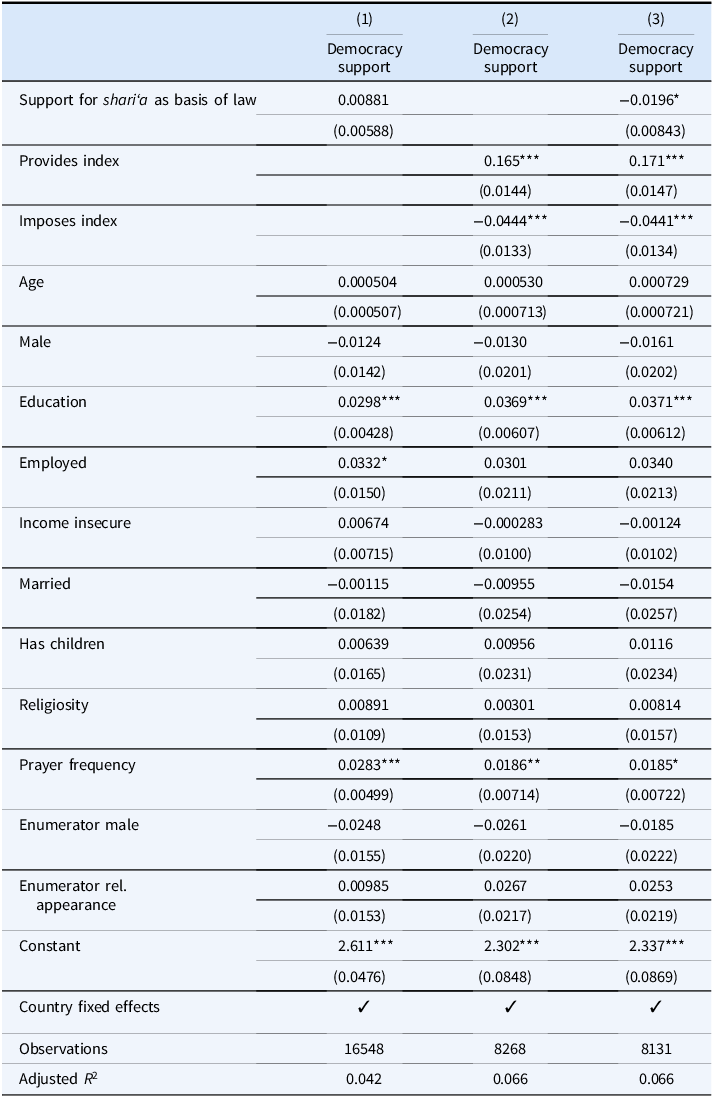
Next, we ask: how do different conceptualizations of shari‘a-based government correlate with support for democracy, and does their inclusion improve understanding of the relationship between support for shari‘a and support for democracy?Footnote 8 Table 2 includes the results of three models with country fixed effects. The first specification includes the variable measuring support for shari‘a-based government, but does not include the conceptualization of a shari‘a-based government. The second drops support for shari‘a and only includes the conception of shari‘a-based government. The third includes both support for shari‘a and conceptions of shari‘a-based government. The results of additional analyses, presented in the Appendix in Table A4, demonstrate that these conceptions of shari‘a are robust predictors in a number of model specifications.
Support for Shari‘a, perceptions of Shari‘a (index), and support for democracy

Standard errors in parentheses.
* $p\lt 0.05$
,
$p\lt 0.05$
, ${{\rm{\;}}^{{\rm{**}}}}$ $p \lt 0.01$
,
$p \lt 0.01$
, ${{\rm{\;}}^{{\rm{***}}}}p\lt 0.001$
Regressions separating the data by individual country show that there is some country-level variation. While the positive relationship between conceiving of a shari‘a-based government as one that provides and support for democracy is generally consistent across countries, the relationship between conceiving of a shari‘a-based government as one that restricts and support for democracy is more mixed. Exploring this country-level variation is beyond the scope of this research note (see Table A8, Table A9, and Table A10 in the appendix).
We interpret the combined results—that support for a shari‘a-based government is only significantly correlated with support for democracy when controlling for respondents’ conceptions of a shari‘a-based government, though conceptions remain significant on their own—as evidence that measuring respondents’ understanding of shari‘a-based government is necessary either in place of or in addition to measuring respondents’ level of support for a shari‘a-based government given that respondents have differing understandings of what is meant by shari‘a itself.
Conclusion
For years, scholars have discussed the impact of Muslim religious identity on a number of variables, including support for democracy. Overall, these findings have been contradictory, partial, or inconclusive. The result has been a mixed set of tentative conclusions: some aspects of Islam and its teachings may increase support for democracy, and some may decrease it. More recently, scholars have hypothesized complex pathways and mechanisms to help explain such findings. What we seek here is a simpler and more easily implemented solution.
We suggest that scholars like Ciftci are correct to disentangle different aspects of Muslim religious identity to explain this complex relationship. In a similar vein, we find that parsing differences in understanding of shari‘a—the fundamental blueprint within Islam informing social and political life—has major implications for the relationship between Islam and support for democracy at the individual level. In effect, those who see shari‘a as a legal code focused on good governance and providing services for the citizens are more supportive of democracy. After all, at least in theory, this is also what a democracy is designed to do better than other political systems. For Muslims with this interpretation of shari‘a, there is, in effect, no contradiction with democracy as hypothesized by scholars like Gellner and Kedourie. Instead, shari‘a and democracy seek similar goals. It follows that those who understand shari‘a primarily in these terms would also support democracy.
On the other hand, those Muslims who understand shari‘a as a legal code that implements corporal punishments or restricts the rights of members of women are less supportive of democracy. This follows from the fact that in a full democracy, citizens would potentially be able to overrule such opinions at the ballot box. Certainly, women may be unlikely to favor greater restrictions on themselves compared with men and be opposed to this point of view if it were put to a vote. As a result, Muslims who interpret shari‘a in this manner are likely to be opposed to democracy, which is consistent with what we find in the statistical models presented.
Thus, we advance the literature in an important way. These findings suggest that much of the existing disagreement in the literature boils down to the simple fact that there is no one agreed-upon interpretation of shari‘a. Our approach is to emphasize four potential aspects of this religious code. There are additional elements that could be queried, but we find that this approach sheds important light on our key variable of interest and contributes to a more comprehensive understanding of the link between Islam and democracy.
The key advancement in this research note is to clearly demonstrate across a range of country contexts, religious environments, and political systems that the relationship remains robust. Although we focus on how this approach can better elucidate the relationship between Islam and democracy, there is little reason to think that our contribution would be limited to this relationship. Given that we establish that Muslims do not all have the same interpretation of shari‘a when they specify their level of support for implementing it, ignoring such differences in scholarly work has likely obfuscated the relationship between support for shari‘a and other variables. Examining such questions should be the subject of future research, and we highly encourage scholars to take this broader insight and apply it to their models that seek to understand Muslim political behavior at the individual level.
Supplementary material
The supplementary material for this article can be found at https://doi.org/10.1017/S1755048326100352.
Financial support
The authors declare none.
Competing interests
The authors declare none.
Sam Dunham is a PhD Candidate in Political Science at Yale University. He can be reached at samuel.dunham@yale.edu.
C. Christine Fair is a Professor of Security Studies within the Walsh School of Foreign Service at Georgetown University. She can be reached at ccf33@georgetown.edu.
Rebecca Littman is an assistant professor in the Department of Psychology at the University of Illinois Chicago. She can be reached at rlittman@uic.edu.
Elizabeth Nugent is an assistant professor of politics at Princeton University. She can be reached at enugent@princeton.edu.
Michael Robbins is Director and co-Principal Investigator at Arab Barometer. He can be reached at mdr7@princeton.edu.



 Open access

