




Introduction
Human adaptation to northern climates is distinct from other world regions, particularly in terms of sedentism and domestication. Following the Last Glacial Maximum, northern latitudes are often characterised by the persistence of hunting and gathering, and a specific range of organisational changes, including an early and protracted reduction in residential mobility, an intensified exploitation of aquatic species and more active management of natural resources. Across the global north (broadly, North America and Eurasia north of 40°), these shifts occurred at different times following the Last Glacial Maximum, and were closely tied to climatic amelioration (Gamble Reference Gamble and Zvelebil1986; Elston et al. Reference Elston, Zeanah and Codding2014; Popov et al. Reference Popov, Tabarev and Mikishin2014; Liu et al. Reference Liu, Zhao, Liu, Barker and Goucher2015a; Janz Reference Janz2016). Depending on the region, such changes preceded a range of further organisational shifts, including a return to greater mobility, the adoption of exotic domesticates and increasingly specialised hunting strategies (Basgall Reference Basgall1987; Beck & Jones Reference Beck and Jones1997; Fisher Reference Fisher, Fitzhugh and Habu2002; Wolff Reference Wolff2008; Weber & Bettinger Reference Weber and Bettinger2010; Bousman & Okasnen Reference Bousman, Oksanen, Bousman and Vierra2012; Chatters et al. Reference Chatters, Hackenberger, Prentiss, Thomas, Bousman and Vierra2012; Rosenthal & Fitzgerald Reference Rosenthal, Fitzgerald, Bousman and Vierra2012; Habu Reference Habu, Renfrew and Bahn2014; Popov et al. Reference Popov, Tabarev and Mikishin2014). In the northern latitudes, subsistence was characterised by the continued management of local resources, with little emphasis on domestic crops or animals. Furthermore, the adoption of exotic domesticates occurred long after they were adopted in neighbouring regions (e.g. Ames Reference Ames1998; Crawford Reference Crawford2011; Popov et al. Reference Popov, Zhushchikhovskaya and Nikitin2019; Janz et al. Reference Janz, Cameron, Bukhchuluun, Odsuren and Dubreuil2020). Hence, in contrast to the situation in Western Eurasia, in North-east Asia, the ‘Neolithic’ was characterised by a series of shifts that did not always result in long-term sedentism or domestication.
The Mongolian Plateau is a critical but poorly understood region in East Asian prehistory. Scholars have been inclined to assume that, throughout prehistory, people on the plateau have persistently retained highly mobile lifeways, initially based on hunting and culminating in nomadic pastoralism; this interpretation stems from the historic narrative of ‘steppe nomadism’ and the absence of concentrated and productive r-selected resources (i.e. species with high reproductive potential, such as fish, shellfish and nuts) (Cao Reference Cao2007). Such supposition, however, is now challenged by archaeological data from the eastern Plateau indicating more sedentary lifeways and intensified exploitation of local resources after 8.5 ka cal BP (Zhao Reference Zhao2020). This general reduction in residential mobility was supported by diverse subsistence strategies, including grain cultivation, broad-spectrum foraging and the intensive exploitation of large game. The juxtaposition of these various modes of subsistence is emphasised by their association with climatic amelioration, raising questions about the common drivers of change.
Geographically, the eastern Mongolian Plateau is bounded to the east by the Great Khingan Range, with ecozones today ranging from arid or semi-arid steppe to the semi-humid margins of north China and the north-east China Plain (Ren Reference Ren1999). Notable variations in modes of subsistence across the region reveal the diversity of adaptations to sedentary life in monsoon-dominated East Asia during the Holocene Climatic Optimum (c. 8.3–5.5 cal BP (Herzschuh Reference Herzschuh2006: 167)). An examination of Neolithic subsistence and settlement patterns on the eastern Mongolian Plateau presents the opportunity to explore these variable trajectories in sedentism, including their limits in regions with low rainfall and extreme seasonal variation.
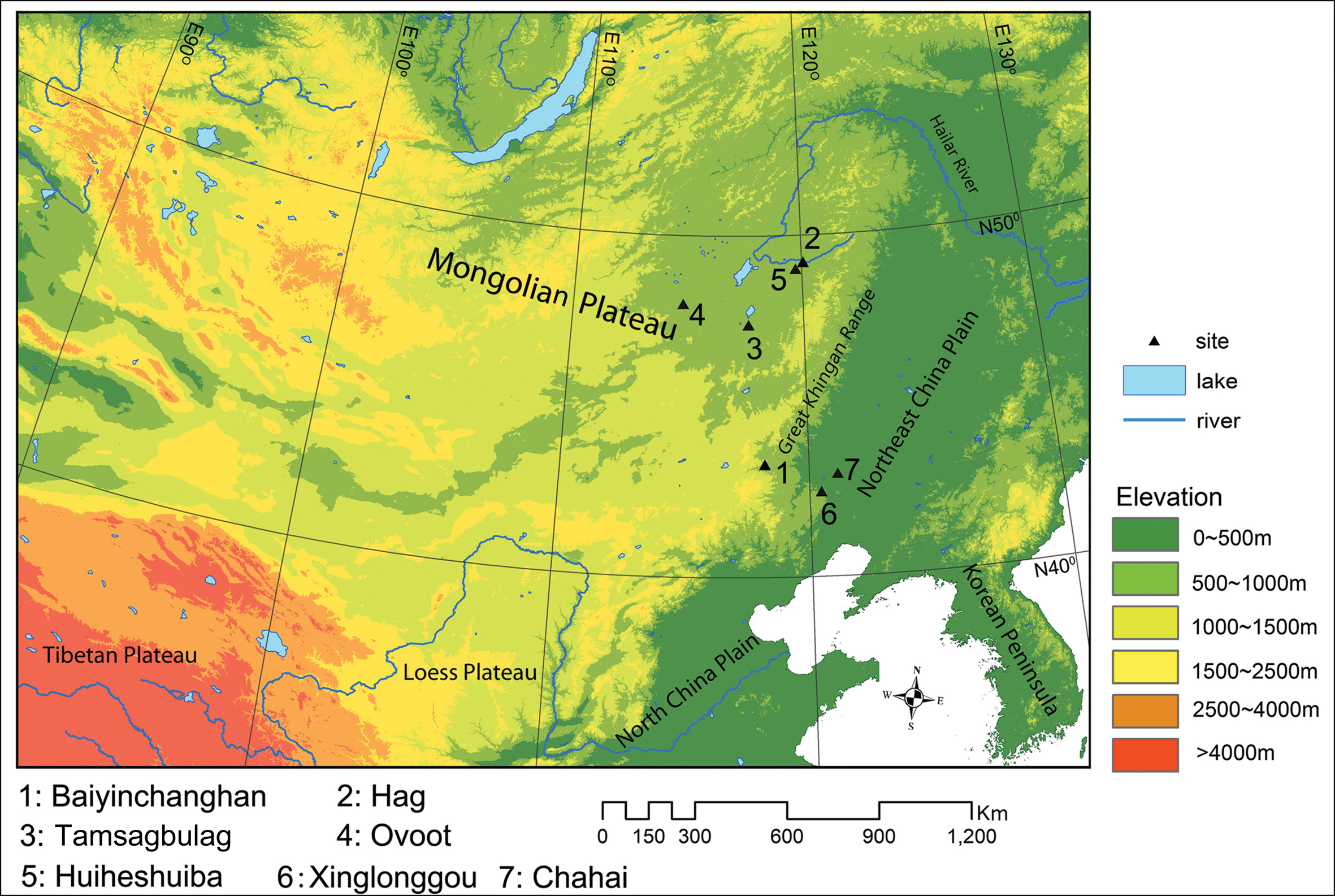
The sites of Baiyinchanghan, Hag and Tamsagbulag represent sedentary adaptations within three distinct micro-environmental zones of the eastern Mongolia Plateau: the transitional zone between steppe and deciduous forest, the resource-rich wetland zone and open steppe. Baiyinchanghan (Figure 1.1) is located on the upper West Liao River valley, in the southernmost part of the study area (Neimenggu Reference Neimenggu2004). The primary phase of occupation, dating to 8034–7325 cal BP (Table S1 in the online supplementary material (OSM)), is associated with the Xinglongwa Culture. Baiyinchanghan is one of the most westerly Xinglongwa sites to be extensively excavated and reported in the Chinese literature (Liu Reference Liu2001). The site represents the westward expansion of early millet-based agricultural economies in north-east China. Hag (Figure 1.2) dates to 8580–8036 cal BP (Table S1) and is located on the Hulunbuir Steppe far in the north of the study area. The Hailar, a tributary of the Amur (Heilongjiang) River, surrounds the site on three sides (Zhongguo et al. Reference Zhongguo, Neimenggu, Hulunbuir and Hailar2010). Dating to 8400–7339 cal BP (Table S1), Tamsagbulag (Figure 1.3) is located along tributaries of the Hulunbuir drainage system, a few hundred kilometres west of Hag. The upper West Liao River valley and the Hulunbuir Steppe are located on the margins of regions categorised by the Köppen-Geiger climate classification as cold semi-arid (BSk) and boreal winter dry with a cool to warm summer (Dwc to Dwb) (Beck et al. Reference Beck, Zimmermann, Mcvicar, Vergopolan, Berg and Wood2018). (The Köppen-Geiger climate classification system categorises all world climates according to seasonal temperature and precipitation patterns, and is one of the most widely used climate classification systems; B = arid, S = steppe/semi-arid, k = cold arid; D = boreal/snow, w = winter dry, c = cool summer, b = warm summer; http://koeppen-geiger.vu-wien.ac.at/.) Modern average annual precipitation at Tamsagbulag is 190mm, compared with 350mm at Baiyinchanghan. The Hulunbuir Steppe is colder than the West Liao River valley, with shorter growing seasons (Wu et al. Reference Wu, Zhang, Li and Liang2015). Here, we examine similarities and differences in subsistence, site structure and material culture to identify variation in patterns of residential stability within some of the more marginal reaches of mainland East Asia.
Geographic location of sites mentioned in text and online supplementary material (OSM) (GMTED 2010, image courtesy of the U.S. Geological Survey).
Trajectories in sedentism
Site architecture
All three sites reveal significant investment in architecture that is consistent with full or intensive seasonal sedentism. Hulunbuir sites are characterised by large, 40–50m2 dwellings, with carefully constructed roofs, floors, and indoor middens and/or storage pits (Figure 2) (Okladnikov & Derevianko Reference Okladnikov and Derevianko1970; Dorj Reference Dorj1971; Zhongguo et al. Reference Zhongguo, Neimenggu, Hulunbuir and Hailar2010). Evidence of surface dwellings at Tamsagbulag, within 1km of pit dwelling concentrations, suggest some form of year-round occupation (see the OSM). At the Hag site, a layer of shells more than 0.16m thick was found beneath the living floor, and may have served to keep the floors dry and provide insulation (Zhongguo et al. Reference Zhongguo, Neimenggu, Hulunbuir and Hailar2010).
A) The excavation zone at the Hag site: F = house; H = midden or storage pit; D = posthole; M = burial; SHD = piles of sand; JS3 = piles of animal bones. All remains belong to cultural layer 7 (after Zhongguo et al. Reference Zhongguo, Neimenggu, Hulunbuir and Hailar2010: foldout page); B) house 1 from Tamsagbulag, showing postholes, pit features, and hearth. The circular feature on the northern wall is a human burial (redrawn from Okladnikov & Derevianko Reference Okladnikov and Derevianko1970: 5).

Excavations at Baiyinchanghan have revealed contemporaneous, or slightly later (Table S1), evidence for intensively planned population nucleation, characterised by two settlement clusters on the hillslope—each with its own associated hilltop cemetery (Figure 3). Excavation has revealed 56 rectangular, semi-subterranean houses arranged in neat rows within the two clusters. Many of the houses had living floors that were typically surfaced with fired clay for durability (Neimenggu Reference Neimenggu2004). Extensive trench features at Baiyinchanghan and Tamsagbulag (see the OSM) and the elaborate floors at Hag and Baiyinchanghan illustrate investment in place that is uncharacteristic of earlier periods.
A) Layout of Xinglongwa-period houses at Baiyinchanghan (H = midden or storage pit) (redrawn from Neimenggu Reference Neimenggu2004: foldout page); B) the plane and section view of house AF32 of the Baiyinchanghan site (1, 3, 6, 8 = stone rollers; 2 = pestle; 4 = handstone; 5 = rock; 7 = perforated stone disk; 9 = cylinder jar) (after Neimenggu Reference Neimenggu2004: 145).

Differences in burial ritual between Baiyinchanghan and the two Hulunbuir sites similarly highlight contrasting levels of site investment. The Baiyinchanghan burials are represented by individual pit-tombs capped with layers of stone (Figure 4C). Some tombs have vertical stone slabs lining the walls (Neimenggu Reference Neimenggu2004). In contrast, the Hag and Tamsagbulag burials are scattered and unmarked (Figure 4A–B), including one subfloor interment at Tamsagbulag (Dorj Reference Dorj1971). Graves at Hag are often characterised by secondary inhumations (Zhongguo et al. Reference Zhongguo, Neimenggu, Hulunbuir and Hailar2010). The pattern of elaborate inhumation and structured community burial at Baiyinchanghan is characteristic of planned investment in recurrent and intensive site use. In contrast, across Hulunbuir, the diverse approaches to burial, the consistent lack of surface markings and evidence of secondary interment (e.g. at Hag) are more consistent with a less organised—or perhaps discontinuous—site usage.
A) Hag burial 04 07T5-T6XM3 (after Zhongguo et al. Reference Zhongguo, Neimenggu, Hulunbuir and Hailar2010: 32); B) Tamsagbulag burial from house 1 (redrawn from Okladnikov & Derevianko Reference Okladnikov and Derevianko1970: 9); C) Baiyinchanghan burial M13 (after Neimenggu Reference Neimenggu2004: 29).

The subsistence basis of ‘sedentism’
Sedentism requires sufficient resources within the catchment zone and highly efficient methods of exploiting them. Without improved procurement strategies, people must relocate during the year in order to avoid local resource depletion (Kelly Reference Kelly1983). The use of storage pits at all three sites (see the OSM; Figures 2–3) highlights the fact that increased sedentism—particularly in northern climates—requires more abundant seasonal procurement for storage. Although sedentism was once assumed to be dependent upon farming, we now know that sedentism can be supported without agriculture through the intensive exploitation of wild species that occur in dense concentrations and are resilient to harvesting pressure, such as fish, shellfish, nuts and seeds (Henry Reference Henry, Price and Brown1985; Gamble Reference Gamble and Zvelebil1986; Rosenswig Reference Rosenswig2006; Habu Reference Habu, Renfrew and Bahn2014; Popov et al. Reference Popov, Tabarev and Mikishin2014). While the three sites in this study have yielded evidence for the exploitation of such species, it varies greatly across sites and does not necessarily correlate with the apparent degree of sedentism.
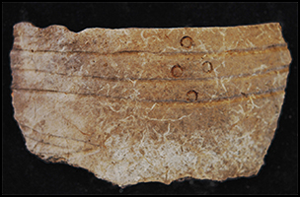
Pottery and milling stones are present at the three sites (Figures 5–7). Despite their ubiquity in agricultural communities, such tools have been widely used by hunter-gatherers for cooking, shelling, grinding and pulverising many types of wild or domesticated plants (Adams Reference Adams2013; Dubreuil et al. Reference Dubreuil, Savage, Delgado-Raack, Plisson, Stephenson, de la Torre, Marreiros, Gibaja Bao and Bicho2015). As such, their presence indicates a more intensive approach to plant exploitation, although not necessarily agriculture. Residue analysis from Baiyinchanghan and other Xinglongwa-phase sites indicates the exploitation of a wide range of wild species, including nuts, roots, rhizome bulbs and grasses (Tao et al. Reference Tao, Wu, Guo, Hill and Wang2011; Wu Reference Wu2014; Liu et al. Reference Liu, Duncan, Chen, Liu and Zhao2015b). The quantity and formality of milling stone assemblages may indicate the relative importance of plant foods, and there is a clear regional divergence in the importance of these tools. The small, fragmented assemblages of grinding slabs and ball-headed rollers from Tamsagbulag and Hag (Figure 6), for example, contrast sharply with Baiyinchanghan (Table S2). Their absence from earlier sites on the Mongolian Plateau (Janz et al. Reference Janz, Odsuren and Bukhchuluun2017), however, emphasises the relationship between reduced mobility and increased investment in plant processing (Table S2).
Selection of lithics from Baiyinchanghan (after Neimenggu Reference Neimenggu2004: 289, 292, 294, 300, 301 & 303): A) grinding slab; B) digging weight; C) polished axe; D) handstone; E) pestle; F) hoe; G–H) flake tools; I) microblade core.

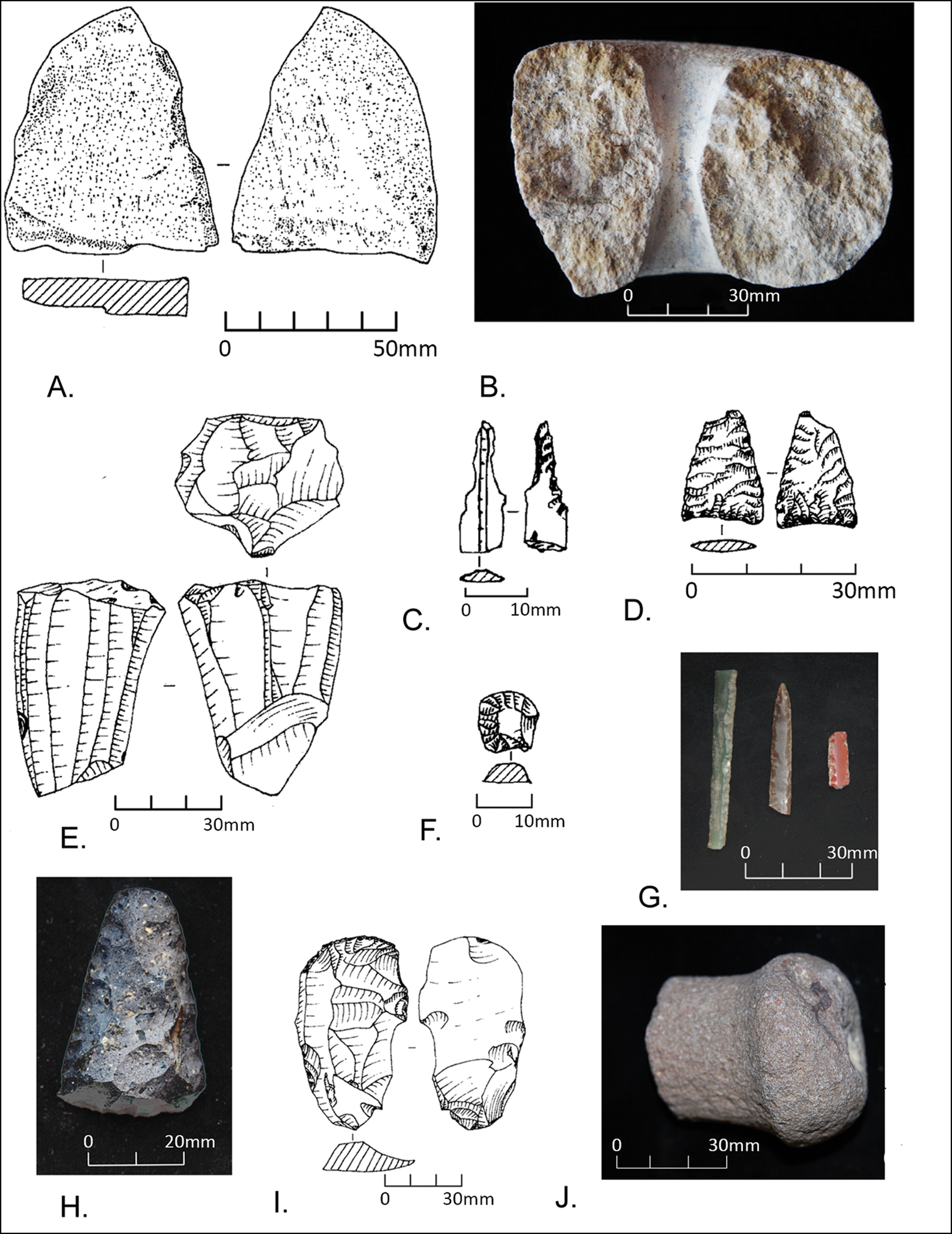
Selection of lithics from Hag (line drawings, all after Zhongguo et al. Reference Zhongguo, Neimenggu, Hulunbuir and Hailar2010: 35, 62, 64 & 71) and Tamsagbulag (photographs by L. Janz): A) grinding slab; B) digging weight; C) drill; D) projectile point (biface); E) microblade core; F) thumbnail scraper; G) retouched microblade tools; H) chipped adze; I) tongue-shaped scraper; J) fragment of ball-headed roller similar to those from Tamsagbulag.
A (top row): selection of pottery from Baiyinchanghan (after Neimenggu 2004: 278, 283 & 286); B (bottom two rows): selection of pottery from Hag (line drawings, all after Zhongguo et al. Reference Zhongguo, Neimenggu, Hulunbuir and Hailar2010: 75 & 83), and Tamsagbulag (photographs by L. Janz).

Aside from the exploitation of wild plant resources, millet-based farming also provided supplementary foods for the Baiyinchanghan communities. As no systematic flotation or bone chemistry studies have yet been published, we are unable to evaluate the dietary contribution of domesticated millets. Nonetheless, the presence and type of farming-related tools provide important clues to the scale and extent of the development of the farming. While Baiyinchanghan yielded no typical tools for harvesting (e.g. perforated knives) and ploughing (e.g. pointed spade-like tools), stone hoes comprise nearly 28 per cent of the entire lithic assemblage (Yang Reference Yang2016). The lack of specialised harvesting and ploughing tools may suggest that cultivation was less intensive at Baiyinchanghan than at other contemporaneous sites in the heartland of north China, such as Cishan and Peiligang (Zhongguo Reference Zhongguo2010), although it could also indicate variation in agricultural practices. All Xinglongwa-period sites, including Baiyinchanghan, contain large quantities of wild faunal remains, and those with evidence of plant use likewise demonstrate the continued importance of wild resources (Liu et al. Reference Liu, Zhao, Liu, Barker and Goucher2015a).
Hoes and spades are rare or absent in Hulunbuir. The numerous digging weights found at Tamsagbulag were probably used to build the pit dwellings and trench features (Figure 6). The relative lack of plant-processing tools at Tamsagbulag and Hag suggests that heavily processed plant resources were less important than at Baiyinchanghan. Higher densities of faunal remains at the Hulunbuir sites, combined with an emphasis on microblade- and projectile-based hunting technology, further suggest the greater relative importance of game over plant foods.
Direct evidence of diet is present in the sites’ faunal assemblages, with the range of animals being highly divergent across sites. Published species lists are available for Baiyinchanghan and Hag (Table 1), while analysis of the Tamsagbulag fauna is ongoing. Cervids represent the primary source of meat at Baiyinchanghan, while smaller prey was limited to a single fox (Vulpes sp.) element (percentage number of identified species (NISP) = 0.3). None of the animals were identified as domesticated. A broader range of species were exploited at Hag and Tamsagbulag. The latter site is characterised by an emphasis on aurochs (Bos primigenius), equids (Equus hemionus hemionus and Equus ferus) and antelope (cf. Saiga tatarica mongolica, Gazella subgutturosa and/or Procapra gutturosa), compared to the predominance of small prey (e.g. fox, birds, fish) and roe deer (Capreolus pygargus) at Hag.
Comparison of faunal remains from Xinglongwa-period Baiyinchanghan and layer 7 of Hag (Neimenggu Reference Neimenggu2004; Zhongguo et al. Reference Zhongguo, Neimenggu, Hulunbuir and Hailar2010).

Aurochs dominate the Tamsagbulag assemblage; four such skeletons were recovered from the upper layers of one dwelling (Dorj Reference Dorj1971). Moreover, what appear to be ritual burials were recovered from contemporaneous sites near the city of Choibalsan, about 400km west of Tamsagbulag, including an aurochs bull skull and a cache of horns (Dorj Reference Dorj1971). Scholars have previously interpreted these sites as belonging to agropastoralists (Derevianko & Dorj Reference Derevianko, Dorj, Dani and Masson1992). The exploitation of small-bodied prey at Hag differs from Tamsagbulag, and presents the broadest spectrum of dietary species of the three sites analysed here, with a focus on riverine resources and terrestrial species that thrive around shrubby, riparian wetlands. These differences correspond to the local environment: Tamsagbulag sits high above a river, on the edge of an open steppe, whereas Hag is surrounded on three sides by a river. These trends might also be temporal, as Hag pre-dates Tamsagbulag.
Both Baiyinchanghan and Tamsagbulag exhibit higher levels of dietary specialisation than the earlier Hag site, although the emphasis varies greatly. The intensive exploitation of deer at Baiyinchanghan supports the notion of high occupational permanency, as cervids are resilient to heavy predation and are well adapted to forage on plants associated with high human population densities—particularly agricultural crops (Butler & Campbell Reference Butler and Campbell2004). In contrast, important species at Tamsagbulag, such as antelope and khulan (Equus hemionus hemionus), decline relative to human population density (Kaczensky et al. Reference Kaczensky, Kuehn, Lhagvasuren, Pietsch, Yang and Walzer2011). The unique juxtaposition of seemingly high levels of sedentism and an emphasis on wary large game at Tamsagbulag suggests that inhabitants practised a distinct approach to settlement and resource use.
The evidence presented here demonstrates high variation in levels of sedentism across the Mongolian Plateau during the Middle Holocene. The two Hulunbuir sites clearly reveal increasing sedentism and the coalescence of small hunter-gatherer communities, whereas the organisation of Xinglongwa-period site architecture and infrastructure at Baiyinchanghan supports the idea of a permanent village settlement. The pattern of differentiated dwelling types at Tamsagbulag suggests that the pit dwellings were designed for cold-season sedentism, while the surface dwellings were used during the warmer months (see the OSM). Together, these regions exemplify a large-scale trend, although with different approaches, towards increasing sedentism across North-east Asia.
Discussion
Holocene climatic amelioration and the onset of sedentism
The close temporal association of increasing and widespread sedentism across monsoonal East Asia and the Holocene Climatic Optimum—when annual average temperatures peaked and the East Asian Summer Monsoon strengthened and reached its northernmost limits—is compelling (Figure 8) (Winkler & Wang Reference Winkler, Wang, Wright, Kutzbach, Webb, Ruddiman, Street-Perrott and Bartlein1993; Dykoski et al. Reference Dykoski2005; Herzschuh Reference Herzschuh2006). Multiple lines of evidence from lacustrine sediments along the south-eastern edge of the Mongolian Plateau show peaks in effective moisture between c. 8.0 and 4.0 ka cal BP (Liu et al. Reference Liu, Chen, Zhang, Li, Rao and Chen2015c: 200; Fan et al. Reference Fan, Xiao, Wen, Zhang, Wang, Cui and Yamagata2017; Wen et al. Reference Wen, Xiao, Fan, Zhang and Yamagata2017). Proxy data from Lake Hulun, immediately west of Hag (Figure 1), indicate high lake levels between 11.1 and 6.2 ka cal BP (Zhai et al. Reference Zhai, Xiao, Zhou, Wen, Chang, Wang, Jin, Pang and Itoh2011), with a marked shift c. 8.0 ka cal BP from dry steppe to relatively wet meadow-steppe, and the expansion of birch (Betula) and hazel (Corylus). This pattern lasted until c. 6.4 ka cal BP (Wen et al. Reference Wen, Xiao, Chang, Zhai, Xu, Li and Itoh2010), when large Hulunbuir sites had already been abandoned or were in decline. As seen from Russian excavations farther east, in the middle and lower sections of the nearby Amur River basin (Popov et al. Reference Popov, Tabarev and Mikishin2014; Tabarev Reference Tabarev, Renfrew and Bahn2014) and in Japan (Pearson Reference Pearson2006; Habu Reference Habu, Renfrew and Bahn2014), initial trajectories towards sedentism corresponded with phases of climatic amelioration, and, on the Mongolian Plateau, with peaks in maximum humidity between 8.0 and 7.0 ka cal BP.
Timing of Holocene Climatic Optimum compared to sites in this study; climate curve based on stalagmite δ18O records for Dongge Cave (after Dykoski et al. Reference Dykoski2005).

These dates suggest that the trend towards sedentism was probably facilitated by ecological changes associated with the Holocene Climatic Optimum. Environmental conditions were arguably the primary driver of major contemporaneous shifts in settlement and subsistence patterns on the Mongolian Plateau, and probably across North-east Asia (Popov et al. Reference Popov, Tabarev and Mikishin2014; Janz Reference Janz2016; Shelach-Lavi et al. Reference Shelach-Lavi2019). These ecological changes differed from region to region. In the West Liao River valley, the expansion of deciduous forests would have enhanced access to nut-bearing trees, while longer growing seasons and higher annual precipitation would have expanded the limits for producing large-seeded grasses, such as millets. The expanding wetlands, forests and meadow-steppe in Hulunbuir would have created richer habitats for all prey types—a process also witnessed in even more arid reaches of the western Mongolian Plateau (Janz Reference Janz2016; Janz et al. Reference Janz, Odsuren and Bukhchuluun2017).
The role of the environment in adaptation
The eastern Mongolian Plateau sites discussed here contrast with regions typically discussed in similar studies, which show that the changes expressed in Middle Holocene sites neither persisted nor developed into fully sedentary lifeways. It is hypothesised that increasing aridity stimulated a rise in residential mobility across Late Neolithic Mongolia (Cybiktarov Reference Cybiktarov2002; Chen Reference Chen2011). At Tamsagbulag, the main occupation was abandoned after c. 7300 cal BP, and recent unpublished survey and excavation data from eastern Mongolia suggest a decline in occupational intensity after 6500 cal BP. After the adoption of nomadic pastoralism by 3.5 ka cal BP (Tumen et al. Reference Tumen, Khatanbaatar and Erdene2014; Honeychurch Reference Honeychurch2015; Wright et al. Reference Wright, Ganbaatar, Honeychurch, Byambatseren and Rosen2019), herding economies dominated much of the region into historic times. This explains the relative lack of cultural material in the upper stratigraphy at Hag (2.0–0.9 ka cal BP). These layers contain little evidence for house structures and a much lower artefact density, suggesting shorter occupation durations and less extensive site use. Although house structures and farming tools were still present in the later Neolithic at Baiyinchanghan, the site was abandoned during the Bronze Age, and no sedentary settlements have been found in the surrounding area from that time through most of the historic period (2.8–0.1 ka cal BP).
This discontinuity in the development of sedentary lifeways contrasts with trends in more temperate, less arid regions of East Asia (see Shi Reference Shi1989). The trajectory of intensified farming and more entrenched sedentism continued among communities to the south, such as in the Yellow River valley, where seasonality was less extreme and precipitation more reliable (Zhongguo Reference Zhongguo2010). In temperate Japan, sedentism developed even earlier than on the mainland, and although it was not uniform and unilinear, residential stability was largely retained, and became tied to intensive resource management and aquatic resource exploitation that continued even after the introduction of crop agriculture after 800 BC (Akazawa Reference Akazawa and Zvelebil1986; Crawford Reference Crawford2011; Habu Reference Habu, Renfrew and Bahn2014). To a certain extent, this confirms the assumption that people living in cold, arid climates are more sensitive to climatic fluctuations and, in response to such fluctuations, make major changes in subsistence strategies. The emphasis on ungulate prey—from specialised exploitation of aurochs at Tamsagbulag to the persistent and widespread reliance on domesticated herd animals—further highlights the critical importance of large-game exploitation for subsistence in northern, continental climates.
Simultaneously, despite the fact that variability in the degree of sedentism and population density between regions are closely tied to differences in resource availability, it is difficult to determine the relative importance of environment vs cultural influences, particularly when there are clear, large-scale consistencies in site structure and material culture across a range of environmental contexts. The subsistence practices employed at Baiyinchanghan show no fundamental differences to those practised by other Xinglongwa communities located within milder climate zones to the east, such as Chahai and Xinglonggou (Liaoning Reference Liaoning2012; Wu Reference Wu2014). The pattern is also consistent with contemporaneous sites to the south, where the intensive exploitation of diverse plant resources included, but was not limited to, millet (Sun Reference Sun2015; Chen & Yu Reference Chen and Yu2017). Despite stark differences in topography and vegetation, Hulunbuir sites bear some resemblance to hunter-gatherer sites around Lake Baikal and the Amur River Basin, including: broad-spectrum foraging and the exploitation of aquatic resources; the persistence of rectangular pit dwellings exemplified at Tamsagbulag and earlier Neolithic sites in the Amur River basin; emphasis on microblade technology; and the practice of secondary burials (Derevianko & Powers Reference Derevianko and Powers1969; Lbova et al. Reference Lbova, Zhambaltarova and Konev2008). The data presented here highlight the importance and potential of untangling the complexities of environmental and cultural influences on sedentism and associated subsistence practices.
Conclusion
Globally, researchers increasingly recognise that climatic amelioration corresponds with trends towards increased dietary breadth, sedentism and domestication (e.g. Gamble Reference Gamble and Zvelebil1986; Pearson Reference Pearson2006; Liu & Chen Reference Liu and Chen2012; Zeder Reference Zeder2012; Elston et al. Reference Elston, Zeanah and Codding2014; Janz Reference Janz2016; Piperno Reference Piperno2011; Shelach-Lavi et al. Reference Shelach-Lavi2019). Janz (Reference Janz2016) argues that these changes occurred globally during the Holocene and were closely tied to the creation of highly concentrated and diverse biotic patches. These resulted from wetland expansion and unprecedented forestation, due to the combination of higher humidity, megafaunal extinctions and increased atmospheric CO2. Other researchers have emphasised the importance of land-use management strategies as a feedback mechanism in increasing resource abundance in the context of emerging sedentism (e.g. Yen Reference Yen, Harris and Hillman1989; Smith Reference Smith2001; Crawford Reference Crawford2011).
The variation in prehistoric subsistence strategies across the eastern Mongolian Plateau is striking, and includes broad-spectrum hunting, the intensive exploitation of large game and high investment in plant use, supplemented by resilient, medium-sized game species. Our data show that in relation to sedentism, exploited resources may vary widely, even within close geographic regions. Furthermore, large- and medium-bodied prey may be more critical to sedentary lifeways in some regions than previously acknowledged. The emphasis on aurochs and equids at Tamsagbulag is surprising, given that large game populations typically decline around settlements (Jerozolimski & Peres Reference Jerozolimski and Peres2003; Badenhorst & Driver Reference Badenhorst and Driver2009; Broughton et al. Reference Broughton, Cannon and Bartelink2010; Schollmeyer & Driver Reference Schollmeyer and Driver2013). Additional research on species composition, the extent and nature of plant use, population density and occupation duration in regions such as Hulunbuir will be critical in further illuminating the relationship between sedentism and exploitation of large game, particularly in northern regions.
The establishment of sedentary communities and semi-permanent dwelling structures represents a remarkable change in human adaptive strategies. This study shows that despite being relatively simultaneous, such changes were highly variable in character, even within individual regions. Such changes in residential mobility and dietary breadth occurred across North-east Asia as lake levels increased, wetlands expanded and deciduous and mixed forests fragmented the Pleistocene steppe ecosystems. Similar types of responses to climate change across a range of environmental conditions support existing hypotheses that greater dietary breadth and reduced mobility are tied to ecological change, while the resulting variations in site organisation and material culture derives from local, culturally mediated solutions to environmental stimuli. Even in communities vulnerable to climate change, culture plays an important role in recognising, selecting and implementing solutions. Likewise, broad similarities in material culture, settlement planning and burial practice across the region emphasise points of cohesion in mediating adaptation. As such, there is still potential in the traditional analysis of material culture for tracing cultural interaction and affiliation. Environmental transition zones, such as the eastern Mongolian Plateau, offer a testing ground where we can trace long-term trends in human responses to ecological change and culturally mediated adaptation.
Acknowledgements
Collagen from Tamsagbulag was processed at Trent Environmental Archaeology Laboratory for radiocarbon analysis. The theoretical discussion was greatly enhanced by the feedback from two anonymous reviewers.
Funding statement
Research was funded by the National Geographic Society (grant NGS-188R-18), the Social Sciences and Humanities Research Council of Canada (grant 430-2016-00173), Symons Trust (Trent University) and Zhengzhou University through the ‘Research on the Roots of Chinese Civilization’ grant (XKZDJC202006).
Supplementary material
To view supplementary material for this article, please visit https://doi.org/10.15184/aqy.2020.236


 Open access

