




1. Introduction
Restrictive relative clause markers in contemporary English, as in (1), have long been a reliable source of insight into social and linguistic processes in the study of language variation and change.

The introduction of the relative who into English is one of the most well-studied changes from above on the morphosyntactic level (Romaine, Reference Romaine1982:213). Like the other wh- relativizers, it originated in the fifteenth century, likely introduced by the educated sector of society (Ball, Reference Ball1996; Mustanoja, Reference Mustanoja1960). From the start, the wh- forms have functioned as highly standard forms (D’Arcy & Tagliamonte, Reference D’Arcy and Tagliamonte2010; Macaulay, Reference Macaulay1991), while their major covariants—that, which, and the zero—have not. With subject gaps, the relative that can be either neutral (if the head noun is [-human]) or prescriptively frowned upon (if it is [+human]). The variant which is now unusual as a subject relativizer in Canadian English (Jankowski, Reference Jankowski2013), and the zero-subject relativizer is certainly nonstandard and notable in normative dialects of English, including urban Canada (D’Arcy & Tagliamonte, Reference D’Arcy and Tagliamonte2010). This has led to the choice of subject relativizers being particularly sensitive to prestige, which may be discerned in effects of education, occupation, class, and gender (Levey, Reference Levey2006:65; Levey & Hill, Reference Levey and Hill2013:37; Tottie, Reference Tottie1997:245).
Regional distribution, particularly the continuum between urban and rural, is also heavily implicated in the choice of forms. Relative who is most prevalent in urban varieties, at least in British and Canadian English (Cheshire, Adger & Fox, Reference Cheshire, Adger and Fox2013; D’Arcy & Tagliamonte, Reference D’Arcy and Tagliamonte2010; Levey, Reference Levey2006; Quirk, Reference Quirk1957; Tagliamonte, Smith & Lawrence, Reference Tagliamonte, Smith and Lawrence2005b:93; Tottie, Reference Tottie1997). Beyond urban conurbations, a great deal of diversity is reported for the inner workings of relativizer systems (Ball, Reference Ball1996:239; Geisler, Reference Geisler and Poussa2002; Tagliamonte et al., Reference Tagliamonte, Smith and Lawrence2005b; Tagliamonte, Reference Tagliamonte2013). However, multiple researchers point out that there have been comparatively few studies of relativizers in rural, blue-collar, or otherwise nonstandard dialects (Ball, Reference Ball1996:239; Bayley, Reference Bayley1999; Levey, Reference Levey2006:46; Tagliamonte et al., Reference Tagliamonte, Smith and Lawrence2005b:76; Tottie & Rey, Reference Tottie and Rey1997:219). One exception is Tagliamonte et al. (Reference Tagliamonte, Smith and Lawrence2005b), who demonstrated that the relativizer systems of four rural hamlets of the rural United Kingdom mostly lacked wh-relativization. The authors argued that the wh- relativizers never infiltrated these smaller and more remote places, at least not up to the oldest generation at the end of the twentieth century (Tagliamonte, Reference Tagliamonte2013). The present study begins with this foundation and asks the question: what is the status of subject relative who across an urban-rural spread of varieties of English in a settler-colonial context (Denis & D’Arcy, Reference Denis and D’Arcy2018) such as those of Ontario?
2. Situating Canadian English
Canadian English is far younger than any UK dialect. While Anglo-America was settled by Europeans comparatively early, Canadian English bears substantial influence from later waves of migration, especially the United Empire Loyalists, who fled the Thirteen Colonies in the wake of the American Revolution, and ensuing waves of migrants to Canada from the United Kingdom and elsewhere well into the nineteenth century (Chambers, Reference Chambers and Lougheed1986; Walker, 2015: Chapter 3).
Present-day Canadian English is widely cited as being homogenous, at least among urban and middle-class speakers (Chambers, 1986; Reference Chambers, Gold and McAlpine2010:19–20; Labov, Ash & Boberg, Reference Labov, Ash and Boberg2006; Priestly, Reference Priestly, Partridge and Clark1951:75–76), and rarely straying from a standard core (Chambers, Reference Chambers and Hickey2004:233). However, many smaller communities outside of cities had a distinct settlement history such that Irish, Scots, and Northern English settlers made up a strong majority of the early populations, such as Newfoundland (Clarke, Reference Clarke and Schneider1997, Reference Clarke, Daniel Schreier, Schneider and Williams2010), the Ottawa Valley (Pringle & Padolsky, Reference Pringle and Padolsky1981, Reference Pringle and Padolsky1983), and Cape Breton Island (Gardner, Reference Gardner2013). While the settlers of southern areas of Ontario were mostly Loyalists (e.g., Walker, 2015), regions to the north were more of a mix in terms of early European settlement (see Abel, Reference Abel2006) and, until the late twentieth century, had not been the subject of linguistic scrutiny.
Recent research in Ontario has discovered that many linguistic features are regionally differentiated in a meaningful way (e.g., Tagliamonte, Reference Tagliamonte, Green and Meyer2014). If Canadian English is indeed unusually homogeneous and/or standardized, then rates of the subject relativizer who may be largely comparable across different parts of English-speaking Canada. However, the findings of Levey & Hill (Reference Levey and Hill2013) hint that the proportion of who is quite different in communities outside of urban centers. What is not known is, with small enough towns far enough from Toronto, whether rates of wh- relativizers ever drop as low as they do in far-flung hamlets of the UK (Tagliamonte, Smith & Lawrence, Reference Tagliamonte, Smith and Lawrence2005a). For all these reasons, these unexplored possibilities make subject-relative who in Ontario an ideal case study of social and geographic differentiation. Given the typical behavior of relative who as a prestige form, this feature also offers an excellent testing ground for how long-term changes from above evolve in transplanted regional and social ecologies such as settler-colonial Canada.
3. Background
3.1 Relative clause markers
The foundational restrictive relativize clause markers in English are that and zero (Dekeyser, Reference Dekeyser and Fisiak1984; Traugott, Reference Traugott1972). The wh- variants were grafted onto the extant system in a prototypical case of change from above (Ball, Reference Ball1996:248, 213; Nevalainen & Raumolin-Brunberg, Reference Nevalainen and Raumolin-Brunberg2002:120). Early attestations of the wh- forms are limited to formal written styles and/or environments with complex syntax (Dekeyser, Reference Dekeyser and Fisiak1984:76; Jones, Reference Jones1972:140; Nevalainen & Raumolin-Brunberg, Reference Nevalainen and Raumolin-Brunberg2002; Tagliamonte et al., Reference Tagliamonte, Smith and Lawrence2005b:93–94). The first generations of wh- users were authors of fiction who were likely inspired by French and/or Latin, prestigious languages of scholarship that have interrogative particles able to serve as relativizers (Mustanoja, Reference Mustanoja1960:199–200; Rydén, Reference Rydén1983:133; Tottie & Rey, Reference Tottie and Rey1997:84).
The relativizer who apparently lagged behind the other wh- forms in this context, such as which, but is attested in English from the fifteenth century onwards (Montgomery, Reference Montgomery and Trahern1989:127–8; Romaine, Reference Romaine1983:223; Rydén, Reference Rydén1983). In the late seventeenth century, that “shifted away from personal subjects, wh- and zero expanded to take its place” (Ball, Reference Ball1996:2467). The two forms who and which eventually developed specialized functions, [±human] (Ball, Reference Ball1996:246), and, by the eighteenth century, human subject relativization in British writing was almost categorically represented by who (Ball, Reference Ball1996:249).
In contemporary spoken English, the use of subject relative who is common in urban dialects (Cheshire et al., Reference Cheshire, Adger and Fox2013; D’Arcy & Tagliamonte, Reference D’Arcy and Tagliamonte2010; Levey, Reference Levey2006; Quirk, Reference Quirk1957) but is highly determined by broad social factors such as class (Macaulay, Reference Macaulay1991:65), education (Tagliamonte, Reference Tagliamonte and Poussa2002:161), the interaction of gender and education (D’Arcy & Tagliamonte, Reference D’Arcy and Tagliamonte2010:396–7), and upward social aspirations (Tagliamonte et al., Reference Tagliamonte, Smith and Lawrence2005b:107n18). In this way, relative who continues to correlate with elements of prestige, even centuries after its introduction into English.
The extent to which the relativizer who is found in rural or nonstandard dialects has been less well-studied (Ball, Reference Ball1996:239; Bayley, Reference Bayley1999:115; Tottie & Rey, Reference Tottie and Rey1997:219). In North American dialects of English, rates of who are either low or zero in Appalachia (Ball, Reference Ball1996; Hackenberg, Reference Hackenberg1972), Oklahoma (Berni, Reference Berni1995, as cited by Bayley, Reference Bayley1999:118), Mexican American English in Texas (Bayley, Reference Bayley1999), and African American Vernacular English of both the past and the present (McKay, Reference McKay1969; Tottie & Harvie, Reference Tottie, Harvie and Poplack2000; Tottie & Rey, Reference Tottie and Rey1997). In the United Kingdom, dialects diverge in terms of both the proportions of the relativizers and the inventory of variants (Ball, Reference Ball1996; Cheshire et al., Reference Cheshire, Adger and Fox2013; Levey, Reference Levey2006).Footnote 1 In the UK, several studies also suggest a north/south split in relativization strategies (Jones, Reference Jones1972:140; Nevalainen & Raumolin-Brunberg, Reference Nevalainen and Raumolin-Brunberg2002:1112; Tagliamonte, Reference Tagliamonte and Poussa2002; Van den Eynden, Reference Van den Eynden1993), with people in southern Britain having more wh- and those in the north more that and sometimes at (Beal & Corrigan, Reference Beal, Corrigan, Markku Filppula, Palander and Penttilä2005; Jones, Reference Jones1972).Footnote 2 The key factor appears to be distance from large cities. Small rural towns in the south of England are not so different from those in the north in terms of relativization (Tagliamonte, Reference Tagliamonte2013:103), and proportions of who in the northern city of York are higher than expected from its location alone (Tagliamonte, Reference Tagliamonte and Poussa2002:161).Footnote 3 Rather than absolute size, “it is relative proximity of the dialects to mainstream norms that matters” (Tagliamonte, Reference Tagliamonte2013:103) in terms of how much representation there is of who among the relativizers. Tagliamonte (Reference Tagliamonte2013:105) argues that in remote, small, rural communities in the UK, who and other wh- relativizers are “an overlay from outside the variable grammar.” Consistent with earlier findings (Romaine, Reference Romaine1982:222), the wh- forms simply never spread to these locations from the geographic and social epicenter where it arose, that is, London (Tagliamonte et al., Reference Tagliamonte, Smith and Lawrence2005b:94).
In Canadian English, there are signs of urban-rural differences in terms of relativizer behavior. In Toronto, who represents 31.2% of subject relativizers (D’Arcy & Tagliamonte, Reference D’Arcy and Tagliamonte2010:391). In Oshawa-Whitby, on the outskirts of the city, Levey and Hill (Reference Levey and Hill2013:48) find 23.4%. While a necessary caveat is that the data these studies were based on were collected by independent researchers, the difference in terms of the number of tokens of who and that in Toronto versus Oshawa-Whitby is highly significant (Pearson’s χ2: p < 0.001, df = 1, N = 2228).
Given that this variable remains sensitive to prestige even centuries after its emergence, our central research question is the status of subject relativizers in a cross-section of outlying communities in English-speaking Ontario. Is who arrayed across the landscape in an interpretable way, as in the UK?
3.2 Models of diffusion
In terms of linguistic diffusion, the Canadian situation cannot, of course, be taken as a mirror of the UK situation, where who was a fully innovative form at the point of actuation centuries ago. However, Toronto is the cultural and economic core of the province and thus can be taken as the epicenter for linguistic prestige. If relative who is still in the process of infiltrating restrictive subject relatives clauses in Ontario, it may pattern in accordance with one of several models of diffusion (see Britain, Reference Britain, Chambers and Schilling2013).Footnote 4 A wave model (Bailey, Reference Bailey1973) predicts that the proportion of an innovation—in this case, relativizer who—is correlated with geographic distance from its point of origin, as per ripples in a pond. A cascade model or hierarchical model (Chambers & Trudgill, Reference Chambers and Trudgill1998:192; Hernández-Campoy, Reference Hernández-Campoy2003; Labov, Reference Labov, Britain and Cheshire2003:192) rests primarily on community population size, with innovations spreading from large cities to medium-sized ones, then to the smallest, with less regard for absolute distance. Taking both distance and population size into account yields a gravity model (Chambers & Trudgill, Reference Chambers and Trudgill1998: Chapter 11; Trudgill, Reference Trudgill1974).
Changes in progress may behave differently in terms of which of these models is the closest match (Bailey et al., Reference Bailey, Wikle, Tillery and Sand1993; Britain, Reference Britain, Chambers and Schilling2013; Labov, Reference Labov, Britain and Cheshire2003). As a result, our developing understanding of the geographic behavior of changes in progress will eventually depend on studies of a large assortment of innovations from different levels of the grammar (e.g., Maegaard et al., Reference Maegaard, Juel Jensen, Kristiansen and Normann Jørgensen2013), different levels of salience, etc. Vernacular speech corpora that encompass communities with a range of distances and a range of settlement sizes, where these factors are not collinear, are the key to disentangling the respective influences of distance and population size.
4. Methodology
4.1 Data
This study draws on the Ontario Dialects Project (ODP) (Tagliamonte, Reference Tagliamonte2003–2006: et seq.) as of April 2018. At that point, the corpus comprised approximately ten million words composed of sociolinguistic interviews (Labov, Reference Labov, Baugh and Sherzer1984) conducted with individuals born and raised in various towns in Ontario. We target ten communities, shown in Table 1, as shown on Map 1. The speaker sample is stratified by age, gender, education level, and occupation. Crucially, the locations vary in terms of both population size and isolation vis-à-vis Toronto without these dimensions being conflated. A Spearman’s correlation test between these measures reveals a coefficient of 0.16, which is close to neutral (the reference range being −1 for a perfect negative correlation and +1 for a perfect positive one).
Ontario communities (Google Maps, 2018).

Communities in Ontario with distances from Toronto (Google Maps 2017–2018) and populations.
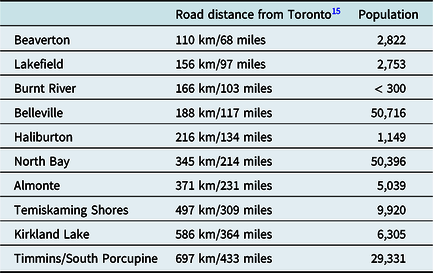
Belleville is a medium-sized, predominantly white-collar town to the east of Toronto along Highway 401 and the northern shores of Lake Ontario. The settlement history overlaps with that of Toronto in that the founders were mostly Loyalists (Boyce, Reference Boyce1967). Almonte is a small town located in the Ottawa Valley at the eastern extent of the province of Ontario. It is well known to be an enclave of conservative dialect features due to its distinctive Irish heritage (Jankowski & Tagliamonte, Reference Jankowski, Tagliamonte, Tanja Säily, Palander-Collin and Auer2017; Pringle & Padolsky, Reference Pringle and Padolsky1981, Reference Pringle and Padolsky1983). Beaverton, Burnt River, Haliburton, and Lakefield are small towns lying off the major highways (e.g., Highways 401 and 400 and 11) that extend eastward and northward from Toronto. North Bay, Temiskaming Shores, Kirkland Lake, and Timmins/South Porcupine are all located along Highway 11, the main north-south corridor that splits Ontario into eastern and western regions.
As noted, the historical settlement of areas north of Toronto differed from that of the southern areas of the province around Lake Ontario and Lake Erie in multiple respects (Tagliamonte, Reference Tagliamonte, Green and Meyer2014). While southern Ontario was populated mainly by United Empire Loyalists fleeing the United States in the wake of the American Revolution, the north was settled around small, dispersed towns that sprang up around natural resources (lumber, paper, mining, etc.). The population in these areas was multicultural from the beginning and represented several different socioeconomic strata (e.g., Tagliamonte, Reference Tagliamonte, Green and Meyer2014:204, 214–15). Moreover, the more northerly regions have “a strong and distinct northern identity” (Tagliamonte, Reference Tagliamonte, Green and Meyer2014:204; Zaslow, Reference Zaslow1973). In terms of linguistic features examined thus far, there are some similarities across Toronto and the north, but a range of conservative UK features exist in the small towns of Ontario, especially among the older population (Tagliamonte, Reference Tagliamonte, Green and Meyer2014:215). Even within some phenomena that north and south share, there are sometimes subtle differences in rates and usage: such as the be like quotative (Tagliamonte, Reference Tagliamonte, Green and Meyer2014:226–7), the difference between supper and dinner for the evening meal (Jankowski & Tagliamonte, Reference Jankowski and Tagliamonte2019), the use of certain swear words (Tagliamonte & Jankowski, Reference Tagliamonte and Jankowski2019), and discourse-pragmatic uses of there/here (Tagliamonte & Jankowski, Reference Tagliamonte and Jankowski2020).
4.2 Extraction and coding
All restrictive subject relative clauses were extracted and coded following the protocol detailed in an earlier study of Toronto (D’Arcy & Tagliamonte, Reference D’Arcy and Tagliamonte2010). This, in turn, was adapted from that of Tagliamonte et al. (Reference Tagliamonte, Smith and Lawrence2005b) and Tagliamonte (Reference Tagliamonte and Poussa2002) following Tottie and Harvie (Reference Tottie, Harvie and Poplack2000). Adverbial relatives (when, where, why, etc.) were excluded for being syntactically and semantically divergent (Levey, Reference Levey2006:54; Tagliamonte, Reference Tagliamonte and Poussa2002:152). A necessary caveat is that even when nonrestrictive relative clauses are excluded (Ball, Reference Ball1996:228–9; Tagliamonte et al., Reference Tagliamonte, Smith and Lawrence2005b:85), relativizers are a syntactically partitioned system. Relativizers with subject gaps diverge so much from those with object gaps that these contexts need to be considered separately (D’Arcy & Tagliamonte, Reference D’Arcy and Tagliamonte2010; D’Arcy & Tagliamonte, Reference D’Arcy and Tagliamonte2015). In Toronto, relative who is seldom found beyond subject gaps (D’Arcy & Tagliamonte, Reference D’Arcy and Tagliamonte2010:391), and the object relativization system consists largely of stable variation between that and zero (D’Arcy & Tagliamonte, Reference D’Arcy and Tagliamonte2010:393). For these reasons, we consider only restrictive relativizers with subject gaps.
As with Tagliamonte et al. (Reference Tagliamonte, Smith and Lawrence2005b), we include cleft (2a), possessive (2b), and existential (2c) structures (see also Ball, Reference Ball1996:257), on the basis of two of their properties. One is that they are not different enough from canonical relative clauses to warrant omission (Ball, Reference Ball1994:196; Ball, Reference Ball1996:236). The other is that they are fairly infrequent and so are unlikely to overwhelm the canonical relative clauses in terms of number and/or patterning. The envelope of variation is thus defined as a relativized subject regardless of the syntactic context preceding the head NP. AntConc (Anthony, Reference Anthony2019) was used to search for the strings “that,” “who,” and “which,” and then the output was manually sorted to identify restrictive relative clauses.Footnote 5

The zero-subject relativizerFootnote 6 is uncommon in most dialects (Bayley, Reference Bayley1999: 134; Guy & Bayley, Reference Guy and Bayley1995:155; Levey, Reference Levey2006:59; Sigley, Reference Sigley1997) and is often considered nonstandard or stigmatized (Beal & Corrigan, Reference Beal, Corrigan, Markku Filppula, Palander and Penttilä2005; Beal & Corrigan, Reference Beal and Corrigan2000:15; Cheshire et al., Reference Cheshire, Adger and Fox2013:58; D’Arcy & Tagliamonte, Reference D’Arcy and Tagliamonte2010:392).Footnote 7 In Toronto, this variant is both unusual and declining in apparent time (D’Arcy & Tagliamonte, Reference D’Arcy and Tagliamonte2010:393; Levey & Hill, Reference Levey and Hill2013:48-49). However, zero-subject relativizers have often been found at higher rates in rural/working-class varieties than in those of normative urban dialects (e.g., Bayley, Reference Bayley1999:118; Britain, Reference Britain, Coupland and Jaworski2008; Clarke, Reference Clarke, Kortmann and Upton2004; Comrie, Reference Comrie, Collins and Lee1999:83; Hackenberg, Reference Hackenberg1972:114; Henry, Reference Henry1995: Chapter 6; Macaulay, Reference Macaulay1991; Quirk, Reference Quirk1957; Tagliamonte, Reference Tagliamonte2013:102; Wolfram & Christian, Reference Wolfram and Christian1976:120–21). As could be expected for a nonstandard form, the zero-subject relativizer also appears more in speech than in writing (Hinrichs, Szmrecsanyi & Bohmann, Reference Hinrichs, Szmrecsanyi and Bohmann2015:808n2; Levey, Reference Levey2006:51–52; Sigley, Reference Sigley1997:224). Given the potential importance of zero-subject relativizers in Ontario, we were interested in taking these into account.
Zero variants of any morphosyntactic variable are difficult to find with efficiency or automaticity.Footnote 8 To find a baseline for the syntactic distribution of the zero-subject relativizers, we manually read through the text files of one of the community samples of the ODP (Belleville) in order to find the zeros (N = 40). Table 2 shows that, as with earlier analyses (e.g., Doherty, Reference Doherty2000), a majority of the zero-subject relativizers (N = 27, or 67.5%) are found in an existential or possessive construction. Therefore, we used AntConc (Anthony, Reference Anthony2019) to find all of the constructions in Table 2 and manually examined them to find zero-subject relativizers. We estimate that this procedure has located about two-thirds of the zeros in the corpus.
Contexts of the zero-subject relativizer in Belleville.

We exclude proper names, relative adverbials, atypical gapless relative clauses, ambiguities, WHIZ deletion, fossilized phrases, etc. (Tagliamonte et al., Reference Tagliamonte, Smith and Lawrence2005b:85–86). We also disregard whose, the possessive thats (McDaniel et al., Reference McDaniel, Stickney, Fowler and McKee2002; Seppänen & Kjellmer, Reference Seppänen and Kjellmer1995), and doubly filled heads such as that who or who that introducing a restrictive relative clause.
Each token was coded for animacy of the head NP, as per five categories based on those of Tagliamonte et al. (Reference Tagliamonte, Smith and Lawrence2005a:91) and D’Arcy and Tagliamonte (Reference D’Arcy and Tagliamonte2010): things and other inanimate nominals; small numbers of individual humans; the word people; collectives (including groups and indefinite pronouns); and animals.Footnote 9
This accounts for the two major linguistic factors that have consistently been found to affect English relativizer variation in prior studies (see Tagliamonte et al., Reference Tagliamonte, Smith and Lawrence2005b:87). We have controlled for syntactic role by restricting the sample to subject gaps only and coding for animacy. Beyond those, there are several minor linguistic factors that are also recognized as playing a role in restrictive relative clause variation, including the type of construction (Ball, Reference Ball1996:235; Tagliamonte et al., Reference Tagliamonte, Smith and Lawrence2005b:96), length of clause (Cofer, Reference Cofer1975:31; Sigley, Reference Sigley1997:214; Tagliamonte et al., Reference Tagliamonte, Smith and Lawrence2005b:97), adjacency of head NP and relative clause (Guy & Bayley, Reference Guy and Bayley1995:150; Montgomery, Reference Montgomery and Trahern1989:130–31; Sigley, Reference Sigley1997:214; Tagliamonte et al., Reference Tagliamonte, Smith and Lawrence2005b:98), definiteness of head NP (Tagliamonte et al., Reference Tagliamonte, Smith and Lawrence2005b:98; Tottie, Reference Tottie1997:233), and more (Cheshire et al., Reference Cheshire, Adger and Fox2013:62; Hinrichs et al., Reference Hinrichs, Szmrecsanyi and Bohmann2015:816–819). However, as with D’Arcy and Tagliamonte (Reference D’Arcy and Tagliamonte2010), we focus on social factors that govern the use of the relativizers. Paramount in our study are the roles of population size, distance from Toronto, and whether these elements correlate with the use of who.
Subject to these restrictions, the data comprise over 7,000 restrictive relative clauses with subject gaps from the ODP, from a total of 347 speakers.Footnote 10
5. Results and discussion
5.1 Geographic distribution of variants
Table 3 and Figure 1 display the proportion of each subject relativizer for each of the ten communities in Ontario targeted for this study compared to the proportions for subject relativizers in Toronto. Appendix A has the proportions and total number by community.
Proportions and total number of subject relativizers in each Ontario community. Values for Toronto are from D’Arcy and Tagliamonte (Reference D’Arcy and Tagliamonte2010:392).

Subject relativizers as percentage of the total subject relatives in 10 Ontario communities. Values for Toronto are from D’Arcy and Tagliamonte (Reference D’Arcy and Tagliamonte2010:392).

Figure 1 shows that the proportion of who (the light gray bars) is higher in Toronto (31.2%) than it is in any of the ten towns in the hinterland. The proportion of relative who in these communities spans a range from a high of 27% in Timmins/South Porcupine to a mere 10% in Haliburton and Almonte.
The communities are also distinguished by the relative proportions of the other relativizers: which, that, and zero. Timmins/South Porcupine patterns with Toronto. The three other towns along Highway 11, between Toronto and Timmins/South Porcupine (North Bay, Temiskaming Shores, Kirkland Lake), have a slightly lower proportion of who, but what sets them apart from Toronto and Timmins/South Porcupine is their use of which. Belleville has greater use of relativizer which than in any of the other places.Footnote 11 Almonte stands out for a different reason: the proportion of the zero-subject relativizer is the highest of all the communities. However, those interviewed in Almonte were all older speakers, likely explaining this heightened rate of zero. The other small towns—Lakefield, Beaverton, Burnt River, and Haliburton—also have a healthy representation of relative zero and comparatively low rates of who.
To confirm commonalities across communities, we use a conditional inference tree analysis (Baayen, Reference Baayen2009; Hothorn, Hornik, & Zeileis, Reference Hothorn, Hornik and Zeileis2006; Tagliamonte, Reference Tagliamonte2012: Chapter 5; Tagliamonte & Baayen, Reference Tagliamonte and Harald Baayen2012). This procedure, which operates iteratively within subsets, exposes divisions corresponding to statistically significant differences. Figure 2 shows a conditional inference tree created in R 3.6.3 (R Core Team, 2020) with the party package (Hothorn et al., Reference Hothorn, Hornik and Zeileis2006), using subject relativizers as the dependent variable and community as an independent factor.
Conditional inference tree (Hothorn et al., Reference Hothorn, Hornik and Zeileis2006) conducted in R 3.6.3 (R Core Team, 2020).

Figure 2 shows divisions at nodes 1, 3, 4, and 7. The first community to split off from the rest is Almonte. As is visible here and in Figure 1, this community has a distinctively high rate of the zero-subject relativizer and is the only place in the current study where there is more zero than who. The analysis identifies another regional set at node 3, which splits off the other small towns (consisting of Burnt River, Beaverton, and Haliburton) versus mid-size cities both north and south: Timmins/South Porcupine, Kirkland Lake, Temiskasming Shores, North Bay, and Lakefield. The proportion of who is lower in these small towns, with a subject relativizer system dominated by that. At the third level of division at node 4, the tree distinguishes Burnt River and Beaverton from Haliburton. At node 7, Belleville separates from the rest, possibly due to its higher rate of which. The position of Lakefield is curious; however, there are only 199 tokens of relativizers (as per Appendix A). Given that it is also geographically distant from the northerly towns (see Map 1), for the sake of regional grouping we reassign it to the node with Belleville, to which it is proximate. The four Highway 11 towns we henceforth refer to as the “northern towns,” Haliburton, Beaverton, and Burnt River are the “small towns,” and Belleville and Lakefield represent the “southeast.”
Figure 3 shows the distribution of relativizers in these four regions. The southeast and the northern towns pattern together in terms of their proportion of who; Almonte is sui generis, as noted. The key pattern of differentiation is, on one hand, the small towns (Beaverton, Burnt River, and Haliburton) as well as Almonte, and, on the other hand, the northern towns and the southeast, where the proportion of who is comparably higher. These regional differences point to a role for population size and local connectivity rather than raw distance as an explanatory factor in the use of relative who in Ontario English. Indeed, a Spearman’s correlation test in Microsoft Excel 2016 between the proportions of who across these eleven sites and distance from Toronto (see Map 1) show only moderately positive correlation (0.53). A similar test with the proportions and settlement population size is stronger (0.65).
Subject relativizers as percentage of the total subject relatives in five regions of Ontario. Values for Toronto are from D’Arcy and Tagliamonte (Reference D’Arcy and Tagliamonte2010:392).

5.2 Apparent time
D’Arcy and Tagliamonte (Reference D’Arcy and Tagliamonte2010:394) reported a classic inverted-V shaped trajectory in apparent time of subject relative who in Toronto, the reflex of an age-graded variant (Downes, Reference Downes1998; Holmes, Reference Holmes1992; Labov, Reference Labov1994:73). This pattern suggests that the subject relativizer system of the city is stable over time with individuals changing their use as they age, but the community, in general, stays the same as time goes by. A first step in assessing this possibility for the current data is to visualize the variation among subject relativizers in apparent time (i.e., by decade of birth), in Figure 5.
Proportions of who in five Ontario locations by animacy of the head NP. Values for Toronto are from D’Arcy and Tagliamonte (Reference D’Arcy and Tagliamonte2010:392).

Proportion of who among subject relativizers in apparent time (i.e., by decade of birth).

The results primarily indicate stability. The proportions of who and that are steady for most of the twentieth century, but it is worth noting that plotting the full range of the scale visually highlights the low frequency of who. Both which and zero are rare from the earliest decades of the twentieth century and show a visible downward trend. Notably, among speakers born after 1980, the proportion of who increases and that decreases.
The stability of these relativizers in apparent time can be interpreted in terms of what Labov (Reference Labov2007) refers to as transmission: when there is parallel frequency of forms across generations and locations. While this view of the data obscures the regional patterning that we have already identified, this finding suggests that the English-speaking settlers brought who-relativization with them—as per the founder principle of Mufwene (Reference Mufwene1996)—and that the system has remained essentially stable since that time. However, given the rise of who in the youngest speakers, diffusion (Labov, Reference Labov2007) must also be involved with this variation. Who as a relativizer, as noted, came about as a change from above and continues to have prestigious connotations in urban English-speaking populations in several countries. If diffusion is indeed involved, we might expect linguistic change in progress such that women lead change toward the more prestigious form, as per Labov’s Principle 3 (Reference Labov2001:274). Figure 6 tests this possibility by showing subject relative who by speaker gender.Footnote 12
Proportion of subject relative who in apparent time (i.e. by decade of birth) by gender.

Figure 6 offers several important findings. First, beginning with individuals born in the 1960s, women start to break away from the men by using more who. Second, in both gender groups, there is an evident change in progress beginning in speakers in the 1980s. These results support the interpretation of a change from above (Labov, Reference Labov2001:274). The Toronto data also showed that women used more who than men, but especially within a restricted group of more educated speakers. D’Arcy and Tagliamonte (Reference D’Arcy and Tagliamonte2010:397) argued that the female lead went hand-in-hand with stability (i.e. Labov’s Principle 2 [Reference Labov2001:266]) and that the heightened use of relative who in female to female speech was a synchronic reflex of social meaning from the old prestige associated with the wh- relativizers. The new findings presented here from northern cities and rural small towns of Ontario show stability as in the city and are also consistent with an interpretation of enduring prestige. Unlike in Toronto, however, they reveal a distinct increasing use of who in recent decades, especially by women.
Another reasonable hypothesis is that more educated speakers or those with white collar occupations are leading the change toward who, as part of a long change from above. Figures 7 and 9 test this possibility by showing the use of who by speaker decade of birth and binary level of education (any postsecondary education versus none) and binary occupation (blue-collar versus white-collar).
Proportion of who among subject relativizers in apparent time (i.e., by decade of birth), by education level (more-educated = at least some postsecondary education).

Figure 7 reveals a nuance to the apparent time trajectory: more educated and less educated speakers diverge. Both groups are stable in apparent time until the 1970s. Up to that point, educated speakers used more who (with the exception of those born in the 1980s). Then, there are two patterns. The less educated speakers have an increased use of who, rising to rival the more educated speakers in the 1970s. Thereafter, among those born in the 1980s, both groups show an increase in use of who. We will return to interpret these trends below.
Figure 8 reveals that individuals with white collar occupations show a consistent, slightly higher use of relative who among the oldest generations, but less so in later decades. Along with the fact that the differences are modest at every point in the trajectory, this suggests that occupation type is comparatively less diagnostic of relative who usage.Footnote 13
Proportion of who among subject relativizers in apparent time (i.e., by decade of birth), by occupation (white collar versus blue collar).

Strong evidence for diffusion alongside transmission would come from differing frequencies and/or grammatical patterns of the use of who, demonstrating contact with or influence from urban (mainstream) norms over time. Was the shift toward more who in rural Ontario only the result of social influence, or are there internal mechanisms of this linguistic change? Is there longitudinal transmission of constraints as well as frequency? To address these questions, we consider the remaining linguistic factor: the type of head noun by semantic category.
5.3 Semantic class of head noun
Historically, subject relativizer who came to favor [+human] subjects (Ball, Reference Ball1996:246); conversely, that became specialized for the opposite, and the zero-subject relativizer was relegated to specific constructions and conservative varieties. As an incoming form in rural Ontario, who may be continuing to encroach on human subjects. In this way, semantic class of the head noun may offer further insight into recent stages of this change.
Figure 4 displays the proportions of who in Toronto (D’Arcy & Tagliamonte, Reference D’Arcy and Tagliamonte2010) and in the four geographic regions outside the city according to four semantic categories of head nouns in the data. This visualization excludes the category of inanimate objects or concepts (things), since those are decidedly nonhuman and thus have near-categorical use of that (Ball, Reference Ball1996:246). Appendix B contains the counts and percentages.
Table 4 and Figure 4 show that animacy of the head NP operates in parallel across Ontario. Each region has the same constraint hierarchy: collectives and animals have the least use of relative who, collectives have a little more, and [+human] head nouns and the noun people have the most.Footnote 14 This stability of the constraint ranking of the semantic class of head noun across locations is consistent with transmission of the incoming form in this region. The ODP data show that, with respect to both the internal patterns of the system (the proportions of the variants) and the internal constraints (i.e., [±human]), the subject relativization system has been transmitted faithfully across generations and is (mostly) parallel across communities. However, there is a hint that this system continues to encompass prestige and geographical gradation. In order to test how the different factors operate together, we turn to statistical modeling. This enables us to assess the significance of the factors when treated simultaneously, evaluate interactions, and treat the many individuals in the sample as random.
Proportions of who in five Ontario locations by animacy of the head NP. Values for Toronto are from D’Arcy and Tagliamonte (Reference D’Arcy and Tagliamonte2010:392).

5.4 Statistical modeling
As per D’Arcy and Tagliamonte (Reference D’Arcy and Tagliamonte2010:401; Reference D’Arcy and Tagliamonte2015:273), given the nearly categorical use of that with nonhuman head nouns (Bailey & Ross, Reference Bailey and Ross1988:131), the model was run on only the [+human] tokens from the ODP data (N = 4356, from 347 individuals), that is excluding animals, collectives, and inanimate objects. From there, all the predictors and their interactions were tested together in R 3.6.3 (R Core Team, 2020) via mixed-effects logistic regression using the lme4 package (Bates, Maechler & Bolker, Reference Bates, Maechler and Bolker2011) and the BOBYQA optimizer (Powell, Reference Powell2009). The model was gradually refined in order to capture the significant factors. Even with the large token count, modeling date of birth as continuous was untenable, so decade of birth was used instead. Occupation was never selected as significant, so it was removed. The results are shown in Table 5.
Mixed-effects logistic regression on the likelihood of who as a relativizer (versus all of the alternatives together) for tokens with [+human] head nouns.

Each of these independent factors—region, decade of birth, gender, and level of education—contributes explanatory value due to encompassing one or more significant differences. In terms of region, the northern towns and the southeast both contain significantly more who than the small towns do: the effect size is both larger (higher absolute value of the estimate) and more highly significant (lower p value) for the southeast. In terms of decade of birth, against the reference value of the 1910s, the only decade with a proportion of who that differs significantly is the 1990s: the youngest people in the corpus use significantly more who than the oldest people, while none of the other decades is statistically distinguishable from the people born in the 1910s. The possibility of age-grading away from the standard in young adulthood, who, cannot be ruled out; Brook et al. (Reference Brook, Konnelly, Jankowski and Tagliamonte2018) found this in a panel study of a young woman in Toronto. However, the sex effect and educational effect suggest a role for change in progress with an acceleration occurring recently in apparent time. The sex effect reaches significance such that men use less who than women, and the educational effect is highly significant: people with more education in rural Ontario use more who. The social factors point to change from above in progress, and the regional patterning indicates the key role of region and population size.
6. Conclusion
We began our study by asking how subject relative who—a long-term change from above—would operate in a settler-colonial ecology where considerable migration occurred from the early to late nineteenth century, and to what extent this variant would be geographically variegated in a region as expansive as Ontario. We focused on speakers born and raised in communities that have an assortment of sizes, ancestral settler roots, relative isolation, and distance from the major urban center of the province (Toronto). We discovered that the situation in Ontario, with British-majority founders up to the mid-nineteenth century, preserves a trace of the conservative vernacular system of the English relativizer system at earlier stages in the UK. The contemporary geographic patterning of variants in Ontario illuminates a change from above as it spreads through about one hundred years of time and space.
First, subject relative who is found at varying proportions across Ontario communities. These range from a low of 10%, nearing the low rates found in rural UK communities in the late twentieth century (Tagliamonte et al., Reference Tagliamonte, Smith and Lawrence2005b) to 27%, almost a full third of subject relative clauses. The communities with the highest proportion of who, Belleville and Timmins/South Porcupine, have virtually the same amount of this variant as Toronto does (D’Arcy & Tagliamonte, Reference D’Arcy and Tagliamonte2010), but they are neither near each other nor at similar distances from Toronto. Rather, the proportion of who ends up hinging on population size. Timmins/South Porcupine is the most distant place represented in the data examined here, but it has a large size for its remoteness and an airport with flights to Toronto. The other northern towns—Kirkland Lake, Temiskaming Shores, and North Bay—are still more than 300 kilometers from Toronto but are much larger in size than the small towns closer to the city (see Table 1) and have fairly high rates of who. The places with the substantially lower rates are those that have small population sizes, even if they are nearer to Toronto in terms of raw distance. This is the pattern predicted by the cascade or hierarchical model of diffusion, which proposes that changes propagate from urban centers outward by targeting the outlying settlements in descending order of population (Labov, Reference Labov, Britain and Cheshire2003).
A striking finding is that on top of broad stability, signs interpretable as change from above are evident in the apparent-time patterning of relative who in Ontario. Across all three categories of settlement in the Ontario Dialects Project (the northern towns, the southeast, and the small towns including Almonte), who as a relativizer has increased recently in apparent time. While individuals with postsecondary education use more relative who consistently from the early decades of the twentieth century (Figure 7), in the later generations, those with less education are catching up and patterning with their stable, more educated counterparts. Further, from the 1960s onward, women use more relative who than men (Figure 6). These observations were tested in the statistical modeling, which confirmed the prevailing influence of the educational and gender effects as well as the lag in small communities and the increasing use of who toward the end of the twentieth century. We suggest that these temporally specific and socially demarcated developments are the result of external influences. While the jump in the use of who by people born in the 1940s may simply be the result of small token numbers in that decade in these data, the trends in the late twentieth century are more substantial and require comment. It is well known that Canadian education has been constantly under reform for more than a century (O’Sullivan, Reference O’Sullivan1999). In the context of broader global changes, Ontario has undergone expansive changes to its curriculum with specific bursts of education reform from the 1960s onward that have led to shifting standards for education and concomitant shifts in social attitudes toward education. One of the outcomes of this is an increasing proportion of the population with higher-level educational attainment, a globally reported trend (e.g., Breen, Reference Breen2010:367). While detailed analysis of these trends and their impact on linguistic phenomena is beyond the scope of this paper, similar influences on other linguistic variables in Ontario suggest that these broader influences are a topic ripe for further research. For now, what these trends underscore is that change from above is “clearly the result of social factors operating upon language” (Labov, Reference Labov2010:185). In this case, our findings indicate the extent to which the progression of relative who is regulated by geographic influences even several centuries after its onset. In sum, the adoption of relativizer who in the English-speaking world is a longitudinal process driven by social pressures, scaffolded by linguistic constraints (in this case, semantic class of head noun) and geography, each influence preserving an imprint of the development even after centuries.
Britain (Reference Britain, Chambers and Schilling2013) cautions that different types of variables in different places, situations, and languages might be subject to different forms of diffusion, but this is not the only variable in the Ontario Dialects Project for which Cascade Model patterning has been uncovered. Jankowski and Tagliamonte (Reference Jankowski and Tagliamonte2021) found similar results for indefinite pronominal quantifiers in the ODP. For this variable, there is also a change in progress: the quantifiers are increasingly formed with -one rather than -body, with a strong effect of education underlying the change. Similarly, Franco and Tagliamonte (Reference Franco and Tagliamonte2021) showed that the lexical item guy has increased dramatically in the late twentieth century, with partial Cascade Model effects also driven by speakers with more education. These combined findings suggest that prescriptive norms more generally are implicated in at least some of the linguistic changes in progress in Ontario. However, it is the lingering influence of spatially embedded patterns that leads us to an explanation centered on geography. Even when it comes to a change in progress dating back further than the arrival of European settlers in Ontario, one’s place of birth and location in time and space continue to be highly relevant to linguistic variation and change.
Acknowledgments
The second author gratefully acknowledges the support of the Social Sciences and Humanities Research Council of Canada for research grants from 2001 to the present. We are grateful to the following scholars and sources for some of the data that were used in this work under research agreements with the second author: Rebecca Roeder for the Thunder Bay data; Graeme Gordon and Kaye Rogers for the Tay Valley data; Professor Emeritus Ian Pringle (Carleton University) for the Lanark County data, from the 1975–1980 Linguistic Survey of the Ottawa Valley; John MacFie and the West Parry Sound District Museum for the Parry Sound legacy data; the Hastings County Historical Society for the Belleville Oral History Project Archive (1975); the Museum of Northern History for the Kirkland Lake 1983 data; the Cobalt Mining Museum for the 1990 Cobalt data. This research profited from the thoughtful and helpful feedback we received on this research from audiences at the 2016 annual meeting of the Linguistic Society of America (Washington, D.C., January 7–10, 2016), ICAME 39 (Tampere, Finland, May 30–June 3, 2018), and the Workshop on Urban and Rural Language Research: Variation, Identity and Innovation (Toronto, Ontario, November 9–10, 2019). We also extend our appreciation to the many fieldworkers and research assistants in the Language Variation and Change Research Laboratory at the University of Toronto who helped collect and transcribe the data, and to our anonymous reviewers.


 Open access

