





1. Introduction
Causality is a ubiquitous feature in how we perceive our world. From as simple as knocking down a tower of blocks to the more complex phenomena such as microbes causing illnesses, events have causes and effects. Not surprisingly, all languages of the world have dedicated constructions to express this fundamental notion of causality (Comrie, Reference Durgunoğlu1976). Namely, a variety of causative types exist and languages differ in which combination of these types they adopt (Comrie, Reference Durgunoğlu1976; Dixon, Reference Erguvanli and Taylan2000). Children not only need to learn cause-effect relations to make accurate predictions regarding future events (Gopnik et al., Reference Gopnik, Glymour, Sobel, Schulz, Kushnir and Danks2004), but also learn how their native language expresses these causal events. Children growing up in different language environments might start out with similar cognitive representations of causality (Saxe & Carey, Reference Saxe and Carey2006). Still, throughout development, they need to learn to map linguistic representations of causality in their native language onto their developing causal representations. The differences in how their native language expresses causality might shape how well young children achieve this mapping (Boroditsky, Reference Dixon, Dixon and Aikhenvald2011). Here, we ask whether the cross-linguistic differences in causal expressions influence the extent to which preschool-aged children map causal language on the causal aspect of an event.
Let us briefly focus on how causality is expressed in different languages. Some languages such as English expresses causality mainly with lexical causatives embedded in transitive syntactic frames. Lexical causatives are verbs that do not have any specific formal marker to express a causal meaning but the causal meaning is merely part of their semantics (e.g., fill, spill, break, melt). For example, in ‘Mommy is filling your bottle’, the lexical causative ‘fill’ entails both the mother’s causing action and the resulting change in the bottle. Other languages have additional forms to express causality. Turkish, for example, expresses causality not only with lexical causatives but also, and predominantly, with morphological causatives. The same example in Turkish is expressed as Anne şişeni dolDURuyor ‘Mom your bottle-acc fill(int.)-caus-prog-3.sg’. In this morphological causative construction, a specific causative marker, -dir, added to a non-causal verb stem, changes the meaning to a causal one. Please note that the -dir suffix can surface as one of -dir, -dır, -dür, -dur, -tir, -tır, -tür, -tur based on vowel–consonant harmony rules of Turkish, and it is -dur in this example. Imagine that the child in this example scenario does not know the meaning of the verb ‘fill’. Would having the verb in a transitive sentence frame with a subject argument and an object argument, both as in Turkish and English, be good enough to interpret causal meaning? Or would having a distinct formal marker of causality in this verb, as in the case of Turkish, make the child’s task easier to interpret causal meaning?
In the present study, we focused on these typological differences in how causality is expressed and investigated whether the cross-linguistic differences have an influence on the extent to which children conjecture a causal meaning. We tested Turkish and Swiss-German [Zurich variety]. Turkish is a language with elaborate morphology belonging to the family of Turkic languages. Morphology is separative (i.e., agglutinative), that is, there is a one-to-one correspondence of morpheme to grammatical category. For example, in gül-dür-ebil-di-k laugh-caus-abil-pst-1.pl ‘we could make [∅] laugh’, each of the grammatical categories – causative voice, abilitative mood, past tense, and person agreement – is denoted by a separate morpheme. Turkish typically has a subject–object–verb word order, but there is variation driven by information structure (Göksel & Kerslake, Reference Göksel and Kerslake2004). Swiss-German is an umbrella term for a large number of Alemannic dialects spoken in the German-speaking part of Switzerland. It is a dialect continuum that is mainly used in spoken interaction. Swiss German dialects differ from Standard German in many aspects including phonetics, lexicon, morphology, and syntax (e.g., Hollenstein & Aepli, Reference Hollenstein and Aepli2014). Morphology in Swiss-German is largely cumulative (i.e., fusional), resulting in a one-to-many relationship between morphemes and grammatical categories. For example, in Mir lach-et We laugh-pres.1.pl ‘We laugh’, the morpheme ‘-et’ denotes both the present tense and person agreement. In Swiss-German, the main verb is typically in the last position, only in the present tense it is in the second position and in interrogatives and imperatives it is in the first position (Lötscher, Reference Lötscher1978).
We chose Turkish and Swiss-German as our target languages because they are strong representatives of typological differences in the expression of causality. They differ in two crucial features with respect to causal constructions. First, Turkish has both morphological and lexical causatives, with morphological causatives predominating, while Swiss-German only has lexical causatives. Second, Turkish allows pervasive nominal ellipsis while Swiss-German does not. We explain these differences and what role they may play in the mapping between causal form and meaning in more detail below.
Regarding the first difference, examples (1) and (2) exemplify lexical causatives in Turkish (1) and Swiss-German (2). As illustrated in example (3), Turkish (3) also uses a morphological marker to causativize an intransitive verb root. Here the intransitive verb gül ‘laugh’ is causativized with the causative marker -DIr to produce gül-DÜr ‘make laugh’. There are a number of causative markers in Turkish (-DIr, -Ir, -Ar, -t/-It), which are verb-specific. In this study we focused on the marker -DIr, because it is the most frequent causative marker used in Turkish. The affix -DIr is used with several hundred verb stems in contrast to the other causative markers which are restricted to much fewer stems (Nakipoğlu & Üntak, Reference Nakipoğlu, Uzundag and Sarıgül2008). In addition, -DIr has been shown to be the default in Turkish-speaking children’s choices in production and the verbs taking other causative suffixes are overregularized with -DIr (Nakipoğlu et al., Reference Nakipoğlu, Sarıgül, Yıldız and Yumrutaş2012, Reference Nakipoğlu and Üntak2021).



The morphological marker in Turkish is transparent on the surface structure and a 100% reliable indicator of causality, meaning it always indicates a causal meaning when it is there. In contrast, lexical causatives as in example (1) do not show any specific formal marker that distinctly indicates that the meaning of the verb includes causality. The only structural marker a child could rely on in lexical causatives is the syntactic frame of the construction, that is, the transitive structure consisting a verb and two arguments. Transitivity, particularly the presence of two arguments, has been shown to be mapped onto causative meanings from a very young age (Arunachalam & Waxman, Reference Berko2010; Fisher, Reference Fisher, Gertner, Scott and Yuan1996, Reference Gampe, Kurthen and Daum2002; Jin & Fisher, Reference Jin and Fisher2014; Kline et al., Reference Kline, Snedeker and Schulz2017; Naigles, Reference Naigles1990; Naigles & Kako, Reference Naigles and Kako1993). Still, transitivity as a cue is not as reliable as the morphological marker because not all transitive verbs express causality, for example, verbs expressing contact (e.g., ‘touch’), perception (e.g., ‘see’), possession (i.e., ‘own’) or spatial relations (e.g., ‘approach’) (Kline et al., Reference Kline, Snedeker and Schulz2017; Shibatani & Pardeshi, Reference Shibatani and Pardeshi2002). The overt causative marker in Turkish might therefore focus the attention of the listener more strongly on the causal aspect of events because it exclusively marks causation in contrast to the transitive frame. Imagine a scene where a mom simultaneously walks toward her baby and makes a funny face which results in the baby laughing. When Turkish-learning children hear an accompanying sentence with a causative marker, they may be more likely to focus on the causal ‘making laugh’ event. On the other hand, Swiss-German-learning children hearing a lexical causative in a transitive sentence frame might as well focus on the non-causal approaching event, because the transitive frame might denote just a spatial relation as in ‘The mother approached the baby’ as well as a causal relation as in ‘The mother entertained the baby.’
Only a few studies, so far, have examined the role of verbal causative morphology in children’s interpretations of causality. Lidz et al. (Reference Lidz, Gleitman and Gleitman2003) examined three-year-old children speaking Kannada, a Dravidian language (spoken mainly in southern India) and Göksun et al. (Reference Göksun, Küntay and Naigles2008) examined two- to five-year-old children speaking Turkish. In both languages, the most reliable cue to causality is the verbal causative morpheme. In both studies, children were asked to enact sentences in which the syntactic frame and verbal morphology cues competed. For instance, they had to enact a sentence with a morphological causative (cueing a causal act-out) but a single argument (cueing a non-causal act-out). Children in both studies relied on the syntactic frame rather than the verbal morphology, such as failing to causatively enact morphological causatives used in an intransitive frame. Another study by Ammon and Slobin (Reference Ammon and Slobin1979) examined the causative act-outs of sentences in child speakers of either of four languages, namely, English, Italian, Serbo-Croatian, and Turkish. They showed an advantage of Turkish children in the correct causal interpretations and suggested this to be driven by the causative marker.
All these studies, however, used familiar verbs and therefore the effect of syntax or verbal morphology on causative act-outs was not independent of the verb semantics. In other words, children might have enacted some sentences more causally simply because they were more familiar with the particular verb used in the sentence and its causal meaning, rather than relying on the syntactic or morphological cues per se. Moreover, even though Lidz et al. (Reference Lidz, Gleitman and Gleitman2003) and Göksun et al. (Reference Göksun, Küntay and Naigles2008) were able to test if children chose to act on the syntactic or the verbal morphological cues when these cues competed, they could not test the extent to which children can exclusively make use of these cues to conjecture verb meanings when they do not conflict. Furthermore, in Ammon and Slobin (Reference Ammon and Slobin1979), the linguistic prompts included not only verbal morphological cues but also nominal case marking cues, in particular the accusative marker that marks the patient of the causal action. Accusative case is a strong cue for transitivity and causativity (Göksun et al., Reference Göksun, Küntay and Naigles2008; Ural et al., Reference Ural, Yuret, Ketrez, Koçbaş and Küntay2009). Therefore, in Ammon and Slobin (Reference Ammon and Slobin1979), the role of the causative marker in Turkish was conflated with the role of the accusative case marker. The goal of the present study is to test children’s judgment of syntactic and morphological cues in non-competing conditions using pseudo-verbs and avoiding accusative markers to assess the effect of these cues independent of the effect of verb meanings and case markers. Although the existing previous research hints at superior cueing by syntactic cues compared to verbal morphological cues, these results may have been strongly influenced by verb meanings. We expect this pattern to reverse in the favor of verbal morphological cues with the use of pseudo-verbs. Please note that pseudo-verb is abbreviated as VERB for linguistic notation throughout the manuscript.
Regarding the second difference, Turkish allows pervasive subject and object ellipsis while Swiss-German does not. For example, the object of the Turkish sentence (3) can be dropped as in (4). Although ellipsis is still possible in Swiss-German in cases where the subject is marked in the verb, such as ‘Chunnsch au? (Come-2.sg [∅] (you) too?)’ (Aepli, Reference Aepli2018), its use is very limited (Stark & Meier, Reference Stark and Meier2018) compared to Turkish. The lack of a direct object in a sentence with a novel verb is likely to elicit a non-causal reading in young English-learning children (e.g., Naigles, Reference Naigles1990). Further, in Turkish, the presence of two arguments is revealed as a strong cue for transitivity and causativity, and therefore, the ellipsis of the object argument may be expected to perturb the causal reading (Göksun et al., Reference Göksun, Küntay and Naigles2008; Ural et al., Reference Ural, Yuret, Ketrez, Koçbaş and Küntay2009). However, it is not known whether children learning a language such as Turkish, which provides additional cues to causality, namely a causative marker, would nevertheless conjecture a causal meaning for a pseudo-verb used in an intransitive frame when it is suffixed with a causative marker. Therefore, we asked first whether the causative marker in Turkish in and of itself (i.e., in the absence of an object argument), elicits a causal conjecture of a novel verb. In other words, does verbal causative morphology without a transitive frame elicit a causal reading? Given that the causative marker in Turkish is a fully reliable cue, it may not only achieve to elicit a causal conjecture in the absence of an object argument but also be even more likely to elicit it compared to a case where the object argument is present, but the causative marker is absent. Therefore, we asked second whether the verbal causative morphology without a transitive frame elicits a causal reading to a higher extent compared to the transitive frame without verbal causative morphology?

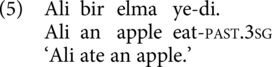
Nominal case marking, in particular, the accusative marker denoting the patient (i.e., undergoer) of a causal action, serves as yet another cue to causality (Göksun et al., Reference Göksun, Küntay and Naigles2008; Ural et al., Reference Ural, Yuret, Ketrez, Koçbaş and Küntay2009) as in the Turkish examples in (1) and (3). Nonetheless, it is possible in Turkish to form causal sentences without the accusative marker yet with two noun phrases, when the direct object has an indefinite or a non-specific status (Erguvanli & Taylan, Reference Fisher1984; Ketrez, Reference Ketrez2004), such as bir elma ‘an apple’ in (5). In this study, we aimed to examine the role of syntactic and verbal morphological causality cues on causal meaning conjectures, independent of the effect of nominal case markers. Therefore, we avoided accusative markers by using indefinite direct objects in our Turkish stimuli. Swiss-German does not employ a systematic case marking that cues a causal meaning.
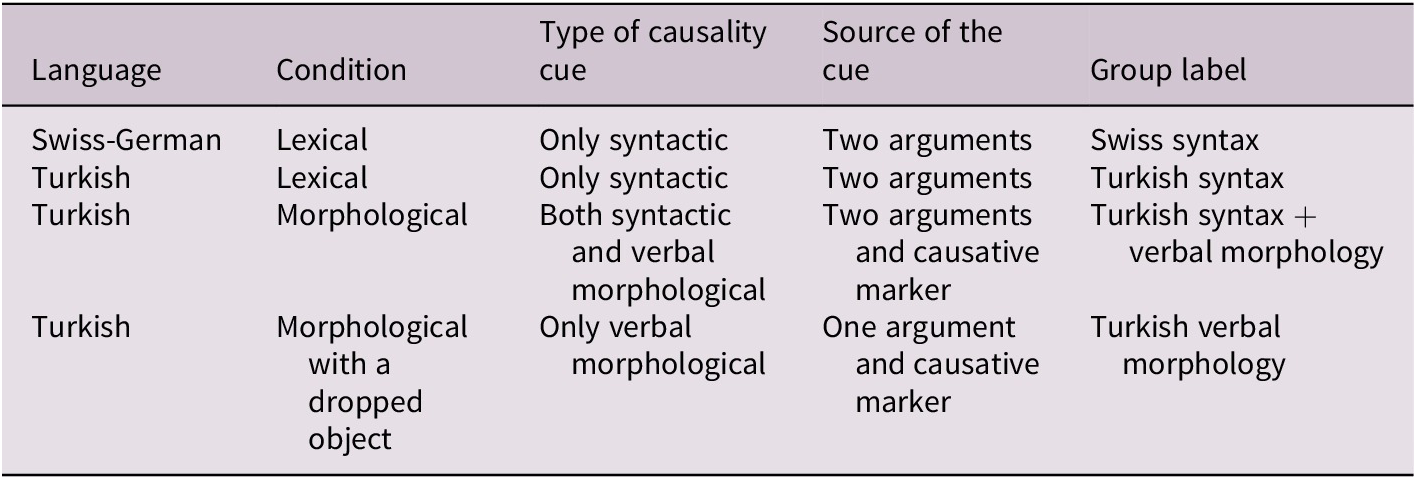
In the present study, we adapted the preferential pointing task of Kline et al. (Reference Kline, Snedeker and Schulz2017) for the cross-linguistic comparison between Turkish and Swiss-German. We assessed children’s choice of causal scenes (over non-causal alternatives) based on different linguistic causality cues. We compared the influence of the syntactic frame, which is a shared cue in the two languages, and the influence of the verbal causative marker, which is only available in Turkish. Specifically, we compared Swiss children who heard lexical causatives (i.e., only syntactic causality cue, e.g., ‘Where did the girl verb the round toy?’) to Turkish children who heard either i. lexical causatives (i.e., only syntactic causality cue), ii. morphological causatives (i.e., both syntactic and verbal morphological causality cues, e.g., ‘Where did the girl verb-caus the round toy?’), or iii. morphological causatives with a dropped object (i.e., only verbal morphological causality cue, e.g., ‘Where did the girl verb-caus [∅]?’). Please note that hearing lexical causatives in this context means hearing pseudo-verbs in a transitive frame, which stands for lexical causatives; and hearing morphological causatives means hearing pseudo-verbs marked with the causative morpheme. We hypothesized that, although the transitive frame is the only available cue in Swiss-German, Swiss children who hear a lexical causative would choose the causal scene to a similar extent to Turkish children who hear a lexical causative because the prevalence of non-causal transitives (e.g., see, believe) are presumably similar in these two languages. Hence, for a given unknown (pseudo-) verb used in a transitive frame, children in both language groups can be expected to conjecture a causal meaning to a similar extent, which should be less than perfect due to the existence of non-causal transitives in both languages. Furthermore, we hypothesized that both Swiss and Turkish children who hear a lexical causative would choose the causal scene to a lesser extent than Turkish children who hear a morphological causative or a morphological causative with a dropped object. The reasoning behind this hypothesis is that the verbal morphological marker of causality is expected to more reliably elicit a causal interpretation due to its certainty in expressing causality as a fully reliable cue, regardless of the transitivity cue (i.e., the presence or absence of a direct object argument), compared to transitivity cue alone.Footnote 1
An alternative reasoning might also derive from the following fact: Apart from the reliability of a given cue, the process/duration of learning a given cue may also play a role in how well that cue is used at a certain age. Usage-based language acquisition theorists would claim that both syntactic and morphological cues are acquired from the input with time (e.g., Tomasello, Reference Tomasello2003), whereas nativist theorists would claim that the syntactic cues are innate and universal, and morphological cues are acquired (e.g., Lidz et al., Reference Lidz, Gleitman and Gleitman2003). In the case that syntactic cues are indeed earlier to be acquired and morphological cues take longer, then it is possible that this learning aspect promotes the syntactic cues, while the reliability aspect promotes the morphological cues. Assuming that they have equal weight, these two aspects may in turn place the two types of cues in the same level in terms of how beneficial they are to derive causal meanings. Consequently, we may observe no overall difference in how well form is mapped onto meaning between syntactic and morphological cues.
To recapitulate, by using Turkish and Swiss-German as our test cases, we aimed to shed more light on cross-linguistic acquisition of form-meaning mapping in the domain of causality. We particularly addressed whether the distinctness and reliability of form (i.e., linguistic causality cues) promotes better mapping onto meaning. Accordingly, we expected learners of a language that provides a more reliable type of causality cue to be better in using that cue to infer causal meaning. The findings of the study have the potential to inform us on how children acquire causal language in differing language typologies.
2. Methods
2.1. Participants
We tested typically developing monolingual Turkish children (n = 135 (65 female), M(SD) age = 3;11(0;5), range = 3;0–4;11), and Swiss children (n = 45 (21 female), M(SD) = 4;2(0;5), range = 3;0–4;9). Typical development meant the absence of any parent-reported developmental problems such as language or hearing related problems. Monolingual meant that the parent-reported exposure of the child to (an) additional language(s) did not exceed 15% of the total language input.
Our sample size was determined by an a priori power analysis based on the effect sizes in the relevant literature. If not reported, effect sizes were calculated from reported statistics via the effect size conversion spreadsheet created by Daniel Lakens (http://osf.io/ixgcd/, Lakens, Reference Lakens2013). All the relevant studies reviewed had medium to large effect sizes with r values ranging from 0.32 to 0.60. We set our smallest effect size of interest as r = 0.32 (transformed to Cohen’s d = 0.68) and our power to 0.90 for the power analysis of a one-way ANCOVA examining whether group has an influence on the causal preference controlling for the covariates age and receptive vocabulary. We planned one-tailed analyses for the planned comparisons, therefore, we set our type 1 error rate to .016, correcting the alpha level of .05 for three pairwise comparisons between the Swiss children and the three groups of Turkish children. The study we adopted our design from, Kline et al. (Reference Kline, Snedeker and Schulz2017), had a non-normal distribution of the outcome scores with three to four-year-old English speakers; therefore, we similarly expected a non-normal distribution and foresaw the use of Wilcoxon–Mann–Whitney tests for our planned comparisons. Given these parameters, the sample size calculated per group was 45.
We tested but excluded from analyses additional 18 Turkish children (eight developmental problems, five technical errors, one fussed, and four younger than the target age range) and six Swiss children (fussed). Turkish participants were recruited from kindergartens in Istanbul, Turkey. Swiss participants were recruited via the participant database of the University of Zurich. All children received a small gift (and Swiss children also a certificate of participation). All parents gave informed consent before the study and all procedures were approved by the local ethics committee and performed in accordance with the ethical standards of the 1964 Helsinki declaration and its later amendments.
Children needed to pass a pretest to be included in the final analyses. We replaced children who failed to pass the pretest until we obtained our target sample size. Thirty-six Turkish children (16 verbal morphology, 10 syntax, 10 syntax + verbal morphology) and 21 Swiss children failed the pretest. Because the number of children who could not pass the pretest was larger than expected, we also compared the children who passed and who failed the pretest. In these analyses, we included 171 Turkish children (79 female, M(SD) age = 3;11(0;5) months, range = 3;0–4;11) and 66 Swiss children (34 female, M(SD) age = 4;1(0;6) months, range = 3;0–4;9).
2.2. Materials
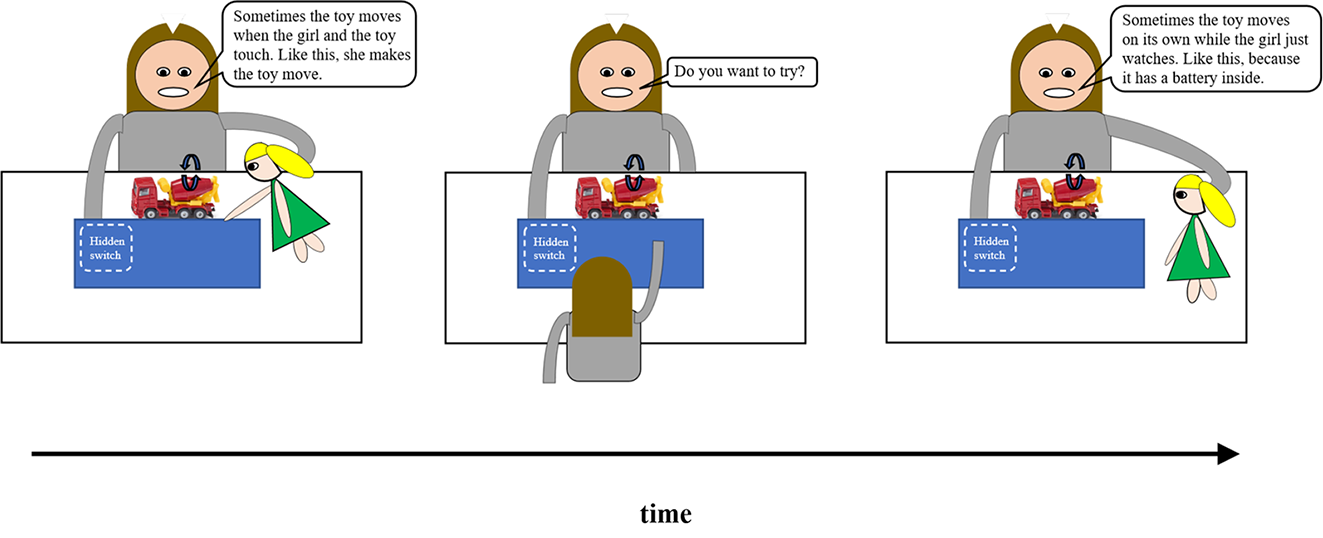
The experiment consisted of a training, pretest, and a test phase. All video and audio (prompt) stimuli used in the pretest and the test phase, and the experiment scripts can be found at: https://osf.io/aytnx/. The training was used to familiarize the children with the concept that a puppet would cause a toy to activate when she touched it or otherwise the toy would activate on its own when she did not touch it. For this phase, we used a female puppet and a remote-controlled toy cement truck whose container could rotate, which was attached to a cardboard box with an opening on the back. The remote control and its cable were hidden inside the box to allow the experimenter to secretly operate the toy to create the impression that either the puppet activates it or it activates on its own (see Fig. 1). A 17-inch Lenovo touchscreen laptop was used for the main experiment and the receptive vocabulary test. Both tests were run in PsychoPy2[version 1.90.1] (Peirce & MacAskill, Reference Peirce and MacAskill2018). We adapted the task from Kline et al. (Reference Kline, Snedeker and Schulz2017). For the pretest and test phase of the experiment, we used the original stimuli of Kline et al. (Reference Kline, Snedeker and Schulz2017) and replaced the original verbal prompts (English) with our tested languages (i.e., Turkish and Swiss-German). The audios in each language were recorded by a female native speaker (in the Zurich dialect for the Swiss-German audios). The pretest and test videos consisted of the causal and non-causal version of an event, where the same puppet as in the training phase touched an unfamiliar toy that could move, light up or make a sound, and immediately activated it (causal) or the puppet stopped short of touching the toy and the toy activated after a one-second delay (non-causal). There was one pair of events (i.e., causal and non-causal version) in the pretest phase and four pairs of events in the test phase. In the pretest phase, the unfamiliar toy was a green granular ball with a thick rope connected to it, which made a squeak sound. The toys in the four test trials were the following: (1) a fiber optic light attached on a blue box, which twinkled; (2) a yellow box with a mobile blue pin attached to it on top that fell down and naturally swung back and forth; (3) a mini fan with colorful led lights on its wings, which was embedded in a transparent domed glass and attached on a box, which rotated and lighted up; and (4) a white piece of paper folded like an accordion that unfolded upwards. The pairs of each event were presented one by one on the left and right hand side of the computer screen. The presentation order of the events and the sides were randomized.
Schematic representation of the materials and procedure of the training phase.
2.3. Procedure
Swiss children were tested in the lab at the Department of Psychology at the University of Zurich in Switzerland. Turkish children were tested in a quiet room in kindergartens in Istanbul, Turkey. Different experimenters, native speakers of the tested languages, performed the testing at the two sites. On the Swiss site, children and parents were first welcomed to a playroom in the lab where the child and the experimenter warmed up by playing games for several minutes. Then they were escorted to a testing room. On the Turkish site, the experimenter was introduced to the children in a classroom in the kindergarten and participating children were taken to a quiet room individually. The experimenter warmed up with the child by conversing for a few minutes before starting testing. On both sites, the child sat in front of a table facing the experimenter; and only on the Swiss site the parent sat behind the child. Children were videotaped by two cameras at the front and the back of the child.
The experimental session consisted of three phases, a training phase, a pretest phase, and the experimental test phase. In the training phase, the experimenter told the child that “sometimes the toy moves when the girl and the toy touch” and she brought the puppet toward the toy, made its hand touch the surface of the box right next to where the toy stood and immediately activated the toy and said “like this, she makes the toy move” (repeated twice). We gave these instructions in children’s respective languages using forms that did not contain any syntactic or verbal morphological causality cues. Specifically, we said when the girl and the toy touch instead of saying when the girl touches the toy, and used periphrastic causative constructions such as she makes the toy move instead of saying she moves the toy. Afterwards, the experimenter offered the child to try by moving the toy closer to the child and once the child touched the toy she activated it for a few seconds. Afterwards, the experimenter said “sometimes the toy moves on its own while the girl just watches”, tilted the puppet toward the toy, activated the toy after a brief pause, and said “like this, because it has a battery inside” (repeated twice).
The pretest phase consisted of a feedback and a forced-choice subphase. Similar to the training, the language used during these phases did not contain any syntactic or verbal morphological causality cues. In the feedback subphase, the children consecutively watched the causal and non-causal video. In the causal video, the puppet approached the green toy, jumped and sat on it, immediately upon which the toy made a squeak sound. In the non-causal video, the puppet just approached but stopped at a distance to the green toy, which spontaneously made a squeak sound after a brief pause. After watching each video, the experimenter pointed to the video and asked the child: “In this video, did the girl and the green toy touch or not touch?” If the child answered correctly she moved to the second question and asked: “In this video did the girl make the green toy squeak or did the toy squeak on its own?” If the child answered correctly she moved on to play the other video and asked the same questions. If the child responded incorrectly or did not respond to either of the questions she gave feedback by saying the correct answer as “Hmm, I think in this video the girl and the green toy touched/did not touch” and “Hmm, I think in this video the girl made the green toy squeak/the green toy squeaked on its own”. Then she repeated the video and asked the unanswered/incorrectly answered question(s) again. The same video was repeated only once more if the child did not answer or incorrectly answered the question. Then the experimenter told the child that they would practice pointing and the forced-choice sub-phase started. The child heard the positive and negative versions of two questions, totaling four questions. First question asked where the puppet and the toy touch (positive) and where they do not touch (negative), and the second question asked where the girl made the toy squeak (positive) and where she did not make the toy squeak (negative). This phase aimed at ensuring that the child could identify the touching and the (non-)causation in the videos. Following Kline et al. (Reference Kline, Snedeker and Schulz2017), children were included in the analyses of the test phase only if they correctly answered at least three out of the four questions in the forced-choice subphase, and those who failed to do so were replaced.
The actual test phase consisted of four trials. In each trial, children consecutively watched the causal and the non-causal video in randomized order. The description of the events in the videos are given in Table 1. After each video, the last frame stayed on the screen as a picture. Then children heard a positive prompt (e.g., Where did the girl verb the tall toy?) and a negative prompt (e.g., Where did the girl not verb the tall toy?) in randomized order. These prompt sentences depended on the condition groups (see Appendix A for the prompts in each group). Turkish-learning children were tested in three conditions and Swiss-German-learning children were tested in a single condition (see Table 2). Children were asked to answer to the prompts by pointing to one of the two pictures. Negative prompts were used to ensure that children chose the causal scenes not only due to a global preference for causal (or contact) events but that they chose them by paying attention to the valence of the questions.
Description of causal and non-causal events in the videos of the test trials

Description of conditions
After the test phase, children’s receptive vocabulary was assessed on the BILEX tool (Gampe et al., Reference Ger, You, Küntay, Göksun, Stoll and Daum2018). This tool was originally developed to measure bilingual children’s vocabulary in both of their languages. Here, however, we used it because it was available in both of our target languages and is easily administered on a touch screen. Children were instructed to touch on the picture of the named object among six possible pictures. It consisted of 48 trials (for the materials, see the OSF project link: https://osf.io/x5wcj/).
3. Results
We used R[Version 4.0.2](R Core Team, 2020) for our analyses. Our preregistered planned analyses can be found at: https://osf.io/edn9q, and their results are in Appendix B. The anonymized data and the analysis script can be found at: https://osf.io/aytnx/.
Following the analyses in the original study by Kline et al. (Reference Kline, Snedeker and Schulz2017), we examined children’s choice of the causal video separately upon the positive and negative prompts. However, children did not always choose the other (yet unchosen) video upon the second prompt. Specifically, 45 children (Swiss syntax = 12, Turkish verbal morphology = 10, Turkish syntax = 14, Turkish syntax + verbal morphology = 9) chose the same video upon both the positive and the negative prompt in at least one trial. Children’s choice of the causal video (causal preference) upon the positive prompt and their choice of the causal video upon the negative prompt were attained as two separate variables by converting them into a score ranging from 0 to 4 pertaining to the number of trials the child chose the causal video upon each question. A Wilcoxon rank-sum test showed that there were no sex differences in children’s causal preferences upon the positive or negative questions (ps = 0.14, 0.37, respectively), therefore we collapsed them in the analyses. Furthermore, two separate paired Wilcoxon rank-sum test showed that children’s causal preference upon the positive question did not differ based on whether the question came first (M = 1.26, SD = 0.92) or second (M = 1.44, SD = 1), p = 0.06, and their causal preference upon the negative question also did not differ based on whether the question came first (M = 0.74, SD = 0.84) or second (M = 0.64, SD = 0.75), p = 0.32.
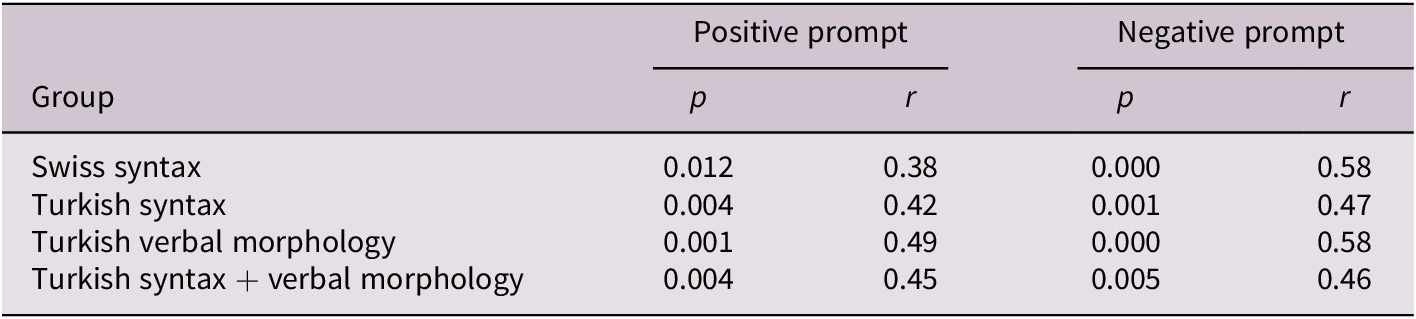
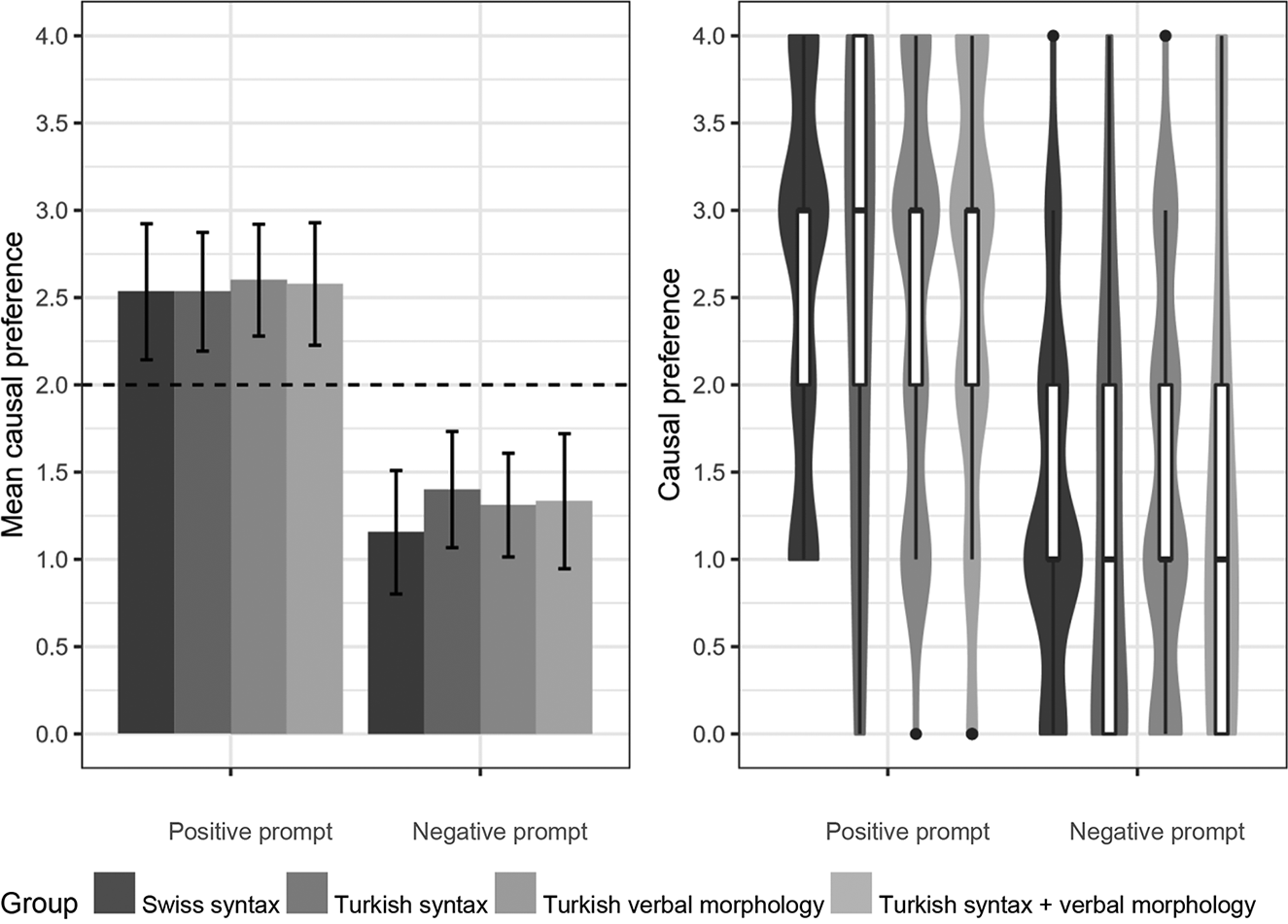
First, we compared children’s causal preference upon the positive prompt in each group – Swiss syntax, Turkish syntax, Turkish verbal morphology, Turkish syntax + verbal morphology – against chance (μ = 2), using one-sample Wilcoxon signed-rank tests. All groups chose the causal scene upon the positive prompt at a level above chance (see Table 3). To control that the children did not have a global causal preference but that they selectively chose it upon the positive prompt, we also compared children’s causal preference upon the negative prompt in each group against chance (μ = 2). All groups chose the causal video upon the negative prompt at a level below chance (see Table 3), showing that children were selectively mapping the causal sentences onto causal events. Fig. 2 shows the mean causal preference of each group upon the positive and negative prompts.
p-values and effect sizes(r) for chance comparisons
Children’s causal preference upon the positive and negative prompts across groups. The bar plots on the left show the means, and the error bars represent 95% confidence intervals. The violin and box plots on the right show the distribution of scores.
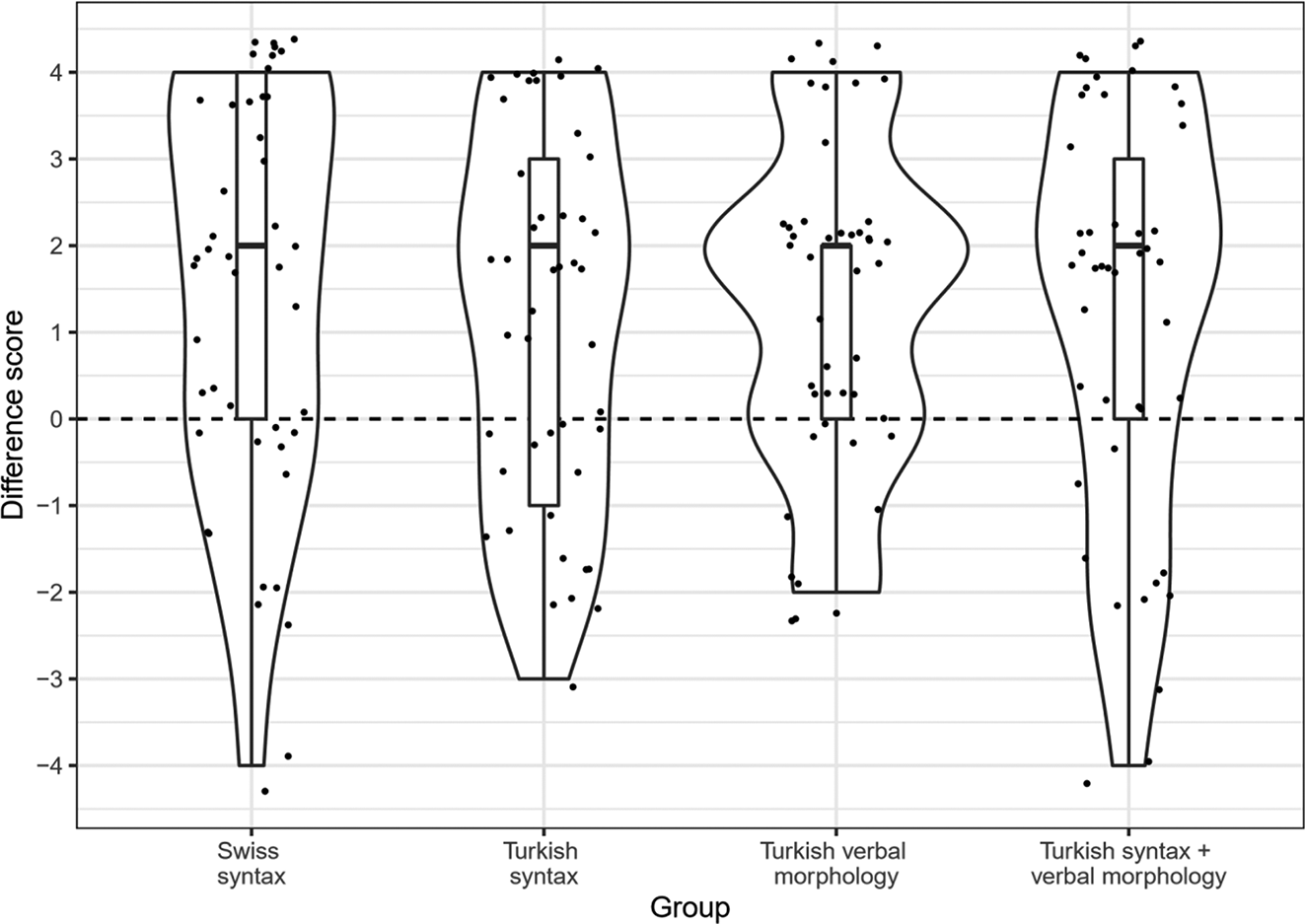
To illustrate the individual response patterns, we additionally calculated a difference score for each participant by subtracting the number of trials with causal preference for negative prompts from the number of trials with causal preference for positive prompts. A difference score of 4 indicated a strong correct differentiation of prompts (choosing the causal scene exclusively upon the positive prompt), 0 indicated no differentiation, and −4 indicated a strong incorrect differentiation of prompts (choosing the causal scene exclusively upon the negative prompt). Fig. 3 shows the distribution of difference scores in each condition. As can be seen from the violin and box plots, in each condition there were more children showing a stronger correct differentiation of prompts than those showing either no differentiation or incorrect differentiation.
Difference scores across groups. The violin plots and embedded box plots in this figure show the distribution of difference scores (i.e., number of trials with causal preference for positive prompts minus the number of trials with causal preference for negative prompts) across groups.
Next, we focused on the causal preference score upon the positive prompt and, using Wilcoxon rank-sum tests, compared Swiss children to the three groups of Turkish children, and compared Turkish children in the syntax group to Turkish children in the syntax + verbal morphology and verbal morphology groups. We found that Swiss children’s causal preference score upon the positive prompt (M = 2.53, SD = 1.31) did not differ from that of the Turkish syntax group (M = 2.53, SD = 1.14, p = 0.85), Turkish verbal morphology group (M= 2.60, SD = 1.07, p = 1.00), or Turkish syntax + verbal morphology group (M = 2.58, SD = 1.18, p = 0.99). Turkish syntax group also did not differ from either those in the syntax + verbal morphology group (p = 0.81) or the verbal morphology group (p = 0.83). Moreover, age was not a significant predictor of children’s causal preference upon the positive prompt for either of the language groups (ps = 0.36, 0.67; respectively for Swiss and Turkish). However, only for the Turkish children, receptive vocabulary scores predicted their causal preference upon the positive prompts (t = 2.68, p = 0.008, Adjusted R 2 = 0.04), such that children with a higher receptive vocabulary were better at mapping the causal sentences onto causal scenes (Swiss children: t = −0.47, p = 0.64). Please note that pairwise deletion was used for one Turkish participant whose vocabulary score could not be obtained. Fig. 4 shows the scatter plot of the receptive vocabulary scores and causal preference scores upon the positive prompt across the groups. Remarkably, one may observe in the plots that unlike Turkish children, the vocabulary scores of Swiss children accumulated on the higher end of the measurement scale. This may drive the lack of a correlation between vocabulary and task performance for the Swiss children. Together, these results indicated that children in all language and cue groups made use of the respective linguistic causality cues they were provided with to determine causal events, with no differences across the groups regarding the extent to which they did so.
Causal preference as a function of receptive vocabulary across groups. The scatterplots show the relationship between the causal preference upon the positive prompt and receptive vocabulary scores across groups.

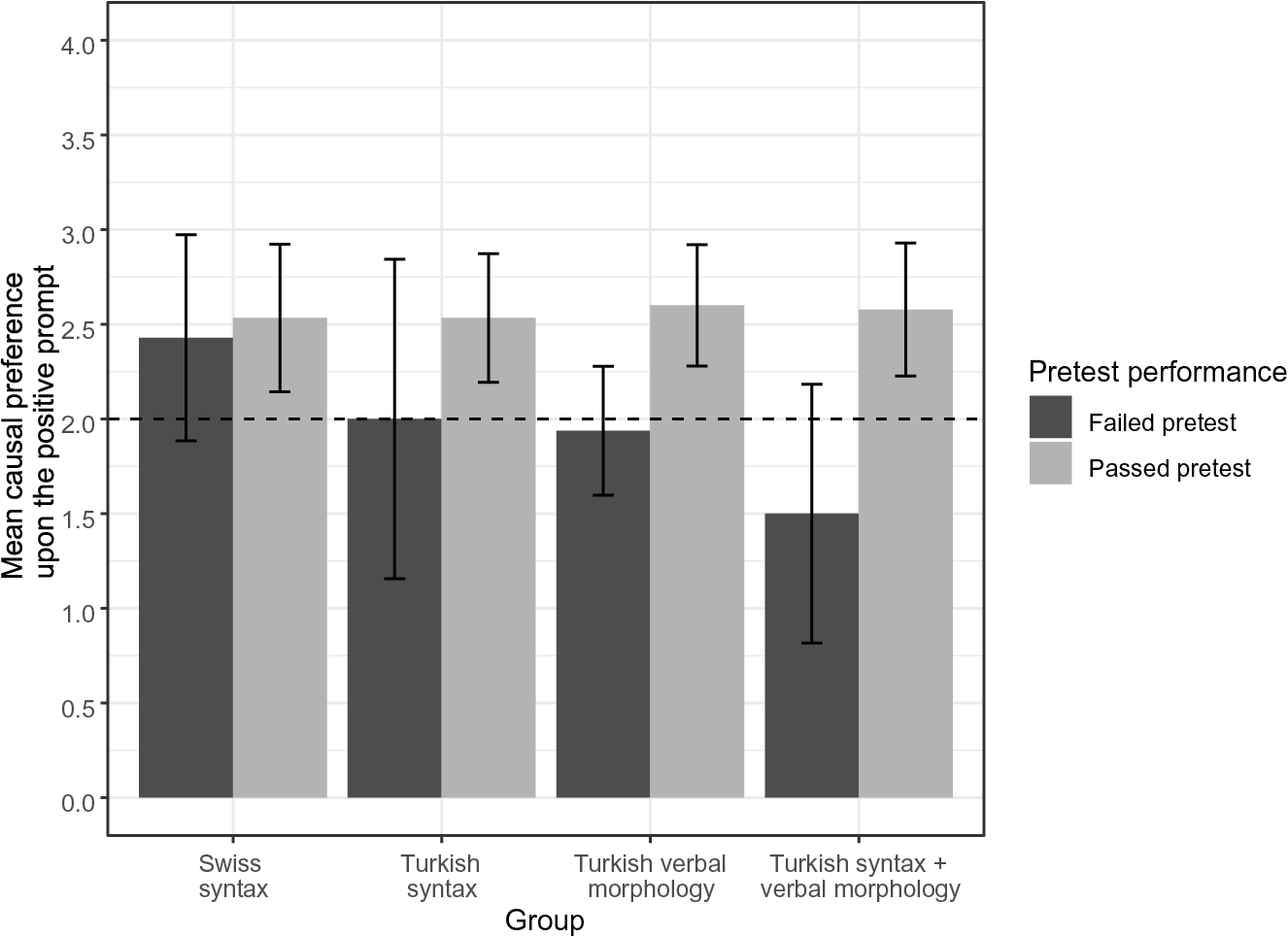
Although children who failed the pretest were replaced for the final analyses, we had continued testing even if the children failed the pretest. However, the number of children who failed to pass the pretest were far more than expected based on the findings of the adapted study (Kline et al., Reference Kline, Snedeker and Schulz2017). Therefore, we decided to additionally analyze the performance of the children who failed the pretest in comparison to those who passed. This allowed us to examine whether children who understood the contact and the causality in the pretest videos performed better in mapping the causal prompts onto causal scenes at test. Indeed, we found that passing the pretest predicted children’s preference of the causal event upon the positive prompt, controlling for the condition, age and the receptive vocabulary score (t = 2.47, p = 0.01, Adjusted R 2 = 0.04). Children who passed the pretest were better at mapping causal prompts to causal scenes. In addition, the causal preference score upon the positive prompt of those children who failed the pretest was at chance for all groups (ps = 0.15, 1, 0.82, 0.19; respectively for Swiss syntax, Turkish syntax, Turkish verbal morphology, and Turkish syntax + verbal morphology groups). Fig. 5 shows the mean causal preference upon the positive prompt for children who passed vs. failed the pretest, across the groups. We additionally checked the performance in the pretest score itself, that is, the number of correct answers out of the four questions in the forced-choice subphase. A Kruskal–Wallis test showed that the pretest score of children did not differ across the groups (χ2(3) = 7.29, p = 0.06). Table 4 shows the number of children included in each group and the mean and SD of their pretest scores.
Pretest scores across groups

Causal Preference as a Function of Pretest Performance. The plots show the mean causal preference upon the positive prompt of children who passed or failed the pretest across groups. Error bars represent 95% confidence intervals.
4. Discussion
In this study, we assessed the influence of the syntactic frame and verbal morphological cues on deriving causal meanings in two distinct languages with differing cues for indicating causality. We found that the transitive syntactic frame was a comparably effective cue for children to detect causality both in Swiss-German and Turkish. The verbal morphological cue in Turkish, on the other hand, did not provide the Turkish-learning children with additional sensitivity to causal meaning compared to either Swiss-German-learning children who do not have this cue in their language or Turkish-learning children who did not receive this cue. Nevertheless, the verbal morphological cue was in and of itself a sufficiently effective cue for Turkish children to conjecture a causal meaning, given that they consistently mapped morphological causatives with or without a dropped object onto causal events. That is, even when the object was missing in a sentence and therefore the syntactic frame possibly hinted a non-causal meaning (e.g., Naigles, Reference Naigles1990), Turkish children still expected a causal meaning because the morphological causative marker was present.
The causative marker in Turkish did not lead children to map sentences more reliably onto causative events in comparison to Swiss children or Turkish children in the syntax condition, either when it was provided alongside the syntactic cue or alone. Therefore, the fact that this marker is a distinct and deterministic causality cue compared to the hidden and probabilistic syntactic frame cue does not seem to provide an advantage for children in focusing on the causal aspect of an event. Whereas our findings do not lend support for a particular influence of verbal causative morphology, the previous finding that the causative marker in Turkish leads to a better comprehension of causality (Ammon & Slobin, Reference Ammon and Slobin1979) could be attributed to their use familiar verbs and the coexistence of nominal case marking cues alongside verbal morphological cues. Further research is needed to tease apart the potential impact of these different components.
Nonetheless, when the causative marker was provided in the absence of the syntactic cue, Turkish children still performed as well as the Swiss children. If Turkish children relied solely on the syntactic frame, then they would have chosen the causal video at or below chance upon the prompt with the single noun phrase and the causative marker (i.e., ‘The girl verb-caus-pst’), given that the intransitive frame cues a non-causal meaning (e.g., Naigles, Reference Naigles1990). They would have inferred that the girl does something on her own and chosen one of the videos at chance because the girl performs the same action such as hopping toward the toy in both the causal and non-causal version of an event, or they would have further inferred that the girl does something on her own but likely not on another thing and chosen the causal video below chance. Therefore, the verbal morphological cue in this condition is highly likely to have driven the causal choices of the children. Göksun et al. (Reference Göksun, Küntay and Naigles2008) did not find an effect of verbal morphology on Turkish children’s causality judgments over and above the influence of the syntactic frame and nominal case markers. However, with this study, we showed that three-year-olds do use the verbal morphology cue to infer causality even in the absence of syntactic frame or case marker cues. Yet, we acknowledge that the effect of verbal morphology could be inferred more confidently by a future study examining whether Turkish children would choose causal scenes at or below chance when hearing a prompt with an intransitive frame but without a causative marker.
The finding that the causative marker in Turkish did not result in firmer causal construals compared to transitivity in Swiss-German or Turkish can be interpreted in at least three ways. First, typological differences in causal expressions might not lead to differences in children’s causal construal of events. Although the absence of evidence does not mean evidence of absence, several points render the absence interpretation more likely. For one, the sufficient sample sizes of the present study predetermined by power analyses may rather hint at a lack of influence of typological differences. For another, in a recent study with 2.5- to 3.5-year-old Turkish- and Swiss-German learners, we investigated the role of different causal expressions on their understanding of non-prototypical causal relations. This study also did not find any differences between the different types of causative constructions in these two languages (Ger, Stuber, et al., Reference Arunachalam and Waxman2021). All in all, children may be deriving a causal meaning from any form of causal expression to a similar extent regardless of the distinctness or reliability of the form, as long as there are probabilistic form-meaning regularities in a given language and children are able to pick up on these regularities.
Second, typological differences in causal expressions might not ‘yet’ lead to differences in the causal construal of events. Specifically, before the age of 4, Turkish children may still be in the process of abstracting causative markers as productive morphemes that express a causal meaning. Given that there are both lexical and morphological causatives in Turkish, and that the morphological marker is not systematically present in every causal construction, the adult-like abstraction of the morphological marker may take more than three to four years. In fact, in another recent study, we showed that Turkish children reliably judged the use of the causative marker -dir for causativized events only at the age of five (Ger, You, et al., Reference Ger, Stuber, Küntay, Göksun, Stoll and Daum2021). Therefore, some children might have not yet acquired an abstraction for the causative marker and thus perceived the causatively marked pseudo-verb as an unmarked root verb. This explanation is in line with the usage-based language acquisition accounts, where children are proposed to learn inflected verbs as unanalyzed chunks in the initial stages of language acquisition until they have enough exemplars to generalize a rule from the input they hear (Aguado-Orea & Pine, Reference Aguado-Orea and Pine2015; Theakston et al., Reference Theakston, Lieven and Tomasello2003, Reference Theakston, Lieven, Pine and Rowland2005; Tomasello, Reference Tomasello2003). In sum, an advantage of the distinct and reliable causative markers in Turkish for deriving causal meaning may emerge only later than the age of 4, when the causative makers are comprehended at an abstract, adult-like level.
One might counterargue that the stage of abstract grammar is already attained at around the third year of life. The influence of the number of arguments in a sentence as a syntactic cue has been demonstrated with children as young as 15 months of age (Jin & Fisher, Reference Jin and Fisher2014) and corroborated with an abundance of studies scanning toddler ages, although almost always with English (Fisher et al., Reference Ger, Stuber, Küntay, Göksun, Stoll and Daum2010, for a review). Our findings also show that by the age of three, the syntactic frame cue is used to infer causal meanings in speakers of Turkish and Swiss-German, as well as the use of verbal morphological cues in speakers of Turkish. However, we did not observe an improvement with age although children did not show ceiling performance. This is in line with Kline et al. (Reference Kline, Snedeker and Schulz2017) who did not find a difference in performance of three- and four-year-old English-speaking children with the same task that we adapted in our study. One reason could be that the causal and non-causal event alternatives in this task were attained by manipulating the spatio-temporal contingencies between the two sub-events of an action while keeping the sub-events the same in both causal and non-causal versions. Hence, they were relatively more difficult to distinguish than the obviously different event alternatives used in the majority of the previous literature with younger children, that is, caused-motion events (causal) and simultaneous action events (non-causal) (Fisher et al., Reference Ger, Stuber, Küntay, Göksun, Stoll and Daum2010). Therefore, the difficulty in mapping might have originated from the decoding of events rather than in decoding of the sentence structures. Nonetheless, the possibility remains that children still develop their syntactic and verbal morphological analyses into the preschool and school ages. In fact, especially for adult-level abstract operations with pseudo-verbs, children do continue to develop their skills toward and across the school ages for morphologically rich (e.g., Turkish: Durgunoğlu, Reference Fisher2003; Japanese: Klafehn, Reference Klafehn2011) as well as morphologically impoverished languages (e.g., Berko, Reference Boroditsky1958).
Yet a third possibility as delineated in the introduction and closely related to the second point is that, at the ages of 3–4, the process/duration of learning a given cue may also play a role in the extent to which a cue is used to infer a particular meaning, aside from the reliability of that cue. Although verbal morphological cues are more reliable in denoting a causal meaning compared to syntactic cues, they may require more than 4 years of language exposure to become the dominant cue that children rely on, as opposed to the syntactic cues that may be acquired earlier (e.g., Göksun et al., Reference Göksun, Küntay and Naigles2008; Lidz et al., Reference Lidz, Gleitman and Gleitman2003). In this case, while the reliability aspect might have partially highlighted the verbal morphological cues, the learning aspect might have partially highlighted the syntactic cues, resulting in the effect of the cues to cancel each other out. Future studies testing older children might shed more light on this possibility.
Children’s receptive vocabulary, as assessed by the BILEX tool, was related to their mapping performance only for the Turkish children. One possible explanation for the lack of this relation in Swiss children is that their scores accumulated on the higher end of the score range in our measurement scale so that we were not able to capture fine-grained individual differences in their vocabulary. Yet, the finding for the Turkish children suggests that children with a larger vocabulary might entertain more opportunities to deduce rules about the syntactic organization of nouns and the operations with morphological markers simply because they recognize these nouns in sentences and can determine their position in a sentence as well as whether they take any suffixes. As much as this lexicon to grammar route is possible (Bates & Goodman, Reference Bonawitz, Ferranti, Saxe, Gopnik, Meltzoff, Woodward and Schulz1997; Tomasello, Reference Tomasello2003), so is grammar to lexicon route (Gleitman, Reference Gleitman1990), or even more plausibly a bidirectional influence (Marchman & Bates, Reference Marchman and Bates1994). In any case, the effect size of this relation was low, and our vocabulary measure only consisted of nouns, hence we are limited in our interpretations specifically for the verbal morphological markers. A vocabulary measure of verbs would certainly serve as a better proxy for the ability to distinguish root verbs and causative markers.
In an exploratory vein, we had a closer look at children who failed the pretest. One potential reason why we had many more children than Kline et al. (Reference Kline, Snedeker and Schulz2017), who studied English, might be the language. Remember that two of the four pretest questions concerned causality and asked whether the girl (puppet) made the toy squeak, or the toy squeaked on its own. These questions used a periphrastic construction, which is quite common in English. Many studies researching children’s causal understanding use this construction type (e.g., Bonawitz et al., Reference Comrie and Shibatani2010; Gopnik et al., Reference Gopnik, Sobel, Schulz and Glymour2001). However, the periphrastic construction may be more unusual in Turkish and Swiss-German. Nonetheless, comparing the mapping performance of Turkish and Swiss children in our study who passed vs. who failed the pretest, we found a small but positive effect of passing the pretest. Children who failed to learn the contact and causality relations in the scenes of the pretest scored worse in mapping causal sentences to causal scenes than those who did learn, and their performance was only at chance level. On the one hand, this may suggest that children make use of the linguistic cues of causality to match causal language with causal events better when they can distinguish causal and non-causal events based on spatio-temporal features. It is possible that those children who failed the pretest might have derived causal meanings from the causal prompts and non-causal meanings from the non-causal prompts but failed to match them correctly with the corresponding causal and non-causal events because they were not able to detect the causality and non-causality in the presented events, although being trained. On the other hand, it is also possible that the children who could understand the causality cues in language were also already better at detecting the causality in events. Yet another possibility is that, given that we assessed children’s understanding of contact and causality relations in the pretest using periphrastic causative constructions, children who failed to infer causality from periphrastic forms may also have failed to infer causality from other forms of causal expressions available in their respective languages.
There are two limitations of our study. First, it is possible that children did not necessarily infer a causal meaning for the pseudo-verb used in a transitive frame, but rather simply attributed a meaning like ‘touch’ for the pseudo-verb in ‘Where did the girl VERB the tall toy?’ and chose the video where the puppet touches the toy. However, we think this is not likely for a number of reasons. First, specifically in Turkish, the verb corresponding to ‘touch’ – dokun – is not used in a canonical transitive frame with an accusative marked object, but rather a dative marked object, and cannot be used with an indefinite object. Therefore, it would be ungrammatical to replace the pseudo-verb in the test prompts with ‘touch’. The possibility remains that instead of replacing the pseudo-verb with ‘touch’, the children may have mapped the pseudo-verb onto a novel contact verb with a different syntax. Still, there is reason to believe that children would not map all of the four different pseudo-verbs on the fairly similar touching action in each trial, based on mutual exclusivity assumption (Markman et al., Reference Markman, Wasow and Hansen2003). Second, during the training phase of the experiment, children of both language groups were taught that the puppet (and themselves) caused the toy to work when they touched the toy, but the toy worked on its own when they did not touch it. Hence, children were trained to focus on the causation as a result of touch and thus can be expected to focus on the presence or absence of causation in choosing what scene fits the linguistic prompts. Third, it is a well-established finding that children associate spatiotemporal contiguity with causality as early as in infancy (Saxe & Carey, Reference Saxe and Carey2006). Hence, we would expect children to naturally perceive causality in our causal scenes displaying spatiotemporal contiguity. Furthermore, we included children in the analyses only if they correctly answered the pretest questions asking in which video the puppet touched the toy and thus made the toy work. Hence, we presume that the children have already learned to infer a causal relation whenever there is physical contact between the puppet and the toy before the test phase. Having learned the higher-order causal relation as a result of the lower-order contact, it is not likely that children still constrain their attention only on the lower-order contact relation. Finally, Kline et al. (Reference Kline, Snedeker and Schulz2017) showed with their control experiment (Experiment 2) that it was the causality per se, rather than the presence or absence of contact, which drove children’s preference of causal scenes. We nevertheless acknowledge that more research is needed to clarify this issue further. A potential future direction is to replicate the current study with scenes where the causal and non-causal alternatives do not differ in terms of contact.
As a second limitation, and relevant to the first point, children might have selected the target scene simply based on the presence or absence of negation in the sentence. For instance, if they attributed a meaning such as ‘touch’ for the pseudo-verb, then it would be enough to choose the causal scene when the sentence is affirmative (i.e., The girl touched the tall toy) and choose the non-causal scene when the sentence is negative (i.e., The girl did not touch the tall toy). Nonetheless, this explanation, based on a possible replacement of the pseudo-verb with the verb ‘touch’, is not likely as mentioned before. In addition, the negation cannot simply be associated with the scene where there is no causal relation, because it matters what the negation word or marker actually negates in the sentence. For example, if the children infer a meaning like ‘The girl approached the tall toy’ then they cannot simply choose the causal scene when it is affirmative and choose the non-causal scene when it is negative, because the girl approaches the toy in both scenes. Therefore, the children must have already inferred that the verb that is negated expresses a causal meaning, to make a selection based on the presence or absence of negation.
In summary, our study, comparing two languages that include different forms of causative constructions (i.e., Turkish and Swiss-German), showed that by the age of three, children use both syntactic and verbal morphological cues to derive causal meanings. Swiss and Turkish children made use of the syntactic cue to a similar extent. Moreover, the verbal causative morpheme in Turkish provided a comparably strong cue in the absence of syntactic cues but did not provide an advantage in causal construals. Hence, our study reveals that children learn the grammatical patterns of expressing causal meanings that are specific to their languages and use these language-specific grammatical cues similarly well, be it syntactic or morphological, to interpret causal meanings.
Acknowledgments
During the work of her dissertation, Ebru Ger was a fellow of the “International Max-Planck Research School on the Life Course” (IMPRS LIFE, http://www.imprs-life.mpg.de). We very much thank the participants of this study, their parents, and the kindergartens for their participation. We also thank Dr. Melissa Kline for making their video material available and providing further information on the procedure of their study. We thank Prof. Ben Ambridge for his feedback on the findings of the study. We greatly appreciate the thoughtful contribution of Larissa Stuber and Guanghao You on the conceptualization of this study, and the help of Larissa Stuber, Sura Ertaş, Sena Gezici, Merve Duran, and Raphaela Schnider in data collection and coding. We thank the anonymous reviewers for their feedback.
Data availability statement
The data used in this study, the analysis code, all the audio and video materials, and the experiment script (in Python) can all be found at: https://osf.io/aytnx/.
Funding statement
This work was funded by the Swiss National Foundation (Project number 100015_169712, PIs: Sabine Stoll, Moritz M. Daum).
Conflicts of interest
We have no conflicts of interest to declare.
A. Appendix A
A.1. Prompts in each language and condition

B. Appendix B
B.1. Planned analyses results
We planned analyses with a different scoring where for every trial the child gets a score of 1 only if they both point to the causal video upon hearing the positive prompt and point to the non-causal video upon hearing the negative prompt. Otherwise, the child gets a score of 0. The dependent variable is the sum of these scores for all four trials and ranges from 0 to 4. We planned to test whether there is a difference between at least two groups among the total four groups (three Turkish and one Swiss) on this total score, controlling for age and receptive vocabulary using a one-way ANCOVA after checking for relevant assumptions. However, the normality of residuals assumption was not met for the planned ANCOVA. Therefore, we moved on to the planned individual pairwise comparisons. Scores from all groups violated the normality assumption, thus we conducted three Wilcoxon–Mann–Whitney tests using the ‘wilcox_test’ function of the ‘coin’ package[version 1.3.1]. All comparisons yielded non-significant results with no difference in the score of the Swiss syntax group compared to the Turkish syntax (Z = 0.31, p = 0.75), Turkish morphology (Z = 0.23, p = 0.82), and Turkish syntax + verbal morphology groups (Z = −0.23, p = 0.82).


 Open access

