


Impact statement
This article provides insights from anthropological research on plastic use and waste management in metropolitan cities, provincial towns and peri-urban communities in India, Indonesia and the Philippines – often cited as three of the world’s top plastic polluters. We propose a conceptual framing of plastics as leaky, supported by collaborative multi-sited fieldwork and demonstrate that plastic pollution is a result of systemic and structural failures across the lifecycle of plastics, and not a result of material leakage, release or emission alone. We thus challenge the unfair attribution of plastic pollution primarily to low- and middle-income countries, especially those in South and Southeast Asia, by questioning whether downstream waste management can effectively contain plastic leakage. The article is written in the wake of the failed fifth meeting of the international negotiating committee to adopt an internationally binding treaty on reducing plastics in Busan in 2024. Two contentious issues were at stake during this meeting: the need to adopt a production cap on virgin plastics and the need to reduce toxic chemicals in plastic production to mitigate harm caused by plastic-associated chemicals. Drawing insights from community-level waste management practices that include efforts to upcycle and to find alternatives to plastics among populations severely impacted by plastic pollution, our conceptual argument advocates for policy measures to reduce the volume of plastics and hazardous chemicals. Acknowledgment of plastic’s inherent leakiness among scholars and policymakers should result in generation of effective, equitable interventions and regulatory policies.
Introduction
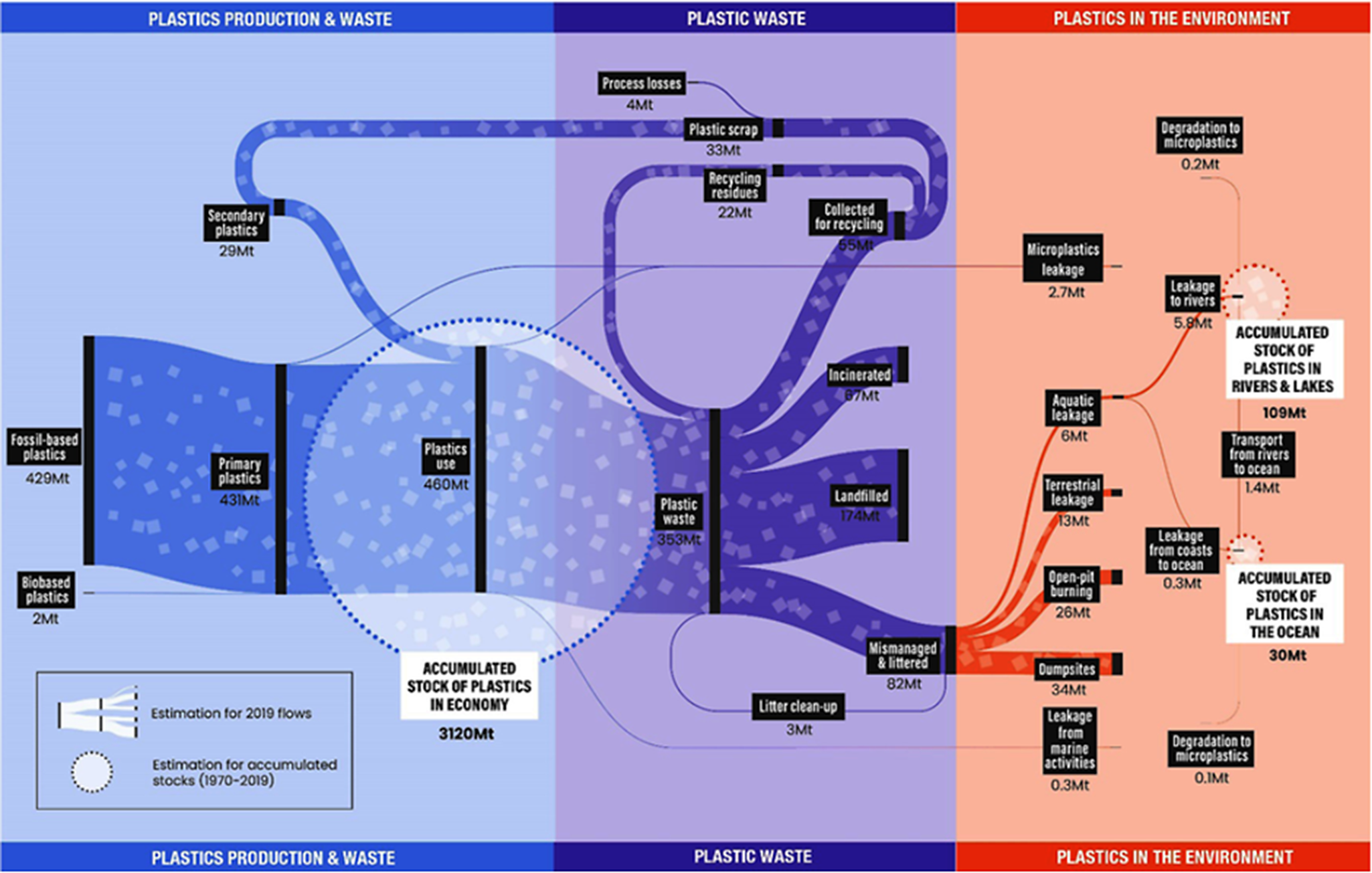
In 2022, the OECD proposed a conceptual framework suggesting that most environmental plastic leakage, especially in marine environments, stems from inadequate waste management and post-consumption littering, while relatively minor leaks originate from the early stages plastics’ lifecycles (Figure 1). The OECD presupposes efficiency and integrity in waste management systems – recycling, landfills and incineration – capable of containing plastics.
Plastic production, recycling, and waste flows, (source: OECD 2022).

Scientists and civil society activists dispute the OECD’s assumption that plastic leakage is primarily a downstream issue, highlighting widespread environmental contamination by macro-, micro- and nanoplastics in aquatic and terrestrial environments. They likewise note the significant health risks associated with chemicals from plastics entering food and biological systems, including human bloodstreams, tissues and placentas (Wright and Kelly, Reference Wright and Kelly2017; Cox et al., Reference Cox, Covernton, Davies, Dower, Juanes and Dudas2019; Zhang et al., Reference Zhang, Xu, Li, Chen, Ma, Zeng and Shi2020; MacLeod et al., Reference MacLeod, Arp, Tekman and Jahnke2021; Dey, Reference Dey2022). Next, we present insights from ethnographic research in India, Indonesia and the Philippines, revealing the direct impact of plastic’s leakiness on people in those countries – from the materials themselves, the chemicals they leak and systemic plastic waste management failures. We disclose how inefficient waste recycling and energy recovery and inadequate national regulatory policies exacerbate leakiness.
In ongoing Global Plastic Treaty negotiations, the OECD’s framework serves to bolster the position of petrostates. States with powerful petroleum industries have actively lobbied against a motion Rwanda proposed in 2024, supported by 85 other states. The Rwanda Motion, which India and Indonesia did not support and the Philippines did, advocates for a legally binding cap on the production of new (virgin) plastics and an obligation to phase out hazardous chemicals in plastics. The petrostates argued against upstream interventions, aligning with plastic and oil industry lobbyists calling for strengthening waste management infrastructures and increasing recycling to prevent plastic leakage in low- and middle-income countries considered the main contributors to pollution (Durrani, Reference Durrani2024). This powerful lobby successfully stalled the INC-5 negotiations, which concluded without an agreement.
Our ethnographic research challenges the prevailing narrative that primarily blames low- and middle-income countries for plastic pollution due to “waste mismanagement” (Jambeck et al., Reference Jambeck, Andrady, Geyer, Narayan, Perryman, Siegler, Wilcox and Lavender Law2015; Ocean Conservancy, 2015; Cottom et al., Reference Cottom, Cook and Velis2024), without acknowledging petrostates’ contributions to the problem by continuing to produce vast amounts of virgin plastics or the way the Global North compounds pollution by exporting its plastic waste to Asian countries.
Ethnographic insights into plastic’s leakiness
Building on a long line of scholarship in Anthropology and Science and Technology Studies (Bennett, Reference Bennett2010; Gabrys et al., Reference Gabrys, Hawkins and Michael2013; Hardon and Sanabria, Reference Hardon and Sanabria2017; Nading, Reference Nading2017; Dey, Reference Dey2021), we propose a conceptual framework for analyzing plastic pollution challenging the idea that objects have a fixed or self-contained materiality. “The bodies of organisms and indeed of other things leak continually; indeed, their lives depend on it” (Ingold, Reference Ingold2012, 438). Plastics are likewise dynamic, fluid, constantly interacting with their changing surroundings. Nading (Reference Nading2017, 143) analyzes chemicals used to control malaria in Nicaragua as “leaky things having long afterlives implicated in fluid interactions involving complex material-socio-political processes,” tracing leakiness both as “material” – as when communities repurpose insecticides for rodent control – and “structural” – as when a wider range of actors than envisaged engage in controlling. Studying plastic use and waste management in India, Indonesia and the Philippines, we observe similar material and structural leakiness.
We conducted ethnographic interviews and long-term participant observation in environments with visible pollution (Pathak and Nichter, Reference Pathak and Nichter2019; Dey, Reference Dey2021; Pathak et al., Reference Pathak, Nichter, Hardon, Moyer, Latkar, Simbaya, Pakasi, Taqueban and Love2023; Pakasi et al., Reference Pakasi, Hardon, Hidayana and Rahmadhani2024), where residents must manage ever-increasing plastic waste polluting their air, water and soil, and entering their bodies. We enlisted university students to conduct plastic waste disposal mapping in Indonesia and the Philippines (2020–2022). Universitas Indonesia anthropology students conducted fieldwork in three communities located within 50 km of Jakarta: Bogor District, Tangerang City and Depok City. In each site, students conducted 10 ethnographic interviews with waste activists, local authorities and private landfill operators, validating their findings in six focus groups (two per site). University of the Philippines anthropology students conducted similar fieldwork in nine communities in Tarlac, La Union, Easter Samar, Laguna, South Cotabato, Cagayan de Oro, Aklan and Dinagat Island Provinces, and in two towns near Metro Manila (2020–2021). During two Anthropology of Plastics workshops in Aarhus in 2022 and 2023, we reviewed findings from long-term and focused research, documenting factors contributing to plastics’ material and structural leakiness and critically examining downstream intervention feasibility in each country.
Leaky waste infrastructures in India
Faced with growing volumes of high-calorie plastic solid waste, the Indian government employs waste-to-energy (WTE) incineration to generate power from plastics. By 2020, there were plans for at least 100 projects across the country in private–public partnerships (Kornberg, Reference Kornberg2019). WTE requires elaborate, integrated infrastructures to maximize waste collection, separate dry (incinerable) from wet (non-incinerable) waste and secure transportation to incineration plants through intermediary measuring and segregation sites. India’s growing consumer economy caused its INC-5 delegation, embracing large-scale waste incineration’s potential, to oppose the Rwanda Motion, emphasizing its “right to development” (Rwanda Motion, 2024) with a treaty that respects its unique priorities and capabilities.
In 2017–2019, Dey (Reference Dey2022) conducted ethnographic fieldwork in Ahmedabad, India that entailed following garbage trucks on their routes crisscrossing urban neighborhoods. His observations revealed plastic containment efforts failing. Ahmedabad, like other Indian municipalities, provided households with different-colored bins for dry and wet waste and used trucks with color-coded compartments divided by a steel wall. As garbage handlers drove through narrow city streets in the busy morning hours, residents hastened to dump their waste clumsily emptying their dry and wet bins into whichever compartment was closest. Thus, despite governmental planning efforts, dry plastics smothered in food waste, leaves, sanitary pads, paper and cardboard fell into both compartments.
This situation maps onto an overall trend whereby incinerators frequently receive large quantities of unsorted, wet mixed waste for which they are not designed (UNCRD and AMC, 2012; Cheela and Dubey, Reference Cheela, Dubey, Rathinasamy, Chandramouli, Phanindra and Mahesh2019). Municipal officials under budgetary constraints and public (and political) pressure purchase cheap machines with filtration systems inadequate to contain emissions (Doron and Jeffrey, Reference Doron and Jeffrey2018). Managers and engineers running the incinerators, needing to dispose of massive waste volumes within tight deadlines, cut corners. Poorly paid waste workers have little incentive to separate the mess to make it profitably – or even viably – incinerable. Mixed with food and other waste, plastics burn inefficiently: producing energy below target, causing facility breakdowns and leaking toxicants and greenhouse gases (Demaria and Schindler, Reference Demaria and Schindler2016; Luthra, Reference Luthra2017; Sambyal and Agarwal, Reference Sambyal and Agarwal2018; Dey, Reference Dey2025). Finally, there is the question of the afterlife of residues containing hazardous substances, which WTE advocates rarely acknowledge (Liu et al., Reference Liu, Zhao, Liang, Wang, Sun and Chen2021; Mantovani et al., Reference Mantovani, Tribaudino, De Matteis and Funari2021). Incinerator sludge often ends up in landscaping projects and roadbeds, without sufficient consideration for potentially leaking harmful chemicals into the environment.
Effective managing plastics downstream presents significant challenges for India, demanding sophistication in urban planning and systems integration exceeding the capacity of its existing waste management agencies, given the immense scale and complexity of the task. Daily infrastructure leaks increase environmental pollution and accelerate climate change.
Indonesia’s leaky public–private partnerships
The Indonesian delegates to the Global Plastic Treaty negotiations likewise opposed the Rwanda Motion. Indonesia’s burgeoning consumer goods sector heavily relies on non-recyclable, single-use packaging, creating significant demand for virgin plastics. Its National Plan of Action on Plastic (NPAP, 2020) mandates shared responsibility, including local communities in waste management, making producers accountable for recovering their post-consumer packaging, while commercial and industrial entities must collect and transport their waste to temporary disposal sites or landfills.
Despite government intentions, this public–private partnership contributes to plastics’ ongoing leakiness. Regulated shared responsibility implies equal distribution of agency and fails to account for the disproportionate burden placed on individuals with scarce resources to manage their garbage. Furthermore, it masks the failure of local administrative units to fulfill their plastic waste duties (Pakasi et al., Reference Pakasi, Hardon, Hidayana and Rahmadhani2024). Across the sites we studied, railroad tracks, roads and tracts of land piled high with rubbish were common.
Individuals collect waste and sell it to landfills. Landfill owners sort out the plastics with monetary value, but, due to limited space at landfills, often burn plastics for which they cannot receive compensation. Moreover, to avoid garbage collection fees, many households sort and burn their waste, mixing plastics with leaves to help ignite fires that also keep mosquitoes away. They use toxic ashes as garden compost or to landscape, unknowingly leaking chemicals into the soil, water and air (Velis and Cook, Reference Velis and Cook2021; Kováts et al., Reference Kováts, Hubai, Sainnokhoi, Eck-Varanka, Hoffer, Tóth, Kakasi and Teke2022; Pakasi et al., Reference Pakasi, Hardon, Hidayana and Rahmadhani2024).
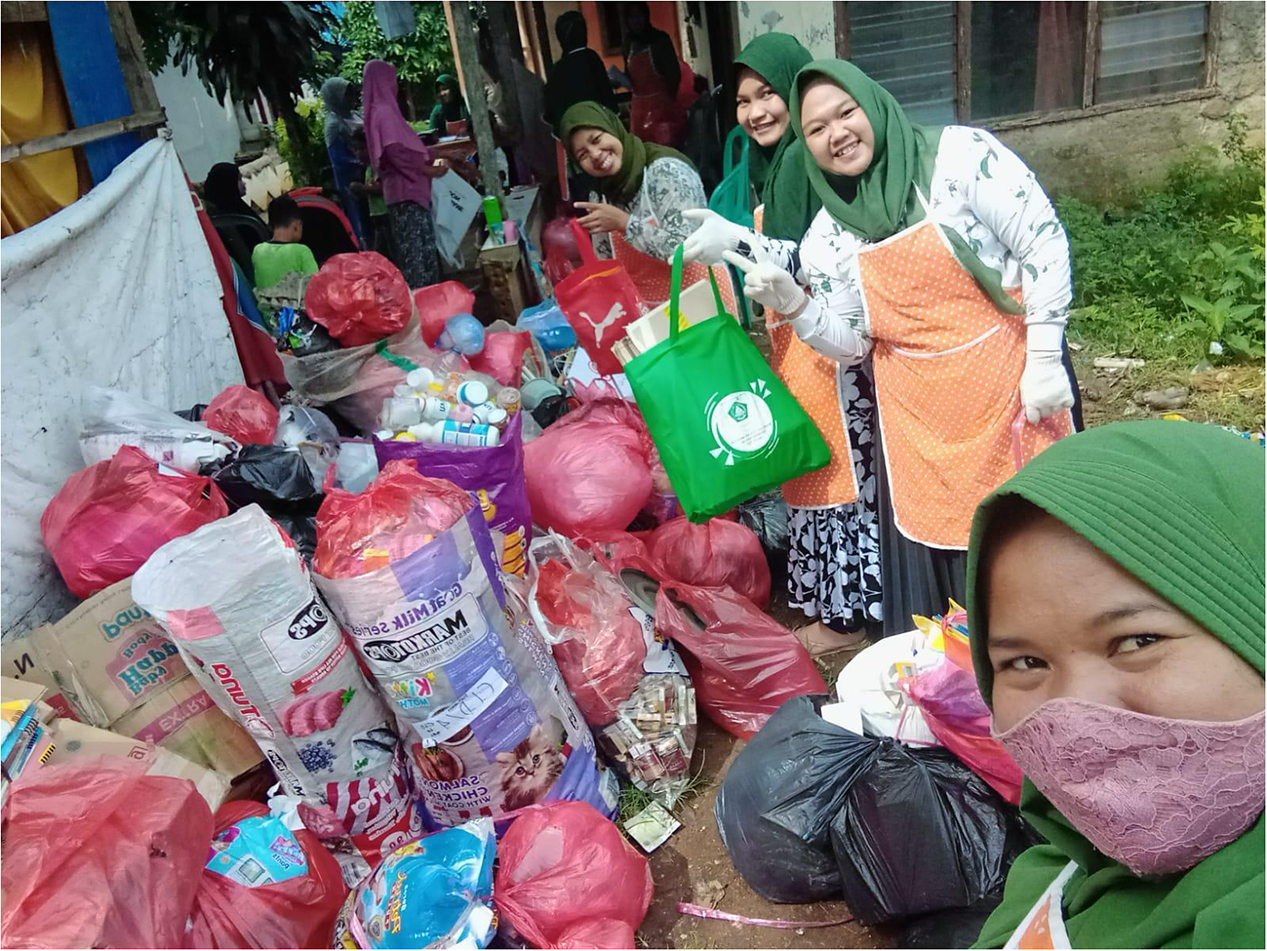
Seeking to reduce household waste in landfills, the Indonesian Ministry of Environment helped establish community waste banks (Wijayanti and Suryani, Reference Wijayanti and Suryani2015; Raharjo et al., Reference Raharjo, Matsumoto, Ihsan, Rachman and Gustin2017). Intended as collection points to which citizens bring recyclables, the banks generally accept all dry waste, see Figure 2.
Citayam Waste Bank, Indonesia, May 2021 (source: Putri Rahmadhani).

Multinational corporations, facing pressure from citizens and Extended Producer Responsibility regulations, express shared sustainability goals (Foster, Reference Foster2008) with key consumer groups and launch programs to buy back plastic packaging. For example, Unilever partnered with waste banks to collect and recycle lightweight sachets with limited resale value and prone to becoming litter. Using the chemical CreaSolv technology, Unilever transformed plastic polymers into new sachets (Unilever, 2017), offering waste bank workers 800 rupiahs (USD 0.05)/kilogram to collect sachets. However, after a 2-year period, Unilever’s program abruptly ceased, leaving participating waste banks overwhelmed with flyaway sachets (McVeigh and Cahya, Reference McVeigh and Cahya2022).
Focusing solely on managing sachets downstream is problematic because manufacturers make them from cheap, low-quality materials, designing them to be thrown away after a single use (Hawkins, Reference Hawkins, Gabrys, Hawkins and Michael2013). Because of the difficulty of recycling and impossibility of reusing sachets, people commonly resort to burning sachets and other plastic waste, contributing to climate change by releasing greenhouse gases, fine particulate matter, and harmful byproducts like polycyclic aromatic hydrocarbons into the air, which cause respiratory problems and cancer (Pathak et al., Reference Pathak, Nichter, Hardon, Moyer, Latkar, Simbaya, Pakasi, Taqueban and Love2023).
Leaky remediation in the Philippines
Although the Philippines’ consumer goods industry relies on virgin plastics just as much as Indonesia’s does, its delegation to INC-5, which included a Department of Health senior official and chairperson of the Mother Earth Foundation, supported the Rwanda Motion. The Philippine government is taking measures to contain plastic leakiness through local-level restrictions on single-use plastics and promoting recycling. While these steps are laudatory, our ethnographic fieldwork in the Philippines revealed communities inundated with accumulations of plastic pollution, with single-use sachets and other forms of packaging as the largest contributors (OECD, 2022). Sold in every corner of the country in small sari-sari stores, sachets cater to people’s everyday needs. In the early 2000s, they replaced glass or metal containers for everyday commodities bought in bulk and sold to customers with little purchasing power on a tingi-tingi or piecemeal basis (Chang and Chen, Reference Chang and Chen2017). Our research revealed that low-income individuals value low-cost sachets for making access to a variety of products affordable and purchase them daily. Emerging regulations discouraging the proliferation of single-use plastics fail to include sachets, due to consumer necessity and the lobbying efforts of corporations that use glossy packaging to brand and market their products. Consequently, in August–September 2020, when 915 Filipino Break Free from Plastic Movement volunteers performed a brand audit of over 38,000 pieces of waste strewn over 17 beaches and urban centers, sachets comprised 40% of all plastic waste (Brand Audit, 2022).
Given the proliferation of sachets and the fact that, while not an uncommon practice, burning trash in the Philippines is illegal, community organizations have tried to come up with creative ways to encourage the upcycling of sachets into floor mats and bags as a way to generate income. Locals also upcycle plastic bottles and Styrofoam into plant containers, building materials and sports equipment. Despite small grants from local governments, the upcyclers find the market for their goods to be limited.
While leveraging existing community practices of repurposing plastic waste might appear a positive approach, our research revealed potential negative consequences. Community gardens are common in resource-constrained urban areas where there is little access to arable land or industry has contaminated the soil. Gardeners commonly reuse plastic containers to grow plants, unaware that they leak potentially harmful chemicals and disintegrate into microplastics, especially after prolonged exposure to direct sunlight. The cumulative effects on human health of plastic chemicals in soil used to produce food remain unclear, but nonetheless pose a concern to environmental scientists (Lee et al., Reference Lee, Shim and Kwon2014; Stratova et al., Reference Stratova, DiGiangi and Genon2018).
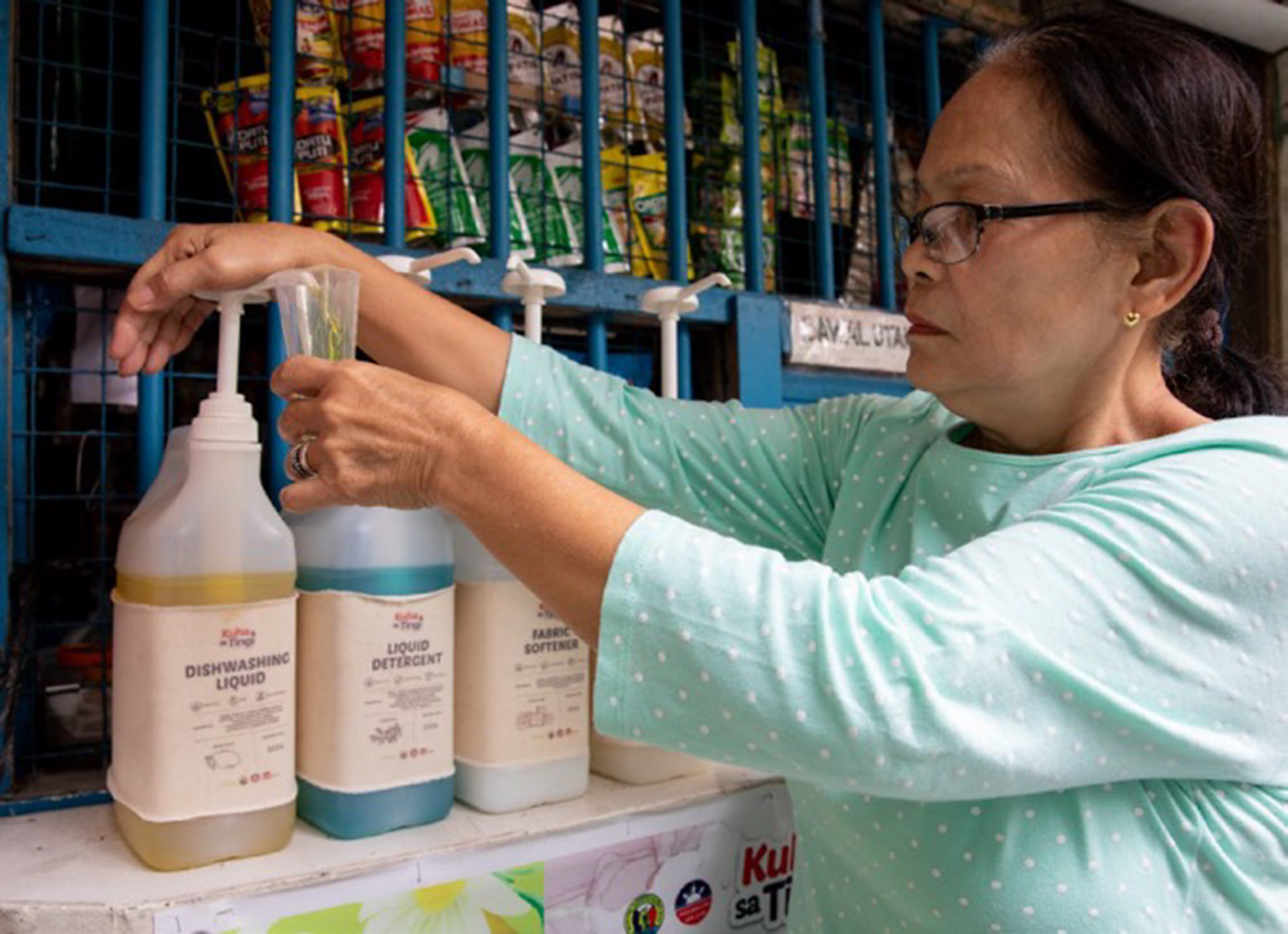
As plastics continue to accumulate, Filipino communities have begun exploring alternatives to the widespread use of sachets. Local initiatives, such as reintroducing the tingi-tingi system and establishing refill stations in sari-sari shops, which predominantly sell sachets, offer valuable lessons (see Figure 3).
Kuha sa Tingi, a Greenpeace Philippines co-led project with Impact Hub Manila and the local government (source: Greenpeace Philippines 2023).

However, it remains uncertain whether consumers will readily embrace a system that limits their product choices. Ultimately, global regulatory bans on sachets as packaging materials are necessary in order to significantly reduce the environmental pollution they cause.
Conclusion
Highlighting the inherent leakiness of plastic products exposes the fallacy of the dominant narrative that irresponsible governments and citizens in India, Indonesia and the Philippines, as well as in other Global South countries, are primarily to blame for plastic pollution in their environments. The current recycling and technological fixes are not comprehensive solutions to the plastic crisis. As Liboiron (Reference Liboiron2021), 16) notes: “cleaning just shuffles…[plastics] in space as they endure in time. You can’t recycle them out of the way…there is no away….”
Our research demonstrates that, in India, efforts to generate energy from incinerating plastics fall prey to messy, under-resourced logistics. In Indonesia, when the government outsources responsibility for waste to local public and private actors, plastic piles up. Insights from our studies in the Philippines reveal that downstream projects fail to recycle plastics into valuable goods because waste management is inherently leaky. Much like large-scale infrastructure projects in India, community-based remediation projects in Indonesia and the Philippines give the impression that clean-ups, recycling and repurposing can resolve the plastics problem, decreasing necessary pressure to regulate plastic production and hold manufacturers accountable for plastics’ post-consumer lives.
Recognizing the inherent material leakiness of plastics and the fundamental inefficiencies of infrastructures designed to close loops should spur our efforts to reduce plastic production and the use of hazardous chemicals in that production. Rather than depend on empty promises of a future circular economy that minimizes downstream microplastic leakage, we must develop and support strategies that acknowledge and address the problems plastics create, their chemical byproducts and the flawed downstream infrastructures that do not prevent pollution.
INC-5 negotiators’ failure to agree on the need to significantly reduce plastic production will lead to ever-increasing volumes of potentially toxic plastic waste that local waste management systems cannot process.
Open peer review
To view the open peer review materials for this article, please visit http://doi.org/10.1017/plc.2025.10022.
Acknowledgements
We thank our interlocutors in India, Indonesia and the Philippines for sharing their experiences and views with us and allowing us to conduct fieldwork in their communities. We thank Helen Faller for her incisive editing of our contribution.
Author contribution
This article emerges from collaborative analysis of plastic’s leakiness across our field sites. Pathak hosted the workshops at Aarhus University. Hardon and Nichter developed the methodology for the focused ethnographies in Indonesia and the Philippines, with input from all the authors. Hardon led the analysis by writing a detailed concept note. Dey co-drafted this article and co-developed the concept of leakiness, sharing the results from fieldwork in India in his PhD thesis. Taqueban led the fieldwork in the Philippines and wrote an unpublished report presenting her findings and observed the INC-5. Pakasi and Hidayana conducted fieldwork in Indonesia and published an article with the results. Pathak and Nichter analyzed burning practices.
Financial support
Tridibesh Dey received funding from the Wageningen University and Research International Talent Post-Doc Grant, while the University of Exeter and Gauri Pathak’s Carlsberg Fellowship supported his PhD and post-doctoral fieldwork respectively. Anita Hardon’s ERC Advanced Grant Embodied Ecologies (grant nr. 101054300) funded research and Efenita May Taqueban’s trip to Busan to observe the INC-5. A research grant from the University of Indonesia supported Diana Pakasi’s follow-up research. A Carlsberg Foundation Young Researcher Fellowship (CF-20-0151) granted to Gauri Pathak supported the May 2023 analysis workshop. The Centre for Social Science and Global Health at the University of Amsterdam funded fieldwork in Indonesia and the Philippines.
Competing interests
There are no conflicts of interest to declare.

 Open access


Comments
Dear Editors, hereby we submit a perspective piece which was written based on our extensive anthropological fieldwork in India, the Philppines and Indonesia, by way of input into the deliberation towards a Plastic Treaty, post the Busan failure to come up with a binding agreement.
on behalf of the authors.
Anita Hardon.
Warm wishes
Anita