




Introduction
The Clavicula Salomonis (Little Key of Solomon) is likely to be the most prominent title in scholarly discussions of early modern magic in general and “Solomonic magic” in particular. In the sixteenth century, this notorious text was granted an
ignominious status when it was included in the Index of Prohibited Books.Footnote 1 In addition to conferring iconic status on the texts of the Clavicula, this designation also gave the impression that there is only a single Clavicula, the prohibited one. However, this is far from the case. There are at least two hundred manuscripts and printed books with this title, with an incredible degree of variation. Some of these manuscripts were typographically mapped and grouped into eleven categories by Robert Mathiesen as part of a study of manuscripts and catalog records.Footnote 2 Mathiesen’s work has been used by various scholars and sometimes expanded.Footnote 3 Another work has attempted to portray a network of textual materials shared by different Claviculae and other “Solomonic” texts, pointing to some medieval Hebrew and Aramaic translations into Latin as examples of such materials.Footnote 4 Little, however, has been done to clarify the shared form of these Claviculae, which seems to be the most obvious link between them. The aim of this article is threefold. First, it will argue that these texts are “open” in nature, because of their function: they are supposed to complement other magical materials. Second, this will allow us to undertake a more careful examination of the partially told story of the Hebrew manuscripts that are considered to be “translations” of the earlier non-Hebrew Claviculae. Through this journey, we will be exposed to the fascinating process of textual transmission and editing. Third, this article will argue, based on a recent discovery, that such works are attested in Hebrew already during the sixteenth century, which is earlier than has been previously assumed.
Auxiliary Manuals: The Genre of the Clavicula Salomonis
The first appearance of a work with a similar structure to most of the later Claviculae was in Milan, circa 1446.Footnote 5 In that year, at least two anonymous Italian scribes finished their translation of a Latin exemplar,Footnote 6 another Clavicula, commenting on textual lacunae and (sometimes) attempting to clarify and correct the text when they felt it necessary.Footnote 7 Following the exemplar, this Italian Clavicula is divided into two different books. Broadly, the first book lays out essential astrological knowledge for determining the optimal timing of various magical “experiments” (i.e., practices), categorizing them by their objectives—such as love, friendship, and destruction—and includes a section on extraordinary experiments, further divided into beneficent and maleficent experiments. The first book also details seven categories, each dedicated to specific aims such as finding stolen objects, achieving invisibility, and creating illusions. The second book presents the practical aspects of these magical practices, focusing on the necessary tools and instruments such as ritual knives and candles, and outlines the preparatory steps for the practitioner, including fasting, bathing, and preparing both the followers and the ritual space, alongside instructions for suffumigation.
Already at this very early stage of transmission, the scribes of this Italian Clavicula treated their text as a general guide to different experiments. The first book of the Italian Clavicula begins with the astrological knowledge that is necessary for each kind of experiment, without going into detail or giving any kind of instruction concerning the performance of a specific experiment. These experiments are divided into categories according to their aims, e.g., experiments to bring about love are to be undertaken during the hours of Venus, Jupiter, or the Sun, while experiments to bring about destruction are to be executed during the hours of Saturn or Mars.Footnote 8 There are also experimenti extraordinari that do not fit into other categories and which are later sub-categorized into “good” (beneficent) and “bad” (maleficent) ones. Different chapters of the first book are then dedicated to each of the seven categories presented by the scribe: experiments for finding stolen objects (chapter 4), to create invisibility (chapter 5), to bring about love (chapter 6), entreaties (chapter 7), to bring about hatred and destruction (chapter 8), extraordinary experiments (beneficent and maleficent, chapter 9), and illusionary experiments (chapter 10).Footnote 9 None of those chapters stand alone, and practitioners are instructed to use them to complement the recipes they already have.
The descriptions of these experiments offer significant insight into the scribes’ intentions. Take, for instance, the section on experiments for recovering stolen goods. In the fourth chapter of the first book, the scribes start by outlining “in what manner it is necessary to operate the experiments of [finding] theft.”Footnote 10 This very description, which focuses on the manner of operating experiments, in the plural, shows that this section was not meant to fit a specific recipe, but rather a wide variety of recipes with this common aim. This intention becomes even more apparent upon reading the first sentence of this chapter: “You will find, dearest son, the experiment to find stolen objects as you will, either by conjuration, or by gathering [demons], or by art, or through sleep, or by writing characters, or in another manner.”Footnote 11 In this concise statement, the scribes reveal their familiarity with the broadly disseminated techniques for locating stolen items. Readers acquainted with the magical literature from this era will concur with the observation of the Italian scribes. Experiments aimed at recovering stolen goods are quite prevalent, with various recipes emphasizing methods such as conjurations or invocations to retrieve the item, oneiromancy (“through sleep”), or techniques centered on inscribing certain χαρακτήρες (“by writing characters”) for achieving this goal.Footnote 12 The subsequent instructions are intended to complement these diverse practices. According to the Italian scribes, adherence to these instructions, predominantly involving prayers and adjurations, is essential; without them, the experiment is bound to fail.Footnote 13
The diverse (external) experiments necessitate the practitioner’s use of a myriad of tools and instruments (e.g., ritual knives, swords, magical circles, etc.), prompting the Italian scribes to dedicate chapters in the second book to each specific tool. Additionally, they provide detailed guidelines on fasting, bathing, preparing the practitioner’s followers, setting up the ritual space, and suffumigation. While the Italian scribes have striven to cover all conceivable instruments, they acknowledge that their text offers instructions for “almost everything” (quasi per tutto),Footnote 14 highlighting their comprehensive effort despite the challenge of encompassing (or collecting) all possibilities. This is yet another expression of the auxiliary nature of this early Clavicula.
We can infer that even at this early stage of textual transmission, Clavicula Salomonis texts were not designed to introduce novel, standalone methods, nor were they meant to provide a detailed, step-by-step ritual for achieving a specific goal. Instead, they predominantly appear in the form of indispensable auxiliary manuals, drawing upon and supplementing popular practices. This interdependence is crucial—the practitioner relies on the Claviculae to ensure that the recipe can be properly carried out, while the Claviculae themselves hold little value without the integration of external recipes. In that sense, these texts seem to represent attempts to systematize, standardize, and regulate the widespread diffusion of numerous practices. Thus, the scribes of such auxiliary texts typically practiced eclecticism and drew on common inventories of formulas and recipes. This explains why most codices containing a Clavicula were typically compiled alongside separate recipe books, which often reference or mirror the Clavicula’s content. This pattern is also evident in the Hebrew Claviculae, where it is clear that the scribes incorporated “external” recipes, yet grounded them in the knowledge acquired from this auxiliary manual in their possession.Footnote 15
As we will explore, scribes believed that they could use a Clavicula to alter and supplement other recipes they encountered, a sentiment echoed by many different readers of different Claviculae who viewed these auxiliary manuals as an essential key for conducting the experiments they desired to perform. Consequently, textual analysis should accommodate the complexities that are not fully captured by the narrowly defined term “translation,” rather than treating manuscripts as “complete translations” of a particular work. This is especially relevant to certain Hebrew manuscripts identified as “the Hebrew Clavicula Salomonis.” These manuscripts, while correlating with other known Claviculae, are distinct entities and merit individual examination to accurately determine their histories.
Hebrew Claviculae: Hermann Gollancz’s Discovery
After finding an eighteenth-century manuscript in his father’s library, Hermann Gollancz, then a professor of Hebrew at London University, published a broad survey of its content in 1903.Footnote 16 Considering it to be a Hebrew Clavicula Salomonis, he then published a facsimile edition of it in 1914.Footnote 17 The original manuscript is now regarded as lost. Intriguingly, despite his lack of comprehension of some parts of the material, as evidenced by certain translations he made, Gollancz possessed a remarkable intuition regarding the authorship of this manuscript. He surmised that it was likely authored by a member of the Sabbatian movement, a hypothesis that was initially met with skepticism and dismissed by Gershom Scholem.Footnote 18 However, a decade ago, Gollancz’s speculation was validated.Footnote 19 By making the manuscript accessible, Gollancz enabled scholars to scrutinize it. His enthusiasm for this significant discovery, however, was not shared by his colleagues, and it took decades before it received scholarly attention. This shift occurred with the British Museum’s acquisition of more Hebrew Claviculae, which were meticulously described by Claudia Rohrbacher-Sticker.Footnote 20 Subsequently, Reimund Leicht conducted an important and systematic study of these texts.Footnote 21
Typically viewed as Hebrew translations of a (specific) Clavicula Salomonis, these Hebrew manuscripts should not, in fact, all be treated as complete translations of a single text. Rather, like many other Claviculae, they represent compilations, combining the auxiliary manual with various recipes that were revised, commented on, and edited. In 2014, I discovered the identity of the scribe behind Gollancz’s manuscript: Rabbi Yehuda Arie (Leon), son of Yoseph Peretz.Footnote 22 This Italian rabbi, who was born circa 1680 to a family of Moroccan descent in Ragusa, was later known as the personal scribe of the (in)famous Sabbatian Neḥemiah Ḥayyun. From 1709 to 1711, the young Peretz served as the sermonizer of the Ashkenazic synagogue in Venice, replacing his close friend Rabbi Isaac Cavalero, who had passed away due to unknown causes. Peretz published these sermons in a book he printed in Berlin in 1711/12 entitled Peraḥ Levanon (The Flower of Lebanon).
After resigning from his position in the Ashkenazic synagogue, Peretz traveled to various important cities in Europe, completing his journey in Amsterdam, where he started composing his own Clavicula Salomonis, that is, Gollancz’s manuscript. In 1721/22, he finished working on this manuscript, as two different colophons in the manuscript clearly show.Footnote 23 His work was based on several manuscripts, but the main one was indeed a Hebrew manuscript, possibly connected to Neḥemiah Ḥayyun himself.Footnote 24 Peretz consulted different works that were at his disposal, some of which were not part of any kind of Clavicula. An example is the passages from the Liber Iuratus Honorii that he included at the beginning of the manuscript, as Leicht already observed.Footnote 25
Upon completing his own copy, Peretz relocated to London, where he collaborated with his new student on a revised version of his Clavicula. This student, Isaac Zekli, who was Dutch, took the lead on this particular copy, and he is the scribe behind this manuscript.Footnote 26 Peretz and Zekli commented on the material found in the first copy in several places, now having more sources to compare, including a Spanish and an Italian Clavicula, as they explicitly stated.Footnote 27 After consulting these additional sources, Peretz also made revisions to his own (first) copy, where we can observe minor modifications that were likely made around the year 1729.Footnote 28 Peretz viewed the material in the Clavicula, the auxiliary manual, as a resource that could enhance other recipes in his manuscript, and he embraced its “open” nature to further innovate the book’s structure. In his version, there is a section titled “The Book of Seals,” a feature also present in Zekli’s copy. Peretz compiled most of the various seals and magical characters from his manuscript into this “book,” creating a reference guide for practitioners. This initiative resulted in a unique section not found in earlier Claviculae. Perceiving it as an auxiliary manual, Peretz took the liberty of modifying and adapting his text, making changes based on diverse sources and practical considerations.
The perception of the Clavicula as an auxiliary manual was not exclusive to the Italian scribes, including both the anonymous creators of the earlier Italian Clavicula and Peretz. This perspective was also shared by the anonymous scribe of the manuscripts housed in the British Library. This scribe explicitly described his Clavicula as an auxiliary manual designed to complement external recipes. For instance, in an experiment aimed at binding a spirit within a crystal, the practitioner is directed to use a table draped with a red cloth. This red cloth, according to the scribe, “should be consecrated according to the key.”Footnote 29 In another experiment, the scribe included a remark about the circle the practitioner must use, stating: “But it is worth nothing if it is not done according to the key of King Solomon, peace be upon him. And all the rest of the things should be done according to this, as is known to the wise-hearted.”Footnote 30 The scribe mentioned “other keys” (e.g., 8r: ובמפתח מצאתי אחר [and I have found in a different key …]), and also commented on chapters that are typically found in other “keys,” but were absent from his version.Footnote 31
The history of the manuscripts in the British Library, previously part of a single codex, remains largely uncharted, in contrast to the origins of Gollancz’s manuscript and Zekli’s text. However, as Rohrbacher-Sticker intuitively noted, these manuscripts might also trace their lineage back to earlier Hebrew texts.Footnote 32 The reliance of both Peretz and the anonymous British Library scribe on Hebrew sources, coupled with the partial similarities between their manuscripts, implies that Hebrew documents sharing common content were in circulation before the eighteenth century. Despite this, scholars have often dismissed this notion, favoring the theory that these materials only began to appear in the latter half of the seventeenth century.Footnote 33 This assumption is partly influenced by the controversial claim of an ultimate Greek source for the (whole) Clavicula Salomonis.Footnote 34 My goal is to present a counterargument, beginning with a re-evaluation of what some consider a mere fable about a distinguished Italian Jewish engineer.
Abraham (or Abramo, in Italian) Colorni was a colorful sixteenth-century Italian figure.Footnote 35 Born in Mantua in 1544, he gained widespread recognition for his exceptional accomplishments as an engineer. Indeed, his engineering prowess and knowledge earned him fame throughout Italy, a fact attested by Tommaso Garzoni (1549–1589).Footnote 36 Around 1566, Abraham, who was then living in the contrada del Grifone in Mantua, married Violante, the daughter of Yeḥiel Nissim da Pisa.Footnote 37 Following a period at the Gonzaga family court in Mantua and several years after the death of Yeḥiel Nissim in 1574, the couple relocated to the residence of the da Pisa family in Ferrara.Footnote 38 There, Colorni was able to work on his inventions, especially weaponry, in the court of the Este family for Alfonso II, the duke of Ferrara (1533–1597).Footnote 39 Beyond his renowned engineering skills, he also had a keen interest in cryptography, penning an entire work on the subject in 1593. This work, titled Scotographia, was dedicated to Rudolf II (1552–1612).Footnote 40 This esteemed and well-connected engineer also undertook the translation of a Clavicula Salomonis from Hebrew into Italian. Although many scholars have dismissed this notion as mere legend,Footnote 41 I, like Toaff, see no reason to doubt it.Footnote 42 A recent discovery confirms that a Hebrew Clavicula Salomonis was circulating among Jewish individuals in Italy during the sixteenth century. This lends additional support to the possibility that Abraham Colorni indeed translated Hebrew materials, identified as the Clavicula Salomonis, into Italian.
While working on an article about Hebrew Claviculae from 2012 to 2014, I encountered brief remarks by Max Grunwald (written in 1947), referenced by Gideon Bohak,Footnote 43 which at the time appeared to me to align with certain recipes from the eighteenth-century Hebrew Claviculae.Footnote 44 Grunwald mentioned that the manuscript he had examined was held in the Bezalel Museum, which subsequently closed in 1965, with its collection being transferred to the Israel Museum. My search for this manuscript within the Israel Museum’s collection via the manuscript database of the National Library of Israel in Jerusalem yielded no results—none of the manuscripts matched Grunwald’s description. Consequently, I thought that it might have been lost during the collection’s transition from the Bezalel Museum to the Israel Museum. Fortunately, in 2016, Yoel Peretz, aided by the staff of the Israel Museum, discovered a folio in the museum’s collection that appeared to fit. He sought the expertise of Yuval Harari and myself for further insight. It was at this point that I recognized the significance of the find; this was the lost manuscript referenced by Grunwald, or a closely related source (see below), a realization to which Peretz had also come.Footnote 45
Upon close examination, I identified the folio (Jerusalem, The Israel Museum, B12.1864 [see Appendix below]) as part of a Hebrew Clavicula—not in the sense of a “complete translation of a specific Clavicula Salomonis,” but rather as a work derived from such an auxiliary manual, originally compiled alongside one. Through paleographical and filigranological analysis, I dated the document to the sixteenth century.Footnote 46 Furthermore, the watermark suggests that the paper was produced in Ferrara, where the Colorni family resided from 1574 onwards. It is important to recognize the limitations of this analysis: even if accurate, it does not necessarily imply that the manuscript was authored by Colorni or directly linked to him. Nonetheless, this finding allows us to suggest that a Hebrew Clavicula text was circulating in Italy during this period.Footnote 47
Considering the “open” nature of these texts, determining whether this folio genuinely originates from a manuscript whose scribe identified it as a Clavicula requires careful examination. To establish this, we must delve into the textual content of the folio, which not only offers significant insights about this particular piece, but also enhances our comprehension of the later Hebrew Claviculae. In the following section of this article, I will describe the folio, presenting evidence that substantiates its identification as part of a Clavicula.
Echoes in the Margins: The Role of Scribe-Readers in Textual Development
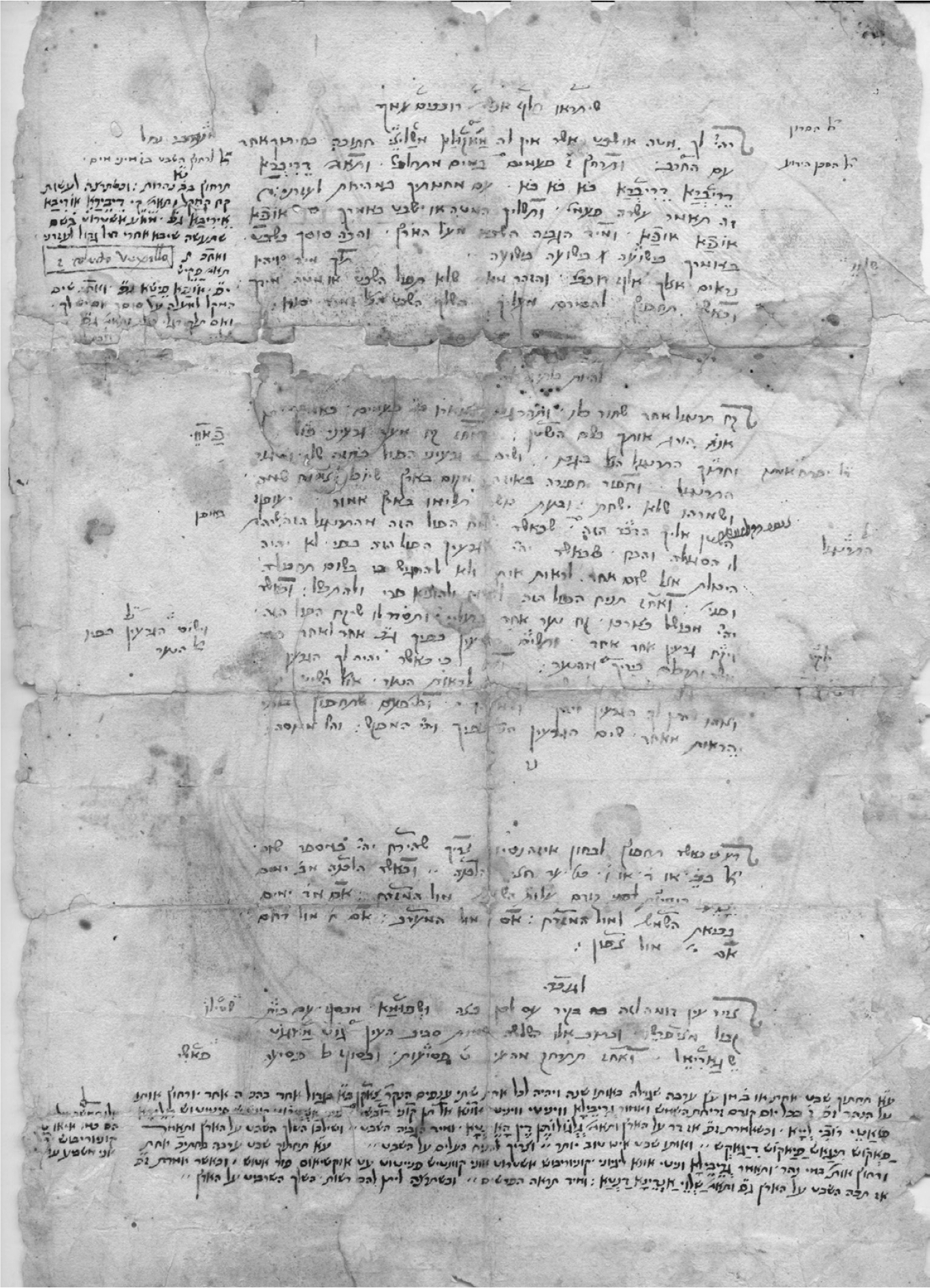
Our folio bears the imprint of three individuals. The initial contributor was an Italian Jewish scribe, likely of Ashkenazic heritage.Footnote 48 The bulk of this folio, drawings included, features handwriting in a semi-cursive sixteenth-century Ashkenazic script, which is a clear indication of his contribution. The color drawings were meticulously planned, with the artist first creating a pencil draft and only then applying the ink. This scribe adorned some words in the text with a red overline, indicating the beginning of a sentence. He also used an overline in the shape of a triangle composed of three dots (∴) to refer to a (usually lexical) clarification in the margins and an overline circle with a straight line (o—) where the direction of the line points to a comment in the margins, often a comment that completes a lacuna. However, these marks were evidently used interchangeably.
In a single case, the scribe used the original Latin script that was in front of him, writing the common i-like sign as an abbreviation for “et” (and) and a phrase that reads “cohrdo vexillo,” whose first word is probably a contracted form of “coherendo,” thus meaning “and by adhering to the troop.” The recipe that is commented on here is a recipe to make a military troop of “thousands of horsemen” appear as the practitioner’s companions (עמך רוכבים אנשים אלף שיתראו), so this possibility seems quite reasonable. These kinds of illusionary experiments, with their obvious militant flavor, were sometimes of interest to engineers who were interested in creating such cutting-edge weaponry, as proven by texts like the fifteenth-century Bellifortis.Footnote 49 The Bellifortis was translated into Yiddish in the late fifteenth century, and a later hand made many other additions to it, including spells and incantations.Footnote 50 This connection between engineers and magical texts, therefore, is also attested in Jewish sources.
Other lexical comments by this scribe include: the clarification of the Hebrew transliteration of the Latin maculat[a] ( ), which describes the staff or wand used and which he explains in the margin as “that is to say, [without any] defect”; the Hebrew transliteration of the Latin/Italian salice (
 ), adding the comment “that is to say, willow”; the Hebrew word פול (i.e., fava bean), adding in the margin the Hebrew transliteration of the Italian
  (fave); and the Hebrew word בישועה (salvation), adding in the margin the Hebrew transliteration of the Latin/Italian
  (salve), that is, “greetings.” All these comments suggest that our scribe was taking an active part in the translation process, preserving specific forms (like בישועה), but also commenting on them if they seemed odd or problematic. In the case of בישועה, it is clear that a reader of the Hebrew translation would have read it as “by salvation,” or even “by Jesus.” Thus, the scribe-translator, who was aware of this possibility (which was intensified by the fact that בישועה appears three times; i.e., בישועה בישועה בישועה), added the common form of greeting in the margin, making it clear that this word came from salve, a common way to greet summoned spirits. The scribe made his translation process visible to the reader, though not necessarily intentionally, by pointing to the equivalent in the vernacular—sometimes the Hebrew (like the willow, נחל ערבי), but other times the Italian (like the fava beans, fave). The Latin script that he inscribed in the margin indicates that he had a Latin source before him, yet this does not imply that it was the sole source he consulted.
The scribe was actively engaged in translating into Hebrew, a process evident from the examples provided, as well as from a notable instance where he appears to choose one word over another based on stylistic preferences. This is the case of the word לפני (before), which he crossed out with a line and changed into קודם, in the phrase השמש עלות קודם (before sunrise), both probably derived from the Latin or Italian ante. This act, I suggest, points to the translation process, and it is possible that our scribe was more familiar with the phrase השמש עלות קודם than he was with השמש עלות לפני, thus changing his mind concerning its phrasing. The close word קדם (the east) perhaps also contributed to his decision concerning this specific phrasing.
At a later stage, likely in the late-sixteenth century, a reader of this manuscript took an active role in editing it by adding three alternative recipes to the first recipe on this folio. This reader, also of Ashkenazic descent, inscribed a single recipe in the left margin and two more at the bottom of the folio, in his own semi-cursive Ashkenazic script. Similarly to the first scribe, this individual was proficient in both Italian and Latin. In a particular instance, he even referenced a Yiddish term for the sake of clarification ([אשכנז בלשון] א"ב צאקן [אים]הנקר ענפים שתי). Furthermore, at the bottom of the folio, he commented on corrupted Italian that he had transliterated into Hebrew. In the context of offering an alternative to the aforementioned recipe for conjuring horsemen, he inscribed the following incantation:  . The first three words seem to be a call for a spirit named GrivelaFootnote 51 to come (וויניטי וויניטי; that is, “Veniti! Veniti!”), but the other five words are unrecognizable at first sight. As an Italian who was well-versed in magical texts, our scribe added a philological insight in the margin, mixing Latin and Italian: “These five words are like קוניוריבוש טי איאו [eo te coniuro vos],Footnote 52 that is to say, ‘I adjure you.’ ” His inclusion of an additional alternative recipe for the last one indicates that he, like the first scribe, was also consulting various texts.
In one intriguing case, this scribe seems to transliterate from Latin rather than translating, possibly because of a source that was already confusing. In a recipe at the bottom of the folio, the practitioners are instructed to say דנטא אנדינא שלוי, which will result in the appearance of the horsemen. These words, I suggest, were transliterated because they made little sense to the scribe, who was evidently familiar with Latin. From the context, I posit that it was something along the lines of “salve a devenientia” (greetings to [those who are] coming), but the common misreading of the letter v as n caused a misunderstanding that led our scribe to transliterate these words. It is more probable that the source of this spell was already quite difficult to read, making the splitting of the unrecognized words a phenomenon that was probably already attested in the original Latin. This should not come as a surprise: if you expect to see uncommon or meaningless words in a spell, you might well see them—even if they made complete sense in the original. If I am correct, this case underscores the need for caution when assessing a scribe’s language proficiency based on such instances.Footnote 53
Later, around the eighteenth century, this manuscript was owned by a person who seems not to have cared about it very much, using it as a sheet of paper for testing a quill, resulting in a small portion of the original text being overwritten with his Sephardic cursive script הקולמוס אנסה (I will test the quill), a common formula for such scribal practice. While this inscription does not provide us with much information about the scribe and his apparent lack of interest, it could offer insights into the dissemination of the folio we are examining, specifically its circulation among individuals of Sephardic Jewish descent.
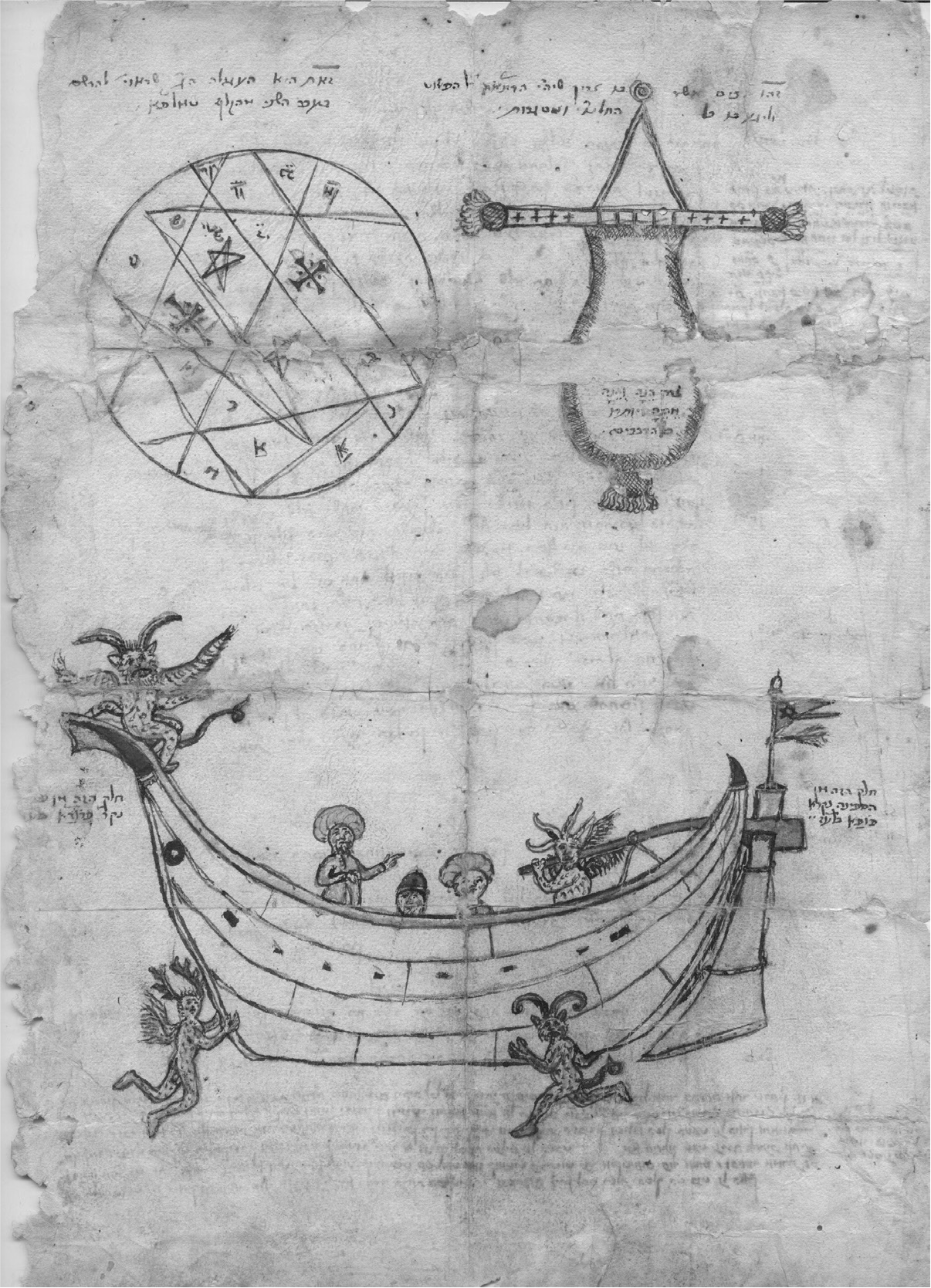
The folio in question is written on both sides. On the recto, we find three drawings: a circular diagram with lines and letters, a depiction of a small purse with inscriptions on it, and a large drawing of a ship containing three human figures, carried by four demonic figures. All these are known from later Claviculae, except for the ship, which is known only from the British Library manuscript Or. 14759 (33v).Footnote 54 These drawings on our folio are accompanied by captions that describe them and were part of a recipe for escaping from prison, which has not been preserved in the folio. While this assertion is based on the later manuscripts, the captions that survived in the folio support it. Above the circular diagram, the caption reads  (this is the third circle that should be inscribed on the other side of the parchment [that is made of] talpa [Latin/Italian for mole]). Above the small purse, there is also a caption:
  (this is the purse within which the dinaro—that is to say, the small coin—should be, and the windows and gates should be touched [with it]). The inscription on the purse reads
  (justice, HENA VEHENA MEHENA, all things will be loosened), clearly referring to the aim of this purse; namely, to make all gates and windows open by loosening their bonds.Footnote 55 By the sides of the ship, there are two captions concerning its anatomy. On the right, the caption reads
  (this part of the ship is called poppa [Italian for stern] in the vernacular).Footnote 56 On the left, the caption reads
  (this part of the ship is called proda [Italian for prow] in the vernacular).Footnote 57
On the verso, we find three recipes with an added paragraph containing general instructions (concerning the proper timing of experiments)—commonly found in auxiliary manuals—between the second and third recipes. The first recipe, as mentioned above, concerns the summoning of (the appearance of) a thousand horsemen. Next, a recipe for invisibility is described, which involves slaughtering a black rooster in the name of Satan, inserting a fava bean into it, burying the rooster, and waiting for the bean to grow. The beans that sprout from it will supposedly grant the one who holds them the ability to become invisible. The third (partial) recipe concerns a well-known method for finding a stolen good, widely known as “the eye of Abraham.”Footnote 58
All these recipes appear in this exact order in British Library Ms. Or. 14759 (33v–34r). Furthermore, the drawings are also to be found there (the magical circle and the purse on 33r; the floating ship on 33v). Peretz included the second and third recipes in his work, with the drawings of the magical circle and the purse in their relevant places. Consequently, Zekli also included them, but he explicitly omitted the recipe for invisibility out of an obvious halakic concern: “This gate remains closed, no man in Israel will enter it, since it contains a sacrifice for Satan.”Footnote 59
All of this suggests that the British Library manuscript seems to follow the structure and content of our folio more closely. Interestingly, a connection can be drawn between the two. All of the alternative recipes that were added to the folio by a later scribe were incorporated into the British Library manuscript. In the British Library manuscript, these alternative recipes are presented consecutively, without a whole new section (with a new title) being dedicated to each recipe, which was a practice that the scribe of this manuscript evidently used when describing consecutive experiments with the same goal. Additionally, the comments found in the margin of our folio were also integrated into the main body of the text in the British Library manuscript. For example, when the earliest scribe in our folio explained the Latin maculat[a] ( ) as חסרון in the margin, the scribe of the British Library manuscript directly wrote חסרון לה אין אשר (33v). While he kept the form
  (salice), he added נחל ערבי ל"ר (that is to say, willow) in parentheses.
In certain cases, the scribe of the British Library manuscript shortened the alternative recipe offered in the margins. For example, he recognized that the recipe in the left margin follows the recipe in the main text and only deviated from it at specific points. Thus, he ended his third and last recipe with ל"כנ (as mentioned above), referring to the formula of the first recipe. Practically, this scribe relates these two recipes to each other, making the third recipe dependent on the first. While the scribe of the British Library manuscript establishes this functional dependency between the two recipes, the relationship in our folio is purely structural. The third recipe is presented as an alternative to the first based on its placement, but it remains practically independent and can be performed without recourse to the formulas in the initial recipe.
The scribal strategies adopted by the later scribes are interesting in and of themselves and can show how they perceived the material in front of them and how they incorporated different sources to create their own Clavicula. However, given this “open” nature of the texts under discussion, how can we assume, from later manuscripts, the form of the original manuscript that contained this folio? More evidence is needed to support the argument that we are indeed looking at a folio from a Hebrew Clavicula.
The margins of this folio, as we saw, reveal some interesting insights concerning the scribes who participated in different stages of the development of its structure and content, which would manifest later in several different manuscripts. They can help us to uncover editorial decisions made by later scribes and clarify how texts went through changes in the process of transmission. These margins, I suggest, can also offer us an opportunity to contextualize this folio. In particular, a single simple comment in the margin shows that our scribe was familiar with the concept of auxiliary manuals, and with a Clavicula Salomonis in particular, which in turn makes the assumption concerning the original manuscript being a part of a Clavicula more plausible.
The first recipe in the surviving collection instructs the practitioner to use a staff or wand made of a willow branch. This branch should be cut with a single sword stroke, a reasonable instruction given the slenderness of willow branches. Our scribe, however, was seemingly concerned about the sword used in this practice: he used the definitive form החרב (the sword), without mentioning this sword earlier in the recipe. He thus commented in the right margin, explaining that “the sword” refers to “the familiar knife” (הידוע ן[י]הסכ). What value does this comment have to the already perplexed reader? What is known about this knife that led the scribe to consider it appropriate to explain “the sword” using it? There is only a single reasonable explanation: this is indeed a familiar knife; that is, a knife that has already been described. Since we have the whole recipe from its very beginning, we cannot argue that this knife was described in a part of it that is now missing.
Given the fact that manuscripts of the Clavicula Salomonis dedicated a whole chapter to the preparation of a knife to be used in different experiments, we may assume that this is exactly the case here. Evidently, such a chapter can be found in the later Hebrew manuscripts. For example, in the British Library manuscript, we read “Chapter 9: On the Knife and the Swords of the Art” (9v). This chapter gives a detailed description of how this knife should be prepared, what materials should be used, and what formulas should be used to consecrate it. This is a common chapter shared by many Claviculae, and it also appears in the Latin and Italian ones.Footnote 60 In the relevant recipe in the British Library manuscript, the scribe replaced “the sword” with “the familiar knife,” incorporating this reference into the main text.
Other internal references to different sections of this auxiliary manual from different discrete recipes in Hebrew Claviculae can be seen, for example, in Peretz’s instruction  (the most important thing is for you to arrange your things according to the order of the key of Solomon the king, peace be upon him), in a recipe that otherwise stands alone.Footnote 61 In another recipe, now an experiment attributed to Simon Magus, Peretz instructs the practitioners to end the ritual with a formula with which they should depart from the summoned spirits. However, he does not detail it, but only refers to it: להם תתן הידוע באופן רשות (give them permission [to leave] in the known manner).Footnote 62 What is this “known manner”? It is the one that appears in the first book of many Claviculae, which Peretz did not include in his work. The scribe of the British Library manuscript, however, explicitly referenced it: הפנים על להפטר רשות להם תתן כ"אח המלאכות כל בענין הראשון בספר שאמרנו (afterward, give them permission to depart in the manner that we spoke about in the first book concerning all the arts).Footnote 63 In a similar recipe attributed to Simon Magus, the scribe of this manuscript also wrote: ידעת אשר באופן רשות להם תתן (give them permission [to leave] in the manner that you already know).Footnote 64 The scribe included a note in parentheses in the left margin regarding this matter, but unfortunately, the method used to preserve this manuscript resulted in the margins being neglected and led to the removal of portions of the text in several instances. The surviving comment reads: }{במ הוא }{ה נתינת. Considering the nature of such comments in other places in the manuscript, I posit that it is … במ הוא הרשות נתינת (giving permission is [described] in …), probably referring to the same “first book” mentioned above, hence במ being, most likely, במפתח (in the Key).Footnote 65
Further evidence to support the argument that this folio originated in a Clavicula
Salomonis manuscript is the paragraph between the second and third recipes. This paragraph, which does not appear in Peretz’s manuscript, but only in the British Library one (34r), contains general instructions concerning when and how to test an experiment (נסיון איזה לבחון). According to this passage:
Note that when you wish to test an experiment, the moon should be in an even-numbered [day]; that is to say, in [day] two or [day] four or [day] six, etc., until the half [cycle] of the moon [i.e., the fourteenth day]. And when the moon is in its second day, the experiments should be written before sun-rise, toward the east. And if it is in the fourth day, [the experiments should be written] at sunrise [השמש ביאת], toward the east. And if [it is in the] sixth [day], toward the west. And if [it is in the] eighth [day], toward the south. And if [it is in the] tenth [day], toward the North.Footnote 66
This passage provides a relatively general set of instructions, which aligns with the genre of auxiliary manuals. While it cannot be found in the earliest attested Italian Clavicula, a note that appears in it suggests that we are witnessing an elaboration of a concept that was rooted in this early stage of transmission. This concept revolves around the challenge or impossibility of calculating astrological timing based on all the relevant planets. Recognizing the difficulty in pinpointing the precise moment for a magical operation based on specific planetary hours, the Italian Clavicula proposes: “But if it seems too difficult and burdensome for you to find the hours and points as finely [i.e., precisely] as mentioned above, you should observe the moon from the first to the fifteenth day and arrange it on one of the aforementioned days in the first hour of these days; that is, between the first dawn and the sunrise.”Footnote 67
Here, relying mainly on the moon is offered as a solution to the difficulty of finding the precise astrological moment. Practically, this presents the practitioners with an accessible method: observing the moon and the sunrise does not require external specialized tools or updated ephemerides. It seems that the passages in the Hebrew manuscripts correspond to this or are reacting to this passage and that they are, in that sense, an elaboration made for an easier, or more accessible, modus operandi. This is, however, not exclusive to the Hebrew manuscripts. We can find a similar passage in some of the Latin Claviculae. For example, in a late seventeenth-century Clavicula Salomonis, we find:
Note that if anyone wishes to perform an experiment, note well that it is necessary that he have this method. First, he should know what he wishes to perform. Second, he should observe the moon, namely, from the first [day of] moon until the fourteenth [day of] moon. Third, it is necessary for the moon to be in an even-numbered day during its waxing phase, because you should not write or conjure any experiment unless the moon is in its second, fourth, sixth, eighth, tenth, twelfth, [or] fourteenth [day]. If any experiment is to be written when the moon is in its second phase, it must be done before the sunrise in the east. If in the sixth, towards the west. If in the eighth, towards the south. If in the tenth or twelfth, towards the north. If in the fourteenth, at the sunrise, but first see that you know the time, the hour, and the phase of the moon.Footnote 68
The user-friendly method of calculating astrological timing offered by various Claviculae alleviates the concerns raised by practitioners who did not have the knowledge, expertise, or economic means to choose the precise moment for their practice. This method, presented as a general method for all kinds of experiments, fits very well with the genre of auxiliary manuals.
Our folio contains the recipes that can be found later in an eighteenth-century Hebrew Clavicula, which incorporates comments and notes in the folio’s margin. The recipes in the later manuscript appear in the same order as on our folio. Taking into account the reference to “the familiar knife” and the passage addressing astrological timing, which are commonly found in various Claviculae and fit the auxiliary nature of these texts, we can postulate with a high degree of certainty that this folio is indeed a remnant of an elaborated codex of a Hebrew Clavicula. Furthermore, the translation process reflected in the text suggests that it is one of the first Hebrew Claviculae to include these specific recipes, which would later be considered integral parts of the (known) Hebrew Clavicula, as seen in later Hebrew manuscripts. However, this should not mislead us: while recipes are often found in the same codices as Claviculae, it does not necessarily mean that they were always seen as integral parts of them. As demonstrated earlier, scribes who worked on Claviculae saw them as auxiliary manuals that could stand alone textually, but not practically. Thus, some scribes compiled different recipes with their Claviculae, sometimes adding references to the Clavicula as an authority on certain techniques.
Grunwald’s (Still) Lost Manuscript
We can conclude with some certainty that Hebrew Claviculae were already available in Italy during the sixteenth century. During the 1570s, a Clavicula was mentioned in Shalsheleth Haqqabbalah by Gedalyah Ibn Yaḥia, who spent time in Ferrara. There, Gedalyah mentioned a שלמה מפתח (Key of Solomon) in the list of books attributed to King Solomon, describing it as a book containing “adjurations against the devils” (השטנים נגד השבעות). The presence of Claviculae circulating among the Jewish community in Italy, particularly in northern Italy, at such an early stage should not come as a surprise. Inquisitorial records studied by Barbierato provide clear evidence of Christian-Jewish exchanges of magical materials related to the Clavicula during the seventeenth century in Venice. A notable example is the trial of Francesco Viola, which explicitly mentions the involvement of a Jewish practitioner.Footnote 69 In fact, the Jewish practitioner served as a mediator, explaining to the Christian practitioner the Hebrew names written in the texts and how they should be pronounced.Footnote 70 Obviously, this mediating role also provided an opportunity for an exchange in the opposite direction.
Twelve years before he completed his Clavicula in Amsterdam, Peretz visited Livorno, which is southwest of Ferrara. A possible indication of the dissemination of his knowledge is that sixteen years later, in 1725, a Hebrew Clavicula was mentioned by the Livornese Joseph Attias (1672–1739).Footnote 71 At that time, Hebrew materials that are related to our folio from a Hebrew Clavicula were already circulating outside Italy, and it is plausible that at least some of the materials moved to other cities in Europe via Peretz himself, as he is known to have exchanged magical manuscripts with an anonymous figure in Prague and Vienna.Footnote 72
Our folio is evidence of an early attestation of a Clavicula Salomonis among Italian Jewish communities during the sixteenth century. Despite its discovery, this finding does not entirely resolve the issue surrounding Grunwald’s manuscript. I argue that this folio is not the same one examined by Grunwald. Instead, it appears to be an earlier source that influenced Grunwald’s manuscript. Several factors support this argument. First, Grunwald transcribed more recipes than those that have survived on our folio. However, this can be attributed to the possibility that he examined it when it was still part of a codex. Indeed, there is one recipe that Grunwald transcribed from his manuscript that does not appear in our folio, but is found in a somewhat different form in the British Library manuscript (44v).
While we cannot determine when this folio became detached from its original context, we can closely examine Grunwald’s transcription of the recipes that also appear on it. This examination reveals two important things. First, several comments that appear in the folio’s margins were incorporated into the text, given in parentheses. However, not all of them are included, and some of them seem to have been paraphrased. For example, “Take a staff or a wand of salice (willow) that does not have a maculin (defect), cut it (cut it)Footnote 73 in a single stroke with the sword (knife), and wash it [the wand or the stick]Footnote 74 seven times in flowing water (seven types of water).”Footnote 75 While we can find most of the comments in the parentheses on our folio, we cannot find all of them, and some of those that can be found are abbreviated. For example, the “familiar knife” (הידוע הסכן) in the right margin is simply “a knife” (סכין) in Grunwald’s manuscript.
Another point that seems to suggest that this folio is not the source of Grunwald’s transcription is some quite odd readings he made, which might also be explained by his use of a different source. For example, he unwittingly invented a recipe by misreading a short caption above the drawing of the purse used to open gates. As mentioned above, this purse should contain the dinaro (דינארו), a small coin. However, according to Grunwald, the caption reads הקמח להיות צריך בו אשר הכיס זהו ומסגרת חלון כל בו ולהגן לשפוך (this is the purse within which the flour should be, to pour [over] and to protect with it every window and gate). Thus, he suggested that this is a recipe for a magical flour that was used to patch up leaks in ships. The word “flour,” however, was not in the original text, as Grunwald stated in parentheses, but rather the word רינא, which he understood as the Spanish word for “flour.” This רינא, I suggest, is a misreading of דינארו, which led to this new recipe. In our folio, the phrase הפשוט ל"ר (that is to say, a small coin) prevents such a misreading, and thus it is unlikely that it was our manuscript that Grunwald examined.
Grunwald’s assumption that a Spanish word underlies the form רינא was not entirely unfounded, as he had reasonable grounds for suspecting a Spanish influence. This suspicion is supported by a recipe that he described as part of the manuscript he examined, which corresponds to a recipe in the British Library manuscript and contains words in Ladino. He wrote explicitly about this, stating: “And on the fingers (in the original: y en los dedos).”Footnote 76 From this brief note, it appears likely that Grunwald possessed a different manuscript, one that potentially included all the recipes found in our folio, as well as some that align with recipes in later Hebrew Claviculae. It seems that a few of these recipes may have been modified or adapted by Ladino-speaking practitioners. The drawing of the ship that was added to Grunwald’s article also supports this conclusion, since a close examination reveals that while all the details in it are also shared by the drawing in our folio, their proportions vary.Footnote 77 Moreover, Grunwald described a colored image, which also does not correspond to the one found in the British Library manuscript.
All the evidence suggests that Grunwald was not engaging with any of the manuscripts that are currently known to us. His manuscript, while its origins are not entirely clear, was produced against a Sephardic cultural backdrop, as indicated by its scribe’s proficiency in Ladino. Given that a later hand added the formula הקולמוס אנסה in a cursive Sephardic script, it is tempting to describe our folio as a direct source for Grunwald’s manuscript. Although this connection presents a compelling narrative, the evidence required to definitively prove such a lineage is, as yet, incomplete. In the meantime, the enigma of Grunwald’s manuscript, once housed within the Bezalel Museum, remains unsolved.
Appendix
Jerusalem, The Israel Museum, B12.1864: fragment from a copy of The Key of Solomon the King (Clavicula Salomonis), North Italy, 16th century, handwritten and drawn in ink on paper, H: 24 cm, L: 34 cm.
B12.1864, 1r (Photo © The Israel Museum, Jerusalem)

Fig. 1: Long description
The image contains several distinct elements. At the top left, there is a circular diagram divided into sections with various symbols, including stars and numbers. To the right of the circle, there is a cross-like structure with detailed decorations at each end. Below the cross, there is a bowl with Hebrew text around it. The bottom half of the image features a boat with several figures inside, including one holding a staff. The boat is adorned with mythical creatures and flags. Hebrew text is present throughout the image, providing annotations and explanations for the various elements.
B12.1864, 1v (Photo © The Israel Museum, Jerusalem)

Fig. 2: Long description
A page of handwritten text in Hebrew with various annotations and marginal notes. The text is densely written with multiple lines and paragraphs. There are several annotations in the margins, including Hebrew transliterations of Latin and Italian words. The annotations clarify and explain specific terms in the main text, such as the Hebrew transliteration of the Latin maculat[a], which describes a staff or wand without any defect. Other annotations include the Hebrew transliteration of the Latin/Italian salice, explained as willow, and the Hebrew word for fava bean with the Italian fave added in the margin. The Hebrew word for salvation is also annotated with the Latin/Italian salve, meaning greetings. These comments suggest the scribe's active participation in the translation process, preserving specific forms and commenting on them if they seemed odd or problematic.








 Open access

