




INTRODUCTION
Despite the Covid-19 pandemic, the internationalization of higher education continues unabated, and international student mobility is expected to keep rising by 5% annually over the next decade (Laad & Sharma Reference Laad and Sharma2021). In 2019, there were over five million tertiary students worldwide studying outside their country of origin. While student flows are increasingly diversifying, UNESCO identifies two clear trends. First, most international students hail from Asia, with China, India, and South Korea alone accounting for a quarter of all international students. Second, over half of all international students head to only five Anglophone destinations: US, UK, Australia, Canada, and New Zealand (UNESCO 2020).
These figures point to the central role that the English language plays in the internationalization of higher education (de Wit Reference de Wit2019), particularly as the attraction of universities in the Anglosphere is flanked by the concomitant rise of English medium instruction offered by institutions elsewhere (Doiz, Lasagabaster, & Sierra Reference Doiz, Lasagabaster and Sierra2012; Tsou & Kao Reference Tsou, Kao, Tsou and Kao2017). English today is undoubtedly a global lingua franca through which an ever-larger number of students are being educated, regardless of national-linguistic heritage or country of residence. Yet, despite the phenomenal advance of a new register that has been termed ‘English as a lingua franca in academic settings’ (Jenkins Reference Jenkins2013), old ideas about the primacy of the native speaker in higher education and global knowledge production continue to linger (Holliday, Aboshiha, & Swan Reference Holliday, Aboshiha and Swan2015; Gobbo & Russo Reference Gobbo and Russo2020; Piller, Zhang, & Li Reference Piller, Zhang and Li2022). They go hand in hand with the persistence of language ideologies claiming a privileged status for Standard English as defined by Britain and the US.
In other words, English language proficiency (ELP) today is a construct that is pulled in two different directions. First, there is the ascendent ideological complex of global academic English as independent of a speaker's ethno-national identities, and of their country of residence or citizenship. This construct is closely associated with the neoliberal commodification of language (Piller & Cho Reference Piller and Cho2013; Sharma & Phyak Reference Sharma and Phyak2017; Soto & Pérez-Milans Reference Soto and Pérez-Milans2018) and entrepreneurial speaker subjectivities (Costa, Park, & Wee Reference De Costa, Sung-Yul Park and Wee2021; Li & Zheng Reference Li and Zheng2021). Second, there is the staying power of the construct of English as based on the standard forms emanating from Britain and the US and imagined as belonging to people whose heritage and citizenship tie them to these countries and a handful of others in ‘the Anglophone center’. When speaking of ‘the Anglophone center’, we draw on Kachru's (Reference Kachru, Quirk and Widdowson1985) well-known concentric model of World Englishes. In this model, Britain and US, along with their settler colonies Australia, Canada, Ireland, New Zealand, and South Africa, are the center of the Anglosphere. This inner circle is surrounded by a so-called ‘outer circle’ of countries that were at some point British or US extraction colonies and where English today enjoys official status, usually alongside one or more other languages. Examples include India, Nigeria, and the Philippines. The outer circle is surrounded by countries of the expanding circle, where English is learned as a foreign language. This basically comprises the rest of the world and includes most of continental Europe, Latin America, and West, Central, and East Asia. Despite its well-discussed shortcomings and obvious simplifications, the model serves as a useful shorthand for different ideological relationships between different forms of English and the identities they index (Park & Wee Reference Park and Wee2009). This construct of ELP is deeply racialized with white speakers in the inner circle and racialized others in the outer circle. Consequently, it produces a binary set of identities for the speaking subject: the white native speaker citizen and its other, the non-white non-native speaker non-citizen (Shuck Reference Shuck2006; Piller, Torsh, & Smith-Khan Reference Piller, Torsh and Smith-Khan2021).
How do universities in the Anglosphere—who are deeply invested both in national and international education—navigate these tensions? What language ideological constructs of ELP and speaker identities do they embrace, reject, and reaffirm as they seek to fulfill their educational and academic missions while remaining economically viable? This article sets out to explore these questions through an examination of ELP requirements for university admission. Specifically, we pursue four research questions:
(i) How is ELP as a university admission requirement constructed?
(ii) What counts as evidence of adequate ELP?
(iii) Who is subject to language testing and who is exempt?
(iv) What speaker identities are constructed and deconstructed, legitimized and delegitimized through these processes?
In the following, we first situate our study in the literature engaging with language ideological debates about language proficiency and ethno-national identities in higher education and beyond. We then introduce our methods: based on the ELP requirements for admission to the most prestigious Australian universities, we conducted a language ideological analysis focusing on iconization, fractal recursivity, and erasure (Irvine & Gal Reference Irvine, Gal and Kroskrity2000). Our analysis demonstrates that ELP is constructed as a neutral requirement that applies to all students equally, regardless of background or citizenship. However, there are two different types of ELP required of different groups of students. First, there is the kind of ELP that is taken to be inherent in other student characteristics and qualifications. This kind of ELP is closely tied to applicants from Anglophone center countries. Second, there is another kind of ELP which needs to be demonstrated through performance on a recognized English language test. This kind of ELP is associated with students from Asia, regardless of the status of English in their country of origin. These two different constructs of ELP map closely onto different ethno-national groups and, in the process, both dis-invent and re-invent native speaker ideologies. Native speaker ideologies are challenged because inherent ELP is not only assigned to applicants from the inner circle but also to some applicants from outer and even expanding circle countries. By contrast, non-native speaker ideologies are reaffirmed by the fact that tested ELP is mapped onto Asian applicants. We close with conceptual and applied implications of our research.
LANGUAGE PROFICIENCY AND ETHNONATIONAL IDENTITIES IN HIGHER EDUCATION
In recent decades many universities in center Anglophone countries have come to depend on international students for revenue generation (Zhang, Worthington, & Hu Reference Zhang, Worthington and Hu2017). Although US and British universities attract the largest numbers of international students in absolute terms, we focus our case study on Australia because it stands out among destination countries on a per capita basis: in 2019, 28.4% of all tertiary students enrolled in Australian universities were international (OECD 2021) and the provision of educational services has been in the country's top-five export industries throughout the twenty-first century (Australian Government, Department of Foreign Affairs and Trade 2021). This means that Australian universities serve two distinct groups of students: domestic and international. The former account for about two thirds of students and the latter one third. University places for the former are subsidized by the Australian taxpayer and their fees are capped. By contrast, international student fees are borne by the individual and universities are free to set them at market rates (Ferguson Reference Ferguson2021).
These market and group dynamics have repeatedly been the subject of intense media scrutiny and public debates. International students have often been disparaged as ‘cash cows’ (Robertson Reference Robertson2011) and universities as ‘visa factories’ because tertiary education can provide a pathway to permanent residency (Robertson & Runganaikaloo Reference Robertson and Runganaikaloo2013). International students’ ELP has been central to these debates and there is a widespread perception that international students’ English is poor (Haugh Reference Haugh2016; Bodis Reference Bodis2021a,Reference Bodisb). In an influential 2006 government report, universities’ alleged lax ELP requirements were blamed for international students’ inability to participate effectively in higher education and in the workforce after graduation (Birrell, Hawthorne, & Richardson Reference Birrell, Hawthorne and Richardson2006). International students, low ELP, falling academic standards, increasing levels of academic misconduct, and failure to integrate into Australian public life have since become indexically related through a series of language panics (Paltridge, Mayson, & Schapper Reference Paltridge, Mayson and Schapper2014; Bodis Reference Bodis2021a,Reference Bodisb).
Universities have responded to these ongoing media debates through repeated reviews of their admission processes, and ELP requirements are now subject to intense quality monitoring (Tertiary Education Quality and Standards Agency 2021). As we know from personal experience, applied linguists and language testing experts are regularly called upon to provide expertise in their institutions’ ELP requirements (see also Knoch Reference Knoch2021). As a result, ELP requirements for international students have become relatively standardized to pathway programs and test scores from the huge variability of sixty-one different pieces of acceptable evidence found by Coley in Reference Coley1999.
Central to this standardization is a high level of reliance on English language testing scores. The most widely used test in Australia is the International English Language Testing System (IELTS; O'Loughlin Reference O'Loughlin2011). The international use of this and other language tests is supposed to ensure objectivity and the fair and equal treatment of all test takers. This assumption is increasingly being questioned as researchers find that the overreliance on a test score for admission purposes seems to detract from attention to ongoing language development once students have entered their studies (Pilcher & Richards Reference Pilcher and Richards2017; Arkoudis, Dollinger, Baik, & Patience Reference Arkoudis, Dollinger, Baik and Patience2019; Pearson Reference Pearson2019). While the overreliance on test scores is being questioned by academics in applied linguistics, they tend to be uncritically accepted by university admission officers (Deygers & Malone Reference Deygers and Malone2019), university lecturers (O'Loughlin Reference O'Loughlin2011), and even English language teachers preparing students for university entry (Chappell, Bodis, & Jackson Reference Chappell, Bodis and Jackson2015).
Amidst these debates one question has remained relatively underexamined: who should be subject to language testing and who should receive a waiver? While the debate about ELP has been nominally about ‘international students’, it is obvious that ‘international student’—a legal category—only partly overlaps with the category of ‘English language learner’. A hypothetical monolingual English speaker from the UK, for instance, who has received all their education through the medium of English is an international student in Australia, but their ELP is unlikely to come under scrutiny.
The decision who should and who should not be required to undertake a language test is far from a hypothetical problem, as the following examples from our own experience illustrate. When the second author applied for admission to a PhD program as a domestic candidate, she was required to evidence her ELP through a test score although she had extensive English teaching experience, almost a decade of residence in Australia, and a previous degree from Central European University, an English-medium institution in Hungary. As she also worked as an IELTS examiner, this role was accepted as constituting evidence of performance in the highest band. Without such involvement with a recognized ELP test, an international applicant from Bangladesh did have to sit the IELTS test, although all of their prior education had been through the medium of English, they were employed as university lecturer in the English department of a university in Bangladesh, and they had published fictional and non-fictional writing in English. Similarly, in another example, a domestic applicant with a decade of professional experience as interpreter and interpreter trainer in Australia had to undertake an ELP test because all of their prior degrees were from South Korea. The first author even provided an expert support statement about the candidate's ELP but no exemption from the ELP testing requirement was granted.
As these examples demonstrate, whose English should or should not be tested is by no means a straightforward decision. Even so, it is not a problem which has been the subject of much debate nor scrutiny. This is where our study comes in as we seek to make explicit the constructs of ELP and speaker identities underpinning language testing requirements for university admission. What language ideologies undergird these policies that are developed in response to a practical problem but lack theoretical and empirical articulation (Moore & Harrington Reference Moore and Harrington2016)?
ELP requirements for university admission are embedded in broader debates about the relationship between language proficiency and social inclusion. In recent decades, proficiency in the national language has widely come to be seen as a precondition for integration, belonging, and citizenship. Conversely, limited or no proficiency is taken as evidence of segregation and justification for exclusion. Against this background, an increasing number of countries have introduced language proficiency requirements as preconditions for entry and citizenship since the 1990s (Extra, Spotti, & Van Avermaet Reference Extra, Spotti, Van Avermaet, Extra, Spotti and Avermaet2009; Frost & McNamara Reference Frost, McNamara, Tollefson and Pérez-Milans2018; Kunnan Reference Kunnan, Fulcher and Harding2021). Simultaneously, a body of scholarship has emerged that has interrogated the language ideological debates surrounding these developments (e.g. Piller Reference Piller2001a; Milani Reference Milani2008; Blackledge Reference Blackledge2009). This article builds on this work and brings it to a different group of mobile people for whom language proficiency testing ostensibly has a different purpose: to ascertain whether they are fit for university entry.
Before we move on to our analysis, we briefly address racialization as another conceptual underpinning of our study. University admission requirements are inherently discriminatory: they discriminate between those who are and those who are not deemed worthy of admission. Whether universities’ legitimate selection processes are overlaid by illegitimate discrimination has been a matter of intense scrutiny. Bias in admission procedures, whether real or perceived, constitutes a significant risk for universities (Zimdars Reference Zimdars2010; Pitman Reference Pitman2015). In the context of a wider project of multiculturalism in liberal democracies, the embrace, at least rhetorically, of diversity is today part of the nation building of Australia and other liberal democracies (Moran Reference Moran2011; Kymlicka Reference Kymlicka, Stiftung and Institute2012). Within these states, universities have been some of the institutions most committed to equity, diversity, and inclusion (Basit & Tomlinson Reference Basit and Tomlinson2012)—to the degree that social inclusion rhetoric in higher education has been termed a ‘meme’ (Hughes Reference Hughes2015). Many have questioned whether these commitments can ever be more than mere window dressing (Ahmed Reference Ahmed2021). Be that as it may, beyond the moral imperative, universities today have an economic incentive to be inclusive of diversity, and ‘diversity marketing’ is highly prominent in the discourses of higher education (Urciuoli Reference Urciuoli2010, Reference Urciuoli2016).
Diversity discourses may operate as a form of ‘converse racialization’, as Mena & García (Reference Mena and García2021) recently showed with reference to the public communications of a bilingual US university. Converse racialization ‘shifts the directionality of semiotic indexes away from a particular “race” or “ethnicity” (including whiteness) and produces an apparent state of “unmarkedness”’ (Reference Mena and García2021:343). Racial unmarking happens as the order of the nation state clashes with the order of corporate globalization. While the construct of English as a white language is tied to ethnonational identities, the construct of English as the language of the neoliberal entrepreneur is tied to economic identities. The clash of these identities produces considerable instability in racial formations (Solomos Reference Solomos2020) but the central function of racializing discourse remains the same: ‘contrasting those with rightful places in a larger social order to those without’ (Urciuoli Reference Urciuoli, Samy Alim, Reyes and Kroskrity2020:124).
We argue that university admission requirements in national, yet neoliberal, universities are one such discourse where racialization and converse racialization, and linguistic marking and unmarking, clash. How, then, is ELP constructed? What counts as evidence and who is subject to or exempt from language testing? And, ultimately, which speakers are constructed as having a rightful place in the social order?
METHODS
Australia's oldest and most prestigious universities form a coalition known as the ‘Group of Eight’ (Go8). This coalition comprises the Australian National University, Monash University, and the universities of Adelaide, Melbourne, New South Wales (NSW), Sydney, Queensland, and Western Australia (Group of Eight Australia 2021). Admission to these institutions is highly competitive and their graduates dominate Australian elites (Marginson Reference Marginson, Palfreyman and Tapper2009). Go8 universities also attract the lion's share of international students: in 2019, 37.5% of all international students in Australia studied at a Go8 institution, although they only make up 20% of Australia's forty-one universities (Australian Government, Department of Education 2020). The dominance of Go8 institutions in Australian higher education justifies concentrating our enquiry on their ELP admission requirements.
To compile our dataset, we started with the search query ‘entry requirements’ on the home page of each of the eight universities. From the results, we visited all webpages and hyperlinked documents that contained information about English language requirements. We collected all pages providing general information, policies, and procedures but excluded the requirement pages for specific courses or degrees, as the latter differ only in required test scores. Additionally, we included the English language requirements page of University Admissions Centre (UAC), the commercial organization that handles the bulk of university admissions in the most populous state, NSW, and the Australian Capital Territory (Universities Admissions Centre 2022).
This resulted in a corpus comprising twenty-three webpages and related documents. Most universities had ELP requirements spread out over two to three pages, with an overview page hyperlinking to one or more detailed policy documents.
In a first analytical step we employed content analysis (Krippendorf Reference Krippendorf2019) and coded for linguistic and non-linguistic characteristics of ELP in the data. We identified four different characteristics of ELP, as follows.
• ELP as language test score: ‘You need to achieve the minimum scores shown for any of the English language tests below’ or ‘the University's preferred accredited English language tests are…’
• ELP as citizenship: This may be done through explicit statements such as ‘have citizenship or permanent long-term residency (minimum ten years) … in an English-speaking country recognised by the University’ or implicitly through providing different pathways through the requirements for ‘domestic students’ and ‘international students’.
• ELP based on educational qualifications: ‘have completed your final four years of secondary schooling at an institution that teaches entirely in English’ or ‘successful completion of the International Baccalaureate Diploma meets the English language requirements’
• ELP as linguistic heritage: ‘from an English-speaking background’ or ‘English is your first language’
In a second analytic step, we examined how these characteristics of ELP map onto social identities. We did this by focusing on the three semiotic processes of the ideologization of language proposed by Irvine & Gal (Reference Irvine, Gal and Kroskrity2000). These are iconization, fractal recursivity, and erasure. Iconization serves to attribute an inherent connection between a linguistic form and a social group. Fractal recursivity serves to construct group binaries by transposing a linguistic contrast onto a group contrast, and erasure serves to simplify the linguistic and social field by rendering certain linguistic forms and the people who use them invisible. This is most often done by disregarding internal variation.
Before we proceed to a discussion of our findings, we articulate our locus of enunciation in an effort to confront epistemological racism and to decolonize scholarly knowledge (Diniz De Figueiredo & Martinez Reference Diniz De Figueiredo and Martinez2021; Piller et al. Reference Piller, Zhang and Li2022). We both speak as academic linguists with roles in our department's Applied Linguistics and TESOL program, as language teacher trainers, and as former English language teachers. That we have been reasonably successful in these roles as so-called non-native speakers of English—we both started to learn English as a foreign language in continental Europe in our early teens—continues to occasion, infrequent but regular, surprise and sometimes a questioning of our competence and authority. Yet, we also acknowledge that, in contrast, to our colleagues and students who do not embody whiteness we are not ‘on migrant duty 24/7’, as a Sudanese participant at one of Piller's teacher training workshops once remarked. As white academics ‘with an accent’ we fall between the cracks of the binaries of language and identity we are about to describe.
ELP AS A NEUTRAL SELECTION TOOL WITHIN A BINARY LEGAL STATUS FRAMEWORK
The fundamental university entrance requirement are academic qualifications and results. All Australian universities additionally have an ELP requirement. The ELP requirement may or may not be folded into the qualifications evidence:
English language proficiency (ELP) is an admission requirement for most tertiary courses offered through UAC. However, most people—including those with an Australian Year 12 qualification—do not have to do anything extra to prove their proficiency. Their qualification will be used as evidence. If you do need to provide evidence of your proficiency in English, this will be indicated in your application. [emphasis in original]
Most universities provide an explicit rationale for the universal ELP requirement:
English is the language of instruction when you come to study at [University]. Your lectures, tutorials, exams, class discussions and other activities will be in English. Given this, it's important you understand what English language requirements you'll need to meet to be offered a place.
[University] teaches and assesses its units and courses in English … To ensure that students have a good chance of succeeding at [University], the University sets minimum English language proficiency standards.
English is the language of instruction at [University]. Therefore, you will need to be proficient in speaking, listening, reading and writing in English.
In addition to stating the rationale for the ELP entry requirement these examples simultaneously function as a programmatic language policy justifying institutional monolingualism in the face of a highly linguistically diverse student population (Bodis Reference Bodis2021a,Reference Bodisb). They also serve to neutralize English: as an institutional given put in place for the benefit of the students, its status as a selection tool that applies to different students differently is masked. This is particularly obvious in the following examples:
All students need appropriate English language skills for admission.
All applicants, whether domestic or international, must provide evidence that their English language ability meets the minimum requirements for admission. [emphasis added]
By explicating that ‘all applicants’ fall into ‘domestic and international’ the second excerpt also raises the fundamental legal distinction that is inextricably enmeshed with the ELP requirement. All of the universities in our dataset have a dual admission architecture, with one navigation path for domestic students and another path for international students (see Figure 1). This dichotomy is a legal requirement and guided by citizenship legislation. As the example in Figure 1 shows, domestic students are positively identified by their status (‘a citizen’, ‘a permanent resident’) while international students are identified negatively by their lack of such a status (‘not’).
Example of the two different navigational pathways through the admission process.

The choice of navigational pathway by legal status through the application process is non-optional. This legal dichotomy then leads to another linguistic dichotomy between those whose ‘first language is English’ and those whose ‘first language is not English’ (see Figure 2). Alternative phrasings for this linguistic binary include ‘English-speaking background or education’ and ‘Non-English speaking background or education’, or ‘English primary language pathway’ and ‘English not your main language’.
Example of the linguistic binary that overlays the legal status binary.
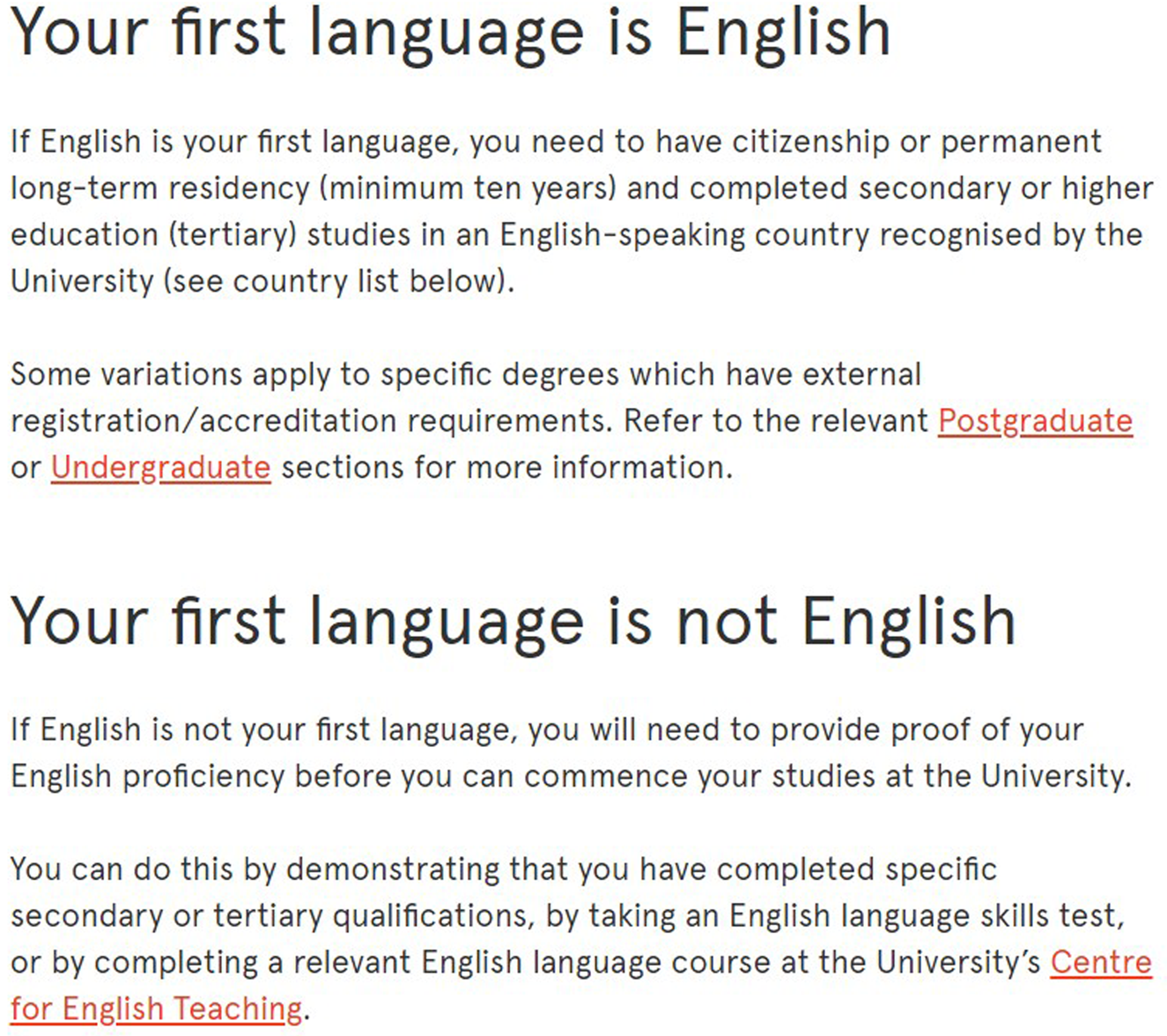
The legal status binary and the linguistic background binary are not coterminous. However, their ubiquity on the admission websites means that they become closely associated with each other. In other words, citizenship status becomes imbricated with a linguistic component and, conversely, ELP is imbued with a legal dimension (Smith-Khan Reference Smith-Khan2021).
In this section, we have shown that ELP is asserted as a neutral selection criterion that applies equally to all applicants. On this asserted equity rests a binary between two forms of ELP, their attendant forms of evidence, and their speakers. One form of ELP is inherent in other applicant characteristics and achievements. For this type of ELP, no further linguistic evidence of proficiency is required. Opposed to this inherent form of ELP is another form of ELP that is constituted by an absence—a linguistic deficit—in applicant characteristics and achievements. Applicants without inherent ELP are required to demonstrate their ELP through a language test score. We now examine each of these two forms of ELP—inherent and tested—and the social groups they index in detail.
INHERENT ELP
What we call ‘inherent ELP’ is a construct that is independent of language tests. This kind of language proficiency is presented as inherent in other applicant characteristics or achievements, specifically their citizenship, their educational qualifications, and their linguistic heritage. Inherent language proficiency may be referred to as ‘first language’, ‘main language’, ‘primary language’, or ‘language background’. However, it is important to note that linguistic heritage is not the sole basis, and mostly not even the most important one, for the determination of inherent ELP. Rather, this kind of ELP is determined through a mélange of citizenship, education, and heritage criteria:
If English is your first language, you need to have citizenship or permanent long-term residency (minimum ten years) and completed secondary or higher education (tertiary) studies in an English-speaking country recognised by the University (see country list below).
This document contains the requirements based on citizenship status, prior study, and English language tests.
Citizenship, education, and heritage are rarely systematically distinguished and citizenship and heritage, in particular, are readily conflated. For example, to be recognized as having an ‘English-speaking background’ one policy requires two pieces of evidence from two different sets: one needs to be a citizenship document (‘birth certificate, passport, arrival documents to establish residency’) and the other a portfolio of documents providing evidence of schooling, work, and residency. Curiously, the latter may include utility bills, tax notices, and medical records, as well as a letter of reference from ‘a person with standing in the community’. Examples of such persons include ‘a school principal or teacher, doctor or pharmacist, a local manager, community leader, social worker or sporting coach who know the person's family’.
While the precise nature of the evidence required to prove inherent ELP differs, it is always tied to a set of countries. In other words, inherent ELP is guided by the territorial principle (Piller Reference Piller2016) and only citizens, residents, or graduates of specific countries are constructed as potentially having inherent ELP. These specific countries are, first and foremost, Australia and New Zealand.Footnote 1 That means that legal status as a domestic student and the ascription of inherent ELP overlap.
UAC and seven of the eight universities under investigation provide lists of an additional set of eligible countries other than Australia and New Zealand whose citizens, residents, or graduates are deemed to meet the required ELP level qua their status:
Is my country recognised as English-speaking country?
[University] recognises the following countries as English-speaking: American Samoa, Australia, Bahamas, Barbados, Belize, Botswana, Canada, Fiji, Gibraltar, Ghana, Guyana, Ireland, Jamaica, Kenya, Lesotho, Liberia, New Zealand, Nigeria, Papua New Guinea, Singapore, Solomon Islands, South Africa, The Gambia, Tonga, Trinidad and Tobago, United Kingdom (including Northern Ireland), United States of America, Zambia, Zimbabwe.
The country lists differ somewhat but, in addition to Australia and New Zealand, all of them include Canada (explicitly excluding Quebec in two instances), Ireland, UK, and the US. That ELP is constructed as an inherent property of citizens, residents, and graduates of these countries is not particularly surprising and in line with well-known language ideologies of native speakerism and English as a white language. In these language ideologies, English speakers from inner circle countries (as per Kachru's (Reference Kachru, Quirk and Widdowson1985) model; see above) are taken to have privileged access to the language as native speakers (Holliday Reference Holliday2006). As these are white-dominant societies, native speaker status of English also comes to be mapped on whiteness (Piller et al. Reference Piller, Torsh and Smith-Khan2021). By contrast, speakers from the outer and expanding circles are conventionally constructed as non-native speakers (Hickey Reference Hickey2018) and non-native speaker status is racialized as non-white (Shuck Reference Shuck2006).
However, this marking of English goes hand in hand with a process of unmarking where inherent ELP is also assigned to speakers from several countries in the outer and expanding circles. These constructions of inherent ELP complicate conventional ideologies of native speakerism and racialization.
There are two lists of countries: a set of countries whose citizens, residents, and graduates are deemed to have inherent ELP, and another set of countries where the holders of certain academic qualifications are accepted without a further language testing requirement. The first list is centered on Anglophone countries, as we have discussed. Additionally, a number of countries conventionally deemed to fall in the outer circle are also routinely included. The second list centers on countries in the expanding circle. We now discuss each list in turn.
The lists of countries whose citizens, residents, or graduates are assigned inherent ELP are relatively long. The longest list includes fifty-three countries and the shortest five. The average number of countries on the eight lists is twenty-five. The length of these lists, in itself, indexes inclusion and diversity.
In terms of content, the lists are relatively heterogeneous, and made up of a variety of outer circle countries in Africa, the Caribbean, and the Pacific with majority Black and multilingual populations. Their inclusion in lists of inherent English proficiency thus clearly demonstrates a shift in language ideologies away from native speakerism and of English as a White language.
At the same time, it is noteworthy that the outer circle countries included are mostly small countries with very small student populations in Australia. Some frequently listed countries, such as Guyana, Lesotho, or Liberia, each have less than thirty students in Australia (Australian Government, Department of Education 2020). In other words, the relatively long lists of outer circle countries whose citizens, residents, or graduates are deemed to have ELP qua their status could be considered to create an illusion of diversity instead of a true challenge to native speakerism and the racialization of English as White language. The lists are instances of banal nationalism (Billig Reference Billig1995) that seem inclusive on paper but are really exclusive of the actual student population from outer circle countries in Australia.
By contrast, outer circle countries that have large student populations in Australia are not listed: absent are India (89,018 students in 2019), Nepal (32,375), Malaysia (29,652), Sri Lanka (13,029), Pakistan (11,333), Bangladesh (6,528), and Philippines (4,721). The only countries conventionally deemed outer circle with sizable student numbers in Australia that appear on the lists are Singapore (21,259; on six lists) and Hong Kong (11,611; on one list). In other words, except for Singapore, applicants from racialized, multilingual English-speaking countries with sizable student numbers are excluded from the construct of inherent ELP.
In addition to listing countries whose residents are deemed to have inherent ELP qua origin, seven of the universities in our dataset also provide a secondary list of countries for which ELP is deemed inherent in an academic qualification. Nonetheless, the link to territory and citizenship is still created indexically through the arrangement of accepted qualifications by country, that is, an applicant first needs to search for their country and then for their qualification. The design of the lists thus suggests the primacy of territory and citizenship, even if, in actual fact, the ELP of these candidates is demonstrated through an academic qualification.
These secondary lists are much shorter ranging between six and twelve entries (average: eight). They are also less heterogeneous than the lists discussed above and center on countries conventionally deemed to belong to the expanding circle. Four countries appear on each of them (Denmark, Germany, Norway, Sweden) and several other European countries appear on some of them (Austria, Finland, France, Netherlands, Switzerland). Additionally, there is an entry for ‘international’, which leads to the International Baccalaureate and some other secondary qualifications. The International Baccalaureate is a secondary qualification that is at the forefront of the marketization and denationalization of secondary education (Resnik Reference Resnik2012; Sunyol & Codó Reference Sunyol, Codó, Rojo and Percio2019). And it is precisely the emergent ideological decoupling of ethnonational identity and education in the assessment of ELP that the secondary country lists speak to. Even if still organized by nation state logics, educational qualification is becoming primary. This has inclusive and exclusive consequences, as we now explain.
The inclusive consequences are most notable in the fact that some expanding circle countries are now included within the realm of inherent ELP. Being placed on the list practically means that applicants from these countries will not need to undertake a further ELP test. In a clear sign of the weakening of native speaker ideologies, they are included in the construct of inherent ELP, even if indexically relegated to peripheral status through placement on the secondary list.
The exclusive consequences become apparent, yet again, when we compare the expanding circle countries on the list with those with sizable student populations in Australia. Consistently missing is the largest sending country, China (170,768 students in 2019; (Australian Government, Department of Education 2020). Other expanding circle countries with large student numbers that are absent include Vietnam (22,938), Indonesia (12,647), South Korea (5,186), United Arab Emirates (4,863), Saudi Arabia (4,644), and Taiwan (3,379)—all well ahead of Germany, the largest European sending country (2,128). While the inclusion of applicants from some northern and western European countries in the construct of inherent ELP certainly suggests a weakening of native speaker ideologies, the secondary lists simultaneously could be interpreted as a fortification of the ideology of English as a White language, given the striking absence of any expanding circle country outside Europe.
In sum, university admission requirements construct one set of ELP that is closely tied to linguistic heritage, educational qualifications, and citizenship. These characteristics are entangled to various degrees to create a core of applicants whose ELP is taken to be beyond doubt. First and foremost, these are citizens, residents, and high school graduates of Australia and New Zealand. However, inherent ELP is not limited to domestic students. In a process of linguistic unmarking, inherent ELP is also assigned to some international students. This extension, except for the unsurprising inclusion of applicants from inner circle countries, complicates ideologies of native speakerism and English as White language. However, because it only applies to small groups of international students and does not systematically disentangle linguistic heritage, educational qualifications, and citizenship, it ultimately maintains ELP within a binary identity construct. We now turn to the other side of that construct.
TESTED ELP
Inherent ELP may be constructed as so natural that it is not even identified as a matter of language. This stands in stark contrast with tested ELP, which always requires evidence:
Depending on your educational background and country of origin, you may need to provide evidence of your English proficiency to be able to study here.
Whether ELP will need to be evidenced by performance on a language test essentially is determined through a process of elimination. Those who do not meet specific citizenship, educational qualifications, and linguistic heritage criteria are relegated to the left-over basket of those who need to provide language test scores. This engulfs them in a deficit perspective:
If English is not your first language, you will need to provide proof of your English proficiency before you can commence your studies at the University.
If English is not your first language, you will be required to demonstrate English language proficiency in the form of an English test that has been taken within the two years preceding the date of commencement.
English test for Non-English Speaking Background applicants
Graduates from Australian or international Universities are not automatically assumed to have demonstrated English Language Proficiency despite that they may have studied [sic!] some or all of the courses in English.
In contrast to the diffuse, indirect, and contradictory descriptions of inherent ELP, tested ELP is an extremely precise construct: a numerical score.
Achievement of the required score can be demonstrated on a variety of English language tests, with four commercial tests being accepted by all of the universities in our dataset. These are the International English Language Testing System (IELTS) Academic Test, the Test of English as a Foreign Language (TOEFL; both internet- and paper-based), the Pearson Test of Academic English, and the Cambridge English Scale (CES). Additionally, there are some other tests that are accepted only by some universities. Even though each of these tests assesses different constructs and is rated differently (Davies, Hamp-Lyons, & Kemp Reference Davies, Hamp-Lyons and Kemp2003), required scores are presented as easily convertible (see Figure 3). Each university has long tables, similar to the one in Figure 3, with the test scores required on various admissible tests for various degrees and disciplines.
Example of table presenting ELP as a convertible test score.

The reduction of ELP to a numerical score is undoubtedly a simplification, as are all marks. What we are interested in here is the contrast between the conceptualization of inherent and tested ELP. The former is embedded in a bundle of citizenship, education, and heritage to a degree that its nature almost seems to defy description. By contrast, the latter is presented in the mathematical language of numbers and tables that associates it with precision and objectivity and lends it the authority of science (O'Halloran Reference O'Halloran2005).
The impression of extreme precision, objectivity, and authority of tested ELP is further enhanced by the fact that it comes with an expiry date.
All English test results … must have been obtained within the past two years.
The validity of IELTS, TOEFL and Pearson PTE Academic tests has been temporarily extended from two to three years [due to the Covid-19 pandemic].
To be valid, English language tests must have been taken within 2 years of commencing study at [University]. We verify all test results with the relevant test authority.
The expiry date on tested ELP contrasts with inherent ELP, which has no expiry date. In yet another process of fractal recursivity, ELP derived from citizenship and heritage characteristics is set up as inherent to the speaker. Tested ELP, by contrast, is constructed as a temporary achievement that will fade over time. While weakening language skills over periods of non-use are certainly a reality, attrition may apply to both early and late learned languages (Schmid & Köpke Reference Schmid and Köpke2019).
The absurdity of putting an expiry date on language proficiency is aptly expressed in a sarcastic tweet from 2020, which has since received over 206,000 likes:
My TOEFL test scores expired. I can no longer speak, write, or understand English. (Hamza 2020)
There is a further twist: expiry dates sometimes blur the line between inherent and tested ELP because they may also apply to some educational qualifications that serve as proxies for inherent ELP:
At least one successful year of full-time or equivalent degree studies undertaken in Australia within the past two years; or
At least two successful years of full-time or equivalent degree studies undertaken in Australia completed more than two years ago.
As in this example, the construct of ELP as deriving from prior education is often time-bound because program duration and expiry date may be linked. A certain duration will come with an expiry date (‘one successful year … within the past two years’) while longer duration may come without an expiry date (‘At least two successful years … more than two years ago’).
The permeability of inherent and tested language proficiency on the time criterion once again suggests that the ideology of native speakerism is fracturing, as universities accept that a certain length of study through the medium of English results in inherent ELP. However, at the same time, time-boundedness continues to cement the identity binary that the two forms of English map onto: the inherent language proficiency of naturalized citizens who may not have undertaken all their secondary education in Australia remains conditional.
CONCLUSION
This research set out to examine the ELP construct used in university admission determinations and associated student identities between the nation and the market. In this concluding section, we first revisit our research questions before addressing the implications of our research.
We found two clearly distinct and mutually exclusive constructs of ELP in university admission requirements. One type of ELP is a diffuse construct that is taken to be inherent to the speaker. This kind of ELP is evidenced through a mélange of citizenship, heritage, and prior education. It is treated as a given and not subject to language testing, as the second type of ELP is. In contrast to the diffuse and seemingly organic nature of inherent ELP, tested ELP is a highly precise construct consisting of a single number—the test score. In a case of extreme reduction, the test score is the only kind of evidence acceptable to demonstrate this kind of ELP. The inflexibility of the construct is further solidified by the fact that tested ELP comes with an expiry date.
Inherent and tested ELP are thus presented as two mutually exclusive linguistic constructs—mutually exclusive because they are categorically different. Each kind of ELP iconizes an associated group of speakers. And just as the two forms of ELP form a binary set, the two associated speaker groups are constructed as a binary opposition in a process of fractal recursivity.
Who then are these two groups of speakers? To begin with, and until you get to the fine print, so to speak, the two types of ELP seem to map onto the legal distinction that is salient in our context, namely the distinction between domestic and international applicants. However, the ELP of domestic applicants is not automatically taken to be inherent and that of international applicants is not automatically tested. For domestic applicants, citizenship alone does not count as proof of inherent ELP but needs to be complemented by meeting prior education, residency, and linguistic heritage criteria. International applicants may be taken to have inherent ELP if they hail from select countries of origin. Citizens of these select countries are taken to have inherent ELP in the same way as domestic students. The identity of those whose ELP is subject to testing is determined ex negativo by elimination from the pool of candidates who qualify for a waiver based on their inherent ELP.
This process of elimination casts tested ELP and those who are subject to it in a deficit perspective. It turns them into problematic speakers of English—in contrast to those who are accorded inherent proficiency. As such, the language proficiencies and speaker identities constructed in university admission requirements map closely onto the constructs of the native and non-native speaker, even if these terms themselves do not appear in our data. The group labels that are readily available in our data are ‘domestic’ and ‘international students’. The mapping of these legal categories onto linguistic categories reinforces the primacy of the native. Even more so, it naturalizes language proficiency as an index of citizenship, and inextricably ties the two constructs together. At the same time, it is precisely this naturalized connection that undergirds both the marking and unmarking of the native speaker. Our analysis certainly has shown that university admission requirements continue to racialize English as a White language of the Anglophone center. However, simultaneously, and echoing Mena & García's (Reference Mena and García2021) findings in another context of neoliberal higher education, a process of converse racialization is at work where the White-English complex is being unmarked. This happens when inherent ELP is not only ascribed to inner circle applicants but also to applicants from a long list of outer circle countries. Given that applicants from these designated outer circle countries to whom inherent language proficiency is granted constitute a numerically small group, the White-English complex can only receive a minor dent. The same is true for the small group of continental European applicants who are removed from the group of those whose ELP is subject to testing. They are unmarked as non-native speakers and their countries are unmarked from the expanding circle. Their peers from expanding circle countries in Asia with substantial student numbers in Australia continue to be marked as problematic English speakers whose proficiency needs to be tested.
The inextricable entanglements of language proficiency and identity that we have observed here have long been described as characteristics of the (non)native speaker construct by applied linguists (Leung, Harris, & Rampton Reference Leung, Harris and Rampton1997; Piller Reference Piller2001b; Davies Reference Davies2003). The field of language assessment has been striving for objectivity by rejecting the identity component of the construct and focusing on language proficiency as independent of speaker identity. The native speaker was declared dead in the late twentieth century (Paikeday Reference Paikeday1985) and the consensus of the lively debate that ensued is summarized by Davies (Reference Davies2011): full control of the standard language may be achieved by both native and non-native speakers. Traces of this debate can be found in our data in the objectification of tested language proficiency and the studious effort to create a convoluted set of regulations that can be expected to stand up to any legal challenges as long as they are applied consistently (Smith-Khan Reference Smith-Khan2021). However, this objectification of language proficiency has not made the identity component disappear. On the contrary, as we have shown, identity is baked into universities’ ELP constructs.
Critical language testing has increasingly paid attention to the social dimensions of language testing (McNamara & Roever Reference McNamara and Roever2007). A particular focus has been on those who are subject to language testing (Khan & McNamara Reference Khan, McNamara and Suresh Canagarajah2017; Frost & McNamara Reference Frost, McNamara, Tollefson and Pérez-Milans2018). Our research adds to this body by urging attention to those who are exempt from language testing. The exclusion of those whose ELP is subject to language testing is predicated on the naturalization of those whose ELP is taken to be a given. Language proficiency and identity cannot be decoupled, and language proficiency is not a binary but a gradient. Applied linguists’ efforts to contribute to language policy and to enhance stakeholders’ testing literacy therefore need to engage with the language ideologies that undergird the native speaker construct and its Others (see also Flores Reference Flores2020).
Before we close, we turn to the language proficiencies and identities that are erased by the semiotic processes we have discussed here. The construction of language proficiency and associated groups as binary produces specific ways of seeing. The dialectic relationship between the perception of language proficiency and identity was first demonstrated by Rubin & Smith (Reference Rubin and Smith1990; see also Rubin Reference Rubin1992). These researchers showed that, in a university context, speakers of Asian appearance were perceived to have lower levels of English proficiency and produce lower-quality academic content than white-looking peers. The university discourses in our data reinforce precisely that association by subjugating a group of applicants who numerically are mostly Asian to the objectivized scrutiny of language testing while exempting others. In the process, it is not only the perception of the ELP of this group that is called into question but also their credibility and moral worth (Piller et al. Reference Piller, Torsh and Smith-Khan2021; Smith-Khan Reference Smith-Khan2019, Reference Smith-Khan2022).
An increasing body of scholarship has indeed documented that those who do not neatly fit into these binary categories often find their identities undermined, their language scrutinized, and their belonging questioned (e.g. Hua Reference Hua, Komisarof and Hua2015; Hua & Li Wei Reference Hua and Wei2016; Kubota, Corella, Lim, & Sah Reference Kubota, Corella, Lim and Sah2021; Tankosić & Dovchin Reference Tankosić and Dovchin2021). Similarly, there is extensive documentation of the fact that students in Australian universities find it difficult to engage across the perceived language-identity barrier (Arkoudis & Baik Reference Arkoudis and Baik2014; Phan Reference Phan2016; Marangell, Arkoudis, & Baik Reference Marangell, Arkoudis and Baik2018). Universities regularly deplore individuals’ lived experiences of exclusion and divisions within their student body. Yet our research suggests that admission requirements contribute to maintaining the ways of seeing that undergird these exclusions. Universities could contribute to dismantling these binaries, first, by uncoupling citizenship and heritage criteria from the language proficiency construct, and, second, by conceptualizing academic language and communication as a gradient which requires ongoing development for all students.


 Open access

