





1. Introduction
One of us – we won't say which – gets very cranky sleepy after 10:00pm.
Our Dungeons & Dragons group has learned this well. “10:00pm,” we know, means we ought really to say goodbye – and “J” (we'll say) really ought to go to bed. What our group has learned, over many evenings playing together, is that 10:00pm is J's bedtime. And with our shared j's bedtime associations in tow, we need only glance at the clock to know that J ought to go to bed: from “it's 10:00pm,” the mental ride via j's bedtime to the normative conclusion is virtually uninterrupted.
Compare more pernicious cases: consider the mental ride from a woman's having five cats to her being unmarried and undesirable (via the concept cat lady). Likewise from uses cannabis to is a burnout (via stoner); from is a romantic comedy to isn't worth watching (via chick flick); and from posits a conspiracy to is obviously irrational (via conspiracy theory). We'll argue that stereotypes attached to and activated by such concepts provide normative inference tickets. Just as a train ticket licenses its holder to ride the train from one station to another, an “inference ticket” provides permission for certain transitions in thought.Footnote 1 And normative inference tickets, as we'll use the phrase, provide automatic “shortcuts” to conclusions with normative significance – whether they are explicitly normative (and so involve concepts like should and wrong), or otherwise feed obviously into outstanding evaluative frameworks. They take us not just to certain descriptive conclusions like “Eddy is a cat,” but to conclusions about what is good, what is bad, what matters (or does not matter!), what does or does not “make sense,” and what we ought or ought not to do.
Prior (Reference Prior1960) discussed inference tickets involving putative analytic inferences; our focus is on a broader category of inferences. Inference tickets need not be analytic, but we insist that there's an important sense in which they are robust. While their “import” and “output” conditions may be defeasible, they are far from conceptually arbitrary, and are often hard to resist. We're particularly interested in communal inference tickets, which exist and play important roles at the social, rather than the individual, level. We'll focus especially on inference tickets associated with concepts like sexual harassment, he-said–she-said, conspiracy theory, and paradigmatic slurs. As we'll argue, these communal normative inference tickets are hermeneutical goldmines, in the good cases, and ethical landmines, in the bad ones.
We begin in Section 2 by clarifying what we do, and do not, mean by interference tickets “involving” or “being attached” to concepts. In Section 3 we will make this a bit sharper, by explaining how we think certain inferential roles are “conceptually” privileged, and so give rise to our key notion of normative inference tickets. This helps us situate our project in the context of recent work in conceptual ethics and conceptual engineering. Section 4 connects and relates our notion of inference tickets to Prior's (Reference Prior1960) discussion of tonk.
Following Prior, we understand inference tickets as a matter of licensed inferential connections – input connections identify the circumstances under which one may reason to a thought involving a given concept, and output connections, specifying how one may reason from such thoughts. And following Dummett (Reference Dummett1973), we think something important happens when there isn't the right match between input and output rules. But, as we explain in Section 5, our idea of normative inference tickets is different from theirs in important respects, especially in that we allow them to permit exceptions. Section 6 works through several case studies of harmful inference tickets, and the barriers to reforming them, including a discussion of the stereotypes attached to he-said–she-said, conspiracy theory, and paradigmatic slurs. In Section 7 we apply our framework to Miranda Fricker's notion of hermeneutical injustice to show how communal normative inference tickets can constitute hermeneutical resources.
2. Stereotypes and “conceptual” connections
We'll have a lot to say in this paper about various “conceptual” connections. Certain “concepts,” we think, tend to activate certain stereotypical connections, leading to inferential patterns we think are interesting. We'd like to clarify at the outset, however, that we are not intending an intervention in the vast and abstruse philosophical literature on concepts. We take no stand on whether concepts literally are mental representations or Platonic abstracta,Footnote 2 or whether they are structured or simple,Footnote 3 whether they are innate or learned,Footnote 4 or even whether strictly speaking there are any such things as concepts.Footnote 5
Our use of “concept” and “conceptual” is intended in a largely colloquial and pretheoretic way. When we say later this section that there is a tight “conceptual” connection between dogs and barking, this will be in part to emphasize that inferential patterns at issue exist at the level of thought, and have centrally to do with what's involved in thinking about dogs and barking. Depending on your theory of concepts, you may or may not think it is literally true that the connection is part of the concepts dog and bark. Our interest is in the stereotypical connections and the inferences they tend to license, not in the nature of concepts.Footnote 6
What is important to us is that inference tickets are tied to stereotypes, where stereotypes are conceptual (in some sense) associations, which can be more or less tight vis-à-vis a given constituent of thought (e.g., the mental object cat lady). They can also be made more or less salient by corresponding linguistic expressions (e.g., the phrase ‘cat lady').
There has been significant work in social and cognitive psychology on the role of stereotypes in categorization and inference.Footnote 7 Following this literature, we will understand stereotypes as mental representations of characteristic features, like x is athletic or x has four legs, corresponding to (perceived) instances of the relevant category or concept. (Note that we are not using “stereotype” in a pejorative sense – some stereotypes are generally accurate and unobjectionable, like the stereotype associating having four legs with chair. Others, of course, are more problematic.)
The more prototypical of a category or concept a given stereotype is perceived to be, the more likely it is to be activated by occasions of relevant linguistic expressions or salient candidate instances, and employed in determinations of category membership.Footnote 8 Many psychologists, and some philosophers, have accordingly proposed prototype theories, on which concepts and lexical meanings themselves just are structured relations of more-or-less prototypical representations.Footnote 9
As we said above, we do not wish to commit to any theory of concepts. But regardless of whether concepts or word meanings are structured relations of prototypical representations, it is obvious that many concepts and words are conceptually associated with a series of stereotypical connections. These stereotypical connections will play central roles in our paper.
Figure 1 is an illustration exhibiting a possible stereotypical structure associated with the concept dog.
Dense core model of dog stereotypes.
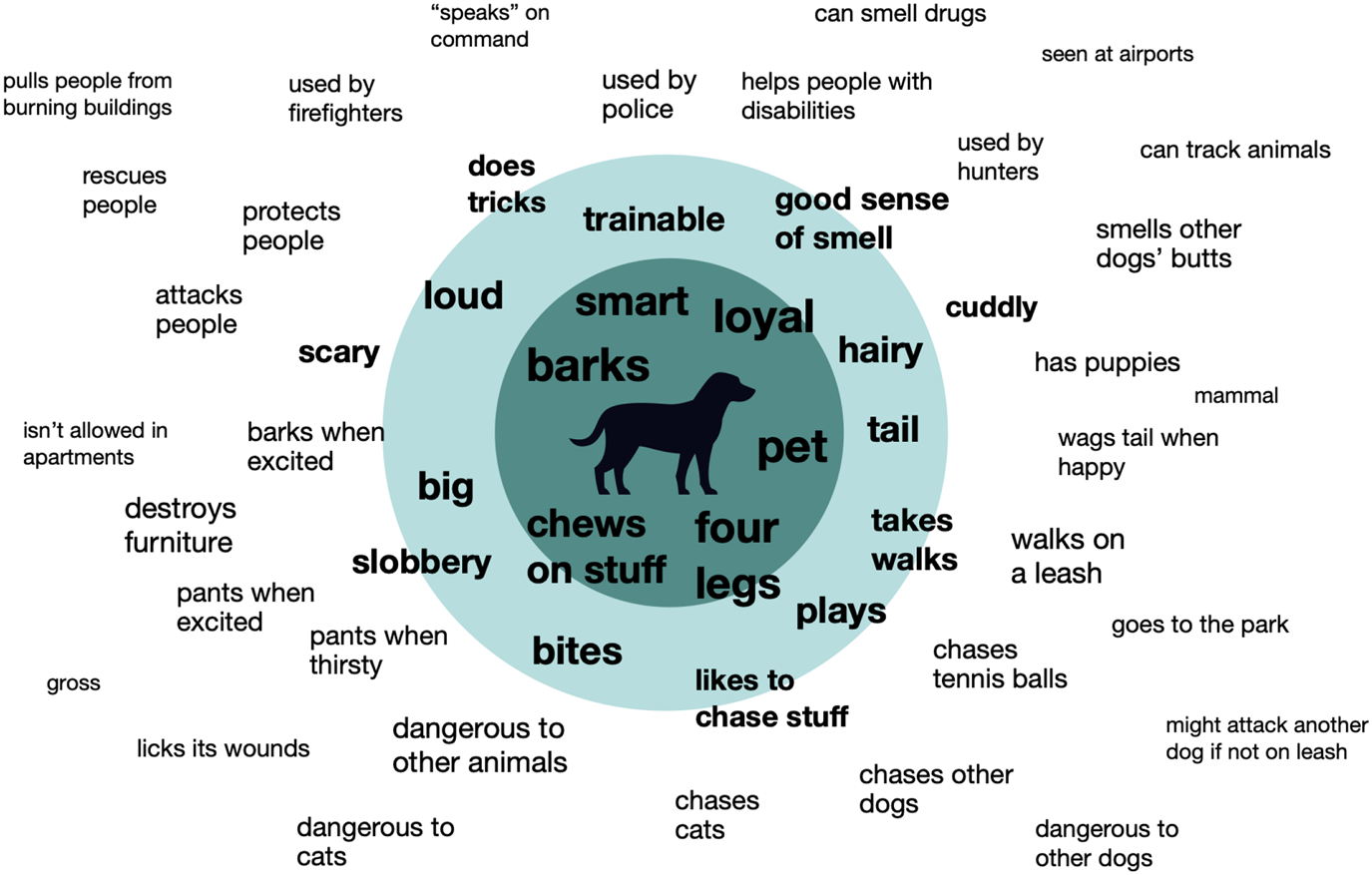
The concept dog is associated with many stereotypes.Footnote 10 Some stereotypes are closer to the core of the stereotype map. The closer to the core a feature is, the more salient it will be made upon activation of the concept. So too, we will suggest, the more easily it will underwrite an inference ticket.
Not all inferences connected to stereotypes are natural. By default, the inference from Rover is a dog to Rover isn't allowed in apartments is a wacky inference. The mental connection between being a dog and not being allowed in apartments is a weak and non-central one. (We represented this by including that property in small typeface and far off to the left of the center of the figure.) Without a significant amount of background context (say, a conversation about apartment hunting, or the reasoner's being a real-estate agent), it would be strange for someone to reason directly and automatically from Rover is a dog to the conclusion that Rover isn't allowed in apartments.
Similarly, though the generic sentence
(1) Dogs are pets.
is fine, the generic sentence
(2) Dogs are not allowed in apartments.
is questionable at best, and to most ears (perhaps excepting real estate agents or landlords) probably even false. By contrast, the direct inference from Rover is a dog to Rover is a pet seems far less wacky by comparison. This inference, though not deductively valid, has a general reasonability underwriting it. The connection between dog and pet is much tighter and more robust. Under many ordinary circumstances, one might reasonably infer, perhaps even come to know, that Rover is a pet, by inferring it from his being a dog.Footnote 11
Generic sentences like the ones above are often useful for getting a sense of the phenomenon we're interested in. But inference tickets are not simply a special case of generics, for at least three reasons. First, generics are typically characterized linguistically – they are a particular kind of sentence. Our inference tickets exist most fundamentally at the level of thought. Second, some generics do not seem to license the corresponding inference tickets. ‘Mosquitoes carry the West Nile Virus', for example, is often characterized as a true generic sentence, but we do not automatically judge that something carries the West Nile Virus upon calling it a mosquito. Third, not all normative inference tickets seem closely connected to any generic construction. What generic encodes the inference from ‘it's 10:00' to ‘it's J's bedtime'? ‘J's bedtime is 10:00' is not a generic sentence – unlike ‘children's bedtimes are before 10:00', it is specific to J.
We do think there is an interesting relationship between inference tickets and generics. Sarah-Jane Leslie (Reference Leslie2017) in particular has highlighted the way that generics, in entrenching and perpetuating stereotypes, can have important normative implications. The correct semantic theory of generics should help explain why sentences of that kind often tend to be associated with the patterns of thought that interest us. But the project of providing such a semantic theory – the main focus of the philosophical literature on generics – is quite different from our project about automatic normative inferences. Reasoning with stereotypes does not always involve reasoning with generics.
Inference tickets exploit connections close to the stereotypical core. They can also bring stereotypes that might not be close to the core otherwise, closer. For example, suppose it's 2016 and you hear that Ghostbusters is being remade, but you don't know further details. Since you saw the original Ghostbusters, your (inchoate) concept of the new Ghostbusters movie already has some stereotypes attached to it – e.g., being a movie, being funny, being about guys fighting ghosts. Probably not associated at all, or certainly not near the core, are the stereotypes being a chick flick and (assuming you liked the original) being bad.
But now you learn that the leads of the Ghostbusters remake are all women. Your stereotypical representation of the new Ghostbusters movie includes a new feature – being a movie with female leads, which brings along the feature being a chick flick. And if you are like many YouTube commentators in 2016, these new associations may suddenly “make it make sense” to conclude that the new Ghostbusters, being a chick flick, is uncool, emasculating, not worth seeing, etc. The stereotype is a movie with female leads, we claim, underwrites an automatic and largely unreflective inference ticket to is a chick flick; and is a chick flick, for a very significant population of speakers, is a shortcut to is not worth seeing.Footnote 12
Inference tickets, therefore, influence thought in profound ways. To change an inference ticket would be to change which patterns of thought one treats as automatic. In the normative cases we're interested in, they also represent a mode of normative valence shifting. Thus we also get inference tickets from posits a conspiracy to should be dismissed out-of-hand and is a woman with five cats to is romantically undesirable.
This is part of why we are especially interested in normative inference tickets. Such tickets license conclusions with normative import. Changing these licenses changes patterns of normative thought.Footnote 13
3. Stereotypes and inference tickets
Anyone who knows that Clifford is a big red dog probably knows other things about Clifford too. They probably know, for instance, that Clifford is not tiny. If they thought he was tiny – or even that he might be – it's hard to see how they could know that he is a big red dog. Likewise if they were agnostic as to whether he is black.
This is more about the thought x is a big red dog than it is about Clifford, or about knowledge. If someone believes (whether or not they know) that Fifi is a big red dog, one expects them to believe that Fifi is not tiny. If one daydreams about any big red dog, they daydream about something that is not black. There are central inferential connections between the feature x is a big red dog and the features x is tiny and x is black. These can be represented thus:
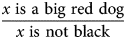
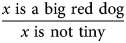
These inferences are not brute; the prototypical route from x is a big red dog to x is not tiny runs via x is big; hence the name “inference ticket” (Figure 2).
Input and output inferences for is big.
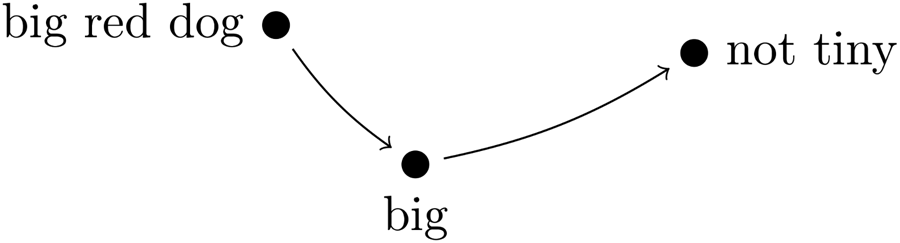
This type of input–output diagram, like the dense core model given for dog in Figure 1, is a useful way for characterizing some of the inferential connections activated by a given thought or concept. Our input–output diagrams, unlike dense core models, only include more central prototypical elements involved in the relevant concepts, not more distant ones. (The small font in Figure 1 wouldn't show up in a diagram like this.) They also convey stereotypical directionality in a way not emphasized in dense core models. A dense core model for big stereotypes would include associations with Mt. Everest and with not being tiny, but a standard diagram would not indicate, as this one does, that there are privileged inferential directions corresponding to those prototypical connections.
In the case just mentioned, the stereotypes associated with x is big provide an inference ticket that licenses one to move from x is a big red dog to x is not tiny. The ticket lets one get from the first thought to the second. Think of them as “mental shortcuts” – direct inferential paths to conclusions that would otherwise take a longer, more circuitous “route” to access.
Positing inference tickets involves privileging particular inferential patterns. One possible rather strong way to implement this idea would treat dispositions to particular inferential patterns as (at least partly) constitutive of entertaining the contents in question.Footnote 14 This is one way to characterize analytic inference.Footnote 15 Standard examples of putatively analytic inferential connections are particularly clear examples of our category, but not all inference tickets are analytic, at least according to traditional notions of analyticity. We think, for instance, that the concept dog is associated with a set of stereotypical connections that underwrites this inference ticket:
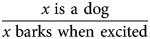
The point isn't that most people happen to know that dogs bark when excited, and so can use that knowledge in the form of an inference. The inference is much more automatic than that – it corresponds to stereotypes close to the core.
This inference is not valid – it is not guaranteed to be truth-preserving whenever used. But it does, we think, have important commonalities with the inferences above: it's an inference most people familiar with dogs will make, at least quite often, absent special reason to withhold it. Ceteris paribus, x's status as a dog is a perfectly good reason to think x will bark when excited; this is a reliable stereotype. In suitable circumstances, this inference ticket will give knowledge. Other inference tickets are less benign – they correspond to stereotypes we have good reason to resist. The stereotypes associated with cat lady and chick flick, for instance, both perpetuate sexist associations.
One can think of the relation we're describing as a kind of weakening of deductive entailment. It isn't actual entailment – it's perfectly possible to be a dog that doesn't bark – but it's a relatively core part of our conception of dogs that most dogs – and certainly the most typical dogs – bark. There is a default connection available.
Not all default inferences are a priori; clearly their rationality is often shaped by experience.Footnote 16 Moreover, because they are shaped by particular patterns of experience, as well as by broad memes like stories and stereotypes in the cultural imagination, the availability of an inference ticket will often be specific to a given culture or subculture, as in the case of J's bedtime.
So-called “default logics” are designed to systematize reasoning of this kind.Footnote 17 Classical logic and other monotonic logics capture only entailment; the most they can say about the inference from x is a dog to x barks when excited is that it is invalid. Non-monotonic logics seek to capture the sense in which inferences like this are good. On non-monotonic logics, whether an inference is licensed doesn't depend only on whether there are premises that adequately support it; a given set of premises might support a conclusion typically, but fail to do so given additional information.
Consider these inferences:

The first is typically good, but the second isn't: in the presence of additional information, the shared premise does not license the conclusion.Footnote 18 The non-monotonic feature of defeasible inference makes its systematization challenging. But logicians are motivated to develop such projects because they reflect what clearly is a critical feature of human reasoning. Our own interests are not formal, but they are motivated by the same psychological and epistemic phenomena.
One upshot of the complexity and contingency of inference tickets is that their availability is not a fixed matter. They can be modified, improved, rejected, augmented, or replaced. As we'll go on to emphasize, this places them within the realm of morality and practical reasoning. We can, and should, critically consider what inference tickets we ought to use.
4. Input and output conditions
The “inference ticket” label was made famous by Prior's (Reference Prior1960) Analysis article, “The Runabout Inference-Ticket.” Prior noticed that an attractive approach to logical connectives, if unrestricted, has implausible results. Logical connectives, Prior observed, have characteristic inferential inputs, and also characteristic outputs. For example, the propositional connective and is closely tied to these three inferential forms – the first is an input condition, describing when one may infer to an and claim; the latter two describe output conditions, which are about what one may infer from an and claim:

Prior's observation was that if one is free to specify input and output rules for concepts as one pleases, one can articulate concepts that provide undesirable inference tickets. He posits the propositional connective tonk, which is stipulated to be characterized by these inference rules:
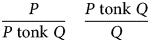
Such a connective is a “runabout inference ticket” – it permits one to get anywhere from anywhere. Let P be wherever one starts, and Q be wherever one wishes to get; one may infer: P, so P tonk Q, so Q.
A standard moral drawn from Prior's paper is that a concept's input and output rules must match up in a certain way: adding tonk, and the associated inferences characterized above, to one's conceptual repertoire, would legitimate new inferences. As Michael Dummett puts it, the input and output rules for a new term must be harmonious – by which he means they must result in a conservative extension of one's previous language.Footnote 19 Rephrased into our terminology, Dummett's idea is that inference tickets should at most provide redundant routes; they must not provide genuinely new access.
To illustrate, assume an initial language in which one may infer from A to B, but not from A to C, as in Figure 3a. If one introduces a new term D, which one reaches via A, but which does not provide access to C, as in Figure 3b, nothing expressible in the first language will be true in the second language unless it is true in the first language as well. So D's inferential roles are harmonious in Dummett's sense.
Redundant and non-redundant extensions.
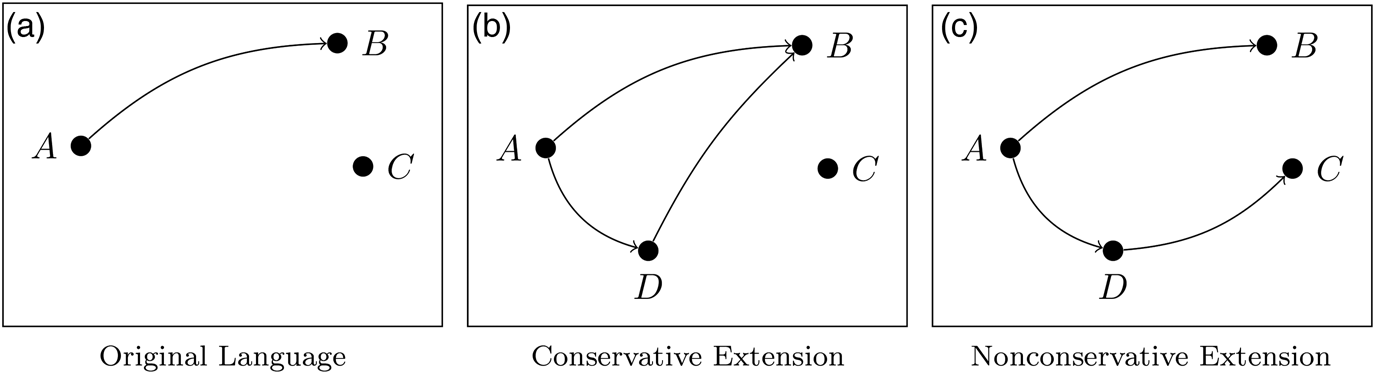
But in Figure 3c, we contemplate different rules for D – one may infer from A to D, and from D to C. D thus provides an inference ticket from A to C, where no such route was initially available. This unharmonious extension, according to Dummett, uses a term with inadmissible inferential roles.
This framework is our starting place, but our interests are distinct from the logical ones Prior and Dummett focused on. As we have already indicated, we do not think the relevant connections need always be deductive, even when they are proper. (So we cannot agree that the problem with tonk is that it allows invalid inferences.Footnote 20) And we are not particularly interested in terms that are introduced via stipulated inferential relations; the inference tickets we are concerned with form important parts of our social and practical realities. It's not just a matter of what inferences are available to individuals – it is a question of epistemological, moral, and political significance, which inferences are natural and automatic at a broader social level.
5. Making things more explicit
We're now in a position to describe the bedtime example from our Introduction in more detail. Our friends, you may remember, know that J needs to go to bed by 10:00 – 10:00 is J's bedtime. In our framework, the concept j's bedtime is associated with a network of stereotypical connections that provide an inference ticket from it's after 10:00 to J should be in bed. These are plausible input and output rules:

When we say that j's bedtime is associated with an inference ticket licensing these rules, we certainly do not mean to suggest that concepts are typically associated one-to-one with privileged input–output rule pairs. A dense core model of the j's bedtime stereotypes would reveal many other central associations (as well as many more peripheral ones). We think there are many other inference tickets that are also associated with j's bedtime. For example, one needn't consider its being past J's bedtime as in any sense conceptually fundamental. One might wish to focus on inference tickets that focus on what happens before bedtime – if it is close to bedtime, for instance, one should avoid caffeine or exercise. The inference ticket characterized above isn't the only one available; it's just the one we've selected for illustration.
The output rule we articulated might actually be both analytic and entailing – plausibly, 10:00 wouldn't count as J's bedtime if J weren't supposed to be in bed then. But the input rule is clearly conventional and contingent. Still, we think both inferences are welcome; the new routes they provide are useful ones.Footnote 21
In other words, the advantages of useful inference tickets need not consist in their ability to get us places we couldn't get before. It's also useful to be able to travel existing paths more easily, efficiently, and automatically. Our D&D group converged on the J's bedtime ticket gradually – but now that we have it, it's only a matter of checking the time to know that we should wrap up. These inference tickets are also importantly communal – they're not merely available to individuals thinking alone, but to social groups engaged in collective coordination and decision-making. They are productive, in the sense that they help facilitate social organization, and prescribe particular behaviors.Footnote 22
Our group could have reasoned our way to the conclusions in question without such an inference ticket. We might eventually have noticed the negative correlation between the late hour and J's social contributions, and so abductively confirmed a hypothesis to the effect that if it's after 10:00pm, J should go to bed. On any given night, we could have performed that abductive inference. But we have more fully internalized the thought; we are not coming to a decision about whether to end the evening on a given night by generalizing on our past experience via abductive inference – our past knowledge has given us a concept that lets us infer this directly. The shortcut is available and automatic. (It can be resisted – someone might ask, “do we really need to stop just because it's 10:10?” This would trigger a slower deliberation about whether to follow this inferential pattern in this instance. This might or might not be helpful, depending on the circumstances.)
In both deductive and non-deductive cases, the automaticity of learned inference tickets can provide helpful shortcuts. Consider one of De Morgan's laws:
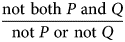
If you have studied logic you might find this inference immediately obvious; but imagine a student who does not. When initially considering whether not both P and Q implies not P or not Q, our student has no immediate intuitive reaction. But they do have the logical sophistication to work it out. They could draw the relevant truth tables, for instance, and observe that on no interpretation is the negated conjunction true, while the disjunction is false. Or they can derive the reductio proof of the entailment. In this sense, the inference pattern described above is available, but it would need to be worked out.
Something interesting happens when students learn De Morgan's laws. It's not that more inferential destinations become available – the rules represent a conservative extension of the previous rules. But they do learn new routes. De Morgan's laws let you move directly from a sentence, once you recognize it as the negation of a conjunction, to a disjunction of the negated conjuncts. In a natural deduction system they are literal shortcuts – they provide inference tickets that let you skip checkpoints you would have otherwise had to pass through. The resulting inferences are largely reflexive, highly intuitive, and, as far as cognitive processing power goes, efficient.
But not everything efficient is good – as Dummett emphasized, some inference rules license undesirable patterns of reasoning. Although we reject Dummett's requirement that a good inference ticket must be conservative, the restriction was motivated: there are bad inference tickets. We mentioned some in our Introduction; the next sections describe others in detail. Conceptual shortcuts, like most things, can be used for good or for ill. And when undesirable associations are conceptually privileged, resisting bad inferences will be much more difficult.
6. Harmful inference tickets
Here are some case studies involving harmful normative inference tickets.
6.1. He-said–she-said
Suppose you've received conflicting testimony on some matter, from the two individuals well-positioned to know what happened. X tells you that p, and Y tells you that not-p. What should you think happened? Obviously, it depends: if X is sufficiently credible, and Y's testimony comes with good reasons to doubt it, you should believe that p; if the reverse, you should believe that not-p. In other circumstances, you should investigate further, to try to seek out more information about whom to believe. The final possibility is that you should submit to agnosticism – neither believing nor investigating, you might decide there's just going to be no way to find out.
Invoking the he-said–she-said concept emphasizes that final possibility to the exclusion of the others. It tends to activate an inference ticket from conflicting testimony to skepticism:


The import rule for a he-said–she-said situation can feel close to analytic, especially if it conforms to the stereotype, with X as female, Y as male, and p a description of inappropriate conduct by Y toward X. While it wouldn't be impossible, it would be conceptually and conversationally difficult to maintain that X and Y are giving contradictory reports about a situation in which they were the only witnesses, while denying that it is a he-said–she-said situation.
But the output rule is also extremely natural. Upon admitting that something is a he-said–she-said situation, one activates a tight set of stereotypical connections that tend to steer one toward the conclusion that one must suspend judgment. The thought will be reflexive – it will barely feel like an inferential step at all. The label strongly suggests a balance of reasons that prohibits belief, on pain of irrationality.
The point isn't that, if one possesses a concept of this form, one is committed to inevitable skepticism in all cases of conflicting testimony. Again, the connections inference tickets license don't have to be deductive. But it would require special pleading to suppose that this is an example of a he-said–she-said situation where one ought to accept her testimony and reject his. One would need conflicting reasons to avoid the skeptical result, or a defeater that undermines the generic inference as applied to this specific case.Footnote 23 The inference ticket provides a conceptual shortcut from conflicting testimony to skepticism; only in exceptional circumstances will resisting it feel plausible.
The pattern of reasoning above is not the only inference ticket supplied by the stereotypical connections involved with the concept he-said–she-said. We think it's a particularly central one, but there are others. Figure 4 shows a possible dense core model for the stereotypes someone might associate with he-said–she-said. (The particular stereotypical associations will vary between individuals; in this case, they are likely to vary significantly by political affiliation. We have constructed one possible dense core model for illustration.)
Possible dense core model of he-said–she-said stereotypes.
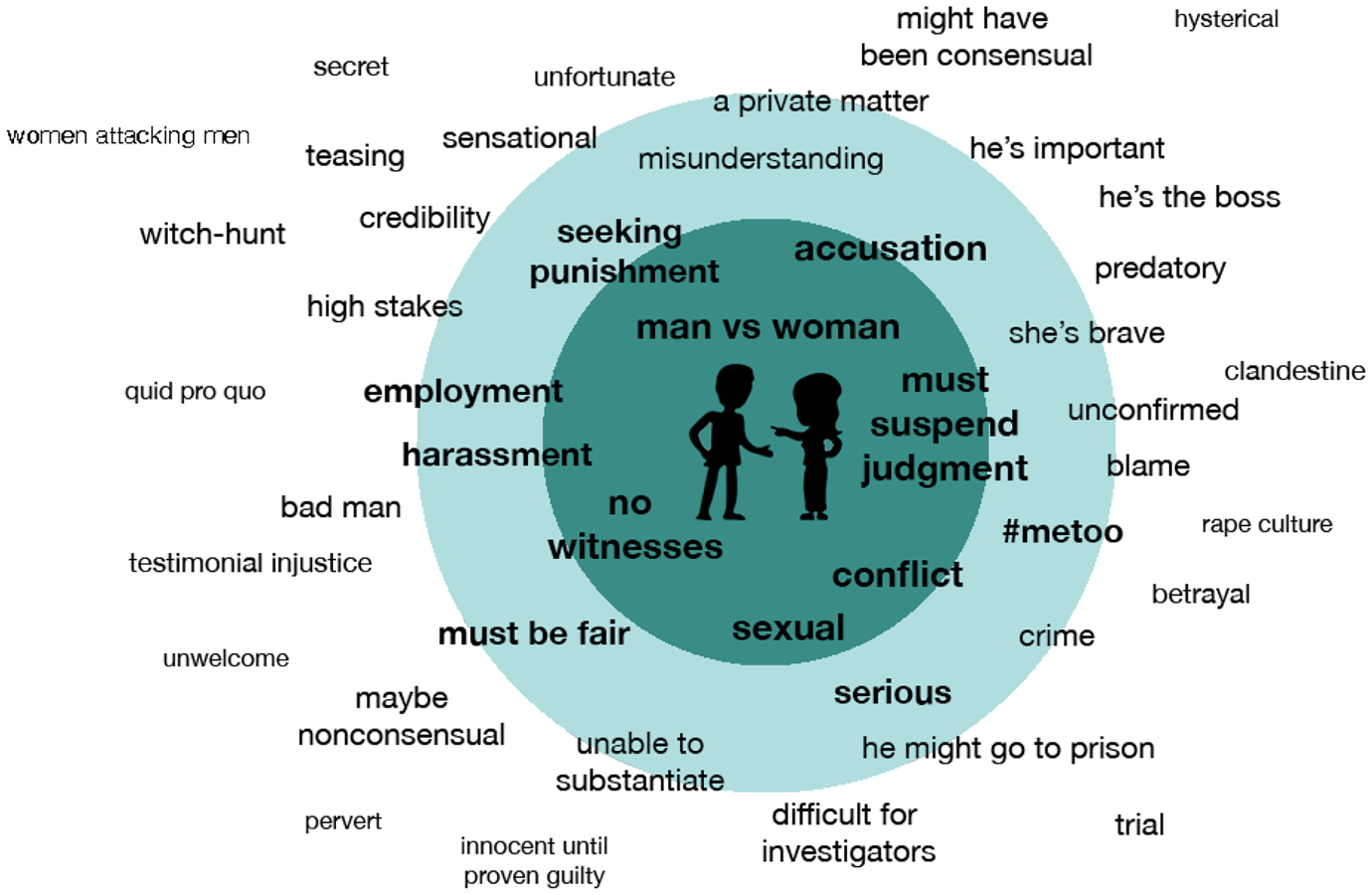
Although the exact network of stereotypes attached to a concept can vary from person to person, commonalities between people within a culture give rise to communal inference tickets. Consequently, their effects extend well beyond any individual's thoughts. Unlike in the case of j's bedtime, where the community in question was a relatively small social circle, the reach of the he-said–she-said inference ticket extends to society at large. In individual or collective deliberation, it will take one from conflicting testimony, especially involving alleged wrongdoing by man Y against woman X, to skepticism. The stereotypes associated with the concept he-said–she-said prime people – indeed, whole cultures – to ignore the other possibilities: believing X, believing Y, and undertaking further investigation to decide what to believe.
Indeed, that seems to be its point. As Leigh Gilmore puts it in her book Tainted Witness, “[w]hen their stories conflict, the shorthand judgment ‘he said/she said’ misrepresents a cultural bias against women's testimony as the false equality of rational skepticism and objectivity. He said/she said represents the creation of a false pairing of culpability in the face of unequal harm, action, and exposure to risk” Gilmore (Reference Gilmore2017: 45).Footnote 24
The problem with this inference ticket is not merely that it misleads. It does mislead, when testimonial knowledge is possible. But a communal tendency toward skepticism in “he-said–she-said” cases also results in social harms. In particular, it will perpetuate rape culture by facilitating the dismissal of sexual assault complaints, thus preventing accountability for perpetrators and reinforcing conditions for further wrongdoing.Footnote 25 Bad inference tickets can contribute to moral harms, as well as epistemic ones.
6.2. Slurs
Dummett applied his approach to unharmonious concepts to slurs: the problem, he said, is that they provide inferential routes that would be unavailable without them. Dummett's example of a slur is the slang term ‘boche', to refer pejoratively to Germans. It is a shortening of ‘alboche', a French portmanteau of ‘allemand' (‘German') and ‘caboche' (‘cabbage'). ‘Alboche', it seems, carried roughly the connotation of ‘German numbskull' during the early twentieth century.Footnote 26 Dummett describes ‘boche' thus:
The condition for applying the term to someone is that he is of German nationality; the consequences of its application are that he is barbarous and more prone to cruelty than other Europeans. We should envisage the connections in both directions as sufficiently tight as to be involved in the very meaning of the word: neither could be severed without altering its meaning. Someone who rejects the word does so because he does not want to permit a transition from the grounds for applying the term to the consequences of doing so. The addition of the term “Boche” to a language which did not previously contain it would be to produce a nonconservative extension, i.e. one in which certain statements which did not contain the term were inferrable from other statements not containing it which were not previously inferrable. (Dummett Reference Dummett1973: 454)
We ourselves are not fluent with ‘boche'. This is reason for caution; there are good reasons to be methodologically suspicious of theorizing about expressions one doesn't use.Footnote 27 Nevertheless, we take it Dummett intends the point generally; and we are sufficiently familiar with the broader operation of pejoratives to critically evaluate it.
We reject Dummett's explanation for the badness of ‘boche' in terms of its non-conservative extension of a pre-‘boche' language. We also are not convinced that inferentialism is the best theory of the meanings of slurs. We do agree, however, that one harmful feature of slurs is that they tend to activate undesirable inferential routes.
Dummett's discussion of ‘boche' suggests these inferential roles:
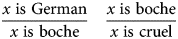
So boche stereotypes provide inference tickets from someone's being German to someone's being cruel. We agree with Dummett that this is an undesirable route to have open. But this is not because it wasn't open in a pre-‘boche' language; rather, it's because it would have a tendency to further a harmful stereotype in a post-war world. It's bad in at least two ways: it is unreliable, and so conducive to false beliefs; it is also morally objectionable, insofar as it perpetuates bigotry.
Dummett focuses on deductive inferences – he treats the inferential forms above as exceptionless. Consider the input rule:

Understood as a deductive entailment, this inference corresponds to what remains a very widespread assumption in the philosophical literature on slurs; namely, that slurs have non-slur “neutral counterparts,” equivalent in extension, but stripped of their pejorative force. It follows from this assumption that ‘Boche' and ‘German' are extensionally equivalent; and were this so, then of course Dummett would be right that the inference from x is German to x is boche would be deductive.
Foster (Reference Fosterforthcoming) challenges this assumption,Footnote 28 arguing that the systematic relationship between slurs and their so-called “neutral counterparts,” rather than extensional equivalence, involves substantial overlap in extension (or at least a presumption to that effect by competent users), underwritten by substantial overlap in associated stereotypes. While we do not take a stand on the actual semantics of slurs and “neutral counterpart” terms here,Footnote 29 we agree with Foster that the ordinary bigotry associated with slurs is systematically exception-granting with respect to input rules like the one above. And, as she also emphasizes that this is part of why it can be so pernicious.Footnote 30
It is not difficult to imagine a fluent user of ‘boche'– an interwar English World War I veteran, say – who has developed strong, bigoted associations between Germans and cruelty, but who nevertheless allows that there can be “exceptions to the rule.” He might develop a friendship with a German gardener, whom he fully recognizes to be German, but does not consider to be “boche.” His friend, he thinks, is German, but isn't “boche” (and isn't cruel). If our veteran is like ordinary users of more familiar slurs, this possibility will seem to him just as mundane as the possibility that Dino is a dog who doesn't bark, even when excited. One needn't think that all Germans are “boche,” to be a “prototypical” user of the term. (Nor for that matter that all “boche” people are German!)
Understanding the stereotypical connections associated with slurs as involving automatic but defeasible normative inference tickets helps make sense of Foster's observations about slur use.
6.3. Genocidal language games
In her (Reference Tirrell, Maitra and McGowan2012) “Genocidal Language Games,” Lynne Tirrell argues that linguistic practices like the use of particular ethnic slurs contributed in important ways to the 1994 genocide in Rwanda. Our approach to inference tickets can help illustrate how this was possible. We will be brief, as Tirrell herself draws many of the connections between her cases and conceptual inferential roles.Footnote 31 Our aim is to illustrate how her observations fit into our pattern.
Tirrell focuses particularly on the Kinyarwandan words ‘inyenzi' (cockroach) and ‘inzoka' (snake). Both were used as labels for Tutsi people as ethnic hate speech; both, Tirrell argues, contributed to the willingness of Hutu to participate in atrocities. She describes both input and output rules for x is inyenzi. The input rule establishes that Tusi are inyenzi; the output rules are explicitly normative: inyenzi are threatening, lacking in humanity, and to be killed.Footnote 32

These inferential rules provide a straightforward inference ticket from an ethnicity to a call to murder. “Woe betide those whose identity cards bore the word ‘Tutsi,’” André Sibomana told Laure Guilbert and Hervé Deguine. “Those five letters amounted to a death sentence, with immediate execution.”Footnote 33
Tirrell's discussion is part of a theoretical project that involves a particular inferentialist approach to inyenzi, and to derogatory terms in general.Footnote 34 As we indicated in Section 6.2, we do not commit to such inferentialism. Whatever one's theory of slurs and other derogatory expressions, it is obvious that they have a tendency to activate tight negative stereotypical associations. One doesn't have to be an inferentialist to recognize that calling members of a marginalized ethnic group cockroaches tends to activate negative stereotypes, and associated harmful inference tickets.
We won't rehearse Tirrell's discussion of the causal influence of these inferential patterns in the Rwandan genocide; our brief discussion of it here is intended simply as an illustration of the breadth of applications of our framework. We recommend Tirrell's paper for further analysis, including discussion of the ways in which inferential roles change over use and time.
The harmful inference tickets we've been discussing so far involve cases where the negative normative import is obvious: rape culture, bigotry, and genocide are uncontroversially harmful. There are also examples of pernicious inference tickets, where the harms in question tend to fly under the radar. We turn to one now.
6.4. Conspiracy theories
In a recent paper, Charles Pigden has argued that the phrase ‘conspiracy theory' is a “tonkish” term. Like ‘tonk', Pigden suggests, ‘conspiracy theory' is characterized by inferential roles that can sometimes lead from truth to falsehood. Pigden (Reference Pigden2023: 430) posits this pair of rules:

(Pigden's discussion is given explicitly in terms of terms. Because throughout this paper, we're interested in the role of stereotypical connections in thought, we will also consider the conceptual analogue of Pigden's suggestion, which would associate these inference rules with the concept conspiracy theory.)
As Pigden points out, these rules are not conservative – they permit inferential connections that would be unavailable without them. Moreover, many of those connections would introduce epistemic errors, since there are, as Pigden has emphasized in some of his previous work, in fact many theories which posit conspiracies, but which are not false, crazy, or unbelievable. Consider for example the widely-accepted “theory” that the 9/11 attack on the World Trade Tower in 2001 was the result of an al-Qaeda conspiracy (Pigden Reference Pigden and Coady2006: 157–58).
We think Pigden is onto something important here, but that there are some respects in which he may overstate his case. He doesn't say exactly what it takes to count as a “tonkish” term or concept – his paper includes an explanation of Prior's (Reference Prior1960) tonk similar to ours above, then just says that conspiracy theory is similarly problematic for allowing inferential routes from truth to falsehood. But there are some important respects in which the case Pigden makes for conspiracy theory is quite unlike the case of tonk.
First and most obviously, Prior gave tonk a stipulative definition in terms of its unharmonious inference rules. ‘Conspiracy theory' is a natural language label that is learned in the ordinary way, primarily by exposure to other competent users' use of the term. Second, no doubt relatedly, the inferential connections Pigden posits for conspiracy theory leave considerable room for debate. (And indeed, there is considerable philosophical debate on just this question, as we'll discuss below.) One might wish to deny, for instance, that there really is a good inference from positing a conspiracy to being a conspiracy theory. The case of well-established historical conspiracies makes this avenue particularly plausible. Would any ordinary speaker really be inclined to describe the idea that 9/11 was the result of a clandestine organization's evil plans as a conspiracy theory?Footnote 35 Even though we think there is something accurate about Pigden's description of the inferential roles given above, the connection between them and the idea of a conspiracy theory is weaker in important ways than that for tonk and its inference rules.
As Prior (Reference Prior1960) observed, if one employed a concept like tonk with its stipulated inferential roles, one would literally have to hold that every proposition is true. Pigden's proposed conspiracy theory rules are not quite so explosive as that, but Pigden is right that they are deeply problematic, from an epistemic perspective: they imply that literally every theory that posits a conspiracy is false, crazy, or unbelievable. Consequently, however, Pigden's proposal renders it somewhat mysterious why it is that are many people who are fluent in “conspiracy theory” discourse who think there are some perfectly reasonable theories that posit conspiracies.
We think that the better way to implement Pigden's insight is via our notion of normative inference tickets. conspiracy theory isn't literally tonkish in the sense that it licenses inconsistent meaning-constitutive inferences. But we are convinced by what we take to be Pigden's main point: that the label ‘conspiracy theory' has a tendency to activate and strengthen automatic stereotypical associations along the lines he describes. Competent users of the term need not treat these inferences as exceptionless and analytic – one can hold that some conspiracy theories, like the 9/11 hijacker theory, are rational. But conspiracy theory does tend to activate a network of strong “conceptual” connections between positing conspiracies and irrationality. To deny the output inference ticket would be to say that it is not even true ceteris paribus that conspiracy theories are irrational. The connection doesn't need to be exceptionless to be robust. The field is tilted against someone who wishes to hold, contra the output rule, that a particular conspiracy theory is worth taking seriously.Footnote 36 That is why the presence of this inference ticket is a barrier to the uptake of ideas involving conspiracies – even ones that deserve to be taken seriously.
Likewise with the input rule. It's not impossible to posit a conspiracy while disclaiming the label ‘conspiracy theory', but doing so, we think, would require special pleading. One might attempt to define ‘conspiracy theory' by building irrationality in by definition – effectively attempting to deny the input rule above, insisting that one can only describe something as a conspiracy theory if it is an unsubstantiated theory positing a conspiracy.Footnote 37 But many dictionaries actually encode the simpler definition; here is Merriam-Webster's: “a theory that explains an event or set of circumstances as the result of a secret plot by usually powerful conspirators.”Footnote 38
We see similarly tight conceptual connections along these lines in colloquial discussions involving conspiracy theories. To take but one recent example, on January 18, 2021, a National Public Radio segment about “the psychology behind conspiracies,” motivated primarily by discussions of QAnon, repeatedly demonstrated the assumption that accepting a “conspiracy” ipso facto amounts to conspiracy theory and its associated irrationality.Footnote 39 For example, it featured an interview with a self-described former conspiracy theorist; the interviewer introduced him by pointing out that he “used to believe in some conspiracies,” then asked what had changed. Later in the program, the host asked listeners “if any of you know anyone who believed in a conspiracy.” No one called in describing the al-Qaeda's conspiracy that led to 9/11, or the American revolutionaries' conspiracy that led to the Declaration of Independence!
The mismatch between input and output rules Pigden is emphasizing has motivated some theorists to a kind of conceptual engineering project, whereby the pejorative conspiracy theory is separated from a more “purely descriptive” notion. M. Giulia Napolitano and Kevin Reuter, for example, suggest introducing a neutral term ‘conspiratorial explanation' to refer to “the descriptive concept,” distinguishing it from the existing pejorative one.Footnote 40
We are reminded of the attempts to identify so-called “neutral counterparts” for slurs, discussed in Section 6.2. We agree that “conspiracy theory” and conspiracy theory, like other pejorative expressions and the concepts they express, tend to activate strong stereotypical connections. But, also as in the case of other pejoratives, we are convinced by Foster (Reference Fosterforthcoming) that the stereotypes associated with the pejorative ‘conspiracy theory' will only mostly overlap with those associated with any candidate “neutral” notion along the lines of Napolitano and Reuter's ‘conspiratorial explanation', or ‘theory positing a conspiracy'. We've seen already that not all such theories tend to inspire the ‘conspiracy theory' label; there also seem to be exceptions to the converse generalization, whereby one applies ‘conspiracy theory' to an idea despite its not actually invoking a conspiracy.Footnote 41 This, we think, is exactly analogous to the operation of ordinary slurs.Footnote 42
David Coady (Reference Coady2012: 126) argues against using the phrase ‘conspiracy theory', on the grounds that we should not presume that an idea should be rejected simply because it involves positing a conspiracy. As Matthew Shields (Reference Shields2023) and Rico Hauswald (Reference Hauswald2023) both point out, the phrase is often used in epistemically and politically harmful ways.Footnote 43 We feel the force of Coady's suggestion; we are sympathetic to the idea that the phrase ‘conspiracy theory' has a tendency to activate substantive normative stereotypical associations that there may well be good epistemological and political reason to challenge. Although many people believe unreasonable and even dangerous things, we are not convinced that ‘conspiracy theory' is a helpful label for illuminating them. Like ‘he-said–she said', the ‘conspiracy theory' label tends to activate the stereotypical connections constitutive of this inference ticket, and those connections create epistemic barriers to the uptake of certain ideas that may deserve to be taken seriously. Our framework can explain how this worry makes sense.
6.5. Epistemic and moral harms
Inference tickets can be bad in two ways. One is epistemic: a bad inference ticket can lead thinkers astray, yielding false beliefs. This represents an epistemic error, but the moral harms are quite conspicuous as well. Inference tickets can also be morally objectionable without being generally unreliable.Footnote 44 Consider, for example, the connection between x is y's mother and y should call x on Mother's Day. At least in our communities, there is a strong conceptual association here that amounts to an inference ticket. It is at least pretty reliable: if y is x's mother, it will quite often be the case that x should call y on Mother's Day. Maybe one can reasonably infer the latter on the basis of the former. But we also think there are moral concerns about the automaticity of this inference.
There are people who have no obligation to call their mothers on Mother's Day – many survivors of maternal child abuse, for instance, depend for their well-being on distance from their mothers (and similarly for many on Father's Day). This inference ticket would marginalize such people. For one thing, it will create a tendency for people to mistakenly think that they should call their mothers (and perhaps that they would be blameworthy not to). This will lead either to social approbation, if they flout the perceived norm, or potential psychological distress from engagement with their mothers, if they abide by it.
The inference is not inevitable; since it is defeasible, people might recognize a child abuse victim as an exception to the rule. But it is nevertheless potentially alienating to be conceptualized as exceptional in such contexts. Such an inference rule marginalizes its exceptions. This is among the costs that weigh against the advantages – the automaticity of the recognition, for others, that they should phone their mothers. Whether the cost is ultimately worth paying, or whether we would be better off as a society if people individually reasoned their way to conclusions about whether to phone their mothers on Mother's Day, we'll remain neutral on. The point of this discussion was simply to draw out the distinction between epistemic and moral harms of bad inference tickets.
Whether they're epistemically bad, morally bad, or both, whenever there are bad inference tickets, there is reason to pursue ameliorative projects to alter the associated stereotypes, replacing the bad inference tickets with good ones. But such reform is never easy; the exception-granting nature of stereotypical associations makes them resistant to counterexample. Even among people who recognize their harmful nature, they cannot simply be dismissed; their automatic character makes them difficult to “unlearn.” Such resilience and automaticity are characteristic features of inference tickets, and they have clear advantages in the good cases – but in the case of bad inference tickets, they reinforce profound harms.
7. Hermeneutical injustice
We return now to good inference tickets. Sometimes – and by the same mechanisms at play in the bad cases – such shortcuts can be genuine moral and hermeneutical advances. Indeed, we believe that normative inference tickets can make more concrete Miranda Fricker's (Reference Fricker2007) notion of “hermeneutical lacunae,” and why filling those lacunae could make such an important difference to moral and political life.
One of Fricker's central examples highlights the hermeneutical advantages attached to coining the term ‘sexual harassment'. Fricker contends that women who experienced sexual harassment before the concept sexual harassment was socially available to them “suffered (among other things) an acute cognitive disadvantage from a gap in the collective hermeneutical resource” (Reference Fricker2007: 151). Moreover, she says, the gap does not only affect victims of harassment; it renders their experience unintelligible to harassers as well. We think our notion of “inference tickets” helps illuminate the relevant sense in which concepts are “resources” – tools to make our epistemic and moral lives easier – to in turn explain why, exactly, a “lacuna” in such resources can be so bad.
A common interpretation of Fricker's hermeneutical injustice holds that that it primarily or exclusively involves gaps in hermeneutical resources, and that the resources in question are concepts.Footnote 45 We do not identify the problem Fricker focuses on in terms of missing concepts. It may be that some hermeneutical injustices derive from a lack of important concepts like sexual harassment, but whether this is so depends on the complex and substantive questions about the nature of concepts about which we (and, we presume, Fricker) prefer to remain neutral. On nativist approaches to concepts, for instance, there is literally no such thing as a missing concept. And by anybody's lights, the women Fricker writes about in her discussion of sexual harassment clearly had some concept they used to think and talk about the experiences they were having. Whether this could be “the” concept sexual harassment depends on notoriously thorny questions about concept individuation over time and between individuals. But we think the concepts employed by the women in question enjoyed an important continuity with a concept that we would now recognize as sexual harassment. This may well be a likely candidate for contributing to sameness of concept type.Footnote 46
Some philosophers have complained that Fricker's discussion erases the cognitive achievements of sexual harassment victims – especially women of color – who were able to think about the misconduct they were suffering, arguing that Fricker doesn't allow for diverse sets of hermeneutical resources in different communities.Footnote 47 While we agree that this is an important dynamic that doesn't receive emphasis in Fricker's book, we do that think Fricker is right that some important hermeneutical resources were missing. We think those resources were normative inference tickets.
Whether or not there was a missing concept, early sexual harassment victims certainly suffered from a deficiency in the collective hermeneutical resources. In particular, their society did not include tight stereotypical connections encouraging automatic, reflexive mental shortcuts that would prompt inference – not just in their own heads but in their discussions with each other, and among the public level at large – from this is happening to this is wrong.Footnote 48
Insofar as inference tickets make inferences easy and automatic, the hermeneutical advantage of such a ticket in this instance is profound. It is of course true that, even in the absence of the concept sexual harassment, the inference

is available. Notably, though, getting there requires cognitive effort, and a significant amount of social knowledge and moral imagination. An established inference ticket makes it much easier:

These inferences, we think, are central to the stereotypes attached to sexual harassment; a community with such stereotypes in it will be one in which certain social knowledge – like the fact that it's wrong to repeatedly ask your co-worker on dates – will be much easier to obtain. Indeed, it will feel close to tautological.
Inference tickets can be specific to local social contexts (as in the case of j's bedtime) or in wide public currency (as in the case of conspiracy theories). Consciousness-raising can be a way of developing inference tickets within a small community, as in the feminist groups described in Fricker's discussion; but when the hermeneutical resources become firmly enough established there, they can be brought into the broader culture as well. (The sexual harassment inference tickets are now quite secure, even outside feminist spaces.Footnote 49) This is an important component to epistemic justice.
We mentioned two widespread assumptions about hermeneutical injustice: that it always involves hermeneutical lacunae, and that the missing hermeneutical resources are concepts. We think both assumptions are questionable. We've been discussing reasons to resist the identification of hermeneutical lacunae with missing concepts – one might have the concept, but suffer the hermeneutical injustice due to a lack in the communal inference ticket. (Indeed, in her initial (Reference Fricker2007) presentation of hermeneutical injustice, Fricker herself does not identify them; the word “concept” does not appear in her chapter on hermeneutical injustice.)
But we also think there can be hermeneutical injustices that aren't best explained by a lack in hermeneutical resources at all. Some of Fricker's cases – the sexual harassment case and her postpartum depression case – seem plausibly to involve hermeneutical gaps, but we don't think all of her cases can reasonably be read that way. Fricker's discussion of a male stalking victim (156–58), for instance, or of a gay man gripped by homophobic stereotypes (164), do not, we think, involve missing concepts or missing inference tickets. Instead the problem is the presence of harmful inference tickets.
Our analysis here has important points in common with that given in a recent paper by Mason (Reference Mason, Khoo and Sterken2021). Mason argues, as we do, that hermeneutical injustice doesn't always involve missing concepts, opting instead of a disjunctive approach to hermeneutical injustice, according to which it is sometimes the result of missing concepts, and sometimes the result of “distortion” in the collective hermeneutical resource. Mason's discussion of distorted hermeneutical resources has many points of commonality with our discussion of inference tickets, including an emphasis on collectively shared networks of stereotypical connections. We think Mason is quite right to emphasize these features of the collective hermeneutical resources. Unlike us, however, Mason limits her discussion of these inferential connections to hermeneutical injustices that obviously do not involve missing labels or concepts, which is what gives her approach to hermeneutical injustice a disjunctive character. Our story is more general: it is always inference tickets, rather than concepts, that play the central roles. Note that if a community did have the concept sexual harassment, but lacked the tendency to infer according to the inference tickets we describe, this would do little to alleviate the hermeneutical injustice victims of sexual harassment suffered.Footnote 50 We think existing bad inference tickets are sometimes at the root of hermeneutical injustice.
For example, harmful sexist and homophobic associations can activate pernicious inference tickets that constitute hermeneutical injustices.Footnote 51 Indeed, in a passage Fricker quotes from Edmund White's novel A Boy's Own Story, the gay narrator explicitly casts his worries in inferential terms: “Perhaps I became so vague, so exhilarated with vagueness, precisely in order to forestall a recognition of the final term of the syllogism that begins: If one man loves another he is a homosexual; I love a man….”Footnote 52 The problem isn't a missing inference ticket; it's a bad one that is shaping his thoughts in undesirable ways.
Homophobic ideas about homosexuality might license an input route from x is a man who loves a man to x is homosexual, alongside an output route from x is homosexual to, as Fricker puts it, the “various powerful bogeymen constructions of The Homosexual” (164).
Some of the observations we made in Section 6.4 about bad conspiracy theory inference tickets fit well into this framework. Shields (Reference Shields2023: 473) argues that the pejorative sense of ‘conspiracy theory' “is a tool for stigmatizing and further marginalizing those already outside of the relevant halls of power and in turn treating the halls themselves as avatars of rationality,” and that therefore its use ought to be resisted and discontinued. If Shields is right, this concept may contribute to hermeneutical injustice by contributing noxious stereotypical connections – by infecting the collective hermeneutical resources with harmful inference tickets.
Bad inference tickets poison the public hermeneutical well; good ones fortify it.
8. Conclusion
None of the case studies we've explored in this paper requires the notion of a normative inference ticket to explain. One can discuss the cultural harm of proclaiming ignorance about “he-said–she-said” situations, or the oppressive effects of stereotypical associations, or the hermeneutical advantages of sexual harassment, without invoking our label. But while the concept normative inference ticket may not be strictly indispensable, we do think it can illuminate many important phenomena. We close by sketching a few more examples.
One of the points of emphasis in Jenkins's (Reference Jenkins and Martin2019, Reference Jenkins and Vintiadis2021) recent work on romantic love is the social significance of love, and the way that it can reinforce and perpetuate harmful norms. We can explain some of Jenkins's ideas by invoking inference tickets; core stereotypes attached to love connect certain kinds of monogamous, heterosexual, family oriented relationships to social approbation. Heterodox relationships are liable to trigger automatic inferences to the conclusion that they are unserious or unworthy of respect.Footnote 53 As Jenkins (Reference Jenkins and Martin2019: 72) says, discourse about love is “laden with personal, emotional, practical, political, and/or ethical significance.”
In a similar way, Barnes (Reference Barnes2016: 179) invokes a “normatively laden” conception of disability, according to which being disabled automatically involves “[suffering] a loss, lack, or unfortunate departure from normalcy.” As Barnes emphasizes, the naturalness of this inference is due not to its following analytically from the meaning of ‘disability', but to the strength of the associations of ableist stereotypes. Mole (Reference Mole2017: 1130) likewise explores the moral and hermeneutical difficulties of debating whether autism is “a disease,” where doing so ties the experiences of autistic people to sickness and need for a cure. In all of these cases, the simultaneous “strength” and “defeasibility” of the harmful associations make discourse about these topics extremely vexed, and impose serious hermeneutical burdens on those whose experiences are being labeled, discussed, and debated.
We hope we have illustrated many of the benefits of considering these diverse cases alongside one another, emphasizing the similarities between the various conceptual associations at play. Naming the category of normative inference tickets, and centering them as an object of study, helps make some of their features more obviously and immediately recognizable; it also gives a useful framework for adjudicating whether a set of privileged and automatic stereotypical inferential roles should be welcomed. Inference tickets are useful to the extent we want connections between various ideas to be drawn in quick and reflexive ways.
A fluent user of our term, we think, will leave this paper with the ability to recognize inference tickets quickly and automatically. That is to say, one can internalize the input rules for inference ticket, and infer, from something's being a licensing of a privileged inferential form for the application of a given concept, that it is an inference ticket. And, by applying the framework of comparing input to output inferences to evaluate inference tickets as desirable or undesirable, one may also employ useful output rules for inference ticket, drawing the immediate and straightforward conclusions from something's being an inference ticket.
To put it another way, this paper is only partly about the examples. It also, we hope, has given you a valuable set of inference ticket inference tickets, which may help guide the development of local or broader hermeneutical resources.Footnote 54


 Open access

