





1. Introduction
A fundamental problem in Schubert calculus is that of finding polynomial representatives for the cohomology classes of the Schubert varieties. In the mid 1990s, Fulton and Pragacz [Reference Fulton and Pragacz10] asked a relative version of the same question, seeking explicit formulas which represent the classes of degeneracy loci for the classical groups, in the sense of [Reference Fulton8], [Reference Fulton9], [Reference Pragacz and Ratajski21]. These loci pull back from the universal Schubert varieties in a $G/P$
-bundle, where G is a classical Lie group, and P is a parabolic subgroup of G. As such, they are indexed by elements w in the Weyl group of G, which describe the relative position of two flags of (isotropic) subspaces of a fixed (symplectic or orthogonal) vector space.
$G/P$
-bundle, where G is a classical Lie group, and P is a parabolic subgroup of G. As such, they are indexed by elements w in the Weyl group of G, which describe the relative position of two flags of (isotropic) subspaces of a fixed (symplectic or orthogonal) vector space.
The above Giambelli and degeneracy locus problems were solved in full generality in [Reference Tamvakis25]. The answer given there is a positive Chern class formula which respects the symmetries of the Weyl group element w and its inverse. The paper [Reference Tamvakis25] introduced a new, intrinsic point of view in Schubert calculus, showing that formulas native to the homogeneous space $G/P$
are possible, for any parabolic subgroup P, and in all classical Lie types. In special cases, there are alternatives to the general formulas of [Reference Tamvakis25], but they must all be equivalent to the formulas found there, modulo an explicit ideal of relations among the variables involved.
$G/P$
are possible, for any parabolic subgroup P, and in all classical Lie types. In special cases, there are alternatives to the general formulas of [Reference Tamvakis25], but they must all be equivalent to the formulas found there, modulo an explicit ideal of relations among the variables involved.
The seminal work of Lascoux and Schützenberger [Reference Lascoux and Schützenberger18], [Reference Lascoux and Schützenberger19] on Schubert polynomials exposed intrinsic formulas for an important class of permutations, which they called vexillary. They defined the shape of a general permutation to be the partition obtained by arranging the entries of its code in decreasing order. The key defining property of a vexillary permutation was that its Schubert polynomial can be expressed as a flagged Schur polynomial indexed by its shape. In particular, the prototype for vexillary permutations was the Grassmannian permutations, whose Schubert polynomials are the classical Schur polynomials. Our aim in the present article is to define a family of amenable signed permutations, which serve as the analogs of vexillary permutations in the other classical Lie types.
There have been two attempts in the past to define a notion of vexillary signed permutation in the Lie types B–D, by Billey and Lam [Reference Billey and Lam4] and Anderson and Fulton [Reference Anderson and Fulton1]. These definitions miss the mark because according to either of them, the Grassmannian signed permutations are not all vexillary. The revision [Reference Anderson and Fulton2] of [Reference Anderson and Fulton1] sought to generalize the latter paper by incorporating the theta and eta polynomials of Buch, Kresch, and the author [Reference Buch, Kresch and Tamvakis6], [Reference Buch, Kresch and Tamvakis7] and Wilson [Reference Tamvakis and Wilson31], [Reference Wilson32], which are the analogs of the Schur polynomials in the aforementioned Lie types. Unfortunately, although [Reference Anderson and Fulton2] is in the right direction, the proofs given there contain serious errors in all Lie types except type A, and the main theorem is false, at least in type D. Moreover, Anderson and Fulton have not acknowledged that intrinsic Chern class formulas for the cohomology classes of all the degeneracy loci are known in any of their writings to date.
Our approach to amenable elements is based on a careful study of how the corresponding raising operator formulas transform under divided differences. The outline of the argument is similar to the one found in Macdonald’s notes [Reference Macdonald20], but there are important differences in the details. The proof is new even in type A, where we obtain a new characterization of vexillary permutations (see below). It is critical to work with double polynomials throughout and use both left and right divided differences to maximum effect, starting from the known formula for the top polynomial, which is indexed by the longest length element. In types B–D, we employ the Schubert polynomials of Ikeda, Mihalcea, and Naruse [Reference Ikeda, Mihalcea and Naruse13], which extend the work of Billey and Haiman [Reference Billey and Haiman3] to a theory suitable for applications to equivariant cohomology and degeneracy loci. The paper [Reference Tamvakis30] provides another key ingredient: the definition of the shape of a signed permutation, which plays the role of Lascoux and Schützenberger’s shape in the latter Lie types.
The difficulty when working with sequences of divided differences applied to polynomials lies in choosing which path to follow in the weak Bruhat order, as the Leibnitz rule tends to destroy any nice formulas. The papers [Reference Tamvakis28], [Reference Tamvakis29], [Reference Tamvakis and Wilson31] showed how divided differences can be used to obtain combinatorial proofs of the raising operator formulas for double theta and double eta polynomials, exploiting the fact that these polynomials behave well under the action of left divided differences. Therefore, as long as one remains among the Grassmannian elements, the choice of path through the left weak Bruhat order is immaterial. However, this surprising property, first observed in the symplectic case by Ikeda and Matsumura [Reference Ikeda and Matsumura12], completely fails once one leaves the Grassmannian regime.
To solve this problem, we introduce the notion of leading elements of the Weyl group, which generalize the Grassmannian elements. In the Lie types A–C, a (signed) permutation $w=(w_1,\ldots ,w_n)$
is leading if the A-code of the extended sequence
$w=(w_1,\ldots ,w_n)$
is leading if the A-code of the extended sequence $(0,w_1,\ldots ,w_n)$
is unimodal. The analogous treatment of type D elements involves some subtleties, which we discuss later. The leading signed permutations are partitioned into equivalence classes defined by their truncated A-code. Each of them is in bijection with the class of Grassmannian elements, where the truncated A-code vanishes. The longest length elements within each class give rise to Pfaffian formulas which are proved using divided differences, starting from the formula for the longest element in the Weyl group. Following this, any sequence of left divided differences used to establish the double theta/eta polynomial formula in the Grassmannian case works—in the same way!—to prove a corresponding “factorial” formula for the elements of the other equivalence classes.
$(0,w_1,\ldots ,w_n)$
is unimodal. The analogous treatment of type D elements involves some subtleties, which we discuss later. The leading signed permutations are partitioned into equivalence classes defined by their truncated A-code. Each of them is in bijection with the class of Grassmannian elements, where the truncated A-code vanishes. The longest length elements within each class give rise to Pfaffian formulas which are proved using divided differences, starting from the formula for the longest element in the Weyl group. Following this, any sequence of left divided differences used to establish the double theta/eta polynomial formula in the Grassmannian case works—in the same way!—to prove a corresponding “factorial” formula for the elements of the other equivalence classes.
Once the formulas for the leading elements are obtained, one can continue to apply type A divided differences, in a manner that preserves the shape of these formulas, and proceed a bit further down the left weak order. We thus arrive at our definition of amenable elements of the Weyl group: they are modifications of the leading elements, obtained by multiplying them on the left by suitable permutations. In the symmetric group, this reflects the (apparently new) fact that the vexillary permutations are exactly those which can be written as products $\omega {\varpi }$
, with
$\omega {\varpi }$
, with $\ell (\omega {\varpi })=\ell ({\varpi })-\ell (\omega )$
, where
$\ell (\omega {\varpi })=\ell ({\varpi })-\ell (\omega )$
, where $\omega $
and
$\omega $
and ${\varpi }$
are
${\varpi }$
are $312$
-avoiding and
$312$
-avoiding and $132$
-avoiding permutations, respectively.
$132$
-avoiding permutations, respectively.
Finally, one has to deal with the problem that the above formulas do not respect the symmetries (i.e., the descent sets) of the amenable Weyl group element involved. This issue was dealt with in [Reference Macdonald20] by exploiting the alternating properties of determinants, and a similar argument works for the Pfaffian examples of [Reference Anderson and Fulton1], [Reference Kazarian14]. In the situation at hand, we require variants of the key technical lemmas obtained in [Reference Buch, Kresch and Tamvakis7], which exposed the more subtle alternating properties of the raising operator expressions that define theta polynomials.
To understand some of the additional challenges one faces in the even orthogonal type D, consider first the question of how to define the shape of an element w in the associated Weyl group $\widetilde {W}_n$
. There seems to be no consistent way to do this, since, for example, the element
$\widetilde {W}_n$
. There seems to be no consistent way to do this, since, for example, the element $(\overline {3},\overline {1},2)$
has shape
$(\overline {3},\overline {1},2)$
has shape $\lambda =2$
when considered as a
$\lambda =2$
when considered as a $\Box $
-Grassmannian element, but shape
$\Box $
-Grassmannian element, but shape $\lambda =(1,1)$
when considered as a
$\lambda =(1,1)$
when considered as a $1$
-Grassmannian element. The definition given in [Reference Tamvakis30, Definition 5] prefers the latter shape over the former, but the more difficult question before us here requires a further refinement.
$1$
-Grassmannian element. The definition given in [Reference Tamvakis30, Definition 5] prefers the latter shape over the former, but the more difficult question before us here requires a further refinement.
Our solution is to define the shape of w to be a typed partition, where the type is an integer in $\{0,1,2\}$
, extending the corresponding notion for Grassmannian elements from [Reference Buch, Kresch and Tamvakis5]. The
$\{0,1,2\}$
, extending the corresponding notion for Grassmannian elements from [Reference Buch, Kresch and Tamvakis5]. The $\Box $
-Grassmannian elements and their Pfaffian formulas are abandoned entirely; instead, we view them all as
$\Box $
-Grassmannian elements and their Pfaffian formulas are abandoned entirely; instead, we view them all as $1$
-Grassmannian elements! This fits in well with our previous papers [Reference Buch, Kresch and Tamvakis5], [Reference Buch, Kresch and Tamvakis6], [Reference Tamvakis26], [Reference Tamvakis28] on the orthogonal Grassmannians
$1$
-Grassmannian elements! This fits in well with our previous papers [Reference Buch, Kresch and Tamvakis5], [Reference Buch, Kresch and Tamvakis6], [Reference Tamvakis26], [Reference Tamvakis28] on the orthogonal Grassmannians $\operatorname {\mathrm {OG}}(n-k,2n)$
and (double) eta polynomials, where we assumed
$\operatorname {\mathrm {OG}}(n-k,2n)$
and (double) eta polynomials, where we assumed $k\geq 1$
from the beginning—but for a different reason.
$k\geq 1$
from the beginning—but for a different reason.
Another obstacle appears when one tries to define the leading elements of $\widetilde {W}_n$
. It was observed in [Reference Tamvakis28, Section 3.3] that the compatibility of double eta polynomials with left divided differences is more delicate than the corresponding fact in types B and C. In order to preserve this crucial property for the polynomials indexed by leading elements, we must demand that they are all proper elements of
$\widetilde {W}_n$
. It was observed in [Reference Tamvakis28, Section 3.3] that the compatibility of double eta polynomials with left divided differences is more delicate than the corresponding fact in types B and C. In order to preserve this crucial property for the polynomials indexed by leading elements, we must demand that they are all proper elements of $\widetilde {W}_n$
(Definition 12). There is no analog of this subtle condition in the other classical Lie types. Once all the definitions which are special to the type D theory are found, the proof of the main result proceeds in a manner parallel to the other three types.
$\widetilde {W}_n$
(Definition 12). There is no analog of this subtle condition in the other classical Lie types. Once all the definitions which are special to the type D theory are found, the proof of the main result proceeds in a manner parallel to the other three types.
We now provide the statements of our main theorems. Let $E\to {\mathfrak X}$
be a symplectic or orthogonal vector bundle of rank N on a smooth complex algebraic variety
$E\to {\mathfrak X}$
be a symplectic or orthogonal vector bundle of rank N on a smooth complex algebraic variety ${\mathfrak X}$
. We are given two complete flags of subbundles of E
${\mathfrak X}$
. We are given two complete flags of subbundles of E
 $$\begin{align*}0 \subset E_1\subset \cdots \subset E_N=E \ \ \, \mathrm{and} \, \ \ 0 \subset F_1\subset \cdots \subset F_N=E \end{align*}$$
with ${\mathrm {rank}} E_r={\mathrm {rank}} F_r=r$
for each r. If
${\mathrm {rank}} E_r={\mathrm {rank}} F_r=r$
for each r. If $N=2n$
is even, we have
$N=2n$
is even, we have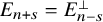 $E_{n+s}=E_{n-s}^{\perp }$
and
$E_{n+s}=E_{n-s}^{\perp }$
and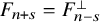 $F_{n+s}=F_{n-s}^{\perp }$
for
$F_{n+s}=F_{n-s}^{\perp }$
for $0\leq s < n$
, while if
$0\leq s < n$
, while if $N=2n+1$
is odd, we are in the orthogonal case, and have
$N=2n+1$
is odd, we are in the orthogonal case, and have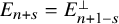 $E_{n+s}=E_{n+1-s}^{\perp }$
and
$E_{n+s}=E_{n+1-s}^{\perp }$
and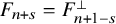 $F_{n+s}=F_{n+1-s}^{\perp }$
for
$F_{n+s}=F_{n+1-s}^{\perp }$
for $1\leq s \leq n$
. Consider the degeneracy locus
$1\leq s \leq n$
. Consider the degeneracy locus ${\mathfrak X}_w\subset {\mathfrak X}$
, which we assume has pure codimension
${\mathfrak X}_w\subset {\mathfrak X}$
, which we assume has pure codimension $\ell (w)$
in
$\ell (w)$
in ${\mathfrak X}$
(the precise definition of
${\mathfrak X}$
(the precise definition of ${\mathfrak X}_w$
is given in Sections 5.3 and 6.3). If w is an amenable Weyl group element, we obtain formulas for the class of
${\mathfrak X}_w$
is given in Sections 5.3 and 6.3). If w is an amenable Weyl group element, we obtain formulas for the class of ${\mathfrak X}_w$
in the cohomology ring of
${\mathfrak X}_w$
in the cohomology ring of ${\mathfrak X}$
, which are given by flagged theta and flagged eta polynomials.
${\mathfrak X}$
, which are given by flagged theta and flagged eta polynomials.
Fix an amenable signed permutation w in the hyperoctahedral group $W_n$
. Let
$W_n$
. Let $k\geq 0$
be the first right descent of w, list the entries
$k\geq 0$
be the first right descent of w, list the entries $w_{k+1},\ldots ,w_n$
in increasing order:
$w_{k+1},\ldots ,w_n$
in increasing order:
 $$\begin{align*}u_1<\cdots < u_m < 0 < u_{m+1} < \cdots < u_{n-k} \end{align*}$$
and define
 $$\begin{align*}\beta:=(u_1+1,\ldots,u_m+1,u_{m+1},\ldots,u_{n-k}), \end{align*}$$
 $$\begin{align*}D:=\{(i,j) \ |\ 1\leq i<j \leq n-k \ \, \text{and} \ \, u_i+ u_j < 0 \}, \end{align*}$$
and the raising operator expression
 $$\begin{align*}R^D: = \prod_{i<j}(1-R_{ij})\prod_{i<j\, :\, (i,j)\in D}(1+R_{ij})^{-1}. \end{align*}$$
The A-code of w is the sequence $\gamma $
with
$\gamma $
with $\gamma _i:= \#\{j>i\ |\ w_j<w_i\}$
. Define two partitions
$\gamma _i:= \#\{j>i\ |\ w_j<w_i\}$
. Define two partitions $\nu $
and
$\nu $
and $\xi $
by setting
$\xi $
by setting $\nu _j:= \#\{i\ |\ \gamma _i\geq j\}$
and
$\nu _j:= \#\{i\ |\ \gamma _i\geq j\}$
and $\xi _j:=\#\{i\ |\ \gamma _{k+i}\geq j\}$
for each
$\xi _j:=\#\{i\ |\ \gamma _{k+i}\geq j\}$
for each $j\geq 1$
. Following [Reference Tamvakis30], the shape of w is the partition
$j\geq 1$
. Following [Reference Tamvakis30], the shape of w is the partition $\lambda =\mu +\nu $
, where
$\lambda =\mu +\nu $
, where $\mu :=(-u_1,\ldots ,-u_m)$
. If
$\mu :=(-u_1,\ldots ,-u_m)$
. If $\ell $
denotes the length of
$\ell $
denotes the length of $\lambda $
, we say that
$\lambda $
, we say that ${\mathfrak q}\in [1,\ell ]$
is a critical index if
${\mathfrak q}\in [1,\ell ]$
is a critical index if $\beta _{{\mathfrak q}+1}> \beta _{\mathfrak q}+1$
, or if
$\beta _{{\mathfrak q}+1}> \beta _{\mathfrak q}+1$
, or if $\lambda _{\mathfrak q}>\lambda _{{\mathfrak q}+1}+1$
(respectively,
$\lambda _{\mathfrak q}>\lambda _{{\mathfrak q}+1}+1$
(respectively, $\lambda _{\mathfrak q}>\lambda _{{\mathfrak q}+1}$
) and
$\lambda _{\mathfrak q}>\lambda _{{\mathfrak q}+1}$
) and ${\mathfrak q}<m$
(respectively,
${\mathfrak q}<m$
(respectively, ${\mathfrak q}>m$
). Define two sequences
${\mathfrak q}>m$
). Define two sequences ${\mathfrak f}$
and
${\mathfrak f}$
and ${\mathfrak g}$
of length
${\mathfrak g}$
of length $\ell $
by setting
$\ell $
by setting
 $$\begin{align*}{\mathfrak f}_j:=k+\max(i\ |\ \gamma_{k+i}\geq j) \end{align*}$$
for each j, and ${\mathfrak g}_j:={\mathfrak f}_{\mathfrak q}+\beta _{\mathfrak q}-\xi _{\mathfrak q}-k,$
where
${\mathfrak g}_j:={\mathfrak f}_{\mathfrak q}+\beta _{\mathfrak q}-\xi _{\mathfrak q}-k,$
where ${\mathfrak q}$
is the least critical index such that
${\mathfrak q}$
is the least critical index such that ${\mathfrak q}\geq j$
. The sequences
${\mathfrak q}\geq j$
. The sequences ${\mathfrak f}$
and
${\mathfrak f}$
and ${\mathfrak g}$
are the right and left flags of w, and
${\mathfrak g}$
are the right and left flags of w, and ${\mathfrak f}$
(respectively,
${\mathfrak f}$
(respectively, $|{\mathfrak g}|$
) consists of right (respectively, left) descents of w.
$|{\mathfrak g}|$
) consists of right (respectively, left) descents of w.
Theorem CB. Let w be an amenable element of $W_n$
.
$W_n$
.
(a) If E is a symplectic vector bundle, then we have
 $$ \begin{align} [{\mathfrak X}_w] = \Theta_w(E-E_{n-{\mathfrak f}}-F_{n+{\mathfrak g}}) = R^D\, c_{\lambda}(E-E_{n-{\mathfrak f}}-F_{n+{\mathfrak g}}) \end{align} $$
in the cohomology ring ${\mathrm {H}}^*({\mathfrak X})$
.
${\mathrm {H}}^*({\mathfrak X})$
.
(b) If E is an odd orthogonal vector bundle, then we have
 $$ \begin{align} [{\mathfrak X}_w] = 2^{-m} \Theta_w(E-E_{n-{\mathfrak f}}-F_{n+1+{\mathfrak g}}) = 2^{-m}R^D\, c_{\lambda}(E-E_{n-{\mathfrak f}}-F_{n+1+{\mathfrak g}}) \end{align} $$
in the cohomology ring ${\mathrm {H}}^*({\mathfrak X})$
.
${\mathrm {H}}^*({\mathfrak X})$
.
Following [Reference Tamvakis and Wilson31], the Chern polynomial in equation (1) is interpreted as the image of $R^D \mathfrak {c}_\lambda $
under the
$R^D \mathfrak {c}_\lambda $
under the ${\mathbb Z}$
-linear map which sends the noncommutative monomial
${\mathbb Z}$
-linear map which sends the noncommutative monomial ${\mathfrak c}_\alpha ={\mathfrak c}_{\alpha _1}{\mathfrak c}_{\alpha _2}\dots $
to
${\mathfrak c}_\alpha ={\mathfrak c}_{\alpha _1}{\mathfrak c}_{\alpha _2}\dots $
to $\prod _j c_{\alpha _j}(E-E_{n-{\mathfrak f}_j}-F_{n+{\mathfrak g}_j})$
, for every integer sequence
$\prod _j c_{\alpha _j}(E-E_{n-{\mathfrak f}_j}-F_{n+{\mathfrak g}_j})$
, for every integer sequence $\alpha $
. The Chern polynomial in equation (2) is defined similarly.
$\alpha $
. The Chern polynomial in equation (2) is defined similarly.
As discussed above, the main theorem in the even orthogonal case involves nuances in its formulation and its proof; we therefore state it separately.
Theorem D. Let w be an amenable element of $\widetilde {W}_n$
. If E is an even orthogonal vector bundle, then we have
$\widetilde {W}_n$
. If E is an even orthogonal vector bundle, then we have
 $$ \begin{align} [{\mathfrak X}_w] = H_w(E-E_{n-{\mathfrak f}}-F_{n+{\mathfrak g}}) = 2^{-m}R^D \star \widehat{c}_{\lambda}(E-E_{n-{\mathfrak f}}-F_{n+{\mathfrak g}}) \end{align} $$
in the cohomology ring ${\mathrm {H}}^*({\mathfrak X})$
.
${\mathrm {H}}^*({\mathfrak X})$
.
We refer the reader to Sections 2.3 and 6 for the precise meaning and basic properties of the terms which appear in equation (3).
This article is organized as follows. Section 2 contains background material on divided differences and Schubert polynomials, and defines the shape of a (signed) permutation in all the classical types. Section 3 deals with raising operators and provides variants of the lemmas from [Reference Buch, Kresch and Tamvakis7] that we require here. Sections 4–6 define and study amenable elements and their applications in types A, C, and B/D, respectively. In particular, we give our notion of flagged theta and flagged eta polynomials; these are indexed by amenable Weyl group elements. Finally, Appendix A contains counterexamples to several statements in [Reference Anderson and Fulton2].
2. Preliminaries
This section gathers together background material on the divided differences and Schubert polynomials used in this work. We also discuss the notion of the shape of a (signed) permutation. Our notation is compatible with that found in [Reference Tamvakis30].
2.1. Lie type A
Throughout this article, we will employ integer sequences $\alpha =(\alpha _1,\alpha _2,\ldots )$
, which are assumed to have finite support, and we identify with integer vectors. The integer sequence
$\alpha =(\alpha _1,\alpha _2,\ldots )$
, which are assumed to have finite support, and we identify with integer vectors. The integer sequence $\alpha $
is a composition if
$\alpha $
is a composition if $\alpha _j\geq 0$
for all j. A weakly decreasing composition is called a partition. If
$\alpha _j\geq 0$
for all j. A weakly decreasing composition is called a partition. If $\lambda $
is a partition, the length of
$\lambda $
is a partition, the length of $\lambda $
is the integer
$\lambda $
is the integer $\ell (\lambda ):=\#\{i\ |\ \lambda _i\neq 0\}$
, and the conjugate of
$\ell (\lambda ):=\#\{i\ |\ \lambda _i\neq 0\}$
, and the conjugate of $\lambda $
is the partition
$\lambda $
is the partition $\lambda '$
with
$\lambda '$
with $\lambda ^{\prime }_j:=\#\{i\ |\ \lambda _i\geq j\}$
for all
$\lambda ^{\prime }_j:=\#\{i\ |\ \lambda _i\geq j\}$
for all $j\geq 1$
. As is customary, we identify partitions with their Young diagrams of boxes, arranged in left justified rows. An inclusion
$j\geq 1$
. As is customary, we identify partitions with their Young diagrams of boxes, arranged in left justified rows. An inclusion $\mu \subset \lambda $
of partitions corresponds to the containment of their respective diagrams; in this case, the skew diagram
$\mu \subset \lambda $
of partitions corresponds to the containment of their respective diagrams; in this case, the skew diagram $\lambda /\mu $
is the set-theoretic difference
$\lambda /\mu $
is the set-theoretic difference $\lambda \smallsetminus \mu $
. For each integer
$\lambda \smallsetminus \mu $
. For each integer $r\geq 1$
, let
$r\geq 1$
, let $\delta _r:=(r,r-1,\ldots ,1)$
,
$\delta _r:=(r,r-1,\ldots ,1)$
, $\delta ^{\vee }_r:=(1,2,\ldots ,r)$
, and set
$\delta ^{\vee }_r:=(1,2,\ldots ,r)$
, and set $\delta _0:=0$
. Denote by
$\delta _0:=0$
. Denote by $\epsilon _r$
the sequence whose rth term is 1 and all other terms are zero.
$\epsilon _r$
the sequence whose rth term is 1 and all other terms are zero.
The symmetric group $S_n$
is generated by the simple transpositions
$S_n$
is generated by the simple transpositions $s_i=(i,i+1)$
for
$s_i=(i,i+1)$
for $1\leq i \leq n-1$
. There is a natural embedding of
$1\leq i \leq n-1$
. There is a natural embedding of $S_n$
in
$S_n$
in $S_{n+1}$
by adjoining
$S_{n+1}$
by adjoining $n+1$
as a fixed point, and we let
$n+1$
as a fixed point, and we let $S_\infty :=\cup _n S_n$
. We will write a permutation
$S_\infty :=\cup _n S_n$
. We will write a permutation ${\varpi }\in S_n$
using one line notation, as the word
${\varpi }\in S_n$
using one line notation, as the word $({\varpi }_1,\ldots ,{\varpi }_n)$
where
$({\varpi }_1,\ldots ,{\varpi }_n)$
where ${\varpi }_i={\varpi }(i)$
.
${\varpi }_i={\varpi }(i)$
.
The length of a permutation ${\varpi }$
, denoted
${\varpi }$
, denoted $\ell ({\varpi })$
, is the least integer r such that we have an expression
$\ell ({\varpi })$
, is the least integer r such that we have an expression ${\varpi }=s_{i_1} \dots s_{i_r}$
. The word
${\varpi }=s_{i_1} \dots s_{i_r}$
. The word $s_{i_1}\dots s_{i_r}$
is called a reduced decomposition for
$s_{i_1}\dots s_{i_r}$
is called a reduced decomposition for ${\varpi }$
. An element
${\varpi }$
. An element ${\varpi }\in S_\infty $
has a left descent (respectively, a right descent) at position
${\varpi }\in S_\infty $
has a left descent (respectively, a right descent) at position $i\geq 1$
if
$i\geq 1$
if $\ell (s_i{\varpi })<\ell ({\varpi })$
(respectively, if
$\ell (s_i{\varpi })<\ell ({\varpi })$
(respectively, if $\ell ({\varpi } s_i)<\ell ({\varpi })$
). The permutation
$\ell ({\varpi } s_i)<\ell ({\varpi })$
). The permutation ${\varpi }=({\varpi }_1,{\varpi }_2,\ldots )$
has a right descent at i if and only if
${\varpi }=({\varpi }_1,{\varpi }_2,\ldots )$
has a right descent at i if and only if ${\varpi }_i>{\varpi }_{i+1}$
, and a left descent at i if and only if
${\varpi }_i>{\varpi }_{i+1}$
, and a left descent at i if and only if ${\varpi }^{-1}(i)>{\varpi }^{-1}(i+1)$
.
${\varpi }^{-1}(i)>{\varpi }^{-1}(i+1)$
.
The code $\gamma =\gamma ({\varpi })$
of a permutation
$\gamma =\gamma ({\varpi })$
of a permutation ${\varpi }\in S_n$
is the sequence
${\varpi }\in S_n$
is the sequence $\{\gamma _i\}$
with
$\{\gamma _i\}$
with $\gamma _i:=\#\{j>i\ |\ {\varpi }_j<{\varpi }_i\}$
. The code
$\gamma _i:=\#\{j>i\ |\ {\varpi }_j<{\varpi }_i\}$
. The code $\gamma $
determines
$\gamma $
determines ${\varpi }$
, as follows. We have
${\varpi }$
, as follows. We have ${\varpi }_1=\gamma _1+1$
, and for
${\varpi }_1=\gamma _1+1$
, and for $i>1$
,
$i>1$
, ${\varpi }_i$
is the
${\varpi }_i$
is the $(\gamma _i+1)$
st element in the complement of
$(\gamma _i+1)$
st element in the complement of $\{{\varpi }_1,\ldots ,{\varpi }_{i-1}\}$
in the sequence
$\{{\varpi }_1,\ldots ,{\varpi }_{i-1}\}$
in the sequence $(1,\ldots ,n)$
. Following [Reference Lascoux and Schützenberger18], [Reference Macdonald20], the shape
$(1,\ldots ,n)$
. Following [Reference Lascoux and Schützenberger18], [Reference Macdonald20], the shape $\lambda =\lambda ({\varpi })$
of
$\lambda =\lambda ({\varpi })$
of ${\varpi }$
is the partition whose parts are the non-zero entries
${\varpi }$
is the partition whose parts are the non-zero entries $\gamma _i$
of the code
$\gamma _i$
of the code $\gamma ({\varpi })$
, arranged in weakly decreasing order. We have
$\gamma ({\varpi })$
, arranged in weakly decreasing order. We have $|\lambda |:=\sum _i \lambda _i=\sum _i \gamma _i = \ell ({\varpi })$
.
$|\lambda |:=\sum _i \lambda _i=\sum _i \gamma _i = \ell ({\varpi })$
.
For any integer $p\geq 0$
and sequence of variables
$p\geq 0$
and sequence of variables $Z:=(z_1,z_2,\ldots )$
, the elementary and complete symmetric functions
$Z:=(z_1,z_2,\ldots )$
, the elementary and complete symmetric functions $e_p(Z)$
and
$e_p(Z)$
and $h_p(Z)$
are defined by the generating series
$h_p(Z)$
are defined by the generating series
 $$\begin{align*}\prod_{i=1}^{\infty}(1+z_it) = \sum_{p=0}^{\infty} e_p(Z)t^p \ \ \ \text{and} \ \ \ \prod_{i=1}^{\infty}(1-z_it)^{-1} = \sum_{p=0}^{\infty} h_p(Z)t^p, \end{align*}$$
respectively. If $r\geq 1,$
then we let
$r\geq 1,$
then we let $e^r_p(Z):=e_p(z_1,\ldots ,z_r)$
and
$e^r_p(Z):=e_p(z_1,\ldots ,z_r)$
and $h^r_p(Z):=h_p(z_1,\ldots ,z_r)$
denote the polynomials obtained from
$h^r_p(Z):=h_p(z_1,\ldots ,z_r)$
denote the polynomials obtained from $e_p(Z)$
and
$e_p(Z)$
and $h_p(Z)$
by setting
$h_p(Z)$
by setting $z_i=0$
for all
$z_i=0$
for all $i>r$
. Let
$i>r$
. Let $e^0_p(Z)=h^0_p(Z):=\delta _{0p}$
, where
$e^0_p(Z)=h^0_p(Z):=\delta _{0p}$
, where $\delta _{0p}$
denotes the Kronecker delta, and for
$\delta _{0p}$
denotes the Kronecker delta, and for $r<0$
, define
$r<0$
, define $h^r_p(Z):=e^{-r}_p(Z)$
and
$h^r_p(Z):=e^{-r}_p(Z)$
and $e^r_p(Z):=h^{-r}_p(Z)$
.
$e^r_p(Z):=h^{-r}_p(Z)$
.
Let $X:=(x_1,x_2,\ldots )$
and
$X:=(x_1,x_2,\ldots )$
and $Y:=(y_1,y_2,\ldots )$
be two sequences of independent variables. There is an action of
$Y:=(y_1,y_2,\ldots )$
be two sequences of independent variables. There is an action of $S_\infty $
on
$S_\infty $
on ${\mathbb Z}[X,Y]$
by ring automorphisms, defined by letting the simple reflections
${\mathbb Z}[X,Y]$
by ring automorphisms, defined by letting the simple reflections $s_i$
act by interchanging
$s_i$
act by interchanging $x_i$
and
$x_i$
and $x_{i+1}$
while leaving all the remaining variables fixed. Define the divided difference operator
$x_{i+1}$
while leaving all the remaining variables fixed. Define the divided difference operator $\partial _i^x$
on
$\partial _i^x$
on ${\mathbb Z}[X,Y]$
by
${\mathbb Z}[X,Y]$
by
 $$\begin{align*}\partial_i^xf := \frac{f-s_if}{x_i-x_{i+1}} \ \ \ \text{for } i\geq 1. \end{align*}$$
Consider the ring involution $\pi :{\mathbb Z}[X,Y]\to {\mathbb Z}[X,Y]$
determined by
$\pi :{\mathbb Z}[X,Y]\to {\mathbb Z}[X,Y]$
determined by $\pi (x_i)=-y_i$
and
$\pi (x_i)=-y_i$
and $\pi (y_i)=-x_i$
for each i, and set
$\pi (y_i)=-x_i$
for each i, and set $\partial _i^y:=\pi \partial _i^x\pi $
.
$\partial _i^y:=\pi \partial _i^x\pi $
.
For any $p,r,s\in {\mathbb Z}$
, define the polynomial
$p,r,s\in {\mathbb Z}$
, define the polynomial ${}^rh^s_p$
by
${}^rh^s_p$
by
 $$\begin{align*}{}^rh^s_p:=\sum_{i=0}^p h^r_i(X)e_{p-i}^s(-Y). \end{align*}$$
We have the following basic lemma.
Lemma 1. Suppose that $p,r,s\in {\mathbb Z}$
. For all
$p,r,s\in {\mathbb Z}$
. For all $i\geq 1$
, we have
$i\geq 1$
, we have
 $$\begin{align*}\partial^x_i ({}^rh_p^s)= \begin{cases} {}^{r+1}h_{p-1}^s & \text{if } r=\pm i, \\ 0 & \text{otherwise} \end{cases} \ \quad \mathrm{and} \ \quad \partial^y_i ({}^rh_p^s)= \begin{cases} {}^rh_{p-1}^{s-1} & \text{if } s=\pm i, \\ 0 & \text{otherwise}. \end{cases} \end{align*}$$
The double Schubert polynomials ${\mathfrak S}_{\varpi }$
for
${\mathfrak S}_{\varpi }$
for ${\varpi }\in S_{\infty }$
of Lascoux and Schützenberger [Reference Lascoux17], [Reference Lascoux and Schützenberger18] are the unique family of polynomials in
${\varpi }\in S_{\infty }$
of Lascoux and Schützenberger [Reference Lascoux17], [Reference Lascoux and Schützenberger18] are the unique family of polynomials in ${\mathbb Z}[X,Y]$
such that
${\mathbb Z}[X,Y]$
such that
 $$ \begin{align} \partial_i^x{\mathfrak S}_{\varpi} = \begin{cases} {\mathfrak S}_{{\varpi} s_i} & \text{if } \ell({\varpi} s_i)<\ell({\varpi}), \\ 0 & \text{otherwise}, \end{cases} \quad \partial_i^y{\mathfrak S}_{\varpi} = \begin{cases} {\mathfrak S}_{s_i{\varpi}} & \text{if } \ell(s_i{\varpi})<\ell({\varpi}), \\ 0 & \text{otherwise}, \end{cases} \end{align} $$
for all $i\geq 1$
, together with the condition that the constant term of
$i\geq 1$
, together with the condition that the constant term of ${\mathfrak S}_{\varpi }$
is
${\mathfrak S}_{\varpi }$
is $1$
if
$1$
if ${\varpi }=1$
, and
${\varpi }=1$
, and $0$
otherwise.
$0$
otherwise.
2.2. Lie type C
The Weyl group for the root system of type $\text {C}_n$
is the group of signed permutations on the set
$\text {C}_n$
is the group of signed permutations on the set $\{1,\ldots ,n\}$
, denoted
$\{1,\ldots ,n\}$
, denoted $W_n$
. The group
$W_n$
. The group $W_n$
is generated by the simple transpositions
$W_n$
is generated by the simple transpositions $s_i=(i,i+1)$
for
$s_i=(i,i+1)$
for $1\leq i \leq n-1$
together with the sign change
$1\leq i \leq n-1$
together with the sign change $s_0$
, which fixes all
$s_0$
, which fixes all $j\in [2,n]$
and sends
$j\in [2,n]$
and sends $1$
to
$1$
to $\overline {1}$
(a bar over an integer here means a negative sign). We write the elements of
$\overline {1}$
(a bar over an integer here means a negative sign). We write the elements of $W_n$
as n-tuples
$W_n$
as n-tuples $(w_1,\ldots , w_n)$
, where
$(w_1,\ldots , w_n)$
, where $w_i:=w(i)$
for each
$w_i:=w(i)$
for each $i\in [1,n]$
. There is a natural embedding of
$i\in [1,n]$
. There is a natural embedding of $W_n$
in
$W_n$
in $W_{n+1}$
by adjoining
$W_{n+1}$
by adjoining $n+1$
as a fixed point, and we let
$n+1$
as a fixed point, and we let $W_\infty :=\cup _n W_n$
. The symmetric groups
$W_\infty :=\cup _n W_n$
. The symmetric groups $S_n$
and
$S_n$
and $S_\infty $
are the subgroups of
$S_\infty $
are the subgroups of $W_n$
and
$W_n$
and $W_\infty $
, respectively, generated by the reflections
$W_\infty $
, respectively, generated by the reflections $s_i$
for i positive. The length
$s_i$
for i positive. The length $\ell (w)$
and the reduced decompositions of an element
$\ell (w)$
and the reduced decompositions of an element $w\in W_\infty $
is defined as in type A. We have
$w\in W_\infty $
is defined as in type A. We have
 $$\begin{align*}\ell(w) = \#\{i<j\ |\ w_i>w_j\} + \sum_{i\, :\, w_i <0}|w_i| \end{align*}$$
for every $w\in W_\infty $
.
$w\in W_\infty $
.
An element $w\in W_\infty $
has a right descent (respectively, a left descent) at position
$w\in W_\infty $
has a right descent (respectively, a left descent) at position $i\geq 0$
if
$i\geq 0$
if $\ell (ws_i)<\ell (w)$
(respectively, if
$\ell (ws_i)<\ell (w)$
(respectively, if $\ell (s_iw)<\ell (w)$
). The signed permutation
$\ell (s_iw)<\ell (w)$
). The signed permutation $w=(w_1,w_2,\ldots )$
has a right descent at 0 if and only if
$w=(w_1,w_2,\ldots )$
has a right descent at 0 if and only if $w_1<0$
, and a right descent at
$w_1<0$
, and a right descent at $i \geq 1$
if and only if
$i \geq 1$
if and only if $w_i>w_{i+1}$
. The element w has a left descent at 0 if and only if
$w_i>w_{i+1}$
. The element w has a left descent at 0 if and only if $w^{-1}(1)<0$
, that is,
$w^{-1}(1)<0$
, that is, $w=(\cdots \overline {1} \cdots )$
. The element w has a left descent at
$w=(\cdots \overline {1} \cdots )$
. The element w has a left descent at $i \geq 1$
if and only if
$i \geq 1$
if and only if $w^{-1}(i)>w^{-1}(i+1)$
, that is, w has one of the following four forms:
$w^{-1}(i)>w^{-1}(i+1)$
, that is, w has one of the following four forms:
 $$\begin{align*}(\cdots i+1 \cdots i \cdots), \quad (\cdots i \cdots \overline{i+1} \cdots), \quad (\cdots \overline{i+1} \cdots i \cdots), \quad (\cdots \overline{i} \cdots \overline{i+1} \cdots). \end{align*}$$
Let $w\in W_\infty $
be a signed permutation. Following [Reference Tamvakis30, Definition 2], the strict partition
$w\in W_\infty $
be a signed permutation. Following [Reference Tamvakis30, Definition 2], the strict partition $\mu =\mu (w)$
is the one whose parts are the absolute values of the negative entries of w, arranged in decreasing order. The A-code of w is the sequence
$\mu =\mu (w)$
is the one whose parts are the absolute values of the negative entries of w, arranged in decreasing order. The A-code of w is the sequence $\gamma =\gamma (w)$
with
$\gamma =\gamma (w)$
with $\gamma _i:=\#\{j>i\ |\ w_j<w_i\}$
. We define a partition
$\gamma _i:=\#\{j>i\ |\ w_j<w_i\}$
. We define a partition $\nu =\nu (w)$
by
$\nu =\nu (w)$
by
 $$\begin{align*}\nu_j = \#\{i\ |\ \gamma_i\geq j\}, \ \ \text{for all } j\geq 1. \end{align*}$$
Finally, the shape of w is the partition $\lambda (w):=\mu (w)+\nu (w)$
. The element w is uniquely determined by
$\lambda (w):=\mu (w)+\nu (w)$
. The element w is uniquely determined by $\mu (w)$
and
$\mu (w)$
and $\gamma (w)$
, and we have
$\gamma (w)$
, and we have $|\lambda (w)|=\ell (w)$
.
$|\lambda (w)|=\ell (w)$
.
Example 1.
(a) For the signed permutation $w := (\overline {5},3, \overline {4}, 7, \overline {1}, \overline {6}, 2)$
in
$w := (\overline {5},3, \overline {4}, 7, \overline {1}, \overline {6}, 2)$
in $W_7$
, we obtain
$W_7$
, we obtain $\mu = (6,5,4,1)$
,
$\mu = (6,5,4,1)$
, $\gamma =(1, 4, 1, 3, 1,0,0)$
,
$\gamma =(1, 4, 1, 3, 1,0,0)$
, $\nu = (5,2, 2, 1)$
, and
$\nu = (5,2, 2, 1)$
, and $\lambda = (11, 7, 6, 2)$
.
$\lambda = (11, 7, 6, 2)$
.
(b) Let $k\geq 0$
. An element
$k\geq 0$
. An element $w\in W_\infty $
is k-Grassmannian if
$w\in W_\infty $
is k-Grassmannian if $\ell (ws_i)>\ell (w)$
for all
$\ell (ws_i)>\ell (w)$
for all $i\neq k$
. This is equivalent to the conditions
$i\neq k$
. This is equivalent to the conditions
 $$\begin{align*}0<w_1<\cdots < w_k \quad \mathrm{and} \quad w_{k+1}<w_{k+2}<\cdots. \end{align*}$$
If w is a k-Grassmannian element of $W_\infty $
, then
$W_\infty $
, then $\lambda (w)$
is the k-strict partition associated with w in [Reference Buch, Kresch and Tamvakis7, Section 6.1].
$\lambda (w)$
is the k-strict partition associated with w in [Reference Buch, Kresch and Tamvakis7, Section 6.1].
(c) Suppose that the first right descent of $w\in W_n$
is
$w\in W_n$
is $k\geq 0$
, and let
$k\geq 0$
, and let $m=\ell (\mu )$
and
$m=\ell (\mu )$
and $\ell =\ell (\lambda )$
. Then,
$\ell =\ell (\lambda )$
. Then, $\mu $
is a strict partition and
$\mu $
is a strict partition and $\nu \subset k^{n-k}+\delta _{n-k-1}$
, with
$\nu \subset k^{n-k}+\delta _{n-k-1}$
, with $\nu _j\geq k$
for all
$\nu _j\geq k$
for all $j\in [1,m]$
. It follows that
$j\in [1,m]$
. It follows that
 $$\begin{align*}\lambda_1>\lambda_2>\cdots > \lambda_m >\max(\lambda_{m+1},k) \geq \lambda_{m+1}\geq \lambda_{m+2}\geq \cdots \geq \lambda_{\ell}. \end{align*}$$
Lemma 2 [Reference Macdonald20], [Reference Tamvakis30]
If $i\geq 1$
,
$i\geq 1$
, $w\in W_\infty $
, and
$w\in W_\infty $
, and $\gamma =\gamma (w)$
, then
$\gamma =\gamma (w)$
, then
 $$\begin{align*}\gamma_i>\gamma_{i+1} \Leftrightarrow w_i>w_{i+1} \Leftrightarrow \ell(ws_i)=\ell(w) -1. \end{align*}$$
If any of the above conditions hold, then
 $$\begin{align*}\gamma(ws_i) = (\gamma_1,\ldots, \gamma_{i-1}, \gamma_{i+1},\gamma_i-1,\gamma_{i+2},\gamma_{i+3},\ldots). \end{align*}$$
Let $c:=(c_1,c_2,\ldots )$
be a sequence of commuting variables, and set
$c:=(c_1,c_2,\ldots )$
be a sequence of commuting variables, and set $c_0:=1$
and
$c_0:=1$
and $c_p:=0$
for
$c_p:=0$
for $p<0$
. Consider the graded ring
$p<0$
. Consider the graded ring $\Gamma $
which is the quotient of the polynomial ring
$\Gamma $
which is the quotient of the polynomial ring ${\mathbb Z}[c]$
modulo the ideal generated by the relations
${\mathbb Z}[c]$
modulo the ideal generated by the relations
 $$ \begin{align} c_pc_p+2\sum_{i=1}^p(-1)^ic_{p+i}c_{p-i}=0, \ \ \ \text{for all } p\geq 1. \end{align} $$
Let $X:=(x_1,x_2,\ldots )$
and
$X:=(x_1,x_2,\ldots )$
and $Y:=(y_1,y_2,\ldots )$
be two sequences of variables. Following [Reference Billey and Haiman3], [Reference Ikeda, Mihalcea and Naruse13], there is an action of
$Y:=(y_1,y_2,\ldots )$
be two sequences of variables. Following [Reference Billey and Haiman3], [Reference Ikeda, Mihalcea and Naruse13], there is an action of $W_\infty $
on
$W_\infty $
on $\Gamma [X,Y]$
by ring automorphisms, defined as follows. The simple reflections
$\Gamma [X,Y]$
by ring automorphisms, defined as follows. The simple reflections $s_i$
for
$s_i$
for $i\geq 1$
act by interchanging
$i\geq 1$
act by interchanging $x_i$
and
$x_i$
and $x_{i+1}$
while leaving all the remaining variables fixed. The reflection
$x_{i+1}$
while leaving all the remaining variables fixed. The reflection $s_0$
maps
$s_0$
maps $x_1$
to
$x_1$
to $-x_1$
, fixes the
$-x_1$
, fixes the $x_j$
for
$x_j$
for $j\geq 2$
and all the
$j\geq 2$
and all the $y_j$
, and satisfies
$y_j$
, and satisfies
 $$\begin{align*}s_0(c_p) := c_p+2\sum_{j=1}^p x_1^jc_{p-j} \ \ \text{for all } p\geq 1. \end{align*}$$
For each $i\geq 0$
, define the divided difference operator
$i\geq 0$
, define the divided difference operator $\partial _i^x$
on
$\partial _i^x$
on $\Gamma [X,Y]$
by
$\Gamma [X,Y]$
by
 $$\begin{align*}\partial_0^xf := \frac{f-s_0f}{-2x_1}, \qquad \partial_i^xf := \frac{f-s_if}{x_i-x_{i+1}} \ \ \ \text{for } i\geq 1. \end{align*}$$
Consider the ring involution $\varphi :\Gamma [X,Y]\to \Gamma [X,Y]$
determined by
$\varphi :\Gamma [X,Y]\to \Gamma [X,Y]$
determined by
 $$\begin{align*}\varphi(x_j) = -y_j, \qquad \varphi(y_j) = -x_j, \qquad \varphi(c_p)=c_p \end{align*}$$
and set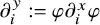 $\partial _i^y:=\varphi \partial _i^x\varphi $
for each
$\partial _i^y:=\varphi \partial _i^x\varphi $
for each $i\geq 0$
. The right and left divided difference operators
$i\geq 0$
. The right and left divided difference operators $\partial ^x_i$
and
$\partial ^x_i$
and $\partial ^y_i$
on
$\partial ^y_i$
on $\Gamma [X,Y]$
satisfy the right and left Leibnitz rules
$\Gamma [X,Y]$
satisfy the right and left Leibnitz rules
 $$ \begin{align} \partial^x_i(fg) = (\partial^x_if)g+(s_if)\partial^x_ig \quad \ \mathrm{and} \quad \ \partial^y_i(fg) = (\partial^y_if)g+(s^y_if)\partial^y_ig, \end{align} $$
where $s_i^y:=\varphi s_i \varphi $
, for every
$s_i^y:=\varphi s_i \varphi $
, for every $i\geq 0$
.
$i\geq 0$
.
For any $p,r,s\in {\mathbb Z}$
, define the polynomial
$p,r,s\in {\mathbb Z}$
, define the polynomial ${}^rc^s_p$
by
${}^rc^s_p$
by
 $$\begin{align*}{}^rc^s_p:=\sum_{i=0}^p\sum_{j=0}^p c_{p-i-j}e^{r}_i(X)h_j^s(-Y). \end{align*}$$
We have the following basic lemma, which stems from [Reference Ikeda and Matsumura12, Section 5.1].
Lemma 3.
(a) Suppose that $p,r,s\in {\mathbb Z}$
. For all
$p,r,s\in {\mathbb Z}$
. For all $i\geq 0$
, we have
$i\geq 0$
, we have
 $$\begin{align*}\partial^x_i ({}^rc_p^s)= \begin{cases} {}^{r-1}c_{p-1}^s & \text{if } r=\pm i, \\ 0 & \text{otherwise}. \end{cases} \ \quad \mathrm{and} \ \quad \partial^y_i ({}^rc_p^s)= \begin{cases} {}^rc_{p-1}^{s+1} & \text{if } s=\pm i, \\ 0 & \text{otherwise}. \end{cases} \end{align*}$$
(b) For all $i\geq 1$
,
$i\geq 1$
, $r,s\geq 0$
, and indices p and q, we have
$r,s\geq 0$
, and indices p and q, we have
 $$\begin{align*}\partial^y_i({}^rc_p^{-i}\,{}^sc_q^i) = {}^rc_{p-1}^{-i+1}\,{}^sc_q^{i+1} + {}^rc_p^{-i+1}\,{}^sc_{q-1}^{i+1}. \end{align*}$$
Suppose $r,s\geq 0$
, and let
$r,s\geq 0$
, and let ${\mathfrak c}_p:={}^rc^{-s}_p$
for each
${\mathfrak c}_p:={}^rc^{-s}_p$
for each $p\in {\mathbb Z}$
. We then have the relations
$p\in {\mathbb Z}$
. We then have the relations
 $$ \begin{align} {\mathfrak c}_p{\mathfrak c}_p+2\sum_{i=1}^p (-1)^i {\mathfrak c}_{p+i}{\mathfrak c}_{p-i}=0 \ \ \text{for all} \ \, p> r+s \end{align} $$
in $\Gamma [X,Y]$
. Indeed, if
$\Gamma [X,Y]$
. Indeed, if ${\mathcal C}(t):=\sum _{p=0}^{\infty } {\mathfrak c}_pt^p$
is the generating function for the
${\mathcal C}(t):=\sum _{p=0}^{\infty } {\mathfrak c}_pt^p$
is the generating function for the ${\mathfrak c}_p$
, we have
${\mathfrak c}_p$
, we have
 $$\begin{align*}{\mathcal C}(t) = \prod_{i=1}^r(1+x_it)\prod_{j=1}^s(1-y_jt) \left(\sum_{p=0}^{\infty}c_pt^p\right) \end{align*}$$
and hence
 $$\begin{align*}{\mathcal C}(t){\mathcal C}(-t) = \prod_{i=1}^r(1-x^2_it^2)\prod_{j=1}^s(1-y^2_jt^2), \end{align*}$$
which is a polynomial in t of degree $2(r+s)$
.
$2(r+s)$
.
The type C double Schubert polynomials ${\mathfrak C}_w$
for
${\mathfrak C}_w$
for $w\in W_{\infty }$
of Ikeda, Mihalcea, and Naruse [Reference Ikeda, Mihalcea and Naruse13] are the unique family of elements of
$w\in W_{\infty }$
of Ikeda, Mihalcea, and Naruse [Reference Ikeda, Mihalcea and Naruse13] are the unique family of elements of $\Gamma [X,Y]$
such that
$\Gamma [X,Y]$
such that
 $$ \begin{align} \partial_i^x{\mathfrak C}_w = \begin{cases} {\mathfrak C}_{ws_i} & \text{if } \ell(ws_i)<\ell(w), \\ 0 & \text{otherwise}, \end{cases} \quad \partial_i^y{\mathfrak C}_w = \begin{cases} {\mathfrak C}_{s_iw} & \text{if } \ell(s_iw)<\ell(w), \\ 0 & \text{otherwise}, \end{cases} \end{align} $$
for all $i\geq 0$
, together with the condition that the constant term of
$i\geq 0$
, together with the condition that the constant term of ${\mathfrak C}_w$
is
${\mathfrak C}_w$
is $1$
if
$1$
if $w=1$
, and
$w=1$
, and $0$
otherwise.
$0$
otherwise.
2.3. Lie types B and D
When working with the orthogonal Lie types, we use coefficients in the ring ${\mathbb Z}[\frac {1}{2}]$
. For any
${\mathbb Z}[\frac {1}{2}]$
. For any $w\in W_\infty $
, the type B double Schubert polynomial
$w\in W_\infty $
, the type B double Schubert polynomial ${\mathfrak B}_w$
of [Reference Ikeda, Mihalcea and Naruse13] satisfies
${\mathfrak B}_w$
of [Reference Ikeda, Mihalcea and Naruse13] satisfies ${\mathfrak B}_w=2^{-s(w)}{\mathfrak C}_w$
, where
${\mathfrak B}_w=2^{-s(w)}{\mathfrak C}_w$
, where $s(w)$
is the number of indices j such that
$s(w)$
is the number of indices j such that $w_j<0$
. The odd orthogonal case is therefore entirely similar to the symplectic case. In the rest of this section, we provide the corresponding preliminaries for the even orthogonal group, that is, in Lie type D, and assume that
$w_j<0$
. The odd orthogonal case is therefore entirely similar to the symplectic case. In the rest of this section, we provide the corresponding preliminaries for the even orthogonal group, that is, in Lie type D, and assume that $n\geq 2$
.
$n\geq 2$
.
The Weyl group $\widetilde {W}_n$
for the root system
$\widetilde {W}_n$
for the root system $\text {D}_n$
is the subgroup of
$\text {D}_n$
is the subgroup of $W_n$
consisting of all signed permutations with an even number of sign changes. The group
$W_n$
consisting of all signed permutations with an even number of sign changes. The group $\widetilde {W}_n$
is an extension of
$\widetilde {W}_n$
is an extension of $S_n$
by the element
$S_n$
by the element $s_\Box =s_0s_1s_0$
, which acts on the right by
$s_\Box =s_0s_1s_0$
, which acts on the right by
 $$\begin{align*}(w_1,w_2,\ldots,w_n)s_\Box=(\overline{w}_2,\overline{w}_1,w_3,\ldots,w_n). \end{align*}$$
There is a natural embedding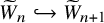 $\widetilde {W}_n\hookrightarrow \widetilde {W}_{n+1}$
of Weyl groups, induced by the embedding
$\widetilde {W}_n\hookrightarrow \widetilde {W}_{n+1}$
of Weyl groups, induced by the embedding $W_n\hookrightarrow W_{n+1}$
, and we let
$W_n\hookrightarrow W_{n+1}$
, and we let $\widetilde {W}_\infty := \cup _n \widetilde {W}_n$
. The elements of the set
$\widetilde {W}_\infty := \cup _n \widetilde {W}_n$
. The elements of the set ${\mathbb N}_\Box :=\{\Box ,1,\ldots \}$
index the simple reflections in
${\mathbb N}_\Box :=\{\Box ,1,\ldots \}$
index the simple reflections in $\widetilde {W}_\infty $
. The length
$\widetilde {W}_\infty $
. The length $\ell (w)$
and reduced decompositions of an element
$\ell (w)$
and reduced decompositions of an element $w\in \widetilde {W}_\infty $
are defined as before. We have
$w\in \widetilde {W}_\infty $
are defined as before. We have
 $$\begin{align*}\ell(w) = \#\{i<j\ |\ w_i>w_j\} + \sum_{i\, :\, w_i <0}(|w_i|-1) \end{align*}$$
for every $w\in \widetilde {W}_\infty $
.
$w\in \widetilde {W}_\infty $
.
An element $w\in \widetilde {W}_\infty $
has a right descent (respectively, a left descent) at position
$w\in \widetilde {W}_\infty $
has a right descent (respectively, a left descent) at position $i\in {\mathbb N}_\Box $
if
$i\in {\mathbb N}_\Box $
if $\ell (ws_i)<\ell (w)$
(respectively, if
$\ell (ws_i)<\ell (w)$
(respectively, if $\ell (s_iw)<\ell (w)$
). The element
$\ell (s_iw)<\ell (w)$
). The element $w=(w_1,w_2,\ldots )$
has a right descent at
$w=(w_1,w_2,\ldots )$
has a right descent at $\Box $
if and only if
$\Box $
if and only if $w_1<-w_2$
, and a right descent at
$w_1<-w_2$
, and a right descent at $i\geq 1$
if and only if
$i\geq 1$
if and only if $w_i>w_{i+1}$
. We use the notation
$w_i>w_{i+1}$
. We use the notation $\widehat {1}$
to denote
$\widehat {1}$
to denote $1$
or
$1$
or $\overline {1}$
, determined by the parity of the number of negative entries of w. The following result corrects [Reference Tamvakis28, Lemma 4].
$\overline {1}$
, determined by the parity of the number of negative entries of w. The following result corrects [Reference Tamvakis28, Lemma 4].
Lemma 4. Suppose that w is an element of $\widetilde {W}_\infty $
.
$\widetilde {W}_\infty $
.
(a) We have $\ell (s_\Box w)<\ell (w)$
if and only if w has one of the following four forms:
$\ell (s_\Box w)<\ell (w)$
if and only if w has one of the following four forms:
 $$\begin{align*}(\cdots \widehat{1} \cdots \overline{2} \cdots), \quad (\cdots \overline{2} \cdots \overline{1} \cdots), \quad (\cdots 2 \cdots \overline{1} \cdots). \end{align*}$$
(b) Assume that $i\geq 1$
. We have
$i\geq 1$
. We have $\ell (s_iw)<\ell (w)$
if and only if w has one of the following four forms:
$\ell (s_iw)<\ell (w)$
if and only if w has one of the following four forms:
 $$\begin{align*}(\cdots i+1 \cdots i \cdots), \quad (\cdots i \cdots \overline{i+1} \cdots), \quad (\cdots \overline{i+1} \cdots i \cdots), \quad (\cdots\overline{i} \cdots \overline{i+1} \cdots). \end{align*}$$
Definition 1. We say that w has type 0 if $|w_1|=1$
, type 1 if
$|w_1|=1$
, type 1 if $w_1>1$
, and type 2 if
$w_1>1$
, and type 2 if $w_1<-1$
.
$w_1<-1$
.
There is an involution $\iota :\widetilde {W}_\infty \to \widetilde {W}_\infty $
which interchanges
$\iota :\widetilde {W}_\infty \to \widetilde {W}_\infty $
which interchanges $s_\Box $
and
$s_\Box $
and $s_1$
; we have
$s_1$
; we have $\iota (w) = s_0ws_0$
in the hyperoctahedral group
$\iota (w) = s_0ws_0$
in the hyperoctahedral group $W_\infty $
. We deduce that
$W_\infty $
. We deduce that $\iota (w)=w$
if and only if w has type 0, while if w has positive type and
$\iota (w)=w$
if and only if w has type 0, while if w has positive type and $|w_r|=1$
for some
$|w_r|=1$
for some $r>1$
, then
$r>1$
, then
 $$\begin{align*}\iota(w)=(-w_1,w_2,\ldots,w_{r-1},-w_r,w_{r+1},\ldots). \end{align*}$$
It follows that $\iota $
interchanges type 1 and type 2 elements. The next definition refines the notion of the shape of an element of
$\iota $
interchanges type 1 and type 2 elements. The next definition refines the notion of the shape of an element of $\widetilde {W}_\infty $
introduced in [Reference Tamvakis30, Definition 5].
$\widetilde {W}_\infty $
introduced in [Reference Tamvakis30, Definition 5].
Definition 2. Let $w\in \widetilde {W}_\infty $
have type 0 or type 1. The strict partition
$w\in \widetilde {W}_\infty $
have type 0 or type 1. The strict partition $\mu (w)$
is the one whose parts are the absolute values of the negative entries of w minus one, arranged in decreasing order. Let
$\mu (w)$
is the one whose parts are the absolute values of the negative entries of w minus one, arranged in decreasing order. Let $\gamma =\gamma (w)$
be the A-code of w, and define the parts of the partition
$\gamma =\gamma (w)$
be the A-code of w, and define the parts of the partition $\nu =\nu (w)$
by
$\nu =\nu (w)$
by $\nu _j:=\#\{i\ |\ \gamma _i\geq j\}$
. If w has type
$\nu _j:=\#\{i\ |\ \gamma _i\geq j\}$
. If w has type $2$
, then set
$2$
, then set $\mu (w):=\mu (\iota (w))$
,
$\mu (w):=\mu (\iota (w))$
, $\gamma (w):=\gamma (\iota (w))$
, and
$\gamma (w):=\gamma (\iota (w))$
, and $\nu (w):=\nu (\iota (w))$
.
$\nu (w):=\nu (\iota (w))$
.
A typed partition is a pair consisting of a partition $\lambda $
together with an integer
$\lambda $
together with an integer ${\mathrm {type}}(\lambda )\in \{0,1,2\}$
. The shape of w is the typed partition
${\mathrm {type}}(\lambda )\in \{0,1,2\}$
. The shape of w is the typed partition $\lambda =\lambda (w)$
defined by
$\lambda =\lambda (w)$
defined by $\lambda (w):=\mu (w)+\nu (w)$
, with
$\lambda (w):=\mu (w)+\nu (w)$
, with ${\mathrm {type}}(\lambda ):={\mathrm {type}}(w)$
.
${\mathrm {type}}(\lambda ):={\mathrm {type}}(w)$
.
Observe that the element w is uniquely determined by $\mu (w)$
,
$\mu (w)$
, $\gamma (w)$
, and
$\gamma (w)$
, and ${\mathrm {type}}(w)$
. Moreover, we have
${\mathrm {type}}(w)$
. Moreover, we have $|\lambda (w)|=\ell (w)$
.
$|\lambda (w)|=\ell (w)$
.
Definition 3. Let $w\in \widetilde {W}_\infty \smallsetminus \{1\}$
, let d denote the first right descent of w, and set
$w\in \widetilde {W}_\infty \smallsetminus \{1\}$
, let d denote the first right descent of w, and set $k:=d$
, if
$k:=d$
, if $d\neq \Box $
, and
$d\neq \Box $
, and $k:=1$
, if
$k:=1$
, if $d=\Box $
. We call k the primary index of w.
$d=\Box $
. We call k the primary index of w.
Example 2.
(a) For the signed permutation $w := (3, 2, \overline {7}, 1, 5, 4, \overline {6})$
in
$w := (3, 2, \overline {7}, 1, 5, 4, \overline {6})$
in $\widetilde {W}_7$
, we obtain
$\widetilde {W}_7$
, we obtain $\mu = (6,5)$
,
$\mu = (6,5)$
, $\gamma =(4,3, 0, 1, 2, 1, 0)$
,
$\gamma =(4,3, 0, 1, 2, 1, 0)$
, $\nu = (5, 3, 2,1)$
, and
$\nu = (5, 3, 2,1)$
, and $\lambda = (11, 8, 2,1)$
with
$\lambda = (11, 8, 2,1)$
with ${\mathrm {type}}(\lambda )=1$
. The element
${\mathrm {type}}(\lambda )=1$
. The element $\iota (w)= (\overline {3}, 2, \overline {7}, \overline {1}, 5, 4, \overline {6})$
has shape
$\iota (w)= (\overline {3}, 2, \overline {7}, \overline {1}, 5, 4, \overline {6})$
has shape $\overline {\lambda } = (11, 8, 2,1)$
with
$\overline {\lambda } = (11, 8, 2,1)$
with ${\mathrm {type}}(\overline {\lambda })=2$
. Both w and
${\mathrm {type}}(\overline {\lambda })=2$
. Both w and $\iota (w)$
have primary index
$\iota (w)$
have primary index $k=1$
.
$k=1$
.
(b) Let $k\geq 1$
. An element w of
$k\geq 1$
. An element w of $\widetilde {W}_\infty $
is k-Grassmannian if
$\widetilde {W}_\infty $
is k-Grassmannian if $\ell (ws_i)>\ell (w)$
for all
$\ell (ws_i)>\ell (w)$
for all $i\neq k$
, if
$i\neq k$
, if $k>1$
, and for all
$k>1$
, and for all $i\notin \{\Box ,1\}$
, if
$i\notin \{\Box ,1\}$
, if $k=1$
. This is equivalent to the conditions
$k=1$
. This is equivalent to the conditions
 $$\begin{align*}|w_1|<w_2<\cdots < w_k \quad \mathrm{and} \quad w_{k+1}<w_{k+2}<\cdots, \end{align*}$$
the first condition being vacuous if $k=1$
. If w is a k-Grassmannian element of
$k=1$
. If w is a k-Grassmannian element of $\widetilde {W}_\infty $
, then
$\widetilde {W}_\infty $
, then $\lambda (w)$
is the typed k-strict partition associated with w in [Reference Buch, Kresch and Tamvakis6, Section 6.1].
$\lambda (w)$
is the typed k-strict partition associated with w in [Reference Buch, Kresch and Tamvakis6, Section 6.1].
(c) Suppose that the primary index of $w\in \widetilde {W}_n$
is
$w\in \widetilde {W}_n$
is $k\geq 1$
, and let
$k\geq 1$
, and let $m=\ell (\mu )$
and
$m=\ell (\mu )$
and $\ell =\ell (\lambda )$
. Then,
$\ell =\ell (\lambda )$
. Then, $\mu $
is a strict partition and
$\mu $
is a strict partition and $\nu \subset k^{n-k}+\delta _{n-k-1}$
, with
$\nu \subset k^{n-k}+\delta _{n-k-1}$
, with $\nu _j \geq k$
for all
$\nu _j \geq k$
for all $j\in [1,m]$
. We therefore have
$j\in [1,m]$
. We therefore have
 $$\begin{align*}\lambda_1>\lambda_2>\cdots > \lambda_m >\max(\lambda_{m+1},k) \geq \lambda_{m+1}\geq \lambda_{m+2}\geq \cdots \geq \lambda_{\ell}. \end{align*}$$
Let $b:=(b_1,b_2,\ldots )$
be a sequence of commuting variables, and set
$b:=(b_1,b_2,\ldots )$
be a sequence of commuting variables, and set $b_0:=1$
and
$b_0:=1$
and $b_p:=0$
for
$b_p:=0$
for $p<0$
. Consider the graded ring
$p<0$
. Consider the graded ring $\Gamma '$
which is the quotient of the polynomial ring
$\Gamma '$
which is the quotient of the polynomial ring ${\mathbb Z}[b]$
modulo the ideal generated by the relations
${\mathbb Z}[b]$
modulo the ideal generated by the relations
 $$\begin{align*}b_pb_p+2\sum_{i=1}^{p-1}(-1)^i b_{p+i}b_{p-i}+(-1)^p b_{2p}=0, \ \ \ \text{for all } p\geq 1. \end{align*}$$
We regard $\Gamma $
as a subring of
$\Gamma $
as a subring of $\Gamma '$
via the injective ring homomorphism which sends
$\Gamma '$
via the injective ring homomorphism which sends $c_p$
to
$c_p$
to $2b_p$
for every
$2b_p$
for every $p\geq 1$
.
$p\geq 1$
.
Following [Reference Billey and Haiman3], [Reference Ikeda, Mihalcea and Naruse13], we define an action of $\widetilde {W}_\infty $
on
$\widetilde {W}_\infty $
on $\Gamma '[X,Y]$
by ring automorphisms as follows. The simple reflections
$\Gamma '[X,Y]$
by ring automorphisms as follows. The simple reflections $s_i$
for
$s_i$
for $i \geq 1$
act by interchanging
$i \geq 1$
act by interchanging $x_i$
and
$x_i$
and $x_{i+1}$
and leaving all the remaining variables fixed. The reflection
$x_{i+1}$
and leaving all the remaining variables fixed. The reflection $s_\Box $
maps
$s_\Box $
maps $(x_1,x_2)$
to
$(x_1,x_2)$
to $(-x_2,-x_1)$
, fixes the
$(-x_2,-x_1)$
, fixes the $x_j$
for
$x_j$
for $j\geq 3$
and all the
$j\geq 3$
and all the $y_j$
, and satisfies, for any
$y_j$
, and satisfies, for any $p\geq 1$
,
$p\geq 1$
,
 $$ \begin{align*} s_\Box(b_p) := b_p+(x_1+x_2)\sum_{j=0}^{p-1}\left(\sum_{a+b=j}x_1^ax_2^b\right) c_{p-1-j}. \end{align*} $$
For each $i\in {\mathbb N}_\Box $
, define the divided difference operator
$i\in {\mathbb N}_\Box $
, define the divided difference operator $\partial _i^x$
on
$\partial _i^x$
on $\Gamma '[X,Y]$
by
$\Gamma '[X,Y]$
by
 $$\begin{align*}\partial_\Box^xf := \frac{f-s_\Box f}{-x_1-x_2}, \qquad \partial_i^xf := \frac{f-s_if}{x_i-x_{i+1}} \ \ \ \text{for } i\geq 1. \end{align*}$$
Consider the ring involution $\varphi ':\Gamma '[X,Y]\to \Gamma '[X,Y]$
determined by
$\varphi ':\Gamma '[X,Y]\to \Gamma '[X,Y]$
determined by
 $$\begin{align*}\varphi'(x_j) = -y_j, \qquad \varphi'(y_j) = -x_j, \qquad \varphi'(b_p)=b_p \end{align*}$$
and set $\partial _i^y:=\varphi '\partial _i^x\varphi '$
for each
$\partial _i^y:=\varphi '\partial _i^x\varphi '$
for each $i\in {\mathbb N}_\Box $
. The right and left divided difference operators
$i\in {\mathbb N}_\Box $
. The right and left divided difference operators $\partial ^x_i$
and
$\partial ^x_i$
and $\partial ^y_i$
on
$\partial ^y_i$
on $\Gamma '[X,Y]$
satisfy the right and left Leibnitz rules
$\Gamma '[X,Y]$
satisfy the right and left Leibnitz rules
 $$ \begin{align} \partial^x_i(fg) = (\partial^x_if)g+(s_if)\partial^x_ig \quad \ \mathrm{and} \quad \ \partial^y_i(fg) = (\partial^y_if)g+(s^y_if)\partial^y_ig, \end{align} $$
where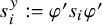 $s_i^y:=\varphi ' s_i \varphi '$
, for every
$s_i^y:=\varphi ' s_i \varphi '$
, for every $i\in {\mathbb N}_\Box $
.
$i\in {\mathbb N}_\Box $
.
Let $r\geq 0$
and set
$r\geq 0$
and set $\displaystyle {}^rc_p:= \sum _{i=0}^p c_{p-i}h^{-r}_i(X)$
. Define
$\displaystyle {}^rc_p:= \sum _{i=0}^p c_{p-i}h^{-r}_i(X)$
. Define ${}^rb_p := {}^rc_p$
for
${}^rb_p := {}^rc_p$
for $p<r$
,
$p<r$
, $\displaystyle {}^rb_p := \frac {1}{2}{}^rc_p$
for
$\displaystyle {}^rb_p := \frac {1}{2}{}^rc_p$
for $p>r$
, and set
$p>r$
, and set
 $$\begin{align*}{}^rb_r := \frac{1}{2}{}^rc_r + \frac{1}{2}e^r_r(X) \quad \text{and} \quad {}^r\widetilde{b}_r := \frac{1}{2}{}^rc_r - \frac{1}{2}e^r_r(X). \end{align*}$$
For $s\in \{0,1\}$
, let
$s\in \{0,1\}$
, let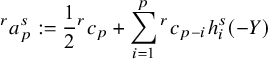 $\displaystyle {}^ra^s_p:=\frac {1}{2}{}^rc_p + \sum _{i=1}^p {}^rc_{p-i}h^s_i(-Y)$
, and define
$\displaystyle {}^ra^s_p:=\frac {1}{2}{}^rc_p + \sum _{i=1}^p {}^rc_{p-i}h^s_i(-Y)$
, and define
 $$\begin{align*}{}^rb^s_r:={}^rb_r + \sum_{i=1}^r {}^rc_{r-i}h^s_i(-Y), \quad \text{and} \quad {}^r\widetilde{b}^s_r:={}^r\widetilde{b}_r + \sum_{i=1}^r {}^rc_{r-i}h^s_i(-Y). \end{align*}$$
We have the following propositions, which are proved as in [Reference Tamvakis28, Section 2].
Proposition 1. Suppose that $p,q\in {\mathbb Z}$
and
$p,q\in {\mathbb Z}$
and $r,s\geq 1$
.
$r,s\geq 1$
.
(a) For all $i \geq 1$
, we have
$i \geq 1$
, we have
 $$\begin{align*}\partial^x_i ({}^rc_p^q)= \begin{cases} {}^{r-1}c_{p-1}^q & \text{if } r=\pm i, \\ 0 & \text{otherwise} \end{cases} \quad \ and \ \quad \partial^y_i ({}^rc_p^q)= \begin{cases} {}^rc_{p-1}^{q+1} & \text{if } q=\pm i, \\ 0 & \text{otherwise}. \end{cases} \end{align*}$$
We have
 $$\begin{align*}\partial^y_\Box \left({}^rc_p^q\right)= \begin{cases} {}^rc_{p-1}^2 & \text{if } q=1, \\ 2\left({}^rc_{p-1}^2\right) & \text{if } q=0, \\ 2\left({}^rc_{p-1}^1\right) -{}^rc_{p-1} & \text{if } q=-1, \\ 0 & \text{if } |q|\geq 2. \end{cases} \end{align*}$$
(b) For all $i\geq 1$
, we have
$i\geq 1$
, we have
 $$\begin{align*}\partial^y_i({}^rc_p^{-i}\,{}^sc_q^i) = {}^rc_{p-1}^{-i+1}\,{}^sc_q^{i+1} + {}^rc_p^{-i+1}\,{}^sc_{q-1}^{i+1}. \end{align*}$$
We also require certain variations of the above identities. Let $f_r$
be an indeterminate of degree r, which will equal
$f_r$
be an indeterminate of degree r, which will equal ${}^rb_r$
,
${}^rb_r$
, ${}^r\widetilde {b}_r$
, or
${}^r\widetilde {b}_r$
, or $\displaystyle \frac {1}{2}\,{}^rc_r$
in the sequel. We also let
$\displaystyle \frac {1}{2}\,{}^rc_r$
in the sequel. We also let $f_0 \in \{0,1\}$
. For any
$f_0 \in \{0,1\}$
. For any $p,s\in {\mathbb Z}$
, define
$p,s\in {\mathbb Z}$
, define ${}^r\widehat {c}_p^{\,s}$
by
${}^r\widehat {c}_p^{\,s}$
by
 $$\begin{align*}{}^r\widehat{c}_p^{\,s}:= {}^rc_p^s + \begin{cases} (2f_r-{}^rc_r)e^{p-r}_{p-r}(-Y) & \text{if } s = r - p < 0, \\ 0 & \text{otherwise}. \end{cases} \end{align*}$$
For $s\in \{0,1\}$
, define
$s\in \{0,1\}$
, define
 $$\begin{align*}f_r^s:= f_r+\sum_{j=1}^r {}^rc_{r-j}h_j^s(-Y), \end{align*}$$
set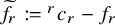 $\widetilde {f}_r:={}^rc_r-f_r$
and
$\widetilde {f}_r:={}^rc_r-f_r$
and $\widetilde {f}_r^s:={}^rc_r-2f_r+f_r^s$
.
$\widetilde {f}_r^s:={}^rc_r-2f_r+f_r^s$
.
Proposition 2. Suppose that $p\in {\mathbb Z}$
and
$p\in {\mathbb Z}$
and $p>r$
.
$p>r$
.
(a) For all $i \geq 1$
, we have
$i \geq 1$
, we have
 $$\begin{align*}\partial^x_i({}^r\widehat{c}_p^{\,r-p}) = \begin{cases} {}^{r-1}\widehat{c}_{p-1}^{\,r-p} & \text{if } i=p-r\geq 2, \\ 2\varphi'(f_r) & \text{if } i=p-r=1, \\ 0 & \text{otherwise} \end{cases} \end{align*}$$
and
 $$\begin{align*}\partial^y_i ({}^r\widehat{c}_p^{\,r-p})= \begin{cases} {}^r\widehat{c}_{p-1}^{\,r-p+1} & \text{if } i=p-r\geq 2, \\ 2f_r & \text{if } i=p-r= 1, \\ 0 & \text{otherwise}. \end{cases} \end{align*}$$
We have
 $$\begin{align*}\partial^y_\Box \left({}^r\widehat{c}_p^{\,r-p}\right)= \begin{cases} 2\widetilde{f}^1_r & \text{if } r-p=-1, \\ 0 & \text{if } r-p < -1. \end{cases} \end{align*}$$
(b) For all $i\geq 2$
, we have
$i\geq 2$
, we have
 $$\begin{align*}\partial^y_i({}^r\widehat{c}_p^{\,-i}\,{}^sc_q^i) = {}^r\widehat{c}_{p-1}^{\,-i+1}\,{}^sc_q^{i+1} + {}^r\widehat{c}_p^{\,-i+1}\,{}^sc_{q-1}^{i+1}. \end{align*}$$
Fix $r,s\geq 0$
, and define
$r,s\geq 0$
, and define ${\mathfrak c}_p:={}^rc^{-s}_p$
for each
${\mathfrak c}_p:={}^rc^{-s}_p$
for each $p\in {\mathbb Z}$
. For
$p\in {\mathbb Z}$
. For $p=r+s$
, set
$p=r+s$
, set ${\mathfrak d}_p:=e^r_r(X)e^s_s(-Y)$
. Then, in addition to the relations (7), we have the relations
${\mathfrak d}_p:=e^r_r(X)e^s_s(-Y)$
. Then, in addition to the relations (7), we have the relations
 $$ \begin{align} ({\mathfrak c}_p+{\mathfrak d}_p)({\mathfrak c}_p-{\mathfrak d}_p)+ 2\sum_{i=1}^p (-1)^i {\mathfrak c}_{p+i}{\mathfrak c}_{p-i}=0 \ \ \text{for} \ \, p = r+s \end{align} $$
in $\Gamma '[X,Y]$
.
$\Gamma '[X,Y]$
.
Following [Reference Ikeda, Mihalcea and Naruse13], the type D double Schubert polynomials ${\mathfrak D}_w$
for
${\mathfrak D}_w$
for $w\in \widetilde {W}_{\infty }$
are the unique family of elements of
$w\in \widetilde {W}_{\infty }$
are the unique family of elements of $\Gamma '[X,Y]$
satisfying the equations
$\Gamma '[X,Y]$
satisfying the equations
 $$ \begin{align} \partial_i^x{\mathfrak D}_w = \begin{cases} {\mathfrak D}_{ws_i} & \text{if } \ell(ws_i)<\ell(w), \\ 0 & \text{otherwise}, \end{cases} \quad \partial_i^y{\mathfrak D}_w = \begin{cases} {\mathfrak D}_{s_iw} & \text{if } \ell(s_iw)<\ell(w), \\ 0 & \text{otherwise}, \end{cases} \end{align} $$
for all $i\in {\mathbb N}_\Box $
, together with the condition that the constant term of
$i\in {\mathbb N}_\Box $
, together with the condition that the constant term of ${\mathfrak D}_w$
is
${\mathfrak D}_w$
is $1$
if
$1$
if $w=1$
, and
$w=1$
, and $0$
otherwise.
$0$
otherwise.
3. Raising operators
For each pair $i<j$
of distinct positive integers, the operator
$i<j$
of distinct positive integers, the operator $R_{ij}$
acts on integer sequences
$R_{ij}$
acts on integer sequences $\alpha =(\alpha _1,\alpha _2,\ldots )$
by
$\alpha =(\alpha _1,\alpha _2,\ldots )$
by
 $$\begin{align*}R_{ij}(\alpha):=(\alpha_1,\ldots,\alpha_i+1,\ldots,\alpha_j-1, \ldots). \end{align*}$$
A raising operator R is any monomial in these $R_{ij}$
’s.
$R_{ij}$
’s.
Following [Reference Buch, Kresch and Tamvakis7, Section 1.2], let $\Delta ^\circ := \{(i,j) \in {\mathbb Z} \times {\mathbb Z} \mid 1\leq i<j \}$
and define a partial order on
$\Delta ^\circ := \{(i,j) \in {\mathbb Z} \times {\mathbb Z} \mid 1\leq i<j \}$
and define a partial order on $\Delta ^\circ $
by agreeing that
$\Delta ^\circ $
by agreeing that $(i',j')\leq (i,j)$
if
$(i',j')\leq (i,j)$
if $i'\leq i$
and
$i'\leq i$
and $j'\leq j$
. We call a finite subset D of
$j'\leq j$
. We call a finite subset D of $\Delta ^\circ $
a valid set of pairs if it is an order ideal in
$\Delta ^\circ $
a valid set of pairs if it is an order ideal in $\Delta ^\circ $
. Any valid set of pairs D defines the raising operator expression
$\Delta ^\circ $
. Any valid set of pairs D defines the raising operator expression
 $$\begin{align*}R^D := \prod_{i<j}(1-R_{ij})\prod_{i<j\, :\, (i,j)\in D}(1+R_{ij})^{-1}. \end{align*}$$
We also use the raising operator expressions
 $$\begin{align*}R^{\emptyset}:=\prod_{i<j}(1-R_{ij}) \ \quad \mathrm{and} \ \quad R^{\infty}:= \prod_{i<j}\frac{1-R_{ij}}{1+R_{ij}}. \end{align*}$$
3.1. Alternating properties in types A–C
For each $r\geq 1$
, let
$r\geq 1$
, let ${\sigma }^r=({\sigma }^r_i)_{i\in {\mathbb Z}}$
be a sequence of variables, with
${\sigma }^r=({\sigma }^r_i)_{i\in {\mathbb Z}}$
be a sequence of variables, with ${\sigma }^r_0=1$
and
${\sigma }^r_0=1$
and ${\sigma }^r_i=0$
for each
${\sigma }^r_i=0$
for each $i<0$
, and let
$i<0$
, and let ${\mathbb Z}[{\sigma }]$
denote the polynomial ring in the variables
${\mathbb Z}[{\sigma }]$
denote the polynomial ring in the variables ${\sigma }^r_i$
for
${\sigma }^r_i$
for $i,r\geq 1$
. For any integer sequence
$i,r\geq 1$
. For any integer sequence $\alpha $
, let
$\alpha $
, let ${\sigma }_\alpha :={\sigma }^1_{\alpha _1}{\sigma }^2_{\alpha _2}\dots $
, and for any raising operator R, set
${\sigma }_\alpha :={\sigma }^1_{\alpha _1}{\sigma }^2_{\alpha _2}\dots $
, and for any raising operator R, set $R\, {\sigma }_\alpha :={\sigma }_{R\alpha }$
.
$R\, {\sigma }_\alpha :={\sigma }_{R\alpha }$
.
Fix $j\geq 1$
, let z be a variable, set
$j\geq 1$
, let z be a variable, set $\tau ^r:={\sigma }^r$
for each
$\tau ^r:={\sigma }^r$
for each $r\neq j$
and
$r\neq j$
and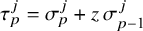 $\tau ^j_p = {\sigma }^j_p+z\,{\sigma }^j_{p-1}$
for each
$\tau ^j_p = {\sigma }^j_p+z\,{\sigma }^j_{p-1}$
for each $p\in {\mathbb Z}$
. If
$p\in {\mathbb Z}$
. If $\alpha :=(\alpha _1,\ldots ,\alpha _\ell )$
and
$\alpha :=(\alpha _1,\ldots ,\alpha _\ell )$
and $\alpha ':=(\alpha ^{\prime }_1,\ldots ,\alpha ^{\prime }_{\ell '})$
are two integer vectors and
$\alpha ':=(\alpha ^{\prime }_1,\ldots ,\alpha ^{\prime }_{\ell '})$
are two integer vectors and $r,s\in {\mathbb Z}$
, we let
$r,s\in {\mathbb Z}$
, we let $(\alpha ,r,s,\alpha ')$
denote the integer vector
$(\alpha ,r,s,\alpha ')$
denote the integer vector $(\alpha _1,\ldots ,\alpha _\ell ,r,s,\alpha ^{\prime }_1,\ldots ,\alpha ^{\prime }_{\ell '})$
. The following two lemmas are generalizations of [Reference Buch, Kresch and Tamvakis7, Lemmas 1.2 and 1.3].
$(\alpha _1,\ldots ,\alpha _\ell ,r,s,\alpha ^{\prime }_1,\ldots ,\alpha ^{\prime }_{\ell '})$
. The following two lemmas are generalizations of [Reference Buch, Kresch and Tamvakis7, Lemmas 1.2 and 1.3].
Lemma 5. Let $\lambda =(\lambda _1,\ldots ,\lambda _{j-1})$
and
$\lambda =(\lambda _1,\ldots ,\lambda _{j-1})$
and $\mu =(\mu _{j+2},\ldots ,\mu _\ell )$
be integer vectors, and D be a valid set of pairs. Assume that
$\mu =(\mu _{j+2},\ldots ,\mu _\ell )$
be integer vectors, and D be a valid set of pairs. Assume that ${\sigma }^j={\sigma }^{j+1}$
,
${\sigma }^j={\sigma }^{j+1}$
, $(j,j+1)\notin D$
, and that for each
$(j,j+1)\notin D$
, and that for each $h<j$
,
$h<j$
, $(h,j)\in D$
if and only if
$(h,j)\in D$
if and only if $(h,j+1)\in D$
.
$(h,j+1)\in D$
.
(a) For any integers r and s, we have
 $$\begin{align*}R^D\,{\sigma}_{\lambda,r,s,\mu} = - R^D\, {\sigma}_{\lambda,s-1,r+1,\mu} \end{align*}$$
in ${\mathbb Z}[{\sigma }]$
.
${\mathbb Z}[{\sigma }]$
.
(b) For any integer r, we have
 $$\begin{align*}R^D\,\tau_{\lambda,r,r,\mu} = R^D\, {\sigma}_{\lambda,r,r,\mu} \end{align*}$$
in ${\mathbb Z}[{\sigma },z]$
.
${\mathbb Z}[{\sigma },z]$
.
Proof. The proof of (a) is identical to that of [Reference Buch, Kresch and Tamvakis7, Lemma 1.2]. For part (b), we use linearity in the jth position to obtain $R\,\tau _{\lambda ,r,r,\mu } =R\, {\sigma }_{\lambda ,r,r,\mu } + z\,R\, {\sigma }_{\lambda ,r-1,r,\mu }$
, for any raising operator R that appears in the expansion of the power series
$R\,\tau _{\lambda ,r,r,\mu } =R\, {\sigma }_{\lambda ,r,r,\mu } + z\,R\, {\sigma }_{\lambda ,r-1,r,\mu }$
, for any raising operator R that appears in the expansion of the power series $R^D$
. Adding these equations gives
$R^D$
. Adding these equations gives
 $$\begin{align*}R^D\,\tau_{\lambda,r,r,\mu} = R^D\, {\sigma}_{\lambda,r,r,\mu} + z\,R^D\, {\sigma}_{\lambda,r-1,r,\mu}. \end{align*}$$
Now, part (a) implies that $R^D\, {\sigma }_{\lambda ,r-1,r,\mu }=0$
.
$R^D\, {\sigma }_{\lambda ,r-1,r,\mu }=0$
.
Fix $k\geq 0$
, let
$k\geq 0$
, let ${\mathfrak c}=({\mathfrak c}_i)_{i\in {\mathbb Z}}$
be another sequence of variables, and consider the relations
${\mathfrak c}=({\mathfrak c}_i)_{i\in {\mathbb Z}}$
be another sequence of variables, and consider the relations
 $$ \begin{align} {\mathfrak c}_p{\mathfrak c}_p+2\sum_{i=1}^p (-1)^i {\mathfrak c}_{p+i}{\mathfrak c}_{p-i}=0 \ \ \text{for all} \ \, p> k. \end{align} $$
Lemma 6. Let $\lambda =(\lambda _1,\ldots ,\lambda _{j-1})$
and
$\lambda =(\lambda _1,\ldots ,\lambda _{j-1})$
and $\mu =(\mu _{j+2},\ldots ,\mu _\ell )$
be integer vectors, and D be a valid set of pairs. Assume that
$\mu =(\mu _{j+2},\ldots ,\mu _\ell )$
be integer vectors, and D be a valid set of pairs. Assume that ${\sigma }^j={\sigma }^{j+1}={\mathfrak c}$
,
${\sigma }^j={\sigma }^{j+1}={\mathfrak c}$
, $(j,j+1)\in D$
, and that for each
$(j,j+1)\in D$
, and that for each $h>j+1$
,
$h>j+1$
, $(j,h)\in D$
if and only if
$(j,h)\in D$
if and only if $(j+1,h)\in D$
.
$(j+1,h)\in D$
.
(a) If $r,s\in {\mathbb Z}$
are such that
$r,s\in {\mathbb Z}$
are such that $r+s> 2k$
, then we have
$r+s> 2k$
, then we have
 $$\begin{align*}R^D\,{\sigma}_{\lambda,r,s,\mu} = - R^D\,{\sigma}_{\lambda,s,r,\mu} \end{align*}$$
in the ring ${\mathbb Z}[{\sigma }]$
modulo the relations coming from (12).
${\mathbb Z}[{\sigma }]$
modulo the relations coming from (12).
(b) For any integer $r>k$
, we have
$r>k$
, we have
 $$\begin{align*}R^D\,\tau_{\lambda,r+1,r,\mu} = R^D\, {\sigma}_{\lambda,r+1,r,\mu} \end{align*}$$
in the ring ${\mathbb Z}[{\sigma },z]$
modulo the relations coming from (12).
${\mathbb Z}[{\sigma },z]$
modulo the relations coming from (12).
Proof. The proof of (a) is identical to that of [Reference Buch, Kresch and Tamvakis7, Lemma 1.3]. For part (b), we expand $R^D\,\tau _{\lambda ,r+1,r,\mu }$
and use linearity in the jth position to obtain
$R^D\,\tau _{\lambda ,r+1,r,\mu }$
and use linearity in the jth position to obtain
 $$\begin{align*}R^D\,\tau_{\lambda,r+1,r,\mu} = R^D\, {\sigma}_{\lambda,r+1,r,\mu} + z\,R^D\, {\sigma}_{\lambda,r,r,\mu}. \end{align*}$$
Now, part (a) implies that $R^D\, {\sigma }_{\lambda ,r,r,\mu }$
vanishes modulo the relations (12).
$R^D\, {\sigma }_{\lambda ,r,r,\mu }$
vanishes modulo the relations (12).
3.2. Alternating properties in type D
In type D, we will require certain variations of Lemmas 5 and 6. For each $r\geq 1$
, we introduce a new sequence of variables
$r\geq 1$
, we introduce a new sequence of variables ${\upsilon }^r=({\upsilon }^r_i)_{i\in {\mathbb Z}}$
such that
${\upsilon }^r=({\upsilon }^r_i)_{i\in {\mathbb Z}}$
such that ${\upsilon }^r_i=0$
for each
${\upsilon }^r_i=0$
for each $i\leq 0$
. Let
$i\leq 0$
. Let ${\mathbb Z}[{\sigma }, {\upsilon }]$
denote the polynomial ring in the variables
${\mathbb Z}[{\sigma }, {\upsilon }]$
denote the polynomial ring in the variables ${\sigma }^r_i$
,
${\sigma }^r_i$
, ${\upsilon }^r_i$
for
${\upsilon }^r_i$
for $i,r\geq 1$
. For each
$i,r\geq 1$
. For each $r\geq 1$
, define the sequence
$r\geq 1$
, define the sequence $\widehat {{\sigma }}^r$
by
$\widehat {{\sigma }}^r$
by $\widehat {{\sigma }}^r_i:={\sigma }^r_i+(-1)^r{\upsilon }^r_i$
for each i, and for any integer sequence
$\widehat {{\sigma }}^r_i:={\sigma }^r_i+(-1)^r{\upsilon }^r_i$
for each i, and for any integer sequence $\alpha $
, let
$\alpha $
, let $\widehat {{\sigma }}_\alpha :=\widehat {{\sigma }}^1_{\alpha _1}\widehat {{\sigma }}^2_{\alpha _2}\dots $
.
$\widehat {{\sigma }}_\alpha :=\widehat {{\sigma }}^1_{\alpha _1}\widehat {{\sigma }}^2_{\alpha _2}\dots $
.
Fix an integer $d\geq 0$
such that
$d\geq 0$
such that ${\upsilon }^r_i=0$
for all i whenever
${\upsilon }^r_i=0$
for all i whenever $r>d$
. If
$r>d$
. If $R:=\prod _{i<j} R_{ij}^{n_{ij}}$
is a raising operator, denote by
$R:=\prod _{i<j} R_{ij}^{n_{ij}}$
is a raising operator, denote by ${\mathrm {supp}}_d(R)$
the set of all indices i and j such that
${\mathrm {supp}}_d(R)$
the set of all indices i and j such that $n_{ij}>0$
and
$n_{ij}>0$
and $j \leq d$
. Let D be a valid set of pairs and R be any raising operator appearing in the expansion of the power series
$j \leq d$
. Let D be a valid set of pairs and R be any raising operator appearing in the expansion of the power series $R^D$
. Let
$R^D$
. Let $\lambda =(\lambda _1,\ldots ,\lambda _\ell )$
be any integer vector and set
$\lambda =(\lambda _1,\ldots ,\lambda _\ell )$
be any integer vector and set $\rho :=R\lambda $
. Define
$\rho :=R\lambda $
. Define
 $$\begin{align*}R \star \widehat{{\sigma}}_{\lambda} = \overline{{\sigma}}_{\rho} := \overline{{\sigma}}^1_{\rho_1}\dots \overline{{\sigma}}^{\ell}_{\rho_\ell} \end{align*}$$
where, for each $i\geq 1$
and
$i\geq 1$
and $p\in {\mathbb Z}$
,
$p\in {\mathbb Z}$
,
 $$\begin{align*}\overline{{\sigma}}^i_p:= \begin{cases} {\sigma}^i_p & \text{if } i\in{\mathrm{supp}}_d(R), \\ \widehat{{\sigma}}^i_p & \text{otherwise}. \end{cases} \end{align*}$$
Fix $j\geq 1$
, set
$j\geq 1$
, set $\widehat {\tau }^i:=\widehat {{\sigma }}^i$
for each
$\widehat {\tau }^i:=\widehat {{\sigma }}^i$
for each $i\neq j$
and
$i\neq j$
and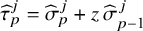 $\widehat {\tau }^j_p = \widehat {{\sigma }}^j_p+z\,\widehat {{\sigma }}^j_{p-1}$
for each
$\widehat {\tau }^j_p = \widehat {{\sigma }}^j_p+z\,\widehat {{\sigma }}^j_{p-1}$
for each $p\in {\mathbb Z}$
.
$p\in {\mathbb Z}$
.
Lemma 7. Let $\lambda =(\lambda _1,\ldots ,\lambda _{j-1})$
and
$\lambda =(\lambda _1,\ldots ,\lambda _{j-1})$
and $\mu =(\mu _{j+2},\ldots ,\mu _\ell )$
be integer vectors, and D be a valid set of pairs. Assume that
$\mu =(\mu _{j+2},\ldots ,\mu _\ell )$
be integer vectors, and D be a valid set of pairs. Assume that $j>d$
,
$j>d$
, ${\sigma }^j={\sigma }^{j+1}$
,
${\sigma }^j={\sigma }^{j+1}$
, $(j,j+1)\notin D$
, and that for each
$(j,j+1)\notin D$
, and that for each $h<j$
,
$h<j$
, $(h,j)\in D$
if and only if
$(h,j)\in D$
if and only if $(h,j+1)\in D$
.
$(h,j+1)\in D$
.
(a) For any integers r and s, we have
 $$\begin{align*}R^D\star\widehat{{\sigma}}_{\lambda,r,s,\mu} = - R^D\star \widehat{{\sigma}}_{\lambda,s-1,r+1,\mu} \end{align*}$$
in ${\mathbb Z}[{\sigma },{\upsilon }]$
.
${\mathbb Z}[{\sigma },{\upsilon }]$
.
(b) For any integer r, we have
 $$\begin{align*}R^D\star\widehat{\tau}_{\lambda,r,r,\mu} = R^D\star \widehat{{\sigma}}_{\lambda,r,r,\mu} \end{align*}$$
in ${\mathbb Z}[{\sigma },{\upsilon },z]$
.
${\mathbb Z}[{\sigma },{\upsilon },z]$
.
Proof. Since $j>d$
, the argument used in the proof of [Reference Buch, Kresch and Tamvakis7, Lemma 1.2] works here as well to establish part (a). Part (b) is an easy consequence of (a).
$j>d$
, the argument used in the proof of [Reference Buch, Kresch and Tamvakis7, Lemma 1.2] works here as well to establish part (a). Part (b) is an easy consequence of (a).
Fix $k\geq 0$
, let
$k\geq 0$
, let ${\mathfrak c}=({\mathfrak c}_i)_{i\in {\mathbb Z}}$
and
${\mathfrak c}=({\mathfrak c}_i)_{i\in {\mathbb Z}}$
and ${\mathfrak d}=({\mathfrak d}_i)_{i\in {\mathbb Z}}$
be two other sequences of variables such that
${\mathfrak d}=({\mathfrak d}_i)_{i\in {\mathbb Z}}$
be two other sequences of variables such that ${\mathfrak d}_p=0$
for all
${\mathfrak d}_p=0$
for all $p>k+1$
, and consider the relations
$p>k+1$
, and consider the relations
 $$ \begin{align} ({\mathfrak c}_p+{\mathfrak d}_p)({\mathfrak c}_p-{\mathfrak d}_p)+ 2\sum_{i=1}^p (-1)^i {\mathfrak c}_{p+i}{\mathfrak c}_{p-i}=0 \ \ \text{for all} \ \, p> k. \end{align} $$
Lemma 8. Let $\lambda =(\lambda _1,\ldots ,\lambda _{j-1})$
and
$\lambda =(\lambda _1,\ldots ,\lambda _{j-1})$
and $\mu =(\mu _{j+2},\ldots ,\mu _\ell )$
be integer vectors, and D be a valid set of pairs. Assume that
$\mu =(\mu _{j+2},\ldots ,\mu _\ell )$
be integer vectors, and D be a valid set of pairs. Assume that $j<d$
,
$j<d$
, ${\sigma }^j={\sigma }^{j+1}={\mathfrak c}$
,
${\sigma }^j={\sigma }^{j+1}={\mathfrak c}$
, ${\upsilon }^j={\upsilon }^{j+1}={\mathfrak d}$
,
${\upsilon }^j={\upsilon }^{j+1}={\mathfrak d}$
, $(j,j+1)\in D$
, and that for each
$(j,j+1)\in D$
, and that for each $h>j+1$
,
$h>j+1$
, $(j,h)\in D$
if and only if
$(j,h)\in D$
if and only if $(j+1,h)\in D$
.
$(j+1,h)\in D$
.
(a) If $r,s\in {\mathbb Z}$
are such that
$r,s\in {\mathbb Z}$
are such that $r+s> 2k+2$
, then we have
$r+s> 2k+2$
, then we have
 $$ \begin{align} R^D\star\widehat{{\sigma}}_{\lambda,r,s,\mu} = - R^D\star\widehat{{\sigma}}_{\lambda,s,r,\mu} \end{align} $$
and
 $$ \begin{align} R^D\star\widehat{{\sigma}}_{\lambda,k+1,k+1,\mu} = 0 \end{align} $$
in the ring ${\mathbb Z}[{\sigma },{\upsilon }]$
modulo the relations coming from (13).
${\mathbb Z}[{\sigma },{\upsilon }]$
modulo the relations coming from (13).
(b) For any integer $r>k$
, we have
$r>k$
, we have
 $$\begin{align*}R^D\star\widehat{\tau}_{\lambda,r+1,r,\mu} = R^D\star \widehat{{\sigma}}_{\lambda,r+1,r,\mu} \end{align*}$$
in the ring ${\mathbb Z}[{\sigma },{\upsilon },z]$
modulo the relations coming from (13).
${\mathbb Z}[{\sigma },{\upsilon },z]$
modulo the relations coming from (13).
Proof. The proof of (14) is identical to that of [Reference Buch, Kresch and Tamvakis7, Lemma 1.3]. The proof of (15) follows the same argument, using (14) and induction to reduce to the case when $\mu $
is empty. For any integer vector
$\mu $
is empty. For any integer vector $\rho $
with at most d components, define
$\rho $
with at most d components, define $T_\rho :=R^D \star \widehat {{\sigma }}_{\rho }$
. If g is the least integer such that
$T_\rho :=R^D \star \widehat {{\sigma }}_{\rho }$
. If g is the least integer such that $2g\geq \ell $
and
$2g\geq \ell $
and $\rho := (\lambda ,r,s)$
, then we have the relation
$\rho := (\lambda ,r,s)$
, then we have the relation
 $$\begin{align*}T_\rho = \sum_{j=2}^{2g} (-1)^j T_{\rho_1,\rho_j} T_{\rho_2,\ldots,\widehat{\rho}_j,\ldots,\rho_{2g}}. \end{align*}$$
The proof is now completed by induction, as in [Reference Buch, Kresch and Tamvakis7, Lemma 1.3]. For part (b), we expand $R^D\star \widehat {\tau }_{\lambda ,r+1,r,\mu }$
and use linearity in the jth position to obtain
$R^D\star \widehat {\tau }_{\lambda ,r+1,r,\mu }$
and use linearity in the jth position to obtain
 $$\begin{align*}R^D\star\widehat{\tau}_{\lambda,r+1,r,\mu} = R^D\star \widehat{{\sigma}}_{\lambda,r+1,r,\mu} + z\,R^D\, \widehat{{\sigma}}_{\lambda,r,r,\mu}. \end{align*}$$
Now, part (a) implies that $R^D\star \widehat {{\sigma }}_{\lambda ,r,r,\mu }$
vanishes modulo the relations (13).
$R^D\star \widehat {{\sigma }}_{\lambda ,r,r,\mu }$
vanishes modulo the relations (13).
4. Amenable elements: Type A theory
4.1. Definitions and main theorem
As Lie theorists know well, type A is very special when compared to the other Lie types. In the theory of amenable elements, this manifests itself in the fact that we can work with dominant elements instead of leading elements. The result is the simplified treatment given here, which does not have a direct analog in types B–D. Another difference in type A is that the order of application of the divided difference operators is switched: we first use the left divided differences, then the right ones. But by far the main distinction between type A and the other classical types is that one can use Jacobi–Trudi determinants, represented here by $R^{\emptyset }$
, instead of the more general raising operator expressions
$R^{\emptyset }$
, instead of the more general raising operator expressions $R^D$
that define theta and eta polynomials, which are essential ingredients of the theory for the symplectic and orthogonal groups.
$R^D$
that define theta and eta polynomials, which are essential ingredients of the theory for the symplectic and orthogonal groups.
If ${\varpi }\in S_n$
and
${\varpi }\in S_n$
and $v\in S_m$
, then
$v\in S_m$
, then ${\varpi }$
is called v-avoiding if
${\varpi }$
is called v-avoiding if ${\varpi }$
does not contain a subword
${\varpi }$
does not contain a subword $({\varpi }_{i_1},\ldots , {\varpi }_{i_m})$
having the same relative order as
$({\varpi }_{i_1},\ldots , {\varpi }_{i_m})$
having the same relative order as $(v_1,\ldots ,v_m)$
. The notion of v-avoidance also makes sense when
$(v_1,\ldots ,v_m)$
. The notion of v-avoidance also makes sense when ${\varpi }$
is any integer vector
${\varpi }$
is any integer vector $({\varpi }_1,\ldots ,{\varpi }_n)$
with distinct components
$({\varpi }_1,\ldots ,{\varpi }_n)$
with distinct components ${\varpi }_i$
. We say that
${\varpi }_i$
. We say that ${\varpi }$
is dominant if its code
${\varpi }$
is dominant if its code $\gamma ({\varpi })$
is a partition, or equivalently, if
$\gamma ({\varpi })$
is a partition, or equivalently, if ${\varpi }$
is
${\varpi }$
is $132$
-avoiding (see [Reference Macdonald20, Proposition 1.30] and [Reference Reifegerste22, Theorem 2.2]).
$132$
-avoiding (see [Reference Macdonald20, Proposition 1.30] and [Reference Reifegerste22, Theorem 2.2]).
For the next result, we refer to [Reference Knuth15, Exercise 2.2.1.5] and [Reference Stump24, Section 2.2].
Lemma 9. The following conditions on a permutation ${\omega } \in S_n$
are equivalent:
${\omega } \in S_n$
are equivalent:
(a) ${\omega }$
is
${\omega }$
is $312$
-avoiding; (b)
$312$
-avoiding; (b) ${\omega }^{-1}$
is
${\omega }^{-1}$
is $231$
-avoiding;
$231$
-avoiding;
(c) ${\omega }$
has a reduced decomposition of the form
${\omega }$
has a reduced decomposition of the form $R_1\dots R_{n-1}$
, where each
$R_1\dots R_{n-1}$
, where each $R_j$
is a (possibly empty) subword of
$R_j$
is a (possibly empty) subword of $s_1\dots s_{n-1}$
and furthermore all simple reflections in
$s_1\dots s_{n-1}$
and furthermore all simple reflections in $R_p$
are also contained in
$R_p$
are also contained in $R_{p+1}$
, for each
$R_{p+1}$
, for each $p<n-1$
.
$p<n-1$
.
Definition 4. A (right) modification of ${\varpi }\in S_n$
is a permutation
${\varpi }\in S_n$
is a permutation ${\varpi } {\omega }$
, where
${\varpi } {\omega }$
, where ${\omega }\in S_n$
is such that
${\omega }\in S_n$
is such that $\ell ({\varpi } {\omega })=\ell ({\varpi })-\ell ({\omega })$
, and
$\ell ({\varpi } {\omega })=\ell ({\varpi })-\ell ({\omega })$
, and ${\omega }$
is
${\omega }$
is $231$
-avoiding. A permutation is amenable if it is a modification of a dominant permutation.
$231$
-avoiding. A permutation is amenable if it is a modification of a dominant permutation.
For any three integer vectors $\alpha ,\beta ,\rho \in {\mathbb Z}^\ell $
, which we view as integer sequences with finite support, define
$\alpha ,\beta ,\rho \in {\mathbb Z}^\ell $
, which we view as integer sequences with finite support, define ${}^{\rho }h^\beta _\alpha :={}^{\rho _1}h^{\beta _1}_{\alpha _1}\,{}^{\rho _2}h^{\beta _2}_{\alpha _2}\dots $
. Given any raising operator
${}^{\rho }h^\beta _\alpha :={}^{\rho _1}h^{\beta _1}_{\alpha _1}\,{}^{\rho _2}h^{\beta _2}_{\alpha _2}\dots $
. Given any raising operator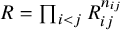 $R=\prod _{i<j}R_{ij}^{n_{ij}}$
, let
$R=\prod _{i<j}R_{ij}^{n_{ij}}$
, let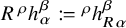 $R\, {}^{\rho }h^\beta _{\alpha } := {}^{\rho }h^\beta _{R\alpha }$
.
$R\, {}^{\rho }h^\beta _{\alpha } := {}^{\rho }h^\beta _{R\alpha }$
.
Proposition 3 [Reference Macdonald20, Proposition 6.14]
Suppose that ${\varpi }\in S_n$
is dominant. Then, we have
${\varpi }\in S_n$
is dominant. Then, we have
 $$\begin{align*}{\mathfrak S}_{\varpi} = R^{\emptyset} \, {}^{\delta^\vee_{n-1}}h^{\lambda({\varpi})}_{\lambda({\varpi})}. \end{align*}$$
Proof. We use descending induction on $\ell ({\varpi })$
. Let
$\ell ({\varpi })$
. Let ${\varpi }_0:=(n,\ldots ,1)$
denote the longest element in
${\varpi }_0:=(n,\ldots ,1)$
denote the longest element in $S_n$
. One knows from [Reference Lascoux17] and [Reference Macdonald20, Proposition 3.5] that the equation
$S_n$
. One knows from [Reference Lascoux17] and [Reference Macdonald20, Proposition 3.5] that the equation
 $$\begin{align*}{\mathfrak S}_{{\varpi}_0} = R^{\emptyset}\, {}^{\delta^\vee_{n-1}}h_{\delta_{n-1}}^{\delta_{n-1}} \end{align*}$$
holds in ${\mathbb Z}[X,Y]$
, so the result is true when
${\mathbb Z}[X,Y]$
, so the result is true when ${\varpi }={\varpi }_0$
.
${\varpi }={\varpi }_0$
.
Suppose that ${\varpi }\neq {\varpi }_0$
and
${\varpi }\neq {\varpi }_0$
and ${\varpi }$
is dominant of shape
${\varpi }$
is dominant of shape $\lambda $
. Then,
$\lambda $
. Then, $\lambda \subset \delta _{n-1}$
and
$\lambda \subset \delta _{n-1}$
and $\lambda \neq \delta _{n-1}$
. Let
$\lambda \neq \delta _{n-1}$
. Let $r\geq 1$
be the largest integer such that
$r\geq 1$
be the largest integer such that $\lambda _i=n-i$
for
$\lambda _i=n-i$
for $i\in [1,r]$
, and let
$i\in [1,r]$
, and let $j:=\lambda _{r+1}+1={\varpi }_{r+1}\leq n-r-1$
. Then,
$j:=\lambda _{r+1}+1={\varpi }_{r+1}\leq n-r-1$
. Then, $s_j{\varpi }$
is dominant of length
$s_j{\varpi }$
is dominant of length $\ell ({\varpi })+1$
and
$\ell ({\varpi })+1$
and $\lambda (s_j{\varpi })=\lambda ({\varpi })+\epsilon _{r+1}$
. Using Lemma 1 and the left Leibnitz rule, we deduce that for any integer sequence
$\lambda (s_j{\varpi })=\lambda ({\varpi })+\epsilon _{r+1}$
. Using Lemma 1 and the left Leibnitz rule, we deduce that for any integer sequence $\alpha =(\alpha _1,\ldots ,\alpha _n)$
, we have
$\alpha =(\alpha _1,\ldots ,\alpha _n)$
, we have
 $$\begin{align*}\partial^y_j\left({}^{\delta^\vee_{n-1}}h^{\lambda(s_j{\varpi})}_{\alpha}\right) = {}^{\delta^\vee_{n-1}}h^{\lambda({\varpi})}_{\alpha-\epsilon_{r+1}}. \end{align*}$$
We conclude that
 $$\begin{align*}{\mathfrak S}_{\varpi} = \partial^y_j({\mathfrak S}_{s_j{\varpi}}) = \partial^y_j\left(R^{\emptyset} \, {}^{\delta^\vee_{n-1}}h^{\lambda(s_j{\varpi})}_{\lambda(s_j{\varpi})}\right)= R^{\emptyset} \, {}^{\delta^\vee_{n-1}}h^{\lambda({\varpi})}_{\lambda({\varpi})}. \end{align*}$$
Definition 5. Let ${\varpi }$
be an amenable permutation with code
${\varpi }$
be an amenable permutation with code $\gamma $
and shape
$\gamma $
and shape $\lambda $
, with
$\lambda $
, with $\ell =\ell (\lambda )$
. Define two sequences
$\ell =\ell (\lambda )$
. Define two sequences ${\mathfrak f}={\mathfrak f}({\varpi })$
and
${\mathfrak f}={\mathfrak f}({\varpi })$
and ${\mathfrak g}={\mathfrak g}({\varpi })$
of length
${\mathfrak g}={\mathfrak g}({\varpi })$
of length $\ell $
as follows. For
$\ell $
as follows. For $1\leq j \leq \ell $
, set
$1\leq j \leq \ell $
, set
 $$\begin{align*}{\mathfrak f}_j:=\max(i\ |\ \gamma_i\geq \lambda_j) \end{align*}$$
and let
 $$\begin{align*}{\mathfrak g}_j:={\mathfrak f}_{\mathfrak q}+\lambda_{\mathfrak q}-{\mathfrak q}, \end{align*}$$
where ${\mathfrak q}$
is the least integer such that
${\mathfrak q}$
is the least integer such that ${\mathfrak q}\geq j$
and
${\mathfrak q}\geq j$
and $\lambda _{\mathfrak q}>\lambda _{{\mathfrak q}+1}$
. We call
$\lambda _{\mathfrak q}>\lambda _{{\mathfrak q}+1}$
. We call ${\mathfrak f}$
the right flag of
${\mathfrak f}$
the right flag of ${\varpi }$
, and
${\varpi }$
, and ${\mathfrak g}$
the left flag of
${\mathfrak g}$
the left flag of ${\varpi }$
.
${\varpi }$
.
It is clear from Lemma 2 that the right flag ${\mathfrak f}$
of an amenable permutation is a weakly increasing sequence consisting of right descents of
${\mathfrak f}$
of an amenable permutation is a weakly increasing sequence consisting of right descents of ${\varpi }$
. We will show that the left flag
${\varpi }$
. We will show that the left flag ${\mathfrak g}$
is a weakly decreasing sequence consisting of left descents of
${\mathfrak g}$
is a weakly decreasing sequence consisting of left descents of ${\varpi }$
.
${\varpi }$
.
Proposition 4. Suppose that $\widehat {{\varpi }}\in S_n$
is dominant with
$\widehat {{\varpi }}\in S_n$
is dominant with $\widehat {\lambda }:=\lambda (\widehat {{\varpi }})$
. Let
$\widehat {\lambda }:=\lambda (\widehat {{\varpi }})$
. Let ${\omega }$
be a
${\omega }$
be a $231$
-avoiding permutation such that
$231$
-avoiding permutation such that $\ell (\widehat {{\varpi }}{\omega })=\ell (\widehat {{\varpi }})-\ell ({\omega })$
, and set
$\ell (\widehat {{\varpi }}{\omega })=\ell (\widehat {{\varpi }})-\ell ({\omega })$
, and set ${\varpi }:=\widehat {{\varpi }} {\omega }$
,
${\varpi }:=\widehat {{\varpi }} {\omega }$
, $\gamma :=\gamma ({\varpi })$
, and
$\gamma :=\gamma ({\varpi })$
, and $\lambda :=\lambda ({\varpi })$
. Then, the sequence
$\lambda :=\lambda ({\varpi })$
. Then, the sequence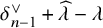 $\delta ^\vee _{n-1}+\widehat {\lambda }-\lambda $
is weakly increasing, and
$\delta ^\vee _{n-1}+\widehat {\lambda }-\lambda $
is weakly increasing, and
 $$\begin{align*}{\mathfrak S}_{\varpi} = R^{\emptyset} \, {}^{\delta^\vee_{n-1}+\widehat{\lambda}-\lambda}h_{\lambda}^{\widehat{\lambda}}. \end{align*}$$
Moreover, if $\lambda _{\mathfrak q}>\lambda _{{\mathfrak q}+1}$
, then
$\lambda _{\mathfrak q}>\lambda _{{\mathfrak q}+1}$
, then $\widehat {\lambda }_{\mathfrak q}$
is a left descent of
$\widehat {\lambda }_{\mathfrak q}$
is a left descent of ${\varpi }$
,
${\varpi }$
, ${\mathfrak q}+\widehat {\lambda }_{\mathfrak q}-\lambda _{\mathfrak q}$
is a right descent of
${\mathfrak q}+\widehat {\lambda }_{\mathfrak q}-\lambda _{\mathfrak q}$
is a right descent of ${\varpi }$
, and we have
${\varpi }$
, and we have ${\mathfrak q}+\widehat {\lambda }_{\mathfrak q}-\lambda _{\mathfrak q}= \max (i\ |\ \gamma _i\geq \lambda _{\mathfrak q})$
.
${\mathfrak q}+\widehat {\lambda }_{\mathfrak q}-\lambda _{\mathfrak q}= \max (i\ |\ \gamma _i\geq \lambda _{\mathfrak q})$
.
Proof. Suppose that $\widehat {{\varpi }}$
is of shape
$\widehat {{\varpi }}$
is of shape $\widehat {\lambda } = \widehat {\gamma } = (p_1^{n_1},p_2^{n_2}\ldots ,p_t^{n_t})$
, where
$\widehat {\lambda } = \widehat {\gamma } = (p_1^{n_1},p_2^{n_2}\ldots ,p_t^{n_t})$
, where $p_1>\cdots > p_t$
. Then, the right descents of
$p_1>\cdots > p_t$
. Then, the right descents of $\widehat {{\varpi }}$
are at positions
$\widehat {{\varpi }}$
are at positions $d_1:=n_1, d_2:=n_1+n_2, \ldots , d_t:= n_1+\cdots +n_t$
. Since we have
$d_1:=n_1, d_2:=n_1+n_2, \ldots , d_t:= n_1+\cdots +n_t$
. Since we have $\widehat {{\varpi }}_j<\widehat {{\varpi }}_{j+1}$
for all
$\widehat {{\varpi }}_j<\widehat {{\varpi }}_{j+1}$
for all $j\neq d_r$
for
$j\neq d_r$
for $r\in [1,t]$
, we deduce that
$r\in [1,t]$
, we deduce that
 $$\begin{align*}\widehat{{\varpi}}_1 = p_1+1, \widehat{{\varpi}}_{d_1+1}=p_2+1,\ldots, \widehat{{\varpi}}_{d_{t-1}+1}=p_t+1, \widehat{{\varpi}}_{d_t+1}=1. \end{align*}$$
Moreover, since $\widehat {{\varpi }}$
is
$\widehat {{\varpi }}$
is $132$
-avoiding, it follows that the left descents of
$132$
-avoiding, it follows that the left descents of $\widehat {{\varpi }}$
are
$\widehat {{\varpi }}$
are $p_1,\ldots ,p_t$
. Finally, Proposition 3 gives
$p_1,\ldots ,p_t$
. Finally, Proposition 3 gives
 $$ \begin{align} {\mathfrak S}_{\widehat{{\varpi}}} = R^{\emptyset} \, {}^{\delta^\vee_{n-1}}h^{\widehat{\lambda}}_{\widehat{\lambda}} \end{align} $$
so the result holds when ${\omega }=1$
and
${\omega }=1$
and ${\varpi }=\widehat {{\varpi }}$
is dominant.
${\varpi }=\widehat {{\varpi }}$
is dominant.
Suppose next that ${\varpi }:=\widehat {{\varpi }} {\omega }$
for some
${\varpi }:=\widehat {{\varpi }} {\omega }$
for some $231$
-avoiding permutation
$231$
-avoiding permutation ${\omega }$
such that
${\omega }$
such that $\ell (\widehat {{\varpi }}{\omega })=\ell (\widehat {{\varpi }})-\ell ({\omega })$
. Lemma 9 implies that
$\ell (\widehat {{\varpi }}{\omega })=\ell (\widehat {{\varpi }})-\ell ({\omega })$
. Lemma 9 implies that ${\omega }$
has a reduced decomposition of the form
${\omega }$
has a reduced decomposition of the form $R_1\dots R_{n-1}$
, where each
$R_1\dots R_{n-1}$
, where each $R_j$
is a (possibly empty) subword of
$R_j$
is a (possibly empty) subword of $s_{n-1}\dots s_1$
and all simple reflections in
$s_{n-1}\dots s_1$
and all simple reflections in $R_{p+1}$
are also contained in
$R_{p+1}$
are also contained in $R_p$
, for every
$R_p$
, for every $p\geq 1$
. Now repeated application of (4), Lemma 1, and the right Leibnitz rule (6) in equation (16) give
$p\geq 1$
. Now repeated application of (4), Lemma 1, and the right Leibnitz rule (6) in equation (16) give
 $$\begin{align*}{\mathfrak S}_{\varpi}= \partial^x_{{\omega}^{-1}}({\mathfrak S}_{\widehat{{\varpi}}}) = R^{\emptyset} \, {}^{\delta_{n-1}^{\vee} +\widehat{\lambda}-\lambda}h^{\widehat{\lambda}}_{\lambda}. \end{align*}$$
We will show that the sequence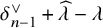 $\delta ^\vee _{n-1}+\widehat {\lambda }-\lambda $
is weakly increasing and verifies the last assertion, about the left and right descents of
$\delta ^\vee _{n-1}+\widehat {\lambda }-\lambda $
is weakly increasing and verifies the last assertion, about the left and right descents of ${\varpi }$
.
${\varpi }$
.
Using Lemma 2, we study the right action of the successive simple transpositions in the reduced decomposition $R_1\dots R_{n-1}$
for
$R_1\dots R_{n-1}$
for ${\omega }$
on the code
${\omega }$
on the code $\widehat {\gamma }$
of
$\widehat {\gamma }$
of $\widehat {{\varpi }}$
. The action of these on
$\widehat {{\varpi }}$
. The action of these on $\widehat {\gamma }$
is by a finite sequence of moves
$\widehat {\gamma }$
is by a finite sequence of moves $\alpha \mapsto \alpha '$
, where
$\alpha \mapsto \alpha '$
, where $\alpha :=\gamma (v)$
and
$\alpha :=\gamma (v)$
and $\alpha ':=\gamma (v')$
for some
$\alpha ':=\gamma (v')$
for some $v,v'\in S_n$
. Here,
$v,v'\in S_n$
. Here, $v'=vs_{j-1}\dots s_i$
for some
$v'=vs_{j-1}\dots s_i$
for some $i<j$
such that
$i<j$
such that $\ell (v')=\ell (v)-j+i$
, and
$\ell (v')=\ell (v)-j+i$
, and $s_{j-1}\dots s_i$
is a subword of some
$s_{j-1}\dots s_i$
is a subword of some $R_p$
with
$R_p$
with $j-i$
maximal. Since the initial code
$j-i$
maximal. Since the initial code $\widehat {\gamma }$
is weakly decreasing, we have
$\widehat {\gamma }$
is weakly decreasing, we have $\alpha _i\geq \cdots \geq \alpha _{j-1}>\alpha _j$
, and
$\alpha _i\geq \cdots \geq \alpha _{j-1}>\alpha _j$
, and
 $$\begin{align*}\alpha'=(\alpha_1,\ldots,\alpha_{i-1},\alpha_j,\alpha_i-1,\ldots,\alpha_{j-1}-1,\alpha_{j+1}, \alpha_{j+2},\ldots). \end{align*}$$
We say that the move is performed on the interval $[i,j]$
, or is an
$[i,j]$
, or is an $[i,j]$
-move. The procedure is defined as the performance of finitely many moves to
$[i,j]$
-move. The procedure is defined as the performance of finitely many moves to $\widehat {\gamma }$
, ending in the code
$\widehat {\gamma }$
, ending in the code $\gamma $
. This describes the effect of multiplying
$\gamma $
. This describes the effect of multiplying $\widehat {{\varpi }}$
on the right by
$\widehat {{\varpi }}$
on the right by ${\omega }$
.
${\omega }$
.
Example 3. Suppose that $\widehat {{\varpi }}:=(5,6,7,4,3,8,2,1)$
in
$\widehat {{\varpi }}:=(5,6,7,4,3,8,2,1)$
in $S_8$
with code
$S_8$
with code
 $$ \begin{align*}\widehat{\gamma}=(4,4,4,3,2,2,1,0).\end{align*} $$
If ${\omega }:=s_7s_6s_5s_4s_3s_2s_7s_6s_5s_4s_6s_5$
, then
${\omega }:=s_7s_6s_5s_4s_3s_2s_7s_6s_5s_4s_6s_5$
, then $\widehat {{\varpi }} {\omega } = (5,1,6,2,3,7,4,8)$
and
$\widehat {{\varpi }} {\omega } = (5,1,6,2,3,7,4,8)$
and $\gamma =\gamma ({\varpi } {\omega }) = (4,0,3,0,0,1,0,0)$
. The procedure from
$\gamma =\gamma ({\varpi } {\omega }) = (4,0,3,0,0,1,0,0)$
. The procedure from $\widehat {\gamma }$
to
$\widehat {\gamma }$
to $\gamma $
consists of a
$\gamma $
consists of a $[2,8]$
-move, followed by a
$[2,8]$
-move, followed by a $[4,8]$
-move, followed by a
$[4,8]$
-move, followed by a $[5,7]$
-move:
$[5,7]$
-move:
 $$\begin{align*}(4,4,4,3,2,2,1,0) \mapsto (4,0,3,3,2,1,1,0) \mapsto (4,0,3,0,2,1,0,0)\mapsto (4,0,3,0,0,1,0,0). \end{align*}$$
Notice that after an $[i,j]$
-move
$[i,j]$
-move $\alpha \mapsto \alpha '$
, we have
$\alpha \mapsto \alpha '$
, we have
 $$ \begin{align} \alpha^{\prime}_i=\gamma_i=\min(\alpha^{\prime}_r\ |\ r\in [i,j]) \geq \max(\alpha^{\prime}_r\ | \ r>j). \end{align} $$
Let $\mu $
and
$\mu $
and $\mu '$
be the shapes of v and
$\mu '$
be the shapes of v and $v'$
, respectively, and set
$v'$
, respectively, and set $f:=\delta ^\vee _{n-1}+\widehat {\lambda }-\mu $
(respectively,
$f:=\delta ^\vee _{n-1}+\widehat {\lambda }-\mu $
(respectively, $f':=\delta ^\vee _{n-1}+\widehat {\lambda }-\mu '$
). We then have
$f':=\delta ^\vee _{n-1}+\widehat {\lambda }-\mu '$
). We then have
 $$\begin{align*}\mu'=(\mu_1,\ldots,\mu_{r-1},\mu_r-1,\ldots,\mu_{s-1}-1,\mu_s,\mu_{s+1},\ldots) \end{align*}$$
for some $r<s$
with
$r<s$
with $s-r=j-i$
, and
$s-r=j-i$
, and
 $$\begin{align*}f'=(f_1,\ldots,f_{r-1},f_r+1,\ldots,f_{s-1}+1,f_s,f_{s+1},\ldots). \end{align*}$$
Since $\mu _s = \alpha _j \leq \alpha _{j-1}-1 = \mu _{s-1}-1$
, we deduce that
$\mu _s = \alpha _j \leq \alpha _{j-1}-1 = \mu _{s-1}-1$
, we deduce that $f^{\prime }_s-f^{\prime }_{s-1} = f_s-f_{s-1}-1 = \mu _s-\mu _{s-1}-1\geq 0$
. It follows by induction on the number of moves that the sequence f is weakly increasing.
$f^{\prime }_s-f^{\prime }_{s-1} = f_s-f_{s-1}-1 = \mu _s-\mu _{s-1}-1\geq 0$
. It follows by induction on the number of moves that the sequence f is weakly increasing.
Suppose that $\mu ^{\prime }_d>\mu ^{\prime }_{d+1}$
for some d. Using (17) and induction on the number of moves, we deduce that
$\mu ^{\prime }_d>\mu ^{\prime }_{d+1}$
for some d. Using (17) and induction on the number of moves, we deduce that $f^{\prime }_d=\max (i\ |\ \alpha ^{\prime }_i\geq \mu ^{\prime }_d)$
. This implies that for any
$f^{\prime }_d=\max (i\ |\ \alpha ^{\prime }_i\geq \mu ^{\prime }_d)$
. This implies that for any ${\mathfrak q}$
such that
${\mathfrak q}$
such that $\lambda _{\mathfrak q}>\lambda _{{\mathfrak q}+1}$
, we have
$\lambda _{\mathfrak q}>\lambda _{{\mathfrak q}+1}$
, we have ${\mathfrak q}+\widehat {\lambda }_{\mathfrak q}-\lambda _{\mathfrak q} = \max (i\ |\ \gamma _i\geq \lambda _{\mathfrak q})$
, and hence that
${\mathfrak q}+\widehat {\lambda }_{\mathfrak q}-\lambda _{\mathfrak q} = \max (i\ |\ \gamma _i\geq \lambda _{\mathfrak q})$
, and hence that ${\mathfrak q}+\widehat {\lambda }_{\mathfrak q}-\lambda _{\mathfrak q}$
is a right descent of
${\mathfrak q}+\widehat {\lambda }_{\mathfrak q}-\lambda _{\mathfrak q}$
is a right descent of ${\varpi }$
, in view of Lemma 2.
${\varpi }$
, in view of Lemma 2.
We claim that $\widehat {\lambda }_d$
is a left descent of
$\widehat {\lambda }_d$
is a left descent of $v'$
. Clearly, the left descents of v and
$v'$
. Clearly, the left descents of v and $v'$
are subsets of
$v'$
are subsets of $\{p_1,\ldots , p_t\}$
. There is at most one left descent
$\{p_1,\ldots , p_t\}$
. There is at most one left descent $p_e$
of v that is not a left descent of
$p_e$
of v that is not a left descent of $v'$
, and this occurs if and only if
$v'$
, and this occurs if and only if $v_j=p_e$
and
$v_j=p_e$
and $v_h=p_e+1$
for some
$v_h=p_e+1$
for some $h\in [i,j-1]$
. Since
$h\in [i,j-1]$
. Since $\alpha _h\geq \cdots \geq \alpha _{j-1}>\alpha _j$
, we deduce that
$\alpha _h\geq \cdots \geq \alpha _{j-1}>\alpha _j$
, we deduce that $\alpha _h=\cdots = \alpha _{j-1}=\alpha _j+1$
, and hence
$\alpha _h=\cdots = \alpha _{j-1}=\alpha _j+1$
, and hence $\mu ^{\prime }_{s-(j-h)+1} = \cdots = \mu ^{\prime }_s=\mu _s$
. We conclude that
$\mu ^{\prime }_{s-(j-h)+1} = \cdots = \mu ^{\prime }_s=\mu _s$
. We conclude that $\widehat {\lambda }_d\neq p_e$
, completing the proof of the claim, and the proposition.
$\widehat {\lambda }_d\neq p_e$
, completing the proof of the claim, and the proposition.
Example 4. Let $\widehat {{\varpi }}:=(4,5,6,2,1,3)$
, a dominant permutation in
$\widehat {{\varpi }}:=(4,5,6,2,1,3)$
, a dominant permutation in $S_6$
with shape
$S_6$
with shape $\widehat {\lambda } = \gamma (\widehat {{\varpi }})=(3,3,3,1)$
. Take
$\widehat {\lambda } = \gamma (\widehat {{\varpi }})=(3,3,3,1)$
. Take ${\omega }:=s_4s_3s_2s_1s_4s_3$
in Proposition 4, so that
${\omega }:=s_4s_3s_2s_1s_4s_3$
in Proposition 4, so that ${\varpi }=\widehat {{\varpi }} {\omega } = (1,4,2,5,6,3)$
, with
${\varpi }=\widehat {{\varpi }} {\omega } = (1,4,2,5,6,3)$
, with $\gamma (\widehat {{\varpi }}{\omega })=(0,2,0,1,1,0)$
and
$\gamma (\widehat {{\varpi }}{\omega })=(0,2,0,1,1,0)$
and $\lambda =(2,1,1)$
. We have
$\lambda =(2,1,1)$
. We have $\delta _5^\vee +\widehat {\lambda }-\lambda = (2,4,5,5,5)$
, and deduce that
$\delta _5^\vee +\widehat {\lambda }-\lambda = (2,4,5,5,5)$
, and deduce that
 $$\begin{align*}{\mathfrak S}_{\varpi} = R^{\emptyset} \, {}^{(2,4,5,5,5)}h_{(2,1,1,0)}^{(3,3,3,1)} = R^{\emptyset} \, {}^{(2,4,5)}h_{(2,1,1)}^{(3,3,3)}. \end{align*}$$
Theorem 1. For any amenable permutation ${\varpi }$
, we have
${\varpi }$
, we have
 $$\begin{align*}{\mathfrak S}_{\varpi} = R^{\emptyset} \, {}^{{\mathfrak f}({\varpi})}h_{\lambda({\varpi})}^{{\mathfrak g}({\varpi})}. \end{align*}$$
Proof. We may assume that we are in the situation of Proposition 4, so that ${\varpi }=\widehat {{\varpi }} {\omega }$
, with
${\varpi }=\widehat {{\varpi }} {\omega }$
, with $\widehat {\lambda }=\lambda (\widehat {{\varpi }})$
and
$\widehat {\lambda }=\lambda (\widehat {{\varpi }})$
and $\lambda =\lambda ({\varpi })$
. Choose
$\lambda =\lambda ({\varpi })$
. Choose $j\in [1,\ell ]$
and let
$j\in [1,\ell ]$
and let ${\mathfrak q}$
be the least integer such that
${\mathfrak q}$
be the least integer such that ${\mathfrak q}\geq j$
and
${\mathfrak q}\geq j$
and $\lambda _{\mathfrak q}>\lambda _{{\mathfrak q}+1}$
. Then, we have
$\lambda _{\mathfrak q}>\lambda _{{\mathfrak q}+1}$
. Then, we have $\lambda _j=\lambda _{j+1}=\cdots = \lambda _{\mathfrak q}$
. As the sequence
$\lambda _j=\lambda _{j+1}=\cdots = \lambda _{\mathfrak q}$
. As the sequence $f:=\delta _{n-1}^\vee +\widehat {\lambda }-\lambda $
is weakly increasing, we deduce that if
$f:=\delta _{n-1}^\vee +\widehat {\lambda }-\lambda $
is weakly increasing, we deduce that if $\lambda _r=\lambda _{r+1}>0$
, then either (i)
$\lambda _r=\lambda _{r+1}>0$
, then either (i) $\widehat {\lambda }_r = \widehat {\lambda }_{r+1}$
and
$\widehat {\lambda }_r = \widehat {\lambda }_{r+1}$
and $f_r=f_{r+1}-1$
or (ii)
$f_r=f_{r+1}-1$
or (ii)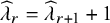 $\widehat {\lambda }_r = \widehat {\lambda }_{r+1}+1$
and
$\widehat {\lambda }_r = \widehat {\lambda }_{r+1}+1$
and $f_r=f_{r+1}$
. Theorem 1 follows from this and induction on
$f_r=f_{r+1}$
. Theorem 1 follows from this and induction on ${\mathfrak q}-j$
, using Lemma 5(b) in Proposition 4.
${\mathfrak q}-j$
, using Lemma 5(b) in Proposition 4.
Example 5. Consider the amenable permutation ${\varpi }:=(3,4,6,1,5,2)$
in
${\varpi }:=(3,4,6,1,5,2)$
in $S_6$
. We then have
$S_6$
. We then have $\gamma ({\varpi })=(2,2,3,0,1,0)$
,
$\gamma ({\varpi })=(2,2,3,0,1,0)$
, $\lambda ({\varpi })=(3,2,2,1)$
,
$\lambda ({\varpi })=(3,2,2,1)$
, ${\mathfrak f}({\varpi })=(3,3,3,5)$
, and
${\mathfrak f}({\varpi })=(3,3,3,5)$
, and ${\mathfrak g}({\varpi })=(5,2,2,2)$
. Theorem 1 gives
${\mathfrak g}({\varpi })=(5,2,2,2)$
. Theorem 1 gives
 $$\begin{align*}{\mathfrak S}_{346152} = R^{\emptyset} \, {}^{(3,3,3,5)}h_{(3,2,2,1)}^{(5,2,2,2)}. \end{align*}$$
Recall from [Reference Lascoux and Schützenberger18], [Reference Lascoux and Schützenberger19] that a permutation ${\varpi }$
is vexillary if and only if it is
${\varpi }$
is vexillary if and only if it is $2143$
-avoiding. Equivalently,
$2143$
-avoiding. Equivalently, ${\varpi }$
is vexillary if and only if
${\varpi }$
is vexillary if and only if $\lambda ({\varpi }^{-1})=\lambda ({\varpi })'$
.
$\lambda ({\varpi }^{-1})=\lambda ({\varpi })'$
.
Theorem 2. The permutation ${\varpi }$
is amenable if and only if
${\varpi }$
is amenable if and only if ${\varpi }$
is vexillary.
${\varpi }$
is vexillary.
Proof. According to [Reference Macdonald20, Proposition 1.32], a permutation is vexillary if and only if its code $\gamma $
satisfies the following two conditions, for any
$\gamma $
satisfies the following two conditions, for any $i<j$
: (i) if
$i<j$
: (i) if $\gamma _i\leq \gamma _j$
, then
$\gamma _i\leq \gamma _j$
, then $\gamma _i\leq \gamma _k$
for any k with
$\gamma _i\leq \gamma _k$
for any k with $i<k<j$
and (ii) if
$i<k<j$
and (ii) if $\gamma _i>\gamma _j$
, then the number of k with
$\gamma _i>\gamma _j$
, then the number of k with $i<k<j$
and
$i<k<j$
and $\gamma _k<\gamma _j$
is at most
$\gamma _k<\gamma _j$
is at most $\gamma _i-\gamma _j$
.
$\gamma _i-\gamma _j$
.
Assume first that ${\varpi }$
is amenable, so that
${\varpi }$
is amenable, so that ${\varpi }=\widehat {{\varpi }}{\omega }$
for some dominant permutation
${\varpi }=\widehat {{\varpi }}{\omega }$
for some dominant permutation $\widehat {{\varpi }}$
and
$\widehat {{\varpi }}$
and $231$
-avoiding permutation
$231$
-avoiding permutation ${\omega }$
. Using Lemma 2, we see that the code
${\omega }$
. Using Lemma 2, we see that the code $\widehat {\gamma }$
of
$\widehat {\gamma }$
of $\widehat {{\varpi }}$
is transformed into the code
$\widehat {{\varpi }}$
is transformed into the code $\gamma $
of
$\gamma $
of ${\varpi }$
by the moves of the procedure described in the proof of Proposition 4.
${\varpi }$
by the moves of the procedure described in the proof of Proposition 4.
We claim that the sequence $\gamma $
is a vexillary code. It follows from the inequalities (17) that for any
$\gamma $
is a vexillary code. It follows from the inequalities (17) that for any $[i,j]$
-move of the procedure, we have
$[i,j]$
-move of the procedure, we have $\gamma _s\leq \gamma _i\leq \gamma _r$
for every
$\gamma _s\leq \gamma _i\leq \gamma _r$
for every $r\in [i,j]$
and
$r\in [i,j]$
and $s>j$
. Moreover, if
$s>j$
. Moreover, if $r\neq i$
for all
$r\neq i$
for all $[i,j]$
-moves of the procedure, then
$[i,j]$
-moves of the procedure, then $\gamma _s\leq \gamma _r$
for all
$\gamma _s\leq \gamma _r$
for all $s>r$
. It is easy to see from this that
$s>r$
. It is easy to see from this that $\gamma $
satisfies the vexillary conditions (i) and (ii). Indeed, choose
$\gamma $
satisfies the vexillary conditions (i) and (ii). Indeed, choose $r<s$
such that
$r<s$
such that $\gamma _r\leq \gamma _s$
, and some
$\gamma _r\leq \gamma _s$
, and some $t\in [r,s]$
. If
$t\in [r,s]$
. If $r=i$
for some
$r=i$
for some $[i,j]$
-move, then we have
$[i,j]$
-move, then we have $\gamma _r\leq \gamma _k$
for all
$\gamma _r\leq \gamma _k$
for all $k\in [i,j]$
, while if
$k\in [i,j]$
, while if $k>j$
, then we must have
$k>j$
, then we must have $\gamma _r=\gamma _s=\gamma _k$
. Therefore,
$\gamma _r=\gamma _s=\gamma _k$
. Therefore, $\gamma _r\leq \gamma _t$
. If
$\gamma _r\leq \gamma _t$
. If $r\neq i$
for all
$r\neq i$
for all $[i,j]$
-moves, then
$[i,j]$
-moves, then $\gamma _r=\gamma _s$
and hence
$\gamma _r=\gamma _s$
and hence $\gamma _r=\gamma _t$
. To prove (ii), suppose that
$\gamma _r=\gamma _t$
. To prove (ii), suppose that $r<k<s$
and
$r<k<s$
and $\gamma _r>\gamma _s>\gamma _k$
. Then, we must have
$\gamma _r>\gamma _s>\gamma _k$
. Then, we must have $k=i$
for some
$k=i$
for some $[i,j]$
-move of the procedure, where
$[i,j]$
-move of the procedure, where $s\leq j$
. We conclude that the number of such k is at most
$s\leq j$
. We conclude that the number of such k is at most $\gamma _r-\gamma _s$
.
$\gamma _r-\gamma _s$
.
Conversely, suppose that ${\varpi }\in S_n$
is a vexillary permutation with code
${\varpi }\in S_n$
is a vexillary permutation with code $\gamma $
. We call an integer
$\gamma $
. We call an integer $i\geq 1$
an initial index if there exists an
$i\geq 1$
an initial index if there exists an $s>i$
with
$s>i$
with $\gamma _i<\gamma _s$
. We claim that there is a canonical
$\gamma _i<\gamma _s$
. We claim that there is a canonical $312$
-avoiding permutation
$312$
-avoiding permutation ${\omega }$
such that
${\omega }$
such that $\ell ({\varpi }{\omega })= \ell ({\varpi })+\ell ({\omega })$
,
$\ell ({\varpi }{\omega })= \ell ({\varpi })+\ell ({\omega })$
, ${\varpi }{\omega }$
is dominant, and
${\varpi }{\omega }$
is dominant, and ${\omega }_a=a$
if
${\omega }_a=a$
if $a<i$
for every initial index i. This will complete the proof of the theorem, by applying Lemma 9.
$a<i$
for every initial index i. This will complete the proof of the theorem, by applying Lemma 9.
To establish the claim, we argue by descending induction on the length of ${\varpi }$
. Observe that
${\varpi }$
. Observe that ${\varpi }$
has no initial index if and only if
${\varpi }$
has no initial index if and only if ${\varpi }$
is a dominant permutation. Hence, if
${\varpi }$
is a dominant permutation. Hence, if ${\varpi }$
is already dominant, then we must take
${\varpi }$
is already dominant, then we must take ${\omega }$
to be the identity.
${\omega }$
to be the identity.
Assume that ${\varpi }$
is not dominant. We say that the index j is associated with the initial index i of
${\varpi }$
is not dominant. We say that the index j is associated with the initial index i of ${\varpi }$
if j is the maximum s such that
${\varpi }$
if j is the maximum s such that $\gamma _i<\gamma _s$
. Let i be the smallest initial index, let j be associated with i, and set
$\gamma _i<\gamma _s$
. Let i be the smallest initial index, let j be associated with i, and set ${\varpi }':={\varpi } s_i\dots s_{j-1}$
. The vexillary condition (i) and Lemma 2 imply that
${\varpi }':={\varpi } s_i\dots s_{j-1}$
. The vexillary condition (i) and Lemma 2 imply that
 $$\begin{align*}\gamma({\varpi}') = (\gamma_i,\ldots, \gamma_{i-1}, \gamma_{i+1}+1,\ldots, \gamma_j+1,\gamma_i,\gamma_{j+1},\ldots) \end{align*}$$
and $\ell ({\varpi }')=\ell ({\varpi })+j-i>\ell ({\varpi })$
. It follows by checking conditions (i) and (ii) that
$\ell ({\varpi }')=\ell ({\varpi })+j-i>\ell ({\varpi })$
. It follows by checking conditions (i) and (ii) that ${\varpi }'$
is vexillary and that every initial index
${\varpi }'$
is vexillary and that every initial index $i'$
of
$i'$
of ${\varpi }'$
satisfies
${\varpi }'$
satisfies $i'\geq i$
.
$i'\geq i$
.
By the inductive hypothesis, there exists a canonical $312$
-avoiding permutation
$312$
-avoiding permutation ${\omega }'$
with
${\omega }'$
with $\ell ({\varpi }'{\omega }')=\ell ({\varpi }')+\ell ({\omega }')$
,
$\ell ({\varpi }'{\omega }')=\ell ({\varpi }')+\ell ({\omega }')$
, ${\varpi }'{\omega }'$
dominant, and
${\varpi }'{\omega }'$
dominant, and ${\omega }^{\prime }_a=a$
if
${\omega }^{\prime }_a=a$
if $a<i'$
for every initial index
$a<i'$
for every initial index $i'$
of
$i'$
of ${\varpi }'$
. The claim is proved with
${\varpi }'$
. The claim is proved with ${\omega }:=s_i\dots s_{j-1}{\omega }'$
, once we check that
${\omega }:=s_i\dots s_{j-1}{\omega }'$
, once we check that ${\omega }$
is
${\omega }$
is $312$
-avoiding. Indeed, since
$312$
-avoiding. Indeed, since ${\omega }^{\prime }_a=a$
for all
${\omega }^{\prime }_a=a$
for all $a<i$
and
$a<i$
and $\ell (s_i\dots s_{j-1}{\omega }')=j-i+\ell ({\omega }')$
, we must have
$\ell (s_i\dots s_{j-1}{\omega }')=j-i+\ell ({\omega }')$
, we must have
 $$\begin{align*}{\omega}'=(1,2,\ldots,i-1,\ldots,a_1,\ldots,a_2, \ldots, a_{j-i},\ldots,j,\ldots) \end{align*}$$
and
 $$\begin{align*}{\omega} = (1,2,\ldots,i-1,\ldots,a_1+1,\ldots,a_2+1, \ldots, a_{j-i}+1,\ldots,i,\ldots) \end{align*}$$
where the set $\{a_1,\ldots ,a_{j-i}\}$
is equal to
$\{a_1,\ldots ,a_{j-i}\}$
is equal to $\{i,\ldots , j-1\}$
. As
$\{i,\ldots , j-1\}$
. As ${\omega }'$
is
${\omega }'$
is $312$
-avoiding, there are no integers
$312$
-avoiding, there are no integers $a<b<c$
such that
$a<b<c$
such that ${\omega }^{\prime }_a>{\omega }^{\prime }_c >{\omega }^{\prime }_b$
. It is easy to see from this and the above relation between
${\omega }^{\prime }_a>{\omega }^{\prime }_c >{\omega }^{\prime }_b$
. It is easy to see from this and the above relation between ${\omega }'$
and
${\omega }'$
and ${\omega }$
that the latter permutation has the same property, and therefore is also
${\omega }$
that the latter permutation has the same property, and therefore is also $312$
-avoiding.
$312$
-avoiding.
Remark 1.
(a) Define a left modification of ${\varpi }\in S_n$
to be a permutation
${\varpi }\in S_n$
to be a permutation ${\omega }{\varpi }$
, where
${\omega }{\varpi }$
, where ${\omega }\in S_n$
is
${\omega }\in S_n$
is $312$
-avoiding and such that
$312$
-avoiding and such that $\ell ({\omega }{\varpi })=\ell ({\varpi })-\ell ({\omega })$
. Then, a permutation is amenable if and only if it is a left modification of a dominant permutation. This follows from Lemma 9, Theorem 2, and the fact that
$\ell ({\omega }{\varpi })=\ell ({\varpi })-\ell ({\omega })$
. Then, a permutation is amenable if and only if it is a left modification of a dominant permutation. This follows from Lemma 9, Theorem 2, and the fact that ${\varpi }$
is dominant (respectively, vexillary) if and only if
${\varpi }$
is dominant (respectively, vexillary) if and only if ${\varpi }^{-1}$
is dominant (respectively, vexillary).
${\varpi }^{-1}$
is dominant (respectively, vexillary).
(b) It is not hard to show that a definition of amenable permutations as left modifications of leading permutations, in the same manner as Definition 8 in type C, results in the same class of permutations as that given in Definition 4.
Let ${\varpi }$
be a vexillary permutation with code
${\varpi }$
be a vexillary permutation with code $\gamma $
and shape
$\gamma $
and shape $\lambda $
, and let
$\lambda $
, and let ${\omega }$
be the canonical
${\omega }$
be the canonical $312$
-avoiding permutation associated with
$312$
-avoiding permutation associated with ${\varpi }$
in the proof of Theorem 2. Define a new sequence
${\varpi }$
in the proof of Theorem 2. Define a new sequence $\widehat {\gamma }$
by the prescription
$\widehat {\gamma }$
by the prescription
 $$\begin{align*}\widehat{\gamma}_\alpha:=\gamma_\alpha+\#\{i\ |\ i \text{ is an initial index with associated index } j \text{ and } i<\alpha\leq j\} \end{align*}$$
for each $\alpha \geq 1$
. Let
$\alpha \geq 1$
. Let $\widehat {\lambda }$
be the partition obtained by listing the entries of
$\widehat {\lambda }$
be the partition obtained by listing the entries of $\widehat {\gamma }$
in weakly decreasing order. Then,
$\widehat {\gamma }$
in weakly decreasing order. Then, $\widehat {\lambda }$
is the shape of
$\widehat {\lambda }$
is the shape of ${\varpi } {\omega }$
.
${\varpi } {\omega }$
.
Consider the skew Young diagram $\tau ({\varpi }):=\widehat {\lambda }/\lambda $
. For each
$\tau ({\varpi }):=\widehat {\lambda }/\lambda $
. For each $i\geq 1$
, fill the boxes in row i of
$i\geq 1$
, fill the boxes in row i of $\tau ({\varpi })$
with a strictly decreasing sequence of consecutive positive integers ending in i. In this way, we obtain a tableaux
$\tau ({\varpi })$
with a strictly decreasing sequence of consecutive positive integers ending in i. In this way, we obtain a tableaux $T=T({\varpi })$
of shape
$T=T({\varpi })$
of shape $\tau ({\varpi })$
with strictly decreasing rows. Define the depth of a box B of T to be the distance from B to the end of the row it occupies. Form a reduced decomposition for a permutation
$\tau ({\varpi })$
with strictly decreasing rows. Define the depth of a box B of T to be the distance from B to the end of the row it occupies. Form a reduced decomposition for a permutation ${\omega }_T$
by listing the entries in the boxes of T in decreasing order of depth, with the entries of a fixed depth listed in increasing order. It then follows from the definition of
${\omega }_T$
by listing the entries in the boxes of T in decreasing order of depth, with the entries of a fixed depth listed in increasing order. It then follows from the definition of ${\omega }$
that
${\omega }$
that ${\omega }_T={\omega }$
.
${\omega }_T={\omega }$
.
Example 6. Let ${\varpi }:=(1,3,6,7,9,4,8,2,5)$
be the vexillary permutation in
${\varpi }:=(1,3,6,7,9,4,8,2,5)$
be the vexillary permutation in $S_9$
with code
$S_9$
with code $\gamma =(0,1,3,3,4,1,2,0,0)$
. The initial indices are
$\gamma =(0,1,3,3,4,1,2,0,0)$
. The initial indices are $1$
,
$1$
, $2$
,
$2$
, $3$
,
$3$
, $4$
, and
$4$
, and $6$
with associated indices
$6$
with associated indices $7$
,
$7$
, $7$
,
$7$
, $5$
,
$5$
, $5$
, and
$5$
, and $7$
, respectively. The reduced decomposition for the canonical permutation
$7$
, respectively. The reduced decomposition for the canonical permutation ${\omega }$
is
${\omega }$
is
 $$\begin{align*}s_4s_3s_4s_6s_2s_3s_4s_5s_6s_1s_2s_3s_4s_5s_6 \end{align*}$$
and we have ${\varpi } {\omega }=(9,7,6,8,4,3,1,2,5)$
, with code
${\varpi } {\omega }=(9,7,6,8,4,3,1,2,5)$
, with code $(8,6,5,5,3,2,0,0,0)$
. We also have
$(8,6,5,5,3,2,0,0,0)$
. We also have $\lambda =(4,3,3,2,1,1)$
,
$\lambda =(4,3,3,2,1,1)$
, $\widehat {\gamma }=(0,2,5,6,8,3,5,0)$
, and
$\widehat {\gamma }=(0,2,5,6,8,3,5,0)$
, and $\widehat {\lambda }=(8,6,5,5,3,2)$
. The tableau
$\widehat {\lambda }=(8,6,5,5,3,2)$
. The tableau $T({\varpi })$
on the skew diagram
$T({\varpi })$
on the skew diagram $\tau ({\varpi })$
is displayed in Figure 1.
$\tau ({\varpi })$
is displayed in Figure 1.
The tableau T on the skew diagram $\widehat {\lambda }/\lambda $
.
$\widehat {\lambda }/\lambda $
.

It would be interesting to find analogs of the canonical permutation ${\omega }$
and the tableaux
${\omega }$
and the tableaux $T({\varpi })$
for the amenable elements in the other classical Lie types.
$T({\varpi })$
for the amenable elements in the other classical Lie types.
4.2. Type A degeneracy loci
Let $E\to {\mathfrak X}$
be a vector bundle of rank n on a complex algebraic variety
$E\to {\mathfrak X}$
be a vector bundle of rank n on a complex algebraic variety ${\mathfrak X}$
, assumed to be smooth for simplicity. Let
${\mathfrak X}$
, assumed to be smooth for simplicity. Let ${\varpi }\in S_n$
be amenable of shape
${\varpi }\in S_n$
be amenable of shape $\lambda $
, and let
$\lambda $
, and let ${\mathfrak f}$
and
${\mathfrak f}$
and ${\mathfrak g}$
be the left and right flags of
${\mathfrak g}$
be the left and right flags of ${\varpi }$
, respectively. Consider two complete flags of subbundles of E
${\varpi }$
, respectively. Consider two complete flags of subbundles of E
 $$\begin{align*}0 \subset E_1\subset \cdots \subset E_n=E \ \ \, \mathrm{and} \, \ \ 0 \subset F_1\subset \cdots \subset F_n=E \end{align*}$$
with ${\mathrm {rank}} E_r={\mathrm {rank}} F_r=r$
for each r. Define the degeneracy locus
${\mathrm {rank}} E_r={\mathrm {rank}} F_r=r$
for each r. Define the degeneracy locus ${\mathfrak X}_{\varpi }\subset {\mathfrak X}$
as the locus of
${\mathfrak X}_{\varpi }\subset {\mathfrak X}$
as the locus of $x \in {\mathfrak X}$
such that
$x \in {\mathfrak X}$
such that
 $$\begin{align*}\dim(E_r(x)\cap F_s(x))\geq \#\,\{\,i \leq r \ |\ {\varpi}_i> n-s\,\} \ \, \forall \, r,s. \end{align*}$$
Assume further that ${\mathfrak X}_{\varpi }$
has pure codimension
${\mathfrak X}_{\varpi }$
has pure codimension $\ell ({\varpi })$
in
$\ell ({\varpi })$
in ${\mathfrak X}$
. The next result, which follows from Theorem 1 and Fulton’s work [Reference Fulton8], will be a formula for the cohomology class
${\mathfrak X}$
. The next result, which follows from Theorem 1 and Fulton’s work [Reference Fulton8], will be a formula for the cohomology class $[{\mathfrak X}_{\varpi }]$
in
$[{\mathfrak X}_{\varpi }]$
in ${\mathrm {H}}^{2\ell ({\varpi })}({\mathfrak X})$
in terms of the Chern classes of the bundles
${\mathrm {H}}^{2\ell ({\varpi })}({\mathfrak X})$
in terms of the Chern classes of the bundles $E_r$
and
$E_r$
and $F_s$
. Recall that for any integer p, the class
$F_s$
. Recall that for any integer p, the class $c_p(E-E_r-F_s)$
is defined by the equation
$c_p(E-E_r-F_s)$
is defined by the equation
 $$\begin{align*}c(E-E_r-F_s) := c(E)c(E_r)^{-1}c(F_s)^{-1} \end{align*}$$
of total Chern classes.
Theorem 3 [Reference Fulton8]
For any amenable permutation ${\varpi }\in S_n$
, we have
${\varpi }\in S_n$
, we have
 $$ \begin{align} [{\mathfrak X}_{\varpi}] = s_{\lambda'}(E-E_{{\mathfrak f}}-F_{n-{\mathfrak g}}) = R^\emptyset\, c_{\lambda}(E-E_{{\mathfrak f}}-F_{n-{\mathfrak g}}) \end{align} $$
in the cohomology ring ${\mathrm {H}}^*({\mathfrak X})$
.
${\mathrm {H}}^*({\mathfrak X})$
.
The Chern polynomial in (18) is interpreted as the image of the Schur polynomial $s_{\lambda '}(\mathfrak {c}) :=R^\emptyset \mathfrak {c}_{\lambda }$
under the
$s_{\lambda '}(\mathfrak {c}) :=R^\emptyset \mathfrak {c}_{\lambda }$
under the ${\mathbb Z}$
-linear map which sends the noncommutative monomial
${\mathbb Z}$
-linear map which sends the noncommutative monomial $\mathfrak {c}_\alpha $
to
$\mathfrak {c}_\alpha $
to $\prod _j c_{\alpha _j}(E-E_{{\mathfrak f}_j}-F_{n-{\mathfrak g}_j})$
, for every integer sequence
$\prod _j c_{\alpha _j}(E-E_{{\mathfrak f}_j}-F_{n-{\mathfrak g}_j})$
, for every integer sequence $\alpha $
.
$\alpha $
.
Remark 2. Theorem 3 and its companion Theorems 5, 7, and 8 in the other classical Lie types are results about cohomology groups, taken with rational coefficients in types B and D. However, from these, one may obtain corresponding results for cohomology with integer coefficients, and for the Chow groups of algebraic cycles modulo rational equivalence. For the latter transition, see [Reference Fulton9], [Reference Graham11].
5. Amenable elements: Type C theory
5.1. Definitions and main theorem
Let w be a signed permutation with A-code $\gamma $
and shape
$\gamma $
and shape $\lambda =\mu +\nu $
, with
$\lambda =\mu +\nu $
, with $\ell =\ell (\lambda )$
and
$\ell =\ell (\lambda )$
and $m=\ell (\mu )$
. Choose
$m=\ell (\mu )$
. Choose $k\geq 0$
, and assume that w is increasing up to k. If
$k\geq 0$
, and assume that w is increasing up to k. If $k=0$
, this condition is vacuous, while if
$k=0$
, this condition is vacuous, while if $k\geq 1,$
it means that
$k\geq 1,$
it means that $0<w_1<\cdots <w_k$
. Eventually, k will be the first right descent of w, but the increased flexibility is useful.
$0<w_1<\cdots <w_k$
. Eventually, k will be the first right descent of w, but the increased flexibility is useful.
List the entries $w_{k+1},\ldots ,w_n$
in increasing order:
$w_{k+1},\ldots ,w_n$
in increasing order:
 $$\begin{align*}u_1<\cdots < u_m < 0 < u_{m+1} < \cdots < u_{n-k}. \end{align*}$$
Define a sequence $\beta (w)$
by
$\beta (w)$
by
 $$\begin{align*}\beta(w):=(u_1+1,\ldots,u_m+1,u_{m+1},\ldots,u_{n-k}). \end{align*}$$
and the denominator set $D(w)$
by
$D(w)$
by
 $$ \begin{align} D(w):=\{(i,j) \ |\ 1\leq i<j \leq n-k \ \, \text{and} \ \, u_i+ u_j < 0 \}. \end{align} $$
This notation suppresses the dependence of $\beta (w)$
and
$\beta (w)$
and $D(w)$
on k. Observe that the inequality
$D(w)$
on k. Observe that the inequality $u_i+u_j<0$
in (19) is equivalent to
$u_i+u_j<0$
in (19) is equivalent to $\beta _i(w)+ \beta _j(w) \leq 0$
.
$\beta _i(w)+ \beta _j(w) \leq 0$
.
Definition 6. Suppose that $w\in W_n$
has code
$w\in W_n$
has code $\gamma =\gamma (w)$
and
$\gamma =\gamma (w)$
and $k\geq 0$
. The k-truncated A-code
$k\geq 0$
. The k-truncated A-code ${}^k\gamma ={}^k\gamma (w)$
is defined by
${}^k\gamma ={}^k\gamma (w)$
is defined by
 $$\begin{align*}{}^k\gamma(w):=(\gamma_{k+1}, \gamma_{k+2},\ldots, \gamma_n). \end{align*}$$
If k is the first right descent of w, then we call ${}^k\gamma (w)$
the truncated A-code of w. We let
${}^k\gamma (w)$
the truncated A-code of w. We let $\xi =\xi (w)$
be the conjugate of the partition whose parts are the non-zero entries of
$\xi =\xi (w)$
be the conjugate of the partition whose parts are the non-zero entries of ${}^k\gamma (w)$
arranged in weakly decreasing order.
${}^k\gamma (w)$
arranged in weakly decreasing order.
Clearly, an element $w\in W_n$
increasing up to k with a given k-truncated A-code C is uniquely determined by the set of elements
$w\in W_n$
increasing up to k with a given k-truncated A-code C is uniquely determined by the set of elements $\{w_{k+1},\ldots ,w_n\}$
, or equivalently, by the sequence
$\{w_{k+1},\ldots ,w_n\}$
, or equivalently, by the sequence $\beta (w)$
.
$\beta (w)$
.
Let $ v(w)$
be the unique k-Grassmannian element obtained by reordering the entries
$ v(w)$
be the unique k-Grassmannian element obtained by reordering the entries $w_{k+1},\ldots ,w_n$
to be increasing. For example, if
$w_{k+1},\ldots ,w_n$
to be increasing. For example, if $w:=(2,4,7,5,8,\overline {3},1,\overline {6})$
and
$w:=(2,4,7,5,8,\overline {3},1,\overline {6})$
and $k:=3$
, then
$k:=3$
, then $v(w)=(2,4,7,\overline {6},\overline {3},1,5,8)$
. Note that the map
$v(w)=(2,4,7,\overline {6},\overline {3},1,5,8)$
. Note that the map $w \mapsto v(w)$
is a bijection from the set of elements in
$w \mapsto v(w)$
is a bijection from the set of elements in $W_n$
increasing up to k with k-truncated A-code C onto the set of k-Grassmannian elements in
$W_n$
increasing up to k with k-truncated A-code C onto the set of k-Grassmannian elements in $W_n$
, such that
$W_n$
, such that $\beta (v(w))=\beta (w)$
and
$\beta (v(w))=\beta (w)$
and
 $$\begin{align*}\ell(v(w)) = \ell(w)-\sum_{i=k+1}^n C_i = \ell(w)-\sum_{j=1}^{n-k} \gamma_{k+j}. \end{align*}$$
In particular, if $w,\overline {w}$
are two such elements, then
$w,\overline {w}$
are two such elements, then $\ell (w)>\ell (\overline {w})$
if and only if
$\ell (w)>\ell (\overline {w})$
if and only if $\ell (v(w))>\ell (v(\overline {w}))$
.
$\ell (v(w))>\ell (v(\overline {w}))$
.
Lemma 10. Let w and $\overline {w}$
be elements in
$\overline {w}$
be elements in $W_n$
increasing up to k and with the same k-truncated A-code C, such that
$W_n$
increasing up to k and with the same k-truncated A-code C, such that $\ell (w)=\ell (\overline {w})+1$
. Suppose that
$\ell (w)=\ell (\overline {w})+1$
. Suppose that $v(\overline {w})=s_iv(w)$
for some simple reflection
$v(\overline {w})=s_iv(w)$
for some simple reflection $s_i$
. Then,
$s_i$
. Then, $\overline {w}=s_iw$
.
$\overline {w}=s_iw$
.
Proof. There are four possible cases for i and $v(w)$
: (a)
$v(w)$
: (a) $i=0$
and
$i=0$
and $v(w) = (\cdots \overline {1} \cdots )$
; (b)
$v(w) = (\cdots \overline {1} \cdots )$
; (b) $i \geq 1$
and
$i \geq 1$
and $v(w) = (\cdots i \cdots \overline {i+1} \cdots )$
; (c)
$v(w) = (\cdots i \cdots \overline {i+1} \cdots )$
; (c) $i \geq 1$
and
$i \geq 1$
and $v(w) = (\cdots \overline {i+1} \cdots i \cdots )$
; and (d)
$v(w) = (\cdots \overline {i+1} \cdots i \cdots )$
; and (d) $i \geq 1$
and
$i \geq 1$
and $v(w) = (\cdots i+1 \cdots i \cdots )$
. In the first three cases, the result is clear. In case (d), the
$v(w) = (\cdots i+1 \cdots i \cdots )$
. In the first three cases, the result is clear. In case (d), the $i+1$
must be among the first k entries of
$i+1$
must be among the first k entries of $v(w)$
, which coincide with the first k entries of w, while i lies among the last
$v(w)$
, which coincide with the first k entries of w, while i lies among the last $n-k$
entries of w. Hence, the result follows.
$n-k$
entries of w. Hence, the result follows.
For any three integer vectors $\alpha ,\beta ,\rho \in {\mathbb Z}^\ell $
, define
$\alpha ,\beta ,\rho \in {\mathbb Z}^\ell $
, define ${}^{\rho }c^\beta _\alpha :={}^{\rho _1}c^{\beta _1}_{\alpha _1}\,{}^{\rho _2}c^{\beta _2}_{\alpha _2}\dots $
. Given any raising operator
${}^{\rho }c^\beta _\alpha :={}^{\rho _1}c^{\beta _1}_{\alpha _1}\,{}^{\rho _2}c^{\beta _2}_{\alpha _2}\dots $
. Given any raising operator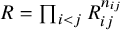 $R=\prod _{i<j}R_{ij}^{n_{ij}}$
, let
$R=\prod _{i<j}R_{ij}^{n_{ij}}$
, let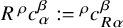 $R\, {}^{\rho }c^\beta _{\alpha } := {}^{\rho }c^\beta _{R\alpha }$
.
$R\, {}^{\rho }c^\beta _{\alpha } := {}^{\rho }c^\beta _{R\alpha }$
.
Proposition 5. Fix an integer $k\geq 0$
. Suppose that w and
$k\geq 0$
. Suppose that w and $\overline {w}$
are elements in
$\overline {w}$
are elements in $W_n$
increasing up to k with the same k-truncated A-code C, such that
$W_n$
increasing up to k with the same k-truncated A-code C, such that $\ell (w)=\ell (\overline {w})+1$
and
$\ell (w)=\ell (\overline {w})+1$
and $s_iv(w)=v(\overline {w})$
for some simple reflection
$s_iv(w)=v(\overline {w})$
for some simple reflection $s_i$
. Assume that we have
$s_i$
. Assume that we have
 $$\begin{align*}{\mathfrak C}_w = R^{D(w)}\,{}^{{\kappa}}c^{\beta(w)}_{\lambda(w)} \end{align*}$$
for some integer sequence ${\kappa }$
. Then, we have
${\kappa }$
. Then, we have
 $$\begin{align*}{\mathfrak C}_{\overline{w}} = R^{D(\overline{w})}\,{}^{{\kappa}}c^{\beta(\overline{w})}_{\lambda(\overline{w})}. \end{align*}$$
Proof. Set $F_w:=R^{D(w)} \, {}^{{\kappa }}c^{\beta (w)}_{\lambda (w)}$
, so we know that
$F_w:=R^{D(w)} \, {}^{{\kappa }}c^{\beta (w)}_{\lambda (w)}$
, so we know that ${\mathfrak C}_w=F_w$
. As equation (8) gives
${\mathfrak C}_w=F_w$
. As equation (8) gives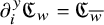 $\partial ^y_i{\mathfrak C}_w = {\mathfrak C}_{\overline {w}}$
, it will suffice to show that
$\partial ^y_i{\mathfrak C}_w = {\mathfrak C}_{\overline {w}}$
, it will suffice to show that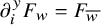 $\partial ^y_i F_w = F_{\overline {w}}$
. The proof of this will follow the argument of [Reference Tamvakis and Wilson31, Proposition 5].
$\partial ^y_i F_w = F_{\overline {w}}$
. The proof of this will follow the argument of [Reference Tamvakis and Wilson31, Proposition 5].
Let $\mu :=\mu (w)$
,
$\mu :=\mu (w)$
, $\nu :=\nu (w)$
,
$\nu :=\nu (w)$
, $\lambda :=\lambda (w)=\mu +\nu $
,
$\lambda :=\lambda (w)=\mu +\nu $
, $\overline {\mu }:=\mu (\overline {w})$
,
$\overline {\mu }:=\mu (\overline {w})$
, $\overline {\nu }:=\nu (\overline {w})$
,
$\overline {\nu }:=\nu (\overline {w})$
, $\overline {\lambda }:=\lambda (\overline {w})= \overline {\mu }+\overline {\nu }$
,
$\overline {\lambda }:=\lambda (\overline {w})= \overline {\mu }+\overline {\nu }$
, $\beta =\beta (w)$
, and
$\beta =\beta (w)$
, and $\overline {\beta }=\beta (\overline {w})$
. There are four possible cases for w, discussed below. In each case, we have
$\overline {\beta }=\beta (\overline {w})$
. There are four possible cases for w, discussed below. In each case, we have $\overline {\lambda }\subset \lambda $
, so that
$\overline {\lambda }\subset \lambda $
, so that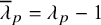 $\overline {\lambda }_p=\lambda _p-1$
for some
$\overline {\lambda }_p=\lambda _p-1$
for some $p\geq 1$
and
$p\geq 1$
and $\overline {\lambda }_j=\lambda _j$
for all
$\overline {\lambda }_j=\lambda _j$
for all $j\neq p$
.
$j\neq p$
.
(a) $v(w) = (\cdots \overline {1} \cdots )$
with
$v(w) = (\cdots \overline {1} \cdots )$
with $i=0$
. In this case, we have
$i=0$
. In this case, we have $D(w)=D(\overline {w})$
. Since clearly
$D(w)=D(\overline {w})$
. Since clearly $\nu =\overline {\nu }$
and
$\nu =\overline {\nu }$
and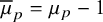 $\overline {\mu }_p=\mu _p-1$
for
$\overline {\mu }_p=\mu _p-1$
for $p=\ell (\mu )$
, while
$p=\ell (\mu )$
, while $\overline {\mu }_j=\mu _j$
for all
$\overline {\mu }_j=\mu _j$
for all $j\neq p$
, it follows that
$j\neq p$
, it follows that $\beta _p=i$
,
$\beta _p=i$
, $\overline {\beta }_p= i + 1$
, while
$\overline {\beta }_p= i + 1$
, while $\beta _j=\overline {\beta }_j$
for all
$\beta _j=\overline {\beta }_j$
for all $j \neq p$
.
$j \neq p$
.
(b) $v(w) = (\cdots i \cdots \overline {i+1} \cdots )$
. In this case
$v(w) = (\cdots i \cdots \overline {i+1} \cdots )$
. In this case $D(w)=D(\overline {w})$
, and we have
$D(w)=D(\overline {w})$
, and we have $\nu =\overline {\nu }$
and
$\nu =\overline {\nu }$
and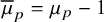 $\overline {\mu }_p=\mu _p-1$
, while
$\overline {\mu }_p=\mu _p-1$
, while $\overline {\mu }_j=\mu _j$
for all
$\overline {\mu }_j=\mu _j$
for all $j\neq p$
. It follows that
$j\neq p$
. It follows that $\beta _p = -i$
,
$\beta _p = -i$
, $\overline {\beta }_p=-i+1$
, and
$\overline {\beta }_p=-i+1$
, and $\beta _j=\overline {\beta }_j$
for all
$\beta _j=\overline {\beta }_j$
for all $j \neq p$
.
$j \neq p$
.
(c) $v(w) = (\cdots \overline {i+1} \cdots i \cdots )$
. In this case
$v(w) = (\cdots \overline {i+1} \cdots i \cdots )$
. In this case $D(w)=D(\overline {w})\cup \{(p,q)\}$
, where
$D(w)=D(\overline {w})\cup \{(p,q)\}$
, where $\beta _p=-i$
and
$\beta _p=-i$
and $\beta _q=i$
. We see similarly that
$\beta _q=i$
. We see similarly that $\overline {\beta }_p=-i+1$
and
$\overline {\beta }_p=-i+1$
and $\overline {\beta }_q=i+1$
, while
$\overline {\beta }_q=i+1$
, while $\beta _j=\overline {\beta }_j$
for all
$\beta _j=\overline {\beta }_j$
for all $j \notin \{p,q\}$
.
$j \notin \{p,q\}$
.
(d) $v(w) = (\cdots i+1 \cdots i \cdots )$
. In this case, we have
$v(w) = (\cdots i+1 \cdots i \cdots )$
. In this case, we have $D(w)=D(\overline {w})$
while clearly
$D(w)=D(\overline {w})$
while clearly $\mu =\overline {\mu }$
. We deduce that
$\mu =\overline {\mu }$
. We deduce that $\overline {\nu }_p=\nu _p-1$
, while
$\overline {\nu }_p=\nu _p-1$
, while $\overline {\nu }_j=\nu _j$
for all
$\overline {\nu }_j=\nu _j$
for all $j\neq p$
. We must show that
$j\neq p$
. We must show that $\beta _p=i$
, and hence
$\beta _p=i$
, and hence $\overline {\beta }_p=i+1$
, and
$\overline {\beta }_p=i+1$
, and $\beta _j=\overline {\beta }_j$
for all
$\beta _j=\overline {\beta }_j$
for all $j\neq p$
.
$j\neq p$
.
Note that if $w_r=i+1$
, then
$w_r=i+1$
, then $r\in [1,k]$
. Since
$r\in [1,k]$
. Since $w_j\geq w_r$
for all
$w_j\geq w_r$
for all $j\in [r,k]$
, and the sequence
$j\in [r,k]$
, and the sequence $\beta (w)$
is strictly increasing, we deduce that
$\beta (w)$
is strictly increasing, we deduce that $\beta _g=i$
exactly when
$\beta _g=i$
exactly when $g=\gamma _r(w)$
. We have
$g=\gamma _r(w)$
. We have $\gamma _r(\overline {w})=\gamma _r(w)-1=g-1$
, while
$\gamma _r(\overline {w})=\gamma _r(w)-1=g-1$
, while $\gamma _j(w)=\gamma _j(\overline {w})$
for
$\gamma _j(w)=\gamma _j(\overline {w})$
for $j\neq r$
. It follows that
$j\neq r$
. It follows that $\overline {\nu }_g=\nu _g-1$
, while
$\overline {\nu }_g=\nu _g-1$
, while $\overline {\nu }_j=\nu _j$
for all
$\overline {\nu }_j=\nu _j$
for all $j\neq g$
. In other words,
$j\neq g$
. In other words, $g=p$
, as desired.
$g=p$
, as desired.
To simplify the notation, set $c^{\rho }_{\alpha }:={}^{{\kappa }}c^{\rho }_\alpha $
, for any integer sequences
$c^{\rho }_{\alpha }:={}^{{\kappa }}c^{\rho }_\alpha $
, for any integer sequences $\alpha $
and
$\alpha $
and $\rho $
. In cases (a), (b), or (d), it follows using the left Leibnitz rule and Lemma 3(a) that for any integer sequence
$\rho $
. In cases (a), (b), or (d), it follows using the left Leibnitz rule and Lemma 3(a) that for any integer sequence $\alpha =(\alpha _1,\ldots ,\alpha _\ell )$
, we have
$\alpha =(\alpha _1,\ldots ,\alpha _\ell )$
, we have
 $$ \begin{align*} \partial^y_i c^{\beta}_\alpha &= c^{(\beta_1,\ldots,\beta_{p-1})}_{(\alpha_1,\ldots,\alpha_{p-1})} \left(\partial^y_i(c^{\beta_p}_{\alpha_p})\,c^{(\beta_{p+1},\ldots,\beta_\ell)}_{(\alpha_{p+1},\ldots,\alpha_\ell)} +s^y_i(c^{\beta_p}_{\alpha_p})\,\partial^y_i (c^{(\beta_{p+1},\ldots,\beta_\ell)}_{(\alpha_{p+1},\ldots,\alpha_\ell)})\right) \\ &=c^{(\beta_1,\ldots,\beta_{p-1})}_{(\alpha_1,\ldots,\alpha_{p-1})} \left(c^{\beta_p+1}_{\alpha_p-1}\,c^{(\beta_{p+1},\ldots,\beta_\ell)}_{(\alpha_{p+1},\ldots,\alpha_\ell)} +s^y_i(c^{\beta_p}_{\alpha_p})\cdot 0\right) =c^{(\beta_1,\ldots,\beta_p+1,\ldots,\beta_\ell)}_{(\alpha_1,\ldots,\alpha_p-1,\ldots,\alpha_\ell)} = c^{\overline{\beta}}_{\alpha-\epsilon_p}. \end{align*} $$
Since $\lambda -\epsilon _p=\overline {\lambda }$
, we deduce that if R is any raising operator, then
$\lambda -\epsilon _p=\overline {\lambda }$
, we deduce that if R is any raising operator, then
 $$\begin{align*}\partial^y_i (R \,c^{\beta}_{\lambda}) = \partial^y_i (c^{\beta}_{R\lambda}) = c^{\overline{\beta}}_{R\lambda-\epsilon_p} = R \,c^{\overline{\beta}}_{\overline{\lambda}}. \end{align*}$$
As $R^{D(w)}= R^{D(\overline {w})}$
, we conclude that
$R^{D(w)}= R^{D(\overline {w})}$
, we conclude that
 $$\begin{align*}\partial^y_i(F_w) = \partial^y_i (R^{D(w)} c^{\beta}_{\lambda}) = R^{D(\overline{w})} c^{\overline{\beta}}_{\overline{\lambda}} = F_{\overline{w}}. \end{align*}$$
In case (c), it follows from the left Leibnitz rule as in the proof of Lemma 3(b) that for any integer sequence $\alpha =(\alpha _1,\ldots ,\alpha _\ell )$
, we have
$\alpha =(\alpha _1,\ldots ,\alpha _\ell )$
, we have
 $$ \begin{align*} \partial^y_i c^{\beta}_\alpha &= \partial^y_i c^{(\beta_1,\ldots,-i,\ldots,i,\ldots,\beta_{\ell})}_{(\alpha_1,\ldots,\alpha_p,\ldots,\alpha_q, \ldots,\alpha_\ell)} \\ &= c^{(\beta_1,\ldots,-i+1,\ldots,i+1,\ldots,\beta_{\ell})}_{(\alpha_1,\ldots,\alpha_p-1,\ldots,\alpha_q,\ldots,\alpha_\ell)} +c^{(\beta_1,\ldots,-i+1,\ldots,i+1,\ldots,\beta_{\ell})}_{(\alpha_1,\ldots,\alpha_p,\ldots,\alpha_q-1,\ldots,\alpha_\ell)} = c^{\overline{\beta}}_{\alpha-\epsilon_p} + c^{\overline{\beta}}_{\alpha-\epsilon_q}. \end{align*} $$
Since $\lambda -\epsilon _p=\overline {\lambda }$
, we deduce that if R is any raising operator, then
$\lambda -\epsilon _p=\overline {\lambda }$
, we deduce that if R is any raising operator, then
 $$\begin{align*}\partial^y_i (R \,c^{\beta}_\lambda) = \partial^y_i (c^{\beta}_{R\lambda}) = c^{\overline{\beta}}_{R\lambda-\epsilon_p} + c^{\overline{\beta}}_{R\lambda-\epsilon_q} = R \,c^{\overline{\beta}}_{\overline{\lambda}} + RR_{pq}\,c^{\overline{\beta}}_{\overline{\lambda}}. \end{align*}$$
As $R^{D(w)}+R^{D(w)} R_{pq} = R^{D(\overline {w})}$
, we conclude that
$R^{D(w)}+R^{D(w)} R_{pq} = R^{D(\overline {w})}$
, we conclude that
 $$\begin{align*}\partial^y_i(F_w) = \partial^y_i(R^{D(w)} c^{\beta}_\lambda) = R^{D(w)} c^{\overline{\beta}}_{\overline{\lambda}} +R^{D(w)} R_{pq}c^{\overline{\beta}}_{\overline{\lambda}} = R^{D(\overline{w})} c^{\overline{\beta}}_{\overline{\lambda}} = F_{\overline{w}}. \end{align*}$$
Proposition 6. Suppose that $w\in W_n$
is such that
$w\in W_n$
is such that $\gamma (w)$
is a partition. Then, we have
$\gamma (w)$
is a partition. Then, we have
 $$ \begin{align} {\mathfrak C}_w = R^{D(w)} \, {}^{\nu(w)}c^{\beta(w)}_{\lambda(w)}. \end{align} $$
Proof. Assume first that $w_i<0$
for each i, and
$w_i<0$
for each i, and $\gamma (w)$
is a partition. We claim that
$\gamma (w)$
is a partition. We claim that
 $$ \begin{align} {\mathfrak C}_w = R^{\infty} \, {}^{\nu(w)}c^{-\delta_{n-1}}_{\lambda(w)}. \end{align} $$
The proof of (21) is by descending induction on $\ell (w)$
. One knows from [Reference Ikeda, Mihalcea and Naruse13, Theorem 1.2] and [Reference Tamvakis29, Proposition 3.2] that (21) is true for the longest element
$\ell (w)$
. One knows from [Reference Ikeda, Mihalcea and Naruse13, Theorem 1.2] and [Reference Tamvakis29, Proposition 3.2] that (21) is true for the longest element $w_0$
in
$w_0$
in $W_n$
, since
$W_n$
, since $\nu (w_0)=\delta _{n-1}$
and
$\nu (w_0)=\delta _{n-1}$
and $\lambda (w_0)=\delta _n+\delta _{n-1}$
.
$\lambda (w_0)=\delta _n+\delta _{n-1}$
.
Suppose that $w\neq w_0$
is such that
$w\neq w_0$
is such that $\gamma (w)$
is a partition, and the shape of w equals
$\gamma (w)$
is a partition, and the shape of w equals $\delta _n+\nu $
. Then,
$\delta _n+\nu $
. Then, $\nu \subset \delta _{n-1}$
and
$\nu \subset \delta _{n-1}$
and $\nu \neq \delta _{n-1}$
. Let
$\nu \neq \delta _{n-1}$
. Let $r\geq 1$
be the largest integer such that
$r\geq 1$
be the largest integer such that $\nu _i=n-i$
for
$\nu _i=n-i$
for $i\in [1,r]$
, and let
$i\in [1,r]$
, and let $j:=\nu _{r+1}+1\leq n-r-1$
. Then,
$j:=\nu _{r+1}+1\leq n-r-1$
. Then, $ws_j$
is of length
$ws_j$
is of length $\ell (w)+1$
and satisfies the same conditions,
$\ell (w)+1$
and satisfies the same conditions, $\nu (ws_j)=\nu (w)+\epsilon _{r+1}$
, and
$\nu (ws_j)=\nu (w)+\epsilon _{r+1}$
, and $\lambda (ws_j)=\lambda (w)+\epsilon _{r+1}$
. Using Lemma 3(a), for any integer sequence
$\lambda (ws_j)=\lambda (w)+\epsilon _{r+1}$
. Using Lemma 3(a), for any integer sequence $\alpha =(\alpha _1,\ldots ,\alpha _n)$
, we have
$\alpha =(\alpha _1,\ldots ,\alpha _n)$
, we have
 $$\begin{align*}\partial^x_j\left({}^{\nu(ws_j)}c^{-\delta_{n-1}}_{\alpha}\right) = {}^{\nu(w)}c^{-\delta_{n-1}}_{\alpha-\epsilon_{r+1}}. \end{align*}$$
We deduce that
 $$\begin{align*}{\mathfrak C}_w = \partial^x_j({\mathfrak C}_{ws_j}) = \partial^x_j\left(R^{\infty} \, {}^{\nu(ws_j)}c^{-\delta_{n-1}}_{\lambda(ws_j)}\right)= R^{\infty} \, {}^{\nu(w)}c^{-\delta_{n-1}}_{\lambda(w)}, \end{align*}$$
proving the claim. Equation (20) now follows, by combining (21) with the $k=0$
case of Proposition 5.
$k=0$
case of Proposition 5.
Corollary 1. Suppose that $w\in W_n$
is increasing up to k and the k-truncated A-code
$w\in W_n$
is increasing up to k and the k-truncated A-code ${}^k\gamma $
is a partition. Let
${}^k\gamma $
is a partition. Let $k^{n-k}+\xi (w)=(k+\xi _1,\ldots ,k+\xi _{n-k})$
. Then, we have
$k^{n-k}+\xi (w)=(k+\xi _1,\ldots ,k+\xi _{n-k})$
. Then, we have
 $$ \begin{align} {\mathfrak C}_w = R^{D(w)} \, {}^{k^{n-k}+\xi(w)}c^{\beta(w)}_{\lambda(w)}. \end{align} $$
Proof. If $w=(1,\ldots ,k,w_{k+1},\ldots ,w_n)$
with
$w=(1,\ldots ,k,w_{k+1},\ldots ,w_n)$
with $w_{k+j}<0$
for all
$w_{k+j}<0$
for all $j\in [1,n-k]$
, then
$j\in [1,n-k]$
, then $\gamma (w)=k^{n-k}+\xi (w)$
is a partition, and (22) is a direct application of Proposition 6. In this case,
$\gamma (w)=k^{n-k}+\xi (w)$
is a partition, and (22) is a direct application of Proposition 6. In this case, $v(w)=(1,\ldots ,k,-n,\ldots ,-k-1)$
is the longest k-Grassmannian element in
$v(w)=(1,\ldots ,k,-n,\ldots ,-k-1)$
is the longest k-Grassmannian element in $W_n$
. The general result now follows from Proposition 5, as the k-Grassmannian elements of
$W_n$
. The general result now follows from Proposition 5, as the k-Grassmannian elements of $W_n$
form an ideal for the left weak Bruhat order (see, e.g., [Reference Stembridge23, Proposition 2.5]).
$W_n$
form an ideal for the left weak Bruhat order (see, e.g., [Reference Stembridge23, Proposition 2.5]).
Definition 7. Let $k\geq 0$
denote the first right descent of
$k\geq 0$
denote the first right descent of $w\in W_n$
. List the entries
$w\in W_n$
. List the entries $w_{k+1},\ldots ,w_n$
in increasing order:
$w_{k+1},\ldots ,w_n$
in increasing order:
 $$\begin{align*}u_1<\cdots < u_m < 0 < u_{m+1} < \cdots < u_{n-k}. \end{align*}$$
We say that a simple transposition $s_i$
for
$s_i$
for $i\geq 1$
is w-negative (respectively, w-positive) if
$i\geq 1$
is w-negative (respectively, w-positive) if $\{i,i+1\}$
is a subset of
$\{i,i+1\}$
is a subset of $\{-u_1,\ldots ,-u_m\}$
(respectively, of
$\{-u_1,\ldots ,-u_m\}$
(respectively, of $\{u_{m+1}\ldots ,u_{n-k}\}$
). Let
$\{u_{m+1}\ldots ,u_{n-k}\}$
). Let $\sigma ^-$
(respectively,
$\sigma ^-$
(respectively, $\sigma ^+$
) be the longest subword of
$\sigma ^+$
) be the longest subword of $s_{n-1}\dots s_1$
(respectively, of
$s_{n-1}\dots s_1$
(respectively, of $s_1\dots s_{n-1}$
) consisting of w-negative (respectively, w-positive) simple transpositions. A modification of
$s_1\dots s_{n-1}$
) consisting of w-negative (respectively, w-positive) simple transpositions. A modification of $w\in W_n$
is an element
$w\in W_n$
is an element ${\omega } w$
, where
${\omega } w$
, where ${\omega }\in S_n$
is such that
${\omega }\in S_n$
is such that $\ell ({\omega } w)=\ell (w)-\ell ({\omega })$
, and
$\ell ({\omega } w)=\ell (w)-\ell ({\omega })$
, and ${\omega }$
has a reduced decomposition of the form
${\omega }$
has a reduced decomposition of the form $R_1\dots R_{n-1}$
, where each
$R_1\dots R_{n-1}$
, where each $R_j$
is a (possibly empty) subword of
$R_j$
is a (possibly empty) subword of $\sigma ^-\sigma ^+$
and all simple reflections in
$\sigma ^-\sigma ^+$
and all simple reflections in $R_p$
are also contained in
$R_p$
are also contained in $R_{p+1}$
, for each
$R_{p+1}$
, for each $p<n-1$
.
$p<n-1$
.
Definition 8. Suppose that $w\in W_n$
has first right descent at
$w\in W_n$
has first right descent at $k\geq 0$
and A-code
$k\geq 0$
and A-code $\gamma $
. We say that w is leading if
$\gamma $
. We say that w is leading if $(\gamma _{k+1}, \gamma _{k+2},\ldots , \gamma _n)$
is a partition. We say that w is amenable if w is a modification of a leading element.
$(\gamma _{k+1}, \gamma _{k+2},\ldots , \gamma _n)$
is a partition. We say that w is amenable if w is a modification of a leading element.
Remark 3.
(a) The integer vector $\alpha =(\alpha _1,\ldots ,\alpha _p)$
is called unimodal if for some
$\alpha =(\alpha _1,\ldots ,\alpha _p)$
is called unimodal if for some $j\in [1,p]$
, we have
$j\in [1,p]$
, we have
 $$\begin{align*}\alpha_1\leq \alpha_2 \leq \cdots \leq \alpha_j\geq \alpha_{j+1} \geq \cdots \geq \alpha_p. \end{align*}$$
The element $w\in W_n$
is leading if and only if the A-code of the extended sequence
$w\in W_n$
is leading if and only if the A-code of the extended sequence $(0,w_1,w_2,\ldots ,w_n)$
, where we have set
$(0,w_1,w_2,\ldots ,w_n)$
, where we have set $w(0):=0$
, is unimodal.
$w(0):=0$
, is unimodal.
(b) Given an element $w\in W_n$
, there is an easy algorithm to decide whether or not w is amenable. One simply applies all possible inverse modifications to w and checks if any of these result in a leading element.
$w\in W_n$
, there is an easy algorithm to decide whether or not w is amenable. One simply applies all possible inverse modifications to w and checks if any of these result in a leading element.
Example 7. Consider the leading element $w:=(2,4,6,5,\overline {1},\overline {3})$
in
$w:=(2,4,6,5,\overline {1},\overline {3})$
in $W_6$
, with
$W_6$
, with $k=3$
,
$k=3$
, $\gamma (w)= (2,2,3,2,1,0)$
,
$\gamma (w)= (2,2,3,2,1,0)$
, $\mu (w)=(3,1)$
,
$\mu (w)=(3,1)$
, $\nu (w)=(5,4,1)$
,
$\nu (w)=(5,4,1)$
, $\xi (w)=(2,1)$
, and
$\xi (w)=(2,1)$
, and $\lambda (w)=(8,5,1)$
. We have
$\lambda (w)=(8,5,1)$
. We have $\beta (w)=(-2,0,5)$
and
$\beta (w)=(-2,0,5)$
and $D(w)=\{(1,2)\}$
, so Corollary 1 gives
$D(w)=\{(1,2)\}$
, so Corollary 1 gives
 $$\begin{align*}{\mathfrak C}_w = R^{\{12\}} \, {}^{(5,4,3)}c_{(8,5,1)}^{(-2,0,5)} = \frac{1-R_{12}}{1+R_{12}}(1-R_{13})(1-R_{23})\, {}^{(5,4,3)}c_{(8,5,1)}^{(-2,0,5)}. \end{align*}$$
In the following, we will assume that w has first right descent at $k\geq 0$
and
$k\geq 0$
and $\xi $
is as in Definition 6. Let
$\xi $
is as in Definition 6. Let $\psi :=(\gamma _k,\ldots ,\gamma _1)$
,
$\psi :=(\gamma _k,\ldots ,\gamma _1)$
, $\phi :=\psi '$
,
$\phi :=\psi '$
, $\ell :=\ell (\lambda ),$
and
$\ell :=\ell (\lambda ),$
and $m:=\ell (\mu )$
. We then have
$m:=\ell (\mu )$
. We then have
 $$ \begin{align} \lambda = \phi+\xi+\mu \end{align} $$
and $\lambda _1>\cdots > \lambda _m > \lambda _{m+1}\geq \cdots \geq \lambda _{\ell }$
.
$\lambda _1>\cdots > \lambda _m > \lambda _{m+1}\geq \cdots \geq \lambda _{\ell }$
.
Definition 9. Say that ${\mathfrak q}\in [1,\ell ]$
is a critical index if
${\mathfrak q}\in [1,\ell ]$
is a critical index if $\beta _{{\mathfrak q}+1}> \beta _{\mathfrak q}+1$
, or if
$\beta _{{\mathfrak q}+1}> \beta _{\mathfrak q}+1$
, or if $\lambda _{\mathfrak q}>\lambda _{{\mathfrak q}+1}+1$
(respectively,
$\lambda _{\mathfrak q}>\lambda _{{\mathfrak q}+1}+1$
(respectively, $\lambda _{\mathfrak q}>\lambda _{{\mathfrak q}+1}$
) and
$\lambda _{\mathfrak q}>\lambda _{{\mathfrak q}+1}$
) and ${\mathfrak q}<m$
(respectively,
${\mathfrak q}<m$
(respectively, ${\mathfrak q}>m$
). Define two sequences
${\mathfrak q}>m$
). Define two sequences ${\mathfrak f}={\mathfrak f}(w)$
and
${\mathfrak f}={\mathfrak f}(w)$
and ${\mathfrak g}={\mathfrak g}(w)$
of length
${\mathfrak g}={\mathfrak g}(w)$
of length $\ell $
as follows. For
$\ell $
as follows. For $1\leq j \leq \ell $
, set
$1\leq j \leq \ell $
, set
 $$\begin{align*}{\mathfrak f}_j:=k+\max(i\ |\ \gamma_{k+i}\geq j) \end{align*}$$
and let
 $$ \begin{align*}{\mathfrak g}_j:={\mathfrak f}_{\mathfrak q}+\beta_{\mathfrak q}-\xi_{\mathfrak q}-k,\end{align*} $$
where ${\mathfrak q}$
is the least critical index such that
${\mathfrak q}$
is the least critical index such that ${\mathfrak q}\geq j$
. We call
${\mathfrak q}\geq j$
. We call ${\mathfrak f}$
the right flag of w, and
${\mathfrak f}$
the right flag of w, and ${\mathfrak g}$
the left flag of w.
${\mathfrak g}$
the left flag of w.
If $m\geq 1$
, then m is a critical index, since
$m\geq 1$
, then m is a critical index, since $u_m$
is the largest negative entry of w. We will show that for any amenable element w,
$u_m$
is the largest negative entry of w. We will show that for any amenable element w, ${\mathfrak f}$
is a weakly decreasing sequence consisting of right descents of w, and
${\mathfrak f}$
is a weakly decreasing sequence consisting of right descents of w, and ${\mathfrak g}$
is a weakly increasing sequence whose absolute values consist of left descents of w.
${\mathfrak g}$
is a weakly increasing sequence whose absolute values consist of left descents of w.
Lemma 11.
(a) If $\beta _{s+1}> \beta _s+1$
, then
$\beta _{s+1}> \beta _s+1$
, then $|\beta _s|$
is a left descent of w.
$|\beta _s|$
is a left descent of w.
(b) If $s\leq m$
, then
$s\leq m$
, then $\phi _s=k$
, while if
$\phi _s=k$
, while if $s>m$
and
$s>m$
and $\beta _{s+1} = \beta _s+1$
, then
$\beta _{s+1} = \beta _s+1$
, then $\phi _s=\phi _{s+1}$
.
$\phi _s=\phi _{s+1}$
.
Proof. Let $i:=|\beta _s|$
, and suppose that
$i:=|\beta _s|$
, and suppose that $1\leq s\leq m$
. If
$1\leq s\leq m$
. If $i=0,$
then
$i=0,$
then $u_s=-1$
, so clearly i is a left descent of w. If
$u_s=-1$
, so clearly i is a left descent of w. If $i\geq 1$
and
$i\geq 1$
and $\beta _{s+1}> \beta _s+1$
, then i is a left descent of w, since
$\beta _{s+1}> \beta _s+1$
, then i is a left descent of w, since $w^{-1}(i)>0$
and
$w^{-1}(i)>0$
and $w^{-1}(i+1)<0$
. As
$w^{-1}(i+1)<0$
. As $w_j>0$
for all
$w_j>0$
for all $j\in [1,k]$
, we have
$j\in [1,k]$
, we have $\psi _j\geq m$
for all
$\psi _j\geq m$
for all $j\in [1,k]$
, and hence
$j\in [1,k]$
, and hence $\phi _s=k$
.
$\phi _s=k$
.
Next, suppose that $s>m$
. If
$s>m$
. If $\beta _{s+1}> \beta _s+1=i+1$
, then we have
$\beta _{s+1}> \beta _s+1=i+1$
, then we have $w^{-1}(i+1)<0$
or
$w^{-1}(i+1)<0$
or $w_j=i+1$
for some
$w_j=i+1$
for some $j\in [1,k]$
. In either case, it is clear that i is a left descent of w. Finally, assume that
$j\in [1,k]$
. In either case, it is clear that i is a left descent of w. Finally, assume that $\beta _{s+1} = \beta _s+1$
. If
$\beta _{s+1} = \beta _s+1$
. If $\phi _s>\phi _{s+1}$
, there must exist
$\phi _s>\phi _{s+1}$
, there must exist $j\in [1,k]$
such that
$j\in [1,k]$
such that $\gamma _j=s$
, that is,
$\gamma _j=s$
, that is, $\#\{r>k\ |\ w_r<w_j\} = s$
. We deduce that
$\#\{r>k\ |\ w_r<w_j\} = s$
. We deduce that
 $$\begin{align*}\{w_r\ |\ r>k \ \,\text{and}\, \ w_r<w_j\} = \{u_1,\ldots, u_s\}, \end{align*}$$
which is a contradiction, since $u_s<w_j \Rightarrow u_{s+1}=u_s+1<w_j$
, for any
$u_s<w_j \Rightarrow u_{s+1}=u_s+1<w_j$
, for any $j\in [1,k]$
. This completes the proof of (a) and (b).
$j\in [1,k]$
. This completes the proof of (a) and (b).
Proposition 7. Suppose that $\widehat {w}\in W_n$
is leading with first right descent at
$\widehat {w}\in W_n$
is leading with first right descent at $k\geq 0$
, let
$k\geq 0$
, let $\widehat {\lambda }:=\lambda (\widehat {w})$
, and
$\widehat {\lambda }:=\lambda (\widehat {w})$
, and $\widehat {\xi }:=\xi (\widehat {w})$
. Let
$\widehat {\xi }:=\xi (\widehat {w})$
. Let $w={\omega }\widehat {w}$
be a modification of
$w={\omega }\widehat {w}$
be a modification of $\widehat {w}$
, and set
$\widehat {w}$
, and set $\gamma :=\gamma (w)$
,
$\gamma :=\gamma (w)$
, $\lambda :=\lambda (w)$
,
$\lambda :=\lambda (w)$
, $\beta :=\beta (w)$
, and
$\beta :=\beta (w)$
, and $\xi :=\xi (w)$
. Then, the sequence
$\xi :=\xi (w)$
. Then, the sequence $\beta +\widehat {\lambda }-\lambda $
is weakly increasing, and
$\beta +\widehat {\lambda }-\lambda $
is weakly increasing, and
 $$\begin{align*}{\mathfrak C}_w = R^{D(w)} \, {}^{k^{n-k}+\widehat{\xi}}c^{\beta(w)+\widehat{\xi}-\xi}_{\lambda(w)} = R^{D(w)} \, {}^{k^{n-k}+\widehat{\xi}}c^{\beta+\widehat{\lambda}-\lambda}_{\lambda}. \end{align*}$$
Moreover, if ${\mathfrak q}\in [1,\ell ]$
is a critical index of w, then
${\mathfrak q}\in [1,\ell ]$
is a critical index of w, then $k+\widehat {\xi }_{\mathfrak q}$
is a right descent of w, the absolute value of
$k+\widehat {\xi }_{\mathfrak q}$
is a right descent of w, the absolute value of $\beta _{\mathfrak q}+\widehat {\xi }_{\mathfrak q}-\xi _{\mathfrak q}$
is a left descent of w, and
$\beta _{\mathfrak q}+\widehat {\xi }_{\mathfrak q}-\xi _{\mathfrak q}$
is a left descent of w, and $\widehat {\xi }_{\mathfrak q}=\max (i\ |\ \gamma _{k+i}\geq {\mathfrak q})$
.
$\widehat {\xi }_{\mathfrak q}=\max (i\ |\ \gamma _{k+i}\geq {\mathfrak q})$
.
Proof. Suppose that the truncated A-code of $\widehat {w}$
is
$\widehat {w}$
is
 $$\begin{align*}{}^k\widehat{\gamma}=(p_1^{n_1},\ldots, p_t^{n_t}) \end{align*}$$
for some parts $p_1>p_2>\cdots > p_t>0$
, and we let
$p_1>p_2>\cdots > p_t>0$
, and we let $d_j:=n_1+\cdots +n_j$
for
$d_j:=n_1+\cdots +n_j$
for $j\in [1,t]$
. Then, we have
$j\in [1,t]$
. Then, we have
 $$\begin{align*}\widehat{\xi}=(d_t^{p_t},d_{t-1}^{p_{t-1}-p_t},\ldots,d_1^{p_1-p_2}) \end{align*}$$
and it follows that
 $$\begin{align*}\widehat{w}_{k+1}=u_{p_1+1},\ \widehat{w}_{k+d_1+1}=u_{p_2+1},\ \ldots, \ \widehat{w}_{k+d_{t-1}+1}=u_{p_t+1} \end{align*}$$
and $\widehat {w}_j<\widehat {w}_{j+1}$
for all
$\widehat {w}_j<\widehat {w}_{j+1}$
for all $j\notin \{k, k+d_1,\ldots ,k+d_t\}$
. Hence, the set of components of the vector
$j\notin \{k, k+d_1,\ldots ,k+d_t\}$
. Hence, the set of components of the vector $k^{n-k}+\widehat {\xi }$
coincides with the set of all right descents of
$k^{n-k}+\widehat {\xi }$
coincides with the set of all right descents of $\widehat {w}$
.
$\widehat {w}$
.
If ${\mathfrak q}\in [1,\ell ]$
is a critical index, we have shown that
${\mathfrak q}\in [1,\ell ]$
is a critical index, we have shown that $f_{\mathfrak q}$
is a right descent of
$f_{\mathfrak q}$
is a right descent of $\widehat {w}$
. We claim that
$\widehat {w}$
. We claim that $i:=|g_{\mathfrak q}|=|\beta _{\mathfrak q}|$
is a left descent of
$i:=|g_{\mathfrak q}|=|\beta _{\mathfrak q}|$
is a left descent of $\widehat {w}$
. By Lemma 11(a), we may assume that
$\widehat {w}$
. By Lemma 11(a), we may assume that $\beta _{{\mathfrak q}+1}=\beta _{\mathfrak q}+1$
, which implies that
$\beta _{{\mathfrak q}+1}=\beta _{\mathfrak q}+1$
, which implies that ${\mathfrak q}\neq m$
.
${\mathfrak q}\neq m$
.
Suppose that ${\mathfrak q} < m$
. Then, we have
${\mathfrak q} < m$
. Then, we have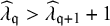 $\widehat {\lambda }_{\mathfrak q}>\widehat {\lambda }_{{\mathfrak q}+1}+1$
and
$\widehat {\lambda }_{\mathfrak q}>\widehat {\lambda }_{{\mathfrak q}+1}+1$
and $\widehat {\mu }_{\mathfrak q}=\widehat {\mu }_{{\mathfrak q}+1}+1$
, so (23) gives
$\widehat {\mu }_{\mathfrak q}=\widehat {\mu }_{{\mathfrak q}+1}+1$
, so (23) gives $\widehat {\xi }_{\mathfrak q}>\widehat {\xi }_{{\mathfrak q}+1}$
. We therefore have
$\widehat {\xi }_{\mathfrak q}>\widehat {\xi }_{{\mathfrak q}+1}$
. We therefore have ${\mathfrak q}=p_j$
for some
${\mathfrak q}=p_j$
for some ${\mathfrak q}\in [1,t]$
, and hence
${\mathfrak q}\in [1,t]$
, and hence $i=\widehat {\mu }_{p_j}-1 = \widehat {\mu }_{p_j+1}=-u_{p_j+1}=-\widehat {w}_{k+d_{j-1}+1}$
. Since we have
$i=\widehat {\mu }_{p_j}-1 = \widehat {\mu }_{p_j+1}=-u_{p_j+1}=-\widehat {w}_{k+d_{j-1}+1}$
. Since we have
 $$\begin{align*}\widehat{w}_{k+1}> \widehat{w}_{k+d_1+1} >\cdots > \widehat{w}_{k+d_{j-1}+1} =-i, \end{align*}$$
and the sequence $(\widehat {w}_{k+1},\ldots ,\widehat {w}_n)$
is
$(\widehat {w}_{k+1},\ldots ,\widehat {w}_n)$
is $132$
-avoiding, we conclude that
$132$
-avoiding, we conclude that $\widehat {w}^{-1}(-i) = k+d_{j-1}+1 < \widehat {w}^{-1}(-i-1)$
, as desired.
$\widehat {w}^{-1}(-i) = k+d_{j-1}+1 < \widehat {w}^{-1}(-i-1)$
, as desired.
Suppose next that ${\mathfrak q}>m$
. Then, we have
${\mathfrak q}>m$
. Then, we have $\widehat {\lambda }_{\mathfrak q}>\widehat {\lambda }_{{\mathfrak q}+1}$
, so Lemma 11(b) and equation (23) imply that
$\widehat {\lambda }_{\mathfrak q}>\widehat {\lambda }_{{\mathfrak q}+1}$
, so Lemma 11(b) and equation (23) imply that $\widehat {\xi }_{\mathfrak q}>\widehat {\xi }_{{\mathfrak q}+1}$
. We deduce that
$\widehat {\xi }_{\mathfrak q}>\widehat {\xi }_{{\mathfrak q}+1}$
. We deduce that ${\mathfrak q}=p_j$
for some j, hence
${\mathfrak q}=p_j$
for some j, hence $i+1=u_{p_j+1}$
and the result follows.
$i+1=u_{p_j+1}$
and the result follows.
According to Corollary 1, we have
 $$ \begin{align} {\mathfrak C}_{\widehat{w}} = R^{D(\widehat{w})} \, {}^{k^{n-k}+\widehat{\xi}}c^{\beta(\widehat{w})}_{\lambda(\widehat{w})}, \end{align} $$
so the proposition holds for leading elements. Suppose next that $w:={\omega }\widehat {w}$
is a modification of
$w:={\omega }\widehat {w}$
is a modification of $\widehat {w}$
. Then repeated application of (8), Lemma 3(a), and the left Leibnitz rule (6) in equation (24) give
$\widehat {w}$
. Then repeated application of (8), Lemma 3(a), and the left Leibnitz rule (6) in equation (24) give
 $$\begin{align*}{\mathfrak C}_w = R^{D(w)} \, {}^{k^{n-k}+\widehat{\xi}}c^{\beta(w)+\widehat{\xi}-\xi}_{\lambda(w)}. \end{align*}$$
It remains to check the last assertion, about the left and right descents of w.
Let $R_1\dots R_{n-1}$
be the reduced decomposition for
$R_1\dots R_{n-1}$
be the reduced decomposition for ${\omega }$
from Definition 7. We will study the left action of the successive simple transpositions in
${\omega }$
from Definition 7. We will study the left action of the successive simple transpositions in $R_1\dots R_{n-1}$
on
$R_1\dots R_{n-1}$
on $\widehat {w}$
. Observe that
$\widehat {w}$
. Observe that $\sigma ^-$
and
$\sigma ^-$
and $\sigma ^+$
are disjoint and
$\sigma ^+$
are disjoint and $\sigma ^-\sigma ^+ = \sigma ^+ \sigma ^-$
. Moreover, the actions of the
$\sigma ^-\sigma ^+ = \sigma ^+ \sigma ^-$
. Moreover, the actions of the $\widehat {w}$
-positive and
$\widehat {w}$
-positive and $\widehat {w}$
-negative simple transpositions on
$\widehat {w}$
-negative simple transpositions on $\widehat {w}$
are similar, and we can consider them separately. Let
$\widehat {w}$
are similar, and we can consider them separately. Let $A:=\{k+1,k+d_1+1,\ldots , k+d_t+1\}$
.
$A:=\{k+1,k+d_1+1,\ldots , k+d_t+1\}$
.
We begin with the $\widehat {w}$
-positive simple transpositions. The action of these on
$\widehat {w}$
-positive simple transpositions. The action of these on $\widehat {w}$
is by a finite sequence of moves
$\widehat {w}$
is by a finite sequence of moves $v\mapsto v'$
, where
$v\mapsto v'$
, where $v'=s_i\dots s_{j-1}v$
for some
$v'=s_i\dots s_{j-1}v$
for some $i,j$
with
$i,j$
with $1\leq i < j$
,
$1\leq i < j$
, $\ell (v')=\ell (v)-j+i$
, and
$\ell (v')=\ell (v)-j+i$
, and $s_i\dots s_{j-1}$
is a subword of some
$s_i\dots s_{j-1}$
is a subword of some $R_p$
with
$R_p$
with $j-i$
maximal. We call such a move an
$j-i$
maximal. We call such a move an $[i,j]$
-move at position r if
$[i,j]$
-move at position r if $v_r=j$
and
$v_r=j$
and $v^{\prime }_r=i$
, so that
$v^{\prime }_r=i$
, so that $v'$
is obtained from v by cyclically permuting the values
$v'$
is obtained from v by cyclically permuting the values $i,i+1,\ldots ,j$
. Observe that we must have
$i,i+1,\ldots ,j$
. Observe that we must have $r\in A$
, and subsequent
$r\in A$
, and subsequent $[i',j']$
-moves for
$[i',j']$
-moves for $[i',j']\subset [i,j]$
are at positions
$[i',j']\subset [i,j]$
are at positions $r'\in A$
with
$r'\in A$
with $r< r'$
. This follows from the fact that the sequence
$r< r'$
. This follows from the fact that the sequence $(\widehat {w}_{k+1},\ldots ,\widehat {w}_n)$
is
$(\widehat {w}_{k+1},\ldots ,\widehat {w}_n)$
is $132$
-avoiding, and by induction on the number of moves.
$132$
-avoiding, and by induction on the number of moves.
Let $\alpha $
denote the truncated A-code of v, and
$\alpha $
denote the truncated A-code of v, and $\xi _v$
,
$\xi _v$
, $g_v:=\beta +\widehat {\xi }-\xi _v$
the associated statistics, with
$g_v:=\beta +\widehat {\xi }-\xi _v$
the associated statistics, with $\alpha ', \xi ':=\xi _{v'}$
,
$\alpha ', \xi ':=\xi _{v'}$
, $g'=g_{v'}:=\beta +\widehat {\xi }-\xi '$
the corresponding ones for
$g'=g_{v'}:=\beta +\widehat {\xi }-\xi '$
the corresponding ones for $v'$
. If
$v'$
. If $\alpha _r=e$
, then we have
$\alpha _r=e$
, then we have $\alpha ^{\prime }_r=d$
for
$\alpha ^{\prime }_r=d$
for $d=e+i-j$
, and
$d=e+i-j$
, and $\alpha ^{\prime }_s=\alpha _s$
for all
$\alpha ^{\prime }_s=\alpha _s$
for all $s\neq r$
. If
$s\neq r$
. If $\xi _v=(\xi _1,\xi _2,\ldots )$
and
$\xi _v=(\xi _1,\xi _2,\ldots )$
and $g_v=(g_1,g_2,\ldots )$
, then
$g_v=(g_1,g_2,\ldots )$
, then $g_{d+1}=i, \ldots , g_e = j-1$
, while
$g_{d+1}=i, \ldots , g_e = j-1$
, while
 $$\begin{align*}\xi'=(\xi_1,\ldots,\xi_d,\xi_{d+1}-1,\ldots,\xi_e-1,\xi_{e+1},\ldots) \end{align*}$$
and
 $$ \begin{align*} g' &= (g_1,\ldots,g_d,g_{d+1}+1,\ldots,g_e+1,g_{e+1},\ldots) \\ & = (g_1,\ldots,g_d,i+1,\ldots,j,g_{e+1},\ldots). \end{align*} $$
Lemma 11 implies that the critical indices of v and $v'$
can only differ in positions d and e. Since the simple transpositions
$v'$
can only differ in positions d and e. Since the simple transpositions $s_i,\ldots , s_{j-1}$
are all
$s_i,\ldots , s_{j-1}$
are all $\widehat {w}$
-positive, we have
$\widehat {w}$
-positive, we have $\beta _s+1=\beta _{s+1}$
for all
$\beta _s+1=\beta _{s+1}$
for all $s\in [d+1,e]$
. If
$s\in [d+1,e]$
. If $\beta _d+1<\beta _{d+1}$
, then
$\beta _d+1<\beta _{d+1}$
, then $|g_d| = |\beta _d|$
is a left descent of both
$|g_d| = |\beta _d|$
is a left descent of both $\widehat {w}$
and
$\widehat {w}$
and $v'$
, by Lemma 11. We may therefore assume that
$v'$
, by Lemma 11. We may therefore assume that $\beta _s+1=\beta _{s+1}$
for all
$\beta _s+1=\beta _{s+1}$
for all $s\in [d,e]$
, and only need to study the
$s\in [d,e]$
, and only need to study the $s\in [d,e],$
where
$s\in [d,e],$
where $\xi ^{\prime }_s>\xi ^{\prime }_{s+1}$
. If
$\xi ^{\prime }_s>\xi ^{\prime }_{s+1}$
. If $s\in [d+1,e]$
, since the values
$s\in [d+1,e]$
, since the values $i,\ldots ,j$
of v are cyclically permuted in
$i,\ldots ,j$
of v are cyclically permuted in $v'$
, it follows by induction on the number of moves that
$v'$
, it follows by induction on the number of moves that $g^{\prime }_s$
is a left descent of
$g^{\prime }_s$
is a left descent of $v'$
. Notice that we must have
$v'$
. Notice that we must have $i\geq 2$
in this situation. It remains to prove that
$i\geq 2$
in this situation. It remains to prove that $g^{\prime }_d=g_d=i-1$
is a left descent of
$g^{\prime }_d=g_d=i-1$
is a left descent of $v'$
. But since
$v'$
. But since $\widehat {w}^{-1}(i-1)>k$
and the sequence
$\widehat {w}^{-1}(i-1)>k$
and the sequence $(\widehat {w}_{k+1},\ldots ,\widehat {w}_n)$
is
$(\widehat {w}_{k+1},\ldots ,\widehat {w}_n)$
is $132$
-avoiding, we deduce that
$132$
-avoiding, we deduce that $(v')^{-1}(i)=r<(v')^{-1}(i-1)$
, as desired.
$(v')^{-1}(i)=r<(v')^{-1}(i-1)$
, as desired.
The above procedure shows that for any critical index h of $v'$
, we must have
$v'$
, we must have
 $$\begin{align*}\widehat{\xi}_h=\max(i\ |\ \widehat{\gamma}_{k+i}\geq h) = \max(i\ |\ \alpha^{\prime}_i \geq h), \end{align*}$$
while $k+\max (i\ |\ \alpha ^{\prime }_i \geq h)$
is a right descent of
$k+\max (i\ |\ \alpha ^{\prime }_i \geq h)$
is a right descent of $v'$
, by Lemma 2. Finally, the action of the
$v'$
, by Lemma 2. Finally, the action of the $\widehat {w}$
-negative simple transpositions on
$\widehat {w}$
-negative simple transpositions on $\widehat {w}$
is studied in the same way.
$\widehat {w}$
is studied in the same way.
Theorem 4. For any amenable element $w\in W_\infty $
, we have
$w\in W_\infty $
, we have
 $$ \begin{align} {\mathfrak C}_w = R^{D(w)} \, {}^{{\mathfrak f}(w)}c_{\lambda(w)}^{{\mathfrak g}(w)} \end{align} $$
in $\Gamma [X,Y]$
.
$\Gamma [X,Y]$
.
Proof. We may assume that we are in the situation of Proposition 7, so that $w={\omega }\widehat {w}$
, with
$w={\omega }\widehat {w}$
, with $\widehat {\lambda }=\lambda (\widehat {w})$
and
$\widehat {\lambda }=\lambda (\widehat {w})$
and $\lambda =\lambda (w)$
. Suppose that
$\lambda =\lambda (w)$
. Suppose that $j\in [1,\ell ]$
and let
$j\in [1,\ell ]$
and let ${\mathfrak q}$
be the least critical index of w such that
${\mathfrak q}$
be the least critical index of w such that ${\mathfrak q}\geq j$
. Then, we have
${\mathfrak q}\geq j$
. Then, we have $\lambda _j=\lambda _{j+1}=\cdots = \lambda _{\mathfrak q}$
, if
$\lambda _j=\lambda _{j+1}=\cdots = \lambda _{\mathfrak q}$
, if ${\mathfrak q}>m$
, and
${\mathfrak q}>m$
, and $\lambda _j=\lambda _{j+1}+1 = \cdots = \lambda _{\mathfrak q}+({\mathfrak q}-j)$
, if
$\lambda _j=\lambda _{j+1}+1 = \cdots = \lambda _{\mathfrak q}+({\mathfrak q}-j)$
, if ${\mathfrak q}\leq m$
. Moreover, in either case, we have
${\mathfrak q}\leq m$
. Moreover, in either case, we have $\xi _j=\cdots = \xi _{\mathfrak q}$
, and the values
$\xi _j=\cdots = \xi _{\mathfrak q}$
, and the values $\beta _j,\ldots ,\beta _{\mathfrak q}$
are consecutive integers. As the sequence
$\beta _j,\ldots ,\beta _{\mathfrak q}$
are consecutive integers. As the sequence $g:=\beta +\widehat {\xi }-\xi $
is weakly increasing, we deduce that for any
$g:=\beta +\widehat {\xi }-\xi $
is weakly increasing, we deduce that for any $r\in [j,{\mathfrak q}-1]$
, either (i)
$r\in [j,{\mathfrak q}-1]$
, either (i) $\widehat {\xi }_r=\widehat {\xi }_{r+1}$
and
$\widehat {\xi }_r=\widehat {\xi }_{r+1}$
and $g_r=g_{r+1}-1$
or (ii)
$g_r=g_{r+1}-1$
or (ii) $\widehat {\xi }_r=\widehat {\xi }_{r+1}+1$
and
$\widehat {\xi }_r=\widehat {\xi }_{r+1}+1$
and $g_r=g_{r+1}$
. Theorem 4 follows from this and induction on
$g_r=g_{r+1}$
. Theorem 4 follows from this and induction on ${\mathfrak q}-j$
, by employing Lemmas 5(b) and 6(b) in Proposition 7. The required conditions on
${\mathfrak q}-j$
, by employing Lemmas 5(b) and 6(b) in Proposition 7. The required conditions on $D(w)$
in these two lemmas and the corresponding relations (7) are both easily checked.
$D(w)$
in these two lemmas and the corresponding relations (7) are both easily checked.
Remark 4. The equalities, such as (25) in this section, occur in $\Gamma [X,Y]$
, which is a ring with relations coming from
$\Gamma [X,Y]$
, which is a ring with relations coming from $\Gamma $
. Therefore, they are not equalities of polynomials in independent variables, in contrast to the situation in type A. The same remark applies to the corresponding equalities in Section 6.1.
$\Gamma $
. Therefore, they are not equalities of polynomials in independent variables, in contrast to the situation in type A. The same remark applies to the corresponding equalities in Section 6.1.
Anderson and Fulton [Reference Anderson and Fulton2] have introduced a family of signed permutations, each determined by an algorithm starting from an equivalence class of “triples.” These were named “theta-vexillary” and studied further by Lambert [Reference Lambert16]. It seems plausible that the theta-vexillary signed permutations coincide with our amenable elements in types B and C, but we do not examine this question here.
5.2. Flagged theta polynomials
In this section, we define a family of polynomials $\Theta _w$
indexed by amenable elements
$\Theta _w$
indexed by amenable elements $w\in W_\infty $
that generalize Wilson’s double theta polynomials [Reference Tamvakis and Wilson31], [Reference Wilson32]. For each
$w\in W_\infty $
that generalize Wilson’s double theta polynomials [Reference Tamvakis and Wilson31], [Reference Wilson32]. For each $k\geq 0$
, let
$k\geq 0$
, let ${}^k{\mathfrak c}:=({}^k{\mathfrak c}_p)_{p\in {\mathbb Z}}$
be a family of variables, such that
${}^k{\mathfrak c}:=({}^k{\mathfrak c}_p)_{p\in {\mathbb Z}}$
be a family of variables, such that ${}^k{\mathfrak c}_0=1$
and
${}^k{\mathfrak c}_0=1$
and ${}^k{\mathfrak c}_p=0$
for
${}^k{\mathfrak c}_p=0$
for $p<0$
, and let
$p<0$
, and let $t:=(t_1,t_2,\ldots )$
. The polynomial
$t:=(t_1,t_2,\ldots )$
. The polynomial $\Theta _w$
represents an equivariant Schubert class in the T-equivariant cohomology ring of the symplectic partial flag variety associated with the right flag
$\Theta _w$
represents an equivariant Schubert class in the T-equivariant cohomology ring of the symplectic partial flag variety associated with the right flag ${\mathfrak f}(w)$
, which is defined in [Reference Tamvakis25, Section 4.1]. The t variables come from the characters of the maximal torus T, as explained in [Reference Tamvakis and Wilson31].
${\mathfrak f}(w)$
, which is defined in [Reference Tamvakis25, Section 4.1]. The t variables come from the characters of the maximal torus T, as explained in [Reference Tamvakis and Wilson31].
For any integers p and r, define
 $$\begin{align*}{}^k{\mathfrak c}_p^r:=\sum_{j=0}^p {}^k{\mathfrak c}_{p-j}h_j^r(-t). \end{align*}$$
Given integer sequences ${\kappa }$
,
${\kappa }$
, $\alpha $
, and
$\alpha $
, and $\rho $
, let
$\rho $
, let ${}^{\kappa } {\mathfrak c}^{\rho }_\alpha := {}^{{\kappa }_1}{\mathfrak c}_{\alpha _1}^{\rho _1}\, {}^{{\kappa }_2}{\mathfrak c}_{\alpha _2}^{\rho _2} \dots $
, and let any raising operator R act in the usual way, by
${}^{\kappa } {\mathfrak c}^{\rho }_\alpha := {}^{{\kappa }_1}{\mathfrak c}_{\alpha _1}^{\rho _1}\, {}^{{\kappa }_2}{\mathfrak c}_{\alpha _2}^{\rho _2} \dots $
, and let any raising operator R act in the usual way, by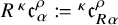 $R\,{}^{\kappa } {\mathfrak c}^{\rho }_\alpha := {}^{\kappa } {\mathfrak c}^{\rho }_{R\alpha }$
.
$R\,{}^{\kappa } {\mathfrak c}^{\rho }_\alpha := {}^{\kappa } {\mathfrak c}^{\rho }_{R\alpha }$
.
If $w\in W_n$
is amenable with left flag
$w\in W_n$
is amenable with left flag ${\mathfrak f}(w)$
and right flag
${\mathfrak f}(w)$
and right flag ${\mathfrak g}(w)$
, then the flagged double theta polynomial
${\mathfrak g}(w)$
, then the flagged double theta polynomial $\Theta _w({\mathfrak c}\, |\, t)$
is defined by
$\Theta _w({\mathfrak c}\, |\, t)$
is defined by
 $$ \begin{align} \Theta_w({\mathfrak c}\, |\, t):= R^{D(w)}\, {}^{{\mathfrak f}(w)}{\mathfrak c}_{\lambda(w)}^{{\mathfrak g}(w)}. \end{align} $$
The flagged single theta polynomial is given by $\Theta _w({\mathfrak c}):=\Theta _w({\mathfrak c}\, |\, 0)$
. If w is a leading element, then (26) can be written in the “factorial” form
$\Theta _w({\mathfrak c}):=\Theta _w({\mathfrak c}\, |\, 0)$
. If w is a leading element, then (26) can be written in the “factorial” form
 $$\begin{align*}\Theta_w({\mathfrak c}\, |\, t)= R^{D(w)}\, {}^{{\mathfrak f}(w)}{\mathfrak c}_{\lambda(w)}^{\beta(w)}. \end{align*}$$
When w is a k-Grassmannian element, the above formulas specialize to the double theta polynomial $\Theta _\lambda ({\mathfrak c}\, |\, t)$
found in [Reference Tamvakis and Wilson31]; here,
$\Theta _\lambda ({\mathfrak c}\, |\, t)$
found in [Reference Tamvakis and Wilson31]; here, $\lambda $
is the k-strict partition corresponding to w. Moreover, the single theta polynomial
$\lambda $
is the k-strict partition corresponding to w. Moreover, the single theta polynomial $\Theta _\lambda ({\mathfrak c})$
agrees with that of [Reference Buch, Kresch and Tamvakis7].
$\Theta _\lambda ({\mathfrak c})$
agrees with that of [Reference Buch, Kresch and Tamvakis7].
5.3. Symplectic degeneracy loci
Let $E\to {\mathfrak X}$
be a vector bundle of rank
$E\to {\mathfrak X}$
be a vector bundle of rank $2n$
on a smooth complex algebraic variety
$2n$
on a smooth complex algebraic variety ${\mathfrak X}$
. Assume that E is a symplectic bundle, so that E is equipped with an everywhere nondegenerate skew-symmetric form
${\mathfrak X}$
. Assume that E is a symplectic bundle, so that E is equipped with an everywhere nondegenerate skew-symmetric form $E\otimes E\to {\mathbb C}$
. Let
$E\otimes E\to {\mathbb C}$
. Let $w\in W_n$
be amenable of shape
$w\in W_n$
be amenable of shape $\lambda $
, and let
$\lambda $
, and let ${\mathfrak f}$
and
${\mathfrak f}$
and ${\mathfrak g}$
be the left and right flags of w, respectively. Consider two complete flags of subbundles of E
${\mathfrak g}$
be the left and right flags of w, respectively. Consider two complete flags of subbundles of E
 $$\begin{align*}0 \subset E_1\subset \cdots \subset E_{2n}=E \ \ \, \mathrm{and} \, \ \ 0 \subset F_1\subset \cdots \subset F_{2n}=E \end{align*}$$
with ${\mathrm {rank}}\ E_r={\mathrm {rank}}\ F_r=r$
for each r, while
${\mathrm {rank}}\ E_r={\mathrm {rank}}\ F_r=r$
for each r, while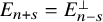 $E_{n+s}=E_{n-s}^{\perp }$
and
$E_{n+s}=E_{n-s}^{\perp }$
and $F_{n+s}=F_{n-s}^{\perp }$
for
$F_{n+s}=F_{n-s}^{\perp }$
for $0\leq s < n$
.
$0\leq s < n$
.
There is a group monomorphism $\zeta :W_n\hookrightarrow S_{2n}$
with image
$\zeta :W_n\hookrightarrow S_{2n}$
with image
 $$\begin{align*}\zeta(W_n)=\{\,{\varpi}\in S_{2n} \ |\ {\varpi}_i+{\varpi}_{2n+1-i} = 2n+1, \ \ \text{for all} \ i\,\}. \end{align*}$$
The map $\zeta $
is determined by setting, for each
$\zeta $
is determined by setting, for each $w=(w_1,\ldots ,w_n)\in W_n$
and
$w=(w_1,\ldots ,w_n)\in W_n$
and $1\leq i \leq n$
,
$1\leq i \leq n$
,
 $$\begin{align*}\zeta(w)_i :=\left\{ \begin{array}{cl} n+1-w_{n+1-i} & \mathrm{ if } \ w_{n+1-i} \ \mathrm{is} \ \mathrm{unbarred}, \\ n+\overline{w}_{n+1-i} & \mathrm{otherwise}. \end{array} \right. \end{align*}$$
Define the degeneracy locus ${\mathfrak X}_w\subset {\mathfrak X}$
as the locus of
${\mathfrak X}_w\subset {\mathfrak X}$
as the locus of $x \in {\mathfrak X}$
such that
$x \in {\mathfrak X}$
such that
 $$\begin{align*}\dim(E_r(x)\cap F_s(x))\geq \#\,\{\,i \leq r \ |\ \zeta(w)_i> 2n-s\,\} \ \, \mathrm{for} \ 1\leq r \leq n, \, 1\leq s \leq 2n. \end{align*}$$
We assume that ${\mathfrak X}_w$
has pure codimension
${\mathfrak X}_w$
has pure codimension $\ell (w)$
in
$\ell (w)$
in ${\mathfrak X}$
, and give a formula for the class
${\mathfrak X}$
, and give a formula for the class $[{\mathfrak X}_w]$
in
$[{\mathfrak X}_w]$
in ${\mathrm {H}}^{2\ell (w)}({\mathfrak X})$
.
${\mathrm {H}}^{2\ell (w)}({\mathfrak X})$
.
Theorem 5. For any amenable element $w\in W_n$
, we have
$w\in W_n$
, we have
 $$ \begin{align} [{\mathfrak X}_w] = \Theta_w(E-E_{n-{\mathfrak f}}-F_{n+{\mathfrak g}}) = R^{D(w)}\, c_{\lambda}(E-E_{n-{\mathfrak f}}-F_{n+{\mathfrak g}}) \end{align} $$
in the cohomology ring ${\mathrm {H}}^*({\mathfrak X})$
.
${\mathrm {H}}^*({\mathfrak X})$
.
As in [Reference Tamvakis and Wilson31, Equation (7)], the Chern polynomial in (27) is interpreted as the image of the polynomial $R^{D(w)} \mathfrak {c}_\lambda $
under the
$R^{D(w)} \mathfrak {c}_\lambda $
under the ${\mathbb Z}$
-linear map which sends the noncommutative monomial
${\mathbb Z}$
-linear map which sends the noncommutative monomial ${\mathfrak c}_\alpha ={\mathfrak c}_{\alpha _1}{\mathfrak c}_{\alpha _2}\dots $
to
${\mathfrak c}_\alpha ={\mathfrak c}_{\alpha _1}{\mathfrak c}_{\alpha _2}\dots $
to $\prod _j c_{\alpha _j}(E-E_{n-{\mathfrak f}_j}-F_{n+{\mathfrak g}_j})$
, for every integer sequence
$\prod _j c_{\alpha _j}(E-E_{n-{\mathfrak f}_j}-F_{n+{\mathfrak g}_j})$
, for every integer sequence $\alpha $
. Theorem 5 is proved by applying the type C geometrization map of [Reference Ikeda, Mihalcea and Naruse13, Section 10] to both sides of (25), following [Reference Tamvakis25, Section 4.2].
$\alpha $
. Theorem 5 is proved by applying the type C geometrization map of [Reference Ikeda, Mihalcea and Naruse13, Section 10] to both sides of (25), following [Reference Tamvakis25, Section 4.2].
6. Amenable elements: Type D theory
6.1. Definitions and main theorem
Let w be an element in $\widetilde {W}_\infty $
with A-code
$\widetilde {W}_\infty $
with A-code $\gamma $
and shape
$\gamma $
and shape $\lambda =\mu +\nu $
, with
$\lambda =\mu +\nu $
, with $\ell =\ell (\lambda )$
and
$\ell =\ell (\lambda )$
and $m=\ell (\mu )$
. Choose
$m=\ell (\mu )$
. Choose $k\geq 1$
, and assume that w is increasing up to k. If
$k\geq 1$
, and assume that w is increasing up to k. If $k=1$
, this condition is vacuous, while if
$k=1$
, this condition is vacuous, while if $k>1,$
it means that
$k>1,$
it means that $|w_1|<w_2<\cdots <w_k$
. Eventually, k will be set equal to the primary index of w.
$|w_1|<w_2<\cdots <w_k$
. Eventually, k will be set equal to the primary index of w.
List the entries $w_{k+1},\ldots ,w_n$
in increasing order:
$w_{k+1},\ldots ,w_n$
in increasing order:
 $$\begin{align*}u_1<\cdots < u_{m'} < 0 < u_{m'+1} < \cdots < u_{n-k}, \end{align*}$$
where $m'\in \{m,m+1\}$
. Define a sequence
$m'\in \{m,m+1\}$
. Define a sequence $\beta (w)$
by
$\beta (w)$
by
 $$\begin{align*}\beta(w):=(u_1+1,\ldots,u_{m'}+1,u_{m'+1},\ldots,u_{n-k}) \end{align*}$$
and the denominator set $D(w)$
by
$D(w)$
by
 $$\begin{align*}D(w):=\{(i,j) \ |\ 1\leq i<j \leq n-k \ \, \text{and} \ \, u_i+ u_j < 0 \}. \end{align*}$$
As in Section 5.1, the notation suppresses the dependence of $\beta (w)$
and
$\beta (w)$
and $D(w)$
on k.
$D(w)$
on k.
Definition 10. Suppose that $w\in \widetilde {W}_n$
has code
$w\in \widetilde {W}_n$
has code $\gamma =\gamma (w)$
and
$\gamma =\gamma (w)$
and $k\geq 1$
. The k-truncated A-code
$k\geq 1$
. The k-truncated A-code ${}^k\gamma ={}^k\gamma (w)$
is defined by
${}^k\gamma ={}^k\gamma (w)$
is defined by ${}^k\gamma (w):=(\gamma _{k+1}, \gamma _{k+2},\ldots , \gamma _n)$
. If k is the primary index of w, then we call
${}^k\gamma (w):=(\gamma _{k+1}, \gamma _{k+2},\ldots , \gamma _n)$
. If k is the primary index of w, then we call ${}^k\gamma (w)$
the truncated A-code of w. Let
${}^k\gamma (w)$
the truncated A-code of w. Let $\xi =\xi (w)$
be the partition whose parts satisfy
$\xi =\xi (w)$
be the partition whose parts satisfy $\xi _j:=\#\{i\ |\ \gamma _{k+i}\geq j\}$
for each
$\xi _j:=\#\{i\ |\ \gamma _{k+i}\geq j\}$
for each $j\geq 1$
.
$j\geq 1$
.
We let $v(w)$
be the unique k-Grassmannian element obtained by reordering the entries
$v(w)$
be the unique k-Grassmannian element obtained by reordering the entries $w_{k+1},\ldots ,w_n$
to be increasing. For example, if
$w_{k+1},\ldots ,w_n$
to be increasing. For example, if $w:=(\overline {2},4,7,5,\overline {8},\overline {3},1,\overline {6})$
and
$w:=(\overline {2},4,7,5,\overline {8},\overline {3},1,\overline {6})$
and $k:=3$
, then
$k:=3$
, then $v(w)=(\overline {2},4,7,\overline {8},\overline {6},\overline {3},1,5)$
. The map
$v(w)=(\overline {2},4,7,\overline {8},\overline {6},\overline {3},1,5)$
. The map $w \mapsto v(w)$
is a type-preserving bijection from the set of elements in
$w \mapsto v(w)$
is a type-preserving bijection from the set of elements in $\widetilde {W}_n$
increasing up to k with a given k-truncated A-code C onto the set of k-Grassmannian elements in
$\widetilde {W}_n$
increasing up to k with a given k-truncated A-code C onto the set of k-Grassmannian elements in $\widetilde {W}_n$
, such that
$\widetilde {W}_n$
, such that $\beta (v(w))=\beta (w)$
and
$\beta (v(w))=\beta (w)$
and
 $$\begin{align*}\ell(v(w)) = \ell(w)-\sum_{i=k+1}^n C_i = \ell(w)-\sum_{j=1}^{n-k} \gamma_{k+j}. \end{align*}$$
Lemma 12. Let w and $\overline {w}$
be elements in
$\overline {w}$
be elements in $\widetilde {W}_n$
increasing up to
$\widetilde {W}_n$
increasing up to $k\geq 1$
and with the same k-truncated A-code C, such that
$k\geq 1$
and with the same k-truncated A-code C, such that $\ell (w)=\ell (\overline {w})+1$
. Suppose that
$\ell (w)=\ell (\overline {w})+1$
. Suppose that $v(\overline {w})=s_iv(w)$
for some simple reflection
$v(\overline {w})=s_iv(w)$
for some simple reflection $s_i$
. Then,
$s_i$
. Then, $\overline {w}=s_iw$
.
$\overline {w}=s_iw$
.
Proof. We have seven possible cases for i and $v(w)$
: (a)
$v(w)$
: (a) $i=\Box $
and
$i=\Box $
and $v(w) = (\widehat {1} \cdots \overline {2} \cdots )$
; (b)
$v(w) = (\widehat {1} \cdots \overline {2} \cdots )$
; (b) $i=\Box $
and
$i=\Box $
and $v(w) = (\cdots \overline {2} \cdots \overline {1} \cdots )$
; (c)
$v(w) = (\cdots \overline {2} \cdots \overline {1} \cdots )$
; (c) $i=\Box $
and
$i=\Box $
and $v(w) = (2 \cdots \overline {1} \cdots )$
; (d)
$v(w) = (2 \cdots \overline {1} \cdots )$
; (d) $i\geq 1$
and
$i\geq 1$
and $v(w) = (\cdots i \cdots \overline {i+1} \cdots )$
; (e)
$v(w) = (\cdots i \cdots \overline {i+1} \cdots )$
; (e) $i\geq 1$
and
$i\geq 1$
and $v(w) = (\cdots \overline {i+1} \cdots i \cdots )$
; (f)
$v(w) = (\cdots \overline {i+1} \cdots i \cdots )$
; (f) $i\geq 1$
and
$i\geq 1$
and $v(w) = (\overline {i} \cdots \overline {i+1} \cdots )$
; and (g)
$v(w) = (\overline {i} \cdots \overline {i+1} \cdots )$
; and (g) $i \geq 1$
and
$i \geq 1$
and $v(w) = (\cdots i+1 \cdots i \cdots )$
. In the first five cases, it is clear that
$v(w) = (\cdots i+1 \cdots i \cdots )$
. In the first five cases, it is clear that $\overline {w}=s_iw$
. In case (f) (respectively, (g)), the
$\overline {w}=s_iw$
. In case (f) (respectively, (g)), the $\overline {i}$
(respectively,
$\overline {i}$
(respectively, $i+1$
) must be among the first k entries of
$i+1$
) must be among the first k entries of $v(w)$
, which coincide with the first k entries of w, while
$v(w)$
, which coincide with the first k entries of w, while $\overline {i+1}$
(respectively, i) lies among the last
$\overline {i+1}$
(respectively, i) lies among the last $n-k$
entries of w. Hence, we again deduce that
$n-k$
entries of w. Hence, we again deduce that $\overline {w}=s_iw$
.
$\overline {w}=s_iw$
.
If $R:=\prod _{i<j} R_{ij}^{n_{ij}}$
is any raising operator and
$R:=\prod _{i<j} R_{ij}^{n_{ij}}$
is any raising operator and $d \geq 0$
, denote by
$d \geq 0$
, denote by ${\mathrm {supp}}_d(R)$
the set of all indices i and j such that
${\mathrm {supp}}_d(R)$
the set of all indices i and j such that $n_{ij}>0$
and
$n_{ij}>0$
and $j \leq d$
.
$j \leq d$
.
Definition 11. Let $w\in \widetilde {W}_n$
be of shape
$w\in \widetilde {W}_n$
be of shape $\lambda =\mu +\nu $
, with
$\lambda =\mu +\nu $
, with $\ell =\ell (\lambda )$
and
$\ell =\ell (\lambda )$
and $m=\ell (\mu )$
. Let
$m=\ell (\mu )$
. Let $\alpha =(\alpha _1,\ldots ,\alpha _{\ell })$
be a composition such that
$\alpha =(\alpha _1,\ldots ,\alpha _{\ell })$
be a composition such that $\alpha _{m+1}=\lambda _{m+1}$
, if
$\alpha _{m+1}=\lambda _{m+1}$
, if ${\mathrm {type}}(w)>0$
, and
${\mathrm {type}}(w)>0$
, and $\upsilon =(\upsilon _1,\ldots ,\upsilon _\ell )$
be an integer vector such that
$\upsilon =(\upsilon _1,\ldots ,\upsilon _\ell )$
be an integer vector such that $\upsilon _{m+1}\in \{0,1\}$
. For any integer vector
$\upsilon _{m+1}\in \{0,1\}$
. For any integer vector $\rho $
, define
$\rho $
, define
 $$\begin{align*}{}^\alpha\widehat{c}_\rho^{\,\upsilon}:= {}^{\alpha_1}\widehat{c}_{\rho_1}^{\,\upsilon_1} {}^{\rho_2}\widehat{c}_{\rho_2}^{\,\upsilon_2}\cdots \end{align*}$$
where, for each $i\geq 1$
,
$i\geq 1$
,
 $$ \begin{align} {}^{\alpha_i}\widehat{c}_{\rho_i}^{\,\upsilon_i}:= {}^{\alpha_i}c_{\rho_i}^{\upsilon_i} + \begin{cases} (-1)^ie^{\alpha_i}_{\alpha_i}(X)e^{\rho_i-\alpha_i}_{\rho_i-\alpha_i}(-Y) & \text{if } \upsilon_i = \alpha_i - \rho_i < 0, \\ 0 & \text{otherwise}. \end{cases} \end{align} $$
Let R be any raising operator appearing in the expansion of the power series $R^{D(w)}$
and set
$R^{D(w)}$
and set $\rho :=R\lambda $
. If
$\rho :=R\lambda $
. If ${\mathrm {type}}(w)=0$
, then define
${\mathrm {type}}(w)=0$
, then define
 $$\begin{align*}R \star {}^{\alpha}\widehat{c}^{\,\upsilon}_{\lambda} = {}^{\alpha}\overline{c}^\upsilon_{\rho} := {}^{\alpha_1}\overline{c}_{\rho_1}^{\upsilon_1}\dots {}^{\alpha_\ell}\overline{c}^{\upsilon_\ell}_{\rho_\ell} \end{align*}$$
where, for each $i\geq 1$
,
$i\geq 1$
,
 $$\begin{align*}{}^{\alpha_i}\overline{c}_{\rho_i}^{\upsilon_i}:= \begin{cases} {}^{\alpha_i}c_{\rho_i}^{\upsilon_i} & \text{if } i\in{\mathrm{supp}}_m(R), \\ {}^{\alpha_i}\widehat{c}_{\rho_i}^{\,\upsilon_i} & \text{otherwise}. \end{cases} \end{align*}$$
If ${\mathrm {type}}(w)>0$
and R involves any factors
${\mathrm {type}}(w)>0$
and R involves any factors $R_{ij}$
with
$R_{ij}$
with $i=m+1$
or
$i=m+1$
or $j=m+1$
, then define
$j=m+1$
, then define
 $$\begin{align*}R \star {}^{\alpha}\widehat{c}^{\,\upsilon}_{\lambda} := {}^{\alpha_1}\overline{c}_{\rho_1}^{\upsilon_1} \dots {}^{\alpha_m}\overline{c}_{\rho_m}^{\upsilon_m} \, {}^{\alpha_{m+1}}a^{\upsilon_{m+1}}_{\rho_{m+1}} \,{}^{\alpha_{m+2}} c_{\rho_{m+2}}^{\upsilon_{m+2}} \dots {}^{\alpha_{\ell}}c^{\upsilon_\ell}_{\rho_\ell}. \end{align*}$$
If R has no such factors, then define
 $$\begin{align*}R \star {}^{\alpha}\widehat{c}^{\,\upsilon}_{\lambda} := \begin{cases} {}^{\alpha_1}\overline{c}_{\rho_1}^{\upsilon_1} \dots {}^{\alpha_m}\overline{c}_{\rho_m}^{\upsilon_m} \, {}^{\alpha_{m+1}}b^{\upsilon_{m+1}}_{\lambda_{m+1}} \, {}^{\alpha_{m+2}}c_{\rho_{m+2}}^{\upsilon_{m+2}} \dots {}^{\alpha_\ell}c^{\upsilon_\ell}_{\rho_\ell} & \text{if } \,{\mathrm{type}}(w) = 1, \\ {}^{\alpha_1}\overline{c}_{\rho_1}^{\upsilon_1} \dots {}^{\alpha_m}\overline{c}_{\rho_m}^{\upsilon_m} \, {}^{\alpha_{m+1}}\widetilde{b}^{\upsilon_{m+1}}_{\lambda_{m+1}} \, {}^{\alpha_{m+2}}c_{\rho_{m+2}}^{\upsilon_{m+2}} \dots {}^{\alpha_\ell}c^{\upsilon_\ell}_{\rho_\ell} & \text{if } \,{\mathrm{type}}(w) = 2. \end{cases} \end{align*}$$
Proposition 8. Suppose that $w\in \widetilde {W}_n$
is an element with primary index k such that
$w\in \widetilde {W}_n$
is an element with primary index k such that $(w_1,\ldots ,w_k)=(\widehat {1},2,\ldots ,k)$
,
$(w_1,\ldots ,w_k)=(\widehat {1},2,\ldots ,k)$
, $w_{k+j}<0$
for
$w_{k+j}<0$
for $1\leq j\leq n-k$
, and the truncated A-code
$1\leq j\leq n-k$
, and the truncated A-code ${}^k\gamma (w)$
is a partition. Then, we have
${}^k\gamma (w)$
is a partition. Then, we have
 $$ \begin{align} {\mathfrak D}_w = 2^{k-n}\, R^{D(w)} \star {}^{\nu(w)}\widehat{c}^{\,(1-n,2-n,\ldots, -k)}_{\lambda(w)}. \end{align} $$
Proof. The proof of (29) is by descending induction on $\ell (w)$
. One knows from [Reference Tamvakis29, Section 4.4] that (29) is true for the longest element
$\ell (w)$
. One knows from [Reference Tamvakis29, Section 4.4] that (29) is true for the longest element $w_0^{(k,n)}:=(\widehat {1},2,\ldots ,k, -k-1,\ldots ,-n)$
, which has shape
$w_0^{(k,n)}:=(\widehat {1},2,\ldots ,k, -k-1,\ldots ,-n)$
, which has shape $(n+k-1,\ldots ,2k)+\delta _{n-k-1}$
of type 0.
$(n+k-1,\ldots ,2k)+\delta _{n-k-1}$
of type 0.
Suppose that $w\neq w_0^{(k,n)}$
satisfies the conditions of the proposition, and the shape of w equals
$w\neq w_0^{(k,n)}$
satisfies the conditions of the proposition, and the shape of w equals $(n+k-1,\ldots ,2k)+\rho (w)$
(of type 0). Then,
$(n+k-1,\ldots ,2k)+\rho (w)$
(of type 0). Then, $\rho \subset \delta _{n-k-1}$
and
$\rho \subset \delta _{n-k-1}$
and $\rho \neq \delta _{n-k-1}$
. Let
$\rho \neq \delta _{n-k-1}$
. Let $r\geq 1$
be the largest integer such that
$r\geq 1$
be the largest integer such that $\rho _i=n-k-i$
for
$\rho _i=n-k-i$
for $i\in [1,r]$
, and let
$i\in [1,r]$
, and let $j:=\rho _{r+1}+1\leq n-k-r-1$
. Then,
$j:=\rho _{r+1}+1\leq n-k-r-1$
. Then, $ws_{k+j}$
is of length
$ws_{k+j}$
is of length $\ell (w)+1$
and satisfies the same conditions,
$\ell (w)+1$
and satisfies the same conditions, $\nu (ws_{k+j})=\nu (w)+\epsilon _{r+1}$
, and
$\nu (ws_{k+j})=\nu (w)+\epsilon _{r+1}$
, and $\lambda (ws_{k+j})=\lambda (w)+\epsilon _{r+1}$
. Using Proposition 1(a), for any integer sequence
$\lambda (ws_{k+j})=\lambda (w)+\epsilon _{r+1}$
. Using Proposition 1(a), for any integer sequence $\alpha =(\alpha _1,\ldots ,\alpha _n)$
, we have
$\alpha =(\alpha _1,\ldots ,\alpha _n)$
, we have
 $$\begin{align*}\partial^x_{k+j}\left({}^{\nu(ws_{k+j})}\widehat{c}^{\,(1-n,\ldots, -k)}_{\alpha}\right) = {}^{\nu(w)}\widehat{c}^{\,(1-n,\ldots, -k)}_{\alpha-\epsilon_{r+1}}. \end{align*}$$
By induction, we deduce that
 $$ \begin{align*} {\mathfrak D}_w &= \partial^x_{k+j}\left({\mathfrak D}_{ws_{k+j}}\right) = 2^{k-n}\, \partial^x_{k+j}\left(R^{\infty} \star {}^{\nu(ws_{k+j})}\widehat{c}^{\,(1-n,\ldots, -k)}_{\lambda(ws_{k+j})}\right) \\ &= 2^{k-n}\,R^{\infty} \star {}^{\nu(w)}\widehat{c}^{\,(1-n,\ldots, -k)}_{\lambda(w)}, \end{align*} $$
proving the proposition.
Let $w\in \widetilde {W}_\infty $
have shape
$w\in \widetilde {W}_\infty $
have shape $\lambda = \mu +\nu $
and
$\lambda = \mu +\nu $
and ${\kappa }$
be any integer sequence. We say that
${\kappa }$
be any integer sequence. We say that ${\kappa }$
is compatible with w if
${\kappa }$
is compatible with w if ${\kappa }_p=\nu _p$
for
${\kappa }_p=\nu _p$
for $p\in [1,m]$
, and
$p\in [1,m]$
, and ${\kappa }_{m+1}=\nu _{m+1}$
whenever
${\kappa }_{m+1}=\nu _{m+1}$
whenever ${\mathrm {type}}(w)>0$
.
${\mathrm {type}}(w)>0$
.
Proposition 9. Fix an integer $k\geq 1$
. Suppose that w and
$k\geq 1$
. Suppose that w and $\overline {w}$
are elements in
$\overline {w}$
are elements in $\widetilde {W}_n$
increasing up to k with the same k-truncated A-code C, such that
$\widetilde {W}_n$
increasing up to k with the same k-truncated A-code C, such that $\ell (w)=\ell (\overline {w})+1$
and
$\ell (w)=\ell (\overline {w})+1$
and $s_iv(w)=v(\overline {w})$
for some simple reflection
$s_iv(w)=v(\overline {w})$
for some simple reflection $s_i$
. Assume that we have
$s_i$
. Assume that we have
 $$\begin{align*}{\mathfrak D}_w = 2^{-\ell(\mu(w))}\,R^{D(w)}\star {}^{{\kappa}}\widehat{c}^{\,\beta(w)}_{\lambda(w)} \end{align*}$$
in $\Gamma '[X,Y]$
, for some integer sequence
$\Gamma '[X,Y]$
, for some integer sequence ${\kappa }$
compatible with w. Moreover, if
${\kappa }$
compatible with w. Moreover, if $i\in \{\Box ,1\}$
and
$i\in \{\Box ,1\}$
and $|w_1|>2$
, assume that
$|w_1|>2$
, assume that ${\kappa }_m={\kappa }_{m+1}$
. Then,
${\kappa }_m={\kappa }_{m+1}$
. Then, ${\kappa }$
is compatible with
${\kappa }$
is compatible with $\overline {w}$
, and we have
$\overline {w}$
, and we have
 $$\begin{align*}{\mathfrak D}_{\overline{w}} = 2^{-\ell(\mu(\overline{w}))}\,R^{D(\overline{w})}\star {}^{{\kappa}}\widehat{c}^{\,\beta(\overline{w})}_{\lambda(\overline{w})} \end{align*}$$
in $\Gamma '[X,Y]$
.
$\Gamma '[X,Y]$
.
Proof. Set
 $$ \begin{align} F_w:=2^{-\ell(\mu(w))}\,R^{D(w)} \star {}^{{\kappa}}\widehat{c}^{\,\beta(w)}_{\lambda(w)}, \end{align} $$
so we know that ${\mathfrak D}_w=F_w$
. As equation (11) gives
${\mathfrak D}_w=F_w$
. As equation (11) gives $\partial ^y_i{\mathfrak D}_w = {\mathfrak D}_{\overline {w}}$
, it will suffice to show that
$\partial ^y_i{\mathfrak D}_w = {\mathfrak D}_{\overline {w}}$
, it will suffice to show that $\partial ^y_i F_w = F_{\overline {w}}$
. The proof of this will follow the argument of [Reference Tamvakis28, Proposition 5], and correct it by including case (h) below, which was missing there.
$\partial ^y_i F_w = F_{\overline {w}}$
. The proof of this will follow the argument of [Reference Tamvakis28, Proposition 5], and correct it by including case (h) below, which was missing there.
Let $\mu :=\mu (w)$
,
$\mu :=\mu (w)$
, $\nu :=\nu (w)$
,
$\nu :=\nu (w)$
, $\lambda :=\lambda (w)=\mu +\nu $
,
$\lambda :=\lambda (w)=\mu +\nu $
, $\overline {\mu }:=\mu (\overline {w})$
,
$\overline {\mu }:=\mu (\overline {w})$
, $\overline {\nu }:=\nu (\overline {w})$
,
$\overline {\nu }:=\nu (\overline {w})$
, $\overline {\lambda }:=\lambda (\overline {w})= \overline {\mu }+\overline {\nu }$
,
$\overline {\lambda }:=\lambda (\overline {w})= \overline {\mu }+\overline {\nu }$
, $\beta =\beta (w)$
, and
$\beta =\beta (w)$
, and $\overline {\beta }=\beta (\overline {w})$
. Using Lemma 4, we distinguish eight possible cases for w. In each case, we have
$\overline {\beta }=\beta (\overline {w})$
. Using Lemma 4, we distinguish eight possible cases for w. In each case, we have $\overline {\lambda }\subset \lambda $
, so that
$\overline {\lambda }\subset \lambda $
, so that $\overline {\lambda }_p=\lambda _p-1$
for some
$\overline {\lambda }_p=\lambda _p-1$
for some $p\geq 1$
and
$p\geq 1$
and $\overline {\lambda }_j=\lambda _j$
for all
$\overline {\lambda }_j=\lambda _j$
for all $j\neq p$
. Moreover, we must have
$j\neq p$
. Moreover, we must have ${\mathrm {type}}(w)+{\mathrm {type}}(\overline {w}) \neq 3$
.
${\mathrm {type}}(w)+{\mathrm {type}}(\overline {w}) \neq 3$
.
First, we consider the four cases with $i\geq 1$
:
$i\geq 1$
:
(a) $v(w) = (\cdots i+1 \cdots i \cdots )$
. In this case,
$v(w) = (\cdots i+1 \cdots i \cdots )$
. In this case, $D(w)=D(\overline {w}),$
while clearly
$D(w)=D(\overline {w}),$
while clearly $\mu =\overline {\mu }$
. We deduce that
$\mu =\overline {\mu }$
. We deduce that $\overline {\nu }_p=\nu _p-1$
, while
$\overline {\nu }_p=\nu _p-1$
, while $\overline {\nu }_j=\nu _j$
for all
$\overline {\nu }_j=\nu _j$
for all $j\neq p$
. We must show that
$j\neq p$
. We must show that $\beta _p=i$
, and hence
$\beta _p=i$
, and hence $\overline {\beta }_p=i+1$
, while
$\overline {\beta }_p=i+1$
, while $\beta _j=\overline {\beta }_j$
for all
$\beta _j=\overline {\beta }_j$
for all $j\neq p$
.
$j\neq p$
.
Note that if $w_r=i+1$
, then
$w_r=i+1$
, then $r\in [1,k]$
. Since
$r\in [1,k]$
. Since $w_j\geq w_r$
for all
$w_j\geq w_r$
for all $j\in [r,k]$
, and the sequence
$j\in [r,k]$
, and the sequence $\beta (w)$
is strictly increasing, we deduce that
$\beta (w)$
is strictly increasing, we deduce that $\beta _g=i$
exactly when
$\beta _g=i$
exactly when $g=\gamma _r(w)$
. We have
$g=\gamma _r(w)$
. We have $\gamma _r(\overline {w})=\gamma _r(w)-1=g-1$
, while
$\gamma _r(\overline {w})=\gamma _r(w)-1=g-1$
, while $\gamma _j(w)=\gamma _j(\overline {w})$
for
$\gamma _j(w)=\gamma _j(\overline {w})$
for $j\neq r$
. It follows that
$j\neq r$
. It follows that $\overline {\nu }_g=\nu _g-1$
, while
$\overline {\nu }_g=\nu _g-1$
, while $\overline {\nu }_j=\nu _j$
for all
$\overline {\nu }_j=\nu _j$
for all $j\neq g$
. In other words,
$j\neq g$
. In other words, $g=p$
, as desired.
$g=p$
, as desired.
Finally, observe that (i) if $i=1$
, then
$i=1$
, then $p=m+1$
,
$p=m+1$
, ${\mathrm {type}}(w)>0$
, and
${\mathrm {type}}(w)>0$
, and ${\mathrm {type}}(\overline {w})=0$
and (ii) if
${\mathrm {type}}(\overline {w})=0$
and (ii) if $i\geq 2$
, then
$i\geq 2$
, then $p>m$
and
$p>m$
and ${\mathrm {type}}(w)={\mathrm {type}}(\overline {w})$
, while
${\mathrm {type}}(w)={\mathrm {type}}(\overline {w})$
, while $p>m+1$
if
$p>m+1$
if ${\mathrm {type}}(w)>0$
. It follows that
${\mathrm {type}}(w)>0$
. It follows that ${\kappa }$
is compatible with
${\kappa }$
is compatible with $\overline {w}$
.
$\overline {w}$
.
(b) $v(w) = (\cdots i \cdots \overline {i+1} \cdots )$
. In this case
$v(w) = (\cdots i \cdots \overline {i+1} \cdots )$
. In this case $w^{-1}(i)\in [1,k]$
,
$w^{-1}(i)\in [1,k]$
, $D(w)=D(\overline {w})$
,
$D(w)=D(\overline {w})$
, $\nu =\overline {\nu }$
,
$\nu =\overline {\nu }$
, $\beta _p = -i$
,
$\beta _p = -i$
, $\overline {\beta }_p=-i+1$
, and
$\overline {\beta }_p=-i+1$
, and $\beta _j=\overline {\beta }_j$
for all
$\beta _j=\overline {\beta }_j$
for all $j\neq p$
.
$j\neq p$
.
(c) $v(w) = (\overline {i} \cdots \overline {i+1} \cdots )$
. In this case
$v(w) = (\overline {i} \cdots \overline {i+1} \cdots )$
. In this case $w_1=\overline {i}$
,
$w_1=\overline {i}$
, ${\mathrm {type}}(w)=2$
if
${\mathrm {type}}(w)=2$
if $i \geq 2$
,
$i \geq 2$
, $D(w)=D(\overline {w})$
,
$D(w)=D(\overline {w})$
, $\nu =\overline {\nu }$
,
$\nu =\overline {\nu }$
, $\beta _p =-i$
,
$\beta _p =-i$
, $\overline {\beta }_p = -i+1$
, and
$\overline {\beta }_p = -i+1$
, and $\beta _j=\overline {\beta }_j$
for all
$\beta _j=\overline {\beta }_j$
for all $j\neq p$
.
$j\neq p$
.
(d) $v(w)= (\cdots \overline {i+1} \cdots i \cdots )$
. We distinguish two subcases here:
$v(w)= (\cdots \overline {i+1} \cdots i \cdots )$
. We distinguish two subcases here:
Case (d1): $w_1\neq \overline {i+1}$
. Then,
$w_1\neq \overline {i+1}$
. Then, $\nu =\overline {\nu }$
,
$\nu =\overline {\nu }$
, $\beta _p=-i$
,
$\beta _p=-i$
, $\overline {\beta }_p=-i+1=\beta _p+1$
, and
$\overline {\beta }_p=-i+1=\beta _p+1$
, and $D(w)=D(\overline {w})\cup \{(p,q)\}$
, where
$D(w)=D(\overline {w})\cup \{(p,q)\}$
, where $v(w)_{k+p}=\overline {i+1}$
and
$v(w)_{k+p}=\overline {i+1}$
and $v(w)_{k+q}=i$
. It follows that
$v(w)_{k+q}=i$
. It follows that $\beta _q=i$
and
$\beta _q=i$
and $\overline {\beta }_q=i+1 = \beta _q+1$
, while
$\overline {\beta }_q=i+1 = \beta _q+1$
, while $\beta _j=\overline {\beta }_j$
for all
$\beta _j=\overline {\beta }_j$
for all $j \notin \{p,q\}$
.
$j \notin \{p,q\}$
.
Case (d2): $w_1=\overline {i+1}$
and we have
$w_1=\overline {i+1}$
and we have $w^{-1}(i)>k$
. In this case
$w^{-1}(i)>k$
. In this case ${\mathrm {type}}(w)=2$
,
${\mathrm {type}}(w)=2$
, $D(w)=D(\overline {w})$
, while clearly
$D(w)=D(\overline {w})$
, while clearly $\mu =\overline {\mu }$
. We deduce that
$\mu =\overline {\mu }$
. We deduce that $\overline {\nu }_p=\nu _p-1$
, while
$\overline {\nu }_p=\nu _p-1$
, while $\overline {\nu }_j=\nu _j$
for all
$\overline {\nu }_j=\nu _j$
for all $j\neq p$
. We must show that
$j\neq p$
. We must show that $\beta _p =i$
, and hence
$\beta _p =i$
, and hence $\overline {\beta }_p=i+1$
, while
$\overline {\beta }_p=i+1$
, while $\beta _j=\overline {\beta }_j$
for all
$\beta _j=\overline {\beta }_j$
for all $j\neq p$
. Indeed, observe that
$j\neq p$
. Indeed, observe that $\nu (w)=\nu (\iota (w))$
, and
$\nu (w)=\nu (\iota (w))$
, and $\iota (w)_1=i+1$
, the argument used in case (a) applies; this is true even when
$\iota (w)_1=i+1$
, the argument used in case (a) applies; this is true even when $i=1$
.
$i=1$
.
Next, we consider the four cases where $i=\Box $
.
$i=\Box $
.
(e) $v(w) = (\widehat {1} \cdots \overline {2} \cdots )$
. In this case
$v(w) = (\widehat {1} \cdots \overline {2} \cdots )$
. In this case ${\mathrm {type}}(w)=0$
,
${\mathrm {type}}(w)=0$
, $D(w)=D(\overline {w})$
,
$D(w)=D(\overline {w})$
, $\nu =\overline {\nu }$
,
$\nu =\overline {\nu }$
, $\beta _p =-1$
, and
$\beta _p =-1$
, and $\overline {\beta }_p=1$
. We also have
$\overline {\beta }_p=1$
. We also have $\beta _j=\overline {\beta }_j$
for all
$\beta _j=\overline {\beta }_j$
for all $j\neq p$
.
$j\neq p$
.
(f) $v(w) = (\overline {2} \cdots \overline {1} \cdots )$
. In this case
$v(w) = (\overline {2} \cdots \overline {1} \cdots )$
. In this case ${\mathrm {type}}(w)=2$
,
${\mathrm {type}}(w)=2$
, $D(w)=D(\overline {w})$
, and
$D(w)=D(\overline {w})$
, and $\mu =\overline {\mu }$
. We deduce that
$\mu =\overline {\mu }$
. We deduce that $\overline {\nu }_p=\nu _p-1$
, while
$\overline {\nu }_p=\nu _p-1$
, while $\overline {\nu }_j=\nu _j$
for all
$\overline {\nu }_j=\nu _j$
for all $j\neq p$
. We must show that
$j\neq p$
. We must show that $\beta _p=0$
, and hence
$\beta _p=0$
, and hence $\overline {\beta }_p =2$
, while
$\overline {\beta }_p =2$
, while $\overline {\beta }_j=\beta _j$
for all
$\overline {\beta }_j=\beta _j$
for all $j\neq p$
. Indeed, we have
$j\neq p$
. Indeed, we have $\iota (v(w))= (2 \cdots 1 \cdots )$
, so the analysis in case (a) applies.
$\iota (v(w))= (2 \cdots 1 \cdots )$
, so the analysis in case (a) applies.
(g) $v(w) = (\cdots \overline {2} \overline {1} \cdots )$
, with
$v(w) = (\cdots \overline {2} \overline {1} \cdots )$
, with $|w_1|>2$
. In this case,
$|w_1|>2$
. In this case, ${\mathrm {type}}(w)$
and
${\mathrm {type}}(w)$
and ${\mathrm {type}}(\overline {w})$
are both positive,
${\mathrm {type}}(\overline {w})$
are both positive, $\nu =\overline {\nu }$
, and
$\nu =\overline {\nu }$
, and $D(w)=D(\overline {w})\cup \{(p,p+1)\}$
, where
$D(w)=D(\overline {w})\cup \{(p,p+1)\}$
, where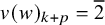 $v(w)_{k+p}=\overline {2}$
and
$v(w)_{k+p}=\overline {2}$
and $v(w)_{k+p+1}=\overline {1}$
, and thus
$v(w)_{k+p+1}=\overline {1}$
, and thus $p=\ell (\mu )=m$
. It follows that
$p=\ell (\mu )=m$
. It follows that $\beta _p=-1$
,
$\beta _p=-1$
, $\beta _{p+1}=0$
,
$\beta _{p+1}=0$
, $\overline {\beta }_p=1$
,
$\overline {\beta }_p=1$
, $\overline {\beta }_{p+1}=2$
, and
$\overline {\beta }_{p+1}=2$
, and $\beta _j=\overline {\beta }_j$
for all
$\beta _j=\overline {\beta }_j$
for all $j \notin \{p,p+1\}$
. We also have
$j \notin \{p,p+1\}$
. We also have $\lambda _m=k+\xi _m+1$
,
$\lambda _m=k+\xi _m+1$
, $\lambda _{m+1}=k+\xi _{m+1}=\lambda _m-1$
.
$\lambda _{m+1}=k+\xi _{m+1}=\lambda _m-1$
.
(h) $v(w) = (2 \cdots \overline {1} \cdots )$
. In this case,
$v(w) = (2 \cdots \overline {1} \cdots )$
. In this case, ${\mathrm {type}}(w)=1$
,
${\mathrm {type}}(w)=1$
, $D(w)=D(\overline {w})$
, and
$D(w)=D(\overline {w})$
, and $\mu =\overline {\mu }$
. We deduce that
$\mu =\overline {\mu }$
. We deduce that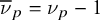 $\overline {\nu }_p=\nu _p-1$
, while
$\overline {\nu }_p=\nu _p-1$
, while $\overline {\nu }_j=\nu _j$
for all
$\overline {\nu }_j=\nu _j$
for all $j\neq p$
. We must show that
$j\neq p$
. We must show that $\beta _p=0$
, so that
$\beta _p=0$
, so that $\overline {\beta }_p=2$
, and
$\overline {\beta }_p=2$
, and $\beta _j=\overline {\beta }_j$
for all
$\beta _j=\overline {\beta }_j$
for all $j\neq p$
. This is proved as in case (f).
$j\neq p$
. This is proved as in case (f).
To simplify the notation, set $c^{\upsilon }_{\alpha }:={}^{{\kappa }}c^{\upsilon }_\alpha $
and
$c^{\upsilon }_{\alpha }:={}^{{\kappa }}c^{\upsilon }_\alpha $
and $\widehat {c}^{\,\upsilon }_{\alpha }:={}^{{\kappa }}\widehat {c}^{\,\upsilon }_\alpha $
, for any integer sequences
$\widehat {c}^{\,\upsilon }_{\alpha }:={}^{{\kappa }}\widehat {c}^{\,\upsilon }_\alpha $
, for any integer sequences $\alpha $
and
$\alpha $
and $\upsilon $
. We now distinguish the following cases.
$\upsilon $
. We now distinguish the following cases.
Case 1. ${\mathrm {type}}(w)={\mathrm {type}}(\overline {w})=0$
.
${\mathrm {type}}(w)={\mathrm {type}}(\overline {w})=0$
.
Note that we have $|w_1|=|\overline {w}_1|=1$
, and hence
$|w_1|=|\overline {w}_1|=1$
, and hence $i\geq 2$
and
$i\geq 2$
and $\ell (\mu ) = \ell (\overline {\mu })$
. We must be in one among cases (a), (b), or (d1) above. In cases (a) or (b), it follows from Propositions 1 and 2 and the left Leibnitz rule that for any integer sequence
$\ell (\mu ) = \ell (\overline {\mu })$
. We must be in one among cases (a), (b), or (d1) above. In cases (a) or (b), it follows from Propositions 1 and 2 and the left Leibnitz rule that for any integer sequence $\alpha =(\alpha _1,\ldots ,\alpha _\ell )$
, we have
$\alpha =(\alpha _1,\ldots ,\alpha _\ell )$
, we have
 $$ \begin{align*} \partial_i^y\, \widehat{c}^{\,\beta(w)}_\alpha &= \widehat{c}^{\,(\beta_1,\ldots,\beta_{p-1})}_{(\alpha_1,\ldots,\alpha_{p-1})} \left(\partial_i(\widehat{c}^{\,\beta_p}_{\alpha_p})\,\widehat{c}^{\,(\beta_{p+1},\ldots,\beta_\ell)}_{(\alpha_{p+1},\ldots,\alpha_\ell)} +s^y_i(\widehat{c}^{\,\beta_p}_{\alpha_p})\,\partial_i (\widehat{c}^{\,(\beta_{p+1},\ldots,\beta_\ell)}_{(\alpha_{p+1},\ldots,\alpha_\ell)})\right) \\ &=\widehat{c}^{\,(\beta_1,\ldots,\beta_{p-1})}_{(\alpha_1,\ldots,\alpha_{p-1})} \left(\widehat{c}^{\,\beta_p+1}_{\alpha_p-1}\,\widehat{c}^{\,(\beta_{p+1},\ldots,\beta_\ell)}_{(\alpha_{p+1},\ldots,\alpha_\ell)} +0\right) =\widehat{c}^{\,(\beta_1,\ldots,\beta_p+1,\ldots,\beta_\ell)}_{(\alpha_1,\ldots,\alpha_p-1,\ldots,\alpha_\ell)} = \widehat{c}^{\,\beta(\overline{w})}_{\alpha-\epsilon_p}. \end{align*} $$
Since $\lambda -\epsilon _p=\overline {\lambda }$
, it follows that if R is any raising operator, then
$\lambda -\epsilon _p=\overline {\lambda }$
, it follows that if R is any raising operator, then
 $$\begin{align*}\partial^y_i \left(R \star\widehat{c}^{\,\beta(w)}_\lambda\right) = \partial^y_i \left(\overline{c}^{\beta(w)}_{R\lambda}\right) = \overline{c}^{\beta(\overline{w})}_{R\lambda-\epsilon_p} = R \star\widehat{c}^{\,\beta(\overline{w})}_{\overline{\lambda}}. \end{align*}$$
As $R^{D(w)}= R^{D(\overline {w})}$
, we deduce that
$R^{D(w)}= R^{D(\overline {w})}$
, we deduce that
 $$\begin{align*}\partial^y_i(F_w)= 2^{-\ell(\mu)}\partial^y_i \left(R^{D(w)} \star \widehat{c}^{\,\beta(w)}_\lambda\right) = 2^{-\ell(\overline{\mu})} R^{D(\overline{w})} \star \widehat{c}^{\,\beta(\overline{w})}_{\overline{\lambda}} = F_{\overline{w}}. \end{align*}$$
In case (d1), for any integer sequence $\alpha =(\alpha _1,\ldots ,\alpha _\ell )$
, we compute that
$\alpha =(\alpha _1,\ldots ,\alpha _\ell )$
, we compute that
 $$ \begin{align*} \partial^y_i\, \widehat{c}^{\,\beta(w)}_\alpha &= \partial^y_i\, \widehat{c}^{\,(\beta_1,\ldots,-i,\ldots,i,\ldots,\beta_{\ell})}_{(\alpha_1,\ldots,\alpha_p,\ldots,\alpha_q, \ldots,\alpha_\ell)} \\ &= \widehat{c}^{\,(\beta_1,\ldots,-i+1,\ldots,i+1,\ldots,\beta_{\ell})}_{(\alpha_1,\ldots,\alpha_p-1,\ldots,\alpha_q,\ldots,\alpha_\ell)} + \widehat{c}^{\,(\beta_1,\ldots,-i+1,\ldots,i+1,\ldots,\beta_{\ell})}_{(\alpha_1,\ldots,\alpha_p,\ldots,\alpha_q-1,\ldots,\alpha_\ell)} = \widehat{c}^{\,\beta(\overline{w})}_{\alpha-\epsilon_p} + \widehat{c}^{\,\beta(\overline{w})}_{\alpha-\epsilon_q}. \end{align*} $$
This follows from the left Leibnitz rule, as in the proof of Proposition 1(b). Since $i\geq 2$
, we must have
$i\geq 2$
, we must have $q>\ell (\mu )$
. Hence, if R is any raising operator, then
$q>\ell (\mu )$
. Hence, if R is any raising operator, then $q\notin {\mathrm {supp}}_m(RR_{pq})$
, where
$q\notin {\mathrm {supp}}_m(RR_{pq})$
, where $m=\ell (\mu )$
. As
$m=\ell (\mu )$
. As $\lambda -\epsilon _p=\overline {\lambda }$
, we deduce that
$\lambda -\epsilon _p=\overline {\lambda }$
, we deduce that
 $$\begin{align*}\partial^y_i\left(R \star \widehat{c}^{\,\beta(w)}_\lambda\right) = \partial^y_i \left(\overline{c}^{\beta(w)}_{R\lambda}\right) = \overline{c}^{\beta(\overline{w})}_{R\lambda-\epsilon_p} + \overline{c}^{\beta(\overline{w})}_{R\lambda-\epsilon_q} = R \star \widehat{c}^{\,\beta(\overline{w})}_{\overline{\lambda}} + RR_{pq} \star \widehat{c}^{\,\beta(\overline{w})}_{\overline{\lambda}}. \end{align*}$$
Since $R^{D(w)}+R^{D(w)} R_{pq} = R^{D(\overline {w})}$
, it follows that
$R^{D(w)}+R^{D(w)} R_{pq} = R^{D(\overline {w})}$
, it follows that $\partial ^y_i F_w = F_{\overline {w}}$
.
$\partial ^y_i F_w = F_{\overline {w}}$
.
Case 2. ${\mathrm {type}}(w)=0$
and
${\mathrm {type}}(w)=0$
and ${\mathrm {type}}(\overline {w})>0$
.
${\mathrm {type}}(\overline {w})>0$
.
In this case, we have $|w_1|=1$
and
$|w_1|=1$
and $|\overline {w}_1|>1$
, so
$|\overline {w}_1|>1$
, so $i\in \{\Box , 1\}$
. We must be in one of cases (b), (c), or (e) above, hence
$i\in \{\Box , 1\}$
. We must be in one of cases (b), (c), or (e) above, hence $D(w)=D(\overline {w})$
. We also have
$D(w)=D(\overline {w})$
. We also have $(p,p+1)\notin D(w)$
,
$(p,p+1)\notin D(w)$
, $\ell (\mu ) = \ell (\overline {\mu })+1$
,
$\ell (\mu ) = \ell (\overline {\mu })+1$
, $\beta _p=-1$
,
$\beta _p=-1$
, $\overline {\beta }_p=0$
if
$\overline {\beta }_p=0$
if $i=1$
, and
$i=1$
, and $\overline {\beta }_p=1$
if
$\overline {\beta }_p=1$
if $i=\Box $
.
$i=\Box $
.
Observe that for any integer sequence $\alpha =(\alpha _1,\ldots ,\alpha _\ell )$
, we have
$\alpha =(\alpha _1,\ldots ,\alpha _\ell )$
, we have
 $$ \begin{align*} \partial^y_i \widehat{c}^{\,\beta(w)}_\alpha &= \widehat{c}^{\,(\beta_1,\ldots,\beta_{p-1})}_{(\alpha_1,\ldots,\alpha_{p-1})} \left(\partial^y_i(\widehat{c}^{\,-1}_{\alpha_p})\, \widehat{c}^{\,(\beta_{p+1},\ldots,\beta_\ell)}_{(\alpha_{p+1},\ldots,\alpha_\ell)} +s^y_i(\widehat{c}^{\,-1}_{\alpha_p})\,\partial_i^y (\widehat{c}^{\,(\beta_{p+1},\ldots,\beta_\ell)}_{(\alpha_{p+1},\ldots,\alpha_\ell)})\right) \\ &= \widehat{c}^{\,(\beta_1,\ldots,\beta_{p-1})}_{(\alpha_1,\ldots,\alpha_{p-1})}\,\partial^y_i(\widehat{c}^{\,-1}_{\alpha_p}) \,\widehat{c}^{\,(\beta_{p+1},\ldots,\beta_\ell)}_{(\alpha_{p+1},\ldots,\alpha_\ell)}. \end{align*} $$
We now compute using Propositions 1 and 2(a) that
 $$\begin{align*}\partial_1^y\left({}^r\widehat{c}_q^{\,-1}\right)= \begin{cases} 2\left({}^ra_{q-1}^0\right) & \text{if } q\neq r+1 \\ 2f_r & \text{if } q=r+1. \end{cases} \end{align*}$$
 $$\begin{align*}\partial^y_\Box\left({}^r\widehat{c}_q^{\,-1}\right)= \begin{cases} 2\left({}^ra_{q-1}^1\right) & \text{if } q\neq r+1 \\ 2\widetilde{f}^1_r & \text{if } q=r+1. \end{cases} \end{align*}$$
Note that the choice of $f_r$
in these equations is specified by formula (28). The rest is straightforward from the definitions, arguing as in Case 1.
$f_r$
in these equations is specified by formula (28). The rest is straightforward from the definitions, arguing as in Case 1.
Case 3. ${\mathrm {type}}(w)>0$
and
${\mathrm {type}}(w)>0$
and ${\mathrm {type}}(\overline {w})=0$
.
${\mathrm {type}}(\overline {w})=0$
.
We have $|w_1|>1$
and
$|w_1|>1$
and $|\overline {w}_1|=1$
, so
$|\overline {w}_1|=1$
, so $i\in \{\Box ,1\}$
, and we are in one of cases (a), (d2), (f), or (h) above, hence
$i\in \{\Box ,1\}$
, and we are in one of cases (a), (d2), (f), or (h) above, hence $D(w)=D(\overline {w})$
.
$D(w)=D(\overline {w})$
.
We also have $\beta _p\in \{0,1\}$
,
$\beta _p\in \{0,1\}$
, $\overline {\beta }_p=2$
, and
$\overline {\beta }_p=2$
, and $\ell (\mu ) = \ell (\overline {\mu })$
. Recall that
$\ell (\mu ) = \ell (\overline {\mu })$
. Recall that ${}^r\widehat {c}_q^{\,s} = {}^rc_q^s$
whenever
${}^r\widehat {c}_q^{\,s} = {}^rc_q^s$
whenever $q\leq r$
,
$q\leq r$
, ${}^rb_r^1={}^rc_r^1-{}^r\widetilde {b}_r$
,
${}^rb_r^1={}^rc_r^1-{}^r\widetilde {b}_r$
, ${}^r\widetilde {b}_r^1={}^rc_r^1-{}^rb_r$
, and
${}^r\widetilde {b}_r^1={}^rc_r^1-{}^rb_r$
, and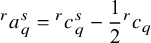 $\displaystyle {}^ra^s_q={}^rc^s_q-\frac {1}{2} {}^rc_q$
. We deduce the calculations
$\displaystyle {}^ra^s_q={}^rc^s_q-\frac {1}{2} {}^rc_q$
. We deduce the calculations
 $$ \begin{gather*} \partial^y_\Box \left({}^rb_r\right) = \partial^y_\Box \left({}^r\widetilde{b}_r\right) = \partial^y_1 \left({}^rb^1_r\right) = \partial^y_1\left( {}^r\widetilde{b}_r^1\right) = {}^rc_{r-1}^2 \\ \partial^y_\Box \left({}^ra^0_q\right) = \partial^y_1 \left({}^ra_q^1 \right) = {}^rc_{q-1}^2. \end{gather*} $$
As in the previous cases, it follows that $\partial ^y_i F_w = F_{\overline {w}}$
.
$\partial ^y_i F_w = F_{\overline {w}}$
.
Case 4. ${\mathrm {type}}(w)={\mathrm {type}}(\overline {w})>0$
.
${\mathrm {type}}(w)={\mathrm {type}}(\overline {w})>0$
.
We have $|w_1|>1$
and
$|w_1|>1$
and $|\overline {w}_1|>1$
. If
$|\overline {w}_1|>1$
. If $i\geq 2$
, then we must be in one of cases (a), (b), (c), or (d1) above, and the result is proved by arguing as in Case 1. It remains to study (i) case (d1) with
$i\geq 2$
, then we must be in one of cases (a), (b), (c), or (d1) above, and the result is proved by arguing as in Case 1. It remains to study (i) case (d1) with $v(w)=(\cdots \overline {2}1 \cdots )$
and
$v(w)=(\cdots \overline {2}1 \cdots )$
and $i=1$
or (ii) case (g) with
$i=1$
or (ii) case (g) with $v(w) = (\cdots \overline {2} \overline {1} \cdots )$
and
$v(w) = (\cdots \overline {2} \overline {1} \cdots )$
and $i=\Box $
. In both of these subcases, we have
$i=\Box $
. In both of these subcases, we have $p=m$
,
$p=m$
, $\ell (\mu ) = \ell (\overline {\mu })+1$
,
$\ell (\mu ) = \ell (\overline {\mu })+1$
, $D(w)=D(\overline {w})\cup \{(m,m+1)\}$
,
$D(w)=D(\overline {w})\cup \{(m,m+1)\}$
, $\beta _m(w)=-1$
,
$\beta _m(w)=-1$
, $\overline {\beta }_{m+1}=2$
, and
$\overline {\beta }_{m+1}=2$
, and $\beta _j=\overline {\beta }_j$
for all
$\beta _j=\overline {\beta }_j$
for all $j \notin \{m,m+1\}$
. In subcase (i), we have
$j \notin \{m,m+1\}$
. In subcase (i), we have $\beta _{m+1}=1$
and
$\beta _{m+1}=1$
and $\overline {\beta }_m=0$
, while in subcase (ii), we have
$\overline {\beta }_m=0$
, while in subcase (ii), we have $\beta _{m+1}=0$
and
$\beta _{m+1}=0$
and $\overline {\beta }_m=1$
. Finally, we have
$\overline {\beta }_m=1$
. Finally, we have $\lambda _m=k+1+\xi _m$
and
$\lambda _m=k+1+\xi _m$
and $\lambda _{m+1}=k+\xi _{m+1}=\lambda _m-1$
, since the assumption
$\lambda _{m+1}=k+\xi _{m+1}=\lambda _m-1$
, since the assumption $\nu _m=\nu _{m+1}$
implies that
$\nu _m=\nu _{m+1}$
implies that $\xi _m=\xi _{m+1}$
.
$\xi _m=\xi _{m+1}$
.
The rest of the argument now follows the proof of [Reference Tamvakis28, Proposition 5], by studying the effect of the raising operators R in the expansion of $R^{D(w)}$
which involve only basic operators
$R^{D(w)}$
which involve only basic operators $R_{ij}$
with
$R_{ij}$
with $i\in \{m,m+1\}$
or
$i\in \{m,m+1\}$
or $j\in \{m,m+1\}$
. We first assume that
$j\in \{m,m+1\}$
. We first assume that $\lambda $
has length
$\lambda $
has length $m+1$
, let
$m+1$
, let $r:=\lambda _{m+1}=\lambda _m-1$
, and use [Reference Tamvakis28, Proposition 3] and the key relations
$r:=\lambda _{m+1}=\lambda _m-1$
, and use [Reference Tamvakis28, Proposition 3] and the key relations
 $$\begin{align*}f_r\widetilde{f}_r + 2\sum_{j=1}^r (-1)^j \left({}^ra^0_{r+j} {}^ra^0_{r-j}\right) = \widetilde{f}^1_rf^1_r + 2\sum_{j=1}^r (-1)^j \left({}^ra^1_{r+j} {}^ra^1_{r-j}\right) = 0 \end{align*}$$
in $\Gamma '[X,Y]$
, which are easily deduced from the relations (10), as in [Reference Tamvakis28]. Finally, if
$\Gamma '[X,Y]$
, which are easily deduced from the relations (10), as in [Reference Tamvakis28]. Finally, if $\ell (\lambda )>m+1$
, similar arguments show that the contribution of all the residual terms in that appear with a negative sign in [Reference Tamvakis28, Proposition 3] vanishes.
$\ell (\lambda )>m+1$
, similar arguments show that the contribution of all the residual terms in that appear with a negative sign in [Reference Tamvakis28, Proposition 3] vanishes.
Definition 12. An element $w\in \widetilde {W}_\infty $
is called proper if (i)
$w\in \widetilde {W}_\infty $
is called proper if (i) $|w_1|\leq 2$
or (ii)
$|w_1|\leq 2$
or (ii) $|w_1|>2$
and
$|w_1|>2$
and $w_j=2$
implies
$w_j=2$
implies $j>2>w_{j-1}$
.
$j>2>w_{j-1}$
.
Lemma 13. Fix an integer $k\geq 1$
. We say that an element of
$k\geq 1$
. We say that an element of $\widetilde {W}_n$
is valid if w is increasing up to k, has k-truncated A-code a partition C, and is proper. Let
$\widetilde {W}_n$
is valid if w is increasing up to k, has k-truncated A-code a partition C, and is proper. Let $w(C)$
be the longest valid element in
$w(C)$
be the longest valid element in $\widetilde {W}_n$
, which has type 0. If
$\widetilde {W}_n$
, which has type 0. If $\overline {w}$
is valid and
$\overline {w}$
is valid and $\overline {w}\neq w(C)$
, then there exists a valid
$\overline {w}\neq w(C)$
, then there exists a valid $w\in \widetilde {W}_n$
such that
$w\in \widetilde {W}_n$
such that $\ell (w)=\ell (\overline {w})+1$
and
$\ell (w)=\ell (\overline {w})+1$
and $v(\overline {w})=s_iv(w)$
for some
$v(\overline {w})=s_iv(w)$
for some $i\in {\mathbb N}_\Box $
.
$i\in {\mathbb N}_\Box $
.
Proof. We distinguish the following cases for $\overline {w}$
.
$\overline {w}$
.
Case 1: $|\overline {w}_1|=1$
. Let w be any element with the same truncated A-code C such that
$|\overline {w}_1|=1$
. Let w be any element with the same truncated A-code C such that $\ell (w)=\ell (\overline {w})+1$
and
$\ell (w)=\ell (\overline {w})+1$
and $v(\overline {w})=s_iv(w)$
for some
$v(\overline {w})=s_iv(w)$
for some $i\in {\mathbb N}_\Box $
.
$i\in {\mathbb N}_\Box $
.
Case 2: $|\overline {w}_1|=2$
. If
$|\overline {w}_1|=2$
. If $\overline {w}=(\widehat {2} \cdots 1 \cdots )$
, then let
$\overline {w}=(\widehat {2} \cdots 1 \cdots )$
, then let $w:=s_\Box \overline {w}$
, while if
$w:=s_\Box \overline {w}$
, while if $\overline {w}=(\widehat {2} \cdots \overline {1}\cdots )$
, then let
$\overline {w}=(\widehat {2} \cdots \overline {1}\cdots )$
, then let $w:=s_1\overline {w}$
.
$w:=s_1\overline {w}$
.
Case 3: $|\overline {w}_1|>2$
. If
$|\overline {w}_1|>2$
. If $\overline {w}_j=2,$
then
$\overline {w}_j=2,$
then $j>2$
and
$j>2$
and $\overline {w}_{j-1}<2$
. Since the A-code C is a partition, the sequence
$\overline {w}_{j-1}<2$
. Since the A-code C is a partition, the sequence $(\overline {w}_{k+1},\ldots ,\overline {w}_n)$
is 132-avoiding. We deduce that if
$(\overline {w}_{k+1},\ldots ,\overline {w}_n)$
is 132-avoiding. We deduce that if $\overline {w}_i=\widehat {1}$
, then
$\overline {w}_i=\widehat {1}$
, then $i<j$
. If
$i<j$
. If $\overline {w}= (\cdots \overline {1} \cdots 2 \cdots )$
, then let
$\overline {w}= (\cdots \overline {1} \cdots 2 \cdots )$
, then let $w:=s_1\overline {w}$
, while if
$w:=s_1\overline {w}$
, while if $\overline {w}= (\cdots 1 \cdots 2 \cdots )$
, then let
$\overline {w}= (\cdots 1 \cdots 2 \cdots )$
, then let $w:=s_\Box \overline {w}$
.
$w:=s_\Box \overline {w}$
.
In all three cases, the element w satisfies the required conditions.
Corollary 2. Suppose that $w\in \widetilde {W}_n$
is increasing up to
$w\in \widetilde {W}_n$
is increasing up to $k\geq 1$
, proper, and the k-truncated A-code
$k\geq 1$
, proper, and the k-truncated A-code ${}^k\gamma $
is a partition. Let
${}^k\gamma $
is a partition. Let $k^{n-k}+\xi (w)=(k+\xi _1,\ldots ,k+\xi _{n-k})$
. Then, we have
$k^{n-k}+\xi (w)=(k+\xi _1,\ldots ,k+\xi _{n-k})$
. Then, we have
 $$ \begin{align} {\mathfrak D}_w = 2^{-\ell(\mu(w))}\,R^{D(w)} \star {}^{k^{n-k}+\xi(w)}\widehat{c}^{\,\beta(w)}_{\lambda(w)}. \end{align} $$
Proof. If $w=(\widehat {1},2,\ldots ,k,w_{k+1},\ldots ,w_n)$
with
$w=(\widehat {1},2,\ldots ,k,w_{k+1},\ldots ,w_n)$
with $w_{k+j}<0$
for all
$w_{k+j}<0$
for all $j\in [1,n-k]$
, then (31) follows from Proposition 8. In this case,
$j\in [1,n-k]$
, then (31) follows from Proposition 8. In this case, $v(w)=(\widehat {1},2,\ldots ,k,-n,\ldots ,-k-1)$
is the longest k-Grassmannian element in
$v(w)=(\widehat {1},2,\ldots ,k,-n,\ldots ,-k-1)$
is the longest k-Grassmannian element in $\widetilde {W}_n$
. We deduce the result in the general case from Proposition 9 and Lemma 13, using the fact that the k-Grassmannian elements of
$\widetilde {W}_n$
. We deduce the result in the general case from Proposition 9 and Lemma 13, using the fact that the k-Grassmannian elements of $\widetilde {W}_n$
form an ideal for the left weak Bruhat order. Indeed, the hypotheses required in Proposition 9 are satisfied, as long as w and
$\widetilde {W}_n$
form an ideal for the left weak Bruhat order. Indeed, the hypotheses required in Proposition 9 are satisfied, as long as w and $\overline {w}$
are proper. The key point is to show that if
$\overline {w}$
are proper. The key point is to show that if $i\in \{\Box ,1\}$
and
$i\in \{\Box ,1\}$
and $|w_1|>2$
, then
$|w_1|>2$
, then $\xi _m=\xi _{m+1}$
, which implies that
$\xi _m=\xi _{m+1}$
, which implies that $\nu _m=\nu _{m+1}$
, and hence
$\nu _m=\nu _{m+1}$
, and hence ${\kappa }_m={\kappa }_{m+1}$
. For if not, then
${\kappa }_m={\kappa }_{m+1}$
. For if not, then $\xi _m>\xi _{m+1}$
, so there exists a
$\xi _m>\xi _{m+1}$
, so there exists a $j>k$
such that
$j>k$
such that $\gamma _j=m$
. As
$\gamma _j=m$
. As ${}^k\gamma $
is a partition,
${}^k\gamma $
is a partition, $(w_{k+1},\ldots ,w_n)$
is a
$(w_{k+1},\ldots ,w_n)$
is a $132$
-avoiding sequence. It follows that
$132$
-avoiding sequence. It follows that $w_j=\widehat {1}$
, and furthermore
$w_j=\widehat {1}$
, and furthermore $j=2$
, or
$j=2$
, or $j>2$
and
$j>2$
and $w_{j-1}>w_j$
. We conclude that
$w_{j-1}>w_j$
. We conclude that $\overline {w}_j=2$
and
$\overline {w}_j=2$
and $\overline {w}$
is not proper, completing the proof.
$\overline {w}$
is not proper, completing the proof.
Notice that if w (respectively, $\overline {w}$
) is increasing up to
$\overline {w}$
) is increasing up to $k\geq 1$
and proper (respectively, not proper) with truncated A-code equal to a fixed partition C, such that
$k\geq 1$
and proper (respectively, not proper) with truncated A-code equal to a fixed partition C, such that $\ell (w)=\ell (\overline {w})+1$
and
$\ell (w)=\ell (\overline {w})+1$
and $s_iv(w)=v(\overline {w})$
, then
$s_iv(w)=v(\overline {w})$
, then $i=\Box $
or
$i=\Box $
or $i=1$
. Moreover, referring to equation (30), in this situation, we can have
$i=1$
. Moreover, referring to equation (30), in this situation, we can have ${\mathfrak D}_w = F_w$
for an integer sequence
${\mathfrak D}_w = F_w$
for an integer sequence $\kappa $
compatible with w but
$\kappa $
compatible with w but ${\mathfrak D}_{\overline {w}} \neq F_{\overline {w}}$
, as Corollary 2 and the following example show, with
${\mathfrak D}_{\overline {w}} \neq F_{\overline {w}}$
, as Corollary 2 and the following example show, with $k=1$
,
$k=1$
,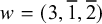 $w=(3,\overline {1},\overline {2})$
, and
$w=(3,\overline {1},\overline {2})$
, and $\overline {w}=(3,2,1)$
.
$\overline {w}=(3,2,1)$
.
Example 8. Let $n:=3$
and
$n:=3$
and $w:=(3,2,1)$
. Then,
$w:=(3,2,1)$
. Then, ${\mathrm {type}}(w)=1$
,
${\mathrm {type}}(w)=1$
, $\lambda =\nu =(2,1)$
,
$\lambda =\nu =(2,1)$
, $\ell =2$
,
$\ell =2$
, $\mu =0$
,
$\mu =0$
, $m=0$
,
$m=0$
, $k=1$
,
$k=1$
, $\beta (w)=(1,2)$
,
$\beta (w)=(1,2)$
, $D(w)=\emptyset $
, and w is not proper. We have
$D(w)=\emptyset $
, and w is not proper. We have ${}^1c_0^2 = 1$
, while
${}^1c_0^2 = 1$
, while
 $$ \begin{gather*} {}^2b_2^1 = {}^2b_2+{}^2c_1\, h_1^1(-Y)+h_2^1(-Y) \\ =\frac{1}{2}\left(c_2+c_1e_1^2(X)\right) +e_2^2(X) +\left(c_1+e_1^2(X)\right)h_1^1(-Y)+h_2^1(-Y), \\ {}^1c_1^2 = c_1+e_1^1(X)+h_1^2(-Y), \\ {}^2a^1_3 = \frac{1}{2}\left(c_3+c_2e_1^2(X)+c_1e_2^2(X)\right) + {}^2c_2\,h_1^1(-Y) + {}^2c_1\,h_2^1(-Y)+{}^2c_0\,h^1_3(-Y) \\ = \frac{1}{2}c_3+c_2\left(\frac{1}{2}e_1^2(X)+h_1^1(-Y)\right) + c_1\left(\frac{1}{2}e_2^2(X)+e_1^2(X)h_1^1(-Y)+h_2^1(-Y)\right) \\ + \,e_2^2(X)h_1^1(-Y)+e_1^2(X)h_2^1(-Y)+h_3^1(-Y). \end{gather*} $$
One checks using the table of [Reference Ikeda, Mihalcea and Naruse13, Section 13] that
 $$\begin{align*}(1-R_{12})\star {}^{(2,1)}\widehat{c}^{\,(1,2)}_{(2,1)} ={}^2b_2^1\, {}^1c_1^2 - {}^2a^1_3\, {}^1c_0^2 \neq {\mathfrak D}_{321}. \end{align*}$$
Now consider $w':=\iota (w)=(\overline {3},2,\overline {1})$
. Then,
$w':=\iota (w)=(\overline {3},2,\overline {1})$
. Then, ${\mathrm {type}}(w')=2$
,
${\mathrm {type}}(w')=2$
, $\lambda =\nu =(2,1)$
,
$\lambda =\nu =(2,1)$
, $\ell =2$
,
$\ell =2$
, $\mu =0$
,
$\mu =0$
, $m=0$
,
$m=0$
, $k=1$
,
$k=1$
, $\beta (w')=(0,2)$
,
$\beta (w')=(0,2)$
, $D(w')=\emptyset $
, and
$D(w')=\emptyset $
, and $w'$
is not proper. We have
$w'$
is not proper. We have
 $$ \begin{gather*} {}^2b_2^0 = {}^2b_2 =\frac{1}{2}\left(c_2+c_1e_1^2(X)\right) +e_2^2(X), \ \ {}^2\widetilde{b}_2^0 = {}^2\widetilde{b}_2 = \frac{1}{2}\left(c_2+c_1e_1^2(X)\right), \\ {}^2a^0_3 = \frac{1}{2} {}^2c^0_3 = \frac{1}{2}\left(c_3+c_2e_1^2(X) + c_1e_2^2(X)\right). \end{gather*} $$
Using the table of [Reference Ikeda, Mihalcea and Naruse13, Section 13], we observe that
 $$\begin{align*}(1-R_{12})\star {}^{(2,1)}\widehat{c}^{\,(0,2)}_{(2,1)} ={}^2\widetilde{b}_2^0\, {}^1c_1^2 - {}^2a^0_3\, {}^1c_0^2 \neq {\mathfrak D}_{\overline{3}2\overline{1}}. \end{align*}$$
Notice that we also have $\displaystyle {}^2b_2^0\, {}^1c_1^2 - {}^2a^0_3\, {}^1c_0^2 \neq {\mathfrak D}_{\overline {3}2\overline {1}}$
.
$\displaystyle {}^2b_2^0\, {}^1c_1^2 - {}^2a^0_3\, {}^1c_0^2 \neq {\mathfrak D}_{\overline {3}2\overline {1}}$
.
Definition 13. Let $k\geq 1$
be the primary index of
$k\geq 1$
be the primary index of $w\in \widetilde {W}_n$
, and list the entries
$w\in \widetilde {W}_n$
, and list the entries $w_{k+1},\ldots ,w_n$
in increasing order:
$w_{k+1},\ldots ,w_n$
in increasing order:
 $$\begin{align*}u_1<\cdots < u_{m'} < 0 < u_{m'+1} < \cdots < u_{n-k}, \end{align*}$$
where $m'\in \{m,m+1\}$
. We say that a simple transposition
$m'\in \{m,m+1\}$
. We say that a simple transposition $s_i$
for
$s_i$
for $i\geq 2$
is w-negative (respectively, w-positive) if
$i\geq 2$
is w-negative (respectively, w-positive) if $\{i,i+1\}$
is a subset of
$\{i,i+1\}$
is a subset of $\{-u_1,\ldots ,-u_m\}$
(respectively, of
$\{-u_1,\ldots ,-u_m\}$
(respectively, of $\{u_{m'+1}, \ldots ,u_{n-k}\}$
). Let
$\{u_{m'+1}, \ldots ,u_{n-k}\}$
). Let $\sigma ^-$
(respectively,
$\sigma ^-$
(respectively, $\sigma ^+$
) be the longest subword of
$\sigma ^+$
) be the longest subword of $s_{n-1}\dots s_2$
(respectively, of
$s_{n-1}\dots s_2$
(respectively, of $s_2\dots s_{n-1}$
) consisting of w-negative (respectively, w-positive) simple transpositions. A modification of
$s_2\dots s_{n-1}$
) consisting of w-negative (respectively, w-positive) simple transpositions. A modification of $w\in \widetilde {W}_n$
is an element
$w\in \widetilde {W}_n$
is an element ${\omega } w$
, where
${\omega } w$
, where ${\omega }\in S_n$
is such that
${\omega }\in S_n$
is such that $\ell ({\omega } w)=\ell (w)-\ell ({\omega })$
, and
$\ell ({\omega } w)=\ell (w)-\ell ({\omega })$
, and ${\omega }$
has a reduced decomposition of the form
${\omega }$
has a reduced decomposition of the form $R_1\dots R_{n-2}$
where each
$R_1\dots R_{n-2}$
where each $R_j$
is a (possibly empty) subword of
$R_j$
is a (possibly empty) subword of $\sigma ^-\sigma ^+$
and all simple reflections in
$\sigma ^-\sigma ^+$
and all simple reflections in $R_p$
are also contained in
$R_p$
are also contained in $R_{p+1}$
, for each
$R_{p+1}$
, for each $p<n-2$
.
$p<n-2$
.
Definition 14. Suppose that $w\in \widetilde {W}_n$
has primary index
$w\in \widetilde {W}_n$
has primary index $k\geq 1$
and A-code
$k\geq 1$
and A-code $\gamma $
. We say that w is leading if w is proper and
$\gamma $
. We say that w is leading if w is proper and $(\gamma _{k+1}, \gamma _{k+2},\ldots , \gamma _n)$
is a partition. We say that w is amenable if w is a modification of a leading element.
$(\gamma _{k+1}, \gamma _{k+2},\ldots , \gamma _n)$
is a partition. We say that w is amenable if w is a modification of a leading element.
Remark 5. The proper element $w\in \widetilde {W}_n$
of type 0 or 1 is leading if and only if the A-code of the extended sequence
$w\in \widetilde {W}_n$
of type 0 or 1 is leading if and only if the A-code of the extended sequence $(0,w_1,w_2,\ldots ,w_n)$
is unimodal. Indeed, if
$(0,w_1,w_2,\ldots ,w_n)$
is unimodal. Indeed, if ${\mathrm {type}}(w)=0$
and
${\mathrm {type}}(w)=0$
and $w_1=\overline {1}$
, then this is ensured since there is more than one negative entry in w. If
$w_1=\overline {1}$
, then this is ensured since there is more than one negative entry in w. If ${\mathrm {type}}(w)=2$
, then w is leading if and only if it is proper and the A-code of the extended sequence
${\mathrm {type}}(w)=2$
, then w is leading if and only if it is proper and the A-code of the extended sequence $(0,w^{\prime }_1,w^{\prime }_2,\ldots ,w^{\prime }_n)$
is unimodal, where
$(0,w^{\prime }_1,w^{\prime }_2,\ldots ,w^{\prime }_n)$
is unimodal, where $w':=\iota (w)$
.
$w':=\iota (w)$
.
In the following, we will assume that w has primary index $k\geq 1$
and the partition
$k\geq 1$
and the partition $\xi $
is specified as in Definition 10. Let
$\xi $
is specified as in Definition 10. Let $\psi :=(\gamma _k,\ldots ,\gamma _1)$
,
$\psi :=(\gamma _k,\ldots ,\gamma _1)$
, $\phi :=\psi '$
,
$\phi :=\psi '$
, $\ell :=\ell (\lambda ),$
and
$\ell :=\ell (\lambda ),$
and $m:=\ell (\mu )$
. We then have
$m:=\ell (\mu )$
. We then have
 $$ \begin{align} \lambda = \phi+\xi+\mu \end{align} $$
and $\lambda _1>\cdots > \lambda _m > \lambda _{m+1}\geq \cdots \geq \lambda _{\ell }$
.
$\lambda _1>\cdots > \lambda _m > \lambda _{m+1}\geq \cdots \geq \lambda _{\ell }$
.
Definition 15. Say that ${\mathfrak q}\in [1,\ell ]$
is a critical index if
${\mathfrak q}\in [1,\ell ]$
is a critical index if $\beta _{{\mathfrak q}+1}> \beta _{\mathfrak q}+1$
, or
$\beta _{{\mathfrak q}+1}> \beta _{\mathfrak q}+1$
, or $(\beta _{\mathfrak q},\beta _{{\mathfrak q}+1})= (1,2)$
, or if
$(\beta _{\mathfrak q},\beta _{{\mathfrak q}+1})= (1,2)$
, or if $\lambda _{\mathfrak q}>\lambda _{{\mathfrak q}+1}+1$
(respectively,
$\lambda _{\mathfrak q}>\lambda _{{\mathfrak q}+1}+1$
(respectively, $\lambda _{\mathfrak q}>\lambda _{{\mathfrak q}+1}$
) and
$\lambda _{\mathfrak q}>\lambda _{{\mathfrak q}+1}$
) and ${\mathfrak q}\leq m$
(respectively,
${\mathfrak q}\leq m$
(respectively, ${\mathfrak q}>m$
). Define two sequences
${\mathfrak q}>m$
). Define two sequences ${\mathfrak f}={\mathfrak f}(w)$
and
${\mathfrak f}={\mathfrak f}(w)$
and ${\mathfrak g}={\mathfrak g}(w)$
of length
${\mathfrak g}={\mathfrak g}(w)$
of length $\ell $
as follows. For
$\ell $
as follows. For $1\leq j \leq \ell $
, set
$1\leq j \leq \ell $
, set
 $$\begin{align*}{\mathfrak f}_j:=k+\max(i\ |\ \gamma_{k+i}\geq j) \end{align*}$$
and let
 $$ \begin{align*}{\mathfrak g}_j:={\mathfrak f}_{\mathfrak q}+\beta_{\mathfrak q}-\xi_{\mathfrak q}-k,\end{align*} $$
where ${\mathfrak q}$
is the least critical index such that
${\mathfrak q}$
is the least critical index such that ${\mathfrak q}\geq j$
. We call
${\mathfrak q}\geq j$
. We call ${\mathfrak f}$
the right flag of w, and
${\mathfrak f}$
the right flag of w, and ${\mathfrak g}$
the left flag of w.
${\mathfrak g}$
the left flag of w.
We will show that for any amenable element w, ${\mathfrak f}$
is a weakly decreasing sequence, which consists of right descents of w, unless
${\mathfrak f}$
is a weakly decreasing sequence, which consists of right descents of w, unless ${\mathfrak f}_j=1$
and
${\mathfrak f}_j=1$
and $w_1<-|w_2|$
, when
$w_1<-|w_2|$
, when ${\mathfrak f}_j$
is a right descent of
${\mathfrak f}_j$
is a right descent of $\iota (w)$
. Moreover,
$\iota (w)$
. Moreover, ${\mathfrak g}$
is a weakly increasing sequence, whose absolute values consist of left descents of w, unless
${\mathfrak g}$
is a weakly increasing sequence, whose absolute values consist of left descents of w, unless ${\mathfrak g}_j=0$
and
${\mathfrak g}_j=0$
and $w=(\cdots \overline {1} \cdots 2 \cdots )$
, or
$w=(\cdots \overline {1} \cdots 2 \cdots )$
, or ${\mathfrak g}_j=1$
and
${\mathfrak g}_j=1$
and $w=(\cdots 1 \cdots 2 \cdots )$
.
$w=(\cdots 1 \cdots 2 \cdots )$
.
Lemma 14.
(a) If $\beta _{s+1}> \beta _s+1$
and
$\beta _{s+1}> \beta _s+1$
and $(\beta _s,\beta _{s+1})\neq (0,2)$
, then
$(\beta _s,\beta _{s+1})\neq (0,2)$
, then $|\beta _s|$
is a left descent of w.
$|\beta _s|$
is a left descent of w.
(b) If $s\leq m,$
then
$s\leq m,$
then $\phi _s=k$
. If
$\phi _s=k$
. If $s>m$
and
$s>m$
and $\beta _{s+1} = \beta _s+1$
, then
$\beta _{s+1} = \beta _s+1$
, then $\phi _s=\phi _{s+1}$
.
$\phi _s=\phi _{s+1}$
.
(c) If $\beta _s=0$
or
$\beta _s=0$
or $\beta _s=1$
, then
$\beta _s=1$
, then $s=m+1$
,
$s=m+1$
, ${\mathrm {type}}(w)>0$
, and
${\mathrm {type}}(w)>0$
, and $\phi _{m+1}=k$
. If
$\phi _{m+1}=k$
. If $\beta _s=0,$
then
$\beta _s=0,$
then $\Box $
is a left descent of w, unless
$\Box $
is a left descent of w, unless $w = (\cdots \overline {1} \cdots 2 \cdots )$
. If
$w = (\cdots \overline {1} \cdots 2 \cdots )$
. If $\beta _s=1,$
then
$\beta _s=1,$
then $1$
is a left descent of w, unless
$1$
is a left descent of w, unless $w = (\cdots 1 \cdots 2 \cdots )$
.
$w = (\cdots 1 \cdots 2 \cdots )$
.
Proof. Let $i:=|\beta _s|$
, and suppose that
$i:=|\beta _s|$
, and suppose that $1\leq s\leq m$
. If
$1\leq s\leq m$
. If $\beta _{s+1}> \beta _s+1\neq 1,$
then
$\beta _{s+1}> \beta _s+1\neq 1,$
then $i\geq 1$
is a left descent of w. Indeed, if
$i\geq 1$
is a left descent of w. Indeed, if $w_1=-i,$
then i is a left descent of w, while if
$w_1=-i,$
then i is a left descent of w, while if $w_1\neq -i$
, then
$w_1\neq -i$
, then $w^{-1}(i)>0$
and
$w^{-1}(i)>0$
and $w^{-1}(i+1)<0$
, so this is clear. If
$w^{-1}(i+1)<0$
, so this is clear. If ${\mathrm {type}}(w)\neq 2$
, then
${\mathrm {type}}(w)\neq 2$
, then $w_j \geq -1$
for all
$w_j \geq -1$
for all $j\in [1,k]$
, and hence
$j\in [1,k]$
, and hence $\psi _j\geq m$
for all
$\psi _j\geq m$
for all $j\in [1,k]$
, and so
$j\in [1,k]$
, and so $\phi _s=k$
.
$\phi _s=k$
.
Next, suppose that $s>m$
. If
$s>m$
. If $\beta _{s+1}> \beta _s+1\neq 1$
, then we have
$\beta _{s+1}> \beta _s+1\neq 1$
, then we have $w^{-1}(i+1)<0$
or
$w^{-1}(i+1)<0$
or $w_j=i+1$
for some
$w_j=i+1$
for some $j\in [1,k]$
. In either case, it is clear that i is a left descent of w. Assume that
$j\in [1,k]$
. In either case, it is clear that i is a left descent of w. Assume that $\beta _{s+1} = \beta _s+1$
, so that
$\beta _{s+1} = \beta _s+1$
, so that $\beta _s=u_s\geq 1$
. If
$\beta _s=u_s\geq 1$
. If $\phi _s>\phi _{s+1}$
, there must exist
$\phi _s>\phi _{s+1}$
, there must exist $j\in [1,k]$
such that
$j\in [1,k]$
such that $\gamma _j=s$
, that is,
$\gamma _j=s$
, that is, $\#\{r>k\ |\ w_r<|w_j|\} = s$
. We deduce that
$\#\{r>k\ |\ w_r<|w_j|\} = s$
. We deduce that
 $$\begin{align*}\{w_r\ |\ r>k \ \,\text{and}\, \ w_r<|w_j|\} = \{u_1,\ldots, u_s\}, \end{align*}$$
which is a contradiction, since $u_s<|w_j| \Rightarrow u_{s+1}=u_s+1<|w_j|$
, for any
$u_s<|w_j| \Rightarrow u_{s+1}=u_s+1<|w_j|$
, for any $j\in [1,k]$
. This completes the proof of (a) and (b) except in the case
$j\in [1,k]$
. This completes the proof of (a) and (b) except in the case $\beta _s=0$
, which is dealt with below.
$\beta _s=0$
, which is dealt with below.
If $\beta _s=0$
or
$\beta _s=0$
or $\beta _s=1$
, then clearly
$\beta _s=1$
, then clearly $s=m+1$
and
$s=m+1$
and ${\mathrm {type}}(w)>0$
. We have
${\mathrm {type}}(w)>0$
. We have $\psi _j\geq m+1$
for all
$\psi _j\geq m+1$
for all $j\in [1,k]$
, and hence
$j\in [1,k]$
, and hence $\phi _{m+1}=k$
. If
$\phi _{m+1}=k$
. If $\beta _s=0$
, then since
$\beta _s=0$
, then since $w_{m+1}=\overline {1}$
we see that
$w_{m+1}=\overline {1}$
we see that $\Box $
is a left descent of w, unless
$\Box $
is a left descent of w, unless $w = (\cdots \overline {1} \cdots 2 \cdots )$
. Finally, if
$w = (\cdots \overline {1} \cdots 2 \cdots )$
. Finally, if $\beta _s=1$
, then since
$\beta _s=1$
, then since $w_{m+1}=1$
, it is clear that
$w_{m+1}=1$
, it is clear that $1$
is a left descent of w, unless
$1$
is a left descent of w, unless $w = (\cdots 1 \cdots 2 \cdots )$
.
$w = (\cdots 1 \cdots 2 \cdots )$
.
Proposition 10. Suppose that $\widehat {w}\in \widetilde {W}_n$
is leading with primary index
$\widehat {w}\in \widetilde {W}_n$
is leading with primary index $k\geq 1$
, let
$k\geq 1$
, let $\widehat {\lambda }:=\lambda (\widehat {w})$
, and
$\widehat {\lambda }:=\lambda (\widehat {w})$
, and $\widehat {\xi }:=\xi (\widehat {w})$
. Let
$\widehat {\xi }:=\xi (\widehat {w})$
. Let $w={\omega }\widehat {w}$
be a modification of
$w={\omega }\widehat {w}$
be a modification of $\widehat {w}$
, and set
$\widehat {w}$
, and set $\gamma :=\gamma (w)$
,
$\gamma :=\gamma (w)$
, $\lambda :=\lambda (w)$
,
$\lambda :=\lambda (w)$
, $\beta :=\beta (w)$
, and
$\beta :=\beta (w)$
, and $\xi :=\xi (w)$
. Then, the sequence
$\xi :=\xi (w)$
. Then, the sequence $\beta +\widehat {\lambda }-\lambda $
is weakly increasing, and
$\beta +\widehat {\lambda }-\lambda $
is weakly increasing, and
 $$\begin{align*}{\mathfrak D}_w = 2^{-\ell(\mu(w))} \,R^{D(w)} \star {}^{k^{n-k}+\widehat{\xi}}\widehat{c}^{\,\beta(w)+\widehat{\xi}-\xi}_{\lambda(w)} = 2^{-\ell(\mu(w))} \,R^{D(w)} \star {}^{k^{n-k}+\widehat{\xi}}\widehat{c}^{\,\beta+\widehat{\lambda}-\lambda}_{\lambda}. \end{align*}$$
If ${\mathfrak q}\in [1,\ell ]$
is a critical index of w, then
${\mathfrak q}\in [1,\ell ]$
is a critical index of w, then $k+\widehat {\xi }_{\mathfrak q}$
is a right descent of w, unless
$k+\widehat {\xi }_{\mathfrak q}$
is a right descent of w, unless $k+\widehat {\xi }_{\mathfrak q}=1$
and
$k+\widehat {\xi }_{\mathfrak q}=1$
and $w_1<-|w_2|$
, when
$w_1<-|w_2|$
, when $k+\widehat {\xi }_{\mathfrak q}$
is a right descent of
$k+\widehat {\xi }_{\mathfrak q}$
is a right descent of $\iota (w)$
. The absolute value of
$\iota (w)$
. The absolute value of $g_{\mathfrak q}:=\beta _{\mathfrak q}+\widehat {\xi }_{\mathfrak q}-\xi _{\mathfrak q}$
is a left descent of w, unless
$g_{\mathfrak q}:=\beta _{\mathfrak q}+\widehat {\xi }_{\mathfrak q}-\xi _{\mathfrak q}$
is a left descent of w, unless $g_{\mathfrak q}=0$
and
$g_{\mathfrak q}=0$
and $w=(\cdots \overline {1} \cdots 2 \cdots )$
, or
$w=(\cdots \overline {1} \cdots 2 \cdots )$
, or $g_{\mathfrak q}=1$
and
$g_{\mathfrak q}=1$
and $w=(\cdots 1 \cdots 2 \cdots )$
. Moreover, we have
$w=(\cdots 1 \cdots 2 \cdots )$
. Moreover, we have $\widehat {\xi }_{\mathfrak q}=\max (i\ |\ \gamma _{k+i}\geq {\mathfrak q})$
.
$\widehat {\xi }_{\mathfrak q}=\max (i\ |\ \gamma _{k+i}\geq {\mathfrak q})$
.
Proof. Suppose that the truncated A-code of $\widehat {w}$
is
$\widehat {w}$
is
 $$\begin{align*}{}^k\widehat{\gamma}=(p_1^{n_1},\ldots, p_t^{n_t}) \end{align*}$$
for some parts $p_1>p_2>\cdots > p_t>0$
, and we let
$p_1>p_2>\cdots > p_t>0$
, and we let $d_j:=n_1+\cdots +n_j$
for
$d_j:=n_1+\cdots +n_j$
for $j\in [1,t]$
. Then, we have
$j\in [1,t]$
. Then, we have
 $$\begin{align*}\widehat{\xi}=(d_t^{p_t},d_{t-1}^{p_{t-1}-p_t},\ldots,d_1^{p_1-p_2}) \end{align*}$$
and it follows that
 $$\begin{align*}\widehat{w}_{k+1}=u_{p_1+1},\ \widehat{w}_{k+d_1+1}=u_{p_2+1},\ \ldots, \ \widehat{w}_{k+d_{t-1}+1}=u_{p_t+1} \end{align*}$$
and $\widehat {w}_j<\widehat {w}_{j+1}$
for all
$\widehat {w}_j<\widehat {w}_{j+1}$
for all $j\notin \{k, k+d_1,\ldots ,k+d_t\}$
. Recall that
$j\notin \{k, k+d_1,\ldots ,k+d_t\}$
. Recall that $1$
is a right descent of w if and only if
$1$
is a right descent of w if and only if $w_1>w_2$
, and
$w_1>w_2$
, and $\Box $
is a right descent of w if and only if
$\Box $
is a right descent of w if and only if $w_1<-w_2$
. Hence, if the primary index k equals
$w_1<-w_2$
. Hence, if the primary index k equals $1$
, then k is not a right descent of w if and only if and
$1$
, then k is not a right descent of w if and only if and $w_1<-|w_2|$
, in which case
$w_1<-|w_2|$
, in which case ${\mathrm {type}}(w)=2$
and k is a right descent of
${\mathrm {type}}(w)=2$
and k is a right descent of $\iota (w)$
. We deduce that the set of components of
$\iota (w)$
. We deduce that the set of components of $k^{n-k}+\widehat {\xi }$
coincides with the set of all positive right descents of
$k^{n-k}+\widehat {\xi }$
coincides with the set of all positive right descents of $\widehat {w}$
, or of
$\widehat {w}$
, or of $\iota (\widehat {w})$
if
$\iota (\widehat {w})$
if $\widehat {w}_1<-|\widehat {w}_2|$
.
$\widehat {w}_1<-|\widehat {w}_2|$
.
If ${\mathfrak q}\in [1,\ell ]$
is a critical index, we have shown that
${\mathfrak q}\in [1,\ell ]$
is a critical index, we have shown that $k+\widehat {\xi }_{\mathfrak q}$
is a right descent of
$k+\widehat {\xi }_{\mathfrak q}$
is a right descent of $\widehat {w}$
, except in the case when
$\widehat {w}$
, except in the case when $k+\widehat {\xi }_{\mathfrak q}=1$
and
$k+\widehat {\xi }_{\mathfrak q}=1$
and $\widehat {w}_1<-|\widehat {w}_2|$
, when
$\widehat {w}_1<-|\widehat {w}_2|$
, when $k+\widehat {\xi }_{\mathfrak q}$
is a right descent of
$k+\widehat {\xi }_{\mathfrak q}$
is a right descent of $\iota (\widehat {w})$
. We claim that
$\iota (\widehat {w})$
. We claim that $i:=|g_{\mathfrak q}|=|\beta _{\mathfrak q}|$
is a left descent of
$i:=|g_{\mathfrak q}|=|\beta _{\mathfrak q}|$
is a left descent of $\widehat {w}$
, unless
$\widehat {w}$
, unless $i=0$
and
$i=0$
and $\widehat {w}=(\cdots \overline {1} \cdots 2 \cdots )$
, or
$\widehat {w}=(\cdots \overline {1} \cdots 2 \cdots )$
, or $i=1$
and
$i=1$
and $\widehat {w}=(\cdots 1 \cdots 2 \cdots )$
. By Lemma 14, we may assume that
$\widehat {w}=(\cdots 1 \cdots 2 \cdots )$
. By Lemma 14, we may assume that $\beta _{\mathfrak q}\neq 0$
and
$\beta _{\mathfrak q}\neq 0$
and $\beta _{{\mathfrak q}+1}=\beta _{\mathfrak q}+1$
.
$\beta _{{\mathfrak q}+1}=\beta _{\mathfrak q}+1$
.
We first prove that ${\mathfrak q}\neq m$
. Indeed,
${\mathfrak q}\neq m$
. Indeed, $\beta _{m+1}=\beta _m+1$
implies that
$\beta _{m+1}=\beta _m+1$
implies that $\beta _m=-1$
and
$\beta _m=-1$
and $\beta _{m+1}=0$
, so in particular
$\beta _{m+1}=0$
, so in particular $|\widehat {w}_1|>2$
. Since
$|\widehat {w}_1|>2$
. Since $\widehat {w}$
is proper and
$\widehat {w}$
is proper and ${}^k\widehat {\gamma }$
is a partition, it follows that there is no
${}^k\widehat {\gamma }$
is a partition, it follows that there is no $j\geq 1$
such that
$j\geq 1$
such that $\widehat {\gamma }_{k+j}=m$
. This implies that
$\widehat {\gamma }_{k+j}=m$
. This implies that $\xi _m=\xi _{m+1}$
, and since
$\xi _m=\xi _{m+1}$
, and since $\phi _m=\phi _{m+1}=k$
by Lemma 14(b), we deduce that
$\phi _m=\phi _{m+1}=k$
by Lemma 14(b), we deduce that $\lambda _m=\lambda _{m+1}+1$
, which contradicts the fact that
$\lambda _m=\lambda _{m+1}+1$
, which contradicts the fact that ${\mathfrak q}$
is a critical index.
${\mathfrak q}$
is a critical index.
Suppose that ${\mathfrak q} < m$
and let
${\mathfrak q} < m$
and let $\widehat {\mu }:=\mu (\widehat {w})$
. Then, we have
$\widehat {\mu }:=\mu (\widehat {w})$
. Then, we have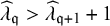 $\widehat {\lambda }_{\mathfrak q}>\widehat {\lambda }_{{\mathfrak q}+1}+1$
and
$\widehat {\lambda }_{\mathfrak q}>\widehat {\lambda }_{{\mathfrak q}+1}+1$
and $\widehat {\mu }_{\mathfrak q}=\widehat {\mu }_{{\mathfrak q}+1}+1$
, so (32) gives
$\widehat {\mu }_{\mathfrak q}=\widehat {\mu }_{{\mathfrak q}+1}+1$
, so (32) gives $\widehat {\xi }_{\mathfrak q}>\widehat {\xi }_{{\mathfrak q}+1}$
. We therefore have
$\widehat {\xi }_{\mathfrak q}>\widehat {\xi }_{{\mathfrak q}+1}$
. We therefore have ${\mathfrak q}=p_j$
for some
${\mathfrak q}=p_j$
for some ${\mathfrak q}\in [1,t]$
, and hence
${\mathfrak q}\in [1,t]$
, and hence $i=\widehat {\mu }_{p_j}-1 = \widehat {\mu }_{p_j+1}=-u_{p_j+1}=-\widehat {w}_{k+d_{j-1}+1}$
. Since we have
$i=\widehat {\mu }_{p_j}-1 = \widehat {\mu }_{p_j+1}=-u_{p_j+1}=-\widehat {w}_{k+d_{j-1}+1}$
. Since we have
 $$\begin{align*}\widehat{w}_{k+1}> \widehat{w}_{k+d_1+1} >\cdots > \widehat{w}_{k+d_{j-1}+1} =-i, \end{align*}$$
and the sequence $(\widehat {w}_{k+1},\ldots ,\widehat {w}_n)$
is
$(\widehat {w}_{k+1},\ldots ,\widehat {w}_n)$
is $132$
-avoiding, we conclude that
$132$
-avoiding, we conclude that $\widehat {w}^{-1}(-i) = k+d_{j-1}+1 < \widehat {w}^{-1}(-i-1)$
, as desired.
$\widehat {w}^{-1}(-i) = k+d_{j-1}+1 < \widehat {w}^{-1}(-i-1)$
, as desired.
Suppose next that ${\mathfrak q}>m$
. Then, we have
${\mathfrak q}>m$
. Then, we have $\widehat {\lambda }_{\mathfrak q}>\widehat {\lambda }_{{\mathfrak q}+1}$
, so Lemma 14(b) and equation (32) imply that
$\widehat {\lambda }_{\mathfrak q}>\widehat {\lambda }_{{\mathfrak q}+1}$
, so Lemma 14(b) and equation (32) imply that $\widehat {\xi }_{\mathfrak q}>\widehat {\xi }_{{\mathfrak q}+1}$
. We deduce that
$\widehat {\xi }_{\mathfrak q}>\widehat {\xi }_{{\mathfrak q}+1}$
. We deduce that ${\mathfrak q}=p_j$
for some j, hence
${\mathfrak q}=p_j$
for some j, hence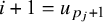 $i+1=u_{p_j+1}$
and the claim follows.
$i+1=u_{p_j+1}$
and the claim follows.
According to Corollary 2, we have
 $$ \begin{align} {\mathfrak D}_{\widehat{w}} = 2^{-\ell(\mu(\widehat{w}))}\,R^{D(\widehat{w})} \star {}^{k^{n-k}+\widehat{\xi}}\widehat{c}^{\,\beta(\widehat{w})}_{\lambda(\widehat{w})}, \end{align} $$
so the proposition holds for leading elements. Suppose next that $w:={\omega }\widehat {w}$
is a modification of
$w:={\omega }\widehat {w}$
is a modification of $\widehat {w}$
. Then repeated application of (11), Propositions 1(a) and 2(a), and the left Leibnitz rule in equation (33) give
$\widehat {w}$
. Then repeated application of (11), Propositions 1(a) and 2(a), and the left Leibnitz rule in equation (33) give
 $$\begin{align*}{\mathfrak D}_w = 2^{-\ell(\mu(w))}\,R^{D(w)} \star {}^{k^{n-k}+\widehat{\xi}}\widehat{c}^{\,\beta(w)+\widehat{\xi}-\xi}_{\lambda(w)}. \end{align*}$$
It remains to check the last assertion, about the left and right descents of w. This is done exactly as in the proof of Proposition 7.
Theorem 6. For any amenable element $w\in \widetilde {W}_\infty $
, we have
$w\in \widetilde {W}_\infty $
, we have
 $$ \begin{align} {\mathfrak D}_w = 2^{-\ell(\mu(w))}\,R^{D(w)} \star {}^{{\mathfrak f}(w)}\widehat{c}_{\lambda(w)}^{\,{\mathfrak g}(w)} \end{align} $$
in $\Gamma '[X,Y]$
.
$\Gamma '[X,Y]$
.
Proof. We may assume that we are in the situation of Proposition 10, so that $w={\omega }\widehat {w}$
, with
$w={\omega }\widehat {w}$
, with $\widehat {\lambda }=\lambda (\widehat {w})$
and
$\widehat {\lambda }=\lambda (\widehat {w})$
and $\lambda =\lambda (w)$
. Suppose that
$\lambda =\lambda (w)$
. Suppose that $j\in [1,\ell ]$
and let
$j\in [1,\ell ]$
and let ${\mathfrak q}$
be the least critical index of w such that
${\mathfrak q}$
be the least critical index of w such that ${\mathfrak q}\geq j$
. Then, we have
${\mathfrak q}\geq j$
. Then, we have $\lambda _j=\lambda _{j+1}=\cdots = \lambda _{\mathfrak q}$
, if
$\lambda _j=\lambda _{j+1}=\cdots = \lambda _{\mathfrak q}$
, if ${\mathfrak q}>m$
, and
${\mathfrak q}>m$
, and $\lambda _j=\lambda _{j+1}+1 = \cdots = \lambda _{\mathfrak q}+({\mathfrak q}-j)$
, if
$\lambda _j=\lambda _{j+1}+1 = \cdots = \lambda _{\mathfrak q}+({\mathfrak q}-j)$
, if ${\mathfrak q}\leq m$
. Moreover, in either case, we have
${\mathfrak q}\leq m$
. Moreover, in either case, we have $\xi _j=\cdots = \xi _{\mathfrak q}$
, and the values
$\xi _j=\cdots = \xi _{\mathfrak q}$
, and the values $\beta _j,\ldots ,\beta _{\mathfrak q}$
are consecutive integers. As the sequence
$\beta _j,\ldots ,\beta _{\mathfrak q}$
are consecutive integers. As the sequence $g:=\beta +\widehat {\xi }-\xi $
is weakly increasing, we deduce that for any
$g:=\beta +\widehat {\xi }-\xi $
is weakly increasing, we deduce that for any $r\in [j,{\mathfrak q}-1]$
, either (i)
$r\in [j,{\mathfrak q}-1]$
, either (i) $\widehat {\xi }_r=\widehat {\xi }_{r+1}$
and
$\widehat {\xi }_r=\widehat {\xi }_{r+1}$
and $g_r=g_{r+1}-1$
or (ii)
$g_r=g_{r+1}-1$
or (ii) $\widehat {\xi }_r=\widehat {\xi }_{r+1}+1$
and
$\widehat {\xi }_r=\widehat {\xi }_{r+1}+1$
and $g_r=g_{r+1}$
. Equation (34) follows from this and induction on
$g_r=g_{r+1}$
. Equation (34) follows from this and induction on ${\mathfrak q}-j$
, by using Lemmas 7(b) and 8(b) in Proposition 10. The required conditions on
${\mathfrak q}-j$
, by using Lemmas 7(b) and 8(b) in Proposition 10. The required conditions on $D(w)$
in these two lemmas and the corresponding relations (7) and (10) are all easily checked.
$D(w)$
in these two lemmas and the corresponding relations (7) and (10) are all easily checked.
6.2. Flagged eta polynomials
In this section, we define a family of polynomials $H_w$
indexed by amenable elements
$H_w$
indexed by amenable elements $w\in \widetilde {W}_\infty $
that generalize the double eta polynomials of [Reference Tamvakis28]. As in Section 5.2, the polynomial
$w\in \widetilde {W}_\infty $
that generalize the double eta polynomials of [Reference Tamvakis28]. As in Section 5.2, the polynomial $H_w$
represents an equivariant Schubert class in the T-equivariant cohomology ring of the even orthogonal partial flag variety associated with the right flag
$H_w$
represents an equivariant Schubert class in the T-equivariant cohomology ring of the even orthogonal partial flag variety associated with the right flag ${\mathfrak f}(w)$
.
${\mathfrak f}(w)$
.
For every $k\geq 1$
, let
$k\geq 1$
, let ${}^k{\mathfrak b}:=({}^k\widetilde {{\mathfrak b}}_k,{}^k{\mathfrak b}_1,{}^k{\mathfrak b}_2,\ldots )$
and
${}^k{\mathfrak b}:=({}^k\widetilde {{\mathfrak b}}_k,{}^k{\mathfrak b}_1,{}^k{\mathfrak b}_2,\ldots )$
and ${}^k{\mathfrak c}:=({}^k{\mathfrak c}_1,{}^k{\mathfrak c}_2,\ldots )$
be families of commuting variables, set
${}^k{\mathfrak c}:=({}^k{\mathfrak c}_1,{}^k{\mathfrak c}_2,\ldots )$
be families of commuting variables, set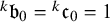 ${}^k{\mathfrak b}_0={}^k{\mathfrak c}_0=1$
and
${}^k{\mathfrak b}_0={}^k{\mathfrak c}_0=1$
and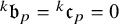 ${}^k{\mathfrak b}_p={}^k{\mathfrak c}_p=0$
for each
${}^k{\mathfrak b}_p={}^k{\mathfrak c}_p=0$
for each $p<0$
, and let
$p<0$
, and let $t:=(t_1,t_2,\ldots )$
. These variables are related by the equations
$t:=(t_1,t_2,\ldots )$
. These variables are related by the equations
 $$\begin{align*}{}^k{\mathfrak c}_p= \begin{cases} {}^k{\mathfrak b}_p &\text{if } p< k,\\ {}^k{\mathfrak b}_k+{}^k\widetilde{{\mathfrak b}}_k &\text{if } p=k,\\ 2\left({}^k{\mathfrak b}_p\right) &\text{if } p> k. \end{cases} \end{align*}$$
For any $p,r\in {\mathbb Z}$
and for
$p,r\in {\mathbb Z}$
and for $s\in \{0,1\}$
, define the polynomials
$s\in \{0,1\}$
, define the polynomials ${}^k{\mathfrak c}^r_p$
and
${}^k{\mathfrak c}^r_p$
and ${}^k{\mathfrak a}^s_p$
by
${}^k{\mathfrak a}^s_p$
by
 $$\begin{align*}{}^k{\mathfrak c}^r_p:= \sum_{j=0}^p {}^k{\mathfrak c}_{p-j} \, h^r_j(-t) \ \ \ \text{and} \ \ \ {}^k{\mathfrak a}^s_p:= \frac{1}{2}\left({}^k{\mathfrak c}_p\right)+\sum_{j=1}^p {}^k{\mathfrak c}_{p-j} \, h^s_j(-t). \end{align*}$$
Moreover, define
 $$\begin{align*}{}^k{\mathfrak b}^s_k:= {}^k{\mathfrak b}_k+\sum_{j=1}^k {}^k{\mathfrak c}_{k-j} \, h^s_j(-t) \ \ \ \text{and} \ \ \ {}^k\widetilde{{\mathfrak b}}^s_k:= {}^k\widetilde{{\mathfrak b}}_k+\sum_{j=1}^k {}^k{\mathfrak c}_{k-j} \, h^s_j(-t). \end{align*}$$
For any integer sequences $\alpha $
,
$\alpha $
, $\rho $
,
$\rho $
, ${\kappa }$
with
${\kappa }$
with ${\kappa }_i\geq 1$
for each i, let
${\kappa }_i\geq 1$
for each i, let
 $$\begin{align*}{}^{\kappa}\widehat{{\mathfrak c}}_\alpha^{\,\rho}:= {}^{{\kappa}_1}\widehat{{\mathfrak c}}_{\alpha_1}^{\,\rho_1}\, {}^{{\kappa}_2}\widehat{{\mathfrak c}}_{\alpha_2}^{\,\rho_2}\dots \end{align*}$$
where, for each $i\geq 1$
,
$i\geq 1$
,
 $$\begin{align*}{}^{{\kappa}_i}\widehat{{\mathfrak c}}_{\alpha_i}^{\,\rho_i}:= {}^{{\kappa}_i}{\mathfrak c}_{\alpha_i}^{\rho_i} + \begin{cases} (2({}^{{\kappa}_i}\widetilde{{\mathfrak b}}_{{\kappa}_i})- {}^{{\kappa}_i}{\mathfrak c}_{{\kappa}_i})e^{\alpha_i-{\kappa}_i}_{\alpha_i-{\kappa}_i}(-t) & \text{if } \rho_i = {\kappa}_i - \alpha_i < 0 \text{ and } i \text{ is odd}, \\ (2({}^{{\kappa}_i}{\mathfrak b}_{{\kappa}_i})-{}^{{\kappa}_i}{\mathfrak c}_{{\kappa}_i})e^{\alpha_i-{\kappa}_i}_{\alpha_i-{\kappa}_i}(-t) & \text{if } \rho_i = {\kappa}_i - \alpha_i < 0 \text{ and } i \text{ is even}, \\ 0 & \text{otherwise}. \end{cases} \end{align*}$$
If $w\in \widetilde {W}_n$
is amenable with left flag
$w\in \widetilde {W}_n$
is amenable with left flag ${\mathfrak f}(w)$
and right flag
${\mathfrak f}(w)$
and right flag ${\mathfrak g}(w)$
, the flagged double eta polynomial
${\mathfrak g}(w)$
, the flagged double eta polynomial $H_w({\mathfrak c}\, |\, t)$
is defined by
$H_w({\mathfrak c}\, |\, t)$
is defined by
 $$ \begin{align} H_w({\mathfrak c}\, |\, t):= 2^{-\ell(\mu(w))}\,R^{D(w)}\star {}^{{\mathfrak f}(w)}\widehat{{\mathfrak c}}_{\lambda(w)}^{\,{\mathfrak g}(w)}, \end{align} $$
where the action $\star $
of the raising operator expression
$\star $
of the raising operator expression $R^{D(w)}$
is as in Definition 11. The flagged single eta polynomial is given by
$R^{D(w)}$
is as in Definition 11. The flagged single eta polynomial is given by $H_w({\mathfrak c}):=H_w({\mathfrak c}\, |\, 0)$
. If w is a leading element, then (35) can be written in the “factorial” form
$H_w({\mathfrak c}):=H_w({\mathfrak c}\, |\, 0)$
. If w is a leading element, then (35) can be written in the “factorial” form
 $$\begin{align*}H_w({\mathfrak c}\, |\, t)= 2^{-\ell(\mu(w))}\,R^{D(w)}\star {}^{{\mathfrak f}(w)}\widehat{{\mathfrak c}}_{\lambda(w)}^{\,\beta(w)}. \end{align*}$$
When w is a k-Grassmannian element, the above formulas specialize to the double eta polynomial $H_\lambda ({\mathfrak c}\, |\, t)$
found in [Reference Tamvakis28]; here,
$H_\lambda ({\mathfrak c}\, |\, t)$
found in [Reference Tamvakis28]; here, $\lambda $
is the typed k-strict partition corresponding to w. Moreover, the single eta polynomial
$\lambda $
is the typed k-strict partition corresponding to w. Moreover, the single eta polynomial $H_\lambda ({\mathfrak c})$
agrees with that introduced in [Reference Buch, Kresch and Tamvakis6] (see also [Reference Tamvakis26], [Reference Tamvakis27]).
$H_\lambda ({\mathfrak c})$
agrees with that introduced in [Reference Buch, Kresch and Tamvakis6] (see also [Reference Tamvakis26], [Reference Tamvakis27]).
6.3. Orthogonal degeneracy loci
6.3.1. Odd orthogonal loci
Let $E\to {\mathfrak X}$
be a vector bundle of rank
$E\to {\mathfrak X}$
be a vector bundle of rank $2n+1$
on a smooth complex algebraic variety
$2n+1$
on a smooth complex algebraic variety ${\mathfrak X}$
. Assume that E is an orthogonal bundle, that is, E is equipped with an everywhere nondegenerate symmetric form
${\mathfrak X}$
. Assume that E is an orthogonal bundle, that is, E is equipped with an everywhere nondegenerate symmetric form $E\otimes E\to {\mathbb C}$
. Let
$E\otimes E\to {\mathbb C}$
. Let $w\in W_n$
be amenable of shape
$w\in W_n$
be amenable of shape $\lambda $
, and let
$\lambda $
, and let ${\mathfrak f}$
and
${\mathfrak f}$
and ${\mathfrak g}$
be the left and right flags of w, respectively. Consider two complete flags of subbundles of E
${\mathfrak g}$
be the left and right flags of w, respectively. Consider two complete flags of subbundles of E
 $$\begin{align*}0 \subset E_1\subset \cdots \subset E_{2n+1}=E \ \ \, \mathrm{and} \, \ \ 0 \subset F_1\subset \cdots \subset F_{2n+1}=E \end{align*}$$
with ${\mathrm {rank}} E_r={\mathrm {rank}} F_r=r$
for each r, while
${\mathrm {rank}} E_r={\mathrm {rank}} F_r=r$
for each r, while $E_{n+s}=E_{n+1-s}^{\perp }$
and
$E_{n+s}=E_{n+1-s}^{\perp }$
and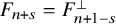 $F_{n+s}=F_{n+1-s}^{\perp }$
for
$F_{n+s}=F_{n+1-s}^{\perp }$
for $1\leq s \leq n$
.
$1\leq s \leq n$
.
There is a group monomorphism $\zeta ':W_n\hookrightarrow S_{2n+1}$
with image
$\zeta ':W_n\hookrightarrow S_{2n+1}$
with image
 $$\begin{align*}\zeta'(W_n)=\{\,{\varpi}\in S_{2n+1} \ |\ {\varpi}_i +{\varpi}_{2n+2-i} = 2n+2, \ \ \text{for all} \ i\,\}. \end{align*}$$
The map $\zeta' $
is determined by setting, for each
$\zeta' $
is determined by setting, for each $w=(w_1,\ldots ,w_n)\in W_n$
and
$w=(w_1,\ldots ,w_n)\in W_n$
and $1\leq i \leq n$
,
$1\leq i \leq n$
,
 $$\begin{align*}\zeta'(w)_i :=\left\{ \begin{array}{cl} n+1-w_{n+1-i} & \mathrm{ if } \ w_{n+1-i} \ \mathrm{is} \ \mathrm{unbarred}, \\ n+1+\overline{w}_{n+1-i} & \mathrm{otherwise}. \end{array} \right. \end{align*}$$
Define the degeneracy locus ${\mathfrak X}_w\subset {\mathfrak X}$
as the locus of
${\mathfrak X}_w\subset {\mathfrak X}$
as the locus of $x \in {\mathfrak X}$
such that
$x \in {\mathfrak X}$
such that
 $$\begin{align*}\dim(E_r(x)\cap F_s(x))\geq \#\,\{\,i \leq r \ |\ \zeta'(w)_i> 2n+1-s\,\} \ \, \mathrm{for} \ 1\leq r \leq n, \, 1\leq s \leq 2n. \end{align*}$$
As in the symplectic case, we assume that ${\mathfrak X}_w$
has pure codimension
${\mathfrak X}_w$
has pure codimension $\ell (w)$
in
$\ell (w)$
in ${\mathfrak X}$
, and give a formula for the class
${\mathfrak X}$
, and give a formula for the class $[{\mathfrak X}_w]$
in
$[{\mathfrak X}_w]$
in ${\mathrm {H}}^{2\ell (w)}({\mathfrak X})$
.
${\mathrm {H}}^{2\ell (w)}({\mathfrak X})$
.
Theorem 7. For any amenable element $w\in W_n$
, we have
$w\in W_n$
, we have
 $$ \begin{align*} [{\mathfrak X}_w] &= 2^{-\ell(\mu(w))}\,\Theta_w(E-E_{n-{\mathfrak f}}-F_{n+1+{\mathfrak g}}) \\ &= 2^{-\ell(\mu(w))}\,R^{D(w)}\, c_{\lambda}(E-E_{n-{\mathfrak f}}-F_{n+1+{\mathfrak g}}) \end{align*} $$
in the cohomology ring ${\mathrm {H}}^*({\mathfrak X})$
.
${\mathrm {H}}^*({\mathfrak X})$
.
Theorem 7 is derived from equation (25) in the same way as Theorem 5, using the type B geometrization map of [Reference Ikeda, Mihalcea and Naruse13, Section 10]; compare with [Reference Tamvakis27, Section 6.3.1].
6.3.2. Even orthogonal loci
Let $E\to {\mathfrak X}$
be an orthogonal vector bundle of rank
$E\to {\mathfrak X}$
be an orthogonal vector bundle of rank $2n$
on a smooth complex algebraic variety
$2n$
on a smooth complex algebraic variety ${\mathfrak X}$
. Let
${\mathfrak X}$
. Let $w\in \widetilde {W}_n$
be an amenable element of shape
$w\in \widetilde {W}_n$
be an amenable element of shape $\lambda $
, and let
$\lambda $
, and let ${\mathfrak f}$
and
${\mathfrak f}$
and ${\mathfrak g}$
be the left and right flags of w, respectively. Two maximal isotropic subbundles L and
${\mathfrak g}$
be the left and right flags of w, respectively. Two maximal isotropic subbundles L and $L'$
of E are said to be in the same family if
$L'$
of E are said to be in the same family if $\mathrm {rank}(L\cap L')\equiv n \, (\text {mod 2})$
. Consider two complete flags of subbundles of E
$\mathrm {rank}(L\cap L')\equiv n \, (\text {mod 2})$
. Consider two complete flags of subbundles of E
 $$\begin{align*}0 \subset E_1\subset \cdots \subset E_{2n}=E \ \ \, \mathrm{and} \, \ \ 0 \subset F_1\subset \cdots \subset F_{2n}=E \end{align*}$$
with ${\mathrm {rank}} E_r={\mathrm {rank}} F_r=r$
for each r, while
${\mathrm {rank}} E_r={\mathrm {rank}} F_r=r$
for each r, while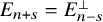 $E_{n+s}=E_{n-s}^{\perp }$
and
$E_{n+s}=E_{n-s}^{\perp }$
and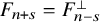 $F_{n+s}=F_{n-s}^{\perp }$
for
$F_{n+s}=F_{n-s}^{\perp }$
for $0\leq s < n$
. We assume that
$0\leq s < n$
. We assume that $E_n$
is in the same family as
$E_n$
is in the same family as $F_n$
, if n is even, and in the opposite family, if n is odd.
$F_n$
, if n is even, and in the opposite family, if n is odd.
We have a group monomorphism $\zeta :\widetilde {W}_n\hookrightarrow S_{2n}$
, defined by restricting the map
$\zeta :\widetilde {W}_n\hookrightarrow S_{2n}$
, defined by restricting the map $\zeta $
of Section 5.3 to
$\zeta $
of Section 5.3 to $\widetilde {W}_n$
. Let
$\widetilde {W}_n$
. Let $\widetilde {w}_0$
denote the longest element of
$\widetilde {w}_0$
denote the longest element of $\widetilde {W}_n$
, and define the degeneracy locus
$\widetilde {W}_n$
, and define the degeneracy locus ${\mathfrak X}_w\subset {\mathfrak X}$
as the closure of the locus of
${\mathfrak X}_w\subset {\mathfrak X}$
as the closure of the locus of $x \in {\mathfrak X}$
such that
$x \in {\mathfrak X}$
such that
 $$\begin{align*}\dim(E_r(x)\cap F_s(x)) = \#\,\{\,i \leq r \ |\ \zeta(\widetilde{w}_0w\widetilde{w}_0)_i> 2n-s\,\} \ \, \mathrm{for} \ 1\leq r \leq n-1, \, 1\leq s \leq 2n \end{align*}$$
with the reduced scheme structure. Assume further that ${\mathfrak X}_w$
has pure codimension
${\mathfrak X}_w$
has pure codimension $\ell (w)$
in
$\ell (w)$
in ${\mathfrak X}$
, and consider its cohomology class
${\mathfrak X}$
, and consider its cohomology class $[{\mathfrak X}_w]$
in
$[{\mathfrak X}_w]$
in ${\mathrm {H}}^{2\ell (w)}({\mathfrak X})$
.
${\mathrm {H}}^{2\ell (w)}({\mathfrak X})$
.
Theorem 8. For any amenable element $w\in \widetilde {W}_n$
, we have
$w\in \widetilde {W}_n$
, we have
 $$ \begin{align} [{\mathfrak X}_w] = H_w(E-E_{n-{\mathfrak f}}-F_{n+{\mathfrak g}}) = 2^{-\ell(\mu(w))}\,R^{D(w)}\star \widehat{c}_{\lambda}(E-E_{n-{\mathfrak f}}-F_{n+{\mathfrak g}}) \end{align} $$
in the cohomology ring ${\mathrm {H}}^*({\mathfrak X})$
.
${\mathrm {H}}^*({\mathfrak X})$
.
The Chern polynomial in (36) is defined by employing the substitutions
 $$ \begin{gather*} {}^r{\mathfrak b}_p \longmapsto \begin{cases} c_p(E-E_{n-r}-F_n) & \text{if } p<r, \\ \displaystyle\frac{1}{2} c_p(E-E_{n-r}-F_n) & \text{if } p>r, \end{cases} \\ {}^r{\mathfrak b}_r\longmapsto\frac{1}{2}(c_r(E-E_{n-r}-F_n)+c_r(E_n-E_{n-r})), \\ {}^r\widetilde{{\mathfrak b}}_r\longmapsto\frac{1}{2}(c_r(E-E_{n-r}-F_n)-c_r(E_n-E_{n-r})) \end{gather*} $$
in equation (35), for any integer p and $r\geq 1$
. The proof of Theorem 8 is obtained by applying the type D geometrization map of [Reference Ikeda, Mihalcea and Naruse13, Section 10] to equation (34), and using the computations in [Reference Tamvakis27, Section 7.4].
$r\geq 1$
. The proof of Theorem 8 is obtained by applying the type D geometrization map of [Reference Ikeda, Mihalcea and Naruse13, Section 10] to equation (34), and using the computations in [Reference Tamvakis27, Section 7.4].
A. Counterexamples to statements in [Reference Anderson and Fulton2]
The following two examples exhibit errors in the proofs—in all types except type A—and in the main type D result of [Reference Anderson and Fulton2]. We use the notation in [Reference Anderson and Fulton2].
Example A.1. We show that Lemma A.1(i) of [Reference Anderson and Fulton2] is incorrect. Set $\rho =(0,1,0)$
,
$\rho =(0,1,0)$
, $\lambda =(2,1,1)$
,
$\lambda =(2,1,1)$
, $k=m=2$
, and
$k=m=2$
, and $n=\ell =3$
. The assumptions are that
$n=\ell =3$
. The assumptions are that $c(2)=c(3)$
,
$c(2)=c(3)$
, $c'(2)=c(2)(1+b_1)$
, so that
$c'(2)=c(2)(1+b_1)$
, so that $c^{\prime }_j(2)=c_j(2)+b_1c_{j-1}(2)$
for each j, and
$c^{\prime }_j(2)=c_j(2)+b_1c_{j-1}(2)$
for each j, and $c'(i)=c(i)$
for
$c'(i)=c(i)$
for $i=1,3$
.
$i=1,3$
.
We compute that $R^{(\rho ,\ell )} = (1+R_{12})^{-1}(1-R_{12})(1-R_{13})(1-R_{23})$
and hence
$R^{(\rho ,\ell )} = (1+R_{12})^{-1}(1-R_{12})(1-R_{13})(1-R_{23})$
and hence
 $$\begin{align*}\Theta_\lambda^{(\rho)}(c)= c_2(1)c_1(2)c_1(2) -2c_3(1)c_1(2)+c_3(1)c_1(2)-c_2(1)c_2(2) \end{align*}$$
while
 $$\begin{align*}\Theta_\lambda^{(\rho)}(c')=c_2(1)(c_1(2)+b_1)c_1(2) -2c_3(1)c_1(2)+c_3(1)(c_1(2)+b_1) -c_2(1)(c_2(2)+b_1c_1(2)). \end{align*}$$
It follows that
 $$\begin{align*}\Theta_\lambda^{(\rho)}(c')-\Theta_\lambda^{(\rho)}(c) = b_1c_3(1)\neq 0. \end{align*}$$
One can show similarly that Lemma A.1(ii) and Lemma A.2 of [Reference Anderson and Fulton2] are also wrong.
Example A.2. We show that Theorem 4 of [Reference Anderson and Fulton2] is false. Consider the type D triple $\tau = (\mathbf {k}, \mathbf {p}, \mathbf {q}) = ((1,2), (2,1), (0,-2))$
, which corresponds to the Weyl group element
$\tau = (\mathbf {k}, \mathbf {p}, \mathbf {q}) = ((1,2), (2,1), (0,-2))$
, which corresponds to the Weyl group element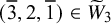 $(\overline {3},2,\overline {1})\in \widetilde {W}_3$
(or to the element
$(\overline {3},2,\overline {1})\in \widetilde {W}_3$
(or to the element $(3,2,1)$
, depending on the type convention). We have
$(3,2,1)$
, depending on the type convention). We have $\rho =(0,0)$
and
$\rho =(0,0)$
and $\lambda =(2,1)$
, while
$\lambda =(2,1)$
, while $\ell =2$
and
$\ell =2$
and $r=1$
, so
$r=1$
, so $\widetilde {R}^{(\rho ,r,\ell )} = 1-R_{12}$
and
$\widetilde {R}^{(\rho ,r,\ell )} = 1-R_{12}$
and
 $$\begin{align*}H^{\rho(\tau)}_{\lambda(\tau)}(c(1),c(2)) = (1-R_{12})(c(1)_2c(2)_1) = c_2(1)c_1(2) - c_3(1)c_0(2). \end{align*}$$
The computations of Example 8 show that $2\,[\Omega _{\boldsymbol {\tau }}]\neq H^{\rho (\tau )}_{\lambda (\tau )}(c(1),c(2))$
.
$2\,[\Omega _{\boldsymbol {\tau }}]\neq H^{\rho (\tau )}_{\lambda (\tau )}(c(1),c(2))$
.
Acknowledgements
I thank Andrew Kresch for encouraging me to work on this article, providing useful comments, and, more importantly, for being a good friend. Thanks are also due to the referees for a careful reading of the article and suggestions which helped to improve the exposition and to simplify the proof of Theorem 2.


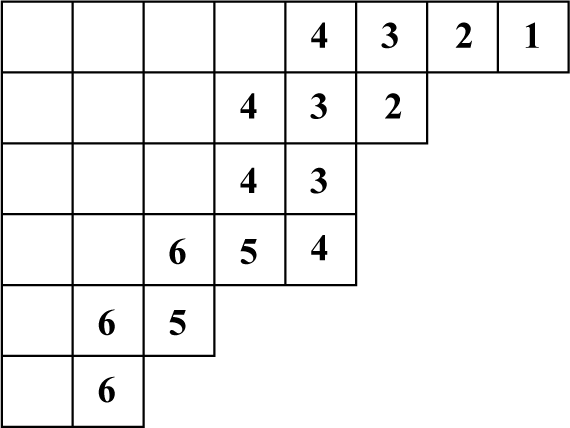


 Open access

