





1. Introduction
Event-related potential (ERP) studies with proficient adult readers consistently demonstrate that visual words, in comparison to non-linguistic control stimuli, elicit a more pronounced N170 amplitude in the left occipitotemporal cortex (Bentin et al., Reference Bentin, Mouchetant-Rostaining, Giard, Echallier and Pernier1999; Maurer et al., Reference Maurer, Brandeis and McCandliss2005a, Reference Maurer, Brem, Kranz, Bucher, Benz, Halder and Brandeis2006, Reference Maurer, Zevin and Mccandliss2008). This neural print-tuning mechanism is essential for the efficient recognition of visual words within the visual system (Schlaggar & McCandliss, Reference Schlaggar and McCandliss2007). Currently, studies examining the presence of neural print tuning for Chinese characters among adult second language (L2) learners of Chinese are limited, and to our knowledge, no studies have examined whether neural print tuning changes with increased reading experience of Chinese language in adult L2 learners. Given the distinct contrasts between the literacy acquisition processes of adult L2 learners and native-speaking children, it is important to investigate the neural tuning for print in adult L2 Chinese learners with different levels of Chinese reading skills.
1.1. The coarse and fine N170 tuning for print
The word-related N170 component, peaking between 160 and 200 ms post-stimulus onset over the left occipital–temporal cortex, is believed to be a neural index of visual tuning for print (Bentin et al., Reference Bentin, Mouchetant-Rostaining, Giard, Echallier and Pernier1999; Lin et al., Reference Lin, Chen, Zhao, Li, He and Weng2011; Maurer et al., Reference Maurer, Brem, Kranz, Bucher, Benz, Halder and Brandeis2006; Zhao et al., Reference Zhao, Li, Lin, Cao, He and Weng2012). Collective findings from ERP studies have demonstrated that the early N170 responses evoked by visual words were consistently larger when compared with different types of control stimuli (Maurer et al., Reference Maurer, Brandeis and McCandliss2005a, Reference Maurer, Brem, Kranz, Bucher, Benz, Halder and Brandeis2006, Reference Maurer, Zevin and Mccandliss2008; Zhao et al., Reference Shu2012). To understand the sensitivity of the N170 component for written words, researchers distinguish between coarse tuning and fine-tuning for print. The coarse neural tuning for print is defined as N170 amplitude difference between letter strings and strings of non-letters, such as symbols or false fonts in alphabetic studies (Maurer et al., Reference Maurer, Brandeis and McCandliss2005a, Reference Maurer, Brem, Bucher and Brandeis2005b; Zhao et al., Reference Zhao, Li, Lin, Cao, He and Weng2012). For example, Maurer et al. (Reference Maurer, Brandeis and McCandliss2005a) found that both English real words and pseudo-words showed greater N170 amplitudes than symbol strings. Such coarse tuning effects are also observed in contrast to French words (Bentin et al., Reference Bentin, Mouchetant-Rostaining, Giard, Echallier and Pernier1999), familiar Roman characters, and false fonts in skilled English native readers (Wong et al., Reference Wong, Gauthier, Woroch, DeBuse and Curran2005). Coarse neural tuning for print has also been observed in Chinese script and is defined as the N170 sensitivity for characters over stroke combinations (e.g., Lin et al., Reference Lin, Chen, Zhao, Li, He and Weng2011; Tong et al., Reference Tong, Lo, McBride, Ho, Waye, Chung and Chow2016; Xue et al., Reference Xue, Maurer, Weng and Zhao2019; Zhao et al., Reference Zhao, Maurer, He and Weng2019). Researchers found that coarse print tuning emerged rapidly after children began learning to read, whereby Chinese characters elicited a larger N170 than line drawings (Cao et al., Reference Cao, Li, Zhao, Lin and Weng2011), symbols (Maurer et al., Reference Maurer, Brem, Kranz, Bucher, Benz, Halder and Brandeis2006; Zhao et al., Reference Zhao, Kipp, Gaspar, Maurer, Weng, Mecklinger and Li2014) and false fonts (Eberhard-Moscicka et al., Reference Eberhard-Moscicka, Jost, Raith and Maurer2015) within a literacy training period of no more than two years.
Expert readers also demonstrate fine neural tuning for print, which is defined by N170 amplitude differences in alphabetic scripts among various types of letter strings such as words, pseudo-words, or consonant strings. There are different subtypes of fine print tuning, first, given the differences in lexical–semantic properties, previous studies have examined lexicality effects (lexicality fine tuning) by contrasting real words with pronounceable pseudo-words, revealing an increased N170 response to real words (Hauk et al., Reference Hauk, Davis, Ford, Pulvermüller and Marslen-Wilson2006; Maurer et al., Reference Maurer, Brem, Kranz, Bucher, Benz, Halder and Brandeis2006); second, previous studies also compared the N170 differences between words and word-like stimuli, such as consonant strings in alphabetic scripts or false characters in logographic scripts, reflecting sensitivity for orthographic processing, also called orthographic regularity fine tuning (Bentin et al., Reference Bentin, Mouchetant-Rostaining, Giard, Echallier and Pernier1999; Cao et al., Reference Cao, Li, Zhao, Lin and Weng2011; Lin et al., Reference Lin, Chen, Zhao, Li, He and Weng2011; Maurer et al., Reference Maurer, Brandeis and McCandliss2005a; Simon et al., Reference Simon, Bernard, Largy, Lalonde and Rebai2004; Tong et al., Reference Tong, Lo, McBride, Ho, Waye, Chung and Chow2016). Compared to coarse tuning, developmental studies showed that fine-tuning for print emerged later and developed slower during the process of reading acquisition (Cao et al., Reference Cao, Li, Zhao, Lin and Weng2011; Posner & McCandliss, Reference Posner, McCandliss, Klein and McMullen1999; Tong et al., Reference Tong, Lo, McBride, Ho, Waye, Chung and Chow2016; Zhao et al., Reference Zhao, Kipp, Gaspar, Maurer, Weng, Mecklinger and Li2014). For example, Posner and McCandliss (Reference Posner, McCandliss, Klein and McMullen1999) found that in 10-year-old children, familiar words elicited larger N170 amplitudes compared to consonant strings, a difference that was not observed in children aged 7 or in preschoolers aged 4. Further study investigating younger German children with high reading ability (7 years old, with 6 months of training for reading) showed stronger N170 amplitude for words than consonant strings (Zhao et al., Reference Zhao, Kipp, Gaspar, Maurer, Weng, Mecklinger and Li2014), suggesting that fine-tuning can emerge earlier than previously believed, and is possibly associated with reading ability/experience. In Chinese children, after 1.5 years of literacy learning, the N170 fine-tuning effect has also been observed in real and pseudo-characters relative to non-characters and stroke combination in 7.7- and 9.4-year-old children, and interestingly, the neural print effects were bilateral in younger children, but left-lateralized in older children (Tong et al., Reference Tong, Lo, McBride, Ho, Waye, Chung and Chow2016).
1.2. The lateralization of N170 effects
In addition to coarse and fine print-tuning effects, studies have also examined the lateralization of word-related N170 effects. Alphabetic studies typically showing left lateralization for visual words (N170 amplitude in the left hemisphere is larger than that in the right hemisphere). In contrast, the N170 lateralization has not always been clear in Chinese studies, with some researchers directly compared the N170 response to characters between hemispheres but drawing criticism for oversimplified assumption of hemispheric anatomical symmetry (Zhao et al., Reference Zhao, Li, Lin, Cao, He and Weng2012). Studies using this measure have led to mixed findings, with some reporting the left-lateralized effect of Chinese characters (Cao et al., Reference Cao, Li, Zhao, Lin and Weng2011; Lin et al., Reference Lin, Chen, Zhao, Li, He and Weng2011), while others show right-lateralized or bilateral N170 effects (Lee et al., Reference Lee, Tsai, Chan, Hsu, Hung and Tzeng2007; Liu & Perfetti, Reference Liu and Perfetti2003; Zhang et al., Reference Zhang, Jiang, Mei, Yang, Chen, Xue and Dong2011), possibly due to task differences (Yum & Law, Reference Yum and Law2021). Further research has investigated the contrast of the N170 response to characters with control stimuli within each hemisphere and found a more pronounced selectivity in the left hemisphere in response to real words than control conditions, while this differentiation is absent in the right hemisphere, suggesting a left-hemisphere specialization for visual word processing (Cao & Zhang, Reference Cao and Zhang2011; Zhang et al., Reference Zhang, Jiang, Mei, Yang, Chen, Xue and Dong2011; Zhao et al., Reference Zhao, Li, Lin, Cao, He and Weng2012). Moreover, developmental studies have found that the trend in the lateralization of the N170 effect is generally from right or bilateral to left lateralization. For example, Maurer et al. (Reference Maurer, Brem, Bucher and Brandeis2005b, Reference Maurer, Brem, Kranz, Bucher, Benz, Halder and Brandeis2006) found that 6-year-old children without reading training displayed right lateralization of N170 amplitudes when processing words; however, after 1.5 years of reading training, 8.3-year-old children exhibited bilateral activation, while adults showed clear left lateralization. This indicated that the lateralization of the N170 word-related effect changes over time, through an interaction between age and reading ability/expertise. Consistent with this, previous Chinese studies have shown a developmental shift from bilateral to left-lateralized print-tuning effect for Chinese characters with increase in reading skills (Tong et al., Reference Tong, Lo, McBride, Ho, Waye, Chung and Chow2016).
1.3. The print-tuning effects in adult L2 learners
To date, less is known about the development of neural tuning for L2 learners, especially for adult L2 learners from alphabetic written scripts to Chinese written script. This question is of importance because Chinese characters are linguistically distinct from alphabetic scripts and are considered among the most challenging writing systems to master worldwide (Shu, Reference Shu2003; Tong & Yip, Reference Tong and Yip2015). This is especially the case for adult L2 learners from alphabetic scripts when they are learning to read Chinese, given that the latter has more complex writing systems, tonal nature and character stroke order. In contrast to the alphabetic writing system, where there is regular grapheme to phoneme correspondences, there are no such regular conversions in Chinese (Tan et al., Reference Tan, Liu, Perfetti, Spinks, Fox and Gao2001). In addition to this, the visual feature within a Chinese word is more complicated than the alphabetic word in terms of visual–spatial structure (Hoosain, Reference Hoosain, Chen and Tzeng1992). Currently, neural evidence for whether and how the neural tuning for Chinese characters develops is relatively limited. Children learning Chinese as their L1 typically learn to speak before they begin reading; however, adult L2 Chinese learners have to learn to speak and read at the same time, which means they are not familiar with either the spoken or written forms, indicating that their language acquisition is considerably different to those who learn Chinese as their L1. Therefore, while there is some evidence showing the coarse and fine neural tuning in Chinese children, it is not yet clear whether such tuning for Chinese characters could be observed in adult L2 learners. Finally, the brains of children undergo large maturational changes during childhood and adolescence, with some of the largest changes occurring at the time of initial literacy acquisition (Lebel et al., Reference Lebel, Walker, Leemans, Phillips and Beaulieu2008). For instance, some studies have observed a decrease in the N170 response to words relative to age and learning, as reported by Cao et al. (Reference Cao, Li, Zhao, Lin and Weng2011), thus, leaving the open question of whether the decrease indicated a general amplitude reduction due to brain maturation or a suppression effect due to the development of visual expertise.
Several studies have examined the print-tuning effects on non-native readers in different writing systems (Kim et al., Reference Kim, Yoon and Park2004; Wong et al., Reference Wong, Gauthier, Woroch, DeBuse and Curran2005; Yum et al., Reference Yum, Holcomb and Grainger2011, Reference Yum, Law, Lee and Shum2018). However, these investigations have typically focused on certain aspects of the print-tuning effect and have been limited to learners with certain levels of reading proficiency. For example, for the coarse print-tuning effects, a previous study investigating English native participants with no prior experience with Chinese found that Roman character stimuli lead to larger N170 amplitudes than Chinese and pseudo-font stimuli and that the N170 amplitude difference was not significant between Chinese characters and artificial non-words (Wong et al., Reference Wong, Gauthier, Woroch, DeBuse and Curran2005). Aligned with these findings, Yum et al. (Reference Yum, Holcomb and Grainger2011) found that native English participants with no prior experience in reading Chinese or related scripts such as Japanese Kanji showed large N170 amplitude differences between English words and pictures, but only small N170 amplitude differences between Mandarin words and pictures. However, for native Korean speakers with 6 years of Chinese character learning experience, researchers have found that the N170 amplitude induced by Chinese characters was larger than that of object graphics (Kim et al., Reference Kim, Yoon and Park2004). These studies collectively suggest that the N170 coarse print tuning is likely to be driven by reading experience. However, as previously mentioned, these studies only focused on investigating coarse print-tuning effects. Likewise, research focusing entirely on fine-tuning effects has also been conducted, for example, a recent study by Yum et al. (Reference Yum, Law, Lee and Shum2018) demonstrated that adolescent L2 Chinese learners showed N170 sensitivity to orthographic regularities. In this study, the participants involved were intermediate-level L2 Chinese learners whose L1 utilized an alphabetic script. The findings demonstrated that regular orthographic pseudo-characters evoked larger N170 than false characters that violate the radical position, and this pattern was only presented in the left hemisphere. These findings revealed that fine-tuning for Chinese characters can occur in intermediate-level L2 learners of Chinese. Moreover, some studies have examined the N170 lateralization effects for Chinese print in bilingual participants, which so far yielded mixed findings. For instance, Kim et al. (Reference Kim, Yoon and Park2004) found left-lateralized N170 response to English and Korean words, but bilateral posterior activation to Chinese words and pictures in L1 Korean–L2 Chinese and English learners. This suggests that the left lateralized N170 effects might be limited to alphabetic scripts. Further study by Yum & Law (Reference Yum and Law2021) found that Korean-Chinese readers had bilateral N170 response to Chinese characters, while native Chinese and Japanese Chinese groups had left-lateralized N170 response, with stronger left lateralization in native Chinese compared to Japanese Chinese readers. These findings imply that visual familiarity to a script determined the left lateralization of the N170 response. Although numerous studies are exploring the print-tuning effects on non-native readers of Chinese script, to date, no study has yet examined if and how both coarse and fine-tuning, as well as the lateralization of neural responses for Chinese characters, develop among adult L2 Chinese learners as they gain greater experience with the Chinese script.
1.4. The cognitive correlate of neural tuning for print
Currently, the cognitive correlates underlying N1 print tuning are not yet fully understood. There are some hypotheses explaining the underlying mechanisms of N1 tuning for print. The visual expertise hypothesis argues that N1 print tuning improves with better reading abilities (McCandliss et al., Reference McCandliss, Cohen and Dehaene2003), whereas the phonological mapping hypothesis attributes this tuning to the ability to connect sounds with their written symbols, particularly in languages like English (Maurer and McCandliss, Reference Maurer, McCandliss, Grigorenko and Naples2007). Previous findings from the studies which focused on individual difference were mixed and did not fully support these two hypotheses. For instance, some studies have shown that children with higher reading speeds tend to have larger fine-tuning effects between N170 responses to pseudo-words and consonant strings (Zhao et al., Reference Zhao, Kipp, Gaspar, Maurer, Weng, Mecklinger and Li2014). On the other hand, Eberhard-Moscicka et al. (Reference Eberhard-Moscicka, Jost, Raith and Maurer2015) found that among 7.6-year-old German children, N1 print-tuning effect did not relate to phonological skills like phoneme deletion or pseudo-word segmentation. Instead, reading fluency and vocabulary were more closely related to print tuning. These researchers suggest that understanding the meaning of words might be more crucial than phonological skills in developing print tuning. Similarly, Tong et al. (Reference Tong, Lo, McBride, Ho, Waye, Chung and Chow2016) found that in 7.7- and 9.9-year-old Chinese children, N1 tuning related moderately to reading fluency and accuracy but not to other language skills such as rapid naming phonology, or vocabulary knowledge, suggesting that semantic or phonological processes may not be driven of print-tuning effects. Notably, while studies have identified some cognitive aspects associated with print tuning in children, it is unclear whether reading fluency and phonological awareness are associated with print tuning in adult L2 learners with a wide range of reading skills. Furthermore, other important cognitive aspects of reading, like morphological awareness – which is particularly significant in Chinese script (McBride-Chang et al., Reference McBride-Chang, Shu, Zhou, Wat and Wagner2003; Shu et al., Reference Shu, McBride-Chang, Wu and Liu2006) – are not yet fully examined in relation to N1 print tuning.
1.5. The present study
In this study, we assess visual word recognition through the N170, using three operational definitions. The coarse tuning is identified by the N170 amplitude differences between characters and stroke combinations. Fine-tuning is based on the N170 differences between real characters and pseudo-characters (lexicality fine tuning) and between pseudo-characters and false characters (orthographic regularity fine tuning). Lateralization is measured by comparing N170 responses in the left and right hemispheres. This study aimed to examine the coarse and fine neural tuning effects, and lateralization in Chinese characters in beginner-level and intermediate adult L2 Chinese learners from alphabetic languages and native L1 readers. We also aimed to examine the cognitive correlates of neural tuning for Chinese print in adult L2 learners. We expected to see coarse tuning for Chinese characters in beginner and intermediate levels of Chinese reading skills, with an increased N170 response to Chinese characters than stroke combinations. We hypothesized that fine neural tuning would appear in intermediate L2 learners with an increased N170 response to Chinese characters than false characters. We also expected to see development changes for the neural print-tuning pattern from beginner L2 learners to intermediate L2 learners and native Chinese readers with the increase in Chinese reading experience. Lastly, in line with the visual expertise account, we hypothesized that reading fluency skills would be related to stronger coarse or fine-tuning effects for Chinese characters. We would expect to see phonological awareness would correlate with coarse and/or fine-tuning effects if the phonological mapping hypothesis holds true.
Our hypotheses were informed by prior research examining print-tuning effects in Chinese L1 readers and adult L2 Chinese learners (e.g., Cao et al., Reference Cao, Li, Zhao, Lin and Weng2011; Tong et al., Reference Tong, Lo, McBride, Ho, Waye, Chung and Chow2016; Yum et al., Reference Yum, Holcomb and Grainger2011, Reference Yum, Law, Lee and Shum2018). First, previous studies have identified a left-lateralized N170 component – larger for Chinese characters than for control stimuli (e.g., Lin et al., Reference Lin, Chen, Zhao, Li, He and Weng2011; Tong et al., Reference Tong, Lo, McBride, Ho, Waye, Chung and Chow2016; Zhao et al., Reference Zhao, Li, Lin, Cao, He and Weng2012). This left-lateralized print-tuning effect has also been observed in intermediate-level L2 Chinese learners (Yum et al., Reference Yum, Law, Lee and Shum2018). Second, research has indicated a developmental shift from bilateral to left-lateralized print-tuning effect for Chinese characters as reading skills improved with age (Tong et al., Reference Tong, Lo, McBride, Ho, Waye, Chung and Chow2016). Third, concerning the cognitive correlates of print-tuning effects, previous studies have demonstrated that word reading fluency is a reliable predictor (e.g., Eberhard et al., Reference Eberhard-Moscicka, Jost, Raith and Maurer2015; Tong et al., Reference Tong, Lo, McBride, Ho, Waye, Chung and Chow2016).
2. Methods
2.1. Participants
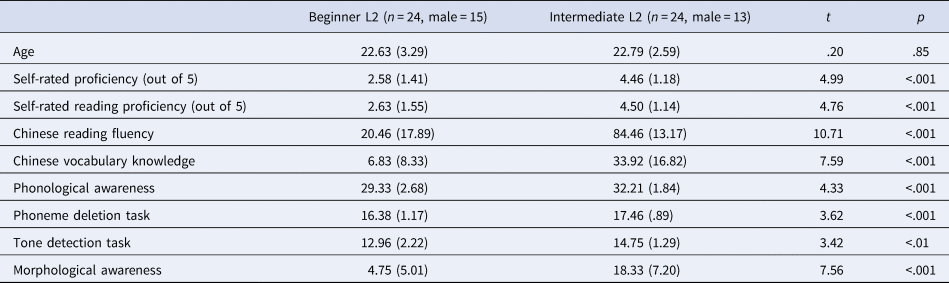
Forty-eight adult learners of L2 Chinese participated in this study (20 female, M = 22.71, SD = 2.87). All the participants had alphabetic L1: Portuguese (n = 22), French (n = 11), Spanish (n = 9), Italian (n = 2), English (n = 2) and Russian (n = 2) (for detailed language background, see Table 1). This study used the Chinese word reading fluency test as an index of reading proficiency for L2 learners. Using a median split, 48 L2 learners were grouped into beginner and intermediate level, each with 24 participants. The independent-samples t test showed that the L2 learners with intermediate level were significantly more fluent, and had higher Chinese vocabulary knowledge, and meta-linguistic skills (all p's < .001) compared to the beginner L2 learners. Twenty-three native Chinese speakers' data were reported (16 females, M = 23.67, SD = 2.41), with one additional data excluded due to low quality (bad epochs more than 40%). All participants were right-handed, without known neurological disease or psychological disorders. They were paid for participation and signed informed consent forms.
Language background of L2 learners

Note. Standard deviations are presented in parentheses alongside mean values.
2.2. Stimuli
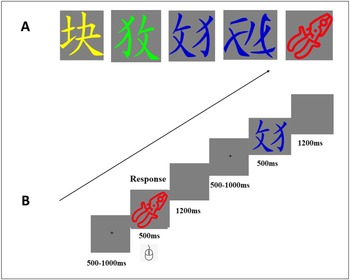
The ERP experiment utilized five categories of stimuli: real characters, pseudo-characters, false characters, stroke combinations and line drawings. Each category comprised 70 items, presented in four colors: red (10), yellow (20), green (20) and blue (20). Figure 1A illustrated examples of these materials. Real characters were high-frequency, left–right configured compound Chinese characters, all of which were content words selected from the syllabus of graded words and characters for Chinese proficiency Jia level (National Committee of Chinese Language Teaching Abroad, 1992). Pseudo-characters, created by combining two unpronounceable radicals adhering to Chinese orthographic regularity (i.e., radical position) (Lin et al., Reference Lin, Chen, Zhao, Li, He and Weng2011), were unpronounceable at both character and radical levels. Stroke numbers, frequencies of left radicals and frequencies of right radicals for pseudo-characters were strictly matched with real characters, t (118) = 1.48, p > .05; t (118) = .23, p > .05; t (118) = .19, p > .05, respectively (Shanghai Jiao Tong University, 1988). Two types of non-character stimuli, false characters and stroke combinations were designed based on violations of Chinese orthographic regularity in radical position and radical shape, respectively. False characters were created using the same radicals as pseudo-characters but with their positions reversed. Pseudo-characters and false characters were all unpronounceable to minimize the possibility of phonological activation. Stroke combinations were formed by randomly arranging the strokes of false characters. Line drawings were common object tools.
(A) Examples of stimuli: real character, pseudo-character, false character, stroke combination and line drawing from the left side to the right side. (B) Sketch map of the ERP color detection task. Participants were required to press the key whenever they saw a red stimulus (target trials).

2.3. Procedure
Participants engaged in an ERP experiment followed by a series of behavioral tests assessing cognitive literacy skills. The ERP experiment employed a content-irrelevant and implicit color detection task (Figure 1B). The rationale for utilizing a content-irrelevant task is to minimize the potential for top-down influences from phonetic and semantic aspects, as well as to control for attentional biases across different stimulus types (Zhao et al., Reference Zhao, Li, Zhao, Gaspar, Weng and Li2015, Reference Zhao, Zhao, Weng and Li2018). Stimulus presentation was managed with E-prime software (version 2.0), and each stimulus was displayed in red, yellow, blue, or green. Red stimuli constituted the target, while those in yellow, blue, or green were non-target. The experiment included 300 non-target and 50 target stimuli.
Each trial commenced with a fixation cross displayed for a duration between 500 and 1000 ms. Participants were instructed to focus on the screen upon the appearance of the fixation cross. Subsequently, a stimulus in one of the four colors was presented for 500 ms. Participants were required to detect the red stimuli (targets) by pressing the ‘J’ key as quickly and accurately as possible, without responding to other colors. A blank screen was displayed for 1200 ms following each stimulus. The stimuli were presented in a pseudo-random order to prevent successive target trials, with the sequence order kept constant across participants. Participants went through a practice session to ensure they understood the task.
2.3.1. Cognitive literacy measures in reading
The cognitive literacy measures included Chinese reading fluency, Chinese vocabulary knowledge, phonological awareness and morphological awareness.
2.3.2. Chinese word reading fluency
The reading fluency was measured through a one-minute reading task, utilizing Chinese words from the second language textbook ‘The Road to Success’ (Qiu & Yang, Reference Qiu and Yang2008). Five Chinese-as-a-second-language teachers (experts in primary level class) were tasked with assessing familiarity with 250 two-character words using a 5-point scale. Subsequently, a set of 150 words, each with an average familiarity rating exceeding 4 (SD = .83), was selected to ensure recognition and familiarity among beginner-level participants. These words, arranged in ascending order of difficulty, were to be read as quickly as possible within a minute. The scoring was based on the average number of words correctly read per minute.
2.3.3. Chinese vocabulary knowledge
A standardized Chinese word reading test was used to measure Chinese vocabulary knowledge (Zhang et al., Reference Zhang, Zhang, Zhang and Wang2021). Participants were presented with a list of Chinese characters and asked to write down the pronunciation (Pinyin) form and meaning of each character. They could use words or phrases in Chinese or translate their meaning in English. A score of 1 point was awarded for each character where both the Pinyin spelling and the meaning were correct. The test comprised 100 Chinese characters organized by increasing difficulty, and it demonstrated a high reliability with an alpha coefficient of .98.
2.3.4. Chinese phonological awareness
Phonological awareness was assessed at phoneme and tone levels (Shu et al., Reference Shu, McBride-Chang, Wu and Liu2006). (1) Phoneme deletion task: Participants listened to real Chinese words and had to repeat each word while omitting the target phoneme. For instance, when asked to remove the /m/ from /mei4/, the correct response would be /ei4/. This task included two practice rounds followed by 18 experimental trials, which involved deleting target phonemes from the initial, middle and final positions of words, with six items for each position type. (2) Tone detection task: Participants first listened to Chinese words, and they were required to decide which word had the same tone as the first one. This task consisted of two practice trials and 16 experimental trials. The rime was the same in half of the items, e.g., /Zhuo1/, /guo2/ and /duo1/, while the other half of the items had different rimes, e.g., /Jia1/, /che1/ and /dian4/. The α reliability coefficient was .66.
2.3.5. Chinese morphological awareness
The morphological awareness was evaluated using a morpheme production task, based on the method by Zhang and Jiang (Reference Zhang and Jiang2015). Participants were required to produce two words in which one new word shared the same meaning as the target morpheme, while the other bore a different meaning. Scoring was based on the functional similarity of the morpheme in the new words to the target morpheme, with identical and distinct meanings each awarded 2 points. For instance, participants might encounter the word [hua1yuan2] (flower garden) and then be tasked to write two new words using the morpheme [hua1], potential answers could be [xian1hua1] (fresh flower) and [hua1qian2] (to spend money). The task included two practice trials and 15 experimental trials and demonstrated a high reliability with an α coefficient of .95.
2.4. EEG recording and data analysis
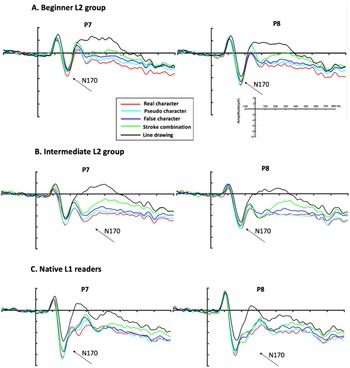
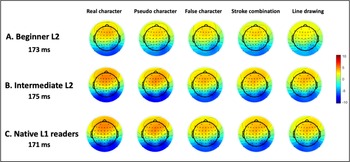
The EEG was recorded using a 64-channel Neuroscan Curry system (Neuroscan, El Paso, TX, USA). All channels were amplified with DC 100 Hz band-pass filter and digitized at a sampling rate of 1000 Hz, with the left mastoid as the online reference and transformed to average reference offline. Electrode impedances were kept below 5 kΩ. The EEG data were preprocessed with the EEGLAB package of Matlab. EEG data were digitally filtered with a .5–30 Hz band-pass filter. The epochs were segmented from 200 ms pre-stimulus to 800 ms post-stimulus and were corrected by the baseline correction (−200 to 0 ms). Eye movement artifacts were corrected offline by using an ICA procedure. Only the non-target trials were entered into further analysis. Before averaging, artifacts exceeding ± 80 μV were automatically rejected. The average number of the remaining trials for each condition across participants is shown in Table 2. A robust N170 component was observed for the five stimulus types in the left and right occipital–temporal areas of the three groups (Figure 2). As shown in Figure 3, the topographic maxima were in occipitotemporal electrodes, which correspond to typical N170 response. We chose the P7/P8 channel pair as these channels have also been used to measure the N170 response in earlier studies (e.g., Zhao et al., Reference Zhao, Li, Lin, Cao, He and Weng2012, Reference Zhao, Kipp, Gaspar, Maurer, Weng, Mecklinger and Li2014, Reference Zhao, Maurer, He and Weng2019). We used a global field power (GFP) method to determine the time window of the N170 component in each group (beginner L2 learners: 126–216 ms; intermediate L2 learners: 141–231 ms; native reader: 126–250 ms; respectively, see Supplementary materials). The peak amplitude and latencies of N170 at the P7 and P8 were detected.
Mean trial numbers and standard deviation

Averaged ERP waveforms and peak topographic maps of five stimulus types (real character, pseudo-character, false character, stroke combination and line drawing) over the left and right hemispheres in the beginner L2 group (A), intermediate L2 group (B) and native L1 group (C). Peak time points were determined by GFP (global field power). A robust N170 component was observed for the five stimulus types in the left and right occipital–temporal areas of the three groups.

Peak topographic maps of five stimulus types in the beginner L2 group (A), intermediate L2 group (B) and native L1 group (C). The peak time points were determined by GFP, 173 ms for beginner L2 group, 175 ms for intermediate L2 group and 171 ms for native L1 readers.

3. Results
3.1. Behavioral results
Means and standard deviations of accuracy and reaction time (RT) to target trials of five stimulus types are illustrated in Table S1. The data were analyzed in a mixed 5 × 3 two-way ANOVA with stimulus type (real characters, pseudo-characters, false characters, stroke combinations and line drawings) as the within-subject factor and group (beginner L2, intermediate L2 and native L1) as the between-subject factor.
Accuracy results showed that the main effect of stimulus types was significant, F (4, 272) = 5.89, p < .001, η 2 = .08. However, neither the main effects of group nor the interaction was significant: group, F (2, 68) = 1.53, p = .22, η 2 = .04, stimulus type × group, F (8, 272) = .79, p = .61, η 2 = .02. Post hoc tests with Bonferroni correction for multiple comparisons demonstrated that the ACC for line drawings was lower than the real character, pseudo-character, false character (all p's < .05), with no significant difference observed between real character, pseudo-character, false character (all p's > .10). For RT, similar ANOVA results revealed that neither the main effects nor the interaction was significant: Stimulus type, F (4, 272) = 2.40, p = .13, η 2 = .03; group, F (2,68) = .08, p = .93, η 2 = .002; stimulus type × group, F (8, 272) = .51, p = .85, η 2 = .02.
3.2. ERP results
3.2.1. N170 peak amplitude
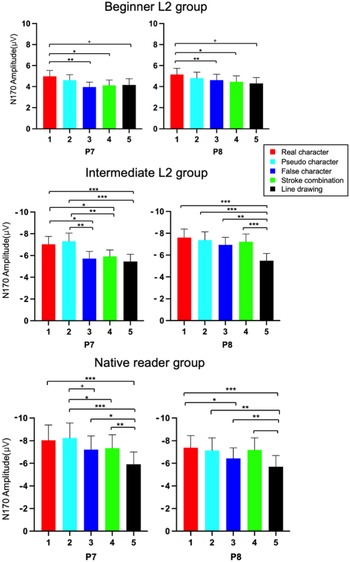
See Figure S1 for topographic maps of coarse tuning effects (N170 differences between real characters/pseudo-characters and line drawings, N170 differences between real characters/pseudo-characters and stroke combinations) as well as the fine-tuning effects (N170 differences between real characters/pseudo-characters and false characters). The coarse and fine-tuning effects for print were examined by analyzing N170 peak amplitude differences in a mixed 5 × 2 × 2 ANOVA with stimulus type (five levels: real characters, pseudo-characters, false characters, stroke combinations and line drawings) and lateralization (two levels: left vs. right hemisphere) as within-subject factors, group (three levels: beginner L2, intermediate L2 learners and native readers) as the between-subject factor (Figure 4). The results showed a significant main effect of stimulus type, F (4, 272) = 37.97, p < .001, η 2 = .36, a significant main effect of group, F (1, 68) = 3.60, p < .05, η 2 = .10, a significant interaction of stimulus types × group, F (8, 272) = 3.44, p < .01, η 2 = .10, and a significant interaction of stimulus types × lateralization, F (1, 272) = 5.56, p < .001, η 2 = .08, and a significant interaction of stimulus types × lateralization × group, F (8, 272) = 2.64, p < .01, η 2 = .07. Neither the main effect of lateralization nor the lateralization × group was significant: for lateralization, F (1, 68) = .08, p = .77, η 2 = .001; for lateralization × group, F (2, 68) = .75, p = .48, η 2 = .02. To further analyze the three-way interaction effect of stimulus type × lateralization × group, we broke down the three-way interaction by group and lateralization. In the beginner L2 group, there was a significant main effect of the stimulus type, F (4, 92) = 4.91, p < .01, η 2 = .18. The main effect of lateralization, F (1, 92) = .32, p = .57, η 2 = .01) and interaction with stimulus type was not significant, F (4, 92) = 1.02, p = .40, η 2 = .04). Post hoc comparisons (with Bonferroni correction) showed that real character evoked larger N170 amplitude than false-character (MD = .79, p < .05) and stroke combination (MD = .78, p < .01), marginally significant than line drawings (MD = .84, p = .08) over the left hemisphere and right hemisphere. In the intermediate L2 learners, a significant main effect of the stimulus type was found, F (4, 92) = 20.12, p < .001, η 2 = .47, whereas the main effect of the hemisphere was not significant, F (1, 23) = 1.86, p = .19, η 2 = .08. The interaction of stimulus type and hemisphere was significant, F (4, 92) = 6.74, p < .001, η 2 = .23. Follow-up analysis revealed that the main effect of stimulus type was significant over left hemisphere, F (4, 92) = 14.82, p < .00, η 2 = .39 and the right hemisphere, F (4, 92) = 17.14, p < .001, η 2 = .42). The post hoc test (with Bonferroni correction) showed that real character evoked larger N170 amplitude than the false character (MD = 1.32, p < .05), and stroke combination (MD = 1.12, p < .05), and line drawing (MD = 1.58, p < .001) over the left hemisphere. The pseudo-character evoked significantly stronger N170 amplitudes than the false character (MD = 1.60, p < .01), stroke combination (MD = 1.40, p < .01) and line drawing (MD = 1.86, p < .001) over the left hemisphere. In the right hemisphere, the N170 for the real characters (MD = 2.12, p < .001), pseudo-character (MD = 1.88, p < .001), false character (MD = 1.44, p < .01) and stroke combination (MD = 1.74, p < .001) was more negative than for the line drawings. For the native readers, the main effect of stimulus type was significant, F (4, 88) = 18.16, p < .001, η 2 =.45, and the interaction between stimulus type and the hemisphere was significant, F (4, 88) = 2.70, p < .05, η 2 = .11, whereas the main effect of the hemisphere was not significant, F (1, 22) = .30, p = .59, η 2 = .01. Follow-up analysis revealed that the main effect of stimulus type was significant over the left hemisphere, F (4, 88) = 15.28, p < .001, η 2 = .41 and the right hemisphere, F (4, 88) = 11.14, p < .001, η 2 = .33. The post hoc test (with Bonferroni correction) showed that N170 was larger for the real characters (MD = 2.13, p < .001), pseudo-characters (MD = 2.33, p < .001), false character (MD = 1.31, p < .05) and stroke combination (MD = 1.44, p < .01) than it was for the line drawings in the left hemisphere. The pseudo-character evoked significantly larger N170 amplitudes than the stroke combination (MD = .90, p < .05), and marginally significant N170 than the false character (MD = 1.03, p = .058) over the left hemisphere. In addition, the N170 was larger for the real characters (MD = 1.68, p < .001), pseudo-character (MD = 1.43, p < .01), and stroke combination (MD = 1.49, p < .01) than the line drawing over the right hemisphere. The N170 for the real character was larger than the false character (MD = .96, p < .05) over the right hemisphere.
The mean of N170 amplitudes for the five stimulus types at P7/P8 in beginner L1 and intermediate L2 group and native L1 group. +p < .08, *p < .05, **p < .01, ***p < .001.

3.2.2. Left lateralization results
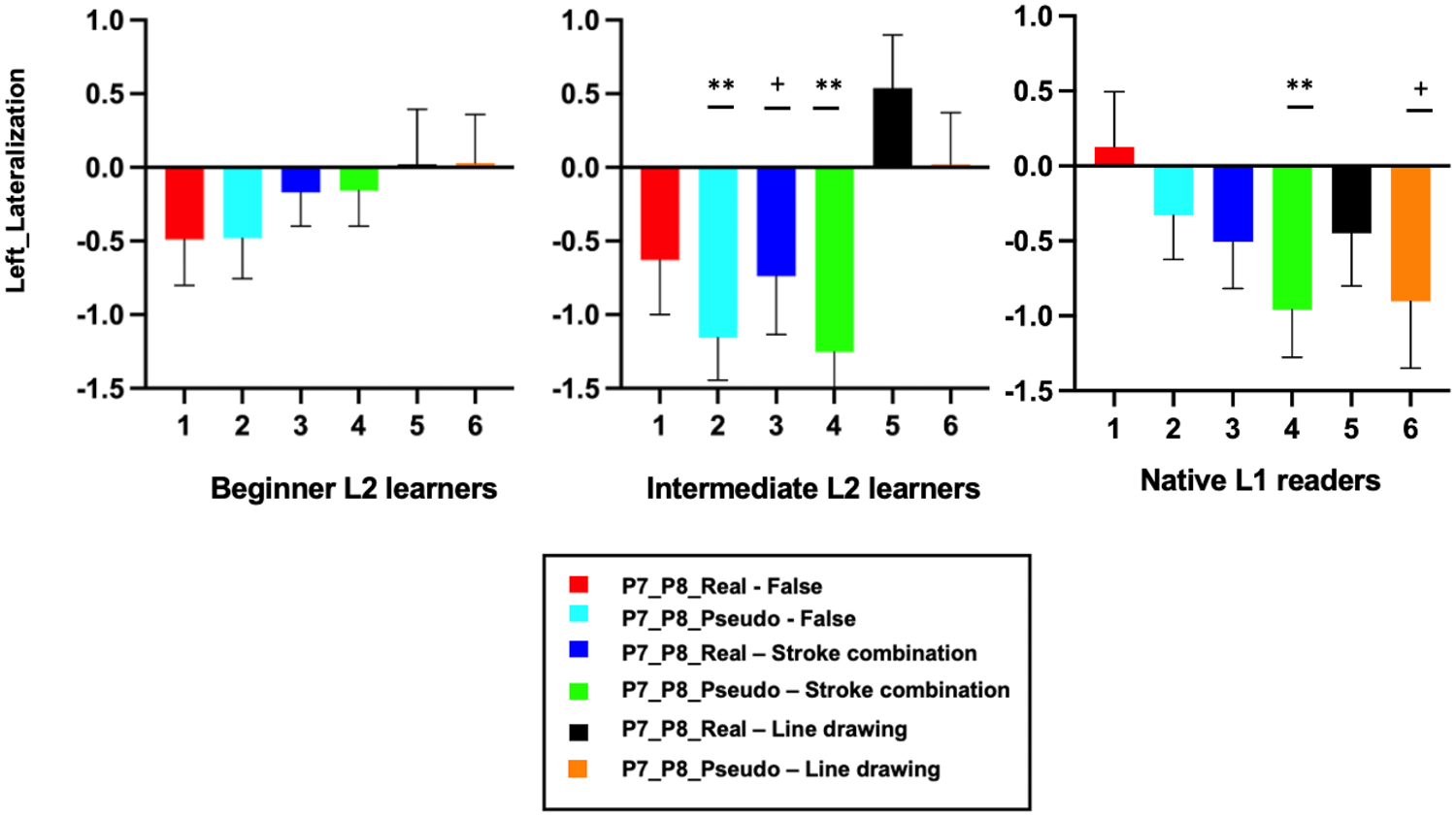
To investigate the developmental changes of N170 lateralization effects, we first performed the paired t test comparing the N170 amplitude in the left and right hemispheres for L2 learners and native readers. The results indicated that N170 elicited by false characters and stroke combinations was larger in the left hemisphere compared to the right hemisphere among intermediate L2 learners, demonstrating a left lateralization of N170 (all p's < .05). However, the left and right hemisphere difference for the N170 amplitude of real characters and pseudo-characters was not significant for beginner and intermediate L2 learners, as well as native readers (all p's > .05). We also conducted the lateralization differences of N170 print-tuning effects to examine the lateralization (left) of coarse and fine-tuning effects. Left lateralization was quantified as the difference value between print-tuning effects in the left and right hemispheres – a value close to zero indicates bi-lateralization (no hemispheric preference), whereas values above or below zero suggest left and right lateralization, respectively (Figure 5). This method may offer a more direct and informative measure for assessing lateralization in Chinese studies. Results from this method indicated that, within the beginner L2 group, one-sample t tests showed no significant differences: real characters compared to false characters (t = 1.59, p = .13), pseudo-characters to false characters (t = 1.78, p = .09), real characters versus stroke combinations (t = .74, p = .47), pseudo-characters against stroke combinations (t = .67, p = .51), real characters against line drawings (t = .06, p = .96), pseudo-characters compared to line drawings (t = .09, p = .93). In the intermediate L2 group, t tests demonstrated significant differences between pseudo-characters and false characters (t = 4.03, p < .001), as well as between pseudo-characters and stroke combinations (t = 3.91, p < .001). A marginally significant difference was found between real characters and stroke combinations (t = 1.87, p = .07). However, differences were non-significant for the comparison between real characters and false characters (t = 1.72, p = .09), real character and line drawing (t = 1.50, p = .15), pseudo-character and line drawings (t = .6, p = .95). For native readers, t tests indicated significant differences between pseudo-characters and stroke combination (t = 3.03, p < .01), pseudo-characters and line drawings (t = 2.03, p = .05). Non-significant differences were observed when comparing real character and false characters (t = .35, p = .73), pseudo-characters and false characters (t = 1.12, p = .28). Real characters and stroke combination (t = 1.62, p = .12), and real characters to line drawings (t = 1.27, p = .45).
Left lateralization of fine and coarse N170 tuning effects for Chinese character. Y-axis showed the hemisphere difference of print-tuning effects (left–right). X-axis showed the different aspects of print-tuning effects.

3.2.3. N170 peak latency
Means and standard deviation (in parentheses) of N170 peak latency (ms) of five stimulus categories at P7/P8 in three groups, see Table S2. A mixed 5 × 2 × 3 ANOVA was conducted with stimulus category (real character, pseudo-character, false character, stroke combination, line drawing) and lateralization (left vs. right) as within-subject factors, and group (beginner L2, intermediate L2, native L1) as a between-subject factor. The analysis showed a significant main effect of stimulus category, F (4, 272) = 16.26, p < .001, η 2 = .19. Post hoc tests with Bonferroni correction for multiple comparisons demonstrated that the N170 peak latency evoked by words, pseudo-words, stroke combinations were significantly shorter than line drawings (all p's < .001), with no significant difference observed between words, pseudo-words and stroke combinations (all p's > .05). Moreover, the ANOVA revealed a significant main effect of the group, F (1, 68) = 5.05, p < .01, η 2 = .13. Subsequent post hoc tests with Bonferroni correction showed that the peak latency of native learners was faster than that of beginner L2 learners (MD = 13.72, p < .01). However, no significant differences were detected between beginner and intermediate L2 learners, and between intermediate L2 learners and native L1 readers (all p's > .05).
3.3. Correlations between print-tuning effects and cognitive-literacy skills
We conducted a correlational analysis to explore the relationship between individual differences in neural print tuning and various reading and cognitive skills. Specifically, we examined the correlations among coarse tuning (contrasting real characters/pseudo-characters with stroke combinations), fine tuning (contrasting real characters with pseudo-characters, and real characters with false characters) and the left lateralization in these tuning effects. We combined both beginner and intermediate-level adult L2 learners in the correlation analyses to increase the variation in reading and cognitive abilities among our participants. Furthermore, this approach can increase the statistical power of our analysis, allowing for a more robust examination of the relationships between cognitive–linguistic skills and the print-tuning effects. The analyses revealed that coarse-tuning effects (pseudo-character vs. line drawing) were negatively correlated with reading fluency (r = .29, p < .05). Similarly, fine-tuning effects (real character vs. stroke combination and pseudo-character vs. stroke combination) were negatively associated with reading fluency (r = .29, p < .05; r = .38, p < .001) and morphological awareness (r = .29, p < .05; r = .38, p < .001). Furthermore, left lateralization of coarse tuning (pseudo-character vs. line drawing) and fine tuning (pseudo-character vs. stroke combination) displayed positive correlations with character reading fluency (r = .41, p < .001), Chinese vocabulary knowledge (r = .33, p < .05) and morphological awareness (r = .39, p < .001). However, no significant correlations were observed between coarse and fine neural tuning effects (real character vs. false character, pseudo-character vs. false character) and phonological awareness, including tone and phoneme awareness separately (all p's > .05). See Figure S2 for scatterplot between literacy and cognitive skills and neural N170 print-tuning effects.
4. Discussion
This study investigated whether adult L2 Chinese learners from alphabetic backgrounds show coarse (comparing real and pseudo-characters with stroke combinations) and fine (contrasting real and pseudo-characters, pseudo-characters and false characters) print tuning, as well as left lateralization for Chinese characters. The results indicated that N170 amplitude responses to Chinese characters were larger than stroke combinations (coarse neural tuning) in beginner adult L2 learners in both the left and right hemispheres, while the stronger N170 amplitude for Chinese characters than stroke combinations (coarse neural tuning), and larger N170 amplitude for pseudo-characters than false characters (orthographic regularity fine tuning) in intermediate adult L2 learners and native L1 readers in left hemisphere suggesting the bilateral to left left-lateralized pattern with the increase of reading experience. Moreover, individual differences in neural print-tuning effects show a moderate correlation with literacy and cognitive skills, including word-reading fluency, Chinese vocabulary knowledge and morphological awareness in adult L2 Chinese learners.
4.1. Presence of coarse tuning for Chinese characters in beginner L2 learners
The coarse neural tuning reflects neural selectivity for visual word categories. Previous studies have found that the amplitude of N170 in skilled readers is stronger in response to the visual word over non-linguistic visual control stimuli (e.g., Bentin et al., Reference Bentin, Mouchetant-Rostaining, Giard, Echallier and Pernier1999; Cao et al., Reference Cao, Li, Zhao, Lin and Weng2011; Li et al., Reference Li, Lee, Zhao, Yang, He and Weng2013; Lin et al., Reference Lin, Chen, Zhao, Li, He and Weng2011; Maurer et al., Reference Maurer, Brandeis and McCandliss2005a, Reference Maurer, Brem, Kranz, Bucher, Benz, Halder and Brandeis2006; Zhao et al., Reference Zhao, Li, Lin, Cao, He and Weng2012). While there are studies that have examined the coarse print tuning in alphabetic language readers with no prior Chinese reading experience and with an advanced Chinese level (Kim et al., Reference Kim, Yoon and Park2004; Wong et al., Reference Wong, Gauthier, Woroch, DeBuse and Curran2005; Yum et al., Reference Yum, Holcomb and Grainger2011), fewer studies have been examined beginner level L2 learners, therefore, less is known about whether L2 learners at this beginner level develop the coarse tuning for Chinese characters over time.
In this study, we found that beginner L2 Chinese learners showed larger N170 amplitudes for real characters (rather than pseudo-characters) than stroke combinations across the left and right hemispheres. The differential coarse neural-tuning effect suggests that beginner L2 learners have developed the neural sensitivity to separate Chinese characters from non-print stimuli. However, the neural selectively is not fully developed as first they are limited to Chinese characters with lexical representations, and second, presented in both hemispheres. In contrast, The intermediate L2 Chinese learners showed stronger N170 for real as well as pseudo-characters and only presented in the left hemisphere, suggesting the emergence of a refined and more abstract representation of Chinese characters. Further results from our study showed that in beginner L2 learners, real characters are only marginally distinguished from line drawings. The findings are in line with previous studies, such as Kim et al. (Reference Kim, Yoon and Park2004), which demonstrated that native Korean speakers with six years of experience learning Chinese exhibited larger N170 amplitudes in response to Chinese characters than to images of objects. However, it is important to note that previous studies have used line drawings as a baseline to measure coarse-tuning effects; however, the visual complexity of line drawings can vary substantially from that of visual words (e.g., Cao et al., Reference Cao, Li, Zhao, Lin and Weng2011), which could potentially influence the neural print-tuning effects. Our findings indeed indicate that ERPs elicited by line drawings are significantly distinct from those elicited by other types of stimuli. Conversely, stroke combinations may offer a more appropriate control condition, as they are more visually matched with Chinese characters. By using stroke combinations and line drawings as control stimuli to measure coarse print-tuning effects, our study offers novel insights into the definition of coarse tuning, i.e., stroke combinations as control condition could serve as a more suitable measure when assessing the coarse-tuning effects, as supported by previous research (e.g., Lin et al., Reference Lin, Chen, Zhao, Li, He and Weng2011 Tong et al., Reference Tong, Lo, McBride, Ho, Waye, Chung and Chow2016; Xue et al., Reference Xue, Maurer, Weng and Zhao2019; Zhao et al., Reference Zhao, Maurer, He and Weng2019).
4.2. Emergence of fine print tuning in intermediate L2 Chinese learners
Previous research has shown similar fine-tuning effects in skilled readers, with increased N170 amplitudes to real words over pseudo-characters (lexicality effects) (Hauk et al., Reference Hauk, Davis, Ford, Pulvermüller and Marslen-Wilson2006; Maurer et al., Reference Maurer, Brem, Kranz, Bucher, Benz, Halder and Brandeis2006), and significant N170 differences between Chinese characters and false characters in logographic scripts, reflecting sensitivity for orthographic processing (Bentin et al., Reference Bentin, Mouchetant-Rostaining, Giard, Echallier and Pernier1999; Cao et al., Reference Cao, Li, Zhao, Lin and Weng2011; Lin et al., Reference Lin, Chen, Zhao, Li, He and Weng2011; Maurer et al., Reference Maurer, Brandeis and McCandliss2005a; Simon et al., Reference Simon, Bernard, Largy, Lalonde and Rebai2004; Tong et al., Reference Tong, Lo, McBride, Ho, Waye, Chung and Chow2016). To date, the investigation of fine-tuning effects in bilingual individuals has been limited. One notable study by Yum et al. (Reference Yum, Law, Lee and Shum2018) revealed left-lateralized fine-tuning effects in intermediate-level L2 Chinese learners. However, fine-tuning for Chinese characters among beginner-level L2 learners has not been examined in this study.
The present study is one of the first to examine fine-tuning for Chinese characters in adult L2 learners at beginner and intermediate proficiency levels. We found that beginner-level L2 Chinese learners did not show a significant difference between pseudo-characters and false characters (orthographic regularity fine-tuning). In contrast, intermediate-level L2 learners showed increased N170 amplitude for pseudo-characters compared to false characters in the left hemisphere. Consistent with previous studies in Chinese L1 and L2 studies, these findings indicate the emergence of a refined neural sensitivity to Chinese orthographic regularities, i.e., radical position (real character vs. false characters) in intermediate L2 learners. Our study thus contributes to the current literature by showing that intermediate L2 Chinese learners emerged with fine-tuning neural sensitivity to orthographic regularities, but also provides evidence for the developmental trajectory of fine-tuning effects from beginner-level to intermediate-level Chinese L2 learners.
4.3. Bilateral to left-lateralized of print-tuning effects in L2 Chinese learners
Importantly, our findings indicate a developmental shift in print-tuning effects, moving from bilateral to left-lateralized patterns as Chinese reading proficiency increases. In beginner L2 learners, the coarse print tuning for Chinese characters (real character vs. stroke combination) was observed in both the left and right hemispheres. Further analysis of hemispheric lateralization revealed that coarse and fine print-tuning effects are bilaterally distributed. Intermediate-level L2 learners, however, showed both coarse (real/pseudo-character vs. stroke combination) and orthographic regularity fine-tuning (pseudo-character vs. false character) that are only observed in the left hemisphere. The lateralization results confirmed the left lateralization of such fine and coarse-tuning effect. At the beginner level, L2 Chinese learners seem to engage both hemispheres during the visual processing of Chinese characters, which is reflected in the bilateral print-tuning effects. This initial reliance on both hemispheres could be attributed to the beginners' lack of specialized processing skills for Chinese characters. However, with increased Chinese reading experience, intermediate-level L2 learners may have formed a more specialized processing for visual word forms at the left hemisphere. Such a shift toward specialized visual word processing is supported by the similar emergence of left hemisphere dominance in native readers. A hypothesis proposed by Perfetti et al. (Reference Perfetti, Liu, Fiez, Nelson, Bolger and Tan2007) suggests that L2 acquisition involves both assimilation, which involves the existing neural network of the native writing system processing the new language, and accommodation, which involves adjusting to the different writing system requirements. Therefore, the observed transition toward left-lateralized tuning effects could be indicative of the accommodation process in Chinese language acquisition. As learners' exposure to Chinese script increases, their neural processing may adapt to handle the new script more efficiently, despite significant differences between their first language and Chinese characters.
Notably developmental studies in children have shown that print-tuning evolves from bilateral or right-lateralized in preschoolers to left-lateralized patterns after 1.5 years of reading instruction in German children (2006) and after 3–4 years of literacy training in Chinese children (Tong et al., Reference Tong, Lo, McBride, Ho, Waye, Chung and Chow2016). These studies suggest that the lateralization of N170 tuning is associated with age and reading experience. However, it's challenging to disentangle the contribution of reading experience and age-related maturation changes to print-tuning lateralization in these studies. To date, less is known about the developmental changes in print-tuning effects in adult L2 Chinese learners. Our study, which examined adult L2 Chinese learners with different levels of Chinese reading experience, provides critical evidence for a neural shift in the print tuning of Chinese characters – from a bilateral N170 response in beginners to a left-lateralized response in intermediate learners, a pattern that is analogous to the developmental shift seen in children before and after L1 literacy acquisition. These observations suggest that reading experience, rather than age, may be more closely associated with the development of left-lateralized neural print effects. Consequently, the left-lateralized print-tuning effects for Chinese characters might serve as a neural marker for reading proficiency in Chinese, applicable to both young and adult readers, including L2 Chinese readers (Maurer et al., Reference Maurer, Brem, Bucher and Brandeis2005b, Reference Maurer, Zevin and Mccandliss2008; Tong et al., Reference Tong, Lo, McBride, Ho, Waye, Chung and Chow2016).
Interestingly, while the fine-tuning for pseudo-characters and false characters appeared more pronounced in the left hemisphere of native readers, as indicated by negative values for hemisphere difference, such left-lateralization was less pronounced compared to that in intermediate L2 Chinese learners. A plausible explanation could be that native readers, having undergone extensive exposure to their first language since childhood, are more proficient in orthographic processing, so their neural processing has become more efficient and distributed, possibly engaging additional right hemisphere resources, and thus showing a less pronounced lateralization effect for fine print tuning. These results between intermediate L2 Chinese learners and native readers may suggest potential changes for the neural tuning for orthographic processing with increased reading proficiency. Future studies are necessary to further examine the neural print tuning effects in L2 learners with higher reading skills as well as Chinese native readers.
4.4. Cognitive correlates of neural print tuning
This study also investigated the relationship between print-tuning effects and the left lateralization of these effects with various reading and cognitive skills through correlation analysis. Our findings found that coarse-tuning effects (real character vs. stroke combination and pseudo-character vs. stroke combination) were moderately negatively correlated with reading fluency, indicating that L2 Chinese learners with swifter reading speeds showed more N170 differences between Chinese characters and stroke combination. Additionally, left lateralization of coarse tuning (pseudo-character vs. stroke combination) was positively correlated with character reading fluency, indicating that faster L2 Chinese learners typically show more pronounced left-lateralized print-tuning effects. These results are consistent with current literature linking individual differences in neural print-tuning effects with reading-related skills. For instance, studies with German and Chinese children have consistently shown that word reading fluency can predict the magnitude of N170 print-tuning effects (Eberhard-Moscicka et al., Reference Eberhard-Moscicka, Jost, Raith and Maurer2015; Tong et al., Reference Tong, Lo, McBride, Ho, Waye, Chung and Chow2016; Zhao et al., Reference Zhao, Kipp, Gaspar, Maurer, Weng, Mecklinger and Li2014). These findings support the visual expertise hypothesis, suggesting that neural tuning for print is improved as reading skills improve (McCandliss et al., Reference McCandliss, Cohen and Dehaene2003), and provide additional evidence that neural tuning for print is also influenced by reading skills in adult L2 Chinese learners.
Moreover, although previous studies have indicated a close relationship between print tuning and top-down phonological process (Xue et al., Reference Xue, Jiang, Chen and Dong2008; Maurer et al., Reference Maurer, Brem, Bucher, Kranz, Benz, Steinhausen and Brandeis2007), our study did not find a significant correlation between phonological awareness (i.e., phoneme and tone level) and either coarse or fine neural print-tuning effects. Rather, we observed a moderate correlation between coarse-tuning effects (real character vs. stroke combination and pseudo-character vs. stroke combination) and morphological awareness, indicating that L2 Chinese learners with higher morphological awareness generally displayed larger N170 differences between character and stroke combination stimuli. We observed a moderate correlation between coarse-tuning effects (real character vs. stroke combination and pseudo-character vs. stroke combination) and vocabulary.
The non-significant correlation between phonological awareness (i.e., phoneme and tone level) and either coarse or fine neural print-tuning effects does not support the phonological mapping hypothesis that posits that phoneme–grapheme decoding skills drive N170 print tuning in alphabetic languages (Maurer & McCandliss, Reference Maurer, McCandliss, Grigorenko and Naples2007). In the current experimental design, we carefully minimized top-down phonological influence by employing an implicit color detection task and using unpronounceable stimuli at both the whole word and radical levels. This was considered based on the predictive coding model proposing that reading results from the interaction of bottom-up visual features from written words and top-down predictions from language areas, which are based on previously established associations between visual inputs and phonology and semantics (Price and Devlin, Reference Price and Devlin2011). Previous research has shown that vocabulary (semantic knowledge) correlates with N170 print tuning in first-grade German children, while measures reflecting phonological processing do not exhibit this correlation (Eberhard-Moscicka et al., Reference Eberhard-Moscicka, Jost, Raith and Maurer2015; Tong et al., Reference Tong, Lo, McBride, Ho, Waye, Chung and Chow2016).
Morphological awareness is crucial in Chinese literacy due to the morpho-syllabic composition of the Chinese script (McBride-Chang et al., Reference McBride-Chang, Shu, Zhou, Wat and Wagner2003; Shu et al., Reference Shu, McBride-Chang, Wu and Liu2006). In Chinese, morphemes are the fundamental semantic units, and thus, morphological awareness is intricately linked to the semantic knowledge of Chinese words. To our knowledge, the influence of morphological awareness on neural print tuning has not been examined. The findings of the current study suggest that individual variability in print-tuning correlates not only with word-reading fluency but also with semantic knowledge. This implies that the neural print-tuning effect observed in adult L2 Chinese learners might be influenced by top-down semantic modulation, rather than being primarily phonological.
4.5. Implication and limitation
The results of this study may have potential implications for the pedagogy of Chinese as L2 language. First, it was noted that beginner L2 Chinese learners, despite having developed the neural sensitivity of separate Chinese characters from stroke combinations, do not show the fine tuning for Chinese orthographic regularities, and left lateralization pattern of coarse tuning that is seen in intermediate L2 Chinese learners and native readers. Thus, teachers and educators should explicitly teach Chinese orthographic regularities, including radical positions, at the beginner's level. It is possible that such a strategy could assist in the development of fine specializations for Chinese characters. Second, our findings highlight the importance of reading fluency and morphological awareness in the emergence of print-tuning effects. These literacy skills are likely to drive the neural tuning to Chinese characters. It is, therefore, recommended that Chinese language educators use instructional strategies that can increase these cognitive skills in L2 Chinese learners. For instance, the curriculum could include activities that aim to enhance reading fluency, through timed reading exercises or interactive reading games, as well as exercises designed to improve morphological awareness, including word construction drills and morpheme recognition tasks.
This study may also have some potential limitations. First, the phonological measures employed exhibited relatively low reliability (α = .66), highlighting the necessity for further research to investigate the role of phonological processing in neural tuning for Chinese characters. Second, although we attempted to include participants from alphabetic languages, variations in these languages, particularly in orthographic depth, could have affected our results. Future research could investigate how differences in L1 may influence neural tuning in L2. This might involve more selective recruitment of L2 Chinese learners or a comparative study of learners from diverse L1 backgrounds. Moreover, our study focuses on adult L2 Chinese learners with beginner to intermediate levels of Chinese proficiency. Future longitudinal studies could extend the range of proficiency levels at both lower and higher proficiency levels. Such research is critical and would enhance our understanding of neural print-tuning development in adult L2 Chinese learners.
5. Conclusion
This study examined the neural tuning for Chinese characters in adult L2 Chinese learners with beginner and intermediate Chinese reading levels from alphabetic language backgrounds. We found coarse neural tuning both the left and right hemispheres in beginner adult L2 learners. L2 Chinese learners only at intermediate level showed orthographic regularity fine tuning to Chinese characters. These print-tuning effects evolved from bilateral in beginners to left-lateralized in intermediate learners and native L1 readers as their Chinese reading experience increased. Moreover, significant correlations were found between the individual differences in neural print tuning and lateralization for Chinese characters with measures of Chinese reading fluency, vocabulary knowledge and morphological awareness, suggesting that these cognitive and reading skills are essential to neural tuning for Chinese characters during the reading acquisition process in L2 Chinese learners. Overall, our study provides novel evidence into the development of neural tuning for print in adult L2 Chinese learners from alphabetic languages and may have potential implications for Chinese as language learning and instruction.
Supplementary material
The supplementary material for this article can be found at https://doi.org/10.1017/S1366728924000403.
Data availability statement
The data that support the findings of this study are available from the corresponding author upon reasonable request.
Author contributions
Bingbing Song: conceptualization, data curation, formal analysis, writing – original draft. Xin Jiang: conceptualization, funding acquisition, methodology, writing – review & editing, supervision. Urs Maurer: formal analysis, writing – review & editing. Su Li: conceptualization, methodology, writing – review & editing.
Funding statement
This work was supported by the National Social Science Foundation of China (Grant No. 17ZDA305) and the Discipline Team Support Program of Beijing Language and Culture University (Grant No. 2023YGF07) to the second author.
Competing interests
None.



 Open access

