





Introduction
Children’s ability to register and process aspects of their environment greatly influences how environmental factors affect their development (Belsky & Pluess, Reference Belsky and Pluess2013; Pluess, Reference Pluess2015). This capacity for environmental sensitivity enables them to effectively react and adapt to challenges as well as opportunities presented by their current environmental conditions (Belsky et al., Reference Belsky, Bakermans-Kranenburg and van IJzendoorn2007). Although adaptation to environmental circumstances is essential for all individuals, a large number of empirical studies in animals as well as in humans indicate that individuals differ significantly in their degree of environmental sensitivity, with some being more and others less affected by contextual factors (Boyce & Ellis, Reference Boyce and Ellis2005; Ellis & Boyce, Reference Ellis and Boyce2008; Pluess, Reference Pluess2015; Wolf et al., Reference Wolf, van Doorn and Weissing2008). The traditional Diathesis-Stress model identified individual differences in sensitivity primarily as a vulnerability factor for developing pathological outcomes in reaction to negative environmental influences such as maltreatment or stressful life events (e.g. Zuckerman & Riskind, Reference Zuckerman and Riskind1999). In contrast, the more modern Environmental Sensitivity meta-framework (Pluess, Reference Pluess2015) suggests that more sensitive individuals are not only more susceptible to adversity, but are also more responsive to positive and supportive environmental conditions (vantage sensitivity) such as sensitive parenting, social support, and others (Belsky & Pluess, Reference Belsky and Pluess2009, Reference Belsky and Pluess2013, Pluess, Reference Pluess2015, Reference Pluess2017).
Within the environmental sensitivity meta-framework, the temperament trait of Sensory Processing Sensitivity (SPS) is often proposed as a phenotypical marker of individual differences in environmental sensitivity. SPS describes a common, evolutionarily conserved temperament trait associated with greater depth of processing, lower sensory thresholds to stimulation, ease of overstimulation and higher emotional and physiological reactivity (Aron & Aron, Reference Aron and Aron1997; Greven et al., Reference Greven, Lionetti, Booth, Aron, Fox, Schendan, Pluess, Bruining, Acevedo, Bijttebier and Homberg2019). SPS has demonstrated robust predictive value across numerous studies, consistently moderating the effects of both adverse and beneficial environmental conditions on a wide range of developmental and psychopathological outcomes, including the effects of parenting quality, school environments, post-learning activities, psychological interventions and others (e.g. Greven et al., Reference Greven, Lionetti, Booth, Aron, Fox, Schendan, Pluess, Bruining, Acevedo, Bijttebier and Homberg2019; Lionetti et al., Reference Lionetti, Pastore, Moscardino, Nocentini, Pluess and Pluess2019; Marhenke, Reference Marhenke and Acevedo2024; Pluess et al., Reference Pluess, Assary, Lionetti, Lester, Krapohl, Aron and Aron2018; Slagt et al., Reference Slagt, Dubas, van Aken, Ellis and Deković2018). Importantly, these effects are not accounted for by related constructs such as neuroticism, trait anxiety, or introversion, underscoring the distinctiveness and relevance of SPS within the broader Environmental Sensitivity framework (Pluess, Reference Pluess2015; Lionetti et al., Reference Lionetti, Pastore, Moscardino, Nocentini, Pluess and Pluess2019). Thus, assessing SPS in children holds significant potential for improving risk assessment, guiding prevention efforts, and informing personalized treatment approaches to support optimal developmental and mental health outcomes.
Although SPS might be a continuous trait, approximately 20% to 30% of most populations exhibit markedly elevated levels of the trait and are often referred to as highly sensitive (Aron et al., Reference Aron, Aron and Jagiellowicz2012; Lionetti et al., Reference Lionetti, Aron, Aron, Burns, Jagiellowicz and Pluess2018). Individuals higher in SPS tend to inhibit behavior or “pause-to-check” in response to novel stimuli, reflect more on this information, but can also be easily overwhelmed by intense or high numbers of stimuli, which can lead to frequent withdrawal in order to regenerate (Aron & Aron, Reference Aron and Aron1997; Marhenke, Reference Marhenke and Acevedo2024). Neuroscientific research on SPS suggests that highly sensitive individuals exhibit neural responses and resting-state brain connectivity within or between brain regions associated with attention control, emotion, depth of processing and memory consolidation (Acevedo et al., Reference Acevedo, Jagiellowicz, Aron, Marhenke and Aron2017, Reference Acevedo, Santander, Marhenke, Aron and Aron2021; Marhenke, Reference Marhenke and Acevedo2024). Individuals with higher SPS demonstrate an increased tendency for behavioral inhibition (Hoffmann et al., Reference Hoffmann, Marhenke and Sachse2022), which may allow for deeper processing of environmental stimuli (Jagiellowicz et al., Reference Jagiellowicz, Xu, Aron, Aron, Cao, Feng and Weng2011; Marhenke, Reference Marhenke and Acevedo2024). This depth of processing can enhance reflective thinking and learning from experiences, potentially contributing to developing more adaptive responses and a greater reactivity to environmental stimuli (Marhenke, Reference Marhenke and Acevedo2024; Marhenke et al., Reference Marhenke, Acevedo, Sachse and Martini2023; Patterson & Newman, Reference Patterson and Newman1993). In order to integrate children’s temperament into risk assessment, prevention, and treatment selection, brief measures are needed that reliably and validly capture relevant dimensions of temperament throughout childhood.
Assessment of sensory processing sensitivity in children
In adults, SPS is most often measured with the Highly Sensitive Person (HSP) Scale (Aron & Aron, Reference Aron and Aron1997). Many studies demonstrated that scores on the HSP scale are reliable and valid across many different samples and cultures (e.g. Lionetti et al., Reference Lionetti, Aron, Aron, Burns, Jagiellowicz and Pluess2018; see Lionetti, Reference Lionetti and Acevedo2020 for review). In children, SPS can be assessed using self- and caregiver-report questionnaires (Aron, Reference Aron2002; Pluess et al., Reference Pluess, Assary, Lionetti, Lester, Krapohl, Aron and Aron2018; Slagt et al., Reference Slagt, Dubas, van Aken, Ellis and Deković2018; Weyn et al., Reference Weyn, van Leeuwen, Pluess, Lionetti, Goossens, Bosmans, van den Noortgate, Debeer, Bröhl and Bijttebier2022), structured interviews (Kähkönen et al., Reference Kähkönen, Lionetti, Castelli and Pluess2024) or behavioral observation (Lionetti et al., Reference Lionetti, Aron, Aron, Klein and Pluess2019). The most widely used measure for children and adolescents 8 years and older is the Highly Sensitive Child (HSC) scale (Pluess et al., Reference Pluess, Assary, Lionetti, Lester, Krapohl, Aron and Aron2018), a 12-item self-report questionnaire. With slight adaptations, the HSC-scale is also frequently used as a caregiver-report questionnaire, especially for younger children (Slagt et al., Reference Slagt, Dubas, van Aken, Ellis and Deković2018; Sperati et al., Reference Sperati, Spinelli, Fasolo, Pastore, Pluess and Lionetti2024).
Similar to the factor structure of the adult HSP scale (e.g. Lionetti et al., Reference Lionetti, Aron, Aron, Burns, Jagiellowicz and Pluess2018), factor analysis of the HSC-scale showed evidence of a bifactor structure, meaning that it consists of both a general sensitivity construct and three specific subdimensions: Ease of Excitation (EOE) — a heightened susceptibility to feeling overwhelmed by too many strong, high-frequency or potentially harmful stimuli; Low Sensory Threshold (LST) — unpleasant sensory arousal caused by stimuli such as loud noises, bright lights, or being touched; and Aesthetic Sensitivity (AES) — an enhanced appreciation of positive environmental stimuli and subtleties (e.g. details or fine smells).
A growing body of research supports the validity of the HSC-scale to reliably predict environmental sensitivity in various contexts. For instance, in a large randomized-controlled trial testing a school-based antibullying intervention, boys scoring higher on the HSC-scale benefitted significantly more from an anti-bullying intervention than their less sensitive peers (Nocentini et al., Reference Nocentini, Menesini and Pluess2018). Another longitudinal study compared negative emotionality and sensory processing sensitivity (measured with the Dutch parent-report version of the HSC-scale) as susceptibility markers to parenting quality in young children (Slagt et al., Reference Slagt, Dubas, van Aken, Ellis and Deković2018). HSC-scale scores reliably predicted reductions in externalizing problem behavior when decreased negative parenting decreased or positive parenting remained stable, but also moderated increases in externalizing behavior when negative parenting increased, or positive parenting decreased. Although HSC-scores were moderately correlated with negative emotionality, the associations between parenting and child behavior were not affected by children’s negative emotionality. An additional longitudinal study found that during the COVID-19 lockdown restrictions, highly sensitive versus low sensitive Italian preschoolers (measured with the Italian version of the HSC) benefited more from high parent–child closeness in developing less internalizing problem behaviors (Lionetti et al., Reference Lionetti, Spinelli, Moscardino, Ponzetti, Garito, Dellagiulia, Aureli, Fasolo and Pluess2023). Similarly, HSC scores moderated the positive effects of a school-based resilience-promoting intervention (Pluess & Boniwell, Reference Pluess and Boniwell2015); benefits from school-based cultural identity interventions (Ceccon et al., Reference Ceccon, Schachner, Lionetti, Pastore, Umaña-Taylor and Moscardino2023); the negative effects of a stressful environment on physical and social functioning as well as increased positive effects of a supportive family environment on children’s social performance (Scrimin et al., Reference Scrimin, Osler, Pozzoli and Moscardino2018); the effects of negative parenting on prosocial behaviors and the effect of observed negative feedback (Li et al., Reference Li, Li, Jiang and Yan2023); the effect of positive or negative parenting on the development of internalizing problems (Zeng et al., Reference Zeng, Liu and Wang2024); the effect of internalized attachment representation on the development of emotion regulation (Sperati et al., Reference Sperati, Spinelli, Fasolo, Pastore, Pluess and Lionetti2024); or the effect of the usage of emotion regulation strategies in more or less sensitive boys (Džida et al., Reference Džida, Keresteš and Brajša-Žganec2024). Additionally, Japanese youth with higher scores on the HSC have been shown to benefit disproportionately from positive school transitions (Iimura & Kibe, Reference Iimura and Kibe2020) and resilience interventions, with improvements in self-efficacy and reductions in depression (Kibe et al., Reference Kibe, Suzuki, Hirano, Boniwell and Hashimoto2020). Thus, HSC-scale scores reflect an important aspect of child temperament that is not otherwise captured by other personality and temperament traits.
Despite the success in the theoretical validation of the HSC-scale, some studies in children and adolescents found weak internal consistencies for the AES and LST subdimensions in their samples (Pluess et al., Reference Pluess, Assary, Lionetti, Lester, Krapohl, Aron and Aron2018; Weyn et al., Reference Weyn, van Leeuwen, Pluess, Lionetti, Greven, Goossens, Colpin, van den Noortgate, Verschueren, Bastin, van Hoof, Fruyt and Bijttebier2019) and only partial measurement invariance across sex, developmental stage, and countries (Weyn et al., Reference Weyn, van Leeuwen, Pluess, Lionetti, Greven, Goossens, Colpin, van den Noortgate, Verschueren, Bastin, van Hoof, Fruyt and Bijttebier2019). Weyn et al. (Reference Weyn, van Leeuwen, Pluess, Lionetti, Greven, Goossens, Colpin, van den Noortgate, Verschueren, Bastin, van Hoof, Fruyt and Bijttebier2019) also identified several items that showed little variation in responses (e.g., “I love nice tastes” or “I love nice smells”) or were too difficult for young children to answer (“I don’t like watching TV programs with a lot of violence in them”), thus possibly skewing the distribution of the AES and LST subdimensions and limiting the discriminative value of AES.
In an attempt to address these psychometric limitations, Weyn et al. (Reference Weyn, van Leeuwen, Pluess, Lionetti, Goossens, Bosmans, van den Noortgate, Debeer, Bröhl and Bijttebier2022) adapted the original HSC-scale from Pluess et al. (Reference Pluess, Assary, Lionetti, Lester, Krapohl, Aron and Aron2018) by developing additional items, with potentially stronger psychometric properties, that maintained the conceptual integrity of the original measure. Weyn et al. (Reference Weyn, van Leeuwen, Pluess, Lionetti, Goossens, Bosmans, van den Noortgate, Debeer, Bröhl and Bijttebier2022) tested the resulting 38-item version (comprised of the original 12 and 26 new items) in two samples of early adolescents and their parents from the Dutch speaking part of Belgium and the Netherlands. Based on their findings, Weyn et al. (Reference Weyn, van Leeuwen, Pluess, Lionetti, Goossens, Bosmans, van den Noortgate, Debeer, Bröhl and Bijttebier2022) selected the best functioning 21 items, creating the HSC-21. Across samples and child as well as mother reports, they found good reliability, normally distributed item responses, moderate agreement between child and mother reports and evidence for full configural, partial and full metric, and partial and full scalar measurement invariance across sex, developmental stage, country, and informants. HSC-21-scale items were found to be age appropriate and seemed to be well understood among different age groups. Despite these promising results, the stand-alone HSC-21 has not yet been evaluated, as Weyn et al. (Reference Weyn, van Leeuwen, Pluess, Lionetti, Goossens, Bosmans, van den Noortgate, Debeer, Bröhl and Bijttebier2022) only presented the extended 38-item version to their participants.
Similar to the original HSC-scale (Pluess et al., Reference Pluess, Assary, Lionetti, Lester, Krapohl, Aron and Aron2018) or the adult HSP scale (Aron & Aron, Reference Aron and Aron1997), Weyn et al. (Reference Weyn, van Leeuwen, Pluess, Lionetti, Goossens, Bosmans, van den Noortgate, Debeer, Bröhl and Bijttebier2022) found strong evidence for a bifactor structure of the HSC-21, with one general sensitivity factor and specific subdimensions. Contrary to the original HSC-scale (Pluess et al., Reference Pluess, Assary, Lionetti, Lester, Krapohl, Aron and Aron2018), Weyn et al.’s (Reference Weyn, van Leeuwen, Pluess, Lionetti, Goossens, Bosmans, van den Noortgate, Debeer, Bröhl and Bijttebier2022) results supported only two specific subdimensions, one collapsed EOE/LST subdimension and one AES subdimension. This bifactor structure provides statistical justification for the use of mean scores across all items as a measure of general environmental sensitivity, but also confirms that individual differences in environmental sensitivity tend to manifest themselves both in response to contextual adversity (which is represented through the EOE and LST subdimensions) as well as in response to the beneficial effects of positive environmental factors (reflected in the AES subdimension, Lionetti et al., Reference Lionetti, Aron, Aron, Burns, Jagiellowicz and Pluess2018).
The HSC-scale as well as the HSC-21 have demonstrated convergent and discriminant validity, as they correlate with related temperament traits but are not fully captured by them. For example, in one study, both negative and positive emotionality, effortful control, behavioral inhibition, and behavioral activation correlated with HSC-scale scores, but explained only 34% of its total variance (Pluess et al., Reference Pluess, Assary, Lionetti, Lester, Krapohl, Aron and Aron2018). Meta-analytic findings further indicate that total scores on the HSC-scale show weak to moderate correlations with negative and positive affect (Lionetti et al., Reference Lionetti, Pastore, Moscardino, Nocentini, Pluess and Pluess2019). HSC-scale and HSC-21 scores have also been linked to Big Five personality traits and are consistently found to be weak to moderately positively associated with neuroticism, openness, and negatively with extraversion (e.g. Lionetti et al., Reference Lionetti, Pastore, Moscardino, Nocentini, Pluess and Pluess2019; Weyn et al., Reference Weyn, van Leeuwen, Pluess, Lionetti, Goossens, Bosmans, van den Noortgate, Debeer, Bröhl and Bijttebier2022). In one study, HSC-21 scores were negatively associated with agreeableness (Weyn et al., Reference Weyn, van Leeuwen, Pluess, Lionetti, Goossens, Bosmans, van den Noortgate, Debeer, Bröhl and Bijttebier2022), but this result has not been found in other studies on SPS (Lionetti et al., Reference Lionetti, Pastore, Moscardino, Nocentini, Pluess and Pluess2019). Regarding temperament, the HSC-21 demonstrated positive associations with negative affect and orienting sensitivity and was negatively associated with effortful control and extraversion (Weyn et al., Reference Weyn, van Leeuwen, Pluess, Lionetti, Goossens, Bosmans, van den Noortgate, Debeer, Bröhl and Bijttebier2022).
The present study
The HSC-scale has been translated and subsequently validated in several languages, including English (Pluess et al., Reference Pluess, Assary, Lionetti, Lester, Krapohl, Aron and Aron2018; Weyn et al., Reference Weyn, van Leeuwen, Pluess, Lionetti, Greven, Goossens, Colpin, van den Noortgate, Verschueren, Bastin, van Hoof, Fruyt and Bijttebier2019), Dutch (Slagt et al., Reference Slagt, Dubas, van Aken, Ellis and Deković2018; Weyn et al., Reference Weyn, van Leeuwen, Pluess, Lionetti, Greven, Goossens, Colpin, van den Noortgate, Verschueren, Bastin, van Hoof, Fruyt and Bijttebier2019), Italian (Nocentini et al., Reference Nocentini, Menesini and Pluess2018; Sperati et al., Reference Sperati, Spinelli, Fasolo, Pastore, Pluess and Lionetti2024), Japanese (Iimura & Kibe, Reference Iimura and Kibe2020; Kibe et al., Reference Kibe, Suzuki, Hirano, Boniwell and Hashimoto2020), Spanish (Costa-López et al., Reference Costa-López, Ruiz-Robledillo, Albaladejo-Blázquez, Baryła-Matejczuk and Ferrer-Cascales2022), Polish (Baryła-Matejczuk et al., Reference Baryła-Matejczuk, Kata, Poleszak and Piwowar-Sulej2022) and Chinese (Dong et al., Reference Dong, Zhou, Wang, Wei, Pluess and Ma2022; Liu et al., Reference Liu, van Dijk, Lin, Wang, Deković and Dubas2023). In the German language, only an adapted German translation of the adult HSP scale has been used to measure SPS in older adolescents over the age of 14 (Tillmann et al., Reference Tillmann, El Matany and Duttweiler2018). However, to date there is no validated German measure of environmental sensitivity available for children or young adolescents. The improved version of the HSC-scale, the HSC-21, though available in English and Dutch, has only been psychometrically tested as a 38-item preliminary version in two samples of Dutch-speaking young adolescents (Weyn et al., Reference Weyn, van Leeuwen, Pluess, Lionetti, Goossens, Bosmans, van den Noortgate, Debeer, Bröhl and Bijttebier2022). To our knowledge, the final 21-item version of the HSC-21 has not yet been tested as a stand-alone measure.
To address these gaps in current research, the present study has four complementary aims: First, to provide a reliable tool for measuring SPS and environmental sensitivity in younger German-speaking populations, we aim to translate the HSC-21 into the German language. Second, since, to our knowledge, the HSC-21 has never been tested as its final 21-item stand-alone version, we aim to evaluate the reliability and internal structure of the HSC-21 (i.e., factor structure, internal consistency, measurement invariance, test-retest reliability, and agreement between child and parent reports) with a sample of German caregivers and their children. Third, as the HSC-21 has only been evaluated in Dutch-speaking populations, we also aim to examine its applicability and psychometric performance in German-speaking countries. Finally, we aim to analyze convergent and discriminant validity of the HSC-21 by investigating its associations with different well-studied temperament and personality dimensions and criterion validity with several behavioral outcomes (i.e., internalizing and externalizing problem behaviors; school performance). Similar to some previous studies (e.g. Sperati et al., Reference Sperati, Spinelli, Fasolo, Pastore, Pluess and Lionetti2024), we will focus our main efforts on validating a caregiver-report version of the HSC-21-scale.
Methods
Participants and procedure
The sample included 367 German-speaking parents and 112 of their children. They were recruited through schools, universities, sports clubs, online parent groups, and crowdsourcing platforms (Clickworker and Prolific). To track the recruitment sources, we used separate links for channels specifically targeting highly sensitive individuals (e.g., email lists, social media groups, social clubs) and those with a broader focus (e.g., schools, sports clubs, or general social media groups and email lists without an SPS context). The majority of adults were mothers (70%), followed by fathers (28%), while 2% were other relatives (e.g., aunt or grandparent). Their mean age was 41.27 years (SD = 6.62; range: 22 – 74 years). A total of 38% of participants received payment for their participation. Regarding nationality, 58% were German, 40% Austrian, 1% Swiss and 1% Italian. The average age of the children assessed was 10.60 years (SD = 1.69; range: 8 – 14 years). Regarding child sex, 50% were female, 49% were male, and 1% were non-binary.
Participants rated their child on the HSC-21 and other measures in an online survey. An optional self-report HSC-21 for children was included at the end of the survey. In total, 112 children (31%) participated, of which 54% were male and 46% were female. The mean age of participating children was 9.98 years (SD = 1.64; range: 8 – 14 years).
After two weeks, the parents could take part in a follow-up survey in which they rated their child again on the HSC-21. On average, 18.49 days (SD = 3.96; range: 14 – 27 days) after completing the first survey, 45 parents (12%) participated in this test-retest survey. Chi-square- and t-tests showed no significant differences in demographic or outcome variables between participants completing the test-retest survey and those who did not, indicating that data were missing at random. The study was approved by the departmental ethics committee and informed consent was obtained from all participants.
Materials
Sensory processing sensitivity
Highly Sensitive Child Scale – 21 Item Version (HSC-21). We measured environmental sensitivity using the HSC-21 (Weyn et al., Reference Weyn, van Leeuwen, Pluess, Lionetti, Goossens, Bosmans, van den Noortgate, Debeer, Bröhl and Bijttebier2022). The 21 items were rated on a seven-point Likert scale ranging from 1 (Not at all) to 7 (Very much). As the HSC-21 is only available in English and Dutch, we translated it into German, following the approach of Tsang et al. (Reference Tsang, Royse and Terkawi2017). The forward translation of the English items into German was carried out by two independent bilingual translators (native German speakers). The initial translation was back-translated by two other independent bilingual translators (native English speakers) to ensure the accuracy of the translation. Discrepancies in wording or meaning between the original items and the back-translated items were then discussed and resolved jointly with the involvement of all translators and the principal investigators of this study. For the parent version, items were rephrased from first to third person (e.g. “I notice when small things have changed in my environment” to “Notices when small things have changed in his/her environment”).
The translated scale was then tested on a pilot sample of 82 German-speaking parents. They rated their children, including 48 boys (58%) and 34 girls (42%) aged 8 to 13 years (M = 10.11, SD = 1.41). Parents were invited to provide feedback on each item regarding clarity and comprehensibility. Internal consistency of the Highly Sensitive Child total score was good (α = .89). Nevertheless, six items were identified, which were either too complicated according to the feedback from parents and/or yielded lower item-total correlations. We therefore revised them according to suggestions from parents and experts in the field. Examples of item adaptations can be found in the Supplementary Materials (SM1). The final version of the German HSC-21 items is available in Supplementary Materials (SM2).
A preliminary exploratory factor analysis of the pilot data further indicated that several items with similar content exhibited correlated residuals. This was also the case in Weyn et al. (Reference Weyn, van Leeuwen, Pluess, Lionetti, Goossens, Bosmans, van den Noortgate, Debeer, Bröhl and Bijttebier2022). The HSC-21 has not yet been administered and validated as a stand-alone questionnaire but has been selected from 38 items. Some items with similar content were initially separated by other items but are placed directly one behind the other in the final version (e.g. HSC20 “Is sensitive to being touched” and HSC21 “Gets upset when other children touch him/her”). Since correlated residuals can be reduced or even avoided by randomly ordering similar items (Bandalos, Reference Bandalos2021), we restructured the item numbering to ensure that items tapping into similar sensational domains or aspects of environmental sensitivity are more balanced and evenly distributed across the questionnaire. A table displaying all items and the order in which they were administered can be found in the Appendix.
Personality
Big Five Inventory for Children and Adolescents (BFI-K KJ-F). We assessed the Big Five personality traits (Extraversion, Neuroticism, Conscientiousness, Agreeableness, and Openness) with the short form of the BFI-K KJ-F for other-ratings (Kupper et al., Reference Kupper, Krampen, Rammstedt and Rohrmann2021). The inventory consists of 26 items that were rated on a five-point scale ranging from not true at all (0) to absolutely true (4). Internal consistencies ranged from α = .71 to α = .85.
Temperament
Integrative Late Childhood Temperament Inventory (ILCTI). Temperament was assessed using the recently introduced ILCTI (Biedermann & Zentner, Reference Biedermann and Zentner2024), which is based on the ICTI (Zentner & Wang, Reference Zentner and Wang2013), and consists of six dimensions (Frustration, Behavioral Inhibition, Attention/Persistence, Activity Level, Sensory Sensitivity, and Affiliation). The questionnaire contains 24 items, which were rated on a six-point scale ranging from behavior occurs never or hardly ever (1) to behavior occurs always or close to always (6). Internal consistencies ranged from α = .65 to α = .86.
School performance
We included three questions related to school performance: “Which grade describes your child’s academic performance best (or which grade did your child receive most often during the last school year)?,” “How do you rate your child’s academic performance compared to his or her classmates?” (answer format ranged from is below average (1) to is one of the best in his/her class (4)); and “Does your child find school and learning easy in general?” (answer format ranged from No (1) to Yes (4)). In a previous study (Biedermann & Zentner, Reference Biedermann and Zentner2024), these questions were averaged to create a total score for “school performance.” As the three questions also demonstrated high internal consistency reliability (α = .85) in our sample, we decided to use the same approach.
Externalizing and internalizing problems
Strengths and Difficulties Questionnaire (SDQ). The SDQ is a brief screening questionnaire that measures Conduct Problems, Emotional Symptoms, Peer Problems, Hyperactivity, and Prosocial Behavior (Goodman, Reference Goodman1997) and has been used in previous studies on SPS (e.g. Slagt et al., Reference Slagt, Dubas, van Aken, Ellis and Deković2018). The 25 items were answered on a 3-point scale: not true (0), somewhat true (1) or certainly true (2). To analyze Internalizing Problems, the scales Emotional Symptoms and Peer Problems are added, and for Externalizing Problems the scales Conduct Problems and Hyperactivity are added. In addition, all four problem scales can be summed into a Total Problems score (Goodman et al., Reference Goodman, Lamping and Ploubidis2010). Internal consistencies ranged from α = .64 to α = .86.
Data analyses
The underlying factor structure of the parent-rated HSC-21 was investigated by computing and comparing confirmatory factor analyses (CFA) for a one-factor (general sensitivity), two-factor (EOE-LST, AES), three-factor (EOE, LST, AES), and a bifactor model (general sensitivity and subdimensions). The models were selected based on previous research (Pluess et al., Reference Pluess, Assary, Lionetti, Lester, Krapohl, Aron and Aron2018; Sperati et al., Reference Sperati, Spinelli, Fasolo, Pastore, Pluess and Lionetti2024; Weyn et al., Reference Weyn, van Leeuwen, Pluess, Lionetti, Goossens, Bosmans, van den Noortgate, Debeer, Bröhl and Bijttebier2022). Depending on the non-bifactor model that fit the data best, we computed a bifactor model with either two or three uncorrelated factors. Analyses were performed in R v4.2.1 (lavaan package). We used maximum likelihood robust estimation to account for non-normality (Satorra, Reference Satorra1994). In line with the benchmark recommendations by Browne & Cudeck (Reference Browne and Cudeck1992), Schermelleh-Engel et al. (Reference Schermelleh-Engel, Moosbrugger and Müller2003), and Kline (Reference Kline2005), we applied the following criteria for evaluating model fit: the comparative fit index (CFI) should be .90 or higher, the standardized root mean squared residual (SRMR) should be .08 or lower, and the root mean square error of approximation (RMSEA) should not exceed .08 for an adequate fit and .05 for a good fit. Although the χ2 statistic should preferably not be significant (p < .05), it is sensitive to sample size and even small model discrepancies (Kline, Reference Kline2016). Therefore, it can be neglected if the other fit indices are in the recommended range. For comparisons between nested models, the fit was substantially better, when the difference (Δ) in CFI was .010 or higher and χ2 was significantly lower (Cheung & Rensvold, Reference Cheung and Rensvold2002; Satorra, Reference Satorra, Heijmans, Pollock and Satorra2000). We focused on ΔCFI because simulation studies demonstrated that it is more reliable than ΔRMSEA and ΔSRMR when comparing nested models (Sellbom & Tellegen, Reference Sellbom and Tellegen2019). In addition, measurement invariance was tested across sex (boys versus girls) and two age groups: late childhood (8 to 10 years) versus early adolescence (11 to 14 years). We evaluated configural (invariant factor structure across groups), metric (invariant factor loadings across groups), and scalar (invariant item intercepts across groups) measurement invariance. Configural invariance was given when the model fit of the multigroup CFA was adequate. Metric and scalar invariance was given if ΔCFI between the non-constrained and constrained model was smaller than .010, ΔSRMR was smaller than .030 (metric) or .010 (scalar), and ΔRMSEA was smaller than .015 (Chen, Reference Chen2007).
Internal consistencies were measured for parent and child ratings using both Cronbach’s α and McDonald’s (1999) ω (in R v4.2.1, psych package). We included McDonald’s ω because it makes more realistic assumptions and is more robust to commingling populations (Dunn et al., Reference Dunn, Baguley and Brunsden2014). For α and ω, values of .60 or lower were regarded as low, .60 to .70 as acceptable, and .70 or higher as good (Leary, Reference Leary2008).
For bifactor-specific indices of the parent-version, we calculated McDonald’s omega hierarchical (ωH/ωHS; McDonald, Reference McDonald1999) and the explained common variance (ECV) in R v4.2.1 (packages BifactorIndicesCalculator and semTools). Omega hierarchical of the general factor (ωH) indicates how much variance in the total score is explained by the general sensitivity, after controlling for the subdimensions. Conversely, omega hierarchical for specific factors (ωHS) indicates how much variance the subdimensions explain in the subdimension scores, after controlling for general sensitivity. The difference between ω and ω(H/HS) implies how much ω is inflated due to the contribution of a subdimension or general sensitivity (Reise et al., Reference Reise, Bonifay and Haviland2013; Rodriguez et al., Reference Rodriguez, Reise and Haviland2016). The explained common variance (ECV) indicates the strength of the general sensitivity factor relative to the subdimensions and represents the percentage of variance explained by it (Sijtsma, Reference Sijtsma2009). Values below .80 supported multidimensionality and a bifactor model (Rodriguez et al., Reference Rodriguez, Reise and Haviland2016).
Furthermore, we evaluated the test-retest reliability of the parent version and the interrater agreement between parents and children by computing Spearman correlation coefficients. For an adequate test-retest reliability, coefficients should be .70 or higher (McCrae et al., Reference McCrae, Kurtz, Yamagata and Terracciano2011).
The following analyses were performed in SPSS (version 29). Prior to calculating descriptive statistics and validity, the HSC total score and SDQ scores were compared between samples within and outside the SPS context using independent samples t-tests. For associations between the parent-rated HSC-21-scale and other variables, Pearson’s correlation coefficients were calculated. For associations regarding the subdimensions, we also computed partial correlations controlling for the contribution of the other subdimensions. For interpretation, a Pearson’s r of .10 was considered small, .30 medium, and .50 large (Cohen, Reference Cohen1988). Correlations should be smaller than .50 to support discriminant validity (Sperati et al., Reference Sperati, Spinelli, Fasolo, Pastore, Pluess and Lionetti2024). To control for multiple testing, results were considered significant when p < .001. Finally, for criterion validity, we ran simple and multiple regression analyses to examine how much variance in behavior problems and school performance was explained by the HSC total score and the subdimensions.
Results
Factor structure of the German version of the HSC-21 scale
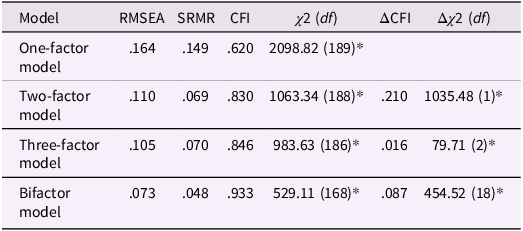
We analyzed the structure of the parent-rated HSC-21 using confirmatory factor analyses (CFA) by evaluating and comparing model fit indices of a one-factor, two-factor, three-factor, and a bifactor model. As can be seen in Table 1, the model fit of the one-factor model was inadequate (CFI = .620, SRMR = .149, RMSEA = .164). Model-fit for the two-factor (CFI = .830, SRMR = .069, RMSEA = .110) and three-factor model (CFI = .846, SRMR = .070, RMSEA = .105) was improved, but still below acceptable levels. The three-factor model fit the data slightly better than the two-factor model. Because the difference was significant (ΔCFI = .016, Δχ2(2) = 79.71, p < .001), we tested a bifactor model with three factors. This solution yielded a good model fit (CFI = .933, SRMR = .048, RMSEA = .073) and was significantly better than the three-factor model on all fit indices (ΔCFI = .087, Δχ2(18) = 454.52, p < .001). Additionally, we compared the bifactor model with three factors to a bifactor model with two factors, as this was the best fitting model in Weyn et al. (Reference Weyn, van Leeuwen, Pluess, Lionetti, Goossens, Bosmans, van den Noortgate, Debeer, Bröhl and Bijttebier2022). However, the bifactor model with three factors remained slightly superior (ΔCFI = .011, see Supplementary Table 1). Therefore, we selected the bifactor model with three factors as the final model.
Model fit indices and comparisons of the confirmatory factor analyses for the HSC-21

Note. N = 367; HSC-21 = Highly Sensitive Child - 21 Items Scale; RMSEA = root mean square error of approximation; SRMR = standardized root mean square residual; CFI = comparative fit index; Δ = increment of change.
* p < .001.
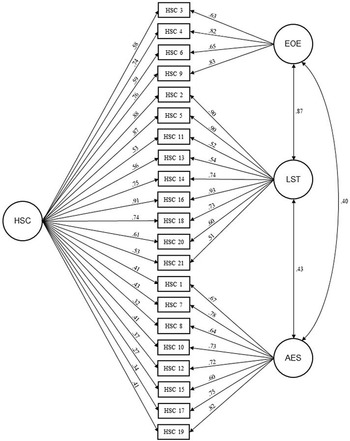
The standardized path coefficients are reported in Figure 1. All factor loadings of the subdimensions exceeded .50 (.51 to .93). It was not necessary to allow for correlated residuals between items to optimize model fit, suggesting that the re-ordering of items, with items of similar content spaced apart, was effective.
Bifactor model of the German version of the highly sensitive child - 21 Items Scale. Values represent standardized covariances and factor loadings of the one-factor and the three-factor solution. Item numbering refers to Weyn et al. (Reference Weyn, van Leeuwen, Pluess, Lionetti, Goossens, Bosmans, van den Noortgate, Debeer, Bröhl and Bijttebier2022). HSC General Sensitivity, EOE Ease of Excitation, LST Low Sensory Threshold, AES Aesthetic Sensitivity.

Measurement invariance
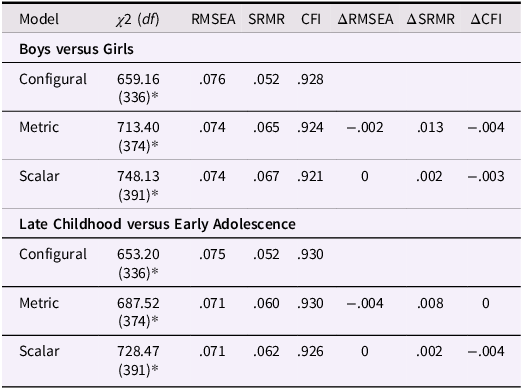
In a next step, measurement invariance of the HSC-21 was examined across sex (boys versus girls) and two age groups (late childhood versus early adolescence). The results of all invariance models are presented in Table 2. According to all three criteria (ΔRMSEA, ΔSRMR, ΔCFI), there was evidence of full configural, full metric, and full scalar invariance across sex and age groups.
Results of the measurement invariance analyses for the HSC-21 across sex and age group
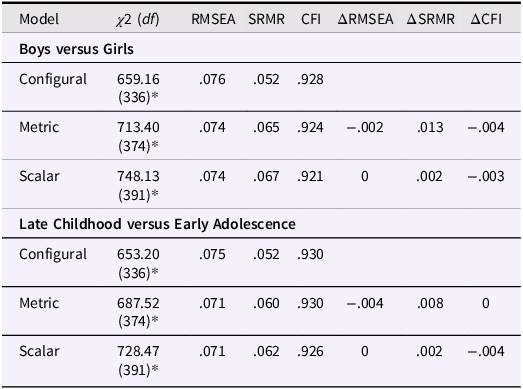
Note. N = 367; HSC-21 = Highly Sensitive Child - 21 Items Scale; RMSEA = root mean square error of approximation; SRMR = standardized root mean square residual; CFI = comparative fit index; Δ = increment of change between consecutive invariance models.
* p < .001.
Reliability and dimensionality
We then calculated internal consistencies, test-retest reliability and interrater agreement for the parent and child version (see Table 3). The internal consistency of the HSC-21 was excellent for both the parent (α = .92; ω = .95) and the child version (α = .92; ω = .95). Weyn et al. (Reference Weyn, van Leeuwen, Pluess, Lionetti, Goossens, Bosmans, van den Noortgate, Debeer, Bröhl and Bijttebier2022) reported almost the same values for the parent version and slightly lower values for the child version. For the subdimensions, Cronbach’s α ranged from .82 to .91 and Mc Donalds ω from .85 to .94 and was therefore also good.
Internal consistency reliability, test–retest reliability and interrater agreement (Spearman correlation) of the HSC-21 and its subdimensions

Note. HSC-21 = Highly Sensitive Child - 21 Items Scale; ωH = McDonald’s hierarchical omega for the total scale; ωHS = McDonald’s hierarchical omega for the subdimensions; ECV = Explained common variance of the total scale and the subdimensions; HSC = Highly Sensitive Child total score; EOE = Ease of Excitation; LST = Low Sensory Threshold; AES = Aesthetic Sensitivity; a N = 367; b N = 112; c N = 45.
*p < .001.
Furthermore, we investigated bifactor-specific indices for the parent version. Omega hierarchical (ωH) of the HSC-21 total score was .82, indicating that 82% of its variance is attributable to general sensitivity, controlling for the three subdimensions. The small difference of .13 between ω and ωH also implies that most of the total score’s reliable variance is due to the general sensitivity factor and not the subdimensions.
Regarding omega hierarchical for the subdimensions (ωHS), 74% of the variance in Aesthetic Sensitivity (AES) was explained by the AES factor, after controlling for the general sensitivity factor. This indicates that a substantial portion of the variance in AES items is specific and independent from general sensitivity and suggests that AES captures a relatively distinct aspect of environmental sensitivity. In contrast, for Ease of Excitation (EOE), 19% of the variance was explained by the EOE-factor, and for Low Sensory Threshold (LST), only 1% was explained by the LST-factor. Thus, it implies that these subdimensions contribute very little unique reliable variance beyond what is already captured by the general sensitivity factor. Also compared to ω, most of the reliable variance in EOE and LST can be attributed to the general factor, while most of the reliable variance in AES was unique to the specific factor and independent of general sensitivity. In addition, according to the ECV, 41% of the common variance was explained by the general sensitivity factor. The remaining 59% were distributed across the subdimensions.
Test-retest reliability estimates for the parent version were acceptable, ranging from r = .76 (EOE) to r = .83 (HSC-21 total score). In terms of interrater agreement between parent and child reports, we found a strong positive correlation for the HSC-21 total score (r = .82). Similar to Weyn et al. (Reference Weyn, van Leeuwen, Pluess, Lionetti, Goossens, Bosmans, van den Noortgate, Debeer, Bröhl and Bijttebier2022), agreement for AES was lower (r = .65) than for the other subdimensions (r = .81 to r = .85).
Comparisons of children recruited within or outside a SPS context
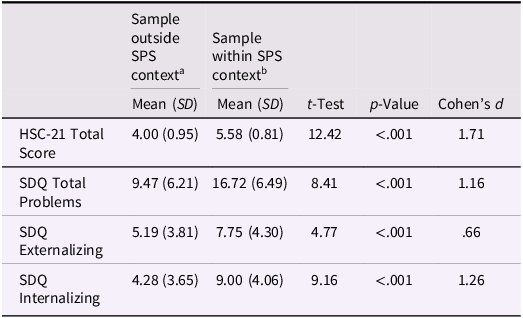
Prior to calculating descriptive statistics and validity results, we compared the samples recruited within (n = 64) or outside the SPS context (n = 303) on their HSC-21 total scores and SDQ problems using independent samples t-tests, to avoid overrepresentation of highly sensitive children with emotional or behavioral problems. Indeed, Table 4 demonstrates that children in the sample recruited within the SPS context had significantly higher scores on the HSC-21 total score, SDQ Internalizing, Externalizing and Total Problem scores than children recruited without a SPS context. Effect sizes ranged from moderate to large, with the largest difference observed for the SDQ Total Problems score (d = 1.71). In the sample with a SPS context, the mean Total Problems score (M = 16.72, SD = 6.49) was within the borderline clinical range (Lohbeck et al., Reference Lohbeck, Schultheiß, Petermann and Petermann2015). Hence, we decided to exclude this subsample from the validity analyses and from the descriptive statistics in order to obtain more representative means. The results of the factor analyses and reliability did not change when we repeated the analyses without the subsample.
t-test comparisons of the HSC-21 and SDQ scale for the samples recruited with and without sensitivity context

Note. HSC-21 = Highly Sensitive Child - 21 Items Scale; SDQ = Strength and Difficulties Questionnaire; SD = standard deviation; a N = 303; b N = 64.
Descriptive statistics
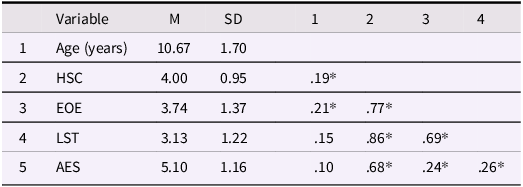
Means, standard deviations, and intercorrelations between the HSC-21 total score, the three subdimensions, and the children’s age are presented in Table 5. The mean HSC-21 total score (M = 4.00) was comparable to the means (M = 3.97, M = 3.94) found by Weyn et al. (Reference Weyn, van Leeuwen, Pluess, Lionetti, Goossens, Bosmans, van den Noortgate, Debeer, Bröhl and Bijttebier2022). As expected, EOE and LST were strongly correlated with each other (r = .69), while their correlations with AES were small. The HSC-21 total score and EOE demonstrated small positive associations with children’s age. Means and standard deviations for the 21 items are included in the Appendix. To test for sex differences, we ran independent sample t-tests on the HSC-21 total score and its subdimension. In line with the measurement invariance analyses, there were no significant differences in the scores between boys and girls (see Supplementary Table 2).
Means, standard deviations and pearson zero-order correlations

Note. N = 303; M = mean; SD = standard deviation; HSC = Highly Sensitive Child total score; EOE = Ease of Excitation; LST = Low Sensory Threshold; AES = Aesthetic Sensitivity.
*p < .001.
Convergent and discriminant validity: associations with temperament and personality
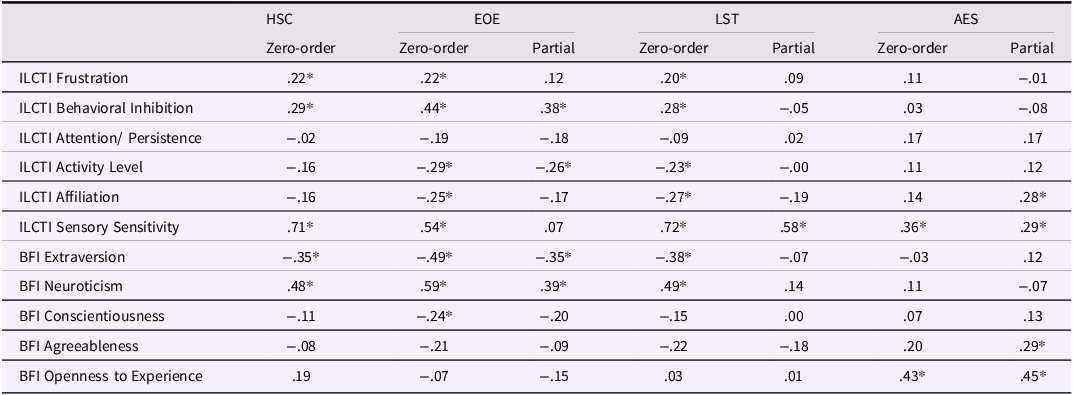
Table 6 presents zero-order and partial correlations between the HSC-21, temperament, and personality. For the subdimensions, only partial correlations are considered, controlling for the other two subdimensions. The strong correlation between the HSC-21 total score and the corresponding ILCTI temperament scale Sensory Sensitivity (r = .71) indicates convergent validity. Among the subdimensions, LST demonstrated the highest correlation (r = .58). In addition, the HSC-21 total score was significantly associated with Behavioral Inhibition (r = .29) and Frustration (r = .22). EOE correlated moderately positively with Behavioral Inhibition (r = .38) and demonstrated a small negative correlation with Activity Level (r = -.26). AES was associated with Sensory Sensitivity (r = .29) and Affiliation (r = .28). Except for Sensory Sensitivity, LST was not significantly correlated with any other temperament scale, and overall, there were no significant associations with Attention/Persistence. As the correlations with temperament traits other than Sensory Sensitivity were all below r = .4, discriminant validity was supported.
Bivariate zero-order and partial correlations of the HSC-21 and its subdimensions with the ILCTI and BFIscales

Note. N = 303; HSC-21 = Highly Sensitive Child - 21 Items Scale; ILCTI = Integrative Late Childhood Temperament Inventory; BFI = Big Five Inventory for Children and Adolescents HSC = Highly Sensitive Child total score; EOE = Ease of Excitation; LST = Low Sensory Threshold; AES = Aesthetic Sensitivity; Partial correlations control for the contribution of the other subdimensions.
*p < .001.
Regarding the Big Five personality traits, the HSC-21 total score demonstrated a moderate positive association with Neuroticism (r = .48) and a moderate negative association with Extraversion (r = −.35). The same pattern emerged for EOE. AES was moderately correlated with Openness to Experience (r = .45) and slightly correlated with Agreeableness (r = .29). LST was not significantly related to any of the Big Five traits, and there were no significant correlations with Conscientiousness. Overall, these findings provide evidence of construct validity.
Criterion validity: predicting internalizing and externalizing problems
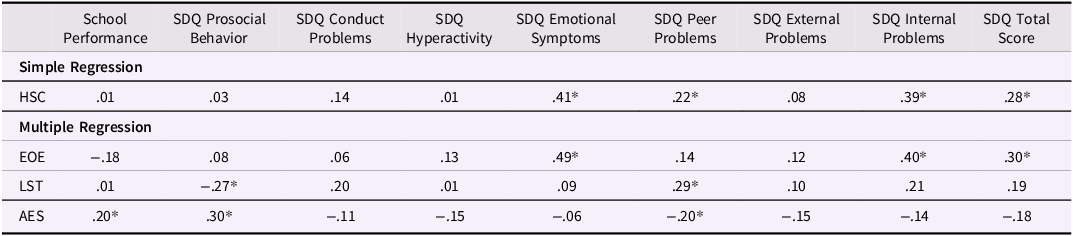
The standardized beta weights of the simple and multiple regression analyses are reported in Table 7. In the simple regressions, the HSC-21 total score significantly predicted SDQ Total Problems, explaining 8% of its variance. Interestingly, this result was only due to the contribution of the HSC-21 total score to Internalizing Problems, explaining 15% of its variance. For Externalizing Problems, the model was not significant. Consistent with this finding, the HSC-21 total score significantly predicted both Internalizing subscales, Emotional Symptoms and Peer Problems, explaining 17 and 5% of their variance respectively, but none of the Externalizing subscales (Conduct Problems and Hyperactivity). In addition, there was no significant contribution to SDQ Prosocial Behavior or School Performance.
Simple and multiple regressions. unique contributions (standardized beta weights) of the Hsc-21 and its subdimensions to school performance and the sdq symptom scales

Note. N = 303; HSC-21 = Highly Sensitive Child - 21 Items Scale; SDQ = Strength and Difficulties Questionnaire; HSC = Highly Sensitive Child total score; EOE = Ease of Excitation; LST = Low Sensory Threshold; AES = Aesthetic Sensitivity. Coefficients are standardized beta weights, representing the contribution of the HSC-21 total score and the unique contributions of its subdimensions to problem scores.
*p < .001.
To examine the specific contributions of the three subdimensions, the regression analyses were repeated, this time including EOE, LST, and AES simultaneously as predictors. Results indicated that EOE accounted for most of the variance in Emotional Symptoms (β = .49), Internalizing Problems (β = .40), and Total Problems (β = .30). Conversely, EOE was not associated with Peer Problems. Instead, higher scores on LST significantly predicted more Peer Problems (β = .29), whereas AES significantly predicted fewer Peer Problems (β = −.20). Compared to the simple regression models, the proportions of variance accounted for increased: 19% for Total Difficulties, 29% for Internalizing Problems, 30% for Emotional Symptoms, and 15% for Peer Problems. Again, Externalizing Problems and its subscales were not significantly predicted by any of the HSC-21 subdimensions. However, this time a significant amount of variance was explained for School Success (6%) and SDQ Prosocial Behavior (11%). AES significantly predicted School Performance (β = .20) and Prosocial Behavior (β = .30), whereas LST was negatively associated with the latter (β = −.27).
Discussion
In this study, we translated the 21-item version of the Highly Sensitive Child (HSC-21) scale, a questionnaire measuring Sensory Processing Sensitivity (SPS), into German and assessed the psychometric properties of the final caregiver-rated version and its associations with personality, temperament, and behavior problems in a sample of German-speaking caregivers and their children. Our findings offer strong support for the reliability and structural validity of the HSC-21, including evidence for a bifactor structure and full measurement invariance across sex and age groups, with good to excellent reliability across multiple indices. HSC-21 scores also showed meaningful associations with temperament and personality traits and moderately predicted internalizing, but not externalizing, problem behavior, supporting the scale’s convergent and criterion validity. Together, these results highlight the utility of the HSC-21 as a robust measure of environmental sensitivity in children and extend its relevance to German-speaking populations.
Psychometric properties of the german HSC-21 scale
Overall, our findings support Weyn et al.’s (Reference Weyn, van Leeuwen, Pluess, Lionetti, Goossens, Bosmans, van den Noortgate, Debeer, Bröhl and Bijttebier2022) recent evaluation of the HSC-21 as a reliable and valid tool to measure SPS in children. As was the case in Weyn et al.’s (Reference Weyn, van Leeuwen, Pluess, Lionetti, Goossens, Bosmans, van den Noortgate, Debeer, Bröhl and Bijttebier2022) previous investigation of the HSC-21, evaluations of the original HSC-scale (e.g. Pluess et al., Reference Pluess, Assary, Lionetti, Lester, Krapohl, Aron and Aron2018), most recent investigations regarding the adult version of the HSP scale (see Lionetti, Reference Lionetti and Acevedo2020) or the newly developed Sensory Processing Sensitivity Questionnaire (SPSQ, De Gucht et al., Reference De Gucht, Woestenburg and Wilderjans2022), we also found clear support for a bifactor structure of the German HSC-21. While Weyn et al. (Reference Weyn, van Leeuwen, Pluess, Lionetti, Goossens, Bosmans, van den Noortgate, Debeer, Bröhl and Bijttebier2022) found evidence for a bifactor solution with a general sensitivity factor and two specific subdimensions (one combined EOE-LST subfactor and AES), our data supported a bifactor model with a general sensitivity factor and three subdimensions (EOE, LST, AES) as is commonly found in most investigations on the original HSC-scale or the HSP scale (Lionetti, Reference Lionetti and Acevedo2020). Yet, in our data, as well as in many other studies on the original HSC-scale (e.g. Weyn et al., Reference Weyn, van Leeuwen, Pluess, Lionetti, Greven, Goossens, Colpin, van den Noortgate, Verschueren, Bastin, van Hoof, Fruyt and Bijttebier2019, Pluess et al., Reference Pluess, Assary, Lionetti, Lester, Krapohl, Aron and Aron2018), the LST and EOE subdimensions were highly correlated. Our results thus suggest that a bifactor solution is clearly superior to non-bifactor solutions, but that the difference in model fit between models with either two or three subdimensions is small (Chen, Reference Chen2007).
In line with most other studies on the HSC- or HSC-21-scale (e.g., Weyn et al., Reference Weyn, van Leeuwen, Pluess, Lionetti, Goossens, Bosmans, van den Noortgate, Debeer, Bröhl and Bijttebier2022, Pluess et al., Reference Pluess, Assary, Lionetti, Lester, Krapohl, Aron and Aron2018), the ECV further supports a multidimensional structure. Omega hierarchical of the total score indicated that the general sensitivity factor explained the vast majority of the reliable variance in total HSC-21 scores, supporting the use of a total score as a measure of general sensitivity. Omega hierarchical for the subdimensions implies that EOE and AES accounted for additional reliable variance, while the LST specific subdimension barely explained any reliable variance. Overall, these findings suggest that the German version of the HSC-21 may reflect a general sensitivity factor encompassing reactivity to both positive (AES) as well as negative (EOE and LST) environmental influences.
One of the key challenges addressed by Weyn et al. (Reference Weyn, van Leeuwen, Pluess, Lionetti, Goossens, Bosmans, van den Noortgate, Debeer, Bröhl and Bijttebier2022) in refining the original HSC-scale was the issue of weak internal consistency found for its subdimensions (especially LST and AES, e.g., Liu et al., Reference Liu, van Dijk, Lin, Wang, Deković and Dubas2023; Pluess et al., Reference Pluess, Assary, Lionetti, Lester, Krapohl, Aron and Aron2018; Sperati et al., Reference Sperati, Spinelli, Fasolo, Pastore, Pluess and Lionetti2024; Weyn et al., Reference Weyn, van Leeuwen, Pluess, Lionetti, Greven, Goossens, Colpin, van den Noortgate, Verschueren, Bastin, van Hoof, Fruyt and Bijttebier2019). Our results support Weyn et al.’s (Reference Weyn, van Leeuwen, Pluess, Lionetti, Goossens, Bosmans, van den Noortgate, Debeer, Bröhl and Bijttebier2022) findings in demonstrating predominantly good to very good internal consistency for the total HSC-21 as well as its subdimensions in child- and caregiver-reports.
Another issue that Weyn et al. (Reference Weyn, van Leeuwen, Pluess, Lionetti, Goossens, Bosmans, van den Noortgate, Debeer, Bröhl and Bijttebier2022) set out to address in refining the HSC-scale was the problem of only partial metric (Weyn et al., Reference Weyn, van Leeuwen, Pluess, Lionetti, Greven, Goossens, Colpin, van den Noortgate, Verschueren, Bastin, van Hoof, Fruyt and Bijttebier2019) and partial scalar invariance between sex and developmental stage for the original HSC-scale (Liu et al., Reference Liu, van Dijk, Lin, Wang, Deković and Dubas2023). In line with Weyn et al. (Reference Weyn, van Leeuwen, Pluess, Lionetti, Goossens, Bosmans, van den Noortgate, Debeer, Bröhl and Bijttebier2022) we found evidence for full configural (same factor structure), full metric (same factor loadings), and full scalar (same item intercepts) invariance across children’s sex and age groups within caregiver reports, according to all three investigated criteria (ΔRMSEA, ΔSRMR, ΔCFI). Since the number of children answering the self-report form of the HSC-21 was too low, we did not calculate measurement invariance for the self-report form. Our results suggest that the caregiver-report-form of the German HSC-21 can be used across sex and different age groups of children ensuring comparability of results.
Our results further demonstrate excellent test-retest reliability (Cicchetti, Reference Cicchetti1994; McCrae et al., Reference McCrae, Kurtz, Yamagata and Terracciano2011) for the evaluated German caregiver version of the total HSC-21 and its subdimensions over a two- to three-week interval. Only one other study investigated test-retest reliability for the original HSC-scale and found an only acceptable temporal stability over two to three weeks (Pluess et al., Reference Pluess, Assary, Lionetti, Lester, Krapohl, Aron and Aron2018). Although these studies might not be directly comparable and attrition rates were high in our sample, the HSC-21 demonstrates a very high temporal stability across measurements.
Finally, we found substantial agreement between caregiver- and child-reports for the total HSC-21 as well as the EOE and LST subdimensions. Similar to Weyn et al. (Reference Weyn, van Leeuwen, Pluess, Lionetti, Goossens, Bosmans, van den Noortgate, Debeer, Bröhl and Bijttebier2022), we found lower agreement between child and parent reports for the AES subdimension. However, while Weyn et al. (Reference Weyn, van Leeuwen, Pluess, Lionetti, Goossens, Bosmans, van den Noortgate, Debeer, Bröhl and Bijttebier2022) only found little agreement between children and their caregivers on AES-items, inter-rater agreement for the AES subdimension in our study was acceptable (Koo & Li, Reference Koo and Li2016). Thus, our results demonstrate that the HSC-21 can reliably capture SPS across informants, with some variation in the specific subdimensions.
Interactions of recruitment sources and prevalence of problem behavior
We employed multiple recruitment channels, including mailing lists, social media groups, schools, sports clubs, online parent groups, and crowdsourcing platforms. We observed that children whose parents were recruited through SPS-specific social media channels, groups, or mailing lists exhibited markedly elevated levels (more than a standard deviation) of internalizing and externalizing problem behavior on the SDQ as well as higher HSC-21 total scores compared to those recruited through media not specifically targeting highly sensitive individuals, such as schools, sports clubs, and non-SPS-related social media channels, crowdsourcing platforms or mailing lists. The mean SDQ Total Problem score for children in the first subsample can be categorized as borderline clinically relevant, indicating a significantly elevated prevalence of mental health problems (Goodman, Reference Goodman1997; Lohbeck et al., Reference Lohbeck, Schultheiß, Petermann and Petermann2015).
A likely explanation is that parents who join and follow SPS-specific social media channels, groups, or mailing lists may do so because they seek help in dealing with their children’s behavioral problems or own mental health issues (Edenroth-Cato, Reference Edenroth-Cato2020). Compared to the general population, the population of SPS-interested individuals might therefore be skewed towards a disproportionately high number of individuals (or caregivers of such) who identify as highly sensitive and also suffer from mental health issues. This bias might lead to an overestimation of interactions between SPS and negative traits or psychopathology, while underestimating interactions with positive traits or vantage sensitivity. Similar sampling bias may have contributed to prior findings of small to large associations between SPS and various other mental health problems (e.g. Liss et al., Reference Liss, Timmel, Baxley and Killingsworth2005, Reference Liss, Mailloux and Erchull2008, Mac et al., Reference Mac, Kim and Sevak2024).
Consequently, we excluded all participants that were recruited via channels specifically addressing SPS or highly sensitive individuals from correlational analysis between SPS and other traits in this study. Although the number of participants recruited through SPS-specific channels in our sample was modest and the analysis presented here was exploratory, the substantial difference between recruitment methods is noteworthy and has implications for other studies as well. Interactions of SPS with negative traits like neuroticism, anxiety or psychopathology might in some cases be exaggerated due to similar sampling bias. Therefore, future studies should exercise great caution in sample acquisition, especially when investigating interactions between SPS and other traits.
Associations with problem behavior and temperament
Although associations between SPS and various behavioral problems were much lower in the sample that was not recruited in the pretext of SPS-research, caregiver reported SPS scores were moderately associated with SDQ dimensions representing Internalizing Problems, such as Emotional Problems and to a smaller degree Peer Problems. On subdimension level, EOE explained most of the variance in the SDQ Total Problems score, mainly through its association with internalizing problems, especially in the Emotional Symptoms subscale. Higher scores on the AES subdimension significantly predicted better caregiver-rated school performance. AES was moreover linked to lower rates of Peer Problems and higher ratings of Prosocial Behavior, which reflects positive social behaviors, such as empathy, kindness, and cooperation. In contrast, LST predicted higher rates of Peer Problems and lower ratings of Prosocial Behavior.
These divergent patterns within the SPS-trait across the SDQ subscales for positive social behaviors align well with Environmental Sensitivity Theory and the concept of SPS (Pluess, Reference Pluess2015). Children with higher SPS might exhibit improved social functioning in low stimulating social interactions due to higher AES, while a heightened LST may also contribute to them being more easily overwhelmed in highly stimulating social situations, which may lead to social withdrawal and reduced willingness for empathic or prosocial behavior. Overall, these findings confer with differential susceptibility theory and the trend in recent research to distinguish between the negative versus positive aspects within the SPS-trait. While EOE and LST seem to capture increased vulnerability towards internalizing problem behavior, AES appears to validly capture what could be described as vantage sensitivity (Pluess, Reference Pluess2017). Consistent with most previous research (e.g. Slagt et al., Reference Slagt, Dubas, van Aken, Ellis and Deković2018), we found no associations between externalizing problem behavior and the HSC-21 total score or any of its subdimensions. In fact, externalizing problems are more related to temperamental aspects such as frustration and inattention (Zentner, Reference Zentner2020; Zentner et al., Reference Zentner, Biedermann, Taferner, Da Cudan, Möhler, Strauß and Sevecke2021), which are not or only weakly related to SPS.
Additional support for the convergent and discriminant validity of the translated HSC-21 is evident in the replication of most association patterns found in previous studies between the HSC- or HSC-21-scales, their subdimensions and related temperament and personality measures. Consistent with prior research (Pluess et al., Reference Pluess, Assary, Lionetti, Lester, Krapohl, Aron and Aron2018; Sperati et al., Reference Sperati, Spinelli, Fasolo, Pastore, Pluess and Lionetti2024), the HSC-21 total score demonstrated significant small to moderate positive associations with temperament and personality traits associated with emotional reactivity, such as trait-Frustration or Neuroticism. In line with previous research (Hoffmann et al., Reference Hoffmann, Marhenke and Sachse2022; Liu et al., Reference Liu, van Dijk, Lin, Wang, Deković and Dubas2023; Marhenke, Reference Marhenke and Acevedo2024; Pluess et al., Reference Pluess, Assary, Lionetti, Lester, Krapohl, Aron and Aron2018) we found a moderate positive association between the HSC-21 total score and Behavioral Inhibition. Furthermore, the HSC-21 total score was negatively associated with Extraversion, reflecting its inverse relationship with sociability and activity levels, in line with established findings on heightened sensitivity and introversion (Greven et al., Reference Greven, Lionetti, Booth, Aron, Fox, Schendan, Pluess, Bruining, Acevedo, Bijttebier and Homberg2019). Finally, a strong association with the ILCTI Sensory Sensitivity subscale further supports construct validity.
In line with previous research (e.g. Weyn et al., Reference Weyn, van Leeuwen, Pluess, Lionetti, Goossens, Bosmans, van den Noortgate, Debeer, Bröhl and Bijttebier2022), if controlling for variance in the other subdimensions, EOE was small to moderately associated with increased behavioral inhibition and neuroticism, and lower activity levels and extraversion. LST was only associated with the ILCTI subscale Sensory Sensitivity that reflects a heightened reactivity to low-intensity stimuli and aligns with the characteristics measured by the LST subdimension. AES also showed small positive associations with the Sensory Sensitivity subscale, Agreeableness and its early temperamental precursor Affiliation and a moderate association with Openness. These small to moderate associations are in line with previous research (Aron & Aron, Reference Aron and Aron1997; Lionetti et al., Reference Lionetti, Aron, Aron, Burns, Jagiellowicz and Pluess2018; Pluess et al., Reference Pluess, Assary, Lionetti, Lester, Krapohl, Aron and Aron2018; Weyn et al., Reference Weyn, van Leeuwen, Pluess, Lionetti, Goossens, Bosmans, van den Noortgate, Debeer, Bröhl and Bijttebier2022) in demonstrating that SPS is associated with well-studied domains of temperament and personality (i.e., showing convergent validity), yet constitutes a distinct trait that is not fully captured by any of them (i.e., demonstrating discriminant validity).
Strengths and limitations
The present research is the first to establish a reliable and valid measure of environmental sensitivity for children and young adolescents in the German language. An important strength is the in-depth examination of the psychometric properties of the refined 21-item HSC-scale, including caregiver reports and additional child reports. Across the investigated samples, the German version of the HSC-21 demonstrated good to very good psychometric properties, measurement invariance across sex and age, high agreement between child and caregiver reports and robust associations with childhood temperament and personality, all of which support the scale’s validity. Nonetheless, this research should be considered in the light of several limitations. First, as mentioned above, the main focus of this research was to provide a caregiver-rated version of the HSC-21 in the German language. We also translated and evaluated a self-rating version for children, however the sample size for the evaluation of the child self-rating was limited. Although our results indicate good to very good psychometric properties in our sample, further validation of the German translation of the child-self-rating version is needed. Future research using the German HSC-21 should investigate whether it moderates the effects environmental influences (e.g., parenting quality, stress exposure, social support) on developmental outcomes, in line with environmental sensitivity theory. As noted earlier, prior studies have demonstrated that the original HSC scale reliably predicts susceptibility to various beneficial or adverse environmental conditions. While there is no reason to expect that the psychometric refinement or translation would alter the theoretical function of the scale, empirically confirmation remains essential to test whether the German HSC-21 similarly captures individual differences in sensitivity to environmental influences and functions as a moderator in predicting differential developmental outcomes.
Moreover, there was high interrater agreement between child self-ratings on the HSC-21 and corresponding caregiver ratings. However, these results might be overestimated, as children might have answered the questionnaire with their caregiver close by. Caregivers might have explained difficult items to their children, thus potentially influencing their children’s responses. Therefore, future studies should focus on collecting child ratings in more controlled settings, such as schools. This would ensure that all children receive the same instructions and allow for direct feedback on the comprehensibility of the items. Another limitation is the restricted age range (8 – 14 years) of children and young adolescents for which the HSC-21 has been validated. Younger children may struggle with the accuracy and reliability of self-report questionnaires. Available alternative methods, such as observational SPS measures (Lionetti, et al., Reference Lionetti, Aron, Aron, Klein and Pluess2019) or structured interviews (Kähkönen et al., Reference Kähkönen, Lionetti, Castelli and Pluess2024), are recommended for this age group. There are several SPS-questionnaires available in the German language, for older adolescents above the age of 14 (Tillmann et al., Reference Tillmann, El Matany and Duttweiler2018) or adults (Konrad & Herzberg, Reference Konrad and Herzberg2019). However, given that the original HSC scale has been validated until 18 years old (e.g. Pluess et al., Reference Pluess, Assary, Lionetti, Lester, Krapohl, Aron and Aron2018), future research should also validate the German HSC-21 version in older adolescent samples (14 – 18 years old).
Finally, the internal consistencies of three ILCTI and SDQ scales (activity level, conduct problems, and peer problems) were below the commonly accepted threshold of .70. Therefore, associations between these three subscales and the HSC-21 should be interpreted with caution due to potential measurement error. However, the overall validity of findings for the HSC-21 are unlikely to be substantially affected by these limitations.
Conclusion
Overall, our findings indicate good to very good psychometric properties for the German translation of the parent version of the HSC-21. The translated HSC-21 scale demonstrated (a) a good model fit for a bifactor structure, including a general sensitivity factor and the three specific subdimensions EOE, LST, and AES, which are regularly found in most other research on the HSC scale as well as the adult HSP scale. We found (b) full configural, metric, and scalar measurement invariance across sex and age groups (c) very good internal consistency for the full scale and good to very good internal consistency for its subdimensions; (d) excellent test-retest reliability for the evaluated caregiver version of the HSC-21; (e) substantial interrater agreement between child and caregiver reports; and (f) meaningful associations with well-established temperament and personality traits, as well as a moderate association between the HSC-21 total score and internalizing problem behavior. Our results paint a consistent picture of the German HSC-21 as a reliable and valid measure of SPS and environmental sensitivity that can be used not only in research but potentially in clinical or school contexts to develop more personalized interventions.
Supplementary material
The supplementary material for this article can be found at https://doi.org/10.1017/S0954579425100412.
Data availability
Data available on request from the authors.
Acknowledgements
We would like to thank Michelle Hildebrandt and Kaylie-Anne Ward for their invaluable help in the forward and backward translation of the questionnaire. We also thank the Informations- und Forschungsverbundes Hochsensibilität e.V. (IFHS) for their support in recruitment. Finally, we would like to express our gratitude to all the participating children and early adolescents as well as their parents.
Funding statement
This research received no specific grant from any funding agency, commercial or not-for-profit sectors.
Competing interests
The authors declare none.



 Open access

