

In the year 1989, the widely read Russian newspaper Moskovskie Novosti (Moscow news) published an interview with Gelii Riabov, a scriptwriter known for his prize-winning TV series from the 1970s about the early history of Soviet police (militsiya).Footnote 1 Riabov confessed that twenty years earlier he and a group of his friends had found the concealed grave of the last Russian Tsar Nicholas II and his family in a swamp near Sverdlovsk (Ekaterinburg before 1924 and after 1991) (Riabov Reference Riabov1989). Equally proud of and frightened by their discovery, they made a vow to keep silent about it until a good time came. Here, Riabov broke that promise and launched complicated and highly emotional public debates that unfolded against the backdrop of the work of criminologists, archaeologists, and historical activists involved in the search for and identification of the “Ekaterinburg’s remains” (yekaterinburgskie ostanki).Footnote 2
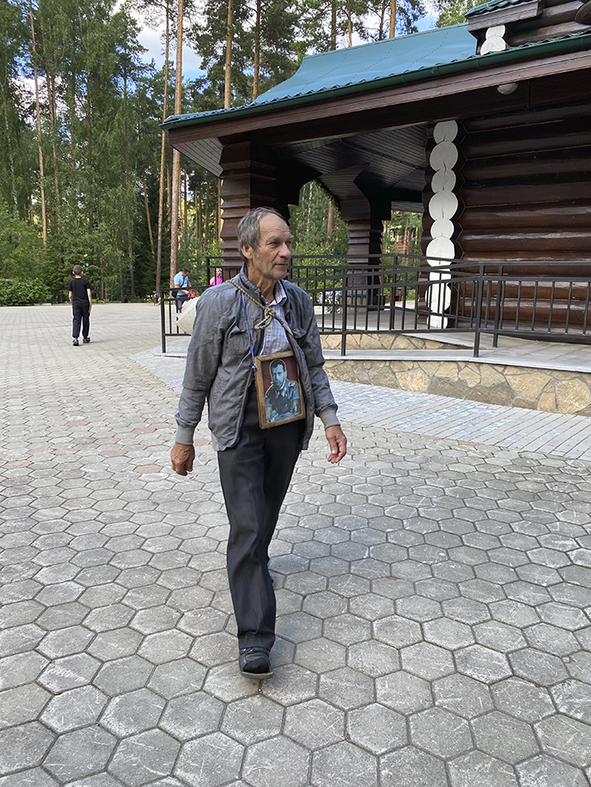
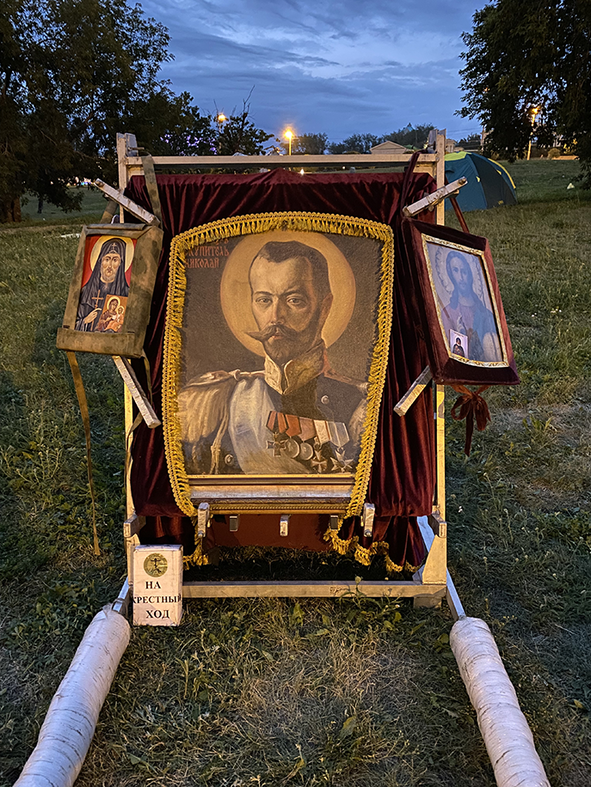
Pilgrim with a portrait of Nicholas II at Ganina Yama, 17 July 2022. Author’s photo.
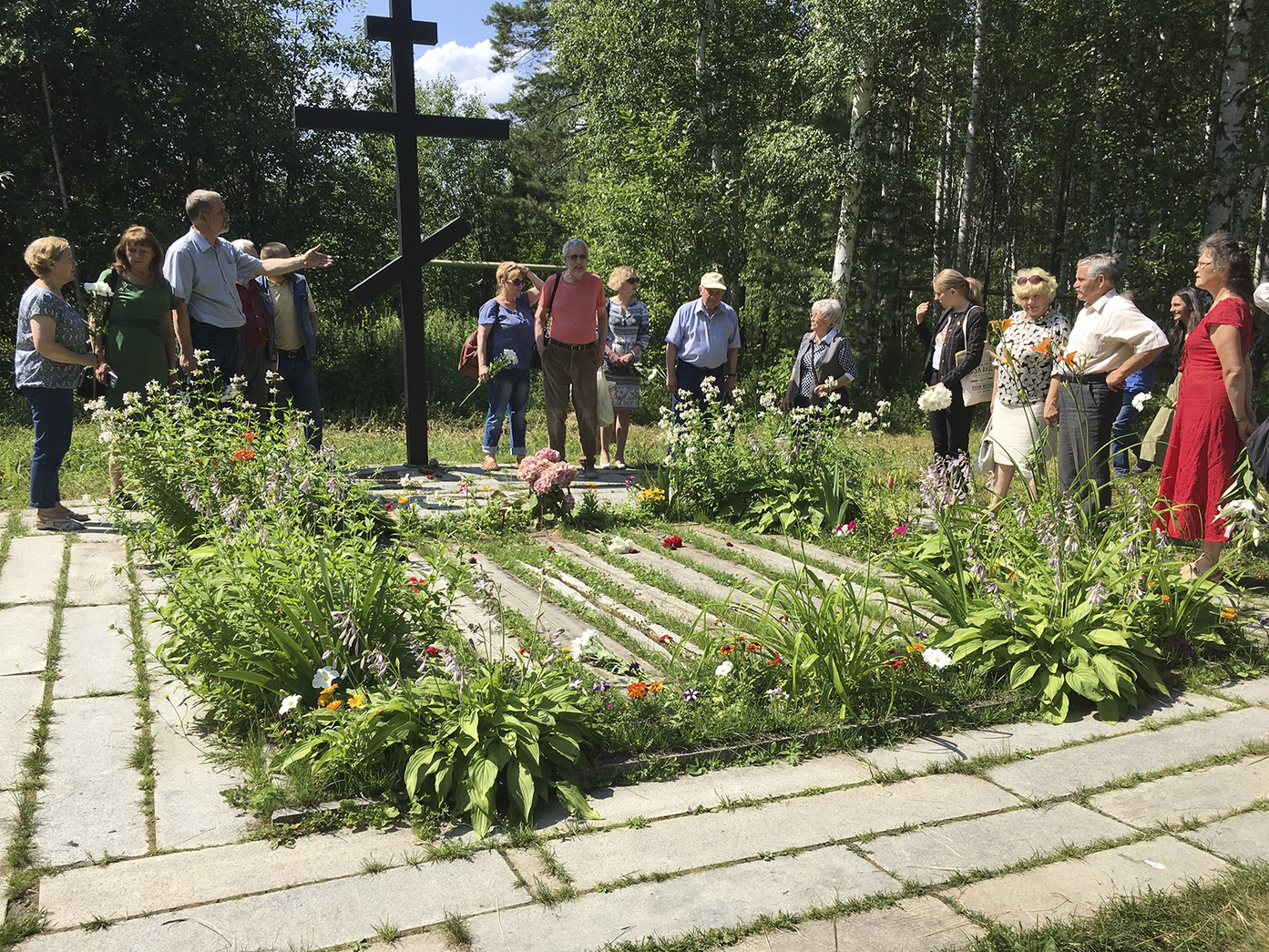
The Porosenkov Log grave, 19 July 2019. Author’s photo.
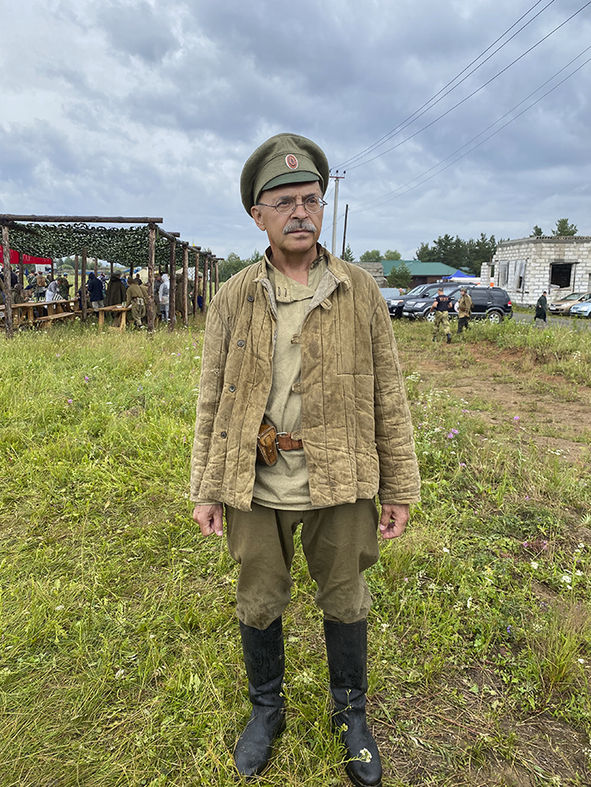
Leonid, who found remains of Alexei ana Maria, dressed in a World War I uniform at the historical reenactment festival, Sverdlovsk region, 10 July 2021. Author’s photo.
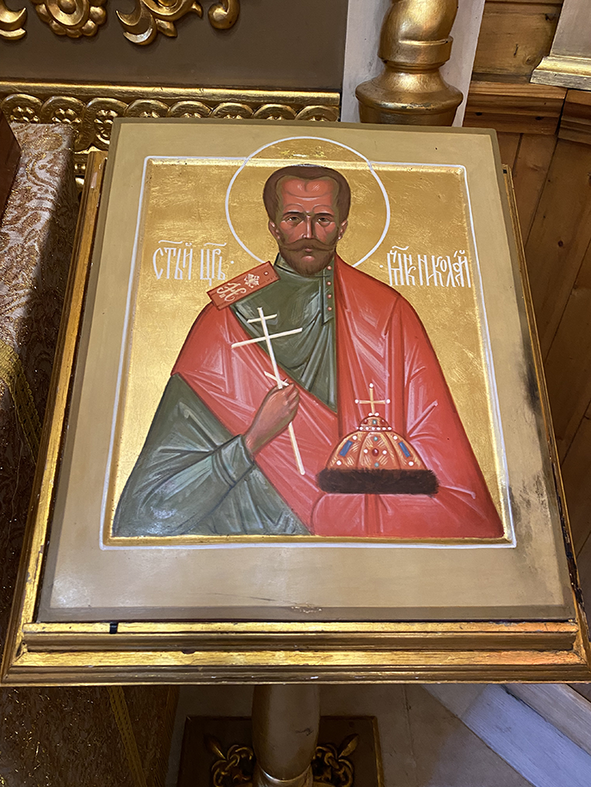
Icon of Nicholas II in a seventeenth-century royal garment, Ekaterinburg, 16 July 2022. Author’s photo.
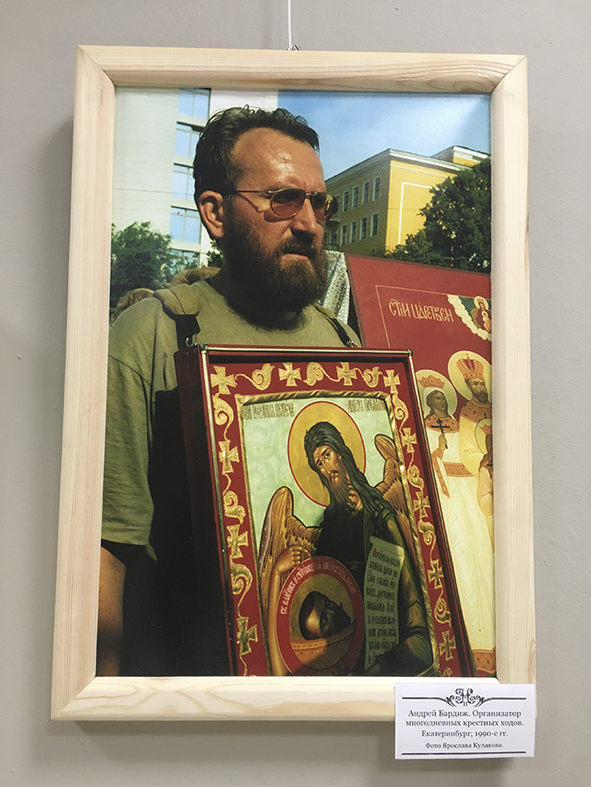
Icon Zhertva userdnaya (Zealous sacrifice), picture from the Museum of Ganina Yama, 16 July 2019. Author’s photo.
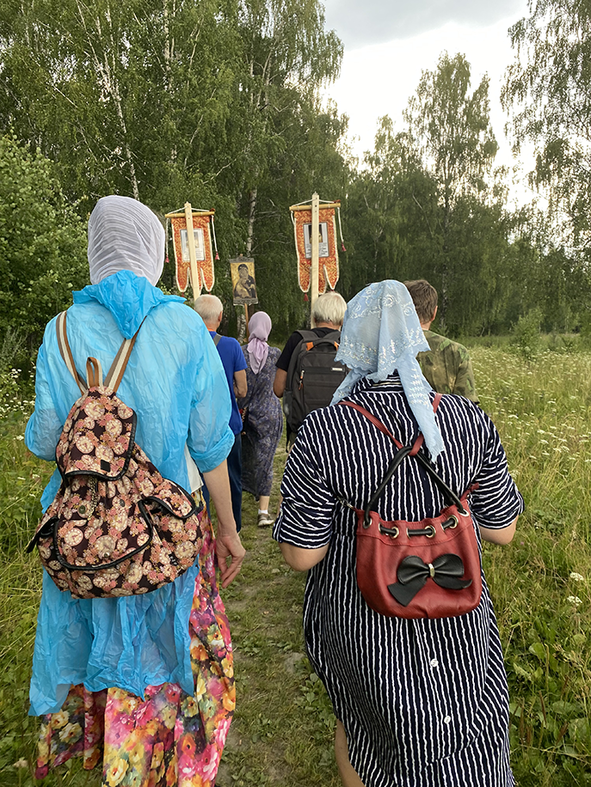
Veronika and her cross procession going to Ganina Yama, 18 July 2021. Author’s photo.
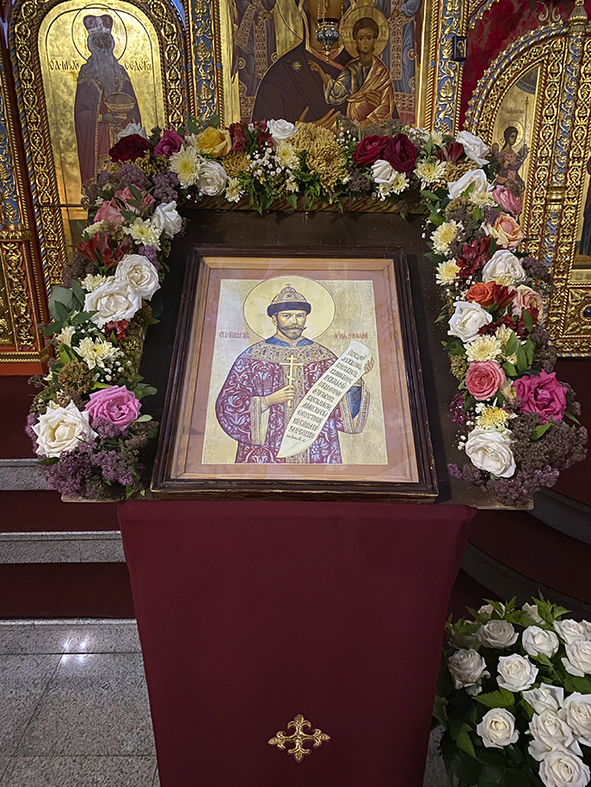
Icon of Nicholas as Holy Tsar, Ekaterinburg, 15 July 2021. Author’s photo.
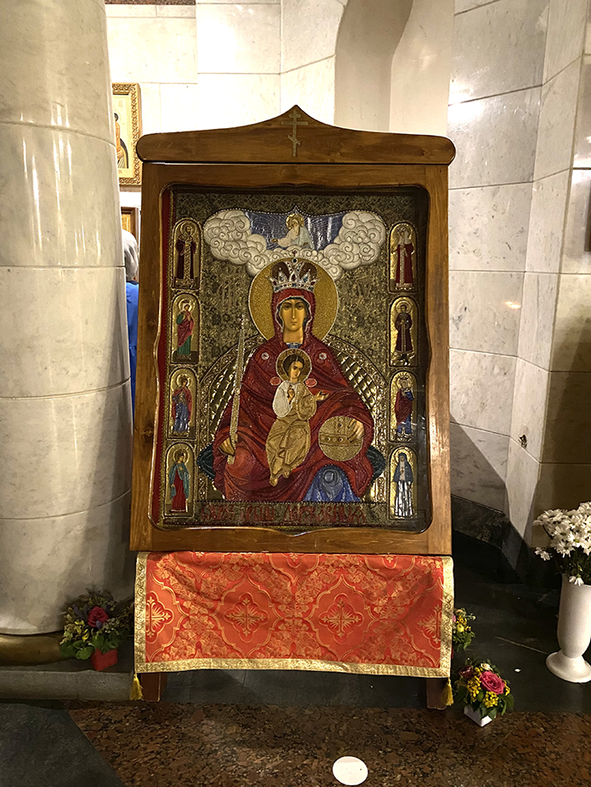
Icon of the Mother of God Derzhavnaia (She who reigns), Ekaterinburg, 19 July 2021. Author’s photo.
Icon of the Tsar as Redeemer brought by participants in the Tsar Cross procession, Ekaterinburg, 16 July 2021. Author’s photo.
At first glance, this Romanov’s case fits well into the pattern of “parades of dead bodies” that Katherine Verdery described for post-Socialist countries of Eastern and Central Europe. Since the end of the 1980s, these corpses—remains and mummified bodies, but also symbolic representations of them, such as statues—started to be moved intensively, changing their geographical locations and social statuses (Verdery Reference Verdery1999). In some cases they were repatriated from abroad to their native lands to become symbols of renewed nations, whereas in others they were removed from the central squares of cities, destroyed, vandalized, or symbolically punished in some other way. The new ancestors needed proper burials, and rituals of commemoration helped people create new social ties with each other as members of the same kinship group, as a community of mourners (Hertz Reference Hertz, Needham and Needham1960; Cannell Reference Cannell, Boddy and Lambeck2013). Translatio of the dead bodies per se, hiding them, keeping them, and moving them, could be used as a powerful symbolic tool in processes of reunifying nations or introducing them into a new political context. For example, in Germany Chancellor Kohl reinterred the Prussian Emperor Frederick the Great’s coffin in the Potsdam Gardens in August 1991, “as a tribute to—and symbol of—German reunification” (Trouillot Reference Trouillot1995: 45). In Hungary, composer Bela Bartok was reburied in Budapest in 1988 with great pomp; his remains having been taken to his native country from the United States, where he died in 1945. In this way, Susan Gal wrote, Hungarians stressed their belonging to European culture and celebrated their Europeanness (Reference Gal1991). There are many other examples of this (see, for example, Todorova Reference Todorova2009).
In the Russian case, the timing was perfect. In June 1991, Boris Yeltsin was elected the country’s first president; in August of same year there was a failed Soviet coup attempt; and in December the Supreme Soviet of the Soviet Union officially declared the dissolution of the USSR. In this time of change, remains and rituals of commemorations could become symbolic instruments to draw a connecting line between the Soviet past and the future, and create new solidarities among descendants of newly discovered ancestors. All of this took place against the backdrop of revelations about victims of Soviet political repression and the discovery of their mass graves (Paperno Reference Paperno2001; Etkind Reference Etkind2013). As in similar European cases, there was a group of enthusiasts who initiated the process from below (Verdery Reference Verdery1999: 51) with the support of the local political elites and of the central government in Moscow. In the same year, excavations of the Tsar and his family’s remains started with the personal permission of Yeltsin (who was born in Sverdslovsk region and had worked as a First Secretary of the Party’s Sverdlovsk Oblast committee before he moved to Moscow) and under the personal supervision of the local governor, Eduard Rossel.
And yet symbolic work with the corpses of collective “ancestors” in post-Soviet Russia turned out to be quite different from that in the countries of Eastern and Central Europe. The main corpse of the Soviet era, the mummified body of Vladimir Lenin, remained in a mausoleum in Moscow’s Red Square. Although there are occasional public discussions advocating that Lenin’s body should be removed from the mausoleum and buried, they have not aroused widespread support. In the post-Soviet period, Lenin’s body was excluded from public state rituals and popular veneration of it ceased (Panchenko Reference Panchenko1996; Tumarkin Reference Tumarkin1997; Yurchak Reference Yurchak2015). Lenin’s image has been ridiculed in art and mass culture (Yurchak Reference Yurchak2011), and his status has changed from being a political prophet and founder of the Soviet state to occupying the modest role of a hero of the Communists, now a marginalized political party in the Russian parliament. His body was symbolically abandoned in the palimpsest of the capital city and yet it remains as an unmovable layer.
Post-Soviet public reburials in Russia were rare, and remains were repatriated from abroad rather than removed. Most noticeable among them were the 2005 transmission of the remains of General Anton Denikin (1872–1947), who led anti-Bolshevik forces during the civil war, from the United States to Moscow, and those of philosopher Ivan Ilyin (1883–1954) from Switzerland. Both were buried on the same day at the Moscow Danilov monastery. These reburials were represented as signaling the end of the civil war between White and Red and an act of reconciliation between two parts of the Russian people the Revolution had divided. These were not acts of creating a new state, as in the cases analyzed by Verdery.
Only the reinterment of a contemporary of Lenin (1870–1924), the last Russian Tsar Nicholas II (1868–1918), resembled post-socialist reburials in Central and Eastern Europe. In that case, however, instead of debating candidates for the role of new ancestors and the proper burial places for them, people have discussed the authenticity of the remains found during excavations: are they Romanovs’ remains or not? Just as in post-socialist Europe, the question of what to do with important dead led to elaboration of powerful tropes that can help people to articulate their ideas about the state, political power, the course of history, and citizenship. Yet, rather than addressing problems about the past (who is to blame) and the future (what to do), the debate about the Ekaterinburg remains revolved around the bodies themselves, their present status and veracity. Like Lenin’s unmoved and forgotten remains, those of the royal family became for my interlocutors a metaphor for the continuation of the imperial/Soviet political project up to the present.
This research started with a simple question: why were the Ekaterinburg remains never recognized as authentic? To answer it, I propose to look at the history of non-recognition of the royal remains from the perspective of the “king’s double body theory,” which explains the continuity of political power and the political body (Schnepel Reference Schnepel2021: 22; Kantorowicz Reference Kantorowicz1957: 273). If the rituals of moving dead bodies helped new states to draw a boundary between “before” and “after,” using the symbolic power of the burial ritual to mark a temporal and ideological break with the past, then unburied bodies and unperformed funeral rites indicate a continuity of the political body. I argue that the image of the Tsar and the question of the authenticity of his remains have become key tropes in Russian political ontology, at least in its religious version.
Ethnographically, this political ontology is revealed in what I call popular theopolitics. Popular theopolitics, expressed in prayers and polemical texts, as well as in visual theology of icons, concern not only emic concepts and logics (thinking), but also ritual practices (doing), which allow people to get involved intellectually, bodily, and emotionally in maintaining the ideal order of things. It lets them feel they belong to an ideal collective body, be it the state, the church, the nation, or some other collectivity. Popular theopolitics of post-Soviet people in Russia are built on Christian concepts such as salvation, sin, and redemption, and employ the language of Apocalypse. The article considers three arenas of popular theopolitics: debates about authenticity of Romanovs’ remains; discussions of ritual murder and pedagogy of the spiritual gaze; and the question of intangible saints.
The spirit of breaking with the past was very much in vogue during the perestroika years, as a famous book by Alexei Yurchak rightly registered (Reference Yurchak2005). There were strong voices for drawing a clear temporal boundary between the Soviet past and the non-Soviet present, and an important means to doing this was seen to be finding out who had been guilty of political repression and burying the victims of that repression. According to this logic, collective repentance is followed by the revival of the people and the country. I will call this trend historical optimism. Already in the 1990s, though, another trend emerged: that of stressing continuity between pre- and post-Soviet times. The language of Orthodox Christianity, perceived by many as an unchanging, non-historical tradition, hidden rather than interrupted during the Soviet period, became a powerful means of expressing continuity. In this version of theopolitical imagination, which I will call spiritual realism, political life takes place in the utopian world of “Holy Russia.” Also different here is temporality: it is a temporality of an extended present.
Ekaterinburg, where I did my fieldwork, is an industrial city profiting from gas and oil in neighboring western Siberia, and an informal capital of the Urals region of the Russian Federation. It has about one and a half-million inhabitants. In the post-Soviet era, an impressive commemorative culture developed in the city around the killing of the last Russian Tsar, his family, and attendants: monuments were erected, churches were built and icons painted, books were published, artworks were created, museum exhibitions were organized, and a regular conference of “Romanovs’ readings” was established. Since the early 2000s, the city has held an annual mid-July festival of Orthodox culture called Tsarskie Dni (Tsar’s days), which lasts for more than a week and attracts tens of thousands of visitors and pilgrims. The festival’s main event—a night liturgy at the place of regicide followed by the Procession of the Cross going to the burial place of Romanovs—has grown from fifteen hundred participants in 2001 to approximately forty thousand in 2019. Up to a hundred thousand attended in 2018, the centenary of the regicide, when Patriarch Kirill himself delivered the liturgy and headed the procession. Though in 2021 the procession was officially banned due to the coronavirus pandemic it nevertheless took place and attracted several thousand pilgrims from across the country. During my fieldwork, which I began in the late 2000s, I talked to people who were involved in practices of commemorating the Romanovs in Ekaterinburg, from cultural managers and entrepreneurs to ordinary urban dwellers, as well as pilgrims and tourists. I read their books and articles, followed their social media activities, visited their lectures and exhibitions, went on processions of the cross, and socialized with them in other ways. My aim was to see how they use the image of the Tsar and the fact of his murder in their religious and political ontologies, their popular theopolitics.
Orthodox Theopolitics
The concept of theopolitics, as presented in contemporary historiography through the works of Carl Schmitt and their reading by Agamben, implies that “all significant concepts of the modern theory of the state are secularized theological concepts” which “evacuate their political force” (McAllister and Napolitano Reference McAllister and Napolitano2021: 11). Without arguing against the validity of this theorization, I would point out that when these authors spoke of Christian theology they were referring to Western Christianity as a universal form of Christianity. However, vernacular theopolitics might exhibit different patterns in post-Christian contexts that have different theological traditions, local histories of secularization, and principles of drawing a line between the religious and the secular (see Hann and Goltz Reference Hann, Goltz, Hann and Goltz2010). Quite logically, the theopolitics of Eastern Christianity has its own distinct features.
The concept of theopolitics grows out of Ernst Kantorowicz’s historical study The King’s Two Bodies (1957). The book analyzes the theory of that same name developed by English jurists of the Tudor period, and the time thereafter, to give greater legitimacy to the transmission of power, or “Dignity,” from a deceased king to a new sovereign. According to this theory, the King can never die; “for the King has in him two Bodies, a Body natural and a Body politic. His Body natural is a Body mortal … but his Body politic is a Body that cannot be seen or handled, consisting of policy and government, and constituted for the direction of the people, and the management of the public weal…” (ibid.: 7). The King as a sovereign can never die the same way Jesus Christ, who had two Bodies in him, did not die: when his mortal Body suffered on the Calvary Cross, his heavenly Body as a sovereign of the world continued its eternal life. The most famous pages of this long book describe the habit of displaying the deceased king’s effigy atop his coffin as a symbol of “the King’s survival despite the king’s death” (ibid.: 419). Whereas the effigy is dressed in coronation garments, his dead body is left naked; in the course of the burial ritual, the king as a human being is separated from the eternal royal Dignity.
Kantorowicz’s ideas were perpetuated in the works of historians and political scientists (e.g., Gieasey Reference Gieasey1960). One among them who is rarely mentioned is Mikhail Cherniavsky (1922–1973), his student at Berkeley and later his assistant at Princeton. A son of Russian émigrés of Jewish origin who was born in Kharbin, Cherniavsky taught Russian history at American universities and published several important works in the field of Russian medieval studies. For many years he was in Kantorowicz’s inner circle and corresponded with him regularly, and he became a keeper of his archives (Lerner Reference Lerner2017). In his works on the Russian theopolitical imagination, Cherniavsky studied the ways in which Russian rulers and their Dignity were legitimated in medieval times, and pointed to a “significant difference in the image of the saintly prince in Russia” compared to one his teacher analyzed:
As Christ, whose image he is, the king is both god and man; he is god in his being and a man in his function. The dual nature of the prince in Western medieval Europe created a tension in his image which was finally resolved by the separation of the person and the office of the prince.… In the West, the tension was between two unequal entities, one higher and one lower, a divine nature and a human one. In Russia, the tension was between the divine nature of princely power and the saintly nature of the prince as a man” (Cherniavsky Reference Cherniavsky1961: 28–29).
Cherniavsky went on to observe that a substantial portion of the saints canonized in medieval Russia were princes. “In Russian popular tradition and in Russian political theology, all princes were seen as saints, through actions or in their being, mediators between God and their people in life and in death, and in that sense, true images of Christ” (ibid.: 32). Besides, up to the seventeenth century Russian princes took the monastic vow before death, thus joining the angelic rank and confirming their more-than-human nature. In other words, instead of separating the holy Dignity of a sovereign from his mortal body—the non-human continuity of state power from human mortality—the political theorists in medieval Russia concentrated on the ruler’s holiness.
Another difference Cherniavsky formulated between Western European and Russian development in the political sphere concerned the late acceptance in the latter of the secular idea of the state: “The theory of the state, the very concept of state was introduced into Russia as part of the Christian ethos. In other words, there was no concept of a secular state in Russia, no concept outside Christianity and its purposes; Kyivan Russia received and assimilated Christianity but not the antique concept of secular society and state” (ibid.: 33). Hence, “What one could call a political Nestorianism of the West, the splitting apart of two natures of the prince, the human and the divine, his person and his functions, could not apply, at least in theory, to the Russian prince, who in his person was as much an image of Christ as he was in his office and function” (ibid.: 34).
Later on, from the seventeenth into the mid-nineteenth century, the idea of inseparability of the Tsar’s body (and personality) and his Dignity could be found in the phenomena of samozvantsy—fake Tsars, or imposters.Footnote 3 Throughout three centuries of the Romanov dynasty, dozens of fake Tsars appeared in different parts of the vast territory of the Russian Empire. They were people with great personal charisma, from a leader of a popular uprising, Yemelyan Pugachev (fake Tsar Peter III), to lesser-known persons who claimed that they had come to redeem the people, to make their life more bearable economically and socially. According to Russian folklorist and historian Kirill Chistov, who studied this phenomenon as a facet of popular utopian thinking (one not uniquely Russian), it was exceptionally widespread in Russia because people there believed “in the special nature of persons of the royal pedigree” (Reference Chistov1967: 149). As the famous Russian philologist Boris Uspenskij argued, fake Tsars appear in Russian reality simultaneously with the transmission of Byzantine royal rituals and concepts to Russian soil, and with the Tsar’s sacralization. He points out that the coronation ceremony includes an anointing, which in the Russian version equates the Tsar with Christ. The ritual of anointment was borrowed from the Byzantines, just like the royal insignia, but as Uspenskij shows, the Russians misinterpreted it, and it has become a kind of eighth sacrament that spreads grace on a persona and an office (power) of the Tsar (Uspenskij Reference Uspenskij1998: 29). Importantly, this sacralization of the Tsar was taking place in the process of creating a religious and political ideology of Moscow as a Third Rome, a “theocratic eschatology” that describes Russia as the last Orthodox kingdom after the Roman and Byzantine empires (Uspenskij and Zhivov Reference Uspenskij, Zhivov, Uspenskij and Trudy1996: 221–22). While in Western monarchies the importance of the king’s relationship “with the altar and the sacrament diminished gradually: law replaces liturgy” (Schnepel Reference Schnepel2021: 20), in Orthodox theopolitics, the power of the king remained sacred.Footnote 4
Are medieval and early modern ideas of theopolitics relevant in the case of Nicholas II, who reigned from 1894–1917 and was announced as a canonized saint in 1981 in New York (by the ROCOR—Russian Orthodox Church Outside Russia)? It would be ridiculous to suggest that the idea that a ruler’s personal sanctity as legitimization of his political power was transmitted from the Middle Ages to the present. Instead, I argue that twentieth-century people, Russian Orthodox Christians living in Russia and abroad, have created an image of a holy ruler based on the archaic images of canonized rulers they knew from hagiographic literature. But they have placed them in a modern context defined by their own experience of living through tectonic political changes, when one state dissolved and another appeared. Not surprisingly, both periods of tectonic change—the time of the Revolution and the civil war when the regicide happened, and that of the USSR’s dissolution when the remains were unearthed (obreteny)—are represented in popular religious imagination as apocalyptic in nature, as liminal periods of waiting for a radical rupture with the past and a frightening, indefinite future (Akhmetova Reference Akhmetova2010). The apocalyptic imagination does not divide time into before and after—it focuses on the present state of waiting. Historical optimists discussed in the next section oppose this apocalyptic thinking not only because it is mystical but also because it plunges people into an endless liminal situation, an expansive present (Haynes Reference Haynes2020) that does not allow society to develop.
Historical Optimists: Repentance and Resurrection
On 17 July 1918, in the time of civil war between Whites (supporters of the Ancien Régime) and Reds (supporters of the Bolsheviks) that unfolded after the October Revolution, Russian Tsar Nicholas Romanov, his wife, five children, and four attendants were secretly killed by the local Bolsheviks in the Ipatiev house in Ekaterinburg, their last place of exile.Footnote 5 Their corpses were hidden in an old mine (now known as Ganina Yama) on the town’s outskirts, some 20 kilometers from where they were shot. The next night, the Bolsheviks, after unsuccessful attempts to extinguish the burning bodies in the mine, decided to move them to another spot (Porosenkov Log) and buried them there. Within a week the town was occupied by the anti-revolutionary Whites, who began a criminal investigation of the case but could not find the bodies. The main criminal investigator, Nikolai Sokolov (1882–1924), became convinced that the whole family had been killed in the shooting and their bodies completely destroyed (Sokoloff Reference Sokoloff1924; Sokolov Reference Sokolov1925). He did not complete his work on the case in Ekaterinburg because in June 1919 the Reds recaptured the city and he fled with the Whites and the boxes of evidence in his luggage. He emigrated through Kharbin in China to France, where he died in a small town of a heart attack at age forty-two. His research findings were published as a book, first in French (1924) and then in Russian (1925, in Berlin).
Ekaterinburg was at the time of the Revolution a town with seventy thousand inhabitants, mostly workers in mines and factories. Its residents in the 1920s seemed proud that the Tsar had been killed there, and the square in front of Ipatiev house was renamed “Square of the People’s Revenge.” During those years, visiting celebrities such as the poet Vladimir Mayakovsky and delegations of communists were invited to see the site of the Romanovs’ secret grave. The department of the Romanovs (Zal Romanovykh) in the local history museum displays a photograph of a group of party leaders from the summer of 1924 in the woods by the spot where the bones were hidden. From the early 1930s, though, this historical event vanished from the public memory of the city until in September of 1977 the Ipatiev house was demolished. This was, officially, a part of a reconstruction of the city center and the building of a Theater of Young Spectators (Shitov Reference Shitov2013). The demolition was resented by local activists who belonged to a recently emerged heritage protection movement. The building had been under the protection of the state as a “historical monument,” one of just a few in the provincial city, which had a very short and “eventless” cultural history. Local cultural publics, architects, and museum workers criticized the destruction as an act of disrespect for the city’s historical heritage (Kormina Reference Kormina2018). A year later, a small group of enthusiasts, led by Gelii Riabov together with a professional geologist and amateur historian from Sverdlovsk, Alexander Avdonin, began searching for the Romanovs’ burial place (Avdonin Reference Avdonin2013).
In July 1991, two years after publication of the interview with Riabov, the secret grave was discovered, officially. Besides Riabov and Avdonin, various specialists were involved in the excavations and criminal investigation, ranging from rescue workers to soldiers, forensic scientists to procurators. The excavations were carried out quickly and unprofessionally. As a participant in both the unofficial expedition of 1978–1979 and the excavations of 1991, geologist Gennady Vassiliev, has recalled, the only professional archaeologist in the expedition, Liudmila Koryakova, “had been a nervous wreck since she could hardly follow the protocols of her profession and keep her archaeological dig clean from other, non-professional participants and the public” (Zatekin Reference Zatekin2021: 194). In any case, the remains were sent to the forensic examination bureau in Sverdlovsk where they were inspected by experts from Sverdlovsk, Moscow, and the United States—the team of the famous American forensic anthropologist William Maples (Maples and Browning Reference Maples and Browning1994). Two years later, in 1993, the Russian government organized an international research group to investigate the Romanovs’ remains. The team included, among more than a hundred people from different research fields, a pioneer of DNA analysis, Peter Gill. In his book, Gill proudly called the case “the first historical mystery to be solved by DNA analysis” (Reference Gill2014).
In 1998, after many tests had been made in laboratories both in Russia and abroad, and heated debates and hesitations, the remains were solemnly buried in St. Peter and Paul Cathedral of St. Petersburg, the burial place of Russian emperors and their family members since the eighteenth century.Footnote 6 In his speech at the ceremony, President Boris Yeltsin said that he saw the burial ritual, this “historical day,” as a step toward the reconciliation of the nation: “When burying [literally: giving to the earth, pridavaia zemle] the remains of the innocent victims, we want to atone for the sins of our ancestors…. The burial of remains is an act of earthly justice. This is a symbol of the unification of the nation and of exculpation of our common blame (viny).”Footnote 7 In his speech, the president mentioned the split in the society that led to the tragedy and can still be observed in Russia; he probably referred here to the Orthodox Church, which did not support the state in this official act of repentance and reconciliation. The burial ceremony was meant to divide history into periods, to “turn the page” and start a new historical epoch, cleansed from the repented sins of the past. It was quite in line with the logic of historical optimism.
The head of the Russian Orthodox Church at that time, Patriarch Alexy II, did not show up for the 1998 ceremony because the Church had not reached a consensus on the authenticity of the remains from Ekaterinburg. Many in the Church believed that the bodies had been burned to ashes by the Bolsheviks, and so the remains were bogus. Those beliefs originated from the Russian Orthodox Church Outside Russia (ROCOR) and mass-media products imported from the West and could be explained by either people’s trust during the early post-Soviet years in everything that came from the West or by preparations for the planned reconciliation with the ROCOR in 2007.Footnote 8 Be that as it may, the Church did not recognize the investigation’s results and this left the remains in St. Petersburg with a liminal status as bones of saints that cannot be venerated as holy relics.
Every year when I visited Ekaterinburg I met with people who had participated in excavating the remains, and one of the main topics of our conversations was the expectation that the Church would soon recognize them. Reasons for the delay were discussed, and new dates were suggested for when it might finally happen—when the truth would triumph. But it never did—not on the 2018 centenary of the Royal Family’s murder, nor on any other date. Leonid, one of my interlocutors in Ekaterinburg, did not hide his disappointment: “It hurts. They [the Church] say they need miracles, they need veneration [to recognize the relics], some nonsense. What miracles? People of little faith need miracles, and not the church bureaucrats.”Footnote 9 He was an active participant in the Democratic political movement at the end of the 1980s, and in the 1990s joined the local club of historical reconstruction, “Mountain Shield,” which reenacted civil war battles and, among other things, volunteered to help with excavations in Porosenkov Log with Avdonin. Leonid was also one of the comrades from the club who every year went to the Second World War battlefields in Russia’s northwest to find and bury the bodies of fallen soldiers.
In 2007 Leonid joined a group of his friends from the club to continue the search in Porosenkov Log for the missing bones of Princess Maria and Prince Alexei, and he found them the same day he joined the expedition. This discovery changed him; he befriended nuns from Novotikhvinsky monastery in Ekaterinburg who also participated in the excavations, and he gradually became an Orthodox believer. With his wife, who had joined the Church much earlier, he entered the Missionary Institute in Ekaterinburg, where several brilliant historians from Ural State University taught courses. Already in his forties, he studied there for five years and earned a diploma in theology. He became a believer-intellectual who knows how the Church makes decisions on canonizations and he belongs to the Orthodox religious culture where the saints are considered historical figures and heroes rather than miracle-makers (see Agadjanian Reference Agadjanian2013). His words about church bureaucrats would usually be unexpected from a believer and be more typical for an engineer (Leonid also graduated from the Mining Institute and worked as an engineer for electrical systems) or another person possessed of critical thinking. He and his friends—volunteers and professionals who participated in the investigation of this case—have been looking for additional evidence or arguments that will convince their opponents of the authenticity of the remains, but they have failed. Why is that so?
One possible explanation for the non-recognition of the bones concerns different ways of making truth statements relevant to science (e.g., genetics) and religion. Scientists discuss weak and strong aspects of their methods, and their truth may look to an outsider as relational and situational, and certainly not eternal. Every scientific statement is, in principle, open for discussion, and yesterday’s truth may be questioned tomorrow.Footnote 10 By contrast, the Church cannot support truths that can change even in small details. “The Church is a non-earthly organization (nadmirnaia), and we have no right to make mistakes. The most important thing for us is to not be abandoned by God, do you understand?” asked another interlocutor when explaining to me her position on the matter of the royal remains,Footnote 11 which she obviously considered false. Believers like her are used to an ultimate truth that cannot be questioned or disputed. This clash in understandings of truth is evident in the reaction of another of my informants when I asked her why the Church does not recognize the results of the scientific research, specifically DNA tests of the remains: “How it is possible to be a 99.99 percent saint?!” she exclaimed.Footnote 12 That type of statistical verification was for her inapplicable in such a case and unworthy of consideration. The epistemology of “spiritual realists” like her differs from the scientific one that is based on experiment and open discussion of the weak and strong aspects of methods, so that any truth appears to an outsider relational and situational. Their epistemology instead takes religious experience and a “spiritual gaze” as the proper ways of learning the truth. As Shapin and Scheffer, in their book analyzing 1660s scientific debates between Boyle and Hobbs on the qualities of emptiness, “Leviathan’s truth and the truth of the air-pump are products of different forms of social life” (Reference Shapin and Schaffer1985: 154).
That said, the distinction between these “forms of life” or modes of truth does not correlate with that between religious and secular worldviews.Footnote 13 Orthodox Christianity in today’s Russia has become a sort of an ambient faith (Engelke Reference Engelke2012), which provides people with language and a repertoire of practices for dealing with issues of death, misfortune, and morality. In the same way as Boyle and Hobbs in their debates on emptiness spoke about God, the main participants in the debates about the royal remains believe in God in an Orthodox Christian way. Some of them, like Leonid, want to bury the dead and move forward in building a new moral society, whereas others defend what they already have—the Holy Tsar and the Holy Rus’. They also struggle to keep their earthly sovereign, the Church, untainted by lies. In other words, some believers think that scientific methods are irrelevant to discussions of spiritual matters, and that the Tsar’s body is not merely earthly remains—it is something that is different in its very nature.
Historical optimists such as Leonid believe that recognizing the truth about the Tsar’s remains, the guilt of the regicide, and other crimes such as Stalinist purges will allow their country and people to transition into a qualitatively new state. “The truth will make you free!” Nikolay Nikolai, the curator of Zal Romanovykh (Romanovs department in the local history museum) and a member of the “Mountain Shield” club, told me in his usual passionate manner during one of the many conversations we held in the museum or at the site where the remains were discovered in Porosenkov Log.Footnote 14 For him, too, a proper burial and commemoration of the dead is a prerequisite for the future to finally arrive. In this view, until that happens, Russia will remain stuck in a liminal period of uncertainty during which time has stopped and no development is possible. To Nikolai and many of his friends, the problem is that the Church leaves the question unsolved, saying it needs more proof, and the lack of a broader consensus in contemporary Russian society. Nikolai once asked, “Who are these bishops and secular authorities? They are Red, the same as those who killed the Romanovs. How can they recognize this fact of homicide? That would be the same as blaming themselves!” Recognition of the royal remains would for him be a victory of justice that would let his country move into a brighter future.
Spiritual Realists: Expanded Present
Ernst Kantorowitz opened his book about the two king’s bodies with a passage on the epistemological challenge that mysticism presented to a researcher: “Mysticism, when transposed from the warm twilight of myth and fiction to the cold searchlight of fact and reason, has usually little left to recommend itself. Its language, unless resounding within its own magic and mystic circle, will often appear poor and even slightly foolish … political mysticism in particular is exposed to the danger of losing its spells or becoming quite meaningless when taken out of its native surroundings, its time and its space” (1957: 3). I thought of his words when listening to an interview I recorded with Veronika, a well-mannered middle-aged woman whom I met in Ekaterinburg at the Procession of the Cross dedicated to the Royal Martyrs. She agreed to be interviewed after some hesitation. It became clear after our long conversation in a random café in the city center that my interest in the Romanovs’ remains tempted her to try to convince and convert me by sharing the deep truth about their murder with me and teaching me the instruments that help develop the right optics for that. She refused to drink tea or anything else, explaining that she was fasting that day, and I wondered if she was fasting because of our conversation, which for her was more than just our words.
Veronika is one of the Orthodox public who criticizes the Church for its ambiguous position on the royal remains.Footnote 15 She and her comrades, who are dispersed throughout Russia, insist that the remains buried in St. Peter and Paul Cathedral of St. Peterburg are fake; they are not convinced by the scientific evidence because the research does not help them develop a deep understanding or spiritual vision (dukhovnoe videnie) of the murder, of its causes and effects (Shtyrkov Reference Shtyrkov2019). The spiritual gaze is a comprehensive, holistic vision of a big issue—a social problem or historical event—and its many non-obvious connections and affiliated meanings that cannot be seen by a naked “naïve” eye.
Seeing by means of a spiritual vision, the death of the Tsar and his family is being converted from a political killing amid the chaos of the civil war into an eschatological event on a global scale carried out by an invisible hand (ibid.: 144). Learning the truth, Veronika explained to me, is not such a difficult task, and one just has to try; you just “open your soul and ask God to open you this truth.” If the truth is not divulged to you by God as a revelation, then you should sort it out (razobtat’sia) on your own. This means you should not comprehend the matter superficially, but at a deeply fundamental level of understanding, with your spiritual sight if you have it, or if you do not by reading the right literature and speaking with the right people. This means of learning through revelation makes Veronika and her comrades an elite group—the spiritual aristocrats.Footnote 16
In the conspiracist milieu, a spiritual gaze can be established by accumulating epistemic capital that “refers not to what or who you know, but how you know” (Robertson Reference Robertson, Dyrendal, Robertson and Asprem2018: 250). One can develop one’s spiritual gaze by reading the right literature and, more importantly, by opening one’s mind to new, unorthodox ideas. To prepare me for the truth about the murder of the Tsar, Veronika emailed me two books that discussed the infamous Bailis case that took place in Kyiv in 1913. Both authors, contemporaries of this last blood libel trial in Europe, believed that the Jews killed Orthodox children and used their blood for their religious rituals, and asserted that the Bailis case was proof of this (Panchenko Reference Panchenko2011).Footnote 17 I was invited to read these “lighter” books to prepare myself for reading the works by Nikolai Kozlov, a pen-name of Andrei Schchedrin, born in 1954, a professional journalist and graduate from Moscow State University who became one of the ideologists of spiritual realists. In the e-mail, Veronika explained how this would help: “After even a superficial reading of these books the works of N. Kozlov will not seem so shocking, and many references in the texts will already be clear. The material is very heavy for understanding, may God strengthen you!”
Kozlov published many works, including the book The Tsar’s Sacrifice: Conspirology of the Regicide. His texts are, in fact, hard to read, and I think few people do so. Instead, the spread and sharing of theological ideas about the Tsar among spiritual realists is facilitated by prayers, miracles, and, last but not least, visual texts. Among the variety of icons that present the Tsar as a martyr, the most typical image depicts Nicholas II in the red garments of the Russian Tsars of the seventeenth century, when Romanov’s dynasty started, and with symbols of the Tsar’s regalia on his head (the Cap of Monomakh) and in his hands (orb and scepter). On other icons and church banners, Nicholas II is depicted wearing a crown of thorns or other signs of Christ-like and at the same time royal Dignity. In other words, on these icons he represents not himself as a person but the Tsar’s Dignity, the Romanov dynasty, and the monarchy as a political concept (Bercken Reference Bercken, Sutton and van der Bercken2003). In some versions of the icons, Nicholas holds a cross in one hand as the sign of his martyrdom and a crown in the other as a sign of sovereignty. The ancient garments and crown in his hand help people think of the everlasting presence of the Tsar’s sovereignty in the heavenly world, depicted on the icon.Footnote 18
These images tell the believers exactly what Veronika explained verbally when she introduced me to the vernacular theology centered on the role of the last Tsar in Russian history after the 1917 Revolution. This theology develops three main ideas: of the Tsar as uderzhivayushchii or katechon (the one who holds); of the ritual murder of the Tsar and his family; and of Nicholas’ willing, Christ-like sacrifice. The Tsar was the katechon destined to protect Russia from the Apocalypse and this is why he was killed by the country’s inner, invisible enemies (Shnirelman Reference Shnirelman2020, see also McAllister and Napolitano Reference McAllister and Napolitano2021)—Jews and Masons, and in later interpretations liberals. Like Jesus Christ, Nicholas II knew his destiny and accepted his fate without hesitation. Just as Jesus died for the whole of humankind on the cross in Jerusalem, Nicholas went to his Calvary in Ekaterinburg to expiate sins of his people who had lost their way on the eve of the Revolution that occurred due to that fall. Through his self-sacrifice, the Tsar sought to save his people and reconnect them to God. This sacrifice was not in vain, since it has held the bridges of the faith through the Russian Orthodox Church structures in the Soviet Union and abroad, and has made the post-Soviet religious awakening possible.
Obviously, Veronika shares ideas typical of what some researchers call a “conspiracist milieu.” Usually, conspiracy theories are studied through written texts rather than ethnographically. Indeed, people of the conspiracist milieu function as a textual community that has its own library of obligatory readings, media, and internet-based forums for virtual communication. They read a lot, discuss books and articles which they send to each other and comment on, and they write their own texts. They also share stories of dreams and miracles which prove their Tsar-as-redeemer narrative, and they transmit news and gossip about attempts to recognize the Ekaterinburg remains. But they do not meet only virtually, and in addition to the localities where they reside (sometimes in monasteries and parishes), they meet in places like the Tsar Processions of the Cross, which Veronika and her followers-in-arms enthusiastically join.Footnote 19
We can call these people “the Brotherhood,” since they are typically members of an extraterritorial network such as the “Brotherhood of the Tsar the Redeemer (iskupitel’)” or the “Brotherhood of Orthodox Banner-Bearers” (see Rock Reference Rock2002). They think that monarchy is an ideal form of sovereignty for an Orthodox country like Russia and believe that the Tsar and his family were victims of a ritual murder. They are the ideal “repugnant” or “unlikable” others (Harding Reference Harding1991; Pasieka Reference Pasieka2019) for some researchers as well as for many people inside and outside the Church, because to many what they say and believe sounds like pure nonsense, either dangerous or ridiculous. At the same time, their ideas are widespread even among more moderate Orthodox Christians, and they can be read in milder versions in official speeches of Patriarch Kirill and in the vast polemic literature on the topic penned by amateur historian-revisionists.Footnote 20 Let us take here a charitable interpretation of their ideas and a brief glance at their theory of ritual murder.
“Ritual” is the key word in this theory. The concept of ritual (Russian ritual) as a performance that follows a strict protocol, contains deep symbolism, and changes the statuses of its participants and the state of the world, translates the tragic event of 1918 from the realm of political struggles into that of theology. In their ritual murder theory, spiritual realists follow a universal cultural logic analyzed by Sahlins and Graeber in their book “On Kings”: “Royal regicide is just the ultimate form of adverse sacralization” (Reference Sahlins and Graeber2017: 8), yet they articulate it in a language of their cultural and religious tradition. The framework of ritual makes this event exceptional and singular, comparable to the crucifixion or the resurrection.
The ritual separates two “king’s bodies”; the physical body dies and disappears, and the sovereign’s body ascends to heaven—in the same way as Jesus Christ, who also has not left his earthly remains to people. The mortal body disappears, or rather dissolves in the earth at the place of killing (where blood is spilled) and the place of extinguishing the remains, but “the royal Dignity does not die” (Kantorowicz Reference Kantorowicz1957: 400). This Dignity, however, cannot be embodied in the next ruler without a project to restore monarchy in Russia. The true sovereign, the Holy Tsar, rules in Holy Russia, and is real to people who possess spiritual vision.
In the vernacular theory of the ritual murder, the victim of the massacre is not deprived of his agency, in contrast to the story of the shooting in Ipatiev’s house. According to Veronika, the Tsar performed the heroic act of his willing sacrifice because he saw it as the only opportunity to save Russia from the Antichrist.Footnote 21 For her, evidence of his continued governing of the Holy Rus’ is that religious life continued and the Church survived through the Soviet period. She admitted that the time we live in now is a happy time because the Tsar has come back to Russia; he is with us in our prayers and on the icons, in the processions of the cross, and in her city’s landscape. In religious imagination today, similar to during medieval Russia, “The Christlike Tsar and Holy Russia were myths not only Christian in terminology but in content as well. Both justified and explained reality in terms of an overarching and transcendental purpose—salvation” (Cherniavsky Reference Cherniavsky1961: 228). Veronika, who holds a degree in philosophy and previously had an administrative and research position at a university, concluded her explanations of the ritual murder theory with: “God makes no jokes.” Her prayers to the Tsar and her participation in processions of the cross have performative force, as does any ritual act. Similarly, if the Church confirmed the false Tsar remains, that would change the prospect for salvation for the Church if not for the whole country.
Where do spiritual realists come from, and how have their ideas formed? The image of Nicholas as the Holy Tsar was developed among Russian immigrants who survived the Revolution of 1917 and the civil war and were looking for emotional comfort and support for their identity in Orthodox Christianity. Though not all white émigrés were monarchists, for many of them the image of the Tsar epitomized the tragedy of their country and their own private tragedies. After long preparations, Nicholas II was canonized by the Russian Orthodox Church Abroad in 1981 as a Tsar martyr who presented the whole country and the ancient political regime martyred by the new pagans-atheists—the Bolsheviks. For the emigrants, their country was no more, lost forever just like the burial place and bodies of the Tsar and his family. Following the publication of investigator Sokolov’s book and other works, the émigré public decided that the bodies of the Tsar and his family members had been burnt to ashes.
It is no surprise that it was in the emigrant community that a legend arose to justify Nicholas’ abdication of the throne. In Russia, the separation of the king as a physical body and his Dignity occurred, unlike the medieval monarchs Kantorowicz described, not posthumously but during his lifetime. Nicholas II abdicated the throne in March 1917, though some Orthodox historical revisionists question this fact and, more importantly, in popular theology the Tsar cannot lose his office: having been anointed by God in the coronation ritual he remains the “Lord’s anointed” whatever documents he might sign. A ritual cannot be undone. According to a legend, after his abdication the Tsar transmitted his office to the Mother of God. The icon of the Mother of God Derzhavnaia (“She who reigns”) is believed to have been miraculously discovered by a female peasant on the day of Nicholas II’s abdication, 2 March 1917, in Kolomenskoe near Moscow. It depicts Theotokos sitting on an imperial throne and holding a scepter and orb—imperial insignia. American historian and theologist Vera Shevzov pointed out that in emigrant circles the story passes the agency from a peasant woman to Nicholas II himself who “‘had beseeched the Heavenly Queen to take upon herself the supreme authority over the people who had rejected their anointed tsar’” (2016–Reference Shevzov2017: 6).
To a certain extent, the story of the transmission of sovereignty to the Mother of God depicted as Maria Regina resembles the Western European rituals of separating mortal and immortal aspects of the king’s power, his body from his Dignity, if not in the flesh then in spirit. In Russian theopolitical imagination, Dignity also “never dies.”Footnote 22 It does, however, hide from the eyes of the ignorant and becomes visible only to the well-trained spiritual gaze.Footnote 23 Or, as an Orthodox journalist and nun based in Moscow wrote in an article for the anniversary of the icon’s appearance, “When the empire collapsed, burying under its ruins that sense of belonging to the state, which allows you to call the country Motherland, there remained only its invisible part—Holy Russia” (Senchukova Reference Senchukova2022).
In Russia, after much debate Nicholas II was canonized in 2000 in the exotic rank of Passion Bearer, like Boris and Gleb and several other medieval princes. For many Orthodox Christians, though, this archaic image was incomprehensible and useless; it explained neither the Tsar’s death nor the Revolution, nor did it address the question of the continuity or legitimacy of statehood in Russia. In contrast to this, the image of the Tsar-martyr, which emerged within the immigrant community as a reaction to the events of the Revolution, became usable for folk historiosophy and popular theopolitics in contemporary Russia. Among other things, the figure of Tsar-martyr and the story of his assassination help to imagine the Soviet period of Russian history as a ritual drama, with its actors and scenario, which unfolded according to God’s plan and under God’s supervision.
Intangible Saints
Verdery was right when she wrote that certain dead bodies have enormous symbolic potential. Historian Peter Brown wrote about the same in his book on the rise of the cult of Christian saints. They, like the national heroes from Verdery’s book, become unrelated-by-blood ancestors for the group that cares for and honors them. Significantly, what makes the heroes real is their materiality: the remains, arranged burial sites, chapels, and other things and structures became the extended bodies of these special dead, “the privileged places where the contrasted poles of Heaven and earth met” (Brown Reference Brown1980: 4). But what happens if the need for the hero or a saint is there and the image of the hero exists, but the body around which collective ritual practices are to be built is absent? Whereas Verdery in her book equates bodies as remains and bodies as statues or other physical representations of a hero in the public space, for the Orthodox religious culture, which is heavily fixed on materiality (Luehrmann Reference Luehrmann2018), the presence of relics has always been crucial.
In the same way the kings and their immortal Dignity belong to particular systems of legitimation, saints belong to their churches, which have their own theories of sainthood and protocols for recognition of a prospected saint (canonization). In the Russian Orthodox Church a canonization commission considers three main files in the saint’s dossier: the relics, the vita (life of a saint), and the evidence of his or her veneration by people. All these files are expected to include God’s interventions, that is miracles: the relics are to be miraculously acquired (obreteny), the life should provide proof that the person was chosen by God, and evidence of popular veneration should include stories of miraculous healing and other cases of heavenly intercession of the saint into people’s life. The combination of these three prerequisites for canonization can vary; Russian Orthodox tradition includes a few saints whose biographies were unknown and some saints without miracles, but the presence of their physical bodies has always been necessary (Golubinsky Reference Golubinsky1903).
Yet, the protocols for the canonization of new saints change over time. The challenge for the Russian Orthodox Church at the end of the twentieth century was the canonization of the New Martyrs of Russia, the Christians who suffered from the Soviet regime in the 1920s and 1930s. The challenge was of two sorts. First, in contrast to the early Christian martyrs of the Roman Empire whose executions were public performances focused on tortures and torments of their bodies (they could be beheaded, killed by lions, and so forth), nobody witnessed or could register the tortures of church prelates in the prisons and shooting polygons of the Gulag. Their executioners buried their bodies in mass and often unmarked graves throughout Russia (Etkind Reference Etkind2013). Second, to write their biographies, local commissions for canonizing saints had to carry out the proper archival and sometimes archeological work.Footnote 24 They visited the KGB archives to read the interrogation files, which were supposed to help them decide whether a particular priest or bishop behaved as an exemplary Christian in the face of death and hence deserved canonization (Christensen Reference Christensen2017). Usually, ordinary Orthodox Christians feel no emotional attachment to these “archival saints” who, unsurprisingly, made no miracles. With few exceptions, these saints do not become popular objects of veneration among believers, and a core reason for this religious non-interest is their immateriality. To become an object of popular veneration a saint needs his or her individual earthly home—a casket in a church, a chapel, or a grave where people can come to have physical contact with their saint by kissing and touching.
Nicholas II and his family were canonized as part of the large group of Orthodox believers killed in the first years of the Soviet state, though in a different rank. On the icon made for the canonization they are put in the very center as the most typical representatives of the group. Indeed, they share with new martyrs many features—they were contemporaries, killed in the same period and for similar reasons—as representatives of the old political regime; their vitae resemble secular biographies and their remains are either absent or highly questionable. They are, in a way, saints of the age of disenchantment, heroes rather than wonder-workers. And yet, the difference is huge; if the new martyrs were to be the saints whom modern Orthodox believers were to follow as examples, the Tsar—canonized not as a head of an ideal family, good father, and husband, but as the Lord’s anointed—cannot be followed or imitated.Footnote 25
As a redeemer, Nicholas should have no earthly remains, just as Jesus Christ left none on earth. At the same time, believers from both camps of spiritual realists and historical optimists do think that his material presence is in Ekaterinburg. They have the place in the city landscape where the blood was spilled in Ipatiev’s house (now within the boundaries of the Church on Blood) and the place where the bodies were presumably burnt and dispersed (Ganina Yama monastery). The local Orthodox media often cite the words arguably said by patriarch Alexy II at the time he made the decision not to recognize the body remains buried solemnly in St. Peterburg, “All space of Ganina Yama is a living antimins permeated with the particles of the burnt relics.”Footnote 26 Antimins is a piece of cloth furnishing the altar in an Orthodox church with a small part of a saint’s relics sewn into it. Comparison of the place where the bodies were presumably destroyed to an antimins means that the remains are not absent, since they mixed with the soil of a former mine and thus belong to that place forever. These remains cannot be reburied; this history cannot be rewritten. Besides, this rich metaphor is read by the activists of Tsar processions of the cross like Veronika in such a way that Ganina Yama is for Nicholas II as any Christian altar is for Jesus Christ: the sacred place where the ritual drama of willing sacrifice is being performed whenever a prayer is said or a liturgy is served.
Importantly for the people of the circle of the Brotherhood, the absence of remains means also that it is impossibile to control them (see Geary Reference Geary1978; Green Reference Green2009)—these saints belong to all and to nobody. The actual church for these fervent believers consists of themselves and their saints; they do not need priests’ blessings or permissions of eparchy officials to go on pilgrimage to Ganina Yama or to pray for the Tsar during processions of the cross. Obviously, the official Church looks upon these Orthodox anarchists with suspicion as a threat to the Church’s integrity (Dvorkin Reference Dvorkin2004), and not without reason, as the following example shows.
Father Sergii (Romanov) (b. 1955) is one of the people who share and actively spread ideas about the ritual murder of the Tsar and corresponding conspiratorial beliefs. With a large group of his followers he, dressed in impressive black garments of a schema-monk, participated in the night processions of the cross every July. He is famous among believers in the region and far beyond as a powerful confessor. He is also a gifted manager who started building the monastery of Ganina Yama in the early 2000s and later erected a big nunnery nearby that houses up to five hundred inhabitants. The nunnery had a school for children, a hospital, and a hospice and was a self-sustaining enterprise with several agricultural farms in the region and many visiting pilgrims who invested in it with money and labor. He managed to build quite a broad network of followers and became popular among some representatives of political and other elites attracted by his “authentic folk spirituality” and his personal charisma. In 2020 Father Sergyi started preaching that Covid-19 was fake and that people did not have to maintain physical distancing or follow other measures imposed by secular or church authorities. He was especially critical of the ban on spreading Eucharist wine and bread with a single spoon during communion. He said, quite logically, that the flesh and blood of Christ cannot be contaminated by any virus and those who say they can be are apostates (see Mitrofanova Reference Mitrofanova and Käsehage2021). Eventually, he announced publicly (on social media) that the current Russian government is a part of a worldwide conspiracy of Jews against the Russian people and urged believers not to participate in the referendum on constitutional reform (in June 2020) which, among other things, “zeroed out the presidential terms” of Russian President Vladimir Putin, enabling him to be re-elected for two more terms, in 2024 and 2030. As punishment, Father Sergii was sentenced to seven years imprisonment and the monastery was closed. People like him live in a world in which, they believe, earthly power does not really matter. They build their little sovereign estates based on powerful personal charisma and an appeal to the reality of the utopian world of Holy Russia, where the Holy Tsar reigns.
For people like Veronika, Father Sergii is a brother in Christ who understands the truth about the Tsar but goes too far and too fast, a leader of “a lower church” who translates the refined theological ideas into a rude language of folk beliefs and simple conspiracy theories. Yet, both refer to the image of the Tsar and his intangible remains when they build their independent religious lives within the networks of believers where they belong.
Concluding Remarks: Body Remains as a Political Metaphor
The government commission on the investigation and reburial of the remains of the Russian Emperor Nicholas II and his family, which resulted in the burial of the Romanovs in St. Petersburg in 1998, wanted to be as transparent as possible and published the book of materials obtained in the course of their research. It opens with a short preface by Boris Nemtsov, the head of the commission and the deputy minister under President Boris Yeltsin. It reads: “A historic moment is coming. Russia is burying Emperor Nicholas II…. We are putting an end to the history of the Age of Terror…. Russia is still at a crossroads, but it is already paying its moral debts…. The Russian Government has decided to bury the remains of Nicholas II, his family members and servants. This decision will be carried out, the historical point will be set. Having paid our debts to the past, we will be able to go into the future with more confidence (Aksiuchits Reference Aksiuchits1998: n.p.).
As in Europe in the Middle Ages, in post-Soviet Russia “relics’ authenticity rested ultimately on human testimony” (Geary Reference Geary1978: 8) based on the actors’ interests and rooted in the ontologies they share. Despite the transparency of the research results, the governmental commission did not manage to convince the Russian public that the results were valid and trustworthy. Less than two years after the royal burials, Yeltsin resigned his office. Boris Nemtsov became an independent politician and was killed in the center of Moscow in 2015. Both will be remembered for having tried to build a new Russia, and for both of them, and for many historical activists in Ekaterinburg like Leonid or Nikolai, the burial of the royal remains was a metaphor for starting a new page in Russia’s history. They wanted to “repent our sins” of Soviet massacres, repressions, and ignorance, and the royal burials would be the best weapon in their symbolic arsenal to do this.
That the remains have not been recognized as authentic and the bones of Alexei and Maria found by Leonid and his friends are still not buried as I write these lines in June 2024 can be interpreted as a result of a series of coincidences and moments of bad luck of both minor and larger scale. Yet, for Leonid and his comrades, the resistance of the Church and broader society to recognizing the truth is also a metaphor, for Russia being stuck in the past. For them, the Russian Orthodox Church’s recognition of the royal remains would launch a new historical epoch for the whole nation. “We have to turn the page,” Leonid explains, meaning people need to accept the Soviet past with all its tragedies and move forward. For him and others, a proper burial and commemoration of the dead is a prerequisite for the future to finally come, just as for the romantic nationalists in post-Socialist Europe of the late 1980s. In this view, until then Russia will remain stuck in a liminal period of uncertainty in which time has stopped and no development is possible. To move beyond this, as one of his friends said, people had to “eliminate untruth about them [i.e., the Romanovs].”Footnote 27 He sees his own service as a citizen and human being as pursuing this work of purification.
As Sahlins and Graeber argued in their study of kings, “king-killing is always, necessarily, a mythic and ritual act, whether or not those who perform the act feel it ought to be,” and this is true not only for exotic places and ancient times, as “practitioners of cold-blooded Realpolitik” such as the Bolsheviks “discovered to their irritation” (2017: 379). My research was inspired by Verdery’s work on post-Soviet reburials in Eastern Europe. It seems that Russia was included in this wave of transformations and opening up to the world, processes of creating a new society and state. As I have argued in this essay, the story of the persistent non-recognition of the remains of Nicholas II differs significantly from what happened in the Eastern European independent states with their powerful political bodies. Post-Soviet Russia was building itself as an empire rather than a nation-state, so instead of an ancestor linked to the people by blood and soil (place of origin), it chose a stranger—a ruler linked to the people by an idea of sovereignty and the principle of legitimacy of power. In the Russian Orthodox version of the double-body theory of the king, the continuity and inviolability of power are glossed through the ritual of anointing, which transforms a man into a Tsar who thus becomes more than human—someone who cannot be shot by decision of the executive committee of the Ural Regional Council of Workers’, Peasants’ and Soldiers’ Deputies, and whose remains cannot be studied by methods of DNA analysis.
The genealogy of the belief that the relics do not exist originated with Russian emigrants who fled Russia after the Revolution. For them, the destruction of the Tsar’s body was a powerful metaphor for the extinction of their country. In other words, they separated the sovereign from the land and took him with them, not as a material thing but as an idea. They had to manage how to be Orthodox Christians without relics and wonder-working icons, which they had left behind in Russia and, as they heard and sometimes witnessed, were destroyed or vandalized there (Green Reference Green2009). By canonization of the Romanovs and the New Martyrs and Confessors of Russia, they created a radically new type of Orthodox saint—saints without bodies. In this cosmology, there is no place for the relics of the Tsar. Veronika, Father Sergii, and other “spiritual realists” adopted the ideas of ritual murder and the Tsar as redeemer from the émigré’s popular theology to build their own mystically oriented religious association of communities and individuals seeking a freedom of thinking and expression outside of the Church and state control.
I wonder what all of these people would say if asked what should be done with Lenin’s body in the Mausoleum. I am almost certain that many would favor his burial, if only because everyone deserves a funeral that preserves their Dignity. Yet Lenin has lost to Nicholas II in terms of relative popularity. There are no long lines to view his body as in Soviet times, when every citizen arriving in Moscow wanted to see Lenin at least once. Nor do state leaders visit the mausoleum as part of any public ceremony. Though physically in the symbolic center of the country, Lenin has become invisible, forgotten by the state and its citizens. I would venture Lenin’s mummified body is kept in the same place as in the 1920s because no one has any clear idea of where to move it and why. Such a movement would require a political will to make a statement about renewed concepts of citizenship and belonging. The current state is not a new political formation like the democracies Verdery described, but rather a continuation of both the Soviet and Imperial state projects. Intangible remains of the Tsar and Lenin’s forgotten body are the emphatic metaphors of this continuation and uncertainty about the future.
Acknowledgments
Much of the work on this article was done during my fellowship at Wissenschaftskolleg zu Berlin in 2019–2020. Stimulating discussions with other fellows helped me greatly in developing the text. Some ideas have been presented at workshops and conferences, including a workshop at GSRL (Paris) organized by Detelina Tosheva (2018), the annual symposium of SOYUZ: Postsocialist Cultural Studies Group of the American Anthropological Association (2021), the Bannye chtenia in Moscow (2019), and a University of Michigan seminar (2015) where a visitor from a local Russian-speaking community argued that she knew someone who had met princess Anastasia Romanova in Europe safe and sound; that is, that the Еkaterinburg remains were false. I am immensely grateful to my interlocutors for their time and trust, and I hope I have not disappointed them. And last but not least, I am thankful to the CSSH reviewers for their extremely helpful criticism of the earlier version of the text. Any errors that remain are solely my responsibility.


 Open access

