


There is uncertainty among consumers regarding the health effects of fish consumption(Reference Verbeke, Sioen and Pieniak1, Reference Vardeman and Aldoory2). This situation partly reflects contrasting scientific results. Substantial evidence suggests that the incorporation of fish in the diet reduces mortality from CHD(Reference Mozaffarian and Rimm3, Reference Mozaffarian4), the leading cause of death in developed and several developing nations. However, concern exists about potential health problems from increased exposure to Hg via contaminated fish(Reference Mahaffey5–Reference Groth9). Although information about benefits and risks is crucial for consumers to make informed purchasing decisions, few studies have investigated how the knowledge of safety risks and health benefits affects consumers’ food choice(Reference Alhakami and Slovic10, Reference Siegrist and Cvetkovich11).
With regard to fish consumption, few studies have investigated consumers’ perception of health benefits and risks(Reference Verbeke, Sioen and Pieniak1, Reference Burger and Gochfeld12). One study(Reference Burger and Gochfeld12) examined the perceptions of people fishing in three coastal regions of the New York Bight to assess their knowledge of the risks and benefits of fish consumption. The outcomes clearly showed that the fishing public acknowledges the existence of risks and benefits connected with fish consumption, but has very poor knowledge of the specific risks and benefits. Furthermore, people are not sufficiently aware of the information necessary to make informed purchasing decisions, i.e. what are the possible contaminants, which fish are subject to the highest contamination levels and which sectors of the population are most at risk. Another recent paper(Reference Chien, Gao and Lin13) focused on determining hair Hg concentration in women of childbearing age in Taiwan and assessing risk perception in relation to fish consumption. The study found that the women involved in the research had a very poor knowledge of what kinds of fish are the safest to eat and of the potential health risks associated with contaminated fish.
Information about food health risks can have a psychological impact that depends on the trust in the information source, individual hazard perception and the specific messages conveyed by the media(Reference Verbeke, Sioen and Pieniak1, Reference Frewer, Howard and Hedderley14, Reference Burger, McDermott and Chess15). Although the public's perception of the fish consumption safety issue will not be determined exclusively by the views taken by a newspaper, it might indeed be affected by media information. So far, only one key study(Reference Vardeman and Aldoory2) has attempted to determine women's perception of conflicting media messages about fish consumption and assessed the strategies that women use to make meaning of contradictory health information. In this respect, it is worth mentioning that women were among the main target publics of a ‘consumer advisory’ issued by the US Food and Drug Administration and the US Environmental Protection Agency in 2004(16).
However, very little effort has been devoted to investigating if and how the current degree of scientific uncertainty on the benefits v. risks of fish consumption is incorporated at the media level.
General framework
Hg, a highly reactive metal, is released into the environment by anthropogenic activities such as coal-burning, chlorine production and artisanal gold mining, and is contained in batteries, thermometers and dental amalgams(Reference Mozaffarian4), although plans to eliminate Hg from these and other consumer products are already under implementation. Upon entering aquatic systems, either by atmospheric deposition or from watershed-based sources, Hg is partly converted by micro-organisms into methylmercury (MeHg)(Reference Ullrich, Tanton and Abdrashitova17). MeHg is a contaminant of concern because of its strong tendency to bioaccumulate and biomagnify along the food chain(Reference Morel, Kraepiel and Amyot18), with higher MeHg contents in large, long-lived predators (e.g. shark, swordfish, tilefish), intermediate levels in medium-sized predators (e.g. trout) and lowest levels in short-lived (e.g. salmon) or smaller (e.g. shrimp, clams) species(Reference Mozaffarian and Rimm3, Reference Mozaffarian4, Reference Groth9).
In human adults, high exposure to Hg causes paresthesias, ataxia and sensory symptoms; often reversible with reduction of exposure to Hg(Reference Mozaffarian4, Reference Gochfeld19, Reference Risher20). Nowadays few people are exposed to such doses and most of the health concern for the population is related to the potential effects of chronic, low-level Hg exposure that could derive from fish consumption(Reference Mozaffarian4). Recommendations have been issued(16) about consumption of a few fish species, with the aim of reducing exposure to Hg in pregnant women, nursing mothers and young children. Similar recommendations have not been released for the general population, since current evidence is insufficient to conclude that chronic, low-level Hg exposure has appreciable neurological effects beyond the interval of brain development correspondent to the first year of life(Reference Mozaffarian4).
Absolute consensus has not been reached with regard to Hg-related risks for the cardiovascular system either, with specific studies highlighting adverse effects on several cardiac functions(Reference Lim, Chung and Paek21) and review papers stressing that, for 1–2 servings of fatty fish per week, the benefits of regular fish consumption significantly outweigh the potential risks from Hg and other contaminants(Reference Mozaffarian4).
Very high Hg levels are actually limited to a few fish species (i.e. swordfish, shark, king mackerel and tilefish)(Reference Groth9) which, incidentally, are among those with low to moderate content of beneficial n-3 (omega-3) fatty acids(Reference Mahaffey, Clickner and Jeffries22). A study of the nutritional v. toxicological conflict related to seafood consumption(Reference Sioen, De Henauw and Van Camp23) reports that the tolerable weekly Hg intake is exceeded only for Japan, Korea, Madagascar and the Philippines. However, the same study also cautions about the assumptions made to undertake a global evaluation and underlines that: (i) the intake evaluation is strongly dependent on the applied health-based guidance values (i.e. the maximum Hg intake per kilogram of body weight per day; a value that is not uniform across the recommendations of various regulatory or international bodies); and (ii) local contaminant concentration data are necessary for a more refined picture.
Previous research on media messages about health issues
Previous research(Reference Wiegman, Gutteling and Boer24) has highlighted the effects of media messages about environmental hazards on the public's response, i.e. the readers of newspapers with frequent coverage of a hazard have a higher perception of the associated risks. Furthermore, media messages on hazards and related risks can lead the public to change its views and behaviours when the risks are relevant to its everyday life(Reference Seydlitz, Spencer and Lundskow25, Reference Spencer and Triche26).
In the last decade, there have been a few studies centred on how health-related topics are covered by the media, with regard to cancer(Reference Brown, Zavestoski and McCormick27–Reference Hilton and Hunt30), human papillomavirus(Reference Anhang, Stryker and Wright31, Reference Hilton, Hunt and Langan32), tobacco control policies(Reference Menashe and Siegel33), screening for cancer(Reference Schroy, Glick and Robinson34) and prescription drugs(Reference Cassels, Hughes and Cole35, Reference Mintzes, Baver and Kravitz36). As already pointed out in the last paragraph of the introduction, very little research has focused on the public's perception of the safety of fish consumption as a result of media coverage. The only key paper published so far(Reference Vardeman and Aldoory2) investigated how women make sense of conflicting media information about the risks of eating fish. Its approach focused on determining the effects of conflicting media information, rather than analysing the media message itself. Our approach can be regarded as complementary: we use a combination of qualitative and quantitative methods to analyse two major Italian newspapers with the purpose of identifying key messages and journalistic frames used in coverage of the benefits v. the risks of eating fish. We then attempt to suggest how the Italian public might respond to these messages and frames and how this, in turn, might influence purchasing decisions and fish consumption patterns.
Methods
Newspaper selection
We analysed the content of all news articles related to ‘mercury and fish consumption’ that appeared in the two broadsheets: La Repubblica and Corriere della Sera. Their online editions, Repubblica.it and Corriere.it, were also used for the analysis. They were chosen because they are the most widely circulated newspapers in Italy(37). We chose to limit our analysis to the two most-read newspapers in Italy, although we acknowledge they may not be representative of the whole Italian readership. The articles were published from 1990 to 2010, spanning a 20-year period.
Search strategy
Story headlines and main body were analysed for any of the following combinations of words: ‘tuna–mercury’, ‘swordfish–mercury’, ‘tuna–omega-3’, ‘swordfish–omega-3’, ‘fish–mercury’, ‘fish–risks’, ‘fish–benefits’, ‘fish–pollution’ and ‘fish–omega-3’. We did not include ‘mercury’ as a stand-alone word, as this would have yielded too many hits to stories where ‘mercury’ was covered without relation to the safety of fish consumption. The search yielded 169 articles that fit these criteria and represented the sample for our study.
Data analysis
The 169 news stories were analysed first qualitatively and then quantitatively to assess the presence of ‘perspectives’ or ‘frames’ in the general discourse about the health implications of fish consumption.
Qualitative data analysis
News stories are often built to take one perspective or another and to define which issues have to be regarded as important(Reference Menashe and Siegel33). These ‘perspectives’ or ‘frames’ determine what is included or excluded from stories. A frame is the result of putting an issue in perspective so that it will express a certain meaning(Reference Menashe and Siegel33, Reference Iyengar38–Reference Wallack and Dorfman44).
While no established frames are available for dealing with the topic of the present paper, the occurrence of frames in the media coverage of health-related issues has been examined by several works(Reference Hilton, Hunt and Langan32, Reference Menashe and Siegel33, Reference Clarke and Everest45). To come up with frames to use for our qualitative analyses, we therefore followed the procedure described by previous authors(Reference Menashe and Siegel33) who investigated newspaper coverage of tobacco issues. The use of the approach based on the mentioned work(Reference Menashe and Siegel33) enabled us to identify, in the whole database of our news stories, two frames, that we named ‘risk frame’ and ‘benefit frame’. The next step was to evaluate the extent to which the identified frames occurred in our sample of articles.
Hence, our qualitative analysis was aimed at determining: (i) whether, in each story, the ‘risk frame’ was dominant; (ii) whether, in each story, the ‘benefit frame’ was dominant; or (iii) whether there was no predominance of either the ‘risk frame’ or the ‘benefit frame’.
Quantitative data analysis
In order to quantitatively confirm the existence of the two ‘opposing’ frames in our sample (‘risk frame’ v. ‘benefit frame’) we used TalTac®, a dedicated software suitable for scanning huge databases for content and investigating the language used by the media. The most powerful feature in the software is the possibility to determine how much more (or less) often any single word occurs in the study database, compared with a reference database of 270 000 000 words (occurrences) contained within the software. The reference database was put together by the software's developers who uploaded all the articles published during 10 years in selected Italian newspapers. The software calculates the frequency with which any given word occurs in the study database, compares it with its average frequency in the reference database, and eventually yields a numerical value (Deviation on Occurrences, DO) for each word. This value indicates how much one particular word is over- or under-represented in the study database in comparison with the reference database.
The software calculates DO as follows:
 $${\rm{DO}}= \;\frac{{f{\rm{ - }}f^\ast}}{{\sqrt {f^\ast} }},\eqno\rm$$
where f stands for the frequency with which any word occurs in the study database, and f* stands for the frequency with which any word occurs in the reference database. When DO>0 for any given word in the study database, it means that this word occurs more frequently than it normally does in the journalistic discourse. When DO < 0 for any given word in the study database, it means that this word occurs less frequently than it normally does in the journalistic discourse(Reference Bolasco and Pavone46). The calculation of DO retains its statistical significance regardless of the total number of words in any study database.
We calculated the five words that had the highest DO values in our database of news stories, separating the articles in La Repubblica from the ones in Corriere della Sera. Both print and online versions of the two publications were analysed.
The second step of our quantitative assessment was based on the selection of a few relevant pairs of keywords from our database, which may help to quantitatively assess the presence of the already identified ‘benefit frame’ and ‘risk frame’. We selected the following pairs of keywords with opposite semantic meanings in terms of the benefit v. risk discourse: (i) Omega/Mercury; (ii) Benefits/Risks; (iii) Antioxidant/Carcinogenic; (iv) Healthy/Contaminated; (v) Prevention/Damage; and (vi) Cure-all/Poison. We then calculated DO values for the selected pair of keywords for both broadsheets, together with their online versions.
Results
The time evolution of the print media coverage of this issue showed that, after an initial decade (1990–1999) characterized by extremely sparse stories, there has been an overall increase in the coverage from 2000 to 2010, with a peak of twenty-three articles in 2003 (Fig. 1). This reflects the growth of media and public awareness of environment- and health-related issues in Italy over the last decade.
Temporal trend of the number of news stories on fish consumption published from 1990 to 2010 by the Italian newspapers La Repubblica and Corriere della Sera

Our qualitative and software-based, quantitative analyses enabled us to identify and evaluate the occurrence of two frames, hereby named ‘benefit frame’ and ‘risk frame’, that characterize the overall discourse on the health implications of fish consumption. As a result of the qualitative analysis on the 169 stories, it has been possible to clearly identify the dominance of either the ‘risk frame’ or the ‘benefit frame’ in 121 of them. As shown in Fig. 2, there was an overall balance in the numbers of stories where implication of risks (sixty-two stories) and benefits (fifty-nine stories) are discussed as the main topic of the article. In the remaining forty-eight stories, a more balanced discourse on benefits and risks, more respondent to scientific evidence, emerged. The two broadsheets differed in terms of how much they represented the ‘benefit frame’ v. the ‘risk frame’ (Fig. 2). Considering all fifty news stories from La Repubblica, eighteen articles were ‘balanced’. Out of the remaining thirty-two articles, 64 % were mainly centred on risks, whereas 36 % were mainly centred on benefits. In the newspaper's online version, risks and benefits were equally covered.
Results of the qualitative analysis on the 169 news stories on fish consumption retrieved from the Italian newspapers Corriere della Sera and La Repubblica, and their respective online versions, for the period 1990–2010 ( $$$$
, benefits;
$$$$
, benefits;  $$$$
, risks;
$$$$
, risks;  $$$$
, balance)
$$$$
, balance)
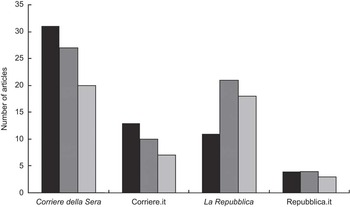
Considering the total of seventy-eight stories from Corriere della Sera, twenty articles were ‘balanced’. Out of the remaining fifty-eight articles, 54 % highlighted the ‘benefit frame’, whereas 46 % showed a dominance of the ‘risk frame’. With regard to the thirty online stories from Corriere.it, seven were ‘balanced’. Out of the remaining twenty-three articles, 56 % focused mainly on the benefit discourse, while 44 % highlighted the risks more than the benefits.
The subsequent quantitative analysis enabled us to gain further insight into possible differences in the approach used by the two broadsheets to represent the issue. Our determination of the words with the highest DO value in the La Repubblica database resulted in the following five words (Fig. 3a), in decreasing order of frequency: (i) Mercury; (ii) Omega; (iii) Augusta; (iv) Tuna; (v) Fish. The word ‘Augusta’ refers to the chronic environmental pollution that affects the Bay of Augusta, in Southern Italy(Reference Cundy, Collins and Turner47), a topic which was often covered by this newspaper. Our calculation for the Corriere della Sera database resulted (Fig. 3b) in the following words, in decreasing order of frequency: (i) Omega; (ii) Fish; (iii) Mercury; (iv) Fatty; (v) Tuna.
The five words with the higher DO (Deviation on Occurrences) values in (a) the La Repubblica database and (b) the Corriere della Sera database

It is worth noting that among the three most meaningful words (DO>1, over-representation) in the stories from both newspapers were featured ‘Omega’ and ‘Mercury’, which can be clearly related to the correspondent benefit and risk frames. However, there is a difference in how frequently these words (and the correspondent frames) were used in the two newspapers. ‘Mercury’ is the most ‘over-represented’ word in the La Repubblica database (Fig. 3a), while the word ‘Omega’ has the highest DO in the Corriere della Sera database, where ‘Mercury’ holds the third position in the ranking (Fig. 3b). The results of our calculations of DO on pairs of opposite keywords reveal even more clearly that the two broadsheets have different approaches in covering this topic. DO values for La Repubblica clearly suggest a predominance (with no exception) in the frequency of words that can be related to the risk frame (Fig. 4a and b), whereas DO values for Corriere della Sera clearly indicate (with the exception of the Healthy/Contaminated pair) that this broadsheet tends to emphasize the benefits more than the risks associated with fish consumption (Fig. 5a and b).
La Repubblica database: (a) results of DO (Deviation on Occurrences) calculations on selected pairs of keywords; (b) results for the Omega/Mercury pair of keywords, shown separately to graphically compensate for the much higher DO values

Corriere della Sera database: (a) results of DO (Deviation on Occurrences) calculations on selected pairs of keywords; (b) results for the Omega/Mercury pair of keywords, shown separately to graphically compensate for the much higher DO values

Therefore, from our qualitative and quantitative assessment, it appears that the two studied newspapers have different agendas when addressing the health and fish consumption topic. La Repubblica has been supporting the view that, besides health benefits, there may be risks associated with fish consumption, while Corriere della Sera has been emphasizing health benefits more than possible risks.
Discussion
To evaluate the potential effects of the above identified frames on the Italian public's perception of this issue, we need to envision three possible scenarios that consider different audiences and a combination of them: (i) an audience that mainly/exclusively reads La Repubblica; (ii) an audience that mainly/exclusively reads Corriere della Sera; and (iii) an audience that reads both newspapers (as these broadsheets have the highest circulation in Italy, this possibility – and hence this scenario – cannot be ruled out).
1. Previous studies assessed that negative media messages about food can have a considerable impact on purchasing choices(Reference Carson and Hassel48–Reference de Jonge, Frewer and van Trijip50). Moreover, it has been suggested that negative press has an impact five to seven times stronger on purchasing behaviours than favourable press(Reference Mizerski51, Reference Verbeke and Ward52). Hence, a possible impact of the La Repubblica coverage on fish consumption patterns of its readers could be a reduction in fish intake; which, in turn, would lead to a decrease in the health benefits related to fish consumption. On the other hand, we need to consider the results of a study(Reference Chien, Gao and Lin13) reporting that about 68 % of Taiwanese women of childbearing age would not change their fish consumption habits even when informed that some fish contained high levels of Hg that may be harmful for unborn babies. However, the perception of the safety of fish consumption of the Italian public may be different from that of Asian consumers, mainly due to different cultural approaches to food. Further research is needed to shed light on this particular issue.
2. One of the possible influences of the Corriere della Sera coverage on its readership would be an increase in fish intake, in view of the potential health benefits. However, not perceiving the potential risks associated with some fish with high Hg levels could lead women who are or may become pregnant and nursing mothers to reduce their efforts to minimize Hg intake via the consumption of contaminated fish.
3. The citizens who read both newspapers will be faced with ‘conflicting information’, which can bring about emotional, negative consequences. Studies have shown(Reference Wu and Hoyoung53–Reference Hembroff and Sierra55) that individuals can receive contradictory health information from a range of different sources. Conflicting health information can generate confusion about the correct behaviours needed to stay in good health. In addition to the above, previous research(Reference Vardeman and Aldoory2), aimed at finding out how women made sense of conflicting media coverage of health implications of fish consumption, revealed that most women not only manifested confusion about the problem, but became sceptical towards health information presented in the media.
Conclusions and recommendations
Our qualitative and quantitative analysis clearly showed that the two most influential Italian newspapers (and their online versions) used different journalistic frames in their coverage of the possible presence of Hg in fish. While the present study has not directly assessed public perception and response to media coverage, previous research has demonstrated unequivocally that media information can have an impact on consumers’ perception with respect to fish consumption(Reference Vardeman and Aldoory2). As a result, consumers may face difficulties in balancing possible risks with recognized health benefits and adopting, when necessary, the appropriate behavioural changes. Hence, further research is needed about the impact of unbalanced or conflicting media messages on consumer decision making.
Moreover, the lack of specific information about risks and benefits of eating certain fish types in Italy highlights the need for a risk communication campaign that provides detailed information aimed at enabling citizens to make informed decisions. This type of communication effort has been conducted in the last decade especially in the USA and Canada(Reference Burger and Gochfeld12, Reference Jardine56, Reference Knuth, Connelly and Sheehka57).
Media alone cannot be expected to take full responsibility for such efforts and other stakeholders should engage in these communication campaigns. A recent work(Reference Clonan, Holdsworth and Swift58) highlighted the role that public health nutritionists and dietitians can play in communicating how nutritional needs can be met, while at the same time enabling the protection of fish stocks. Another paper(Reference Sulda, Coveney and Bentley59) investigated how the public health nutrition workforce, in Australia, can develop policies to respond to factors that contribute to climate change. We believe that public health nutritionists and dietitians should directly commit themselves to raising consumers’ awareness of the benefits and risks of fish consumption. Indeed, a tight cooperation between scientists, the public health nutrition workforce and the media would result in the elaboration of more balanced and scientifically reliable messages to the public. Such information should place more emphasis on the existence of a few fish species (i.e. swordfish, shark, king mackerel, tilefish, certain types of tuna, walleye and porgy) that have high to very high Hg levels(Reference Groth9) and, for swordfish, shark, king mackerel and tilefish, relatively low contents of beneficial n-3 fatty acids(Reference Mahaffey, Clickner and Jeffries22). This effort could help consumers to make more informed choices aimed at maximizing the benefits of n-3 intake from fish v. the possible risks of consuming Hg-contaminated fish.
Finally, Hg is only one of the contaminants that can accumulate in fish from various polluting sources(Reference Dórea60) and severe local pollution can reduce (and at worst eliminate) the benefits normally obtained from consuming normally safe-to-eat fish species. The creation of new journalistic messages providing consumers with all the global and local relevant information to make the safest choices in relation to fish consumption appears a necessary step to increase the societal role of the (Italian) media in making scientific information readily accessible to the public.
Acknowledgements
Sources of funding: This research received no specific grant from any funding agency in the public, commercial or not-for-profit sector. Conflicts of interest: The authors of this manuscript declare no conflict of interests. Authors’ contributions: F.A.P. carried out the software-based analysis and wrote the manuscript; R.B. contributed to the software-based analysis and participated in writing the manuscript; S.F. carried out the qualitative analysis of the news stories and participated in writing the manuscript; D.A.V. coordinated the research and participated in writing the manuscript. Part of this research was conducted within S.F.'s final dissertation in the Program of Environmental Sciences at Insubria University. The authors are thankful to two anonymous reviewers for their helpful comments, suggestions and corrections to the original manuscript, which greatly improved the quality of the paper.



