


The world has been undergoing a profound nutrition transition associated with increased nutrition-related chronic non-communicable diseases since the Second World War(Reference Popkin1). China, with the fastest economic growth in the last two decades in the world, has been undergoing a unique nutrition transition(Reference Popkin2) and a related steady increase in child obesity(Reference Cui, Huxley and Wu3). To tailor effective interventions to address child obesity in China, it is necessary to understand the transition in dietary patterns, which is one side of energy balance, in Chinese children.
Most previous studies(Reference Popkin1, Reference Popkin2, Reference Popkin and Du4, Reference Zhai, Wang and Du5) examining this nutrition transition have been conducted in adults. There have been some reports of changes in macronutrient intake in US youth over several decades(Reference Cavadini, Siega-Riz and Popkin6–Reference Adair and Popkin10). However, few studies from the developing world, including China, have examined trends in dietary patterns in children even though childhood and adolescence is a critical period for the establishment of a healthy lifestyle and the prevention of obesity and other nutrition-related non-communicable chronic diseases(Reference Cavadini, Siega-Riz and Popkin6). The nutrition transition in US children with a decline in the proportion of energy from fat between the 1960s and the 1990s may not be applicable to Chinese children because of the low fat content in traditional Chinese diets and the demonstrated differences in nutrition transition between Chinese and American adults(Reference Zhai, Wang and Du5, Reference Kennedy, Bowman and Powell11).
The examination of a nutrition transition is often constrained by the lack of detailed nationwide individual food intake data in most developing countries(Reference Popkin12–Reference Noor17). Substituting individual consumption data with ecological nutrient intake data to examine a nutrition transition is problematic, because an association observed between variables at a group level may not represent an association that exists at an individual level(Reference Chanmugam, Guthrie and Cecilio18, Reference Harnack, Jeffery and Boutelle19). Also, changes in dietary measurement methods between surveys conducted over many years apart make the interpretation of trends in dietary intake difficult(Reference Briefel and Johnson9, Reference Harnack, Jeffery and Boutelle19). The purpose of the present study was to examine the temporal trends in dietary energy, fat, carbohydrate and protein intake in Chinese children in the last two decades using the China Health and Nutrition Surveys (CHNS), in which individual level, consecutive 3 d dietary recall data were collected using the same methods in each survey.
Subjects and methods
Study design
The China Health and Nutrition Surveys are an ongoing series of longitudinal household surveys conducted in eight provinces from 1989 to 1997, and expanded to nine provinces since 2000, from all thirty-one provinces (or regions) of mainland China. These provinces varied substantially in geography, economic development and health indicators(Reference Popkin, Keyou and Zhai20). When Liaoning province was unable to continue to participate in 1997, a new province (Heilongjiang) from the same region of China was added. However, the dropped province returned to the study in 2000. So far, there have been eight rounds of surveys conducted in 1989, 1991, 1993, 1997, 2000, 2004, 2006 and 2009. The sampling procedure has been described in detail elsewhere(Reference Popkin, Keyou and Zhai20), and comprised a multistage random-cluster sample selected in each province. Firstly, four counties (one low-, two middle- and one high-income county, defined on the basis of per-capita income) were randomly selected from each province using a weighted sampling method. In addition, the provincial capital and a low-income city were selected when feasible. Then, the township capital and three villages within the counties and urban and suburban neighbourhoods within the cities were randomly sampled, and twenty households were randomly selected within each neighbourhood. All individuals in each household were interviewed.
This study was conducted according to the guidelines laid down in the Declaration of Helsinki. Survey protocols, instruments and the process for obtaining informed consent for this study were approved by institutional review committees of the University of North Carolina at Chapel Hill and the National Institute for Nutrition and Food Safety, China Center for Disease Control and Prevention. Written informed consent was obtained from all subjects.
Participants
In the eight provinces that participated in the 1991 survey, participants aged 7–17 years were included in the analysis. Heilongjiang was included in 1997 to ensure adequate geographical coverage of China, but was then excluded in the following surveys once Liaoning had returned, to ensure that the provinces in each survey were from a comparable variety of regions in China.
Socio-demographic data
Demographic information included the child's date of birth, sex, residence and annual family income. Per-capita annual family income in renminbi (RMB) was obtained by dividing annual family income by household size. The per-capita annual family income in each survey was inflated to values in 2009 by adjusting for consumer price index and then categorised into tertiles as high, medium and low income by urban and rural areas.
Dietary data
Household food consumption data and individual dietary recall data were collected during three consecutive days that were randomly allocated from Monday to Sunday and almost equally balanced across the 7 d of the week for each sampling unit. Household food consumption was determined using a weighing technique. All foods, including edible oils, remaining after the last meal before initiation of the survey were weighed and recorded. During the three survey days, whenever foods were brought into the household unit, they were weighed, and preparation waste was estimated when weighing was not possible. At the end of the survey, all remaining foods were again weighed and recorded. The foods eaten outside were not weighed. The number and personal characteristics of all household members and visitors were recorded at each meal.
Individual dietary intake data were collected by asking each household member to report regarding all food consumed away from home and at home on a 24 h-recall basis – except for young children under 12 years of age, whose mother or caregiver who handled food preparation in the household was asked to recall the child's consumption. Using food models and picture aids, trained field interviewers recorded the types, amounts, type of meal, and place of consumption of all food items during the previous day. Respondents were prompted about snacks and shared dishes. Housewives and other household members were encouraged to provide additional information to determine the amounts of particular food items in dishes consumed in the household. Cooking oil from the household food consumption data was used to supplement the individual dietary intake data(Reference Wang, Popkin and Zhai21). The quality of the data collection was checked by comparing an individual's average daily dietary intake, calculated from the household survey and individual dietary intake based on 24 h-recall data, respectively. Where significant discrepancies were found, the household and the individual in question were revisited and asked about their food consumption to resolve these discrepancies. In a few cases, subjects had missed 1 d because of absence, but over 99 % of the sample was available for the full 3 d of data collection.
All field workers were trained nutritionists who are otherwise professionally engaged in nutrition work in their own counties and who have participated in other national surveys. Almost all interviewers were graduates of post-secondary schools; many had 4-year degrees. In addition, all interviewers were trained for at least 3 d in the collection of dietary data in each survey.
The 1991 Food Composition Table for China was utilised to calculate nutrient values for the dietary data of 2000 and previous years. A newer version of Food Composition Table (2002) was used for the 2004 survey and the latest version (2004) was used for the 2006 and 2009 surveys.
Statistical analysis
Adjusted means and standard errors were used to describe the distribution of continuous variables after adjusting for complex sampling and covariates including age, sex, urban/rural residence and per-capita annual family income tertiles. Age was adjusted as a continuous variable, and income as a categorical variable. Mixed-effect models were used to calculate adjusted mean values of dietary energy, fat, carbohydrate, protein and the percentages of their energy contributions in the total energy intake and to examine the temporal trends after adjusting for intra-class correlation within clusters and covariates including age, sex, urban/rural residence and income level. All the analyses were conducted using SAS (version 9; SAS Institute).
Results
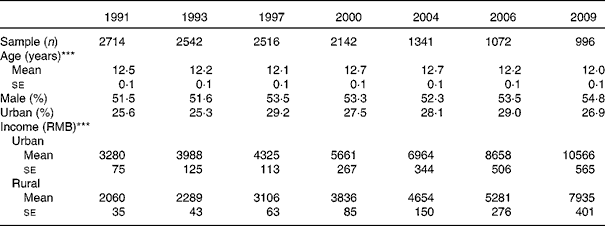
Table 1 presents the characteristics of the participant children aged 7–17 years in the CHNS by survey year. The sample size was 2714 in 1991, 2542 in 1993, 2516 in 1997, 2142 in 2000, 1341 in 2004, 1072 in 2006 and 996 in 2009, respectively. The mean ages ranged from 12·0 to 12·7 years, and even though these differences between the survey years were small, they were statistically significant (P < 0·0001). There were no significant differences in the distribution of sex and urban/rural residence across the survey years. The inflation-adjusted per-capita annual family income increased from 3280 RMB in 1991 to 10 566 RMB in 2009 in urban areas (P < 0·0001), far larger than the increase in rural areas from 2060 RMB to 7935 RMB during the same period (P < 0·0001).
(Number of participants, percentages or mean values with their standard errors)
RMB, renminbi.
*** Significant trend across the survey years (P < 0·0001; test for trend).
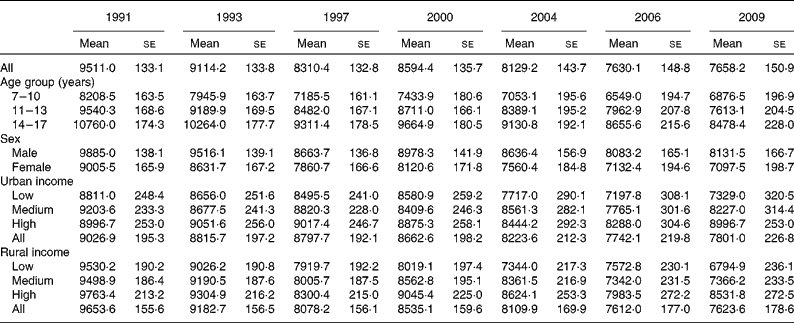
As shown in Table 2, energy intake among children steadily declined in different age (7–10, 11–13 and 14–17 years), sex, urban/rural residence and income groups (P < 0·0001). The average daily energy intake decreased from 9511·0 kJ in 1991 to 7658·2 kJ in 2009. It is worth noting that the decline in energy intake in rural children (2030·0 kJ/d) was larger than that in urban children (1225·9 kJ/d). Further, the largest decline of 2735·3 kJ/d in energy intake was found in those from low-income rural families. This decline was larger than that in medium-income families (2132·7 kJ/d) or high-income families (1231·6 kJ/d) in rural areas.
(Mean values with their standard errors)
*** Significant trend in each subgroup across the survey years (P < 0·0001; test for trend).
† Values adjusted for age, sex, urban/rural residence and income.
Similarly, as seen in Table 3, daily carbohydrate intake steadily dropped across the survey years in each age group, sex, urban/rural residence and different income groups (P < 0·0001). Daily carbohydrate intake dropped from 382·5 g in 1991 to 254·1 g in 2009. The decline in carbohydrate intake in rural children was higher than that in urban children. Further, the decline in carbohydrate intake in children from lower-income families was higher than that in those from higher-income families in both urban and rural areas. As a result, the proportion of energy from carbohydrate decreased from 66·7 % in 1991 to 56·8 % in 2009 (P < 0·0001, data not shown). Similar trends were found in both urban and rural areas as shown in Fig. 1.
(Mean values with their standard errors)

*** Significant trend in each subgroup across the survey years (P < 0·0001; test for trend).
† Values adjusted for age, sex, urban/rural residence and income.
Percentages of energy from protein (□), carbohydrate ( ) and fat (
 ) in Chinese children from 1991 to 2006 by residence: (a) urban; (b) rural. Proportions were adjusted for age, sex, urban/rural residence and income. There was a significant trend in the proportions of energy from fat, carbohydrate and protein across the survey years (P < 0·0001; test for trend).

Table 4 shows that daily fat intake in Chinese children from 1991 to 2009 increased during this period from 54·8 to 66·0 g (P < 0·0001). As a result, the proportion of energy from fat increased from 21·5 % in 1991 to 30·0 % in 2009, and even reached 34·6 % in urban areas (P < 0·0001), as shown in Fig. 1. The proportion of children who consumed a diet with more than 30 % of energy from fat increased from 20·1 % in 1991 to 49·4 % in 2009 (Table 5). Further, the increase in the proportion of children who consumed more than 30 % of energy from fat was greater in the lower-income group than in the higher-income group in urban areas, while the increase was larger in the higher-income group than in the lower-income group in rural areas.
(Mean values with their standard errors)

Significant trend across the survey years: *P < 0·05, **P < 0·01, ***P < 0·0001; test for trend.
† Values adjusted for age, sex, urban/rural residence and income.
(Mean values with their standard errors)

*** Significant trend in each subgroup across the survey years (P < 0·0001; test for trend).
† Values adjusted for age, sex, urban/rural residence and income.
Table 6 presents the daily protein intake among Chinese children from 1991 to 2006, which steadily declined from 66·2 to 58·0 g during this period (P < 0·0001). In urban areas, there were no significant changes in the protein intake in children from each income group, while in rural areas the decline in protein intake in the lower-income group was larger than that in the higher-income group.
(Mean values with their standard errors)

Significant trend across the survey years: ** P < 0·05, ***P < 0·0001; test for trend.
† Values adjusted for age, sex, urban/rural residence and income.
Discussion
Our present study indicates that energy intake dramatically decreased when the dietary pattern shifted from high carbohydrate to high fat. The proportion of children who consumed a high-fat diet more than doubled. These findings indicate that Chinese children have been undergoing a rapid nutrition transition over the last two decades as China has been undergoing rapid economic development. It is worth noting that the largest transitions in dietary patterns were found in children from low-income urban households or high-income rural households. These findings suggest that future disease burdens related to this nutritional transition may shift from high-income urban populations to medium-to-low-income urban and high-income rural populations.
Energy intake
Our analysis found that energy intake in Chinese children dropped in the last two decades. This trend is consistent with that observed in US children from 9920 kJ in 1965 to 8770 kJ in 1990(Reference Cavadini, Siega-Riz and Popkin6–Reference Briefel and Johnson9, Reference Kennedy, Bowman and Powell11), although this decline was subsequently followed by an increase to reach 9580 kJ in 1995(Reference Cavadini, Siega-Riz and Popkin6, Reference Nielsen, Siega-Riz and Popkin8–Reference Kennedy, Bowman and Powell11). As a result, the energy intake in Chinese children was higher than that in US children in 1990, but it was reversed by 1995. Further, the decline in Chinese children during this period was much faster than that in US children between 1965 and 1990(Reference Cavadini, Siega-Riz and Popkin6, Reference Nielsen, Siega-Riz and Popkin8, Reference Briefel and Johnson9). The more rapid transition in Chinese children might be attributed to the accelerated introduction of technology into their daily life activities(Reference Popkin2). Considering the increasing prevalence of child obesity in China(Reference Cui, Huxley and Wu3), the decline in energy intake may be a response to the decline in physical activity(Reference Cavadini, Siega-Riz and Popkin6) as reported in our previous analysis that both passive commuting to school(Reference Cui, Bauman and Dibley22) and sedentary behaviours(Reference Cui, Hardy and Dibley23) increased in Chinese children during the last decade. Thus, the larger decline in energy intake for children in rural areas or from lower-income households might be attributed to a larger decline in their level of physical activity(Reference Cui, Bauman and Dibley22).
There is limited information about the nutrition transition in children in developing countries. In contrast to our findings, children in the metropolitan Cebu region in the Philippines experienced an increase in daily energy intake from 5018 kJ in 1994 to 7990 kJ in 2002(Reference Adair and Popkin10). This inconsistency might derive from the different stages of economic development in the two countries. In 1994, the Philippines was still recovering from the 1991 economic recession, which was followed by a period of economic development. In contrast, China's gross domestic product (GDP) has been steadily increasing at an average of 9·4 % per year from 1980 to 2002(24). Consistent with data from adults in China(Reference Zhai, Wang and Du5, Reference Du, Lu and Zhai25) and most other developing countries(Reference Madanat, Troutman and Al-Madi13, Reference Rivera, Barquera and Campirano16, Reference Galal26–Reference Lipoeto, Wattanapenpaiboon and Malik31), there has been a dramatic decline in energy intake in parallel with economic development, except in Malaysia(Reference Noor17), Morocco(Reference Benjelloun14) and Chile(Reference Albala, Vio and Kain15), where energy intake increased during the last four decades in the last century. These inconsistencies might be attributed to different methods for the estimation of dietary intake and the different stages of economic development in the time periods examined between the data from these three countries and CHNS.
Carbohydrate intake
Our analysis found a continuous decline in the intake of carbohydrate and the proportion of energy from carbohydrate during the last two decades in Chinese youth. Carbohydrate is the main source of dietary energy in the traditional diet of Chinese children. The decline in carbohydrate intake, and thus dietary energy intake, is a reflection of the drop in energy expenditure as lifestyles have become more sedentary(Reference Popkin32). In contrast to our findings, carbohydrate intake of US adolescents decreased from 274 g in 1965 to 247 g in 1977 followed by an increase to 269 g in 1990 and to 310 g in 1995, while the proportion of energy from carbohydrate steadily increased between 1965 and 1996(Reference Cavadini, Siega-Riz and Popkin6). The decline in both carbohydrate intake and percentage of dietary energy from carbohydrate in Chinese youth was similar to that observed in adults in China(Reference Zhai, Wang and Du5), in other Asian countries(Reference Noor17, Reference Kosulwat28–Reference Lipoeto, Wattanapenpaiboon and Malik31) and in Mexico(Reference Rivera, Barquera and Campirano16), while inconsistent with adults in Chile(Reference Albala, Vio and Kain15) and Morocco(Reference Benjelloun14), where carbohydrate intake increased, resulting in an increase in energy intake from 1960 to 2000.
Fat intake
Fat intake and the proportion of energy from fat increased in Chinese youth during the last two decades. Contrary to our findings, the consumption of fat in US youth decreased from a very high fat intake of 102 g in 1965 to 80 g in 1990 and then increased to 83 g in 1995, while there was a steady decline in the proportion of energy from fat from 38·7 to 32·7 % in US youth between 1965 and 1996(Reference Cavadini, Siega-Riz and Popkin6, Reference Troiano, Briefel and Carroll7). The increase in the consumption of fat and proportion of energy from fat in Chinese youth is consistent with that in adults worldwide experiencing economic development and nutrition transition in the last four decades of the last century(Reference Zhai, Wang and Du5, Reference Benjelloun14–Reference Noor17, Reference Kosulwat28, Reference Kim, Moon and Popkin30, Reference Lipoeto, Wattanapenpaiboon and Malik31). Surprisingly, although experiencing an increase in both fat intake and proportion of energy from fat, South Koreans still adhere to traditional dietary patterns with a low fat intake and low proportion of energy from fat, which might partly be attributed to movements to retain the traditional diet in South Korea(Reference Kim, Moon and Popkin30). The proportion of energy from fat in South Koreans was even lower than that concurrently in the Chinese although China was less developed than South Korea(Reference Kim, Moon and Popkin30). This suggests that a traditional diet can be maintained during economic development if proper measures are taken.
Protein
Animal food is an important source of dietary fat. The increase in fat intake may partly be driven by increases in animal food in our present study. Surprisingly, protein in the children's diets decreased in the last two decades. A possible explanation is that the decline in protein intake was due to dramatically reduced plant food intake that was greater than the increased intake of protein from animal foods.
Dietary pattern transition
The traditional dietary pattern in China conforms to the low-fat and high-carbohydrate diet type. Our study found that the traditional Chinese diet has been shifting to a dietary pattern linked with non-communicable diseases(Reference Popkin1). The proportions of energy from carbohydrate, fat and protein in Chinese children (56·8, 30 and 13·1 %, respectively) in 2009 were very close to those (54·2, 32·7 and 14·2 %, respectively) in US adolescents in 1995(Reference Cavadini, Siega-Riz and Popkin6). Further, the proportion of children who consumed a diet with more than 30 % of energy from fat more than doubled since 1991 to approximately 50 % in 2009. These findings suggest that the burden of future nutrition-related chronic diseases will increase in this population, considering that energy expenditure is decreasing at the same time, if no effective interventions to prompt healthy diets are taken immediately. These measures are particularly needed in urban areas where, on average, more than one-third of energy was from fat and approximately two-thirds of children consumed a diet with more than 30 % of energy from fat.
Our analysis found that the most dramatic transition in diet patterns took place among children who come from low-income urban households, or high-income rural households. The daily intake of fat increased by 10·8 g in children from low-income urban households and 24 g in those from high-income rural households during the last two decades. As a result, the proportion of children who consumed a high-fat diet increased by 43·3 % (from 22·9 to 66·2 %) in children from low-income urban households, and 35·7 % (from 16·9 to 52·6 %) in those from high-income rural households during the same period, respectively. This dramatic nutrition transition may lead to a future dramatic increase in non-communicable diseases in these populations(Reference Popkin1, Reference Popkin and Du4).
Strengths and limitations
One of the strengths of our study was the individual consecutive 3 d dietary recall methods that were identical across surveys. The identical dietary measurements across surveys and the short interval between surveys allowed us to carefully examine the temporal trends in dietary intake. Further, the careful data quality control methods may have reduced the misreports of dietary intake, by comparing the individual's average daily dietary intake from the 3 d diet recall data with that calculated from the household food weighing surveys. One of the limitations of this study was that the effect of using parents as a proxy to report the dietary consumption of young children is unknown. In addition, improvements in food composition databases and actual changes in food composition must be considered in the interpretation of trends in the intake of energy and macronutrients. Also, as the obese are more likely to under-report their dietary intake than normal-weight individuals(Reference Livingstone and Black33), the average level of under-reporting may have increased with the increase in the prevalence of child obesity in China during the study period(Reference Cui, Huxley and Wu3).
Conclusion
Chinese children and adolescents have been undergoing a rapid nutrition transition to a high-fat diet, which was faster than that observed in Western children in the last century(Reference Popkin2). This nutrition transition may be linked with a future increase in chronic non-communicable diseases in this population which has limited access to medical resources. In future studies, special attention should be paid to children who come from low-income urban or high-income rural households who may have been undergoing faster nutrition transition than their peers from high-income urban or low-income rural households.
Acknowledgements
The authors thank the National Institute of Nutrition and Food Safety, China Center for Disease Control and Prevention, Carolina Population Center, the University of North Carolina at Chapel Hill, the National Institutes of Health (NIH) (R01-HD30880, DK056350 and R01-HD38700) and the Fogarty International Center, NIH for financial support for the CHNS data collection and analysis files. The authors also thank the Australian Agency for International Development (AusAID) for funding Zhaohui Cui's doctoral scholarship in International Public Health at the University of Sydney, Australia, and this analysis, which is part of the requirements for his PhD studies. Z. C. analysed and interpreted the data, and wrote the manuscript. M. J. D. contributed to writing of the manuscript and data interpretation, and had primary responsibility for the final content. All authors approved the final version of the manuscript. The authors declare that they have no conflicts of interest.



