




Introduction
Memory, one of the six domains of cognitive function (Sachdev et al., Reference Sachdev, Blacker, Blazer, Ganguli, Jeste, Paulsen and Petersen2014), is the capacity to encode, store, and retrieve information (Craik & Rose, Reference Craik and Rose2012). Changes in the memory domain of cognitive function are commonly linked to the aging process. They can substantially interfere with one’s ability to carry out both basic and instrumental activities of daily living (e.g., dressing, bathing, or preparing meals). Declines in memory may also serve as early markers of neurocognitive disorders such as Alzheimer’s disease (Tuokko et al., Reference Tuokko, Griffith, Simard and Taler2017). Therefore, investigating modifiable risk or protective factors for memory decline is important for offsetting future health challenges in older populations. One such modifiable factor is functional social support (FSS).
FSS is the perception that members of one’s social network will be available to provide help when needed (Gow et al., Reference Gow, Corley, Starr and Deary2013), and this can take many forms, including access to emotional or affectionate support, advice when making life choices, or simply having someone with whom to engage in leisure activities. FSS has been associated with higher levels of cognitive function, specifically memory, in various cross-sectional and longitudinal studies (Ge et al., Reference Ge, Wu, Bailey and Dong2017; Gow et al., Reference Gow, Corley, Starr and Deary2013; Krueger et al., Reference Krueger, Wilson, Kamenetsky, Barnes, Bienias and Bennett2009; Yoo et al., Reference Yoo, Tyas, Maxwell and Oremus2023).
Several interconnected frameworks have been proposed to explain the relationship between FSS and memory, with the stress-buffering hypothesis being one of the most prominent. The stress-buffering hypothesis posits that FSS can mitigate the detrimental effects of stressful life events on an individual’s health by providing a sense of stability, positive affect, and self-worth (Cohen & Wills, Reference Cohen and Wills1985). High-quality support may also help individuals reframe stressful situations as less serious and potentially solvable. Such outlets may counteract the physiological changes associated with stress, such as elevated blood cortisol levels, which have been shown to negatively affect the areas of the brain that are responsible for memory (e.g., the hippocampus) (Kuiper et al., Reference Kuiper, Zuidersma, Zuidema, Burgerhof, Stolk, Oude Voshaar and Smidt2016). However, while the link between FSS and memory has been well established in the literature, the role of marital status in shaping this association remains underexplored.
Marriage is a key source of FSS among middle-aged and older people, especially as health declines (Penning & Wu, Reference Penning and Wu2014). Research has consistently shown that individuals who are married or in common-law relationships tend to report better physical and psychological health than their unmarried counterparts (Grundström et al., Reference Grundström, Konttinen, Berg and Kiviruusu2021; Robles, Reference Robles2014). More specifically, marital status has been associated with differences in memory, with married people consistently reporting better memory performance than single or widowed individuals (Aartsen et al., Reference Aartsen, Van Tilburg, Smits, Comijs and Knipscheer2005; Mousavi-Nasab et al., Reference Mousavi-Nasab, Kormi-Nouri, Sundström and Nilsson2012).
Several mechanisms have been proposed to explain the cognitive benefits of marriage or common-law relationships. Spouses often serve as primary sources of emotional and instrumental support, providing encouragement, affection, financial help, physical assistance, and stress alleviation (Penning & Wu, Reference Penning and Wu2014; Shapiro & Keyes, Reference Shapiro and Keyes2008) – all key components of FSS. In addition, spouses frequently promote healthier lifestyles and greater social engagement, which are both protective factors for cognitive health (Gow et al., Reference Gow, Corley, Starr and Deary2013; Hülür, Reference Hülür2022; Shapiro & Keyes, Reference Shapiro and Keyes2008; Wyke & Ford, Reference Wyke and Ford1992). Therefore, given the central role of FSS in these dynamics, it is possible that the association between FSS and memory may differ depending on one’s marital status. More specifically, while FSS may be linked to better memory through stress-buffering mechanisms (Cohen & Wills, Reference Cohen and Wills1985), FSS from a spouse (in addition to FSS from other support providers) can generate a greater sense of reassurance, foster more effective coping efforts, and reduce stress during times of physical or mental adversity. This enhanced support may amplify the cognitive benefits of FSS, particularly in buffering against memory decline. Investigating whether marital status shapes the association between FSS and memory is, therefore, essential to deepening our understanding of the complex interplay between social engagement, relationship context, and cognitive aging.
Despite the theoretical rationale for marital status as an effect modifier of the association between FSS and memory, this relationship has been understudied in the literature. A recent systematic review by Haghighi and Oremus (Reference Haghighi and Oremus2023) identified only four articles that examined marital-related variables alongside FSS and memory (Liao & Scholes, Reference Liao and Scholes2017; Scholes & Liao, Reference Scholes and Liao2023; Windsor et al., Reference Windsor, Gerstorf, Pearson, Ryan and Anstey2014; Zahodne et al., Reference Zahodne, Ajrouch, Sharifian and Antonucci2019). Results across these studies were equivocal, with most reporting positive, though statistically nonsignificant, associations between spousal support and memory. However, in these articles, the source of FSS (i.e., support from spouses versus support from children, family members, or friends), rather than marital status specifically, was used as an effect modifier of the association between FSS and memory. To fill this gap in the literature, we previously investigated the impact of marital status on the association between FSS and memory using a sample of 10,318 middle-aged and older, community-dwelling persons from the Canadian Longitudinal Study on Aging (CLSA) (Raina et al., Reference Raina, Wolfson, Kirkland, Griffith, Balion, Cossette, Dionne, Hofer, Hogan, van den Heuvel, Liu-Ambrose, Menec, Mugford, Patterson, Payette, Richards, Shannon, Sheets, Taler and Young2019). We found a positive association between FSS and memory, but it was not modified by marital status (Haghighi et al., Reference Haghighi, Zeng, Tyas, Meyer and Oremus2025).
While this quantitative study suggested some support for the stress-buffering hypothesis linking FSS and memory, the lack of a moderating effect of marital status seemed inconsistent with a priori expectations and theoretical rationale. Therefore, we conducted qualitative interviews with a sample of middle-aged and older people, whose ages reflected those of participants in the quantitative study, to explore perceptions of how marital status and marital context may shape the relationship between FSS and memory experiences. Given the dearth of qualitative research on whether marital status affects the association between FSS and memory, we investigated whether the real-life experiences of key informants could help contextualize the earlier quantitative findings and provide a more expansive understanding of an understudied area.
Methods
Study design
One-on-one, semi-structured interviews were conducted with 18 community-dwelling adults between the ages of 45 and 85 years. We recruited these individuals via purposive sampling to reflect the age characteristics of the CLSA participants used in our previous quantitative study (Haghighi et al., Reference Haghighi, Zeng, Tyas, Meyer and Oremus2025). The qualitative participants had to be fluent in English and free of overt signs of cognitive impairment. ‘Overt’ signs included difficulty following conversations, understanding the nature of the interview, providing basic demographic information, or following instructions.
Purposive sampling included snowball sampling, posters, social media posts, and advertisements. We distributed study materials to various organizations across Ontario, such as public libraries, pharmacies, older adult day programs, faculty newsletters, and the union representing the University of Waterloo’s physical plant workers. Advertisements were also displayed in Coffee News magazine. Interested individuals were asked to contact the first author by phone or e-mail if they wished to participate.
After informed consent was obtained, the first author scheduled a mutually convenient time to conduct the interview. All interviews took place on the Zoom video-conferencing platform (v6.1.11, Zoom Video Communications, San Jose, CA) and ranged from 20 to 60 minutes. Participant recruitment continued until at least one or two participants from each marital status category were enrolled, and the data provided sufficient information power to address the research aims (Malterud et al., Reference Malterud, Siersma and Guassora2016), with particular attention to achieving a rich and diverse set of accounts of marital experiences. Information power was judged in relation to the analytic adequacy of the data for developing nuanced, robust themes within the reflexive thematic analysis. Ethics approval for the current study was obtained from the Office of Research Ethics at the University of Waterloo (ORE #45801).
Interview process
We began each interview by asking participants about the types and sources of social support they receive. Participants were also asked to rate their satisfaction with their current marital status and their day-to-day memory function on a scale of 1–10, with 10 indicating excellent marital satisfaction or memory performance. The first author (PH), a doctoral student with formal training in qualitative health research and experience conducting semi-structured interviews, served as the sole interviewer and probed with follow-up questions when necessary. The interviews followed a semi-structured guide (Supplementary Appendix A) that was developed after completion of the quantitative study.
Qualitative analyses
Each interview was audio-recorded and transcribed verbatim using the Zoom platform’s built-in tools. After transcription, the interviewer checked each interview for accuracy by relistening to the audio recordings and cross-referencing them with the written transcripts. Pseudonyms were used in all interview transcripts to protect the privacy of participants. The transcripts were imported into NVivo software (v15.1.0, Lumivero, Denver, CO) and organized by question. A single coder (PH) used reflexive thematic analysis (Braun & Clarke, Reference Braun and Clarke2006, Reference Braun and Clarke2019) to identify recurrent and overarching themes about the extent to which marital status might shape how FSS relates to memory. The coder developed themes through a multistep process. First, she immersed herself in the data by reading and rereading each interview transcript, noting any initial observations or participant comments that appeared to address the study objectives (familiarization). Second, meaningful comments related to participants’ experiences of FSS, marital status, and memory were tagged with short descriptors (coding). Codes were derived inductively, without attempting to validate any preconceived theories about the association between FSS, marital status, and memory (Braun & Clarke, Reference Braun and Clarke2006). Third, codes that reflected similar underlying concepts were merged to form overarching themes. In line with reflexive thematic analysis, we conceptualized themes as patterned, meaningful accounts of how marital status may or may not shape the association between FSS and memory. Fourth, the themes were reviewed against the codes and the full data set to ensure they were internally coherent and clearly distinct from one another. During this process, some themes were collapsed, split, or further refined to more accurately capture the data. Lastly, the final themes were named and refined to clarify their central organizing concepts and the relationships between subthemes.
Throughout data collection and analysis, PH engaged in ongoing reflexive practice, including maintaining analytic memos after each interview to document initial impressions, questions, and emerging interpretations. These memos were revisited and refined during coding and theme development. She also engaged in periodic informal peer debriefing with other members of the research team to discuss recurring interview topics, explore alternative explanations, and refine the developing themes. These reflexive practices were used to enhance analytic depth and transparency.
Results
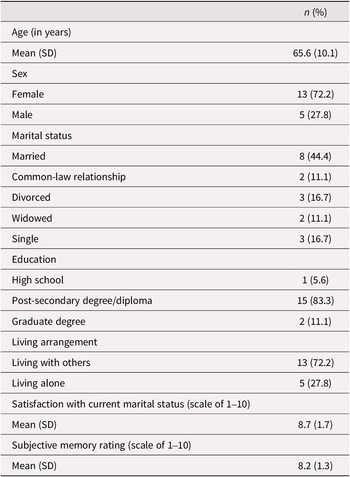
The 18 community-dwelling adult participants represented various marital status categories (married: 8; common-law: 2; divorced: 3; widowed: 2; single: 3). No participants were ultimately excluded based on any of the eligibility criteria. Most participants were recruited through an advertisement placed in Coffee News magazine (n = 14), followed by a public library (n = 2), or a referral from another participant (n = 2). The average age of participants was 65.6 ± 10.1 years (range: 46 – 84 years). Most participants (72.2%) were female and lived with others, and nearly all had some form of post-secondary education. On average, participants rated their day-to-day memory as 8.2 out of 10 (range: 5.5 – 10), while their satisfaction with their current marital status received a rating of 8.7 out of 10 (range: 4 – 10; Table 1).
Study participants’ characteristics (n = 18)

Table 1. Long description
From the top, the table lists participant characteristics. Age is shown as mean 65.6 years with standard deviation 10.1. Sex distribution is 13 female (72.2 percent) and 5 male (27.8 percent). Marital status includes 8 married (44.4 percent), 2 in common-law relationships (11.1 percent), 3 divorced (16.7 percent), 2 widowed (11.1 percent), and 3 single (16.7 percent). Education levels are 1 high school (5.6 percent), 15 post-secondary degree or diploma (83.3 percent), and 2 graduate degree (11.1 percent). Living arrangement shows 13 living with others (72.2 percent) and 5 living alone (27.8 percent). Satisfaction with current marital status, rated on a scale of 1 to 10, has a mean of 8.7 with standard deviation 1.7. Subjective memory rating, also on a scale of 1 to 10, has a mean of 8.2 with standard deviation 1.3. SD is defined as standard deviation.
Abbreviation: SD, standard deviation.
Overall, most participants thought FSS could positively influence memory, but they did not consider marital status to be critical to this association. They provided three general and interconnected rationales to explain how marital status might not shape how FSS relates to memory experiences: ‘learning to cope’ – participants used other alternatives besides a spouse to deal with memory challenges; ‘context matters’ – contextual factors such as marital satisfaction or the length of marriage can affect the degree of support available from a spouse; and ‘doing more harm than good’ – spouses may provide too much support, reducing participants’ autonomy to stimulate their own cognitive processes. Each theme is discussed in greater detail in the following sections.
Learning to cope
Learning to cope was a major theme across interviews and was generally consistent across marital status groups. While many married and common-law participants expressed their appreciation for having a partner to rely on for support and help with memory challenges, they also noted that, in the absence of a partner, they would learn to adapt to their circumstances by seeking other ways of coping with these challenges. This sentiment was shared by nearly all the unmarried participants. The adaptive coping mechanisms described by participants could generally be grouped into two categories: (1) using alternative social connections to fill the gaps, and (2) incorporating tangible tools to overcome memory challenges.
Alternative social connections
Some participants said that in the absence of a spouse or common-law partner, they would turn to other social alternatives, such as family or friends, to fulfill their social support needs. For example, Nina, who did not get married until later in life, noted that she did not observe any differences in her memory compared to when she was single, mainly due to her ability to leverage other social connections:
I didn’t get married until I was like what? 40-something, right? So I have lived all of those lives by myself, and I don’t feel like my memory was any worse. I relied more heavily on my social networks at the time. My friends, my parents, my family, like those kinds of things. (Nina, 46, married)
Similarly, Diana, who had previously been both married and in a common-law relationship, explained that without a partner, she relies on her family for support, which in turn helps her remember things better:
My daughters are really on the ball, and they’ll fill in some details. They’re both bright and I marvel at how they remember details, but then I have to remember … so it’s like they make up those little deficiencies, and they add those little cues, that support. (Diana, 64, single)
When asked whether he believes marriage may shape how social support relates to memory, Lucas disagreed, stating:
I enjoy being married but I know single people who are more than happy to be single. Like they enjoy being single, or they’ve learned to cope with this scenario. I know some widows and widowers who are in a great spot because they have a very good social network. I would say a good, sound social network is just as important as a marital social network. So a marital social network is just a variation of a platonic or family, or whatever friendship social network. It’s just I think you’re able to kind of find what you need with a different set of tools. (Lucas, 58, married)
In fact, some participants emphasized that while marital dissolution is not ideal, most individuals would adapt to these changing circumstances by going into survival mode. For instance, Carmen discussed how, after her husband had passed, she got involved in the community and various philanthropic projects to stay connected:
You’re alone, okay? What do you do? Like I’m alone here. I didn’t go into a depression. I went into fight or flight. I thought, well, if I’m going to survive, there’s so much I can do still. I’ve got to keep busy, right? So that’s what I’ve done to help my memories. (Carmen, 70, widowed)
Likewise, Lucas noted that marriage is not the sole source of FSS, and it is essential for unmarried individuals to explore other social avenues when spousal support is unavailable:
I guess necessity is the motherhood of invention. So if you don’t have that marital support, you find other avenues of tackling, you know, memory being the component. So you have other tools that you need to do like – hey, let’s face it, in order to function in society and in life, you need to kind of find a way how to. You can’t completely forget everything all the time, or it’s a pretty tough life. So if you’re not married, you will find other ways of approaching that memory. It’s just that your social support network is different socially with friends and family than it is with marriage. You just find other options. Other ways of doing things. More than one way to skin a cat, right? (Lucas, 58, married)
Overall, it was evident that in the absence of a spouse (or sufficient spousal support), individuals can turn to alternative social networks, such as friends or family, to fulfill their support needs and access cognitive stimulation.
Other coping mechanisms
Besides relying on social connections to address memory challenges, many participants reported using various tangible tools to help jog their memory. Miriam explained that in the absence of a partner to remind people of appointments or tasks, unmarried individuals may have to take extra steps to compensate for memory issues. However, they can still manage effectively on their own by creating lists, setting phone alerts, utilizing task apps, or employing other reminder techniques:
If they’re self-reliant, independent, then they can use any mechanism to make sure that they remember what they’re supposed to. I mean, even putting post-it notes around the house like remember to do this, remember to go here. Simple ways to help them … The same with using a calendar or something to remind yourself. Using alarms or alerts on your cell phone to remind you of appointments and people’s birthdays and anniversaries. (Miriam, 67, married)
However, these compensation strategies were not just limited to single individuals. A key point in several interviews was that, regardless of marital status, both married and unmarried participants employed similar compensation strategies to enhance their memory, emphasizing the importance of self-efficacy and recognizing that support from a spouse may not be the only source of memory reinforcement:
Well, people who are married have a support system, generally, because they have a caregiver who will bring them to things or sign them up for things. Being on your own, you just do what you have to do. I do make a list when I go grocery shopping, but then so do my friends who are married. (Esther, 81, widowed)
Likewise, Helen noted that her marital status did not impact her memory; although she was single, she had an exceptional memory due to her ability to take advantage of the same support tools that her married peers also used:
In terms of memory, I guess, because whether you’re single or you’re living with one or more people, we all use the same sort of … most of us use the same sort of memory aids. Like I just said, the devices, calendars, photographs, records of events, photographic records of events, they’ll help you remember who was at different parties and things. You have them whether you’re single or married. (Helen, 79, single)
Taken together, these findings support the notion that coping strategies take multiple forms. Regardless of marital status, individuals tend to operate with greater efficacy when leveraging a comprehensive support environment that includes the use of social network members as well as other distinct practical tools, such as calendars, technological reminders, and lists to enhance memory performance.
Context matters
Context matters was another key theme discussed in every interview. Participants highlighted that while marital status alone may not directly influence the association between FSS and memory, contextual factors such as the length of the marriage, prior marital history, and satisfaction with the relationship were all crucial variables that could influence how individuals experience social support and manage their memory. Being in a supportive, fulfilling relationship may enhance memory by providing cognitive support, whereas unsatisfactory relationships, especially those with high stress or emotional distance, can have the opposite effect. More specifically, participants felt that emotionally fulfilling relationships would foster cognitive resilience by promoting a sense of safety, reducing stress, and encouraging positive social interactions that stimulate neural pathways associated with memory and learning. A supportive spouse can also serve as a memory aid, providing reminders for important events, appointments, and daily tasks, thereby further enhancing memory retention efforts.
Marital satisfaction
The role of marital satisfaction in the association between FSS, marital status, and memory is important. Several participants emphasized that the quality of their marital relationships influenced both their cognitive health and overall well-being. Interestingly, among the unmarried participants, many rated their overall satisfaction with their relationship status highly, often giving themselves a score of 9 or 10 on a scale of 1–10. In contrast, many married participants reported lower levels of satisfaction, with some rating their satisfaction as 8 or less.
Several participants, such as Diana, emphasized that marriages or common-law relationships may serve some benefit, but these advantages are not always directly linked to better well-being. Unmarried individuals are not uniformly disadvantaged and, in some cases, may be single by choice. Thus, an individual’s feelings about their relationship status should be considered:
I have a number of girlfriends that have been married, and they have zero interest in dating again or zero interest in cohabitating. They are very, very happy on their own. So I think the big thing is, in whatever relationship you’re happy in, you sleep better, you eat better, you take care of yourself better, I suspect, and you do the things that make you happy. (Diana, 64, single)
When satisfaction is low, individuals may feel burdened by the responsibilities and stress of their relationships, which can subsequently lead to a decline in memory performance. This burden, especially in unsatisfactory or unequal relationships, can have adverse effects on cognitive function by diverting mental energy away from focusing on personal memory tasks, leading to frustration and forgetfulness. As illustrated by Alice, a low-quality relationship can weaken cognitive processes by not allowing individuals to focus their attention on remembering important tasks due to competing stressors: ‘Well, if you’re in a bad relationship, marriage or not, you’re dealing with stress, so you’ll focus on the stress versus other appointments that you have’ (Alice, 58, divorced).
In addition, many participants noted that being in a low-quality relationship often prompted them to seek support from other social network members to fill the gap from their partner, further highlighting the previous theme of learning to cope by using social alternatives. For example, Lucas’s reflections highlighted the emotional weight of an unsatisfactory relationship, noting that even when married, one should feel supported and connected:
So let’s say someone is in an unsatisfactory marriage and, whether it’s emotional, mental, or physical strife, I don’t know, but let’s say they’re not in a scenario where they’re happy with their marriage. I think people will tend to find a different social network to fill the void that they’re getting from their marital social network. So, as an example, a couple is not getting along well. They don’t socialize very well. Typically, I would say the majority of people will find either a family member or an outside friend, or whatever, to discuss certain aspects of their life that they normally would have spoken about with their partner, but that’s not there, so they find a different outlet to kind of discuss that. So as much as it’s great to be married, I don’t think it’s a have-in and be-all, for memory at least. (Lucas, 58, married)
Moreover, participants with more complex marital histories or transitions – whether through divorce, remarriage, or tumultuous long-term relationships – offered unique perspectives on how their experiences influenced their memory. Many participants found that being alone, particularly when their relationships were unsatisfactory, provided them with a greater sense of happiness and fulfillment than being married. Therefore, they did not necessarily associate their divorce or separation with a sense of loss. In fact, being alone allowed them to concentrate on their own needs, creating a mental space where they could focus on remembering things for themselves without worrying about a partner’s needs. This reduction in stress helped them feel more in control of their memories. For example, Paula shared how being single allowed her to be solely responsible for herself and her own memory management:
I find it much easier to keep track of everything for me than to keep track of everything for me and somebody else. And what happens is it’s an extra burden, but it’s an emotionally taxing burden, and it involves resentment and anger and frustration and becomes a burden. More of a burden, more unpleasant. But do I function any less? Is my memory any worse? I feel that it’s high performing whether I’m with somebody or not with somebody, but it’s more annoying to have to be high performing for somebody else and so I feel much better about my memory when I only have to remember for myself. (Paula, 62, divorced)
Thus, while marriage can offer support, not all marriages should be treated equally. Some marriages may be unfulfilling, and the emotional labour of remembering for someone else, as well as the added pressure of an unhappy relationship, can interfere with cognitive function by increasing stress and decreasing the mental energy available for memory tasks.
Marital history
The length of a marriage or partnership may also play a critical role in the association between FSS, marital status, and memory. Long-term marriages may offer stability, but they can also present challenges that affect memory. On one hand, participants suggested that the familiarity and continuity offered by a long-term marriage may support their memory retention. Peter, reflecting on his marriage, acknowledged the benefits of shared experiences and the comfort of a long-term partner, noting that having the same partner for many years helped with his memory:
We talk about stories from when we got married, and stories before we got married. Certainly, she has her own childhood stories, and I have my own childhood stories … we always talk about those things so that certainly helps remember things of the past. So, in terms of long-term memory, certainly talking about such things helps greatly … I mean, if I was married to three or four women, one after the other, probably I wouldn’t remember even a single thing that happened … While I’m talking to you, I realize that probably helps, being married to the same person.
(Peter, 70, married)On the other hand, a longer duration of marriage is not always beneficial. As reiterated by many participants, a longer marriage does not necessarily imply greater ‘togetherness’. Over time, both physical separation and emotional distance can make a long marriage feel less supportive, possibly diminishing its positive impact on cognitive support. For example, Carmen explained how her relationship dynamics changed drastically as her husband started working away for extended periods, ultimately altering the intimacy of their 40-year marriage:
Well, he wasn’t perfect. After 40 years, I can say that. I wasn’t perfect, he wasn’t perfect, and at the end, the last I’d say 7 or 8 years before he passed in 2016, we were basically just friends because he worked in Fort McMurray, Alberta. So he flew in and flew out every two weeks … It changed the whole dynamic of our relationship. So it was tough. It was very tough, but I think it was a precursor. I think God was getting me ready to be on my own.
(Carmen, 70, widowed)These nuances suggest that the role of marital status in cognitive health is not straightforward, but rather deeply affected by broader relational contexts. Factors such as physical separation, emotional closeness, communication patterns, and marital history all play crucial roles in shaping how relationships influence cognitive function.
Doing more harm than good
Another key theme in the interviews was the potential downside of excessive spousal support, which may inadvertently do more harm than good by limiting an individual’s cognitive autonomy and ability to engage in mental stimulation. Some participants expressed that when one partner consistently handles tasks or decision-making, the other may become less inclined to exercise their own cognitive abilities, potentially accelerating cognitive decline. As one participant reflected on his partner:
I know she’s there as a support that way, but I don’t want to rely on that too much because I suspect that’s one of the things with my father that made his dementia worse. My mother did that for him. She passed away many years ago, and we noticed the dementia getting worse then, but she covered for him. You probably run across that before dementia too, a spouse covers for the other without realizing they’re covering. They’re just helping. But we didn’t realize how bad his dementia was while she was there … he tagged along beautifully but I think he was forgetting these things, and he just didn’t say I forgot. He just went with her. My mother just made sure it happened. Food would show up. They would do what they needed to. She ran that, and I think that really too much support can add to the dementia because you’re not letting the person exercise their own memory over time. (Gavin, 66, common-law)
One participant argued that, as a single person, she has had to consistently think on her feet and find alternative strategies to remember things. In fact, this constant engagement may better stimulate her mental processes compared to couples who are co-dependent on each other for support and who might struggle to cope independently:
Especially when my husband left … it’s like nobody’s coming to rescue you. You just need to do this. So buckle down, figure it out and do it. Just do it. So there does come from that a sense of power and self-determination … I looked back and went, wow! You handled that really well. Like I didn’t take grief leave, I just had to battle on through … Put it this way, your brain just has to stay that much stronger. I think you have to push yourself and challenge yourself more when you’re on your own. Like I find my mom relies a lot on my dad. (Diana, 64, single)
These concerns highlight that, while marital support can be beneficial, a delicate balance exists between providing support and fostering independence. If this balance is disrupted, then unintended consequences may occur for cognitive health. As suggested by Gavin, over-support may limit mental exercise and, consequently, affect memory functioning in the long run:
I seriously wonder about that, all the assistance my mother gave to my father, if that really added to it … you know, the brain is, if you don’t exercise it, attributes do fade … And my dad never had to use his memory because my mother always did it for him, so I think that might be something to look at – the fact that if you have someone that does too much for a spouse, they could be harming them. (Gavin, 66, common-law)
Taken together, although spousal support can serve many benefits for cognitive health, it should be provided in moderation. Excessive support can be detrimental to memory, as participants noted that too much assistance may reduce individuals’ cognitive autonomy, not allowing them to sufficiently stimulate their mental processes.
Discussion
Generally, participants agreed that while high-quality FSS may positively impact memory performance, these benefits may not be affected by marital status. The views of participants echoed previous quantitative research in Canada (Haghighi et al., Reference Haghighi, Zeng, Tyas, Meyer and Oremus2025; Yoo et al., Reference Yoo, Tyas, Maxwell and Oremus2023) and other regions (Ge et al., Reference Ge, Wu, Bailey and Dong2017; Gow et al., Reference Gow, Corley, Starr and Deary2013; Krueger et al., Reference Krueger, Wilson, Kamenetsky, Barnes, Bienias and Bennett2009). Indeed, several quantitative studies found mostly positive, though statistically non-significant, associations between FSS from a spouse/partner and memory (Scholes & Liao, Reference Scholes and Liao2023; Windsor et al., Reference Windsor, Gerstorf, Pearson, Ryan and Anstey2014; Zahodne et al., Reference Zahodne, Ajrouch, Sharifian and Antonucci2019). However, none of the quantitative studies specifically explored whether and how marital status shaped the association between FSS and memory. Instead, these studies examined whether spousal support, in comparison to support from other sources such as children or friends, differentially impacted memory, suggesting that the question of marital status as an effect modifier remains unanswered. Moreover, none of these studies examined contextual marital factors (e.g., marital satisfaction or the length of marriage) alongside FSS and memory.
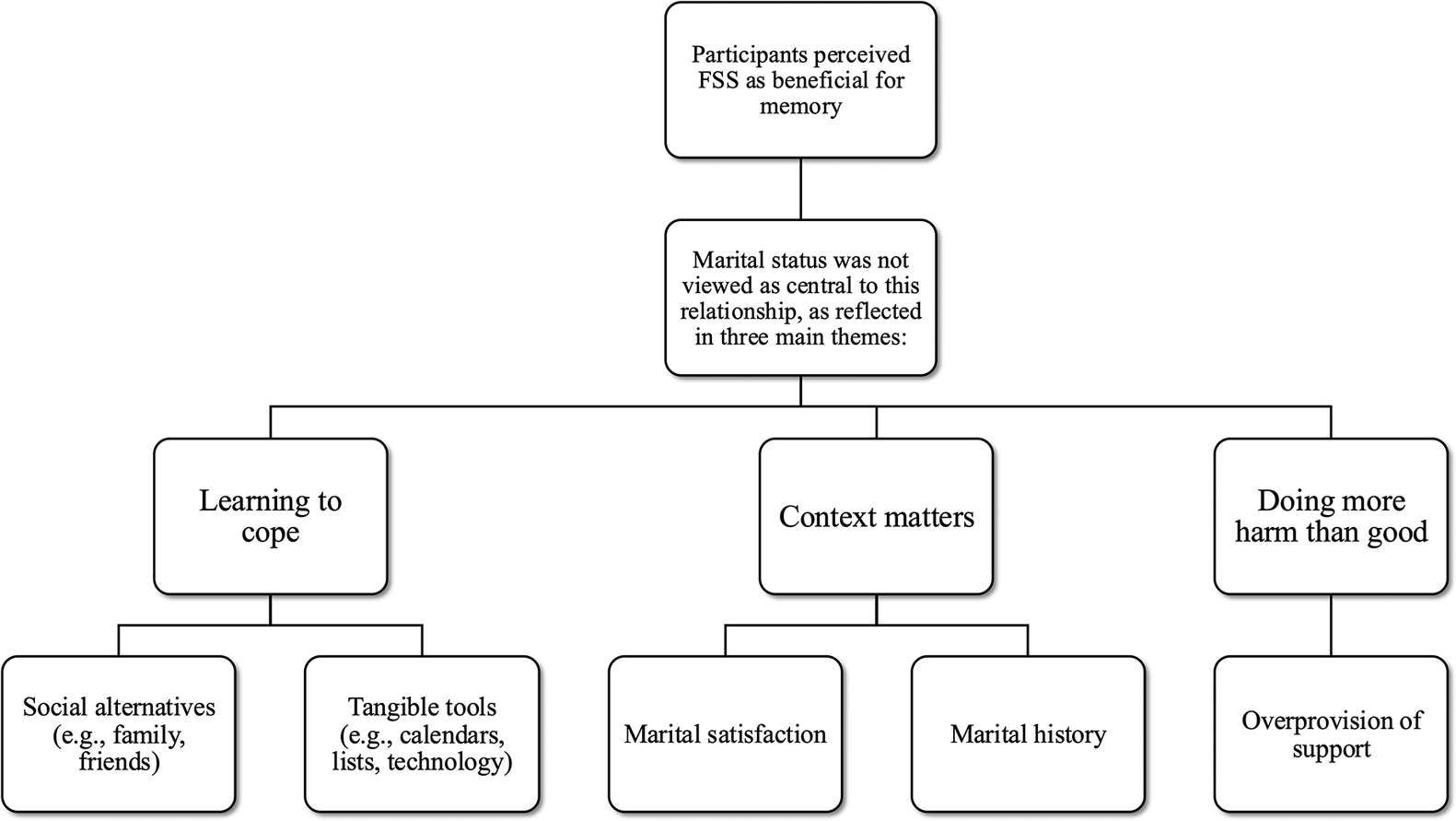
Our novel, qualitative findings generated three key themes to explain participants’ perceptions of how marital status may not shape the relationship between FSS and memory performance: (1) learning to cope in the absence of a spouse, (2) the importance of considering contextual factors, and (3) the potential for excessive support from spouses that may hinder participants’ ability to stimulate their own cognitive processes (see Figure 1 for a visual representation of these themes).
Concept map of qualitative themes reflecting participants’ perspectives on how marital status relates to functional social support and memory.
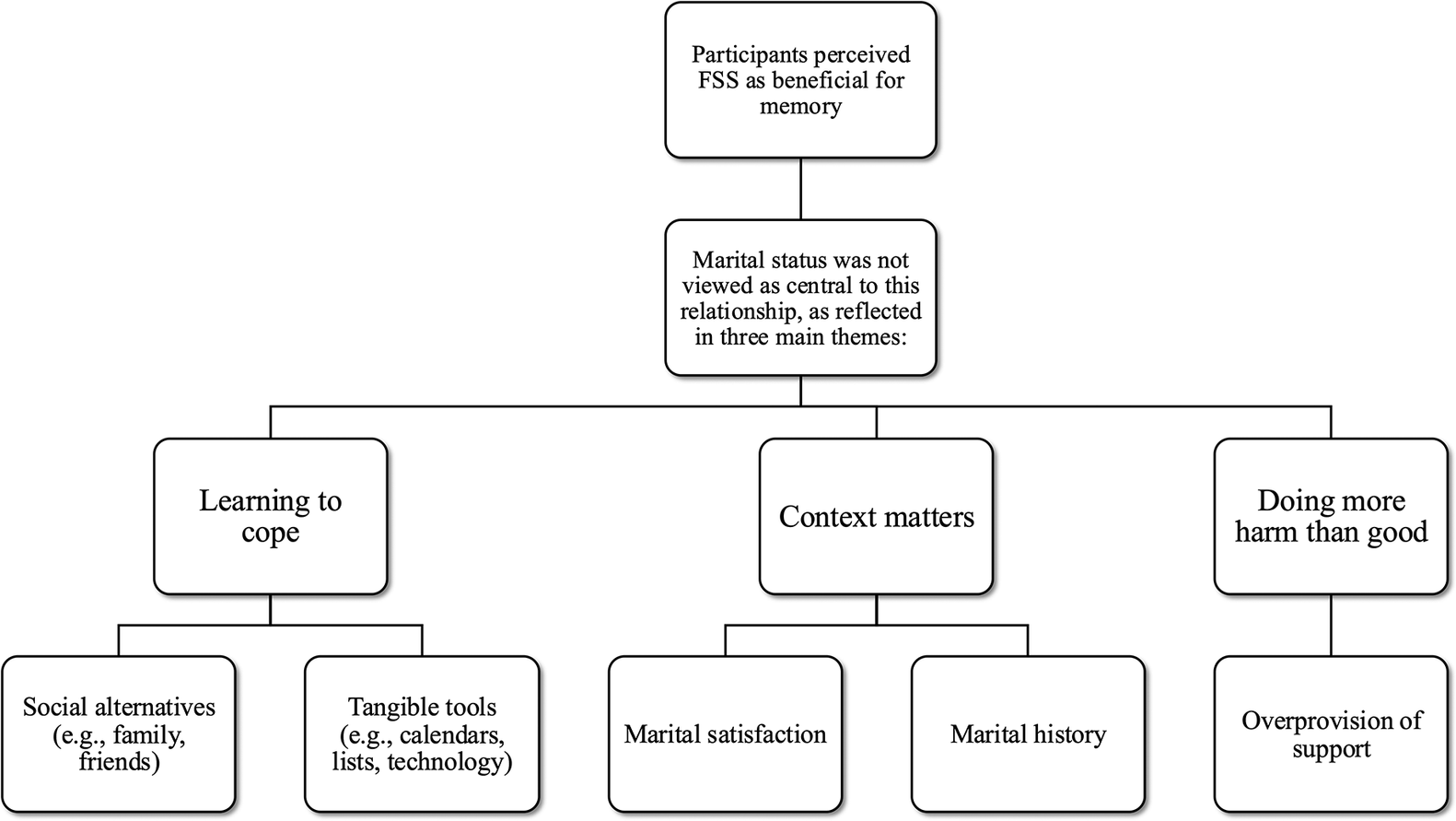
Figure 1. Long description
A hierarchical flowchart with four levels.
Level 1, the top box, states: Participants perceived F S S as beneficial for memory.
Level 2, connected by a vertical line below Level 1, states: Marital status was not viewed as central to this relationship, as reflected in three main themes.
Level 3 consists of three boxes branching horizontally from Level 2:
1. On the left: Learning to cope.
2. In the center: Context matters.
3. On the right: Doing more harm than good.
Level 4 contains sub-themes branching from the Level 3 boxes:
* Under Learning to cope are two boxes: Social alternatives e.g., family, friends and Tangible tools e.g., calendars, lists, technology.
* Under Context matters are two boxes: Marital satisfaction and Marital history.
* Under Doing more harm than good is one box: Overprovision of support.
Learning to cope
The findings support the notion that, regardless of marital status, individuals tend to operate with greater mental capacity when leveraging a comprehensive, supportive environment that includes the use of social network members and practical tools like calendars, phone reminders, or written lists to enhance their memory performance. Conceptualizing individuals’ memory function within an ecological framework that incorporates both social and material support systems may have important implications for understanding the everyday competencies of middle-aged and older people (Harris et al., Reference Harris, Sutton, Keil, McIlwain, Harris, Barnier, Savage and Dixon2022). Previous research has found that practical tools are the most frequently reported memory compensation resources used by older people, and reliance on one’s spouse is the least reported source of compensation, even among couples in long-term marital relationships (Harris et al., Reference Harris, Sutton, Keil, McIlwain, Harris, Barnier, Savage and Dixon2022). The use of external memory compensation tools has been consistently linked with better cognitive function, specifically memory, in older people (Burack & Lachman, Reference Burack and Lachman1996; Tomaszewski Farias et al., Reference Tomaszewski Farias, Schmitter-Edgecombe, Weakley, Harvey, Denny, Barba, Gravano, Giovannetti and Willis2018). As suggested by many of our participants, individuals may leverage such resources to improve or maintain their cognitive functioning, regardless of their marital situation, potentially explaining the absence of a moderating effect of marital status on the association between FSS and memory.
Additionally, unmarried individuals who cannot derive FSS from a spouse may compensate for the absence of a spouse by actively restructuring their support networks to ensure they have sufficient FSS available to them from other close-knit network members. For example, single individuals report receiving more emotional support than married or cohabitating individuals, and are more likely to interact with, provide help to, and receive help from parents, siblings, children, extended family, neighbours, and friends (Penning & Wu, Reference Penning and Wu2014). These findings were echoed by several of our participants, who expressed that many members of their social networks rely more on friends for support rather than on their spouses. Therefore, although marriage is one source of support, close-knit relationships with other members of one’s social circle may also generate support. These findings align with theories such as the stress-buffering hypothesis and the use-it-or-lose-it theory. The stress-buffering hypothesis posits that having access to steady sources of FSS (whether from friends, family, or other close relationships) can offer valuable coping resources, thereby mitigating the adverse effects of stress on cognitive health outcomes (Cohen & Wills, Reference Cohen and Wills1985). On the other hand, the use-it-or-lose-it theory suggests that regular social interaction with these sources of support (whether marital or otherwise) can provide cognitive stimulation, strengthening mental processes like memory and promoting more efficient use of neural networks (Hultsch et al., Reference Hultsch, Hertzog, Small and Dixon1999).
Context matters
Many qualitative interviewees highlighted the complicated nature of ‘marital status’. More specifically, they shared detailed accounts of their marital histories, noting various transitions between marital status categories over time (e.g., from married to divorced). Their collective marital histories provided them with a unique perspective on the topic, allowing them to compare their experiences of social support and memory at various points in their lives. Marital relationships can be complex and dynamic, following intricate trajectories such as divorce and remarriage, or separation and reconciliation. Notably, several participants described how changes in their marital status directly influenced the support they received and their experiences with memory, suggesting a more nuanced interplay that cannot be captured by simplistic measures of marital status, such as ‘What is your current marital/partner status?’. These ‘surface-level’ data about marital status help compile demographic profiles of study participants, but are unlikely to yield substantive information about the relationship between FSS, marital status, and memory because they lack the depth necessary to truly encapsulate the cumulative and evolving nature of marital experiences over time.
Participants expressed varying levels of satisfaction with their marital status, which may help explain differences in cognitive health outcomes, particularly in relation to memory. More specifically, some married participants were unhappy in their relationships, whereas some single individuals reported they were highly satisfied with not having a partner. These findings further support previous research stating that unmarried people are not uniformly disadvantaged and, in some cases, may have better health outcomes than those who are unhappily married (Holt-Lunstad et al., Reference Holt-Lunstad, Birmingham and Jones2008). In fact, some scholars argue that satisfaction with one’s marital status is more salient for health than marital status itself (Umberson et al., Reference Umberson, Williams, Powers, Liu and Needham2006). Indeed, marital satisfaction has been linked to both social support (Brock & Lawrence, Reference Brock and Lawrence2009) and memory (Haghighi et al., Reference Haghighi, Littler, Mauer-Vakil, Miller and Oremus2024; Waldinger et al., Reference Waldinger, Cohen, Schulz and Crowell2015). Thus, it is possible that marital status may intersect with FSS and memory differently for individuals who are satisfied versus dissatisfied with their current relationship status. Consequently, to prevent these nuanced differences from being overlooked, a key direction for future research is to collect data on marital satisfaction when examining marital-related variables as major components of one’s research. Unfortunately, many quantitative studies exploring the health impacts of marital status do not measure key variables such as marital satisfaction or the length of marriage. Therefore, qualitative methodologies, especially those that emphasize the importance of lived experience, can illuminate aspects of marital relationships that are not captured in quantitative research.
Doing more harm than good
The findings suggest that while marital status itself may not substantially shape the relationship between FSS and memory, the amount of support received from a spouse may be crucial for understanding cognitive outcomes. One key qualitative theme was that excessive FSS from a spouse may not always be beneficial and, in some cases, can hinder cognitive functioning. Previous research has suggested that the relationship between social support and cognitive health may be non-linear (Zahodne et al., Reference Zahodne, Ajrouch, Sharifian and Antonucci2019). Indeed, past a certain threshold, high levels of FSS can potentially undermine self-efficacy and foster dependency (Baltes & Wahl, Reference Baltes and Wahl1992), both of which have been linked to increased stress and poorer memory performance. In addition, when a spouse provides excessive assistance – whether by anticipating needs too frequently or taking on tasks the other partner might prefer to handle independently – this may limit the individual’s opportunity to exercise their own cognitive processes. In line with the use-it-or-lose-it theory (Hultsch et al., Reference Hultsch, Hertzog, Small and Dixon1999), this lack of cognitive stimulation could lead to less efficient use of neural networks, potentially contributing to declines in memory function over time. Overprovision of support can also introduce additional stressors into a relationship (Brock & Lawrence, Reference Brock and Lawrence2009), contributing to greater declines in marital satisfaction, which has been shown to negatively affect cognitive function (Haghighi et al., Reference Haghighi, Littler, Mauer-Vakil, Miller and Oremus2024; Kim & Kwon, Reference Kim and Kwon2023). Therefore, excessive support can directly impact cognitive function by hindering mental engagement and indirectly impact cognition by reducing marital quality through heightened conflict, stress, or lack of autonomy. Taken together, these findings suggest the relationship between FSS, marital status, and cognitive outcomes, particularly memory, is far more complex than the simple presence or absence of support. The current study underscores the importance of understanding that individuals have unique support needs. More frequent support is not always preferable and may sometimes create a dynamic where well-intentioned support from a spouse could have unintended, adverse consequences for cognition.
Strengths and limitations
With the current aging population in Canada, it is important to investigate potentially modifiable factors to promote healthy cognitive function. The current study addresses several gaps in the literature, helping to develop a better understanding of how marital relationships affect the association between FSS and memory. As previously discussed, little research has focused on marital-related variables, FSS, and memory simultaneously. To our knowledge, the current study is the first to examine the relationships between FSS, marital-related variables, and memory using qualitative methodology.
Another key strength of this study is the inclusion of both middle-aged and older people, providing a broader perspective that is often overlooked in studies focusing on single age groups. Furthermore, by interviewing individuals with a diverse range of marital statuses, including those in common-law relationships (who are frequently underrepresented in marital research), we were able to capture a wide range of perspectives, enhancing the applicability of the findings. However, the experiences of the qualitative participants may not represent individuals from different geographical regions or age groups. Additionally, our sample primarily consisted of heterosexual participants, which may have limited the diversity of relationship types. Future research should explore the experiences of non-heterosexual couples in this context.
In addition, participants were recruited through posters, advertisements, and snowball sampling, which may have attracted individuals who were healthier, more engaged, and more willing to participate in research. Also, those who were more open to discussing their marriages or marital histories may have been more likely to self-select, potentially influencing the nature of the data collected. Additionally, although the CLSA includes both English- and French-speaking participants, recruitment and interviews for this qualitative study were conducted in English only, as the interviewer was not fluent in French. This may have excluded individuals with limited English proficiency and shaped the perspectives represented in our data. Therefore, our findings and their implications for public health policy are likely to apply to groups who reflect the characteristics of the interviewees. Caution must be exercised when applying these findings to other groups.
A single coder was used in the qualitative analysis. While some researchers argue that multiple coders can increase the reliability of the coding process (O’Connor & Joffe, Reference O’Connor and Joffe2020), reflexive thematic analysis (the method used in this study) values researcher subjectivity and treats coding as inherently idiosyncratic. This contrasts with more quantitatively oriented approaches to coding, which require multiple ‘coders’ to reach consensus (Braun & Clarke, Reference Braun and Clarke2019).
Conclusions
As social networks diminish in size in later life and intimate partnerships become more central, the findings of the current study highlight that fostering strong social connections could be effective for promoting cognitive health in middle-aged and older people. The present study contributes to the growing body of research that can help inform public health strategies targeting social connection, including initiatives such as the World Health Organization's Commission on Social Connection (2025). The Commission views social connection as a multifaceted construct, extending beyond structural indicators to include the quality, functionality, and diversity of social relationships. Our findings underscore this point, supporting the Commission’s recommendation for policies and interventions that prioritize enhancing diverse and meaningful social connections, such as social prescribing or peer-support groups, as a means of addressing the cognitive and emotional needs of the aging population.
Our findings highlight the importance of not only considering the presence of social support but also evaluating its appropriateness and balance. As previously mentioned, overprovision of FSS may inadvertently limit opportunities for cognitive stimulation, which can undermine one’s self-efficacy and promote dependence. This underscores a crucial implication for future interventions to focus on fostering diverse and resilient support networks that extend beyond a single individual, while also providing spouses with guidance on how to offer support in ways that maintain autonomy and encourage cognitive engagement. Enhancing access to FSS from a broader range of social network members may help prevent overreliance on a single partner, leading to a more even and sustainable distribution of care. Health professionals and public health messaging could encourage simple, autonomy-respecting approaches to care (e.g., encouraging a partner to start journaling to track recent events, engage in social activities, or pursue personal hobbies) to help partners understand the delicate balance between being helpful and providing too much assistance.
Supplementary material
The supplementary material for this article can be found at http://doi.org/10.1017/S0714980826100749.
Data availability statement
In accordance with the requirements of our research ethics board, study data cannot be readily shared. However, interested researchers may reach out to the authors to discuss data sharing agreements.
Acknowledgements
We would like to express our heartfelt gratitude to all the participants in this study for generously lending their time, agreeing to be interviewed, and openly sharing their experiences.
Financial support
This work was supported by the Canadian Institutes of Health Research (CIHR) (grant number AC9-187266).
Competing interests
The authors declare that they have no conflicts of interest.


 Open access

