


Introduction
The main function of agricultural soils is to support food production, but they also provide many other ecosystem services (Milne et al., Reference Milne, Banwart, Noellemeyer, Abson, Ballabio, Bampa, Bationo, Batjes, Bernoux, Bhattacharyya, Black, Buschiazzo, Cai, Cerri, Cheng, Compagnone, Conant, Coutinho, de Brogniez, de Carvalho Balieiro, Duffy, Feller, Fidalgo, Figueira da Silva, Funk, Gaudig, Gicheru, Goldhaber, Gottschalk, Goulet, Goverse, Grathwohl, Joosten, Kamoni, Kihara, Krawczynski, La Scala, Lemanceau, Li, Li, Lugato, Maron, Martius, Melillo, Montanarella, Nikolaidis, Nziguheba, Pan, Pascual, Paustian, Pineiro, Powlson, Quiroga, Richter, Sigwalt, Six, Smith, Smith, Stocking, Tanneberger, Termansen, van Noordwijk, van Wesemael, Varga, Victoria, Waswa, Werner, Wichmann, Wichtmann, Zhang, Zhao, Zheng and Zheng2015). UK land use is dominated by grassland systems whose primary purpose is to provide feed for ruminants. Agricultural intensification has led to the dominance of ryegrass (Lolium spp.), which is considered the most profitable species in these systems (Hopkins & Wilkins, Reference Hopkins and Wilkins2006). This simplification, however, comes at a cost of the reduction of many ecosystems functions (Cong et al., Reference Cong, van Ruijven, Mommer, De Deyn, Berendse and Hoffland2014). Diverse forage mixtures may alleviate some issues as they contain species with varying phenology, root depth, and biomass when compared to lower diversity grassland mixtures (Skinner & Dell, Reference Skinner and Dell2016). Soil nutrient cycling and retention can be greatly influenced by species diversity, even in the short term of just two years (Steinbeiss et al., Reference Steinbeiss, Bebler, Engel, Temperton, Buchmanns, Roscher, Kreutziger, Baade, Habekost and Gleixner2008). Along with increasing human population and related demand for food, producers will also face climate change, with increased probability of extreme weather events such as droughts or flooding (Hopkins & Del Prado, Reference Hopkins and Del Prado2007). Given their extent, forage systems must be able to maintain productivity, but should also contribute to climate change mitigation and soil sustainability. The objective of this paper is to evaluate potential benefits of forage mixtures other than ryegrass for soil health indicators along a water availability gradient. We hypothesized that forage mixture and prevailing soil moisture conditions interact to affect (H1) soil carbon content, (H2) nitrate/nitrite availability, (H3) soil ammonium content, and finally (H4) plant availability of soil phosphorus.
Materials and Methods
The experimental site is located at the University of Reading Farm in Sonning, Berkshire, UK (51o28’22.4”N 0o54’15.3”W). Three locations within the farm site were chosen for their varying soil moisture regime: dry (2%), medium (7%), and wet (14% soil moisture as of June 2018). Each of the sites was treated homogenously at least for 10 years prior to the experiment. At each location, four replicates of 4 forage mixtures in a 4x4 Latin square design were sown in September 2016. Each of the mixture plots was 4.2 x 5 m in size, the plots were a single species perennial ryegrass (R) and three forage mixtures: Smart Grass (6 species), Biomix (12 species), and Herbal (17 species, Table 1). Ten 2 cm diameter x 15 cm depth soil core samples were taken from each plot in June 2018, nearly two years after establishment and analysed for carbon, nitrogen and phosphorus content. Effects of forage mixture and site were evaluated using R studio (R Core Team, 2018) with plotrix package (Lemon, Reference Lemon2006). A detailed description of the field setup and analytical methodology is available at dx.doi.org/10.17504/protocols.io.bfrajm2e.
Forage mixture species selection list (R: Ryegrass; SG: Smart Grass; B: Biomix; H: Herbal)

Results
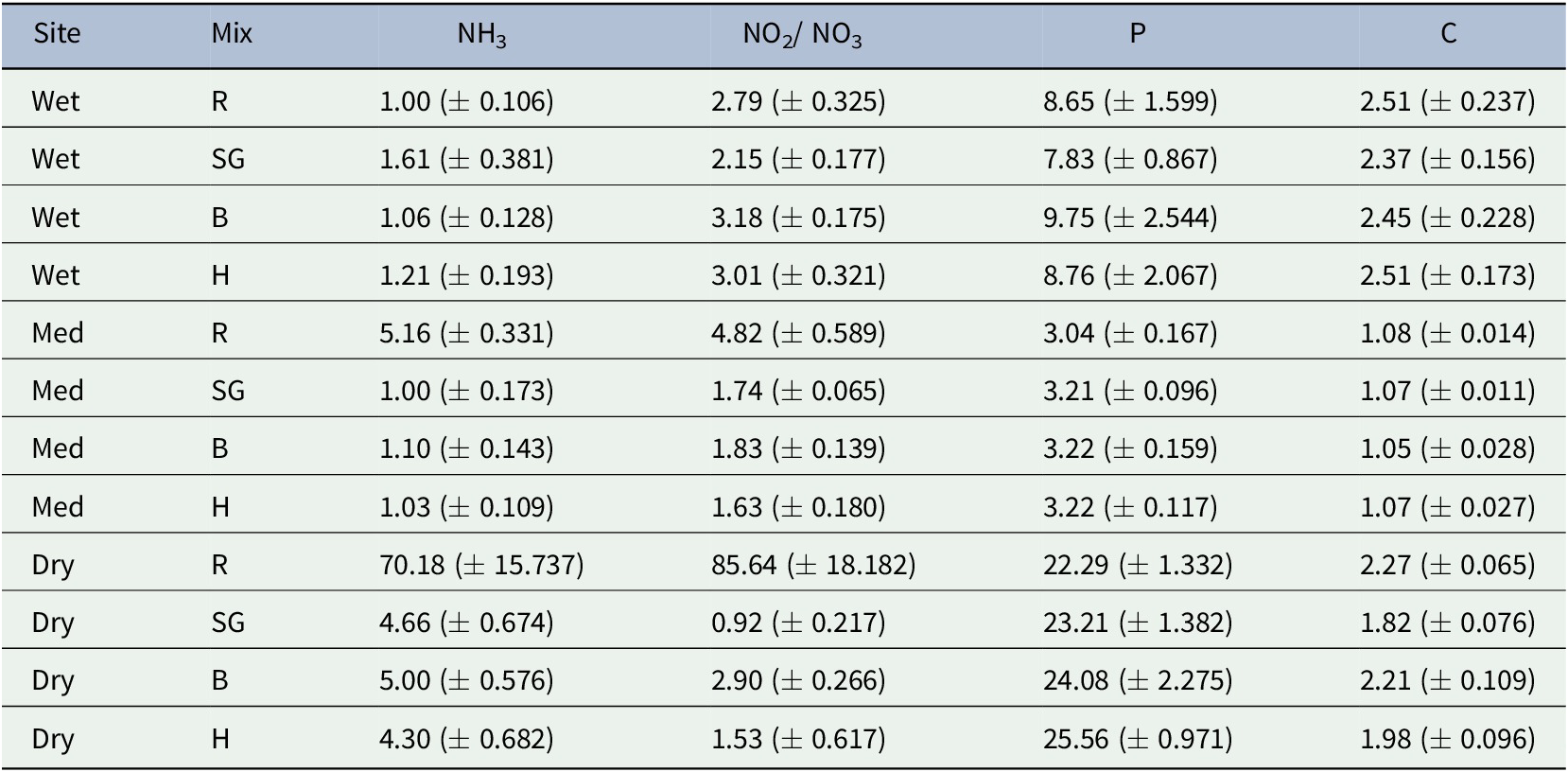
A long-term effect of site on soil carbon concentration was found (P < 0.001; Figure 1), but there was no effect of forage mixture (reject H1). At the dry site, soil carbon content was greater in the R treatment compared to the Smartgrass and Herbal mixtures (P < 0.01 for both). There was an interactive effect of forage mixture and site on soil nitrogen from nitrate/nitrite (P < 0.05; Figure 2). More nitrate/nitrite accumulated in the soil under Smartgrass and Herbal mixtures as soil moisture increased. There were significant differences in soil ammonium availability between sites (P < 0.001; Figure 3). But no interaction between species and site on soil ammonium concentration (reject H3). Soil phosphorus concentrations differed significantly between sites (P < 0.001), the dry site had the highest concentration of soil phosphorus, while the medium soil moisture site had the lowest. No interactive effect of forage mixture and site on soil phosphorus concentration was found (reject H4) (see Table 2 for data).
Boxplot of log soil carbon (C) content in dry, medium soil moisture and wet sites as affected by plant species mixtures: R – Ryegrass (1 species); SG – Smart Grass (6 species); B – Biomix (12 species); and H – Herbal (17 species). Boxes show median, middle 50% of data and upper and lower quartile data range. Letters denote significant difference between treatments.

Boxplot of soil nitrate/nitrite (NO2.N/NO3.N) content in the dry, medium soil moisture and wet sites as affected by plant species mixture: SG – Smart Grass (6 species); B – Biomix (12 species); and H – Herbal (17 species). Ryegrass data were not considered due to nitrogen application in that treatment. Boxes show median, middle 50% of data and upper and lower quartile data range. Letters denote significant difference between treatments.

Boxplot of log nitrogen from ammonium (NH3.N) in the dry, medium soil moisture and wet sites as affected by plant species mixture: SG – Smart Grass (6 species); B – Biomix (12 species); H – Herbal (17 species). Ryegrass data were not considered due to nitrogen application in that treatment. Boxes show median, middle 50% of data and upper and lower quartile data range. Letters denote significant difference between treatments.

Ammonium (NH3), nitrite (NO2), nitrate (NO3) and phosphorus (P) concentration (mg/kg,) and carbon (C, %) in oven dried soil (mean ± standard error). Forage mixtures used in this experiment were R – Ryegrass (1 species); SG – Smart Grass (6 species); B – Biomix (12 species); H – Herbal (17 species).
Discussion
The lack of any significant effect of species mixture on soil carbon content found in the present study conflicts with previous work showing that increasing species diversity positively affects soil carbon accumulation (Skinner & Dell, Reference Skinner and Dell2016), possibly due to the relatively short-term nature of the current study. Skinner and Dell (Reference Skinner and Dell2016) measured soil carbon around a decade after experimental treatment establishment. However, increased carbon accumulation in the top 5 cm soil profile can occur after just 2 years; and in the top 20 cm within 4 years (Steinbeiss et al., Reference Steinbeiss, Bebler, Engel, Temperton, Buchmanns, Roscher, Kreutziger, Baade, Habekost and Gleixner2008). Had the current samples been split into three 5 cm sampling depths, carbon accumulation may have been observed in the surface layer.
The wet site had a significantly higher soil carbon content than the medium or dry sites (Figure 1), likely due to higher water availability stimulating primary productivity and thus carbon deposition. With the predicted increase in temperature in parts of the UK, the dry site could give us an insight into future abilities of pastures to store soil carbon. In this instance, the 12 species forage mixture accumulated significantly more soil carbon than the 6 species mixture (Figure 1).
Forage mixture and soil moisture availability showed an interactive effect on soil nitrate/nitrite concentrations (Figure 2). More soil nitrate/nitrite was found under the Biomix and Herbal mixtures compared to the Smartgrass mixture at the wet site. This could be attributed to the higher proportion of sown legumes in these two mixtures (Biomix 220 g/kg; Herbal 370 g/kg) compared to the Smartgrass mixture (80 g/kg), confirming earlier studies showing effects of legume inclusion on soil nutrient concentrations (Cong et al., Reference Cong, van Ruijven, Mommer, De Deyn, Berendse and Hoffland2014).
Forage mixture had no significant effect on the concentration of nitrate/nitrite at the medium site. The contrast between the medium and the other two sites alludes to the fact that mixtures may require more time to establish full functionality and to demonstrate any significant changes in soil chemistry from the addition of diverse forage species such as legumes under non-stressed environments (Cong et al., Reference Cong, van Ruijven, Mommer, De Deyn, Berendse and Hoffland2014).
Soil ammonium concentration was lower at the wet and medium sites compared to the dry site (Figure 3). Biological reasons for the low ammonium concentration at the medium and wet sites may include: (i) water not a limiting factor for plant growth, stimulating ammonium uptake; or (ii) denitrification and/or volatilization being higher in the wetter soils so more nitrogen is lost to the atmosphere than at the dry site.
There was no significant effect of plant species mixture on soil phosphorus availability. The dry site had higher soil phosphorus availability than the medium and wet sites. Years of arable cropping and fertilizer application at the dry site may explain such high phosphorus concentrations compared to the other two sites, known as the legacy effect (Van der Putten et al., Reference Van der Putten, Bardgett, Bever, Bezemer, Casper, Fukami, Kardoi, Kilronomos, Kulmatiski, Schweitzer, Suding, Van de Voorde and Wardle2013).
Conclusion
The current short-term findings suggest that there is a significant interactive effect of forage mixture and inherent site soil moisture content on soil nitrate/nitrite concentration. Timing of sampling, both in terms of elapsed time since sowing of mixtures and seasonal sample collection, may affect the observations. Farmer adoption of forage mixtures may be an important measure to realise environmental improvements such as increased carbon sequestration or decreased phosphorus and nitrogen leaching. Further studies are therefore required to define which forage mixtures encourage longer-term pasture sustainability, with environmental benefits both above and below ground, in addition to economic and social benefits.
Acknowledgements
The contributions of technical staff at the University of Reading Crops Research Unit and Centre for Dairy Research are gratefully acknowledged.
Author Contributions
AT, DB, TM, HJ, CR and ML conceived and designed the study. SS conducted data gathering, performed statistical analyses and wrote the article with edit inputs from AT, DB, TM, HJ, CR and ML.
Financial Support
Experimental sites were established and maintained as part of the FORAGES project funded by BBSRC-NERC Sustainable Agriculture Research Innovation Club (SARIC) BB/N004353/1.
Conflicts of Interest
The authors declare there are no conflicts of interest.
Ethical Standards
Not applicable.
Data availability
Raw data were generated at the University of Readings Crops Research Unit.


 Open access


Comments
Comments to the Author: The topic of manuscript is interesting and has importance from point of ecology. Unfortunately there are large shortcomings. The period of research is obviously too short for making conclusions about changes in soil carbon contents. The conclusions are made on the basis of soil C, NO2/NO3, NH3 and P contents. If the research was to investigate the effect of plants and various sites on changes of contents of this species, then a comparison of initial and final status is needed. At moment there is no information about the initial contents of C, NO2/NO3, NH3 and P in the sites. Also no information about methods used for nitrate, nitrite, ammonium and phosphorus determination. Also the reviewer can’t understand the reason for using logarithmic scales for C and ammonium graphs. Given address in manuscript (doi.org/10.17504) didn’t help in understanding of research because reviewer can’t find any information there.
At the moment it is not clear what are the differences in soils caused by plants or soils were different already in the beginning of the project. Therefore this manuscript is not ready for publication.