





1. Introduction
The electron–atom collision process (Ichimaru Reference Ichimaru1994; Shevelko & Tawara Reference Shevelko and Tawara1998; Ramazanov & Dzhumagulova Reference Ramazanov and Dzhumagulova2002; Fujimoto Reference Fujimoto2004; Ramazanov, Dzhumagulova & Gabdullin Reference Ramazanov, Dzhumagulova and Gabdullin2006; Shalenov, Dzhumagulova & Ramazanov Reference Shalenov, Dzhumagulova and Ramazanov2017; Dzhumagulova et al. Reference Dzhumagulova, Shalenov, Tashkenbayev and Ramazanov2022a , Reference Dzhumagulova, Shalenov, Tashkenbayev and Ramazanovb ) in plasmas has attracted considerable interest in many fields of physics owing to its fundamental significance and widespread applications in astrophysical and laboratory plasma modelling as well as in basic research in astrophysics and atomic and plasma physics. It is well known that the Debye–Hückel model describes the properties of weakly coupled plasmas since the mean energy of interaction between charged particles is small compared with the usual kinetic energy of a particle in ideal plasmas (Fujimoto Reference Fujimoto2004). In such ideal plasmas, the Debye shielding potential has been employed to derive the perturbation potential since the physical description of the Debye–Hückel model concurs with a pair affinity in many-particle systems (Baimbetove et al. Reference Baimbetov, Nurekenov and Ramazanov1995). Recent advancements have shifted focus towards non-extensive systems composed of electrons and ions described by the q-distribution function, intrinsically linked to the Tsallis q-entropy (Tsallis Reference Tsallis1988; Amour & Tribeche Reference Amour and Tribeche2010; Tribeche, Djebarni & Amour Reference Tribeche, Djebarni and Amour2010). In these non-extensive plasmas, the effective Debye shielding distance has been evaluated to incorporate non-extensive effect electrons and ions, and the temperatures of the constituent species (Gougam & Tribeche Reference Gougam and Tribeche2011). It should also be noted that excellent discussions on Tsallis’ thermostatistics and non-equilibrium plasma based on Tsallis entropy can be found in recent investigations (Naudts Reference Naudts2004; Wada & Scarfone Reference Wada and Scarfone2005; Kikuchi & Akatsuka Reference Kikuchi and Akatsuka2025). Given these developments (Gougam & Tribeche Reference Gougam and Tribeche2011), it is anticipated that the electron-impact ionisation process in a q-non-extensive plasma exhibits notable deviation from that in ideal plasmas due to the influence of Tsallis q-entropy. Therefore, the electron-impact ionisation process in a q-non-extensive plasma is expected to differ from that observed in weakly coupled plasmas due to the influence of q-entropy. To explore this, we examine the impact of Tsallis q-entropy on the electron-impact ionisation probability in a non-extensive plasma. Utilising the semiclassical trajectory analysis, we derive the ionisation probability as a function of impact parameter, revealing the role of q-entropy in this context. Furthermore, we analyse the variation of the maximum position of the ionisation probability as well as the changes in shielding distance, with respect to different levels of non-extensivity.
2. Theory and calculations
The q-distribution function (Gougam & Tribeche Reference Gougam and Tribeche2011) $f_{{q_{\alpha }}}(v_{\alpha })$
for a non-extensive plasma is given by
$f_{{q_{\alpha }}}(v_{\alpha })$
for a non-extensive plasma is given by
 \begin{align} f_{{q_{\alpha }}}\left(v_{\alpha }\right)=N_{{q_{\alpha }}}\left[1-\left(q_{\alpha }-1\right)\left(\frac{m_{\alpha }v_{\alpha }^{2}}{2k_{B}T_{\alpha }}-\frac{e_{\alpha }\phi _{\alpha }}{k_{B}T_{\alpha }}\right)\right]^{{\left(q_{\alpha }-1\right)^{-1}}}, \end{align}
where $N_{{q_{\alpha }}}$
is the normalisation coefficient defined as
$N_{{q_{\alpha }}}$
is the normalisation coefficient defined as
 \begin{align} N_{{q_{\alpha }}}=\left\{\begin{array}{l} \begin{array}{l} n_{q0}\left[\dfrac{m_{\alpha }\left(-q_{\alpha }+1\right)}{2\pi k_{B}T_{\alpha }}\right]^{1/2}\dfrac{{\Gamma} \left(1/\left(-q_{\alpha }+1\right)\right)}{{\Gamma} \left(1/\left(-q_{\alpha }+1\right)-1/2\right)}\quad \left(-1\lt q_{\alpha }\lt 1\right)\!,\\ \end{array}\\[16pt] n_{q0}\left[\dfrac{m_{\alpha }\left(q_{\alpha }-1\right)}{2\pi k_{B}T_{\alpha }}\right]^{1/2}\dfrac{{\Gamma} \left(1/\left(q_{\alpha }-1\right)+1/2\right)}{{\Gamma} \left(1/\left(q_{\alpha }-1\right)\right)}\left(\dfrac{q_{\alpha }+1}{2}\right) \quad\left(q_{\alpha }\gt 1\right)\! .\end{array}\right.\, \end{align}
Here, $q_{\alpha }$
denotes the degree of non-extensivity of species
$q_{\alpha }$
denotes the degree of non-extensivity of species $\alpha$
(
$\alpha$
( $=$
i for ion and e for electron) with
$=$
i for ion and e for electron) with $v_{\alpha } ,\ n_{\alpha 0} ,\ e_{\alpha } ,\ m_{\alpha }$
and
$v_{\alpha } ,\ n_{\alpha 0} ,\ e_{\alpha } ,\ m_{\alpha }$
and $T_{\alpha }$
representing the velocity, number density, charge, mass and temperature of the
$T_{\alpha }$
representing the velocity, number density, charge, mass and temperature of the $\alpha$
species, respectively. The symbol
$\alpha$
species, respectively. The symbol $\phi _{\alpha }$
denotes the electrostatic potential,
$\phi _{\alpha }$
denotes the electrostatic potential, $k_{B}$
is the Boltzmann constant and
$k_{B}$
is the Boltzmann constant and ${\Gamma}$
represents the Gamma function. It has been demonstrated that the non-extensive distribution function that maximises the Tsallis entropy is non-Maxwellian (Liu, Liu & Xu Reference Liu, Liu and Xu2012). Furthermore, such a non-extensive distribution has been shown to provide a better fit than the conventional Maxwellian distribution for describing plasma wave propagation in collisionless plasmas (Lima, Silva & Santos Reference Lima, Silva and Santos2000). It should also be noted that the q-distribution function
${\Gamma}$
represents the Gamma function. It has been demonstrated that the non-extensive distribution function that maximises the Tsallis entropy is non-Maxwellian (Liu, Liu & Xu Reference Liu, Liu and Xu2012). Furthermore, such a non-extensive distribution has been shown to provide a better fit than the conventional Maxwellian distribution for describing plasma wave propagation in collisionless plasmas (Lima, Silva & Santos Reference Lima, Silva and Santos2000). It should also be noted that the q-distribution function $f_{{q_{\alpha }}}(v_{\alpha })$
becomes the Maxwell–Boltzmann velocity distribution function when
$f_{{q_{\alpha }}}(v_{\alpha })$
becomes the Maxwell–Boltzmann velocity distribution function when $q_{\alpha }$
goes to unity. The q-entropy proposed by Tsallis (Reference Tsallis1988) is defined as
$q_{\alpha }$
goes to unity. The q-entropy proposed by Tsallis (Reference Tsallis1988) is defined as
 \begin{align} S_{q}=k_{B}\frac{1-\sum _{i}p_{i}^{q}}{q-1}, \end{align}
where $p_{i}$
denotes the probability of the ith microstate and the parameter q quantifies the degree of non-extensivity in Tsallis q-entropy. Recently, the effective shielding distance, or the correlation length
$p_{i}$
denotes the probability of the ith microstate and the parameter q quantifies the degree of non-extensivity in Tsallis q-entropy. Recently, the effective shielding distance, or the correlation length $\lambda _{q}$
, in a non-extensive plasma was obtained by Gougam & Tribeche (Reference Gougam and Tribeche2011) as
$\lambda _{q}$
, in a non-extensive plasma was obtained by Gougam & Tribeche (Reference Gougam and Tribeche2011) as
 \begin{align} \lambda _{q}=\left[\frac{2+2\sigma }{1+q_{e}+\sigma \left(1+q_{i}\right)}\right]^{1/2}\lambda _{D}, \end{align}
where $\lambda _{D} \{=[1/(1+\sigma )](k_{B}T_{e}/4\pi n_{e0}e^{2})^{1/2}\}$
is the conventional Debye distance and
$\lambda _{D} \{=[1/(1+\sigma )](k_{B}T_{e}/4\pi n_{e0}e^{2})^{1/2}\}$
is the conventional Debye distance and $\sigma (=T_{e}/T_{i})$
denotes the ratio of electron to ion temperature. Using the Gougam–Tribeche model (Gougam & Tribeche Reference Gougam and Tribeche2011), the effective shielding field
$\sigma (=T_{e}/T_{i})$
denotes the ratio of electron to ion temperature. Using the Gougam–Tribeche model (Gougam & Tribeche Reference Gougam and Tribeche2011), the effective shielding field $V_{GT}(r)$
between a target ion with charge number Z and a plasma electron in a non-extensive plasma is given by
$V_{GT}(r)$
between a target ion with charge number Z and a plasma electron in a non-extensive plasma is given by
 \begin{align} V_{GT}\left(r\right)=-\frac{Ze^{2}}{r}\exp \left\{-\left[\frac{2+2\sigma }{1+q_{e}+\sigma \left(1+q_{i}\right)}\right]^{-1/2}\frac{r}{\lambda _{D}}\right\}\!, \end{align}
where $r$
is the interparticle distance between the electron and the target ion. In dense plasmas where the interparticle distance is comparable to the Bohr radius, such as those where electron density and temperature are around
$r$
is the interparticle distance between the electron and the target ion. In dense plasmas where the interparticle distance is comparable to the Bohr radius, such as those where electron density and temperature are around $10^{20}{-}10^{23}\, \textrm{cm}^{-3}$
and
$10^{20}{-}10^{23}\, \textrm{cm}^{-3}$
and $10^{7}{-}10^{8}$
K, the plasma screening effect is important so that the influence of the Tsallis entropy in the effective screening length on the atomic process would be significant.
$10^{7}{-}10^{8}$
K, the plasma screening effect is important so that the influence of the Tsallis entropy in the effective screening length on the atomic process would be significant.
Applying semiclassical-trajectory analysis (Bethe & Jackiw Reference Bethe and Jackiw1986), the differential cross-section for a transition from a bound state $\left.|i\right\rangle$
to a continuum state
$\left.|i\right\rangle$
to a continuum state $\left.|f\right\rangle$
is expressed as
$\left.|f\right\rangle$
is expressed as
 \begin{align} \frac{\text{d}\sigma }{\text{d}E_{f}}=2\pi \int _{0}^{\infty }\text{d}b\,b\left| \,T_{f\hspace{0pt}i}\left(b\right)\right| ^{2}, \end{align}
where $T_{f\hspace{0pt}i}(b)$
and
$T_{f\hspace{0pt}i}(b)$
and $E_{f}$
denote the transition amplitude and the energy of the electron in the final state, respectively, and b is the impact parameter. From the first-order perturbation method, the transition amplitude
$E_{f}$
denote the transition amplitude and the energy of the electron in the final state, respectively, and b is the impact parameter. From the first-order perturbation method, the transition amplitude $T_{f\hspace{0pt}i}(b)$
can be written as
$T_{f\hspace{0pt}i}(b)$
can be written as
 \begin{align} T_{f\hspace{0pt}i}=-\frac{i}{{\hslash }}\int _{-\infty }^{\infty }\text{d}t\,{e}^{{\textrm i}{\omega _{f\hspace{0pt}i}}t}\left\langle f\left| H_{\textrm{int}}\right| \,i\,\right\rangle\! , \end{align}
where $\omega _{f\hspace{0pt}i}=(E_{f}-E_{i})/{\hslash}$
and
$\omega _{f\hspace{0pt}i}=(E_{f}-E_{i})/{\hslash}$
and $H_{\textrm{int}}$
is the interaction Hamiltonian. The ionisation probability
$H_{\textrm{int}}$
is the interaction Hamiltonian. The ionisation probability $I(b)$
for a given impact parameter is then
$I(b)$
for a given impact parameter is then
 \begin{align} I\left(b\right)=\int _{0}^{E_{\max }}\text{d}E_{f}\frac{\text{d}I\left(b\right)}{\text{d}E_{f}}=\int _{0}^{E_{\max }}\text{d}E_{f}\left| \,T_{f\hspace{0pt}i}\left(b\right)\right| ^{2}, \end{align}
where $E_{\max }$
is the maximum energy of the final electron. Then, the total ionisation cross-section is
$E_{\max }$
is the maximum energy of the final electron. Then, the total ionisation cross-section is
 \begin{align} \sigma =2\pi \int _{0}^{\infty }\text{d}b\,bI\left(b\right)\!. \end{align}
For simplicity, we consider a hydrogenic ion with nuclear charge Z as the target and a projectile with charge $z (\ll Z)$
. Then, the interaction Hamiltonian of the projectile–target in a non-extensive plasma is given by the following expression:
$z (\ll Z)$
. Then, the interaction Hamiltonian of the projectile–target in a non-extensive plasma is given by the following expression:
 \begin{align} H_{\textrm{int}}\left(\boldsymbol{r},\,\boldsymbol{R}\right)=-\frac{ze^{2}}{\left| \boldsymbol{r}-\boldsymbol{R}\left(t\right)\right| }\exp \!\left(-\left| \boldsymbol{r}-\boldsymbol{R}\left(t\right)\right| /\lambda _{q}\right)\!, \end{align}
where $\boldsymbol{r}$
and
$\boldsymbol{r}$
and $\boldsymbol{R}(t)[=b\hspace{0pt}\hat{y}+v\enspace t\enspace \hat{z}]$
are the position vectors of the bound electron and the projectile, respectively, since the method of straight-line trajectory is quite reliable for high-energy projectiles, as it corresponds to the classical analogue of the Born method. Using a Fourier transformation, the transition amplitude can be written as
$\boldsymbol{R}(t)[=b\hspace{0pt}\hat{y}+v\enspace t\enspace \hat{z}]$
are the position vectors of the bound electron and the projectile, respectively, since the method of straight-line trajectory is quite reliable for high-energy projectiles, as it corresponds to the classical analogue of the Born method. Using a Fourier transformation, the transition amplitude can be written as
 \begin{align} T_{f\hspace{0pt}i}=\frac{ize^{2}}{2\pi ^{2}{\hslash}}\int \frac{\text{d}^{3}\boldsymbol{q}}{q^{2}+\lambda _{q}^{-2}}G_{f\hspace{0pt}i} (\omega _{f\hspace{0pt}i};\boldsymbol{q})F_{f\hspace{0pt}i}(\boldsymbol{q}), \end{align}
where $\boldsymbol{q}$
is the momentum transfer, the dynamic form factor
$\boldsymbol{q}$
is the momentum transfer, the dynamic form factor $G_{f\hspace{0pt}i}(\omega _{f\hspace{0pt}i};\boldsymbol{q})$
is defined as
$G_{f\hspace{0pt}i}(\omega _{f\hspace{0pt}i};\boldsymbol{q})$
is defined as
 \begin{align} \begin{aligned} G_{f\hspace{0pt}i}(\omega _{f\hspace{0pt}i};\boldsymbol{q}) &=\int _{-\infty }^{\infty }\text{d}t\,e^{i\left[\omega _{f\hspace{0pt}i}t-\boldsymbol{q}\boldsymbol{\cdot }\boldsymbol{R}\left(t\right)\right]} \\ & =2\pi \,e^{-i{q_{y}}b}\delta (\omega _{f\hspace{0pt}i}-q_{z}v) \end{aligned} \end{align}
and the atomic form factor $F_{f\hspace{0pt}i}(\boldsymbol{q})$
(Fano & Rau Reference Fano and Rau1986) is given by
$F_{f\hspace{0pt}i}(\boldsymbol{q})$
(Fano & Rau Reference Fano and Rau1986) is given by
 \begin{align} F_{f\hspace{0pt}i}\left(\boldsymbol{k},\,\boldsymbol{q}\right)=\left\langle f\left| e^{i\boldsymbol{q}\boldsymbol{\cdot }\boldsymbol{r}}\right| \,i\,\right\rangle\!, \end{align}
where $\boldsymbol{k}$
is the momentum of the final electron. From (2.11)–(2.13), the transition amplitude becomes
$\boldsymbol{k}$
is the momentum of the final electron. From (2.11)–(2.13), the transition amplitude becomes
 \begin{align} T_{f\hspace{0pt}i}=\frac{ize^{2}}{\pi {\hslash}v}\int\text{d}^{2}\boldsymbol{q}_{\bot }\frac{e^{-i{\boldsymbol{q}_{\bot }}\boldsymbol{\cdot }\boldsymbol{b}}F_{fi}(\boldsymbol{q}_{\bot },\omega _{fi}/v)}{q_{\bot }^{2}+(\omega _{fi}/v)^{2}+\lambda _{q}^{-2}}, \end{align}
where $\boldsymbol{q}_{\bot }(=\boldsymbol{q}-q_{z}\hat{z})$
denotes the perpendicular component of the momentum transfer
$\boldsymbol{q}_{\bot }(=\boldsymbol{q}-q_{z}\hat{z})$
denotes the perpendicular component of the momentum transfer $\boldsymbol{q}$
and the form factor can be written as
$\boldsymbol{q}$
and the form factor can be written as
 \begin{align} F_{f\hspace{0pt}i}\left(\boldsymbol{k},\,\boldsymbol{q}_{\bot },\,\omega _{f\hspace{0pt}i}/v\right)=\left\langle f\left| e^{i\left({\boldsymbol{q}_{\bot }}\boldsymbol{\cdot }\boldsymbol{r}+{\omega _{f\hspace{0pt}i}}/v\right)}\right| i\,\right\rangle . \end{align}
After algebraic manipulation in polar coordinates in the transverse plane, we obtain
 \begin{align} T_{f\hspace{0pt}i}\left(b\right)=\frac{2ize^{2}}{{\hslash}v}\left\langle f\left| e^{i{\omega _{f\hspace{0pt}i}}z/v}K_{0}\left(\left(\xi \omega _{f\hspace{0pt}i}/v\right)\left[1+\left(v/\omega _{f\hspace{0pt}i}\lambda _{q}\right)^{2}\right]^{1/2}\right)\right| i\right\rangle , \end{align}
where $\xi \equiv | \boldsymbol{r}_{\bot }-\boldsymbol{b}| \ (=\sqrt{x^{2}+(y-b)^{2}})$
and
$\xi \equiv | \boldsymbol{r}_{\bot }-\boldsymbol{b}| \ (=\sqrt{x^{2}+(y-b)^{2}})$
and $K_{0}((\xi \omega _{f\hspace{0pt}i}/v)[1+(v/\omega _{f\hspace{0pt}i}\lambda _{q})^{2}]^{1/2})$
is the modified Bessel function of the second kind of order zero. The initial and the final states in (2.15) can be expressed as
$K_{0}((\xi \omega _{f\hspace{0pt}i}/v)[1+(v/\omega _{f\hspace{0pt}i}\lambda _{q})^{2}]^{1/2})$
is the modified Bessel function of the second kind of order zero. The initial and the final states in (2.15) can be expressed as $|\,i\,\rangle \equiv \varPsi _{100}(\boldsymbol{r})=R_{10}(r)Y_{00}(\hat{r})$
and
$|\,i\,\rangle \equiv \varPsi _{100}(\boldsymbol{r})=R_{10}(r)Y_{00}(\hat{r})$
and $|f\rangle \equiv \varPsi _{E}(\boldsymbol{r})=\sum _{l,\,m}R_{El}(r)Y_{lm}(\hat{r})$
, respectively, where
$|f\rangle \equiv \varPsi _{E}(\boldsymbol{r})=\sum _{l,\,m}R_{El}(r)Y_{lm}(\hat{r})$
, respectively, where $R_{10}(r)$
and
$R_{10}(r)$
and $R_{El}(r)$
are the radial parts of the ground and the continuum wavefunctions, respectively, and
$R_{El}(r)$
are the radial parts of the ground and the continuum wavefunctions, respectively, and $Y_{lm}(\hat{r})$
is the zonal harmonics. The wavefunctions satisfy the normalisation condition:
$Y_{lm}(\hat{r})$
is the zonal harmonics. The wavefunctions satisfy the normalisation condition: $\int _{0}^{\infty }r^{2}\text{d}r\,R_{El}(r)R_{E'l}(r)=\delta (E-E')$
. Now, the atomic form factor is found to be
$\int _{0}^{\infty }r^{2}\text{d}r\,R_{El}(r)R_{E'l}(r)=\delta (E-E')$
. Now, the atomic form factor is found to be
 \begin{align} F_{f\hspace{0pt}l}\left(Q_{\bot },\,\beta _{f\hspace{0pt}i}\right)=4\sqrt{\frac{2mK}{\pi {\hslash}^{2}}}\frac{a_{Z}}{\left[1+\left(K+\sqrt{Q_{\bot }^{2}+\beta _{fi}^{2}}\right)^{2}\right]\left[1+\left(K-\sqrt{Q_{\bot }^{2}+\beta _{fi}^{2}}\right)^{2}\right]}, \end{align}
where $Q_{\bot } (=q_{\bot }a_{Z})$
is the dimensionless perpendicular component of the momentum transfer,
$Q_{\bot } (=q_{\bot }a_{Z})$
is the dimensionless perpendicular component of the momentum transfer, $K(=ka_{Z})$
is the dimensionless wavenumber,
$K(=ka_{Z})$
is the dimensionless wavenumber, $\beta _{f\hspace{0pt}i} (=\omega _{f\hspace{0pt}i}a_{Z}/v)$
is the Sommerfeld parameter,
$\beta _{f\hspace{0pt}i} (=\omega _{f\hspace{0pt}i}a_{Z}/v)$
is the Sommerfeld parameter, $a_{Z} (=a_{0}/Z)$
is the Bohr radius of a hydrogen-like ion with nuclear charge Z and
$a_{Z} (=a_{0}/Z)$
is the Bohr radius of a hydrogen-like ion with nuclear charge Z and $a_{0} (={\hslash}^{2}/me^{2})$
is the Bohr radius of a hydrogen atom. Finally, the transition amplitude is obtained as
$a_{0} (={\hslash}^{2}/me^{2})$
is the Bohr radius of a hydrogen atom. Finally, the transition amplitude is obtained as
 \begin{align} \begin{aligned} T_{f\hspace{0pt}l} & =\frac{8ize^{2}a_{Z}}{{\hslash}^{2}v}\sqrt{\frac{2mK}{\pi }}\int _{0}^{\infty }\text{d}Q_{\bot }\left[Q_{\bot }J_{0}\left(\overline{b}Q_{\bot }\right)\right] \\ & \times\, \!\left\{\!\left(Q_{\bot }^{2}+\beta _{f\hspace{0pt}i}^{2}+a_{\lambda _{q}}^{2}\!\right)\!\left[1+\!\left(K+\sqrt{Q_{\bot }^{2}+\beta _{f\hspace{0pt}i}^{2}}\!\right)^{2}\!\right]\!\left[1+\!\left(K-\sqrt{Q_{\bot }^{2}+\beta _{f\hspace{0pt}i}^{2}}\!\right)^{2}\!\right]\!\right\}^{-1}, \end{aligned} \end{align}
where $a_{{\lambda _{q}}} (=a_{Z}/\lambda _{q})$
is the scaled reciprocal effective Debye length in a non-extensive plasma and
$a_{{\lambda _{q}}} (=a_{Z}/\lambda _{q})$
is the scaled reciprocal effective Debye length in a non-extensive plasma and $\overline{b} (=b/a_{Z})$
is the scaled impact parameter.
$\overline{b} (=b/a_{Z})$
is the scaled impact parameter.
3. Results and discussion
From (2.6), (2.8), (2.9) and (2.18), the scaled ionisation cross-section $Z^{4}\sigma /\pi a_{0}^{2}$
can be expressed in terms of the scaled ionisation probability
$Z^{4}\sigma /\pi a_{0}^{2}$
can be expressed in terms of the scaled ionisation probability $\overline{b}\kern2pt\overline{I}(\overline{b},\,\varepsilon _{0},\,a_{{\lambda _{q}}})\ (=\partial _{\kern1pt\overline{b}}\kern2pt\overline{\sigma }_{\textrm{ioniz}})$
:
$\overline{b}\kern2pt\overline{I}(\overline{b},\,\varepsilon _{0},\,a_{{\lambda _{q}}})\ (=\partial _{\kern1pt\overline{b}}\kern2pt\overline{\sigma }_{\textrm{ioniz}})$
:
 \begin{align} \begin{aligned} \frac{Z^{4}\sigma }{\pi a_{0}^{2}} & =\int _{0}^{\infty }\text{d}\overline{b}2Z^{2}\overline{b}I\left(\overline{b}\right)\\ &=\int _{0}^{\infty }\text{d}\overline{b}\kern2pt\overline{b}\kern2pt\overline{I}\left(\overline{b}\right), \end{aligned} \end{align}
where
 \begin{align} \begin{aligned} \partial _{\kern1pt\overline{b}}\kern2pt\overline{\sigma }_{\textrm{ioniz}} & =\overline{b}\kern2pt\overline{I}\left(\overline{b},\,\varepsilon _{0},\,a_{{\lambda _{q}}}\right) \\ &=\frac{2^{7}}{\pi }\frac{1}{\varepsilon _{0}}\overline{b}\int _{0}^{\varepsilon _{0}-1}\text{d}\varepsilon _{f}\,\sqrt{\varepsilon _{f}}\\ & \quad\times \left| \,\int _{0}^{\infty }\text{d}Q_{\bot }\frac{Q_{\bot }J_{0}\left(\overline{b}Q_{\bot }\right)}{Q_{\bot }^{2}+\frac{\left(1+\varepsilon _{f}\right)^{2}}{4\varepsilon _{0}}+a_{\lambda _{q}}^{2}}\left\{\left[1+\left(\sqrt{\varepsilon _{f}}+\sqrt{Q_{\bot }^{2}+\frac{\left(1+\varepsilon _{f}\right)^{2}}{4\varepsilon _{0}}}\right)^{2}\right]\right.\right. \\ &\quad\times \left.\left.\left[1+\left(\sqrt{\varepsilon _{f}}-\sqrt{Q_{\bot }^{2}+\frac{\left(1+\varepsilon _{f}\right)^{2}}{4\varepsilon _{0}}}\right)^{2}\right]\right\}^{-1}\right| ^{2}. \end{aligned} \end{align}
Here, $\varepsilon _{0}\equiv E_{0}/Z^{2}Ry$
and
$\varepsilon _{0}\equiv E_{0}/Z^{2}Ry$
and $\varepsilon _{f}\equiv E_{f}/Z^{2}Ry$
, and
$\varepsilon _{f}\equiv E_{f}/Z^{2}Ry$
, and $Ry\ (=me^{4}/2{\hslash}^{2}\cong 13.6\,\textrm{eV})$
is the Rydberg constant. To investigate the plasma shielding effects on the electron-impact ionisation process
$Ry\ (=me^{4}/2{\hslash}^{2}\cong 13.6\,\textrm{eV})$
is the Rydberg constant. To investigate the plasma shielding effects on the electron-impact ionisation process $(z=-1)$
in a non-extensive plasma, we consider a high-energy projectile (i.e.
$(z=-1)$
in a non-extensive plasma, we consider a high-energy projectile (i.e. $E_{0}\gg Z^{2}Ry$
) with
$E_{0}\gg Z^{2}Ry$
) with $\varepsilon _{0}\geq 10$
and
$\varepsilon _{0}\geq 10$
and $\overline{\lambda }_{D}=10$
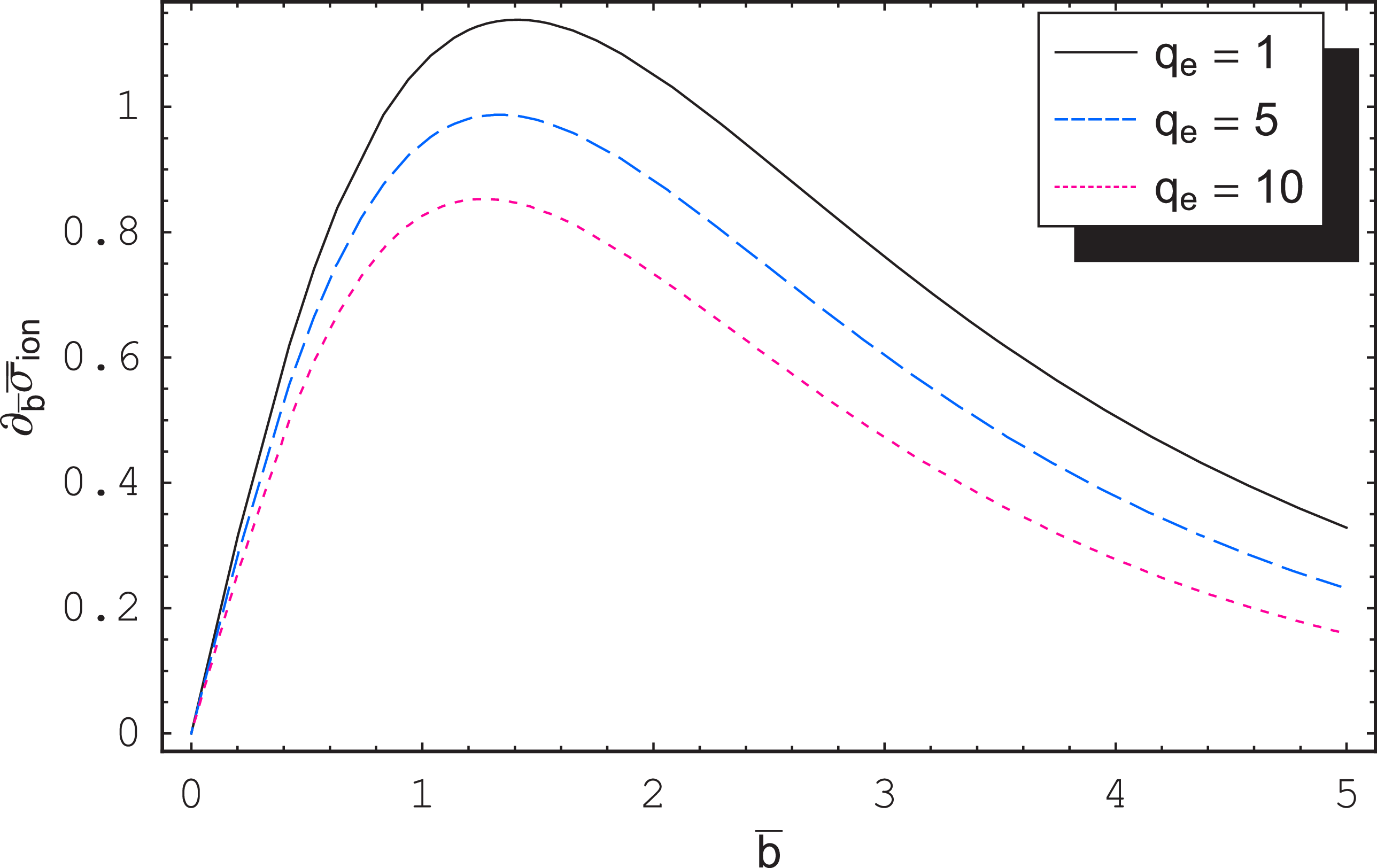
. Figure 1 shows the scaled ionisation probability
$\overline{\lambda }_{D}=10$
. Figure 1 shows the scaled ionisation probability $\partial _{\kern1pt\overline{b}}\kern2pt\overline{\sigma }_{\textrm{ion}}\ [=\overline{b}\kern2pt\overline{I}(\overline{b},\,\varepsilon _{0},\,a_{{\lambda _{q}}})]$
including the plasma shielding effects in a non-extensive plasma as a function of the scaled impact parameter
$\partial _{\kern1pt\overline{b}}\kern2pt\overline{\sigma }_{\textrm{ion}}\ [=\overline{b}\kern2pt\overline{I}(\overline{b},\,\varepsilon _{0},\,a_{{\lambda _{q}}})]$
including the plasma shielding effects in a non-extensive plasma as a function of the scaled impact parameter $\overline{b} (=b/a_{Z})$
for various values of the electron q-entropy
$\overline{b} (=b/a_{Z})$
for various values of the electron q-entropy $q_{e}$
for
$q_{e}$
for $\varepsilon _{0}=10$
and
$\varepsilon _{0}=10$
and $\sigma =1/2$
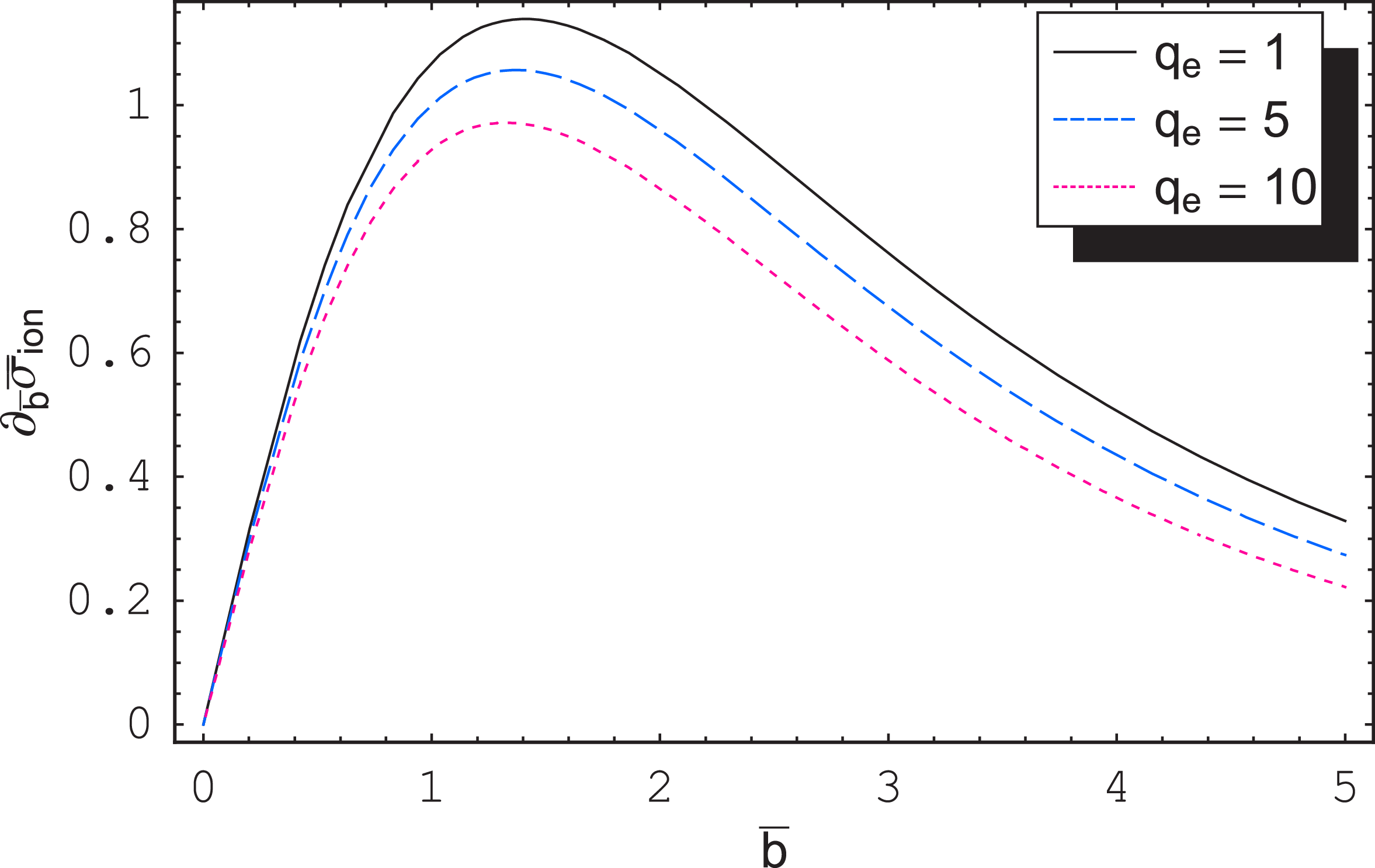
. Figure 2 shows the scaled ionisation probability
$\sigma =1/2$
. Figure 2 shows the scaled ionisation probability $\partial _{\kern1pt\overline{b}}\kern2pt\overline{\sigma }_{\textrm{ion}}$
including the plasma shielding effects in a non-extensive plasma as a function of the scaled impact parameter
$\partial _{\kern1pt\overline{b}}\kern2pt\overline{\sigma }_{\textrm{ion}}$
including the plasma shielding effects in a non-extensive plasma as a function of the scaled impact parameter $\overline{b} (=b/a_{Z})$
for various values of the electron q-entropy
$\overline{b} (=b/a_{Z})$
for various values of the electron q-entropy $q_{e}$
for
$q_{e}$
for $\varepsilon _{0}=10$
and
$\varepsilon _{0}=10$
and $\sigma =2$
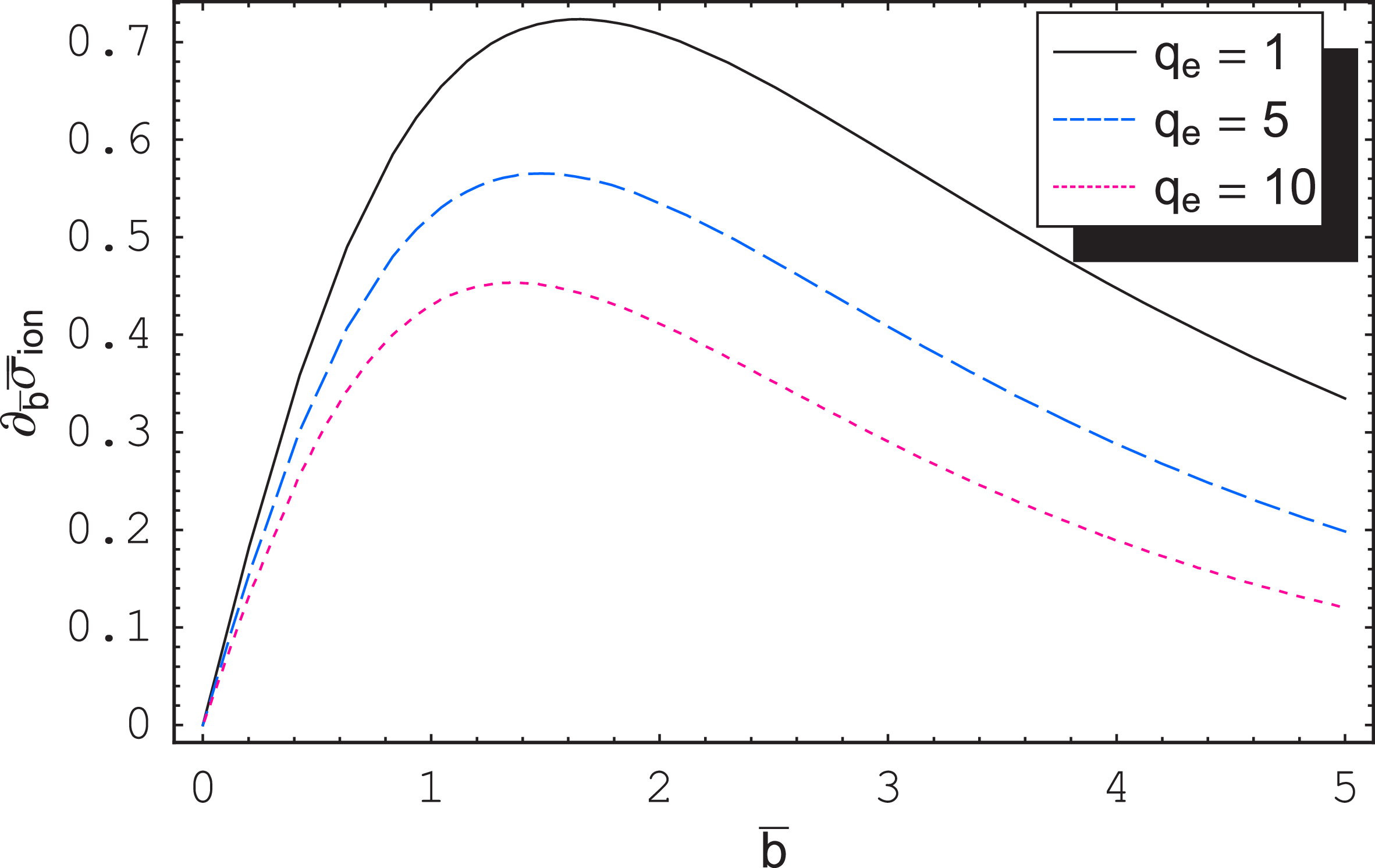
. Figure 3 shows the scaled ionisation probability
$\sigma =2$
. Figure 3 shows the scaled ionisation probability $\partial _{\kern1pt\overline{b}}\kern2pt\overline{\sigma }_{\textrm{ion}}$
including the plasma shielding effects in a non-extensive plasma as a function of the scaled impact parameter
$\partial _{\kern1pt\overline{b}}\kern2pt\overline{\sigma }_{\textrm{ion}}$
including the plasma shielding effects in a non-extensive plasma as a function of the scaled impact parameter $\overline{b} (=b/a_{Z})$
for various values of the electron q-entropy
$\overline{b} (=b/a_{Z})$
for various values of the electron q-entropy $q_{e}$
for
$q_{e}$
for $\varepsilon _{0}=30$
and
$\varepsilon _{0}=30$
and $\sigma =1/2$
. In all cases, the ionisation probability decreases with increasing
$\sigma =1/2$
. In all cases, the ionisation probability decreases with increasing $q_{e}$
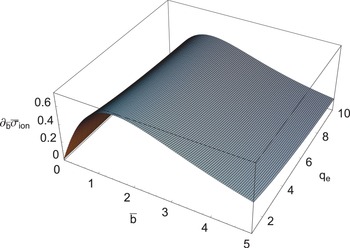
. This indicates that the Tsallis q-entropy suppresses the electron-impact ionisation cross-section in a non-extensive plasma. Moreover, the effect of q-entropy on the ionisation probability becomes weaker as the impact parameter decreases, implying that the non-extensive effects are less significant near the target nucleus. The influence of Tsallis q-entropy also decreases with increasing ratio of electron to ion temperature, while it increases with the energy of the projectile electron, i.e. the collision energy between the electron and the target ion. Figure 4 presents a surface plot of the scaled ionisation probability
$q_{e}$
. This indicates that the Tsallis q-entropy suppresses the electron-impact ionisation cross-section in a non-extensive plasma. Moreover, the effect of q-entropy on the ionisation probability becomes weaker as the impact parameter decreases, implying that the non-extensive effects are less significant near the target nucleus. The influence of Tsallis q-entropy also decreases with increasing ratio of electron to ion temperature, while it increases with the energy of the projectile electron, i.e. the collision energy between the electron and the target ion. Figure 4 presents a surface plot of the scaled ionisation probability $\partial _{\kern1pt\overline{b}}\kern2pt\overline{\sigma }_{\textrm{ion}}$
including the plasma shielding effects in a non-extensive plasma as a function of
$\partial _{\kern1pt\overline{b}}\kern2pt\overline{\sigma }_{\textrm{ion}}$
including the plasma shielding effects in a non-extensive plasma as a function of $\overline{b}$
and
$\overline{b}$
and $q_{e}$
. The results reveal that the location of the maximum ionisation probability in the range
$q_{e}$
. The results reveal that the location of the maximum ionisation probability in the range $1\lt \overline{b}\lt 2$
shifts away from the centre of the target system as the q-entropy increases. Since the q-distribution function
$1\lt \overline{b}\lt 2$
shifts away from the centre of the target system as the q-entropy increases. Since the q-distribution function $f_{{q_{\alpha }}}(v_{\alpha })$
(equation (2.1)) becomes the standard Maxwellian distribution function when
$f_{{q_{\alpha }}}(v_{\alpha })$
(equation (2.1)) becomes the standard Maxwellian distribution function when $q_{\alpha }=1$
, it is found that the peak position for the ionisation probability in a Maxwellian plasmas is closer to the centre of the target ion than in non-extensive plasmas.
$q_{\alpha }=1$
, it is found that the peak position for the ionisation probability in a Maxwellian plasmas is closer to the centre of the target ion than in non-extensive plasmas.
The scaled ionisation probability $\partial _{\kern1pt\overline{b}}\kern2pt\overline{\sigma }_{\textrm{ion}}\ [=\overline{b}\kern2pt\overline{I}(\overline{b},\,\varepsilon _{0},\,a_{{\lambda _{q}}})]$
in a non-extensive plasma as a function of the scaled impact parameter
$\partial _{\kern1pt\overline{b}}\kern2pt\overline{\sigma }_{\textrm{ion}}\ [=\overline{b}\kern2pt\overline{I}(\overline{b},\,\varepsilon _{0},\,a_{{\lambda _{q}}})]$
in a non-extensive plasma as a function of the scaled impact parameter $\overline{b} (=b/a_{Z})$
for
$\overline{b} (=b/a_{Z})$
for $\varepsilon _{0}=10 ,\ \sigma =1/2 ,\ q_{i}=1$
and
$\varepsilon _{0}=10 ,\ \sigma =1/2 ,\ q_{i}=1$
and $\overline{\lambda }_{D}=10$
. The black solid line portrays the condition of
$\overline{\lambda }_{D}=10$
. The black solid line portrays the condition of $q_{e}=1$
. The blue dashed line portrays the condition of
$q_{e}=1$
. The blue dashed line portrays the condition of $q_{e}=5$
. The red dotted line portrays the condition of
$q_{e}=5$
. The red dotted line portrays the condition of $q_{e}=10$
.
$q_{e}=10$
.

The scaled ionisation probability $\partial _{\kern1pt\overline{b}}\kern2pt\overline{\sigma }_{\textrm{ion}}\ [=\overline{b}\kern2pt\overline{I}(\overline{b},\,\varepsilon _{0},\,a_{{\lambda _{q}}})]$
in a non-extensive plasma as a function of the scaled impact parameter
$\partial _{\kern1pt\overline{b}}\kern2pt\overline{\sigma }_{\textrm{ion}}\ [=\overline{b}\kern2pt\overline{I}(\overline{b},\,\varepsilon _{0},\,a_{{\lambda _{q}}})]$
in a non-extensive plasma as a function of the scaled impact parameter $\overline{b} (=b/a_{Z})$
for
$\overline{b} (=b/a_{Z})$
for $\varepsilon _{0}=10 ,\ \sigma =2 ,\ q_{i}=1$
and
$\varepsilon _{0}=10 ,\ \sigma =2 ,\ q_{i}=1$
and $\overline{\lambda }_{D}=10$
. The black solid line portrays the condition of
$\overline{\lambda }_{D}=10$
. The black solid line portrays the condition of $q_{e}=1$
. The blue dashed line portrays the condition of
$q_{e}=1$
. The blue dashed line portrays the condition of $q_{e}=5$
. The red dotted line portrays the condition of
$q_{e}=5$
. The red dotted line portrays the condition of $q_{e}=10$
.
$q_{e}=10$
.

The scaled ionisation probability $\partial _{\kern1pt\overline{b}}\kern2pt\overline{\sigma }_{\textrm{ion}}\ [=\overline{b}\kern2pt\overline{I}(\overline{b},\,\varepsilon _{0},\,a_{{\lambda _{q}}})]$
in a non-extensive plasma as a function of the scaled impact parameter
$\partial _{\kern1pt\overline{b}}\kern2pt\overline{\sigma }_{\textrm{ion}}\ [=\overline{b}\kern2pt\overline{I}(\overline{b},\,\varepsilon _{0},\,a_{{\lambda _{q}}})]$
in a non-extensive plasma as a function of the scaled impact parameter $\overline{b} (=b/a_{Z})$
for
$\overline{b} (=b/a_{Z})$
for $\varepsilon _{0}=30 ,\ \sigma =1/2 ,\ q_{i}=1$
and
$\varepsilon _{0}=30 ,\ \sigma =1/2 ,\ q_{i}=1$
and $\overline{\lambda }_{D}=10$
. The black solid line portrays the condition of
$\overline{\lambda }_{D}=10$
. The black solid line portrays the condition of $q_{e}=1$
. The blue dashed line portrays the condition of
$q_{e}=1$
. The blue dashed line portrays the condition of $q_{e}=5$
. The red dotted line portrays the condition of
$q_{e}=5$
. The red dotted line portrays the condition of $q_{e}=10$
.
$q_{e}=10$
.

The surface plot of the scaled ionisation probability $\partial _{\kern1pt\overline{b}}\kern2pt\overline{\sigma }_{\textrm{ion}}\ [=\overline{b}\kern2pt\overline{I}(\overline{b},\,\varepsilon _{0},\,a_{{\lambda _{q}}})]$
in a non-extensive plasma as a function of the scaled impact parameter
$\partial _{\kern1pt\overline{b}}\kern2pt\overline{\sigma }_{\textrm{ion}}\ [=\overline{b}\kern2pt\overline{I}(\overline{b},\,\varepsilon _{0},\,a_{{\lambda _{q}}})]$
in a non-extensive plasma as a function of the scaled impact parameter $\overline{b} (=b/a_{Z})$
and the electron q-entropy
$\overline{b} (=b/a_{Z})$
and the electron q-entropy $q_{e}$
for
$q_{e}$
for $\varepsilon _{0}=30 ,\ \sigma =1/2 ,\ q_{i}=1$
and
$\varepsilon _{0}=30 ,\ \sigma =1/2 ,\ q_{i}=1$
and $\overline{\lambda }_{D}=10$
.
$\overline{\lambda }_{D}=10$
.

4. Conclusion
In this work, we investigate the influence of the Tsallis q-entropy on the electron-impact excitation process in non-extensive plasmas. Using the semiclassical trajectory analysis, the ionisation probability is obtained as a function of the impact parameter including the plasma shielding effects in a non-extensive plasma. It is found that the Tsallis q-entropy suppresses the electron-impact ionisation cross-section in a non-extensive plasma. It is also found that the effect of the Tsallis q-entropy on the electron-impact excitation process diminishes as the ratio of the electron temperature to the ion temperature increases. Moreover, it is found that the influence of the Tsallis q-entropy is increased with an increase of the projectile energy. Moreover, it is shown that the position of maximum ionisation probability is recessed from the target centre as the q-entropy increases. Hence, it would be expected that the peak position for the ionisation probability in Maxwellian plasmas is closer to the centre of the target ion than in non-extensive plasmas since the q-distribution function becomes the standard Maxwellian distribution function when $q_{\alpha }=1$
. It is demonstrated that Tsallis q-entropy exerts a significant influence on both the electron-impact ionisation cross-section and ionisation probability in dense plasmas. The findings in this work will provide valuable insights into the role of non-extensive statistics in electron-impact ionisation processes in non-extensive plasmas.
$q_{\alpha }=1$
. It is demonstrated that Tsallis q-entropy exerts a significant influence on both the electron-impact ionisation cross-section and ionisation probability in dense plasmas. The findings in this work will provide valuable insights into the role of non-extensive statistics in electron-impact ionisation processes in non-extensive plasmas.
Acknowledgements
This paper is devoted to the late Professor M. Tribeche in memory of stimulating discussions on processes in non-extensive plasmas. This work was supported by the National Research Foundation of Korea (NRF) grant funded by the Korea Government (MSIT) (RS-2025-00561344).
Editor Won Ho Choe thanks the referees for their advice in evaluating this article.
Data availability
The data that support the findings of this study are available upon reasonable request from the authors.
Declaration of interests
The authors declare none.








 Open access

