

Opening
The Queen's Hall, Langham Place, Monday evening, 21 September 1931. For the first time since their establishment in 1895 the daily continuity of the Henry Wood Promenade Concerts (the Proms) had been interrupted by the British Broadcasting Corporation (BBC). Yet the BBC Symphony Orchestra, conducted by Henry Wood, was present and at 7.30 p.m. they commenced a concert with some organ solos played by Berkeley Mason, including the Toccata and Fugue in D Minor by Johann Sebastian Bach. The audience comprised more than two thousand people, with the front row of the stalls occupied by ambassadors and ladies.Footnote 1 At 8 p.m. the National and World Services of the BBC began broadcasting the concert starting with the Trumpet Voluntary for six trumpets, three side drums, timpani and organ, then ascribed to Henry Purcell.Footnote 2 At the end of this piece, five minutes later, James Ramsay MacDonald, the prime minister of the National Government formed the previous month at a time of major social, economic and political crisis, stepped up to the microphone.
The events of the weekend of 18–20 September 1931 have been described as ‘a watershed for the world’.Footnote 3 On the afternoon of Friday 18 September MacDonald had gone to the prime minister's country residence, Chequers in Buckinghamshire, on the understanding that the immediate financial crisis had been overcome. But almost as soon as he arrived he received a message reporting that, following the mutiny of the Atlantic Fleet at its Invergordon base, on the east coast of Scotland, on 15 September, there had been a severe run on the gold reserves of the Bank of England of between seventeen and eighteen million pounds. MacDonald returned immediately to London and on the Sunday the Cabinet, at the request of the Bank of England, suspended the pound from the gold standard and ordered the recall of Parliament for the following day to enact the necessary enabling legislation.Footnote 4
Thus ended in ignominy the attempt in the April 1925 budget by Chancellor of the Exchequer Winston Churchill to return Britain to the gold standard and so, in his view, re-establish the global pre-eminence of Britain's economy as it had existed before the Great War. The reason why the gold-standard crisis was such a watershed was not simply because it marked the end of Britain's post-1918 pretence to be the world's dominant economic power, but because it confirmed what had become increasingly clear during the 1920s, that henceforth the state would play a proactive role in the economy. This was the inescapable lesson eventually put into practice throughout the world, irrespective of the label by which a particular political system called itself.
The policy during the first half of the 1920s of seeking to restore Britain to the pre-1914 order had many strands, in addition to returning to the gold standard. These included the rapid dismantling after 1918 of the state regulation of industry imposed during the Great War. But by the middle of the decade it was becoming clear that aspects of this strategy were inadequate in a number of areas. In Britain the electrical industry was especially significant in this context because it became the first industry in which the state returned to intervention and regulation following the Great War. In 1926, by act of Parliament, the infrastructure for its operation was established with the creation of the Central Electricity Board. The board's primary responsibility was to establish a national grid for the distribution of electricity and a system of large electrical generating power stations that would replace the local generation and distribution facilities built in most towns.Footnote 5 Hence the electrical industry became immediately associated with novel methods of peacetime state planning.
Such novelty ensured the interest of leading politicians in electrification. MacDonald was no exception. During the Monday he was kept busy, and at some point he wrote to the conservative newspaper proprietor Esmond Harmsworth to say so, as an apology for not meeting him. He added that he would be ‘finishing up [the day] with a broadcast on Faraday, which I think I had better stick to because it might have something of a calming effect, and Faraday as a man gives me a good text for suggesting to the nation how it should conduct itself’.Footnote 6 Keeping the nation calm was evidently of considerable importance to MacDonald: in his report that day to the King-Emperor George V on the weekend crisis he appealed to him to remain at Balmoral, since returning to London might provoke rumours of an even more serious crisis, such as a change of government. He added that the previous day he had had lunch with the Prince of Wales (later Edward VIII and Duke of Windsor), who had returned from Biarritz.Footnote 7
While there was political necessity for the prime minister to maintain his appointments so as to pretend that everything apart from the currency was carrying on as usual, we need to look in some depth at what was happening here. Why should the prime minister, in the normal course of events, agree to speak at a meeting held to mark the centenary of a scientific discovery, in this case that of electromagnetic induction made by Michael Faraday on 29 August 1831 in his basement laboratory in the Royal Institution? Why, given the seriousness of the crisis, should MacDonald insist on honouring his engagement? In any case, why should such an event be commemorated in the first place and, as we shall see, on such a grand scale? Finally, what do this celebration and others tell us about the place of science and indeed the use of the history of science in the broader polity?
I will set the story of how Faraday's discovery was celebrated not only within this broader context of the development of the corporate and coordinated state throughout Europe after the end of the Great War, but also in relation to the rise of modernity. Modernity is a term, like Romanticism, notoriously hard to define. As Christopher Wilk put it, ‘Vast numbers of articles and books – including very good ones – use the term Modernism without the authors ever explaining what they mean.’Footnote 8 Nevertheless, in art, literature, theatre, music, cinema, dance, architecture, design and beyond, there was a clear sense of a change of aesthetic which, although it had its beginnings before the Great War, was able to flourish following the disintegration of long-standing social structures in the wake of the war.Footnote 9 I will illustrate, using the example of electrification, how science and engineering were also an integral part of modernity.
To do so we will need to operate at a number of analytical levels in order to understand the mechanisms by which significant resources came to be invested in marking the anniversary of Faraday's discovery. It is simply insufficient to generalize about how these celebrations came about.Footnote 10 We need to understand in detail the intentions, motivations and relationships of the individuals, institutions, groups and networks involved; that is, we need to study what went on behind the public façade of events.
In some respects, this paper can be seen as part of the growth over the past few years of the historical study of scientific reputations and commemorative practices in science, including two recent Presidential Addresses by Janet Browne and Ludmilla Jordanova.Footnote 11 These addresses and the extensive literatures they cite discuss, among other issues, how commemorations help form scientific identity by the use, for example, of images of one kind or another, how they facilitate networking within the scientific community, and how they permit the promotion of science beyond the scientific community. The addresses examine, too, their key role in the (re)writing of history and the shaping of collective memories. These aspects are largely the public elements of such events and it is therefore to some extent appropriate that neither Jordanova nor Browne used any unpublished material apart from images in their addresses. On the other hand, Christine MacLeod and Jennifer Tann did use manuscript material for their study of the commemoration of the centenary of the death of James Watt (held in 1919) but did not do so for the 1931 Faraday celebrations, concentrating instead on the public functions of the events.Footnote 12 However, the availability in this case of a large amount of unpublished documentation, though with clear gaps, does allow us to explore how these events were organized and thus understand how they related to the broader social, economic, political and cultural contexts in which they took place.
Electrical organizations
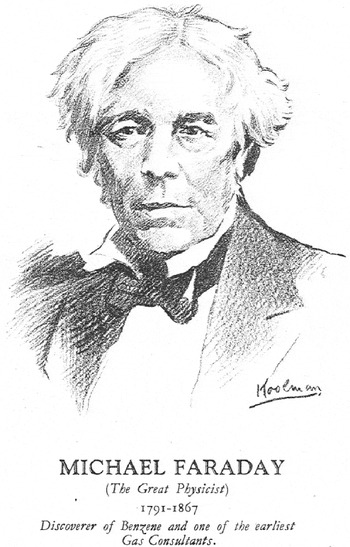
By the 1920s the electrical industry included many organizations devoted to encouraging the use of electricity. During that decade the industry faced the fundamental problem that it was very expensive to develop infrastructure – the means for the generation and distribution of electricity. Without a guarantee of payment by sufficient numbers of customers of what were high prices compared with the well-established technology of gas, it would be difficult to make a worthwhile return on the large amount of invested capital required. Nevertheless, the gas industry saw that electricity presented a threat. Thus during the 1930s the gas industry spent three times more than the electrical industry on promotion,Footnote 13 and indeed successfully fought off, at least for a time, competition from electricity in a number of areas including public lighting.Footnote 14 Indeed, so confident was the gas industry that they sought to appropriate Faraday's image for their own purposes (Figure 1). The profit margins at which the electrical industry operated meant that they could not match the investment of the gas industry in promoting their product. They were thus forced to develop cheaper, but interesting and subtle, approaches to marketing and in this the non-business electrical organizations took the lead.
Faraday's image appropriated by the gas industry: the image is probably related to the 1925 celebrations to mark the centenary of his discovery of benzene. Source: RI MS uncatalogued.
The oldest of these organizations was the Institution of Electrical Engineers, which traced its origins back to the Society of Telegraph Engineers founded in 1871, adopting its new name in 1889. Other institutions which promoted the use of electricity included the Electrical Association for Women and the Electrical Development Association. The former, founded in 1924, sought to encourage women to believe that using electricity would help them overcome their domestic problems. It has been studied extensively in recent years by Gerrylynn Roberts, Lenore Symons, Susanna Reece and Carroll Pursell.Footnote 15
The Electrical Development Association has, in comparison, been little studied, apart from a chapter by Bill Luckin.Footnote 16 Information about the origin of the association is somewhat confused. Luckin suggested that it was founded in 1919 out of the Heating and Cooking Committee of the Institution of Electrical Engineers,Footnote 17 while according to the obituary in The Times of one of its leading figures, Walter Vignoles,Footnote 18 it originated from the Development Committee of the Incorporated Municipal Electrical Association founded following a speech by Vignoles at its 1914 convention. A member of the distinguished engineering and musical family, Vignoles, born in 1874, trained at Finsbury Technical College, as did so many electrical engineers.Footnote 19 He subsequently held a number of positions until 1901, when he was appointed electrical engineer to Grimsby Corporation, where he oversaw the building of the town's power station. His work there was interrupted by army service in France during the Great War. He rose to the rank of colonel, receiving the DSO and bar as well as being mentioned in despatches. He left Grimsby in 1927 on being appointed director of the Electrical Development Association, having served on its Council for a number of years. As director, Vignoles ran a number of campaigns to promote the use of electricity and thus became one of the key figures in orchestrating the events held in 1931 to mark the centenary of Faraday's discovery electromagnetic induction.
In late 1928 Vignoles met the director of the Davy-Faraday Research Laboratory at the Royal Institution, William Henry Bragg, to discuss what might be done. As it happened, at around the same time Bragg had been considering the value or otherwise of centenaries, since the president of the Royal Society, Ernest Rutherford, wrote to him on 25 October 1928 asking what the Royal Institution was going to do to mark the centenary in 1929 of the death of Thomas Young, adding, ‘The number of these centenaries is becoming a nuisance.’ Bragg responded by writing, ‘I agree with you that these anniversaries crowd on one another too much.’Footnote 20
Despite his general reservations, Bragg threw the weight of the Royal Institution behind Vignoles's proposals to mark the centenary of Faraday's discovery of electromagnetic induction. This discovery was regarded as especially important by electrical engineers because the iron ring, with coils wound on opposite sides, with which Faraday discovered induction was seen, if not venerated, as the first electric transformer. Transformers permitted the increase and decrease of voltages with very little energy loss, which in turn meant that high-voltage alternating-current electricity could be transmitted very efficiently through the new national grid. As Bragg's son Lawrence wrote in 1936, ‘It seems almost incredible that anything so simple should be able to hand on energy in such a convenient way.’Footnote 21 In this view, engineering was seen as the mechanism by which the benefits of scientific research were delivered to society. By associating itself with Faraday the electrical industry sought to locate its origin in pure science, a line that meshed well with what William Bragg was doing at the Royal Institution, as Jeff Hughes has discussed.Footnote 22 The message of the dependence of engineering on science would be conveyed and reinforced by the proposed celebrations of the centenary of this specific scientific discovery: hence Bragg's willingness to participate in organizing them.
Thus a couple of weeks later Bragg reported on his meeting with Vignoles to the Managers of the Royal Institution. He said that Vignoles had stated that ‘the Electrical Development Association … was proposing to initiate ceremonies in connection with the centenary of Faraday's discovery of Electro-magnetic induction’. Bragg added that he ‘thought it would be well to get into touch with the Institution of Electrical Engineers and other important bodies so that from the outset the effort might be united in the hands of the most prominent bodies connected with the electrical industry’.Footnote 23 However, the Electrical Development Association was pressing forward with developing its plans, since the following day its Council discussed possible venues for mounting an exhibition devoted to Faraday.Footnote 24
Commemorating science
This would not be the first time that Faraday had been commemorated. To mark the centenary in 1891 of his birth the Prince of Wales (later Edward VII) had presided over a meeting held at the Royal Institution at which John William Strutt, third Lord Rayleigh, delivered a lecture on Faraday's work, and letters praising Faraday were read from various luminaries including John Tyndall, Louis Pasteur, Robert Bunsen, Hermann Helmholtz, August Hofmann, Josiah Willard Gibbs, Stanislaus Cannizzaro and Dmitri Mendeleeff.Footnote 25 Such events did not go unnoticed. In its centenary article The Electrician commenced by commenting, ‘It is rather discomposing to have to associate the idea of the centenary with the name of FARADAY. He and his achievements belong so intensely to our own day that it is a shock to memorialise him as belonging to the past.’Footnote 26 This passage serves as a reminder that even in the late nineteenth century electricity had become closely associated, at least by its practitioners, with the modern world and that Faraday had become one of its chief icons. But modern, by its very meaning, is supposed to eschew the past: hence the rather disconcerted tone of the quotation. Thus right from the start there was a sense that using the past to celebrate the modern had, at its heart, a Janus-like quality. This is a theme to which I shall return.
As Graeme Gooday has noted,Footnote 27 by the time of his centenary Faraday had been adopted by the electrical industry as its founding father, as evinced, for example, by the use of his portrait in the design of the seals of the Institution of Electrical Engineers.Footnote 28 This ascription of paternity was perhaps due to a number of members of Faraday's circle being early presidents of the Society of Telegraph Engineers. Presidents well known to Faraday included Charles William Siemens (who named the first purpose-built telegraph cable-laying ship after Faraday), William Thomson (later Lord Kelvin), Charles Vincent Walker, Frederick Augustus Abel and William Crookes. Furthermore, Faraday's admirer and biographer,Footnote 29 Silvanus Phillips Thompson, was president of the Institution of Electrical Engineers in 1899, although he was too young to have known Faraday personally.
Nor was the proposed celebration in 1931 the first time that the centenary of one of Faraday's discoveries had been commemorated. In 1925 his announcement of the existence of benzene (which he originally called bicarburate of hydrogen) was marked in a number of ways which would, albeit on a much larger scale, be repeated six years later. The key figure in this celebration appears to have been the chemist Henry Edward Armstrong, who chaired a joint committee to organize the centenary celebrations. Members of this committee were drawn from the Royal Institution, the Chemical Society, the Society of Chemical Industry and the Association of British Chemical Manufacturers.
To some extent this celebration can be interpreted, at least as far as Armstrong was concerned, as a reaction against the way in which Faraday had been appropriated by the physical and electrical engineering communities. Armstrong made a strong case for Faraday's importance as a chemist: ‘Few realize … that the foundation stone of the edifice of theoretical chemistry, as well as that of our modern dyestuff and dyeing industries of the wealth of colour now at the disposal of the fair sex, was laid there by the act of the great Faraday.’Footnote 30 The celebrations began on Friday 12 June 1925 with a Friday Evening Discourse at the Royal Institution on Faraday as a chemist, delivered by the professor of chemistry at the University of Cambridge, William Pope.Footnote 31 The following Tuesday, the precise centenary of the day when Faraday's paper was read to the Royal Society,Footnote 32 the president of the Royal Institution, Alan Ian Percy, eighth Duke of Northumberland, received the official delegates representing English and overseas scientific societies, five of whom were made honorary members of the Royal Institution.Footnote 33 These were the usual ways of formally marking such occasions, as we shall again see with the 1931 celebrations. There then followed addresses by ArmstrongFootnote 34 and by Ernst Cohen, the professor of Chemistry at Utrecht and new honorary member of the Royal Institution. The consistent message of all these addresses was that Faraday was the founding father of the chemical industry. Pope stated that the ‘whole of the great coal-tar colour industry sprang from Faraday's study of coal-tar’,Footnote 35 whilst Cohen recounted ‘what the human race owes to Michael Faraday in his capacity of a physical chemist’.Footnote 36
Nor was 1931 the first celebration of an electrical anniversary. In 1927 the centenary of the death of the inventor of the electric battery, Alessandro Volta, was marked by large-scale celebrations centred on the Istituto Carducci in Como.Footnote 37 An electrical exhibition was held there and visitors were offered special train fares. In mid-September there was a meeting of elite physicists including twelve Nobel laureates, among whom was Lawrence Bragg.Footnote 38 As Giuliano Pancaldi has shown, although this celebration was inspired and organized locally, it was extensively funded by the Italian government. They spent the equivalent of thirteen per cent of the Italian state university budget on the celebrations. Indeed, the Italian dictator Benito Mussolini was one of the two honorary presidents of the organizing committee, the other being the Italian-Irish electrical engineer, later member of the Fascist Grand Council, Guglielmo Marconi. This celebration was, of course, in praise of the glory of Fascist Italy, and for the promotion of Como rather than of electricity as such. The local nature of the events accounts for the reluctance of the Italian electrical industry to become heavily involved, and they marked Volta's anniversary in other ways. What is worthy of note is that the Como celebrations contained both popular and elitist elements, which would also be a feature of the 1931 Faraday celebrations.
Scenes from an Exhibition
Thus when Vignoles and Bragg met in late 1928 they had evidence that a large-scale celebration of Faraday's discovery of electromagnetic induction was an entirely feasible proposition and also an indication of some of the problems likely to arise, especially in engaging the interests of the electrical industry. As a result of their discussion the Royal Institution called a meeting of organizations with an interest in commemorating the anniversary. This was held at the Royal Institution on 5 February 1929 under the chairmanship of its treasurer, Arthur Keith. In the room where the meeting was held, the ring with which Faraday had made the discovery and his laboratory notebook recording it were displayed.Footnote 39
Representatives at that meeting were drawn from a formidable group of institutions, listed in Table 1. Some, such as the Institution of Electrical Engineers, sent more than one representative,Footnote 40 while some individuals represented two or more organizations. Those present included Rutherford, Vignoles, Kenelm Edgcumbe (president of the Institution of Electrical Engineers) and John Reith (director general of the BBC), all of whom pledged the support of their respective organizations.Footnote 41
List of organizations invited to attend the meetings at the Royal Institution (RI) on 5 February 1929 and the Institution of Electrical Engineers (IEE) on 17 April 1929. Bold: at RI only, italic: at both RI and IEE, plain text: at IEE only
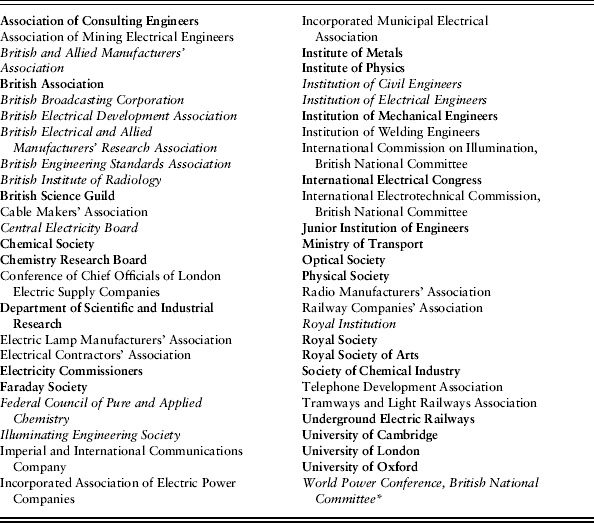
Sources: ‘Faraday Centenary Celebrations, 1931’, Chemical News (1930), 140, 394–5, 395, Bodleian MS Dep BAAS 226, ff. 114–15 and *‘An Electricity Centenary’, The Times, 6 February 1929, 11d.
This was a well-choreographed meeting, with some of the key decisions already taken, for instance that the celebrations would be held during the third week of September 1931. At the outset Keith addressed what at that time was the thorniest issue, namely that in 1931 the British Association, which usually met annually in September, would also be celebrating its centenary. Furthermore, the British Association had already agreed that they would for the first time in their history meet in London. The British Association clearly felt some anxiety that their centenary meeting would be overshadowed, but whether willingly or bowing to the inevitable, John Myres for the British Association said that he would recommend to its Council the ‘most cordial cooperation’.Footnote 42
The main outcome of the Royal Institution meeting was that two committees were formed to organize the events. One was scientific, which the Royal Institution would lead, and the other industrial, which the Institution of Electrical Engineers would lead. The prearranged unanimity displayed meant that the meeting could be open to the press. As a result The Times published a column-length report on it and followed up with an editorial entitled ‘In praise of Faraday’,Footnote 43 which may well have been written by the professor of physics at University College London, E. N. da C. Andrade, who was frequently asked in this period to write editorials on science for The Times. This, taken together with an article in The Times earlier that week by the professor of physics in Berlin, Albert Einstein, which inter alia praised Faraday's theoretical work on the electromagnetic field.Footnote 44 All this publicity emphasizes that one of the key features of the whole celebratory process was the intention to use it to promote electricity as widely as possible using, as a hook to engage general interest in Faraday's discovery and his pre-existing image. Geoffrey Cantor has delineated the highly popular and widespread biographical images of Faraday that emerged in the three or four decades following his death in 1867.Footnote 45 Almost everything written and believed about Faraday in the 1920s and 1930s was based on these accounts.
Vignoles, also a member of the Council of the Institution of Electrical Engineers, reported to them on 14 February 1929: it was agreed that they would draw up a list of organizations to be invited to a meeting hosted by the institution.Footnote 46 The following day Vignoles also reported to the Council of the Electrical Development Association, where he emphasized the publicity that the meeting at the Royal Institution had generated.Footnote 47 The meeting hosted by the Institution of Electrical Engineers was held on 17 April 1929 with representatives from the twenty-nine interested organizations listed in Table 1. Compared to the February meeting at the Royal Institution, there was a distinct absence of representatives from the scientific community, higher education and government departments, including the Ministry of Transport, which was responsible for electrification.Footnote 48 Instead, many of the trade associations linked to the electrical industry sent representatives.Footnote 49 This stresses the separate but coordinated nature of the planned events, but may also be evidence of an unwillingness of some groups to be involved in something explicitly commercial.
The meeting at the Institution of Electrical Engineers appointed a committee of nine, including Edgcumbe and Vignoles, to carry forward plans for its contributions to the celebrations. It is clear that the institution regarded this committee as the industrial committee which it had agreed to establish at the Royal Institution meeting. This committee first met on 2 May 1929 and it was agreed that Vignoles and another member, Charles Rodgers, would prepare a scheme for the exhibition which the Electrical Development Association had had in mind since November.Footnote 50 Over the summer of 1929 Vignoles and Rodgers worked on the report which was considered by the committee at their second meeting on 3 October.Footnote 51 This noted that the Royal Institution would be holding ‘a great Commemorative Meeting’ and other social functions. It was recommended that the Institution of Electrical Engineers should hold an ‘Exhibition to be designed to bring home to the public how much civilization owes to the applications of electricity which are based on Faraday's work’ and that this exhibition should be held in the Albert Hall from 22 September (Faraday's 140th birthday) to 3 October 1931. Somewhat unsurprisingly, in view of Vignoles's involvement, it was recommended that the Electrical Development Association should manage the exhibition. Various sectors and associations of the electrical industry would be invited to contribute to the exhibition, thus spreading the cost of using such an enormous venue. On this idea, the report concluded with the estimate that the Institution of Electrical Engineers would need to raise £10,000 to meet the core costs of the exhibition.Footnote 52 This report was submitted to the Council, which approved it on 7 November 1929.Footnote 53
The task of raising the substantial sum of £10,000 created its own problems, especially as, unlike in Italy, there was no possibility of government financial support. On 21 January 1930 the Institution's Faraday Centenary Committee and its Finance Committee met jointly under the chairmanship of the new president, Thomas Purves. The estimate of £10,000 was broken down into £5,500 for the hire of the Albert Hall, stands and so on; £500 for miscellaneous costs; and £4,000 for publicity. This last figure once again illustrates how important publicizing electricity through this anniversary was to the electrical engineering community. The joint committee suggested, first, that to raise these funds the institution should approach individuals and organizations such as the Electrical Development Association and, second, that a joint appeal with the Royal Institution should be made in the press.Footnote 54
This latter proposal was anathema to the Royal Institution. On 29 December 1927 its electrical substation had exploded shortly after a Christmas lecture had been delivered by Andrade to several hundred children. As a result the Royal Institution had become committed to some very expensive rebuilding and was thus in the midst of a major programme to raise funds.Footnote 55 This must have been made clear to Purves when he met the Royal Institution on 22 January 1930, the day after the joint committee meeting at the Institution of Electrical Engineers. The Royal Institution Managers' minute which followed from the meeting with Purves stated that the cost should be met, if possible, by a private appeal to members of the Institution of Electrical Engineers,Footnote 56 but added that the Federal Council for Chemistry had been invited to support the chemical parts of the exhibition (in the end they contributed £1,642Footnote 57). Furthermore, it was reported to the Managers that ‘the exhibition would not be organized on a commercial basis, and no names of exhibiting firms would appear’.Footnote 58 To say that this was unusual for electrical exhibitions would be a gross understatement,Footnote 59 and I have found nothing to suggest how this decision was reached. But in the context of the Faraday celebrations it was all part and parcel of the effort to foreground Faraday and the benefits of his discoveries rather than promote individual businesses. In many ways this self-effacing policy, which at times amounted almost to anonymity, served to emphasize the increasingly centralized, technocratic nature of the electrical industry.
The next meeting of the Institution of Electrical Engineer's Faraday Centenary Committee, chaired by Purves, held on 7 March 1930, took stock of the situation. The problem must have been quite clear. The idea of a major celebration, though not apparently that of the detailed proposals, had already received considerable press coverage. With only eighteen months to go the financial problem had to be resolved quickly, otherwise some unfavourable publicity could be expected. Vignoles thus proposed that the Institution of Electrical Engineers should bear the entire cost of £10,000 and it was agreed that this would be recommended to the Finance Committee. A publicity subcommittee was formed, with Vignoles as a member, and he also reported the possibility of a special issue of The Times to coincide with the celebration.Footnote 60
The Finance Committee accepted the proposal,Footnote 61 and recommended to Council that the Institution should meet the cost, and on 27 March 1930 they approved this expenditure, minuting laconically, ‘It was also agreed that in view of the above the question of disposing of the Institution's annual surplus would not arise for a year or two.’Footnote 62 With that decision the detailed execution of the proposals could go ahead. The following month Vignoles booked the Albert Hall at a cost of £1,500Footnote 63 and at some point appointed Exhibition Organizers Ltd to undertake the detailed execution of the plans.Footnote 64
Vignoles now took effective charge of the arrangements both for the Times supplement and for the exhibition. As far as the former was concerned, he collaborated with Bragg. Paralleling the structure of the celebrations as a whole, the arrangements for the supplement were split between the scientific and industrial sides. Bragg drew up a list of suggestions for contributors from the scientific side, while in an undated memorandum Vignoles added forty-seven suggestions, mostly related to electrical engineering, as possible topics.Footnote 65 Of these only thirteen made it into the supplement, including the chairman of GEC, Hugo Hirst, who accepted the invitation to contribute a piece on the electrical manufacturing industry in early February 1931.Footnote 66
By early July 1930 the preliminary announcement of the programme outlining the major events had been drafted, and this was issued in early August when it was reported in The Times.Footnote 67 During 1930 Vignoles manoeuvred himself into a position where he was largely unaccountable for his actions, as far as the Faraday celebrations were concerned, either to the Institution of Electrical Engineers or to his employers the Electrical Development Association. In such circumstances it is perhaps not surprising that in October the association advertised for a new director,Footnote 68 appointing Alexander Charles Cramb in Vignoles's place. The following month the association established a Faraday Centenary Celebrations Sub-committee, which first met on 13 November.Footnote 69 One inference that might be drawn from this is that the Association was unhappy at the share of publicity they were receiving from Vignoles's activities. This interpretation is supported by a discussion at the July 1931 meeting of the Association's Council, where there were complaints about the unsatisfactory amount of publicity that it and the other associations had received and significant implied criticism of Vignoles.Footnote 70 While Vignoles was committed to the policy of self-effacement, he clearly had not carried his colleagues with him. After all, they were investing considerable resources in the plans and evidently resented the fact that they were not receiving what they took to be the credit due to them.
One consequence of the changes at the Electrical Development Association was that the Institution of Electrical Engineer's Faraday Centenary Committee met for the first time in nine months on 11 December 1930. At this meeting Vignoles was formally appointed secretary, presumably so that he had a formal position of authority after he had stepped down as director of the Electrical Development Association. The issue of the British Association cropped up again and it was agreed to invite its president, the former Boer commander, imperial statesman and prime minister of South Africa between 1919 and 1924, Jan Christiaan Smuts, to open the exhibition.Footnote 71
The structure of the exhibition display at the Albert Hall had been established by 20 March 1931 when, at a lunch organized by the Electrical Development Association at the Savoy, Bragg described it in his speech reported in The Times:
A statue of Faraday would be the centre of the exhibition. At his feet one his first experiments would be shown and the actual things he used – a piece of wire, a magnet, and a drop of mercury. From this would spread, like the spokes of a wheel from its centre, numerous exhibits showing the marvellous development of electricity in varied forms from that simple experiment.Footnote 72
The statue was a copy by William Fagan of the sculpture by John Henry Foley and Thomas Brock depicting Faraday in academic dress holding his induction ring, which was placed in the Grand Entrance of the Royal Institution in 1876.Footnote 73 Stands A to J (Figure 2) were arranged by the Royal Institution and mostly contained Faraday's original apparatus and manuscripts. The outer stands dealt with the modern technologies which were seen to have stemmed from Faraday's discoveries. Most of these cases contained modern devices, although there were occasional historical objects and reproductions of historical items. There was some attempt, though not in every instance, to group the modern with the most relevant part of Faraday's work. Discharge tubes went with telephone and radio, while electrostatics went with telegraphy. All these outer cases were arranged (that is, paid for) by a variety of organizations, mostly trade associations, but also the Post Office and the BBC. But in addition a large number of other organizations and businesses contributed funding, loaned objects and helped in kind. The list of all these bodies ran to ten pages in the 248-page catalogue of the exhibition edited by Vignoles,Footnote 74 doubtless a concession by Vignoles to his critics.
Layout of the stands at the Albert Hall Faraday Centenary Exhibition, 23 September–3 October 1931. Bold: displays of Faraday apparatus and manuscripts, italic: displays of modern electrical technology, plain text: names of organizations responsible for the modern displays. Source: W. A. Vignoles (ed.), Faraday Centenary Exhibition 23rd Sept to 3rd Oct 1931 Souvenir Catalogue and Guide, London, 1931, 3.

On the first floor in the King's Room of the Albert Hall the Wellcome Historical Medical Museum constructed a reproduction of Faraday's basement laboratory in the Royal Institution, based on an 1850s watercolour by Harriet Moore.Footnote 75 This exhibit was a late addition to the Albert Hall displays and may well have been proposed by Henry Wellcome himself in May 1931.Footnote 76 In the rehearsal room on the same floor was shown a film of Bragg telling the story of Faraday's life which had been premiered shortly before on 15 September at the Marble Arch Pavilion before going on general release.Footnote 77
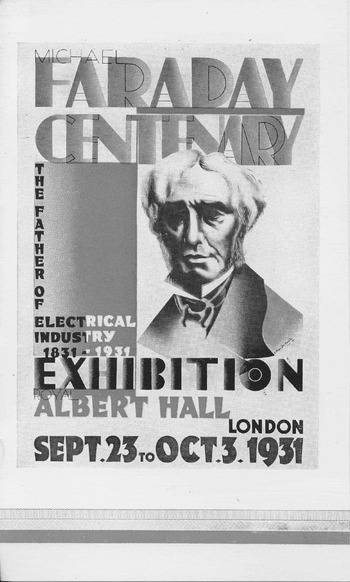
One of the key messages of the exhibition was the association of electrical technology with modernity. This was achieved in a number of ways, but I want to draw specific attention to two here. First, the publicity poster and leaflet were designed by the well-known American-born and French-trained influential avant-garde poster designer Edward McKnight Kauffer (Figure 3).Footnote 78 Second, the lighting design for the exhibition was expressed in the language of modernity. Above Faraday's statue the central light fitting, designed by the twenty-seven-year-old architect Ralph Waldo Maitland of the Lighting Service Bureau,Footnote 79 was forty feet (or just over twelve metres) tall and weighed six hundredweight (or just over three hundred kilos), and produced twenty-five kilowatts of light (Figure 4).Footnote 80 Indeed, rather ironically, the total electrical load requirement for the exhibition was such that the Albert Hall had to increase its capacity at a cost of £250, to which Vignoles agreed to contribute £50.Footnote 81
Edward McKnight Kauffer's leaflet for the Faraday Centenary Exhibition. 12.7×20.9 cm. Source: RI MS uncatalogued.
Photograph of the Faraday Centenary Exhibition at the Albert Hall, showing the central lighting feature, the statue of Faraday immediately beneath and displays radiating from the centre. Source: Journal of the Institution of Electrical Engineers (1931), 69, opposite 1330.

The great Commemorative Meeting
Meanwhile the Royal Institution had been organizing its ‘great Commemorative Meeting’. From the start this was conceived to be a very grand affair indeed. At the beginning of 1930 the new treasurer of the Royal Institution, Robert Robertson, had lunch with Reith and asked him if the Royal Institution could use the Queen's Hall for the Faraday celebrations. As this would be in the middle of the Prom season, it potentially created a problem, but following his undertaking given nearly a year earlier Reith said the BBC would do it.Footnote 82 The following day Robertson wrote thanking Reith for his agreement and especially for breaking the Prom tradition of thirty-five years. He wrote, ‘Let us hope that a compensation will be to bring home to those who listen to the music at the Promenade concerts that it is to Faraday they are indebted for this boon, as for much else of importance and convenience in our daily life.’ The letter also confirmed that the date of the meeting would be 21 September 1931 and that Reith had agreed that the meeting, which Robertson hoped would be held under the highest authority, would be broadcast.Footnote 83
The Royal Institution's general secretary, Thomas Martin,Footnote 84 followed this up with a letter to settle details on which someone in the BBC noted that Wood should be informed that the decision to hold the Faraday meeting in the middle of the Proms was a fait accompli.Footnote 85 Martin's attempt to settle the details revealed a major problem, which was that the BBC had not yet booked the Queen's Hall for the 1931 Prom season. Although Reith made soothing noises,Footnote 86 this lack of certainty gave rise to considerable anxiety at the Royal Institution. By July this had still not been settled and Martin wrote a strongly worded letter to the BBC which resulted in the BBC making a pencilled booking of the Queen's Hall to hold the Proms there in 1931.Footnote 87
By the end of 1930 the structure of the commemorative meeting had been decided, but not the precise speakers, as Martin reported to the committee of the Institution of Electrical Engineers in December. He said he hoped that the Prince of Wales, Bragg and Rutherford would speak.Footnote 88 The BBC did not agree to the structure of the meeting until 20 March 1931,Footnote 89 when Reith, together with Cecil Graves (assistant director of programmes) visited the Royal Institution, ‘seeing Faraday's famous cellar again’ and meeting with Bragg – ‘one of the nicest men I have ever met’.Footnote 90 Three days later Martin told the BBC that American electrical engineer Arthur Kennelly wanted to rebroadcast the meeting on American wireless.Footnote 91 This opened a new set of issues: in mid-June the BBC wrote directly to the Prince of Wales's secretary asking him for permission to relay the broadcast overseas; permission was granted, but with the worrying caveat ‘if he speaks at all’.Footnote 92 Arrangements for overseas transmission went ahead and it was agreed that NBC would take it in New York, provided Bragg could time his talk to start at precisely 9.21, which was agreed.Footnote 93
In the meantime the Royal Institution was seeking to secure the involvement of the prime minister. In early March 1931 the new president of the Royal Institution, the Conservative MP for Hastings Eustace Percy, wrote to MacDonald to invite him to take part in the Faraday celebrations, which he said (rather oddly) were in an ‘embryo stage’.Footnote 94 MacDonald replied, saying that he had some remote but affectionate connection with Faraday and the Royal Institution.Footnote 95 This was a reference to his late father-in-law, the chemist John Hall Gladstone, who had written the third book-length biography of Faraday to be publishedFootnote 96 and had been the third holder of the Fullerian Professorship of Chemistry at the Royal Institution which had been established especially for Faraday in 1833.
Since MacDonald's original career intention was to be a geologist, his letter might also imply that he had attended lectures at the Royal Institution when first in London in the late 1880s. He certainly attended lectures at Birkbeck College and heard Thomas Huxley lecture at the Geological Museum in Jermyn Street. MacDonald was a close friend of the biochemist Frederick Hopkins and of the editor of Nature, Richard Gregory. Generally throughout his political career he was interested in science policy and following his departure as prime minister in 1935 he became responsible, as Lord President of the Council, for, among other things, the Department of Scientific and Industrial Research.Footnote 97
MacDonald told Percy confidentially that in September and October he intended to visit India to achieve a final settlement and also undertake an extended tour of the Dominions to bring them closer to Britain. He was thus unwilling to commit himself to a speaking engagement in September which would restrict his freedom of action.Footnote 98 However, by July, with the looming crisis of the end of the minority Labour government which MacDonald had headed since June 1929, and the formation of the coalition National Government in August 1931 with the Conservative and Liberal parties, MacDonald's imperial concerns disappeared from the agenda and he was free to accept the invitation to speak on Faraday at the Queen's Hall.Footnote 99 Unfortunately, further correspondence relating to this has not been found, nor has any relating to his agreement to host a government dinner at the Dorchester on Friday 25 September 1931. The tone of his March letter to Percy does suggest that he would accept the invitation if he could.
During 1931 enormous efforts were expended in publicizing the forthcoming events and the firm of Cecil Holmes Waghorn were appointed publicists. Beyond a couple of press releases (mostly relating to the exhibition),Footnote 100 no documentation relating to their role has been found, but, judging by the amount of newspaper coverage that the events received, they were effective. On 4 March Bragg delivered a BBC National Lecture simply entitled ‘Michael Faraday’, published both in the Listener and as a separate pamphlet.Footnote 101 Faraday-related stories were reported in the press throughout the year. These included the unveiling on St George's Day of a plaque to Faraday in the control room of the new Battersea Power Station, which was performed by telephone from Ottawa by the Governor General of Canada and former director of the London Power Company, the ninth Earl of Bessborough.Footnote 102 The reopening of the Royal Institution in May, a Faraday conversazione at the Athenaeum (of which he had been the first secretary) and the preparations for September were all reported in The Times. Footnote 103 On 29 August Nature published a forty-page supplement containing tributes and appreciations of Faraday almost entirely written by overseas scientists including Venkata Raman and Pieter Zeeman.Footnote 104 At the beginning of the month the Oxford radiochemist Alexander Russell included a discussion on Faraday in an article entitled ‘Annus mirabilis. 1931’ published in the Nineteenth Century and After,Footnote 105 while on 19 September it published a six-page article on the history of the Royal Institution generally.Footnote 106 Bragg wrote a piece on Faraday for the Illustrated London News,Footnote 107 published the same day, accompanied by a magnificent photograph by Margaret Bourke-White entitled ‘The march of the dynamos’ (Figure 5).
Margaret Bourke-White's photograph ‘The march of the dynamos’. The caption read ‘Power from dynamos made possible by Faraday's great discovery one hundred years ago’. 20×28.5 cm. Source: Illustrated London News (1931), 179, 445.

The events
By the beginning of September everything was planned and construction of the exhibition in the Albert Hall started on 14 September. On 19 and 20 September the Royal Institution was opened to receive the delegates, who were given, amongst other things, a map showing the location of the various events, a name badge with the monogram MF, which the Australian geographer Charles Fenner described as ‘beautiful’,Footnote 108 and a list of delegates and guests.Footnote 109 This last item continued the policy of self-effacement apparent elsewhere in the celebratory events. While those appearing on the list were given, though not invariably, their pre-nominals, there were no post-nominals whatsoever. In contrast to the Como meeting, unless one knew (as many probably did) there was no way of telling from the list who, for example, was a Nobel laureate.
On the Sunday afternoon the events began with a private ceremony in Highgate Cemetery. The secretary of the Royal Institution, Charles Phillips (with whom Bragg had a difficult relationshipFootnote 110), and Clifford Paterson, president of the Institution of Electrical Engineers, laid wreaths on Faraday's grave in the presence of members of his family.Footnote 111
On the morning of 21 September the supplement to The Times was published, but of course the main part of the paper contained news of the crisis. The supplement (which was translated into French and published by the Société française des electriciens as a quite substantial bookFootnote 112) contained thirty-five articles by thirty-three authors. Bragg and Robert Hadfield contributed two each. The vast majority of articles were overwhelmingly historical in subject, concentrating mostly on specific aspects of Faraday's life and work, but there were also articles about the contemporary use of electricity, including one by Gregory reminding readers that already the British electrical industry was capitalized to the amount of £500,000,000.Footnote 113 Figures such as this were frequently bandied about and were intended to convey an impression of the vast economic significance of the electrical industry, rather than precision. In his speech later in the day Bragg compared the income of the American electrical industry to the interest on the British national debt.Footnote 114 Not to be outdone, the Daily Telegraph devoted two pages of articles that day to Faraday and the consequences of his work, followed by another two pages three days later.Footnote 115
Although the articles in The Times emphasized Faraday's work in the creation of the modern world, starting with the opening headline of the supplement ‘Faraday Celebrations 1931: Michael Faraday by his discovery of electro-magnetic induction in 1831 brought electricity into the service of man’,Footnote 116 it was the adverts that drove home the relationship between electrical technology and modernity. For really the only time in the official events, electrical businesses could make their specific contribution to the celebrations by paying for adverts in The Times. The headline that Metropolitan-Vickers used in their advert was ‘The modern expression of Faraday's work’,Footnote 117 whilst that of Phillips depicted Faraday against a background of a strikingly modern building with the heading ‘Look Faraday! See what we have done with your coils’.Footnote 118 The Siemens advert reminded readers that the founders of the firm had known Faraday and depicted the (by now decommissioned) CS Faraday,Footnote 119 the advert of the Incorporated Association of Electric Power Companies depicted Faraday throwing open the dark doors of 1831 to reveal the modern electrically lit and powered world of 1931,Footnote 120 and so on. Once again the Janus nature of the events is in evidence: the modern thrust of all the adverts and of a small number of the articles, counterpoised against historical articles.
The opening ceremony, presided over by Percy, was held in the completely refurbished lecture theatre of the Royal Institution. There about three hundred representatives of universities as well as of scientific and engineering societies throughout the world were welcomed. As each name was read out, the delegate stood and bowed to Percy, and their names were projected on the screen, together with an image of the town or institution that they represented.Footnote 121 Seventeen new honorary members of the Royal Institution were then introduced.Footnote 122 Fenner wrote in his diary,
a most wonderful function. I should consider it to be the most inspiring function I have ever or shall ever attend. So the memory of Michael Faraday, in the beautiful and sumptuous hall where he lectured, all the great men, mostly physicists, from all lands of the world – from Guatemala and Spain – to the greater scientific countries, not excluding India, China and Japan.Footnote 123
No one could have anticipated that the gold-standard crisis would occur at exactly the same time and this was to cause severe problems with the Queen's Hall commemorative meeting that evening. The meeting was attended by the delegates who had been at the opening at the Royal Institution earlier in the day, and they were joined by official guests (such as ambassadors and high commissioners),Footnote 124 as well as members of the Royal Institution and of the Institution of Electrical Engineers (who had been allocated an equal number of tickets). In addition eight hundred seats had been allocated to the public, with preference given to members of scientific societies.Footnote 125 The capacity of the Queen's Hall was approximately 2,450, and while it is not clear whether it was filled completely, the quality of the audience was extraordinary. It included thirteen Nobel Prize-winners and a further twelve who would win the prize, as well as 104 Fellows of the Royal Society (or twenty-three per cent of the total fellowship) and a further thirty-four who would be elected to the society.Footnote 126
However many there were in the audience, they had taken their seats by 7.30 p.m. and the meeting began as planned (Figure 6). As MacDonald wanted to keep the nation calm, he honoured his appointment, despite having to supervise the necessary enabling legislation through both houses of Parliament. The real problem arose because of the need for the chancellor, Philip Snowden, to broadcast to the nation a speech, of just under twenty minutes, immediately after the nine o'clock news, starting at 9.15.Footnote 127 This entailed a frantic rejigging of the Faraday programme, which doubtless had a significant impact on the NBC link as Bragg was now retimed to start half an hour later at 9.52. Wood received instructions to start Dorabella from the Enigma Variations by Edward Elgar at 9.30 and 15 seconds so that the broadcast could resume at 9.34 with the Scherzo from the Octet by Felix Mendelssohn.Footnote 128
The platform party at the Royal Institution's Faraday Commemorative Meeting at the Queen's Hall, 21 September 1931. Ramsay MacDonald and Ernest Rutherford sit on the left. In the row behind are members of the BBC Symphony Orchestra. Source: Graphic, 26 September 1931, 415.

Despite all this MacDonald began speaking according to the original schedule, at five past eight. He commenced, as one might expect, by emphasizing the importance of Faraday's work: ‘Without Michael Faraday there would have been no broadcast.’ However, he turned quickly to Faraday's character, emphasizing his enthusiasm, his simplicity, his lack of ambition, his conscience and the contradictions in his personality – ‘What a miserable personality that has no contradictions!’ – suggesting Faraday's was like a Gothic façade.Footnote 129 I find this a quite remarkable speech and one difficult to analyse. It never explicitly used Faraday as a text to suggest how the nation should behave itself, which had been one of MacDonald's intentions, as he had told Harmsworth earlier in the day. Perhaps MacDonald believed that his listeners would understand his words in the context of the crisis, perhaps MacDonald was recollecting conversations with his father-in-law (who had known Faraday well), or perhaps he was projecting aspects of his own character onto Faraday under the strain of the day. The Times did, however, report the speech under the headline ‘A guide to youth’.Footnote 130 Afterwards MacDonald returned to the Houses of Parliament for the completion of the legislation which ended with the Royal Assent, given at Balmoral late in the night. It is little wonder that, under such strain, MacDonald broke down the following morning and was sent off to Sandwich. His unusually laconic diary entry for 21 September simply noted, ‘Officially off gold standard. Interviews innumerable & Faraday speech at Queen's Hall at 8 p.m. Day of arduous labour.’Footnote 131
Reactions to MacDonald's speech were mixed. Reith thought, ‘The P.M. spoke fairly well, but nothing like as good as he might have done’,Footnote 132 while the science correspondent of the Manchester Guardian and Communist Party member J. G. Crowther wrote in his autobiography,
MacDonald rose and made some sententious remarks about science. It was not his speech, but his deportment, which was remarkable. He was red-faced and stooping, the acme of a hypocrite. The contrast with Bragg and Rutherford beside him made it all the more conspicuous; never were the straightforward characters of Bragg and Rutherford more impressive.Footnote 133
Nevertheless, Punch picked up on MacDonald's scientific interests the following month with a whole-page cartoon by Bernard Partridge depicting him as a white-coated chemist mixing together flasks labelled Labour, Conservative and Liberal.Footnote 134 Furthermore, the Evening Standard published a wonderful cartoon (Figure 7) by David Low directly linking MacDonald's interest in Faraday with the crisis. This was based on two images that were widely disseminated during the celebrations. These were Moore's watercolour of Faraday's laboratory and a photograph of Michael Faraday, whom in the cartoon Low rendered as MacFaraday, and Sarah Faraday, rendered as Conservative Party leader and Lord President (in effect MacDonald's deputy), Stanley Baldwin, looking over his shoulder.
David Low's cartoon, ‘Political electricity’, combining the Faraday celebrations with the simultaneous financial and political crisis. Source: Evening Standard, 25 September 1931, 12. For a discussion of Low's scientific cartoons see Jon Ayer, ‘Technology and British cartoonists in the twentieth century’, Transactions of the Newcomen Society (2004), 74, 181–96.

The following day the celebrations moved to the Kingsway Hall, where the Institution of Electrical Engineers had organized a conference snappily entitled ‘The place of electricity in the production and utilisation of power, and in transport, communications, and the household’. This was addressed by, among others, Paterson, Oliver Lodge and the director of the Electrical Association for Women, Caroline Haslett (Figure 8).Footnote 135 In the evening there were two conversaziones. One was held at the Royal Institution, at which Bragg demonstrated some of Faraday's experiments.Footnote 136 The other, in the Albert Hall, arranged by the Institution of Electrical Engineers, was attended by about three thousand people in evening dress. There William Cramp delivered the Institution's annual Faraday lecture, ‘The birth of electrical engineering’,Footnote 137 and, of course, there was a private view of the exhibition.
The platform party at the meeting on the practical use of electricity organized by the Institution of Electrical Engineers at the Kingsway Hall, 22 September 1931. Caroline Haslett, Director of the Electrical Association for Women, is on the left. Source: The Electrical Age for Women, January 1932, 281.

I do not want to leave the impression that the celebrations were an entirely London-centred affair, although there were also smaller exhibitions of Faraday-related material at the British MuseumFootnote 138 and the National Portrait Gallery,Footnote 139 as well as a conversazione at the Royal Society.Footnote 140 The involvement of the BBC at the very least ensured that there was a national, indeed international, dimension. When BBC Scotland sought to opt out of the Queen's Hall broadcast they were quickly slapped down by being told that this would be ‘unwise’.Footnote 141 At a regional level the Manchester branch of the Institution of Electrical Engineers organized a conversazione in the Whitworth Hall on 21 September.Footnote 142 Many public buildings throughout the country were floodlit electrically. This was connected to the meeting of the International Illumination Congress held during the first half of September in various locations. While not strictly related to the Faraday centenary, their programme was pressed into association with the Faraday celebrations.Footnote 143 The ladies of the Rugby branch of the Electrical Association for Women put on a display of washing, ancient and modern (Figure 9).Footnote 144 Furthermore, celebratory events were organized by branches of the Institution of Electrical Engineers in Australia and New Zealand.Footnote 145 Nor was electricity the only product marketed using Faraday at around this time. Oxo decided to use him for their own advertising with a poster depicting Faraday and his giant electromagnet, with the words ‘Faraday gave us Electricity. Give me OXO for Current Strength’.Footnote 146
The ladies of the Rugby branch of the Electrical Association for Women celebrate the centenary of Faraday's discovery of electromagnetic induction in their own way. Source: The Electrical Age for Women, January 1932, 282.

On the Wednesday Smuts opened the centenary meeting of the British Association at the Albert Hall and welcomed each official delegate, some four hundred in total, personally. In the evening at Central Hall, Westminster, Smuts delivered his Presidential Address,Footnote 147 which was broadcast. Before that, at four o'clock in the afternoon, he opened the Faraday Exhibition in a broadcast speech.Footnote 148 Doubtless briefed by the self-effacing Vignoles, Smuts said, among other things, ‘This Exhibition serves no propaganda or publicity purpose; it is simply and solely an act of homage to Michael Faraday, the man and the scientist.’Footnote 149 The London branch of the Electrical Association for Women seems to have approved of the policy of self-effacement, since they thought the exhibition ‘particularly noteworthy for the way in which all trade names and competitive feelings had been obliterated’.Footnote 150
Shortly after the close of the exhibition Vignoles estimated that in the eight full days it was open it had received fifty thousand visitors (or over six thousand a day),Footnote 151 each paying their shilling, or sixpence if they were children. He later reported that 398 schools had organized visits by 13,179 pupils.Footnote 152 Such figures were in line with what the Institution of Electrical Engineers had expected in terms of gate receipts, although money generated came nowhere near meeting the overall cost of the exhibition. However, Vignoles also reported that the exhibition had generated 30,946 column inches in newspapers, magazines and so on, which he calculated was worth nearly £43,000.Footnote 153 While his concerns here appear to be somewhat at variance with Smuts's speech opening the exhibition, they are nevertheless consistent with his overall approach. He wanted to use Faraday's image to promote a view of electrification independent of business interests and, at the same time, cement the association of electricity with modernity. However, he had clearly learnt that he also had to satisfy the business interests of the electrical industry, who needed to be convinced that their investment had been worthwhile, hence his willingness to publish the press figures in the Journal of the Institution of Electrical Engineers, which would probably not be read by too many outside the industry. There was thus as one might expect a divergence between the public rhetoric of the events and the manner in which they were organized.
MacDonald's breakdown meant that he was not able to host the dinner at the Dorchester on the Friday and his place was taken by the foreign secretary, leader of the House of Lords and former viceroy of India, the Liberal Rufus Isaacs, Marquess of Reading. He had close connections with Imperial Chemical Industries and with the Mond family, who had endowed scientific research at the Royal Institution. This again illustrates the closeness of the leadership of the National Government with the scientific community. The dinner, followed by the ball of the Institution of Electrical Engineers, had a mixed reception. Reith ‘was exceedingly bored’ with the rotten speeches and left,Footnote 154 while a New Zealand delegate, Duncan Sommerville, thought it was a ‘brilliant banquet’.Footnote 155 Apart from the Albert Hall exhibition, the Faraday commemorative events were concluded with the dinner at the Dorchester.
With minor exceptions, press coverage was enthusiastic across most of the political spectrum.Footnote 156 The Graphic (independent) ran a whole page of photographs of some of those who attended the events.Footnote 157 Peter Ritchie Calder wrote in the Daily Herald (Labour) of the ‘world of ultra-modern achievement’ displayed in the exhibition.Footnote 158 The Daily Mirror (independent; it had headlined its wireless listings ‘Faraday Night on the National’ together with images of Rutherford and BraggFootnote 159) commented, ‘Few modern women realise how much they owe to Michael Faraday. But their debt will be evident if they visit the Faraday Centenary Exhibition.’Footnote 160 Writing anonymously in the Manchester Guardian (Liberal), Crowther turned Faraday into a hero of the working class and wondered ‘how many of his discoveries were due to class-difference’.Footnote 161 The paper's report commented that the keynote of the speeches at the Queen's Hall ‘was the influence of Faraday's work on our modern world’.Footnote 162 Precisely the same phrase was used by the Morning Post (Conservative),Footnote 163 which suggests that journalists were relying, as is their wont, on a press release. In the first issue of Action edited by Harold Nicolson, the organ of the New Party founded by Oswald Mosley earlier in the year after he had left the Labour Party, the science writer Gerald Heard struck a slightly discordant note about the purpose of the celebrations when he wrote that ‘Faraday's aim and attainment was not to make money, but to make discoveries’.Footnote 164
Like the Volta celebrations in Como, the Faraday events had been a mixture of the formal for the elite, such as the presentation of delegates, and the open for the general public, such as the exhibition and the Times supplement. It was particularly important for the exhibition to be successful as it had been heavily supported by the entire electrical industry, which contrasts with the Italian experience of four years earlier.
After 1931
The continuing impact of the celebrations can be seen through the effects of the large number of associated publications. These included a seven-volume edition of Faraday's laboratory notebooks edited by Martin.Footnote 165 Since its publication this has proved an invaluable resource not only for historians of science,Footnote 166 but also for scholars in other disciplines.Footnote 167 Martin went on to become one of the founders of the British Society for the History of Science in 1947 and was the first president to be drawn from the Royal Institution.
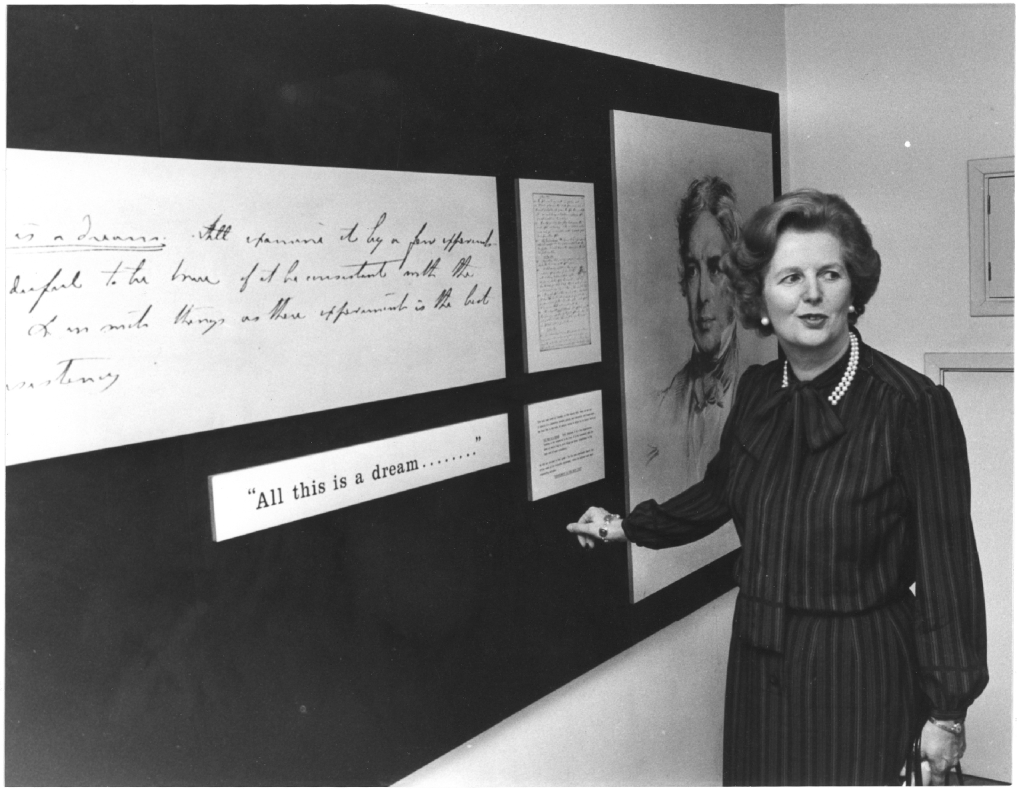
However, the vast majority of publications associated with the 1931 celebrations were hagiographical and many were ephemeral. The Electrical Development Association published a twelve-page pamphlet, Faraday: The Story of an Errand-Boy Who Changed the World, and distributed 95,000 copies.Footnote 168 As with the rest of the celebrations, this pamphlet pushed home the message of the centrality of Faraday's scientific research to modern electrical engineering. The wide circulation of this and other similar publicationsFootnote 169 doubtless had an influence on an impressionable lower middle-class chemistry undergraduate at the University of Oxford in the 1940s. Margaret Roberts was so influenced by the story, as told, of Faraday's rise by his own efforts from obscurity to fame, that it seems to have contributed to the development of her political views as Margaret Thatcher (Figure 10).
Margaret Thatcher, with handbag, visiting the Faraday Museum at the Royal Institution, 22 October 1980. Source: RI MS uncatalogued.
The success of the 1931 celebrations ensured that Faraday's basement magnetic laboratory in the Royal Institution (not the same as that reconstructed in the Albert Hall), which had survived more by accident than by design from Faraday's time, was reconstructed precisely as found when a structural steel frame had to be inserted into that part of the building in the mid-1930s.Footnote 170 The space was filled with some of Faraday's original apparatus, while the remainder was displayed in specially built cabinets on the first floor. In 1972 and 1973 the basement laboratory was rearranged and an adjoining new museum devoted entirely to Faraday was constructed,Footnote 171 and the Royal Institution is currently (2008) completing a major programme of reinterpreting that area.
After 1945, with the framework for electrification largely complete, and indeed the electrical generation and distribution companies nationalized by the end of the decade, Faraday's reputation took something of a dip with the public at large. He presented problems to scientists and engineers in the second half of the twentieth century. Both his religious beliefs and his style of doing science were entirely at variance with their practice of science and engineering. There was a tendency, not just in the case of Faraday, to separate widely admired discoveries from the historical figure. This approach presumably accounts for the number of universities, many with no obvious connection to him (such as University of Manchester Institute of Science and Technology and the Universities of Southampton and Lancaster), that named buildings after Faraday in the expansion of the university system in the 1960s.
In terms of public awareness of Faraday there were a number of key events from 1979 onwards that contributed to a renewal of his general fame. In that year Thatcher became prime minister and in 1982 she asked the Royal Institution to lend Downing Street the bust of Faraday by Matthew Noble.Footnote 172 This became the first thing that visitors saw when they entered 10 Downing Street until it was returned during John Major's term of office in 1996.Footnote 173 Despite her admiration for Faraday, which she announced in 1987 on the Russell Harty television programme My Favourite Things,Footnote 174 the government pursued a policy of reducing both the science and university budgets. Indeed Thatcher suggested that the example of Faraday showed that one could become a successful scientist without attending university(!). But, like Gregory and Bragg before her, she did appreciate the monetary value of Faraday's work, which, as she said in a 1988 speech to the Royal Society, must exceed the capitalization of the Stock Exchange.Footnote 175
Apart from electing her a Fellow of the Royal Society in 1983, one of the scientific community's responses was in 1985 to establish a joint Committee on the Public Understanding of Science (COPUS) of the Royal Institution, Royal Society and British Association.Footnote 176 The founder chair of this committee was George Porter, for a short period simultaneously director of the former and president of the latter two organisations. The mission of COPUS was to increase public awareness of science in the (deliberately unstated) hope that this would persuade the government to reverse its funding policies. One initiative that the committee proposed was to establish an annual prize awarded to a practising scientist who had made significant contributions to the public understanding of science. This was named the Faraday Award and the Royal Society added it to their portfolio of prizes – further evidence of Faraday's returning reputation.
The second key event was the bicentenary of Faraday's birth, celebrated in 1991. In preparation for this, in 1989 the Duke of Kent unveiled near Waterloo Bridge a bronze copy of Foley and Brock's statue of Faraday,Footnote 177 one of the very few outdoor statues in London devoted to a scientific figure. Though not on the scale of 1931, the bicentenary events were quite diverse,Footnote 178 but they lacked the coherence of the earlier celebrations, in terms of both organization and content. They included an excellent exhibition at the National Portrait Gallery, sponsored by the National Grid, for which a useful guide and educational material were produced.Footnote 179 There was also an exhibition at the Science Museum, sponsored by London Electricity, where the same rhetoric (‘Michael Faraday: The Father of Electricity’, as the poster put itFootnote 180) from the 1930s continued to be deployed despite the best efforts of professional historians of science, such as J. V. Field, involved in developing the exhibition; it was, however, partially redeemed by Tim Hunkin's postmodern interpretation of Foley and Brock's statue of Faraday (Figure 11).Footnote 181 The sponsorship of these exhibitions by two of the newly denationalized electrical companies suggests that, as with 1931, the industry realized the value of using Faraday to promote its new identity to the general public. Some further public interest was engaged by the issue of a poorly designed postage stamp and the naming of a 225 electric railway engine after Faraday.Footnote 182
Tim Hunkin's postmodern interpretation of Faraday's statue for the Science Museum's 1991 Faraday bicentenary exhibition. The wire from each modern device passed through Faraday's ring and was activated in turn. Source: Tim Hunkin.

But outside the business and museum worlds, and despite the efforts in the second half of the 1980s of sections of the scientific community to promote science to larger publics, many of the 1991 celebrations were inward-looking and provoked criticism on that account. Three one-day conferences were organized separately by engineers, scientists and historians who talked only to members of their own professions and certainly did not seek to engage broader participation even amongst themselves.Footnote 183 Controversially, the holding of a memorial service at Westminster Abbey attracted criticism on the grounds that it was entirely inappropriate to hold an Anglican service for someone who would never have set foot in the abbey.Footnote 184
Third, and perhaps most significantly, a new twenty-pound note which replaced William Shakespeare with Faraday was issued by the Bank of England. One cannot help but suspect that the prime minister herself gave backing for this note, which drew complaints from a number of people, epitomized by Peter Brookes's cartoon in The Times depicting, on a faux banknote, Faraday in his laboratory, scratching his chin and, in Hamlet mode, holding Shakespeare's head.Footnote 185 The note was withdrawn in 1999 on the grounds that it was easily forgeable.Footnote 186 It has not been possible to document any direct influence that Thatcher had on Faraday's increasing reputation in the 1980s and 1990s. But can it be entirely coincidental that one of the major programmes of the Department of Trade and Industry was the Faraday Partnership launched under Major in 1997? Nor can it be a coincidence that the front cover of the Penguin 1986 abridged edition, with an introduction by that apostle of Thatcherism Keith Joseph, of the ‘management classic’ Self-Help first published by Samuel Smiles in 1859, depicted Faraday chairing a high-powered boardroom meeting.Footnote 187
As with 1931, 1991 inspired a number of publications of varying quality. On the scholarly side there was a major study of Faraday's religion and the first volume of his extant correspondence was published.Footnote 188 There were also the hagiographical texts, which largely ignored modern scholarship and retained the approach of the nineteenth-century biographies.Footnote 189 In the ensuing years texts of these types have continued to be produced, partly because Faraday is on the National Curriculum,Footnote 190 but also because some authors wish to use such texts, especially in the United States, to show that there is no inherent conflict between science and Christianity; they believe that Faraday is a good figure with which to achieve this end.Footnote 191
Modernity, politics, electricity and Faraday
The modern and historical approaches taken towards Faraday in 1931 were an integral part of a network of ideas relating to electrification prevalent throughout the 1930s. Electrification became strongly connected with modernity through many channels; indeed a case could be made that the increasing pervasiveness of electrification, taken together with the development of the London underground system (itself electrically driven),Footnote 192 was one of the major ways in which the modern aesthetic reached a large audience.
Many examples might be cited illustrating this point in a variety of social and cultural contexts. In 1933 the modernist poet Stephen Spender published ‘The Pylons’, the penultimate stanza of which ended, ‘There runs the quick perspective of the future’,Footnote 193 whilst in his mid-1930s film The Face of Britain Paul Rotha extolled the virtues of the national grid of pylons marching across the countryside.Footnote 194 But all was not what it seemed here, for the very word pylon looked to the past, derived from a Greek word for an ancient Egyptian architectural feature which, in that sense, first seems to have entered the English language in the mid-nineteenth century. Furthermore, the Central Electricity Board appointed the anti-modernist architect Reginald Blomfield as its adviser on the design of pylons.Footnote 195 This appointment was presumably made in an attempt to provide a counterweight to the opposition encountered from those objecting to the construction of the national grid over the countryside.Footnote 196
As a final example, Kilowatt House in Bath is particularly pertinent to my theme. This modernist house, named after a unit principally used electrically, was designed by Molly Taylor in the second half of the 1930s while she was in her twenties. She belonged to a family architectural practice in Bath, but because Bath was and is a historic stone-built Georgian city, the practice insisted that she did this building on her own account. They did not wish to be seen to be associated with a project that compromised Bath's heritage. Furthermore, the city council insisted that it be hidden behind trees, so as not to be visible from the road.Footnote 197 Thus a political accommodation had to be made between the past and the modern.
Wherever one looks in the 1930s, in terms of either engineers or scientists, the broader public or politics (where electricity became, as discussed above, the first industry after the Great War where modern state regulation was applied), one sees that the promotion of electrification was Janus-faced. Although the association of electrification with modernity was crucial, at the same time and seemingly paradoxically it was impossible to escape the past. The precise reconstruction of Faraday's laboratory in the Royal Institution, immediately next to one of the most modern X-ray crystallographical laboratories in the world, illustrates how scientific institutions looked both backwards and forwards simultaneously. In politics, MacDonald thought he could invoke the past through Faraday's character to calm the nation at a time of a very modern crisis provoked by a desire to return to the world as it had existed before 1914. Even in the 1980s Thatcher used the name of Faraday as a symbol for her social and economic policies and notoriously harked back in 1983 to the days of ‘Victorian values’.Footnote 198 The 1931 Faraday celebrations drew on and helped sustain that Janus approach in order to propagate a vision of the future role of electricity in society into a brave new world. It is hardly a coincidence that at precisely the time of the 1931 celebrations Aldous Huxley, an admirer of Faraday's,Footnote 199 was writing his dystopian parable shot through with electrical imagery, including neo-Pavlovian electric-shock therapy, electric sky signs and the game of electromagnetic golf at St Andrews.Footnote 200
The use of Faraday's image by MacDonald and Thatcher connects him explicitly with two of the key political events of twentieth-century British and global history. Since Faraday's image came to be deployed for very different political agendas (nicely ironical, in view of his distaste for politicsFootnote 201) we need to understand something of the political commitments of those involved in the Faraday celebrations. But as with the self-effacing nature of the organization of the celebrations, we do not know the views of most of the people involved. We must not, however, assume as a default that their positions were conservative. For example, though she never married Haslett enjoyed a close relationship, as her Oxford DNB entry coyly puts it, with the trade union official Frederick Stephen Button, and at her express wish she was cremated electrically. None of this suggests conservative commitments and, in the case of the latter, illustrates the almost mystical view of electricity that gained hold in some sections of society at that time. On the other hand Clifford Paterson was a Congregationalist who became heavily involved in the Moral Rearmament movement.Footnote 202 This term had been used periodically since the Nazis had come to power in Germany in 1933, but it gained wide currency from 1938 onwards when it was appropriated by Frank Buchman for use by the Oxford Group. This group argued that it was far more important to use Germany as a bulwark against the Soviet Union than to attack the German dictatorship – this was a view held in certain influential upper-class circles until well into the 1940s.Footnote 203 Bragg used the term in a letter to The Times written with others, including Baldwin.Footnote 204 However, as his daughter recorded, he objected very strongly to Buchman's appropriation,Footnote 205 as one might expect from someone who, as president of the Royal Society, had been a key figure in finding jobs for scientists and other academics fleeing from Germany and later from Austria.Footnote 206
While on the basis of these three examples one can illustrate the wide variety of political agendas involved in mounting the Faraday celebrations, the really striking thing is just how little we know about most of those involved. For example, I have not found anything about Vignoles's political views. But this lack of knowledge is in line with the deliberate self-effacing nature of the events – that companies should not be named, but rather their trade associations, that individuals should not be given even their most important post-nominals. At one level this might be interpreted as typical English reticence and such considerations may not have been entirely absent in planning the events.
However, I want to put forward an alternative interpretation related to the rise of the corporate and coordinated state. The individual is of little account and must submit to being part of a much larger whole – hence the deliberate self-effacement and anonymity pursued in the Faraday celebrations. Modernity met, and continues to meet, politics in seeking to render the individual as insignificant as possible – this I take to be one of the meanings, though not the only one, that can be ascribed to the opening quotation. Such submission was an explicit feature of the Italian, German and Russian states during the 1930s and became increasingly so as the decade progressed in the so-called Western liberal democracies. The war of 1939–45 only increased this tendency in the West. Attempts to roll back the boundaries of the state in the 1980s by Thatcher, using Faraday as an example of the benefits of his supposed individual efforts and genius, were not conspicuously successful: but that might not have been her agenda.
Such examples, and Faraday is by no means the only one, illustrate why the stories of how we celebrate the past are now so important, since the issues they raise and the actions they inspire are still very much with us. So is the Janus face of modernity: the word modern, despite all its associations with the disasters and dictatorships of the 1930s,Footnote 207 is still generally used by politicians, scientists and engineers as a positive term. The words ‘history’ or ‘the past’ do not convey such messages, but are nevertheless still used when politicians or scientists wish to convey a message that they hope will be widely understood. A recent example is the celebrations held in 2003 to mark the fiftieth anniversary of the proposal by Francis Crick and James Watson of the double helical structure of DNA. In many respects those events were supposed to bear a strong resemblance to the 1931 Faraday celebrations: an event was commemorated rather than an individual. Although it may be too early to tell, the 2003 DNA celebrations do not seem to have caught the attention of the public. There was no major exhibition in a national museum; dinners organized by the Royal Society, or historical conferences organized by the Royal Institution, do not generally attract wide interest. Furthermore, the financial and political resources devoted to organizing the DNA events were markedly fewer than for the 1931 Faraday celebrations. It would appear that scientists, engineers and politicians have failed to keep up with the ideological zeitgeist which might link science with cultural developments, a linkage evidently so successful in 1931.
The 1931 celebration of Faraday and his fame did not take place simply because he was worthy of recognition. His fame and its celebration emerged out of quite specific interests and negotiations conducted in highly contingent historical, cultural and political contexts. Despite the best efforts of our politicians, scientists and engineers, we cannot escape our past and, as the example of Faraday shows, in order to be comprehensible to a broad audience even the most modern approach towards science and engineering needs to face both to the past and to the future. How long we can continue to fail to learn from this lesson of 1931 and place our view of the past on an equal footing with our concerns for the present and our desires for the future is another question.



