



Front-of-pack labelling (FOPL), which provides information on the nutrient profile of packaged food products, is one of the proposed solutions to reduce the consumption of unhealthy products, particularly ultra-processed food products high in sodium, sugar and fats, while guaranteeing individuals’ right to information(1,2) . FOPL could thus contribute to the prevention and control of non-communicable diseases (NCD) and its risk factors(1,2) .
Brazil is currently developing its FOPL, and the policy process is led by the Brazilian Health Regulatory Agency (Agência Nacional de Vigilância Sanitária – Anvisa). The development of the FOPL started in December 2014 with a working group coordinated by Anvisa, with the participation of different actors from the government, academia, civil society and the food industry. The regulatory process officially started on 27 December 2017. Anvisa’s technical team recommended the use of a warning label (WL) system in its Preliminary Report on Regulatory Impact Analysis about Nutritional Labelling (Relatório Preliminar de Análise de Impacto Regulatório sobre Rotulagem Nutricional – AIR)(3). Then, a technical public consultation, based on the AIR report, was held online between 21 May and 24 July 2018(4). Chile was the first country globally to implement a WL system on food products, soon to be followed by other countries in Latin America, including Peru and Uruguay(5).
It is acknowledged in the literature that interference from powerful economic actors might impede the development and implementation of public health policies(Reference Moodie, Stuckler and Monteiro6–9). Food industry actors use instrumental and discursive strategies, which are grouped under the term ‘corporate political activity’(Reference Mialon, Swinburn and Sacks8,Reference Mialon, Julia and Hercberg10,Reference Ulucanlar, Fooks and Gilmore11) . The instrumental strategies refer to the direct influence on policy, research and practice, while discursive strategies are argument based(Reference Mialon, Swinburn and Sacks8,Reference Mialon, Julia and Hercberg10,Reference Ulucanlar, Fooks and Gilmore11) . Discursive strategies include arguments about the central role of the industry in the economy, the risks associated with the introduction of new public health policies (e.g., unemployment), governance and the positive contributions the industry can make to prevent and control NCD(Reference Mialon, Swinburn and Sacks8,Reference Mialon, Julia and Hercberg10,Reference Ulucanlar, Fooks and Gilmore11) . In particular, there is evidence that food industry actors have tried and delayed the development of the FOPL systems in Latin America and Europe, using a variety of these strategies(Reference Mialon, Julia and Hercberg10,Reference Julia and Hercberg12–Reference Armada, Iturria Caamaño and Bacigalupo14) .
Brazil is no different, with the media reporting food industry attempts to delay and interfere with the development of the new FOPL policy, positioning themselves against the use of WL and for the adoption of a traffic-light labelling (TLL) system(Reference Peres15–Reference Peres17). The objective of the present study was to identify the arguments used by food industry actors during the early development of the new FOPL in Brazil.
Methods
A thematic qualitative analysis of data available in the public domain was performed between December 2018 and April 2019. For our data collection and analysis, we followed a step-by-step approach, as recommended by Mialon et al. for the study of the influence of the food industry on policy, research and practice(Reference Mialon, Swinburn and Sacks8). Given the high number of actors in the food industry who were involved in the development of the new FOPL system in Brazil, as illustrated by the submissions to the Anvisa public consultation, we decided to focus on trade associations and industry groups only. These associations represent some of the major food manufacturers, in terms of market shares, and, as such, advocate on behalf of these companies.
Phase 1: Identification of sources of information
The study covered two periods during the development of the FOPL policy in Brazil. First, we accessed material published between 27 December 2017 and 27 January 2018, which corresponds to the opening of the regulatory process on FOPL in Brazil(18). In addition, we accessed material that was published over a month, from the launch of the technical public consultation held by Anvisa, which corresponds to the period from 21 May 2018 to 24 August 2018.
Material was selected for analysis if it included arguments from the industry about the FOPL policy under development, including the proposed FOPL system, the role of different actors in the process and the policy process itself. For the current study, we did not evaluate the merit and validity of the evidence and claims made by food industry actors on technical aspects of the discussion.
The following sources of information, which were the only ones accessible in the public domain (see the specific URL below), to our knowledge, were included in the study:
-
1. Official publications:
o Submissions to the technical public consultation;
o Minutes of technical meetings and other correspondences and discussions between the industry and government agencies where the content of the regulations has been discussed and where the executive and/or legislative sectors have participated.
-
2. Industry own material: Websites, Twitter and Facebook accounts at the national level.
-
3. Newspaper articles published in the four major newspapers in Brazil: Folha de São Paulo, O Estado de São Paulo, Correio Braziliense and O Globo. Newspaper articles were retrieved from the clipping service of the Brazilian Institute for Consumer’s Defense (Instituto Brasileiro de Defesa do Consumidor – Idec), except for the period 22–31 January 2017, where no clipping service was performed. For this timeframe, additional searches using the keyword ‘rotulagem’ (‘labelling’ in Portuguese) were performed on each newspaper’s websites.
Phase 2: Selection of a sample of industry actors
Table 1 presents the different food industry actors included in our study. In total, we included eight actors in our analysis, seven trade associations and an industry group, all members of the Rede Rotulagem (‘Labelling Network’ in Portuguese), a prominent industry network set-up during the development of the FOPL policy in Brazil.
Industry actors included in the present study
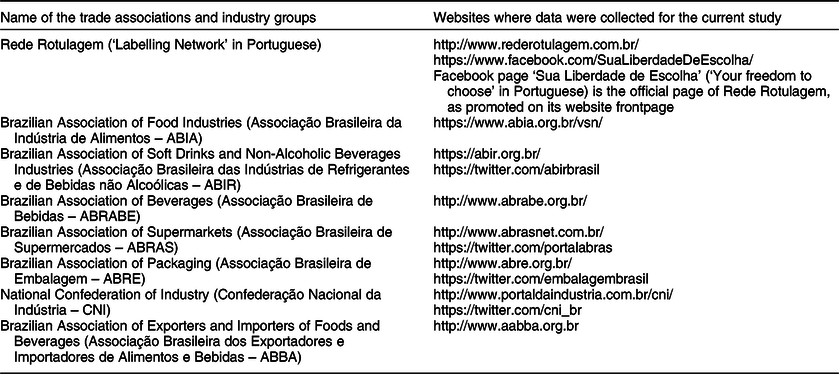
Due to time constraints, we only included actors at the Federal level, since the FOPL regulation is a national policy in Brazil. Our focus was on trade associations and industry groups only, which means that some other actors in the food industry were not included in our study: individual food manufacturers; the media industry; government agencies that may be representing some segments of the food industry, such as the Ministry of Development, Industry and Foreign Trade (Ministério da Indústria, Comércio Exterior e Serviços – MDIC) or the Ministry of Agriculture, Livestock, and Supply (Ministério da Agricultura, Pecuária e Abastecimento – MAPA).
In total, sixty-three pieces of information were included in our dataset: Tweets from the industry (n 32); webpages from the industry websites (n 16); Facebook posts from the industry (n 1); newspaper articles (n 8); written communications to Anvisa (n 2); judicial decision (n 1); webpages with agenda of civil servants where there was a consultation with the industry (n 2) and Excel document (n 1) with all submissions to the technical public consultation.
Phase 3: Inductive data analysis
Inductive analysis was performed on the content identified in the previous phase and was informed by existing categorisation of the discursive corporate political activity strategies used by food industry actors across the globe. Data analysis consisted of:
-
1. Identifying arguments used by the food industry against the adoption of front-of-pack WL in Brazil, by reading each document;
-
2. Collecting arguments by copying and pasting them into an Excel database (see online supplementary material, Supplemental Table 1);
-
3. Inductively coding each argument, in order to summarise the ideas contained in these arguments (see online supplementary material, Supplemental Table 1);
-
4. Developing a codebook, where arguments were grouped into themes;
-
5. Supplementing the coding process by incorporating notes from all the observations that arose during data collection.
The first author coded the entire dataset inductively and then grouped these codes into preliminary themes. Then, she developed a draft codebook. The second author reviewed all data, including their alignment with the research objectives and the labelling and categorisation of codes and themes (agreement was not measured). The third and last authors reviewed 10 % of the data. All authors agreed on a final version of the codebook, after discussion. At all stages, agreement in the coding process was reached after discussion between the authors. Regular team meetings were held to discuss the progress and doubts among the research team.
In the submissions of food industry actors to the technical public consultation, we noted that the text submitted by some industry actors was duplicated (submissions of ABIA, ABIR, ABRAS and CNI). Therefore, in appearance, these were multiple voices with identical messages. In such cases, we only coded the text from one of these actors, ABIA, the trade association representing the food industry in the country and referred to this one in this article. Nevertheless, it must be understood that the other actors had identical messages, and they should not be seen as underrepresented.
In this article, we present a narrative synthesis based on the codebook that we developed during the data analysis, and we illustrate our discussion with quotes from the material included in our analysis. In the quotes, the information into brackets is our addition, for more clarity.
Results
We identified several arguments used by trade associations in the food industry against the adoption of front-of-pack WL in Brazil. We grouped these arguments into two main categories: (i) arguments legitimising the food industry’s involvement in the development of the FOPL policy and (ii) arguments questioning the FOPL policy and the adoption of WL.
Arguments legitimising the food industry’s involvement in the development of the front-of-pack labelling policy
During the FOPL policy development, food industry actors presented themselves as legitimate actors, by highlighting their economic contribution to the country, their role in safeguarding consumers’ right to choose and their range of solutions in addressing the NCD epidemic.
Food manufacturers, industrial or artisanal, rural or urban, are a crucial part in the development of the new nutrition labelling system. Their contribution is fundamental because they are the ones who feed daily the Brazilian population. (ABIA, website)
Industry creates economic opportunities
Actors in the food industry stressed their economic importance, including the tax revenue and jobs they generated for the country. ABIA and CNI claimed, for example, that the Brazilian food industry was one of the leading food manufacturers in the world, and that it represented approximately 10 % of the gross domestic product of Brazil while employing 1·6 million Brazilians.
Industry safeguards individuals’ right to choose
Freedom of choice was one of the principal arguments used by the food industry during the FOPL development. Food industry actors promoted their preferred nutrition label systems, particularly the TLL system, with the rationale that this system would safeguard individuals’ right to choose. Other claims included the fact that the TLL would empower individuals and would be clear and simple to use. In that scenario, individuals would, therefore, bear the responsibility for making the right choices for their health.
‘The consumer has the constitutional right to the freedom of choice. We believe that the traffic-light label is the most informative, with a universal language and can be understood. Clear information, direct, accurate and informative.’ Alexandre K Jobim, President of ABIR (ABIR, Twitter)
Nutrition labelling rules are important, but you should always follow the desire of those who go to the supermarket shelves and choose the product of their choice, according to their convenience. Freedom and responsibility are essential parameters when it comes to standards that affect people’s lives. (CNI, website)
However, food industry actors claimed that FOPL was not a solution in itself to the NCD epidemic. Instead, in addition to providing information through the TLL, they proposed to educate individuals on how to make better choices for their health. In this context, individuals were therefore considered to be lacking knowledge and education in nutrition.
Considering that there is ample scientific evidence of the lack of nutrition education as the leading cause of difficulties in understanding nutritional information, it cannot be assumed that the adoption of a particular labelling system or international practice will solve this issue effectively and immediately. (ABIA, technical public consultation)
These messages also served as a justification for collaboration between the government and the industry, where food industry actors could be a provider of nutrition education.
It is believed that consumer education should be carried out jointly between industry and government and that, for this, it is necessary to create a national nutrition education program. (ABRAS, technical public consultation)
Here, the industry-preferred system (TLL) was presented as a tool to inform the public, coupled with nutrition education, so that individuals could freely make their own choices, and not as a tool that by itself would contribute to the prevention and control of NCD.
Two non-academic, non-peer-reviewed reports were cited to support the industry-preferred labelling: a study commissioned by ABIA and conducted by the Brazilian Institute of Public Opinion and Statistics (Instituto Brasileiro de Opinião Pública e Estatística – IBOPE), a marketing research company, and a study called the ‘Conscious Consumption in Brazil’ conducted by the Akatu Institute, a civil society organisation that received support from the food industry(19). However, no evidence was cited to support the idea that individuals would make healthier choices with the proposed labelling and an increase in education.
Industry provides other solutions to the non-communicable disease epidemic
Food industry actors explained that they were providing additional solutions to the NCD epidemic, sometimes claiming these were better alternatives than FOPL. These solutions included an increase in physical activity, a reduction of portion size and a reformulation of food products.
The industry is constantly offering smaller portion sizes (based on actual and proper portions) that play a crucial role in building a healthier diet. (ABIA, technical public consultation)
The food industry also strongly advocates for initiatives related to nutrition education and the promotion of physical activity. (ABIA, technical public consultation)
In some instances, these alternatives also served as a justification for the criticism of the WL.
The efforts of the manufacturing sector to improve the nutritional profile of its products, whether by reducing the levels of sodium, saturated fats, trans fats, and added sugars, or by increasing the supply of positive nutrients, such as whole grains, milk, fibre, vitamins and minerals, lose relevance to the consumer. How to interpret a product that communicates on a voluntary reduction in its levels of sugar or sodium, and that shows on its packaging a warning sign for the excess of these nutrients? (…) Thus, the nutritional profile that will be adopted should not be a barrier to reformulation initiatives. (ABIA, technical public consultation)
Arguments questioning the front-of-pack labelling policy and adoption of warning label
We observed a second category of arguments during our data analysis. Food industry actors were questioning the FOPL policy by criticising Anvisa’s role, and the science that informed the policy, and by highlighting the supposedly lack of coherence between national, regional and international policies, as well as the socio-economic risks of introducing WL.
Industry questioned the front-of-pack labelling policy process and Anvisa’s role and mandate
Different industry actors criticised the FOPL policy process. The CNI claimed, for example, that food industry actors were excluded from the FOPL discussion and asked for more involvement in the policy process.
The current debate on the new nutrition labelling system, however, has been marked by misinformation and a lack of dialogue from some public bodies and non-governmental organisations. (CNI, website)
Making food label changes is a delicate task that needs to reconcile several points of view. The changes must be preceded by a genuine impact analysis, which also involves weighting the perspectives of producers. (CNI, website)
ABIA questioned Anvisa’s mandate when it claimed that the recommended WL would ‘represent an unconstitutional ban and constitutes an unacceptable excess of regulation’.
The support of international institutions to civil society organisations in Brazil, including a group to which two of the authors of the present study pertain, was also criticised by the CNI, with the rationale that these institutions were representing ‘commercial interests’. It remains unclear who these interests were.
The document presented by Anvisa does not reconcile the legitimate positions of the different social and economic segments and gives the impression of showing the influence of some appealing, mystifying and prejudiced advertising paid by non-governmental organisations, which has already consumed millions of Reais in advertising pieces on radio, television and newspapers. Campaigns on the subject in recent months have demonstrated the desire of foreign entities to direct the internal debate in favour of commercial interests disguised as defending consumer rights. They are NGOs (Non-Governmental Organisations) funded by speculative foreign capital to reduce the competent national food production. (CNI, website)
In parallel, the timeline for the technical public consultation was questioned by the food industry. The consultation started on 25 May 2018 and was planned to end on 9 July 2018, for a total of 45 d. However, food industry actors lobbied the Court at the last hour (on the original last day of the consultation) and were successful in postponing the deadline for submission to this consultation to 25 July 2018, which increased the period of submission by 15 d(20).
Industry questioned the science on which Anvisa’s decisions were based
In addition, the scientific evidence gathered by Anvisa in its AIR preliminary report was questioned by food industry actors and, on certain occasions, used to discredit the agency.
In fact, all the data and information presented in the (AIR) Report, as well as the additional elements brought by ABIA, showed that the reasons pointed out by Anvisa are contradictory and still lacking a solid scientific base, compromising its applicability in the diagnosis of the problem. Thus, it is clear that the AIR on the subject has not been exhaustive. Therefore, ABIA insists on the conduct of more studies, in order to investigate the root of the problem: the lack of nutrition education in Brazil. (ABIA, technical public consultation)
Specifically, industry actors claimed that the agency did not include industry-funded studies in its technical report. This decision at Anvisa was taken with the rationale that industry has a conflict of interest in the discussion, which could bias the evidence it produces and disseminates(3). On the other hand, evidence produced by independent research was discredited by food industry actors.
The traffic light label has specific advantages that have not even been analysed in the report. Also, GGALI [Gerência-Geral de Alimentos or General Food Management] openly disregarded the methodologically robust IBOPE study (…). According to GGALI, the commissioning of the study by the CNI would lead to a ‘conflict of interest’ per se [but] IBOPE is an appropriate institute of unimpaired reputation and, as such, regularly used by the Administration itself without suspicion. (ABIA, technical public consultation)
[GGALI] discards, a priori and without any analysis, the IBOPE study, but takes into account the NUPENS [University of Sao Paulo]/IDEC study with serious methodological problems; [and] GGALI gives preference to the warning model even – as admitted – if lacking relevant scientific studies to confirm its supposed superiority and, even in the framework developed by GGALI itself, which – based on questionable studies – shows at most a slight advantage (…); [and] CGALI closes its eyes on the apparent problems of the warning model [such as the] association of the symbol with dangerous products, which causes confusion and fear to the consumer. (ABIA, technical public consultation)
The industry also asked for a real-life experiment that would compare the WL and the TLL, which was not realised at the time of writing of the present article.
[We] recommend, finally, a greater scientific depth, with the obligatory inclusion of the traffic light model, of the studies and tests that will be done with the Brazilian population, in order to identify the model that has better attributes to help the consumer understand the nutritional information better and thus freely exercise their right of choice. (ABIA, technical public consultation)
Industry emphasised need for coherence between policy under discussion and national, regional and international policies and experience
Food industry actors emphasised the need for coherence between the FOPL policy under discussion and national, regional (Southern Common Market – MERCOSUR) and international (Codex Alimentarius) guidelines and experiences. The reason evoked was that the new FOPL system might be a threat to the economy and in potential violation of trade agreements.
Representatives of the MERCOSUR Food and Beverage Industries Coordination gathered in Brasília on Wednesday, 4 July [2018], to announce a joint document that officialises the contribution of the productive sector to the regulation of nutrition labelling in the countries of the region (Brazil, Argentina, Uruguay and Paraguay). The document, entitled “Letter from Brasília,” advocates the need for the regulation of food and beverage labels to be harmonised throughout the bloc in order to avoid damages to foreign trade and, consequently, to the economies of the countries of the region. (ABIA, website)
Aside from political embarrassments in foreign relations between neighbouring countries and disruption of MERCOSUR’s systematic policy, ultimately, unilateral measures by the Brazilian government may even trigger consultations within the framework of the World Trade Organization for potential violation of the Agreement on Technical Barriers to Trade (TBT). (ABIA, technical public consultation)
Industry mentioned socio-economic and other potential risks if the warning label was introduced
Claims of potential losses of jobs and reduction of sales were at the centre of the arguments used by the food industry in the FOPL policy discussion in Brazil. These arguments were supported by a non-academic, non-peer-reviewed study, conducted by GO Associados, a consultancy firm.
The option for an alarmist model [i.e., WL] instead of the colourful information model [i.e., TLL] for the new nutritional labelling can cause serious socioeconomic damages to the country. This is shown in a study by GO consultancy, presented by Rede Rotulagem to Anvisa. In addition to being ineffective in promoting changes in eating habits and the option of a balanced diet, the warning model would lead to unemployment (1·9 million fewer jobs), losses (almost R $ 100 billion) in various sectors and fall in the collection of taxes. (Sua Liberdade de Escolha, Facebook)
There were also references made to the experience in Chile, where a FOPL policy was implemented in 2016, with the claim that the WL in that country was not improving the health of the population, and that they had negative economic impacts, like large multi-national corporations, abandoning operations in Chile.
The president of ABIA compares the Brazilian proposal to the model adopted in Chile, which also had new labelling, and decided to alert consumers. According to Mello, in the neighbouring country, the decline in consumption was of almost 20 %, but obesity in the population did not decrease. “That is, this type of labelling did not help the consumer as expected. And it is good to remember that Brazil is not Chile, we have a wealth that comes from agribusiness that can suffer from these changes” he warns. (…) Mello explains that the preliminary studies made by ABIA point to the risk of a loss of 200,000 jobs in the sector if Anvisa’s warning proposal was put into practice. (ABIA, newspaper)
To support these claims on the ineffectiveness of the WL in Chile, the food industry cited two non-academic, non-peer-reviewed studies conducted by Activa Research and GfK Adimark, two private companies that do market and public opinion studies.
Two recent surveys released in Chile show that the alarmist nutrition labelling model adopted in Chile does not educate or stimulate change in consumer habits. According to a survey by Activa Research, 55 % of Chileans consider that the rules adopted two years ago did not contribute to the protection of their health. Another study by GfK Adimark showed that only 41 % of Chileans say that having black octagon on the products influences their food choices. (Sua Liberdade de Escolha, Facebook)
Another argument used by the food industry against the WL was that they were alarmists and would result in a loss of empowerment and autonomy for individuals. It was suggested that the government would be impeding the freedom of choice of individuals if the proposed WL was implemented. This is related to the arguments made earlier, where the industry claimed it would, on the other side, help and protect individuals and their freedom of choice.
WL, which replace information by alarmism and education by consumer protection, are ineffective in promoting a healthy diet. (Sua Liberdade de Escolha, Facebook)
Discussion
In Brazil, the food industry tried to legitimise its involvement in the development of the FOPL policy, while questioning the FOPL policy process and content. Food industry actors discussed their economic importance in the country, which might dissuade the government from being too stringent in a public policy that would restrict their sales. These messages ignored the economic losses associated with NCD and related early deaths(Reference Bloom, Cafiero and Jané-Llopis21). Industry actors also suggested that the main problem with labelling was a lack of nutrition education and proposed other non-binding, voluntary solutions, some of which already lead by food companies, such as food products reformulation and changes of the portion sizes of their products, without evidence of their effectiveness, while ignoring other internationally recommended solutions such as taxes and restrictions on the marketing to children for unhealthy products(22). Freedom of choice and personal responsibility were prominent arguments used by the industry and might serve in depicting the industry as a guardian of these rights and in shifting the blame away from the role of their products in the NCD epidemic(Reference Mialon, Swinburn and Sacks8). Indeed, individuals armed with information and free to make their own choices could be held responsible for the decisions they make and the consequences that could have on their health(Reference Mayes23). Food industry actors claimed that they support the right to choose but advocated for the adoption of one specific FOPL, the TLL labels.
Food industry actors also questioned the policy process and its content, which translated in delays in the technical public consultation. They positioned themselves as experts who needed to be consulted despite their inherent conflict of interest in the discussion(24). Some actors asked for more coherence between the proposed FOPL and national, regional and international guidelines and suggested that the WL system supported by Anvisa might violate trade agreements in the region. This might serve as a threat to dissuade the government from using a labelling system that would not be supported by the industry. While MERCOSUR agreements are bindings(25), Codex texts are not, and, in this latter case, governments are free to adopt a labelling system of their choice(26). In addition, health considerations may prevail over trade and economic interests(Reference Snowdon and Thow27).
A small set of evidence, published in non-academic, non-peer-reviewed reports, was used by industry actors to support their arguments. In parallel, there was criticism of independent research. A real-world experiment was, for example, requested by the food industry, which also happened in France when the country was discussing the introduction of a new FOPL system and that was shown to have delayed the policy process in the country(Reference Mialon, Julia and Hercberg10). The food industry claimed that the proposed WL system would lead to multiple economic and social risks and losses and supported these claims with the example of Chile, where a WL system was adopted recently(Reference Girardi Lavín, Ignacio Kuschel Silva and Ruiz-Esquide Jara28). Industry actors ignored peer-reviewed evidence which shows the positive effects of the implementation of the WL(Reference Corvalán, Reyes and Garmendia13,Reference Corvalán, Reyes and Garmendia29,Reference Correa, Fierro and Reyes30) , although it is still very early to understand the full impact of the policy in terms of health outcomes.
We observed during our data analysis that ABRE, the Brazilian Association of Packaging, seemed to be the only entity in the food industry to be neutral in the discussion, by citing independent evidence on its website, for example.
In our document analysis, we noted that the political process was dominated by white men, in public and private spheres, with limited involvement of women. Women in the nutrition and dietetics profession were instead featured in social media, where they would share messages about education. This could be explained by the fact that, perhaps, the health profession is dominated by women, while they may face obstacles to accessing policy-making positions(31). This merits further investigations.
The results described here are similar to the findings from a recent study from other countries in Latin America, conducted by the South American Institute of Government in Health/Union of South American Nations (Instituto Sul-Americano de Governo em Saúde/União de Nações Sul-Americanas – ISAGS/UNASUR)(Reference Armada, Iturria Caamaño and Bacigalupo14). The results of that study indicated that the industry used the following main mechanisms to interfere with the development of FOPL policies in Latin America: (i) denial of the need and utility of the proposed labelling; (ii) technical questions; (iii) unfavourable economic consequences and (iv) broad media use(Reference Armada, Iturria Caamaño and Bacigalupo14). Similar results were also found in France, with evidence that the food industry criticised the proposed FOPL system (Nutri-Score), claimed it would have negative impacts for the economy and that the solutions to the NCD epidemic were individual responsibility and education(Reference Mialon, Julia and Hercberg10).
Alcohol and tobacco industry actors have also used these arguments in their efforts to delay, prevent and influence public health policies around the globe(Reference Ulucanlar, Fooks and Gilmore11,Reference Savell, Fooks and Gilmore32–Reference Gilmore, Fooks and Drope34) . Systematic reviews for the alcohol industry showed that, among different strategies, industry positions itself as a legitimate policy actor in the discussion and as a vital part of the economy, focuses on individual behaviours, promotes voluntary actions, and uses evidence selectively(Reference Savell, Fooks and Gilmore32,Reference McCambridge, Mialon and Hawkins35,Reference Mialon and McCambridge36) . In the tobacco industry, actors used similar strategies and claimed that proposed regulations that would restrict the sales of its products would have negative impacts and represented a barrier to trade(Reference Ulucanlar, Fooks and Gilmore11,Reference Savell, Gilmore and Fooks33,Reference Gilmore, Fooks and Drope34) .
Our study has limitations. We restricted our searches to specific sources of information, for a limited sample of food industry actors, due to time constraints. We observed that several transnationals and trade associations, including from other countries in and outside Latin America, responded to the technical public consultation. Therefore, more work is needed to understand the corporate political activity strategies of these actors in the food industry.
Collectively, these arguments reinforced the position of the food industry as a necessary part of the discussion on FOPL and shifted the blame away from unhealthy products to individual behaviours. While a new FOPL may indeed positively encourage individuals to make healthier choices, such public health initiatives must not be co-opted and negatively influenced by economic actors. The food industry may indeed try to delay the policy process and benefit from reframing FOPL as a problem of personal responsibility and education, then offering to partner with the government on the introduction of non-binding non-enforceable solutions. FOPL is an important tool for health promotion and, along with other regulatory strategies, may help prevent the burden of NCD. In that sense, the policy space must be protected from the vested interests of the food industry. FOPL needs to be combined with stringent implementation and monitoring efforts(Reference Mayes23).
Conclusions
Trade associations in the food industry used a broad range of arguments during the development of a new FOPL policy in Brazil, which could have helped legitimise the role of the industry in the policy process. The industry also opposed the adoption of WL on food products and questioned the Brazilian Health Regulatory Agency’s role and mandate. These arguments could be used to favour the industry’s economic interests rather than protecting and promoting public health. The results from the current study provide additional knowledge to the growing evidence about the discursive strategies of food industry actors and could help to respond to these arguments, therefore contributing to the protection of the policy process from the commercial interests of the food industry.
Acknowledgements
Acknowledgements: Not applicable. Financial support: This work was supported by the São Paulo Research Foundation (FAPESP), Brazil under grants number 2018/24030-0 to the N.K. M.M. received consultancy fees from the Brazilian Institute for Consumer’s Defense (Idec), as part of a grant from the International Development Research Centre (IDRC) (grant number 108644-002). The funders had no role in the design of the study and collection, analysis, and interpretation of data and in writing the manuscript. The authors are solely responsible for the opinions, hypotheses and conclusions or recommendations expressed in this publication, and they do not necessarily reflect IDRC, Idec, nor FAPESP’s vision. Conflict of interest: There are no conflicts of interest. Authorship: M.M., N.K. and M.A.L. authors contributed to the design of the study. M.M. led the data collection, analysis and writing of this manuscript. N.K., M.A.L. and A.P.B.M. reviewed the data analysis. All authors read and approved the final manuscript. Ethics of human subject participation: Not applicable.
Supplementary material
For supplementary material accompanying this paper visit https://doi.org/10.1017/S1368980020003596



