





1. Introduction
The realisation of behavioural influence or change through designed interventions is a growing field with increasingly important societal and industrial implications. Key to this growth has been the emergence of a distinct set of intervention development practices, complete with specialised processes, methods and actors (Michie, Atkins & West Reference Michie, Atkins and West2015; Voorheis et al. Reference Voorheis, Zhao, Kuluski, Pham, Scott, Sztur, Khanna, Ibrahim and Petch2022). These practices, which draw on a diverse range of disciplinary insights and perspectives, have come to be broadly know as ‘behavioural design’ (This term broadly aligns with some significant previous works in this area and recognises the key interaction between implementation science, behavioural science and design essential to many others. Khadilkar & Cash (Reference Khadilkar and Cash2020) define it as having the goal to explicitly and ethically realise positive behaviour, desired by both the individual and society, where the object of design is behaviour itself, which is explicitly understood and designed for using behavioural theories brought into effect with the help of interventions (in various embodied forms). This includes, but goes beyond, behaviour change.). However, the overarching label of behavioural design belies significant underlying differences in perspective and approach (e.g. emphasising deductive versus abductive logic or linear versus iterative processes), driving the need for practice-focused research in this area (Bay Brix Nielsen, Cash & Daalhuizen Reference Bay Brix Nielsen, Cash and Daalhuizen2024).
To date, behavioural design practices have largely been organised around design processes, such as Michie et al.’s (Reference Michie, Atkins and West2015, p. 25) widely recognised ‘behaviour change intervention design process’. These processes typically offer an overarching conceptual frame and approach, coupled with specific steps and directional guidance for achieving good outcomes. However, despite common features, there are also significant apparent variances across behavioural design processes (Voorheis et al. Reference Voorheis, Zhao, Kuluski, Pham, Scott, Sztur, Khanna, Ibrahim and Petch2022; Bay Brix Nielsen et al. Reference Bay Brix Nielsen, Cash and Daalhuizen2024). For example, Michie et al.’s (Reference Michie, Atkins and West2015) and Fogg’s (Reference Fogg2009) processes share similar overall steps but arrange them differently, and the degree to which processes embrace iterative refinement is quite variable. In addition, while experimental or scientific processes typically receive extensive descriptions, design and development processes tend not to be reported at the same level of detail (Bay Brix Nielsen et al. Reference Bay Brix Nielsen, Cash and Daalhuizen2024, p. 516). Further, the relative effectiveness of current processes is still debated (Hagger & Weed Reference Hagger and Weed2019; Cash, Kreye & Browning Reference Cash, Kreye and Browning2026) and behavioural design is rife with accounts of unexpected outcomes and emergent effects (Michie et al. Reference Michie, Atkins and West2015; Kelly & Barker Reference Kelly and Barker2016).
While some work has begun to bridge behavioural science and design (Voorheis et al. Reference Voorheis, Zhao, Kuluski, Pham, Scott, Sztur, Khanna, Ibrahim and Petch2022), efforts to resolve these conflicts have largely been stymied by a general lack of theory or empirical accounts of issues that explicitly focus on comparing and synthesising behavioural design processes themselves, leaving key attributes largely implicit. As a result, despite the growing number and prominence of processes, behavioural designers’ struggles to systematically select and employ problem-solving approaches hamper their ability to consistently achieve three forms of successful outcomes, as described by Cash et al. (Reference Cash, Kreye and Browning2026): during-project success (the explainability of the process and resultant intervention (Michie et al. Reference Michie, Atkins and West2015, p. 202)), end-project success (the demonstration of intervention effects, often via randomised, controlled trials (Schmidt and Stenger, Reference Schmidt, Stenger, Markopoulos, Goonetilleke, Ho and Luximon2021) and post-project success (the longer-term emergence of desired target behaviours (Bay Brix Nielsen et al. Reference Bay Brix Nielsen, Cash and Daalhuizen2024). This makes understanding of processes critical and provides the underlying motivating for our research questions (RQs): (1) How are behavioural design processes currently framed, described, and enacted? and (2) How can we consistently understand commonalities and differences across behavioural design processes?
To answer these questions, we conducted a critical interpretive synthesis (CIS) of current behavioural design processes to interrogate how behavioural design processes are framed, described and enacted. This inquiry complements similar work such as the consolidated framework for implementation research (CFIR) (Damschroder et al. Reference Damschroder, Aron, Keith, Kirsh, Alexander and Lowery2009) and its recent update (Damschroder et al. Reference Damschroder, Reardon, Widerquist and Lowery2022), which has established an overarching typology of terms related to theory building in implementation research. As such, in the work that follows we (i) describe a structured analysis of current processes and practices, (ii) identify areas of deficit and/or conflict, (iii) develop a theory-based account of how behavioural design processes can be coherently understood in relation to one another and (iv) propose salient areas for future research. While this approach facilitates a critical analysis and interpretation of current processes, our intent is explicitly not to identify one preferred or best option. Instead, we propose the need to conceptually reframe behavioural design in light of its dynamic, uncertain and ecosystemic nature, with the goal of helping behavioural design researchers bridge insights from various disciplines to inform when and how to apply particular approaches when solving practical behavioural design challenges.
In this review, we follow previous work (e.g. Khadilkar & Cash Reference Khadilkar and Cash2020) in using the term ‘behavioural design’ to refer to design processes in which desired behaviour is the (or at least one) objective, and in which behavioural science supports core process stages (e.g. framing, understanding and intervention development). Importantly, this definition distinguishes behavioural design processes from (i) behavioural theories without process guidance (e.g. theory of planned behaviour (Ajzen Reference Ajzen1991), (ii) taxonomies of intervention types or influence strategies alone (e.g. the cognitive bias codex (Benson Reference Benson2016), (iii) general design processes that do not explicitly engage behaviour as a goal or behavioural science as a method and (iv) broader behaviour change processes that offer a limited view of design (shifting existing systems only rather than creating desired futures more broadly). Thus, only processes where behavioural considerations shaped the structure and progression of design activity itself, rather than serving solely as background theory, were included.
2. Background
While behavioural design-specific process theory remains sparse, general design processes provide a reasonable basis for our analysis. Design processes typically frame and transform inputs into outputs at various levels of abstraction and in various configurations (e.g. from individual activities, to process steps and to whole processes)(Dorst Reference Dorst2015; Ulrich & Eppinger Reference Ulrich and Eppinger2015. They also tend to operate within a dynamic context, which reflects the evolving characteristics of and relationships between processes, problems, solutions and contexts (e.g. see Dorst & Cross Reference Dorst and Cross2001). In practice, specific process structures and combinations of steps are then chosen in accordance with the nature of inputs/outputs and context (Andreasen, Thorp Hansen & Cash Reference Andreasen, Thorp Hansen and Cash2015); for example, different approaches might be informed by the projected solution’s domain (e.g. healthcare) and related requirements, and/or degree of situational uncertainty. Thus, design processes are informed by inputs (e.g. the problem frame or disciplinary domain) and projected outputs (e.g. in accordance with known constraints) and enacted in contexts that may change dynamically over time. Notably, however, while many design processes are explicitly conceptualised with respect to their intended output (e.g. product or service design processes that result in products and services, respectively (Ulrich & Eppinger Reference Ulrich and Eppinger2015), behavioural design processes tend to employ behaviour change techniques or similar behaviour changing principles as problem-solving mechanisms but result in outputs that can be embodied by a wide range of physical outputs such as communications, interfaces and policies (as in Michie et al. Reference Michie, Atkins and West2015). This variable relationship between contextual realities and output specifications – plus the fact that behavioural design has historically recognised the importance of grappling with issues of context heterogeneity and generalisation more rigorously (Bates & Glennerster Reference Bates and Glennerster2017; Bryan, Tipton & Yeager Reference Bryan, Tipton and Yeager2021) – suggests that a more explicit inclusion of context considerations within these problem-solving processes is both necessary and useful.
Design processes also exist within wider team or organisational contexts, which influence their progression and potential for success (Ulrich & Eppinger Reference Ulrich and Eppinger2015; Harvey & Kitson Reference Harvey and Kitson2016; Daalhuizen et al. Reference Daalhuizen, Timmer, Van der Welie and Gardien2019). For example, agile processes often chain multiple sub-processes over time through the use of tight, frequent feedback loops, whereas systems approaches might tend to coordinate processes simultaneously but at different levels of granularity. Design processes also constitute only one part of a wider set of professional and disciplinary practices enacted by practitioners (Daalhuizen et al. Reference Daalhuizen, Timmer, Van der Welie and Gardien2019; Eklund, Aguiar & Amacker Reference Eklund, Aguiar and Amacker2022), which inform choices concerning what and who to involve, or in what way, and therefore shape what is viewed as possible or even conceivable (Schmidt Reference Schmidt2020). Further, these processes and methods are often ambiguous with regard to how exactly they should be enacted; as a result, in practice they leave significant scope to the interpretation and ‘staging’ of the actors, informed by context, values and mindsets (Andreasen et al. Reference Andreasen, Thorp Hansen and Cash2015). This is also true for related frameworks such as the CFIR and other implementation science approaches, which articulate how interventions are implemented, adapted and sustained in complex conditions. These processes can generate useful outcomes that expand beyond their focal output, such as fostering wider learning. However, while such approaches are useful to structuring evaluation, identifying determinants of success, and guiding implementation strategies, they tend to focus on the implementation and translation of interventions rather than the design process through which behavioural interventions are initially framed, developed and refined.
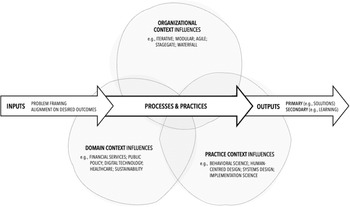
Connecting these considerations, we can consolidate general process understanding into an initial conceptual framework, as illustrated in Figure 1. Here, processes are positioned with respect to (i) their inputs and outputs over time, (ii) their interaction with contexts that shape critical aspects of work (e.g. constraints, workflow and epistemological grounding) and (iii) their enactment as part of a wider set of practices. This conceptual framework served as a sensitising lens (Blumer Reference Blumer1954) which informed our coding and interpretation but remained open to revision as themes emerged during the synthesis.
Initial conceptual framework highlighting relationships between behavioural design processes and practices (including initial inputs and resulting outputs) and organisational, domain and practice context influences.

Figure 1. Long description
A large horizontal arrow spans the center, divided into three segments by arrowheads pointing right.
* The first segment on the left is labeled INPUTS, with subtext: PROBLEM FRAMING and ALIGNMENT ON DESIRED OUTCOMES.
* The middle segment is labeled PROCESSES and PRACTICES.
* The final segment on the right is labeled OUTPUTS, with subtext: PRIMARY for example SOLUTIONS and SECONDARY for example LEARNING.
Behind this central arrow are three large, overlapping circles representing contextual influences.
* The top circle is ORGANIZATIONAL CONTEXT INFLUENCES, listing examples such as ITERATIVE, MODULAR, AGILE, STAGEGATE, and WATERFALL.
* The bottom-left circle is DOMAIN CONTEXT INFLUENCES, listing examples such as FINANCIAL SERVICES, PUBLIC POLICY, DIGITAL TECHNOLOGY, HEALTHCARE, and SUSTAINABILITY.
* The bottom-right circle is PRACTICE CONTEXT INFLUENCES, listing examples such as BEHAVIORAL SCIENCE, HUMAN-CENTRED DESIGN, SYSTEMS DESIGN, and IMPLEMENTATION SCIENCE.
3. Methodology
We determined the CIS approach (Dixon-Woods et al. Reference Dixon-Woods, Cavers, Agarwal, Annandale, Arthur, Harvey, Hsu, Katbamna, Olsen, Smith, Riley and Sutton2006b) to be particularly well suited to our research questions due to its ability to align an interdisciplinary set of methods, tools and perspectives. This was particularly important given the fragmented and conceptually diverse landscape of behavioural design processes but also in light of behavioural design’s limited theoretical maturity and the heterogeneous format of available source materials (e.g. toolkits, grey literature and academic process models). Unlike aggregative review methods, CIS supports theory building through interpretive synthesis, enabling the generation of synthetic constructs and conceptualisations to reconfigure the understanding of a given topic by acknowledging processes as socially situated artefacts and prioritising conceptual coherence over broad coverage. For example, CIS has proved useful in a range of studies that review methodologically diverse data which may come from a variety of fields (Perlman, Ben-Sheleg & Ellen Reference Perlman, Ben-Sheleg and Ellen2026), including several studies that have addressed related topics such as value in process evaluation (French et al. Reference French, Dowrick, Fudge, Pinnock and Taylor2022), how behavioural science theory has been operationalised (Patey et al. Reference Patey, Hurt, Grimshaw and Francis2018) and understanding of participatory action research (Corrado et al. Reference Corrado, Benjamin-Thomas, McGrath, Hand and Laliberte Rudman2020).
Our choice of CIS was further informed by three key conditions: (i) a lack of process-focused theory prohibits clear systematic sampling; (ii) behavioural design processes are often under-described in academic literature, or exist only as practice-facing materials (e.g. toolkits) and (iii) many processes are bespoke to specific organisations, which requires interpretive engagement to generalise. Indeed, a key feature of CIS is its appreciation of the reviewer’s interpretive stance (Dixon-Woods et al. Reference Dixon-Woods, Bonas, Booth, Jones, Miller, Sutton, Shaw, Smith and Young2006a); as such, this paper’s ‘authorial voice’ is thus highly informed by the complementary disciplinary perspectives and professional experiences of the author team, who collectively bring deep expertise in behavioural design, design research, process theory and behavioural design practice spanning academic, industry and policy contexts. This multi-perspectival lens enabled us to interrogate tacit assumptions and surface underarticulated dimensions of practice, and construct synthetic concepts that bridge disciplinary boundaries. We position our interpretation as a theoretically grounded, yet pragmatically useful, reconfiguration of behavioural design process to help inform future design science research.
3.1. Sampling
We employed a purposive sampling strategy guided by theoretical and practical inclusion criteria (Onwuegbuzie & Leech Reference Onwuegbuzie and Leech2007). First, we identified processes that aligned with the theoretical scope and definition of ‘behavioural design’ (as defined above). Second, we excluded models, frameworks and methods that did not conform to our general theoretical understanding of design processes (as in Figure 1). Finally, we excluded processes that did not fulfil the practical criteria of being: (i) employed within the field (rather than as a bespoke or internal process) and (ii) accessible, such that we could carry out in depth analysis of basic and supporting documentation and/or publications.
3.2. Data collection
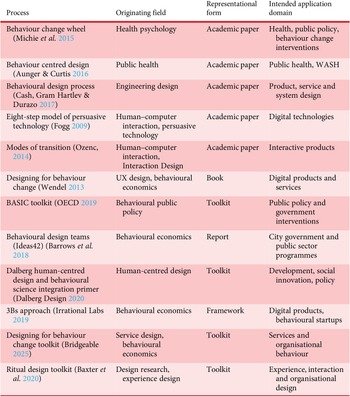
Data were initially collected in Spring 2024 by the authors, who all have substantial expertise in behavioural design theory, practice and pedagogy, using initial search terms ‘behavioural design process’ and ‘design for behaviour change process’. To increase external validity, our search included both academic and ‘grey literature’ of process descriptions. Grey literature was identified through targeted web searches, organisational toolkits and practitioner reports, supplemented by snowball sampling based on cross referencing between processes, journal citations and examples from recent systematic reviews (Voorheis et al. Reference Voorheis, Zhao, Kuluski, Pham, Scott, Sztur, Khanna, Ibrahim and Petch2022; Bay Brix Nielsen et al. Reference Bay Brix Nielsen, Cash and Daalhuizen2024). To test the robustness of our sample, we conducted a second, more general search for behavioural design and implementation processes in Autumn 2024, which confirmed that the processes found to date were adequate for our purposes. For each process, the ‘main’ descriptive document functioned as a primary reference, which was augmented by other relevant documents or publications to triangulate available information, where possible. Table 1 lists those processes included in the review along with their originating field and primary source.
Overview of the processes included in the Critical Interpretive Synthesis, indicating their disciplinary origins, representational form and intended application domains

Table 1. Long description
The table consists of four columns: Process, Originating field, Representational form, and Intended application domain.
* Row 1: Behaviour change wheel (Michie et al. 2015); Health psychology; Academic paper; Health, public policy, behaviour change interventions.
* Row 2: Behaviour centred design (Aunger and Curtis 2016); Public health; Academic paper; Public health, W A S H.
* Row 3: Behavioural design process (Cash, Gram Hartlev and Durazo 2017); Engineering design; Academic paper; Product, service and system design.
* Row 4: Eight-step model of persuasive technology (Fogg 2009); Human–computer interaction, persuasive technology; Academic paper; Digital technologies.
* Row 5: Modes of transition (Ozenc, 2014); Human–computer interaction, Interaction Design; Academic paper; Interactive products.
* Row 6: Designing for behaviour change (Wendel 2013); U X design, behavioural economics; Book; Digital products and services.
* Row 7: B A S I C toolkit (O E C D 2019); Behavioural public policy; Toolkit; Public policy and government interventions.
* Row 8: Behavioural design teams (Ideas42) (Barrows et al. 2018); Behavioural economics; Report; City government and public sector programmes.
* Row 9: Dalberg human-centred design and behavioural science integration primer (Dalberg Design 2020); Human-centred design; Toolkit; Development, social innovation, policy.
* Row 10: 3Bs approach (Irrational Labs 2019); Behavioural economics; Framework; Digital products, behavioural startups.
* Row 11: Designing for behaviour change toolkit (Bridgeable 2025); Service design, behavioural economics; Toolkit; Services and organisational behaviour.
* Row 12: Ritual design toolkit (Baxter et al. 2020); Design research, experience design; Toolkit; Experience, interaction and organisational design.
3.3. Data analysis
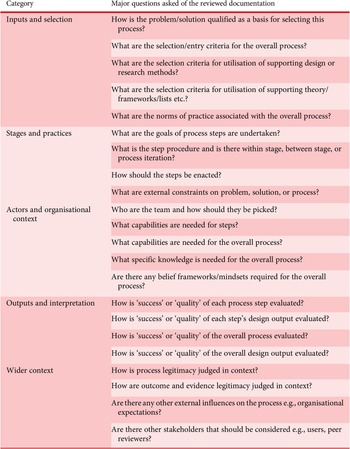
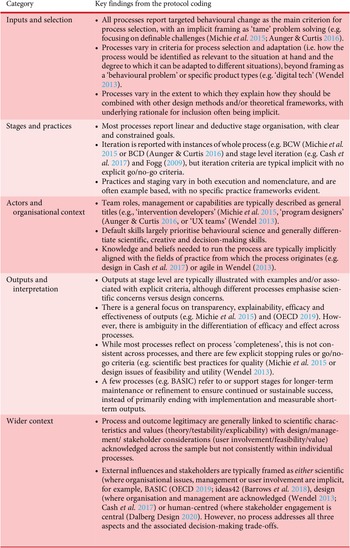
Our analysis followed the interpretive, iterative logic of CIS in several stages with a constant comparative method across processes. In the first stage, we familiarised ourselves with each process and any core process artefacts (e.g. diagrams or descriptions of the process). We also discussed the originating field and familiarised ourselves with some of the dominant ways the process had been used. In the next stage, one author read through primary sources in detail and extracted data based on a protocol derived from our conceptual framework (Figure 1). The protocol (see Table 2) helped to support internal validity (by increasing consistency, conceptual focus and systematicity) and construct validity (by ensuring alignment between extant process constructs and our analysis). As such, it sought to offer a descriptive analysis of common features, differences and deficits in our sample by explicitly highlighting key elements of processes including understanding the inputs, stages, actors or organisational context, outputs and wider context. This both provided an account of current leading behavioural design processes and revealed several salient areas of contrast that formed the basis for elaborating further findings. The results from this stage were discussed in regular meetings with ongoing comparison across methods. In a final phase, the entire author team developed and iteratively refined core themes that emerged from the analysis. This included iteratively moving between the coded data, theory and core models from the general design process, behavioural science and product development literatures to deepen our understanding of the themes. Analysis was deemed complete after several iterations when additional processes did not reveal substantively new findings or fall outside the scope of already extant themes. The detailed findings are elaborated in the results section and summarised in Table 3.
Protocol used to guide the initial interrogation and coding of identified processes based on our conceptual framework (Figure 1)
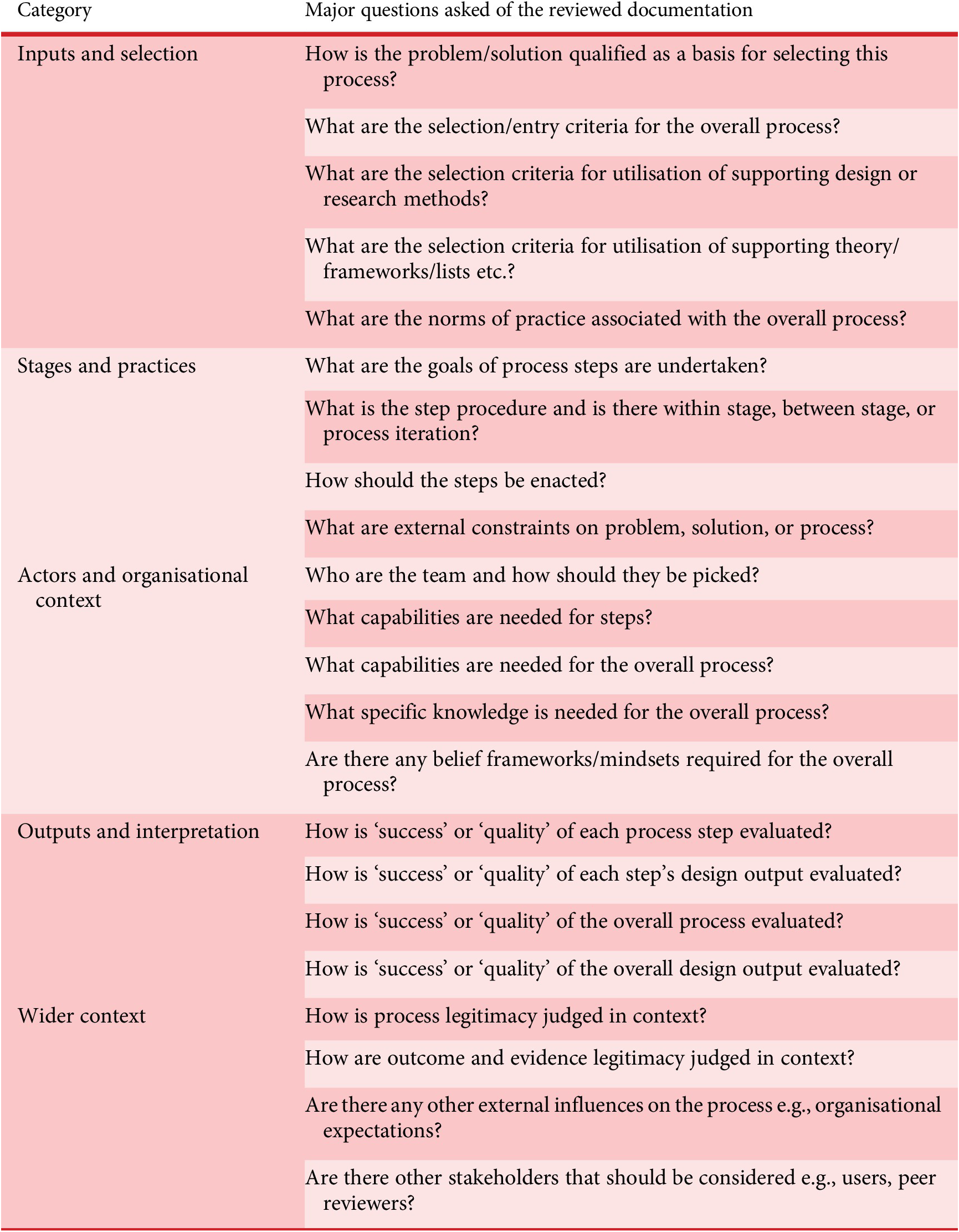
Table 2. Long description
The table consists of two columns: Category and Major questions asked of the reviewed documentation.
* Inputs and selection: Includes questions on how problems/solutions are qualified, selection/entry criteria for the process, criteria for supporting design or research methods, criteria for supporting theory or frameworks, and norms of practice.
* Stages and practices: Includes questions on goals of process steps, step procedures and iteration, how steps should be enacted, and external constraints on the problem, solution, or process.
* Actors and organisational context: Includes questions on team selection, capabilities needed for steps and the overall process, specific knowledge required, and necessary belief frameworks or mindsets.
* Outputs and interpretation: Includes questions on evaluating the success or quality of process steps, step design outputs, the overall process, and the overall design output.
* Wider context: Includes questions on process legitimacy, outcome and evidence legitimacy, external influences like organisational expectations, and consideration of other stakeholders such as users or peer reviewers.
Initial descriptive analysis of information included in sampled processes
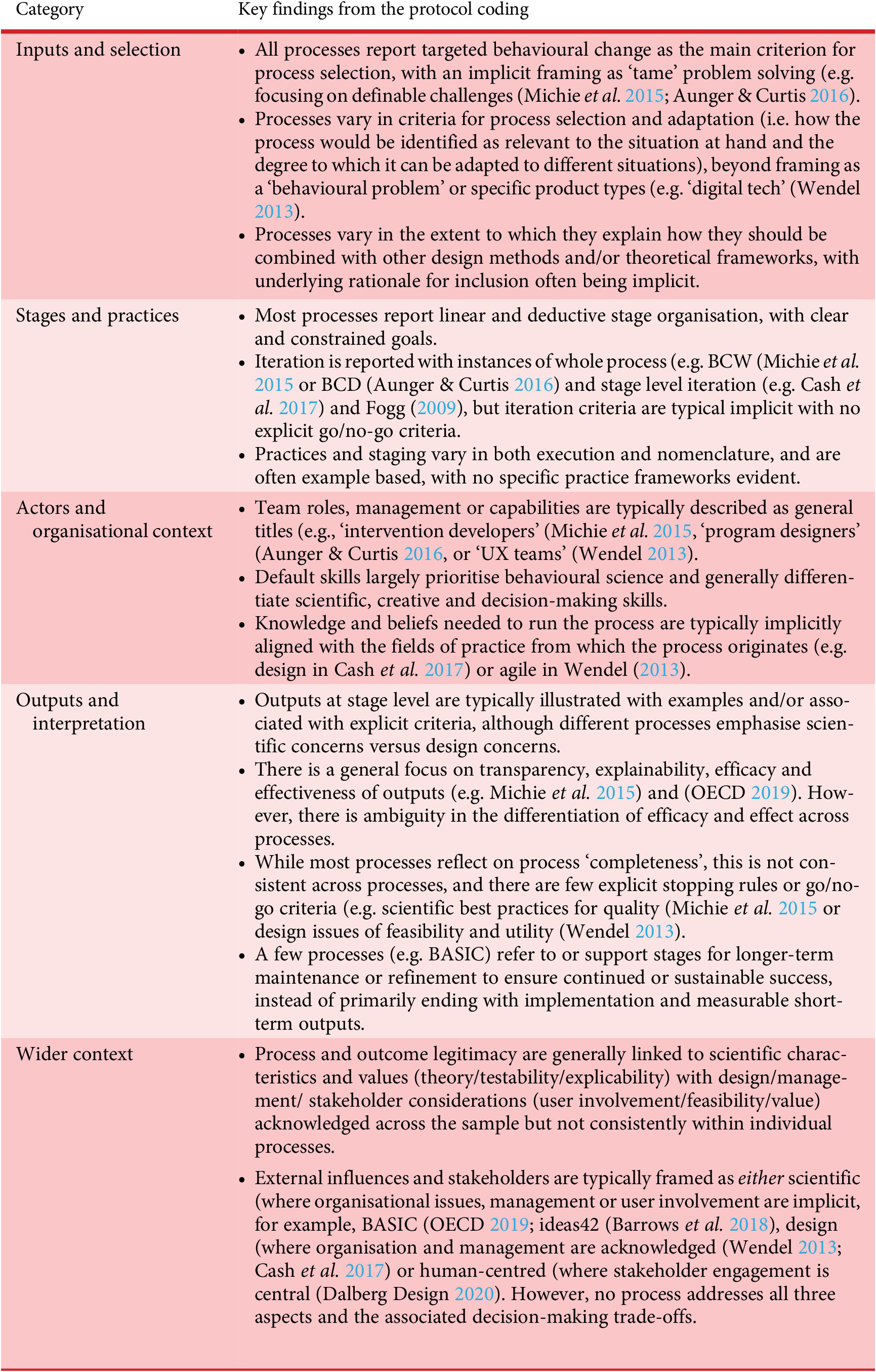
Table 3. Long description
The table consists of two columns: Category and Key findings from the protocol coding.
* Inputs and selection: Processes focus on targeted behavioral change as tame problem solving. Selection criteria vary beyond behavioral problems or product types. There is limited explanation on combining methods with other frameworks.
* Stages and practices: Most processes use linear, deductive organization with clear goals. Iteration occurs at process or stage levels but lacks explicit go/no-go criteria. Nomenclature and execution vary without specific practice frameworks.
* Actors and organizational context: Roles are described with general titles like intervention developers or U X teams. Skills prioritize behavioral science, differentiating scientific, creative, and decision-making capabilities. Knowledge is typically aligned with the originating field of practice.
* Outputs and interpretation: Stage-level outputs use examples or explicit criteria, balancing scientific and design concerns. There is a focus on transparency and efficacy, though differentiation between efficacy and effect is ambiguous. Few processes have explicit stopping rules, though some like B A S I C support long-term maintenance.
* Wider context: Legitimacy is linked to scientific values, with varying acknowledgement of stakeholders. External influences are framed as scientific, design-oriented, or human-centered, but no single process addresses all three aspects and their trade-offs.
3.4. Data characterisation
In total, we identified 12 behavioural design processes spanning the fields of design, behavioural science, policy and human–computer interaction represented through a range of publication formats including journal articles, toolkits and reports. Collectively, the sample includes processes developed within academic research traditions as well as those primarily through practitioner-oriented guidance, which provided a heterogeneous sample. Table 1 provides an overview of the included processes, detailing their disciplinary origins, representational form and the intended application domains. While many of the reviewed processes have been applied across a wide range of contexts and problem types, the application domains listed here reflect how the processes are typically framed in their primary source materials and are intended to be illustrative rather than exhaustive.
4. Results
4.1. Common features and sample relevance
Processes uniformly identified the need for behaviour change as a key motivating input and measurable change as an indicator of output success, which broadly translated into positioning discrete behavioural challenges as the target of intervention development. All processes addressed this focus through stages that included problem definition, literature review, contextual research, method-based ideation, solution development, and testing. These results confirmed the relevance of the sample with respect to both general expectations for evidence-based behavioural design and our specific conceptual framework (Figure 1). Hence, they serve as a basis for further analysis.
4.2. Differences
Interpretive comparison also illuminated two notable contrasts. First, despite ‘evidence’ forming a major construct across processes, there were significant – although often implicit – differences regarding what qualified as evidence for process initiation, progression and output. For example, design-driven processes typically prioritised contextual, qualitative evidence informed by abductive and inductive reasoning (e.g. Bridgeable 2025) while hypothesis-driven processes prioritised more quantitative evidence based on deductive reasoning (e.g. the 3Bs (Irrational Labs 2019). We interpreted these differences as reflecting deeper epistemological orientations regarding rigour, validity and generalisability as well as the overall approach to the design space (e.g. opening up and questioning default problem/solution framing via abduction versus narrowing and concretising existing framing via deduction).
Second, processes focused on different types of outputs (e.g. a specific interface or intervention versus an intervention that facilitated services within a system). This had implications on both stakeholder involvement and assumptions regarding organisational and operational contexts. For example, while some processes focused primarily on discrete solution development, others considered a longer timeline and development phases that traversed disciplinary modes (such as navigating more open-ended design methods in earlier framing activities, followed by more analytical modes as development progressed) and benefitted from involving different stakeholders and skillsets (e.g. BASIC’s (OECD 2019 suggestion to include the impacted publics when crafting behavioural public policy). However, these stakeholders and contexts were often only implicitly defined within individual instances and were revealed more through contrast across processes. Further, semantic differences between process components tended to alternatively exacerbate and obfuscate areas of difference and ambiguity.
4.3. Deficits
Our interpretive synthesis focused not only on what was explicit in process descriptions but also what was not written, ambiguous or left implicit, which also shapes how behavioural design is conceptualised and practiced. These deficits were identified in both methodological and conceptual areas. In the former instance, for example, processes typically did not provide guidance on how to gauge readiness to move from one stage to the next or about when and to what degree iteration should happen, whereas in the latter, issues of team composition and associated philosophical practices typically remained implicit. For example, differences between abductive design sensibilities (that is opportunity identification) and inductive/deductive, analytical ones (i.e. targeted problem-solving) could only be identified by contrasting assumptions in processes such as the BCW (Michie et al. Reference Michie, Atkins and West2015) and Cash et al. (Reference Cash, Gram Hartlev and Durazo2017). While processes are, by definition, reductive reflections of problem-solving activities that deliberately remove nuance in the interest of systematic replicability, this lack of explicitness also diminishes opportunities to surface key questions – How do we know we are ready to move on? Who should be included in these deliberations? Why is this the best path forward? – that can materially impact outputs and which may present a particular challenge to more novice practitioners who are more likely to rely on published processes. These findings, summarised in Table 3, serve to answer RQ 1 and emphasise the need for deeper theoretical analysis to understand what is and is not needed in behavioural design processes.
5. Thematic analysis, discussion and propositional framework
The range of implicit assumptions indicated throughout the descriptive results (Table 3) make sense in the context of an emerging field, where there are few alternative processes and practices tend to naturally align with the fields from which processes emerged (e.g. behavioural science, design). However, the level of inference required limits current applicability, comparability and cross-process learning and threatens to inhibit disciplinary maturation and the development of practice expertise. Deeper analysis to explain these commonalities and differences across behavioural design processes is therefore warranted.
To address this, and RQ 2, we constructed two fundamental themes related to the underlying mechanisms of behavioural design processes and three applied themes dealing with their implications. Together, these themes support our propositional conceptualisation of behavioural design processes as adaptive responses to behavioural prompts within a broader, dynamic process ecosystem shaped by the interplay of uncertainty, contextual specificity and evolving practices that benefit from reflective judgement, iterative progression and diverse capabilities. This reframing challenges dominant assumptions about standardised process models and offers an alternative logic grounded in responsiveness and situated action, and is elaborated in the discussion of these themes below.
5.1. Dynamic and uncertain behavioural design processes
Our first fundamental theme considers the need to position processes with respect to their ability to navigate degrees of dynamism and uncertainty in their inputs, context and outputs. The ways in which processes identified and responded to dynamics proved a critical, yet inconsistently applied, basis for differentiation. For example, Fogg (Reference Fogg2009) situates the identification and gradual growth of intervention ‘success’ dynamically across stages of refinement. In contrast, Wendel (Reference Wendel2013) addresses process-scale dynamics, where the outputs (and their impact on context) from one iteration form the basis for the next, whereas Michie et al. (Reference Michie, Atkins and West2015) acknowledge meta-process dynamics by positioning their process as part of wider complex intervention development. Despite this variation, the processes in our sample also tend to selectively ‘freeze’ their understanding of input/start, context and output/end points, as evidenced by calls to identify discrete behavioural challenges that result in measurable interventions at a single, static point in time.
However, viewing these variances within the wider process literature highlights a more fundamental relationship between process formulation and dynamics. For example, an iterative process of continuous alignment and realignment benefits situations in which both problem and solution are dynamic (Ulrich & Eppinger Reference Ulrich and Eppinger2015, whereas a more linear process may be preferable if the problem is essentially static and only the solution is dynamic (Lévárdy & Browning Reference Lévárdy and Browning2009; Ulrich & Eppinger Reference Ulrich and Eppinger2015). Further, Chambers, Glasgow & Stange (Reference Chambers, Glasgow and Stange2013), Movsisyan et al. (Reference Movsisyan, Arnold, Evans, Hallingberg, Moore, O’Cathain, Pfadenhauer, Segrott and Rehfuess2019), and Schmidt (Reference Schmidt2022) extend dynamic influences to recognise changes in context or in the relationship between problems, solutions, context and process. This also corresponds to the recent work of Bay Brix Neilsen et al. (Reference Bay Brix Nielsen, Cash and Daalhuizen2024), and others in the systems context (de Weck et al. Reference de Weck, Roos, Magee and Cooper2011; Maier & Cash Reference Maier and Cash2022), who highlight how all of the elements of our conceptual framework (Figure 1) can display dynamic properties at different levels of abstraction. This recognition that some system components display repeating patterns over time while others might not, or that some aspects of behaviour might be more (or less) stable in comparison to other behaviours, other aspects of technological interventions or the wider context adds significant complexity to design processes. This heightens the importance of understanding the role of dynamics in any given context; for example, when dealing with isolatable, testable products versus continuously adapting services and systems (Ulrich & Eppinger Reference Ulrich and Eppinger2015. It also strongly suggests the need to incorporate expectations for final outputs into the iterative formulation of behavioural design processes. This is reinforced by our findings that even the same basic processes (e.g. BCD (Aunger & Curtis Reference Aunger and Curtis2016) or BASIC (OECD 2019) are capable of generating a wide range outputs (from products to systems), the selection of which can significantly influence how those processes are enacted. This is acknowledged to a degree by Wendel (Reference Wendel2013) who suggests that their process can be ‘layered’ onto other design processes. Hence, we suggest:
-
• Positioning behavioural design processes as part of and in relation to a wider dynamic context, where processes’ ‘start’ and ‘end’ points in time are semi-arbitrary.
Allowing for dynamics in inputs, context and outputs also requires acknowledging the influence of uncertainty. While no processes in our sample explicitly name ‘uncertainty’, its influence is often evident in their formulation. For example, some processes include an iterative approach to account for the ‘difficulty in predicting outcomes’ (e.g., Fogg Reference Fogg2009) while others build on scientific theory to ‘increase confidence’ (certainty) in the basic understanding of a problem or solution (e.g., Michie et al. Reference Michie, Atkins and West2015 and Aunger & Curtis Reference Aunger and Curtis2016). More generally, processes attempted to reduce uncertainty by minimising scope and complexity, such as directions to ‘get uncomfortably specific’ (3Bs (Irrational Labs 2019) or to ‘select the smallest, simplest behavior that matters’ (Fogg Reference Fogg2009). This broadly aligns with problem-solving approaches – both within and outside of behavioural design – that define problems with upfront specificity such that uncertainty in the solution can be monotonically reduced as the process progresses (e.g. see Browning et al. Reference Browning, Deyst, Eppinger and Whitney2002).
In the wider literature, uncertainty has been defined as the ‘the lack of complete certainty—i.e., the existence of more than one possibility. The true outcome/state/result/value is not known’ (Hubbard Reference Hubbard2009, p. 80) and more specifically for the process context as the ‘potential deficiency in any phase or activity of the process which can be characterised as not definite, not known or not reliable’ (Kreye et al. Reference Kreye, Goh, Newnes and Goodwin2012, p. 683). In this light, many aspects of behavioural design – including, but not limited to, the input problem, context, outputs, and subsequent outcomes – are not fully knowable or stable, and therefore uncertain. Various authors have recognised that to be effective, processes need to respond effectively to the uncertainties that they face (O’Connor & Rice Reference O’Connor and Rice2013; Ramasesh & Browning Reference Ramasesh and Browning2014); depending on the level of uncertainty, processes might accept and work with it during development (Brown Reference Brown2008; Highsmith Reference Highsmith2009) or attempt to mitigate it upfront (Lévárdy & Browning Reference Lévárdy and Browning2009). Further, uncertainty regarding process, outputs or longer-term outcomes (De Meyer, Loch & Pich Reference De Meyer, Loch and Pich2002; Ramasesh & Browning Reference Ramasesh and Browning2014) all have differing implications for process formulation and progression. More critically, De Meyer et al. (Reference De Meyer, Loch and Pich2002) and others (e.g. Highsmith Reference Highsmith2009) highlight how minimising uncertainty too early at one level can be problematic when uncertainty remains at other, higher levels (e.g. detailing a process plan before an output is defined or detailing outputs before wider outcomes are understood). This makes understanding uncertainty and its change over time central to understanding how best to act and proceed. Indeed, differences in uncertainty and other aspects of complex design may usefully be understood and modelled in a variety of ways (Fernandes et al. Reference Fernandes, Henriques, Silva and Pimentel2017). Hence, we suggest:
-
• Selecting and adapting behavioural design processes in relation to the uncertainties they face, including the various, dynamically changing uncertainties in their inputs, outputs, and context over time.
5.2. Context sensitivity and a process ecosystem
Our second fundamental theme was the relationship between how processes are defined (by their authors) and selected/adapted/implemented (by their users) in relation to assumptions about context dynamics and uncertainties described above. Contextual issues, such as local conditions (Damschroder et al. Reference Damschroder, Reardon, Widerquist and Lowery2022, Reference Damschroder, Aron, Keith, Kirsh, Alexander and Lowery2009), political and geographic factors (Pfadenhauer et al. Reference Pfadenhauer, Gerhardus, Mozygemba, Lysdahl, Booth, Hofmann, Wahlster, Polus, Burns, Brereton and Rehfuess2017) are well acknowledged in the implementation (May, Johnson & Finch Reference May, Johnson and Finch2016) and design (Burleson et al. Reference Burleson, Wojciechowski, Toyama and Sienko2024, Reference Burleson, Herrera, Toyama and Sienko2023) literatures. However, they are typically treated as factors to consider in the design of specific interventions, rather than as a basis for defining, selecting or adapting processes used to develop those interventions.
In our sample, processes tended to be formulated around general types of outputs (e.g. persuasive technologies (Fogg Reference Fogg2009; Wendel Reference Wendel2013) or application areas (e.g. public policy (OECD 2019) that essentially served as implicit proxies for their presumed solution space. However, this implicit alignment may oversimplify the extent to which the dynamism and uncertainty of various process elements may hinder efforts to systematically generalise processes across contexts. For example, process elements predicated on links between theory and embodiment (e.g. Stage 3 in the BCW (Michie et al. Reference Michie, Atkins and West2015) might be stable for some long-established technologies (e.g. poster design) but more dynamic for evolving or emerging technologies (e.g. phone interfaces or the introduction of GPTs (Generative Pre-trained Transformer) and LLMs (Large Language Model)). Such effects can also manifest at multiple levels of abstraction. For example, while a service system might change over time, requiring responsive, longitudinal processes, interactions with specific parts of the system might remain stable, requiring focused processes (Ulrich & Eppinger Reference Ulrich and Eppinger2015. Further, processes themselves may splinter or converge, reflecting responses to dynamic variations in uncertainty. For example, ‘design thinking’ processes are often used in the highly uncertain ‘fuzzy-front end’ of problem framing to ensure that the more linear development processes that follow are solving the right problem (Zhang & Doll Reference Zhang and Doll2001). These issues are hinted at in our sample via discussion of interactions with other processes, such as wider intervention development (Michie et al. Reference Michie, Atkins and West2015 or product/service development (Wendel Reference Wendel2013; Cash et al. Reference Cash, Gram Hartlev and Durazo2017), but these relationships are not consistently explained nor explicitly theorised.
Hence, we propose that behavioural design processes can be conceptualised as part of a process ecosystem, where various processes and their component parts are formulated, iterated upon and combined in relation to dynamic uncertainties and contexts, and at different levels of abstraction, over time. This may seem to conflict with the fact that most of our sample echo many traditional, linear development processes in their tendencies to define problems upfront, employ limited iteration and deliver specific interventions (Table 3) (Browning et al. Reference Browning, Deyst, Eppinger and Whitney2002; Ulrich & Eppinger Reference Ulrich and Eppinger2015. However, unlike the development literature, where interactions with other process types are well acknowledged (e.g. linking development in sequence or parallel to design thinking, service design or systems design processes (Ulrich & Eppinger Reference Ulrich and Eppinger2015), evidence of such process linkages are scarce in our behavioural design sample, as noted above. This increases the likelihood of solving problems that do not need solving or creating outputs that are difficult to integrate or implement in context (Zhang & Doll Reference Zhang and Doll2001; De Meyer et al. Reference De Meyer, Loch and Pich2002). For example, a lack of front-end exploratory processes may result in working on symptomatic rather than root cause problems, constrained process capabilities can lead to jumping to assumed solution formats (like apps or user interfaces) over more effective alternatives, and a failure to integrate detailed design and implementation processes can contribute to solutions that are more aligned to the requirements of experimental trials than to the realities of deployment. Efforts to mitigate these forms of procedural ‘brittleness’ – which align with broader accounts of behavioural design solving problems in isolation while neglecting or underappreciating systemic or implementation issues (Hagger & Weed Reference Hagger and Weed2019; Schmidt and Stenger, Reference Schmidt, Stenger, Markopoulos, Goonetilleke, Ho and Luximon2021; Voorheis et al. Reference Voorheis, Zhao, Kuluski, Pham, Scott, Sztur, Khanna, Ibrahim and Petch2022) – also promise to help resolve wider perceived tensions between design-led or behavioural science-led processes (Schmidt Reference Schmidt2020; Bay Brix Nielsen, Daalhuizen & Cash Reference Bay Brix Nielsen, Daalhuizen and Cash2021; Voorheis et al. Reference Voorheis, Zhao, Kuluski, Pham, Scott, Sztur, Khanna, Ibrahim and Petch2022), where each can respond to different dynamic and uncertainty properties in a case of ‘which/when’ rather than ‘either/or’. Hence, we suggest:
-
• Positioning behavioural design processes as part of a context sensitive ecosystem, where processes can be positioned relative to one another as well as in combination with other process types.
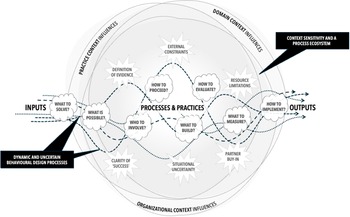
These two fundamental themes are reflected in our revised conceptualisation, depicted in Figure 2.
Revised conceptual framework, depicting the variability of inputs and paths through behavioural design processes and how these take place within an ecosystem composed of organisational, domain and practice context influences, resulting in increased process dynamism and uncertainty.
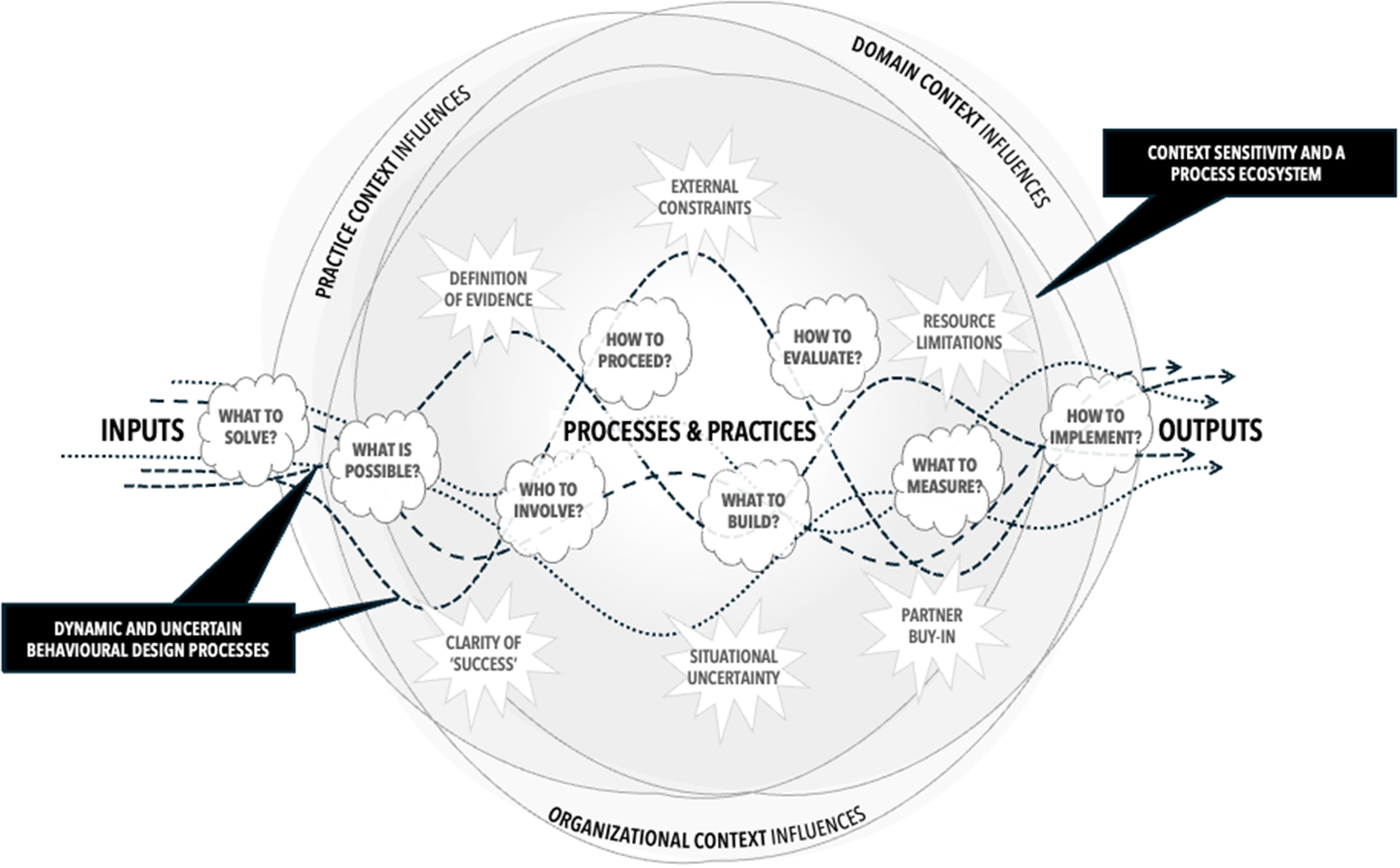
Figure 2. Long description
The diagram is structured with three large overlapping circles forming an outer perimeter labeled PRACTICE CONTEXT INFLUENCES at the top left, DOMAIN CONTEXT INFLUENCES at the top right, and ORGANIZATIONAL CONTEXT INFLUENCES at the bottom. At the center is a large circular zone labeled PROCESSES and PRACTICES.
Inside this central zone, a series of cloud-shaped and starburst-shaped nodes are connected by multiple intersecting dashed and dotted lines, representing non-linear paths.
From left to right, the flow begins with INPUTS leading into a cloud labeled WHAT TO SOLVE? followed by WHAT IS POSSIBLE?.
The internal process nodes include:
* Cloud shapes: WHO TO INVOLVE?, HOW TO PROCEED?, WHAT TO BUILD?, HOW TO EVALUATE?, WHAT TO MEASURE?, and HOW TO IMPLEMENT?.
* Starburst shapes representing constraints: DEFINITION OF EVIDENCE, EXTERNAL CONSTRAINTS, CLARITY OF SUCCESS, SITUATIONAL UNCERTAINTY, RESOURCE LIMITATIONS, and PARTNER BUY-IN.
The flow concludes on the right with OUTPUTS. Two black callout boxes highlight key themes: DYNAMIC AND UNCERTAIN BEHAVIOURAL DESIGN PROCESSES pointing to the internal paths, and CONTEXT SENSITIVITY AND A PROCESS ECOSYSTEM pointing to the overlapping outer circles.
Together, these suggestions point to the value of situating behavioural design processes both within a dynamic uncertain context and in relation to other processes: in other words, as a dynamic ecosystem rather than a sequence of activities. Seeing behavioural design processes as specific, but malleable, responses to context dynamics and uncertainties therefore not only conveys the potential for a shared sensibility amongst the behavioural design processes in our sample but also starts to align our understanding of these processes with wider theories of process definition and progression. Hence, acknowledging the importance of dynamics, uncertainty, context, and ecosystems forms a fundamental answer to RQ 2 as well as a basis for developing our applied themes: incorporating iteration and transition, the role of practices and capabilities, and immediate and proximal outcomes.
5.3. Incorporating iteration and transition
Building on our two fundamental themes (and as illustrated in Figure 2), we developed a first applied theme: the role of iteration and transition as mediators of process progression. When behavioural design processes are viewed merely as a sequence of stages without clarity on when to start, stop, repeat, or change them – let alone whether the process itself is valid for a given task – it risks reducing them to rote formula. Addressing dimensions of dynamism in a process ecosystem only heightens the need for reflection, deliberation and an iterative sensibility.
In our sample, iteration and transitions were clearly recognised but only implicitly addressed, suggesting that its application may rely unnecessarily heavily on tacit knowledge and practice-based experience rather than explicit guidance. Despite a general tendency toward linearity (Table 3), most processes also reflected iteration to some degree, which ranged from substantial and explicit (e.g. Fogg suggests to ‘start small and iterate quickly’ (2009, p. 6) and Aunger & Curtis (Reference Aunger and Curtis2016) incorporate iteration in their build and create stages) to largely implicit (e.g. OECD (2019) or Dalberg Design (2020), which position their processes as part of a wider general iterative development). However, criteria for when steps should be ended, iterated or progressed were not explicit, if described at all, and few processes in our sample identified specific process control gates or activities (Table 3). As a result, the practice and value of iteration is not particularly well defined in behavioural design processes, which often implicitly positioned processes more as a series of procedural, step-to-step activities that employ reflection and choice within the context of discrete procedural stages, rather than in the interest of continual refinement. It also limits behavioural designers’ opportunities for reflection on whether new insights have altered the nature of the challenge or process itself. This contrasts with the wider process literature, where the need to understand and respond to shifts as projects progress has long been acknowledged (Dorst & Cross Reference Dorst and Cross2001; Lewrick, Link & Leifer Reference Lewrick, Link and Leifer2018) and forms the basis for effective reflection-in and reflection-on action (Schön Reference Schön2017) that can inform both the immediate challenge at hand and future work. Further, Marks, Mathieu & Zaccaro (Reference Marks, Mathieu and Zaccaro2001) explicitly differentiate task-focused activities (e.g. Michie et al.’s (Reference Michie, Atkins and West2015) steps or Cooper’s (Reference Cooper2008) stages) and reflective, direction-focused transitions (e.g. Cash et al.’s (Reference Cash, Gram Hartlev and Durazo2017) or Cooper’s (Reference Cooper2008) gates).
Hence, we suggest that behavioural design processes can benefit from balancing progression against their central task with productive reflection throughout the process. Doing this effectively requires understanding the relevance of individual activities as well as their alternatives (Lewrick et al. Reference Lewrick, Link and Leifer2018). Further, explicit understanding of when and why to iterate, progress or change process provides critical transparency into the work of solution development. Building proficiency demands the ability to thoughtfully select approaches, critically reflect upon them and iterate processes in an ecosystem with a more nuanced and flexible understanding of what it means to ‘progress’ to a solution. While the appealingly simple approach of ‘following steps that usually work’ may provide useful support to novice practitioners, this oversimplification can result in formulaic application or false certainty that can undermine practitioners’ ability to internalise an accurate sense of progress or cultivate true expertise (Badke-Schaub, Daalhuizen & Roozenburg Reference Badke-Schaub, Daalhuizen, Roozenburg and Birkhofer2011; Daalhuizen Reference Daalhuizen2014). However, given the increasing interdisciplinarity and applied scope of behavioural design, tacit assumptions and norms of process progression cannot be taken for granted. Hence, explicitly understanding and incorporating iteration and transition will be essential to effectively navigating behavioural design process ecosystems, whilst also fostering expertise development individually and within the field.
5.4. Practices and capabilities
Our second applied theme builds on Figure 2 by acknowledging the expanded scope and complexity of relevant behavioural design practices and capabilities. While our sample emphasises behavioural science skills (Table 3), various processes also hinted at the need for other capabilities, including effective process and team management, decision-making and creativity (e.g., Aunger & Curtis Reference Aunger and Curtis2016, Cash et al. Reference Cash, Gram Hartlev and Durazo2017, and Wendel Reference Wendel2013). However, despite the wider literature‘s recognition of the importance of process management practices and capabilities (Marks et al. Reference Marks, Mathieu and Zaccaro2001; Lewrick et al. Reference Lewrick, Link and Leifer2018), our sample indicated a lack of clarity on how these might be applied or adapted for behavioural design.
More specifically, the mindsets, practices and capabilities necessary to enact processes were almost uniformly implicit or otherwise went unremarked upon (Table 3). This contrasts with the wider process literature that highlights their importance in effectively interpreting and enacting processes (Daalhuizen et al. Reference Daalhuizen, Timmer, Van der Welie and Gardien2019; Daalhuizen & Cash Reference Daalhuizen and Cash2021), whilst also recognising their potential to contribute to cross-disciplinary misunderstanding. In particular, design and behavioural science practices do not always easily combine or lend themselves to clean collaboration (Schmidt Reference Schmidt2020; Voorheis et al. Reference Voorheis, Zhao, Kuluski, Pham, Scott, Sztur, Khanna, Ibrahim and Petch2022; Bay Brix Nielsen et al. Reference Bay Brix Nielsen, Cash and Daalhuizen2024), and Cash and Joo (Reference Cash and Joo2026) highlight the need for explicit coordination of behavioural and technological aspects across levels when dealing with complex behavioural design. Hints of such issues were noticeable in processes that suggested specific combinations or orientations for integrating disciplinary practices, such as grafting design onto behavioural design activities (e.g. Bridgeable 2025), centring on a singular discipline as a baseline (e.g. introducing design to behavioural science (Irrational Labs 2019, or introducing behavioural science to design (Dalberg Design 2020) or employing handoffs from one disciplinary domain to another (e.g. OECD 2019). In other cases (e.g. Michie et al. Reference Michie, Atkins and West2015; Aunger & Curtis Reference Aunger and Curtis2016; or Baxter et al. Reference Baxter, Roots, Tuomala, Aurisicchio, Ratcliffe, Spinola Rodrigues, Childs, Martin and Saclier2020), attempts to more fully integrate behavioural science and design processes though practitioners’ roles and modes of engagement in each task left assumptions implicit or seemed somewhat arbitrary. Beyond this, many sampled processes built on other existing models of behaviour that require their own understanding to be a fully comprehended (e.g. Michie et al.’s Reference Michie, Atkins and West2015, Figure 1.4) The COM-B model or Aunger & Curtis’s (Reference Aunger and Curtis2016, Figure 2) motivation framework); in addition, these instances are often ambiguous in how essential they actually are to the progression of processes, leaving practitioners to develop their own interpretation of what practices might be relevant at any given point.
Hence, we suggest that behavioural design processes would benefit from more deliberately embracing and reinforcing the interdisciplinary nature of the field by more clearly articulating which practices and capabilities are required throughout the process while also recognising that these capabilities are often not constrained to single disciplinary practices. As noted elsewhere (Jensen, Metz & Albers Reference Jensen, Metz and Albers2024), this demands more explicitly acknowledging the importance of team composition and the extent to which specific disciplinary practices and capabilities align with specific activities or conditions of dynamics and uncertainty. It also highlights how different disciplinary sensibilities conceptualise what qualifies as legitimate evidence, how much is enough and what to do next. These issues also suggest the importance of building on similar studies within design research to inform future work, such as how shared mental models impact how teams work (Casakin & Badke-Schaub Reference Casakin and Badke-Schaub2017) and the distinction and importance of adopting a design mindset throughout design practice (Lavrsen, Carbon & Daalhuizen Reference Lavrsen, Carbon and Daalhuizen2024).
5.5. Intermediate and proximal outcomes
Our third and final applied theme is the salience of both proximal outputs and outcomes – for example, emergent cognitive, affective and motivational states within a team, such as knowledge building or agreement (Marks et al. Reference Marks, Mathieu and Zaccaro2001) – and intermediate ones that represent partial, intangible or even unintended results generated during and after a process (Marks et al. Reference Marks, Mathieu and Zaccaro2001). While distinct from formal project objectives or metrics for success, these play an important role in shaping process progression, scaffolding learning and expertise development, fostering wider impact through spin-off projects or ideas and capturing the long-term impact of the specific project output itself.
Most processes in our sample focused on a solution or intervention as a singular, definitive output in which processes concluded at the point of trial, while some – specifically, BCD (Aunger & Curtis Reference Aunger and Curtis2016, BASIC (OECD 2019, and Ritual Design Toolkit (Baxter et al. Reference Baxter, Roots, Tuomala, Aurisicchio, Ratcliffe, Spinola Rodrigues, Childs, Martin and Saclier2020) –highlighted how explicit output/trials can serve as intermediaries to longer-term outcomes. While some processes in our sample implicitly noted proximal outputs, such as building understanding around possible change techniques (e.g. capability in Michie et al.’s Reference Michie, Atkins and West2015, p. 259) technique taxonomy), agreement around necessary practices (e.g. aligning design and behavioural science perspectives on required testing as in Cash et al.’s (Reference Cash, Gram Hartlev and Durazo2017, p. 120) testing stage) or developing knowledge about underlying theory relevant beyond the current project (e.g. as supported by Aunger & Curtis’s (Reference Aunger and Curtis2016, Figure 2) motivation framework), none explicitly dealt with or highlighted these outcomes as elements to deliberately cultivate and capture. Given their relevance to both successful project progression and collaborative work, failure to explicitly acknowledge proximal and intermediate outcomes and outputs risks hindering expertise development and can disguise the wider value of behavioural design processes. Hence, we suggest that behavioural design processes would benefit from their more explicit articulation.
In the wider process literature, proximal and intermediate outputs and outcomes are viewed as key mechanisms for creating value that goes beyond a single process and instead contributes to the wider ecosystem. For example, risky exploratory process that deal with high levels of uncertainty often form the basis for multiple spin-out process that take advantage of the many problem and solution perspectives typically identified in the initial exploration (Kislov et al. Reference Kislov, Pope, Martin and Wilson2019). Similarly, learnings from one process not only often form the basis for changed practices or improved performance in other teams and in the wider field, but serve as the implicit rationale for reporting much of the scientific work associated with behavioural design as a basis for meta-analysis and review (Bay Brix Nielsen et al. Reference Bay Brix Nielsen, Cash and Daalhuizen2024). Further, viewing outputs as ‘intermediate’ is a key differentiator between individual product versus service or systems perspectives, where priorities shift towards implementation, maintenance, and adaptation in context over time (Ulrich & Eppinger Reference Ulrich and Eppinger2015. One way to proactively manage changes to interventions is through the model for adaptation design and impact (MADI) which helps anticipate and evaluate interventions (Kirk et al. Reference Kirk, Moore, Wiltsey Stirman and Birken2020). Addressing such outputs would explicitly position behavioural design processes as simultaneous mechanisms for action as well as learning (Schmidt & Stenger Reference Schmidt, Stenger, Markopoulos, Goonetilleke, Ho and Luximon2021). Hence, proximal and intermediate outcomes are key to understanding how processes function in relation to both the wider ecosystem and the practices of the people enacting them.
6. Summary and implications
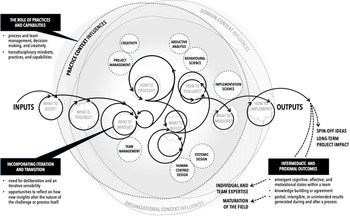
Coupled with our descriptive analysis (Table 3, response to RQ 1), our thematic analysis lays the groundwork for a deeper understanding of behavioural design processes (Figure 3, response to RQ 2). Based on this understanding, we contend that there is no one right way to do behavioural design; rather, we interpret behavioural design processes as contextually situated responses to varying degrees of uncertainty, a range of disciplinary and extra-disciplinary assumptions (notably including underlying theories of behaviour and the scope of relevant outputs) and practical constraints. This suggests the need to conceptualise behavioural design and adjacent processes as an interconnected, non-linear ecosystem with potential to feed and complement one another rather than as isolated efforts. This is illustrated in Figure 3, which depicts a behavioural design process ecosystem that supports iteration and transitions (applied theme 1) coordinating within and between processes and practices (applied theme 2), and scaffolding process, inter-process and field development through proximal and intermediary outputs and outcomes (applied theme 3).
A propositional conceptual model, which positions behavioural design processes as an iterative, dynamic and multidisciplinary effort that results in both project-specific outputs and emergent outputs (e.g. institutional knowledge and individual expertise).

Figure 3. Long description
At the center of the diagram is a dynamic cluster of circular arrows representing an iterative process. Within these loops are questions: WHAT TO SOLVE?, WHAT IS POSSIBLE?, WHO TO INVOLVE?, HOW TO PROCEED?, WHAT TO BUILD?, HOW TO EVALUATE?, WHAT TO MEASURE?, and HOW TO IMPLEMENT?. Surrounding these central loops are dashed circles containing multidisciplinary fields: CREATIVITY, PROJECT MANAGEMENT, TEAM MANAGEMENT, ABDUCTIVE ANALYSIS, BEHAVIOURAL SCIENCE, IMPLEMENTATION SCIENCE, SYSTEMIC DESIGN, and HUMAN-CENTRED DESIGN.
This central core is enclosed within three concentric circular layers. The innermost layer is labeled PRACTICE CONTEXT INFLUENCES. The middle layer is labeled DOMAIN CONTEXT INFLUENCES. The outermost layer is labeled ORGANIZATIONAL CONTEXT INFLUENCES.
A horizontal flow moves from left to right. On the far left, the word INPUTS leads into the central process. On the far right, the word OUTPUTS leads to dashed arrows pointing to SPIN-OFF IDEAS and LONG-TERM PROJECT IMPACT.
Four black callout boxes provide additional context:
- Top-left: THE ROLE OF PRACTICES AND CAPABILITIES, noting process and team management, decision-making, creativity, and transdisciplinary mindsets.
- Bottom-left: INCORPORATING ITERATION AND TRANSITION, noting the need for deliberation and reflection on new insights.
- Bottom-right: INTERMEDIATE AND PROXIMAL OUTCOMES, noting emergent cognitive states, knowledge building, and intangible results. Dashed arrows link this box to INDIVIDUAL AND TEAM EXPERTISE and MATURATION OF THE FIELD.
- A final arrow from the central process also points toward INDIVIDUAL AND TEAM EXPERTISE.
This conceptualisation brings to the fore issues of iteration and transition, dynamic practices and capabilities, and the proximal and intermediate outcomes that link these all together. More pragmatically, however, adopting this model requires behavioural designers to become comfortable with selecting, progressing, iterating and transitioning within and between processes over time and at different levels of abstraction. Given that our themes highlight the need to reframe some norms of practice (e.g. seeing processes as sequential or skillsets as siloed), addressing these issues may require the discomfort of ‘unlearning’ of elements of current practice and demand an openness to uncertainty that behavioural design has historically attempted to minimise. While not intended to be read as a practical guide for implementing this conceptual model in applied behavioural design practice, more specific implications of our themes for behavioural design processes are summarised in Table 4.
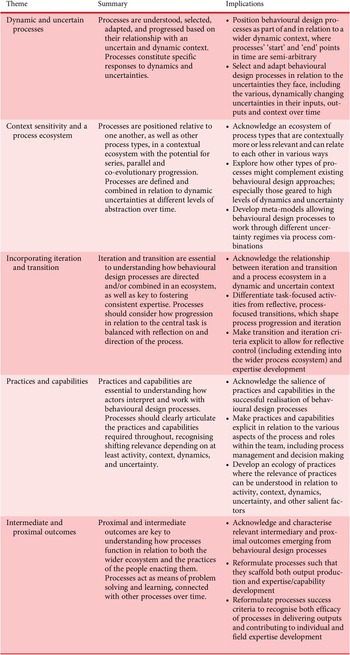
Themes and implications for researchers emerging from the propositional conceptualisation of behavioural design processes illustrated in Figure 3
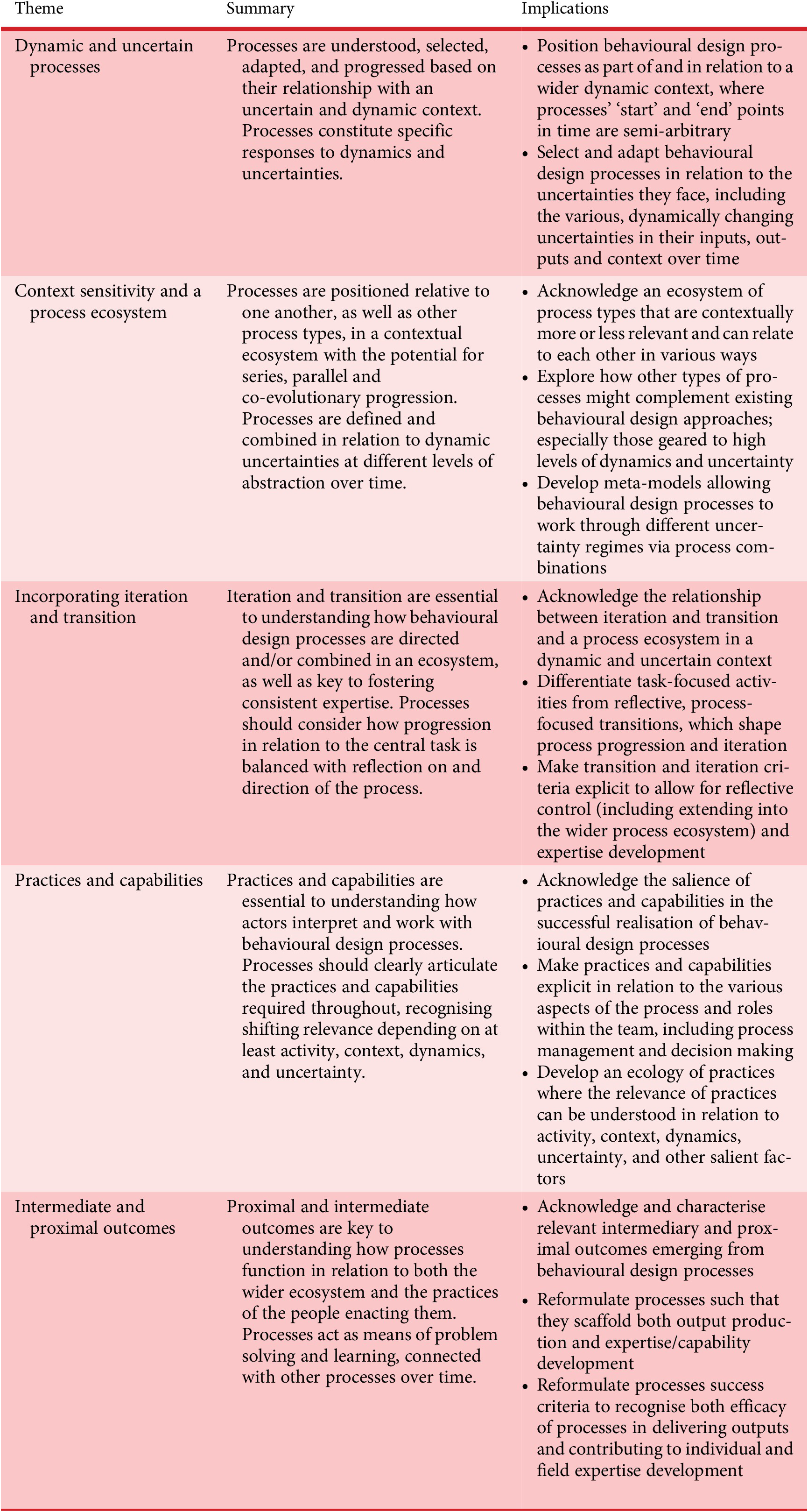
Table 4. Long description
The table consists of three columns: Theme, Summary, and Implications.
* Row 1: Theme is Dynamic and uncertain processes. Summary states processes are adapted based on uncertain contexts. Implications include positioning processes within a wider context and adapting to changing uncertainties in inputs and outputs.
* Row 2: Theme is Context sensitivity and a process ecosystem. Summary describes processes in a contextual ecosystem with potential for series or parallel progression. Implications include acknowledging an ecosystem of process types and developing meta-models for different uncertainty regimes.
* Row 3: Theme is Incorporating iteration and transition. Summary notes these are essential for directing processes and fostering expertise. Implications include differentiating task-focused activities from reflective transitions and making iteration criteria explicit.
* Row 4: Theme is Practices and capabilities. Summary emphasizes how actors interpret processes. Implications include making practices explicit for team roles and developing an ecology of practices related to context and dynamics.
* Row 5: Theme is Intermediate and proximal outcomes. Summary explains processes as means of problem solving and learning. Implications include characterizing emerging outcomes and reformulating success criteria to include expertise development.
7. Conclusions
Behavioural design processes are widely used to develop behavioural interventions. Yet despite the growing number and prominence of processes, behavioural designers still struggle to systematically select and employ problem-solving approaches in the face of dynamic and uncertain conditions, hampering their ability to utilise behavioural design to its full potential. Hence, we aimed to answer the research questions: (1) How are behavioural design processes currently framed, described, and enacted? and (2) How can we consistently understand commonalities and differences across behavioural design processes?
Based on a structured review of 12 widely acknowledged processes, we identified several areas of ambiguity and deficit in current process guidance (Table 3) (answering RQ 1), which then form the basis for deeper thematic analysis. Based on this, we propose a conceptualisation of behavioural design process as contextually contingent and dynamically evolving components of a broader ecosystem (Figure 3) (answering RQ 2). This conceptualisation then also revealed salient issues in the management of process iteration and transition, practices and capabilities, and intermediary and proximal outcomes. Together, this challenges dominant linear and prescriptive models, instead highlighting the centrality of uncertainty, iteration and reflection in effective behavioural design practice and its resultant implications for those developing or refining behavioural process guidance (Table 4).
While some of these conclusions are more broadly relevant to design process research, they have heightened relevance and value in the behavioural design context. Critically, this is motived by a curiosity regarding how (and how much) behavioural science’s more evidence-based and hypothesis-driven processes might adopt and adapt more ‘designerly’ considerations, such as iteration and an appetite for navigating ambiguity, which are often required in practice. When processes fail to call out these skills and considerations, assuming they will be gained through experience, the risk that these tacit assumptions will remain untapped and latent increases. As such, while fully recognising the difference between process models (which are by nature simplified expressions) and actual practice (which is often forced to grapple with complexity), we suspect that the generative qualities that current behavioural design processes tend to implicitly downplay – albeit to varying degrees – may in fact be particularly valuable as behavioural design strives to address more complex challenges. This paper therefore hopes to both bolster the limited theorisation of behavioural design processes and take an additional step toward highlighting how this might also inform shifts in behavioural design practice.

 Open access

