

Background
Human societies have long relied on the ocean, which has historically provided a wide array of ecosystem services. Today, the ocean’s contribution to the global economy is projected to double between 2010 and 2030 (Bennett et al., Reference Bennett, Cisneros-Montemayor, Blythe, Silver, Singh, Andrews, Calò, Christie, Di Franco, Finkbeiner, Gelcich, Guidetti, Harper, Hotte, Kittinger, Le Billon, Lister, Lopez de la Lama, McKinley, Scholtens, Solås, Sowman, Talloni-Álvarez, Teh, Voyer and Sumaila2019). Although the ocean is vital to human societies (Sala et al., Reference Sala, Mayorga, Bradley, Cabral, Atwood, Auber, Cheung, Costello, Ferretti, Friedlander, Gaines, Garilao, Goodell, Halpern, Hinson, Kaschner, Kesner-Reyes, Leprieur, McGowan, Morgan, Mouillot, Palacios-Abrantes, Possingham, Rechberger, Worm and Lubchenco2021), marine biodiversity and ecosystems are increasingly affected by multiple human pressures (Dermawan et al., Reference Dermawan, Wang, You, Jiang and Hsieh2022). Degraded oceans have a reduced capacity to deliver ecosystem services, resulting in negative impacts on human well-being (e.g., declining fisheries productivity, extreme climatic events, coastal erosion; Hoegh-Guldberg and Bruno, Reference Hoegh-Guldberg and Bruno2010). In this context, conservation initiatives and policies have been developed to protect the ocean, halt biodiversity loss, and restore food webs and ecosystem functioning. Marine protected areas (hereinafter, MPAs) are among the most successful tools adopted worldwide, as they contribute to protect biodiversity and ecosystem functioning, ensure food provision for local communities, support sustainable local economies and societal well-being, and contribute to climate change mitigation (Sala et al., Reference Sala, Mayorga, Bradley, Cabral, Atwood, Auber, Cheung, Costello, Ferretti, Friedlander, Gaines, Garilao, Goodell, Halpern, Hinson, Kaschner, Kesner-Reyes, Leprieur, McGowan, Morgan, Mouillot, Palacios-Abrantes, Possingham, Rechberger, Worm and Lubchenco2021). Even though the roles of MPAs for specific aspects are still debated (Kriegl et al., Reference Kriegl, Elías Ilosvay, von Dorrien and Oesterwind2021), there is a wide consensus about the fact that they are important tools, certainly not in isolation from other conservation initiatives, like those supported by regional fisheries management organizations, for better managing, for instance, fishing resources (Heckler, Reference Heckler2019).
The Mediterranean Sea and basin-wide conservation achievements
The Mediterranean basin is a biodiversity hotspot and one of the most heavily impacted seas in the world (e.g., overfishing, dense navigation routes, overtourism, and coastal urbanization; Micheli et al., Reference Micheli, Halpern, Walbridge, Ciriaco, Ferretti, Fraschetti, Lewison, Nykjaer and Rosenberg2013). The extent to which human impacts and climate change have impacted and are still impacting marine biodiversity and ecosystems, along with human well-being, has been widely reported in the scientific literature (see Hilmi et al., Reference Hilmi, Ali, Carnicer Cols, Cramer, Georgopoulou, Le Cozannet and Tirado2022; Lloret et al., Reference Lloret, García-de-vinuesab and Demestrea2024; and references therein). The Mediterranean basin is also a historical and cultural melting pot and, today, a complex geopolitical mosaic (see Teff-Seker and Mackelworth, Reference Teff-Seker and Mackelworth2025) spanning just a few hundred kilometres between parts of the global North (EU countries) and South (North African and Eastern Mediterranean countries). Mediterranean peoples and countries have long shared the same marine natural resources and now face similar environmental challenges, such as the spread of non-indigenous species, raised frequency of extreme weather events, and increasing seawater temperatures (Hochman et al., Reference Hochman, Marra, Messori, Pinto, Raveh-Rubin, Yosef and Zittis2022; Tsirintanis et al., Reference Tsirintanis, Azzurro, Crocetta, Dimiza, Froglia, Gerovasileiou, Langeneck, Mancinelli, Rosso, Stern, Triantaphyllou, Tsiamis, Turon, Verlaque, Zenetos and Stelios Katsanevakis2022).
These interconnected realities make the Mediterranean a region of global significance and highlight the urgent need for shared, coordinated, and effective conservation strategies (Giakoumi et al., Reference Giakoumi, Hermoso, Carvalho, Markantonatou, Dagys, Iwamura, Probst, Smith, Yates and Vogiatzakis2021, and references therein). From a conservation perspective, the Mediterranean stands at a critical crossroads. The Kunming–Montreal Global Biodiversity Framework (GBF) Target 3 (‘30x30’) calls for the effective and equitable protection and conservation of at least 30% of terrestrial, inland water, and coastal and marine areas globally by 2030, under the Convention on Biological Diversity through the creation of MPAs and ‘other effective area-based conservation measures’ (OECMs) (Pike et al., Reference Pike, MacCarthy, Hameed, Harasta, Grorud-Colvert, Sullivan-Stack, Claudet, Horta, Costa, Gonçalves, Villagomez and Morgan2024; Robinson et al., Reference Robinson, LaBruna, O’Brien, Clyne, Dudley, Andelman, Bennett, Chicchon, Durigan, Grantham, Kinnaird, Lieberman, Maisels, Moreira, Rao, Stokes, Walston and Watson2024; Villasenor-Derbez et al., Reference Villasenor-Derbez, Costello and Plantinga2024). In addition, the EU Biodiversity Strategy (EU-BS) adds to the protected 30% the additional target of ‘strictly protecting 10% of EU sea waters’ (Hermoso et al., Reference Hermoso, Carvalho, Giakoumi, Goldsborough, Katsanevakis, Leontiou, Markantonatou, Rumes, Vogiatzakis and Yates2022). Such 30% and 10% refer, to some extent, to different levels of protection against abatable human impacts (see Grorud-Colvert et al., Reference Grorud-Colvert, Sullivan-Stack, Roberts, Constant, Horta, Costa, Pike, Kingston, Laffoley, Sala, Claudet, Friedlander, Gill, Lester, Day, Gonçalves, Ahmadia, Rand, Villagomez, Ban, Gurney, Spalding, Bennett, Briggs, Morgan, Moffitt, Deguignet, Pikitch, Darling, Jessen, Hameed, Di Carlo, Guidetti, Harris, Torre, Kizilkaya, Agardy, Cury, Shah, Sack, Cao, Fernandez and Lubchenco2021 for more details). MPAs, in fact, can be fully protected (areas where extractive or destructive activities are prohibited) or partially protected (areas where human activities are restricted/managed compared to adjacent areas outside MPA borders). In the Mediterranean, MPAs are very often a combination of fully and partially protected areas (i.e., multiple-use MPAs) (Di Blasi et al., Reference Di Blasi, Poli, Bava, Desiderà, Guidetti and Guidetti2025, and references therein).
Nowadays, Mediterranean countries lag significantly behind the above targets. By extracting the most recent available data (from the World Database on Protected Areas – WDPA – at https://www.protectedplanet.net/en/thematic-areas/wdpa?tab=WDPA; see Supplementary Material for more methodological details), estimates are alarmingly low: less than 9% of the basin has been designated as ‘MPAs’ (of all categories), and under 1% is ‘fully protected’. Although within the Mediterranean region there exists a remarkable diversity of MPA typologies, protection levels, and regulatory frameworks, MPAs can generally be grouped into two broad categories: partially protected areas, where many human uses – such as fishing – are regulated but permitted, and fully protected areas, where all extractive and destructive activities are prohibited (Grorud-Colvert et al., Reference Grorud-Colvert, Sullivan-Stack, Roberts, Constant, Horta, Costa, Pike, Kingston, Laffoley, Sala, Claudet, Friedlander, Gill, Lester, Day, Gonçalves, Ahmadia, Rand, Villagomez, Ban, Gurney, Spalding, Bennett, Briggs, Morgan, Moffitt, Deguignet, Pikitch, Darling, Jessen, Hameed, Di Carlo, Guidetti, Harris, Torre, Kizilkaya, Agardy, Cury, Shah, Sack, Cao, Fernandez and Lubchenco2021; Di Blasi et al., Reference Di Blasi, Poli, Bava, Desiderà, Guidetti and Guidetti2025). Also, the distribution of MPAs (sensu lato) and OECMs deserves a comment. MPAs are disproportionately and mostly established along the northern coasts of the Mediterranean Sea, especially in EU waters (see WDPA database for details). Concerning OECMs, in the Mediterranean, the surface presently equals to 0% (see WDPA), even though progresses are expected in a relatively short time. Finally, a significant portion of these MPAs suffers from inadequate design, weak regulations, insufficient management, chronic funding shortages, a lack of staff, and poor enforcement (Bianchi et al., Reference Bianchi, Azzola, Cocito, Morri, Oprandi, Peirano, Sgorbini and Montefalcone2022; Di Cintio et al., Reference Di Cintio, Niccolini, Scipioni and Bulleri2023; MedPAN and UNEP/MAP-SPA/RAC, Reference Neveu, Ganot, Ducarme, El Asmi, Kheriji and Gallon2023). These factors all undermine their ecological, social, and economic effectiveness.
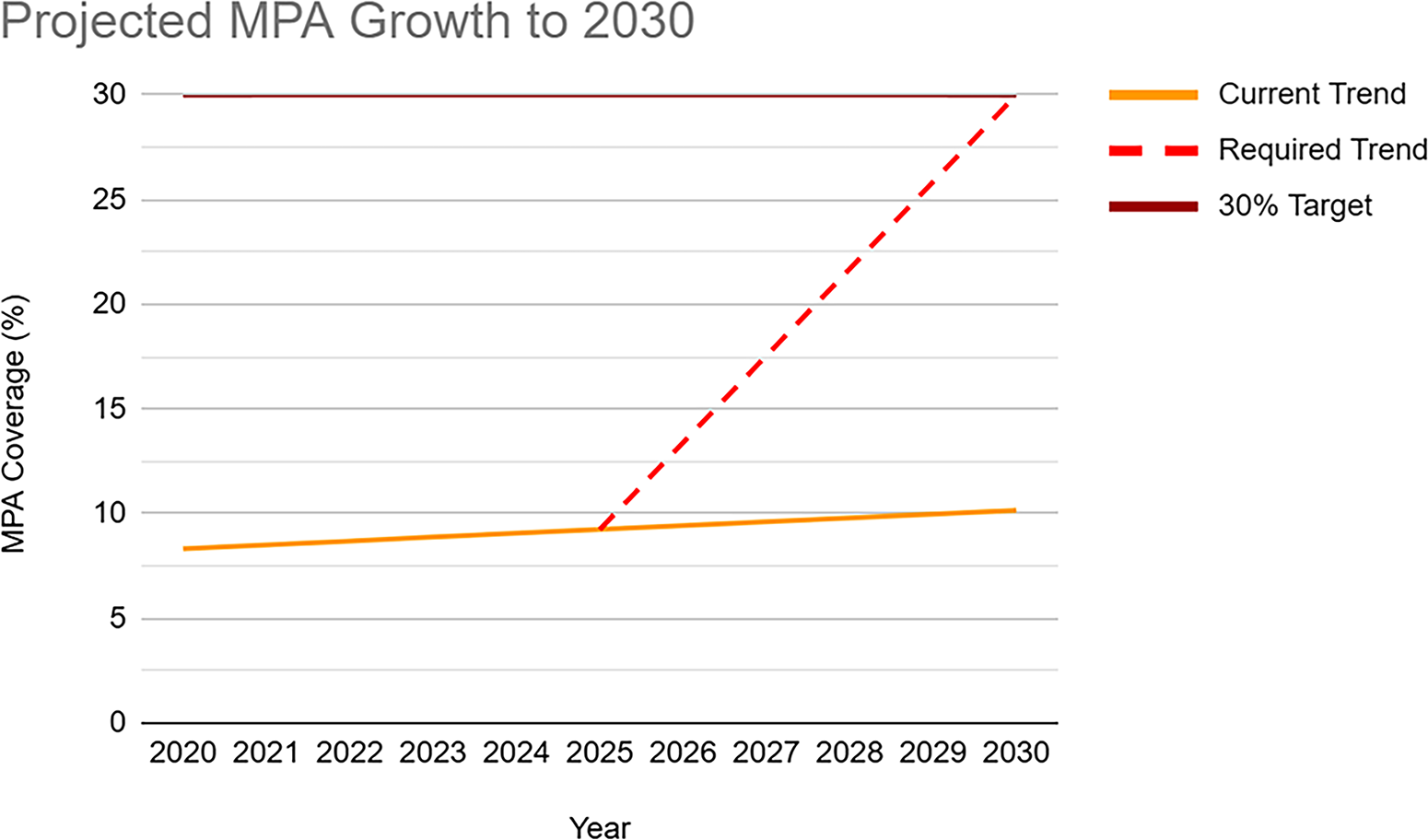
The risk of failing to achieve the 30x30 target in the Mediterranean is alarmingly high, given that (i) less than 5 years are remaining until the year 2030, (ii) the current rate of MPA designation is far too slow (see Figure 1, built from data extracted from the World Database on Protected Areas – WDPA – at https://www.protectedplanet.net/en/thematic-areas/wdpa?tab=WDPA), and (iii) many officially declared MPAs are poorly implemented or exist only on paper (Di Cintio et al., Reference Di Cintio, Niccolini, Scipioni and Bulleri2023). The situation is even more concerning, given the almost complete lack of progress in expanding the proportion of ‘strictly = fully’ protected areas. Such patterns are similar to those documented worldwide (Favoretto et al., Reference Favoretto, Kumagai, López-Sagástegui, Brannigan, Driedger, Sletten, Colegrove, Vincent, Zetterlind, Guidetti and Aburto-Oropeza2026).
Projected MPA growth trends (in terms of overall surface) to 2030 (data extracted from the World Database on Protected Areas – WDPA – at https://www.protectedplanet.net/en/thematic-areas/wdpa?tab=WDPA).

Urgent actions to take
To increase the likelihood of achieving, or at least meaningfully approaching the 30x30 and EU-BS targets in the Mediterranean basin, we outline below the most pressing and critical challenges, together with proposed solutions for each.
1. Even the Aichi Target 11, which required protecting at least 10% of coastal and marine areas by 2020, still remains unmet. There is now a serious risk of failing to achieve the 30x30 target, not only in terms of the percentage of the Mediterranean Sea formally protected but especially in the effectiveness of MPAs in delivering ecological, social, and economic benefits. These shortcomings are primarily attributable to a lack of political will and leadership, insufficient financial investments, and conflicts among users and stakeholders (Miles et al., Reference Miles, Perea Muñoz and Bayle-Sempere2020; Nature Editorial Board, 2023). We argue that after years of high-level commitments and international conferences, Mediterranean leaders must now translate pledges into concrete, legally enforceable action. This requires not only political accountability but also the establishment of robust national legal frameworks that enable the designation, management, and monitoring of MPAs and OECMs (the first being protected on purpose, the second as a result of how the area is used or governed but without any a priori conservation objective). If in EU countries significant efforts are made to integrate conservation and restoration initiatives, and spatial planning (e.g., Birds and Habitats Directives, Water Framework Directive and Marine Strategy Framework Directive [MSFD], Restoration Law, the Maritime Spatial Planning Directive [MSPD]), in several, especially non-EU Mediterranean countries, the legislation remains incomplete or outdated, undermining progress towards binding protection standards (Gomei et al., Reference Gomei, Abdulla, Schröder, Yadav, Sánchez, Rodríguez and Abdel Malek2019). Developing and updating these frameworks is, therefore, essential to ensure that marine protection is not merely aspirational but anchored in law, backed by effective governance, and capable of delivering long-term (ecological and socio-economic) outcomes.
2. The establishment and effective implementation of MPAs often conflict (at least in the short term) with other coastal and marine human activities, such as fisheries, offshore energy production, land reclamation, and aquaculture (Pataki and Kitsiou, Reference Pataki and Kitsiou2022; Vigo et al., Reference Vigo, Hermoso, Navarro, Sala-Coromina, Company and Giakoumi2024). These conflicts frequently undermine the social and political acceptance of MPAs, ultimately reducing their effectiveness and creating resistance by governments to establish new MPAs. We strongly believe that responding to these challenges requires high-level national leadership, through the creation of government-endorsed interministerial bodies and the provision of short-term compensation mechanisms, with formally appointed national focal points for the 30x30 target. These bodies should be empowered to coordinate the implementation of the target, align marine protection with broader national and international targets (i.e., the GBF and EU-BS), and ensure cross-sector coordination. Importantly, they should serve as platforms to identify and resolve potential conflicts of interest and political tensions across key sectors such as fisheries, offshore energy, and aquaculture, thereby fostering coherence, transparency, and accountability in the implementation of marine conservation commitments. The scientific literature provides positive examples of successful MPAs in the Mediterranean when (i) systematic marine spatial planning has been employed to harmonize human uses and protection initiatives (e.g., in Greece; Pataki and Kitsiou, Reference Pataki and Kitsiou2022); (ii) local stake- or right-holders have been properly involved in co-management processes (see Di Franco et al., Reference Di Franco, Hogg, Calò, Bennett, Sévin-Allouet, Esparza Alaminos, Lang, Koutsoubas, Prvan, Santarossa, Niccolini, Milazzo and Guidetti2020 for multiple Mediterranean case studies). It is worth noting, with regard to the Mediterranean area, that the ongoing armed conflicts in the region – particularly severe in the eastern Mediterranean – are significantly hindering the implementation of conservation initiatives.
3. Despite the existence of solid regional and European policy frameworks, including the Barcelona Convention and its regional strategies and action plans (e.g., the Post-2020 SAPBIO and Regional Strategy for MCPAs – Marine and Coastal Protected Areas – and OECMs), the EU-BS 2030, and all nature-related legislations for EU countries, marine conservation efforts in the Mediterranean remain fragmented and inconsistently implemented (Ardito et al., Reference Ardito, Andreone and Rovere2023; Pegorelli et al., Reference Pegorelli, García Sanabria, de Andres, Garcia Onetti, Lees, Calado and Gutierrez2026). Overlaps, gaps, and differing levels of ambition between EU and non-EU countries, such as the EU’s 10% strict-protection target that has no equivalent at the Mediterranean level, create an uneven policy landscape and hinder collective progress. Closing these gaps requires revamping and harmonizing existing frameworks to ensure greater coherence between EU and regional commitments. Aligning the objectives and implementation tools of the Barcelona Convention and EU policies (including the MSFD and MSPD) would create a common regional benchmark and a proper level playing field. This alignment would strengthen policy effectiveness, streamline monitoring and reporting, and facilitate a coordinated basin-wide approach towards achieving the 30x30 target. Considering the significant differences between EU and non-EU countries in the Mediterranean context from multiple points of view (e.g., funding, legislation, technologies), we do not imply here that non-EU countries should adopt the same policies, as that would be pretentious and costly. However, a large number of countries that are part of the EU enlargement programme are required to align their national policies to the EU. We thus refer here to the need of ensuring that (i) the EU should consider an alignment and integration process for its existing policies, and (ii) that EU and regional conventions’ policies should be aligned in their targets (e.g., having a quantified and measurable target for strict protection which only exists at EU level, and is unspecific and unmeasurable at Mediterranean level) and timeframe to facilitate dialogue, cooperation, and implementation by the countries.
4. With the UN Agreement on the Conservation and Sustainable Use of Marine Biological Diversity of Areas Beyond National Jurisdiction (BBNJ Agreement) just entered into force in January 2026 (Lubchenco, Reference Lubchenco2026), following the 60 ratifications achieved, Mediterranean countries face a critical opportunity to translate global commitments into regional action. However, several states in the region have not yet ratified the Agreement (e.g., Italy, Tunisia), risking exclusion from its initial decision-making processes and financial and capacity-building mechanisms. We therefore strongly encourage all remaining Mediterranean countries to ratify the BBNJ Agreement without delay and to take proactive steps upon its entry into force, as recommended on a worldwide scale (Zhou, Reference Zhou2026). This includes aligning national and regional frameworks with BBNJ provisions, engaging actively in the establishment and operationalization of its institutional bodies and tools, and prioritizing the development of a strong scientific evidence base to inform MPA proposals in Areas Beyond National Jurisdiction (ABNJ).
5. The Mediterranean remains far from achieving the 30x30 target (Abello et al., Reference Abello, Ernande, Moullec, Barrier and Shin2025), and only a small portion of MPAs have demonstrated actual ecological effectiveness and social equity, in spite of the crucial importance of these outputs (Bennett et al., Reference Bennett, Calò, Guidetti, Milazzo, Prato, Ben Lamine, Scianna and Di Franco2024; Di Blasi et al., Reference Di Blasi, Poli, Bava, Desiderà, Guidetti and Guidetti2025). Many MPAs remain underfunded, lack proper management, or deliver limited measurable outcomes. This situation jeopardizes the region’s credibility and its ability to achieve global biodiversity goals. Bridging this gap will require Mediterranean leaders to move from quantity to quality by (i) significantly expanding MPA coverage, particularly of fully protected areas, (ii) substantially enhancing the ecological, social, and economic effectiveness of both new and existing MPAs, and (iii) systematically monitoring ecological, social, and economic MPA outcomes to ensure accountability and continuous improvement. MPAs that are underfunded, understaffed, poorly implemented, or not effectively monitored should not be counted towards the 30x30 target, as doing so would misrepresent real progress and undermine the credibility of conservation efforts.
6. MPAs in the Mediterranean are still too often created and managed through top-down approaches (Hogg et al., Reference Hogg, Noguera-Méndez, Semitiel-García and Giménez-Casalduero2013; Jones et al., Reference Jones, Qiu and De Santo2013), which limit the inclusion of moral rights-holders and, more broadly, local and, in some Mediterranean sectors, Indigenous peoples. These latter are identified taking into consideration features like (i) historical continuity with pre-colonial societies; (ii) strong link to territories and surrounding natural resources; (iii) distinct social, economic, political systems, or language, culture, and beliefs; (iii) forming non-dominant groups of society, while resolving to maintain and reproduce their ancestral environments and systems as distinctive peoples and communities (https://www.un.org/esa/socdev/unpfii/documents/5session_factsheet1.pdf). Bearing in mind that the ultimate purpose of MPAs is to serve both nature and people, all existing and future MPAs must adopt inclusive, participatory, and operational mechanisms (technologically and bureaucratically simplified, and widely accessible) to involve local and Indigenous rights-holders actively (including quite often underrepresented social categories like young people and women). Such an approach should prevent social groups affected by the establishment of MPAs – such as small-scale fishers – from becoming marginalized due, for example, to bureaucratic procedures that require the use of overly complex technologies relative to their education level. Their participation should span the different phases of MPA governance: from co-creation, co-planning, co-management, co-production, and co-creation of knowledge to joint monitoring of ecological, social, and economic benefits. Such approaches (fundamentally transdisciplinary; Guyot-Téphany et al., Reference Guyot-Téphany, Trouillet, Diederichsen, Juell-Skielse, Thomas, McCann, Rebours, Scherer, Freeman, Gröndahl, Walsh and Lukic2024) would ensure respect for the diverse cultural, historical, and religious identities present in the Mediterranean, fostering adaptive governance models that maximize long-term benefits for both nature and human societies.
7. Public funding and investment alone have proven largely insufficient (estimated needs range from €60 to €260 million per year) to support MPAs in the Mediterranean Sea adequately (Binet et al., Reference Binet, Diazabakana, Laustriat and Hernandez2015). Many remain underfunded, understaffed, and insufficiently monitored for their effectiveness. A significant number underperform, and some persist merely as ‘paper parks’ (MedPAN and UNEP/MAP-SPA/RAC, Reference Neveu, Ganot, Ducarme, El Asmi, Kheriji and Gallon2023). To address this chronic funding gap, financial support mechanisms must therefore be reorganized and substantially strengthened. We argue that this requires combining increased national investments with additional resources from innovative sources such as philanthropic and multilateral funds, without forgetting the chance MPAs may have in participating in research projects as an additional source of funding. In addition, a regional approach to financing and implementation could help scale up action where individual national efforts fall short. Coordinated regional funding mechanisms could enable more coherent and cost-effective delivery of the 30x30 target. Currently, no major initiative or donor is addressing GBF implementation at a Mediterranean-wide level, yet establishing such cooperation would fill a critical gap and foster shared ownership of results.
Conclusion
Achieving the Kunming–Montreal GBF’s and EU-BS’s 30x30 targets in the Mediterranean requires more than political declarations. It demands a coordinated, legally grounded, and well-financed regional effort. The actions outlined above highlight the need to move beyond fragmented initiatives towards a truly basin-wide approach that aligns EU and non-EU countries, strengthens legal and institutional frameworks, and ensures sustainable financing for marine conservation.
The recent 3rd UN Ocean Conference and the Barcelona Convention COP provided valuable opportunities to garner international support and funding for Mediterranean conservation, and others will come. However, progress remains largely insufficient, and implementation still lags behind the scale of the challenge. The coming months will offer other crucial milestones and occasions, where Mediterranean countries have the chance to demonstrate leadership by adopting concrete, action-oriented, and measurable commitments.
Ultimately, the success of Mediterranean marine conservation will depend on collective responsibility: establishing enforceable laws, ensuring inclusive governance that respects cultural and social diversity, and mobilizing adequate and predictable funding. Only through collaboration across political, societal, and financial dimensions can the Mediterranean hope not only to meet the 30x30 target but also to secure a sustainable and equitable future for its marine ecosystems and the societies that depend on and relate to them.
Supplementary material
The supplementary material for this article can be found at https://doi.org/10.1017/S0025315426101398.
Author contributions
G.D.C., C.L.: extracting and treating data, writing, revising. P.G.: writing, revising.
Declaration of interest
None.
Data availability statement
NA.
Ethics and approach
NA.
Funding statement
NA.