





Introduction
English grammatically-dependent tag questions consist of (non)clausal anchors and interrogative tags comprising an auxiliary, pronoun, and, frequently, a negator. The specific form of dependent tags is determined by the syntactic-semantic properties (person, number, gender, type, tense, polarity) of the anchor subject and verb, exemplified in (1).Footnote 1 Although complex, these formation rules are robust across diachronic and synchronic varieties of vernacular British English (see, for example, Hoffmann Reference Hoffmann2006; Tottie & Hoffmann Reference Tottie and Hoffmann2006, Reference Tottie and Hoffmann2009; Moore & Podesva Reference Moore and Podesva2009; Pichler Reference Pichler2013; Childs Reference Childs2016). However, in contemporary London English, the dramatic spread of the tag form innit, in (2), is disrupting this robustness. Following corpus linguistics studies of innit in London English, I use variationist methods to elucidate this discourse-pragmatic change in progress.
(1)
a. I mean, it’s immoral, isn't it. (Monty, old-M-A-multi)
b. We’ve been on two Mediterranean cruises, haven't we. (Shirley, old-F-A-mono)
c. Cos they don't know me, do they. (Latif, 16-M-A-multi)
(2)
a. Potato is good for you, innit. (Tina, 18-F-N-multi)
b. But next year, she’ll get paid, innit. (Mandy, 18-F-A-mono)
c. You get dazed, innit. (Alex, 16-M-N-multi)
Innit derives from isn't it, possibly via ain't it, and is spreading beyond third-person singular neuter present-tense be-anchors (see (2a) vs. (2b,c)), suggesting its development into an invariant tag which can be appended to any anchor irrespective of grammatical properties and which may eventually oust the dependent tags in (1) (Krug Reference Krug1998; Andersen Reference Andersen2001). I use the Linguistic Innovators Corpus (LIC), with an apparent-time span of seventy-odd years (Kerswill, Cheshire, Fox, & Torgersen Reference Kerswill, Cheshire, Fox and Torgersen2007), to test these predictions and whether the associated changes are (i) an example of grammaticalization, ‘the process by which a frequently used sequence of words or morphemes becomes automated as a single processing unit’ (Bybee Reference Bybee, Joseph and Janda2003:603), and/or (ii) a product of multilingualism, an environment that ‘provides particularly good conditions for the development of invariant [‘is + it’ tags]’ (Andersen Reference Andersen2001:113).
My analysis implicates grammaticalization and, possibly, multiple language contact in changes affecting several aspects of the London English system of negative-polarity interrogative tags (neg-tags): variant inventory, linguistic conditioning, and functional profile. Central to these changes is the rapid spread of innit across social groups and linguistic contexts, at the expense of other neg-tag variants.
Background
Innit (or ennit), pronounced [ɪnɪt] or [ɪnɪʔ], has been widely used in southern England since at least the 1970s by working-class youth of diverse ethnicity, acquiring local vernacular status in London (Cheshire Reference Cheshire1982:61; Sutcliffe Reference Sutcliffe1982:184, Reference Sutcliffe1992:90, 104; Hewitt Reference Hewitt1986:126–32). Without explaining the origins of the form innit, early observers attributed its spread to ethnic minority speech. Hewitt (Reference Hewitt1986:126–32) and Sutcliffe (Reference Sutcliffe1992:90, 104) claim use of innit in extended contexts, as in (2b,c), originated in British Jamaican Creole. Baumann (Reference Baumann1996:47) and Harris (Reference Harris2006:100–101) link innit to London adolescents of South Asian descent.
Krug (Reference Krug1998) and Andersen (Reference Andersen2001) provide corpus-based confirmation of innit's use and spread in southern England. Andersen quantifies its distribution in the Bergen Corpus of London Teenage speech (COLT, 1993) and subsets of the British National Corpus (BNC/London, 1991–1994). Although used across social groups, Andersen finds innit is most frequent among females, adolescents, and individuals from lower social classes and ethnic minority backgrounds, especially when used as in (2b,c) beyond its presumed source context after third-person singular neuter present-tense be-anchors. The findings support Hewitt's (Reference Hewitt1986) and Sutcliffe's (Reference Sutcliffe1992) proposals: some uses of innit may spread from ethnic minority speech. Yet Andersen's basis for evoking language contact—multilingualism promoting invariant ‘is + (-n't+) it’ tags in other contact varieties—is problematic (see Thomason & Kaufman Reference Thomason and Kaufman1988:57–59).
Despite occurrence of innit across anchor types, its linguistic distribution in COLT is more frequent after anchors licensing dependent tag variants that are phonologically complex (e.g. mustn't they), involve certain low-frequency modals (e.g. ought she), or share syntactic-semantic features with the tag isn't it (e.g. isn't he, hasn't it). Based on syntactic-semantic constraints, Andersen (Reference Andersen2001:197) argues innit derived through phonetic reduction and fusion from isn't it: [ɪznt ɪt] > [ɪzn ɪt] > [ɪn ɪt]. He does not exclude derivation from ain't it via in't it (see Krug Reference Krug1998:182), but notes this pathway is not supported by his data, where (a)in't-tags are infrequent and innit rarely occurs in hasn't it contexts (see derivation of ain't from both present-tense be and have; Cheshire Reference Cheshire1981:366).
The sociolinguistic conditioning of innit in Andersen's data reveals change indicative of ongoing grammaticalization. Innit is predominantly used with third-person singular neuter present-tense be-anchors by adults and by adolescents from higher classes and Hertfordshire, whereas (ethnic minority) adolescents from lower classes and London regularly use innit across anchor types. However, in keeping with Hopper's (Reference Hopper, Traugott and Heine1991:28–30) Principle of Persistence, whereby distribution of grammaticalizing features is constrained by their origin, innit is favoured after anchors licensing dependent tags with ‘it’, forms of be, present-tense auxiliaries, and negative polarity. For Andersen, these patterns show innit's host-class expansion, led by male and ethnic minority speakers and accompanied by pragmatic strengthening (see also Erman Reference Erman and Hankioja1998), is gradual and ongoing. Based on distribution of third-person singular neuter present-tense be-tags in the BNC and Bank of English Corpus (1980-), Krug (Reference Krug1998) predicts innit's gradual spread across all anchor types to replace the canon of dependent tag variants.
Torgersen, Gabrielatos, Hoffmann, & Fox (Reference Torgersen, Gabrielatos, Hoffmann and Fox2011) compare innit's normalized frequency (= N/million words) and spread (= % innit users) across subsamples of COLT and LIC. They find neither frequency nor spread of innit differ significantly across the two datasets collected twelve years apart nor across social factors (sex, ethnicity, borough) in LIC. They conclude ‘the use of innit seems to have stabilised [and] is no longer characteristic of a particular group of speakers’ (Torgersen et al. Reference Torgersen, Gabrielatos, Hoffmann and Fox2011:107). While grammaticalization is often associated with frequency increase (Bybee, Pagliuca, & Perkins Reference Bybee, Pagliuca and Perkins1994:8; Bybee Reference Bybee, Joseph and Janda2003:602), frequency increase may lag behind context expansion (Mair Reference Mair and Lindquist2004). Frequencies (and spreads) are therefore not reliable means to assess whether linguistic change involving expansion of an innovating feature across linguistic contexts and social groups is ongoing.
Palacios Martínez (Reference Palacios Martínez2015) explores the linguistic distribution of innit among COLT and LIC adolescents (without circumscribing the variable context). He claims that, between 1993 and 2005–2006, innit increased in frequency after non-be anchors, and with the functions ‘emphatic marker’ and ‘text organiser’. Since Palacios Martínez does not provide comparative data for innit's distribution across anchor pronouns, explain the ‘text organiser’ function or consider social predictors, the nature, direction, and extent of the form's context expansion remain nebulous. Torgersen and colleagues (Reference Torgersen, Gabrielatos, Hoffmann and Fox2011) and Palacios Martínez (Reference Palacios Martínez2015), then, neither refute nor validate Krug's (Reference Krug1998) and Andersen's (Reference Andersen2001) hypotheses about the spread of innit. Nor do they clarify the role of grammaticalization and language contact.
Previous studies also neglect that innit may not be the only neg-tag variant undergoing change. Cheshire & Fox's (Reference Cheshire and Fox2009) analysis of past-tense be in LIC shows that adolescents in outer London use the tag form weren't it after anchors which, in Standard English, do not license third-person singular neuter past-tense be-tags, as in (3). Cheshire & Fox hypothesize that weren't it may be grammaticalizing as an invariant tag in parts of London.
(3)
a. That’s about it, weren't it. (Emily, 16-F-A-mono)
b. Cos I stopped bunning, weren't it. (Kieran, 17-M-A-mono)
A variationist approach to innit
My variationist analysis of innit in London English differs from earlier studies in three aspects.
(i) Recognizing that linguistic forms do not evolve in systemic isolation, I include in the locus of variation the canon of neg-tags (see Labov's Reference Labov1972:72 ‘principle of accountability’). This situates the development of innit within the linguistic subsystem where it first emerges and subsequently operates, and establishes how its development is shaped by and shapes activities in the remainder of the neg-tag system (see Weinreich, Labov, & Herzog's Reference Weinreich, Labov, Herzog, Lehmann and Malkiel1968:185 ‘embedding problem’).
(ii) Because grammaticalization is socially embedded and constituted of multiple directional changes (Bybee et al. Reference Bybee, Pagliuca and Perkins1994:12–14; Nevalainen & Palander-Collin Reference Nevalainen, Palander-Collin, Narrog and Heine2011:128), I operationalize broad social factors and multiple diagnostics of grammaticalization as (in)dependent variables for quantitative analysis, and examine their combined effect on variant selection using mixed-effects modelling. Comparisons of the structure of variant choice across social groups and stages in neg-tag change expose the existence, directionality, and social dimension of ongoing grammaticalization (see Narrog & Heine Reference Narrog, Heine, Narrog and Heine2011; Poplack Reference Poplack, Narrog and Heine2011; Tagliamonte Reference Tagliamonte, Chambers and Schilling2013).
(iii) Applying Poplack & Levey's (Reference Poplack, Levey, Auer and Schmidt2010:406) and Thomason's (Reference Thomason and Hickey2013) imperatives, I test contact hypotheses by examining (a) the structure and conditioning of question tags in presumed model languages, and (b) the distribution of innit in appropriate pre- and non-contact varieties. Cross-linguistic and cross-dialectal comparisons elucidate factors triggering and propelling observed neg-tag changes (see ‘actuation’ and ‘transition’ problems in Weinreich et al. Reference Weinreich1968:184–86).
Data and methodology
Data
The data were extracted from the 1.4-million-word Linguistic Innovators Corpus (LIC, 2005–2006; Kerswill et al. Reference Kerswill, Cheshire, Fox and Torgersen2007), collected through sociolinguistic interviews with older adults (ages sixty-two to ninety) and adolescents (ages sixteen to nineteen) from selected multi- and mono-ethnic London boroughs. Table 1 stratifies the 110 neg-tag users in LIC by social predictors. (Eleven LIC speakers with below-average word counts produced zero neg-tags.) Beyond borough and sex, the adolescent sample is divided by ethnicity as a broad indicator of language background (see Cheshire, Adger, & Fox Reference Cheshire, Adger and Fox2013:54): a homogenous group of largely monolingual individuals of long-standing white British heritage (Anglos), and a heterogeneous group of individuals of ethnic minority and recent immigrant heritage who tended to regularly use a heritage language (non-Anglos). (All old speakers are Anglo.) Andersen (Reference Andersen2001:195) concludes that innit originates in and spreads from ethnic minority speech. Invoking non-Anglo ethnicity as a measure of advanced innit use and employing the apparent-time framework (Bailey Reference Bailey, Chambers, Trudgill and Schilling-Estes2002), I infer evidence for ongoing neg-tag change from the variable's differential patterning across old Anglos, young Anglos, and young non-Anglos. Comparison of neg-tag distributions across ethnicity and borough flags the potential role of language contact in neg-tag innovations. Inclusion of speaker sex identifies which—males or females—are leading observed changes.
LIC neg-tag speaker sample.

Neg-tag variable (context)
Situating the evolution of innit in relation to the linguistic subsystem in which it originates requires (i) operationalizing innit as a linguistic variable and isolating the whole set of forms with which it alternates in this subsystem, and (ii) delimiting the analysis to those contexts where speakers have a choice between co-variants (Labov Reference Labov1972:71–72). Implementing these requirements in discourse variation analyses is not straightforward (see inter alia Pichler Reference Pichler2010; Waters Reference Waters and Pichler2016). Like other discourse-pragmatic features, innit is semantically bleached and polyfunctional, hampering identification of co-variants based on semantic equivalence (Labov Reference Labov1972:271) or functional comparability (Lavandera Reference Lavandera1978; Dines Reference Dines1980). Moreover, innit is referentially and syntactically optional, which complicates determining where it could have occurred but did not (Labov Reference Labov, Lehmann and Malkiel1982:30). To provide an accountable analysis, I use derivational and positional criteria for defining the variable (context). I include in the analysis the canon of reduced negative-polarity interrogative tags (neg-tags) derived from the linear string of components ‘(auxiliary) +(negative clitic) + (pronominal subject)’ and attached to same-speaker positive-polarity declarative anchors (see also Pichler Reference Pichler2013:179). This definition delimits the analysis to a finite set of variants equivalent in component parts (even if not easily identifiable in cases of advanced reduction/fusion), leftward scope over same-speaker propositions, and persistent or fading grammatical dependency on declarative anchors. It excludes constructions which, in LIC, are invariable or have different scopal properties: neg-tags after negative-polarity, imperative, and interrogative anchors; and tokens in pre-finite or turn-initial positions (e.g. One person, innit, was a bit weak; A: He's got to win. B: In he!; see further Pichler Reference Pichler and Pichler2016). Positive-polarity and invariant tags (e.g. do you, yeah) are excluded. The former compete only marginally with innit in LIC. The latter constitute a category of question tags by definition unconstrained by anchor grammatical properties (Axelsson Reference Axelsson2011:802–806), and therefore not comparable to innit in its initial attestations as dependent neg-tag. Without function as inclusion criterion, I can operationalize semantic-pragmatic shift as one of multiple quantitative measures of grammaticalization (Schwenter & Torres Cacoullos Reference Schwenter and Torres Cacoullos2008:11–12; Pichler Reference Pichler2010:587–91).
Extraction and exclusions
I applied a Perl script designed to exhaustively extract all full, reduced, and fused ‘(auxiliary) + (negative clitic) + (pronominal subject)’ combinations from LIC while simultaneously discarding ineligible hits (e.g. don't you immediately preceded by a wh-word). I manually inspected the search results, LIC transcripts, and audio files to remove ineligible extractions (e.g. haven't you immediately followed by a VP), add tokens not isolated by the script (e.g. wunnit), and check the transcription of neg-tags and anchor materials. Following standard variationist procedure, I removed neg-tags with uncertain variant form or indecipherable anchors, and those part of direct quotes and meta-linguistic commentaries. This left 2,359 neg-tag tokens for analysis.
Coding
To assess whether London English neg-tag changes can be understood with reference to grammaticalization, I operationalize as (in)dependent variables the processes jointly constituting grammaticalization and together signalling constituency change (Heine Reference Heine, Joseph and Janda2003:579; Beckner & Bybee Reference Beckner and Bybee2009:39): (i) erosion and fusion, manifested as reduction or loss in phonetic substance and morpheme boundaries; (ii) decategorialization, involving weakening or loss of syntactic-semantic constraints and extension of variants beyond source contexts; and (iii) semantic-pragmatic change, characterized by pragmatic bleaching and development of new discourse functions.Footnote 2
Erosion and fusion
All neg-tag tokens were subjected to auditory analysis to confirm their morphophonological properties and identify the full inventory of neg-tag variants in LIC. For quantification, I categorize individual variants by degree of erosion and overt manifestation of unithood status. The ‘full’ category contains phonetically non-reduced variants analyzable as three distinct morphemes (auxiliary + negator + pronoun). The ‘reduced’ category contains variants derived through phonetic reduction and, occasionally, fusion from full variants. Reduction processes affect auxiliary vowels (e.g. aren't > ain't) and, if present, final consonants of auxiliary stems (e.g. wouldn't > wun't). (With both full and reduced variants, the /t/ of negators is sometimes deleted.) With exception of innit and consistent with other reduced variants, in-, din-, dun-, win-, and wun-forms in LIC (e.g. dun we, wunnit) near-categorically combine with pronouns that match the anchor subject (e.g. He always smiles, in he), suggesting they are not fixed but constructed on-line from distinct negative auxiliary- and pronoun-morphemes (see Beckner & Bybee Reference Beckner and Bybee2009). Innit, by contrast, regularly occurs in contexts where it matches neither the grammatical properties of the anchor verb nor subject (e.g. They look gangster, innit), indicating its negative auxiliary- and pronoun-elements, [ɪn] + [ɪt], have been reanalysed as a single unit, [ɪnɪt], that is stored and accessed holistically as one chunk (Andersen Reference Andersen2001:201–202; see Bybee Reference Bybee, Joseph and Janda2003, Reference Bybee2010 on ‘chunking’). Because of its different constituent structure and centrality in the analysis, innit occupies a distinct category.
Phonetically reduced/fused forms are located further along the grammaticalization cline than non-reduced and non-fused forms (Bybee et al. Reference Bybee, Pagliuca and Perkins1994:107–108; Hopper & Traugott Reference Hopper and Traugott2003:158). Occurrence of reduced variants and innit in LIC thus evidences that the London neg-tag system has been affected by phonetic erosion and fusion indicative of grammaticalization. The results section establishes the extent of these changes and their impact on the formal composition of the London English neg-tag system, including any ousting of variants by the predicted spread of innit (and, possibly, weren't it).
Decategorialization
To assess decategorialization, I followed Andersen (Reference Andersen2001) and examined syntactic-semantic ties between neg-tags and anchors. I distinguish four contexts: (i) paradigmatic, in (4), where choice of tag pronoun and auxiliary are constrained by anchor syntactic-semantic properties; (ii) non-paradigmatic, in (5), where the properties of tag pronoun and auxiliary mismatch those of anchor subject and verb; (iii) semi-paradigmatic, in (6), where either the properties of anchor subject or auxiliary are replicated in the tag, but not both; and (iv) ambiguous, in (7), where neg-tags’ scope and anaphoric reference are unclear. Appendix B details assumptions for coding reduced and fused neg-tags, and neg-tags following elliptical and multi-clausal anchors or anchors with certain semi-auxiliaries. Neg-tags with nonstandard pronoun-auxiliary agreement (e.g. weren't he) were coded as if having standard agreement.
(4) Paradigmatic tokens
a. It’s been on the cards for ages, hasn't it. (Mark, 18-M-N-multi)
b. They’re hyped a bit as well, in't they. (Isabella, 17-F-N-multi)
c. He will just get it sorted, win he. (Marina, 16-F-A-mono)
d. Yeah, but football’s a timed sport, innit. (Dean, 17-M-A-multi)
(5) Non-paradigmatic tokens
a. You watched it black and white, wasn't it. (Rae, old-F-A-mono)
b. We bought a large Fanta, weren't it. (Lewis, 16-M-A-mono)
c. And I was hitting my friend, in he. (Freddy, 16-M-A-mono)
d. I needed money, innit. (Gary, 17-M-A-multi)
(6) Semi-paradigmatic tokens
a. More English people live down there, aren't they. (Bradley, 17-M-A-mono)
b. You still think about fights, ain't you. (Dona, 18-F-A-mono)
c. We are all loud, dun't we. (Michelle, 17-F-A-mono)
d. Your younger brother’s from a different dad, innit. (Alex, 16-M-N-multi)
(7) Ambiguous tokens
a. We think they're rude, innit. (John, M-18-N-mono)
Used beyond their source context through violation of Standard English form-dependency rules, semi- and non-paradigmatic neg-tags provide evidence of decategorialization. Ambiguous neg-tags also indicate weakening anaphoric links between anchors and neg-tags. Cross-tabulations, reported in the next section, isolate affected variants. I also coded semi- and non-paradigmatic neg-tags for their anchor syntactic-semantic properties in order to establish evidence of persistence in their grammatical distribution (see Andersen Reference Andersen2001:177).
Semantic-pragmatic change
I measure semantic-pragmatic change by conceptualizing neg-tags’ multifunctionality as polysemy layering: the co-existence of older and newer discourse functions (Hopper Reference Hopper, Traugott and Heine1991:22–24). I examined the function of each neg-tag in LIC using the time-aligned orthographic transcriptions and insights from conversation analysis (Atkinson & Heritage Reference Atkinson and Heritage1984). Utterance interpretation was guided by sequential context, ambient linguistic context (e.g. prosody, hedges), and co-participants’ next-turn responses. To minimize coder subjectivity, I conducted three independent, blind analyses at six-month intervals, followed by discussion of inconsistent codings with speakers of London English. Using these procedures, I isolated these well-established functions (see inter alia Tottie & Hoffmann Reference Tottie and Hoffmann2006; Pichler Reference Pichler2013): seeking verification or confirmation of anchor propositions, mitigating negatively affective speech acts, underlining salient or obvious anchor propositions, and signalling involvement and alignment (see Appendix C for examples). I also uncovered neg-tag uses resembling ones described by Andersen (Reference Andersen2001:128–32) for innit in COLT, where they function as interactive narrative devices. In (8), Freddy's narrative neg-tags request tacit acknowledgment of the tagged propositions, thereby focusing listeners’ attention on and guiding their interpretation of salient story materials (see further Pichler Reference Pichler, Beaman, Buchstaller, Fox and Walker2021). Unlike other neg-tag functions, the narrative function is not attested in diachronic or synchronic British English varieties outside London. Since development of discourse functions is cumulative (Traugott Reference Traugott2016:32), the narrative function in LIC (and COLT) evidences semantic-pragmatic context expansion.
(8) We all got pizza innit. @ We beat up the pizza man. Then we took his bike innit, joyriding it. And the police come innit. And then there's only two policemen, and we beat up one of them, and the other one run. We took it all, his (.) walkie-talkie, (.) we got helmets. @ (..) It was funny, (man). (h) Put his jacket on and then, one boy is massive, yeah. He put all the suit on innit. And he stripped the geezer innit. Just left him there in his socks and that. […] (Freddy, 16-M-A-multi)
I evoke neg-tags’ conducive force as another measure of semantic-pragmatic change. Verification- and confirmation-seeking neg-tags invite listener responses, warranting their categorization as conducive neg-tags that meet Hudson's (Reference Hudson1975:12) sincerity conditions for interrogatives (‘The speaker believes that the hearer knows at least as well as the speaker does whether the proposition is true or false.’). Other neg-tag uses do not generally meet these conditions, having comparatively weakened conducive force (see Cheshire Reference Cheshire1981; Algeo Reference Algeo1988). I therefore categorize them as non-conducive. (Mitigating neg-tags are exempt; their conduciveness effect varies by context.) Most modern neg-tag functions have been attested since the sixteenth century, but seeking verification or confirmation and, by implication, soliciting listener responses are the original uses (Tottie & Hoffmann Reference Tottie and Hoffmann2009:154). I therefore construe rise in non-conducive neg-tag uses as evidence of pragmatic bleaching or weakening of interrogative force.
Quantification
Distributional analyses examine neg-tags’ social patterning along linguistic measures operationalized above to identify and trace neg-tag changes in progress. The programming environment R (R Core Team 2016) is used for statistical testing. Mixed-effects logistic regressions using the lme4 package (Bates, Mächler, Balker, & Walker Reference Bates, Bolker and Walker2015) establish the statistical significance of sociolinguistic predictors on variant choice when all of them are treated simultaneously and inter-speaker variation in neg-tag frequency and choice is accounted for. In Tables 4–6, significant positive coefficients indicate that specified predictor levels favour application values (compared with specified baseline levels); significant negative coefficients indicate disfavouring effects.Footnote 3
Results
This section first compares neg-tags’ formal, structural, and functional variability across LIC social groups. It then presents mixed-effects logistic regressions that illuminate how ongoing spread of innit (and, possibly, weren't it) restructures the neg-tag system, and which social forces and linguistic processes may generate change.
Distributional results
Figure 1 partitions the full set of neg-tags into the variant categories assumed to occupy different stages on the grammaticalization cline, showing their frequencies as proportions of all neg-tags produced by each social group. It reveals that phonetic reduction and fusion are implicated in synchronic neg-tag variability, and that competition between variant categories is unstable. We observe unidirectional change from a system dominated by full variants (old Anglos) to one where innit is supreme (young non-Anglos), via an intermediate system of more vigorous variation between variant categories (young Anglos) (see ‘layering’ in Hopper Reference Hopper, Traugott and Heine1991:22–24). Ongoing reconfiguration of the neg-tag inventory favours innit, the variant located furthest along the cline of reduction and fusion.
Distribution of neg-tag variant categories.

Table 2 elucidates the reconfiguration by comparing, across social groups, frequencies of the top ten neg-tag variants and total numbers of individual variants used. Because old Anglos use innit, isn't it, and several other full variants with broadly comparable frequencies, innit does not dominate their neg-tag system. With innit assuming majority and virtual default status among young Anglos and young non-Anglos, other variants (e.g. don't they) recede, and both size and diversity of the neg-tag inventory diminish. Contrasting with Andersen's (Reference Andersen2001) COLT data, where innit has lower overall frequency than its assumed source isn't it, innit has effectively replaced isn't it among adolescents in LIC (N = 2 in each group). Rise of innit does not greatly affect the status of ain't it and in't it, alternative precursors to innit; they are consistently negligible or absent (N = 6, N = 7, N = 0 across social groups). Although the second most frequent variant among young Anglos, weren't it is marginal compared to innit.
Neg-tag variant inventories.

For each social group, Figure 2 plots on the y-axis proportional frequencies of neg-tags across the syntactic-semantic contexts listed on the x-axis. It furnishes quantitative evidence of ongoing decategorialization: transformation of a grammatically-dependent into invariant neg-tag system. Older Anglos’ near-categorical use of neg-tags in paradigmatic contexts and robust compliance with Standard English form-dependency rules explains the fragmentation of their variant inventory. Among young Anglos, rise in semi- and non-paradigmatic neg-tags, which bear only partial or no form-dependency on anchors, reduces rates of paradigmatic neg-tags. Weakening of syntactic-semantic ties between neg-tags and anchors is most advanced among young non-Anglos, who predominantly use semi- and non-paradigmatic neg-tags. Small rises in ambiguous tokens also indicate relaxation of anaphoric constraints governing neg-tag variability.
Syntactic-semantic distribution of neg-tags.

Table 3 reports neg-tag frequencies for each micro-function listed on the left as proportion of all neg-tags produced by the social group listed on top. It shows unstable polysemy layering in the system. First, it provides quantitative confirmation of the semantic-pragmatic innovation described earlier. Use of narrative neg-tags is negligible among old Anglos but slowly rises among young speakers. Second, it reveals reweighting in relative importance of established neg-tag functions across social groups indicative of ongoing pragmatic bleaching. The proportional frequency of non-conducive neg-tags (bottom rows) is increasing (11.8% to 30.8% to 54.4%, including contextually recoded mitigating neg-tags).
Semantic-pragmatic distribution of neg-tags.

Logistic regression results
The model in Table 4 fitted independent regressions of the contribution of sociolinguistic predictors to the choice of each neg-tag variant category across all speakers in LIC. For each category, regressions reveal significant main effects of social group, vindicating inference of ongoing change in the formal composition of the London English neg-tag system. Old Anglos favour full variants compared to young speakers; the probability of reduced variants significantly increases among young Anglos; young age significantly boosts the odds of innit compared to old age. Coefficients for borough show that—unlike full variants—innit is favoured in multi-ethnic boroughs, suggesting change towards increased use of innit proceeds at different rates across boroughs. (With Bonferroni corrections of p-values to α = 0.0167 to compensate for multiple independent regressions, effect of speaker sex for full variants is marginal.)
Independent mixed-effects logistic regressions testing contextual effects on the choice of neg-tag variant categories across all speakers in LIC.

Results for main effects of linguistic factors identify innit as principal exponent of decategorialization and semantic-pragmatic change. Innit's significant association with semi- and non-paradigmatic and non-conducive compared to paradigmatic and conducive uses establishes its routine use beyond its source context and with pragmatically bleached functions. By contrast, the distribution of full and reduced neg-tags shows little evidence of syntactic-semantic spread or weakening of interrogative force. Both variant categories are favoured in paradigmatic contexts. The main full and reduced forms occasionally used in semi-/non-paradigmatic contexts are weren't it and (a)in(t)-tags (see (5)–(6) above). Yet their main users (young Anglos) follow the same trajectory of change towards increasing use of (invariant) innit as the leaders of change (young non-Anglos) (see Figures 3 and 4). Weren't it is therefore but a transient competitor for invariant status (contra Cheshire & Fox Reference Cheshire and Fox2009). Regarding function, full variants accommodate to the advancement of non-conducive innit (and polyfunctional reduced variants) by developing a complementary correlation with conduciveness (see Hopper's Reference Hopper, Traugott and Heine1991:24–25 ‘functional split’). The advancement of innit, then, impacts both probability and conditioning of full and reduced neg-tags.
Frequency of innit across tag pronouns and auxiliaries licensed by Standard English tag formation rules. Results for had are not shown due to limited data (N ≤ 1 across groups). Other pronoun and auxiliary contexts occur at N ≥ 13.

Interaction effects on the choice of innit among adolescents in LIC.

Table 5 elucidates innit's expansion. It reports results of parallel regressions modelling effects of sociolinguistic predictors on the probability of innit (versus full and reduced variants) at different development stages. Notwithstanding old Anglos’ low innit frequency, the results show that innit has not entered the neg-tag system as a fully invariant, pragmatically bleached tag. Among old Anglos, there is no main effect of interrogative force. But with increasing frequency, innit first develops then loses correlation with non-conduciveness among Anglo and non-Anglo adolescents. No significant increase in the probability of innit beyond its source context is detected among old Anglos. Only among adolescents does innit significantly expand into semi- and non-paradigmatic contexts. Throughout, innit is favoured in ambiguous contexts, suggesting perhaps that scopal under-specification is an inherent characteristic. The data, then, support an interpretation of semantic-pragmatic and syntactic-semantic change in progress. Growing functional versatility and weakening syntactic-semantic constraints promote innit in the neg-tag system.
Independent mixed-effects logistic regressions testing contextual effects on the choice of innit across social groups in LIC.

Figure 3 inspects the syntactic-semantic distribution of innit. Bars along the y-axes show its proportional frequency out of all neg-tags appended to anchors that in Standard English license the tag pronouns and tag auxiliaries on the x-axes. Among old Anglos, innit is virtually restricted to contexts constituting or resembling its source: it, (s)he; is, has, was. Among young Anglos, innit spreads across available contexts, its proportional weight exceeding 25% across most pronouns and auxiliaries. Yet as in Andersen's (Reference Andersen2001) COLT data, there is evidence of persistence (see Hopper Reference Hopper, Traugott and Heine1991:28–30). Innit is most frequent in contexts fully or partially sharing grammatical properties of its source: it; is, has, does; and it is significantly favoured with it and is over other pronouns and auxiliaries (χ2(1) = 148.78, p < 0.0001; χ2(1) = 173.65, p < 0.0001). These constraints vanish among young non-Anglos, where innit exceeds rates of 70% across contexts and is not significantly favoured with third-person singular pronouns or is (χ2(1) = 3.27, p = 0.07; χ2(1) = 1.93, p = 0.16). As predicted by Krug (Reference Krug1998:171), innit has expanded ‘to all persons, all verbs (in all tenses) and all subjects’ (see also Andersen Reference Andersen2001:203). Old Anglos use innit largely as grammatically-dependent, young non-Anglos as fully decategorialized invariant tag.Footnote 4
Returning to Table 5, there is no detected association of innit with male speakers in any social group. Sex effects uncovered by Andersen (Reference Andersen2001) in COLT have been neutralized. The main effect of borough among young Anglos and differences in variant conditioning between young Anglos and young non-Anglos in Table 5 warrant closer inspection.
Table 6 summarizes results of a regression model fitting main, interaction, and random effects on the probability of innit among the LIC adolescents grouped by ethnicity and borough. (Data from non-Anglo adolescents in mono-ethnic boroughs were not fitted due to poor sample stratification; see Table 1.) The main effects reveal both Anglo and non-Anglo adolescents in multi-ethnic boroughs significantly favour innit over Anglo adolescents in mono-ethnic boroughs. Results for interaction effects reveal significant interactions between adolescent group and linguistic predictors, visualized in Figure 4. (Ambiguous tokens were modelled but not plotted.) The odds of innit in semi- and non-paradigmatic contexts significantly increase among adolescents in multi-ethnic compared to mono-ethnic boroughs; this increase is sharper for non-Anglos than Anglos. The plot also suggests the interaction effect between adolescent group and interrogative force is driven by young Anglos in mono-ethnic boroughs, who use innit for conducive functions with lower frequencies than adolescents in multi-ethnic boroughs. All adolescents have higher innit frequencies with non-conducive compared to conducive functions, but overall these frequencies are higher among those from multi-ethnic than mono-ethnic boroughs.
Mixed-effects logistic regressions testing contextual effects on the choice of innit among adolescents in LIC.
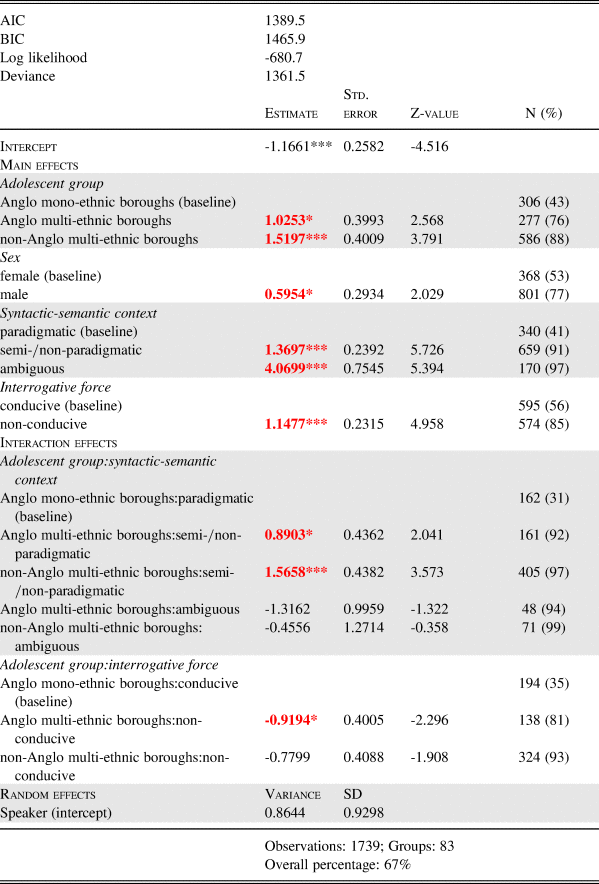
In sum, although innit evinces evidence of syntactic-semantic and semantic-pragmatic change across all young speakers in LIC, the changes are more advanced in multilingual environments (multi-ethnic boroughs) and among multilingual speakers (young non-Anglos). The data provide a basis for pursuing a contact hypothesis for the spread of innit (see Heine & Kuteva Reference Heine and Kuteva2005), and for adding invariant innit to the catalogue of innovations characterizing Multicultural London English (MLE) (Cheshire, Kerswill, Fox, & Torgersen Reference Cheshire, Kerswill, Fox and Torgersen2011). My results contradict Torgersen and colleagues’ (Reference Torgersen, Gabrielatos, Hoffmann and Fox2011): the use of innit has not stabilized, and its proportional frequency and linguistic distribution do continue to differentiate social groups.
Discussion
This section examines the mechanisms generating and diffusing London English neg-tag innovations, and explores factors promoting the selection of innit for linguistic context expansion.
Grammaticalization
The previous section demonstrated that rise of innit within and beyond third-person singular neuter present-tense be-anchor contexts and across macro-functions is driven by interaction of phonetic reduction and fusion, decategorialization, and semantic-pragmatic shift. These changes are associated collectively with grammaticalization (but see n. 2), and provide multilayered evidence that innit has become ‘automated as a single processing unit’ (Bybee Reference Bybee, Joseph and Janda2003:603).
Evolution of the London neg-tag system is in accordance with the unidirectionality hypothesis of grammaticalization: the tendency for formal, structural, and functional changes to proceed in one direction (Hopper & Traugott Reference Hopper and Traugott2003:99–139). Extrapolated from my results, the multilevel pathway in (9) shows that the changes affecting the system follow universal tendencies of loss and expansion (Bybee et al. Reference Bybee, Pagliuca and Perkins1994; Himmelmann Reference Himmelmann, Bisang, Himmelmann and Wiemer2004), viz: (i) the reduction of phonetic substance and loss of morpheme boundaries; (ii) the loss of form-dependency constraints with attendant host-class expansion; and (iii) the acquisition of new polysemies and weakening of interrogative meaning components with corresponding semantic-pragmatic context expansion.
(9) non-reduced/non-fused > reduced/fused
grammatically-dependent > invariant
multifunctional > more multifunctional
conducive > non-conducive
These developments are neither new nor unique to London English. Diachronic studies of question tags in sixteenth- to twentieth-century drama texts show the system has undergone semantic-pragmatic change from the start (Hoffmann Reference Hoffmann2006; Tottie & Hoffmann Reference Tottie and Hoffmann2009). Apparent-time studies of synchronic speech data reveal phonetic erosion and host-class expansion of neg-tags in contemporary northern British Englishes (Pichler Reference Pichler2013; Childs Reference Childs2016). What is striking is the interdependence, speed, and magnitude of neg-tag developments in London. They affect all dimensions of neg-tag use—form, structure, and function—, radically transforming the system within the seventy-odd years covered by LIC. But the different changes are intimately connected only for the diachronically and synchronically most frequent auxiliary-pronoun combination in neg-tags: ‘is + it’ (see inter alia Krug Reference Krug1998:152–53; Hoffmann Reference Hoffmann2006:42–43; Tottie & Hoffmann Reference Tottie and Hoffmann2006:296, Reference Tottie and Hoffmann2009:139; Pichler Reference Pichler2013:198). The findings thus confirm that grammaticalization need not affect all variants of a variable homogeneously (Bybee & Torres Cacoullos Reference Bybee, Cacoullos, Corrigan, Moravcsik, Ouali and Wheatley2009).
The findings also suggest the system in which an innovating variant is embedded and the innovating variant itself need not move in the same direction throughout the course of semantic-pragmatic change. The London neg-tag system is shifting from conduciveness to non-conduciveness. The macro-functional distribution of innit across social groups in LIC displays seemingly counter-directional changes: weakly conducive > non-conducive > weakly non-conducive. This may be because formal reconfiguration of the neg-tag system proceeds faster than its semantic-pragmatic shift. Among LIC young non-Anglos, innit far outnumbers full and reduced neg-tag variants, but the neg-tag variable as such performs conducive and non-conducive functions with roughly similar frequencies. With almost no full variants in young non-Anglos’ repertoire, the functional split between full variants and innit (noted in Table 4) cannot be maintained, and innit must subsume conducive uses (see Hopper's Reference Hopper, Traugott and Heine1991:22 ‘specialization’).
Language contact
London English neg-tag development, then, is consistent with a grammaticalization model. But what triggered it? What, if any, is the role of language contact?
Comparisons with relevant pre- and non-contact data from LIC old Anglos and individuals in cotemporaneous northern England corpora undermine the idea of language contact as trigger. LIC old Anglos were born in the 1930s and grew up as monolingual speakers in mono-ethnic neighbourhoods; multilingualism was not part of their early sociolinguistic histories (Cheshire et al. Reference Cheshire, Adger and Fox2013:66–67). Individuals recorded in the northern communities of Hull, Berwick-upon-Tweed, and Tyneside share limited experience of everyday multilingualism; at the time of data collection, their communities were virtually mono-ethnic white British (Cheshire, Kerswill, & Williams Reference Cheshire, Kerswill, Williams, Auer, Hinskens and Kerswill2005:144; Pichler Reference Pichler2013:211; Childs Reference Childs2016:25–27). Assuming adult linguistic stability and rejecting a south-north diffusion hypothesis for innit,Footnote 5 LIC old Anglos’ and northern individuals’ regular use of innit in paradigmatic and, occasionally, semi- and non-paradigmatic contexts is inconsistent with inference of contact-propelled change.
The emergence of the form innit and its spread through the neg-tag system must have been triggered by a force not restricted to contact settings: frequency. Owing to high incidence of use in a sequence, the morphemes ‘is + -n't + it’ have undergone phonetic reduction ([ɪznt ɪt] > [ɪzn ɪt] > [ɪn ɪt]) and have been reanalysed as the single processing unit or chunk innit ([ɪnɪt]) (Andersen Reference Andersen2001:196–201; see Beckner & Bybee Reference Beckner and Bybee2009; Bybee Reference Bybee2010). Unlike its source variant isn't it, innit is not immediately identifiable as a reduced interrogative clause that is composed of the neg-tag building blocks ‘auxiliary + negator + pronoun’. Through loss of analysability and compositionality, innit has gained autonomy from its source. The growing opacity of innit's internal constituency (relative to isn't it) has weakened its syntactic-semantic co-dependency on third-person singular neuter present-tense be-anchors and induced spread across anchor contexts. In turn, syntactic-semantic context expansion, together with loss of interrogative transparency, have produced new polysemies. Devoid of syntactic-semantic constraints and transparent interrogative structure, innit has spread to past-tense narratives where it developed new non-conducive functions.
An internal causation scenario explains the distribution of innit in the non-contact varieties in northern England. In London English, too, progression of change is compatible with a system-internal evolution of the neg-tag system. But this does not explain the timing, social embedding, and unprecedented scale of neg-tag changes in London. Changes incipient among LIC old Anglos gained momentum in the late twentieth century in boroughs that experienced increased immigration and linguistic diversification, and among adolescents with probable regular exposure to, or even use of, languages other than English in their families and neighbourhoods (see Cheshire et al. Reference Cheshire, Adger and Fox2013:53–54, 66–67). This calls for consideration of language contact.
Language and dialect contact may have played an ancillary role in the development of the form innit. Hewitt (Reference Hewitt1986) and Sutcliffe (Reference Sutcliffe1992) claim (non-paradigmatic) innit has its origins in British Jamaican Creole. While not listing innit or ennit in their dictionaries of Jamaican and Caribbean English, Cassidy & Le Page (Reference Cassidy and Le Page1967:235) and Allsopp (Reference Allsopp1996:18, 304) note the Creole pronunciation [ɪn] for ‘is’ and ‘ain't’. Although ‘[ɪn] + pronoun’ is a common tag variant in British Englishes (see inter alia Cheshire Reference Cheshire1981:370; Pichler Reference Pichler2013:183; Childs Reference Childs2016:176), the dictionaries weakly support the idea of Jamaican or Caribbean English influence on the development of the [ɪn]-element in [ɪnɪt] in southern England varieties.
More compelling, though inconclusive, evidence is available to propose that language and dialect contact may have reinforced the syntactic-semantic spread of innit. Table 7 provides an overview of question tags in languages and non-British varieties of English widely spoken in the multi-ethnic boroughs of LIC adolescents (see Baker & Mohieldeen Reference Baker, Mohieldeen, Baker and Eversley2000); it includes tags in two ambient creoles and in heritage languages (passively) spoken by frequent (N ≥ 10) neg-tag users in LIC (Torgersen, pc, February 28, 2017).Footnote 6 With the exception of Gujarati and Yoruba, which have exclusively polarity-dependent invariant tags, all languages in Table 7 have neutral invariant tags with no semantic, lexical, or syntactic usage constraints. Only Afrikaans, Hindi-Urdu, and Swahili also have dependent tags with more or less complex grammatical or lexical usage restrictions. All contact dialects have invariant tags, sometimes in addition to lower-frequency dependent tags (not listed). Because invariant tags prevail cross-linguistically (Axelsson Reference Axelsson2011) and second-language learners tend to ignore tag characteristics not found in their invariant tag-dominated heritage languages (Kolehmainen, Meriläinen, & Riionheimo Reference Kolehmainen, Meriläinen, Riionheimo, Paulasto, Meriläinen, Riionheimo and Kok2014:17), ambient learner varieties are likely also characterized by invariant tag usage. Only in ambient varieties of British English are dependent tags expected to be more robust than invariant tags (e.g. yeah, right) (Algeo Reference Algeo1988:175; Stenström, Andersen, & Hasund Reference Stenström, Andersen and Hasund2002:185–87). Assuming that the invariant tags listed in Table 7 are known, understood, or used by adolescents in multi-ethnic boroughs, their occurrence may have challenged the status of grammatically-dependent English neg-tags. How?
Question tags in frequent contact languages and dialects.

Based on structural, positional and functional similarities, (non-Anglo) adolescents in multi-ethnic neighbourhoods may have established a cognitive link between invariant tags in Table 7 and dependent tags dominant in the local variety of English. This ‘interlingual identification’ (Weinreich Reference Weinreich1968:7–8) may have motivated grammatical replication, whereby speakers use linguistic resources from one language to create new usage patterns based on the model(s) of (an)other language(s) or dialect(s); crucially, new usage patterns are not replicated in toto but through universal strategies of grammaticalization (Heine & Kuteva Reference Heine and Kuteva2005). (Non-Anglo) adolescents in multi-ethnic boroughs may have recruited innit, a minor use pattern already available in London English. On the model of invariant tags available in the ambient multilingual environment, they may have strengthened a trend embryonic in the old Anglos’ pre-contact variety and gradually extended the use of innit across anchor contexts, thereby developing it into a major use pattern. (Grammatical replication, if implicated, would accelerate, not alter, the manner of change; Heine & Kuteva Reference Heine and Kuteva2005:80.) The social distribution of innit in LIC mirrors the stages leading from minor to major use pattern in grammatical replication (Heine & Kuteva Reference Heine and Kuteva2005:46): at Stage 0, old Anglos use innit relatively infrequently, in restricted syntactic-semantic contexts, and with strong interrogative force; at Stage 1, young Anglos (in mono-ethnic boroughs) use innit with increased frequency, in new syntactic-semantic contexts, and with reduced interrogative force; finally, at Stage 2, young non-Anglos (and young Anglos in multi-ethnic boroughs) use innit with very high frequency, across the range of syntactic-semantic contexts, and with different degrees of interrogative force. The outcome of this sequence replicates a usage pattern prevailing in assumed model languages and dialects: application of one invariant tag form in all grammatical contexts.
Language contact may also have boosted semantic-pragmatic developments. Use of English narrative neg-tags (see (8) above), for example, seems limited currently to London. Goria (Reference Goria, Kaltenböck, Keizer and Lohmann2016) finds that in bilingual Gibraltar, the Spanish tag no, which does not otherwise serve an emphatic function, underwent semantic-pragmatic context expansion on the English model. Although English invariant tags also regularly occur in narratives (Stenström et al. Reference Stenström, Andersen and Hasund2002:165–191; Pichler Reference Pichler, Beaman, Buchstaller, Fox and Walker2021), pragmatic borrowing, whereby linguistic material ‘takes on new discourse functions as a result of external influence’ (Andersen Reference Andersen2014:18), may have reinforced the development of innit and other neg-tag variants as narrative devices in London. Available sources only attribute agreement-seeking functions to tags found in the frequent heritage languages and dialects in Table 7. But narrative tag functions have been reported for less widely used contact languages: Tamil, Mohawk, and Portuguese (Herring Reference Herring, Traugott and Heine1991; Mithun Reference Mithun2012; Gómez González Reference Gómez González2014).
Contact would shape the course of change. In the system-internal scenario I propose, there is a strong causal and temporal link between processes of change. Phonological changes are primary and cause syntactic-semantic context expansion; phonological and syntactic-semantic change are together responsible for semantic-pragmatic change. In a multiple causation scenario involving contact, however, syntactic-semantic spread of innit is not chiefly enabled by loss of analysability and compositionality. Instead, context expansion is driven by recruitment of innit for grammatical replication. Depending on the scenario, frequency increase of innit is either the source or by-product of context expansion.
Social diffusion
Irrespective of language contact effects, innovations in innit usage are led by speakers of MLE—(non-)Anglo adolescents in multi-ethnic boroughs. How do these innovations diffuse to mono-ethnic boroughs? Regression analyses (not shown) revealed the odds of innit increase significantly among: (i) young Anglos in mono-ethnic boroughs with the most ethnically mixed friendship networks (compared to those with exclusively Anglo networks), and (ii) adolescents commuting from multi-ethnic to mono-ethnic boroughs for college (compared to those both studying and living in mono-ethnic boroughs). These correlations indicate regular interethnic contact and everyday mundane mobility may constitute important channels for the social diffusion of innit innovations across ethnicities and boroughs (see also Cheshire, Fox, Kerswill, & Torgersen Reference Cheshire, Fox, Kerswill and Torgersen2008). This would explain why innit is more frequent, less grammatically constrained, and more functionally versatile in mono-ethnic London boroughs than in the mono-ethnic northern locales mentioned earlier. The social forces promoting system-internal tendencies in mono-ethnic London boroughs are likely rarer or altogether absent in northern England.
Selection of innit
Following Cheshire and colleagues (Reference Cheshire, Kerswill, Fox and Torgersen2011), I invoke Mufwene's (Reference Mufwene2001) ‘feature pool’ and Siegel's (Reference Siegel, Spears and Winford1997) selection constraints to account for the promotion of innit in the London English neg-tag system. Cheshire and colleagues propose that in multi-ethnic boroughs, the high linguistic diversity and largely unguided acquisition of English within ethnically mixed adolescent peer groups produce a feature pool. It contains a complex and heterogeneous set of co-variants drawn from different input varieties spoken in the ambient multilingual environment; in the pool, co-variants compete with and reinforce each other (Mufwene Reference Mufwene2001:4–6). Multiple factors such as frequency and unmarkedness conspire to constrain selection from the feature pool (Siegel Reference Siegel, Spears and Winford1997:139–43). The selection may give rise to new variants or to increased and modified use of original input variants, including ones infrequent in the local variety before language and dialect contact began or intensified (Mufwene Reference Mufwene2001:4–6).
Table 7 lists input languages and dialects to the ‘tag feature pool’ in relevant multi-ethnic boroughs. With the exception of Yoruba, all contribute at least one tag form that comprises a negative particle or affix (in bold non-italics); most of these are neutral invariant tags (see final column). Many also contribute forms that comprise a third-person singular neuter pronoun and/or form of be (in bold italics); these are often (reduced) strings of ‘is (+ -n't) + it’ (see final set). Traditional London English contributes dependent tags skewed towards ‘is + it’. We may assume, then, the ‘tag feature pool’ is heavily biased towards variants that contain ‘is + it’, have negative polarity, and/or are invariant. With innit combining multiple or all of these properties in two input varieties, its selection from the feature pool is likely governed by frequency, low salience, unmarkedness, and economy (see Siegel Reference Siegel, Spears and Winford1997:139; De Smet Reference De Smet2012:608). Innit derives from the feature pool's most common auxiliary-negator-pronoun combination and is commonly used as a dependent tag in one input variety (traditional London English) and as an invariant tag in another (London Jamaican). Moreover, it lacks analysability and compositionality vis-à-vis isn't it and other neg-tag variants. Thus, the selection of innit will have been promoted by its gradual spread across social groups and anchor contexts constituting a lowly salient and, by implication, favoured innovation. It extends a pattern already latent in some input varieties; and because of the form's reduced transparency it constitutes a relatively covert rule violation. (Absent detailed descriptions of the functionality of other tags in the feature pool, we can only speculate that innit's selection may have also been affected by its greater multifunctionality; see Hlavac Reference Hlavac2006.)
Since the gradual expansion of innit is relatively unobtrusive, it is favoured over alternative scenarios, viz: (i) spread of a less frequent and more marked auxiliary-negator-pronoun combination (e.g. weren't it); or (ii) wholesale adoption of a fully invariant but lexically marked tag form from a contact language (e.g. Cantonese hóh-mhóu). Due to their pragmatic detachability (Matras Reference Matras2009), tag forms get routinely borrowed in language contact situations (see, for example, Bentahila & Davies Reference Bentahila and Davies1983; Goria Reference Goria, Kaltenböck, Keizer and Lohmann2016). In London, tag variants from contact languages may be rejected over innit because they index ethnic minority group membership or non-localness (see also Cheshire et al. Reference Cheshire, Kerswill, Fox and Torgersen2011:167–68). Innit was at first also related to minority status (black Caribbean and, possibly, South Asian heritage). It diffused across adolescent groups, possibly because of its covert prestige as a racialized linguistic form (see Hollington & Nassenstein Reference Hollington and Nassenstein2017), and it became delinked from racial or ethnic and relinked to place identity (Hewitt Reference Hewitt1986:132; see Aarsæther, Marzo, Nistov & Ceuleers's Reference Aarsæther, Nistov, Ceuleers, Nortier and Svendsen2015 ‘space appropriation’). Because, unlike other variants in the feature pool, it indexes localness, London adolescents may have selected innit for expansion because it helps them foreground their identity as Londoners.
Innit's indexicality of localness, use as an invariant tag in one input variety, and unmarked status in the neg-tag feature pool may also have boosted its adoption by bilingual and second-language speakers. Within the neg-tag feature pool, innit is unmarked in terms of lexical components (‘is + it’), polarity (negative), and usage restrictions (invariant). In language contact settings, bilingual and second-language speakers tend to adopt unmarked rather than marked features (Thomason Reference Thomason and Hickey2013:43–44) and replace dependent with invariant tags (Bhaya Nair Reference Bhaya Nair1991:213). These speakers may promote selection and expansion of innit in a drive towards economy in the neg-tag system, that is, to reduce the complexity and informational redundancy inherent in a grammatically-dependent system. The form's social indexicality would allow them to do so without outing themselves as bilingual or second-language users.
Conclusion
My variationist analysis of LIC reveals the ongoing transformation of the London neg-tag system via successive micro-changes in the sociolinguistic conditioning of co-variants. A system characterized by diversity of full neg-tag variants that are grammatically dependent and largely conducive is being supplanted by one that is increasingly non-conducive and dominated by invariant use of one variant: innit. I attribute these developments to formal, structural, and functional changes associated with grammaticalization, triggered by frequency. I propose that—even if not implicated directly—multiple language contact may play an ancillary role in reinforcing the emergence of the form innit, accelerating its expansion across anchor contexts, and shaping functional change in the neg-tag system.
My contact proposal remains tentative. We do not know (i) to what extent the tags listed in Table 7 are used in the wider community, (ii) whether adolescents in multi-ethnic boroughs were sufficiently exposed to relevant heritage languages for contact effects to occur, or (iii) whether the published sources in the table reflect current functional (and structural) usage. To more reliably confirm the role of multiple language contact in discourse-pragmatic change, we need more research into the use of presumed model languages in the multilingual community, meta-data about individuals’ knowledge and use of these languages, and corpus-based descriptions of relevant model structures.
Among leaders of observed neg-tag changes in London (young non-Anglos), innit has spread across syntactic-semantic contexts and begun to assimilate functions of full and reduced neg-tag variants, which earlier dominated the neg-tag system and initially occur in complementary distribution with innit. Full and reduced variants maintain a precarious foothold, the former occupying a functional niche (conduciveness), the latter carrying social meaning (young Anglo). Continued spread of innit may endanger the survival of these variants and cause the disappearance of grammatically-dependent neg-tags in young Londoners’ vernacular English. With innit having developed into a fully invariant tag in their vernacular, it will be interesting to see how it competes with more established invariant tags such as yeah and right.
Appendix A: Transcription conventions and grammatical glosses
- [ ], [[ ]]
overlap
- -
false start, truncation
- (.), (..)
short, medium pause
- @
laughter
- (h)
audible in-breath
- (?)
indecipherable talk
- ,
continuing intonation contour
- .
final intonation contour
- ?
rising intonation contour
- !
increase in volume
- […]
conversation continues on this topic
- (text)
uncertain transcription
- underlining
emphatic stress
- bold italics
highlights token(s) discussed
- CAPITALS
increased volume
- aux
auxiliary
- cop
copula
- emph
emphatic particle/marker
- int
interrogative particle/marker
- m
masculine
- n
neuter
- neg
negative particle/marker
- pos
positive particle/marker
- pres
present
- pron
pronoun
- q
question particle/marker
- sfp
sentence-final particle
- sg
singular
- 3
third person
Appendix B: Special contexts for coding decategorialization

Appendix C: Established neg-tag functions in LIC


 Open access

