





Introduction
In second language (L2) pronunciation research, fluency, intelligibility, comprehensibility, and accentedness (FICA) have become increasingly important when it comes to thinking about and measuring speaking performance. One of the seminal studies that pushed forward the field of L2 pronunciation in this direction was Munro and Derwing (Reference Munro and Derwing1995a), who challenged the assumption that having an L2 accent was equivalent to being unintelligible. Munro and Derwing (Reference Munro and Derwing1995a) examined the relationships among accentedness, comprehensibility, and intelligibility in the speech of L2 English learners and demonstrated that a strong L2 accent did not necessarily lead to incomprehensible or unintelligible speech despite accentedness negatively correlated with comprehensibility and intelligibility. Such findings fueled a paradigm shift away from L2 pronunciation teaching goals of accent reduction toward prioritizing comprehensibility and intelligibility (Levis, Reference Levis2020), while triggering a resurgence of interest in L2 pronunciation research in general and FICA in particular. Saito and Plonsky (Reference Saito and Plonsky2019) proposed a framework that conceptualizes these dimensions as global aspects of L2 pronunciation proficiency, observing an increase in the proportion of pronunciation studies adopting FICA dimensions, from 22.7% in 1982–2007 to 32.7% in 2008–2017.
Given the growing body of research involving FICA, there has been interest in bringing together our understanding of these global speech dimensions and how they are related to one another in review chapters (e.g., Munro & Derwing, Reference Munro, Derwing, Reed and Levis2015; Thomson, Reference Thomson, Reed and Levis2015, Reference Thomson, Kang and Ginther2017). In this work, FICA dimensions are typically identified as related but distinct, for instance: “intelligibility is at least partially independent of many other commonly discussed dimensions of speech, such as accentedness, comprehensibility, fluency” (Munro & Derwing, Reference Munro, Derwing, Reed and Levis2015, p. 379); or similarly, “accent, intelligibility, and comprehensibility [are conceived of] as partially distinct but related dimensions” (Thomson, Reference Thomson, Kang and Ginther2017, p. 13). In related work, some recent meta-analyses have focused on examinations of the specific linguistic attributes that map onto FICA dimensions. For example, Suzuki, Kormos, and Uchihara (Reference Suzuki, Kormos and Uchihara2021) examined fluency and explored the relationship between perceived fluency and utterance fluency to better understand which temporal measurements of speech are most related to intuitive listener judgments. In another meta-analysis, Saito (Reference Saito2021) explored which phonological features influenced comprehensibility and accentedness ratings of English as a Second Language speakers and provided compelling evidence that comprehensibility and accentedness are “readily distinguishable” (p. 891) as raters relied on different types of phonological information to make their judgments. Because the scope of previous meta-analyses has been limited to one or two FICA dimensions, it remains unclear to what extent the dimensions are related and whether each dimension should be considered as distinct. To answer these questions, it is necessary to investigate all six possible relationships among FICA dimensions, which is the focus of the current study.
Meta-analyzing FICA relationships contributes to a better theoretical understanding of L2 pronunciation proficiency within the field of L2 acquisition and pronunciation research. Focusing on the strengths of the relationships among all FICA dimensions provides crucial insights: Many have argued that comprehensibility is a useful proxy for intelligibility (e.g., Kennedy & Trofimovich, Reference Kennedy and Trofimovich2019; Trofimovich, Isaacs, Kennedy, & Tsunemoto, Reference Trofimovich, Isaacs, Kennedy, Tsunemoto, Derwing, Munro and Thomson2022) with accentedness least related to the other dimensions (e.g., Huensch & Nagle, Reference Huensch and Nagle2021; Munro & Derwing, Reference Munro and Derwing2020), but no meta-analysis has yet confirmed this. Lower correlations, such as the weak relationship between intelligibility and accentedness, challenge traditional assumptions that achieving “nativelike” speech is essential for effective communication. Instead, they reinforce the importance of intelligibility and comprehensibility over accent reduction in L2 instruction. In language assessment, knowledge of FICA relationships can guide the development of assessment tools and rubrics that accurately measure pronunciation proficiency. High correlations might suggest the need for simplified, integrated measures, whereas low correlations justify treating dimensions separately to capture distinct aspects of speech proficiency. Furthermore, by considering factors that moderate FICA relationships, such as task type or listener characteristics, assessments can be designed to provide a comprehensive and considerate evaluation of learners’ pronunciation skills. Finally, by identifying and categorizing the methodological and reporting practices involved in FICA studies, the current meta-analysis addressed a gap in the existing literature by providing a comprehensive overview of how L2 pronunciation is evaluated across studies. This includes examining reliability reporting, emphasizing the importance of transparency and rigor in research. In sum, the current study synthesized and meta-analyzed previous findings on the strengths of the relationships among FICA and explored a number of moderating variables (e.g., study context, listener background, task type, and assessment setting) to explain potential cross-study variation in the strength of observed correlation coefficients. By gathering empirical evidence from a wide range of studies, the current study enhances our understanding of the complex interplay between FICA dimensions.
Definitions of FICA dimensions
Before the literature on FICA relationships is reviewed, it is necessary to provide brief definitions of each FICA dimension, especially because these terms have been used in multiple ways in the literature. The current study adopts definitions of the global FICA dimensions in line with Saito and Plonsky (Reference Saito and Plonsky2019). To start, fluency has mainly been referred to in two senses: a broad sense and a narrow sense (Lennon, Reference Lennon1990). While in the broad sense, fluency is equated with L2 oral proficiency or even general L2 proficiency, in the narrow sense, it is considered only one component of such proficiency—the fluidity or flow of speech (Housen & Kuiken, Reference Housen and Kuiken2009; Lennon, Reference Lennon1990; Thomson, Reference Thomson, Reed and Levis2015). A helpful framework for conceptualizing fluency comes from Segalowitz (Reference Segalowitz2010) and includes cognitive fluency, utterance fluency, and perceived fluency. Cognitive fluency is the efficient mobilization and integration of the cognitive processes responsible for speech production. Utterance fluency comprises temporal, pausing, hesitation, and repair characteristics of speech. Finally, perceived fluency reflects listener judgments of cognitive fluency based on utterance fluency.
Like the other FICA dimensions, perceived fluency represents listeners’ experience with an utterance. It also seems to reflect both cognitive and utterance fluency, with empirical evidence showing its ties to utterance fluency (see Suzuki et al., Reference Suzuki, Kormos and Uchihara2021). For these reasons, and in line with the framework proposed by Saito and Plonsky (Reference Saito and Plonsky2019), perceived fluency, as opposed to measures of utterance fluency, was chosen as the fluency dimension of focus in this meta-analysis. Using a listener-based global dimension such as perceived fluency, measured via listeners’ scalar ratings, allows for a more logical comparison to accentedness and comprehensibility, which are similarly listener-based global dimensions representing intuitive experiences and reactions to speech. Multiple perceived fluency rating scales can be found in the literature. For instance, Derwing, Rossiter, Munro, and Thomson (Reference Derwing, Rossiter, Munro and Thomson2004) had listeners rate speech samples on a discrete scale from 1 (extremely fluent) to 9 (extremely dysfluent), whereas Saito, Trofimovich, and Isaacs (Reference Saito, Trofimovich and Isaacs2016) used a 1,000-point sliding scale, arguing that it enables raters to make more fine-grained judgments than Likert scales.
Intelligibility and comprehensibility are two global speech dimensions related to listeners’ understanding of speech. Although these two speech dimensions share a focus on listener understanding, they differ conceptually and methodologically in important ways. Intelligibility as defined by Munro and Derwing (Reference Munro and Derwing1995a, p. 76), refers to “the extent to which a speaker’s message is actually understood by a listener”, whereas comprehensibility represents “listeners’ perceptions of difficulty in understanding particular utterances” (Munro & Derwing, Reference Munro and Derwing1995b, p. 291). Researchers have not reached a consensus on how to best measure intelligibility (Kang, Thomson, & Moran, Reference Kang, Thomson and Moran2018), so its assessment varies from open dictation with word count, cloze tests, focused interviews of listeners to sentence verification and content summaries as well as comprehension questions (Munro & Derwing, Reference Munro, Derwing, Reed and Levis2015). Of these measures, having listeners transcribe speakers’ utterances in standard orthography and coding the transcription for exact word match are acknowledged to be the most commonly used (Isaacs & Trofimovich, Reference Isaacs and Trofimovich2012; Munro & Derwing, Reference Munro, Derwing, Reed and Levis2015).
Different from the assessment of intelligibility, that of comprehensibility concerns scalar ratings (Munro, Reference Munro, Kang, Thomson and Murphy2018). The actual scales used have differed: Munro and Derwing used a 9-point scale from 1 (extremely easy to understand) to 9 (impossible to understand), while some studies have opted for different scale labels (e.g., Isaacs & Trofimovich, Reference Isaacs and Trofimovich2012; Trofimovich & Isaacs, Reference Trofimovich and Isaacs2012) or lengths (e.g., Isaacs & Thomson, Reference Isaacs and Thomson2013; Saito, Trofimovich, & Isaacs, Reference Saito, Trofimovich and Isaacs2017). In a series of seminal studies, Munro and Derwing provided repeated evidence that intelligibility and comprehensibility were only partially related: Listeners transcribed speech (to reflect intelligibility) and rated how easy it was to understand (to reflect comprehensibility). While accurately transcribed speech was generally rated easy to understand, in some instances, listeners indicated difficulties understanding speech that they could transcribe accurately. Although it might seem logical to focus on intelligibility as opposed to comprehensibility when attempting to measure L2 speech improvements for just the reason that intelligibility reflects actual understanding, Kennedy and Trofimovich (Reference Kennedy and Trofimovich2019) and Trofimovich et al. (Reference Trofimovich, Isaacs, Kennedy, Tsunemoto, Derwing, Munro and Thomson2022) put forth compelling arguments for the usefulness of comprehensibility ratings as a measure in L2 speech research: Comprehensibility has the advantage of practicality over intelligibility; it can be judged relatively quickly and reliably using rating scales, while measuring intelligibility requires unique speech content, specific tasks, and time, with scores less reliable across different tasks. Although not identical to intelligibility measures, comprehensibility often shows similar patterns in listeners’ understanding and is linked to listeners’ processing effort, emotional reactions, and perceptions of speaker credibility, making it valuable for researchers and educators.
The last target dimension in the current meta-analysis was accentedness or the degree of an L2 accent. Accentedness has been defined by different researchers as “the listener’s perception of how closely the pronunciation of an L2 speaker mirrors the pronunciation of a native speaker of a given language” (Jułkowska & Cebrian, Reference Jułkowska and Cebrian2015, p. 141), “how closely the pronunciation of an utterance approaches that of a native speaker” (Kennedy & Trofimovich, Reference Kennedy and Trofimovich2008, p. 461), and “how strong the talker’s foreign accent is perceived to be” (Munro & Derwing, Reference Munro and Derwing1995b, p. 291). Like fluency and comprehensibility, accentedness is often measured by listener judgments on rating scales, although the lengths and labels of the scales for accentedness vary from study to study.
Connections between FICA dimensions
Research into FICA has shown that these dimensions are interrelated but partially independent, with correlations varying not only between but also within studies. Munro and Derwing (Reference Munro and Derwing1995a) laid the groundwork for empirical research into FICA relationships by systematically investigating the relationships among intelligibility, comprehensibility, and accentedness in the speech of L2 learners. They found that although intelligibility and comprehensibility were correlated with accentedness, a strong L2 accent did not necessarily diminish the intelligibility or comprehensibility of L2 speech. Further studies provided additional evidence of the partial independence of these dimensions and examined speakers across proficiency levels and of different L1 backgrounds (Derwing & Munro, Reference Derwing and Munro1997; Munro & Derwing, Reference Munro and Derwing1995b).
As Thomson (Reference Thomson, Reed and Levis2015) noted, there is ample evidence of the connections among intelligibility, comprehensibility, and accentedness, but their association with perceived fluency is not as thoroughly documented. After reviewing the limited evidence available, Thomson (Reference Thomson, Reed and Levis2015) concluded that “fluency is most related to comprehensibility, somewhat related to accentedness, and apparently least related to intelligibility” (p. 217). Nevertheless, such a conclusion has yet to be statistically verified through meta-analysis.
FICA are said to be and commonly accepted as partially independent because the strengths of the correlations vary from rater to rater (Derwing & Munro, Reference Derwing and Munro1997; Munro & Derwing, Reference Munro and Derwing1995a, Reference Munro and Derwing1995b), indicating the contribution of listener factors to the variability of FICA relationships. However, the correlations among FICA dimensions seem to vary not only within but also between studies, to the extent that the direction of the correlation differs. For example, Munro and Derwing (Reference Munro and Derwing1995b) reported an average correlation strength of r = .62 for comprehensibility and accentedness ratings whereas the coefficient was higher in Isbell et al. (Reference Isbell, Park and Lee2019) at r = .92 and has even been reported as negative at r = –.28 in Matsuura et al. (Reference Matsuura, Chiba and Matsuda2010). Attempting to better understand what might impact such variation across studies, including whether the nature of the relationships vary as a result of methodological differences across studies, is an interesting and useful line of inquiry.
Potential moderators of FICA relationships
Research in L2 pronunciation that reports FICA correlations (henceforth FICA research) involves methodological decisions regarding participants and measurement procedures, which might affect the correlation strengths. The current meta-analysis explored whether methodological differences, categorized as speaker, listener, and measurement variables, have a moderating effect on FICA relationships.
Speaker variables
FICA researchers must first recruit speakers who will produce speech samples for listeners to evaluate. The speakers may be living in a context where the target language is the majority language (L2) or minority language (ML). In the L2 context, enhanced fluency, intelligibility, and comprehensibility might lead to stronger and clearer correlations among these FICA dimensions. This could be because learners in an L2 environment are regularly exposed to the target language in natural, everyday situations (see e.g., Pérez-Vidal & Juan-Garau, Reference Pérez-Vidal and Juan-Garau2011), which provides them with consistent and diverse linguistic input. This frequent exposure allows learners to practice and refine their language skills in real time, leading to a more integrated and simultaneous development of fluency, intelligibility, and comprehensibility. Muñoz and Llanes (Reference Muñoz and Llanes2014) compared learners in L2 and ML contexts, showing that ML learners tended to retain strong accents due to limited exposure to natural, spontaneous language input. Learners in an ML context may experience more variable development of FICA dimensions due to less frequent and less immersive exposure to the target language. This limited exposure could result in less consistent practice and fewer opportunities to develop these skills in tandem, leading to more nuanced individual differences and less straightforward relationships between the FICA dimensions. Thus, the current study included study context (L2 vs. ML) as a moderator variable.
Listener variables
Variables related to the background of listeners have been acknowledged as possible factors influencing bias in language evaluation (e.g., Wheeler & Kang, Reference Wheeler and Kang2022). For example, the choice of listeners, whether they are L1 speakers of the target language or experts in phonetics/pronunciation, might moderate FICA correlations. L1 listeners may have different perceptual expectations and thresholds for accentedness compared to L2 listeners (see e.g., Kang, Reference Kang2012). This perceptual variability could moderate the correlation between accentedness and other dimensions (fluency, intelligibility, and comprehensibility). L1 listeners may have a more intuitive grasp of subtle differences in pronunciation and fluency, potentially leading to more consistent ratings across different FICA dimensions. L2 listeners, on the other hand, may focus more on specific aspects of pronunciation that they find challenging or salient, which could influence the strength and nature of the correlations.
Listener experience might also play a significant moderating role in FICA correlations (Isaacs & Thomson, Reference Isaacs and Thomson2013). Experienced listeners, particularly those with expertise in language assessment or phonetics, may exhibit more refined judgments and potentially different patterns of correlation among FICA compared to less experienced listeners. They may also have extensive experience listening to various accents and show higher tolerance for accentedness. Thus, the current study included listener language background (L1 vs. L2) and listener experience (experienced vs. naïve) as moderator variables.
Measurement variables
Apart from participant variables, differences in the measurement of FICA pertaining to speaking task type, task mode, and rating scale might moderate FICA correlations in various ways (e.g., Crowther, Trofimovich, Saito, & Isaacs, Reference Crowther, Trofimovich, Saito and Isaacs2018; Huensch & Nagle, Reference Huensch and Nagle2023). Previous studies had speakers perform speaking tasks that can fall into one of the following three categories: controlled, closed, and open tasks (see Suzuki et al., Reference Suzuki, Kormos and Uchihara2021). In controlled speaking tasks, where speakers read predetermined content out loud, correlations among FICA may be more consistent as the vocabulary/syntax of the utterances are provided and do not vary among speakers. Closed tasks with specific prompts may lead to stronger correlations, especially if the constraints of the task standardize language production and evaluation criteria, for instance, by requiring certain vocabulary or structures to successfully complete the task. Open tasks, allowing more freedom in speech, may result in more variable correlations, as speakers’ individual styles and linguistic choices can influence how FICA relate. When it comes to task mode (i.e., dialogic vs. monologic), the relationship among FICA might be clearer in monologic tasks due to the lack of interactional dynamics. Dialogic tasks, involving interactions between speakers, may introduce additional variables. Correlations may be influenced by how well speakers negotiate meaning, leading to different patterns in the relationships among FICA dimensions. Thus, the current study included task type (controlled vs. closed vs. open) and task mode (monologic vs. dialogic) as moderator variables.
For fluency, intelligibility, and comprehensibility, researchers usually need to decide the scale that raters will use to evaluate speakers which could impact FICA relationships (Isaacs & Thomson, Reference Isaacs and Thomson2013) as well as whether the assessments will occur in person or online (Nagle & Rehman, Reference Nagle and Rehman2021). A continuous-point rating scale (e.g., 100- and 1,000-point scales) allows for finer discrimination between levels of proficiency. Strong correlations may emerge as raters can provide more nuanced assessments, capturing subtle variations in fluency, comprehensibility, and accentedness. A discrete-point scale (5-, 7-, or 9-point scale) may lead to clearer correlations if raters align more consistently on specific proficiency levels. However, this may oversimplify the evaluation, potentially resulting in less nuanced correlations. The assessment setting, whether in person or online, introduces different environments that can impact listener judgments and, consequently, FICA correlations. In-person assessments may provide more controlled conditions, allowing for clearer communication and potentially more accurate evaluations of FICA. Online assessments, however, might introduce distractions or technical issues that could affect listener judgments and, consequently, FICA correlations. Thus, the current study included rating scale (discrete-point scale vs. continuous-point scale) and assessment setting (in person vs. online) as moderator variables.
Finally, primary studies have pointed to the potential moderating effect of additional methodological factors, such as including an explanation of FICA to listeners and/or provision of practice items to listeners (Isaacs & Trofimovich, Reference Isaacs and Trofimovich2012), the number of dimensions investigated (Huensch & Nagle, Reference Huensch and Nagle2021), the order in which dimensions were rated (O’Brien, Reference O’Brien2016), and the inclusion of L1 speaker stimuli (Flege & Fletcher, Reference Flege and Fletcher1992). Providing clear explanations of FICA dimensions to listeners enhances their understanding and may lead to more consistent assessments. Additionally, offering practice items familiarizes listeners with evaluation criteria, potentially strengthening correlations among FICA dimensions. The number of dimensions investigated and the order in which they are rated might also play a role, affecting the complexity of the assessment task and listeners’ attention. For instance, evaluating more dimensions may increase the distinction among dimensions for raters who would be potentially more aware of or focused on attempting to differentiate them. At the same time, rating more dimensions simultaneously might result in a halo effect, or more uniform responses across dimensions and thus higher correlations, if raters do not distinguish well among dimensions or are biased by a general impression of an utterance (see, e.g., Myford & Wolfe, Reference Myford and Wolfe2003). Consecutive rating may lead to fatigue or habituation, affecting the reliability of judgments and potentially weakening correlations among FICA dimensions. Non-consecutive ratings may mitigate these effects, leading to more consistent assessments. Finally, the inclusion of L1 speaker stimuli provides listeners with a benchmark for comparison and may influence their judgments of L2 speech (Flege & Fletcher, Reference Flege and Fletcher1992). Exposure to L1 speaker models can affect listeners’ perceptions of accentedness and, consequently, the correlations among FICA dimensions. Comparisons between L2 and L1 speech may lead to stronger correlations if L2 speech is consistently evaluated against L1 speaker norms. Thus, the current study included dimension definition (with vs. without definition), practice (with vs. without practice), number of dimensions rated (2 vs. 3 vs. 4), rating order (consecutive vs. non-consecutive), and L1 stimuli (with vs. without L1 stimuli) as moderator variables.
With the growth of FICA studies, we are now at a point where it is possible to bring together this body of research to not only draw conclusions about FICA relationships but also identify their key moderators. In order to do this, three research questions (RQs) were formulated:
RQ1. Which task types, tasks, measures, and instruments are used to assess L2 FICA across pronunciation studies?
RQ2. To what extent are L2 FICA related to each other?
RQ3. To what extent do different study contexts, participant backgrounds, and outcome measures moderate the relationships between L2 FICA?
Method
We followed three main steps to answer the RQs: (a) defining a set of inclusion/exclusion criteria and searching for relevant studies; (b) coding the studies for correlation coefficients and features related to study background, participants, and outcome measures; and (c) calculating weighted mean correlation coefficients for the relationships.
Study identification and retrieval
To be included in the meta-analysis, a study had to (a) be a primary study focusing on speech stimuli from adults (18+)Footnote 1 who were speaking an L2. Studies that included synthesized speech, used a matched-guise design, or reported on disordered speech were excluded. Additionally, studies had to (b) measure the strength of the relationship between at least two of four FICA dimensions (e.g., fluency and intelligibility, fluency and comprehensibility) and (c) report their correlation coefficients (i.e., Pearson r).Footnote 2 All the studies were published before April 1, 2023.
Following previous suggestions (Plonsky & Brown, Reference Plonsky and Brown2015; Plonsky & Oswald, Reference Plonsky, Oswald, Mackey and Gass2012), we tried to be as inclusive as possible in our approach to searching. We first used different combinations of keywords (fluency, intelligibility, comprehensibility, accentedness, second language/L2, and foreign language/FL) to search library-housed databases, including Academic Search Premier, Education Full Text, Education Resources Information Center, Education Source, MLA International Bibliography, PsycArticles, PsycInfo (via EBSCO—an information service provider), Linguistics and Language Behavior Abstracts, and ProQuest Dissertations and Theses. The same keywords were also used to search the Journal of Second Language Pronunciation, the IRIS Repository of Instruments for Research into Second Languages, and Google as well as Google Scholar. We manually searched researchers’ websites (Dustin Crowther, Tracey Derwing, Talia Isaacs, John Levis, Murray Munro, Kazuya Saito, Ron Thomson, and Pavel Trofimovich), the International Research Foundation for English Language Education’s reference lists (Accentedness, Fluency, Intelligibility, Pronunciation, and Speaking Assessment), and Pronunciation in Second Language Learning and Teaching conference proceedings. Finally, we performed “backward searching” or “reference digging” by examining the references of pronunciation instruction meta-analyses (Lee, Jang & Plonsky, Reference Lee, Jang and Plonsky2015; Saito & Plonsky, Reference Saito and Plonsky2019).
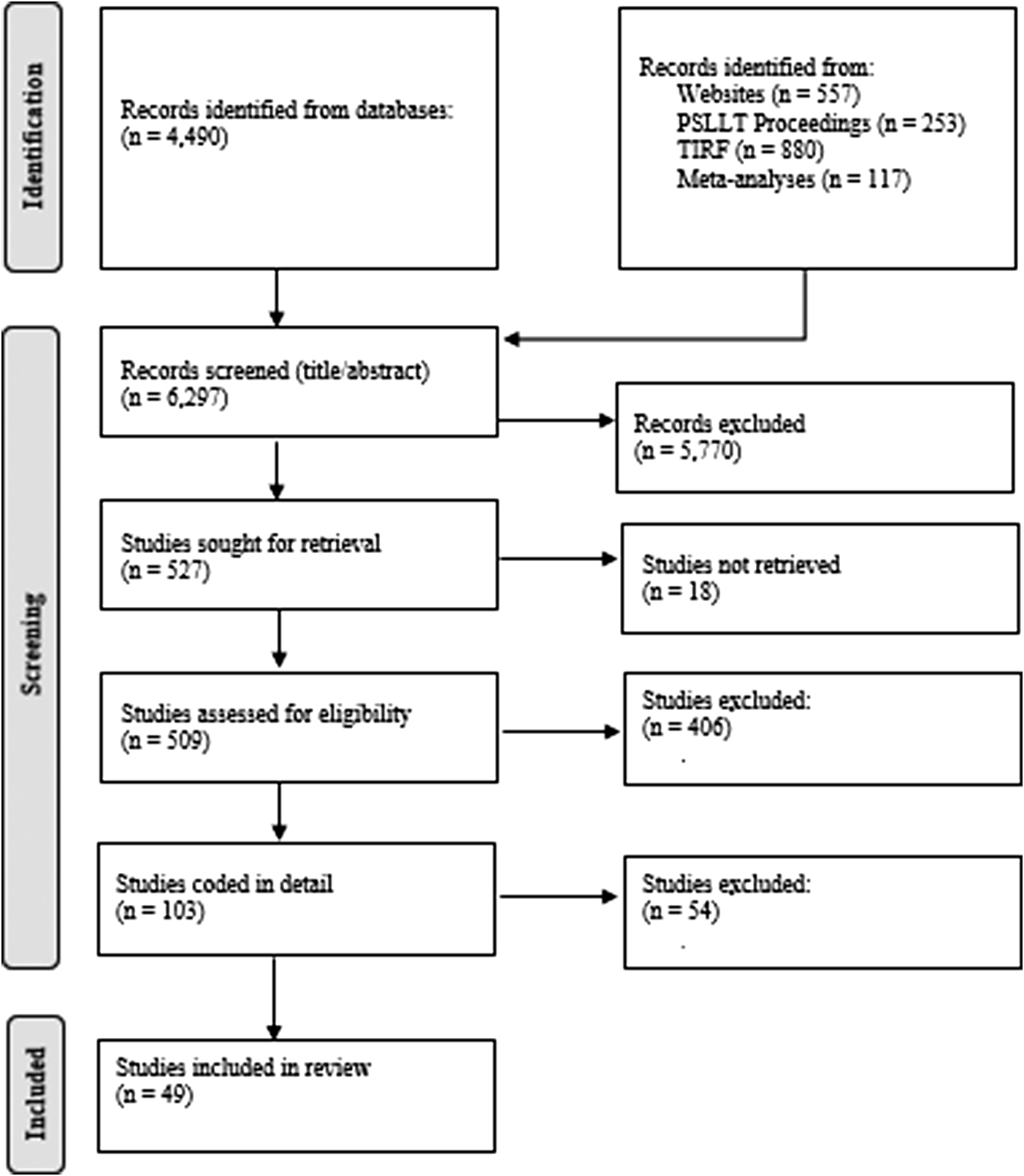
Our literature search returned 6,297 possible studies for inclusion (which included duplicates across the searches). In a first pass, the authors independently reviewed the title and abstract of each unique study to exclude all obviously unrelated studies. All studies identified as potentially relevant by either researcher (n = 527) were then subjected to a second pass in which the full text of each study was reviewed to determine whether it adhered to the inclusion criteria. After this, a total of 103 studies were retained for close coding (see Figure 1 for the study retrieval and screening procedure).
Study retrieval and screening procedure.

Coding of study features
A detailed coding scheme was developed to further filter studies for the final dataset. Each of the 103 studies was coded in Microsoft Access for five categories of features: (a) bibliographic information, (b) speaker, (c) listener, (d) measurement, and (e) correlation. Table 1 describes the coding scheme in detail. The scheme covered a wide range of study characteristics to extract descriptive information and explore potential moderators of the correlations. It underwent several rounds of revision during piloting of a randomly selected sample of studies. As recommended by Plonsky and Oswald (Reference Plonsky, Oswald, Mackey and Gass2012), both authors coded the entire sample to ensure inter-rater reliability. Disagreements were discussed and resolved.
Coding scheme.

Note: CEFR = Common European Framework of Reference for Languages; IELTS = International English Language Testing System; TOEFL = Test of English as a Foreign Language.
During the coding process, additional studies were identified that did not meet the inclusion criteria (because they included non-adult participants, they were duplicate data of another study in the sample, or the correlation coefficient included was not Pearson r, etc.). Requests for missing information were sent via email and when necessary, LinkedIn, to 21 authors of whom 14 (66.7%) replied with the requested information.Footnote 3 In total, 49 studies together with 141 correlation coefficients (r) remained in the final analysis (see https://osf.io/dtp8z/ for a list of included studies).
Analysis
To answer RQ1 (measurement of FICA), we calculated frequencies and percentages of the different task types, tasks, measures, and instruments used to assess FICA. For RQ2 (strengths of FICA relationships), we fitted a three-level random-effects meta-analysis model to each of the six possible relationships (fluency/intelligibility, fluency/comprehensibility, fluency/accentedness, intelligibility/comprehensibility, intelligibility/accentedness, and comprehensibility/accentedness). This approach was taken to account for the dependency between effect sizes occurring when a study contributed more than one effect size to the meta-analysis (Harrer, Cuijpers, Furukawa, & Ebert, Reference Harrer, Cuijpers, Furukawa and Ebert2021). In the current meta-analysis, effect size or correlation coefficient dependence was introduced by researchers who used multiple speaker groups, listener groups, and/or measurement tasks. In the end, five models were fitted using the R package metafor and the function rma.mv (Viechtbauer, Reference Viechtbauer2010). A meta-analysis model could not be fitted for fluency/intelligibility as there was only one study reporting a Pearson correlation (Lee, Reference Lee2017; r = .61, p < .01). Correlation coefficients were transformed into Fisher z scores for all analyses and converted back for presentation (Borenstein, Hedges, Higgins, & Rothstein, Reference Borenstein, Hedges, Higgins and Rothstein2021; Cheung, Reference Cheung2015):
 $$ z=0.5\;\log \left(\left(1+r\right)/\left(1-r\right)\right) $$
The transformed correlations were also weighted by their correspondent sampling variances in order to account for unequal sample sizes:
 $$ {v}_z=1/\left(n-3\right) $$
where n is the sample size.
The results were interpreted based on Plonsky and Oswald’s (Reference Plonsky and Oswald2014) scale for interpreting correlation coefficients in L2 research: small r ≈ .25, medium r ≈ .40, and large r ≈ .60. We addressed RQ3 (moderators of the relationships) by examining I 2, which is the percentage of variability in effects sizes that is due to real differences not sampling error (Harrer et al., Reference Harrer, Cuijpers, Furukawa and Ebert2021). Based on this measure, a predictor can be specified in separate models (i.e., meta-regression) with the mods argument of rma.mv to help determine which factors are causing between-study heterogeneity. The predictors included in these meta-regression models were study context (L2 vs. ML), listener language background (L1 vs. L2), listener experience (experienced vs. naïve), task type (controlled vs. closed vs. open), task mode (monologic vs. dialogic), rating scale (discrete-point scale vs. continuous-point scale), assessment setting (in-person vs. online), dimension definition (with vs. without definition), practice (with vs. without practice), number of dimensions rated (2 vs. 3 vs. 4), rating order (consecutive vs. non-consecutive), and L1 stimuli (with vs. without L1 stimuli). Effect sizes were divided into subgroups based on these categories, and a pooled effect size was computed for each subgroup. We included subgroups with as few as two effect sizes (Valentine, Pigott, & Rothstein, Reference Valentine, Pigott and Rothstein2010).
The data set in this study included both published and unpublished studies in an effort to minimize the potential influence of publication bias that is in favor of positive or statistically significant results (Norris & Ortega, Reference Norris, Ortega, Norris and Ortega2006). To test for publication bias, researchers have advocated the use of funnel plots (see Oswald & Plonsky, Reference Oswald and Plonsky2010). Although the use of funnel plots for multilevel data, such as the data in the current analysis, is debated due to the clustering of effect sizes, we included funnel plots to visually assess potential bias (see supplementary material). While clustering may complicate the visualization and interpretation of funnel plots, they still provide valuable information about the distribution of effect sizes. In addition to funnel plots, we extended Egger’s test (Egger et al., Reference Egger, Smith, Schneider and Minder1997) by including the standard error (SE) of the correlation coefficients as a moderator in the five existing models fitted for RQ2. The intercept of this regression test indicates funnel plot asymmetry or bias: the larger its deviation from zero, the higher the bias, with a significance level set at p < .10. We also examined the distribution of correlations for influential outliers. This is defined as Cook’s distance greater than 0.45 or hat value greater than $ 3\frac{1}{k} $
, where k is the number of effect sizes (Harrer et al., Reference Harrer, Cuijpers, Furukawa and Ebert2021). All data, code, and output used in this meta-analysis are available at https://osf.io/dtp8z/.
$ 3\frac{1}{k} $
, where k is the number of effect sizes (Harrer et al., Reference Harrer, Cuijpers, Furukawa and Ebert2021). All data, code, and output used in this meta-analysis are available at https://osf.io/dtp8z/.
Results
Table 2 provides a summary of the primary studies. The final 49 studies in the current meta-analysis included 50 independent speaker samples and 57 independent listener samples and were conducted between January 1995 and April 2023. A total of 141 correlation coefficients were collected based on these samples. Within individual studies, the speaker sample size ranged from 4 to 120 (M = 29.8; standard deviation [SD] = 22.7) with a total of 1,492 speakers included in the current meta-analysis. The listener sample sizes ranged from 2 to 236 (M = 38.8; SD = 51.1) with a total of 2,214 listeners. The age of 33 speaker samples (66.0%) for which age information was reported ranged from 18 to 41. Age information was reported for 38 listener samples (66.7%), whose ages ranged from 18 to 75.
Summary of primary studies.

In the data set, 33 studies (67.3%) were published articles, 15 (32.6%) were MA and PhD theses and dissertations, and one was a conference paper. The publication language was predominantly English, with the exception of one study published in Korean. English was also the most common target language as reported in 38 studies (77.6%). L2 Arabic, Chinese, Dutch, French, Korean, Russian, and Spanish were the target languages in the remaining 11 studies. Twenty-one studies (42.9%) focused on speakers of the same L1, 27 (55.1%) focused on speakers of different L1s, and one study focused on both single-L1 and mixed-L1 groups of speakers. The speaker L1s in the data set represent a variety of languages: Arabic, Chinese, English, Farsi, Finnish, French, Hindi, Japanese, Kinyarwanda, Polish, Spanish, and Vietnamese. When considering learning context, 26 studies (53.1%) were conducted with speakers in an L2 environment, and 20 (40.8%) were conducted with speakers in an ML environment. One study involved speakers in both L2 and ML contexts. The language acquisition context was not clear in two studies. L1 listeners were recruited as the sole group of listeners in 36 studies (73.5%), whereas three studies (6.12%) recruited only L2 listeners. Ten studies (20.4%) recruited both L1 and L2 listeners. Listener experience was reported in 24 studies (49.0%). Of these, 12 studies recruited naïve listeners, nine recruited experienced listeners, two used a mix of naïve and experienced listeners, and one employed separate groups of naïve and experienced listeners.
Measurement of FICA
Among the 49 included studies, 22 (44.9%) measured two FICA dimensions, while 26 (53.1%) measured three, and only one (2.04%) measured four. In 28 studies (57.1%), the dimensions were explained to listeners, and in 27 studies (55.1%), listeners were provided with practice items. The number of practice items ranged from one to 15, with 22 studies including one to five practice items.
A majority of studies (42) took either a simultaneous or a counterbalanced approach to rating the dimensions, whereas the other studies (7) had listeners rate the dimensions consecutively. Regarding speech stimuli, 20 studies (40.8%) included L1 stimuli in the rating/transcription task, while 29 (59.2%) only included L2 stimuli.
The studies included a total of 181 measurements of FICA dimensions. Table 3 provides a detailed description of the task types, tasks, measures, and instruments involved in measuring each of the dimensions. Regarding measurement characteristics, fluency, comprehensibility, and accentedness were measured via rating scales which ranged from 2-, 4-, 5-, 6-, 7-, 9-, and 10-point scales to 100- as well as 1,000-point scales, although the 2-, 4-, 6-, 10-, and 100-point scales were used infrequently (10 times out of 162). The 9-point scale was the most commonly used for assessing fluency, comprehensibility, and accentedness (82 times out of 162) followed by the 1,000-point scale (35 times out of 162). Of the 22 times intelligibility was measured, transcription was used 18 times (81.8%), rating scales were used three times (13.6%), and comprehension questions were used once (4.55%). To elicit L2 learners’ speech, researchers employed a variety of tasks. Among them, closed tasks (e.g., picture narratives) were the most commonly used (70 out of 181 times), followed by open (57 times) and controlled tasks (50 times).
FICA measurement in L2 research.

Note: The largest percentages of each category are in bold for easy recognition. Issacs and Thomson (Reference Isaacs and Thomson2020) used both 5-point and 9-point scales to measure fluency, comprehensibility, and accentedness, resulting in k = 184 (rather than 181) for instrument. IELTS = International English Language Testing System; TOEFL = Test of English as a Foreign Language; SPEAK = Speaking Proficiency English Assessment Kit.
Of the 35 times fluency was measured, reliability was reported 26 times (74.3%), and of the 67 times comprehensibility was measured, reliability was reported 48 times (71.6%). The reliability reporting rates of accentedness and intelligibility were lower at 59.6% and 50.0%, respectively. Most studies reported alpha or intraclass correlation (ICC) as their reliability index. The mean (M) reliability coefficients of all FICA measures are shown in Table 4. Finally, 29 studies (59.2%) were administered in person; 13 studies (26.5%) were administered remotely, and 7 studies (14.3%) did not report whether study administration was conducted face to face or online.
Mean inter-rater reliability coefficients of FICA measures.

Directions and sizes of FICA relationships
Before arriving at the results for RQ2, we tested for publication bias using Egger’s tests (see the Analysis section). The results indicated that there was publication bias for the correlations of fluency/comprehensibility (p < .0001), intelligibility/comprehensibility (p = .01), and comprehensibility/accentedness (p < .0001), as demonstrated by the asymmetry in their respective funnel plots (see supplementary material). In contrast, the funnel plots for fluency/accentedness and intelligibility/accentedness displayed more symmetry, and no significant publication bias was detected for these correlations. In addition, we excluded one study from the intelligibility/comprehensibility subset as a result of the outlier analysisFootnote 4 (defined as Cook’s distance > 0.45 or hat value > $ 3\frac{1}{k}\Big). $
This resulted in increased precision of the average correlation (i.e., narrowed confidence interval [CI]) and reduced variation due to between-study heterogeneity (i.e., change of Q from 52.8 to 17.5, change of I 2 from 81% to 55%). The strength of the relationship also decreased from r = .67 to r = .59. Given such changes to the statistical model, the exclusion was applied in all subsequent analyses.
$ 3\frac{1}{k}\Big). $
This resulted in increased precision of the average correlation (i.e., narrowed confidence interval [CI]) and reduced variation due to between-study heterogeneity (i.e., change of Q from 52.8 to 17.5, change of I 2 from 81% to 55%). The strength of the relationship also decreased from r = .67 to r = .59. Given such changes to the statistical model, the exclusion was applied in all subsequent analyses.
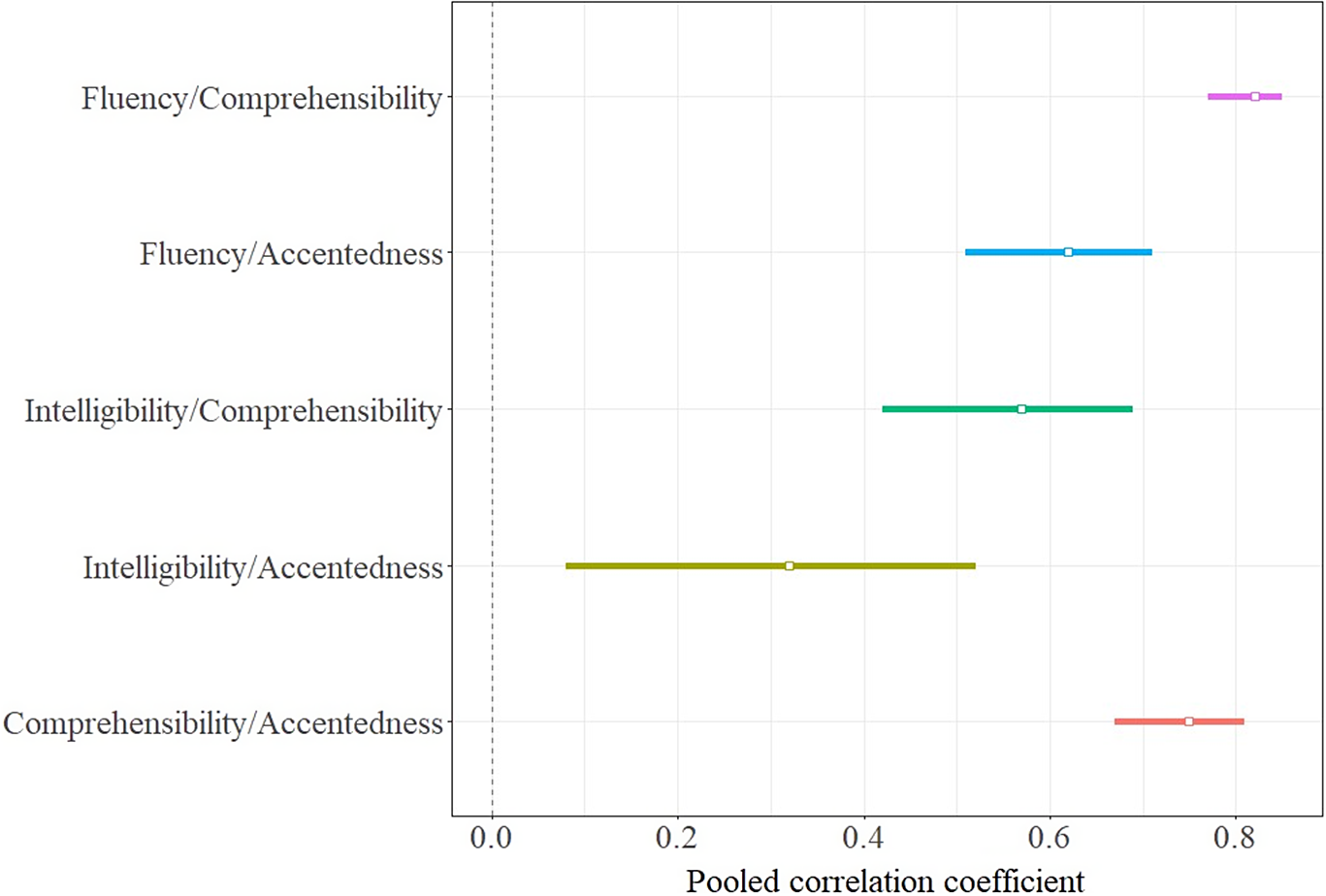
Table 5 summarizes the results regarding the strengths of the correlation coefficients among FICA dimensions in the current sample. The fluency/intelligibility relationship is not included because there was only one correlation coefficient in the sample. The comprehensibility/accentedness relationship had the most frequently reported coefficients (k = 50 out of 139) followed by fluency/comprehensibility (k = 34). All the FICA dimensions were positively correlated, with correlation coefficients ranging from .32 to .82. While most of the pooled correlation coefficients between FICA dimensions were large (r values near and above .60), indicating strong relationships, the correlation between intelligibility and accentedness was small (r = .32). Figure 2 illustrates the strengths of the relationships in the form of a mean plot. Of note, the relationship between fluency and comprehensibility (r = .82) demonstrated highly consistent findings across studies as indicated by a small (SE = 0.06) and comparatively narrow CIs [.77, .85]. Conversely, the relationship between intelligibility and accentedness demonstrated less consistency as indicated by relatively wide CIs [.08, .52]. Forest plots showing the observed effect, CI, and weight of each study for each relationship are available in the supplementary material.
Overall results for FICA relationships.

Note: The final number of correlation coefficients decreased from 141 to 139 because two studies were excluded from the correlation subsets, with one an outlier and the other the only study investigating fluency/intelligibility.
* p < .01;** p < .001; *** p < .0001.
Comparison of FICA relationships.

Moderators of FICA relationships
The last RQ, RQ3, examined the variables that may moderate the relationships among FICA dimensions. The I 2 statistic suggests that between-study heterogeneity makes up about 48% to 84% of the total variation in all the relationships (see Table 5), justifying a closer look at the potential contributions of moderators to the relationships.
The moderator analysis revealed that task type significantly influenced the relationships between fluency/accentedness, intelligibility/comprehensibility, and intelligibility/accentedness relationships. For each comparison, the relationships were strongest when assessed through controlled tasks (e.g., read-aloud and repetition) and weakest when evaluated with open tasks (e.g., conversation, interview, and monologue). For instance, the fluency/accentedness relationship was stronger in controlled tasks (r = .81, 95% CI [.48, .94], k = 3) versus open ones (r = .52, 95% CI [.34, .67], k = 8), and similarly, for intelligibility/accentedness, there was a medium relationship in controlled tasks (r = .53, 95% CI [.22, .74], k = 7) but a negligible effect in open tasks (r = .04, 95% CI [–.34, .41], k = 8). Additionally, the number of dimensions played a role in shaping the relationships between fluency/comprehensibility and comprehensibility/accentedness. Studies with fewer FICA dimensions measured showed stronger relationships. For instance, the comprehensibility/accentedness relationship was somewhat stronger in studies where they were the only two rated dimensions (r = .84, 95% CI [.74, .91], k = 17) in comparison to those studies when a third dimension was measured (r = .69, 95% CI [.61, .77], k = 32). The same was also true for the fluency/comprehensibility relationship: two dimensions included (r = .88, 95% CI [.80, .93], k = 13) versus three (r = .79, 95% CI [.75, .83], k = 20).
No other significant impacts surfaced related to the other moderator variables. The pooled effects for moderator subgroups in each relationship are presented in the supplementary material. For fluency/accentedness, effect sizes were not pooled in the subgroups of rating order and the number of dimensions measured due to a lack of data. The same holds true for the listener experience subgroups of intelligibility/accentedness.
Discussion
Assessment methods in FICA studies
This study set out to meta-analyze the reported correlations among listener-based global dimensions of L2 speech (i.e., FICA). It first surveyed the methodological and reporting practices of FICA studies. A majority of the studies (74%) employed L1 speakers as the sole evaluators of speech samples. Despite English’s status as a lingua franca, leading to its widespread use among L2 speakers, the reliance on L1 speaker norms for measurement within this domain persists (see the Limitations and recommendations for future research section). Furthermore, most of the studies (78%) targeted L2 English pronunciation. This reliance may limit the generalizability of FICA findings, underscoring the need for further research in other languages (see also Crowther & Isbell, Reference Crowther and Isbell2023; Levis, Reference Levis2021). Such work can identify commonalities and differences in how FICA interact, leading to a deeper understanding of cross-linguistic variation in speech perception and evaluation. Additionally, it can inform language teaching methodologies, curriculum development, and assessment practices tailored to specific linguistic contexts. Fortunately, it appears that the field is moving in this direction: Between 2020 and 2023, five studies focused on a target language other than English, compared to only six such studies observed in the previous period from 1995 to 2019.
A notable finding was that comprehensibility and accentedness were the most frequently measured dimensions (k = 53 and k = 45, respectively), followed by fluency (k = 31) and intelligibility (k = 17). This suggests that less attention has been paid to the relationships between intelligibility and other FICA dimensions. This finding might be somewhat surprising due to the increasing acceptance and adoption of intelligibility as a teaching priority (see Levis, Reference Levis2018). At the same time, intelligibility might be less studied because it is much more difficult to operationalize, both in theoretical and practical terms, in comparison to other FICA dimensions. For instance, although transcription has been used to evaluate this measure of understanding, its coding and analysis are not always agreed upon. Should transcription accuracy scores be based on an exact match of all words or only content words? If a speaker makes a grammatical error and the listener/transcriber “corrects” that error in their transcription, should that count as understanding or not? Relatedly, intelligibility scores often result in very different distributions in comparison to other FICA dimensions (see e.g., Huensch & Nagle, Reference Huensch and Nagle2021; Munro & Derwing, Reference Munro and Derwing1995a), such that they are heavily skewed toward utterances being perfectly intelligible. Ultimately, if most utterances are intelligible, measurements of comprehensibility, which show greater variability and are more reliable across task types (Kang et al. Reference Kang, Thomson and Moran2018), may be more informative for researchers and teachers attempting to understand and improve L2 pronunciation proficiency (see also Kennedy & Trofimovich, Reference Kennedy and Trofimovich2019). The variability of intelligibility across tasks and its lack of real-time processing demands in measurement may make it less reliable, especially in capturing the dynamic nature of communication, which might help explain why reliability is reported less frequently in studies on intelligibility.
Another trend observed among the studies pertains to the rating scales utilized. The 9-point Likert scale, used by Munro and Derwing (Reference Munro and Derwing1995a, Reference Munro and Derwing1995b), emerged as the most common scale, often serving as the default measure for fluency, comprehensibility, and accentedness. Although other scales of different lengths were also used, many studies failed to justify their choices. An exception is Saito et al. (Reference Saito, Trofimovich and Isaacs2016), who supported their adoption of the 1,000-point slider by arguing that it could facilitate more nuanced judgments. Furthermore, a critical issue in FICA measurement lies in the inconsistent reporting of reliability, with reporting rates varying considerably among FICA dimensions. For example, fluency exhibited the highest reliability reporting rate at 74.3%, while intelligibility had the lowest at 50.0%. Although reliability coefficients reported in FICA studies tend to be higher than those of L2 acquisition instruments (Plonsky & Derrick, Reference Plonsky and Derrick2016), the average reporting rate of 50.2% might undermine the interpretation of FICA results.
Interrelationships among FICA dimensions
The second RQ examined the nature and magnitude of the relationships among FICA. The results confirmed significant associations between these dimensions, with fluency, intelligibility, and comprehensibility inversely related to accentedness. These associations can be attributed to accent features, such as consonant/vowel insertion/deletion, inappropriate syllable reduction, and consonant cluster divergence, which may impede understanding and cause communication breakdowns (Kang, Thomson, & Moran, Reference Kang, Thomson and Moran2020). However, perhaps of greater interest to pronunciation researchers is the strength of the associations, which can help verify if accentedness “is given more weight than it deserves” (Derwing & Munro, Reference Derwing and Munro2009, p. 488). As for this matter, the present study provided empirical evidence on the magnitude of these relationships. Among the aggregated effect sizes, the correlation between intelligibility and accentedness emerged as the weakest, with a correlation coefficient of r = .32 (95% CI [.08, .52]). According to Plonsky and Oswald’s (Reference Plonsky and Oswald2014) field-specific recommendations for interpreting effect sizes, this correlation represents a small effect. This finding so far lends the strongest support to Munro and Derwing’s (Reference Munro and Derwing1995a) preliminary observations that the two dimensions are partially independent.
Unlike intelligibility, fluency and comprehensibility demonstrated strong correlations with accentedness (r = .62, 95% CI [.51, .71] and r = .75, 95% CI [.67, .81], respectively). One possible explanation for this disparity could lie in the differences in measurement methods between intelligibility and the fluency/comprehensibility/accentedness dimensions. Intelligibility is primarily assessed through transcription tasks, whereas fluency, comprehensibility, and accentedness are measured by rating scales. As pointed out by an anonymous reviewer, these ratings require listeners to make holistic, intuitive judgments and therefore reflect a real-time processing component. As such, the ratings are likely influenced by similar factors (e.g., processing difficulty and alignment with expectations), including linguistic features—an outcome documented in previous work exploring the linguistic features mapping onto these dimensions across tasks (e.g., Crowther et al., Reference Crowther, Trofimovich, Saito and Isaacs2018). In contrast, intelligibility assessments may not align perfectly with the more fluid and immediate nature of rating fluency, comprehensibility, or accentedness, leading to potential inconsistencies, or incongruencies, in how these components are measured and interpreted within research. In other words, the magnitude of the effect sizes of relationships involving intelligibility might be not only indicative of the theoretical distinctions between the dimensions but also influenced by differences in measurement format. This possibility might lend support to recommendations favoring the use of comprehensibility ratings over intelligibility scores in research and teaching (see e.g., Kennedy & Trofimovich, Reference Kennedy and Trofimovich2019; Trofimovich et al., Reference Trofimovich, Isaacs, Kennedy, Tsunemoto, Derwing, Munro and Thomson2022).
Another consideration regarding measurement differences between intelligibility and fluency/comprehensibility/accentedness is the potential impact of having listeners transcribe speech. Recent studies have suggested that the inclusion of a transcription task may impact comprehensibility and accentedness ratings along with the strength of their relationship (Huensch & Nagle, Reference Huensch and Nagle2021, Reference Huensch and Nagle2023). The logic is that having raters transcribe learner speech might act as an awareness-raising tool—by writing down what they hear, raters are able to differentiate speech that is difficult to understand from that which is merely accented. If we compare comprehensibility/accentedness correlation coefficients in studies with and without a transcription task, we see that studies which included an intelligibility task (k = 15) resulted in weaker comprehensibility/accentedness relationships: r = .62, 95% CIs [0.43, 0.76], compared to studies without an intelligibility task (k = 35): r = .79, 95% CIs [0.71, 0.85]. These findings, combined with the results of the moderator analysis suggesting that including more dimensions weakens the strength of some relationships, call for future work targeting the impact of study design features. Specifically, purposefully examining the impact of including an intelligibility transcription task on comprehensibility/accentedness relationships is an important direction for future research.
While the relationship between intelligibility and comprehensibility yielded a medium-sized correlation coefficient r = .57, the relatively wide CI from r = .42 to r = .69 suggests some uncertainty in the relationship. This may, however, simply mean the number of correlation coefficients examined (k = 17) was insufficient. In fact, intelligibility/comprehensibility had the smallest sample size among the five pairings investigated. Nevertheless, the relationship follows the strength pattern observed in previous research, wherein intelligibility and comprehensibility exhibit a stronger relationship than intelligibility and accentedness (Munro & Derwing, Reference Munro and Derwing1995a). The findings underscore the distinction between intelligibility and comprehensibility, despite their intertwined nature. While this relationship does not detract from the benefits of using comprehensibility as an outcome measure for L2 pronunciation research and teaching, it serves as a reminder to researchers in the field that these are indeed distinct dimensions.
Finally, fluency and comprehensibility had the strongest correlation of .82. Moreover, the narrow CI [.77, .85], which is also the narrowest among the relationships, suggests that the correlation was consistently strong across studies. This finding resonates with previous claims that fluency is more strongly associated with comprehensibility than with intelligibility and accentedness (Thomson, Reference Thomson, Reed and Levis2015). Numerous studies have provided evidence of the close relationship between fluency and comprehensibility. Munro and Derwing (Reference Munro and Derwing1995a) and Derwing and Munro (Reference Derwing and Munro1997) reported that goodness of prosody influenced listeners’ judgments of comprehensibility. In addition, Derwing, Munro, and Wiebe (Reference Derwing, Munro and Wiebe1998) and Suzuki and Kormos (Reference Suzuki and Kormos2020) found that comprehensibility ratings were linked to factors such as articulation rate and pause duration and ratio. These temporal measures are in turn associated with fluency (e.g., Bosker, Pinget, Quené, Sanders, & de Jong, Reference Bosker, Pinget, Quené, Sanders and de Jong2013; Chau, Huensch, Hoang, & Chau, Reference Chau, Huensch, Hoang and Chau2022). Moreover, Suzuki and Kormos (Reference Suzuki and Kormos2020) showed that not only comprehensibility and fluency were strongly correlated with each other, but also comprehensibility ratings were the strongest predictors of fluency ratings.
Saito and Plonsky (Reference Saito and Plonsky2019) introduced the Framework for L2 Pronunciation Measurement, aiming at assessing the effectiveness of L2 pronunciation instruction. In their framework, FICA are treated as a single measure of “global L2 pronunciation proficiency” on the grounds that it aligns “with empirical evidence in existing L2 pronunciation research” (p. 657). The researchers referred to Derwing et al. (Reference Derwing, Rossiter, Munro and Thomson2004) and Munro and Derwing (Reference Munro and Derwing1995a), who found strong correlations (r >.80) among intelligibility, comprehensibility, and accentedness, as well as between fluency and comprehensibility, and suggested that FICA could be viewed as a “statistically similar phenomenon” (p. 657). The current study uncovered a more nuanced picture of FICA and their relationships. First, intelligibility exhibited the weakest relationship with accentedness. Second, the strength of the relationships can be sorted as follows, starting with the strongest relationship: fluency/comprehensibility, comprehensibility/accentedness, fluency/accentedness, intelligibility/comprehensibility, and intelligibility/accentedness. Finally, fluency and comprehensibility seem to play an intermediary role in connecting the dimensions. They exhibit strong correlations not only with each other but also with intelligibility and accentedness, although information about the fluency/intelligibility pair remains limited.
Factors influencing FICA correlations
Our last RQ was exploratory in nature. It addressed the variability of FICA relationships by examining several potentially influential moderators. These moderators were study context, listener language background, listener experience, task type, task mode, rating scale, assessment setting, dimension definition, practice items, number of dimensions rated, rating order, and inclusion of L1 stimuli. The results revealed significant differences in correlation coefficients based on task type for the correlations between fluency/accentedness, intelligibility/comprehensibility, and intelligibility/accentedness. More specifically, accentedness showed stronger correlations with fluency and intelligibility when measured by controlled tasks (word, sentence, and paragraph reading). An explanation for this finding is the consistency read speech offers, allowing listeners to focus more on the target measures without being distracted by variations in length, content, and grammatical accuracy. These findings echo Crowther et al. (Reference Crowther, Trofimovich, Saito and Isaacs2018), who demonstrated that increased task demands resulted in greater overlap in how linguistic dimensions mapped onto accentedness and comprehensibility, while also leading to higher ratings of both accentedness and comprehensibility. As pointed out by an anonymous reviewer, the linguistic features of the predefined texts in controlled tasks might have downstream impacts on construct validity (if they differentially contribute to the speech dimensions). This provides additional support for the use of open and free tasks in future FICA research.
In addition to the moderating effects of task type, another influential moderator was the number of dimensions measured, which affected the strength of the fluency/comprehensibility and comprehensibility/accentedness relationships. The number of dimensions listeners rate may moderate FICA interconnections because evaluating multiple dimensions simultaneously increases cognitive processing demands, which can lead to variability in judgments as raters attempt to differentiate among linguistic features, particularly when using scales of varying lengths and encountering task-specific influences (Isaacs & Thomson, Reference Isaacs and Thomson2013; Saito et al., Reference Saito, Trofimovich and Isaacs2017; Crowther et al., Reference Crowther, Trofimovich, Saito and Isaacs2018). The moderator did not significantly impact the fluency/accentedness, intelligibility/comprehensibility, and intelligibility/accentedness relationships, likely due to the limited number of studies (k = 1, k = 2, and k = 3, respectively) that measured only two dimensions in these subsets.
Besides these two moderating effects (which impacted only a subset of relationships), no other significant differences were observed between the subgroups of effect sizes. There are two possible explanations for this result. First, it might be that the relationships among FICA are quite consistent and that the examined variables do not significantly influence the strength of these relationships. However, some studies have indicated influential moderators in specific contexts (e.g., Jułkowska & Cebrian, Reference Jułkowska and Cebrian2015; Saito et al., Reference Saito, Trofimovich and Isaacs2017; Wheeler & Kang, Reference Wheeler and Kang2022), as in the case of task type above. Also, certain correlations have relatively wide CIs, suggesting potential variability. Alternatively, it is more probable that between-study differences did not emerge due to the small and unbalanced sample sizes of many moderator subgroups, rendering statistical tests underpowered.
This study advances our understanding of the intricate relationships among FICA, emphasizing their interconnectedness and the factors influencing these dimensions. Notably, intelligibility showed only a weak correlation with accentedness, supporting its partial independence, while fluency and comprehensibility exhibited the strongest interrelation, highlighting their pivotal roles in L2 speech proficiency. The findings of this study both corroborate and challenge existing literature on L2 pronunciation. While they reinforce established relationships, such as the partial independence of intelligibility and accentedness and the strong correlation between fluency and comprehensibility, they also highlight significant gaps and methodological inconsistencies. The underrepresentation of intelligibility, reliance on L1 norms, and inconsistent reliability reporting reveal areas where previous research may have been limited. Additionally, the moderating effects of task type and measurement practices on FICA relationships underscore the need for more rigorous and inclusive methodologies. Together, these findings validate key insights while calling for methodological advancements to better capture the complexities of L2 pronunciation and its dimensions.
Limitations and recommendations for future research
While our study has shed light on the relationships among FICA and their measurement and reporting practices, several limitations warrant acknowledgement. First, the current analysis required studies to report Pearson correlation coefficients, excluding those reporting other types, such as partial and Spearman. This limitation, coupled with potential publication bias evident in three of the five correlation subsets, may weaken result interpretation. Another limitation concerns the robustness of certain moderator analyses, stemming from unequal sample sizes. For instance, the fluency/accentedness relationship subset included 15 L2 studies but only three ML ones (see supplementary material). In addition, several analyses were based on a small number of correlation coefficients. Results from these analyses should be interpreted with caution. Future research with larger sample sizes is needed to further explore the moderators and validate our findings.
Alongside these methodological limitations, our study sample lacked diversity in terms of target languages, with only 10 of 49 studies targeting a language other than English. However, there is a promising trend, with five of 13 studies included since 2020 focusing on a target language other than English, suggesting a shift in research direction. A clear recommendation for future FICA research is the inclusion of participants whose L2 is not English (see also Levis, Reference Levis2021).
Two design features likely to restrict external validity involve the uses of raters and speaking tasks. In terms of raters, language background (L1 vs. L2) was still the prime parameter for recruitment, despite English being a lingua franca and the diverse interactions English language learners may have with L2 speakers. Having L2 listeners rate speech samples can thus better reflect the diversity of real-life interactions and provide useful insights for the research domain. Regarding speaking tasks, there is a movement towards more authentic tasks beyond controlled read-aloud or repetition tasks, with open tasks favored to measure fluency and intelligibility. Researchers should continue this trend, adopting more spontaneous tasks to enhance ecological validity of findings unless the need for controlled tasks is justified.
Lastly, primary studies should demonstrate rigorous and complete reporting practices, including but not limited to reporting reliability estimates. Incomplete reporting may lead to a lack of transparency and reproducibility in research findings, making it difficult for other researchers to assess the reliability and validity of the reported correlations. This could potentially introduce bias or inaccuracies into meta-analytic studies or systematic reviews that rely on the aggregated data. Additionally, the absence of reliability reporting may raise questions about the robustness and credibility of the reported correlations, hindering the identification and correction of methodological flaws or inconsistencies in FICA studies. Promoting comprehensive and transparent reporting practices in FICA research is thus crucial. If space constraints are a concern, researchers can consider the use of online repositories for additional data, such as Open Science Framework. Through these efforts, we can refine our understanding of listener-based global dimensions of L2 speech.
Supplementary material
The supplementary material for this article can be found at http://doi.org/10.1017/S0272263125000014.
Data availability statement
This manuscript earned the Open Data badge for transparent practices. The data (including the list of included studies) and analysis code are available at https://osf.io/dtp8z/.




 Open access

