


American-Indian (AI) children experience a higher prevalence of obesity and poverty(Reference Story, Stevens and Himes1, Reference Zephier, Himes and Story2) compared with the US youth overall(Reference Ogden, Carroll and Curtin3), putting AI children at a greater risk for obesity-related illnesses(Reference Allison, Fontaine and Manson4, Reference Drewnowski and Specter5). In the Navajo Nation, the prevalence of childhood obesity is three times greater than the overall prevalence rate among US children(Reference Eisenmann, Katzmarzyk and Arnall6). High rates of poverty in AI communities exacerbate the problems of obesity because the likelihood of a healthy diet decreases with income(Reference Neumark-Sztainer, Wall and Perry7). Improving the diets of AI children is important, given that diets high in fruit and vegetables are associated with lower risk for chronic diseases(8).
Both physical (e.g. distance to supermarkets) and financial (e.g. price) barriers make it difficult to increase fresh fruit and vegetable consumption among AI children. Convenience stores, which commonly stock high-energy, low-nutrient foods, are more common in low-income areas than are supermarkets, which typically offer a wider variety of healthy foods(Reference Morland, Diez Roux and Wing9, Reference Booth, Pinkston and Poston10). In the Navajo Nation, although there are supermarkets, convenience stores are more easily accessible.
Farm-to-Table (F2T) programmes, which encourage increased consumption of local produce by linking farmers to stores and schools in their community(11), are proliferating rapidly around the country. The strong farming history on AI reservations suggests that F2T programmes may be a promising mechanism for improving the diet of AI children.
The primary aims of the present study were to understand the barriers to participating in an F2T programme in the Navajo Nation and gauge interest among Navajo farmers. We selected the Navajo Nation as the focus of the present study because they represent one of the largest AI tribes, have a strong agricultural tradition and also because we have a history of research and service in that community(Reference Gittelsohn, Davis and Steckler12).
Methods
Study design
A survey questionnaire was developed by researchers at the Johns Hopkins Bloomberg School of Public Health and at the Center for American Indian Health. It was conducted in the summer of 2009 in the Navajo Nation. One Navajo-speaking interviewer was selected for each service unit. Before administering the questionnaires, the interviewers participated in a day-long training session in Window Rock, AZ, USA. Practice interviews were conducted and reviewed by Johns Hopkins researchers. To develop the survey questionnaire, in-depth interviews were conducted with twenty Navajo farmers. These data were entered into the NVIVO 7 software program (QSR International, Melbourne, Australia) for textual analysis and coding, which allowed us to identify discrete themes to include in the survey.
Procedures
Participant sampling was purposive; therefore, farmers with diverse crop profiles were selected and stratified by the service unit to ensure a roughly equal number of farmers from each profile. Interviewers were instructed to select farmers with heterogeneous crop profiles. Survey interviews lasted approximately 1 h, included both close-ended and open-ended questions and were conducted in Navajo and/or English on the basis of the preference of the participant. Respondents were asked a series of questions about their farm history, farm characteristics, farming challenges, perspectives on a potential F2T programme and on childhood obesity. We also collected demographic information from each participant. If the interview was conducted in Navajo, responses to open-ended questions were translated verbatim into English. Participants received a gift card for their participation. Survey respondents signed a consent form before the interview.
The Navajo Nation Human Research Review Board and the Johns Hopkins School of Public Health Research Review Board approved the present study.
Forty-four Navajo farmers completed the survey questionnaire from three Navajo Nation Service Units (Chinle, Tuba City and Fort Defiance). To identify Navajo farmers we worked with local Chapter representatives from each service unit as well as with farm board members in the Navajo Nation. We also used the snowball technique where we asked identified farmers to refer us to other Navajo farmers.
Data analysis
Descriptive analyses were performed on survey data using the STATA statistical software package version 11·0 (StataCorp. LP, College Station, TX, USA).
Results
Characteristics of the study sample are presented in Table 1. About half of the farmers were women (55 %) and between the ages of 45 and 64 years (59 %). A majority of farmers (77 %) reported an income of <$US 35 000. Roughly one-third of the interviews were conducted in each service unit: Chinle (32 %), Tuba City (30 %) and Fort Defiance (34 %). Most farmers (61 %) reported having a high-school degree or more.
Characteristics of the study sample (n 44)
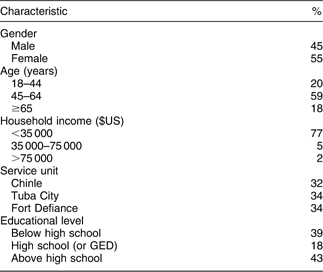
GED, General Educational Development.
Characteristics of the farms are presented in Table 2. Most Navajo farms remain in the family for many decades; two-thirds of farmers (64 %) indicated that their farm had been in the family for >30 years. The majority of farmers (87 %) produced crops every year or every other year and most farms were of less than four acres (59 %). About half of the farmers reported working ≥8 h on their farm each week (59 %). Most farmers owned only one farm plot (59 %) and lived less than an hour away (80 %). The primary water sources for farmers included natural sources such as local springs and rain.
Characteristics of farms (n 44)
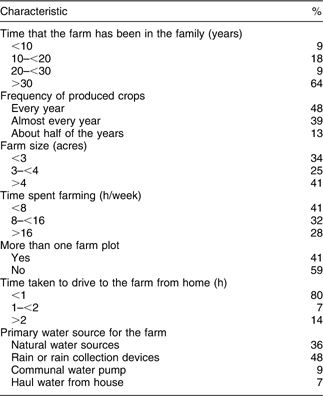
Categories may not sum to 100 % because of rounding error.
Perspectives about farming and the sale of crops are presented in Table 3. Most farmers reported that farming was getting harder (61 %) but offered several reasons why farming was important: it maintained the Navajo farming tradition (100 %), upheld Navajo culture (98 %), saved money (86 %) and saved a trip to the store (86 %). The primary challenges reported by farmers were the cost of farming and irrigation (71 %), the cost of gas to and from the farm (74 %) and the availability and cost of water (63 %). Most farmers reported not selling their crops (64 %). Among the farmers who did sell crops, half reported selling some of their fruit crop (47 %) and two-thirds reported selling some of their vegetable crop (60 %). About half of the farmers indicated that the sale price was the most important factor when they sold crops (56 %).
Perspectives about farming and sale of crops (n 44)
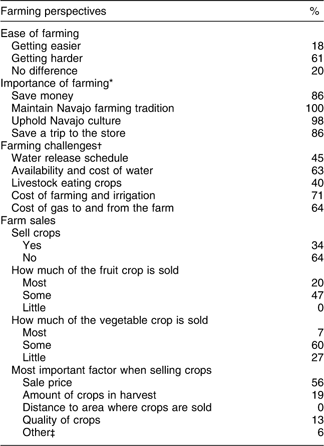
*Percentage reporting very important and important.
†Percentage reporting very challenging and challenging.
‡Other includes time involved to prepare crops for sale.
The types of produce farmed in the Navajo Nation are presented in Table 4. The most popular crop was corn (83 %), followed by squash (66 %), watermelon (49 %), pumpkin (47 %) and cantaloupe (45 %). About one-third of farmers reported harvesting apricots, apples, honeydew and peaches. With the exception of peaches, cabbage and peppers, the majority of farmers reported that they produced less of each crop compared with the previous year.
Produce farmed, overall and over time (n 44)
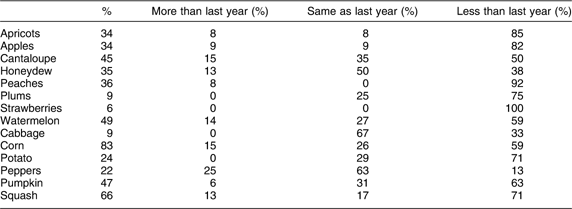
Respondents could provide answers for all crop categories. Changes in crops over time may not sum to 100 % because of rounding error.
Perspectives on participation in an F2T programme and on childhood obesity are presented in Table 5. In all, 43 % of farmers reported an interest in participating in an F2T programme. We observed greater interest in participating in the F2T programme among those farmers who had larger farms (three acres or more – 71 %), whose farm has been in the family for >30 years (71 %) and who worked on their farm >8 h/week (66 %). The farmers unanimously agreed that the programme is important for Navajo children. However, farmers reported many challenges to selling their crops to local stores, including: the price paid for crops (98 %); the lack of US Food and Drug Administration inspection for fruits and vegetables (91 %); unavailability of fruits and vegetables for sale (89 %); the distance from the farm to the food outlet (86 %); and the lack of refrigerated transport to carry the crops (77 %). The farmers agreed that childhood obesity was a very serious or serious problem in the Navajo Nation (100 %) and most (64 %) correctly reported that the rate of childhood obesity is higher in the Navajo Nation compared with the overall rate in the USA.
Perspectives on the F2T programme and childhood obesity (n 44)
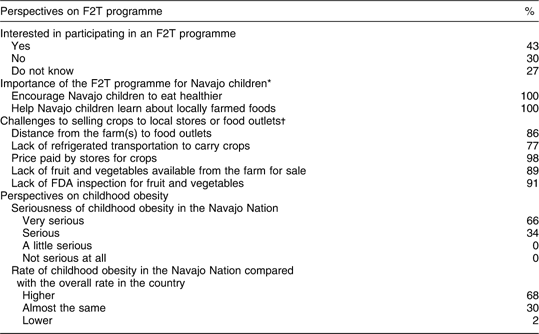
F2T, Farm-to-Table; FDA, US Food and Drug Administration.
*Percentage reporting very important and important.
†Percentage reporting very challenging and challenging.
Discussion
The present study is the first to examine an interest in and barriers to participating in an F2T programme among farmers in the Navajo Nation. We found that interest among farmers was modest and that several barriers limited participation. Key among them were the limited harvest, the lack of crop transportation and the price paid by food outlets. Nevertheless, the farmers believed that childhood obesity is a serious problem in the Navajo Nation and that an F2T programme will help Navajo children eat healthier and learn about locally farmed foods.
In the Navajo Nation, the preservation of culture and tradition is highly valued. As our findings indicate, most of the farms remain in families for decades. This may help explain why farmers unanimously agreed that a programme to educate youth about the benefits of farming and locally farmed foods is important. Prior research also suggests that F2T programmes may increase student's knowledge of locally farmed foods and the importance of healthy eating(Reference Kish13). Therefore, the development of an F2T programme in the Navajo Nation may help to not only encourage farming knowledge among the youth but also maintain the Navajo farming tradition.
Our findings suggest that one of the key barriers to participation in an F2T programme is the lack of available produce for sale. Nearly all farmers reported that they were growing fewer crops than last year. Potential reasons for this crop reduction may include a lack of labour, either from decreased youth involvement in farming or because of an ageing farmer population, or particularly challenging environmental conditions. On the basis of our findings, certain high-yield fruits and vegetables may be more feasible for inclusion in an F2T programme, such as apricots, apples and peaches. These fruits may be particularly amenable to child consumption, as they are small and portable. They also require little preparation, which may make it easy for food outlets to stock them. Many farmers also grow squash, corn, pumpkin and cantaloupe; however, these fruits and vegetables require more preparation before eating, and convenience is a key factor driving consumption(Reference Glanz, Basil and Maibach14).
The present study has several limitations worth noting. First, farmers were surveyed on three of the eight Navajo Nation Service Units. Given that the Navajo Nation is a large region and farm characteristics and farming challenges may vary across the region, the results of the present study may not be generalizable to the service units not included in the study. Second, data collection occurred in the summer, a labour-intensive season for farmers, and the sample size was small. It is possible that many farmers were unable to participate because of the work demands of the season. Third, the study was cross-sectional; hence, we were unable to observe farming trends over time. Finally, some responses were translated from Navajo into English, and it is possible that the initial meaning of those responses was modified in the translation.
To begin to address the high burden of obesity on the Navajo Nation and on other rural areas, more research is needed on potential interventions and the demand for fresh produce. Research is needed to develop solutions to the barriers identified in the present study. It is possible that once key barriers are addressed the farmer's interest will increase. In addition, future research is needed to identify innovative methods of linking farmers to the community, such as farmers’ markets or school nutritional educational programmes, as the small size of Navajo farms may prohibit farmers from supplying sufficient produce to fully stock conventional grocery stores. More research is also needed to identify the demand for fresh produce in the Navajo Nation.
From a policy perspective this research is well timed with the 2007 Farm Bill, which included unprecedented support for the fresh fruit and vegetable industry, as well as a growing interest in supporting locally grown food, which is illustrated by the recent flurry of state-based legislative activity on land use and economic developmental policies(Reference Robbins15). This research is also consistent with the goals of Healthy People 2010(16) and the Let's Move campaign(17), both of which aim to reduce the proportion of overweight and obese children and adolescents(Reference Robbins15, 17). In addition, a key goal of the Let's Move campaign is to make healthy food accessible and affordable for all children. Moreover, the rapidly escalating price of food and crude oil(Reference Campbell and Laherrere18) has catalysed interest in linking local farmers to their communities. F2T programmes may benefit the consumer by increasing the availability of fresh fruits and vegetables and the producer by increasing revenue. From an environmental perspective, an increased reliance on F2T programmes may help reduce our carbon footprint and contribute to the development of sustainable food systems.
Conclusions
Navajo farmers are aware of the burden of childhood obesity on the Navajo Nation and feel that an F2T programme could be beneficial. To successfully implement an F2T programme, the barriers to participation identified in the present study will need to be addressed.
Acknowledgements
The present study was supported by the Center for a Livable Future at the Johns Hopkins Bloomberg School of Public Health. The authors report no conflict of interest. S.N.B. and J.G. conceived the study and developed the hypotheses; A.S. and S.N.B. analysed the data and drafted the manuscript; S.N.B. is the guarantor. All authors contributed to the interpretation of study findings and also to the final draft. The authors thank Ms. Beverly Pigman and the Navajo Institutional Review Board for their helpful guidance throughout this project.



