




the sun
climbs so slowly
even the fallen seeds
throw long shadows.Footnote 1
—Akhil Katyal, ‘These Days’
In 1953 the United Nations Educational, Scientific and Cultural Organization (UNESCO) approached the Government of India with an eye-catching proposal: would the new nation host the world’s first major international conference on wind power and solar energy? Over the next months, Indian scientists and officials weighed in on the idea. So too did Prime Minister Jawaharlal Nehru, a keen solar booster who had dined a year earlier on ‘sun-cooked cabbage and vegetables’ prepared on an indigenously developed solar cooker.Footnote 2 In 1948 Indians had led the charge for UNESCO research on the problems of the ‘arid lands’, based around a climatological perspective on underdevelopment. Accordingly held under the aegis of UNESCO’s new Arid Zone Programme, the wind and solar symposium took place in 1954 in New Delhi—an apt location, wrote the international organization, given India’s ‘remarkable pioneering work in the field of solar energy’.Footnote 3 The socialist politician Keshav Dev Malaviya, more famous as the father of Indian oil exploration, delivered the inaugural address before an interdisciplinary audience of engineers, physicists, meteorologists, chemists, and botanists. ‘Not only should we derive energy from wind and sun,’ he declared, ‘but we should aim at getting it cheaply’. He urged the international experts gathered there to foreground two principles: ‘economy and simplicity’.Footnote 4 Economy and simplicity: these would be the fateful watchwords that guided another half-century of solar energy research in the subcontinent and the global South more generally.
Solar energy often appears a technology without a history, perpetually new and oriented towards the future. This sense of perennial novelty has gone unchallenged by historians, who have generally neglected renewable energy outside the rich world and all but ignored solar energy everywhere.Footnote 5 Left to industry professionals, solar history is typically narrated as a triumphalist tale of technical innovation centred in the global North. Such accounts often conflate solar energy with solar photovoltaics (PV) for direct electricity generation. The storied Bell Telephone Laboratories unveiled the first practical silicon solar cell—a fortuitous offshoot of the semiconductor research for which Silicon Valley is named—only months before the Delhi UNESCO conference in 1954. It is tempting to draw a straight line from this innovation to the huge solar PV installations of the twenty-first century; India’s largest, Rajasthan’s US$1.4 billion Bhadla Solar Park, sprawls across an area the size of Manhattan.Footnote 6
Rejecting the eschatology of climate change, such huge mega-projects have reignited the high-modernist idea of progress. They fuse an optimism about the possibilities of science, technology, and human innovation to deliver sustained improvements in economic production and the satisfaction of human needs. In this bright new age, endless rows of solar panels promise to square the circle of economic growth and environmental preservation by providing virtually infinite amounts of clean power for all—and empowerment for women to boot. These utopian ideas, the environmental humanists Imre Szeman and Darin Barney suggest, are coalescing into ‘one of the sharpest and most powerful of ideologies’ today.Footnote 7
The air of utopian futurism that envelops what we might call high-modernist ‘Big Solar’ obscures longer and more complicated histories. Turning its gaze away from the affluent global North, this article traces a very different episode of solar research and deployment in and for the developing South. This episode does not neatly fit within a linear narrative of revolutionary innovation crowned by commercial triumph. Many solar technologies are surprisingly old; the silicon solar cell, which its inventors regarded as a mere stopgap, would now be drawing a pension, while humble technologies such as the solar cookstove and water heater are older still.Footnote 8 The analysis here accordingly flips the popular direction of inquiry on its head: the question is not why solar PV has taken off so spectacularly in the twenty-first century, but why the long-predicted solar transition stalled for so long.
The most intuitive explanation for the rise of new energy sources is that they are a response to shortages of existing fuels or offer obvious labour-saving advantages. In twentieth-century India and rural Mexico, two significant arenas for postcolonial solar experimentation, fossil fuels remained scarce and expensive in most areas, while gathering wood or dung to burn was often difficult and time-consuming work. Yet the early solar history of both countries reveals a tale of underinvestment, failed commercialization, and sticky technological cul-de-sacs.
Why did interest in the solar alternative falter? Energy historians argue that scarcity alone is typically insufficient to explain the successful incorporation of new sources into household energy portfolios. They have highlighted the importance of overcoming initial popular resistance or indifference to convert technical innovations into commercial success. In the United States, entrepreneurial boosters and advertisers effectively generated new consumer desires for kerosene, household electrification, and high-energy lifestyles, creating constituencies of users that helped to lock in these trends.Footnote 9 In the case of solar energy in the global South, by contrast, technical solutions were developed with little consideration of popular needs and aspirations. Underpinning this neglect was an imaginary of a two-tier energy regime that implicitly denied that energy-intensive modernity was possible for many of the world’s inhabitants, at least in the medium term.
This dualistic imaginary was structured by hierarchies of town and country, race, and class. After the oil shocks of the 1970s, activists in the rich world saw in the sun’s dispersed rays a revolutionary path towards a decentralized ‘energy democracy’, emancipating newly self-reliant citizens from the authoritarian infrastructure of the fossil-fuel-fired electric grid via rooftop solar panels or designer solar homes.Footnote 10 Before this point, though, solar energy was more often pigeonholed as something much drabber. A postwar generation of experts cast solar as the ‘poor man’s energy’, to quote a phrase from the period’s best-known international advocate, arguing that the diffuse and intermittent quality of sunlight made it a second-best energy source suited to the scattered rural populations of ‘underdeveloped’ nations. This was not only a vision imposed by Northern aid donors. Indian scientists agreed that solar energy was suitable where the true infrastructural modernization of the electric grid could not be delivered. Together these experts imagined solar not as a post-carbon energy source, but a pre-carbon parallel track for those left outside the modern energy economy—a substitute for firewood and dung rather than the abundant and flexible energy of fossil fuels and grid electricity. Solar technology promised a reformulation of the ‘old’ organic energy regime, not a reaction to fossil-fuelled excesses. While engineers recognized the downsides of their inventions—inadequacies that doomed social acceptance in the rich, grid-connected world—a ready consumer base was simply presumed to exist among poor rural citizens deprived of better energy options. The imagined constituency for solar technologies thereby became coupled to a subsistence-centred vision of the rural household.
This focus on the rural household ensured that the imagined consumer base was explicitly gendered. Early solar technologies aimed to reduce the energetic labour traditionally undertaken by women, who gathered fuel to prepare food and heat water. Little historical research has so far explored the intersection of gender and energy.Footnote 11 In the few existing studies, focused on the chilly metropoles of western Europe and North America, historians have shown that the household emerged as a key site of industrialization. Huge new energy infrastructures—like gas pipelines and the electric grid—were mediated by women’s (unpaid) reproductive labour in the home.Footnote 12 The analysis here sheds light on women’s energetic labour in a very different climatic and economic setting, in which household heating was typically a less pressing task and energetic changes took more decentralized forms in the absence of the widespread rollout of modern, consumer-facing energy infrastructures. A more fitting moniker for this solar episode, then, might be ‘the poor woman’s energy’.
Scientific and commercial interest was limited by this impoverished and feminized imagined user base, which offered little expected return on investment. Solar research was not a frontier of technological innovation, let alone environmental thought, but a locus of frugal second-best fixes.Footnote 13 Against the high-modernist faith in scientific progress and ‘big push’ investments, experts aimed to engineer simplified, low-cost devices that would meet only minimal everyday energy demands. The emphasis on small-scale, parsimonious applications at the point of use aligned with both the urban bias of Nehruvian development planning and Gandhian ideas about the static and self-contained village economy. This current of solar research in and for the developing world constituted a mode of low modernism that coexisted with the celebrated energy mega-projects serving urban and industrial users.Footnote 14 It is a reminder that development thought always had competing strands. The ideologues of modernization theory might imagine sweeping structural transformations that would ‘conquer Nature’, but the practitioners of low modernism instead focused on mundane, small-scale gadgets that would meet micro-level immediate needs by working with rather than mastering the arid climate. The solar cooker in particular emerged as a recurrent example of the predilection for technofixes, engineered objects that then went looking for social problems to ‘solve’.
It is here that this case’s interest lies for global historians. Scholars have often characterized modern energy history as the globalization of energy-intensive modes of development pioneered in the West. Rising fossil-fuel combustion has become a metonym for the planetwide ‘Great Acceleration’ in humanity’s resource consumption and ecological impacts since around 1945.Footnote 15 As leaders determined that exploiting coal and oil was essential to the nation-state’s flourishing, postcolonial states emulated the rich world and climbed aboard the treadmill of fossil-fuel development.Footnote 16 Contrary to any neat narrative of postwar cross-country convergence, though, this episode in solar history suggests that large-scale imitative modernization was tempered by a countermovement that stressed the exceptionalism of the sunny and resource-poor tropics. In this project, Indian scientists were far from passive recipients of prescriptions delivered from the global North: they played an active role in forging the early international solar establishment, and with it the transnational elite consensus that austere and decentralized technological solutions were the appropriate alternative to big energy infrastructures in arid rural hinterlands.
Yet the Great Acceleration would make itself felt by the back door. Following in the footsteps of returning migrants and international travellers, an explicitly comparative normative ideal of ‘modern’ energy abundance began to emerge, against which the frugal alternative was benchmarked and critiqued. Low modernism inadvertently helped to undercut the rationale for extending grid electricity to the rural poor, legitimizing state neglect of infrastructure, and thereby placed a low ceiling on the quantity and quality of energy services that off-grid consumers were to expect. The two-tier imaginary that undergirded solar devices doomed them among prospective consumers, investors, and technologists. The intended rural users repeatedly rejected these frugal solar technologies as inadequate to their growing energetic needs and expectations. In the face of expert-engineered prescriptions for energy austerity, they sought to lay claim to a universal ideal of high-energy modernity. More than the well-meaning engineers who designed the cookers, thereby seeking to absolve resource-strapped nation-states from the slow and expensive work of infrastructural modernization, citizens themselves came to underpin from below the teleological linkage between modernity and ever-rising energy abundance.
The following account begins with early solar cooker experiments in colonial India, showing how the conceptual link with frugal rural uses began to solidify. I then explore the attempted rollout of solar cookers in 1950s India, and track this model’s journey back to the nascent international development establishment in the United States. Finally, making use of fieldnotes generously shared by two American anthropologists who worked in Mexico in the early 1960s, I analyse perhaps the best-documented study of the local reception of solar cookers as objects of desire and disappointment. Together these cases illustrate the limited popular appeal of solar devices in the face of coalescing imaginaries of the high-energy good life. Against the futuristic and utopian solar ideology of the twenty-first century, this account suggests that the early history of solar energy and international development was predominantly one of austerity, urban bias, and technological disappointment. Such experiences ultimately reinforced rather than destabilized the global tendency towards fossil-fuel dependence.
Colonial origins
For many in nineteenth-century Britain, the intense sunlight over the colonies was a civilizational curse. The tropics had long been stereotyped as the climatic Other of the temperate world, condemned to remain sluggish and malarial backwaters by their oppressive heat.Footnote 17 India’s first solar booster instead reclaimed this sweltering sunlight as a blessing. William Adams had nursed an interest in energy during a stint at the patent office in London, where he patented a rudimentary solar boiler design, before leaving to become deputy registrar of the Bombay High Court in 1870.Footnote 18 There he read about the French inventor Augustin Mouchot’s experiments with solar-powered steam engines, which Mouchot claimed had outstanding potential in les régions intertropicales.Footnote 19
Adams was captivated. His 1878 monograph Solar Heat declared that tropical countries ‘possess, in their clear skies, a gratuitous and inexhaustible source of wealth, equal to that which Western nations have to dig, with infinite labour and toil, from the bowels of the earth’. As the demand for firewood and railway sleepers left the subcontinent’s hills ‘bald as a billiard ball’ and its people stricken by famine, he called upon the colonial government to invest in this promising substitute for expensive imported coal.Footnote 20 In Bombay, the bureaucrat displayed his solar-powered innovations before newspaper reporters and army chiefs. Solar Heat sketched plans to concentrate the sun’s energy for everything from desalination to cotton gins and Hindu crematoria. After much experimentation, Adams recommended using a set of adjustable flat mirrors to concentrate the sun’s rays—an early ancestor of the ‘power tower’ for generating industrial heat and driving steam turbines.
Unlike the centuries-old practice of producing salt through solar evaporation, these were grand visions of fossil-fuel replacement.Footnote 21 Solar energy, Adams informed the Times of India, was ‘destined to make India the seat of the principal manufacturing industries of the world’.Footnote 22 It was not an outlandish view. ‘The time will come when Europe must stop her mills for want of coal’, declaimed the celebrated Swedish-American inventor John Ericsson; industry would shift to the tropics where the ‘excess of solar heat’ promised an unimaginable abundance of motive power.Footnote 23 Other pioneers were similarly active within imperial contexts. In the expanding United States, boosters argued that solar-powered engines and irrigation pumps were the surest way to claim the West.Footnote 24 Under the watchful eye of the British Consul-General, in 1913 the Philadelphian inventor Frank Shuman installed solar-powered steam engines to pump Nile waters for irrigating Egyptian cotton.Footnote 25 Even as Adams’s near-namesake in London published a seminal paper in the history of solar photovoltaics, an alternative lineage of solar research was emerging in the arid colonial peripheries.Footnote 26
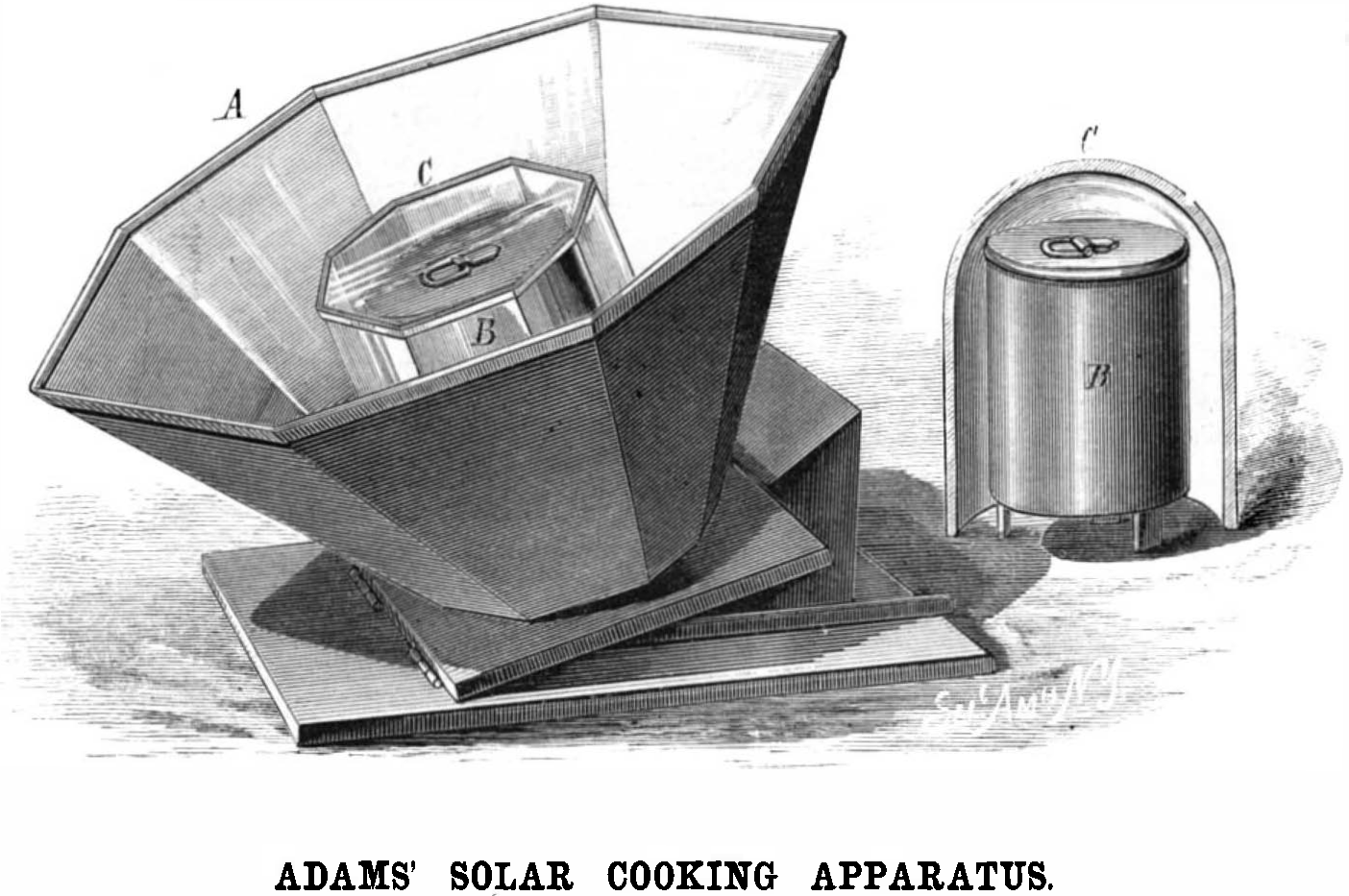
It was for a rather more modest invention that Adams of Bombay would be best remembered, however—his solar cooker. His was far from the earliest solar oven: that honour is typically attributed to the Swiss scientist Horace-Bénédict de Saussure in 1767, though his experimental ‘hot box’ was primarily for measurement rather than cooking, informing Joseph Fourier’s discovery of the greenhouse effect. Nonetheless, Adams innovated in abandoning the simple hot box for an octagonal design that concentrated the sun’s rays upon a cooking utensil (Figure 1). One obliging corporal used a prototype to bake a Christmas cake; Adams boasted that the stove could even perform on the march atop a coolie’s head.
‘Can be constructed by native artizans in any Indian village’: William Adams’s design for a portable solar cookstove, Bombay, 1878. Source: Engraving from W. Adams, ‘Cooking by Solar Heat’, Scientific American, June 15, 1878.
Others were less impressed. A Bombay official adjudged the scheme wholly impractical: factories could not give their workers a holiday when the sky clouded over.Footnote 27 Even a friend complained, ‘“Your cook… goes to bed at six, and civilized people dine at 7-30 or 8 p.m.”’ In any case, ‘man cannot live on one dish alone’, making the contraption perhaps best suited to relief camps. A bruised Adams said that he should have added partitions for ‘making ice-puddings, and cooling champagne’.Footnote 28 As his critical friend made clear, the solar cooker was a technology fit only for the uncivilized. It presaged decades of endless tinkering with frugal innovations aimed at the basic needs of the tropics, which would ‘grow opulent when the utilization of solar heat is carried to the point of simplicity and economy’—‘What a motive to the truly humane inventor and capitalist!’Footnote 29
For all this imperial baggage, there was radically subversive potential in the new energy source and its application to the traditionally feminine domain of cooking. In her classic short story ‘Sultana’s Dream’ (1905), the Bengali educator Rokeya Sakhawat Hossain sketched a feminist utopia called Ladyland, a matriarchy in which it is the men who are locked away in purdah. Ladyland’s enterprising women collect, store, and distribute solar energy for water and space heating and, like Archimedes, even weaponize the sun’s heat to destroy an invading army. In Hossain’s utopia, the solar cooker features prominently: ‘I found no smoke nor was there a chimney in the kitchen… “How do you cook?” I asked. “With solar heat,” she said, at the same time showing me the pipe, through which passed the concentrated sunlight and heat. And she cooked something then and there to show me the process’. Solar energy was already becoming feminized: the story’s (foolish) men scorn such innovations as a ‘sentimental nightmare’.Footnote 30 While large-scale deployment of solar technology remained in the realm of science fiction, this link between solar energy and women’s everyday labour would solidify.
Simultaneously, solar would be ruralized. Among contemporary experts, ‘solar energy’ functioned as an umbrella term almost synonymous with what we now call ‘renewable energy’; it referred to the infinitely replenished ‘income’ harvested directly and indirectly from the sun, as opposed to the exhaustible ‘capital’ of fossil fuels (themselves mineralized sunlight, but formed over inhumanly vast timescales).Footnote 31 This broad conception, which persisted into the 1980s, covered everything from wind power to ocean tides. The most outstanding mechanism for harnessing sunlight, though, was the photosynthetic capability of plants, which humans in turn tapped through agriculture and forestry. ‘By leaves we live,’ declared the social evolutionist Patrick Geddes, newly returned from planning India’s cities, as he argued for the sustainable ‘economics of the leaf-colony’.Footnote 32 His Indian disciple, the sociologist Radhakamal Mukerjee, would similarly call for the use of ‘flow resources’ like sunlight while highlighting the energy-efficient metabolism of the rice-eating Asiatic manual labourer.Footnote 33 Reading plant life and food as solar resources, this conception gave solar energy an implicitly agrarian cast that cut against the high-modernist emphasis on the urban industrial economy.
In India, solar agrarianism gained traction via anticolonial political philosophy. In 1925, the disillusioned Harvard-trained labour relations expert Richard Bartlett Gregg arrived at M.K. Gandhi’s famed Sabarmati ashram. Today, if Gregg is remembered at all, it is as the author of The Power of Nonviolence (1934), the most influential exposition of Gandhian methodology published in a century of non-violent civil disobedience.Footnote 34 In his earliest major effort at intellectual translation, though, Gregg—who had worked as a teenage errand boy for Nikola Tesla and considered becoming an electrical engineer—sketched Gandhian philosophy in energetic terms.Footnote 35 ‘The speed of life and work in the Orient, deriving its power from the annual current flow of solar energy, is very much like that of most organic life’, he wrote, likening India to a rose or a turnip. But, ‘in the great stream of energy by which mankind lives’, this organic pace was a virtue.Footnote 36 Subterranean coal had taken millions of years to form from the fossilization of solar-powered plant growth. Only according to the West’s spendthrift definition could the coal-steam-engine-mill complex undergirding Britain’s Industrial Revolution be considered efficient.
Against this profligacy, Gregg saw in Gandhi’s advocacy of the charkha or spinning wheel nothing less than an energy revolution. He calculated the solar energy falling on India annually at ‘roughly, 58,601,685,904,000,000 horse-power’, over 200,000 times the energy obtained from all the coal mined globally in 1927.Footnote 37 The country’s underemployed labourers were remarkably effective ‘engines’ transforming solar energy into mechanical motion, he argued, quoting as evidence a chapter on ‘The Animal as a Machine’ from a leading American agricultural textbook. The frugal ‘food-man-charkha combination’ would save a vast waste of solar energy: three months’ hand-spinning equalled the output of the Tata hydroelectric dams serving Bombay.Footnote 38 In his notebooks, Gregg explored the relationship between food and energy in minute detail—monitoring, like the Mahatma, his own bodily health as an indicator. Centring the ‘flow of solar energy’ in this way, he wrote excitedly, ‘would profoundly alter gradations of social status. Then the Indian woman who picks up droppings in streets for fuel’ would be ‘seen to be very wise; equal to the physician on one side and to the fuel engineer or coal miner or forest conservator on the other’.Footnote 39 It was a verdict that Ladyland’s women would have endorsed.
Approvingly cited by Gandhi himself, Gregg’s economic philosophy captured an influential interlinkage of solar energy with a romantic countermodernity that valorized traditional village life while rejecting the infinite desires associated with Western commercialism.Footnote 40 In this heliocentric view, farming was the most important branch of solar technology and the Mahatma was a ‘great industrial engineer’. Moreover, Gregg suggested that solar energy aligned with an Oriental proclivity for the decentralized and small-scale: Indians could not ‘think or work easily or efficiently in Western rapid, large-scale ways’.Footnote 41 Borne forth into the postwar period by Gandhian activists and Small Is Beautiful author E.F. Schumacher, it was a lesson that would stick where Gandhi’s radical rejection of industrialization did not: practical research should focus on frugal ‘appropriate technologies’ premised on a rural India of minimal wants.Footnote 42
Energy dualism at home
Like so many Indian National Congress leaders, the future president of independent India spent much of the Second World War sitting in prison. As a good Gandhian, Rajendra Prasad devoted his time in Patna’s Bankipur Jail to reading, writing, and spinning cloth. There in early 1945 he met the Bengali scientist Manindra Kumar Ghosh. Also a follower of Gandhi, Ghosh claimed to have manufactured his first successful solar cooker as early as 1934. Prasad arranged for Ghosh to hold demonstrations for his fellow inmates, and later would secure support from the Tata business house to continue his solar experiments. Ghosh’s wartime ‘sun cooker box’, gifted to Prasad, was passed on to the scientists of the new postcolonial regime as a historic artifact.Footnote 43
Towards midnight on August 14, 1947, Jawaharlal Nehru, bathed in electric light, proclaimed the beginning of independent India’s ‘tryst with destiny’. His two-decade span as prime minister would become synonymous with technocratic energy mega-projects pushed in the name of state-led industrialization: big multipurpose dams, big coal-fired power plants, and a nuclear programme that promised abundant atomic power as well as an indigenous bomb, the ultimate expression of Big Science.Footnote 44 It is the ‘gigantomania’ of such projects, to borrow the contemporary insult lobbed at the Soviet Union, that remains the most visible characteristic of postcolonial Indian energy policy.
Yet Gandhian ideas of the village community did not die out, nor was modernism itself a unitary ideology. Recent revisionist historiography has sought to trouble the ‘myth of high modernism’ in Nehru’s India, showing that postcolonial development thinkers and practitioners formed a pluralistic intellectual community. Strapped for resources and unable to rely on strong state institutions, India developed what Taylor Sherman has called ‘a socialism of scarcity’, turning to popular mobilizations in order to substitute austere and pedagogic ‘self-help’ for capital-intensive development.Footnote 45 Most visible in the community development initiative of the 1950s, there accordingly persisted deep inside the technoscientific apparatus of the postcolonial state a competing tendency to think small.Footnote 46 The result was a twin-track energy policy that embodied the ‘urban bias’ which contemporary observers detected in development policy at large.Footnote 47
In no sector did the gulf between scarce capital and developmental requirements yawn wider than in energy. Though data remained patchy, in 1965 the first serious official estimate suggested that ‘non-commercial’ fuels—firewood, dung cakes, vegetable waste, and charcoal, in descending order of importance—accounted for 95.5 percent of domestic energy consumption in rural areas.Footnote 48 Kerosene accounted for much of the tiny remainder, alongside scavenged coal in the country’s east; electricity was vanishingly rare. This pattern was a source of deep consternation for policymakers. Firewood use threatened to denude forests, while as much as 40 percent of the country’s dung went to domestic hearths. It was an enormous waste of potential organic fertilizer, as Rudyard Kipling’s father had warned decades earlier: ‘Authorities on Indian agriculture lie awake o’ nights weeping over the loss to the soil caused by this industry;—not unknown in many other countries, but nowhere such a staple as in a land where there is no coal to speak of and wood is scarce and dear’.Footnote 49
In the metabolism of the rural Indian household, women and girls were traditionally the crucial energy workers. As wood became scarcer, gathering fuel took ever more time: women spent long, strenuous hours digging up roots and collecting weeds or stripping bark. In the deforested Gangetic plains, the exhausting work of gathering and preparing plate-sized cakes of dung took up a substantial proportion of women’s time, even as men mocked the idea of touching the substance—a literalization of Western feminist complaints about household ‘shit-work’.Footnote 50 Women were also responsible for collecting and heating water, and for processing crops into edible food through grinding, milling, and cooking. Alongside this physical burden came further health costs: women using traditional stoves inhaled huge quantities of particulate matter; yet when fuel ran short and meals were cut, it was they who would go without calories.Footnote 51
The challenge for India’s experts was to meet this vast and rising rural energy demand within severe resource constraints. While central planning suppressed consumer imports in favour of capital goods like heavy electrical equipment, governmental scientists began to research parsimonious ways of meeting the everyday needs of the common man. In 1951 the National Physical Laboratory (NPL), a key organ of the new nationalist technoscience, took up the baton of solar research. Making a virtue of India’s overwhelmingly agrarian economy, its scientists were hard at work researching substitutes for petroleum products like vegetable oils and groundnut-alcohol mixtures, all overseen by the formidable S.S. Bhatnagar. ‘Bhatnagar’s pride and brainchild’, one NPL scientist recalled, was the solar cooker unit in its Division of Heat and Power.Footnote 52 There the young Punjabi scientist Madan Lal Ghai and his colleagues developed a paraboloid design that harked back to Adams’s 1870s device. Fitted on a cast-iron frame that could be rotated as the sun moved, a concave aluminium sheet focused the sun’s rays onto a central arm that held a cooking utensil.Footnote 53 It appeared an important step forward—especially as boosters misleadingly claimed it worked ‘fully automatically without needing any periodical re-adjustments’—and was touted as the first solar cooker to be manufactured on an industrial scale.Footnote 54 These low-modernist efforts fused Nehruvian India’s much-vaunted faith in technology with a populist if austere emphasis on applied utility.
India’s leaders immediately seized upon the project as the exemplar of the postcolony’s technical prowess. The cooker was displayed in newsreels, the demonstrations performed by women dressed in expensive saris.Footnote 55 Nehru himself touted the solar cooker during the first general election campaign of 1951–52. Claiming to use his own prototype regularly, he pushed for rapid commercialization.Footnote 56 Foreign visitors were taken to NPL’s solar unit to understand the importance of scientific investment in a poor country. The Egyptian government wrote to request transfer of the technology—Nehru weighed in to declare the Egyptians should pay no royalties—and a Burmese engineer came to see it ‘to find out what lines of research would be most appropriate for a tropical, nonindustrial country’.Footnote 57 Even the venerable New York Times predicted imminent commercial success.Footnote 58 The path to a mass market seemed assured.
Then the bubble burst, disastrously. Invented without market research among the Indian women who would be its major users, the solar cooker proved socially unacceptable. It required housewives to cook in the heat and shift its inconvenient bulk as the sun moved. Even with subsidies, it was too expensive. Worst of all, wrote the polymathic mathematician D.D. Kosambi, otherwise a solar supporter, ‘The cooker, when tried by ordinary mortals away from newsreel cameras, just refused to work’. The manufacturers allegedly made profits only by selling off the devices for scrap metal.Footnote 59 NPL scientists concluded by 1957 that the programme had ‘completely failed’, largely because traditional cooking methods proved so difficult to change.Footnote 60
The ‘solar cooker affair’ was hugely damaging to the would-be technocrats of independent India. Facing uncomfortable questions in Parliament, Nehru was embarrassed, scolding Bhatnagar and prompting the latter to consider resigning.Footnote 61 In the aftermath, the NPL all but abandoned applied science into ‘niche’ technologies, and the pendulum swung in favour of the Big Science of atomic energy.Footnote 62 It is easy to blame this on specifically Indian pathologies, especially political hype and a statist hostility to commercial enterprise. But India was not alone in misjudging the appeal of solar energy, putting technofixes before social research. As the rich world began to consider the problems of the postcolonial ‘arid zone’, they replicated many of these early mistakes.
Energy dualism in international development
In the early 1950s, US solar researchers were casting around for a new sense of purpose. Grand visions of seizing the energetic cornucopia of the sun-blessed tropics had faded with the wartime humiliation of European empires.Footnote 63 For a brief period during and after the war, fears of imminent fuel scarcity had produced a flurry of research into solar heating and solar homes for the American middle classes.Footnote 64 Crucially for a new superpower busy hoovering up natural resources around the planet, solar energy was all but impossible to store and transport to the metropole.Footnote 65 As a flood of cheap electricity and oil drowned out fuel anxieties at home, the Eisenhower administration abandoned alternative energy.
As one door closed, though, another opened. In his 1949 inaugural address, President Harry Truman had announced his famous Point Four Program to offer economic and technical assistance to the world’s ‘underdeveloped areas’. It galvanized a wave of activity from the country’s leading philanthropic foundations that remade solar energy as a Third World solution, with rich-world aid agencies providing the venture capital. As interest in her solar houses waned at home, the Hungarian-American engineer Maria Telkes, one of vanishingly few women in the sector, won Ford Foundation funding to develop a solar oven, tested on a Navajo reservation in Arizona before being exhibited in India in 1955.Footnote 66 Over at the Rockefeller Foundation, the head of the natural sciences and agriculture division was equally intrigued. Warren Weaver explained the challenges of supporting a growing planetary population in terms of ‘food-energy’. This conceptualization led him to advocate research on solar energy, encompassing everything from ‘direct’ uses like solar boilers to ‘indirect’ uses like algae cultivation.Footnote 67
In parallel with the Foundation’s better-known efforts in propagating the Green Revolution, Weaver accordingly kickstarted an exploratory ‘nonconventional agriculture’ programme. He found a natural fit in an old friend: the physical chemist Farrington Daniels, now teaching at Weaver’s alma mater, the University of Wisconsin–Madison. Though he was pushed out of the postwar nuclear programme, Daniels had been director of the Manhattan Project’s Metallurgical Laboratory in Chicago when the atomic bombs were dropped on Japan. He atoned by becoming the most high-profile international advocate of solar energy as the humanitarian solution for ‘these times of profligate spending of the world’s natural resources and uncontrolled increase in population’.Footnote 68 At Madison in September 1953, Daniels spearheaded a major solar energy symposium. There the Indian solar cooker was presented by none other than M.L. Ghai, formerly of the NPL. The NPL’s frugal innovation aligned neatly with Daniels’s own priorities. In January 1954, Daniels wrote to Weaver of his interest in ‘the possibility of a “poor man’s” solar engine of an efficiency so low that American engineers will have nothing to do with it, but which nevertheless could help to raise standards of living in sunny under-developed countries’. He looked forward to hearing about Asian requirements when he attended the UNESCO’s wind and solar symposium in New Delhi that October.Footnote 69
As Daniels would tell audiences for years afterwards, his visit to India was a revelation. He was deeply moved by witnessing bullock-powered well irrigation during conference excursions to the arid northwest, so much so that he hung his wife’s painting of the scene above his desk.Footnote 70 It was just such traditional organic energy sources—and the deforestation, wasted manure, and women’s labour they entailed—that Daniels expected solar power to replace. Certainly, the industrialized nations were ‘using up the capital in the bank’ in the form of exhaustible fossil fuels. But ‘it must be made abundantly clear,’ he told his audience, ‘that at the present moment there are no practical solar devices capable of competing with electric power lines and gasoline engines, where these are available’. At best, the arid zone was a laboratory for solutions that would become relevant in the rich world ‘eventually, perhaps in a thousand years’.Footnote 71 Outside a few sunny or fuel-short rich countries, notably Australia and Japan, the need of the hour instead lay with inefficient but inexpensive solar devices for non-industrialized countries, which were unlikely to make money.
Upon his return to the United States, Daniels approached the Rockefeller Foundation with a proposal to research ‘poor man’s solar’ applications in the developing world.Footnote 72 While his initial proposal incorporated long-range basic science, the agreed programme favoured a practical emphasis on simple, low-cost hardware, making use of cheap new plastics.Footnote 73 Over the next decade, almost $800,000 in Rockefeller funds would flow to the Wisconsin group, including Daniels, his colleague Jack Duffie, and Denver-based consultant engineer George Löf. It reflected the prevailing view: underdeveloped nations, with their impoverished citizens and minimal needs, ‘do not need and probably do not wish to try to duplicate our Western industrial structure and gadgets’.Footnote 74 Places like ‘sun-stunned India’ ought not imitate the industrious urbanized economy of the United States, but should embrace ‘machines operating at lower temperatures and slower speeds’.Footnote 75 Solar power was fit only for users who had yet to join the modern energy economy, without its expectations of round-the-clock power and productivity.
A curious dualism accordingly characterized postwar international development thinking. Both the Indian and American governments were simultaneously pouring funds into energy projects with a very different logic. In late 1953 Eisenhower’s United States adopted the rhetoric of ‘Atoms for Peace’, promising to deliver ‘abundant electrical energy in the power-starved areas of the world’.Footnote 76 Taking advantage of the newly open atomic marketplace, India too devoted scarce resources to develop an expensive dual-use nuclear programme. For late-industrializing countries, argued Homi Bhabha, the father of India’s nuclear programme, ‘atomic energy is not merely an aid; it is an absolute necessity’.Footnote 77 The simple issue of technical feasibility could not explain the altogether different levels of interest. Atomic energy in the United States won federal support on the order of $10 billion a year, while solar research received a mere $100,000—an annual sum, as one researcher noted ruefully, that would keep the nuclear establishment going for only five minutes.Footnote 78 Solar energy might have received more support if it had proven to lend itself to Ladyland-style weaponization.
The atom was not for everyone, however. International experts recommended a division of labour, taking advantage of the ‘most fortuitous complementarity between solar energy and nuclear energy’.Footnote 79 Daniels’s own trajectory from the massive Manhattan Project to the tiny wooden Wisconsin solar laboratory, formerly the university’s monkey house, tracked the binary between these most high-modernist and low-modernist technologies. Nuclear energy could ‘come only in large, expensive, and dangerous units’, he maintained, fit for densely populated cities and industrial centres. Solar energy was universally available and could be tapped directly at the point of use, by contrast, so did not require large capital investments—although it did require land to capture in quantity. This made it particularly suited for countries with dispersed, rural populations and limited industrial demand, especially in the arid areas where cheap energy was most needed.Footnote 80 In an analogy to which he would frequently return, Daniels declared the sun ‘the poor man’s atomic reactor’, though involving ‘no secrecy, no large expenditures, and no dangers’.Footnote 81
The equation of solar energy with the small-scale was not quite a foregone conclusion. France’s Félix Trombe was building solar furnaces in the Pyrenees. Harry Tabor in Jerusalem experimented with cylindrical power plants. Moscow’s Heliotechnical Laboratory oversaw the design of grand fields of mirrors to create irrigated oases in the Central Asian deserts, tapping into a longstanding Soviet high-modernist faith in the ability of such ‘cosmic technologies’ to transform climates on a massive scale.Footnote 82 The Soviet representative at the Delhi UNESCO meeting, Valentin Baum, thus ‘seemed a little surprised that it was a poor man’s solar engine that most of the delegates were striving for’.Footnote 83 Attendees also eagerly discussed Bell Labs’ new solar photovoltaic cell; the Times of India splashed the New York Times’s verdict across its front page: ‘It may mark the beginning of a new era’ of ‘almost limitless energy’.Footnote 84 The prohibitively high cost of solar cells nonetheless meant that only the space race, pursued without regard to commercial considerations, would provide a major market. Solar cells quickly became critical to both American and Soviet satellites, the earliest incarnation of Big Solar. On Earth, as the urbane Gujarati technocrat who coordinated the Delhi symposium wrote, photovoltaics remained ‘far too expensive’.Footnote 85 Among the few terrestrial customers were the biggest of global players: the Pentagon and huge oil corporations like Exxon, who bought solar arrays for their offshore oil platforms.Footnote 86 Most of the world needed cheaper, cruder applications of solar heat.
The demands of developing countries were many, noted Daniels: the Pakistanis sought tiny solar engines and batteries for village radios, the Egyptians solar saltwater distillation, the Israelis solar refrigeration, the Indians irrigation. He was aware, too, that the latter had ‘got rather badly “burnt” with a premature government development’ that had left them unenthusiastic about solar stoves. Nonetheless, he was much moved by letters from Mexico and Guatemala that called for solar ovens to spare rapidly diminishing forests and women’s labour in hunting fuelwood.Footnote 87 It was easy, then, to rationalize away the earlier failure in India by blaming users. ‘Commercially [the cooker] has been a resounding flop,’ wrote another American researcher. He blamed the conservatism of the Indian housewife: ‘nobody she knows cooks on a solar stove’, least of all her mother.Footnote 88 It was dawning that the challenge was sociological, not merely technological: from 1958 the Wisconsin team would include anthropologists. Nevertheless, Daniels remained convinced that ‘cooking is the easiest practical direct use which can be made of solar energy’.Footnote 89 The researchers eagerly debated the best way to patent their design. Recalling ‘the pained expression’ with which an Indian scientist spoke of an earlier solar patent, Daniels pledged that his team would accept royalties only for cookers sold in rich countries.Footnote 90 Commercial success and philanthropic utility were expected to march forward in tandem.
Experiments in Mexico
This sunny optimism at first appeared well founded. The Wisconsin team had developed ‘a piece of hardware that worked like a charm in the laboratory’.Footnote 91 They began field tests on an American Indian reservation in Arizona (where they would eventually prove ‘too flimsy against roaming pigs’ and whirling ‘sand devils’).Footnote 92 After a pilot with a Mexican restaurateur and his wife in Denver, the cookers were then trialled in Mexico with employees of the Rockefeller Foundation’s agricultural experiment station (Figure 2). Deforestation had already driven a turn towards fossil fuels for Mexican industry and city dwellers, the new electric range and electric tortilla press reshaping the lives of urban middle-class women.Footnote 93 The researchers expected a similar openness to fuelwood alternatives among rural households.
The Wisconsin solar cooker in Mexico. From James Silverberg Papers, Box 14, Folder 1, Hanna Holborn Gray Special Collections Research Center, University of Chicago Library (hereafter Silverberg Papers). Courtesy of Matthew Silverberg.

Initial responses seemed positive. On closer inspection, though, the Americans discovered that ‘the minute we got out of sight [the cookers] were very carefully put away’ and never actually used.Footnote 94 When pressed, households reported similar grievances. The stove was expensive. The women disliked cooking for hours out in the hot sun, and the reflector’s mirrored glare hurt their eyes. The cooker did not work when it was cloudy, windy, or dark. It was flimsy, but simultaneously too bulky to shift. It cooked too slowly, and could handle only one dish at a time. Though useful for boiling water, it made bad tortillas. Overall, it simply could not compete with the oil stove as anything but a supplementary device—and which poor household would buy two cookers?Footnote 95
It was a similar story with the solar-operated refrigeration machine that the Madison team developed for intermittent cooling. The device worked brilliantly in the laboratory, but it required hours of daily mechanical manipulation and was too complicated for laymen to operate. It was folly, Duffie said later, to try to make ‘housewives into engineers’.Footnote 96 Already by 1957 the Rockefeller Foundation was recording a mixed verdict: ‘This project is in part very satisfying and stimulating, and in part somewhat disappointing’.Footnote 97 Aware of the growing despondency, Daniels used the launch of the satellite Sputnik to warn that the Soviets were likely to leap ahead in solar power development.Footnote 98 Despite the Foundation’s growing reservations, funding continued.
In the last of the Wisconsin field tests in Mexico, the young anthropologist Hendrick ‘Hal’ Serrie and his wife Gretchen moved to the town of Teotitlán del Valle at the beginning of 1962 for six months of fieldwork. Tucked in the mild climate of Oaxaca’s central valleys, Teotitlán was a historic Zapotec centre, where farmers’ ploughs tossed up centuries-old pottery. But this was hardly a timeless village. The arrival of the Pan American Highway had transformed Oaxaca. Teotitlán was a mere four kilometres from the highway by dirt road, and reportedly just missed out on state-led electrification in the 1940s; the empty poles were still standing.Footnote 99 Even as they were newly clad in factory-made shirts, many Teotitecos weaved serapes for sale in Europe and the United States, the woollen shawls increasingly decorated with bunnies and butterflies or ‘traditional’ Aztec patterns to cater to the tourist market; indeed, the Serries strategically arrived alongside a well-connected American folk art dealer, thereby ‘hop[ing] to acquire gilt by association’.Footnote 100 Other locals travelled by bus to sell textiles in nearby Oaxaca city or to work as maids in the capital, and many went to the United States as agricultural laborers (braceros): some 200 of the town’s population of 3,500–4,000 crossed the border each year between 1946 and 1949, though that number had dropped to single digits as border controls constricted.Footnote 101 The younger generation in particular ‘wants “progress,”’ the ethnographers found, which meant electricity, purified water, better roads, and ‘more money’. Such ‘progress’ always ‘originates outside of the town and flows from the city as opposed to the pueblo’, and was especially associated with the American tourists, anthropologists, volunteers, and archaeologists who conspicuously streamed through.Footnote 102 The Serries thus arrived into a Teotitlán starting to transform, locals touting their prior experience as anthropologists’ assistants while loudspeakers powered by truck batteries blared out the latest Mexican popular music.
For all this, much remained the same. In Teotitlán’s kitchens, women continued to make all the decisions about what to cook and how to cook (‘women don’t need school because they never go out—they make tortillas’, one man told the anthropologists, despite his own tennis shoes and portable radio).Footnote 103 The favoured cooking fuel was firewood (leña), dried sticks and branches laboriously gathered from the mountains behind the town—always by men—who loaded up a burro or their own backs, a task that they estimated took almost a full day each week. In nearby Mitla three decades earlier, the famed anthropologist Elsie Clews Parsons had often watched ‘the return of the wood-gatherers to their yards, which from that height spread out like a relief map’, imagining herself going out to ‘meet [her] man’ as he allowed the heavy load to fall on the ground outside the kitchen.Footnote 104
Inside, the women made fires in shallow depressions on the earthen floor. They sat or kneeled on mats to prepare meals of hot chocolate, squash, black beans, and occasional meat, thick smoke blackening the pots and ceilings. The wood was ‘burned thriftily, a few sticks at a time placed to radiate from the flame and then pushed farther in as the tips burn down to embers, in the characteristic Indian way’; the same fires provided the convivial heart of the family’s evening meal.Footnote 105 Tortillas were the biggest consumer of fuel by far, guzzling at least half of all firewood used for cooking. Expensive charcoal and ill-smelling kerosene—legends circulated of women blown up by kerosene stovesFootnote 106 —could not compete with the widely distributed heat and smoky taste that leña provided, especially given it did not require a cash outlay. ‘The women of Teotitlán have cooked with leña all their lives’, wrote the Serries, ‘often express their satisfaction with its performance, do not seek substitutes, and have not liked the substitutes they have tried’.Footnote 107 The novelties of the machine age, whether the safety pin or Fab detergent, had so far failed to unsettle the established cultural order. ‘The baubles of Western society have their dramatic appeal’, but ‘people will choose a new alternative only when they perceive an advantage’.Footnote 108
Where the Serries had expected to carry out a conventional study of such uptake, exigencies forced the team to adopt a more complicated strategy. When the Madison laboratory could not ship devices in time, the field researchers determined to develop a local industry in cooker manufacturing and repair. In Oaxaca, Farrington Daniels spent a week teaching Hal solar engineering. Making a virtue of necessity, the researchers hoped that such efforts ‘would offset the cooker’s appearance as an odd, transitory novelty’ by opening a sustainable channel of technological diffusion.Footnote 109 With Wisconsin guidance, village craftsmen used a cheap concrete mould to construct the parabolic reflector shells from mostly local components: muslin and burlap sacking lined with tinfoil or hundreds of square mirrored tiles, though liquid plastic resin still had to be bought from Mexico City. An entire cooker took between eight and thirty-two hours of labour to manufacture, brought down to a cost of between US$5 and US$16 depending on the quality of materials. It was an admirable attempt to make the programme both culturally and practically self-sustaining.
Once again, early responses were encouraging. While Hal Serrie concentrated on equipment manufacture and research with the townsmen, his wife collected daily data on meal preparation among Mexican women while delivering discreet tutorials to encourage the cooker’s use. The Serries’ fieldnotes and final report sketch out the project’s trajectory with refreshing frankness. A crowd gathered to watch Hal deliver the first stoves: ‘It was like the new TV in a lower class neighborhood in the U.S., or perhaps nowadays it would be the new car’.Footnote 110 Helped on by spectacular demonstrations, initial consumer interest far outpaced the limited experimental production; given the promise of saving the men’s wood-gathering labour, Teotiticos ‘even schemed in order that kinsmen or friends might receive them’.Footnote 111 The team thus decided to sell the locally produced cookers for 20 pesos ($1.60) plus one day’s labour to weed out those simply seeking freebies, though in practice most were delivered as gifts.
There were already ominous signs, however. Production had begun during the rainy season, when there were few sunny days to deploy the cooker. Some townsfolk seemed interested in acquiring mirror-laden versions simply because they were ‘pretty’, even as Serrie’s own landlord, a wealthy merchant, patronizingly described the cooker as ‘an aid for the poor’.Footnote 112 The anthropologist had taken pains to introduce the cooker to the townsfolk ‘as a supplementary and not as a replacementive item of culture change’, and had outlined his own reservations about the inconvenience of the device to moderate expectations.Footnote 113
Even these modest hopes proved too ambitious. The Teotitlán-built cookers were cheap, but they were also less durable and efficient than the machine-made Madison stoves; all the mirrors fell out of one locally produced device ‘like rotten teeth in a calavera [skull]’.Footnote 114 Women had rarely initiated acquisition, and none made any modifications in their everyday practices—like menu alterations or changes to cooking hours—to incorporate the cooker’s requirements. Though the solar cookers proved useful for simmering beans and other slow-boiled dishes, the ubiquitous and energy-hungry tortillas once again proved a serious sticking point: the solar cooker could not seat the large pottery plates traditionally used to fry or pan-bake them. Women, too, resented the need to stand outside in the sun’s rays rather than sitting in their cool kitchens. Households did not reduce their usage of firewood, but instead merely used the cooker to heat water for ‘luxury’ uses: men for shaving, women for washing dishes or laundry. ‘Why does everyone want a stove,’ the researchers plaintively asked, ‘and then when they get one, they hardly ever use it?’Footnote 115 As funding ran out and the project hurried to its end, they concluded that cultural incompatibility meant that mass production would be ‘a costly mistake’.Footnote 116
When the Rockefeller Foundation funded a small team to film the experiment, the resulting documentary was candid. The Wisconsin anthropologist James Silverberg spoke to camera: ‘The people in the communities we studied knew or soon learned that solar cookers are not used as household appliances in the metropolitan society that created them, nor in the urban centres of Mexico. Thus, solar cookers are not part of a rural Mexican image of progress, of higher living standards—an image that derives from the experience with industrialized cities, either through travel or through the mass media’. The cookers somehow had to be imbued with the same prestige as urban household appliances, or researchers would have to turn to more remote regions where urban-inflected ideas of progress were less influential.Footnote 117 In the absence of such prestige, Silverberg told fellow anthropologists at a Moscow conference in 1964, there was barely a trace of the cookers two years on: ‘A few broken, twisted frames may now help to hold up laundry lines; a somewhat battered reflector-shell may help cover a corn bin’.Footnote 118
Though their early experiments had hinted at the same prestige gap, Indian scientists and engineers had done little to challenge the direction of travel. At the major UN alternative energy conference in Rome in 1961, Jagdish Chandra Kapur of India agreed that small solar units were ideal for dispersed rural communities in underdeveloped areas. He argued that intermittency was an insignificant hurdle given much of the population was underemployed: ‘Is it really important to have sunshine or work every day except Sundays and festival days? Why must we apply the concept and economies of the advanced societies in entirely unwarranted situations?’ After all, ‘it is neither possible nor advisable to bridge a technological gap of centuries in a few years’.Footnote 119 At the conference, Indians again displayed their solar-powered cookstoves, as well as water heaters and simple mirrored solar concentrators for drying jaggery. Virtually all had met with lukewarm public enthusiasm, and Wisconsin’s consultant George Löf was unimpressed by the stagnating pace of Indian innovation under NPL’s effective solar monopoly.Footnote 120 Yet Kapur’s stated asymmetry of needs was precisely what the editor of the Arizona-based Association for Applied Solar Energy’s magazine Sun at Work took away from the conference’s floor discussions, recommending mass production of simplified and standardized solar goods while dismissing as superfluous ‘refrigeration of homes’ in the Third World. Low modernism meant tolerating heat and intermittency; air-conditioned human mastery over local climate remained a luxury good.Footnote 121
It was not at all clear, though, that users in the ‘underdeveloped areas’ agreed with such sanguine diagnoses of their minimal needs. In a veritable autopsy for the Wisconsin programme a year before his death, Farrington Daniels admitted that when the anthropologists asked about the ovens, ‘The first question was: do the women of the United States use these solar cookers? The answer “no” destroyed the prestige’.Footnote 122 Interviewed by the political scientist Ethan Kapstein, his colleague Jack Duffie was still franker: ‘Mexicans and Indians were aware that the whites who had brought them the cooker were not using them at home… This constituted a double standard, and it was one the people did not wish to accept. Their hope was to progress to new ovens, not to solar energy’.Footnote 123 Locals were clear-eyed: solar devices could not paper over their continued exclusion from the modern energy economy.
Well before the Rockefeller funding finally ran out, the Wisconsin researchers had largely conceded defeat. Already by 1962, Duffie had replied to the queries of an India-based home economics professor with a warning that solar cookers had run up against severe cultural obstacles in Mexico, while the solar coolers had been ‘a complete failure’; he advised her to concentrate on the sole success story, solar water heaters.Footnote 124 Four years later, with the Green Revolution finally directing electricity connections towards the country’s most dynamic farms, Indian parliamentarians formally expressed their disappointment with the national solar energy research programme.Footnote 125 Dramatic improvements in the efficiency of expensive photovoltaics apart, there had been strikingly few major innovations in the past two decades. With a few exceptions, like water heaters, commercialization had been an abject failure. For all the talk of solar energy being free, it turned out to be remarkably expensive to capture. The democratic nature of sunlight was as much of a problem as a blessing: there was no solar counterpart to the owners of mineral rights with a profit-making incentive to stoke demand.Footnote 126 The poverty of potential users meant that no commercial firms were interested.
Worse, the Wisconsin team admitted in their post-mortem for the Rockefeller Foundation, the researchers had failed to identify ‘“real needs” for solar processes’ in the global South.Footnote 127 A chastened Löf and Duffie outlined an updated ‘Philosophy for Solar Energy Development’. For too long solar technologies had been solutions looking for a problem. The desires of local communities must be integrated into research design at the outset, not simply as an afterthought.Footnote 128 Later Duffie would come to regret the entire focus on developing countries, and argue that research ought to concentrate closer to home: ‘You let the rich pay for the Cadillacs, and after a while Chevys are built and the poor can have ’em too’.Footnote 129
Conclusion
In the 1950s and 1960s, a transnational solar establishment, small and underfunded as it was, emerged with a focus on the distinctive problems of the resource-constrained ‘arid zone’. Its early innovations and institutionalization were actively shaped by scientists from India and other postcolonial states in dialogue with experts in the rich industrialized world—though the latter were notably slow to learn from the unhappy experiments of their Southern counterparts. Yet this was also an elite and technocratic establishment, reflected in its priorities. The world energy revolution was imagined as a primarily urban and industrial one. Within the climatological and resource constraints of the arid tropics, the rural poor were left in the waiting room of history, offered patchworks of solar technofixes rather than integrated energy infrastructures.
In the contemporary rich world, going off-grid is framed as a choice. As this earlier episode suggests, though, for much of its history solar energy did not signify the empowerment of the high-tech ‘prosumer’, but spartan compromise with a low-energy past. The physical characteristics of solar energy—available in immense quantity, but diffuse, intermittent, difficult and land-intensive to capture—shaped expert assumptions about its appropriate deployment. In and for the arid tropics, it was seen less as a substitute for fossil fuels than a way to circumvent the expensive expansion of electric grids, marking an admission of the postcolonial state’s inability to deliver public power to the rural majority. Even after independence delivered regimes committed to rapid industrialization, research into solar technologies continued along a low-modernist parallel track. Not simply energy modernization but energy dualism was the pragmatic prescription of the day: large infrastructures for industry and cities, cheap and simple devices for the vast hinterlands of the rural poor. The result was a two-tier energy system, structured by hierarchies of town and country, class, race, and the traditionally gendered division of household labour.
This dualistic approach complicates the grand narrative of a worldwide ‘great acceleration’ in fossil-fuel combustion and ecological impacts beginning around 1945. Much of the world instead encountered the Great Acceleration through the experience of relative infrastructural deprivation, registered more through the increasingly conspicuous absence of modern energy than its abundance. Modern energy sources may lend themselves to the designs of experts, but those experts cannot control the expectations and desires that begin to adhere to technological systems. The solar cooker’s imagined user base—rural, poor, and feminized—undercut its own prospects. With profitability unlikely, solar research languished in the hands of a few committed scientists who continued recycling similar designs. Far from being passive recipients, rural women proved discriminating in rejecting the solar cooker in favour of existing organic energy options. The Teotitlán case suggests that this was no mere case of hidebound traditionalism, but also responded to the perception that these devices were second-rate fixes. The repeated disappointments of the early solar cooker experiments suggest that a global economy of energetic desires was beginning to coalesce, tracking channels of transnational migration and communication—and exceeding the determinedly modest visions of policymakers and experts. Consumers themselves sought a share of ‘real’, energy-intensive modernity, reinforcing from below the equation between ‘progress’ and huge energy infrastructures that would lock societies into ecologically ruinous development paths.
Despite this repeated popular rejection, the dream of a frugal solar device for the housewives of the global South still did not die. In early 1978, James Silverberg, the anthropologist who had supervised the final Wisconsin experiment in Mexico, returned to Teotitlán del Valle. There he recovered one-and-a-half solar cookers, the very last sold back by a man who had used it diligently until diabetes left him bedbound.Footnote 130 The era of oil shocks had reawakened interest in solar solutions, newly touted as pollution-free. Environmentalists and policymakers alike were reconverted to the merits of frugal ‘appropriate technology’ on a humble scale that fit the rural developing world. Shedding mirrored tiles in its wake, the Wisconsin device was scheduled to make its way back to India. There Silverberg met state scientists, Gandhians, entrepreneurs, and Rockefeller-funded foreign researchers, all developing a plethora of rival solar cooker designs. The Wisconsin anthropologist’s warnings about the hard-worn lessons of the 1950s and 1960s went unheeded. One Indian solar activist responded: ‘Should not the solution be a technological one rather than social?’Footnote 131 All that was needed, of course, was a better device.
Acknowledgments
For wise and comprehensive comments on drafts of this piece, I am deeply grateful to Fredrik Albritton Jonsson, Venus Bivar, Megan Eaton Robb, Pratima Gopalakrishnan, Christopher F. Jones, Jill Stinchcomb, and Carl Wennerlind. Chloe Brettmann provided invaluable research assistance, while audiences at Harvard University and the University of Pennsylvania offered thought-provoking questions at critical junctures. Thanks, too, to the JGH editors and three anonymous reviewers for their perceptive feedback. By far my biggest debt is to Hendrick and Gretchen Serrie for so generously sharing their fieldnotes and reports from their solar research in Teotitlán del Valle more than sixty years ago.
Elizabeth Chatterjee is Assistant Professor of Environmental History and the College at the University of Chicago.


 Open access

