


Introduction
In the field of Particle Imaging Velocimetry (PIV), stained Rhodamine B particles are commonly used (Raffel et al., Reference Raffel, Willert, Scarano, Kähler, Wereley and Kompenhans2018). Recently, a method for the measurement of flow-induced rotations of nanoparticles has been proposed (Schmidt, Reference Schmidt2021). For the novel measurement method to be easily applied, it would be convenient to have phosphorescent particles that could be used in an existing PIV setup with only minor modifications. Rhodamine B (RB) and other species of the xanthene group like Eosin Y (EY) and Erythrosine B (EB) exhibit phosphorescence at different levels of efficiency (Benkovics et al., Reference Benkovics, Afonso, Darcsi, Beni, Conoci, Fenyvesi, Szente, Malanga and Sortino2017; Bowers & Porter, Reference Bowers and Porter1967; Eads et al., Reference Eads, Thomas and Austin1984; Parker & Hatchard, Reference Parker and Hatchard1961). In the case of EY and EB, the heavy ions bromine and iodine enable a higher phosphorescent quantum yield compared to RB. Also, xanthene dyes can form supramolecular complexes with cyclodextrins (Hartmann et al., Reference Hartmann, Gray, Ponce, Nocera and Wong1996), potentially altering their luminescent properties. Khurana et al. incorporated RB in Sulfobutylether-β-Cyclodextrin (SbCD) and observed a reduced photodegradation of the dye (Khurana et al., Reference Khurana, Agarwalla, Sridhar, Barooah, Bhasikuttan and Mohanty2018). In combination with the molecular rotor 9-(2-carboxy-2-cyanovinyl)julolidine (CCVJ), cyclodextrins have been successfully applied to alter the fluorescence lifetime (Schmidt et al., Reference Schmidt, Sauter and Rösgen2017; Reference Schmidt, Käslin and Rösgen2021). Thus, the potential influence of these nanocavities is to be investigated.
Objective
The optical properties of the three dyes in question were previously investigated under special laboratory conditions, such as in an ethanol solution, in the absence of oxygen, and at temperatures well below ambient. For experiments in fluid dynamics, the dye may have to perform in solutions with oxygen present and at ambient temperature. In this case, which reflects the many experimental conditions in fluid mechanics, the phosphorescence lifetime and a sufficient intensity signal are essential. To a lesser degree, the fundamental anisotropy of the dyes is of interest. Lifetime and anisotropy are to be examined for both the dye in solution and embedded in particles. In addition, the influence of a supramolecular structure with SbCD on the optical properties is investigated.
Methods
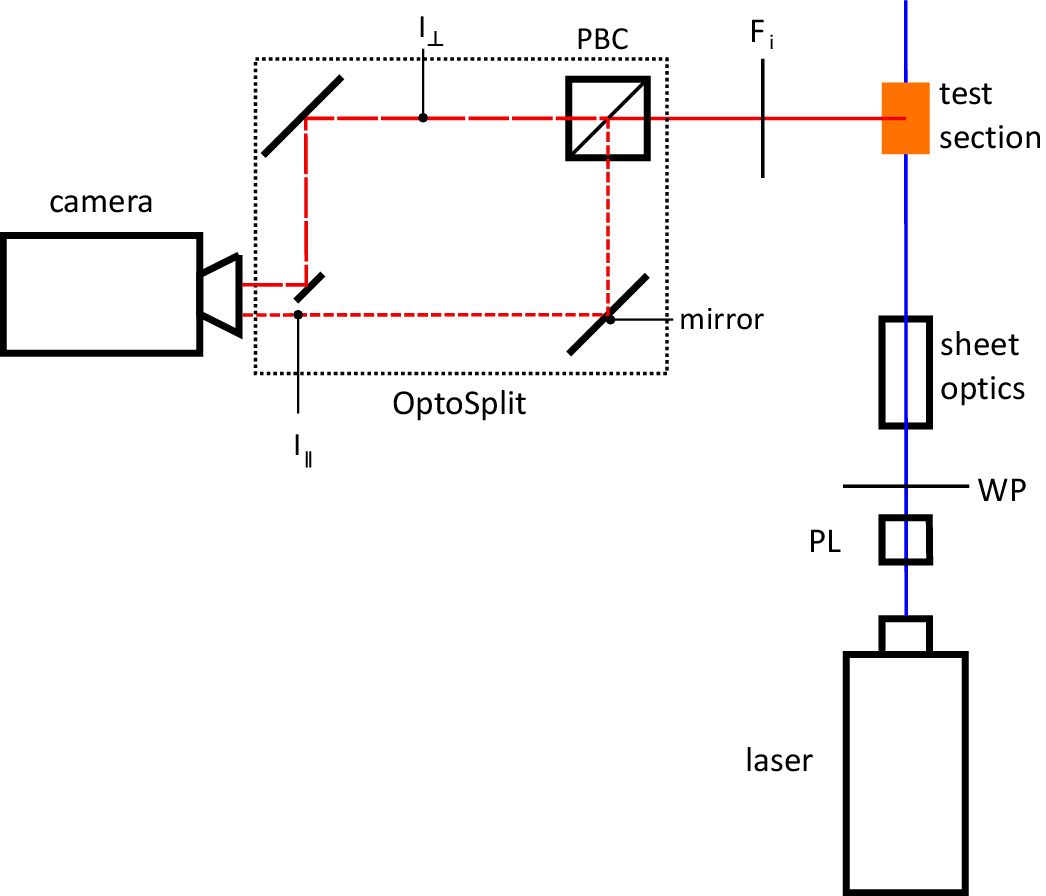
Solutions of the dyes, as well as stained nanoparticles, are analyzed. For the solution, Rhodamine B (Sigma-Aldrich, R6626, CAS: 81-88-9), Eosin Y (Sigma-Aldrich, E4382, CAS: 17372-87-1), Erythrosine B (Sigma-Aldrich, 198269, CAS: 16423-68-0) and SbCD (MedChem Express, CAS 182410-00-0) were used without further purification. Polystyrene nanoparticles were purchased from micromod Partikeltechnologie GmbH (Rostock, Germany), stained with RB (article 30-00-102,  $ 250\hskip0.3em nm $) and custom made EY (article 14-00-102, $ 100\hskip0.3em nm $). In addition, EY stained PMMA nanoparticles were produced in-house according to Angelis et al. (Reference Angelis, Venditti, Fratoddi, Matteis, Prosposito, Cacciotti, D’Amico, Nanni, Yadav, Casalboni and Russo2014) in variation EY4 with a diameter of $ 300\hskip0.3em nm $. The solutions have a concentration of $ 10\hskip0.3em \mu mol{L}^{-1} $ of dye and $ 2\hskip0.3em mmol{L}^{-1} $ SbCD. The suspensions have a particle concentration of $ 0.1\hskip0.3em mg\hskip0.3em m{L}^{-1} $. A schematic of the setup is presented in figure 1. A New Wave Research Solo PIV 120 Nd:YAG laser ( $ 532\hskip0.3em nm $, $ 100\hskip0.3em mJ $, $ 5\hskip0.3em ns $) is used for excitation of the samples. The laser beam is expanded into a sheet, and polarization is achieved by a Glan - Taylor Polarizer (Thorlabs, SM1PM10). On the emission side, the signal is filtered with a Schott OG550 longpass filter. A Cairn Research OptoSplit II Bypass is mounted onto an intensified and gated camera (PCO dicam pro). For the lifetime measurements, the OptoSplit is set to bypass mode for lifetime measurements. A Stanford DG535 delay generator is used for timing the acquisitions.
Experimental setup in polarization mode. The light’s polarization is defined by the polarizer (PL). A  $ \lambda /2 $ waveplate (WP) can be inserted and alters the polarization direction by $ 9{0}^{{}^{\circ}} $. A laser sheet optic is used to create a light sheet in the test section. The camera is equipped with a series of filters ( $ {F}_i $) to attenuate scattered laser light and other fluorescence from unwanted sources. The OptoSplit is operated with a linear polarizing beamsplitter cube (PBC), dividing the signal into perpendicular and parallel signals ( $ {I}_{\parallel } $, $ {I}_{\perp } $). These signals are projected onto separate regions of the camera chip. The PBC is removed for lifetime measurements in bypass mode
Results
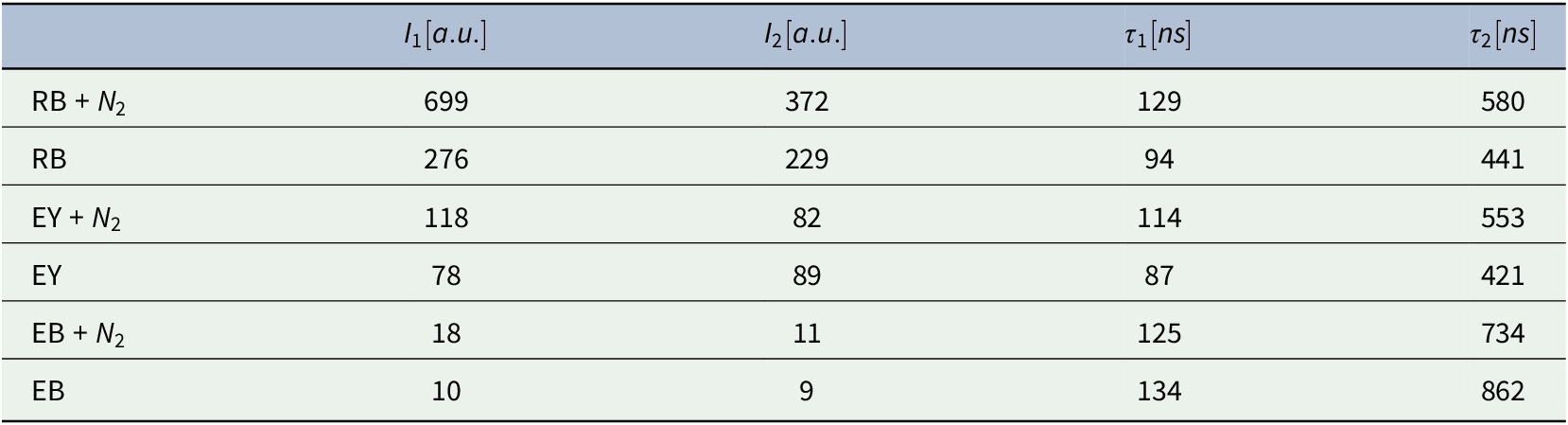
The results of the lifetime measurements are best approximated with a two-exponential decay model. The results for the solutions without SbCD can be found in table 1. The entries with  $ {N}_2 $ were flushed with nitrogen for 30 minutes before measurement. In contrast to Khurana et al. (Reference Khurana, Agarwalla, Sridhar, Barooah, Bhasikuttan and Mohanty2018) measurements with added SbCD are not presented but resulted in no change in lifetimes.
Fits of the lifetime analysis for solutions. Intensity values are normalized to the smallest value.
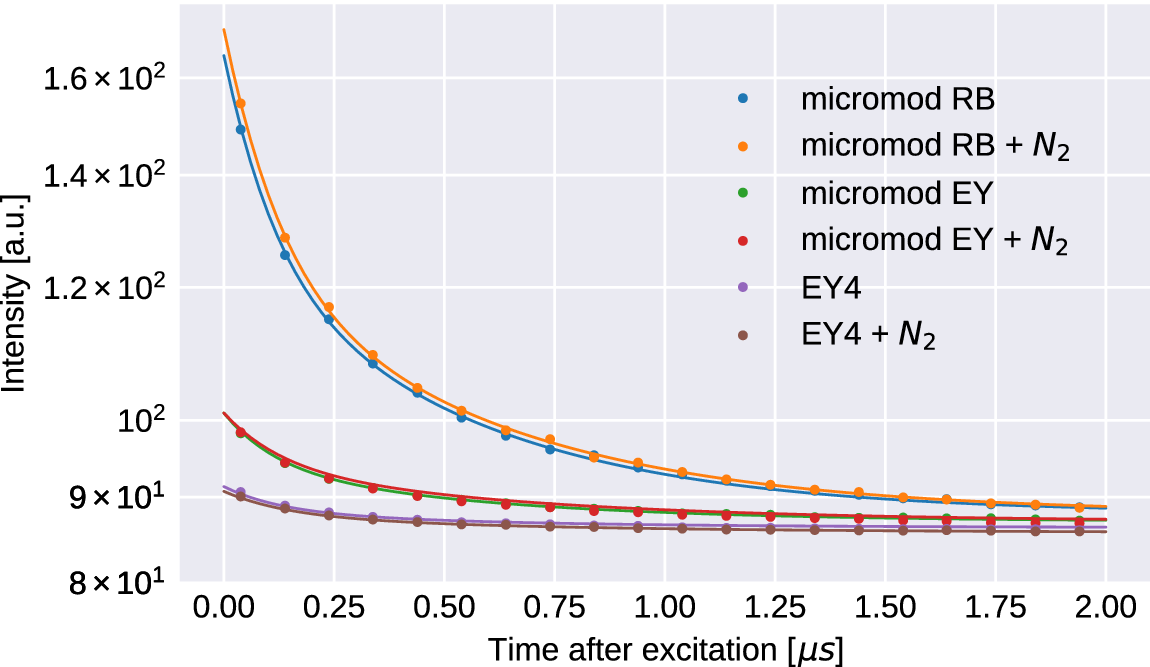
For the particles the results can be found in table 2 and figure 2. Note that the normalized intensity values cannot be directly be compared to table 1.
Fits of the lifetime analysis for nanoparticles. Intensity values are normalized to the smallest value.

Semi-logarithmic plot of particle emission lifetime (dots) and the respective fits (lines)
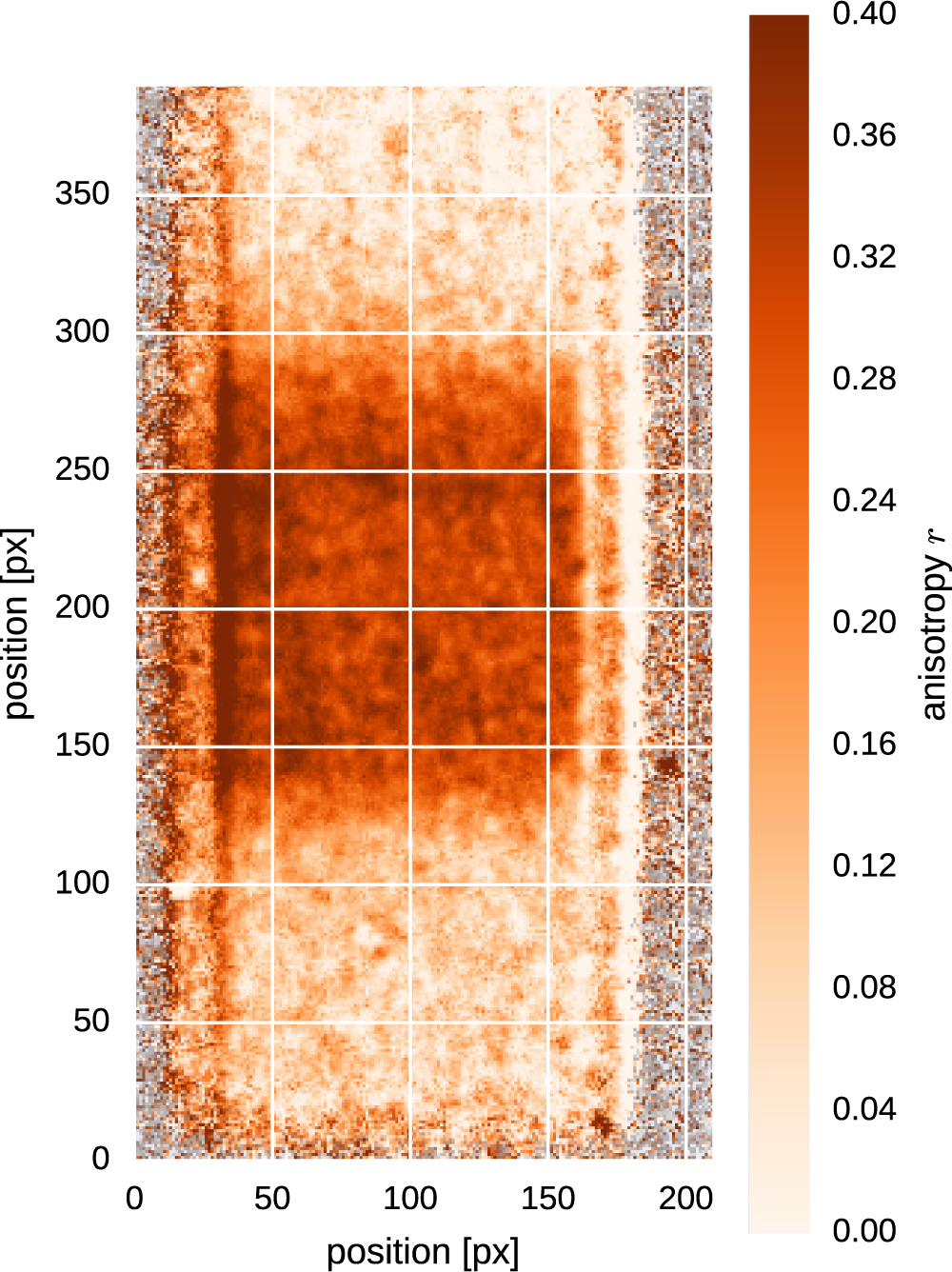
For the anisotropy r, one exemplary result is presented. It is computed from the two polarized signals as  $ r=({I}_{\parallel }-{I}_{\perp }){({I}_{\parallel }+2{I}_{\perp })}^{-1} $. Further anisotropy measurements were not pursued due to the insufficiently short lifetimes for the considered fluid dynamical experiments. The spatially resolved, uncorrected anisotropy of EY4 can be found in figure 3.
Spatially resolved anisotropy of EY4 in a  $ 3.5\hskip0.3em mL $ cuvette
Discussions
The results show a successful measurement of the long-lived luminescence. The two lifetimes are thought to be the delayed fluorescence and the phosphorescence. Overall, the intensity signals and the quantum yield are low with respect to the acquisition system, with multiple integrations on the sensor necessary for a sufficient signal-to-noise ratio. The presence of oxygen leads to a quenching of luminescence. In contrast, the application of SbCD does not result in a measurable change in the optical properties, indicating that no complex with the dye has been formed and quenching persists. In all cases, the emission lifetimes are in the sub-microsecond range. The low quantum yield of EB is remarkable, even though it also exhibits the longest lifetimes.
Conclusions
The lifetimes of the dyes remain below  $ 1\hskip0.3em \mu s $. The sensitivity of the method relies on this lifetime being comparable to or longer than the inverse of the flow-induced microrotation rate (vorticity), which results in measurable vorticities of magnitude $ 1\times 1{0}^6\hskip0.3em s $ to $ 1\times 1{0}^8\hskip0.3em s $. For slower flow regimes, the dyes are not suitable. Even in cuvettes flushed with nitrogen, the lifetimes and quantum yields only increase slightly and stay well below the values for ideal lab conditions. Furthermore, the formation of a supra-molecule does not appear to influence the optical properties, indicating a continued interaction of the dye with its environment.
Acknowledgments
The authors thank Julian Schwarz for the conduction of lifetime experiments during his Bachelor’s thesis.
Author Contributions
MJS and TR designed the study and wrote the manuscript. MJS performed the experiments and analyzed the data.
Data Availability Statement
The data are provided upon request.
Conflict of Interest
Markus J. Schmidt and Thomas Rösgen have no conflicts of interest to declare.


 Open access


Comments
Comments to the Author: The authors present photoluminescene lifetime and anisotropy measurements of various commercially available chromophores and emissive nanoparticles. The results are very incremental but fit the scope of the journal.
Additional comments:
- The author should include the results with SbCD even if the cyclodextrin does not impact the photoluminescence properties
- The author refers to the PLQY as “low” throughout the text but they do not provide a number. Please, quantify the PLQY.