





1. Introduction
A recognized limitation of standard game theory is its difficulty explaining cooperation and coordination in collective action problems. In classic games such as The Prisoner’s Dilemma and Hi-lo, mutually beneficial strategies exist, yet standard game-theoretic reasoning cannot recommend their pursuit. This limitation gives rise to two related challenges. One is descriptive: people frequently cooperate in experiments and real-world settings despite standard predictions. The other is normative: in these games, most clearly in Hi-lo, it appears that rational reasoning itself should recommend the mutually beneficial outcome. In this paper I set aside the descriptive question of how people in fact cooperate, and focus instead on the normative bases of cooperative and coordinated action as provided by two theories: Kantian optimization and team reasoning.
Addressing collective action problems within the framework of individual rationality is challenging. One response to this problem has been to move beyond the individualistic framework of classical game theory. The literature on team reasoning highlights the distinction between individuals acting alone and groups acting collectively. This approach modifies the standard model by treating groups as agents with shared goals and preferences (Sugden Reference Sugden2003; Gold and Sugden Reference Gold, Sugden and Peter2007). Decision-makers ask, “What should we do?” rather than “What should I do?”. However, a recent theory by John Roemer, Kantian optimization, suggests that departing from methodological individualism may be unnecessary (Roemer Reference Roemer2010, Reference Roemer2015, Reference Roemer2019). Kantian optimization retains the individual as the locus of agency but assumes universalization of action. An individual asks, “What would I like that all did?” and then acts accordingly, assuming that others will do the same. This presents a novel way to ground cooperation as rational in non-cooperative games while maintaining an individualist framework.
Shedding light on how these two theories relate is relevant, as, despite their differences, team reasoning and Kantian optimization share an intuitive similarity. Both involve reasoning that considers the outcome of agents acting together, i.e. the actions of a group and the actions of all, respectively. This resemblance has led some scholars to suggest that Kantian optimization could be understood as a special case of team reasoning (Sher Reference Sher2020; Gold Reference Gold2021; Istrate Reference Istrate2021). If true, this would imply that Kantian optimization fits within the group agency framework and can take the team as a unit of agency. This paper aims to investigate whether Kantian optimization could be understood in terms of team reasoning. I will argue against this. Kantian optimization and team reasoning rest on distinct principles. The former considers how the universalization of individual actions would impact the individual in terms of her own preferences and goals. The latter considers what combination of actions would maximize the team outcome based on team goals and team preferences. One does not boil down to the other.
The paper proceeds as follows: Section 2 outlines the problem of cooperation and coordination and introduces Kantian optimization and team reasoning. Section 3 argues that there is a non-binding problem in Kantian optimization and points out how group agency avoids such issues. Section 4 discusses how Kantian optimization might be understood as a kind of Kantian-style team reasoning if “similarly situated” agents are considered a team. However, section 5 demonstrates that when applied to an example game, Kantian-style team reasoning does not lead to the pure strategy Kantian equilibrium since it can recommend strategies where players take different actions. Attempts to impose universalization of action within a team-based framework require justifications external to team reasoning. These justifications suggest more efficient paths to cooperation through individual reasoning, rendering the assumption of group agency redundant. Section 6 concludes that, while both theories aim to ground cooperation in rational reasoning, they operate on opposing principles. Kantian optimization focuses on the individual’s preferences and considers how the universalization of individual actions would impact the individual. Conversely, team reasoning focuses on team preferences and goals, assigning roles to individual team members based on what the team would deem beneficial. While both approaches can lead to similar outcomes, their underlying principles and, therefore, mode of reasoning differ significantly.
2. The Problem of Cooperation
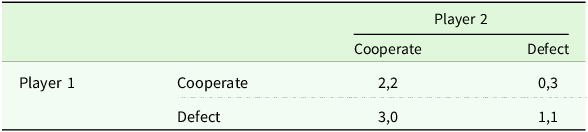
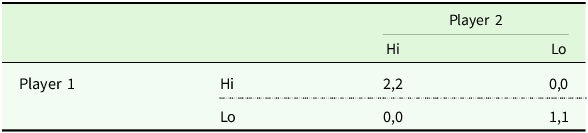
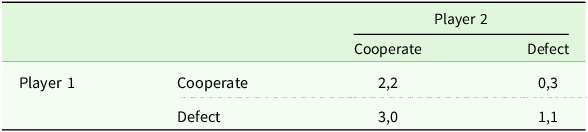
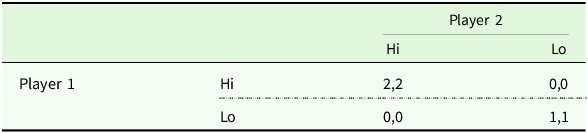
This section introduces two key challenges to orthodox game theory, cooperation and coordination, highlighting their relevance through the Prisoner’s Dilemma game and the Hi-lo game. It also examines how adjusting preferences fails to resolve these challenges, motivating a need for alternative approaches. In the Prisoner’s Dilemma (Table 1), due to individual incentives favouring defection, rational players are driven to defect despite the higher, Pareto-optimal payoffs of mutual cooperation. In Hi-lo (Table 2), a pure coordination game, classical game theory fails to resolve which Nash equilibrium, (hi, hi) or (lo, lo), players should choose.Footnote 1 This arises because Nash reasoning, in this case, creates a circularity: each player’s optimal choice depends on their belief about the other’s action. Player 1 only has reason to choose hi if she has reason to believe that player 2 will choose hi, and the same goes for player 2. This highlights the limitations of game theory in addressing coordination and collective action problems. It seems unsatisfactory that rational reasoning cannot recommend choosing “hi” in a game as simple as Hi-lo or explain how we might cooperate for mutual advantage in the Prisoner’s Dilemma.Footnote 2
The Prisoner’s Dilemma
Hi-lo
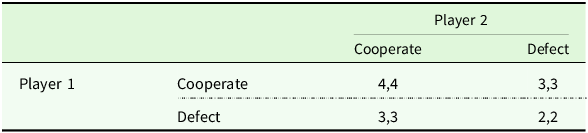
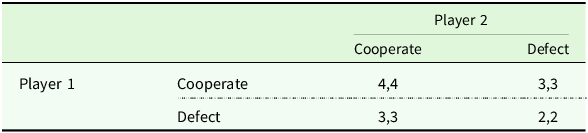
One approach to explaining cooperation in collective action problems involves relaxing the assumption of self-interest to include social preferences like altruism or fairness concerns. Conceptually, this means broadening players’ preferences to capture these additional motivations, which can be represented numerically in payoff matrices (see Table 3). However, this fails to address coordination issues, as seen in Hi-lo, where altruistic payoffs still leave players without a reason to choose hi over lo. In the Hi-lo game, there are no incentives to defect. It is a pure coordination game in which it seems obvious that both should choose hi. The problem in Hi-lo is troubling for the fundamental concept of best response reasoning.
Prisoner’s Dilemma with altruistic preferences
Beyond coordination, there are further issues with preference-based solutions to collective action problems. Critics argue that transforming preferences risks trivializing game theory, as it becomes overly flexible in retrospectively explaining behaviour (Sugden Reference Sugden2015; Roemer Reference Roemer2019). Moreover, Binmore (Reference Binmore1994) argues that if agents cooperate in the Prisoner’s Dilemma, the stated payoffs must differ from the actual utility payoffs. Rational players facing standard expected utility payoffs should always defect. Payoff transformation bridges the gap between stated, often material, payoffs and actual utilities. This approach is unsuitable when no such gap exists, and utilities already capture relevant preferences (Colman Reference Colman2024). Team reasoning and Kantian optimization are compatible with standard expected utilities and, therefore, must take a different route to explain cooperation. They instead alter, in different ways, how agents reason. In the following subsections, I briefly outline the two theories.
2.1 Kantian optimization: universalization of action
In 2010, John Roemer introduced Kantian optimization, a novel theory of rational cooperation (Roemer Reference Roemer2010). His 2019 book How We Cooperate presents the most developed version of this idea. Roemer argues that cooperation is often mistakenly equated with altruism and that self-interested cooperation, cooperating for one’s own good, is possible in collective action problems. He observes that in such cases, agents may optimize in a non-Nash manner. Instead of maximizing their payoff assuming others’ strategies are fixed, they ask: “If I were to deviate from my stipulated action, and all others were to deviate in like manner, would I prefer the consequences of this new action profile?” (Roemer Reference Roemer2015: 46). Roemer calls this reasoning “Kantian” in the economic sense, which refers mainly to universalization and does not claim to accurately capture Kantian ethics. It arises from an interpretation of the categorical imperative as “take those actions one would like to see universalised” (Roemer Reference Roemer2019: 13). Though it resembles a moral principle, Roemer argues that under certain circumstances it can also be seen as self-interestedly rational to Kantian optimize. Agents choose the action that maximizes their payoff, assuming others do the same.
Roemer’s theory alters the optimization strategy of classical game theory, presenting an alternative to Nash optimization (Roemer Reference Roemer2019). It results in a distinct class of equilibria, Kantian equilibria, which are often Pareto-optimal, where Nash equilibria are not. Roemer typically illustrates this with symmetric games where all players face identical choices and payoffs. Symmetry is crucial as agents must recognize they face identical situations where collective success depends on all cooperating.
Nash reasoning: A player reasons: If my opponent chooses to cooperate, my best response is to defect. If my opponent chooses to defect, my best response is to defect. Therefore, I should defect. (defect, defect) is the stable Nash equilibrium.Footnote 3
Kantian optimization: A player reasons: There is common knowledge that the payoff matrix is symmetric and that my opponent and I have equal capacities and reasoning power. Hence, due to the symmetry of the game, I assume that whatever strategy I decide upon will also be decided upon by my opponent. It follows that I must only consider strategy profiles where both play the same strategy i.e. (cooperate, cooperate) or (defect, defect). I, therefore, should choose the strategy that maximizes my payoff if it is played by both my opponent and me. That is the strategy ‘cooperate’. My opponent will choose the same action because she will reason this way as well, and of this, I am confident because of the common-knowledge assumption and our equal reasoning powers. [Example adapted from Roemer Reference Roemer2019: 19]
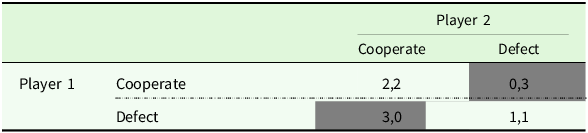
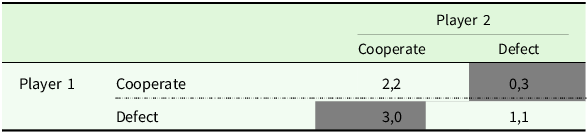
Kantian optimization similarly provides a solution to coordination games like Hi-lo. Two preconditions must be in place for agents to Kantian optimize. Agents must be (a) ‘similarly situated’ in that they are in a situation where there is common knowledge that they have the same goals, and the payoff matrix is symmetric, and (b) have common knowledge of the other’s rationality, equal capacities and reasoning power (Roemer Reference Roemer2019: 4).Footnote 4 When these conditions are in place, each agent has reason to assume that her individual action will be universalized. It could be argued that these are strong assumptions. The agents must face the exact same problem and be sure that the other is identically rational. Additionally, Roemer refers to these conditions of common knowledge of equal reasoning powers as the “micro-foundation” of trust (Roemer Reference Roemer2019: 20). So it seems that it is these very preconditions that allow agents to trust that the other will reason in a cooperative Kantian manner. If there is common knowledge that each is rational and can recognize the symmetry of the game, each can assume that the other will recognize that she will do better by cooperating and will reason the same way. The individual, therefore, only considers strategy profiles where her action is universalized, i.e. strategy profiles where both choose the same strategy. This universalization effectively rules out (cooperate, defect) and (defect, cooperate) depicted by the shading in Table 4. According to Roemer, the agent self-interestedly chooses the strategy that maximizes her payoff if it is universalized, i.e. played by both the agent and her opponent.
Kantian optimization in the Prisoner’s Dilemma
For example, imagine a football team where players can each choose between “showing off” (shooting for the goal themselves) or “playing efficiently” (passing to the player in a better position). Let’s consider the outcomes from one player’s perspective. The best outcome is when everyone else plays efficiently, but you show off: your team wins, and you’re the star. The next best is when everyone plays efficiently, including you: your team wins, but you don’t stand out. The second-to-worst is if everyone shows off, but the team loses due to ineffective play. The worst outcome is if others show off while you play efficiently: the team loses, and you’re not recognized for your supporting role.
This situation is a Prisoner’s Dilemma. If each player acts individualistically and seeks glory by showing off, everyone suffers, resulting in a loss. A better approach is for everyone to play it safe (Kantian solution). This relies on players realizing that cooperation leads to a better outcome for each, including themselves. Recognizing that everyone is in the same situation, they understand that collective success depends on all cooperating. As Roemer puts it, they should recognize that all must hang together or each will hang separately.
2.2 Team Reasoning: Groups as Agents
This subsection explores the team reasoning solution to problems of cooperation and coordination, focusing on its shift from individual to group agency. Classical game theory assumes that agency resides with the individual, who maximizes her expected utility given her beliefs. Even if preferences include concern for others, classical game theory treats them as individual preferences, asking ‘What should I do?’. Team reasoning challenges this assumption by proposing that groups can function as units of agency. In such cases, individuals identify as team members and ask ‘What should we do?’, reasoning from a collective perspective.
Team reasoning is a broad family of theories. Various theorists model this shift differently. Within game theory, the most influential accounts are those of Bacharach (Reference Bacharach, Gold and Sugden2006) and Sugden (Reference Sugden2000, Reference Sugden2003, Reference Sugden2015, Reference Sugden2018). They differ on how team identification arises and how the team’s objective is defined. Bacharach offers a model of team reasoning in which agents may adopt a team payoff function and act even under uncertainty about others’ identification. In contrast, Sugden’s account is more restrictive: agents will only team reason if they have assurance that others will do so, and only if the cooperative outcome benefits each individual. For the present introduction, these differences can be set aside, but they will be revisited in the next section. The key point here is that reasoning from the standpoint of the group can solve problems of cooperation and coordination.
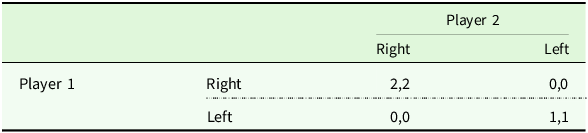
To illustrate team reasoning, consider the Footballer’s Problem (Table 5). Suppose two teammates must coordinate their movements on the pitch. A defender is approaching the player with the ball, who must decide whether to pass left or right. Meanwhile, her teammate must decide where to run (left or right) in order to receive the pass. Both teammates recognize that the right wing offers a better position for scoring, reflected in a higher payoff for both going right. This situation has the same structure as the Hi-lo game. As discussed in the previous section, individualistic reasoning fails because each player’s optimal action depends on expectations about the other’s choice. By reasoning as a team, agents can consider what combination of actions achieves the team’s objective. Reasoning this way can recommend the (right-right) strategy.
Footballer’s Problem
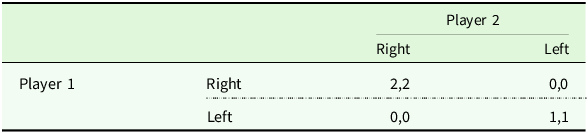
Gold and Sugden’s (Reference Gold, Sugden and Peter2007) generic schema captures this logic succinctly:Footnote 5
S = team U = any payoff functionFootnote 6 A = strategy profile.
Simple team reasoning
-
(1) I am a member of S.
-
(2) It is common knowledge in S that each member of S identifies with S.Footnote 7
-
(3) It is common knowledge in S that each member of S wants the value of U to be maximized.
-
(4) It is common knowledge in S that A uniquely maximizes U.
I should choose my component of A. (Gold and Sugden Reference Gold, Sugden and Peter2007: 289)
In the standard individualistic framework, an agent evaluates her available actions relative to her preferences, given her beliefs about the actions that other individuals will choose. Team reasoning departs from this framework through a transformation of agency: when an individual identifies with a team, the perspective of practical reasoning shifts from the individual to the group. As a result, the agent evaluates alternative action profiles, joint actions by members of the team, in relation to team preferences and team goals (Sugden Reference Sugden2000). How the relevant team goal is specified varies across accounts. In some models, the team-optimal outcome is defined as the one that maximizes the sum of individual payoffs. While this assumption is often used for illustrative purposes in discussions of coordination games, it is not a general commitment of team-reasoning theories.
There has been some debate as to whether team reasoning can be interpreted as a payoff transformation (Duijf Reference Duijf2021; Colman Reference Colman2024). Though some unorthodox payoff transformation models can mimic team reasoning, it does not follow from this that team reasoning is reducible to payoff transformation.Footnote 8 Here, agency transformation involves not only a change in preferences but also an implicit transformation of beliefs: team reasoners expect that other team members will act to achieve the team goal. As shown in the previous section, preference transformation alone cannot resolve coordination problems such as Hi-lo. Without the corresponding shift in beliefs, agents would face the same coordination problem as under standard best-response reasoning. So although team reasoning does involve altered preferences, these changes are best understood as consequences of an overarching transformation in agency, encompassing beliefs and preferences, rather than as a simple reweighting of material outcomes.Footnote 9
Though team reasoning is a broad family of theories, according to Gold (Reference Gold2021), they have two common features. Firstly, they are united by their reliance on group agency as a fundamental concept. Secondly, they share a similar structure in that the rationality of each individual’s action is derived from the rationality of the joint action undertaken by the team. Having outlined the general concept of team reasoning, we can now refine which version of team reasoning is most relevant for comparison with Kantian optimization.
2.3 Mutual Advantage
To assess whether Kantian optimization can be understood as a form of team reasoning, it is useful to focus on the account most closely aligned with its underlying assumptions. I argue that theories of team reasoning for mutual advantage provide the most suitable basis for this comparison. There are two main reasons for this. Firstly, Kantian optimization is cooperation for the good of each. Accounts such as Bacharach’s allow that the team goal may be welfare-decreasing for some members. Bacharach holds that this is sensible as group identification could explain why people might sacrifice their own welfare for the good of the whole, for example, when parents sacrifice for the good of the family (Bacharach Reference Bacharach, Gold and Sugden2006: 91). However, these are not the same phenomena that Roemer is trying to explain with his account of cooperation. Kantian agents cooperate for the good of each, not for the good of all. In contrast, mutual advantage approaches restrict cooperation to outcomes that benefit all agents relative to their individual baselines. They aim to explain intentional cooperation that achieves players’ common interests as opposed to collective interests.
Secondly, some theories of team reasoning presuppose interpersonal comparability, for example, those that aggregate agents’ payoffs.Footnote 10 This reaches beyond standard assumptions of utility theory. Theories of team reasoning for mutual advantage generally do not require interpersonal comparability (Sugden Reference Sugden2015; Karpus and Radzvilas Reference Karpus and Radzvilas2018). They instead define mutual advantage relative to a baseline for each player. The baseline serves as a reference point for evaluating potential team actions relative to each player, which does not presuppose interpersonal comparability. Thus team reasoning for mutual advantage is the most fitting candidate, because it preserves the notion of cooperation for the good of each rather than cooperation for the good of all, and it avoids interpersonal comparability.
Sugden’s (Reference Sugden2015) account provides the foundational model of team reasoning for mutual advantage. Individuals adopt team reasoning when there is a mutually beneficial strategy and when they have reciprocal reason to believe that other players are reasoning as members of a team. The process begins with recognition of a mutually beneficial practice: a strategy profile that offers each participant a payoff exceeding their “maximin payoff” benchmark, i.e. the best outcome an agent could secure by acting independently under worst-case assumptions about others’ actions. For each available strategy, an agent identifies the minimum payoff she could receive and selects the strategy with the highest such minimum. If players have assurance that others endorse the same team reasoning schema, they adopt the team-reasoning mode, automatically expecting others to choose their part of the team strategy. The team outcome must therefore improve each player’s payoff relative to acting alone; in this way, no agent is expected to sacrifice for others, and no interpersonal comparability of payoffs is required.
In comparison to how Gold and Sugden (Reference Gold, Sugden and Peter2007) model the general concept of team reasoning, Sugden’s later work moves away from representing team reasoning as the maximization of an explicit team utility function and does not assume that groups solve coordination problems through rationality alone. This means that mutually beneficial practices need not be optimal; they need only be better than going it alone. He argues that mutually beneficial cooperation often requires conforming to complex and arbitrary conventions that cannot be reconstructed by abstract rational analysis. Understanding the team goal as mutual benefit, as opposed to maximizing the team utility function, broadens the descriptive scope of team reasoning, allowing coordination on pre-existing practices or conventions to be considered successful team reasoning.Footnote 11
A key feature of Sugden’s account is his explicit rejection of maximization (Sugden Reference Sugden2015, Reference Sugden2018). Instead, the focus is on identifying strategies that are mutually advantageous relative to each agent’s maximin benchmark. This makes the account descriptively broader, but it limits its direct comparability with Kantian optimization, which is explicitly an optimization procedure: each agent chooses the strategy that would be best for her if everyone acted similarly. For example, the rejection of maximization means that Sugden’s account does uniquely recommend (hi, hi) in the Hi-lo game. According to his definition, all Nash equilibria in the Hi-lo game are mutually beneficial. To see why, consider what the maximin benchmark is for each player. If Player A chooses lo, the worst-case scenario occurs for her when B plays hi, yielding a payoff of 0. If A chooses hi, the worst-case occurs when B plays lo, also yielding 0. The maximin payoff is the highest of these worst-case payoffs. Here, that is simply 0. It is the same for player B as the game is symmetric. Both (hi, hi) (2, 2) and (lo, lo) (1, 1) would be considered mutually beneficial in comparison to the maximin benchmark of 0.
Karpus and Radzvilas (Reference Karpus and Radzvilas2018) build on Sugden’s account of team reasoning by reformulating it as a maximizing framework grounded in mutual advantage. They introduce a measure that allows outcomes to be ranked in terms of how mutually beneficial they are. They first create a normalized measure of individual advantage. This tracks how far a player’s payoff advances beyond a defined reference point relative to their most preferred outcome. The measure of mutual advantage is flexible depending on what personal reference point you use. Karpus and Radzvilas consider a few options but endorse the worst rationalizable outcome as the reference point, which effectively excludes dominated strategies.Footnote 12 This measure, from reference point to most preferred outcome, gives each player a 0–1 score for each outcome representing their relative improvement within the feasible set. The extent of mutual advantage is then defined as the minimum level of individual advantage achieved by any team member at any given outcome. They integrate Sugden’s maximin principle as a constraint. For an outcome to be considered mutually advantageous, every player’s final payoff must be at least as high as their maximin benchmark. In addition, it must improve each player’s position relative to their reference point. The team-optimal outcome is the strategy profile that maximizes mutual advantage. For example, in the Hi-lo game, each player’s individual reference point as the worst rationalizable outcome is 0. The maximin payoff is also 0, since both strategies yield a worst-case payoff of 0. Note that here the maximin baseline and the individual reference points are the same, but this is not the case in every game. The outcome (hi, hi), therefore, exceeds the maximin baseline while maximizing both players’ gains relative to the reference point, making it the team-optimal and mutually advantageous choice. By combining Sugden’s insistence on cooperation for the good of each with a formal optimization criterion, their account provides a natural point of comparison with Kantian optimization.
2.4 Similarities between Team Reasoning and Kantian Optimization
Now that we have outlined the key features of team reasoning, we can explore its potential overlaps with Kantian Optimization. Both theories alter different assumptions of standard game theory. Team reasoning alters the unit of agency, and Kantian optimization alters the optimizing protocol. Thus, both locate the cause of the problem in the same place: the mode of reasoning of standard game theory, which dictates that agents move from preferences to decisions. In other words, Kantian optimization and team reasoning solve the cooperation and coordination problem by changing the question. Team reasoners ask, “What should we do?” and Kantians ask, “What would I like that all did?”.
This highlights the key similarity: both approaches involve agents optimizing over and considering the outcomes of strategy profiles. However, a distinction persists: Kantian optimization seems to remain within an individualistic framework, where agents act based on their individual preferences. While Roemer’s Kantian agent employs a form of reasoning distinct from Nash reasoning, the individual remains the basic unit of analysis. Before examining whether Kantian optimization can be understood as a form of team reasoning for mutual benefit, I first address a specific issue within Kantian optimization related to optimizing over strategy profiles within the individualistic framework. Outlining this issue clarifies the discussion and suggests a motivation for understanding Kantian optimization as a kind of team reasoning. The next section questions the rationality of optimizing over strategy profiles in an individualistic framework and suggests that Kantian optimization might require something like group agency to get cooperation off the ground. Nevertheless, I argue that the resulting Kantian-style team reasoning differs significantly from Kantian optimization.
3. Dependency and the Non-binding Problem
Roemer argues that Kantian optimization can be viewed as rational in the sense that it advances each individual’s self-interest. However, Kantian optimization depicts an agent optimizing, not over her own actions, but over universalized action, i.e. the actions of all. One can question how this might be deemed rational. Sher (Reference Sher2020) argues that optimizing over strategy profiles isn’t warranted under self-interested individual rationality because the actions of others are not under the control of the individual agent. This raises two important questions: How can it be rational to optimize over the actions of others? And why should a self-interested agent cooperate when it is better for her to defect, especially if she has reason to think the other will choose to cooperate?
In game theory, the individual agent always optimizes over action profiles that include the actions of others. The individual agent takes into account what the other will do. When thinking about her best response, the agent considers how the other rational agent will act and how she should best respond to that. She comes up with individual strategies, such as: if the other plays x, I do best by playing y. What, then, sets Kantian optimization apart? The difference lies in how the Kantian agent considers the actions of others. The agent does not consider how she should best respond to the actions of the others, but how she would fare if all others took the same action as her. Instead of optimizing over one’s own actions in response to another’s, the agent optimizes over universalized actions. The individual agent assumes the other agent will take the same action; that the other is “a part of the action” (Roemer Reference Roemer2019: 6). Roemer explicitly highlights this as a key difference between Kantian and Nash reasoning. In Nash reasoning, the actions of others are held fixed and treated as parameters of the individual’s problem, not as “part of the action” (Roemer Reference Roemer2019: 7).
Sher’s concern is that the Kantian agent is optimizing over the actions of others that she herself does not control. “That one should optimise over what one can control is the reason that actions of others are held fixed in Nash equilibrium” (Sher Reference Sher2020: 64 [emphasis in original]).Footnote 13 Without a mechanism binding agents to take the same action, a rational agent should defect for the higher payoff in the Prisoner’s Dilemma. Jon Elster (Reference Elster2017) raises similar concerns about the potential ‘illusion of control’ over the other players’ actions in Kantian optimization. Elster suggests that Kantian optimization may be explained as a case of ‘magical thinking’ where one mistakenly believes that their action will cause the other to act in a like manner.Footnote 14
I share Sher’s concern and suggest that Roemer’s argument for the rationality of this optimizing protocol relies on an implicit dependency between the agents’ actions. Why is it rational to assume one’s action will be universalized in the first place? Roemer’s starting point is that the conditions of symmetry and the common knowledge of equal reasoning powers constitute the micro-foundations of trust, allowing agents to assume the other will take the same action as them. Interestingly, this argument is reminiscent of an older argument for cooperation in the Prisoner’s Dilemma referred to as “The Argument from Symmetry”. This argument states that two identically rational agents, identically situated in a symmetrical game, will both reason the same way. If one player decides to cooperate, the other player, being rational and identical, should reach the same conclusion and also choose to cooperate (Davis Reference Davis, Campbell and Sowden1985). Agents should take this into account when reasoning, and hence rationality should suggest choosing to cooperate. However, this argument is widely criticized for implicitly assuming that the players’ choices are causally dependent. In reality, what players do is causally independent – meaning that one player’s decision to cooperate does not by itself cause the other to cooperate (Campbell Reference Campbell, Campbell and Sowden1985; Lewis Reference Lewis, Campbell and Sowden1985). One cannot affect or control the choice of the other by what one chooses.
I refer to this as a ‘non-binding problem’ within Kantian optimization. The preconditions do not bind agents to take the same action as each other, so the assumption of universalized action cannot be justified as rational. The actions of one agent do not necessarily affect the actions of the other. Roemer clearly states that Kantian optimization occurs when agents trust that the other will reason cooperatively. But recall that the micro-foundations of this trust are symmetry of position and equal reasoning powers. These conditions are insufficient to bind a self-interested player to take the same action. Assuming universalization implies dependency between actions, raising doubts about the rationality of Kantian reasoning. Roemer (Reference Roemer2020) suggests explicitly that there is moral appeal to making this assumption.Footnote 15 However, he largely makes the argument that the symmetry of the game gives self-interested agents reason to assume their actions will be universalized. It is this argument that I focus on in this paper.
This issue is relevant when discussing the relationship between Kantian optimization and team reasoning, particularly regarding the unit of analysis required to explain cooperation. The group agent avoids issues like the non-binding problem because it can be seen to control group actions collectively, like an agent controlling its limbs. If Kantian optimization cannot be deemed rational within the individualistic framework, it might benefit from moving towards a team framework. If Kantian optimization is an instance of team reasoning, it could provide both a defence to the accusation of dependency and a stronger reason for the individual to cooperate. The non-binding problem, therefore, lends strength to the suggestion that Kantian optimization may be a kind of team reasoning.
4. Incorporating Group Agency: Kantian-style Team Reasoning
Before discussing how Kantian optimization might be understood as a kind of team reasoning, it is helpful to clarify what such a claim would entail. To say that a theory is a kind of team reasoning is to claim that it shares the defining features of this family of theories. Section 2 defined team reasoning theories as united by their reliance on fundamental concepts and a common general structure. Recall that the fundamental concept of team reasoning is group agency; the individual team member appraises group action in light of the group objective and takes their part in it. The general structure of team reasoning is that the group’s choice dictates the rational choice for the individual. That is to say, the rationality of the individual choice is derived from the rationality of the group choice. Does Kantian optimization have these properties?
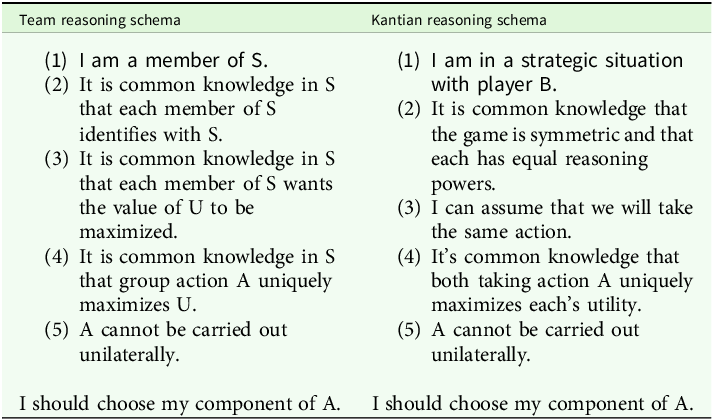
Table 6 shows a slightly adapted reasoning schema of team reasoning from the individual perspective suggested by Gold and Sugden (Reference Gold, Sugden and Peter2007), followed by an example of how team reasoning might incorporate group agency and follow a similar structure. In Table 6, S = team, U = any payoff function, A = strategy profile – pair of strategies.
Reasoning Schema Comparison
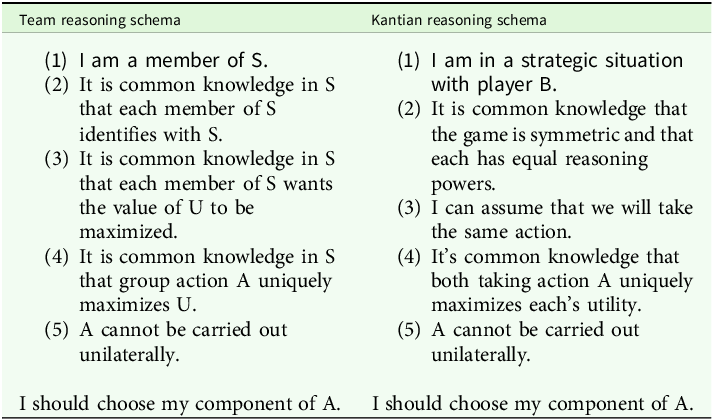
These reasoning schemas have a similar structure. Both involve recognizing a shared situation, identifying a unanimously preferred strategy profile, acknowledging that that strategy requires collective action and then choosing an individual action that aligns with the collective strategy. Most important is how the individual action is deemed rational in these schemas. The rationality of the individual action is derived from the rationality of the group action in team reasoning. However, in Kantian optimization, the agent’s individual action of cooperating is rational in light of the assumption that both will take this action. Roemer depicts this as a kind of parallel individual action made rational by the circumstances of symmetry and common knowledge of equal reasoning powers. I have argued that this particular assumption is problematic: agents are not bound to take the same action when their actions are independent and unaffected by the other’s choice.
With this in mind, the first step towards a ‘Kantian-style’ team reasoning is to note that team reasoning avoids issues like the non-binding problem due to its larger unit of analysis. It does not encounter the problem of control over others’ actions because group agents can be seen to control group actions collectively. A team naturally optimizes over strategy profiles as opposed to actions. A football team can choose the best strategy to score a goal. The second step notes that the individual team member, in virtue of their identification with the team, takes on these team preferences and is assured of the cooperation of other members. An individual’s identification with the team can be seen to bind them to take their part in the group action. A shared identity as a team gets cooperation off the ground. Putting these two elements together suggests that employing the concept of team agency could bind an agent to Kantian cooperation without being susceptible to the problem of causal dependency. Though Kantian optimization does not explicitly incorporate group agency, it could be the case that it implicitly relies on it. If the agents identify as a team, group identification could bind agents to take their part in the Kantian equilibrium.
For Kantian optimization to be a kind of team reasoning, we must assume that the agents identify as a team. In the context of a two-person game, the assumption may not be too much of a stretch. The preconditions of Kantian optimization are symmetry and common knowledge of equal reasoning powers. The structure of the game means that agents are “similarly situated” in that they recognize that they face the same problem. It seems likely that these conditions could also prime team identification under Bacharach’s understanding of identification. Bacharach argues that the structure of games such as Hi-lo and the Prisoner’s Dilemma makes agents more likely to frame a problem as a team problem and identify as a team (Bacharach Reference Bacharach, Gold and Sugden2006). However, as mentioned in section 2, accounts differ on what identification requires. It can be more demanding than simple framing. Sugden (Reference Sugden2015) specifies that agents identify as a team when there is a reciprocal reason to believe that the other player will team reason. It necessitates assurance that others will team reason and implies a kind of commitment to team reasoning (Sugden Reference Sugden2015). If we are willing to add this assurance assumption, the Kantian-style team reasoners could identify as a team and ask something like, “What would I like that we did?”. Note that the identification as a team, not the assurance alone, binds agents to take their part in the team action.
Alternatively, one could argue that though the Kantian agents don’t explicitly identify as members of a team, they constitute a team because they reason like team members (Sugden Reference Sugden2000). They appraise group strategies in light of group objectives. This would necessitate broadening the definition of a team to include agents that do not explicitly identify as team members. Notice that in the question “What would I like that we did?” the agent is still considering their own goals and preferences. For this to be team reasoning, the agent must take on team goals and preferences and ask something like, “What would I, as a team member, like that we did?”.
With an assumed team agent that has maximization of mutual benefit as the team goal, Kantian optimization could avoid the binding problem and fit into the team reasoning framework. However, the introduction of group agency significantly alters how agents reason. The next section argues that incorporating team agency into Kantian reasoning comes at the cost of universalization. In other words, it loses its very “Kantian” feature.
5. Individual and Team Preferences: Why Kantian Optimization is Not a Kind of Team Reasoning
In this section, I present an argument against the claim that Kantian optimization is a kind of team reasoning. I illustrate that in some games, the Kantian-style team reasoning for mutual benefit outlined in the previous section would recommend a different strategy than Roemer’s individual Kantian reasoning. I suggest a way to bridge the gap, but argue that the solutions fall outside the team reasoning framework. Applying them makes team agency redundant.
Recently, Istrate (Reference Istrate2021) has argued that Kantian equilibria are a proper subset of team reasoning equilibria. Meaning that every Kantian equilibrium is also a team-reasoning equilibrium, but not vice versa. To support this claim, he compares Bacharach’s model with an extended notion of Kantian equilibrium, the Kantian Program Equilibria (KPE). In contrast to Roemer’s formulation, where each agent chooses a single action under universalization, KPE allows all players to adopt a shared programme or rule. This programme may use a correlation device to assign different actions to different players, while remaining structurally identical for everyone. Such a mechanism enables Kantian reasoning to operate in more complex or asymmetric settings. KPE is defined only for Pareto-symmetric games, in which the overall game may not be symmetric, but the set of Pareto-optimal outcomes is structured symmetrically. Importantly, KPE restricts its equilibria to Pareto-optimal outcomes. Formally, the probability distribution representing a KPE must have its support entirely on Pareto-efficient profiles (Istrate Reference Istrate2021: 7 Definition 5). This ensures collective efficiency by stipulation, excluding dominated or highly unequal outcomes.
While interesting, KPE represents a different procedural approach than Roemer’s original Kantian optimization. By only considering programmes that generate Pareto-optimal outcomes, it introduces a collective efficiency constraint not present in Roemer’s Kantian Optimization, though it does not require agents to reason altruistically or explicitly maximize joint payoffs. While Istrate incorporates the Pareto restriction as a simple rationality criterion, one concern with this alteration is that it may depart from the individual self-interested standpoint that underlies Roemer’s original definition. For the purposes of this paper, I retain Roemer’s original interpretation. My argument applies to Kantian optimization as defined by Roemer, where agents reason individually under universalization, and efficiency, if it arises, emerges from self-interested reasoning.
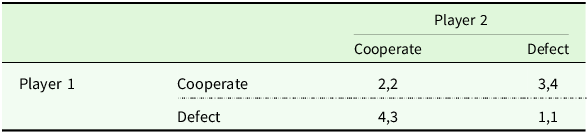
Under Roemer’s definition, there are some symmetric games in which the Kantian equilibrium is not a team reasoning for mutual benefit equilibrium. Consider the game in Table 7.
Kantian Trap
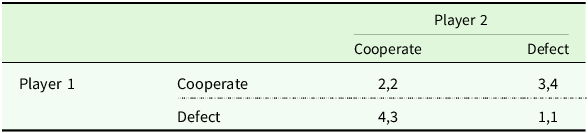
Table 7 shows a symmetric game, which highlights where Kantian-style team reasoners would diverge from Kantian optimizers. Applying Kantian-style team reasoning, the optimal strategy profile would be either (Cooperate, Defect) or (Defect, Cooperate). This selection maximizes mutual advantage and neither player receives a payoff lower than the maximin baseline of (2, 2). Conversely, Kantian optimization would advocate for (Cooperate, Cooperate). This choice stems from the individual’s assessment of the preferred outcome if her action were universalized. In this scenario, mutual cooperation still yields a superior outcome (2, 2) compared with mutual defection (1, 1). Here, we have a divergence between the best universalized action and the optimal team action.Footnote 16
It is also an option for Kantian agents to mix strategies, where the player assigns each action a probability and then randomizes over them according to those probabilities. The Kantians adopt the strategy that they would like both to play. To find the mixed Kantian equilibrium of a game, you calculate the payoff to each player if both players choose the same probability (p) of cooperating. The mixed Kantian equilibrium here would be cooperate with probability 5/8 (and defect with probability 3/8) for an expected payoff of 2.5625.Footnote 17 It should be noted that mixed strategies introduce risk, unlike a pure strategy agents risk ending up with the worst outcome.
This randomization and risk, however, may be unnecessary for a team. To the team, and thereby to its members, (cooperate, defect) or (defect, cooperate) are equally good; they are better than going it alone, and they maximize mutual benefit. If you assume that a team, as an agent, can coordinate its members. A team member can simply say something like “Let’s do x”, and the other members have no incentive to deviate from this if it maximizes the team outcome and is mutually beneficial.Footnote 18 Any coordination aid would lead teams to the higher payoffs. However, it may not be so simple. If agents cannot communicate and there are no coordination aids, team reasoners would be stuck in a coordination problem. Karpus and Radzvilas (Reference Karpus and Radzvilas2018) suggest that, in such cases, the measure of mutual advantage itself could be modified to account for coordination risk. This would potentially favour an outcome that is unique and certain if it provided higher expected utility after discounting the risky options. However, in the case of the Kantian trap game, risking for coordination would likely be more beneficial than playing it safe with (cooperate, cooperate) because the maximal mutual advantage score associated with (cooperate, defect) and (defect, cooperate) is significantly higher than the score for the certain outcome (cooperate, cooperate).
The divergent recommendations highlight a problem with interpreting Kantian optimization as a form of team reasoning. Kantian optimization turns on individual preferences. When agents are assumed to act as team members, they are also assumed to operate based on team preferences rather than individual ones. This transformation alters the core question guiding their reasoning. Instead of asking, “What would I like all of us to do?”, a question grounded in individual preferences, the group identification inherent in team reasoning would lead to asking something like, “What would I, as a team member, like us all to do?” which is the same as asking “What would we like all of us to do?”. The transformation of agency from individual to team implies a transformation of preferences from individual to team, where individual preferences are subsumed under the collective perspective. This significantly changes the reasoning, and universalization no longer has a purpose. Once in the group agency framework, it’s unclear why all taking the same action matters. I will expand on this problem in more detail in the next section.
5.1 Imposing Universalization
One might propose reconciling this problem by restricting the team to only consider universalized strategy profiles (Gold Reference Gold2021). However, this restriction lacks a clear justification from within the team reasoning framework. Why would a team agent be constrained to universalized actions? In fact, in many situations, even symmetric ones, it would be irrational for a team to do so. The team, as a unitary agent, should aim to coordinate actions to yield the highest benefit for them as an agent. Forcing universalized action into team reasoning seems contradictory. It’s like telling a football team to prioritize everyone taking the same action instead of focusing on coordinating actions to win the game.
As some have noted, a team utility function is very flexible. In theory, it can be adjusted to choose the Kantian equilibrium. However, this flexibility may make team reasoning too general at the cost of explanatory power (Istrate Reference Istrate2021). Related issues surround how to interpret the restriction of team agents to symmetric profiles. Such constraints might be justified by appealing to morality or fairness considerations, or perhaps they have some group-wide social norm. However, these justifications are not intrinsic to the framework of team reasoning. This resembles the tweaking of preferences to explain observed behaviour that team reasoning set out to avoid in the first place. If one needs to employ external justifications for these constraints, it raises the question: why invoke the concept of team agency in the first place? If we suggest that fairness considerations or social norms bind team agents to choose symmetric strategy profiles, then it seems simpler to explain this via individual preferences. The individual behaviour can be explained by adherence to these norms, not by membership of some collective agent. Where moral preferences or norms are involved, there seems to be no need to invoke a team agent. The individuals could be acting based on individual moral motivations or pre-existing rules, not as a cohesive team agent with team preferences and a shared team goal. Trying to reconcile these theories by imposing symmetry onto team reasoning makes the concept of team agency redundant. It suggests that the observed cooperation might be better explained by individual motivations and social factors rather than a distinct form of collective reasoning.
The divergence in strategic recommendations and the fact that it is unnecessary to enforce symmetry within the team reasoning framework suggest that Kantian optimization and team reasoning are distinct approaches to resolving collective action problems. This can also be seen in the direction of the reasoning. Kantian optimization begins with individual preferences and goals and asks what would happen if everyone acted the same way. Whereas team reasoning starts with the collective preferences and goals and determines the individual’s role in achieving them. Even when constrained by mutual advantage, the two frameworks are not altogether compatible.
5.2 Relabelling Strategies
In the last two sections, I have investigated the relationship between team reasoning and Kantian optimization. I argued that though the reasoning has similarities, and they can recommend the same solutions in many symmetric games, they are ultimately driven by separate underlying principles. Roemer’s approach has a distinct universalization element to its reasoning that can be at odds with the team reasoning framework. Here, I briefly discuss a potential issue with the Kantian Trap game.
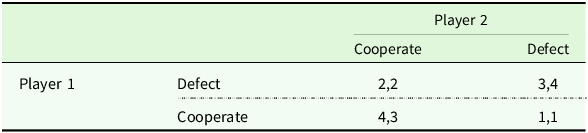
The potential problem relates to how the strategies are named. Kantian optimization requires a conception of which strategies are the “same” for the two players (Gold Reference Gold2021; Istrate Reference Istrate2021). In the divergence example, each player would prefer a strategy in which she coordinates her actions with her partner, but neither player wants to unilaterally choose that outcome. The simple Kantian equilibrium is to both cooperate. However, from a Kantian optimization perspective, one could argue that you should relabel the strategies in these cases such that the off-diagonal payoffs in the original game are considered the same action. In his discussion of the Battle of the Sexes game, Roemer does exactly that; he relabels the strategies to allow him to represent both players taking different actions, as both taking the same strategy (Reference Roemer2019).Footnote 19 With this in mind, could one rename the strategies of the divergence example so that the game can be represented in the way shown in Table 8?
Relabelled Kantian Trap game
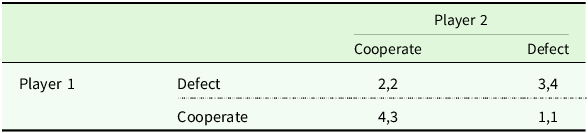
Of course, it is always possible to rename the strategies of a game. Nevertheless, for the argument I am making here, relabelling runs into at least two problems. The first is that in the original Kantian Trap game, unlike the Battle of the Sexes game, there is a pure strategy Kantian equilibrium, it is just not Pareto optimal. Roemer redescribes the battle of the sexes to create a ‘common diagonal’ where both players order the elements on the main diagonal in the same way (Roemer Reference Roemer2019: 23). However, in the Kantian Trap example, there is already a common diagonal and a simple Kantian equilibrium. Secondly, the redescribed divergence game would no longer involve symmetric payoffs for each player, leaving us with a game where agents do not have one of the necessary preconditions for Kantian optimization, i.e. similar situatedness – the strategy that is best for one player if all take it, must also be best for others if all were to take it. Here, player one would prefer that both cooperate, while player two would prefer that both defect. There is no pure Kantian equilibrium. The mixed strategy approach will also not apply as Roemer’s theory relies on the symmetry of the game to give individual agents reason to expect the other player to take the same action. That is why agents assume universalization in the first place: each recognizes that both are in the same boat. Again, this is not the case for team reasoning theories. Once team agency is assumed, symmetry is not necessary for cooperative action. Players are assured of the other’s cooperation by their identification with the team. Universalization, therefore, loses its place in the theory. The point I wish to make here is that incorporating team agency into Kantian optimization makes the reasoning distinctly different. It no longer entails the unique universalization element that makes it ‘Kantian’.
6. Conclusion
This paper has argued that while Kantian optimization and team reasoning share surface-level similarities, and often converge on the same equilibria, they rest on fundamentally different principles. Kantian optimization remains within the framework of individual rationality, relying on the universalization of action based on individual preferences. In contrast, team reasoning shifts the unit of agency to the group, prioritizing team goals and coordinating actions accordingly. The Kantian Trap example illustrates that a Kantian-style team reasoning can yield different strategic recommendations from individual Kantian optimization in the same game, highlighting a misalignment between the two approaches. Attempts to reconcile this divergence by imposing universalization within the team framework render the notion of team agency redundant. This suggests that Kantian optimization is not merely a special case of team reasoning but a distinct approach to solving collective action problems. In other words, it is not a member of the team reasoning family. The discussion of the non-binding problem questions the rationality of Kantian optimization, however, it may be the case that it involves a stronger appeal to morality than first appears. If this is the case, Roemer’s understanding of a moral optimizing protocol needs further specification. While both frameworks provide alternative explanations for cooperation, their underlying mechanisms are not interchangeable.
Acknowledgements
I would like to thank Jelle de Boer for his generous support in reading and commenting on the many iterations of this paper. I am grateful to Lisa Bastian and Lieven Decock for their feedback and guidance, and to Annalisa Costella for her extensive comments on an earlier draft. I am thankful to Christoph Schilling for sharing his formal expertise. I am particularly grateful to the editor and two anonymous reviewers, whose constructive comments significantly improved the paper. Finally, I thank the VU Theoretical Group, the EIPE Slow Philosophy Society, and the participants of the New Avenues for Collective Ethics conference in Gothenburg for their valuable feedback on earlier versions of this work.
Funding Statement
Open access funding provided by Vrije Universiteit Amsterdam.
Bronagh Dunne is a PhD candidate at Vrije Universiteit Amsterdam. Her research focuses on cooperation and rationality, with broader interests in political philosophy and philosophy of action. https://research.vu.nl/en/persons/bronagh-dunne/

 Open access

