


Introduction
Historical accounts (Barreto, Reference Barreto1745; Rodrigues, Reference Rodrigues1917; Martinho, Reference Martinho1968; Pardal, Reference Pardal1996) suggest that elephants Loxodonta africana were once abundant throughout Mozambique. However, trophy hunting, poaching, civil war, tsetse fly control, agricultural development and pastoral expansion induced a sharp decline in elephant numbers (Smithers & Tello, Reference Smithers and Tello1976; Douglas-Hamilton, Reference Douglas-Hamilton1984; DNFFB, 1991). Consequently, elephants now exist in relatively small populations both beyond and within conservation areas administered by the Direcção Nacional das Áreas de Conservação (DNAC).
The decline of elephant numbers in Mozambique apparently started with the demand for ivory (Dias, Reference Dias1971) and continued when elephants and other suspected vectors of tsetse-borne trypanosomiasis were eliminated from several regions as part of a programme to control tsetse flies (Dias & Rosinha, Reference Dias and Rosinha1971; Smithers & Tello, Reference Smithers and Tello1976). Elephants were declared a pest in 1936 (Frade, Reference Frade1950) and later cropped to feed the military (Frade, Reference Frade1950; Dias, Reference Dias1973). The establishment of plantations and agricultural development reduced and fragmented habitats and this may have further reduced elephant numbers (Manghezi, Reference Manghezi2003). Poaching continues, as does legal consumptive use through small-scale trophy hunting of elephants (Milliken, Reference Milliken2002; SRN, 2006).
These observations suggest that human activities reduced elephant numbers in Mozambique. Little information, however, is available on elephant numbers, distribution or demography. Few time series of population estimates exist and most estimates are guesses reported in official government reports and NGO documents. Here, therefore, we compile all available historical data to review the trends in elephant numbers across Mozambique. To establish if trends in numbers could be explained by socio-economic changes we collated historical information on the numbers of elephants and people living in Mozambique, data on the ivory trade and tsetse fly control campaigns, and information on the export of some agricultural products and recent land-use changes.
Study area
Mozambique covers c. 800,000 km2 along the east coast of southern Africa (Fig. 1a). The human population of 20.5 million people is increasing at c. 2.2% per year (INE, 2007). Annual rainfall varies from 1,000 mm in the northern and southern provinces to 1,200 mm in the central provinces (Instituto Nacional de Meteorologia, 2007). The country consists of a series of isolated harbours and settlements, each surrounded by a belt of rural estates that traded with the independent hinterland when it became an overseas province of Portugal in 1890 (Liesegang, Reference Liesegang, Liesegang, Pash and Jones1983). The present borders were drawn in 1891 (Hatton et al., Reference Hatton, Couto and Oglethorpe2001). Ivory and slaves were widely traded in the 16–19th centuries (Liesegang, Reference Liesegang, Liesegang, Pash and Jones1983).
(a) Mozambique, showing the most relevant historical locations mentioned in the text. 1, Mocimboa da Praia; 2, Metangula; 3, Marrupa; 4, Balama; 5, Quissanga; 6, Quirimbas; 7, Mutuali; 8, Ilha de Moçambique; 9, Zumbo; 10, Songo; 11, Inhaminga; 12, Inhamitanga; 13, Shupanga; 14, Luabo; 15, Chimanimani; 16, Quelimane; 17, Gilé National Reserve; 18, Beira; 19, Maputo; 20, Tete; 21, Cazula; 22, Cheringoma; 23, Vila Gouveia. (b) National Parks, Reserves and Community Game Farms that harbour elephants in Mozambique (1, 2, 3, 6, 7, 8, 9, 10, 11, 12, 13 and 14), and others (4 and 5) protecting coastal and marine diversity (modified from DNAC official map). 1, Maputo National Reserve; 2, Limpopo National Park; 3, Banhine National Park; 4, Zinave National Park; 5, Pomene National Reserve; 6, Bazaruto National Park; 7, Chimanimani National Reserve; 8, Gorongosa National Park; 9, Marromeu National Reserve; 10, Tchuma Tchato Community Game Farm; 11, Gilé National Reserve; 12, Mecubúri Forest Reserve; 13, Quirimbas National Park; 14, Niassa National Reserve. (c) Former (1940–1960) elephant range in Mozambique (BEE, 1925–1970; RP, 1952). (d) Reduced and fragmented present elephant range (DNFFB, 1991, 1999; Blanc et al., Reference Blanc, Thouless, Hart, Dublin, Douglas-Hamilton, Craig and Barnes2003). Inset shows location of Mozambique in Africa.
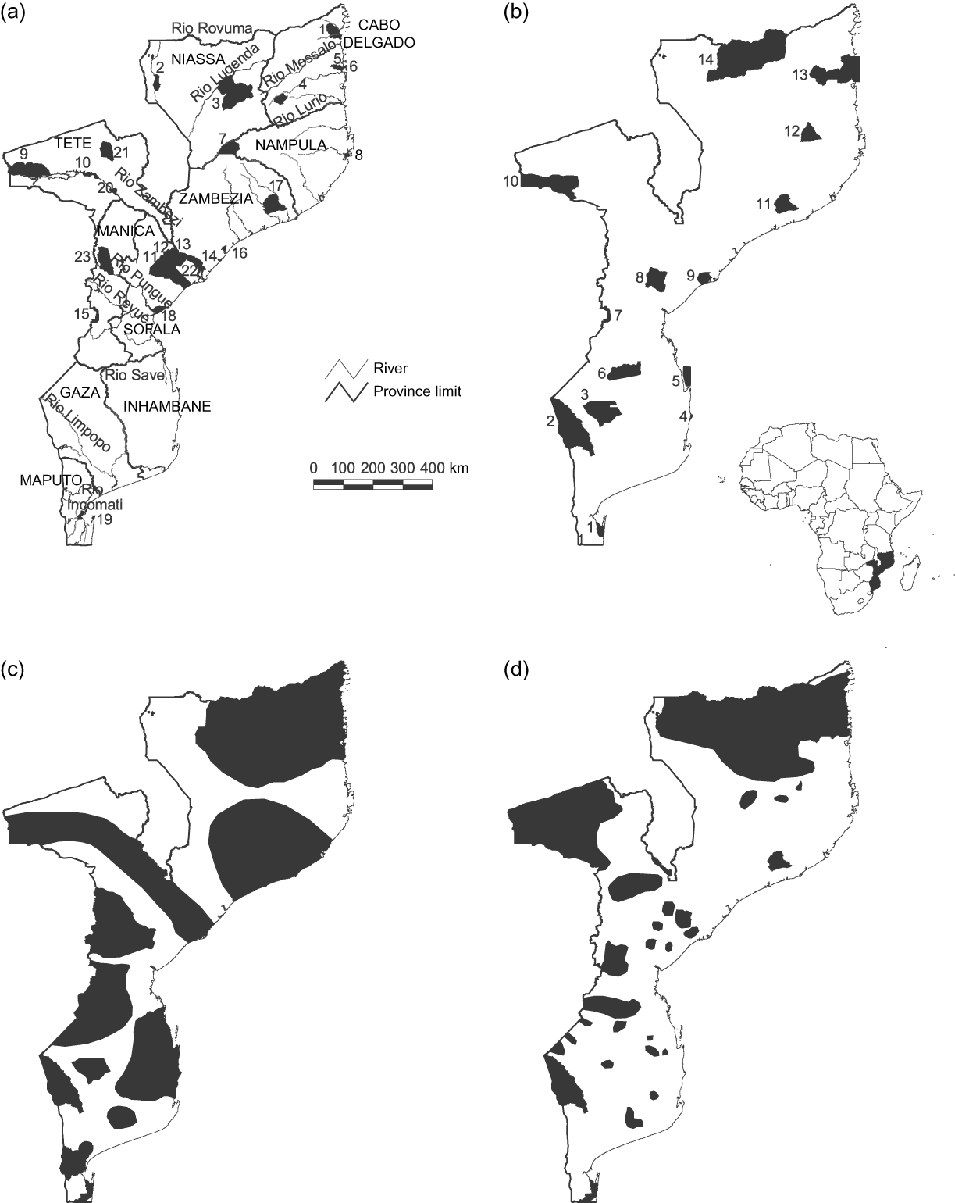
Dry and moist miombo woodlands are common in the northern and central provinces, and mopane woodlands dominate the Limpopo-Save region and the mid Zambezi valley (Hatton et al., Reference Hatton, Couto and Oglethorpe2001). The last two wars (1964–1974 and 1978–1992) devastated large mammal populations in areas of high biological and scenic value (Hatton et al., Reference Hatton, Couto and Oglethorpe2001). Currently c. 16,000 elephants (Blanc et al., Reference Blanc, Barnes, Craig, Dublin, Thouless, Douglas-Hamilton and Hart2007) live in five National Parks, five National Reserves, 13 Controlled Hunting Areas, one Forest Reserve, and in areas beyond protected areas (DNAC, 2006; Fig. 1b). The elephant population of Niassa National Reserve is the largest, with > 10,000 elephants in 2004 (Craig & Gibson, Reference Craig and Gibson2004).
Methods
Our primary sources of information on human densities, land-use change and the quantity of ivory exported since the 1700s include the National Archive of Mozambique's History, the National Ultramarine Archive of Portugal, reports held by the former Direcção Nacional de Florestas e Fauna Bravia (DNFFB), reports by NGOs operating in Mozambique, and the libraries of the Universities of Eduardo Mondlane, Pretoria, South Africa, and Zimbabwe. For information on elephant distribution and relative abundance we relied on descriptions of naturalist travellers, missionaries and professional hunters since the 1500s. Aerial reconnaissance and informed guesses formed the basis of the few elephant population estimates after 1900.
We addressed the historic trends in elephant numbers for the pre-colonial era (before 1500), the colonial era (1500–1975) and the post-colonial era (after 1975). For the pre-colonial era we relied on an interpretation of archaeological information. For the colonial era we found only three elephant censuses and derived likely trends in elephant numbers from records of exported ivory and on the number of elephants killed as part of tsetse fly control programmes. For the post-colonial era we collated data from structured surveys (n = 22) and guesses (n = 32).
We fitted exponential models (Caughley, Reference Caughley1977) to both human (extracted from national censuses) and elephant numbers to identify trends and rates of change since 1900. We used linear regression (Sokal & Rohlf, Reference Sokal and Rohlf1995) to determine if a relationship existed between people and elephant numbers. We examined trends in the ivory trade and agricultural products with available data from the 1700s to 1980, and changes in land-use patterns and sizes of areas allocated to agriculture and forest exploitation over 1925–1975.
Results
The pre-colonial era
Our understanding of elephant distribution during this era is based on deductive speculation. Low human densities and relatively inefficient hunting may have allowed elephants to be relatively common and widely distributed over Mozambique (Klein, Reference Klein, Nitecki and Nitecki1987; Owen-Smith, Reference Owen-Smith, Macphee and Seus1999). Paintings, engravings and excavated artefacts dating back to the Late Stone Age (Deacon, Reference Deacon and Klein1984) from archaeological sites in Mozambique (Silva, Reference Silva, Leakey and Ogot1980; Adamowicz, Reference Adamowicz1987; Sinclair, Reference Sinclair1987; Duarte, Reference Duarte1989) as well as the presence of pits, weighted spears and axes that were used to hunt (Duarte, Reference Duarte1989) and rock sketches of elephants in shelters (Dutton & Dutton, Reference Dutton and Dutton1973; Adamowicz, Reference Adamowicz1987; Sinclair, Reference Sinclair1991) suggest that elephants may have ranged throughout Mozambique (Lewis, Reference Lewis, Nitecki and Nitecki1987; Woodhouse, Reference Woodhouse1996; Eastwood & Blundell, Reference Eastwood and Blundell1999; Whyte et al., Reference Whyte, van Aarde, Stuart, du Toit, Rodgers and Biggs2003).
As elsewhere across southern Africa (Maggs, Reference Maggs and Klein1984) the transition from hunting and gathering to food production in Mozambique occurred during the Holocene (Adamowicz, Reference Adamowicz1987; Stock & Pfeiffer, Reference Stock and Pfeiffer2001). By AD 500 people produced crops and kept domestic animals (Maggs, Reference Maggs and Klein1984) while living in small, scattered villages (Lee & Graham, Reference Lee and Graham2006). The expansion of human populations and activities during the Iron Age (Harpending et al., Reference Harpending, Sherry, Rogers and Stoneking1993; Sherry et al., Reference Sherry, Rogers, Harpending, Soodyall, Jenkins and Stoneking1994) conceivably changed the environment, and increased hunting may have had a modest impact on elephants (Owen-Smith, Reference Owen-Smith, Macphee and Seus1999).
The colonial era
Elephant distribution and abundance in Mozambique changed when merchants arrived and started to supply guns (Gann, Reference Gann1965). Market demand fuelled by the needs of the Islamic empire (Alpers, Reference Alpers1975) brought specialist and extensive elephant hunting expeditions into Mozambique during 1800–1875 (Hedges, Reference Hedges1978), and the ivory trade flourished at this time (Fig. 2) supporting the notion that elephants were then probably numerous and widespread (Sanderson, Reference Sanderson1962; Shepperson, Reference Shepperson1965; Bere, Reference Bere1966; Selous, Reference Selous1984; Adams & McShane, Reference Adams and McShane1992). At this time c. 340,000 people were taken from Mozambique as slaves (Capela & Medeiros, Reference Capela and Medeiros1987), most of them from north of the Zambezi River (Capela & Medeiros, Reference Capela and Medeiros1987) where elephants apparently flourished (Shepperson, Reference Shepperson1965; Maugham, Reference Maugham1914).
(a) The amount of ivory traded in Mozambique declined from the 1700s to the late 1900s (data collated from Jordão, Reference Jordão1870; BEE, 1925–1970; AEC, 1926–1973; Hedges, Reference Hedges1978; Liesegang, Reference Liesegang, Liesegang, Pash and Jones1983; Sheriff, Reference Sheriff1983; Barbier et al., Reference Barbier, Burgess, Swanson and Pearse1992; Spinage, Reference Spinage1994), whilst exports of copra and sugar increased (exports of copra are for Quelimane port; exports of sugar are records of export territories administrated by the State and by the Companhia de Moçambique in Manica and Sofala; data collated from BEE, 1925–1970; AEC, 1926–1973; Liesegang, Reference Liesegang, Liesegang, Pash and Jones1983). (b) Revenue, expressed in contos of reals. Reals (reis) were the colonial currency. The so called weak reals (reis fracos) were introduced in the 18th century. By devaluation weak reals changed to strong reals. A conto corresponds to 1,000,000 reis. Revenue data are the records of the Lourenço Marques port (now Maputo; data collated from BEE, 1925–1970; AEC, 1926–1973; Liesegang, Reference Liesegang, Liesegang, Pash and Jones1983).
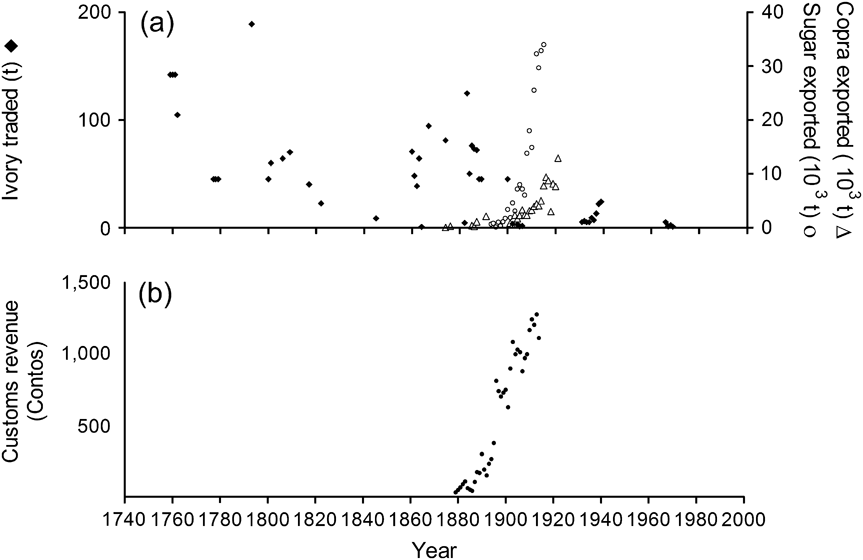
With the decline of the slave trade from 1845 (Capela & Medeiros, Reference Capela and Medeiros1987) human numbers started to increase, and agricultural activities expanded and may have reduced elephant populations. From 1880 to 1920 copra and sugar exports increased (Fig. 2) and contributed greatly to revenue. In addition, from 1800 onwards, transport services to neighbouring territories and migrant labour gradually became more important economic activities (Liesegang, Reference Liesegang, Liesegang, Pash and Jones1983).
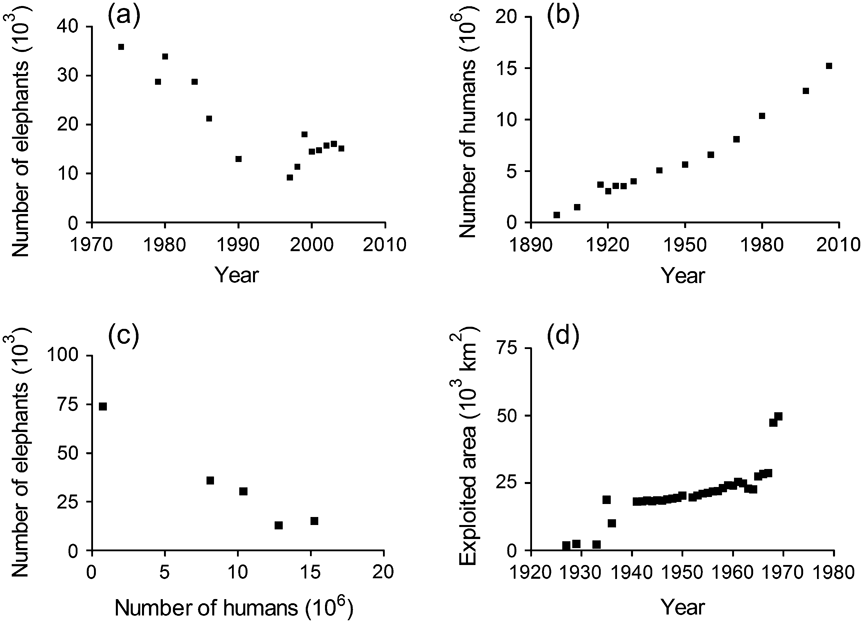
Land-use activities expanded from 1900 (Fig. 3d) and landscape fragmentation and/or loss of habitat may have compressed elephants into refuge areas (Lyell, Reference Lyell1910, Reference Lyell1924; Maugham, Reference Maugham1914; Rodrigues, Reference Rodrigues1917; Dalquest, Reference Dalquest1965) as noted elsewhere in Africa (Lee & Graham, Reference Lee and Graham2006). These refuge areas were mostly in the hinterland but a few were in the country's coastal zones (Chamberlain, Reference Chamberlain1923). In some of these refuge areas, such as Niassa province, the Luabo district extending south of the Zambezi delta to the Shupanga forest and Cheringoma, and from Maputo to the Save River, elephant numbers increased from 1930 (RP, 1952) and their distribution expanded again but remained fragmented (Fig. 1c).
Estimates of the (a) elephant (1974–2004) and (b) human population (1900–2009) in Mozambique (elephant data: DNFFB, 1999; Cumming & Jones, Reference Cumming and Jones2005; Table 1; human data: BEE, 1925–1970; AEC, 1926–1973; INE, 1980, 1999). (c) The elephant population declined as human numbers increased. (d) Exploited areas (agriculture and forestry combined) in Mozambique increased from the 1920s to the 1970s (AEC, 1926–1973).
Official responses to apparent elephant range expansion and threats to crop production included the declaration of elephants as a pest species in 1936 (Frade, Reference Frade1950). Further legalization of elephant killing through the replacement of the Conservation Act of 1955 with the Professional Meat and Ivory Hunting Act in 1960 (Dias, Reference Dias1973; Smithers & Tello, Reference Smithers and Tello1976) formalized actions to reduce elephant numbers in areas beyond the protected areas established in the 1960s (Martinho, Reference Martinho1968). The establishment of these areas conceivably relieved elephants from formal and informal persecution and may have resulted in an increase in elephant numbers from the 1960s to 1970s (Dias, Reference Dias1973).
From the 1960s onwards, elephants from Mozambique also dispersed to neighbouring countries. For example, elephants from Mozambique populated the Kruger National Park (Whyte et al., Reference Whyte, van Aarde, Stuart, du Toit, Rodgers and Biggs2003) and elephants in the Chimanimani, Zumbo and Rovuma-Lugenda regions (Fig. 1a) migrated into Zimbabwe, Zambia and Tanzania (Dutton, Reference Dutton1975; Davies, Reference Davies1999; Hofer et al., Reference Hofer, Hildebrandt, Goritz, East, Mpanduji and Hahn2004). The liberation war of 1964–1974 further reduced elephant numbers when both Frente de Libertação de Moçambique and colonial troops killed elephants to feed soldiers and used ivory to fund their campaigns (Dias & Rosinha, Reference Dias and Rosinha1971).
The post-colonial era
At independence in 1975 many families returned to their villages and started growing crops (Collins, Reference Collins1978; Lorgen, Reference Lorgen1999). This expansion of cultivation reduced elephant ranges further (Smithers & Tello, Reference Smithers and Tello1976; Tello, Reference Tello1977). Game laws became less restrictive (Taylor, Reference Taylor1981) and probably increased the illegal ivory trade (Milliken, Reference Milliken2002). At that time financial support for elephant conservation in Mozambique was limited (WWF/IUCN, 1980).
The civil war of 1980–1992 may have harmed wildlife (DNFFB, 1991) and further reduced elephant numbers (Dutton, Reference Dutton1992; Hatton et al., Reference Hatton, Couto and Oglethorpe2001). Population estimates were 50,000–65,000 in 1974 (DNFFB, 1991), 54,800 in 1981, 17,000 in 1989 (Barbier et al., Reference Barbier, Burgess, Swanson and Pearse1992) and 13,000 by 1990 (Cumming et al., Reference Cumming, Mackie, Magane and Taylor1994). From 1975 to 1983 populations in the central and southern regions declined by 65 and 76%, respectively (Douglas-Hamilton, Reference Douglas-Hamilton1984). Rural people populated areas formerly used by elephants. This resulted in the current situation, with a once continuous elephant population fragmented into small populations that mostly live in relatively small conservation areas across a landscape that is dominated by human activities (Fig. 1d).
Recent trends
Several of the elephant population estimates are guesses (Table 1). Few surveys used standard methods and, when they did, the effort and areas covered varied. All survey areas, except the Maputo National Reserve, were poorly delineated or defined. Most of the populations for which estimates are available are small and isolated (Table 1). The current total estimate is 16,000 elephants (Blanc et al., Reference Blanc, Barnes, Craig, Dublin, Thouless, Douglas-Hamilton and Hart2007). The best available data suggest that the number of elephants in Mozambique declined exponentially at a mean rate of 3.3 ± SE 0.7% (F 1,12 = 22.18, P < 0.01) per annum since 1974. However, estimates post-2000 have not varied significantly (F 1,3 = 2.01, P = 0.25; Fig. 3a).
Estimates (with 95% confidence interval) of elephant numbers in conservation areas in Mozambique by survey area and year, with survey method and data source.

Human population censuses suggest a mean increase of 2.3 ± SE 0.3% (F1,12 = 76.42, P < 0.01) per annum since 1900 (Fig. 3b). Data on the links between trends in human and elephant populations are sparse yet elephant numbers declined as the human population increased (F 1,3 = 66.64, P < 0.01; Fig. 3c). By 1938 farmers had deforested many areas where elephants were once common (BEE, 1925–1970). Such disturbances are continuing (Fig. 3d) and few elephants live in parts of provinces such as Nampula and Zambezia that are densely populated and extensively modified (Wild & Barbosa, Reference Wild, Barbosa, Wild and Frenandez1967; Sinclair, Reference Sinclair1987; Saket, Reference Saket1994; DNFFB, 1999). In less densely populated provinces, such as Niassa, Cabo Delgado and Tete, elephants and other wildlife persist widely, especially close to protected areas such as the Niassa National Reserve, the Quirimbas National Park and the Zumbo region. At present, several small populations of elephants occur throughout the southern provinces, such as those in Maputo (Maputo National Reserve, the Futi River and Magude region), Gaza (Limpopo National Park) and Inhambane (along the Save River; Hatton et al., Reference Hatton, Couto and Oglethorpe2001).
Discussion
The decline in elephant numbers in Mozambique is primarily due to the impact of direct (ivory trade and tsetse control programmes) or indirect human activity (habitat fragmentation and associated factors). People have sought ivory since the early Iron Age (AD 815) and European markets have influenced the ivory trade since the 1400s (Spinage, Reference Spinage1994). Portuguese, Arab and native traders exported 69 tons from Beira (south of Sofala) in 1512–1515 (Spinage, Reference Spinage1994) to India. Dutton (Reference Dutton1975) estimated that the ivory taken per year represented c. 1,000 elephants from the region between the Manica and Maputo provinces during the 1500s. By the mid 18th century extensive hunting had expanded onto the interior, with 150–180 tons of ivory taken per year (Sheriff, Reference Sheriff1983; Spinage, Reference Spinage1994). These anecdotal descriptions suggest that elephant numbers were high in the 17–19th centuries.
Due to price disagreements the ivory trade apparently collapsed in 1780–1790 (Spinage, Reference Spinage1994) and ivory exports oscillated but declined after 1800 (Liesegang, Reference Liesegang, Liesegang, Pash and Jones1983; Barbier et al., Reference Barbier, Burgess, Swanson and Pearse1992; Spinage, Reference Spinage1994). Much of this variability in exports may have been associated with changes in Mozambique's economy. The ivory and slavery trades that dominated in 1770–1870 (da Silva, Reference da Silva1969) were replaced by other export products (primarily sugar and copra) and ivory accounted for only 32% of exports by 1874 (Liesegang, Reference Liesegang, Liesegang, Pash and Jones1983).
At least half of Mozambique (c. 400,000 km2) was infected by tsetse flies (Glossina spp.) in the 1940s. As part of efforts to eradicate tsetse flies > 3,000 elephants were killed in 1947–1969 at Mutuáli (Nampula), Govuro (Imhambane), Changara (Tete), Massangena (Gaza) and Muda (Sofala; Blair, Reference Blair1939; Dias & Rosinha, Reference Dias and Rosinha1971). This followed an earlier campaign in the Rio Maputo valley and Likwati forest (Manghezi, Reference Manghezi2003) that eliminated most of the elephants west of the Rio Maputo. These campaigns continued until the early 1970s (Dias & Rosinha, Reference Dias and Rosinha1971).
Areas cleared of tsetse flies were soon occupied by people and land clearing for agriculture may have prevented coexistence with elephants. Areas earlier cleared of tsetse flies, from Rovuma River south towards Zumbo, Cazula (Macanga District), Marrupa, Balama and Mocimboa da Praia, have now been recolonized by elephants (MINAG, 2006).
More than 80% of people in Mozambique live in rural areas and depend on natural resources (Del Gatto, Reference Del Gatto2003). Charcoal production and the collection of wood for fuel are degrading woodlands (Del Gatto, Reference Del Gatto2003). Although 78% of the country was covered by natural forests in 1980–1990 (MICOA, 1997) the national deforestation rate in 1972–1990 was c. 4.2% (MICOA, 1997). In 1990–2000 closed woodlands decreased by c. 13% (Pereira, Reference Pereira2001). Consequently, habitat available for elephants may be declining and conservation areas are becoming habitat islands in human-dominated landscapes.
Elephants that live in these landscapes may not often come into conflict with people but, at the fine scale, habitat fragmentation may disrupt foraging and breeding and thus lower the population growth rate (Barbault & Sastrapradja, Reference Barbault, Sastrapradja, Heywood and Watson1995). This may in part explain the historical decline in elephant numbers from 1900 onwards and the links between trends in human and elephant populations, as well as the relationship between exploited areas and the number of elephants.
Elephant conservation in Mozambique faces a range of challenges associated with the relatively fast human population growth rate. These challenges include the genetic constraints that may arise in small and isolated populations, and that continuing elephant dispersal into formerly occupied areas may result in human-elephant conflict. Our review suggests that the once continuous elephant population of Mozambique is increasingly being fragmented into relatively small areas. However, many of these areas adjoin larger areas and larger elephant populations in neighbouring countries (South Africa, Zambia, Zimbabwe and Tanzania).
The population in the Niassa National Reserve in northern Mozambique is relatively large and seems to be part of a widely distributed regional population. The recently founded population in the Limpopo National Park that adjoins the population of the Kruger National Park in South Africa illustrates that populations in Mozambique may be founded and maintained through dispersal movements from neighbouring populations. Similarly, the elephant population in the Maputo National Reserve could be reconnected through the Futi Corridor to those living in the Tembe Elephant Park, which is presently fenced (Morley & van Aarde, Reference Morley and van Aarde2007). The integrity of elephant populations in Mozambique may be best preserved when they are provided the opportunity to be part of larger regional populations. Future conservation of elephants in Mozambique may thus depend on management as several regional populations (van Aarde & Jackson, Reference van Aarde and Jackson2007) in a system of transfrontier conservation areas (Hanks, Reference Hanks2001).
More than 60% of Mozambicans are poor and government poverty alleviation strategies (RM, 2006) may conflict with elephant conservation ideologies that call for the development of dispersal linkages across human-dominated landscapes. There is a need for solutions that integrate the needs of both people and elephants (Lee & Graham, Reference Lee and Graham2006). This may well be possible in the large stretches of land where few people live. Increasing urbanization (Maximiano et al., Reference Maximiano, Arndt and Simler2005) and recent changes in human demography and distribution, driven by HIV and associated diseases, and migrations for coastal tourism developments, may provide further options to expand elephant range without confronting people.
Conceptual developments that change the focus of conservation from protected areas to a conservation matrix that comprises a range of land-use options across national and international boundaries (van Aarde & Jackson, Reference van Aarde and Jackson2007) could accommodate the needs of both people and elephants. Although land-use options across international boundaries have been considered in the transfrontier conservation initiatives framework (Hanks, Reference Hanks2001), at a national scale a conservation matrix that accommodates the needs of both people and elephants still requires a systematic assessment and evaluation as well as strategic planning and policy changes.
The National Strategy for Elephant Management in Mozambique (DNFFB, 1999) mostly focuses on the apparent increase of elephant numbers and how it may affect other species and humans. Our assessment indicates that this approach, which assumes that elephants require an economic value for local communities to achieve effective elephant conservation (Bell, Reference Bell, Anderson and Grove1987; Keats, Reference Keats1991; Hanks, Reference Hanks2001) and highlights human-elephant conflict dilemmas (Hoare, Reference Hoare2001), is not the most appropriate.
Our recent novel solution to elephant management (van Aarde et al., Reference van Aarde, Jackson and Ferreira2006; van Aarde & Jackson, Reference van Aarde and Jackson2007) caters for the situation in Mozambique. The mosaic of intact and disturbed landscapes, occupied at varying densities by people and elephants, provides an opportunity to use a metapopulation metaphor on which to base elephant management strategies. Prime elephant habitat can serve as sources to sustain sinks. Sinks may be areas where people live but that are also used by elephants. However, elephant management that relies on dynamic spatial interactions, such as dispersal between source and sink populations across human dominated landscapes, needs information on how elephants and people utilize landscapes and on changes in elephant and human numbers. Such management should focus on inducing local elephant population fluctuations while maintaining regional stability in their numbers and minimizing human-elephant conflict. This may mitigate conflict without placing the elephant population at risk and provide further opportunity for the integration of elephant conservation into a regional economic framework.
Conservation and development authorities in Mozambique may have to maintain landscapes occupied by many elephants and few people as prime conservation areas, e.g. the Niassa-Cabo Delgado region, upper Tete region (Magoe and Zumbo) and Greater Limpopo region. They should also recognize that isolated areas with few elephants, such as Gorongosa-Marromeu Complex, Gilé and Mecuburi, can only persist as conservation areas if linked to larger areas where other elephant populations thrive. This may best be achieved by reinstating spatial and temporal processes in a matrix of landscape uses and by establishing formal transfrontier conservation area agreements in areas with many elephants and much space.
Such ongoing transfrontier conservation area projects include those between Mozambique and Tanzania (the Niassa-Selous initiative and the Rovuma Transfrontier Conservation Area), as well as between Mozambique, South Africa and Zimbabwe (the Great Limpopo Transfrontier Conservation Area) and Mozambique, South Africa and Swaziland (the Lubombo Transfrontier Conservation Area). This approach could also best be explored at a national scale in northern Mozambique to involve the Niassa region, the Quirimbas National Park and the planned Rovuma National Reserve.
Sporadic elephant movements are reported between Mecuburi Forest Reserve and Gilé National Reserve, as well as between Zinave National Park and Banhine National Park. In the south of Mozambique elephant conservation may involve the recolonization of areas across the Magude and Moamba districts. In these cases and at the district level, present community based-conservation initiatives would be best explored because they incorporate the interests of people.
The number of elephants in Mozambique has declined since 1970. People's direct and indirect activities fragmented a once continuous elephant population into a few large and several small populations. The remnant populations could recover through the application of our proposed landscape approach, which allows elephants to disperse and populate landscapes that link subpopulations into a functional metapopulation.
Acknowledgements
The manuscript benefited from the suggestions made by Gerhard Liesegang, Alessandro Fusari, Robert Guldemond and two anonymous reviewers. Our present research in Mozambique is financed by WWF, the MOZAL Community Development Trust, the Peace Parks Foundation and the International Fund for Animal Welfare. This work is part of the PhD of Cornelio Ntumi, funded by WWF and a special grant from Billiton. We are grateful for data searching at the National Ultramarine Archives in Lisbon by Jen Shaffer from the University of Georgia, USA, and the information provided by the staff of Mozambique's History Archive, and maps generated by Ana Massinga.
Biographical sketches
Cornelio P. Ntumi is studying landscape approaches to elephant conservation in Mozambique. He has an interest in conservation ecology, with a particular emphasis on spatial and habitat use by species and the factors influencing this. Sam M. Ferreira's research focuses on conservation biology and, in particular, temporal dynamics and the factors influencing these. Rudi J. van Aarde’s research focuses on the restoration of populations and communities as a contribution to conservation. His research on elephants covers populations in Botswana, Malawi, Mozambique, Namibia, South Africa and Zambia.



