



Cancer is a life-threatening disease and a leading cause of mortality in the world. It is characterised by uncontrolled cellular proliferation with several acquired (epi)genetic abnormalities involving dysregulated cellular signalling pathways. Cancer treatment involves mainly use of cytostatic/cytotoxic chemotherapeutic drugs such as DNA alkylating agents, mitotic inhibitors and tyrosine kinase inhibitors (for example, Gleevec), which have been introduced in the clinic more recently. However, development of chemotherapy resistance significantly reduces the success rate of patient survival( Reference Janne, Gray and Settleman 1 , Reference Kolch, Halasz and Granovskaya 2 ). As such, natural compounds gained renewed attention in recent years because of their cost-effective ‘polypharmacological’ chemosensitising abilities against drug cancers( Reference Reddy and Zhang 3 ). Natural products have a rich and long history for their folkloristic use as traditional medicines. Only by recent reverse pharmacology and chemoproteomic approaches, various molecular targets of active constituents have recently been identified( Reference Harvey, Edrada-Ebel and Quinn 4 – Reference Lanning, Whitby and Dix 8 ). In addition, natural products and their molecular frameworks represent valuable starting points for medicinal chemistry to pursue modern drug development( Reference Rodrigues, Reker and Schneider 9 ).
Dietary supplements of medicinal plant extracts of Withania somnifera (Indian name Ashwagandha) have been widely used in India for more than 3000 years in traditional herbal Ayurvedic medicine to treat inflammation-related disorders. More recently, withaferin A (WA) has been identified as a major biologically active constituent with many pharmacologically useful properties against many cancer types in vitro/in vivo, including breast, colon, prostate and ovarian cancers( Reference Devi 10 – Reference Vanden Berghe, Sabbe and Kaileh 16 ). A selection of in vivo cancer studies with WA is summarised in Table 1.
In vivo evidence for anti-cancer effects of withaferin A

ALDH1, alcochol dehydrogenase1; Bax, Bcl-2 (C-cell lymphoma 2)-associated X protein; CDK, cyclin dependent kinase; CARP-1, cell cycle and apoptosis regulator protein; HSP 27, heat shock protein 27; SOD, superoxide dismutase, PCNA, proliferating cell nuclear antigen; RET, rearranged during transfection.
Cancer therapeutic cell death effects by withaferin A
Programmed cell death, also known as apoptosis, plays a critical role in tissue homeostasis. In contrast, escaping from apoptosis is one of the major causes of cancer malignancy. Two well-characterised pathways in mammalian cells trigger apoptosis. The intrinsic pathway of apoptosis is triggered via proteins released from mitochondria (e.g. B-cell lymphoma 2 protein which promotes formation of an apoptosome and procaspase 9 activation, resulting in downstream activation of execution caspases and cell death( Reference Green 17 , Reference Anichini, Mortarini and Sensi 18 ). The extrinsic pathway of apoptosis is triggered by the activation and ligation of external ligands to death domain containing receptors such as TNF receptor, CD95 (also known as ‘Fas, apoptosis antigen 1 or TNF receptor superfamily member 6’) or TNFα-related apoptosis-inducing ligand. This triggers the formation of a death inducing signalling complex via the Fas-associated death domain and procaspase-8. Procaspase-8 acts as a convergent factor that connects external death signal via caspase-3 resulting in downstream execution of apoptosis.
WA has been reported to induce apoptosis via intrinsic and extrinsic pathways in human prostate, breast( Reference Stan, Hahm and Warin 19 ), leukaemic( Reference Mandal, Dutta and Mallick 20 ), head and neck, melanoma( Reference Mayola, Gallerne and Esposti 21 ) cancer cells via reduction of the mitochondrial membrane potential (Δψm) and activation of various caspases and proteases, which trigger degradation of various substrates such as cytoskeletal proteins and poly(ADP-ribose) polymerase cleavage. Furthermore, it has been documented that WA sensitises cells for extrinsic apoptosis pathway by decreasing negative regulators of apoptosis such as cellular FLICE-like inhibitory protein (c-FLIPL and c-FLIPs). The decreased levels of cellular FLICE-like inhibitory protein concomitantly increased levels of TNFα-related apoptosis-inducing ligand-induced apoptosis( Reference Ichikawa, Takada and Shishodia 22 – Reference Fukazawa, Fujiwara and Uno 25 ). Alternatively, in many cancer cells, induction of mitochondria-mediated intrinsic apoptosis upon WA treatment is associated with WA-mediated reactive oxygen species generation, which elicits cell-type specific changes in Bax and/or Bak protein expression.
In breast cancer cells, WA down-regulates β-tubulin via covalent binding of WA with cytoskeletal tubulin( Reference Antony, Lee and Hahm 26 ). Moreover, WA decreased gene expression of cell adhesion molecules such as laminins and integrins, thus triggers activation of Bax and Bak proteins( Reference Hahm, Moura and Kelley 27 ). The inhibition of the cancer metastasis by WA is associated with the down-regulation of extracellular matrix degrading enzymes such as ADAM8 and urinary plasminogen activator( Reference Szarc vel Szic, Op de Beeck and Ratman 28 ).
Cancer therapeutic cell cycle arrest effects by withaferin A
Dysregulation of cell cycle progression and uncontrolled proliferation are hallmarks of cancer cell growth and development. Eukaryotic cell division is driven by a high fidelity control mechanism, regulated by various cell cycle checkpoints and cyclin-dependent kinases (CDK). These checkpoints ensure intact chromosomes spindle formation before promoting cell cycle progression. Coordinated interaction of the cell cycle is a fine balance between CDK and CDK inhibitors. Checkpoint control mechanisms in response to DNA damage prevent entry into S or M phase until the damage is rescued. Most available cancer drugs today are currently targeting cell cycle progression and apoptotic pathways( Reference Hanahan and Weinberg 29 ).
In early biochemical studies, WA binding to tubulin was demonstrated to inhibit metaphase spindle microtubules( Reference Shohat, Ben-Bassat and Shaltiel 30 ). Later, studies have shown that WA effects on microtubular assembly depend on the degradation of the Mad2–Cdc20 complex in colorectal cancer cells. Furthermore, cancer cells often carry various mutations that imbalance cell cycle by gaining proliferative autonomy and development of immunity towards apoptosis( Reference Hofmann, Fitt and Fleck 31 ). Among them, p53 and pRB play a major role in cell cycle regulation at various checkpoints( Reference Hanahan and Weinberg 29 ). WA stabilises the levels of the tumour suppressor protein p53 in osteosarcoma and breast cancer cells, which could be responsible for the observed G2–M cell cycle arrest( Reference Stan, Zeng and Singh 32 , Reference Roy, Suman and Das 33 ). In human osteosarcoma cells, WA induced arrest in G2/M phase cell cycle triggers apoptotic cell death following inhibition of cyclin(A/B)-associated CDK2 kinase functions( Reference Lv and Wang 34 ). Besides posttranscriptional p53 effects, WA also regulates the transcriptional expression of the transcription factors p53 and cell cycle regulatory proteins such as cyclin B1, cyclin A, CDK2 involved in G2–M checkpoint control mechanisms. The ability of WA to induce cancer cell cytotoxicity or cell cycle arrest not only depends on regulation of p53 protein, but also other transcription factors such as NF-erythroid 2-related factor 2( Reference Yu, Hamza and Zhang 35 ) NF-κB( Reference Kaileh, Vanden Berghe and Heyerick 36 ) and signal transducer and activator of transcription 3( Reference Um, Min and Kim 37 ) forkhead box O3 ( Reference Grogan, Sleder and Samadi 38 ) and heat shock factor 1, which all contribute in the polypharmaceutical cancer therapeutic effects of WA in vitro and in vivo.
Molecular insights in kinase-dependent cancer cell survival strategies targeted by withaferin A
Next, we will focus in more detail on WA-dependent targeting of kinase signalling pathways, which drive key phenotypic changes in multiple cancer hallmarks ranging from tumour-inflammation, angiogenesis, apoptosis, proliferation metastasis, genome instability and drug resistance( Reference Hanahan and Weinberg 39 , Reference Gross, Rahal and Stransky 40 ). Protein kinases are a large family of approximately 530 highly conserved enzymes that transfer a γ-phosphate group from ATP to a variety of amino acid residues, such as tyrosine, serine, and threonine, that serves as a ubiquitous mechanism for cellular signal transduction( Reference Manning, Whyte and Martinez 41 ). The clinical success of a number of kinase-directed drugs and the frequent observation of disease causing mutations in protein kinases suggest that a large number of kinases may represent therapeutically relevant targets such as mitogen-activated protein kinase (MAPK), CDK, sarcoma and epidermal growth factor receptor (EGFR)( Reference Normanno, De Luca and Bianco 42 – Reference Malumbres and Barbacid 45 ). These kinases have significant impact in the tumour progression and development of drug resistance via enzymatic hyperphosphorylation of downstream signalling effectors. Survival of most cancers relies on hyperativated growth factor signalling, for example via EGFR overexpression, constitutively activated mutated receptors or autocrine signalling. EGFR are known to activate MAPK and the Shc–GRB2–RAS–RAF axis( Reference Weihua, Tsan and Huang 46 ). Constitutive activation of upstream kinases of MAPK and MAPK-dependent transcription factors has been observed in many highly proliferative cancer types in patients with refractory stage or therapy resistance( Reference Dhillon, Hagan and Rath 43 , Reference Roberts and Der 47 ). Interestingly, WA inhibits cancer growth and survival of many cancer cells by inhibiting cell surface receptor signalling via HER2/ERBB2, EGFR and c-Met and downstream MAPK activity. Paradoxically, WA has also been shown to increase phosphorylation of extracellular signal-regulated kinase (ERK), c-Jun N-terminal kinase and p38 MAPK in both MCF-7 and SUM159 human breast cancer cells( Reference Hahm, Lee and Singh 48 ). Along the same line, WA-induced cell death can be enhanced by pharmacological inhibitors of ERK and p38 MAPK.
Blocking the NF-κB pathway via direct or indirect IκB kinase (IKK) inhibition has been a common strategy of more than 150 anti-cancer agents, both natural and synthetic compounds, including WA. It is now well established that chronic NF-κB activation is a strong promoter of most cancer hallmarks, including cancer cell survival, cell proliferation, angiogenesis, cell motility and metastasis. As a result, targeting NF-κB signalling pathway is an attractive strategy for the development of potent anti-cancer drugs. Activation of NF-κB transcriptional activity is mediated by posttranslational modifications (ubiquitination, phosphorylation and degradation) of its inhibitory subunit nuclear factor of kappa light polypeptide gene enhancer in B-cells inhibitor, alpha( Reference Yu, Hamza and Zhang 35 ) Phosphorylation of nuclear factor of kappa light polypeptide gene enhancer in B-cells inhibitor, alpha is carried out by IKK, a serine/threonine protein kinase composed of two catalytic subunits IKK1,2 and a regulatory unit NEMO (NF-κB essential modulator)( Reference Niederberger and Geisslinger 49 ). Consequently, inhibition of IKK kinase activity suppresses NF-κB activation and prevents transcription of various tumour promoting target genes involved in cell survival (C-cell lymphoma 2), angiogenesis (vascular endothelial growth factor), metastasis (IL6), cell proliferation (cyclin D).
Another kinase involved in tumourigenesis is the protein kinase B (AKT). Phosphorylation of AKT at T308 and S473 is known to play a very important role in activity of AKT and it is regulated by upstream kinases such as PI3 kinase (PI3K) and auto-phosphorylation of AKT by itself( Reference Yung, Charnock-Jones and Burton 50 ). In addition to the upstream kinases that modulate AKT expression, AKT also modulates downstream NF-κB activity. As such, any perturbations in AKT levels will also influence NF-κB activity. WA treatment in U87 glioblastoma cells lines has shown to inhibit levels of phosphorylated AKT, which in turn affects other target proteins in the PI3K–AKT signalling axis( Reference Lee, Lim and Sung 51 ). In addition to its tumour-promoting role, AKT also regulates cancer cell metastasis by regulating the cancer cell invasion by cell motility proteins and production of matrix metalloproteinases such as Ca2+ and Zn2+-dependent metalloproteinases, involved in the degradation of type IV collagen, which is a principal component of cell basement membrane.
As an additional downstream target of the PI3K, ribosomal S6 kinase (RSK) plays an important role in the regulation of many cellular process such as cell proliferation, growth factor-mediated transformation( Reference Nagalingam, Kuppusamy and Singh 52 ). Surprisingly, WA is found to increase activation of Elk1 and CHOP (CCAAT-enhancer-binding protein homologous protein) by RSK, as well as up-regulation of DR5 by selectively suppressing pathway ERK. As a result, CHOP and Elk1 bind to the DR5 promoter and induce apoptosis. Earlier reports demonstrate that WA inhibits protein kinase C suggesting that WA treatment can block two out of three upstream mediators of P70S6kinase. Remarkably, WA is reported to activate phosphorylation of ERK/RSK axis concomitantly with kinase inhibition and induction of apoptosis both in vitro and in vivo in breast cancer animal models, suggesting dual ERK/RSK regulation by WA( Reference Nagalingam, Kuppusamy and Singh 52 ).
In lymphoma cell lines LY10 and LY-3 cells, WA treatment was found to decrease Lyn levels( Reference McKenna, Gachuki and Alhakeem 53 ). Sarcoma family kinases Lyn, Btk, Syk and PI3K are involved in B-cell receptor signalling, and are further also coupled to NF-κB, AKT, mammalian target of rapamycin and ERK pathways. The B-cell receptor pathway plays an essential role in the development, maturation and survival of B-cells and becomes deregulated in various B-cell lymphoma. Lyn usually mediated phosphorylation of ITAM (immunoreceptor tyrosine-based activation motif), which further controls down-stream signals. Moreover, proteins with the ITAM are sufficient to cause transformation. For example activation of sarcoma kinase Lyn in K1 transgenic mice can contribute to the development of lymphoma. In renal carcinoma Caki cells, WA induces apoptosis by reducing Janus-activated kinase 2 activity which down-regulates signal transducer and activator of transcription 3 activation and expression of signal transducer and activator of transcription 3-regulated genes such as X-linked inhibitor of Bcl, B-cell lymphoma 2 protein, cyclin D1 and survivin.
Multiple drug resistance is one of the major impediments of current cancer therapy and most pathway targeted chemotherapeutic agents will induce drug resistance due to the inherent heterogeneity of cancer cells, which results in clonal section of cancer cells, which are able to bypass targeted therapies( Reference Dancey and Sausville 54 ). In addition to the efflux multidrug transporters, many signalling pathways are known to be involved in the development of drug resistance, such as Wnt/β-catenin( Reference Kim and Singh 55 , Reference Lobo, Shimono and Qian 56 ). The canonical Wnt/β-catenin pathway with important roles in cell motility, proliferation and death is hyperactivated in many cancers( Reference Miller, Hocking and Brown 57 ). Activation of the Wnt signalling is often seen with increasing expression of β-catenin or mutations in the adenomatous polyposis coli protein. Following accumulation of cytoplasmic levels of β-catenin and nuclear translocation, β-catenin binds to promoter elements of the transcriptional repressor-T cell factors (T cell factors /β-catenin–responsive elements, which up-regulates human MDR1 protein( Reference Yamada, Takaoka and Naishiro 58 ). In addition, β-catenin also acts as cofactor for activation of forkhead box O transcription factors, which are regulated by PI3K/AKT( Reference Essers, de Vries-Smits and Barker 59 ). Later studies also show crosstalk of AKT/mammalian target of rapamycin and glycogen synthase kinase β with the Wnt/β-catenin signalling pathway. Thus, increased AKT levels trigger glycogen synthase kinase β activity, which in turn phosphorylates cytoplasmic β-catenin leading to its enhanced stability and translocation to nucleus( Reference Baryawno, Sveinbjornsson and Eksborg 60 ). WA inhibits Wnt/β-catenin pathway via suppression of AKT signalling, which inhibits cancer cell motility and sensitises for cell death( Reference Grogan, Sleder and Samadi 38 ). A selection of molecular targets of WA in various cancer cell types is summarised in Table 2.
Inhibition of cell survival signalling by withaferin A (WA)
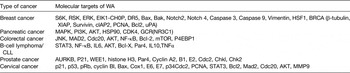
AKT, protein kinase B; AP-1, activator protein 1; AURKB, Aurora kinase B; BAK, Bcl-2 homologous antagonist/killer; BAX, Bcl-2-associated X protein; Bcl-2, B-cell lymphoma 2 protein; Bcl-xL, X-linked inhibitor of Bcl; cIAP-1, cellular inhibitor of apoptosis protein-1; COX-1, cyclooxygenase 1; DR-5, a TNF-related apoptosis-inducing ligand (TRAIL) receptor; GCR(NR3C1), Glucorcorticoid receptor; HSP90, heat shock protein 90; IGF-1R, insulin-like growth factor (IGF)-1-receptor; IGFBP-3, IGF-binding protein 3; IκBα, nuclear factor of kappa light polypeptide gene enhancer in B-cells inhibitor, alpha; JNK, c-Jun N-terminal kinase; mTOR, mammalian target of rapamycin; MAPK, mitogen-activated protein kinase; miR, microRNA; MMP, matrix metalloproteinase; Mcl-1, myeloid cell leukaemia 1; NFKBIA, nuclear factor NF-κB inhibitor alpha; PARP, poly(ADP-ribose) polymerase proteins; Par-4, prostate apoptosis response-4 (Par-4); PCNA, proliferating cell nuclear antigen; P-ERK1/2, phosphor-extracellular signal-regulated kinase 1/2; STAT3, signal transducer and activator of transcription 3; TIMP-1, tissue inhibitor of metalloproteinase-1; uPA, urinary plasminogen activator; XIAP, WEE1, dual specificity protein kinase; XIAPX-linked inhibitor of apoptosis protein.
Characterisation of direct and indirect mechanisms of kinase inhibition by withaferin A
Despite the growing list of cancer signalling pathways targeted by WA, only few studies have demonstrated direct kinase inhibition by WA in in vitro kinase experiments( Reference Niederberger and Geisslinger 49 , Reference Yamamoto and Gaynor 61 ). Recently, the present author group has demonstrated a mechanism for WA-dependent inhibition of IKK2 activity via covalent binding to C179 of IKK2, MEK1/ERK-dependent S181 hyperphosphorylation and degradation of IKK2 (Fig. 1), which results in suppression of NF-κB target genes such as C-cell lymphoma 2, cyclin D1 and inflammatory mediators such as IL10 and transforming growth factor-β,( Reference Vanden Berghe, Sabbe and Kaileh 16 , Reference Baud and Karin 62 ). In general, IKK inhibitors broadly classified into three different classes based on their ATP competitive nature: first class of inhibitors acts as ATP analogues that compete with the substrate ATP in the kinase catalytic site; second class acts as allosteric modulators that cannot compete with ATP-binding but can alter their activity, and a third class acts as irreversible inhibitors known to interact covalently with the C179, present in the activation loop of IKK2 catalytic site, to target IKK2 enzyme activity( Reference Heyninck, Lahtela-Kakkonen and Van der Veken 63 , Reference Zhao, Wu and Wang 64 ). Chemically, WA or (4β,5β,6β,22-R-4,27-dihydroxy-5,6 : 22,26-diepoxyergosta-2,24-diene-1,26-dione) belongs to the withanolide family of steroidal lactones with an ergostane backbone( 65 ). Interestingly, an αβ-unsaturated ketone (enone) at C2–C3 position of WA allows formation of covalent bonds to IKK2 C179 via a Micheal addition reaction. Consistent with this idea, earlier NMR spectroscopic data have demonstrated nucleophilic reaction of cysteamine and WA via an irreversible covalent bond where as other withanolides failed to show any covalent bond( Reference Antony, Lee and Hahm 26 ). One of the remarkable features of the C179 in IKK is its unique position occupying in between a triad of S177 and S181. Hence, compounds that target C179 also influence the phosphorylation of S177 and S181 and their downstream regulatory mechanism( Reference Perkins 66 , Reference Scheidereit 67 ). In addition to WA some other natural compounds such as berberine, parthenolide and certain epoxyquinoids have shown similar mechanism of IKK2 kinase inhibition. Since WA does not show competitive binding to the ATP pocket, it lacks high targeting specificity. This seems a promising strategy for WA-mediated anti-cancer actions because it was found that the catalytic pocket of IKK2 is highly conserved among a broader class of kinases with a similar pattern of cysteine occupation in their binding pockets and as such, explaining the high diversity of WA (kinase) targets( Reference Leproult, Barluenga and Moras 68 , Reference Knighton, Zheng and Ten Eyck 69 ). Interestingly, in order to gain a complete picture of the accessible cysteines in the kinome and generate a kinase cysteinome to facilitate the systematic exploration for irreversible inhibitors, Leproult et al. identified twenty-seven variable positions of cysteines relative to active kinase confirmations, suggesting that more cysteines are accessible than previously known in the proximity of the ATP-binding pocket( Reference Leproult, Barluenga and Moras 68 ). The detailed understanding of this kinase cysteinome( Reference Liu, Sabnis and Zhao 70 ) has recently led to the development of covalent inhibitor drugs towards protein kinases such as RSK2, BTK, NEK2( Reference Henise and Taunton 71 ), FGFR( Reference Zhao, Wu and Wang 64 , Reference Zhou, Hur and McDermott 72 ). In addition to IKK2, WA is also reported to target C789 of PKC( Reference Grover, Katiyar and Jeyakanthan 73 ), which is part of a common branch of the AGC kinases consisting of AKT, PKA, PKC, p70S6K and S6K( Reference Arencibia, Pastor-Flores and Bauer 74 ). Furthermore, in silico modelling also supports covalent binding of WA to kinases with a C/DXG motif, in analogy to binding of hypothemycin( Reference Ward, Colclough and Challinor 75 , Reference Nishino, Choy and Gushwa 76 ) a natural product with the polyketide group, which covalently binds to C preceding the conserved DXG motif (usually X is either Leu or Phe) of ERK (Fig. 2) (Table 3).
Proposed mechanism of action for covalent targeting of kinase via covalent cysteine modification with the carbonyl group (enone) at C2–C3 of withaferin A (WA).

(a) To facilitate the systematic design of irreversible inhibitors, molecular modelling has identified various accessible cysteines in proximity of the ATP-binding pocket of active kinase conformations (Gly region, hinge region, DXG region, etc.)( Reference Leproult, Barluenga and Moras 68 , Reference Liu, Sabnis and Zhao 70 ). (b) In silico comparison of covalent C164 docking of 8 chirality structures of withaferin A (WA) v. the reference covalent kinase inhibitor hypothemycin to the crystal structure of the kinase ERK (PDB: 3c9w), reveals favourable covalent binding energies for WA and a highly significant bond length of 1.85 AU.

In silico calculated binding energies and bond lengths of covalent C164 docking of eight chirality structures of withaferin A (WA) v. the reference covalent kinase inhibitor hypothemycin to the crystal structure of extracellular signal-regulated kinase (PDB: 3c9w). Following stringency parameters were applied in Autodock( Reference Trott and Olson 91 , Reference Ouyang, Zhou and Su 92 ): (i) only negative binding energy (high binding affinity) are permitted for WA binding to cysteines; (ii) a maximal root mean square deviation of the WA pose from the catalytic cysteines is allowed from 2 Å, (iii) the functional group of WA interacts with the cysteines based on their chirality

Finally, with respect to potential mechanisms of indirect kinase inhibition, McKenna and colleagues have demonstrated that WA-dependent inhibition of heat shock protein (HSP) chaperone functions causes reduction in the protein levels of various oncogenic non receptor sarcoma tyrosine kinases in B cell lymphoma( Reference Yu, Hamza and Zhang 35 , Reference McKenna, Gachuki and Alhakeem 53 ). HSP90 is required for maintaining the stability and activity of a diverse group of client proteins, including protein kinases, transcription factors and steroid hormone receptors involved in cell signalling, proliferation, survival, oncogenesis and cancer progression. For several receptor tyrosine kinases, the chaperone activity determines the plasma membrane localisation because this contributes to the correct folding. As such HSP90 is used by cancer cells to facilitate the function of numerous oncogenic protein kinases In contrast, inhibition of HSP90 alters the HSP90-client protein complex, leading to reduced activity, misfolding, ubiquitination and, ultimately, proteasomal degradation of (kinase) client proteins. HSP90 inhibitors have demonstrated significant antitumor activity in a wide variety of preclinical models with evidence of selectivity for cancer v. normal cells( Reference Reddy and Zhang 3 , Reference Butler, Ferraldeschi and Armstrong 77 – Reference Lu, Xiao and Wang 79 ) Current HSP90 inhibitors are categorised into several classes based on distinct modes of inhibition, including: (i) blockade of ATP binding, (ii) disruption of cochaperone/HSP90 interactions, (iii) antagonism of client/HSP90 associations and (iv) interference with post-translational modifications of HSP90. WA inhibits the activity of HSP90-mediated function by binding covalently to the carboxy-domain of HSP90, thereby affecting half-life of HSP90 client proteins such as glucocorticoid receptor, CDK and AKT. However, WA-mediated binding to HSP90 does not affect its binding to p23 and ATP at the catalytic site suggesting that WA is a non-competitive binder and downstream effects are due to the indirect effects, which might influence chaperone activity and protein folding( Reference Yu, Hamza and Zhang 35 ). The first-in-class HSP90 inhibitor 17-AAG (tanespimycin) entered into Phase I clinical trial in 1999. Today thirteen HSP90 inhibitors representing multiple drug classes, with different modes of action, are undergoing clinical phases II and III evaluation for novel cancer therapies( Reference Sidera and Patsavoudi 80 , Reference Tatokoro, Koga and Yoshida 81 ).
Conclusion
WA is receiving growing attention as a promising anti-cancer phytochemical in vitro/vivo because of its polypharmaceutical medicinal effects to suppress cell survival, proliferation, motility, metastasis and angiogenesis and chemosensitisation effects upon drug resistance in vitro/in vivo. We have summarised various cancer signalling pathways targeted by WA and propose a novel mechanism of WA-dependent kinase inhibition via covalent cysteine binding to various conserved kinase domains, explaining its pleiotropic anti-cancer effects. Today, the kinase inhibitor profiles of only few natural compounds have been characterised in much detail, the first of which is olomoucine a purine analogue derived from the radish cotyledons, which is successfully used as ATP competitive CDK inhibitor with an inhibition profile towards thirty-five different kinases( Reference Parker, Entsch and Letham 82 , Reference Meijer 83 ). Resorcylic acid lactones, for example hypothemycin act via covalent binding to cysteines in analogy to WA( Reference Nair, Carey and James 84 ). Detailed studies of the mechanism of action revealed that hypothemycine-induced cell death by inhibition of MEK1/2, VEGFR1, PDGFRB, FLT-3 kinases, via ATP competitive cysteine binding via its cis-enone moiety( Reference Schirmer, Kennedy and Murli 85 ).
Irreversible cysteine binding of covalent kinase inhibitors has recently received renewed interest since the Food and Drug Administration has approved the irreversible bruton tyrosine kinase inhibitor ibrutinib for treatment of chronic lymphocytic leukaemia and other haematological malignancies to target dysregulated B-cell receptor signalling( Reference Ke, Chelvarajan and Sindhava 86 , Reference Burger, Tedeschi and Barr 87 ). Irreversible kinase inhibitors have a number of potential advantages, including prolonged pharmacodynamics, suitability for rational design, high potency and ability to validate pharmacological specificity through mutation of the reactive cysteine residue( Reference Barf and Kaptein 88 ). The advantage of covalent inhibitors from a therapeutic standpoint is the potential to achieve durable target suppression without the necessity of maintaining high continuous drug exposure( Reference Liu, Sabnis and Zhao 70 ). Future research with semisynthetic WA analogues may further optimise covalent binding properties and kinase inhibitor profiles, in analogy to the development of the pyrrolopyrimidine RSK inhibitor fluoromethylketone( Reference Rodrigues, Reker and Schneider 9 , Reference Cohen, Zhang and Shokat 89 ). Finally, peptide phosphorylation array-based kinome activity profiling methods( Reference Eriksson, Kalushkova and Jarvius 90 ) might further assist in mapping the specific serine, threonine or tyrosine kinase cysteinome inhibited by electrophilic covalent binding of WA in cancer samples in vitro/in vivo, underlying its pleiotropic chemosensitising effects in tumour signalling.
Acknowledgements
The authors thank all laboratory members for valuable scientific discussions.
Financial support
Research has been supported by the Strategic Basic Research grant of the Agency for Innovation by Science and Technology (IWT, Belgium), FWO (G059713N; G079614N) and NOI/DOCPRO (UA) research grants.
Conflict of interest
None.
Author contributions
C. S. C. wrote the paper; C. P. N., X. V. O. and W. V. B. evaluated the manuscript text.



