





Introduction
Rice is the main staple food crop globally, with nearly 0.6 billion Mg of production consumed in the human diet (OECD-FAO 2024). It serves as the primary nutrition source for more than half of the world’s population, who depend on rice for 20% of their daily calorie intake (Rao et al. Reference Rao, Wani, Ramesha, Ladha, Chauhan, Jabran and Mahajan2017). California is the second-largest rice producer in the United States, with more than 220,000 ha planted in the Sacramento Valley and Sacramento–San Joaquin River Delta (hereinafter referred to as the Delta) of northern California (Salvato et al. Reference Salvato, Pittelkow, O’Geen and Linquist2024). California rice cultivation is favored by the Mediterranean climate, which is characterized by hot, dry summers with abundant sunshine that supports a single crop per year (Hill et al. Reference Hill, Williams, Mutters and Greer2006). California rice production is among the highest yielding in the world (Ceseski et al. Reference Ceseski, Godar and Al-Khatib2022). Nearly 95% of California rice is medium grain and classified as a temperate japonica (UCANR 2023).
California rice production is mainly water seeded in the Sacramento Valley, where pregerminated rice seed is aerially broadcast into permanently flooded rice paddies (Galvin et al. Reference Galvin, Inci, Mesgaran, Brim-DeForest and Al-Khatib2022). However, drill seeding is the most common rice production practice in the Delta, whereby dry rice seed is drilled into moist soil (Ceseski et al. Reference Ceseski, Godar and Al-Khatib2022). The primary drivers of drill seeding are the high winds of the Delta region and the lightweight and high–organic matter soils (UCANR 2023). Therefore water seeding is not suitable or preferred for the Delta rice system. In both water- and drill-seeded rice systems in California, continuous flooding for most of the season is practiced (Hill et al. Reference Hill, Williams, Mutters and Greer2006). Water depth is generally maintained from 10 to 20 cm, and fields are drained approximately 1 to 2 mo before harvest, depending on the environmental conditions and rice variety (UCANR 2023).
Weeds can significantly suppress rice production and decrease yields if left uncontrolled (Oerke Reference Oerke2006). They can also reduce early establishment of rice seedlings (Kumar et al. Reference Kumar, Mahajan, Sheng, Chauhan and Sparks2023). Direct and indirect rice yield losses caused by weeds are estimated at 10% to 15% globally (Baltazar and De Datta Reference Baltazar and De Datta2023). However, in drill-seeded rice systems, weed competition can reduce yields by up to 100% (Brim-DeForest et al. Reference Brim-DeForest, Al-Khatib, Linquist and Fischer2017). More than half of the California rice production area is in continuous rice. Lack of crop rotation (Rosenberg et al. Reference Rosenberg, Crump, Brim-DeForest, Linquist, Espino, Al-Khatib, Leinfelder-Miles and Pittelkow2022) and the low availability of herbicides in California result in more herbicide-resistant weeds than for any other crop or region in the United States (Becerra-Alvarez et al. Reference Becerra-Alvarez, Godar, Ceseski and Al-Khatib2023). Although rice growers utilize nonchemical weed control practices, such as weed-free certified rice seed, high seeding rates, well-maintained water management, and control of weeds on levees and in water canals (Inci and Al-Khatib Reference Inci and Al-Khatib2024), herbicide use continues to be the most common practice for managing weeds in rice.
In drill-seeded rice systems, weed management depends on the precise timing of events, such as planting, herbicide application, and water management. After rice harvest, rice straw is incorporated into the soil by disking twice with a stubble disk and chiseling 35 to 40 cm deep (Leinfelder-Miles et al. Reference Leinfelder-Miles, Linquist, Buttner, Murdock and Goodrich2022). In spring, typical land preparation generally involves three passes with a stubble disk and another pass with a finish disk (UCANR 2023). Sometimes soil may require further work, such as breaking down large clods with a clod roller, followed by two passes with a brillion roller to smooth the soil surface (Leinfelder-Miles et al. Reference Leinfelder-Miles, Linquist, Buttner, Murdock and Goodrich2022). The seedbed in a drill-seeded rice field is prepared as in water-seeded rice systems, with a smooth soil surface to precisely control seed depth. Unsoaked dry seeds are drilled into moist soil, where row spacing is approximately 15 cm. Permanent flooding is usually established approximately at the 3– to 4–unfolded leaf (lf) rice stage, and the water level is raised as the rice grows.
Troublesome weeds in California rice systems include weedy rice (Oryza sativa f. spontanea Roshev.), which is conspecific with cultivated rice (Galvin et al. Reference Galvin, Inci, Mesgaran, Brim-DeForest and Al-Khatib2022); well-adapted semiaquatic grasses like barnyardgrass [Echinochloa crus-galli (L.) P. Beauv.], early watergrass [Echinochloa oryzoides (Ard.) Fritsch], late watergrass [Echinochloa phyllopogon (Stapf) Koso-Pol.], and bearded sprangletop [Leptochloa fusca (L.) Kunth var. fascicularis (Lam.) Dorn]; sedges, such as ricefield bulrush [Schoenoplectiella mucronata (L.) J. Jung & H.K. Choi] and smallflower umbrella sedge (Cyperus difformis L.); and broadleafs, such as arrowhead (Sagittaria spp.), ducksalad [Heteranthera limosa (Sw.) Willd.], redstem (Ammannia spp.), and waterhyssops (Bacopa spp.) (Hill et al. Reference Hill, Williams, Mutters and Greer2006; UCANR 2023). Additionally, some drill-seeded rice fields in the Delta are infested with cattail (Typha spp.).
Typha species naturally inhabit wetland ecosystems, especially in freshwater habitats (Holm et al. Reference Holm, Doll, Holm, Pancho and Herberger1997). They are a cosmopolitan species that spread and significantly suppress other plant species in their natural habitats (Apfelbaum Reference Apfelbaum1985). The negative impacts of Typha spp. include direct blockage of water flow or canal bank damage; loss of storage capacity of reservoirs; hosting of pests, such as mosquitos; and distortion of canal design features, such as increased sedimentation and channeling of flow through weed beds (Anderson Reference Anderson, Pieterse and Murphy1993). They are widespread throughout the world and troublesome weeds across the Northern Hemisphere (Holm et al. Reference Holm, Doll, Holm, Pancho and Herberger1997). In California, Typha spp. can occur throughout freshwater marshlands below 1.5 km elevation (Munz Reference Munz1973). Common cattail, also known as broadleaf cattail, great cattail, or great reed mace, is native to and widespread in Eurasia, North Africa, and North America (Morton Reference Morton1975). It can be a significant problem in irrigation ditches, canals, and controlled aquatic environments. Recently, common cattail has become an important problem in drill-seeded rice fields in the Delta. It can quickly grow and spread through rhizomes soon after drill seeding, where a few patches can grow and ultimately infest many fields in a short time.
Florpyrauxifen-benzyl (Chemical Abstracts Service [CAS] number 1390661-72-9) is an auxin-mimic (Herbicide Resistance Action Committee/Weed Science Society of America Group IV) herbicide with a novel binding site of action that was recently registered (U.S. Environmental Protection Agency registration number 62719-743) in California rice (Inci Reference Inci2024). The metabolism of florpyrauxifen-benzyl includes activation of the biologically inactive ester molecule upon entering the plants and detoxification of the biologically active acid molecule (Todd et al. Reference Todd, Figueiredo, Morran, Soni, Preston, Kubeš, Napier and Gaines2020). In susceptible plants, florpyrauxifen-acid (the active form of herbicide by enzymatic hydrolysis) exhibits strong binding affinity in the auxin-signaling system, auxin receptor, and/or auxin-signaling F-box proteins (Epp et al. Reference Epp, Alexander, Balko, Buysse, Brewster, Bryan, Daeuble, Fields, Gast, Green, Irvine, Lo, Lowe, Renga, Richburg, Ruiz, Satchivi, Schmitzer, Siddall, Webster, Weimer, Whiteker and Yerkes2016; Inci et al. Reference Inci, Hanson and Al-Khatib2024), instead of favoring only transport inhibitor response 1, compared to other auxin mimics (Miller and Norsworthy Reference Miller and Norsworthy2018).
Important features of florpyrauxifen-benzyl are low use rates and a wide application window from the 2-lf rice stage until 60 d before harvest (Baltazar and De Datta Reference Baltazar and De Datta2023). Therefore florpyrauxifen-benzyl can be used for late-season cleanup applications and/or in a 14-d-apart sequential application program (Wright et al. Reference Wright, Norsworthy, Roberts, Scott, Hardke and Gbur2021). Additionally, florpyrauxifen-benzyl, unlike the other auxin-mimic herbicides, has a broader weed control spectrum, including grasses, sedges, and broadleaf weeds. Moreover, florpyrauxifen-benzyl may be used to control weeds that have evolved resistance to propanil, acetolactate synthase, and acetyl-CoA carboxylase inhibitors in rice cropping systems (Baltazar and De Datta Reference Baltazar and De Datta2023). Therefore florpyrauxifen-benzyl could be a useful herbicide in rice fields, considering the increase in herbicide resistance (Teló et al. Reference Teló, Webster, McKnight, Blouin and Rustom2018).
Triclopyr (CAS 55335-06-3) is another auxin-mimic herbicide that has been widely used to control selected sedges and broadleaf weeds in rice fields. It is in the pyridyloxy-carboxylate herbicidal family and commercially available in triethylamine salt and butoxyethyl ester formulations. Triclopyr is registered in both drill- and water-seeded rice systems. We hypothesized that florpyrauxifen-benzyl can control common cattail that occurs in rice fields. Therefore the objectives of this research were to determine the effects of florpyrauxifen-benzyl on the control of common cattail and whether there are differences between application rates and timing. The overall goal of this research was to provide information to support weed management strategies aimed at reducing and controlling common cattail invasions in California rice production systems.
Materials and Methods
Study Sites
This research was carried out during the 2022 to 2023 growing seasons on McDonald and Roberts Islands in the Delta region near Stockton, CA. Experiments were conducted at one site (McDonald A, 37.994°N, 121.473°W) in 2022 and at two sites (McDonald B, 38.016°N, 121.494°W; Roberts, 37.971°N, 121.465°W) in 2023. The soils at McDonald A, McDonald B, and Roberts Island were classified as Kingile muck, Itano silty clay loam, and Rindge muck, respectively (Table 1). Average minimum and maximum air temperatures at Stockton, CA, for the 2022 and 2023 (April to October) growing seasons (Figure 1) were 11.7 C and 29.5 C and 11.2 C and 28.4 C, respectively (CIMIS 2024).
Properties of soil collected from drill-seeded rice fields in 2022 and 2023 near Stockton, CA a .

a Soil was collected from the A-horizon in the top 15 cm, air-dried, and sieved with a 2-mm screen (University of California, Davis Analytical Lab).
Daily temperature extremes and daily rainfall for 2022 and 2023 growing seasons at Stockton, CA (CIMIS 2024). Solid and dashed lines are daily maximum and minimum temperatures (C), respectively. Gray bars are daily precipitation (mm). Vertical dashed lines are planting dates of April 26, 2022 (upper panel), April 29, 2023 (lower panel), and May 8, 2023 (lower panel).
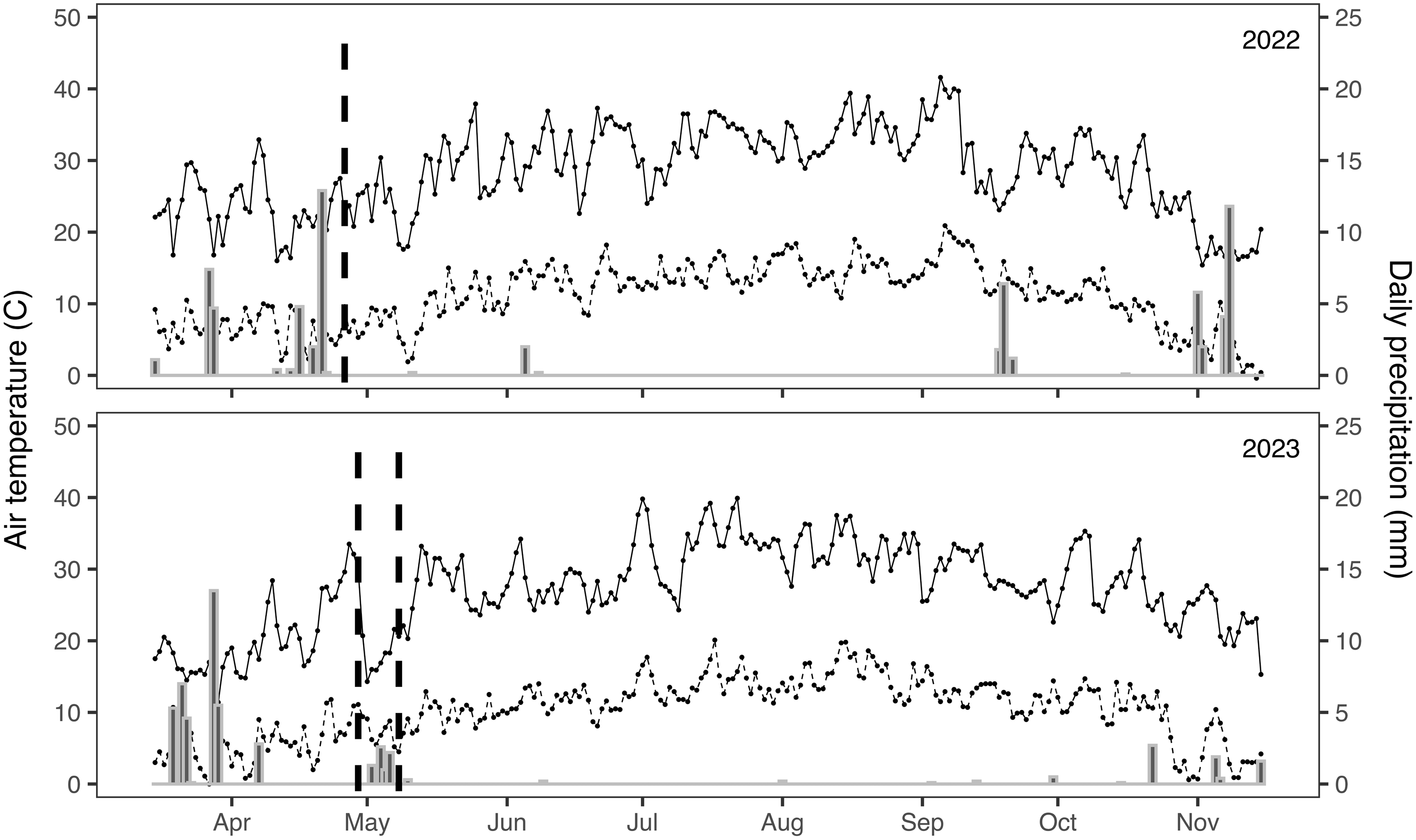
The ‘M-206’ rice cultivar, a Calrose-type medium-grain and smooth-hulled (glabrous) japonica rice variety with 109 d to 50% heading that is a common cultivar in California (Leinfelder-Miles et al. Reference Leinfelder-Miles, Linquist, Buttner, Murdock and Goodrich2022), was planted on April 26, 2022, at McDonald A and on April 29, 2023, and May 8, 2023, at Roberts and McDonald B, respectively. The seeding rate was 150 kg ha–1 and 170 kg ha–1 in 2022 and 2023, respectively. A nitrogen—ammonium nitrate (32% N, 0% P, 0% K)—solution was applied at a rate of ∼6 kg ha–1 at planting and ∼168 kg ha–1 prior to the permanent flood in both years. Prior to herbicide application, 3 × 3 m common cattail–infested rice plots were randomly selected from the densest common cattail patches in the fields, and a wooden stake was placed in the center of each plot. The number of common cattail and their height in each plot were recorded before herbicide application. Field preparations and cultural practices followed the University of California Delta region sample costs to produce rice study guidelines (Leinfelder-Miles et al. Reference Leinfelder-Miles, Linquist, Buttner, Murdock and Goodrich2022).
Herbicide Applications
In 2022, seven herbicide treatments were applied: five treatments were applied on July 8 (Table 2), and two follow-up herbicide treatments were applied 14 d after the first application, on July 22, 2022. In addition, a nontreated control plot was included for comparison. Herbicide applications were timed based on common cattail development stages: 0- to 1-m-tall and 1- to 2-m-tall plants. Rice growth stages were 4- to 5-lf and mid-tillering during the 0- to 1-m-tall and 1- to 2-m-tall common cattail applications, respectively. Herbicide treatments were applied with a two-nozzle, carbon dioxide–propelled backpack sprayer calibrated to deliver 280 L ha–1 at 275 kPa through TeeJet® XR 8004-VS extended-range flat-spray nozzles (TeeJet® Technologies, Camarillo, CA, USA). The sprayer had 50-cm nozzle spacing and was operated at ∼5 km h−1 ground speed; it was oriented to cover half-plot-wide passes on each side of the wooden stakes.
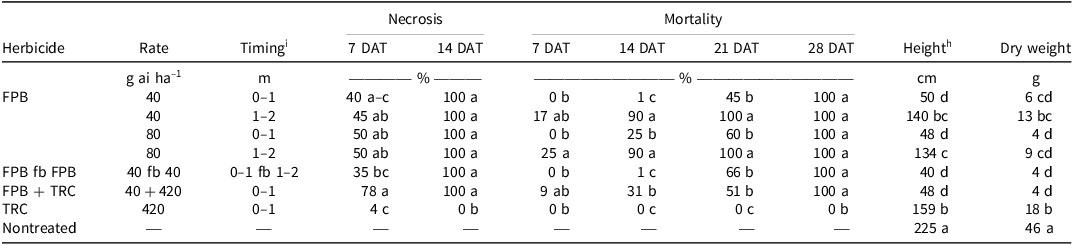
Average visual ratings of necrosis and mortality, height at harvest, and dry weights of common cattail following foliar herbicide treatments of florpyrauxifen-benzyl and triclopyr applied at different growth stages in 2022 and 2023 experiments conducted near Stockton, CA a, b, c, d, e, f, g, h .
a Abbreviations: DAT, days after treatment; fb, followed by; FPB, florpyrauxifen-benzyl; TRC, triclopyr.
b Visible symptomology rated the emerged foliage based on a 0% to 100% scale, where 0% means no plant response and 100% means complete necrosis.
c Mortality is reported as the percent ratio of dead common cattail of the total common cattail per plot.
d Mean responses within a column followed by the same letter do not differ according to Tukey’s HSD post hoc test (α = 0.05).
e Methylated seed oil at 584 ml ha–1 was included with all treatments.
f Triclopyr is reported in g ae ha–1.
g Common cattail height was recorded at 28 DAT and reported as aboveground including submerged foliage.
h Common cattail plants were harvested as aboveground at 28 DAT, dried at 65 C for 72 h, then weighed.
i Common cattail growth stages at the time of application. Sequential applications of FPB fb FPB were sprayed 14 d apart.
Six plots received florpyrauxifen-benzyl (Loyant® CA, 25 g ai L–1, Corteva Agriscience, Indianapolis, IN, USA) applied alone at 40 g ai ha–1 or 80 g ha–1 or in a mixture with triclopyr (Grandstand® CA, 359 g ae L–1, Corteva Agriscience) at 420 g ae ha–1 on 0- to 1-m-tall common cattail. One plot received triclopyr alone at a 420 g ae ha–1 rate. All herbicide treatments included methylated seed oil (Super Spread® MSO, Wilbur-Ellis, Fresno, CA, USA) at 584 ml ha–1. Environmental conditions at the time of the applications at McDonald A on July 8, 2022, and July 22, 2022, were 26 C air temperature, 56% relative humidity (RH), and 0.6 m s–1 wind speed and 18 C air temperature, 59% RH, and 1.3 m s–1 wind speed, respectively. Experiments were repeated at the Roberts and McDonald B sites on June 7, 2023, with 0- to 1-m-tall common cattail application and June 21, 2023, with 1- to 2-m-tall common cattail application, when environmental conditions were 21 C air temperature, 60% RH, and 0.5 m s–1 wind speed and 15 C air temperature, 55% RH, and 0.9 m s–1 wind speed, respectively.
Experimental Design and Data Collection
Experiments were arranged as a randomized complete-block design with four replicates, where a 3 × 3 m rice plot was an experimental unit. Plots were encased by at least 10-m-wide buffers to prevent herbicide cross-contamination to adjacent treatments. All evaluations were made using 2 × 2 m quadrats to avoid plot edge effects. Visual injury and efficacy ratings were conducted at 7, 14, 21, 28, and 42 d after treatment (DAT). Rice and common cattail injury symptoms from herbicide applications were evaluated based on a percentage scale, ranging from 0 (absence of symptoms) to 100 (plant death). Common cattail mortality ratings were calculated based on weed counts as a ratio of dead common cattail plants to total common cattail plants within 2 × 2 m quadrats. Common cattail height in plots was determined from the soil surface to the terminal tips of common cattail plants at each evaluation timing by measuring all plants. At 28 DAT, all common cattail plants in each plot within 2 × 2 m quadrats were hand harvested at the soil surface, dried for 72 h at 65 C, and weighed. Owing to the irregular spacing among randomly selected plots and limited feasibility in grower field conditions, rice yield response was not collected.
Data Analysis
Data from visual evaluations were analyzed using analysis of variance and Tukey’s honestly significant difference (HSD) test in the AOV Means Table function in ARM software (version 2024.2; GDM Solutions, Brookings, SD, USA) with significance set at P < 0.05, when applicable. The necrosis and mortality ratings were expressed as a percentage relative to the nontreated control. Common cattail height and dry biomass were analyzed with analysis of covariance using the agricolae (de Mendiburu Reference de Mendiburu2024), dplyr (Wickham et al. Reference Wickham, François, Henry, Müller and Vaughan2024a), and emmeans (Searle et al. Reference Searle, Speed and Milliken1980) packages in R Studio (version 2024.09.1+394; R Core Team 2024). Means were separated using Tukey’s HSD post hoc test (α = 0.05), when applicable. The multcomp (Bretz et al. Reference Bretz, Hothorn and Westfall2010) package was used to generate multiple comparisons among means. Herbicide rate and application timing were considered fixed factors, while location and year were considered random factors. Visual illustration was generated using the ggplot2 package in R Studio (Wickham et al. Reference Wickham, Navarro and Pedersen2024b).
Results and Discussion
Because there were no significant interactions between year and treatment, the data for 2022 and 2023 were combined for presentation (Table 2). In both 2022 and 2023, rice injury from all herbicide treatments was minimal and insignificant (P > 0.05). Florpyrauxifen-benzyl applied at 80 g ai ha–1 on 0- to 1-m-tall common cattail caused <2% chlorosis and <1% necrosis at 7 DAT (data not shown). All florpyrauxifen-benzyl injury symptoms gradually dissipated, and rice appeared normal by 21 DAT. Previously, research showed that florpyrauxifen-benzyl did not cause significant rice injury or yield reduction when applied at up to 40 g ha–1 from 2-lf to panicle initiation rice growth stages (Inci and Al-Khatib Reference Inci and Al-Khatib2024; Velásquez et al. Reference Velásquez, Bundt, Camargo, Andres, Viana, Hoyos, Plaza and de Avila2021; Wright et al. Reference Wright, Norsworthy, Roberts, Scott, Hardke and Gbur2021). Florpyrauxifen-benzyl applied on 0- to 1-m-tall and 1- to 2-m-tall common cattail coincided with 4- to 5-lf and mid-tillering rice growth stages, respectively.
At all experiments, florpyrauxifen-benzyl symptoms were apparent on all treated common cattail (Figure 2). Generally, common cattail treated with florpyrauxifen-benzyl at 40 g ha–1 in mixture with triclopyr at 420 g ae ha–1 developed injury symptoms 3 DAT. All other florpyrauxifen-benzyl injury symptoms were observed 7 DAT and peaked by 14 DAT. Common cattail injury symptoms included chlorosis, lodging, malformation, necrosis, stunting, and, ultimately, plant death. Among those, necrosis and plant death were by far the most characteristic injury symptoms. Some of the florpyrauxifen-benzyl-treated common cattail plants were partially or completely decayed at 21 DAT. However, plants treated with triclopyr alone at 420 g ha–1 showed <5% necrosis at 7 DAT and were free of injury symptoms throughout the rest of the growing seasons (Table 2).
Herbicide efficacy of common cattail at 28 DAT in experiments conducted near Stockton, CA. Treatments were florpyrauxifen-benzyl at 40 g ai ha–1 on 0- to 1-m-tall common cattail (A), florpyrauxifen-benzyl at 40 g ai ha–1 on 1- to 2-m-tall common cattail (B), florpyrauxifen-benzyl at 40 g ha–1 on 0- to 1-m-tall common cattail followed by florpyrauxifen-benzyl at 40 g ha–1 on 1- to 2-m-tall common cattail (C), florpyrauxifen-benzyl at 80 g ha–1 on 0- to 1-m-tall common cattail (D), florpyrauxifen-benzyl at 80 g ai ha–1 on 1- to 2-m-tall common cattail (E), florpyrauxifen-benzyl at 40 g ha–1 + triclopyr at 420 g ae ha–1 on 0- to 1-m-tall common cattail (F), triclopyr at 420 g ha–1 on 0- to 1-m-tall common cattail (G), and nontreated control treatment (H). Photos were taken on July 5, 2023, in the second year of the study (courtesy DI).

Florpyrauxifen-benzyl applied at 40 g ha–1 on 0- to 1-m-tall common cattail resulted in 1% mortality, whereas florpyrauxifen-benzyl at 40 g ha–1 + triclopyr at 420 g ha–1 applied on 0- to 1-m-tall common cattail resulted in 31% mortality (P < 0.05) at 14 DAT (Table 2). The quicker and greater mortality at 14 DAT when florpyrauxifen-benzyl was applied with triclopyr compared to florpyrauxifen-benzyl applied alone may suggest a synergism interaction, as described by Colby (Reference Colby1967). When florpyrauxifen-benzyl was applied at 80 g ha–1 on 0- to 1-m-tall common cattail, 25% of mortality (P < 0.05) was recorded at 14 DAT. However, when common cattail were treated with florpyrauxifen-benzyl at 40 and 80 g ha–1 at the 1- to 2-m-tall stage, 90% mortality was observed at 14 DAT (P < 0.0001). This result is largely because of taller common cattail receiving more foliage coverage during the herbicide application, ultimately leading to more herbicide absorption and translocation. Additionally, herbicide translocation is expected to increase when common cattail plants are actively growing and transporting carbohydrates to their rhizomes (Bansal et al. Reference Bansal, Lishawa, Newman, Tangen, Wilcox, Albert, Anteau, Chimney, Cressey, DeKeyser, Elgersma, Finkelstein, Freeland, Grosshans, Klug, Larkin, Lawrence, Linz, Marburger, Noe, Otto, Reo, Richards, Richardson, Rodgers, Schrank, Svedarsky, Travis, Tuchman and Windham-Myers2019). Regardless of application rate or timing, all florpyrauxifen-benzyl treatments resulted in 100% mortality at 28 DAT (Table 2).
Common cattail height and dry biomass were significantly reduced (P < 0.0001) with all florpyrauxifen-benzyl treatments at 28 DAT compared to nontreated plants (Table 2). When florpyrauxifen-benzyl was applied on 40 g ha–1 to 0- to 1-m-tall common cattail, plant height and dry biomass weight were reduced by 78% and 87%, respectively. The florpyrauxifen-benzyl + triclopyr mixture applied on 0- to 1-m-tall common cattail reduced height and dry biomass by 79% and 91%, respectively. However, triclopyr alone at 420 g ha–1 applied on 0- to 1-m-tall common cattail reduced height and dry biomass by only 29% and 61%, respectively—lowest among all treatments. The highest dry biomass reduction of 91% was also recorded with florpyrauxifen-benzyl sequential application at 40 g ha–1 and florpyrauxifen-benzyl applied at 80 g ha–1 on 0- to 1-m-tall common cattail. Rustom (Reference Rustom2020) reported that florpyrauxifen-benzyl applied at 29.5 g ha–1 on 20- to 35-cm-tall common cattail resulted in 98% fresh biomass reduction at 56 DAT.
Besides controlling common cattail, florpyrauxifen-benzyl may provide additional benefits by controlling other common weeds. It has been reported that florpyrauxifen-benzyl controlled Eurasian watermilfoil (Myriophyllum spicatum L.), hydrilla [Hydrilla verticillata (L. f.) Royle], and Uruguay waterprimrose [Ludwigia hexapetala (Hook. & Arn.) Zardini, Gu & P.H. Raven] (Enloe and Lauer Reference Enloe and Lauer2017); yellow floating heart [Nymphoides peltata (S.G. Gmel.) Kuntze] (Howell et al. Reference Howell, Leon, Everman, Mitasova, Nelson and Richardson2023); crested floating heart [Nymphoides cristata (Roxb.) Kuntze] (Beets and Netherland Reference Beets and Netherland2018); redstem, waterhyssops, ducksalad, and arrowhead (Inci and Al-Khatib Reference Inci and Al-Khatib2024); and waterhyacinth [Eichhornia crassipes (Mart.) Solms] (Mudge et al. Reference Mudge, Turnage and Netherland2021). Many of these are important weeds in California rice cropping systems.
Previous research on the control of Typha spp. focused on herbicides such as 2,4-D (Corns and Gupta Reference Corns and Gupta1971), glyphosate (Linz and Homan Reference Linz and Homan2011; Messersmith et al. Reference Messersmith, Christianson and Thorsness1992; Solberg and Higgins Reference Solberg and Higgins1993), and imazamox (Rodgers and Black Reference Rodgers and Black2012). Among these herbicides, imazamox applied at 280 g ae ha–1 by helicopter on southern cattail (Typha domingensis Pers.) resulted in >99% control with up to 12 mo longevity (Rodgers and Black Reference Rodgers and Black2012). Imazamox can be used on imidazolinone-resistant (IMI) rice; however, IMI rice is not planted in California. Glyphosate research has focused on broadcast application on wetlands to control Typha spp. at various growth stages (Comes and Kelley Reference Comes and Kelley1989; Linz et al. Reference Linz, Bergman, Homan and Bleier1995, Reference Linz, Blixt, Bergman and Bleier1996; Messersmith et al. Reference Messersmith, Christianson and Thorsness1992; Solberg and Higgins Reference Solberg and Higgins1993). Glyphosate has been reported as most effective in late summer, when Typha spp. are actively metabolizing and transporting carbohydrates to their rhizomes (Linz and Homan Reference Linz and Homan2011). When glyphosate was applied at 4.54 g ae L–1 on hybrid cattail [Typha × glauca Godr. (pro sp.) [angustifolia or domingensis × latifolia]] in 5-cm flooded mesocosms, 99% density and dry biomass reduction was observed (Lawrence et al. Reference Lawrence, Lishawa, Rodriguez and Tuchman2016). Thus glyphosate can be broadcast onto nearby wetlands, ponds, marshes, or fallow fields during the off season to control Typha spp. However, glyphosate is not an option because of its nonselective activity during the growing season for rice systems. Likewise, 2,4-D is not an option for rice growers in California because 2,4-D registration was canceled due to 2,4-D drift onto nontarget crops.
Florpyrauxifen-benzyl is an important tool in the complex weed management programs with its excellent sedge and broadleaf weed control and activity on troublesome grass weeds, such as barnyardgrass (Inci and Al-Khatib Reference Inci and Al-Khatib2024). Our research shows that common cattail control by florpyrauxifen-benzyl in rice is outstanding, regardless of application rate and timing. Given the importance of rice production in the Sacramento Valley and Delta, the second-largest rice-producing region in the United States, it is important to develop sustainable weed management programs considering increasing common cattail infestations in California rice fields. Florpyrauxifen-benzyl can be safely and widely used to control common cattail and can be an important part of the weed management programs in rice systems.
Practical Implications
Recently, common cattail invasion in the drill-seeded rice systems of the Sacramento–San Joaquin River Delta has become a significant problem. This research was conducted in common cattail–invaded drill-seeded rice fields in 2022 and 2023 to elucidate florpyrauxifen-benzyl efficacy on different growth stages of common cattail at different application rates. Florpyrauxifen-benzyl was recently registered and labeled for use in California rice in the 30–40 g ai ha–1 range with up to two applications with a minimum 14-d interval in a growing season. Because the Delta is the heart of California’s water system, supplying fresh water to two-thirds of the state’s population and millions of hectares of farmland, florpyrauxifen-benzyl provides rice growers with a reduced risk for human and environmental exposures and with lower use rates than other auxin mimics, such as 2,4-D and triclopyr. Florpyrauxifen-benzyl at 40 g ai ha–1 controlled 100% of common cattail up to 2 m tall. Florpyrauxifen-benzyl at 40 g ai ha–1 + triclopyr at 420 g ae ha–1 resulted in faster injury symptoms on common cattail than florpyrauxifen-benzyl applied alone, but it did not alter common cattail control. Triclopyr alone at 420 g ae ha–1 did not control common cattail. None of the herbicide treatments resulted in significant rice injury, including the application of florpyrauxifen-benzyl at 80 g ai ha–1. These findings suggest that florpyrauxifen-benzyl can be applied as either a spot or a broadcast application to rice fields where common cattail has become a problem.
Acknowledgments
We gratefully acknowledge Benjamin Leacox, Jeff Lagorio, and Zuckerman Family Farms for providing the rice fields and for their collaboration during this research. Special thanks are extended to herbarium specialists Alison Colwell and Teri Barry for plant identification at the University of California, Davis Center for Plant Diversity.
Funding
This research was funded by the California Rice Research Board, Melvin D. Androus Endowment, and University of California Henry A. Jastro–Shields Graduate Research Award.
Competing interests
The authors declare no conflicts of interest.


 Open access

