





1 Introduction and statement of results
A partition of a positive integer n is a finite sequence of non-increasing positive integers $\lambda =(\lambda _1, \lambda _2, \ldots , \lambda _r)$
such that
$\lambda =(\lambda _1, \lambda _2, \ldots , \lambda _r)$
such that $\lambda _1+\lambda _2+\cdots +\lambda _r=n$
. A Young diagram of a partition
$\lambda _1+\lambda _2+\cdots +\lambda _r=n$
. A Young diagram of a partition $(\lambda _1, \lambda _2, \ldots , \lambda _r)$
is a left-justified array of boxes with the i-th row (from the top) having
$(\lambda _1, \lambda _2, \ldots , \lambda _r)$
is a left-justified array of boxes with the i-th row (from the top) having $\lambda _i$
boxes. For example, the Young diagram of the partition
$\lambda _i$
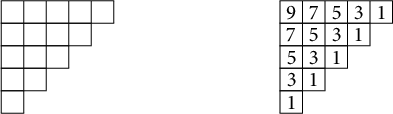
boxes. For example, the Young diagram of the partition $(5,4,3,2,1)$
is shown in Figure 1 (left). The hook length of a box in a Young diagram is the sum of the number of the boxes directly right to it, the number of boxes directly below it and 1 (for the box itself). For example, see Figure 1 (right) for the hook lengths of each box in the Young diagram of the partition
$(5,4,3,2,1)$
is shown in Figure 1 (left). The hook length of a box in a Young diagram is the sum of the number of the boxes directly right to it, the number of boxes directly below it and 1 (for the box itself). For example, see Figure 1 (right) for the hook lengths of each box in the Young diagram of the partition $(5,4,3,2,1)$
.
$(5,4,3,2,1)$
.
Hook lengths of partitions have important connections with representation theory of the symmetric groups $S_n$
and
$S_n$
and $GL_n(\mathbb {C})$
. Hook lengths also appear in the Seiberg–Witten theory of random partitions, which gives the Nekrasov–Okounkov formula for arbitrary powers of Euler’s infinite product in terms of hook numbers. For more details, see, e.g., [Reference Garvan, Kim and Stanton4, Reference James and Kerber7, Reference Littlewood9, Reference Nekrasov and Okounkov10, Reference Stanley13]. Other than the ordinary partition function, hook lengths have also been studied for several restricted partition functions, for example, partitions into odd parts, partitions into distinct parts, partitions into odd and distinct parts, self conjugate partitions and doubled distinct partitions, see, e.g., [Reference Amdeberhan, Andrews, Ono and Singh1–Reference Craig, Dawsey and Han3, Reference Han and Xiong5, Reference Han and Xiong6, Reference Pétréolle11, Reference Singh and Barman12].
$GL_n(\mathbb {C})$
. Hook lengths also appear in the Seiberg–Witten theory of random partitions, which gives the Nekrasov–Okounkov formula for arbitrary powers of Euler’s infinite product in terms of hook numbers. For more details, see, e.g., [Reference Garvan, Kim and Stanton4, Reference James and Kerber7, Reference Littlewood9, Reference Nekrasov and Okounkov10, Reference Stanley13]. Other than the ordinary partition function, hook lengths have also been studied for several restricted partition functions, for example, partitions into odd parts, partitions into distinct parts, partitions into odd and distinct parts, self conjugate partitions and doubled distinct partitions, see, e.g., [Reference Amdeberhan, Andrews, Ono and Singh1–Reference Craig, Dawsey and Han3, Reference Han and Xiong5, Reference Han and Xiong6, Reference Pétréolle11, Reference Singh and Barman12].
The Young diagram of the partition $(5,4,3,2,1)$
and its hook lengths.
$(5,4,3,2,1)$
and its hook lengths.

Let $t\geq 2$
be a fixed positive integer. A t-regular partition of a positive integer n is a partition of n such that none of its parts is divisible by t. A t-distinct partition of a positive integer n is a partition of n such that any of its parts can occur at most
$t\geq 2$
be a fixed positive integer. A t-regular partition of a positive integer n is a partition of n such that none of its parts is divisible by t. A t-distinct partition of a positive integer n is a partition of n such that any of its parts can occur at most $t-1$
times. For integers
$t-1$
times. For integers $t\geq 2$
and
$t\geq 2$
and $k\geq 1$
, let
$k\geq 1$
, let $b_{t,k}(n)$
denote the number of hooks of length k in all the t-regular partitions of
$b_{t,k}(n)$
denote the number of hooks of length k in all the t-regular partitions of $n,$
and
$n,$
and $d_{t,k}(n)$
denote the number of hooks of length k in all the t-distinct partitions of n. Ballantine et al.[Reference Ballantine, Burson, Craig, Folsom and Wen2] studied hook lengths in
$d_{t,k}(n)$
denote the number of hooks of length k in all the t-distinct partitions of n. Ballantine et al.[Reference Ballantine, Burson, Craig, Folsom and Wen2] studied hook lengths in $2$
-regular partitions and
$2$
-regular partitions and $2$
-distinct partitions. The authors, in [Reference Ballantine, Burson, Craig, Folsom and Wen2], proved that
$2$
-distinct partitions. The authors, in [Reference Ballantine, Burson, Craig, Folsom and Wen2], proved that $d_{2,1}(n)\geq b_{2,1}(n)$
, for all
$d_{2,1}(n)\geq b_{2,1}(n)$
, for all $n\geq 0$
. They conjectured [Reference Ballantine, Burson, Craig, Folsom and Wen2, Conjecture 1.7] that for every
$n\geq 0$
. They conjectured [Reference Ballantine, Burson, Craig, Folsom and Wen2, Conjecture 1.7] that for every $k\geq 2$
, there exists an integer
$k\geq 2$
, there exists an integer $N_k$
such that
$N_k$
such that $b_{2,k}(n)\geq d_{2,k}(n)$
, for all
$b_{2,k}(n)\geq d_{2,k}(n)$
, for all $n\geq N_k$
. Ballantine et al. [Reference Ballantine, Burson, Craig, Folsom and Wen2, Theorem 1.8] proved the conjecture for
$n\geq N_k$
. Ballantine et al. [Reference Ballantine, Burson, Craig, Folsom and Wen2, Theorem 1.8] proved the conjecture for $k=2,3$
and very recently Craig et al. [Reference Craig, Dawsey and Han3] proved it for all k. This type of partition inequalities between the number of hook lengths are also called hook length biases. In [Reference Singh and Barman12], we studied the hook length biases for
$k=2,3$
and very recently Craig et al. [Reference Craig, Dawsey and Han3] proved it for all k. This type of partition inequalities between the number of hook lengths are also called hook length biases. In [Reference Singh and Barman12], we studied the hook length biases for $2$
- and
$2$
- and $3$
-regular partitions for different hook lengths. We established two hook length biases for
$3$
-regular partitions for different hook lengths. We established two hook length biases for $2$
-regular partitions, namely,
$2$
-regular partitions, namely, $b_{2,2}(n)\geq b_{2,1}(n)$
, for all
$b_{2,2}(n)\geq b_{2,1}(n)$
, for all $n>4$
and
$n>4$
and $b_{2,2}(n)\geq b_{2,3}(n)$
, for all
$b_{2,2}(n)\geq b_{2,3}(n)$
, for all $n\geq 0$
. We also proposed two conjectures on biases among
$n\geq 0$
. We also proposed two conjectures on biases among $2$
- and
$2$
- and $3$
-regular partitions, see [Reference Singh and Barman12, Conjectures 1.6 and 6.1].
$3$
-regular partitions, see [Reference Singh and Barman12, Conjectures 1.6 and 6.1].
In this article, we study biases among $b_{t,k}(n)$
for fixed k. Our first result proves that the number of hooks of length 1 in (
$b_{t,k}(n)$
for fixed k. Our first result proves that the number of hooks of length 1 in ( $t+1)$
-regular partitions of any nonnegative integer n is greater than or equal to the number of hooks of length 1 in t-regular partitions of n. More precisely, we have the following theorem.
$t+1)$
-regular partitions of any nonnegative integer n is greater than or equal to the number of hooks of length 1 in t-regular partitions of n. More precisely, we have the following theorem.
Theorem 1.1 Let $t\geq 2$
be an integer. We have
$t\geq 2$
be an integer. We have $b_{t+1,1}(n)\geq b_{t,1}(n)$
, for all
$b_{t+1,1}(n)\geq b_{t,1}(n)$
, for all $n\geq 0$
.
$n\geq 0$
.
For the number of hooks of length 2, we expect the same trend in t-regular partitions of any positive integer n. Our second result confirms the bias for the number of hooks of length 2 between $2$
- and
$2$
- and $3$
-regular partitions.
$3$
-regular partitions.
Theorem 1.2 For all integers $n>3$
, we have
$n>3$
, we have $b_{3,2}(n)\geq b_{2,2}(n)$
.
$b_{3,2}(n)\geq b_{2,2}(n)$
.
We observe similar inequality for hooks of length 3. In particular, we have the following theorem.
Theorem 1.3 For all nonnegative integers n, we have $b_{3,3}(n)\geq b_{2,3}(n)$
.
$b_{3,3}(n)\geq b_{2,3}(n)$
.
2 Proof of Theorem 1.1
We introduce some notations. Let $\overline {\ell }(\lambda )$
denote the number of distinct parts in a partition
$\overline {\ell }(\lambda )$
denote the number of distinct parts in a partition $\lambda $
. Let
$\lambda $
. Let $h_k(\lambda )$
denote the number of hooks of length k in the Young diagram of a partition
$h_k(\lambda )$
denote the number of hooks of length k in the Young diagram of a partition $\lambda $
. We recall another form of representation of a partition
$\lambda $
. We recall another form of representation of a partition $\lambda $
given by
$\lambda $
given by
 $$ \begin{align*}\lambda=(\lambda^{m_1}_1,\lambda^{m_2}_2,\ldots,\lambda^{m_r}_r),\end{align*} $$
where $m_i$
is the multiplicity of the part
$m_i$
is the multiplicity of the part $\lambda _i$
and
$\lambda _i$
and $\lambda _1>\lambda _2>\cdots >\lambda _r$
. With this notation, for any partition
$\lambda _1>\lambda _2>\cdots >\lambda _r$
. With this notation, for any partition $\lambda $
, we consider
$\lambda $
, we consider $\lambda _{\overline {\ell }(\lambda )+1}=0$
.
$\lambda _{\overline {\ell }(\lambda )+1}=0$
.
To prove Theorem 1.1, we first prove the following lemma. Let $b_t(n)$
denote the number of t-regular partitions of a positive integer n.
$b_t(n)$
denote the number of t-regular partitions of a positive integer n.
Lemma 2.1 Let $t\geq 2$
be an integer. We have
$t\geq 2$
be an integer. We have $b_{t+1}(n)\geq b_{t}(n)$
, for all
$b_{t+1}(n)\geq b_{t}(n)$
, for all $n\geq 0$
.
$n\geq 0$
. $\Phi _{t,n}$
for
$\Phi _{t,n}$
for $t=3$
and
$t=3$
and $n=12.$

Proof Let $\mathcal {B}_t(n)$
denote the set of all t-regular partitions of n. For fixed t and n, define a map
$\mathcal {B}_t(n)$
denote the set of all t-regular partitions of n. For fixed t and n, define a map $\Phi _{t,n}:\mathcal {B}_t(n)\rightarrow \mathcal {B}_{t+1}(n)$
. For any
$\Phi _{t,n}:\mathcal {B}_t(n)\rightarrow \mathcal {B}_{t+1}(n)$
. For any $\tau \in \mathcal {B}_t(n)$
,
$\tau \in \mathcal {B}_t(n)$
, $\Phi _{t,n}(\tau )$
is a partition in
$\Phi _{t,n}(\tau )$
is a partition in $\mathcal {B}_{t+1}(n)$
with parts from
$\mathcal {B}_{t+1}(n)$
with parts from $\tau $
which are multiple of
$\tau $
which are multiple of $t+1$
changed in such a way that they are not multiple of
$t+1$
changed in such a way that they are not multiple of $t+1$
and other parts remain same. A part of
$t+1$
and other parts remain same. A part of $\tau $
which is a multiple of
$\tau $
which is a multiple of $t+1$
, is of the form
$t+1$
, is of the form $(t+1)(t\ell +r)=t(t+1)\ell +r(t+1)$
, for some nonnegative integer
$(t+1)(t\ell +r)=t(t+1)\ell +r(t+1)$
, for some nonnegative integer $\ell $
and
$\ell $
and $1\leq r\leq t-1$
(
$1\leq r\leq t-1$
( $r\neq 0$
, since
$r\neq 0$
, since $\tau \in \mathcal {B}_t(n)$
). Under the map
$\tau \in \mathcal {B}_t(n)$
). Under the map $\Phi _{t,n}$
the part of part size
$\Phi _{t,n}$
the part of part size $t(t+1)\ell +r(t+1)$
of
$t(t+1)\ell +r(t+1)$
of $\tau $
is changed to
$\tau $
is changed to $(t(t+1)\ell +rt,~r)$
, which means that
$(t(t+1)\ell +rt,~r)$
, which means that $t(t+1)\ell +rt$
and r are considered as two parts in
$t(t+1)\ell +rt$
and r are considered as two parts in $\Phi _{t,n}(\tau )$
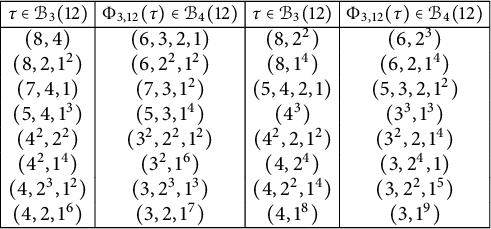
. For example, Table 1 shows the mapping of
$\Phi _{t,n}(\tau )$
. For example, Table 1 shows the mapping of $3$
-regular partitions of 12 to
$3$
-regular partitions of 12 to $4$
-regular partitions of 12 under the map
$4$
-regular partitions of 12 under the map $\Phi _{3,12}$
. The
$\Phi _{3,12}$
. The $3$
-regular partitions of 12 which are not listed in Table 1 are also
$3$
-regular partitions of 12 which are not listed in Table 1 are also $4$
-regular partitions of 12 and hence mapped to themselves. Next, we prove that
$4$
-regular partitions of 12 and hence mapped to themselves. Next, we prove that $\Phi _{t,n}$
is an injective map. For
$\Phi _{t,n}$
is an injective map. For $\tau _1,\tau _2\in \mathcal {B}_t(n)$
, let
$\tau _1,\tau _2\in \mathcal {B}_t(n)$
, let $\Phi _{t,n}(\tau _1)=\Phi _{t,n}(\tau _2)$
. The parts of
$\Phi _{t,n}(\tau _1)=\Phi _{t,n}(\tau _2)$
. The parts of $\Phi _{t,n}(\tau _1)$
and
$\Phi _{t,n}(\tau _1)$
and $\Phi _{t,n}(\tau _2)$
which are not of the type
$\Phi _{t,n}(\tau _2)$
which are not of the type $t(t+1)\ell +rt$
or r (for some nonnegative integer
$t(t+1)\ell +rt$
or r (for some nonnegative integer $\ell $
and
$\ell $
and $1\leq r\leq t-1$
) are also the parts of
$1\leq r\leq t-1$
) are also the parts of $\tau _1$
and
$\tau _1$
and $\tau _2$
. If
$\tau _2$
. If $t(t+1)\ell +rt$
and r are the parts of
$t(t+1)\ell +rt$
and r are the parts of $\Phi _{t,n}(\tau _1)$
and
$\Phi _{t,n}(\tau _1)$
and $\Phi _{t,n}(\tau _2)$
with multiplicity, say m, then
$\Phi _{t,n}(\tau _2)$
with multiplicity, say m, then $(t+1)(t\ell +r)$
is a part in both
$(t+1)(t\ell +r)$
is a part in both $\tau _1$
and
$\tau _1$
and $\tau _2$
with multiplicity m. This implies that
$\tau _2$
with multiplicity m. This implies that $\tau _1=\tau _2$
. Therefore,
$\tau _1=\tau _2$
. Therefore, $\Phi _{t,n}$
is an injective map. This proves that,
$\Phi _{t,n}$
is an injective map. This proves that, $|\mathcal {B}_t(n)|\leq |\mathcal {B}_{t+1}(n)|$
, i.e.,
$|\mathcal {B}_t(n)|\leq |\mathcal {B}_{t+1}(n)|$
, i.e., $b_{t}(n)\leq b_{t+1}(n)$
.
$b_{t}(n)\leq b_{t+1}(n)$
.
Proof of Theorem 1.1
It is easy to observe that for any partition $\tau $
the number of hooks of length 1 in the Young diagram of
$\tau $
the number of hooks of length 1 in the Young diagram of $\tau $
is same as the number of distinct parts of
$\tau $
is same as the number of distinct parts of $\tau $
, i.e.,
$\tau $
, i.e., $h_1(\tau )=\overline {\ell }(\tau )$
. From Lemma 2.1, we have that
$h_1(\tau )=\overline {\ell }(\tau )$
. From Lemma 2.1, we have that $b_t(n)\leq b_{t+1}(n)$
, for all
$b_t(n)\leq b_{t+1}(n)$
, for all $n\geq 0$
. Note that the number of distinct parts in
$n\geq 0$
. Note that the number of distinct parts in $\tau \in \mathcal {B}_t(n)$
is less than or equal to the number of distinct parts in
$\tau \in \mathcal {B}_t(n)$
is less than or equal to the number of distinct parts in $\Phi _{t,n}(\tau )\in \mathcal {B}_{t+1}(n)$
. Therefore,
$\Phi _{t,n}(\tau )\in \mathcal {B}_{t+1}(n)$
. Therefore, $b_{t,1}(n)\leq b_{t+1,1}(n)$
, for all
$b_{t,1}(n)\leq b_{t+1,1}(n)$
, for all $n\geq 0$
.
$n\geq 0$
.
3 Proofs of Theorems 1.2 and 1.3
We represent a partition $\tau $
from
$\tau $
from $\mathcal {B}_2(n)$
by
$\mathcal {B}_2(n)$
by
 $$ \begin{align*}\left((6k+5)^{\alpha_{k,5}},~(6k+3)^{\alpha_{k,3}},~(6k+1)^{\alpha_{k,1}} \right)_{k\geq0},\end{align*} $$
where $\alpha _{k,j}$
is the multiplicity of the part
$\alpha _{k,j}$
is the multiplicity of the part $6k+j$
. From a partition
$6k+j$
. From a partition $\tau \in \mathcal {B}_2(n)$
, we define triples by
$\tau \in \mathcal {B}_2(n)$
, we define triples by
 $$ \begin{align*}\tau_k=\left((6k+5)^{\alpha_{k,5}},~(6k+3)^{\alpha_{k,3}},~(6k+1)^{\alpha_{k,1}} \right)_k,\end{align*} $$
such that $\tau =(\tau _k)_{k\geq 0}$
. The map
$\tau =(\tau _k)_{k\geq 0}$
. The map $\Phi _{2,n}: \mathcal {B}_2(n)\rightarrow \mathcal {B}_3(n)$
is defined by
$\Phi _{2,n}: \mathcal {B}_2(n)\rightarrow \mathcal {B}_3(n)$
is defined by
 $$ \begin{align*} \Phi_{2,n}(\tau)&=\Phi_{2,n}\left(((6k+5)^{\alpha_{k,5}},~(6k+3)^{\alpha_{k,3}},~(6k+1)^{\alpha_{k,1}})_{k\geq0} \right)\nonumber\\ &:=\left((6k+5)^{\alpha_{k,5}},~(6k+2)^{\alpha_{k,3}},~(6k+1)^{\alpha_{k,1}} ;~1^{\alpha_{k,3}}\right)_{k\geq0}. \end{align*} $$
We take $(\Phi _{2,n}(\tau ))_k=\left \{ \begin {array}{@{}lll} \left ((6k+5)^{\alpha _{k,5}},~(6k+2)^{\alpha _{k,3}},~(6k+1)^{\alpha _{k,1}} \right )_k & \text {if}\ k\geq 1;\\ \left (5^{\alpha _{0,5}},~2^{\alpha _{0,3}},~1^{\alpha _{0,1}+\sum _{i\geq 0}\alpha _{i,3}} \right ) & \text {if}\ k=0. \end {array} \right .$
3.1 Proof of Theorem 1.2
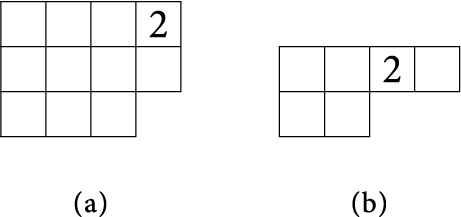
In the Young diagram of a partition, a hook of length 2, which we call a 2-hook, may arise in two different ways.
-
1. We call a 2-hook an m-2-hook if it appears due to the multiplicity of a part being greater than one.
-
2. We call a 2-hook a g-2-hook if it appears in the column corresponding to a part $\lambda _i$
with gap between
$\lambda _i$
and
$\lambda _{i+1}$
being more than 1.
$\lambda _i$
with gap between
$\lambda _i$
and
$\lambda _{i+1}$
being more than 1.


For example, see Figure 2.
Types of 2-hooks: (a) m-2-hook and (b) g-2-hook.

Proof of Theorem 1.2
Note that for $k\geq 1$
,
$k\geq 1$
, $\tau _k$
and
$\tau _k$
and $(\Phi _{2,n}(\tau ))_k$
have the same number of m-2-hooks but the number of g-2-hooks for
$(\Phi _{2,n}(\tau ))_k$
have the same number of m-2-hooks but the number of g-2-hooks for $\tau _k$
is either equal to or one more than the number of g-2-hooks for
$\tau _k$
is either equal to or one more than the number of g-2-hooks for $(\Phi _{2,n}(\tau ))_k$
. Also, the number of 2-hooks in
$(\Phi _{2,n}(\tau ))_k$
. Also, the number of 2-hooks in $\tau _0$
and
$\tau _0$
and $(\Phi _{2,n}(\tau ))_0$
differ by at most 1.
$(\Phi _{2,n}(\tau ))_0$
differ by at most 1.
The idea of our proof is as follows. The number of 2-hooks in $\tau _k$
and
$\tau _k$
and $(\Phi _{2,n}(\tau ))_k$
differ by at most 1. For the case in which a triple
$(\Phi _{2,n}(\tau ))_k$
differ by at most 1. For the case in which a triple $\tau _k$
loses a 2-hook while going under the map
$\tau _k$
loses a 2-hook while going under the map $\Phi _{2,n}$
, we assign a distinct triple to
$\Phi _{2,n}$
, we assign a distinct triple to $\tau _k$
to compensate the loss of one 2-hook for it. For the other case, when the number of 2-hooks is same for
$\tau _k$
to compensate the loss of one 2-hook for it. For the other case, when the number of 2-hooks is same for $\tau _k$
and
$\tau _k$
and $(\Phi _{2,n}(\tau ))_k$
, we are done. In this way, we prove that a partition
$(\Phi _{2,n}(\tau ))_k$
, we are done. In this way, we prove that a partition $\tau \in \mathcal {B}_2(n)$
either has the number of 2-hooks less than the number of 2-hooks in
$\tau \in \mathcal {B}_2(n)$
either has the number of 2-hooks less than the number of 2-hooks in $\Phi _{2,n}(\tau )\in \mathcal {B}_3(n)$
, or (in the other case, when
$\Phi _{2,n}(\tau )\in \mathcal {B}_3(n)$
, or (in the other case, when $\tau $
loses 2-hooks while going under
$\tau $
loses 2-hooks while going under $\Phi _{2,n}$
) along with
$\Phi _{2,n}$
) along with $\Phi _{2,n}(\tau )$
we associate a partition, say
$\Phi _{2,n}(\tau )$
we associate a partition, say $\tau '$
, to
$\tau '$
, to $\tau $
which compensates the loss.
$\tau $
which compensates the loss.
We study triples $\tau _k$
in four cases. The cases in which
$\tau _k$
in four cases. The cases in which $(\Phi _{2,n}(\tau ))_k$
has one 2-hook fewer than
$(\Phi _{2,n}(\tau ))_k$
has one 2-hook fewer than $\tau _k$
, we associate a 4-tuple (a part of a partition in
$\tau _k$
, we associate a 4-tuple (a part of a partition in $\mathcal {B}_3(n)$
and different than
$\mathcal {B}_3(n)$
and different than $(\Phi _{2,n}(\tau ))_k$
) to
$(\Phi _{2,n}(\tau ))_k$
) to $\tau _k$
, which has at least one 2-hook.
$\tau _k$
, which has at least one 2-hook.
Case 1: $ {\alpha }_{ {k,3}} {=0.}$
In this case, the number of 2-hooks in
$ {\alpha }_{ {k,3}} {=0.}$
In this case, the number of 2-hooks in $\tau _k$
is the same as the number of 2-hooks in
$\tau _k$
is the same as the number of 2-hooks in $(\Phi _{2,n}(\tau ))_k=\tau _k$
, if
$(\Phi _{2,n}(\tau ))_k=\tau _k$
, if $k\geq 1$
. For
$k\geq 1$
. For $k=0$
, the number of 2-hooks in
$k=0$
, the number of 2-hooks in $(\Phi _{2,n}(\tau ))_0$
is greater than or equal to the number of 2-hooks in
$(\Phi _{2,n}(\tau ))_0$
is greater than or equal to the number of 2-hooks in $\tau _0$
.
$\tau _0$
.
Case 2: ${\alpha }_{{k,1}}{=0.}$
For
${\alpha }_{{k,1}}{=0.}$
For $k\geq 1$
, the number of 2-hooks in
$k\geq 1$
, the number of 2-hooks in $\tau _k$
is the same as the number of 2-hooks in
$\tau _k$
is the same as the number of 2-hooks in $(\Phi _{2,n}(\tau ))_k$
. For
$(\Phi _{2,n}(\tau ))_k$
. For $k=0$
, if
$k=0$
, if $\tau _0\ne (5^{\alpha _{0,5}},~3)$
then the number of 2-hooks in
$\tau _0\ne (5^{\alpha _{0,5}},~3)$
then the number of 2-hooks in $\tau _k$
is less than or equal to the number of 2-hooks in
$\tau _k$
is less than or equal to the number of 2-hooks in $(\Phi _{2,n}(\tau ))_0$
. If
$(\Phi _{2,n}(\tau ))_0$
. If $\tau _0=(5^{\alpha _{0,5}},~3)$
and
$\tau _0=(5^{\alpha _{0,5}},~3)$
and $\alpha _{0,5}\ne 0$
then we cover the loss of a 2-hook by associating
$\alpha _{0,5}\ne 0$
then we cover the loss of a 2-hook by associating $\rho _0:=(5^{\alpha _{0,5}-1},4^2,1^x)$
to
$\rho _0:=(5^{\alpha _{0,5}-1},4^2,1^x)$
to $\tau _0$
, where x is the multiplicity of 1 coming in the scene due to other triples of
$\tau _0$
, where x is the multiplicity of 1 coming in the scene due to other triples of $\tau =(\tau _k)_{k\geq 0}$
. If
$\tau =(\tau _k)_{k\geq 0}$
. If $\tau _0=(3)$
(i.e.,
$\tau _0=(3)$
(i.e., $\alpha _{0,5}=0$
in
$\alpha _{0,5}=0$
in $\tau _0=(5^{\alpha _{0,5}},~3)$
) then we cover the loss of 2-hook as follows. Since
$\tau _0=(5^{\alpha _{0,5}},~3)$
) then we cover the loss of 2-hook as follows. Since $n>3$
, there is the smallest part with part size greater than or equal to 5, say
$n>3$
, there is the smallest part with part size greater than or equal to 5, say $\lambda _i$
. In this case, we take 5 from the part
$\lambda _i$
. In this case, we take 5 from the part $\lambda _i$
and associate
$\lambda _i$
and associate $(4^2)$
to
$(4^2)$
to $\tau _0=(3)$
. For the remaining part
$\tau _0=(3)$
. For the remaining part $\lambda _i-5$
, we proceed by considering it as a part of the partition under consideration and if
$\lambda _i-5$
, we proceed by considering it as a part of the partition under consideration and if $\lambda _i-5=6r+6$
, for some
$\lambda _i-5=6r+6$
, for some $r\geq 0$
, then we change it to
$r\geq 0$
, then we change it to $(6r+5,1)$
along with other parts while applying
$(6r+5,1)$
along with other parts while applying $\Phi _{2,n}$
. In this case,
$\Phi _{2,n}$
. In this case, $\rho _0:=(5^w,4^{2+z},2^y,1^x)$
, where x is the multiplicity of 1 coming due to the other triples;
$\rho _0:=(5^w,4^{2+z},2^y,1^x)$
, where x is the multiplicity of 1 coming due to the other triples; $y,z$
, and w are the multiplicities of parts 2,4, and 5 (respectively), which may occur due to the part
$y,z$
, and w are the multiplicities of parts 2,4, and 5 (respectively), which may occur due to the part $\lambda _i-5$
. For example, if
$\lambda _i-5$
. For example, if $\tau =(11,3)$
then
$\tau =(11,3)$
then $\rho _0=(5,4^2,1)$
; if
$\rho _0=(5,4^2,1)$
; if $\tau =(7,3)$
then
$\tau =(7,3)$
then $\rho _0=(4^2,2)$
; if
$\rho _0=(4^2,2)$
; if ${\tau =(9,3)}$
then
${\tau =(9,3)}$
then $\rho _0=(4^3)$
; if
$\rho _0=(4^3)$
; if ${\tau =(5^2,3)}$
then
${\tau =(5^2,3)}$
then $\rho _0=(5,4^2)$
.
$\rho _0=(5,4^2)$
.
Case 3: ${\alpha }_{{k,3}}{{>1}} \ {and}\ {\alpha }_{ {k,1}} {\neq } {0.}$
In this case, there is at most one loss of 2-hook in
${\alpha }_{{k,3}}{{>1}} \ {and}\ {\alpha }_{ {k,1}} {\neq } {0.}$
In this case, there is at most one loss of 2-hook in $(\Phi _{2,n}(\tau ))_k$
, which we cover by the following map:
$(\Phi _{2,n}(\tau ))_k$
, which we cover by the following map:
 $$ \begin{align*} f(\tau_k)&=f\left(((6k+5)^{\alpha_{k,5}},~(6k+3)^{\alpha_{k,3}},~(6k+1)^{\alpha_{k,1}} )_{k}\right)\nonumber\\ &=\left((6k+5)^{\alpha_{k,5}},~6k+4,~(6k+2)^{\alpha_{k,3}-1},~(6k+1)^{\alpha_{k,1}} ;~1^{\alpha_{k,3}-2}\right)_{k}. \end{align*} $$
In this case, we associate
 $$ \begin{align*}\sigma_k:=\left((6k+5)^{\alpha_{k,5}},~6k+4,~(6k+2)^{\alpha_{k,3}-1},~(6k+1)^{\alpha_{k,1}} \right)_{k}\end{align*} $$
to $\tau _k$
for
$\tau _k$
for $k\geq 1$
. For
$k\geq 1$
. For $\tau _0$
,
$\tau _0$
, $\sigma _0=(5^{\alpha _{0,5}},~4,~2^{\alpha _{0,3}-1},~1^{\alpha _{0,1}+s})$
, where s is the number of 1s due to other triples.
$\sigma _0=(5^{\alpha _{0,5}},~4,~2^{\alpha _{0,3}-1},~1^{\alpha _{0,1}+s})$
, where s is the number of 1s due to other triples.
Case 4: $ {\alpha }_{ {k,3}} {=1}\ {and}\ {\alpha }_{ {k,1}} {\neq 0.}$
In this case also, there is at most one loss of 2-hook in
$ {\alpha }_{ {k,3}} {=1}\ {and}\ {\alpha }_{ {k,1}} {\neq 0.}$
In this case also, there is at most one loss of 2-hook in $(\Phi _{2,n}(\tau ))_k$
, which we cover by the following map:
$(\Phi _{2,n}(\tau ))_k$
, which we cover by the following map:
 $$ \begin{align*} g(\tau_k)&=g\left(((6k+5)^{\alpha_{k,5}},~6k+3,~(6k+1)^{\alpha_{k,1}})_{k} \right)\nonumber\\ &=\left\{ \begin{array}{@{}lll} \left((6k+5)^{\alpha_{k,5}},~6k+4,~(6k+1)^{\alpha_{k,1}-1};~6k-1,~1\right)_{k} & \text{if}\ k\geq1;\\ \left(5^{\alpha_{0,5}},~4,~1^{\alpha_{0,1}-1}\right) & \text{if}\ k=0. \end{array} \right. \end{align*} $$
Here, for $k\geq 1$
, part
$k\geq 1$
, part $6k-1=6(k-1)+5$
is considered as a part of
$6k-1=6(k-1)+5$
is considered as a part of $\tau _{k-1}$
, doing which does not decrease the number of 2-hooks in
$\tau _{k-1}$
, doing which does not decrease the number of 2-hooks in $\tau _{k-1}$
. In this case, we associate
$\tau _{k-1}$
. In this case, we associate
 $$ \begin{align*}\delta_k:=\left((6k+5)^{\alpha_{k,5}},~6k+4,~(6k+1)^{\alpha_{k,1}-1}\right)_{k}\end{align*} $$
to $\tau _k$
for
$\tau _k$
for $k\geq 1$
. For
$k\geq 1$
. For $\tau _0$
,
$\tau _0$
, $\sigma _0=(5^{\alpha _{0,5}},~4,~1^{\alpha _{0,1}-1+s})$
, where s is the number of 1s due to other triples. Now, let
$\sigma _0=(5^{\alpha _{0,5}},~4,~1^{\alpha _{0,1}-1+s})$
, where s is the number of 1s due to other triples. Now, let $\tau =(\tau _k)_{k\geq 0}\in \mathcal {B}_{2}(n)$
. We consider the following two cases.
$\tau =(\tau _k)_{k\geq 0}\in \mathcal {B}_{2}(n)$
. We consider the following two cases.
Case A. If the number of 2-hooks in $\tau _k$
is less than or equal to the number of 2-hooks in
$\tau _k$
is less than or equal to the number of 2-hooks in $(\Phi _{2,n}(\tau ))_k$
for all k (from Case 1 and Case 2), then we define
$(\Phi _{2,n}(\tau ))_k$
for all k (from Case 1 and Case 2), then we define $\tau ^{*}:=\Phi _{2,n}(\tau )$
. Clearly,
$\tau ^{*}:=\Phi _{2,n}(\tau )$
. Clearly, $h_2(\tau )\leq h_2(\tau ^{*})$
.
$h_2(\tau )\leq h_2(\tau ^{*})$
.
Case B. If for any $k\geq 0$
, the number of 2-hooks in
$k\geq 0$
, the number of 2-hooks in $(\Phi _{2,n}(\tau ))_k$
is one less than the number of 2-hooks in
$(\Phi _{2,n}(\tau ))_k$
is one less than the number of 2-hooks in $\tau _k$
, we take
$\tau _k$
, we take $\tau '$
to be a partition in
$\tau '$
to be a partition in $\mathcal {B}_3(n)$
with
$\mathcal {B}_3(n)$
with $(\Phi _{2,n}(\tau ))_k$
replaced by the required
$(\Phi _{2,n}(\tau ))_k$
replaced by the required $\rho _0$
,
$\rho _0$
, $\sigma _k$
or
$\sigma _k$
or $\delta _k$
, which has at least one 2-hook. In this case, we define
$\delta _k$
, which has at least one 2-hook. In this case, we define $\tau ^{*}:=(\Phi _{2,n}(\tau ),\tau ')$
and
$\tau ^{*}:=(\Phi _{2,n}(\tau ),\tau ')$
and $h_2(\tau ^{*}):=h_2(\Phi _{2,n}(\tau ))+h_2(\tau ')$
(Note that
$h_2(\tau ^{*}):=h_2(\Phi _{2,n}(\tau ))+h_2(\tau ')$
(Note that $\tau ^{*}$
is a set of two partitions from
$\tau ^{*}$
is a set of two partitions from $\mathcal {B}_3(n)$
). In that way, in this case also we have,
$\mathcal {B}_3(n)$
). In that way, in this case also we have, $h_2(\tau )\leq h_2(\tau ^{*})$
.
$h_2(\tau )\leq h_2(\tau ^{*})$
.
Finally, since $\Phi _{2,n}$
is an injective map, all
$\Phi _{2,n}$
is an injective map, all $\Phi _{2,n}(\tau )$
are distinct. Note that
$\Phi _{2,n}(\tau )$
are distinct. Note that $(\Phi _{2,n}(\tau ))_k$
,
$(\Phi _{2,n}(\tau ))_k$
, $\rho _0$
,
$\rho _0$
, $\sigma _k,$
and
$\sigma _k,$
and $\delta _k$
are all distinct as well. Therefore,
$\delta _k$
are all distinct as well. Therefore, $\tau '$
and
$\tau '$
and $\Phi _{2,n}(\tau )$
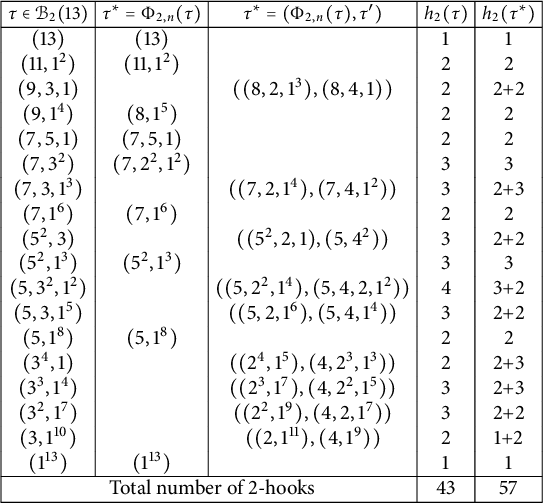
are also distinct. For example, see Table 2.
$\Phi _{2,n}(\tau )$
are also distinct. For example, see Table 2.
Outline of the proof of Theorem 1.2 for $n=13.$

Hence, we have the following.
 $$ \begin{align*} b_{2,2}(n)&=\sum_{\tau\in\mathcal{B}_2(n)}h_2(\tau)=\sum_{\substack{\tau\in\mathcal{B}_2(n)\\ \text{Case A}}}h_2(\tau)+\sum_{\substack{\tau\in\mathcal{B}_2(n)\\ \text{Case B}}}h_2(\tau)\\ &\leq \sum_{\substack{\tau\in\mathcal{B}_2(n)\\ \text{Case A}}}h_2(\Phi_{2,n}(\tau))+\sum_{\substack{\tau\in\mathcal{B}_2(n)\\ \text{Case B}}}(h_2(\Phi_{2,n}(\tau)+h_2(\tau'))\\ &=\sum_{\tau\in\mathcal{B}_2(n)}h_2(\tau^{*})\leq \sum_{\tau\in\mathcal{B}_3(n)}h_2(\tau)=b_{3,2}(n). \end{align*} $$
This completes the proof of the theorem.
3.2 Proof of Theorem 1.3
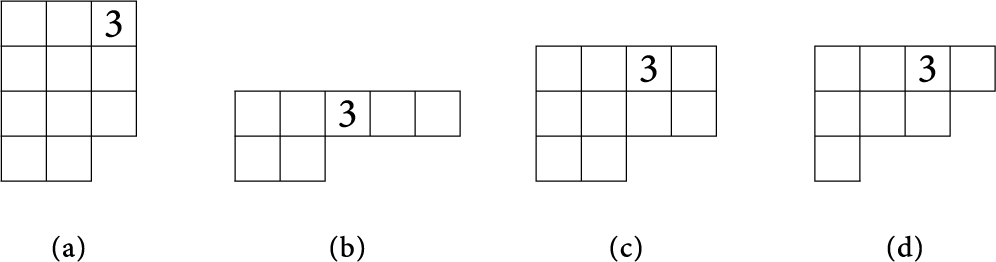
In the Young diagram of a partition, a hook of length 3, which we call a 3-hook may arise in four different ways.
-
(1) We call a 3-hook an
$m_3$
-3-hook if it arises due to the multiplicity of a part being greater than two and it appears in the third last column from the columns corresponding to
$\lambda _i$
in the Young diagram. -
(2) We call a 3-hook a g-3-hook if it appears in the column corresponding to a part
$\lambda _i$
with gap between
$\lambda _i$
and
$\lambda _{i+1}$
being more than 2. -
(3) We call a 3-hook an
$m_2$
-3-hook if it arises due to the multiplicity of a part
$\lambda _i$
being at least two and it appears in the second last column from the columns corresponding to
$\lambda _i$
in the Young diagram. -
(4) We call a 3-hook a s-3-hook if it appears in the column corresponding to a part
$\lambda _i$
with gap between
$\lambda _i$
and
$\lambda _{i+1}$
being exactly 1 and the part
$\lambda _{i+1}$
occurs once.


For example, see Figure 3.
Types of 3-hooks: (a) $m_3$
-3-hook, (b) g-3-hook, (c)
$m_3$
-3-hook, (b) g-3-hook, (c) $m_2$
-3-hook, and (d) s-3-hook.
$m_2$
-3-hook, and (d) s-3-hook.

Proof of Theorem 1.3
Similar to the case of 2-hooks, for $k\geq 1$
,
$k\geq 1$
, $\tau _k$
and
$\tau _k$
and $(\Phi _{2,n}(\tau ))_k$
have same number of
$(\Phi _{2,n}(\tau ))_k$
have same number of $m_3$
-3-hooks. Also, the number of g-3-hooks for
$m_3$
-3-hooks. Also, the number of g-3-hooks for $\tau _k$
is same as the number of g-3-hooks for
$\tau _k$
is same as the number of g-3-hooks for $(\Phi _{2,n}(\tau ))_k$
, when
$(\Phi _{2,n}(\tau ))_k$
, when $k\geq 1$
. However, the number of
$k\geq 1$
. However, the number of $m_2$
-3-hooks for
$m_2$
-3-hooks for $(\Phi _{2,n}(\tau ))_k$
is either equal to or one less than the number of
$(\Phi _{2,n}(\tau ))_k$
is either equal to or one less than the number of $m_2$
-3-hooks for
$m_2$
-3-hooks for $\tau _k$
, for
$\tau _k$
, for $k\geq 1$
. Note that for a 2-regular partition, there is no s-3-hook in its Young diagram. Therefore, the number of 3-hooks in
$k\geq 1$
. Note that for a 2-regular partition, there is no s-3-hook in its Young diagram. Therefore, the number of 3-hooks in $\tau _k$
can be, at the most, one less than the number of 3-hooks in
$\tau _k$
can be, at the most, one less than the number of 3-hooks in $(\Phi _{2,n}(\tau ))_k$
. For
$(\Phi _{2,n}(\tau ))_k$
. For $k=0$
, the number of
$k=0$
, the number of $m_3$
-3-hooks for
$m_3$
-3-hooks for $\tau _0$
is either equal to or one less than the number of
$\tau _0$
is either equal to or one less than the number of $m_3$
-3-hooks for
$m_3$
-3-hooks for $(\Phi _{2,n}(\tau ))_0$
. Whereas, the number of g-3-hooks for
$(\Phi _{2,n}(\tau ))_0$
. Whereas, the number of g-3-hooks for $\tau _0$
is either equal to or one more than the number of g-3-hooks for
$\tau _0$
is either equal to or one more than the number of g-3-hooks for $(\Phi _{2,n}(\tau ))_0$
and same is the case for
$(\Phi _{2,n}(\tau ))_0$
and same is the case for $m_2$
-3-hooks. Therefore, the number of 3-hooks in
$m_2$
-3-hooks. Therefore, the number of 3-hooks in $\tau _0$
can be, at the most, two less than the number of 3-hooks in
$\tau _0$
can be, at the most, two less than the number of 3-hooks in $(\Phi _{2,n}(\tau ))_0$
.
$(\Phi _{2,n}(\tau ))_0$
.
The idea of the proof is similar to the proof of Theorem 1.2. A partition $\tau \in \mathcal {B}_2(n)$
either has the number of 3-hooks less than or equal to the number of 3-hooks in
$\tau \in \mathcal {B}_2(n)$
either has the number of 3-hooks less than or equal to the number of 3-hooks in $\Phi _{2,n}(\tau )\in \mathcal {B}_3(n)$
, or (in the other case, when
$\Phi _{2,n}(\tau )\in \mathcal {B}_3(n)$
, or (in the other case, when $\tau $
loses 3-hooks while going under
$\tau $
loses 3-hooks while going under $\Phi _{2,n}$
) we associate a different partition, say
$\Phi _{2,n}$
) we associate a different partition, say $\tau '$
, to
$\tau '$
, to $\tau $
which compensates the loss.
$\tau $
which compensates the loss.
We study the triples $\tau _k$
in two cases.
$\tau _k$
in two cases.
Case 1: $\boldsymbol {k\geq 1.}$
Note that the number of
$\boldsymbol {k\geq 1.}$
Note that the number of $m_2$
-3-hooks for
$m_2$
-3-hooks for $\tau _k$
decreases under the map
$\tau _k$
decreases under the map $\Phi _{2,n}$
only when
$\Phi _{2,n}$
only when $\alpha _{k,3}\geq 2$
and
$\alpha _{k,3}\geq 2$
and $\alpha _{k,1}\geq 1$
. In that case, we associate a new tuple to
$\alpha _{k,1}\geq 1$
. In that case, we associate a new tuple to $\tau _k$
to cover the loss of an
$\tau _k$
to cover the loss of an $m_2$
-3-hook by using the following map:
$m_2$
-3-hook by using the following map:
 $$ \begin{align*} F(\tau_k)&=F\left(((6k+5)^{\alpha_{k,5}},~(6k+3)^{\alpha_{k,3}},~(6k+1)^{\alpha_{k,1}})_{k}\right)\nonumber\\ &=\left((6k+5)^{\alpha_{k,5}},~(6k+4)^2,~(6k+2)^{\alpha_{k,3}-2},~(6k+1)^{\alpha_{k,1}-1} ;~(6k-1),~1^{\alpha_{k,3}-2}\right)_{k}. \end{align*} $$
In this case, we associate
 $$ \begin{align*}\theta_k:=\left((6k+5)^{\alpha_{k,5}},~(6k+4)^2,~(6k+2)^{\alpha_{k,3}-2},~(6k+1)^{\alpha_{k,1}-1} \right)_{k}\end{align*} $$
to $\tau _k$
, which clearly has at least one 3-hook (
$\tau _k$
, which clearly has at least one 3-hook ( $m_2$
-3-hook corresponding to the parts
$m_2$
-3-hook corresponding to the parts $6k+4$
) to compensate the loss. Here, part
$6k+4$
) to compensate the loss. Here, part $6k-1=6(k-1)+5$
is considered as a part of
$6k-1=6(k-1)+5$
is considered as a part of $\tau _{k-1}$
, doing which does not decrease the number of 2-hooks in
$\tau _{k-1}$
, doing which does not decrease the number of 2-hooks in $\tau _{k-1}$
.
$\tau _{k-1}$
.
Case 2: $\boldsymbol {k=0.}$
In this case, there might be loss of at most two 3-hooks and that also when
$\boldsymbol {k=0.}$
In this case, there might be loss of at most two 3-hooks and that also when $\alpha _{0,3}>0$
. We have
$\alpha _{0,3}>0$
. We have $\tau _0=(5^{\alpha _{0,5}},~3^{\alpha _{0,3}},~1^{\alpha _{0,1}})$
. Depending on the multiplicity of the part 3,
$\tau _0=(5^{\alpha _{0,5}},~3^{\alpha _{0,3}},~1^{\alpha _{0,1}})$
. Depending on the multiplicity of the part 3, $\alpha _{0,3}=4\ell +j$
,
$\alpha _{0,3}=4\ell +j$
, $0\leq j\leq 3$
, we consider the following two cases.
$0\leq j\leq 3$
, we consider the following two cases.
Subcase (a): $\boldsymbol {\ell>0.}$
In this case, we compensate the loss with the following map:
$\boldsymbol {\ell>0.}$
In this case, we compensate the loss with the following map:
 $$ \begin{align*} G(\tau_0)=\left\{ \begin{array}{@{}lll} (5^{\alpha_{0,5}},~4^{3\ell},~1^{\alpha_{0,1}}) & \text{if}\ j=0; \\ (5^{\alpha_{0,5}},~4^{3\ell},~2,~1^{\alpha_{0,1}+1}) & \text{if}\ j=1; \\ (5^{\alpha_{0,5}},~4^{3\ell+1},~1^{\alpha_{0,1}+2}) & \text{if}\ j=2; \\ (5^{\alpha_{0,5}},~4^{3\ell+2},~1^{\alpha_{0,1}+1}) & \text{if}\ j=3. \\ \end{array} \right. \end{align*} $$
Clearly, in each case $G(\tau _0)$
has at least two 3-hooks. We associate
$G(\tau _0)$
has at least two 3-hooks. We associate $\theta _0$
to
$\theta _0$
to $\tau _0$
, which is
$\tau _0$
, which is $G(\tau _0)$
including the multiplicity of part size 1 coming from the other triples
$G(\tau _0)$
including the multiplicity of part size 1 coming from the other triples $\tau _k$
.
$\tau _k$
.
Subcase (b): $\boldsymbol {\ell =0.}$
Here,
$\boldsymbol {\ell =0.}$
Here, $j=0$
can not be the case since
$j=0$
can not be the case since $\alpha _{0,3}>0$
. For
$\alpha _{0,3}>0$
. For $j=3$
, the loss of a
$j=3$
, the loss of a $3$
-hook can be covered by the same map G in the above subcase, i.e.,
$3$
-hook can be covered by the same map G in the above subcase, i.e.,
 $$ \begin{align*} G(\tau_0)=G((5^{\alpha_{0,5}},~3^3,~1^{\alpha_{0,1}}))=(5^{\alpha_{0,5}},~4^{2},~1^{\alpha_{0,1}+1}). \end{align*} $$
We associate $\theta _0=(5^{\alpha _{0,5}},~4^{2},~1^{\alpha _{0,1}+1+\sum _{k\geq 1}\alpha _{k,3}})$
to
$\theta _0=(5^{\alpha _{0,5}},~4^{2},~1^{\alpha _{0,1}+1+\sum _{k\geq 1}\alpha _{k,3}})$
to $\tau _0$
in this case.
$\tau _0$
in this case.
For $j=1$
,
$j=1$
, $(\Phi _{2,n}(\tau ))_0=\Phi _{2,n}\left ((5^{\alpha _{0,5}},~3,~1^{\alpha _{0,1}})\right )=\left (5^{\alpha _{0,5}},~2,~1^{\alpha _{0,1}+\sum _{k\geq 0}\alpha _{k,3}} \right )$
. If either
$(\Phi _{2,n}(\tau ))_0=\Phi _{2,n}\left ((5^{\alpha _{0,5}},~3,~1^{\alpha _{0,1}})\right )=\left (5^{\alpha _{0,5}},~2,~1^{\alpha _{0,1}+\sum _{k\geq 0}\alpha _{k,3}} \right )$
. If either $\alpha _{0,1}\neq 0$
or
$\alpha _{0,1}\neq 0$
or $\sum _{k\geq 0}\alpha _{k,3}\neq 1$
then there is no loss of 3-hook under
$\sum _{k\geq 0}\alpha _{k,3}\neq 1$
then there is no loss of 3-hook under $\Phi _{2,n}$
. If
$\Phi _{2,n}$
. If $\alpha _{0,1}=0$
and
$\alpha _{0,1}=0$
and $\sum _{k\geq 0}\alpha _{k,3}=1$
, then the loss of a 3-hook is covered by taking 1 from
$\sum _{k\geq 0}\alpha _{k,3}=1$
, then the loss of a 3-hook is covered by taking 1 from $\sum _{k\geq 0}\alpha _{k,3}$
and changing part size 3 to part size 4 as follows:
$\sum _{k\geq 0}\alpha _{k,3}$
and changing part size 3 to part size 4 as follows:
 $$ \begin{align*} H(\tau_0)=H((5^{\alpha_{0,5}},~3))=\left(5^{\alpha_{0,5}},~4\right). \end{align*} $$
In this case, $\theta _0=H(\tau _0)$
.
$\theta _0=H(\tau _0)$
.
For $j=2$
,
$j=2$
, $(\Phi _{2,n}(\tau ))_0=\Phi _{2,n}\left ((5^{\alpha _{0,5}},~3^2,~1^{\alpha _{0,1}})\right )=\left (5^{\alpha _{0,5}},~2^2,~1^{\alpha _{0,1}+\sum _{k\geq 0}\alpha _{k,3}} \right )$
. If either
$(\Phi _{2,n}(\tau ))_0=\Phi _{2,n}\left ((5^{\alpha _{0,5}},~3^2,~1^{\alpha _{0,1}})\right )=\left (5^{\alpha _{0,5}},~2^2,~1^{\alpha _{0,1}+\sum _{k\geq 0}\alpha _{k,3}} \right )$
. If either $\alpha _{0,1}\neq 0$
or
$\alpha _{0,1}\neq 0$
or $\sum _{k\geq 0}\alpha _{k,3}\neq 0$
, then the loss of a 3-hook is covered by
$\sum _{k\geq 0}\alpha _{k,3}\neq 0$
, then the loss of a 3-hook is covered by
 $$ \begin{align*} I(\tau_0)=I((5^{\alpha_{0,5}},~3^2,~1^{\alpha_{0,1}}))=\left(5^{\alpha_{0,5}},~4,~1^{\alpha_{0,1}+\sum_{k\geq0}\alpha_{k,3}}\right). \end{align*} $$
For $\alpha _{0,1}=0$
and
$\alpha _{0,1}=0$
and $\sum _{k\geq 0}\alpha _{k,3}=0$
, let
$\sum _{k\geq 0}\alpha _{k,3}=0$
, let $n>6$
. Then, there is the smallest part with part size greater than or equal to 5, say
$n>6$
. Then, there is the smallest part with part size greater than or equal to 5, say $\lambda _i$
. In this case, we take 4 from the part
$\lambda _i$
. In this case, we take 4 from the part $\lambda _i$
and associate
$\lambda _i$
and associate $(4,~2^3)$
to
$(4,~2^3)$
to $(3^2)$
. For the remaining part
$(3^2)$
. For the remaining part $\lambda _i-4$
, we proceed by considering it as a part of the partition and if
$\lambda _i-4$
, we proceed by considering it as a part of the partition and if $\lambda _i-4=6r+6$
, for some
$\lambda _i-4=6r+6$
, for some $r\geq 0$
, then we change it to
$r\geq 0$
, then we change it to $(6r+5,1)$
along with other parts while applying
$(6r+5,1)$
along with other parts while applying $\Phi _{2,n}$
. If the final multiplicity of 1 is v then
$\Phi _{2,n}$
. If the final multiplicity of 1 is v then $(1^v)$
is changed to
$(1^v)$
is changed to $(2^{v/2})$
or
$(2^{v/2})$
or $(2^{(v-1)/2},1)$
, depending on v being even or odd, respectively. In this case,
$(2^{(v-1)/2},1)$
, depending on v being even or odd, respectively. In this case, $\theta _0:=(5^w,4^{1+z},2^y,1^x)$
, where x is the multiplicity of 1 (either 0 or 1);
$\theta _0:=(5^w,4^{1+z},2^y,1^x)$
, where x is the multiplicity of 1 (either 0 or 1); $y,z$
, and w are the multiplicities of parts 2,4, and 5 (respectively), which may also occur due to the part
$y,z$
, and w are the multiplicities of parts 2,4, and 5 (respectively), which may also occur due to the part $\lambda _i-4$
. For example, if
$\lambda _i-4$
. For example, if $\tau =(11,3^2)$
then
$\tau =(11,3^2)$
then $\tau '=(7,4,2^3)$
and
$\tau '=(7,4,2^3)$
and $\theta _0=(4,2^3)$
; if
$\theta _0=(4,2^3)$
; if $\tau =(7,3^2)$
then
$\tau =(7,3^2)$
then $\tau '=\theta _0=(4,2^4,1)$
; if
$\tau '=\theta _0=(4,2^4,1)$
; if $\tau =(5^2,3^2)$
then
$\tau =(5^2,3^2)$
then $\tau '=\theta _0=(5,4,2^3,1)$
.
$\tau '=\theta _0=(5,4,2^3,1)$
.
Now, let $\tau =(\tau _k)_{k\geq 0}\in \mathcal {B}_{2}(n)$
and
$\tau =(\tau _k)_{k\geq 0}\in \mathcal {B}_{2}(n)$
and $n>6$
. We consider two cases.
$n>6$
. We consider two cases.
Case A. If the number of 3-hooks in $\tau _k$
is less than or equal to the number of 3-hooks in
$\tau _k$
is less than or equal to the number of 3-hooks in $(\Phi _{2,n}(\tau ))_k$
for all k, then we define
$(\Phi _{2,n}(\tau ))_k$
for all k, then we define $\tau ^{*}:=\Phi _{2,n}(\tau )$
. Clearly,
$\tau ^{*}:=\Phi _{2,n}(\tau )$
. Clearly, $h_3(\tau )\leq h_3(\tau ^{*})$
.
$h_3(\tau )\leq h_3(\tau ^{*})$
.
Case B. If for any $k\geq 0$
, the number of 3-hooks in
$k\geq 0$
, the number of 3-hooks in $(\Phi _{2,n}(\tau ))_k$
is less than the number of 3-hooks in
$(\Phi _{2,n}(\tau ))_k$
is less than the number of 3-hooks in $\tau _k$
, we take
$\tau _k$
, we take $\tau '$
to be a partition in
$\tau '$
to be a partition in $\mathcal {B}_3(n)$
with
$\mathcal {B}_3(n)$
with $(\Phi _{2,n}(\tau ))_k$
replaced by the required
$(\Phi _{2,n}(\tau ))_k$
replaced by the required $\theta _k$
, which covers the loss of one or two 3-hooks. In this case, we define
$\theta _k$
, which covers the loss of one or two 3-hooks. In this case, we define $\tau ^{*}:=(\Phi _{2,n}(\tau ),\tau ')$
and
$\tau ^{*}:=(\Phi _{2,n}(\tau ),\tau ')$
and $h_3(\tau ^{*}):=h_3(\Phi _{2,n}(\tau ))+h_3(\tau ')$
(Note that
$h_3(\tau ^{*}):=h_3(\Phi _{2,n}(\tau ))+h_3(\tau ')$
(Note that $\tau ^{*}$
is a set of two partitions from
$\tau ^{*}$
is a set of two partitions from $\mathcal {B}_3(n)$
). In this case, also we have,
$\mathcal {B}_3(n)$
). In this case, also we have, $h_3(\tau )\leq h_3(\tau ^{*})$
.
$h_3(\tau )\leq h_3(\tau ^{*})$
.
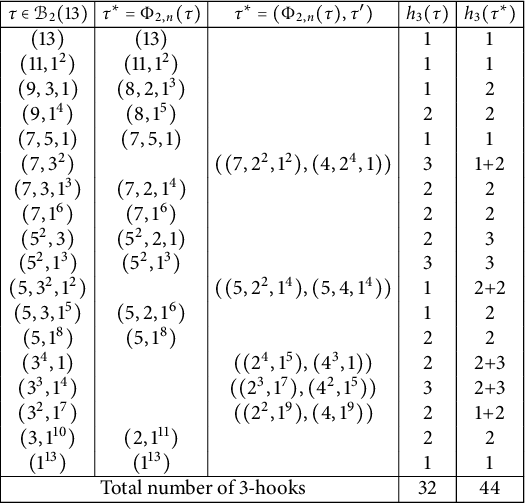
Outline of the proof of Theorem 1.3 for $n=13.$

Since $\Phi _{2,n}$
is an injective map, all
$\Phi _{2,n}$
is an injective map, all $\Phi _{2,n}(\tau )$
are distinct. Note that
$\Phi _{2,n}(\tau )$
are distinct. Note that $(\Phi _{2,n}(\tau ))_k$
and
$(\Phi _{2,n}(\tau ))_k$
and $\theta _k$
are all distinct as well. Therefore, all
$\theta _k$
are all distinct as well. Therefore, all $\tau '$
and
$\tau '$
and $\Phi _{2,n}(\tau )$
are also distinct. For example, see, Table 3. Hence, we have for
$\Phi _{2,n}(\tau )$
are also distinct. For example, see, Table 3. Hence, we have for $n>6$
$n>6$
 $$ \begin{align*} b_{2,3}(n)&=\sum_{\tau\in\mathcal{B}_2(n)}h_3(\tau)=\sum_{\substack{\tau\in\mathcal{B}_2(n)\\ \text{Case A}}}h_3(\tau)+\sum_{\substack{\tau\in\mathcal{B}_2(n)\\ \text{Case B}}}h_3(\tau)\\[4pt] &\leq \sum_{\substack{\tau\in\mathcal{B}_2(n)\\ \text{Case A}}}h_3(\Phi_{2,n}(\tau))+\sum_{\substack{\tau\in\mathcal{B}_2(n)\\ \text{Case B}}}(h_3(\Phi_{2,n}(\tau)+h_2(\tau'))\\[4pt] &=\sum_{\tau\in\mathcal{B}_2(n)}h_3(\tau^{*})\leq \sum_{\tau\in\mathcal{B}_3(n)}h_3(\tau)=b_{3,3}(n). \end{align*} $$
For $0\leq n\leq 6$
, it is easy to check that the inequality
$0\leq n\leq 6$
, it is easy to check that the inequality $b_{2,3}(n)\leq b_{3,3}(n)$
holds. This completes the proof.
$b_{2,3}(n)\leq b_{3,3}(n)$
holds. This completes the proof.
4 Concluding remarks
Let $t\geq 2$
and
$t\geq 2$
and $k\geq 1$
be integers. The main motive of our study is to find the biases among
$k\geq 1$
be integers. The main motive of our study is to find the biases among $b_{t,k}(n)$
and
$b_{t,k}(n)$
and $d_{t,k}(n)$
, for fixed values of k. If
$d_{t,k}(n)$
, for fixed values of k. If $\lambda $
is a t-distinct partition of n, then it is also a
$\lambda $
is a t-distinct partition of n, then it is also a $(t+1)$
-distinct partition of n. Therefore,
$(t+1)$
-distinct partition of n. Therefore, $d_{t+1,k}(n)\geq d_{t,k}(n)$
, for all
$d_{t+1,k}(n)\geq d_{t,k}(n)$
, for all $n\geq 0$
. For a fixed value of k, we want to find the biases in the following diagram:
$n\geq 0$
. For a fixed value of k, we want to find the biases in the following diagram:

In [Reference Li and Wang8, Theorem 1.6], Li and Wang proved that for all $t\geq 2$
and
$t\geq 2$
and $n\geq 0$
 $$ \begin{align*}\sum_{\lambda\in\mathcal{D}_t(n)}\overline{\ell}(\lambda)-\sum_{\lambda\in\mathcal{B}_t(n)}\overline{\ell}(\lambda)\geq0,\end{align*} $$
where $\mathcal {D}_t(n)$
is the set of all t-distinct partitions of n. Since
$\mathcal {D}_t(n)$
is the set of all t-distinct partitions of n. Since $h_1(\lambda )=\overline {\ell }(\lambda )$
, it implies that
$h_1(\lambda )=\overline {\ell }(\lambda )$
, it implies that $d_{t,1}(n)\geq b_{t,1}(n)$
, for all
$d_{t,1}(n)\geq b_{t,1}(n)$
, for all $t\geq 2$
and
$t\geq 2$
and $n\geq 0$
. Also, from Theorem 1.1 we have
$n\geq 0$
. Also, from Theorem 1.1 we have $b_{t+1,1}(n)\geq b_{t,1}(n)$
, for all
$b_{t+1,1}(n)\geq b_{t,1}(n)$
, for all $t\geq 2$
and
$t\geq 2$
and $n\geq 0$
. Therefore, for
$n\geq 0$
. Therefore, for $k=1$
, all the biases are known and the diagram is complete for all
$k=1$
, all the biases are known and the diagram is complete for all $t\geq 2$
and
$t\geq 2$
and $n\geq 0$
:
$n\geq 0$
:

It is known due to Ballantine et al. [Reference Ballantine, Burson, Craig, Folsom and Wen2] that $b_{2,2}(n)\geq d_{2,2}(n)$
for all
$b_{2,2}(n)\geq d_{2,2}(n)$
for all $n\geq 0$
and
$n\geq 0$
and $b_{2,3}(n)\geq d_{2,3}(n)$
for all
$b_{2,3}(n)\geq d_{2,3}(n)$
for all $n\geq 8$
. Also, we have Theorems 1.2 and 1.3. Therefore, for
$n\geq 8$
. Also, we have Theorems 1.2 and 1.3. Therefore, for $k=2,3$
, we have the following diagram for all but finitely many
$k=2,3$
, we have the following diagram for all but finitely many $n\geq 0$
:
$n\geq 0$
:

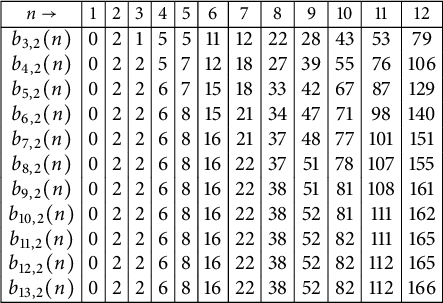
Our method of the proof of Theorem 1.2 can not be generalized to prove the biases for the number of hooks of length 2 in t-regular partitions for the next values of t. However, numerical evidence suggest that the number of hooks of length 2 in t-regular partitions increases with increasing values of t. For example, in Table 4, values in every column are in increasing order. In view of this, we propose the following conjecture.
Values of $b_{t,2}(n): 1\leq n\leq 12$
and
$b_{t,2}(n): 1\leq n\leq 12$
and $3\leq t\leq 13.$

Conjecture 4.1 Let $t\geq 3$
be an integer. We have
$t\geq 3$
be an integer. We have $b_{t+1,2}(n)\geq b_{t,2}(n)$
, for all
$b_{t+1,2}(n)\geq b_{t,2}(n)$
, for all $n\geq 0$
.
$n\geq 0$
.
Recently, several hook length biases among t-regular and t-distinct partitions have been established with the help of generating functions, see, for example, [Reference Ballantine, Burson, Craig, Folsom and Wen2, Reference Craig, Dawsey and Han3, Reference Singh and Barman12]. The generating functions of $b_{2,2}(n)$
and
$b_{2,2}(n)$
and $b_{3,2}(n)$
are already known. Our proof of Theorem 1.2 does not use any generating function technique. It would be interesting to prove the bias established in Theorem 1.2 with the help of generating functions. To find a similar proof of Theorem 1.3, we need to first derive the generating function of
$b_{3,2}(n)$
are already known. Our proof of Theorem 1.2 does not use any generating function technique. It would be interesting to prove the bias established in Theorem 1.2 with the help of generating functions. To find a similar proof of Theorem 1.3, we need to first derive the generating function of $b_{3,3}(n)$
as it is not yet known. Further, it would be very interesting to know if for positive integers k and
$b_{3,3}(n)$
as it is not yet known. Further, it would be very interesting to know if for positive integers k and $t\geq 2$
, there exists an integer
$t\geq 2$
, there exists an integer $N_{t,k}$
such that
$N_{t,k}$
such that $b_{t+1,k}(n)\geq b_{t,k}(n)$
, for all
$b_{t+1,k}(n)\geq b_{t,k}(n)$
, for all $n\geq N_{t,k}$
. This is true for certain values of t and k as we see in Theorems 1.1, 1.2, and 1.3. However, proving similar results for general values of t and k seems to be a hard problem.
$n\geq N_{t,k}$
. This is true for certain values of t and k as we see in Theorems 1.1, 1.2, and 1.3. However, proving similar results for general values of t and k seems to be a hard problem.










 Open access

