


Introduction
Illegal activities such as poaching, livestock grazing, and extraction of timber and non-timber forest products are the major threats to biodiversity in protected areas (Hilborn et al., Reference Hilborn, Arcese, Borner, Hando, Hopcraft and Loibooki2006; Biggs et al., Reference Biggs, Courchamp, Martin and Possingham2013). The conservation objectives of protected areas in West Africa mostly include the protection of animal populations against commercial or non-commercial subsistence harvesting and protection of ecosystems against the extraction of timber and other resources, to prevent habitat loss. Efforts are needed to achieve these objectives because of the increasing human population of West Africa (International Cooperation and Development, 2016) and, consequently, increasing socio-economic pressures on land and resources. Management of protected areas therefore requires comprehensive approaches involving a clearly defined vision, mission and management plan, effective law enforcement, training programmes for staff, educational and awareness campaigns, and cooperation with local communities. Effective law enforcement in protected areas results in fewer illegal activities (Fischer et al., Reference Fischer, Naiman, Lowassa, Randall and Rentsch2014; Moore et al., Reference Moore, Mulindahabi, Masozera, Nichols, Hines and Turikunkiko2017) but, when not implemented, biodiversity may decline (Peres & Terborgh, Reference Peres and Terborgh1995).
Assessing law enforcement effectiveness in protected areas in Africa relies mostly on ranger-collected monitoring data. The effectiveness of law enforcement depends on patrol strategies, determined by managers, and on the structure of enforcement incentives (Robinson & Lokina, Reference Robinson and Lokina2012). The deterrence of illegal activities could, however, be low if detection rates are low and benefits outweigh penalties, and even lower if there is an ambiguous legal framework regarding land tenure (e.g. Abbot & Mace, Reference Abbot and Mace1999; Nolte, Reference Nolte2016).
Optimal ranger patrol strategies differ depending on the threat. Each threat may be targeted effectively based on the knowledge of past spatial and temporal patterns of illegal activities and an appropriate allocation of ranger patrols (Critchlow et al., Reference Critchlow, Plumptre, Driciru, Rwetsiba, Stokes and Tumwesigye2015). Strategies targeting illegal activities based on predictions of their spatial distribution improve law enforcement efficiency even without any increase in ranger resources (Nyirenda & Chomba, Reference Nyirenda and Chomba2012; Plumptre et al., Reference Plumptre, Fuller, Rwetsiba, Wanyama, Kujirakwinja and Driciru2014; Critchlow et al., Reference Critchlow, Plumptre, Alidria, Nsubuga, Driciru and Rwetsiba2017). Approaches using spatial planning tools make law enforcement more effective, yet are not applied in all protected areas, especially in West Africa. The main reasons seem to be inadequate training in the use of software and the lack of evaluation of outcomes from ranger patrols.
In Ghana, a ranger-based monitoring system was implemented by the Wildlife Division of the Forestry Commission in 2004. It focuses on patrols assigned to monitor illegal activities and mammal populations in protected areas. The system incorporated tools to assess staff performance and the effectiveness of field operations, to assist protected area managers in adopting appropriate law enforcement strategies to achieve conservation objectives (Jachmann, Reference Jachmann2008a,Reference Jachmannb). This system was evaluated by several studies that identified internal (e.g. budget) and external (e.g. local population density, level of tourism) factors as key elements that may support or decrease the performance of protected areas (Jachmann, Reference Jachmann2008a,Reference Jachmannb; Jachmann et al., Reference Jachmann, Blanc, Nateg, Balangtaa, Debrah and Damma2011; Wiafe & Amoah, Reference Wiafe and Amoah2012; Wiafe, Reference Wiafe2016). These studies focused on short-term data (2–4 years) collected shortly after the implementation of the system. The long-term dynamics of the system have not previously been examined.
The aim of our investigation was therefore to examine the long-term dynamics of the conventional ranger-based monitoring system in the Kogyae Strict Nature Reserve in Ghana and to provide an assessment of the incidences of poaching activities. Using data for January 2006–August 2017 on monthly patrol performance and poaching-related encounters, our objectives were to evaluate the temporal pattern of patrol staff performance and to examine what factors or events could have affected it. In addition, we investigated the temporal patterns of illegal activities in the Reserve and aimed to identify whether the increasing human population around the Reserve affects the encounter rate of illegal activities.
Study area
The 386 km2 Kogyae Strict Nature Reserve (Fig. 1) lies in the Afram Plains region of Ghana. It is a flat area with a mean altitude of 120 m, with some areas reaching 230 m. The higher areas are the watershed for a network of streams dominated by tributaries of the Afram and Sene rivers, most of which dry up in the dry season (Hagan, Reference Hagan1998). The climate has dry (November–March) and wet (April–October) seasons, with a total annual rainfall of 1,200–1,300 mm. Kogyae lies between transitional woodland (semi-deciduous forest) and Guinea savannah woodland and open grasslands (Wildlife Department, 1994). A large ungulate community of conservation importance includes the buffalo Syncerus caffer, hartebeest Alcelaphus buselaphus, waterbuck Kobus ellipsiprymnus, Buffon's kob Kobus kob, bushbuck Tragelaphus scriptus, oribi Ourebia ourebi, red-flanked Cephalophus rufilatus, black Cephalophus niger, Maxwell's Cephalophus maxwelli and bay Cephalophus dorsalis duikers, red river hog Potamochoerus porcus and warthog Phacochoerus africanus. The Reserve also supports the baboon Papio anubis, patas Erythrocebus patas, green Chlorocebus sabaeus, mona Cercopithecus mona and spot-nosed Cercopithecus petaurista monkeys, and white-thighed colobus Colobus vellerosus (Wildlife Department, 1994).
Kogyae Strict Nature Reserve in Ghana, indicating the location of villages and rangers’ camps (adapted from Ayivor & Ntiamoa-Baidu, Reference Ayivor and Ntiamoa-Baidu2015).
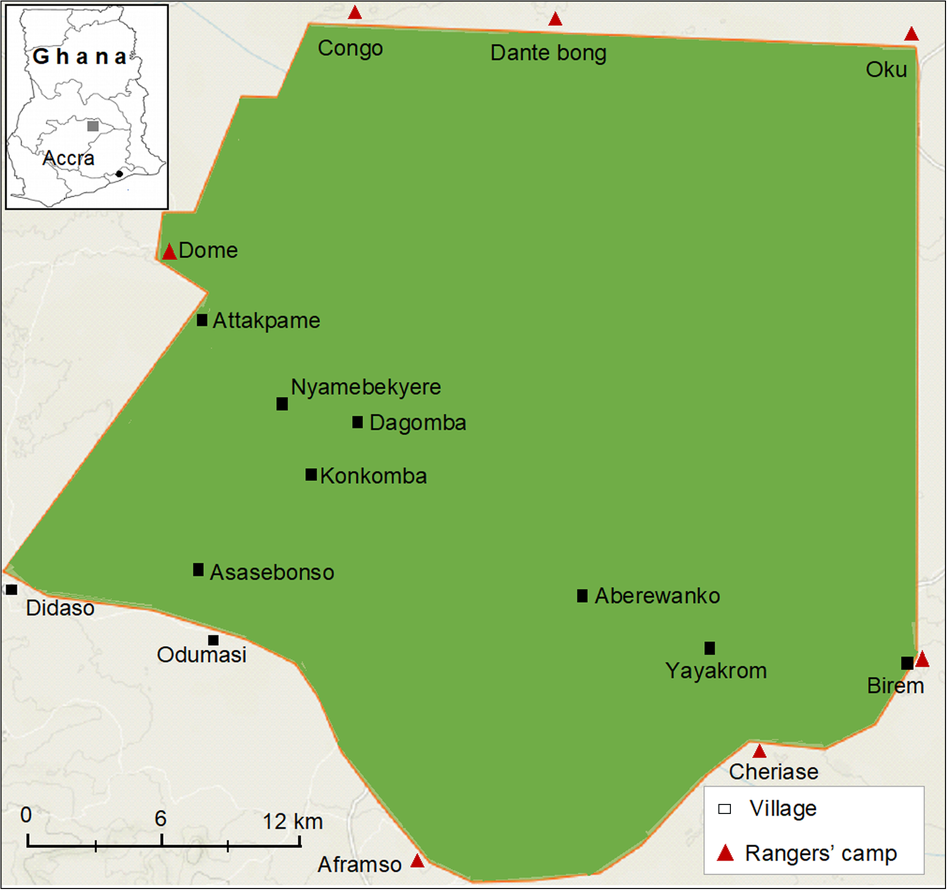
The Kogyae Strict Nature Reserve is the extended former Kujani Forest Reserve, formerly managed by the Forestry Department. In 1971, the administration of the Reserve was handed to the Wildlife Division for strict protection under the Wildlife Reserve Regulations, LI 710. The Kujani Forest Reserve boundary extension was to obtain a viable ecological unit for the Kogyae Strict Nature Reserve (Oduro-Ofori et al., Reference Oduro-Ofori, Ocloo, Peprah and Effah2015). This became necessary because studies by the Wildlife Division indicated that, in the dry season, the animals in the Reserve depend on the rivers in unprotected areas for survival (Ayivor & Ntiamoa-Baidu, Reference Ayivor and Ntiamoa-Baidu2015). The extension also includes the communities of Asasebonso, Atakpame, Nyamekyere Dagomba, Birem, Yahayakura, Aberewanko and Konkomba. Additionally, Aframso, Birem, Chichibon and Kyeiase lie along the border of the Reserve (Ayivor & Ntiamoa-Baidu, Reference Ayivor and Ntiamoa-Baidu2015). Local communities comprise predominantly farmers, with up to 75% of the people in the area working in the agriculture sector (Ministry of Finance, 2015). Farming practices involve a slash and burn method of land clearing and cultivation of a variety of crops (yam, maize, paddy rice, groundnuts, cassava, cowpeas and vegetables). Fifteen and 10% of the population work in the industry and service sectors, respectively. The population in the district is increasing at a rate of 1.4% per year (Ministry of Finance, 2015).
The Kogyae Strict Nature Reserve is managed by a manager, who is assisted by a law enforcement officer in charge of field operations. The patrol staff are employees of the Wildlife Division and are based only in Kogyae. The number of patrol staff varied from 31 to 44 during 2006–2017. The annual budget during 2006–2015 was GHC 6,000 (c. 1,130 USD); this was increased to GHC 40,000 (c. 7,460 USD) in 2016.
Kogyae has four management zones: the Protected, Special-use, Restoration and Development Zones. The Protected Zone is the largest, comprising 220 km2 (57%). This is the most important and least disturbed Zone, fully dedicated to conservation. The 79 km2 Special-use Zone (20%) is an area where some farming activities by local inhabitants are allowed, but not hunting or logging. The 86 km2 Restoration Zone (22%) are those lands that have been degraded or significantly altered by farming, logging and charcoal making; they are leased to immigrants for settlement and farming. The management priorities in this Zone exclude all forms of destructive activities and the Zone is dedicated to the recovery of vegetation and wild animal populations. The 1 km2 Development Zone (1%) has been set aside for staff accommodation, administration facilities, a research station and a centre for conservation education.
Methods
Patrol operations management
Kogyae uses conventional law enforcement in the form of foot patrols that operate from the headquarters and from camps established in each of seven communities at the periphery of the Reserve. A grid map is used for planning of patrol routes, to ensure that the entire Reserve is patrolled each month (described in detail by Jachmann, Reference Jachmann2008a). A foot patrol comprises at least five rangers, led by the most senior of the group. Standardized forms are used to record data: the number of staff on patrol, duration, total distance travelled, and types, number and locations of illegal activity encountered. Illegal activities recorded include poachers arrested, poachers observed, firearms confiscated, gunshots heard, poachers’ camps found, animals found killed, snares recovered and cartridges found.
Evaluation of patrol staff performance
In evaluating the performance of patrol staff, we used the monthly distance walked by all patrols and the effective patrol time, which is a measure of time spent in the field by a patrol team without including deployment time (sensu Bell, Reference Bell, Bell and McShane-Caluzi1985, as applied by Jachmann, Reference Jachmann2008a; Nyirenda & Chomba, Reference Nyirenda and Chomba2012). To facilitate comparison of law enforcement performance across protected areas, two standardized measures of monthly patrolling effort were used: (1) effective patrol man-days calculated as the monthly effective patrol time divided by 8 hours (assigned time unit as standard for 1 patrol day), multiplied by the number of staff in the patrol group, and (2) effective patrol days calculated as the total effective patrol man-days for the month divided by the number of active staff on duty for the month.
We used catch per unit effort (Bell, Reference Bell, Bell and McShane-Caluzi1985; Jachmann, Reference Jachmann2008a) to measure the level of encounter rates with indicators of illegal activities per given period. Catch refers to the total number of monthly encounters with indicators of illegal activity, and the effort is the total number of effective patrol man-days per month.
A kilometric index of abundance, which is the ratio of the number of illegal activities encountered to distance walked by patrols per month, was used as a second measure of encounter rate. The kilometric index of abundance was multiplied by 100, to give the number of encounters per 100 km.
Data collection and analyses
We collected data on law enforcement operations during January 2006–August 2017, and we carried out field visits and informal interviews with the manager and patrol staff to gain insights into patrol operations. Locations of the illegal activities encountered were not available and therefore spatial aspects of law enforcement could not be evaluated. Total distance walked by patrols was only available for 2006–2014, when the GPS units were functioning. All data parameters recorded were examined with the Kolmogorov–Smirnov test and found to be normally distributed.
To examine any annual, monthly or seasonal (wet vs dry) trends in patrol staff performance, general linear models were applied for each parameter separately as the dependent variable, with year, month and season as the independent predictors. In the case of significant differences, we used post hoc Tukey HSD tests to examine any further differences.
Catch per unit effort and the kilometric index of abundance were highly correlated (Pearson's r = 0.94, P < 0.001) and therefore only the catch per unit effort was used for further analyses. To examine differences in encounter rates with various types of illegal activities and their temporal trends, we used general linear models, with catch per unit effort as the dependent variable and year, month, illegal activity type, year × illegal activity type and month × illegal activity type interactions as the independent predictors. Post hoc Tukey HSD tests were used to examine any further differences among the levels of predictors if the general linear model was significant. To examine the effect of patrol staff performance and the number of inhabitants in the district surrounding Kogyae (which increased annually during the years of monitoring) on encounter rate with illegal activities, we used simple linear regression. We used STATISTICA 13 (TIBCO Software, Palo Alto, USA) to perform all statistical analyses.
Results
Patrol staff performance
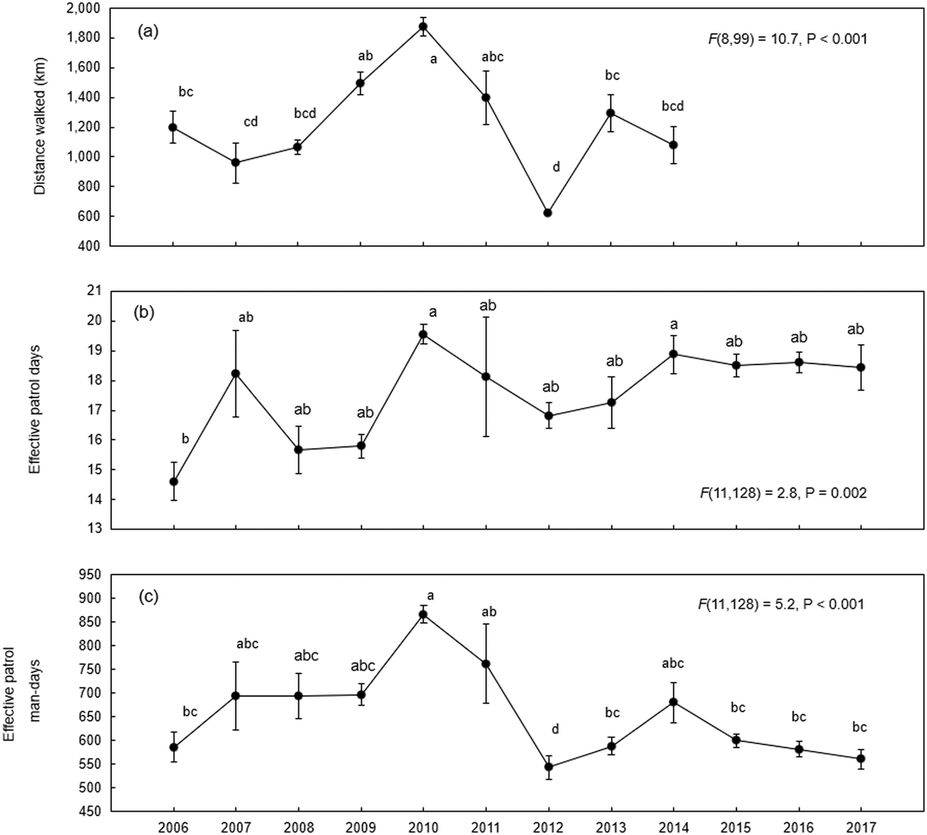
The mean monthly distance walked by patrols in the Kogyae Strict Nature Reserve during 2006–2014 was 1,221 ± SE 47 km/month, with a minimum of 623 ± SE 0 km/month in 2012 to a maximum of 1,874 ± SE 64 km/month in 2010. Mean monthly effective patrol days were 17.5 ± SE 0.3 and mean monthly effective patrol man-days were 657 ± SE 14 during 2006–2017. The dynamics of patrol staff performance differed significantly among years but there was no obvious trend (Fig. 2). Performance in 2006 was similar to the levels measured after 2014 in all three parameters, with peaks in 2010 (Fig. 2).
Patrol staff performance in the Kogyae Strict Nature Reserve, Ghana (Fig. 1), during 2006–2017 measured as (a) mean monthly patrol distance walked, (b) mean monthly effective patrol days, and (c) mean monthly effective patrol man-days. Bars indicate SE. Different letters for years indicate significant differences at P = 0.05, detected with Tukey HSD post hoc tests.
Differences in the monthly distance walked by patrols (Fig. 3a) and effective patrol days (Fig. 3b) were not significant. Effective patrol man-days were, however, significantly different, with a peak in March and a low in October (Fig. 3c), and higher in the dry (686 ± SE 18 patrol man-days) than in the wet season (628 ± SE 21 patrol man-days Fig. 3c).
Monthly patrol staff performance in the Kogyae Strict Nature Reserve, Ghana measured as (a) mean patrol distance walked, (b) mean effective patrol days, and (c) mean effective patrol man-days. Bars indicate SE. Different letters indicate significant differences at P = 0.05, detected with Tukey HSD post hoc tests. The dry season is November–March and the wet season April–October.

Illegal activities
There were differences in the mean encounter rates of illegal activities during 2006–2017 (F(6, 947) = 52.5, P < 0.001). The highest encounter rate was with snares, followed by gunshots heard. The lowest indices were confiscated firearms and poachers arrested (Table 1).
Mean ± SE catch per unit effort and kilometric index of abundance of illegal activities encountered in the Kogyae Strict Nature Reserve (Fig. 1) during 2006–2017.

1 Using Tukey HSD post hoc tests, mean values with different letters indicate significant difference (at P = 0.05) among the encounters of illegal activities during 2006–2017.
2 Number of observations per 100 km.
There were annual increases in illegal activities encountered (comprising principally numbers of snares found, poachers observed and gunshots heard) following the implementation of ranger-based monitoring in 2004, to a peak catch per unit effort in 2009 (Fig. 4). Illegal activities then fell and remained relatively constant during 2012–2017. There was no significant variation in catch per unit effort of illegal activities between months (Fig. 5).
Inter-annual trend trends of encounter rates (± SE) with illegal activities per monthly effective patrol man-days in the Kogyae Strict Nature Reserve during 2006–2017. Different letters indicate significant differences at P = 0.05, detected by Tukey HSD post hoc tests.

Mean encounter rates (± SE) of illegal activities from January to December in the Kogyae Strict Nature Reserve across all years (2006–2017).

Encounter rates of illegal activities decreased with increased effective patrol days (r 2 = 0.05, P = 0.008). Similarly, the encounter rates with illegal activities showed a significantly negative relationship with the increasing number of inhabitants in the district where Kogyae Strict Nature Reserve is located (r 2 = 0.1, P < 0.001).
Discussion
Patrol staff performance
The performance of patrol staff in Kogyae was lowest in 2006, most likely because the patrol-based monitoring system was then in the early phase of its implementation. Analysis of staff performance in the first 2 years (2005–2006) after the implementation of the patrol-based monitoring system in nine protected areas in Ghana (Jachmann, Reference Jachmann2008a) revealed that performance of staff in Kogyae was 3.8–16.3 effective patrol days, similar to that of Ankasa Conservation Area (3.4–14.8 effective patrol days). Our study shows that patrol staff performance in Kogyae improved by c. 35% in 2007 (Fig. 2b), and was highest in 2010, primarily a result of motivation of rangers through external support from the Royal Netherlands Embassy in Accra in the form of food rations (J. Osei-Mensah, pers. comm., 2018). The findings of Jachmann's analysis (Reference Jachmann2008a) aroused the interest of the management of the Ghanaian Wildlife Division in the patrol system, and motivations were offered across protected areas in Ghana (Jachmann, Reference Jachmann2008a).
The reasons for the decline in staff performance after 2011 were threefold. Firstly, in 2011 and 2012 a number of the patrol staff retired, and there was a delay in the recruitment of new staff. Secondly, long patrols mostly accounted for the high performance of patrol staff, and for each such patrol, the Reserve vehicle transported patrol staff and equipment to the locations where patrols began. However, the vehicle was stolen in 2012 and thereafter patrol staff resorted to long patrols on foot, which is time- and energy-consuming, especially when moving between the base and the locations where patrols started and finished. Thirdly, the tents required for long patrols were damaged, and replacements were not provided. All these factors caused patrol staff to resort to day or night patrols only. Provision of equipment is particularly crucial given the dangerous nature of the work, with poachers sometimes resisting arrest violently, and in some cases injuring or even killing patrol staff (in Kyabobo National Park: Frimpong, Reference Frimpong2013; in Mole National Park: Daily Graphic, 2018). Poachers have killed or assaulted patrol staff in Lobéké National Park, Cameroon (Mathiesen, Reference Mathiesen2016), Maswa Game Reserve, Tanzania (BBC News, 2016) and Savé Valley Conservancy, Zimbabwe (Lindsey et al., Reference Lindsey, Romañach, Matema, Matema, Mupamhadzi and Muvengwi2011).
Unofficial reports suggest patrol staff performance decreases during the wet season in Ghana because the patrol staff tend their own farms during this season, to supplement their income (Wiafe & Amoah, Reference Wiafe and Amoah2012). However, we did not record any significant difference in the performance of staff between the dry and wet seasons, similar to the report by Wiafe & Amoah (Reference Wiafe and Amoah2012) for the Kakum Conservation Area in Ghana. However, during the months of the peak wet season, patrol staff performance was slightly but not significantly lower compared to the dry season (Fig. 3). This was probably because of intensive rainfall, which makes movement and sightings difficult, and because there was no logistical support specific for rainy weather.
Changes in the encounters of illegal activities
In 2008 and 2009 patrol staff performance slightly decreased, though not significantly, in comparison with that of 2007 (Fig. 2), but an increase was observed in encounter rates with illegal activities (Fig. 4). This could have been the result of patrol staff concentrating their operations in areas where there was a high probability of encountering illegal activity, especially in the Special-use Zone. Although patrol staff effort was greatest in 2010 there was a lower encounter rate of illegal activities compared to the highest encounter rates in 2009. Poachers may have adjusted their behaviour (Montgomery & Blalock, Reference Montgomery and Blalock2010) or ceased to operate upon noticing the increase in regular patrols, decreasing the likelihood of illegal activities being detected. During 2011–2017, when patrol staff performance stabilized (Fig. 2), the detection of illegal activities remained low (Fig. 4). This could be attributed to patrol staff learning and gaining experience in adapting their patrol strategies to achieve patrol objectives, as suggested by the Park manager (J. Osei-Mensah, pers. comm., 2018). Another possible explanation is that poachers changed their behaviour, leading to a decrease in the rate of detection by patrols even in high-risk areas (as reported by Abbot & Mace, Reference Abbot and Mace1999), and/or changed their poaching techniques.
The most frequently recorded illegal activity in Kogyae was the use of snares, as in other protected areas in Ghana (Wiafe, Reference Wiafe2018) and elsewhere (Queen Elizabeth Conservation Area, Uganda: Critchlow et al., Reference Critchlow, Plumptre, Driciru, Rwetsiba, Stokes and Tumwesigye2015; Serengeti National Park, Tanzania: Hurt & Ravn, Reference Hurt, Ravn, Prins, Grootenhuis and Dolan2000; Nyahongo et al., Reference Nyahongo, East, Mturi and Hofer2005; Holmern et al., Reference Holmern, Muya and Røskaft2007). As the use of snares is silent, poachers using them are less likely to be detected than poachers using firearms, and placing more snares maximizes the probability of hunting success. Animals found dead during patrols had mostly been caught in snares, similar to reports from other countries (e.g. Zambia: Becker et al., Reference Becker, McRobb, Watson, Droge, Kanyembo, Murdoch and Kakumbi2013), or died of infections from injuries suffered as a result of trying to escape from snares. The apparent preference for snares by poachers in Kogyae suggests that snaring may lead to a lower arrest rate because the time spent hunting is reduced (Table 1). This change in poaching method from firearms to snares was indicated by the changes in the encounter rates of poachers observed, which was notably high in 2008 and 2009 (Fig. 5). After 2009, a decline was observed in the direct encounters and in the numbers of poacher camps found in the Reserve, gunshots heard, and firearms confiscated. ‘Cartridges found’ was included as a new category of illegal activity in Kogyae in 2013 but was not frequently encountered by patrol teams.
The weak relationship between the encounters with illegal activities and the number of people in the district where Kogyae is located contrasts with the general findings of increasing pressures on ecosystems coupled with increasing population (e.g. Veldhuis et al., Reference Veldhuis, Ritchie, Ogutu, Morrison, Beale and Estes2019). The weakness of this relationship in Kogyae might be a consequence of the implementation of regular and active patrols specifically in the Reserve, because many inhabitants of the local communities, upon noticing these patrols, avoided entry into the Reserve (J. Osei-Mensah, pers. comm., 2018). However, data on encounters of illegal activities are directly related to the killing of animals, whereas other human activities, such as conversion of habitat for agricultural purposes or grazing of livestock within the Reserve, were not covered in the ranger-based patrol monitoring system. Including these aspects as illegal activities could render the monitoring and evaluation both difficult and controversial as agricultural land use is part of the livelihoods of people inhabiting the Special-use Zone. Considering that the majority of the population is involved in agricultural production, the effects of these activities on wildlife and their habitats throughout the Reserve require further study.
Long-term assessment of law enforcement in protected areas provides stakeholders with information on patrol staff performance over time and on illegal activities related to wildlife. Our findings indicate that patrol staff performance in Kogyae Strict Nature Reserve was partly dependent on logistical support, such as the provision of GPS units, tents, motorbikes, bicycles and other equipment. It means that patrol staff performance depends on the budget allocated by the government to protected areas or on external funding to support conservation. Improvements in provision of equipment would serve not only as an incentive for working in uncomfortable conditions but would also help rangers to feel their work is valued. To improve law enforcement and conservation in Kogyae, we also recommend training for rangers in the use of monitoring tools based on spatial information and the implementation of law enforcement allocation methods that allow prediction of illegal activities and targeting of conservation priorities. Spatial crime mapping approaches such as the Management Information SysTem (MIST, 2021) and the Spatial Monitoring and Reporting Tool (SMART, 2021) have proven to be effective in resource-limited settings (e.g. Critchlow et al., Reference Critchlow, Plumptre, Alidria, Nsubuga, Driciru and Rwetsiba2017), but this approach has not been used in Kogyae. These spatio-temporal approaches, which link the occupancy of large mammals to habitats and to human-related factors, would enable decision-makers to act more efficiently for successful conservation.
Acknowledgements
The study was supported by the Czech University of Life Sciences Prague, project CIGA 20185007. We thank the Wildlife Division of Ghana for granting permission for this study, and the rangers in Kogyae Strict Nature Reserve, including at the headquarters, for their support.
Author contributions
Conceptualization, design: JOA, MOA; data collection, analysis, interpretation: all authors; writing, revision: JOA, MOA, PH.
Conflicts of interest
None.
Ethical standards
Research approval and permits were granted by the Wildlife Division of the Forestry Commission of Ghana (permit number WD/A.30/VOL. 11/28). This research abided by the Oryx guidelines on ethical standards.


 Open access

