

Introduction
This article examines how a number of teachers of Classics at secondary school level say they deal with sensitive topics, such as violence, religious belief, death and sex and sexuality. In the secondary school original texts are read partly for improving the students' understanding of the language and partly for the study of other aspects of the ancient society, such as the subject matter and the process of a legal case, for example. Therefore, sensitive topics often arise incidentally during the reading of a text rather than because they are the particular feature of the reading. Should teachers brush past such an topic for fear of causing offence or getting into trouble with school authorities or parents, or should they use the topic to develop their students' understanding of the topic at hand – and if the latter, how far should they go?
The article starts with a review of existing literature about how teachers of classical subject matter say they teach sensitive topics – drawing mostly on published materials from the tertiary sector and from the US perspective. It then moves on to research carried out among 30 classics teachers in UK secondary schools. Firstly it addresses the question how far these teachers are prepared to go in discussing different types of sensitive topics which arise in their teaching of classical subjects; and secondly it asks them for their recommendations for beginning teachers.
Should we teach controversial and sensitive topics?
In other subject areas there is little disagreement, in theory, that teaching students how to deal with sensitive topics is an important part of schooling. As Claire and Holden (Reference Claire and Holden2007) say:
Learning how to deal with sensitive or controversial topics in a structured setting, through topics introduced into the classroom, can be a rehearsal for dealing with more immediate controversy in the playground, home or community. It is also a part of preparation for living in a democratic society where controversial topics are debated and discussed without recourse to violence. (Claire & Holden, Reference Claire and Holden2007, p. 43)
The study of classical subjects should be no different. Indeed, nearly 40 years ago the classics educationalist John Sharwood Smith was advocating that ‘any serious educator – that is, a teacher who is not content to teach merely what is in the syllabus for the reason that it is in the syllabus – will want to teach his pupils how to learn how to live’ (Sharwood Smith, Reference Sharwood Smith1977, p. 4). His belief that the best Classics teacher would seek to achieve ‘education through Classics’ as well as ‘education in Classics’ (Sharwood Smith, Reference Sharwood Smith1977, p. 9) summarises the point: knowledge about the ancient world is interesting and worthwhile for a student to have in the 21st century, but it is what students do with their knowledge of the classical world which makes the study of it pertinent to their own lives and all the more worthwhile doing. Educationalists specialising in Classics, such as Bolgar (Reference Bolgar1963, p. 17), Gay (Reference Gay and Morwood2003, p. 33), Gruber-Miller (Reference Gruber-Miller and Gruber-Miller2006, pp. 14-15), Lister (Reference Lister2007, p. 10) and Pring (Reference Pring2016) seem to agree: they have all asserted in their turn that by reading original texts and commenting on material culture students are able to learn something significant about the ancient world through the words and actions of the people themselves, to be able to draw comparisons between humans long ago and in modern times, and to become more reflective about themselves and contemporary society. This concept of ‘critical distance’ (Hardwick, Reference Hardwick and Hardwick2003, p. 9) has been well-documented as a successful pedagogical approach. The University of Exeter's Sex and History Project (Langlands & Fisher, Reference Langlands and Fisher2016) was specifically designed to encourage student reflections about modern attitudes to sex and relationships through discussion focusing on ancient objects. Most frequently, however, encounters with the ancient world in the classroom take place when students read original texts. These encounters with the ‘parallel universe’ (Hall, Reference Hall2016) of the ancient world can be said to provide students with an opportunity to take an ‘essential step closer to an understanding of otherness outside ourselves’ (Settis, Reference Settis2006, p. 107), while the subject matter can act as ‘the great conversation openers’ and the study of Classics itself can be a tool which is ‘good to think with as well as about’ (Cartledge, Reference Cartledge, Too and Livingstone1998, p. 28). Hardwick, discussing the power of ancient myth to achieve these ends, explains:
Ancient myth is both distant and personal. It provides a conduit between crisis and transition that is both explanatory and challenging to authors and readers alike. (Hardwick, Reference Hardwick, McConnell and Hall2016, p. 77)
The metaphor of a conduit is apposite. It is clear that such a conduit has the potential to flow and refresh in every classroom with every single glimpse of text or material culture – provided that the teacher allows it or seeks a means to achieve it.
In summary, then, the teacher can address the sensitive topic in three ways of what one might describe as increasing sophistication: as a straightforward investigation into a matter of socio-historical significance; as an opportunity to provide further reflection on more modern and contemporary events and circumstances; and as a way to develop the methodologies of critical enquiry and engagement which can be transferred to other occasions – classical or otherwise.
Learning for Life with Latin
I am concerned more specifically in this article with the study of Latin in UK secondary schools. Latin in this environment nearly always comprises the study of the literature and society of the Romans, as well as the Latin language. Most students of Latin therefore come into contact with sensitive topics almost every time they open their course books. The majority of UK Latin teachers have adopted reading-approach course books and the majority of them use the Cambridge Latin Course which has perhaps 90% of the Latin course book market share (Cambridge School Classics Project, 2015). The Latin stories in the CLC (like those in the other reading courses ecce Romani, The Oxford Latin Course and Imperium) form a continuous narrative which deliberately incorporates many important socio-cultural topics. The sensitive topics of sex and sexuality, death, violence and ethical topics such as slavery and the treatment of women, are thus part and parcel of the majority of the teaching of Latin in UK secondary schools today. Just by way of example, while studying Book One of the Cambridge Latin Course students typically aged 11 or 12 years old are exposed to Roman attitudes towards slavery (Stages 3 and 6: the slave-market and manumission), towards women (Stages 1, 3 and 9: the role of the materfamilias Metella and the slave girl Melissa), towards foreigners (Stages 3 and 10: the Syrian slave-dealer Syphax and the Greek teacher Theodorus), towards religious minorities (Stage 8: Christians), towards death (Stage 7: funeral rituals and beliefs in the afterlife), and towards extreme violence (Stage 8: gladiatorial combat and the riot in Pompeii in AD 59). In Stage 12 of the course book, Vesuvius erupts and destroys nearly all of the main characters, including a fairly graphic portrayal of the death of the main character Caecilius, the loss of Metella his wife (missing, presumed dead), and countless other people in the ashes of Pompeii. For good measure the book ends with a photo-montage of plaster casts of the Pompeian dead. Even Cerberus the family dog dies (and often seems to cause more consternation in the classroom than the deaths of the humans). For those who continue with Latin after their first year, further sensitive topics of increasing sophistication arise in the continuous narrative which comprises the next four books: the unfair blame, torture and execution of slaves by Salvius; further fractious interactions between slaves, freedmen and citizens (the near family breakdown of Salvius and Rufilla, the standoff between the Mafia boss Eutychus and Clemens, and the riot between Egyptians, Greeks and Romans in Alexandria); the amorous exploits of the soldiers Modestus and Strythio; the burning of Celtic villages and the slaughter and enslavement of the Britons by the Roman occupiers - to name but a few. While the CLC does not explicitly draw attention to sensitive topics, they are there if the teacher wants to draw them out:
The book doesn't shelter students, but then it also doesn't make it explicit – it's the teacher's role to bring it out of the book if they want. […] There's nothing to stop teachers from exploring the darker side of Roman life. (Griffiths, quoted in Hales, Reference Hales, Hales and Paul2013, p. 362)
These sensitive cultural topics therefore arise naturally out of the teaching of the language and literature which form the components of Latin teaching. This is not a new approach. In 1988 the Department of Education published a discussion paper Curriculum Matters 12, Classics from 5 to 16, about the school Classics curriculum. Reporting on the classical languages the paper warned that ‘if the [study of Latin or Greek] is divorced from its wider context it is likely to become arid and mechanical’ (Department of Education, 1988, p. 20). Instead it advised:
If due attention is paid to the broader cultural dimension, then not only is the appeal of the subject widened, but it offers richer and more relevant benefits to those who study it. (Department of Education, 1988, p. 20)
More generally, classical studies could provide students with ‘…valuable points of entry into some central questions of human life’ (Department of Education, 1988, p. 8). The paper continued,
Discussions of Roman or Greek attitudes towards slavery, the status of women in society, the Olympian gods or gladiatorial contests can help them to articulate fundamental moral questions, discover something of the cultural conditioning on which many of a society's judgements depend, and gain a greater sensitivity to and tolerance of the diversity of values and religious practice in their own world. (Department of Education, 1988, p. 8)
Such arguments for the study of classical subjects are very powerful and are ones to which most Classics teachers would willingly subscribe. The construction of knowledge about the subject matter – both linguistic and socio-historical – which students experience through their reading of these texts is a huge strength of all reading courses. But while such courses provide outstanding resources for discussion, there has been little guidance as to how such a discussion might be carried out. For the CLC, the Teacher's Handbook (Cambridge School Classics Project, 1999) offers good general advice about lesson planning and gives additional factual information about the socio-historical events which are referred to in the students' book. However, it offers rather less advice about teaching the sorts of sensitive topics which might arise out of the texts themselves. My own book (Hunt, Reference Hunt2016) also offers suggestions on how to bring out some of the socio-cultural topics raised while reading course texts, but stops short (for reasons of space) of exploring the particular difficulties associated with teaching them. The Classics subject associations do not offer advice either. This article is written partly in response to these lacunae.
Subversive texts?
In the vacuum of official government or subject-association guidance, the media seem to offer their own unhelpful, sometimes contradictory and often just plain wrong commentary on the teaching of Classical subjects in schools. This reached a peak in Summer 2013 when, tipped off by a disgruntled parent, the politically and socially conservative Times (2013a) and Daily Mail (2013) newspapers complained vociferously about what they saw as the inappropriateness of some of the questions on Ovid's Amores in that year's AS Latin Literature examination (see Ancona (Reference Ancona2014) for further details). And yet barely a month later the Times (2013b) had changed its tone, favourably reporting a teacher's success in bringing Latin to students in London's deprived E17 district, including in its story the following dialogue between one of the students and their teacher:
My family are from Pakistan and they would rather I didn't study Latin. It touches upon subjects my parents would not approve of.’ ‘Like what?’ ‘There are lots of sexual references. Take someone like Catullus – he was one of the dirtiest poets of all time. Some of his stuff was real edgy.’ (The Times, 2013b)
These mixed messages about what is and what is not acceptable subject matter for discussion in the secondary school Classics classroom inevitably lead to anxiety among teachers confronted by sensitive topics in class.
Looking for advice elsewhere
There has recently been some discussion in the UK at university level about how to handle disclosure occasioned by discussion of sensitive topics such as rape and abuse (Deacy & McHardy, Reference Deacy and McHardy2012) and about how to ensure that discussion of sensitive topics should be guarded by rules about the individual's self-respect and respect towards others (Wardrop, Reference Wardrop2012). Rabinowitz and McHardy's book From Abortion to Pederasty: Teaching Difficult Topics in the Classics Classroom (Reference Rabinowitz and McHardy2014) addresses the rationale for and the practice of the teaching of several types of sensitive topic in the university classroom. Several authors emphasise the importance of teacher preparation before discussion takes place. Thakur (Reference Thakur, Rabinowitz and McHardy2014) recommends that the teacher would need to be comfortable themselves to facilitate the discussion. James (Reference James2014) suggests that the teacher should adequately prepare themselves on both scholarship about the ancient text as well as researching modern reports on the current legalistic framework surrounding similar topics. James also suggests that it is the responsibility of the teacher to make time for a proper discussion of the topic: ‘It's not possible to buzz through…Even if students don't speak up and out, or don't voice objections and alarm, the instructor must raise the subject’ (James, Reference James2014, p. 177). With this statement, James builds on her previous argument that students today are more politicised before they arrive on campus and become more so due to the socialisation process which occurs through contact with others in and out of the class. The classroom becomes a forum for more open, wide-ranging and ultimately more radical discussions than are usual even in academic writing:
They are bolder readers of Terence and Ovid than ever I have been, and not always in a naïve, first-year-college-student kind of way, as they often read very attentively. They of course do not have to pass blind peer reviews in order to publish. Hence in a way they are more free than I am to wrestle with just what the texts actually say, represent, dramatise. They may be more open to the shock effects that Ovid and Terence deliberately create, and thus may be truer to the texts than classicists are. These students seem to know something that we have forgotten. (James, Reference James2008, p. 14)
In the university, where a course unit forms one of many components of a larger course in the study of the ancient world, constructing knowledge and understanding of the sensitive topic itself may be the learning objective (Liveley, Reference Liveley, Rabinowitz and McHardy2014). The topic itself may have been chosen by the lecturer specifically in order to provoke discussion or even to make the students feel uncomfortable about the subject matter and thereby promote more purposeful reflection on it (DuBois, Reference DuBois, Rainowitz and McHardy2014). It is more often the case in the school, however, that the sensitive topic is incidental to the primary enterprise of reading the text for comprehension of the socio-cultural background, and for the linguistic phenomena and stylistic devices which are being employed by the author. Nevertheless, there are a number of guidelines in the university classroom which would still be similar to those in the school: the lecturer or teacher follows faculty or school guidelines about what is permissible to discuss or show; the lecturer or teacher ensures that the classroom environment is a comfortable and ‘safe’ place to hold such discussions; there should be a ‘content warning’; the students should be provided with alternative resources if they wish to withdraw; the students should not be forced to discuss topics about which they may be uncomfortable; and provision should be made to direct distressed students to counsellors or other external authorities if required (Rabinowitz & McHardy, Reference Rabinowitz and McHardy2014). While such lively pedagogical discussion is taking place in universities, it is worth noting that it does not yet seem to be as much of a ‘hot topic’ in schools. Instead I can find only a very small number of examples where educators have written about approaches to teaching sensitive classical topics at school level. Sawyer (Reference Sawyer2016) has written about how important it is for the teacher to show their students – many of whom come from very diverse backgrounds themselves – quite how diverse the Roman world was as well. Even if the course book which the class is using does not make this obvious, or seems to ‘gloss over’ the issue of diversity, she recommends even to use the lack of representation of diversity in the textbook as a ‘teachable moment’ (Sawyer, Reference Sawyer2016, p. 36). But this article is very much the exception. On the whole articles have touched on three main concerns: gender stereotyping, sexually-explicit texts and the teaching of political ideas. While these do not always describe pedagogical practices per se, they sometimes allude to them or make some recommendations. The ones which are mentioned are described below to provide a snapshot of current thoughts and practices in the classroom when dealing with sensitive topics and a starting place from which to consider some approaches.
Gender
The representation of female characters in standard Latin course books has attracted perhaps most comment. Garrett (Reference Garrett2015), Churchill (Reference Churchill and Gruber-Miller2006), Hunt (Reference Hunt2013) and Upchurch (Reference Upchurch2014) have each been concerned about the lack of positive role models, which they feel have reinforced modern stereotypical views of women as pursuing lives of dull domesticity, subservience or lack of aspiration. Even the vocabulary used in practice exercises has come under attack for the predominance of sentences suggestive of masculine activity and feminine passivity (Harwood, Reference Harwood1992). Each article has made suggestions for improvements in either the Latin course books themselves or in the pedagogical approaches employed with them. Garrett (Reference Garrett2015) offers advice to course book authors to make female characters centre-stage with male. Churchill (Reference Churchill and Gruber-Miller2006) singles out the CLC for particular censure and suggests the full rewriting of course books, or, as a minimal alternative, designing classroom activities which seek to re-assess the representation of women in them through discussion and research. In answer to such criticism Story, one of the original editors, was surprised by such criticism when she was training teachers in the US in the use of the CLC, suggesting that with hindsight a better gender balance in the original writing team might have led to a better gender balance in the characters in the course book. With her statement ‘I always have to remember that the course was written by men!’ (quoted in Hales (Reference Hales, Hales and Paul2013, p. 366)), she seems to have been taken aback by the criticism. In some way as an attempt to move towards answering this, the authors of the US CLC fifth edition have written in two more significant female characters – Quintus' sister Lucia, and a female artist to replace the painter Celer. The changes seem to have met with equal measures of approval and disappointment, however, and the remaining Units 2-4 of the course are not due to undergo any changes due to the prohibitive costs of updating not just the text books, but also all the ancillary and digital materials. The alternative, of course, to wishing for a rewrite of the whole CLC is for the teacher to problematise the topic for themselves. This route is considered by Hunt (Reference Hunt2013) and Upchurch (Reference Upchurch2014). Hunt (Reference Hunt2013) suggests that students could interrogate the accuracy of the representation of women and women's lives in their course book in the light of other resources (in this case, a museum visit) and to make it their business to try to do so wherever possible. Upchurch rejects this approach as unlikely to occur: ‘I do not believe that many teachers will be assiduous enough to target these topics at a low level throughout the year’ (Upchurch, Reference Upchurch2014, p. 32); however, she does not here suggest an alternative. I tend to disagree with her proposition, arguing that a good teacher would want to encourage students to interrogate as many aspects of the course book text as they could spare the time for. The teacher must find space to become the alternative voice (James, Reference James2014) and to problematise the topic as a matter of course (Sawyer, Reference Sawyer2016).
Sex
Another example of how to deal with a sensitive topic at the school level is Ancona's (Reference Ancona2014) account of decisions made while she was editing a Latin reader to be used in US school and university classrooms. While preparing the book she carried out a brief investigation of 35 college and high school teachers to assess the likelihood of its adoption if it contained certain sexually explicit poems. College professors were much more likely to use the reader than the high school teachers, who cited anxieties about the explicit vocabulary and sexual references. A small number said that they feared for their job security if it was reported back to parents or the school principal – reflecting a similar unease to that underlining the UK newspaper headlines about the Ovid examination mentioned above. Ancona's (Reference Ancona2014) compromise was to publish the more sexually-explicit poems as a separate supplement to the general reader so that teachers could choose whether to restrict students' exposure to some of the more sexually-explicit texts, while not being denied the opportunity to read some of Catullus' other works. Ancona's article opens up a discussion about self-censorship and how much it takes place to protect the students from being exposed to potentially disturbing materials or to protect the teacher from being exposed to censure.
Politics
Less sensational than either of the above, but still a potential source of controversy in the classroom, is the subject of politics. A brief note by Copson (Reference Copson2006) and a more extensive guide by the Cambridge School Classics Project (2016) have discussed ways in which teachers might raise awareness of the political dimensions of the ancient and modern worlds. It is in Watson (Reference Watson2011), however, in his article about teaching modern values of citizenship through CLC Stage 11, where the experience of teaching political understanding through the ancient world is most richly described. Anxious about the political naivety of his students and the potential dullness of the material and the potential for damaging argument based on strongly-held viewpoints, Watson used ancient political material and ideas which naturally arose from reading the passages as the basis for discussion to develop students' knowledge and understanding about both ancient and modern political behaviour. He was himself impressed by how the class led at least one of the students to a kind of modern political ‘awakening’.
The alternative to any of the above ideas – to avoid mention of any sensitive topics – would mean an approach to teaching Latin which focused exclusively on texts chosen purely for their linguistic interest and because the subject matter was anodyne. To return to that would rule out pretty much any text of interest and worth studying – and would agitate against the very things which attract students to learn about the classical world and teachers to teach it in the first place.
Research sequence
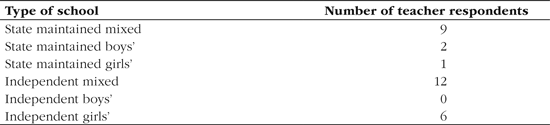
I investigated the opinions of a number of secondary school teachers of Classics to identify how they themselves dealt with the topic of teaching controversial or sensitive topics to students in their classes and also what suggestions they would make for beginning teachers on how to deal with them. In 2013 I surveyed 30 Classics teachers in two cohorts from a Joint Association of Classical Teachers In-Service Training Day on Classical Civilisation teaching in Oxford and from a group of teacher-training mentors who work with the PGCE Classics course in Cambridge. Both groups had several years of experience of teaching secondary students Classical Civilisation and / or Latin. The selection of teachers was opportunistic, gathered at two events four months apart, from schools across the UK. I felt that their experiences together would be representative of a range of the experiences Classics teachers have in general. Of the 30 respondents, eight were men and 23 women. The schools in which they taught reflected the different sorts of schools in which classical subjects are offered in the UK, with 12 from the state sector and 18 from the independent, as shown in Table 1.
| School sector in which respondents taught.
The teachers' length of service ranged from one year to over 26 years (see Table 2).
| Length of service of respondents.

There seemed to be no correlation between the type of school, gender of the teacher, or the length of service and the degree of willingness to hold discussions of various types with students.
There were two parts to the survey: a quantitative and a qualitative part. The first (quantitative) part was deigned to generate an overview of practice in order to assess any trends or characteristics. The second (qualitative) part was designed to allow teachers to generate more personal, nuanced and rich data about their own practices and to make recommendations. The respondents have been anonymised.
In the first part of the survey teachers were asked to complete a set of tick-boxes for five areas which might be considered to be sensitive and which might arise in the course of their normal teaching of Classics. These areas were (1) Cultural Topics, (2) Violence, (3) Death, (4) Religion and (5) Sex and Sexuality. The teachers were asked to indicate the manner in which they would treat each topic on a five-point scale of increasing depth and sophistication, as follows:
-
(a) Teacher avoids drawing attention to the topic.
-
(b) Teacher does all the talking and does not allow any student contribution.
-
(c) Teacher initiates a limited discussion in class.
-
(d) Teacher uses the topic as an opportunity to discuss what seems to be an important topic in ancient times.
-
(e) Teacher uses the topic as an opportunity to discuss what seems to be an important topic in ancient times to compare and contrast with modern times
The respondents were asked to complete this for each of the topics at each of the three different key stages: Key Stage 3 (for 11-14 year olds), Key Stage 4 (for 15-16 year olds, usually in preparation for the GCSE examinations), and Key Stage 5 (for 17-18 year olds, usually in preparation for AS and A Level examinations). I hypothesised that, as students matured, their teachers would allow more discussion on points (d) and (e) to take place. On the whole, this hypothesis seems to have been borne out, although the degree to which teachers allowed freedom of discussion varied between topics. In the second part of the survey teachers were asked to comment about their own practice or their recommendations for practice in a free text box for each topic. The data have been grouped as far as possible by theme.
Findings from the survey
Regarding cultural topics, and the topics of death and religion, the responses were broadly similar, as Figure 1 shows. (Note that not every one of the 30 respondents taught every Key Stage, so the total numbers do not necessarily add up to 30.)
| Responses to discussions about cultural issues.

Data in Figure 1 suggest that nearly all the teachers were happy to discuss cultural topics with all age groups, with the majority using the topics to broaden discussion about the ancient world to shed light on contemporary topics. More teachers took this as an opportunity to take with the KS4 and 5 students than with those at KS3, which may well reflect the subject matter rather than the sensitivity of topics taught at the different levels. A similar spread of responses is found in Figure 2.
| Responses to discussions about religion.

Data in Figure 2 suggest again that most teachers – indeed a slightly higher proportion than in Figure 1, including younger students – were happy to explore contemporary religious topics in the light of discussion about ancient religious practices.
Data in Figure 3 suggest a similar spread of responses about the topic of violence, at least among the older year groups of Key Stages 4 and 5 (14-18 year olds). However, the respondents indicated that they were more reticent to do so with this topic with younger age-group students.
| Responses to discussions about violence.

Data in Figure 4 suggest that respondents felt that it was possible to explore contemporary ideas about the topic of death with students of the older age-groups in Key Stages 4 and 5; there was a tendency to curtail discussion with younger students – some of the reasons for which are discussed later in this article when teacher respondents were allowed more of an opportunity to give their opinions.
| Responses to discussions about death.

Data in Figure 5 indicate that respondents seemed more reluctant than in any other topic area to engage with students in classroom discussion about sex and sexuality. This topic seemed to go against the trend – and reasons for this are explored below. Respondents seemed to offer little or even no discussion at all with the younger age-groups: at Key Stage 3 seven teachers – the highest recorded – said that they would avoid mention of discussions about sex and sexuality. Even with students in Key Stage 4 there still seemed to be reticence. It was only in the case of students in Key Stage 5 (but still not in every case) that respondents reported their willingness to use the topic of the ancient world as a means to reflect upon the modern. This is a topic which is, of course, of great concern to this article. Accordingly, the comments made by teacher respondents about it, recorded below, are of particular interest.
| Responses to discussions about sex and sexuality.

Teachers' own practice and recommendations
In the second part of the research sequence, teachers were asked to write down their own recommendations for beginning teachers faced with the teaching of sensitive topics in the course of their teaching of classical subjects in the secondary school.
Rationale for discussion
Respondents considered discussion of the topics as an important educational objective:
‘Discussion is important in itself – [it is] part of the wider teaching responsibility.’ (Teacher Fay)
‘[Such topics are] still an important topic today.’ (Teacher Iris)
‘Some of these topics are so central to the classical world that they are impossible to avoid. Glossing over them seems to me a futile exercise both in terms of students' social development and their academic understanding.’ (Teacher Jonathan)
Several commented that the topics raised in discussions of Classics had relevance for the students' everyday lives and encouraged students to think beyond the confines of the curriculum:
‘[The students'] views are often very interesting. And often the younger students are far more aware of such things than we used to be. It is a great opportunity for them to explore and express their ideas and for you to find out what they know.’ (Teacher Luke)
The distance of time and space was considered to make Classical subjects a safe place for more objective discussion:
‘There is…a kind of safety in the fact that you are dealing with the topic in the ancient world. They are removed from it.’ (Teacher Helen)
Planning for discussion
Respondents suggested that teachers should be aware of school protocols before attempting discussions with sensitive or controversial topics:
‘Look at PSHE schemes of learning for relevant age groups.’ (Teacher Iris)
‘Make sure you check with the Head of Year / form tutor for any personal student information which might make discussion / dealing with this topic difficult before you start…[Give] confidentiality where possible (but [remember that you] can't give [confidentiality] if [the student] discloses).’ (Teacher Kirstie)
Teachers should also be aware of potential parental concerns:
‘Need to be careful in Key Stage 3 in girls’ schools – the parents are more protective.’ (Teacher Dora)
Teacher preparedness
Respondents suggested that teachers should consider a number of aspects while thinking about preparing texts for teaching. Firstly, they should consider the importance of the topic in relation to the whole text:
‘If there is a shortened discussion [this is] more often for time reasons rather than any lack of interest to discuss…how central is the discussion for overall understanding?’ (Teacher Nicky)
Respondents suggested that there should be sufficient time to do the discussion justice:
‘[There would be] discussion depending on the time available – I may resort to [telling them the main points]. Also it would depend on the students.’ (Teacher Carla)
‘I would be happy to relate this to the modern world with all age groups, but normally don't due to time constraints.’ (Teacher Fay)
‘The length of the discussion depends on the lesson time, context etc.’ (Teacher Owen)
Respondents recommended thorough preparation before the lesson rather than extemporisation within it:
‘Be aware of which views are particularly pertinent to the students. I pay particular attention when topics of social values come up. Perhaps some topics could be discussed before lessons with another relevant teacher – eg before Pliny and the Christians, talk to the Religious Education teachers to ascertain any previous study.’ (Teacher Rione)
Respondents suggested that teachers should prefabricate materials to aid discussion, especially where students’ extra-curricular subject knowledge might be expected to be weak:
‘[I would have] reference to news if items are relevant [to] show [the] topic is just as important, if not more so, today.’ (Teacher Eileen)
‘For some topics a picture can be a useful and safe way into discussion as pupils are commenting on something else rather than necessarily having to express their own opinion.’ (Teacher Sabina)
Managing the discussion
Respondents noted that handling a discussion successfully rested on certain ground rules for themselves and for their students being made explicit and kept to. Much of the correspondence suggested that teachers needed to model how to hold a discussion and that they could build a positive disposition towards the discussion of the topic through their own personal actions.
Respondents suggested that the teacher should display a positive and comfortable disposition to the discussion:
‘If you are uncomfortable, it will rub off on the pupils and they will feel embarrassed.’ (Teacher Dora)
‘I think the confidence of the teacher inspires confidence in the students.’ (Teacher Fay)
‘Talk about what you are comfortable talking about – students will feel at ease if you do.’ (Teacher Iris)
Teachers mentioned the danger of modelling a negative disposition towards students:
‘Don't avoid the topics. Don't make them an object of embarrassment. Always make sure that you are comfortable with the topic before you start the discussion.’ (Teacher Nicky)
Respondents suggested that teachers should adopt an impersonal and objective stance through their use of language:
‘Be as matter of fact and straightforward as possible.’ (Teacher Barbara)
‘Try to be matter of fact, and understand when [to stop].’ (Teacher Rione)
‘I would make sure that the language is appropriate and non-discriminatory’ (Teacher Eileen)
‘[The students] will talk matter of fact about topics…Stay matter of fact and unemotional. State balanced arguments and views.’ (Teacher Owen)
Respondents suggested that teachers should avoid expressing their personal feelings:
‘I find it sometimes helps to distance ourselves personally and compare / discuss ‘ideal’ situations not personal experiences’ (Teacher Amy)
‘Be open and non-judgmental, ie be neutral – avoid personalising the discussion’ (Teacher Kirstie)
Respondents did, however, suggest that a teacher's role could be to offer an alternative opinion to the generally accepted one in class:
‘Avoid offering your own opinion (in matters such as religion). Playing ‘Devil's’ Advocate’ can encourage debate, especially with older students.’ (Teacher Sabina)
Student engagement with discussion
Respondents reported that teachers could often make use of students’ prior awareness of contemporary topics and the way they could connect them with those of the ancient world:
‘Most pupils read newspapers and so are aware of real life topics’ (Teacher Dora)
‘Violence – most of the video games they play are worse!’ (Teacher Iris)
Respondents suggested that it was beneficial if the students had a part in leading the discussion. They felt that the sense of ownership bred greater engagement with the subject matter:
‘[Teachers should try] to allow them to lead the discussion’ (Teacher Jonathan)
‘The discussion [should be] pupil-led with questions with all years. [They] will talk matter of fact about topics. The older the pupils are, the greater the depth of discussion.’ (Teacher Owen)
‘I often allow students to decide where they want to take the discussion by allowing their questions to determine the direction.’ (Teacher Pat)
‘Allow pupil-led discussion so that they lead and influence how far a discussion goes.’ (Teacher Sabina)
Worthwhile study
Respondents mentioned that it was the study of sensitive topics as they arose in Classics lessons that seemed to be especially interesting to their students:
‘It's often these aspects which attract pupils to the study of Classics in the first place (especially at GCSE and A Level)’ (Teacher Norma)
‘Students are aware of slavery and find it interesting.’ (Teacher Iris)
‘Relating [the topic] to a modern context improves engagement’ (Teacher Grace)
Awareness of student disposition
Respondents suggested that the teacher's awareness of the interests of individual students in the class played a large role in facilitating the sorts of discussion which took place. This suggested that a positive teacher-pupil relationship was an important part in deciding what topics to address and how to address them. Respondents often employed phrases such as ‘your class’, which was suggestive of the closeness of the teacher-pupil relationship, and ‘if I know’, to reflect perhaps the knowledge they had of the personal histories of students. This latter point was particularly important when addressing the topic of death, which excited considerable interest and advice from teachers, with six specific responses (all female teachers) from the total of 30:
‘I think that the awareness of your class and the topics that may affect them would inform the way you approach any given topic. For example, I would not necessarily dwell on the topic of death and burial if I knew that this was a sensitive topic at the time. However, I do feel that [having a] good relationship with the students enables you to discuss topics such as slavery / religion and violence in an environment where they feel safe.’ (Teacher Helen)
‘Also [discussion] would be dependent on the students in class (has a girl had a recent bereavement, etc?)’ (Teacher Carla)
‘Be sensitive to the time / content, and [be] aware if [there has been] death in the school community recently.’ (Teacher Eileen)
‘Again ([with regard to a discussion about] death) this would depend on individuals in the group.’ (Teacher Grace)
‘Death – sensitivity is increased when students have experienced [the] death of a family member.’ (Teacher Iris)
‘If I know someone has been recently bereaved I may curtail discussion. Don't shy away from it. Be sensitive to the needs of the students.’ (Teacher Pat)
Discussion focusing on the subject of sex and sexuality is reported as the most problematic area. It is seen as a difficult for both staff and students:
‘If it's a set text, then [I] would discuss [the topic] fully, otherwise [I would] minimise the discussion of particularly sensitive topics. At Key Stage 3 sex and sexuality rarely occur in subject discussions.’ (Teacher Eileen).
‘[With regard to the topic of] [S]ex- discussion in accordance with PSHE schemes of work.’ (Teacher Iris)
‘I would just limit discussion ([on the subject of] sex) in Key Stage 3 if the pupils started to get silly / not take it seriously. I would be reluctant to limit any discussion with any age group just as long as the pupils are taking it seriously. Obviously with Key Stage 3 pupils it might be wise to consider how the topic, in particular sex, is raised and developed.’ (Teacher Martin)
Age-related
Respondents commented on how they adapted the nature and depth of discussion according to the age group of the students. Teachers appeared to be more willing to take the discussion further with older and more mature students:
‘[I suggest that the teacher] should change according to the maturity / age of the class.’ (Teacher Norma)
‘The discussion [should be] pupil-led with questions with all years…The older the pupils are, the greater the depth of discussion…Only continue discussion if the class are responsive, responsible and mature enough.’ (Teacher Owen)
Two respondents mentioned the idea of how discussion enabled students to access a broader education and could encourage them to think in a more adult way:
‘Encourage an adult response.’ (Teacher Barbara)
‘Playing Devil's Advocate’ can encourage debate, especially with older students.’ (Teacher Sabina)
Safe zone
Respondents often referred to the importance of providing students with a safe zone for discussion. Some referred to the idea of a physically ‘safe space’ (Teacher Rione) or a safe mechanism - such as a picture - by means of which they might effect a ‘safe way into discussion’ (Teacher Sabina). The idea of distance from the historical period gave teachers and students a sense of safety:
‘There is also a kind of safety in the fact that you are dealing with the topic in the ancient world.’ (Teacher Helen)
But respondents also noted that it was important for the teacher to listen to students’ responses carefully and be aware of both spoken and unspoken reactions:
‘It's important to have a safe / comfortable environment where questions can be discussed. Be sensitive to reactions.’ (Teacher Norma)
‘[The teacher should be willing to] allow the students the opportunity to voice their own opinions in a safe environment…Be responsive, but do not push topics further than the students wish to take them.’ (Teacher Jonathan)
Otherwise, the discussion could falter and become an unsafe place, where ‘[the discussion] could descend into entrenched opinions / views gathered culturally from parents and peers.’ (Teacher Owen)
One respondent summed up the specialness of the school classroom as being ‘…almost like a confessional.’ (Teacher Kirstie).
Discussion
The study suggested that teachers of classical subjects are often ready to discuss some of the more sensitive or controversial topics with their students in the classroom. They value the opportunity which the subjects provide for students to explore further into human behaviour both ancient and modern. They are thus broadly in agreement with the arguments put forward by Cartledge (Reference Cartledge, Too and Livingstone1998) and Settis (Reference Settis2006) for the study of classical subjects at school level. In the case more specifically of Latin teaching, teachers seem to ensure that the study of Latin, which may predominantly consist of linguistic study, also allows discussion of cultural topics which naturally arise through the texts. Schools frequently teach students about sometimes controversial topics in everyday life, either through specialist subject-matter teaching (such as Black History), generic Personal, Social and Health lessons (such as sex, relationships and sexuality) and to mark special events (such as LGBT+ awareness). Classical subjects, including Latin, can also contribute to these broader educational aims, and often in forms which are very attractive to students, because of the distance in time and space, as has been mentioned above. Perhaps such an approach would make the study of classical subjects more attractive and to a wider audience, as Wilkowski et al. suggest:
The expansion of the classical research into areas of gender, race and age wrests the study of Classics from being the prerogative of the privileged elite; as we start to include ‘lost’ areas of ancient society we are simultaneously increasing the appeal of studying Classics to a wider demographic. (Wilkowski, Toney, & Ranger, Reference Wilkowski, Toney and Ranger2011, p. 20)
It is likely that school students have become so used to discussions about sensitive topics as part of the curriculum that they are increasingly comfortable about discussing such topics as they arise in classical subjects. If the discussion is relevant to them and they see that it fits in with their lives, it is likely that they will be more engaged. The Classics classroom becomes one other space in school for the development of a critically appreciative community, where the sharing of ideas and co-creation of knowledge has become the norm.
The management of the discussion needs to be considered, finally. Teacher respondents noted that they should be well-prepared in order to carry out the discussion rather than merely resort to ad hoc comments, concurring with James’ (Reference James2014) suggestion that the topic deserved its ‘air time’ if it was to be well done. The teacher respondents, however, did not go so far as saying that they felt they had to open up a discussion about a topic that they felt was important but which the students themselves did not. In some cases, this was because they themselves were not comfortable with discussing the topic and teachers felt they would need to be aware of the problems that the subject matter might have particular resonance for. There seemed to be an awareness that this would be the case more especially in girls’ schools. Indeed, Liveley remarks that in her own lecturing she has an arbitrary ‘cut-off’ point of 1979 when viewing and discussing pornographic material on her university level course: as much as she feels her own students may be shy in discussing the subject matter, she also confesses her own awkwardness with some of the material to be studied (Liveley, Reference Liveley, Rabinowitz and McHardy2014). School teachers were broadly in agreement with each other that personal views should not intrude, but that it was possible to play devil's advocate or to be able to state both sides of an argument clearly and logically. Teachers from both secondary and tertiary sectors, however, felt that silence was often not an option if a topic arose which they thought was an important one for the students’ general education. Take the topic of gender-stereotyping of Roman women, for example, as discussed above. Thakur (a male university lecturer) (Reference Thakur, Rabinowitz and McHardy2014) advises that the discussion of such topics should not be dependent on the gender of the teacher or that of the students in the class. Though it might not be easy, he says, the addressing of such topics must still take place ‘even if some might feel they are traversing into subjects where female faculty “own” the exclusive purview and authority’ (Thakur, Reference Thakur, Rabinowitz and McHardy2014, p. 153). The danger, he feels, is that the students might otherwise think the teacher's silence is somehow a ‘validation’ of the topic put before them. The school teachers also felt they had to be involved in modelling the rules of discussion – a reflection, perhaps, of the idea of the study of Classics as a tool to ‘think with’ (Cartledge, Reference Cartledge, Too and Livingstone1998) – and something which many Classics teachers are perhaps very well-placed to achieve through their own awareness of the classical conventions of rhetoric and debate (Holmes-Henderson, Reference Holmes-Henderson, Carr, Thomas, Porfilio and Gorlewski2016).
The question of how far to take the discussion is more contested with some subjects than others. In the secondary school, most teachers seemed prepared to discuss most topics reflectively with students of all ages. The exceptions for this, in increasing degrees, were the topics of violence, death and sex and sexuality. One teacher commented that students’ enthusiastic awareness of video games and scenes of violence on the TV news meant that discussion in class sometimes needed to be curtailed due to the students’ over-exuberance. A female teacher of a girls’ independent school commented that the parents were naturally overprotective of their children and that the teacher needed to be careful in their approach. The topic of death was mentioned by five teachers as being of particular concern and it was recommended that the teacher should make themselves aware of any recent bereavement in the class or school before dealing with this topic. It was this topic of disclosure which seems to have occupied the university lecturers’ minds, and particularly with regard to the topic of the subject of sexual violence and abuse. James (Reference James2014) comments that ‘even if someone doesn't say they've been raped, it doesn't mean that someone has not been raped,’ and she suggests the teacher should prepare themselves for the subject, using scholarship on the ancient topic and researching modern reports on the legalistic framework and responses. None of the school teachers mentioned the so-called ‘trigger effect’ of reading ancient texts – which has been something of concern in US universities of late (The Washington Post, 2015). It is very unlikely, however, that texts in which the subject matter of rape (for example) appears is as common at school level as it may be at the university level. It would be unlikely therefore that the sorts of personal responses and refusal to participate mentioned by James (Reference James2014), Khan (2004) and Everett Beek (Reference Everett Beek2016) would occur. There may be other factors at play as well. There are likely to be significant differences between the school teacher's personal knowledge of their students and that of the university lecturer and their students. In the school classroom, the students have met together regularly, perhaps for several years. The school students perhaps know each other from primary school and they may know each other's families, brothers and sisters and parents. They have also learnt alongside each other in other subject areas and bring with them the knowledge of each other's ways of talking about personal matters to the Classics classroom. They know their teacher well, because they may have been taught by the same person for a number of years. By the time they reach the sixth form students of Classics have been working with their friends and a limited number of teachers (maybe only one Classics teacher for their entire education in many state secondary schools) for at least six years. All this means that many of the characteristics of a student's behaviour have been noted by the teacher (and vice versa). The teacher is also likely to have had a pastoral role as well, and even if they have not been involved throughout with the pastoral education of the specific students whom they are teaching, they often have a broader role in organising school events, maybe even taking them on school trips and so on. This aspect of the education experience – the forming of important and lasting relationships between students and between students and their lecturers – has been noted as important at the university level by Lang (Reference Lang2015) too, who recommends that lecturers’ informal engagement with students reaps the benefits of engagement and participation: ‘The number and intensity of those relationships not only predicted students’ general satisfaction with college, but had the power to motivate them to deeper, more committed learning in their courses’ (Lang, Reference Lang2015). Chambliss and Takacs have also noted that ‘students best learn skills in a supportive community, with relationships that value and encourage those students and those skills’ (Chambliss & Takacs, Reference Chambliss and Takacs2014). Baker, King and Totelin (Reference Baker, King, Totelin, Rabinowitz and McHardy2014) note that this engagement is a two-way process: the student needs to engage with the subject matter intellectually, critically and also emotionally – and so does the lecturer. However, at the university level, it is much harder for the lecturer to empathise with their students due to the relative infrequency of contact with them and the shortness of time allocated for it (Baker, King, & Totelin, Reference Baker, King, Totelin, Rabinowitz and McHardy2014). The university lecturer has to be unusually sensitive to the students - what they say, how they say it, what words they use or do not use or hesitate to use, how they look at the lecturer, how they look at each other, how they talk to each other, pick up on each other's voices, choose to or choose not to build on each other's discussion points, whether they take their cues from the teacher or from each other, and so on. Essentially most school classroom work on classical topics takes place in small groups – sometimes very small groups or even individuals – and is closer in style to the university seminar or tutorial rather than the lecture. But in the tiny workspace of the seminar or tutorial it is difficult for students to be sheltered from opinions or ideas which they find difficult or even offensive. Instead we should teach the student to come prepared to be disturbed:
As teachers we may want to protect the other students from opinions we find offensive, and we may hope to change the mind of the offending student, but honey catches more flies than vinegar and the change must come from the student's engagement with his or her peers. (Butler, Reference Butler, McHardy and Rabinowitz2014, p. 50)
And many of them do come open-minded. The teacher respondents noted that students were very familiar with many of the issues of the day and were happy to talk about them in class, just as James (Reference James2008) had noted: ‘The old model, that of “disinterested” male, no longer exists – or if he does he is in a minority on campus.’ The teacher respondents felt that the opportunity to model how to have a discussion in which different people were able to express their views and listen to those of others was important. Teacher Owen said ‘You can't get away from it – it's a part of teaching Classics – it's what attracts kids to do the subject at GCSE and A level.’
What struck me about the survey responses was how enthusiastically the teachers wanted to initiate discussion with their students about these particular topics, but also how little they remarked on whether they ought to or what strategies they used to frame the discussions. Despite the fact that discussions about sex and sexuality had produced the widest range of responses (as seen also in Figure 5), only three teacher respondents referred directly to talking about sex in the classroom, and only one of those suggested a strategy: that they would consider a sort of cinema censorship system – 12, 14 or 18 – before discussion could take place. The teachers were much more concerned about the effect of discussion about death with their students as seen also in Figure 4). Perhaps this is a result of the widespread importance attached to the pastoral role of teachers in UK schools, where teachers also are tutors and personal supports and advisers to groups of or individual students – much more so than in the university sector, for example. On the other hand, only six out of 30 teachers were aware of any school policies or protocols to follow when dealing with any sensitive topic in the classroom. In a sense, then, teachers were exposing themselves to the possibility of accusations of improper conduct, because they were not following prescribed advice which might protect them. They were much more concerned about the affective environment of the classroom: would the students feel comfortable about the topic under discussion, and would the teacher too? The importance of support for professors from the university authorities has long been recognised (Strolonga, Reference Strolonga, Rabinowitz and McHardy2014). Where is this support for Classics teachers in schools? Professor Mary Beard – the nearest we have in the UK to a ‘public intellectual’ in Classics – has ever been on the teachers’ side: in response to media enquiries about those stories in the Daily Mail and Times newspapers reported above, she said: ‘Please, let's not go back to the days when kids were not supposed to read some poems of, say, Catullus, because some old codger had thought they might get corrupted’ (Daily Mail, 2013). Perhaps we need explicit authority beforehand from the examination boards which set the passages for assessment or from the subject associations? Nor is it just about teachers protecting themselves. There are strong educational reasons for the study of these sensitive topics to be made. Several teachers commented that the discussion precipitated by these topics was attractive both to them and to their students and that they could use the material to model for their students how to have a discussion. I would suggest further that excellent teachers do not just explore the topics, and model the discussion, but also explain to the students the process by which they are going to undertake the discussion. Essentially they should be training the students how to hold a discussion as much as teaching them the subject-specific material: they elicit responses from the students rather than deliver information; they encourage divergent rather than convergent views; they challenge inaccuracy; they clarify the difference between fact and opinion; and they try to get students to empathise with the people of the ancient world, not merely to transpose their own modern ideas onto them.
To my mind, the discussion of sensitive topics in Classics is a golden opportunity to show the ‘relevance’ of the classical world to our own. What is interesting to me as a teacher trainer is how to encourage teachers to think about the how of the discussion as well as the what. The terminology and structure of a debate are in themselves uninteresting; perhaps dry concepts in the absence of something to talk about. But the ancient world provides multiple opportunities to provide topics which are well worth talking about. In this survey, teachers seem to be doing exactly that.


 Open access

