

Since passage of the Native American Graves Protection and Repatriation Act (NAGPRA) in 1990, Americanist archaeology and adjacent fields have increasingly come to terms with the discipline’s origin and operation as a colonial enterprise. Part of this adjustment has been a growing awareness of the offense and harm that orthodox archaeological practices and premises have on descendant and otherwise associated communities. Accountability for the way archaeologists and heritage professionals write about the past—especially that of Indigenous, minority, and vulnerable communities—is intrinsic to this conciliation (Watson et al. Reference Watson, Young, Garcia-Lewis, Lucas and Plummer2022; Welch Reference Welch2001; Zimmerman and Conkey Reference Zimmerman and Conkey2024). Although they are still part of the discourse, once-standard terms—such as ruin, abandonment, prehistory, and myth, among others—are losing currency both because they have connotations or implications contrary to the ontological and historical reckoning of descendant communities and because contemporary archaeological theory and data suggest that in many cases such inferences are no longer factually or conceptually warranted. This article draws attention to one such term and concept that the discipline has heretofore only superficially addressed—“rock art.”
“Rock Art” in Global Context
Paintings and carvings on geological surfaces, marks commonly regarded as “rock art,” exist on each of the six continents inhabited by Homo sapiens. Paintings preserved in cave interiors have been reliably assigned Uranium-series dates upward of 50,000 years before present (Aubert et al. Reference Aubert, Brumm, Ramli, Sutikna, Saptomo, Hakim, Morwood, van den Bergh, Kinsley and Dosseto2014, Reference Aubert, Lebe, Oktaviana, Tang, Burhan and Hamrullah2019; Brumm et al. Reference Brumm, Oktaviana, Burhan, Hakim, Lebe, Zhao and Sulistyarto2021; Oktaviana et al. Reference Oktaviana, Joannes-Boyau, Hakim, Burhan, Sardi, Adhityatam and Hamrullah2024). Other studies suggest that now-extinct sister species, such as H. neanderthalensis and H. heidelbergensis, engaged in similar symbolic and performative behavior (e.g., Hoffman et al. Reference Hoffmann, Standish, García-Diez, Pettitt, Milton and João Zilhão2018; Marquet et al. Reference Marquet, Freiesleben, Jørkov Thomsen, Murray, Calligaro, Macaire and Robert2023; Rodríguez-Vidal et al. Reference Rodríguez-Vidal, d’Errico, Giles Pacheco, Blasco, Rosell, Jennings and Queffelec2014), although those findings remain controversial (Aubert et al. Reference Aubert, Brumm and Huntley2018; Pons-Branchu et al. Reference Pons-Branchu, Luis Sanchidrián, Fontugne, Medina-Alcaide, Quiles, Thil and Valladas2020; White et al. Reference White, Bosinki, Bourrillon, Clottes, Conkey, Corchón Rodriguez and Cortés-Sánchez2020). Nevertheless, the ubiquity and antiquity of “rock art” indicate that human proclivities to paint, engrave, or otherwise mark the Earth’s surface with evocative, information-laden, and at times aesthetically pleasing symbols is demonstrably inherent to the human condition (Dissanayake Reference Dissanayake1995).
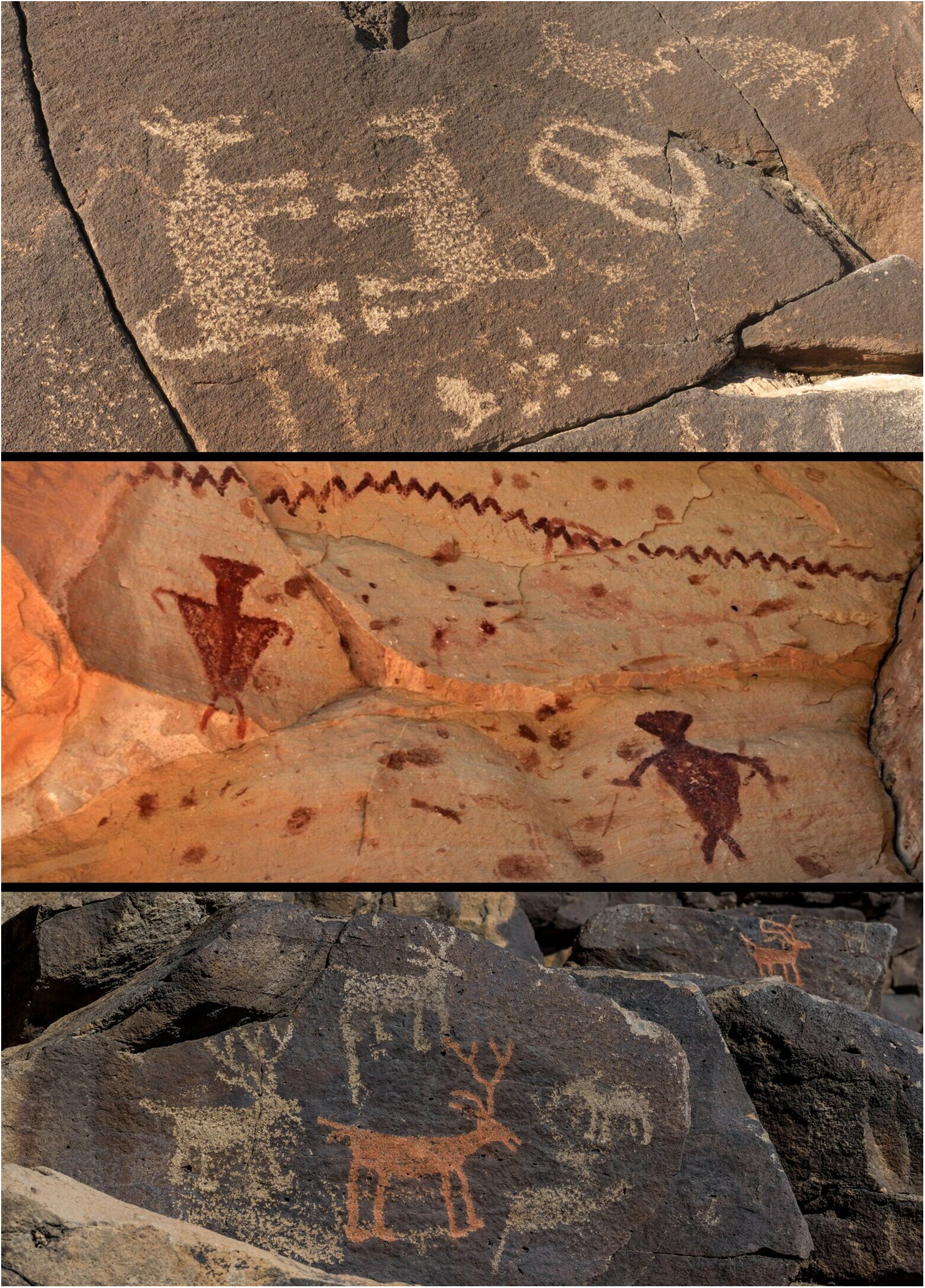
This antiquity and ubiquity begat a seemingly limitless variety in the aesthetics and techniques of such imagery. Accordingly, paleoart scholars have developed a semistandard taxonomy to account for the many nuances that exist worldwide (Bednarik Reference Bednarik1994, Reference Bednarik2010). In general, petroglyphs are works that penetrate the rock, so that a motif takes form though a visual contrast between the carving and the rock’s surface (Figure 1, top). Such contrast is usually between the color of a patinated or otherwise weathered surface and the heartrock exposed in the carving, but visualization can also be afforded through differences in textures, reflectances, and contours between the carving and the unadulterated rock surface. Pictographs, in contrast, are illustrations where a coloring agent is applied to a rock’s surface (Figure 1, middle). Common substances include ochre, charcoal, clay, chalk, minerals, grease, wax, and, in more recent years, lead-based and acrylic paints.Footnote 1 Although the glyph–graph dichotomy accounts for most cases, exceptions abound. For example, sometimes the impressions of petroglyphs contain pigments, indicating the carving was subsequently painted (Figure 1, bottom). There are also instances where portions of rock surfaces were removed or otherwise manipulated (i.e., a petroglyph) in preparation for a painting (i.e., a pictograph).
Examples of petroglyphs and pictographs from the US Southwest: (top) petroglyphs from the lower Gila River, southern Arizona; (middle) pictographs along Kanab Creek in northern Arizona; (bottom) painted petroglyph from Perry Mesa, central Arizona. (Top by Andy Laurenzi and used with permission; middle by Dyan Bone, courtesy of Wikimedia Commons; and bottom by Paul Vanderveen and used with permission). (Color online)

Petroglyphs and pictographs are by no means the only terms for such phenomena. Interchangeable alternatives, such as “rock carvings” and “rock paintings,” are common in publications. Archaeologists also use terminology that is less specific regarding technique—references to “cave art,” “rock drawings,” and “rock imagery” abound.Footnote 2 These general glosses are preferred when considering suites of graphics on rock surfaces or when distinctions in aesthetic and technique are not relevant. In such a schema, the graphics’ placement in or on parietal rock surfaces is the tie that binds them into a single class of cultural resource.
But Is It “Art”?
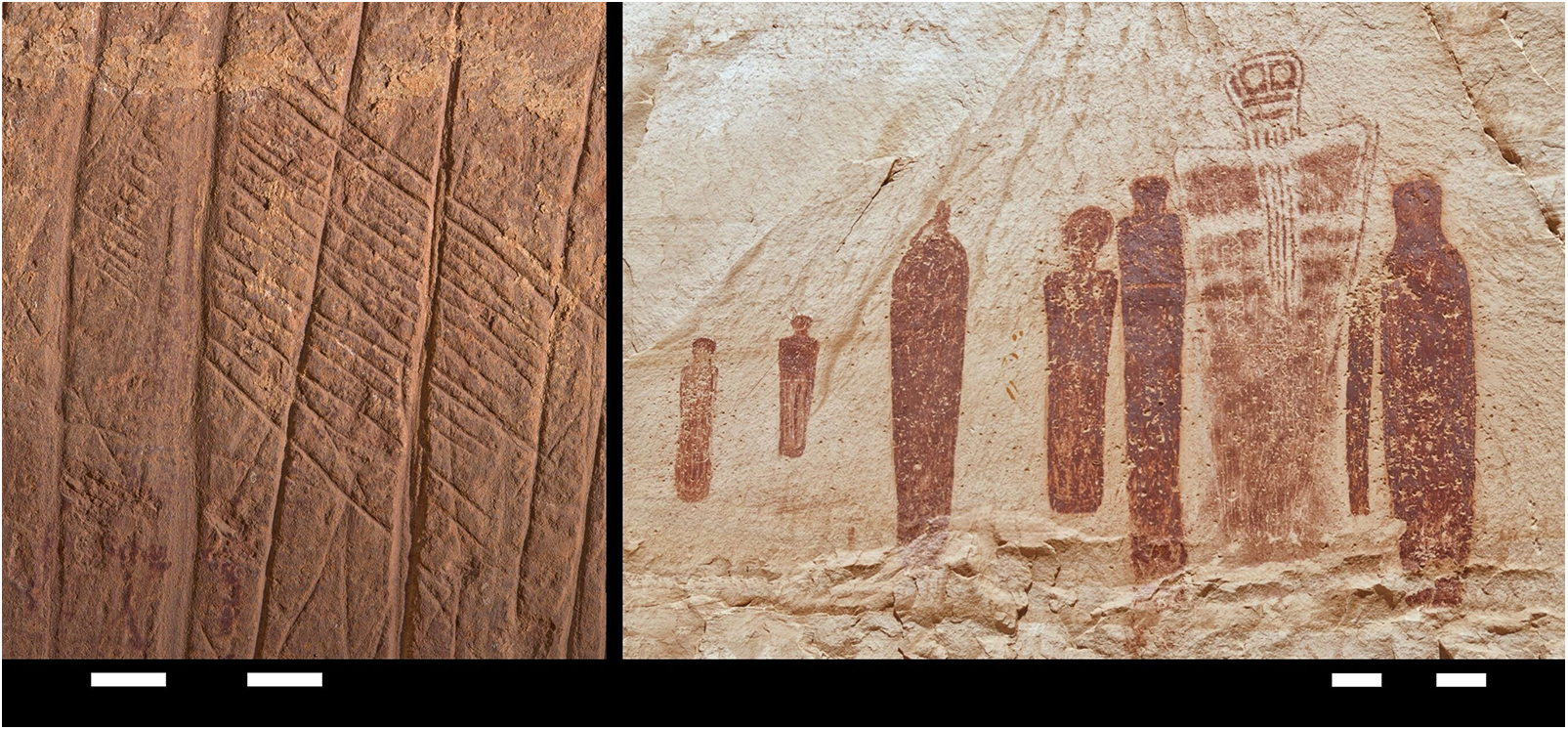
This study addresses the relevance, appropriateness, and accuracy of the most popular of the general taxonomic terms, “rock art.” Whether petroglyphs, pictographs, and similar markings are works of art, or attempts thereof, remains the subject of a prolonged, multifaceted academic and intercultural debate. Some scholars belabor whether rock “art” should only include those intentional anthropogenic markings that evince “conventions of style, structure, and context” (Rosenfeld Reference Rosenfeld1999:29), or all anthropogenic “non-utilitarian rock markings on rock surfaces” (Bednarik Reference Bednarik2002:43). For instance, should simple, non-iconic motifs be classed with and considered alongside mural-like scenes made with patience, exactitude, and exquisite skill (Figure 2)? The answer to that question, of course, depends largely on how one defines “art.”
Simple marks versus murals: (left) fine-line incised petroglyph pattern from Palatki Heritage Site, central Arizona; (right) Barrier Canyon style pictograph mural from Horseshoe Canyon, southeast Utah. (Left by Spence Gustav and used with permission; right by John Fowler, courtesy of Wikimedia Commons). (Color online)

A more cacophonous and arguably also more serious debate centers on the accuracy of “art” to describe and classify ancient, Indigenous, or otherwise non-Western or premodern illustrations. By the mid-twentieth century, a generation following Franz Boas’s (Reference Boas1927) seminal Primitive Art, some anthropologists and art historians had begun to question the concept of “art” existing in noncommercial contexts (e.g., Malraux Reference Malraux and Gilbert1954, Reference Malraux, Gilbert and Malraux1967; Marquet Reference Marquet1979). By the 1990s, scholars acknowledged that notions of “art” can foster Western ethnocentrism and perpetuate the exoticization of non-Western visual culture (e.g., Morphy Reference Morphy1991:35), possibly to the benefit of their professional or economic interests.
Within archaeological circles, this other-than-art debate began in earnest in the late 1990s with Conkey and colleagues’ (Reference Conkey, Soffer, Stratmann and Nina1997) Beyond Art: Pleistocene Image and Symbol, in which contributors disavowed “art” as a descriptive or explanatory framework for premodern illustrations. Their essential premise was, in part, a continued rebuttal to Halverson’s (Reference Halverson1987) provocative claim that Paleolithic cave paintings were simply “art for art’s sake” and therefore meaningless to their makers. It was also, in a sense, an expression of the postmodern critique of both the “primitive” and “art” aspects of primitive art rippling through the anthropological and archaeological communities (see Hay Reference Hay2016/2017; Kisin and Myers Reference Kisin and Myers2019; Myers Reference Myers, Tilley, Keane, Küchler, Spyer and Rowlands2006). This other-than-art perspective continued to surface periodically in archaeological scholarship, with each argument against rock “art” seemingly countered by a rebuttal in favor of it (e.g., Moro Abadía and González Morales Reference Moro Abadía and Gonzáles Morales2008; Nowell Reference Nowell2006; White Reference White2003). Reasoning spanned the spectrum, from stances that “rock art” simply sounds better than alternatives (Murray Reference Murray2005) to claims that objectors to “rock art” suffer from “limited and uniformed notions of art” (Morales Reference Morales2002:49). This latter opinion confirms definitions of art as the fulcrum for this debate.
As is the case with rock imagery and art history (Porr Reference Porr2019), the intersection of art and anthropology is broad and complicated. A comprehensive treatment is beyond the scope of this discussion. Thomas Heyd’s writings about the nexus between contemporary notions of art and Indigenous or premodern marks on rocks provide the best framework for our discussion. Heyd (Reference Heyd, McDonald and Veth2012, Reference Heyd, David and McNiven2018) asserts that most debate about the “artiness” (our term) of petroglyphs, pictographs, and the like owes to differing and at times incongruent concepts of art. Heyd, an advocate for the term “rock art,” sees objections to it as a matter of epistemological difference. For objectors, conceptualizing ancient or Indigenous marks on and in rocks as art necessitates assumptions about the imagery and its makers. This can yield misleading interpretations of other, generally non-Western or premodern cultures, value systems, and ontologies in the past and the present. Worse, it can result in “the reproduction of our own cultural preconceptions, reflected and transported into the prehistoric past” (Heyd Reference Heyd, McDonald and Veth2012:282). In short, objectors maintain that applying—explicitly or implicitly, consciously or subconsciously—Western worldviews, including values and appreciations attuned to bourgeois art of the medieval and Renaissance periods, onto the visual creations of non-Western, noncapitalist societies biases our perceptions and limits our ability to grasp and truly appreciate the subjects of our study.
Heyd’s rebuttal is that the objectors’ understandings of art are anachronistic. As he sees it, socially reactive twentieth-century revisions to the concept of art—ushered in by avant-garde theories of constructivism, futurism, and Dada—render many assumptions of what art is or does either moot or misplaced. In Heyd’s (Reference Heyd, McDonald and Veth2012:286) view, the “twentieth century re-constructed art in such a thoroughgoing way that it ended up divorced not only from most aesthetic values but also from aesthetic pleasure.”
Instead, to reenvision and contemporize art, Heyd sees a “certain consensus that art . . . is an activity of creation . . . of objects for appreciation” and assumes that “art activities” are generally “ubiquitous and probably present in all times that human being have been able to create appreciable objects” (Reference Heyd, McDonald and Veth2012:287; original emphasis omitted). For Heyd (Reference Heyd, David and McNiven2018:717), it is appropriate to view, conceptualize, think of, speak of, appreciate, and call (his words) anthropogenic marks in and on rocks as “art” so long as they “involve culturally mediated aesthetic appreciation.” Heyd’s challenge to researchers, then, is to evaluate the marks for evidence of aesthetic choice, value, attention, and judgment on the part of their makers—because “whether the marks on rock at a certain site are to be understood as art is an empirical question” (Heyd Reference Heyd, McDonald and Veth2012:279). He emphasizes art as the attempt to produce objects that can generate aesthetic delight (Heyd Reference Heyd, David and McNiven2018:730). The onus is therefore on the researcher to demonstrate that aesthetic delight was at least part of the motivation for the creation.
We point to two paradoxes in Heyd’s advocacy for rock “art.” From one angle, Heyd explains how modern constructs emphasize theory and practice as the basis for art, to the point where aesthetics are no longer relevant. This is in contrast to so-called anachronistic suppositions “that sensorily appreciable qualities of artworks . . . generated by superior talent, are constitutive of art” (Heyd Reference Heyd, McDonald and Veth2012:285; emphasis in original). Yet, in almost the same breath, Heyd maintains that art can be recognized via indicators of aesthetic judgment on the part of its creators: So, does art need to be aesthetic or not? And from another angle, Heyd (Reference Heyd, McDonald and Veth2012:278) explains that although aesthetics—what can profitably be considered as sensorial perceptions regarded as pleasing, interesting, meaningful, or emotionally stirring (Hagtvedt Reference Hagtvedt2022)—are generally associated with the arts, they are equally derived from and imputed to nature and everyday utilitarian items. So, when researchers find indications of aesthetic value in an artifact or other creation, how are they to decide whether it is a work of art, a coincidence of manufacture, or a gift of nature? Heyd’s paradoxes illustrate how art—though not necessarily aesthetics—is a cultural construct, and one that, although not solely derived from Western traditions, is unmistakably dominated by modern and non-Indigenous ontologies. “Art” then may be a misnomer for premodern and Indigenous marks in and on rocks, even if they elicit aesthetic responses from contemporary observers.
Our aim here is not to dismiss advocates for rock “art.” Rather, we seek to illuminate how complicated the concept of art can be when applied to non-Western or premodern modes of expression, representation, communication, and symbolism. With no easy answer at hand to “is it art?” this study entertains two related but different questions. For one, should premodern and non-Western imagery in and on rock surfaces be characterized as “rock art” when there is no consensus on its status as art? And second, should scholars reference “rock art” when descendant communities, who regard this imagery as cultural patrimony, reject “art” as a descriptor for it? We present the results of two surveys that address these questions. The first is a systematic review of different English terms scholars have used across the globe since 1865 to describe anthropogenic iconographic marks in or on geological surfaces. The review shows that “rock art” is a relatively new term, there have been and are regionally preferred alternatives, and there have been other acceptable synonyms over the past 150 years. We next present an analysis of feedback from a nationwide survey of Tribal responses and reactions to the use of “art” to describe petroglyphs and pictographs made by their ancestors.
If Not Art, Then What?
We are by no means the first to address interpretive and ontological problems surrounding “rock art.” Although archaeologists and adjacent scholars have quibbled over nomenclature for petroglyphs and pictographs for centuries, specific concern with this term came to the fore in the late 1990s. In their introduction to The Archaeology of Rock-Art, its editors write, “Art has a rather specific meaning in recent western societies, not suited to those many societies where the crafty making of images and pictures was a business centrally integrated with other concerns” (Taçon and Chippindale Reference Taçon, Chippindale, Chippindale and Taçon1998:6; see also Chippindale Reference Chippindale2001; Chippindale and Taçon Reference Chippindale and Taçon2006). Finding no suitable alternative, however, they retain the hyphenated “rock-art” not only to honor the term’s historiography but also to distinguish it from modern notions of “art.”
Chippindale and Taçon’s position prompted Swartz (Reference Swartz2007:125) to recommend expunging “rock art,” hyphenated or not, from the archaeological lexicon. Swartz observes that what archaeologists refer to as art likely had varied meanings and uses to its bygone makers, arguing that any aesthetic assumption “de-anthropologizes” the subject. Much of the debate over hyphenation played out in the journal Rock Art Research, with the prevailing conclusion that “rock art” was too entrenched in the discipline, its literature, and its institutions to move away from it (see Bednarik in Chippindale and Taçon [Reference Chippindale and Taçon2006:257–259] and Greer and Greer, and Woody and Quinlan in Swartz [Reference Swartz2007:131]). “Rock art,” however, is a relatively recent term when compared to its alternatives. In the United States, its first use is generally attributed to Thomas Ewbank’s (Reference Ewbank1866) “rock-writing.” “Pictographs” and “petroglyphs” entered the professional lexicon shortly thereafter with Mallery’s (Reference Mallery1881, Reference Mallery1886, Reference Mallery1893) work. In comparison, “rock art” entered the English lexicon only in the early twentieth century, according to Marymor (Reference Marymor2022:165).
To systematically analyze the history of “rock art” and related terms in Anglophone scholarship, we surveyed the titles of articles published in English-language professional and academic journals. We included all peer- and editor-reviewed contributions published in English. Because of our focus on the discursive occurrence of key terms, rather than the reliability of findings, we collected data on all serial publications, including occasional papers, conference proceedings, transactions, newsletters, and bulletins. Our interest in primary scholarship and in avoiding duplication led us to ignore book reviews and comments. To assure the articles were focused on the subject, we surveyed only titles, omitting article text, abstracts, and bibliographies.
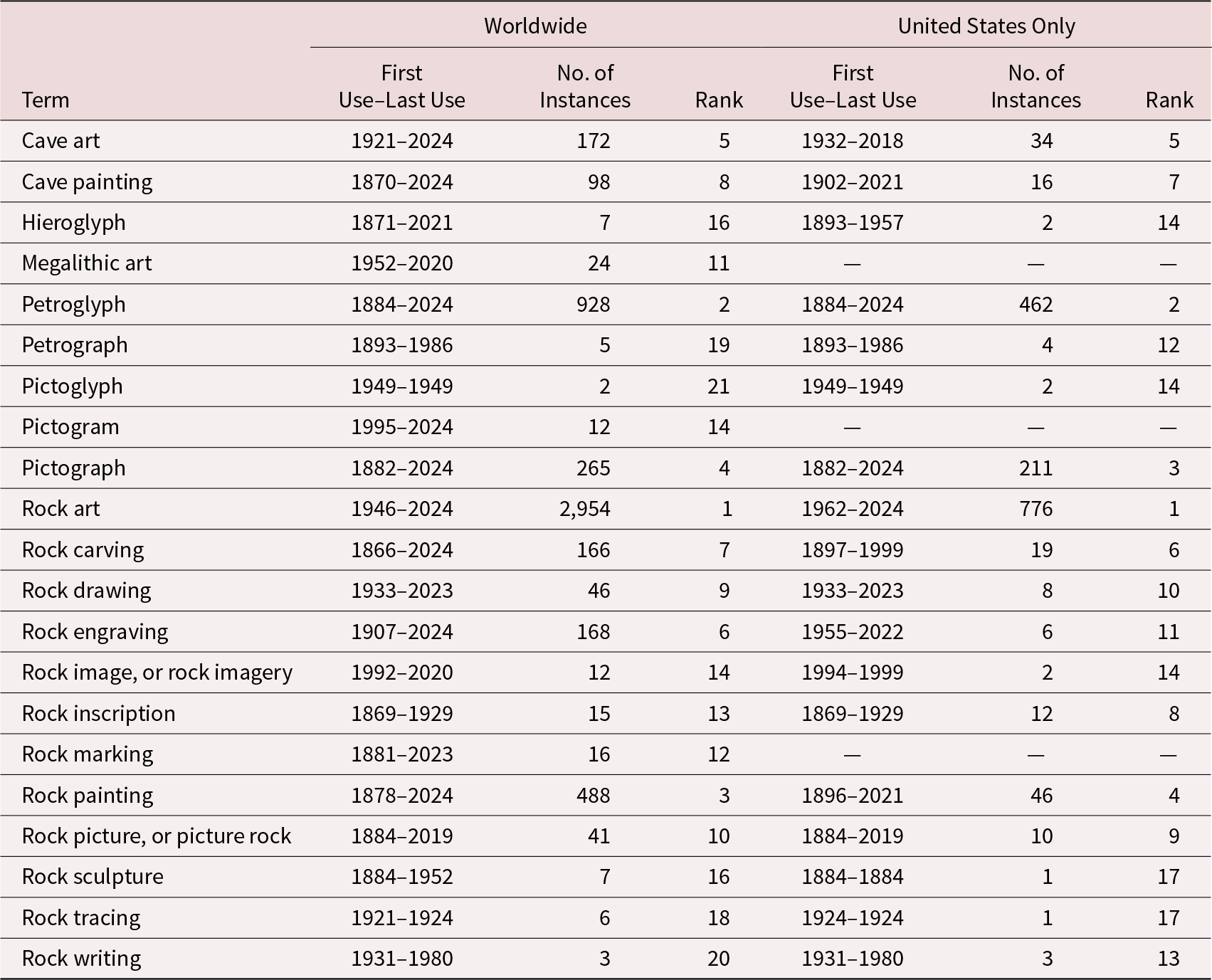
In accord with these parameters, we queried three databases—Scopus, Anthropology Online, and JSTOR—for article titles containing any one of a list of terms to characterize anthropogenic marks in or on rocks (Table 1). The query included singular, plural, adjective, and hyphenated words. Several terms are commonly used in reference to phenomena generally considered distinct from “rock art,” such as formal writing systems (i.e., inscriptions, hieroglyphs) and bas-reliefs (i.e., sculptures). Similarly, “rock image” and “pictogram” are regularly used terms in geology and medicine, respectively. We therefore screened the survey results to ensure that each article in our database used these terms in reference to phenomena consistent with anthropogenic iconographic marks on or in rock surfaces. We also eliminated article titles in which the search terms appeared in proper nouns, such as place names (e.g., Painted Rock Petroglyph Site) and organizations (e.g., Rock Art Research Institute). Ultimately, we identified 5,347 articles in 797 periodicals (individual venues, not issues) published between 1866 and 2024 (Table 1).Footnote 3
The Use of “Rock Art” and Alternative Terms in Article Titles since 1866.

The results of the survey are insightful from multiple perspectives. For one, several terms seem to have been mere regional fads, occurring just a few times and only briefly. “Rock tracings,” for instance, is limited to six articles published within a four-year span, each in reference to cases from Northern Europe, with five published in a single regional journal Scandinavian Studies and Notes. More significant, however, are disparities in the popularity of different terms—some occur just a few times in article titles, whereas others number into the hundreds or, for “rock art,” the thousands. Indeed, “rock art” appears in more titles than all other terms combined. Interestingly, it is not only the most popular term but also one of the most recent, occurring first in 1946 in an article regarding Rhodesia, but not seeing steady use until a decade later.Footnote 4
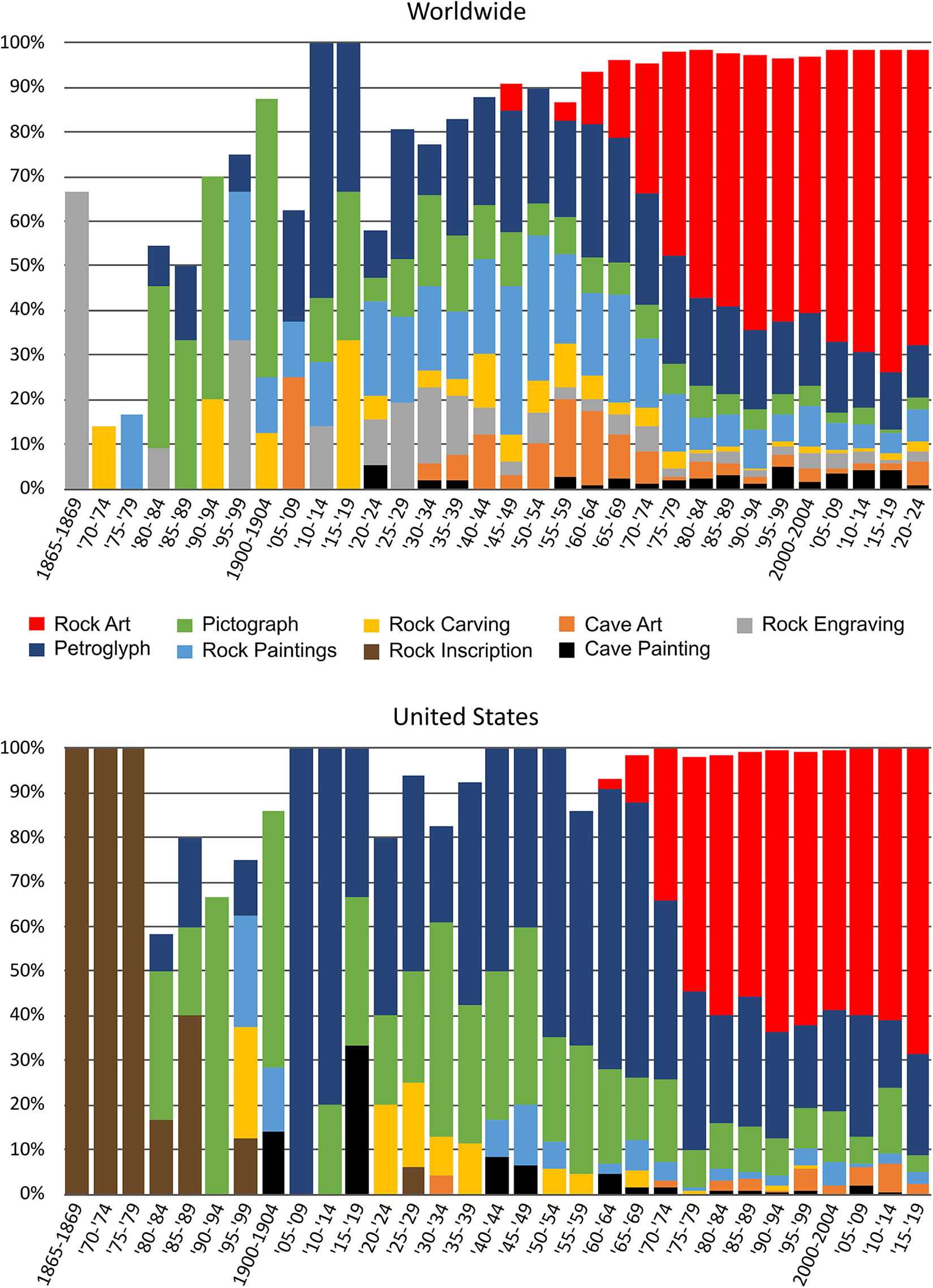
To illustrate trends in nomenclature, the upper graph in Figure 3 depicts the proportion of articles published worldwide with titles containing the eight most popular terms and grouped into five-year intervals. The dips and troughs in the bar graph during the early years signal periods reflecting the influence of the 13 less popular terms on overall trends. We draw two primary conclusions from the data. First, the graph shows considerable volatility before the 1940s as early scholars experimented with different terms and some terms fell from regular use. Second, the pattern after the 1940s shows some standardization in terminology followed by the rapid rise in the popularity of “rock art” beginning in the 1960s.
Time series in the proportion of articles published with different terms in their titles. The upper bar graph shows results for all English-language journal articles worldwide; the lower graph is restricted to those published in the United States and intended primarily for US audiences. (Color online)

Why “rock art” rose in popularity so abruptly beginning in the early 1960s warrants consideration. We note that the term’s ascension corresponds with the publication of two definitive and influential works—Heizer and Baumhoff’s (Reference Heizer and Baumhoff1962) Prehistoric Rock Art of Nevada and Eastern California, followed shortly by Grant’s (Reference Grant1967) Rock Art of the American Indian. Swartz (Reference Swartz2007:125) suggests that the use of “rock art” by Heizer and Baumhoff—who employed it only in the title, preferring “petroglyphs” and “pictographs” throughout the text—was a marketing ploy by the University of California Press, which sought a more evocative title. Grant was a trained artist with a profound interest in Chumash rock paintings of California, so it is fair to assume his approach to Indigenous imagery was influenced to some degree by his professional experience and interests. Grant’s early writings vacillated between using “cave paintings” and “rock paintings” before first using “rock art” in 1964 (e.g., Grant Reference Grant1962, Reference Grant1964, Reference Grant1965).Footnote 5 As authors of two of the first book-length treatments of the subject, both of which were successful popularly and academically, they set a tone for a generation of “rock art” scholars, many of whom convened in 1974 at the first meeting of what would become the American Rock Art Research Association (ARARA).
The rise in “rock art’s” popularity in the early 1960s dovetailed with the tightening grip of cultural ecology and processualism on Americanist archaeology. At the heart of this paradigmatic shift away from culture history was a focus on the adaptation of cultural systems to environmental and social conditions. Accordingly, the discipline’s gaze turned primarily to technology and subsistence and secondarily to settlement patterns and social organization, with political organization receiving occasional attention. Matters of spirituality, ceremony, and worldview were treated as beyond the ken of scientific analysis of material evidence (Hawkes Reference Hawkes1954). Petroglyphs and pictographs, generally regarded as abstract manifestations of belief systems, were largely excluded from archaeological discourse. By reframing this mode of material culture as rock “art,” the discipline simultaneously categorized and dismissed the richly varied phenomena as irrelevant, even antithetical to anthropology’s essential concern with adaptive cultural systems and processes.
As noted, our survey results suggest regional preferences for certain terms. For example, US scholars tend to employ “pictograph” for images where pigment was applied to rocks, whereas Australian and South African counterparts tend to use “rock painting.” As researchers working in the United States, we are most interested in how our regional predecessors and contemporaries use these terms. We therefore looked to the 1,579 articles published across 172 US-based periodicals between 1869 and 2024 (right columns of Table 1 and lower graph in Figure 3). Although doing so reduced the overall sample by 70%, the relative popularity of the terms, as assessed by the rank order of the frequency of uses, is about the same in the United States as it is worldwide (compare the US and worldwide trends in Figure 3). The most noticeable difference is the relative unpopularity of “rock engraving” in US scholarship, where it ranks eleventh, as opposed to sixth worldwide.
The lower graph in Figure 3 also shows a pronounced jump in the popularity of “rock art” beginning in 1975, which corresponds to the first publication of American Indian Rock Art (AIRA), the proceedings of the annual ARARA conference. Many attendees of the inaugural ARARA conference in 1974 hailed from California and were well aware of works by Heizer, Baumhoff, and Grant, as well as the fresh-from-the-press Prehistoric Rock Art of California (Heizer and Clewlow Reference Heizer and Clewlow1973). Of the 13 papers published in 1975 in the with “rock art” in their title, seven were in AIRA. Since then, more than half (61.5%) of the 1,217 article titles published in the United States featured the term “rock art,” and of those 424 (56.6%) appeared in AIRA.
In comparing the popularity of “rock art” between the United States and the rest of the world, we note that the US trend stabilizes around 60%, whereas worldwide it climbs higher to around 70% in the early 1980s and carries through to the present era. The abrupt rise in the early 1980s is likely a result of the founding of the Australian Rock Art Research Association in 1983 and the launch of that organization’s biannual publication, Rock Art Research , in 1984. According to our survey, of the 3,965 articles published worldwide since 1984, 2,590 (65.3%) have “rock art” in their title, and of those 314 (12.1%) appear in Rock Art Research.
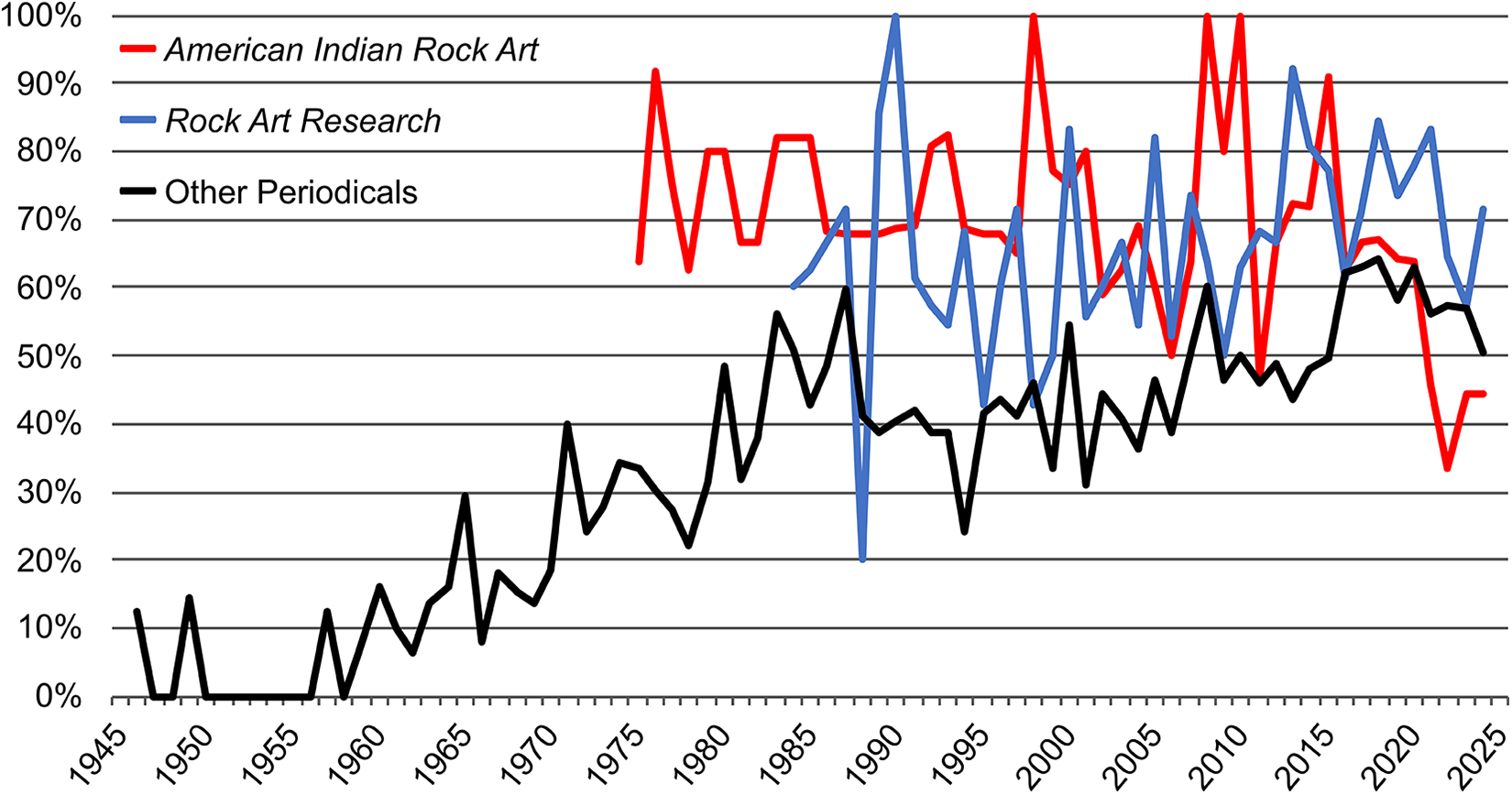
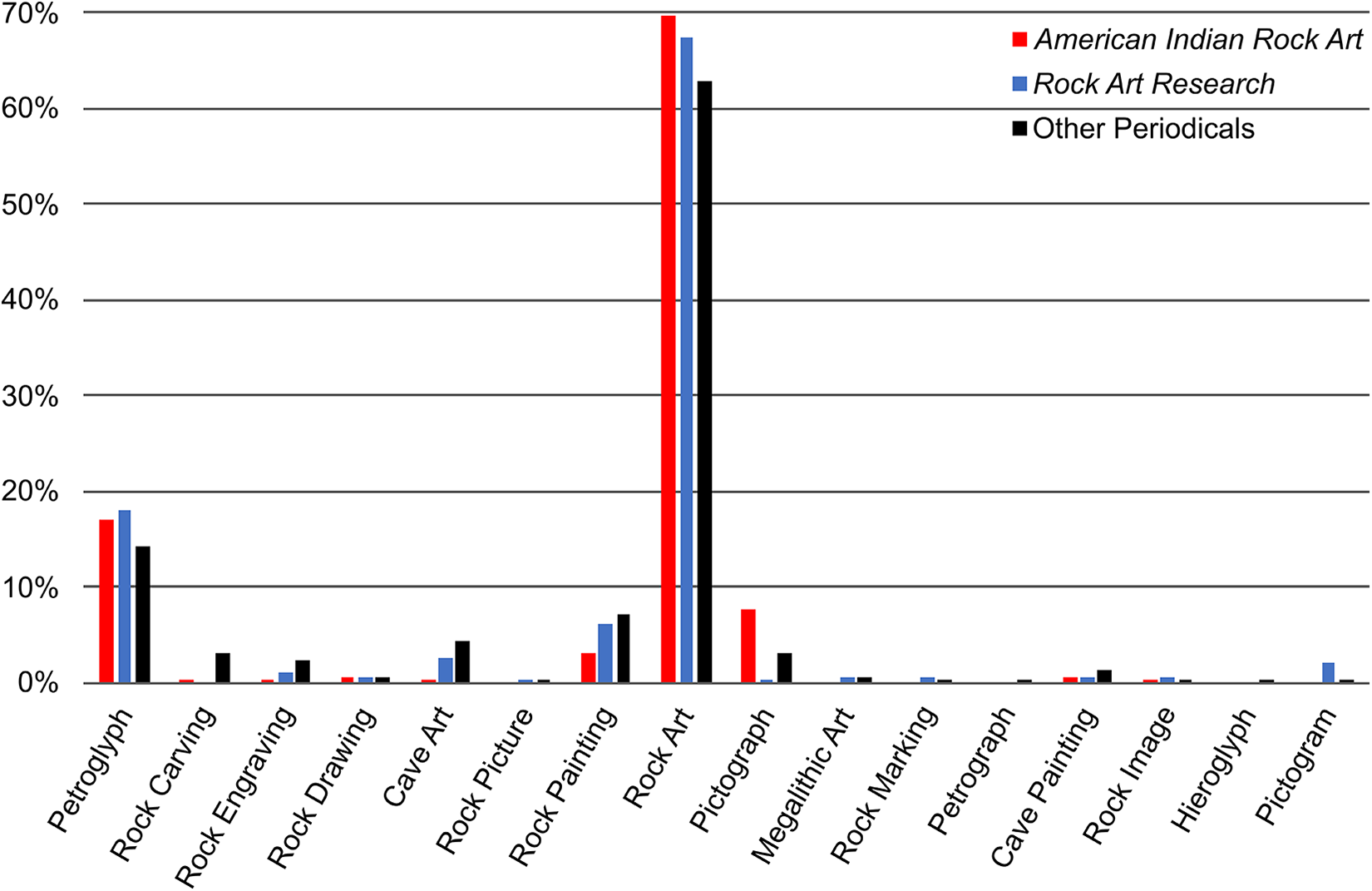
Figure 4 plots the proportion of article titles containing “rock art” published in AIRA, Rock Art Research, and all other surveyed periodicals since 1946.Footnote 6 Figure 5 shows the proportion of articles using different terms among the three groups since the launch of Rock Art Research in 1984. These figures reveal that, for the most part, both AIRA and Rock Art Research have consistently featured articles with “rock art” in their titles in greater proportion than other periodicals that publish similar subject matter. Although the difference is slight, the tendency for AIRA and Rock Art Research to publish titles using “rock art” over alternative terms, when compared to other periodicals, has been significant (χ2 = 11.76, df = 2, p < 0.003, Cramer’s V = .0537). Although “rock art” is still the most popular term across the discipline, periodicals other than Rock Art Research and AIRA were more likely to feature articles with titles using alternatives.
Time series in the proportion of articles featuring “rock art” in their titles published in American Indian Rock Art, Rock Art Research, and all other venues. (Color online)

Proportion of articles featuring different terms in their titles published in American Indian Rock Art, Rock Art Research, and all other venues since 1984. (Color online)

For periodicals with “rock art” in their names and published by or associated with organizations that do the same—the American Rock Art Research Association and Australian Rock Art Research Association—the data suggest an institutional-editorial bias in AIRA and Rock Art Research toward “rock art” in article titles. As Figure 4 shows, the popularity of “rock art” was on the rise before either organization was founded, yet AIRA and Rock Art Research’s institutionalized preferences are obvious and their impacts on discourse undeniable. As organizations dedicated to the study and protection of this form of cultural heritage, it makes sense that their choices would influence the broader discipline, including how we think, talk, and write about the subject. Nevertheless, despite the broad popularity of “rock art” worldwide, it never supplanted already established, alternative terms.
The results of our survey have implications for the debate over the appropriateness of “rock art” as a descriptor and concept. Although it is a popular and established term, it is relatively new, and its history is intertwined with disciplinary trends and perhaps also marketing ploys. Its popularity owes, in part, to the founding of formal organizations to study it in the 1970s and 1980s and their growing influence over time. We see indications that these organizations have resisted alternative terms. The editor of the ARARA newsletter, La Pintura, once wrote, “The intensity of this debate [around “rock art”] has varied over the years, often in response to the discomfort of archaeologists, but in all honesty, no replacement term has achieved wide acceptance either in the scientific community or among the general public. Despite its inadequacies, ‘rock art’ wins by default, and those who study it have to live with the consequences” (Murray Reference Murray2005; emphasis added). Similarly, the editor of Rock Art Research opined, “There have been numerous attempts before to meddle with the term ‘rock art’. . . . They have all led to the same conclusion. Which brings us back to where we started: rock art is not a new category or class of concept. Neologisms are always resisted, even though they are perfectly justified for phenomena that have no agreed name” (Bednarik, in Chippindale and Taçon Reference Chippindale and Taçon2006:259).
Although we agree that the study of petroglyphs, pictographs, and related phenomena is not new and does not need new terms, we find irony in Bednarik’s suggestion of “rock art” as the established referent when, considered historically, it is the neologism. Introduced in 1946, “rock art” is the fourth youngest of the 21 terms in our survey. Claims that “rock art” must be retained as disciplinary are misguided, and Bednarik’s logic should have rejected this term because the discipline had already established a lexicon of more senior terms, such as “petroglyphs,” “pictographs,” “rock engravings,” “rock carvings,” and “rock paintings.”
Descendant Community Perspectives
The seed of this article was our concern that Indigenous and descendant communities have largely been left out of the debate over “rock art.” This neglect was evidence to Wright in his consultations with Tribal Nations in southern Arizona about how to present descendant community perspectives on petroglyphs in interpretive media for a heavily visited site on public land. When asked whether the petroglyphs should be described as “rock art,” one Tribal Historic Preservation Officer (THPO) responded, “No, they are not art. Call them what they are—petroglyphs.”Footnote 7 Here was a clear request for interpretation-free technical specificity. This was echoed in a recent volume on the Hopi Tribe: “The Hopi Cultural Preservation Office recommends use of the terms ‘petroglyph’ and ‘rock image’ rather than ‘rock art.’ ‘Rock art’ implies a decorative function that is not culturally appropriate” (Bernardini and Koyiyumptewa Reference Bernardini, Koyiyumptewa, Bernardini, Koyiyumptewa, Schachner and Kuwanwisiwma2021:239). Then, in reading about an Indigenous-led effort to conserve a sacred site with petroglyphs in the neighboring state of California, Wright learned of a similar sentiment shared by a cultural expert from the Torres Martinez Desert Cahuilla: “They are wrongly called ‘rock art’ . . . the intent was to communicate vital information, not create art” (Elizabeth Paige, cited in Ponder Reference Ponder2023).
Are these Southwest cases anomalous or representative of sentiments across Indian Country? To answer this, we invited US Tribal Nations to participate in a survey, which included the following three elements: (1) an introduction affirming our goal of improving communication among archaeologists and Indigenous Peoples, with particular interest in finding terminology sensitive and responsive to Tribal preferences; (2) what we learned from descendant communities and Indigenous cultural experts who have questioned the use of “rock art”; and (3) solicitation of guidance on the accuracy and appropriateness of “rock art” to determine how widespread such concerns are and to improve our scholarship. The survey then posed three questions:
1. Is “rock art” acceptable, or is it inappropriate or otherwise problematic?
2. What alternative term would you prefer archaeologists use?
3. Does the community you serve have one or more terms for petroglyphs, pictographs, or related heritage assets that can be shared?
From our experience working with Tribes, we anticipated different levels of familiarity with and interest in the topic, a considerable diversity in opinion, and variable sensitivities to the questions. For these reasons and with due respect to sovereignty, we opted to solicit opinions only from Tribes’ designated representatives, especially THPOs. There is no requirement for THPOs to be members (citizens) of the Tribe (Nation) they serve, and many are non-Indigenous. However, most of the historic preservation plans that Tribes must establish to qualify for THPO designation stipulate consultations with traditional knowledge holders. Most THPOs act as liaisons among the Tribe’s historical and cultural experts, the Tribe’s government, and external government agencies on matters pertaining to cultural heritage.
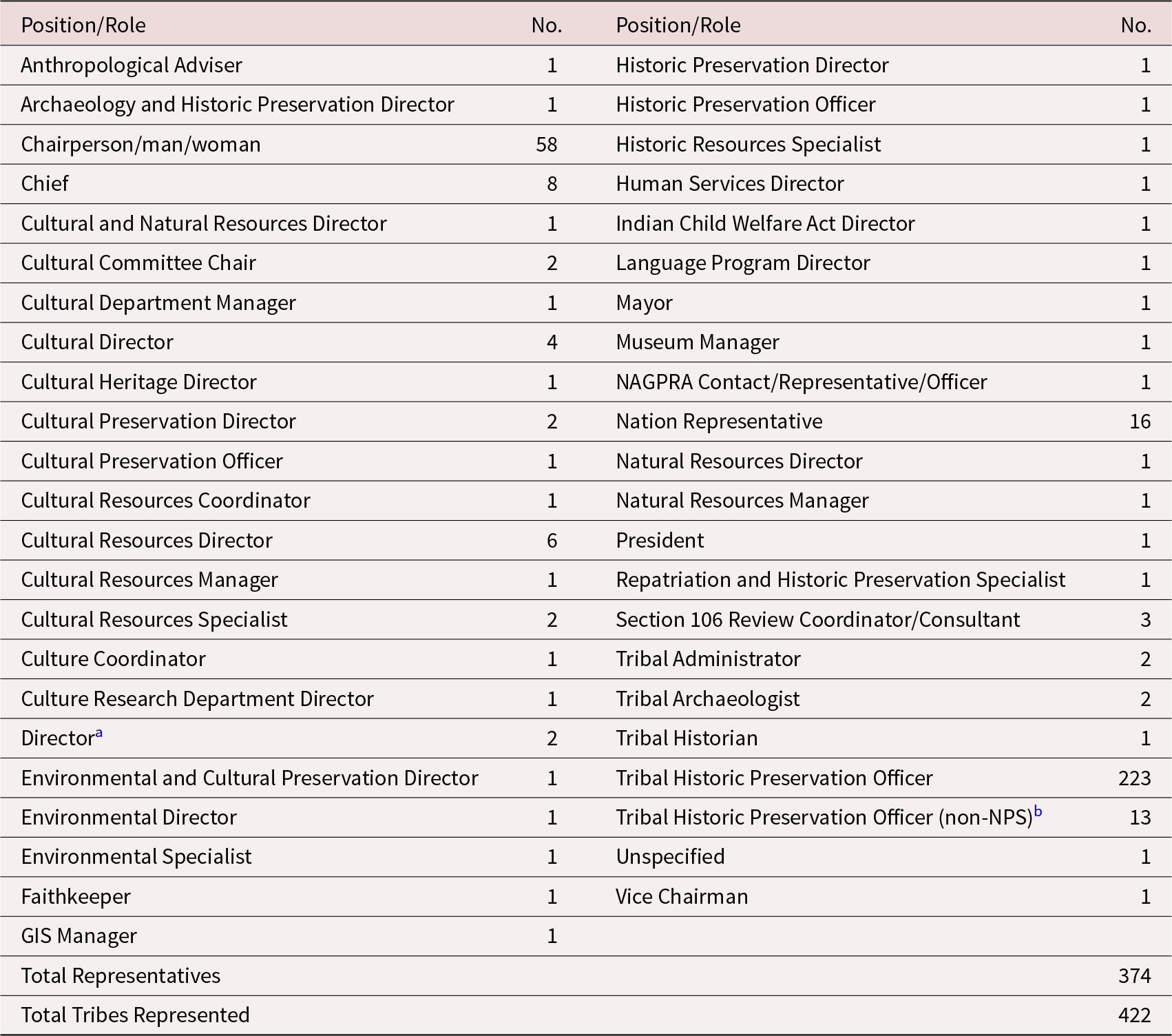
As of November 2024, there were 574 federally recognized Tribes, including Native Alaskan communities, 223 of which have designated THPOs. To enable participation by as many Tribes as possible, we opened the survey to individuals holding roles with Tribes similar to THPOs (Table 2). We identified those individuals through Tribal staff directories, state- and federal-agency consultation records, NAGPRA contact lists, and the Bureau of Indian Affairs’ Tribal Leadership Directory. The criteria were that the individual be officially delegated or otherwise employed to represent their respective Tribe’s interests in cultural affairs and that each Tribe be given a single official response. Through that extension, we identified an additional 151 persons representing 199 Tribes. We invited them and each THPO—a total of 374 officials representing 422 Tribes (Table 2)—to share their expert opinions.Footnote 8
Tribal Positions/Roles Invited to Participate in the Survey.

a Directors on the Board for Native Alaskan Corporations.
b non-NPS = Tribes not formally participating in the National Park Serviceʹs Tribal Historic Preservation Program.
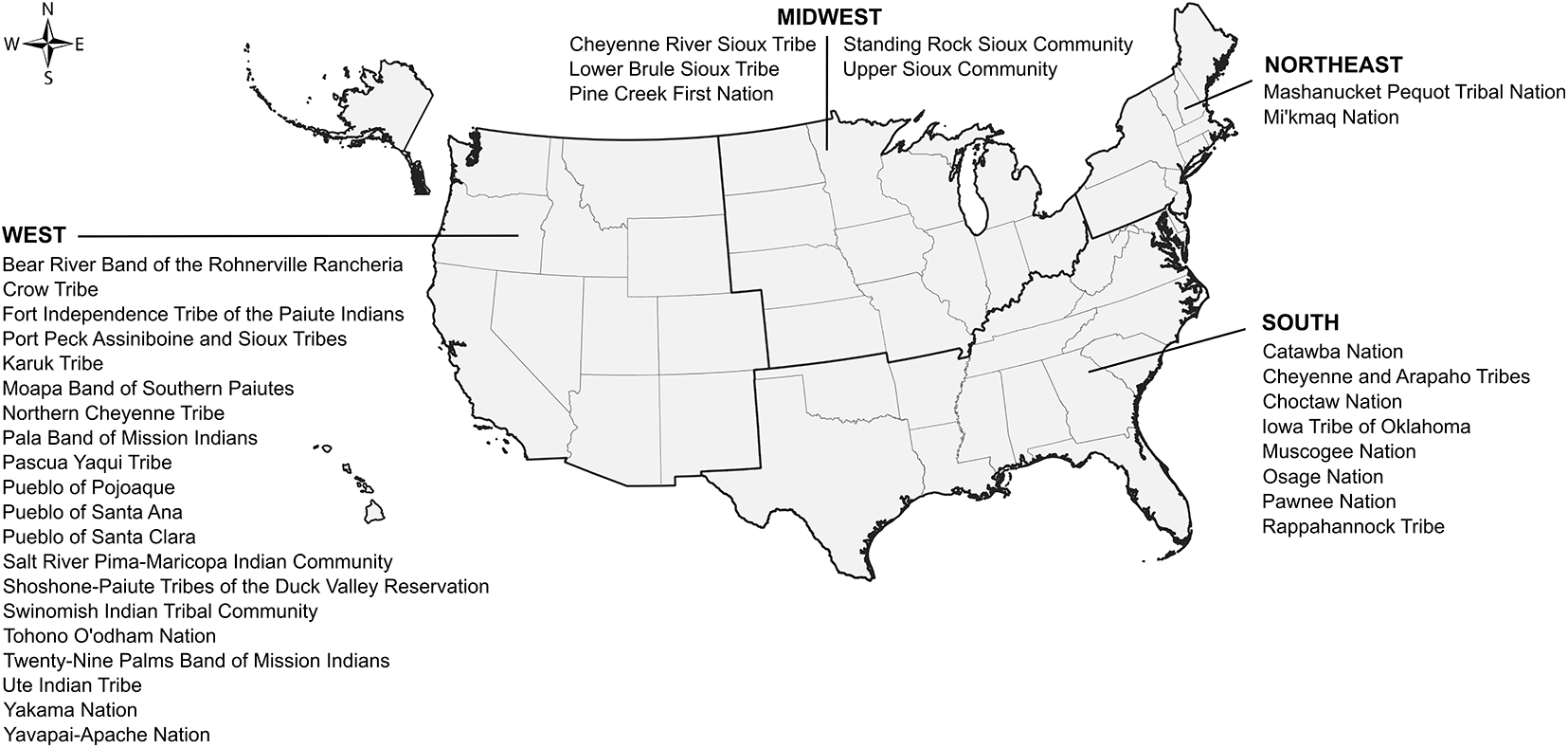
We received responses from 35 Tribes, or around 8% of the number invited and 6% of the total number of federally recognized Tribes. The respondents hailed from 16 states and represent each of the four census-recognized regions in the United States and seven of the nine regional divisions (Figure 6). We therefore consider the sample to represent a range of sentiments across Indian Country. Some responses reflect the perspective of the respondent; in other cases, the respondent conferred with colleagues or Tribal community members on the responses.
Geographic distribution of Tribal respondents, organized by US census-designated region.

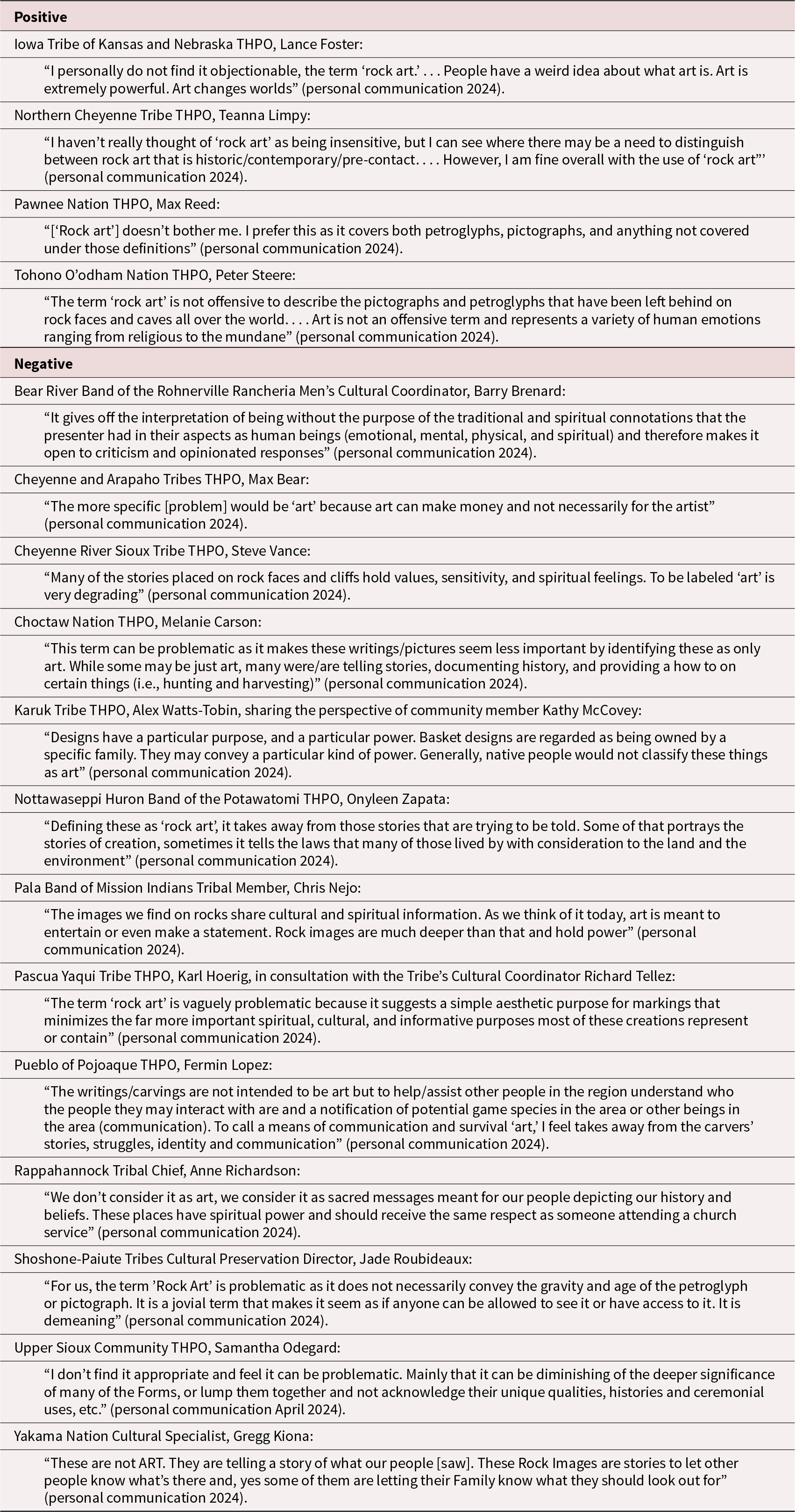
As anticipated, the answers were nuanced and varied. We assigned them to one of three categories: positive, negative, or indifferent. “Positive” reactions (n = 6) are those in which the respondent was comfortable with “rock art” as a descriptor, with one remarking that they considered it “inclusive.” “Negative” (n = 22) are those in which the respondent felt that “rock art” was not a suitable term. Their positions ranged from seeing the term as simply unspecific, representing one end of the spectrum, to harmful at the other end. Negative respondents described it as problematic (n = 4), inaccurate (n = 4), inappropriate (n = 2), unacceptable (n = 2), offensive (n = 2), demeaning (n = 1), and degrading (n = 1). Lastly, “Indifferent” (n = 7) included responses where a position was not provided or could not be discerned from the reply. Table 3 provides a selection of comments accompanying positive and negative responses.
Some Positive and Negative Positions on “Rock Art” Shared by Tribal Respondents.

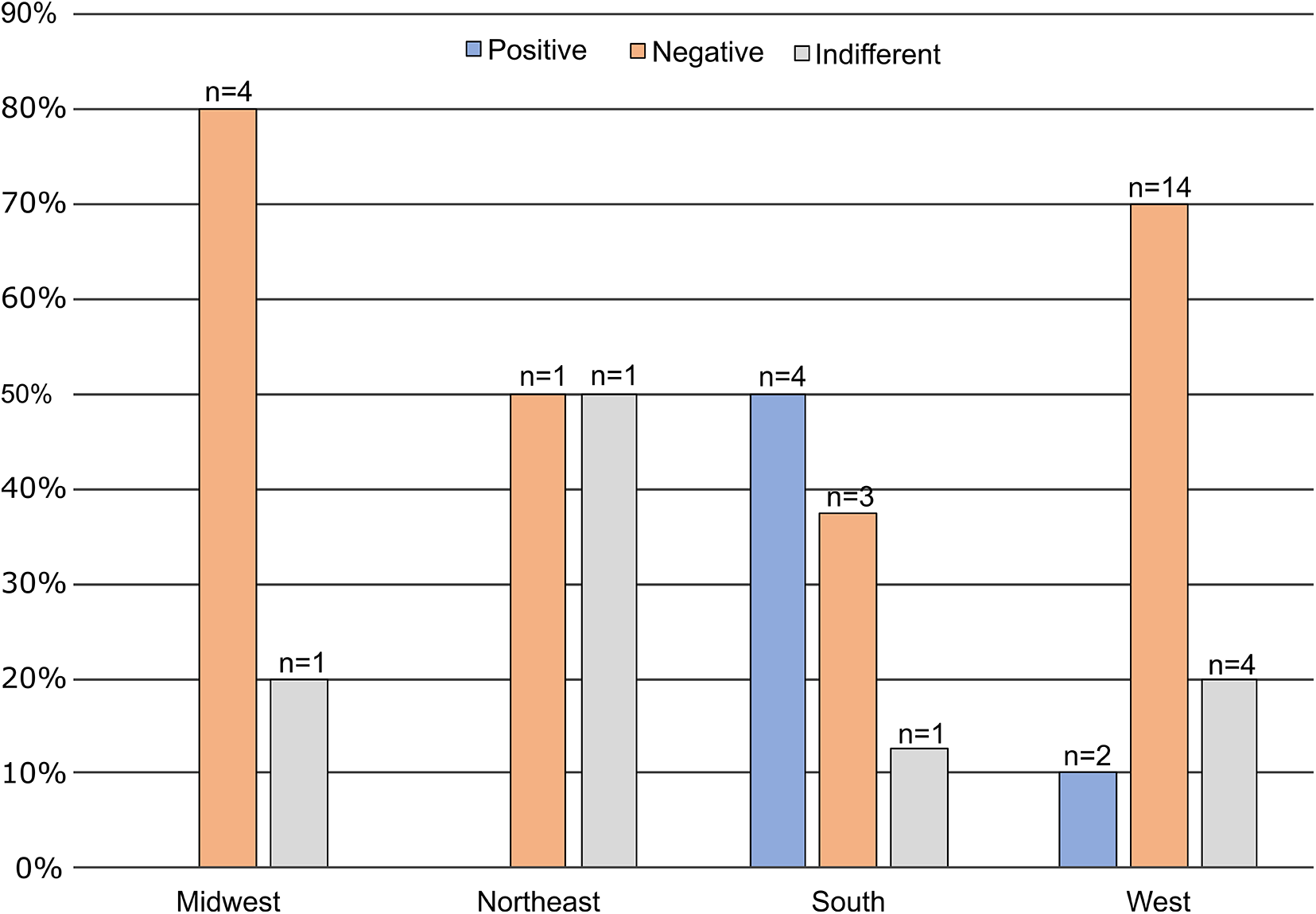
The aggregated data present a broadly shared perspective among respondents that “rock art” is an imperfect classification for ancestral marks on rocks. Negative responses (63%) far outnumber positive ones (17%). Comments accompanying the negative responses express that “rock art” distracts from or diminishes the intended purpose and cultural significance of the imagery. One comment expressed concern over the commodification and commercialization of Indigenous signs, especially when no compensation is offered to the creators or their descendants. A few comments accompanying positive responses harken back to Heyd’s (Reference Heyd, David and McNiven2018) critique of anachronistic understandings of art.
Sentiments were not equally distributed across Indian Country (Figure 7). When considered by census-designated region, positive responses within our sample have a statistically significant association with Tribes in the South (Fisher exact, p = 0.0207). We cannot explain this finding in the absence of additional data or insight, but we suspect the geographical asymmetry relates to complex histories of colonialism and its varied consequences.
Tribal respondent sentiments to the term “rock art” by US census-designated region. (Color online)

Along these lines, the survey asked respondents to propose alternatives to the term “rock art.” Although no Indigenous terms were offered, many respondents suggested English variants that they found to be better or more appropriate. Most (n = 7) preferred “petroglyphs” and “pictographs” as less interpretive and more specific. Others, in order of popularity, included rock writing (n = 5), rock images or imagery (n = 4), rock carvings (n = 1), rock drawings (n = 1), rock illustrations (n = 1), rock depictions (n = 1), rock symbols (n = 1), rock designs (n = 1), sacred history (n = 1), culturally modified landmarks (n = 1), and Indigenous folk messages (n = 1). Interestingly, this list includes terms we failed to include in our article title survey because they are underused in professional scholarship: the diversity underscores the myriad ways that descendant communities conceptualize and relate to the subject. It is important, however, to acknowledge that, with the exception of “petroglyphs” and “pictographs,” the two most popular terms proposed by the Tribal respondents—“rock writing” and “rock imagery”—are two of the least popular in academic scholarship (Table 1). This further illustrates the dissonance between archaeological institutions and Tribes and descendant communities highlighted by other studies (Sanger et al. Reference Sanger, Bourcy, Donathan, Galdun, Heglas, Klingman and Lowe2020; Watkins Reference Watkins and Timothy2012).
Discussion
Native Americans have been voicing concerns for decades about using the term “rock art” in reference to anthropogenic marks on and in rocks. Chippindale (Reference Chippindale2001:13) writes that both he and a colleague, on separate occasions, “had been taken aside by Native Americans . . . and it has been explained to [them] that the term ‘art’ created the impression that places such as Painted Rock were art galleries, whereas in fact they were houses where spirits lived.” Oddly, Chippindale’s anecdote appears in an article in which he argues for retaining “rock-art” because of the flourishing contemporary Australian Aboriginal art scene and its global commercial success: “If ‘art’ and ‘artists’ are words that Aboriginal artists today are universally or near-universally comfortable with . . . then let those words be used” (Reference Chippindale2001:12). It is unclear to what extent Chippindale’s position accords with Australian Aborigine perspectives regarding their ancestral rock paintings or the relationship of those paintings to contemporary works made for the consumer art market. What is clear is that Indigenous Peoples in Australia created paintings and carvings that serve as narratives about life and identity; provide knowledge about traditional aspects of health, well-being, and ritual; and connect them to the songs and epic travels of Ancestral Beings, as well as places prominent in their unique relational ontology known as Dreaming (George et al. Reference George and Musgrave1995; li-Yanyuwa li-Wirdiwalangu et al. Reference Brady, Bradley and Kearney2023). The late David Banggal Mowaljarlai (Reference Mowaljarlai, Vinnicombe, Ward and Chippindale1988:691), a senior traditional lawman and renowned elder of the Ngarinyin of the west Kimberley region of western Australia, made this statement to the inaugural Australian Rock Art Research Association Congress, which was later published with Chippindale as coauthor: “Someone told me recently that ‘rock art is dead.’ If ‘Art’ was dead, that would not matter to we Aborigines. We have never thought of our rock-paintings as ‘Art.’ To us they are IMAGES. IMAGES with ENERGIES that keep us ALIVE EVERY PERSON, EVERYTHING WE STAND ON, ARE MADE FROM, EAT AND LIVE ON.”
As Heyd (Reference Heyd, David and McNiven2018:718) points out, most non-Indigenous persons with whom descendant communities have shared their opposition to the use of “rock art” in reference to their ancestral paintings and engravings have discounted that opposition and deferred to academic agendas. The frontispiece statement on the 2001 ARARA conference program is similarly dismissive (Dean Reference Dean2001:2):
Native American elders in the area have voiced discomfort at the use of the word “art,” as used in the term “rock art.” They feel that its use is both inappropriate and inaccurate when describing pictograph and petroglyph images. While ARARA recognizes and respects their concerns and admits that a label such as “rock images” might be more exact, we also acknowledge that the term “rock art” is generally used, understood, and accepted as the common expression to collectively describe these images. For this reason, it is used openly in all conference-related material. Participants are free to use whichever term they feel most comfortable with.
Institutional and disciplinary resistance to requests from descendant communities to change the terminology is multifaceted. Some scholars suggest it is simply inconvenient to alter commonly used terms. For example, in rejecting the hyphen in “rock-art” because it was unpopular, a pragmatic Bednarik (quoted in Chippindale and Taçon Reference Chippindale and Taçon2006:259) quips, “It would be premature for many . . . organisations of the world to change their names and the names of their journals and newsletters, or to reprint their letterheads, or change their masthead or business cards.” Other “rock art” proponents follow Heyd in claiming Indigenous objectors do not understand art. Morales (Reference Morales2002:56), for instance, questions whether Tribes consulted by ARARA in 2001 would have taken such a position “if they had been informed of the important and diverse ways art functions,” or whether David Mowaljarlai would have been so emphatically against the term “if he had been informed that art is not just some frivolous Western concept and activity.” It is only fitting, then, to point out one of Mowaljarlai’s many achievements was being an accomplished painter who held a position on what is now known as the Australian government’s Aboriginal and Torres Strait Islander Arts Board. We doubt that an ignorance of art, as a field of study and body of theory, was the basis for Mowaljarlai’s position.
Dismissing the sentiments held by Indigenous Peoples about how their ancestral marks are conceptualized, treated, or interpreted conflicts with human rights and contemporary ethics. Article 13 of the UN Declaration on the Rights of Indigenous Peoples (UNDRIP), for instance, maintains that “Indigenous Peoples have the right to revitalize, use, develop and transmit to future generations their histories, languages, oral traditions, philosophies, writing systems and literatures, and to designate and retain their own names for communities, places and persons” (United Nations 2007:12–13). UNDRIP Article 31 (United Nations 2007:22–23) recognizes that
Indigenous Peoples have the right to maintain, control, protect and develop their cultural heritage, traditional knowledge and traditional cultural expressions, as well as the manifestations of their . . . oral traditions, literatures, designs . . . and visual and performing arts. They also have the right to maintain, control, protect and develop their intellectual property over such cultural heritage, traditional knowledge, and traditional cultural expressions.
Principle No. 4 of the Society for American Archaeology’s (SAA; 2024) Principles of Archaeological Ethics holds that professionals should “listen to and incorporate the knowledge and concerns of impacted communities.” Continued refusal to acknowledge and seek to alleviate Indigenous dissatisfaction with how archaeologists and other heritage professionals view, conceptualize, think of, speak of, appreciate, and call (sensu Heyd Reference Heyd, David and McNiven2018) their ancestral marks in and on rock surfaces is unprincipled, unethical, and likely harmful.
For these and other reasons, the National Park Service (NPS) has moved away from using the term “rock art” in interpretive materials. The 2020 revisions to an NPS style guide for interpretive media eliminated the entry for “rock art” and redirects users to “rock markings”: “rock markings—Appropriate general term for pictographs and petroglyphs, but using the specific terms is best. Do not use ‘rock art’ unless the park’s associated Tribes approve its use; it has negative connotations for some Native people” (Harpers Ferry Center 2024). Unlike the NPS and other federal agencies, private organizations such as ARARA and researchers are not legally required to consult, collaborate, or seek agreement with Tribes and therein lies a major source of the discipline’s reluctance to honor the Tribes’ wishes.
We suspect the negative sentiments toward “rock art” that Tribes shared with us, the NPS, and others have less to do with incongruent definitions of art and more to do with ambiguities that accompany the domain of art (Snoeyenbos Reference Snoeyenbos1978; Tormey and Tormey Reference Tormey and Tormey1983). Framing something as art justifiably opens it to interpretation, as though there is no certainty about what it is, which thereby entitles anyone to define it according to how they experience it. As Barry Brenard of the Bear River Band of the Rohnerville Rancheria shared, calling it art “makes it open to criticism and opinionated responses” (personal communication 2024). According to Brenard and other Tribal respondents (Table 3), there is no ambiguity in what the imagery represents—stories, histories, lessons, laws, morals, prayers, and the like. That is why they prefer interpretation-free, technically specific terminology. Rogers (Reference Rogers2009) has explored how such indeterminacy in dialogue around petroglyphs and pictographs works to equalize authority over interpretation and explanation between the Indigenous makers and their descendants and outsiders detached from the heritage in which the imagery is entangled. Indeterminacy diminishes the authority of Tribes, elevates that of others, and opens pathways to cultural (mis)appropriation.
Is there a broadly acceptable way forward? Many defenders of “rock art” claim that no single term can replace it as an inclusive and recognized referent (e.g., Murray Reference Murray2005). Several Tribal survey respondents also questioned the efficacy of replacing “rock art” with another term. Matt Reed, THPO for the Pawnee Nation, prefers the term because “it covers both petroglyphs, pictographs, and anything not covered under those definitions” (personal communication 2024). Santa Clara Pueblo THPO, Ben Chavarria, questions whether all Tribes could cooperatively settle on a new term: “Other Tribes will also have different names as well. . . . The best way is to use the most practical [i.e., rock art] which allows many more people to understand” (personal communication 2024).
We find it telling that many commentators on the appropriateness of “rock art,” in both previous scholarship and our current survey, jump to the issue of replacement; that is, if we stop using “rock art,” then we will need a new term—apparently seeing the need for a single referent for all iconographic marks on and in rocks worldwide. Our historiography of terminology, however, reveals, first, that “rock art” is a neologism that found favor in the discipline in the 1960s when other terms were in wide use. Second, “rock art” never fully superseded the use of older alternatives. For these reasons, we argue that the eschewal of “rock art” does not require a new term but merely an embrace of less conflicted and more culturally and technically salient synonyms. In the United States, “petroglyphs,” “pictographs,” and “rock writing” are the oldest terms and those most recommended by the Tribal respondents. Given the antiquity and ubiquity of the practice of marking rocks, coupled with the spectacular diversity in such rock imagery across the globe and through time, we question whether an all-inclusive term is practical or justifiable. In some places, times, and communities, “rock art” may be appropriate; the challenge then is to determine where and when and then act accordingly.
On that point, we find wisdom in the response of Michael Kickingbear Johnson, THPO for the Mashantucket Pequot Tribal Nation. When asked whether “rock art” is acceptable, he answered, “It depends,” and then elaborated on this comment:
“Rock Art” is generic, as is the word “Indigenous.” Where we feel it matters is when it is known who (i.e., which Tribal people) the created imagery comes from. Then we feel it is more appropriate to specifically use the name [preference] of the people where the imagery comes from. When it is not known as to which people the carved images come from, that is where too much speculation happens. . . . Why specific designations of terms matter is because it supports and keeps intact past and present identity. . . . Where the bigger challenges lay is when the creators of the images are not known, then speculation arises. . . . So, trying to find an alternate word or term for “Rock Art” really isn’t the problem. It’s the publication of assumptions of authors who are merely trying to describe what they are looking at with literally no additional insight from Indigenous sources to help shape narratives. Collaborative approaches are a much better way [forward]. It must involve descendant communities as much as possible [Michael Kickingbear Johnson, personal communication 2024].
As Kickingbear Johnson explains, “rock art” may be appropriate if the descendant or associated community says it is or where no descendant community can be identified. When associated or descendant communities are known, it is the obligation of heritage researchers and interpreters to develop respectful, healthy, and enduring dialogue. As even Heyd (Reference Heyd, David and McNiven2018:718) contends, one can recognize and appreciate aesthetics in signs, symbols, and other forms of imagery but need not deem or call them art.
Conclusion
Made worldwide and throughout time, paintings, engravings, and other forms of anthropogenic marks on and in rocks constitute a distinctive dimension of human practice and expression. Once rooted in philology and anthropology, the study of such imagery now intersects art history, sociology, philosophy, geography, chemistry, geology, and other fields. Over the past 60 years, researchers and institutions have built a rich body of multidisciplinary research and scholarship devoted to such rock imagery, laying foundations for continued study well into the future. Through that process, “rock art” emerged as a popular label. This term, however, has drawn sufficient controversy over the epistemological basis for such a characterization and the efficacy and ethics of its applications to imagery made in non-Western and premodern contexts. Largely excluded from the field of “rock art research” and, until now, the terminological debate are the descendant and associated communities who ascribe cultural patrimony to the imagery.
Our twinned analyses of expert opinions and professional article titles published since 1865 show that a wide range of terms have been used historically to describe anthropogenic marks on and in rocks. “Rock art” is merely one, and it is one of the youngest. Its rapid rise to prominence was not happenstance; instead, that ascendancy was part of a broader shift in anthropology connected to the commercial interests of academic publishers. The founding of quasi-professional “rock art” associations and their periodicals in the 1970s and 1980s helped establish “rock art” as the premiere term within most academic circles and popular media. Still, alternative terms remain in common usage.
A survey distributed to more than 400 sovereign US Tribal Nations revealed that “rock art” is an unpopular term across much of Indian Country. Most respondents held negative feelings about the term. Many shared that “rock art” is a mischaracterization of what they regard as sacred signs and symbols, for which any aesthetic appreciation was of low or no significance. Rather than art, they contend that the imagery conveys cultural, spiritual, and moral lessons, thereby connecting them to their ancestors and territories. Likening their ancestral marks on and in rocks as art creates ambiguity where none exists. “Rock art” can distract and detract from the cultural significance of the imagery, the places where it exists, and the people who made it and own it still. Not all Tribes, however, are of that opinion; some prefer “rock art” over the alternatives.
Although convenient for the discipline, a single term to describe all anthropogenic iconographic marks on and in rocks is not necessary. Because “rock art” elicits academic controversy, and because Tribes hold varying degrees of discomfort with the term, we defer to Tribal representatives, UNDRIP, and SAA ethics and encourage organizations and researchers to enter into systematic and sustained consultations and collaborations with Tribes and other associated communities to advance culturally appropriate dialogues around ancestral marks in and on rocks and to develop culturally and contextually appropriate terminology and narratives that suit both audiences.
Acknowledgments
We are grateful for the Tribal representatives who welcomed the expert opinion survey. Justin Bracken with the University of Utah Press was instrumental in planning this article, and Julie Jones with the Simon Frasier University Library assisted with the article title query. Karen Garthwait, Amanda Rowland, and Sam Wainer provided insight on National Park Service policy. We also thank Richard Rogers and two anonymous reviewers for comments on our original submission. No permit was needed to carry out any of the research reported herein. The American Rock Art Research Association awarded this paper the 2025 Castleton Award for excellence in original research.
Funding Statement
This research received no funding.
Data Availability Statement
No original data were used.
Competing Interests
Aaron Wright presently serves on the American Rock Art Research Association’s Board of Directors. John Welch is a former Tribal Historic Preservation Officer for the White Mountain Apache Tribe.

 Open access

