





INTRODUCTION
The current study investigates the production of prominence realization by Sylheti-English bilinguals. More specifically, this study focuses on speakers from the East London Bangladeshi community, one of the United Kingdom’s largest and most established ethnic communities. The dense urban nature of this community allows for the exploration of intergenerational differences in production patterns, in both the heritage (L1, Sylheti) and majority (L2, English) language because numerous generations live close together. To date, research on the speech patterns in ethnic minority communities has primarily focused on segmental aspects of speech, with much less known about the prosodic patterns in such communities (but see, e.g., de Leeuw et al., Reference de Leeuw, Mennen and Scobbie2012; Mennen, Reference Mennen2004). The current study adds to the growing body of research on prosodic patterns in ethnic minority communities. Moreover, Sylheti-English bilinguals are an under-researched community, and to our knowledge, there is no previous description of the prosodic patterns in this group. We, therefore, provide one of the first descriptions of prosodic patterns in Sylheti-English bilinguals.
In this study, we define prominence in accordance with Ladd (Reference Ladd2008) as “perceptible gradual modifications of the phonetic prominence of the individual words […] by gradual changes in various acoustic parameters, adding a slight nuance of emphasis” (p. 8), and thus we do not specify whether this prominence arises due to stress patterns specifically, as there is disagreement (see below) as to whether Sylheti is a stress bearing language, based on what we know about Standard Bengali. Noteworthy is, however, that previous researchers have perceived stress on the penultimate syllable for words in focus position in both English and Standard Bengali (see below, Khan, Reference Khan2010; Shattuck-Hufnagel, Reference Shattuck-Hufnagel1988).Footnote 1 Additionally, we use the term bilingual to describe people who use two or more languages in their everyday lives (Grosjean, Reference Grosjean1998, Reference Grosjean2010), as “bilinguals do not necessarily need to have perfect knowledge of all the languages they know to be considered as such” (Fabbro, Reference Fabbro2001, p. 201). In line with this, we use the term monolingual to describe people who did not use two or more languages in their everyday lives, although functional monolinguals may have had some knowledge of other languages.
The study had three objectives. First, as there is limited research on Sylheti prosody, the initial objective was to explore and compare prominence in Sylheti and English monolinguals, and, if the prosodic patterns were found to differ, whether Sylheti follows the Standard Bengali pattern, i.e., a lower relative f0 in the prominent syllable.
The second objective was to explore the L1 and L2 prominence patterns of Sylheti-English bilinguals, and, more specifically, intergenerational differences between bilingual speakers in the London Bangladeshi community.
Finally, the third objective was to explore the influence of factors (language use, length of residence, and age of arrival) that might contribute to any potential variation between our bilinguals.
PREVIOUS RESEARCH ON SPEECH IN HERITAGE LANGUAGE COMMUNITIES
There is a growing body of research on intergenerational differences in the production of speech segments. Much of the variability found in L1 and L2 speech production patterns of heritage language speakers can be accounted for by language use patterns and age of arrival (see, e.g., Major, Reference Major1992; Nagy & Kocketov, Reference Nagy, Kocketov, Siemund, Gogolin, Schulz and Davydova2013). In large diaspora communities in the United Kingdom (UK), for example, one general pattern observed is that bilinguals who arrived in the UK as adults are more likely to demonstrate monolingual-like production patterns in the heritage language than subsequent generations, and that the first generation are also more likely to demonstrate foreign-accented speech patterns in English (e.g., Mayr & Siddika, Reference Mayr and Siddika2016; McCarthy et al., Reference McCarthy, Evans and Mahon2013). Moreover, those born in the UK often display non-native production in the heritage language, but acquire production patterns that reflect their monolingual peers in English (Evans et al., Reference Evans, Mistry and Moreiras2007; McCarthy et al., Reference McCarthy, Mahon, Rosen and Evans2014), although, as further discussed below, this is often dependent on language use patterns. For example, McCarthy and colleagues (Reference McCarthy, Evans and Mahon2013) found that first-generation Sylheti-English bilinguals who had arrived as adults and resided in the UK for over 2 decades mostly produced Sylheti plosives with similar voice onset time (VOT) and had vowel quality patterns like Sylheti monolinguals. The authors suggested that the maintenance of native-like monolingual heritage language production patterns was largely driven by the dense nature of the community and ongoing use of the heritage language. In contrast, in other ethnic minority communities, which are potentially not as dense as the London Bangladeshi community, attrition of first language voicing contrasts has been found within first generations, e.g., in English speakers residing in Brazil (Major, Reference Major1992) and France (Flege, Reference Flege1987), Russian speakers in the United States (Dmitrieva et al., Reference Dmitrieva, Jongman and Sereno2010), as well as phonetic drift in English native speakers acquiring Korean (Chang, Reference Chang2012).
In comparison, those who arrive as children or second-generation bilinguals typically display incremental changes toward the majority language production patterns in their native language (Evans et al., Reference Evans, Mistry and Moreiras2007; Mayr & Siddika, Reference Mayr and Siddika2016; McCarthy et al., Reference McCarthy, Evans and Mahon2013, Reference McCarthy, Evans and Mahon2011; Nagy & Kocketov, Reference Nagy, Kocketov, Siemund, Gogolin, Schulz and Davydova2013; Sharma & Sankaran, Reference Sharma and Sankaran2011; but see Kirkham & McCarthy, Reference Kirkham and McCarthy2020). For example, Nagy and Kotchetov (Reference Nagy, Kocketov, Siemund, Gogolin, Schulz and Davydova2013) showed an intergenerational trend toward the English VOT pattern in Russian and Ukrainian heritage language speakers in Toronto, and Mayr and Siddika (Reference Mayr and Siddika2016) found incremental changes in VOT patterns across generations of Sylheti heritage language speakers in Wales, UK.
Heritage language markers may also be retained to fulfil socio-indexical functions on the part of the heritage language speakers (Alam & Stuart-Smith, Reference Alam and Stuart-Smith2011; Heselwood & Mcchrystal, Reference Heselwood and Mcchrystal1999, Reference Heselwood and Mcchrystal2000; Kirkham, Reference Kirkham2011; Sharma & Sankaran, Reference Sharma and Sankaran2011). Moreover, even in first-generation bilinguals, there is preliminary evidence suggesting that not only general attrition processes (i.e., the L2 influencing the L1) affect the native language, but also that socio-indexical factors contribute to changes in both the L1 and L2 (de Leeuw, Reference de Leeuw2019; Passoni et al., Reference Passoni, Mehrabi, Levon and De Leeuw2018).
What we therefore see is general processes affecting generational groups, but also nuanced variation within generations that may be driven by factors such as language use patterns. It is this variation that is explored in the current research through an investigation of the prosodic patterns in Sylheti-English bilinguals.
PREVIOUS RESEARCH ON PROSODIC VARIATION IN BILINGUAL SPEECH
A small body of research has examined prosody in bilingual L1 and L2 speech. In general, the findings indicate that L1 prosody is susceptible to change upon acquisition of an L2, regardless of the age at which the L2 was acquired. For example, Mennen (Reference Mennen2004) found that adult Dutch speakers of L2 Greek living in the Netherlands assimilated toward Greek tonal alignment patterns in their native Dutch, and that they were also unable to realize Greek tonal alignment according to monolingual norms. Furthermore, in a longitudinal study of Stefanie Graf over four decades, maximum pitch peaks in her German became higher and more English-like over time from adolescence to mid-adulthood after her move to the United States (de Leeuw, Reference de Leeuw2019). Additionally, in de Leeuw et al. (Reference de Leeuw, Mennen and Scobbie2012), some late sequential German-English bilinguals in Vancouver, Canada, performed within English monolingual norms in their German tonal alignment production, whereas others displayed native German monolingual production patterns. Further investigation of this same community suggested that the social and political environment of “being German” in Vancouver may have influenced pitch realization of the German-English males, with a wider pitch span and higher pitch level in both their German and English indexing friendliness and helpfulness to dissociate themselves from the stereotypical image of Germans in Canada as being aggressive (de Leeuw, Reference de Leeuw, Brehmer and Treffers-Daller2020; Lieb, Reference Lieb, Schulze, Skidmore, John, Liebscher and Siebel-Achenbach2008). Moreover, in a small group of Turkish-German simultaneous bilingual children (age 10-12 years), it was found that there was bidirectional prosodic interaction with the children producing Turkish prosodic patterns in German, and German prosodic patterns in Turkish (Queen, Reference Queen2001).
Prosodic influence is also possible between bilinguals in contact settings, which promote larger changes within a community. For example, it has been argued that changes in the prosodic patterns of L1 Argentinian Spanish coincided with a large wave of Italian immigration, and with Argentinian Spanish converging with Italian due to direct and indirect prosodic transfer (Colantoni & Gurlekian, Reference Colantoni and Gurlekian2004). Similarly, Spanish-Quechua bilinguals in Peru have been reported to produce Spanish intonation patterns in their Quechua (O’Rourke, Reference O’Rourke2005), and Simonet (Reference Simonet2011) reports finding intonational convergence in a language contact situation in Mallorca.
In brief, it has been found that bidirectional prosodic interaction is prevalent in both bilingual speakers (children and adults), as well as larger communities in which convergence can occur.
PROMINENCE REALIZATION IN SYLHETI AND ENGLISH
As no previous research has been conducted on Sylheti prosody, this section focuses on a discussion of Standard Bengali compared with English. The aim of this comparison is not to enter into a discussion regarding a theoretical typology of Bengali and Sylheti, but rather to provide a baseline for the Sylheti and English data to explore the production patterns of the bilinguals.
In English, in the nuclear tone tradition (see e.g., Cruttenden, Reference Cruttenden1997), a prominent word would generally be realized through a high-fall nuclear pitch accent on the stressed syllable and a higher f0 is often considered to be the strongest cue for lexical stress identification in English (Lieberman, Reference Lieberman1960). Likewise, in the autosegmental metrical framework (Beckman & Pierrehumbert, Reference Beckman and Pierrehumbert1986; Ladd, Reference Ladd2008; Pierrehumbert, Reference Pierrehumbert1980), prominence would be encoded with a pitch accent, such as L+H*, or simply H*, followed by an L- phrasal tone.
In contrast, in Standard Bangladeshi Bengali, it has been proposed that either a low pitch accent, L*, or a rising pitch accent, L*+H, are used to mark focus (Khan, Reference Khan2008; Maxwell, Reference Maxwell2010), but see Hasan (Reference Hasan2015). Thus, in Bengali, a word in focus could be described as having a low rising or “scooped” pitch accent on the prominent syllable (Maxwell, Reference Maxwell2010, p. 58). Notably, this “scooped” pitch accent is also included in the inventory of pitch accents for English, but it is considered to be contextually specific (Ladd, Reference Ladd2008). It has also been suggested that Bengali stress, if existing at all, is consistently word-initial (Khan, Reference Khan2010), indicated by means of a decrease in f0 (see, e.g., Hayes & Lahiri, Reference Hayes and Lahiri1991 in Reetz & Jongman, Reference Reetz and Jongman2009, p. 211), and that Bengali does not “take advantage of higher f0 and greater intensity” to indicate syllable initial stress (Shattuck-Hufnagel, Reference Shattuck-Hufnagel1988, p. 98). However, notably, Hasan (Reference Hasan2015, p. 63) found that focus intonation in Bengali is H*L1 rather than L*Hp, as reported in Hayes and Lahiri (Reference Hayes and Lahiri1991).
It is relevant to emphasize that an increase in f0 in the prominent syllable is often considered to be quite regular within the world’s languages with Danish listed as an exception (Neppert, Reference Neppert1999) which is considered to be—as in the above discussion—similar to Bengali through marking prominence (or indeed “stress” [Khan, Reference Khan2010]) through a relatively lowered pitch.
However, Ladd (Reference Ladd2008) suggests that “Bengali (and probably most of the languages of India) is an example of a language with non-stress accent and no lexical specification of pitch” (p. 165). He continues, “[t]o my knowledge, all such languages clearly have ‘stress’ in Beckman’s phonetic sense, and at least some of them have the possibility (like English or Bengali, and unlike Japanese) of selecting different pitch accent types to convey different pragmatic meanings”. Stress, in this phonetic sense, is “a phonetic description of one possible concrete realisation of the phonological abstraction” (Ladd, Reference Ladd2008, p. 164), and, according to this definition, “is a cluster of phonetic properties that includes increased intensity and duration as well as various spectral correlates [and] stressed syllables are often accompanied by the major pitch movements we call pitch accent” (Ladd, Reference Ladd2008, p. 164). De Jong et al. (Reference de Jong, Beckman and Edwards1993) have similarly defined stress as a “set of prosodic categories which involves relationships of relative prominence between syllables” (p. 199), i.e., not solely a single phonetic correlate at the lexical level. Therefore, in our analysis of prominent syllables in Sylheti and English, we obtained f0 measurements as well as intensity and durational measurements in comparing the prominent penultimate syllable with the final syllable, in disyllabic words.
THE CURRENT STUDY: THE LONDON BANGLADESHI COMMUNITY
This study focuses on Sylheti-English bilinguals from the London Bangladeshi community. The London Bangladeshi community is one of the most established ethnic minority communities in the UK, with the most populous areas being in the London boroughs of Newham, Tower Hamlets, and Camden (Office of National Statistics, 2011). Here, we focus on bilinguals who reside in Tower Hamlets and Camden, where Bangladeshis are the largest ethnic group, 32% and 8%, respectively (Office of National Statistics, 2011; Tower Hamlets, 2018). Continuous migration from the region of Sylhet, Bangladesh, since the 1950s, has resulted in a dense community made up of multiple generations. As such, Sylheti is the dominant heritage language spoken at home and in the community (see, e.g., McCarthy, Reference McCarthy2013).
Sylheti prosody has not been documented in detail, and we are not aware of any previous acoustic-phonetic studies. Here, we focus on Sylheti and English prominence realization as produced across disyllabic words. Given the previous research on Bengali and English prosody, we predicted that the disyllabic words, in a carrier phrase, would most likely be realized in English with a decrease in f0 from the (stressed) penultimate to the ultimate syllable; whereas in Sylheti, we considered it possible for the disyllabic words to be realized with an increase in f0 from the penultimate to the ultimate syllable. For the purposes of the current study, it is important to note that other phonetic cues of prominence in English, e.g., high intensity, longer duration, need not be characteristic of stress in South Asian languages such as Bengali and Sylheti. However, for completeness and to see how such measures behave in Sylheti, we also measured duration and intensity.
METHODS
PARTICIPANTS
Participants were 34 adults (18–63 years old), grouped according to place of birth and age of arrival in the UK: 1. those who had arrived in the UK as adults (late), n = 9; 2. those who had arrived in the UK as children (early), n = 8; 3. those who were born in the UK (second-generation), n = 6; 4. monolingual English, n = 6; 5. monolingual Sylheti, n = 5. All the bilinguals resided in the London Bangladeshi community, namely Camden and Tower Hamlets. Those born in Bangladesh were from the north-east district of Sylhet (see McCarthy et al., Reference McCarthy, Evans and Mahon2013, for more details). All bilinguals had Sylheti as their L1, with no extensive experience or formal education in Standard Bengali. The English monolinguals were all born in the south of England and resided in Hackney or Tower Hamlets at the time of recording. As it was not possible to record Sylheti monolinguals in Bangladesh, we recruited functional Sylheti monolinguals, who were recent arrivals to the United Kingdom (i.e., no more than 3 months), with Sylheti as their L1. Although they reported some English use, they had not attended formal English language classes in Bangladesh and had no more than 1 month of English classes since arrival in the United Kingdom and did not frequently use English in their daily lives.
Information on language use was also collected. Each participant was presented with a list of interlocutors (e.g., when talking to parents, children, etc.), and social situations (e.g., at work, local shops, etc.), and for each situation the speaker stated whether they used English only, Sylheti only, or both English and Sylheti (categorized as “both” in the questionnaire) with the named individuals in the social situations. Based on these responses, a percentage for each language use category was calculated. A series of Tukey adjusted t-tests revealed that late arrivals used significantly more Sylheti and less English than both the early arrivals and second-generation participants (both p < .01). The late arrivals reported to use both languages (e.g., code-mixing) in fewer situations than the early arrivals (p ≤ .01) (see Appendix A for full comparison tables). Additionally, we collected data on age of arrival (AoA) to the United Kingdom and length of residence (LoR) in the United Kingdom. See Table 1 for a summary of the background information.
Speaker group details: mean and standard deviation in brackets

PRODUCTION TASK
Each language was recorded separately on the same day with a 30 min to 1 hour break in between. The order of the languages was counterbalanced across participants. The recordings were made in a quiet room in the participants’ home or workplace using an H2 Zoom recorder with a sampling rate of 44.1 kHz, 16-bit-resolution. Using a picture naming task, speakers were recorded producing disyllabic Sylheti and English words in a carrier phrase (English: ‘Say ____again’; Sylheti: /abaɾ____ xɔ/). Therefore, the target words were realized in focus position. A total of 10 words per language was elicited twice in two separate randomized orders (see Table 2 for the full word list). The words were matched between languages as closely as possible and included mainly, if not only, voiced syllables to ensure a smooth pitch contour, e.g., Sylheti [ˈɡada], donkey, versus English [ˈɡɑːdən], garden.
Target words for Sylheti and English

ANALYSIS OF PROMINENCE REALIZATION
After an initial impressionistic analysis, for which it is important to note that the authors perceived prominence on the penultimate syllable of the target words in both Sylheti and English, mean f0, mean intensity (amplitude), and duration measurements were extracted for the penultimate and ultimate vowel in the target vowels using Praat (Boersma & Weenink, Reference Boersma and Weenink2016) (see Mennen et al., Reference Mennen, Kelly, Mayr and Morris2020). An example of the vowel segmentation, which was conducted manually, is shown in Figure 1. For f0 and intensity, standard Praat settings were used, i.e., 75-500 Hz and 50-100 dB. A total of 1068 tokens were analyzed; 74 tokens were excluded from the analyses due to background noise, unclear speech, or creaky voice. Frequency and intensity measurements were means over the entire vowel in each syllable. For f0, measurements were converted to semitones (see Nolan, Reference Nolan2003). Thereafter, all measurements were subsequently converted to a single value by subtracting the ultimate vowel measurement from the penultimate vowel measurement. This resulted in a single value for each measurement: f0 in semitones (ST), duration in seconds (s), and intensity in decibels (dB), with positive values indicating an increase, negative values indicating a decrease, and 0 indicating no change.
Example vowel segmentation in the Sylheti word /ɡada/. The blue line illustrates the pitch track.

RESULTS
Statistical analyses were run using R (R Core Team, 2019). For linear mixed-model analyses the lmer function in the lme4 package was used (Bates et al., Reference Bates, Mächler, Bolker and Walker2015), with type II analysis-of-variance tables calculated using the package CAR (Fox & Weisberg, Reference Fox and Weisberg2019). Post-hoc Tukey adjusted group comparisons were conducted using the ‘emmeans’ package (Lenth et al., Reference Lenth, Singmann, Love, Buerkner and Maxime2020).
MONOLINGUALS
As displayed in Figure 2, the Sylheti monolinguals had on average a rising pitch movement ( $ \overline{x} $
= 1.1ST;
$ \overline{x} $
= 1.1ST; $ \sigma $
= 1.8), from the penultimate to the ultimate syllable, indicated by the positive ST value. In contrast, as expected, the English monolinguals displayed an average negative value (
$ \sigma $
= 1.8), from the penultimate to the ultimate syllable, indicated by the positive ST value. In contrast, as expected, the English monolinguals displayed an average negative value ( $ \overline{x} $
= −1.4ST;
$ \overline{x} $
= −1.4ST; $ \sigma $
= 1.5), indicating a falling pitch movement from the penultimate to the ultimate syllable.
$ \sigma $
= 1.5), indicating a falling pitch movement from the penultimate to the ultimate syllable.
Box plots for English (A) and Sylheti (B) accent measures (semitones, amplitude in dB, duration in milliseconds) for the bilingual groups and monolingual speakers.
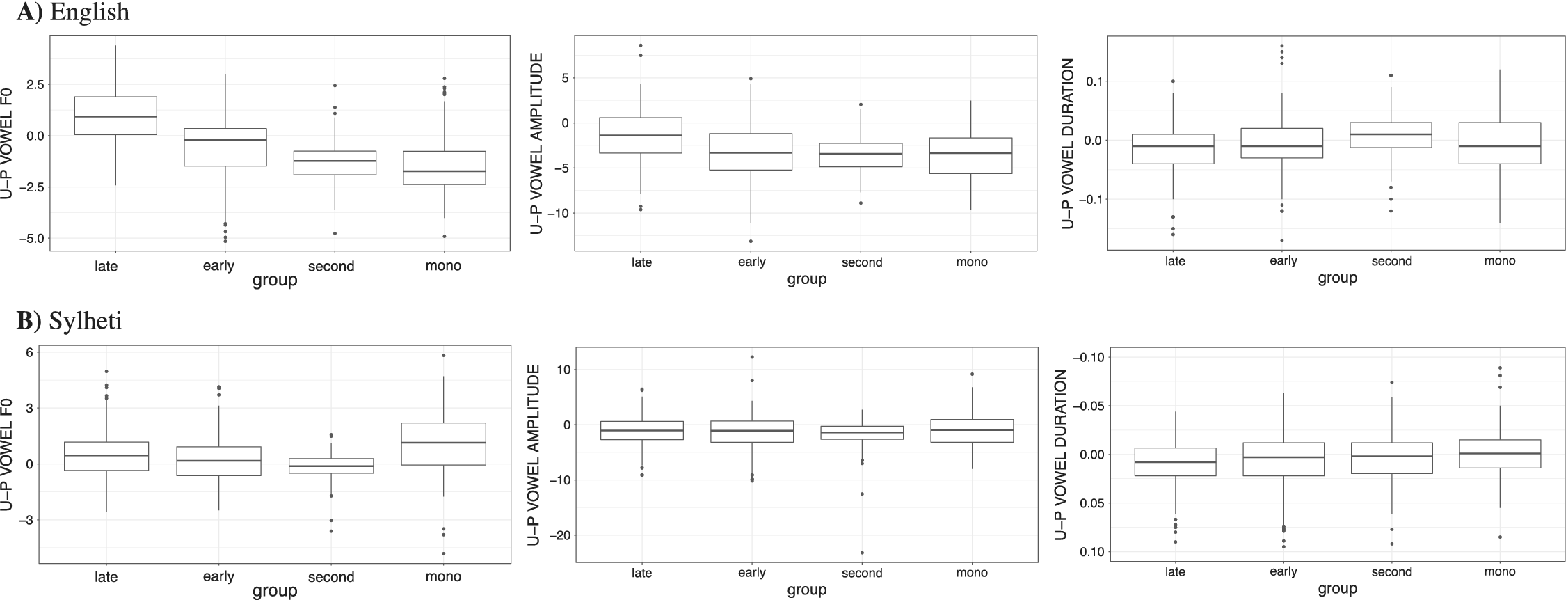
For intensity, the Sylheti monolinguals displayed a negative difference between the penultimate and ultimate syllable ( $ \overline{x} $
= −1.0dB;
$ \overline{x} $
= −1.0dB; $ \sigma $
= 3.1). The English monolinguals also displayed a decrease in intensity from the penultimate to ultimate syllable (
$ \sigma $
= 3.1). The English monolinguals also displayed a decrease in intensity from the penultimate to ultimate syllable ( $ \overline{x} $
= −3.6dB;
$ \overline{x} $
= −3.6dB; $ \sigma $
= 2.8).
$ \sigma $
= 2.8).
For duration, the Sylheti monolinguals showed almost no difference between the penultimate and ultimate syllables ( $ \overline{x} $
= −0.01s;
$ \overline{x} $
= −0.01s; $ \sigma $
= 0.02). Overall, the English monolinguals also displayed little difference in duration from the penultimate and ultimate syllable (
$ \sigma $
= 0.02). Overall, the English monolinguals also displayed little difference in duration from the penultimate and ultimate syllable ( $ \overline{x} $
= −0.01s;
$ \overline{x} $
= −0.01s; $ \sigma $
= 0.05), save open syllables which were longer.
$ \sigma $
= 0.05), save open syllables which were longer.
COMPARISON OF BILINGUALS AND MONOLINGUALS
To investigate the bilingual Sylheti and English prosodic patterns, we ran separate linear mixed effects models for each language and prominence measure (ST, s, dB). In all analyses, the prominence measure was the dependent variable. Each model included group (monolingual, late, early, second-generation) as a fixed factor, and participant and word as random intercepts.
For Sylheti, we found a main effect of group for f0 (χ2 (3) = 8.43; p < .05), but not for intensity (χ2 (3) = 1.21; p = .75) nor for duration (χ2 (3) = 3.72; p = .29). Similarly, for English, we found a main effect of group for f0 (χ2 (3) = 21.74; p < .01), but not for intensity (χ2 (3) = 7.47; p < .06) nor for duration (χ2 (3) = 6.51; p = .09).
To further explore the significant main effect of group for f0, Tukey HSD adjusted pairwise group comparisons were conducted. In the Sylheti comparisons, a significant difference was found between the second-generation bilinguals ( $ \overline{x} $
= −0.18ST;
$ \overline{x} $
= −0.18ST; $ \sigma $
= 0.7), who were born in the United Kingdom, and the Sylheti monolinguals (p < .05), with second-generation bilinguals displaying a production trend toward English. In contrast, the late (
$ \sigma $
= 0.7), who were born in the United Kingdom, and the Sylheti monolinguals (p < .05), with second-generation bilinguals displaying a production trend toward English. In contrast, the late ( $ \overline{x} $
= 1.1ST;
$ \overline{x} $
= 1.1ST; $ \sigma $
= 1.8) and early arrivals, who were born in Bangladesh, (
$ \sigma $
= 1.8) and early arrivals, who were born in Bangladesh, ( $ \overline{x} $
= 0.2ST;
$ \overline{x} $
= 0.2ST; $ \sigma $
= 1.2) were not significantly different from the Sylheti monolinguals (p > .05). There were no significant differences between any other groups (p > .05).
$ \sigma $
= 1.2) were not significantly different from the Sylheti monolinguals (p > .05). There were no significant differences between any other groups (p > .05).
For English, group comparisons, again with f0 as the dependent variable, revealed that the late arrivals ( $ \overline{x} $
= 1.0ST;
$ \overline{x} $
= 1.0ST; $ \sigma $
= 1.3) were significantly different from the English monolinguals, early arrivals (
$ \sigma $
= 1.3) were significantly different from the English monolinguals, early arrivals ( $ \overline{x} $
= −0.8ST;
$ \overline{x} $
= −0.8ST; $ \sigma $
= 1.9) and second-generation bilinguals (
$ \sigma $
= 1.9) and second-generation bilinguals ( $ \overline{x} $
= −1.3ST;
$ \overline{x} $
= −1.3ST; $ \sigma $
= 1.1), (all p < .01). There was no significant difference between any of the other groups (p > .05). Specifically, early arrival and second-generation groups used a pitch pattern similar to the English monolinguals, whereas, as a group, the late arrivals used a Sylheti-like pitch pattern. See Appendix B for the full comparison table and effect sizes.
$ \sigma $
= 1.1), (all p < .01). There was no significant difference between any of the other groups (p > .05). Specifically, early arrival and second-generation groups used a pitch pattern similar to the English monolinguals, whereas, as a group, the late arrivals used a Sylheti-like pitch pattern. See Appendix B for the full comparison table and effect sizes.
EXPLORING INTERPERSONAL VARIATION
Observation of Figure 2 shows within-group variation between our participants’ production patterns in Sylheti and English. To explore the potential factors underlying this variation, we conducted a series of Pearson product-moment correlation analyses to examine the relationship between the bilinguals’ background factors (language use patterns, LoR, AoA) and their Sylheti and English f0 production patterns, particularly because the late arrival bilinguals used significantly more Sylheti and significantly less English than the other two groups.
A summary of the correlations can be found in Table 3. For Sylheti, when all bilinguals were grouped together, we found a significant positive correlation between the speakers’ f0 and Sylheti use, r(21) = .39, p = .05, indicating a more Sylheti-like prominence realization for bilinguals who used more Sylheti in their daily lives. Additionally, again when all bilinguals were grouped together, a negative correlation was revealed between f0 and English use, r(21) = -.34, p < .05. Bilinguals who used more Sylheti (and, therefore, less English) were more likely to follow a Sylheti-like pitch pattern in their Sylheti, i.e., with a rise from the penultimate syllable to the ultimate syllable.
Summary of correlations between the bilinguals’ Sylheti pitch pattern (A) English pitch pattern (B), length of residence in the UK (LOR), age of arrival in the UK (AOA), and language use

* p ≤ .05, ** p ≤ .001.
For English f0, when all bilinguals were grouped together, we found a positive correlation between f0 and Sylheti use, r(21) = .45, p < .05, and a negative correlation between f0 and English use, r(21) = -.46, p < .05, indicating that those who used more English (and, therefore, less Sylheti) were more likely to follow an English-like prominence pattern in their English.
Of interest, no significant correlations were found between f0 and the participants’ LoR nor AoA, for English or Sylheti (see Table 3), indicating that language use was the most significant determiner of prominence realization in the bilinguals’ speech.
DISCUSSION
Our analysis of the Sylheti monolinguals revealed that, in general, prominent syllables were realized through an increase in f0 from the penultimate to the ultimate syllable, with the f0 of the prominent penultimate syllable being lower than the ultimate syllable. This pattern aligns with what some researchers have found in Standard Bengali (Khan, Reference Khan2008, Reference Khan2010; Maxwell, Reference Maxwell2010; Shattuck-Hufnagel, Reference Shattuck-Hufnagel1988). For English, the monolinguals realized prominent syllables through a decrease in f0 from the penultimate to the ultimate syllable.
We did not find salient differences between the two monolingual group measurements for duration and intensity, although goals of future research may be to investigate these factors in larger monolingual groups. As the difference between intensity and duration of the penultimate and ultimate syllables in Sylheti monolingual speech was negligible, we interpret that a lower pitch of the penultimate (and here first because the words were disyllabic) syllable in relation to the ultimate syllable is the primary correlate of prominence realization in Sylheti.
The second aim of this research was to explore the realization of prominent syllables in Sylheti-English bilinguals residing in the London Bangladeshi community. Our analyses only found significant group differences for f0, substantiating the important role of pitch in prominence realization in Sylheti and English.
For f0, our findings showed that Sylheti production of the late and early arrivals, who were born in Bangladesh, was not significantly different from the Sylheti monolinguals, with both groups revealing a rise from the penultimate to the ultimate syllable of the disyllabic words. This lack of significant difference in Sylheti between the Sylheti monolinguals and the late and early arrivals indicates first language maintenance within this community. Such findings are somewhat in contrast to the previously discussed studies (Colantoni & Gurlekian, Reference Colantoni and Gurlekian2004; de Leeuw et al., Reference de Leeuw, Mennen and Scobbie2012; Mennen, Reference Mennen2004; O’Rourke, Reference O’Rourke2005; Queen, Reference Queen2001; Simonet, Reference Simonet2011), which showed that prosodic features are malleable even in first-generation bilinguals. However, it is important to note that the late and early arrivals displayed some variation in production patterns, with some speakers indeed displaying a falling f0 contour.
These overall Sylheti monolingual-like patterns found in our late and early arrival speakers may have been due to the dense language environment of the London Bangladeshi community. For example, in the study by de Leeuw et al. (Reference de Leeuw, Mennen and Scobbie2012), it could be argued that the German-English bilinguals were not the dominant ethnic group within the local Vancouver community (most immigrants to British Columbia speak either Cantonese, Mandarin, or Punjabi as their home language, German ranks 10th as most popular home language in British Columbia, see e.g., Statistic Canada, 2016). In contrast, the Bangladeshi community is one of the largest ethnic groups in the London Boroughs studied here, so there may have simply been more opportunities for the bilinguals of the current study to speak their L1, also with new arrivals, which would give rise to more native-like phonetic realizations in the heritage language. This interpretation would align with our finding that the bilinguals who used Sylheti more frequently were also more likely to produce the prominent syllables in line with the Sylheti monolinguals. In other words, the bilinguals of the current study might have had more opportunity to speak their native language than the bilinguals in the other research, and those who took advantage of this opportunity would have displayed more Sylheti-like prosody patterns.
However, our finding that the late arrival’s Sylheti production did not significantly differ from the monolingual Sylheti speakers, may also be explained by examination of the prosodic variable in question. If a decrease in f0 on the prominent syllable is considered unique among the world’s languages (Neppert, Reference Neppert1999), it may also be that the realization of this prosodic variable was more salient to the Sylheti-English bilinguals, and, therefore, potentially more easily maintained than prosodic variables examined in other studies.
Furthermore, in their Sylheti, bilinguals who were born in the UK were not significantly different from the late or early arrivals, but they were significantly different from the Sylheti monolinguals, displaying a production trend toward English. To some extent, these findings align with segmental research in similar communities that has shown that second-generation speakers often exhibit non-native features in the heritage language (Kupisch et al., Reference Kupisch, Barton, Hailer, Klaschik, Stangen, Lein and van de Weijer2014; Mayr & Siddika, Reference Mayr and Siddika2016; McCarthy et al., Reference McCarthy, Evans and Mahon2013, Reference McCarthy, Mahon, Rosen and Evans2014, 2011; but see Kirkham & McCarthy, Reference Kirkham and McCarthy2020). This pattern might have been driven by their Sylheti language use patterns. Overall, less Sylheti use was associated with their falling English pitch realization, but it could also be in line with the fact that some of the late and early arrivals were patterning somewhat English-like, and that the second-generation speakers acquired the falling English pitch realization from the late and early arrivals (see, e.g., Rothman, Reference Rothman2007).
For English production, we found incremental differences between the bilingual groups, with the late arrivals producing Sylheti-like pitch patterns and the early arrivals and those born in the United Kingdom approximating the monolingual English pattern. These findings are similar to previous segmental research, which found that first-generation speakers typically exhibit patterns that reflect their first and dominant language (Khattab, Reference Khattab2000; Mayr & Siddika, Reference Mayr and Siddika2016; McCarthy et al., Reference McCarthy, Evans and Mahon2013), and second-generation and those who arrived in the UK as children behave similarly to their monolingual peers (Evans et al., Reference Evans, Mistry and Moreiras2007; Mayr & Siddika, Reference Mayr and Siddika2016; McCarthy et al., Reference McCarthy, Evans and Mahon2013, Reference McCarthy, Mahon, Rosen and Evans2014, 2011). Such trends are again possibly due to differences in language use and linguistic experience between our speaker groups. The late arrivals spent their early adulthood in Bangladesh. Their increased exposure to English would have started when they arrived in the United Kingdom, with Sylheti often continuing to be the dominant language spoken at home and in the community, in contrast to the other two bilingual groups who used significantly less Sylheti.
It is noteworthy that the early arrivals were the only group that had acquired monolingual-like prominence patterns in both languages. Thus, the combination of early Sylheti exposure coupled with continued English use thereafter potentially contributed to the patterns for the prosodic feature explored in the current study. Although not investigated in the current study, it is also possible that socio-indexical factors play a role in the production patterns of the early arrival and second-generation bilinguals, such as attitudes and affiliation toward the heritage and majority language and culture (see, e.g., Alam & Stuart-Smith, Reference Alam and Stuart-Smith2011; Heselwood & Mcchrystal, Reference Heselwood and Mcchrystal1999, Reference Heselwood and Mcchrystal2000; Kirkham, Reference Kirkham2011; Sharma & Sankaran, Reference Sharma and Sankaran2011). One avenue for future research could be to incorporate factors such as identity, attitudes, and style.
Our final aim was to explore the effect of language use, length of residence, and age of arrival on the bilinguals’ prominence realization. Our findings highlighted language use as a key driver in the bilinguals’ prosodic patterns. Specifically, our correlation analyses showed that an increase in English use was associated with a more monolingual-like English prominence realization, and an increase in Sylheti use resulted in more monolingual-like Sylheti prominence, regardless of when the bilinguals arrived in the UK. This finding became apparent when all groups were merged together. Again, this result, which is somewhat in contrast to other research (which shows that age of acquisition can be a significant factor in determining language proficiencies [see, e.g., Ortega, Reference Ortega2014, for an overview]) may again have arisen due to the unique community we investigated. As already mentioned, it may be that because the community was large and dense, it was simply possible to have more diverse input from the L1 than other minority communities would receive in their L1. Moreover, previous studies into L2 acquisition and the interaction between the L1 and L2 have focused on segmental aspects, with only a few studies exploring prosodic variables (de Leeuw, Reference de Leeuw2019, Reference de Leeuw, Brehmer and Treffers-Daller2020; de Leeuw et al., Reference de Leeuw, Mennen and Scobbie2012; Mennen, Reference Mennen2004; O’Rourke, Reference O’Rourke2005; Queen, Reference Queen2001; Simonet, Reference Simonet2011). It may, therefore, be that age of acquisition effects can be more easily compensated with enough language input for prosodic dimensions of speech, but not as readily for segmental aspects of speech.
In brief, although our findings are based on a small subset of the London Bangladeshi community, and likely do not represent the group in its entirety, we found that, overall, there was a salient difference in prominence realization between Sylheti and English monolinguals, with Sylheti pitch tending to evidence a rising contour and English pitch tending to evidence a falling contour from the prominent penultimate syllable to the ultimate syllable (see also Khan, Reference Khan2008; Maxwell, Reference Maxwell2010; Shattuck-Hufnagel, Reference Shattuck-Hufnagel1988). Moreover, when groups were compared, prominence tended to be a relatively robust variable in Sylheti, such that only those born in the UK evidenced a significant difference from the Sylheti monolinguals. Alternatively, prominence realization in English was only not successfully acquired by the late arrival group, whereas the early arrivals and those born in the UK realized prominence similar to the English monolinguals.
Although we found these intergenerational group differences, our results further suggested that language use was the most significant predictor variable in determining prominence realization, with more Sylheti use associated with Sylheti-like prosodic patterns, and more English use associated with English-like prosodic patterns. These findings enhance both our understanding of prosody in the world’s languages, as well as the production of prosody in bilinguals more generally.
COMPETING INTERESTS
We have no conflict of interest to disclose.
APPENDIX A
Full group comparisons table and effect size for bilinguals Sylheti, English, and both language use (all df = 21)

* p ≤ .05, ** p ≤ .001.
APPENDIX B
Summary statistics including effect size (Cohen’s d) for Tukey HSD adjusted pairwise group comparisons for (A) Sylheti and (B) English f0 measures

* p ≤ .05, ** p ≤ .001.


 Open access

