


Introduction
As noted on the pages of this journal, there is a distinct European understanding of the various kinds of organisations, initiatives, and movements that contribute to the social economy. This understanding is three-dimensional rather than scalar (more/less) and emphasizes the critical importance of governance in addition to the usual economic and social dimensions (Pestoff and Hulgård Reference Pestoff and Hulgård2016). In comparison with Anglo-American scholarship and practice, it also focuses less on the way legal forms shape practice and more on the nature and content of activities. There are substantial ongoing research efforts to disentangle the theoretical particularities of the relationship between these dimensions, and their empirical and policy implications. The aim of the present article is to contribute to this collective endeavour. Like Pestoff and Hulgård (Reference Pestoff and Hulgård2016), we focus on the governance dimension, but extend it to cover both internal governance (participatory governance arrangements) and external governance (political context). Our specific piece of the puzzle is solidarity, and we argue that closer attention to how solidarity as the performance of reciprocity is manifested in different European countries sheds light on the conditions for establishing the social and solidarity economy (hereafter SSE).
Focusing on the reciprocity dimension of solidarity, expressed in the engagement of citizens and collective action, we borrow from Polanyi the notion that economic action is not limited to the accumulation of capital, but it is also motivated by principles of promoting equality, social justice, and inclusion which can be exercised in both the public and private spheres (Polanyi Reference Polanyi1957). We further draw on Habermas and his view on the democratising potential of civil society, based on the assumption that personal motivations for exercising solidarity are rooted in the lifeworlds of social actors. Both scholars refer to human relations and the reciprocity produced from social interactions as the foundation for both the market and the state, with associations being society’s ‘first line of defence’ before the emergence of modern states that facilitate the link between private and public spheres (Laville Reference Laville, Hart, Laville and Cattani2010).
Modern democratic constitutions enable the exercise of solidarity through constitutional law that permits participation in the political process and creates a resource for legitimate emancipatory social action. Thus, citizens and their organisations have the potential to alter political discourse through deliberation in the public sphere, thus contributing to democratic process (Habermas Reference Habermas1996). This links the sphere of reciprocity, inhabited by free and equal citizens, to systems of public redistribution, enacted through representative democracy (Laville Reference Laville, Hart, Laville and Cattani2010), as both are concerned with the promotion of social rights and equality.
Laville sees a democratic solidarity exercised through entities that place services to members or communities ahead of profit, are self-managed and care about internal participatory decision-making. Such organisations are embedded within institutional regulatory contexts which include public redistribution and interactions between public authorities and civil society, protecting values of social equality and participation against the market (Laville Reference Laville, Hart, Laville and Cattani2010, p. 79). Employing a SSE lens means that we see the social economy as a set of organisations such as social enterprises, cooperatives, mutual organisations and non-profit associations, and the solidarity economy as a perspective highlighting these organisations’ link to contemporary democracy (Laville Reference Laville, Hart, Laville and Cattani2010; Laville and Salmon Reference Laville, Salmon, Laville, Young and Eynaud2015) in both the internal and external governance dimensions.
Drawing on empirical data collected within the EU H2020-funded SOLIDUS project, which explores expressions of European acts of solidarity, the analysis compares initiatives that are embedded in different policy environments. While policymakers across Europe have emphasised the importance of SSE (Liger et al. Reference Liger, Stefan and Britton2016), existing research and reports show how regulatory environments and policy practices that support the SSE differ significantly (e.g. Laville Reference Laville, Hart, Laville and Cattani2010; Mair Reference Mair, Fayrolle and Matlay2010; Hulgård Reference Hulgård2011; Defourny et al. Reference Defourny, Hulgård and Pestoff2014; Defourny and Nyssens Reference Defourny and Nyssens2016). This is reflected in the three countries of study: Denmark, Hungary and Scotland (see further the section on empirical material and analytical framework). Taking the cue from Gardin’s work on types of reciprocity (Gardin Reference Gardin, Defourny, Hulgård and Pestoff2014), we seek to understand our examples of citizens promoting equality, social inclusion and eco-friendly lifestyles in relation to both the national and the locally specific political context.
The article is divided into four sections. In the "The Social and Solidarity Economy" section, we offer a select review of the literature on the SSE that underlines how it is linked to democracy, before presenting the empirical material and analytical framework in the "Empirical Material and Analytical Framework" section. In order not to compartmentalise the analysis, in the "The Context-Dependence of Solidarity" section we analyse the three cases in parallel in accordance with the analytical framework. The section “Findings: The Solidarity Dimension of Reciprocity” spells out the key findings with relation to the reciprocity dimension of solidarity in SSE organisations and how it connects to the immediate social and political context of cases examined. As a result, we found that the support of political institutions, in forms of public funding, collaborative partnership and trust, as well as the constitutive organisational characteristics—that is, the type of reciprocity exercised, the resource-mix and internal democracy—sustain the work of the SSE.
The Social and Solidarity Economy
SSE is an alternative model for economic production and consumption (Laville Reference Laville and Utting2015, p. 47) to counter ‘gender inequality, environmental degradation, fiscal constraints on welfare spending, neoliberal deregulation and financial crisis’ (Utting Reference Utting2015, p. 8). It does this by placing ‘new actors into the workplace, in class strategies and citizenship struggles, in response to concerns over welfare, recognition and a meaningful life’ (Gaiger Reference Gaiger2015, p. 5). The term social and solidarity economy refers to a broad array of citizen-based activities, ranging from fair trade, renewable energy, microfinance and social currencies to third sector organisations providing health care, social services or work integration (Defourny Reference Defourny, Borzaga and Defourney2001; Cooney et al. Reference Cooney, Nyssens, O’Shaughnessy and Defourny2016).
We follow the work of scholars from the EMES networkFootnote 1 who have described and conceptualised extensively the SSE in Europe, taking into account the different historical, political and economic developments (Defourny and Nyssens Reference Defourny and Nyssens2010; Laville Reference Laville, Hart, Laville and Cattani2010; Nyssens Reference Nyssens2006; Laville Reference Laville and Utting2015; Pestoff and Hulgård Reference Pestoff and Hulgård2016). They refer to the social economy in Europe as a set of organisations such as social enterprises, cooperatives, mutual organisations and non-profit associations. Accordingly, when defining the social economy the ‘broader question of its relationship to the contemporary economy and democracy’ is left open (Laville Reference Laville, Hart, Laville and Cattani2010, p. 232). When adding or even changing the perspective from an organisational understanding of social economy to a solidarity economy approach, the perspective is widened to ask how such organisations influence and, in turn, are influenced by the dominant economic and political system (Habermas Reference Habermas1996). The solidarity produced in the SSE is displayed in the internal organisation of these initiatives—a ‘constructed solidarity’ (Laville Reference Laville, Laville and Cattani2006) based on voluntary involvement in day-to-day activities and the adoption of equality principles (Gaiger Reference Gaiger2015)—and in their relationship with external systems. When adopting a SSE framework, we need to ask how the social economy enterprise is embedded in the broader societal framework, and how the ‘practical experience in managing the common good lends new value to the notions of justice and public interest’ (Laville Reference Laville and Utting2015, p. 5).
Unlike the scalar approach, the multi-dimensional approach to SSE means that organisations associated with it are not characterised as acting more or less economically. By way of contrast, it rather emphasizes the importance of governance in addition to the usual economic and social dimensions (Pestoff and Hulgård Reference Pestoff and Hulgård2016). Building on the work of scholars such as Polanyi and Habermas, researchers have conceived SSE as a multi-faceted phenomenon, characterised by a social, an economic, and a political dimension. The SSE is strongly intertwined with participatory governance, due to its focus on citizen involvement, the base in civil society and on the promotion of self-organised activity.
Thus, the social dimension seeks to enhance the quality of life through recognition, the promotion of personal autonomy and social justice (Laville and Salmon Reference Laville, Salmon, Laville, Young and Eynaud2015). The economic dimension combines self-organised activity with multiple income sources to help vulnerable people, consumers and self-help groups to become producers/co-producers and owners/co-owners (Laville and Salmon Reference Laville, Salmon, Laville, Young and Eynaud2015). By coupling common good actions with plural economic understandings of citizen initiatives and third sector, this social and solidarity economy framework converts the social dimension into economic leverage or specific productive strength (Fraser Reference Fraser2013). The political dimension holds that the solidarity of individuals is motivated by their ‘lifeworlds’ and that this solidarity in turn has the potential to alter political discourse through deliberation in the public sphere (Habermas Reference Habermas1996).
With regard to the internal governance of SSE organisations, it is important to note that this is usually shared by multiple stakeholders, such as professionals and volunteers, who might be represented on the board of directors alongside users or public authorities. Through forms such as, though not only, a general assembly, participants have to find compromise between multiple perspectives and interests in order to serve the common interest. External governance refers to the relationship between the SSE and state institutions, who may provide funding by ‘ordering’ services, supply the relevant legal structures, or even have a place on the Board (Nyssens and Petrella Reference Nyssens, Petrella, Laville, Young and Eynaud2015, p. 184). This in turn connects to wider discourses on the roles of civil society, civic engagement and active citizenship.
A key concept in SSE research is the principle of reciprocity, prominent in Polanyi’s pluralist definition of the economy. One system consists of the free exchange of goods with the aim of generating profits, a second involves redistribution through measures such as taxation or philanthropic giving and the third system encompasses reciprocity and the production of use value to satisfy family and community needs (Polanyi Reference Polanyi1957). The reciprocity dimension of solidarity shows itself through the mobilisation of various types of actors involved in a magnitude of civic initiatives, where users, employees and volunteers, but also representatives of public authorities and other providers of capital come together to address specific unmet needs or interests. Expressions of reciprocity create voluntary-based relations between disparate groups or persons, giving, receiving and giving in return, and in so doing creating new bonds of solidarity (Laville and Cattani Reference Laville and Cattani2006; Laville Reference Laville, Hart, Laville and Cattani2010; Hulgård and Andersen Reference Hulgård, Andersen, Andersen, Gawell and Spear2016).
Collective actors are often supported through public principles of redistribution, according to political priorities and interests in re-allocating and redistributing value as well as addressing some of the more ambivalent consequences of social change (Gardin Reference Gardin, Defourny, Hulgård and Pestoff2014). In these ways, the market becomes culturally and politically embedded, rather than being wholly autonomous and dominating both the political and private spheres (Laville Reference Laville, Laville and Cattani2006, p. 278). SSE research highlights the potentially democratising effects of including people in some form of self-managed economic life (Defourny and Delvetere Reference Defourny, Delvetere, Defourny, Develtere and Fonteneau1999; Fraisse et al. Reference Fraisse, Guérin and Laville2010; Laville Reference Laville2003).
This is where the solidarity and social economy literature takes inspiration from Habermas and his work on system, life worlds and public sphere, coupling economic and political approaches to create a comprehensive understanding of citizen initiatives (Laville and Salmon Reference Laville, Salmon, Laville, Young and Eynaud2015, p. 158; Hulgård Reference Hulgård, Bogason, Kensen and Miller2004, p. 105). Conceptualising engagement in communication in the public sphere as a legitimate source of power for political decision-making, Habermas (Reference Habermas1996) sees civil society as an emancipatory force so long as it is permitted to access the public sphere. This describes the political potential of the SSE. While solidarity-based public redistribution sees ‘its rules enacted through representative democracy, reciprocity [can] unfold on the basis of voluntary commitments, in the public space, of free and equal citizens’ (Laville Reference Laville and Utting2015, p. 50–51).
Polanyi’s hybrid conceptualisation of the economy leads to a twofold movement: on the one hand, the priority given to market exchange in the institutionalist process of the economy (Polanyi Reference Polanyi1957); on the other hand, the invention of modern solidarity in the form of constitutional law that enables participation in the political process and creates a resource for legitimate emancipatory social action. This is what Habermas calls the socially integrating force of solidarity to counter the power of money and administration (Habermas Reference Habermas1996). Thus, personal autonomy is guaranteed through legal provisions and a democratic society. As they are mutually constitutive, citizens can make use of their legal rights to decide for themselves the rules of social intercourse (Eriksen and Weigard Reference Eriksen and Weigard2003, p. 9).
This combination of redistribution which ‘reinforce[s] social cohesion and redress[es] inequality’ and of an understanding of reciprocity as enhancing ‘voluntary social relations between free and equal citizens’ is the prerequisite for what Laville calls ‘democratic solidarity’ (Laville Reference Laville and Utting2015, p. 107). This combines ‘redistributive solidarity with a more reciprocal and performance-based version of the latter in order to rebuild society’s capacity for self-organisation’ (Laville Reference Laville and Utting2015, pp. 107–108). Democratic solidarity seeks the recipient who would reciprocate, so as to avoid the ‘permanent position of inferiority’ (Laville Reference Laville and Utting2015, p. 106). From an SSE perspective, one way forward would be to promote a stronger societal position for civil society and the third sector, but ‘without losing the objectives of social justice, redistribution and the institutional mechanisms of ‘the old’ universal welfare state’ (Hulgård Reference Hulgård, Laville, Young and Eynaud2015, p. 217).
The question for this paper is how different elements of the economic and political context affect the reciprocity dimension of solidarity.
Gardin’s typology of reciprocity observed in Europe (Reference Gardin, Defourny, Hulgård and Pestoff2014) helps to address some of these questions, or more precisely, to understand solidarity actions in the context of their political environments. He distinguishes three types of reciprocity:
• Unequal reciprocity: this is where the group in charge of the initiative (volunteers, professionals, public authorities) differs substantively from the users or consumers of a service or product. This does not preclude a later move to more horizontal forms of reciprocity via participatory forms of governance;
• Reciprocity among peers: these are cases where a group is both more homogeneous and self-organised. In this scenario, members can end up as future workers, i.e. in production cooperatives, users, i.e. in consumer cooperatives or both, i.e. local exchange trading systems;
• Multilateral reciprocity: in this case, a variety of actors come together in a roughly symmetrical position. According to Gardin, the key difference is that ‘the beneficiary group is given consideration and able to dictate its terms’ over the course of the activity (Gardin Reference Gardin, Defourny, Hulgård and Pestoff2014, p. 118).
The first two types refer to vertical and horizontal forms of reciprocity. In order to include a political dimension of reciprocity, one must take into account the relationship to the market, redistributive mechanisms and the nature of the democratic process. This should be seen in the way redistributing intermediaries are chosen and how they distribute resources based on notions of rights and equality (Gardin Reference Gardin, Defourny, Hulgård and Pestoff2014, p. 126). In this way, the organisation demonstrates whether its democratic solidarity is based on vertical, horizontal or multilateral forms of reciprocity.
In other words, reciprocity produced in the SSE is politically and economically embedded in a system that is based on public redistribution, market exchange logic and political interests, all of which can be used as resources for SSE, but can also be a barrier for common good production. Different types of resource allocation can be combined as SSE organisations might sell products and services on the market, be recipients of state subsidies or private donations, as well as benefit from the time and expertise of volunteers (Gardin Reference Gardin, Defourny, Hulgård and Pestoff2014, p. 116; Laville and Salmon Reference Laville, Salmon, Laville, Young and Eynaud2015). The three cases presented below use different resources mixes, something which is partly conditioned by their respective political systems.
When linked explicitly to a neoliberal policy agenda, SSE organisations, like social enterprises can have ambiguous characters. They ‘are supposed to combine social purpose activities in poor constituencies with capital, knowhow and managerial structures developed in the for-profit market sphere of society’ (Hulgård Reference Hulgård, Laville, Young and Eynaud2015, p. 207), moving from a half movement, half government character of civil society towards a half charity, half business logic (Wijkström and Zimmer Reference Wijkström and Zimmer2011, p. 46). This sometimes results in a form of political neutering and is diametrically opposed to Laville’s concept of democratic solidarity based on reciprocity.
Even though mostly operating at the local level, researchers highlight the need for a broader recognition of the SSE by political institutions, i.e. by adjusting the relationship with welfare state institutions (Nyssens and Petrella Reference Nyssens, Petrella, Laville, Young and Eynaud2015; Laville and Hulgård Reference Laville and Hulgård2016). Since SSE has social benefits at its core, Nyssens and Petrella term their products and services as ‘quasi-collective’ (Reference Nyssens, Petrella, Laville, Young and Eynaud2015, p. 183), and as such in the interest of democratic governments. However, public support is not always there or can be undermined by political interests, austerity or dominant public logics. This does not diminish the importance of the social actors engaged in reciprocal solidarity, rather, it raises the question of how to acquire resources and what type of reciprocity they wish to exercise.
In the following sections, we draw on this theoretical framework to examine three case studies exploring how reciprocity and solidarity are enacted in SSE initiatives and how far this is an expression of their particular institutional contexts.
Empirical Material and Analytical Framework
The current paper stems from a large collaborative research project on solidarity practices in Europe, conducted over 3 years and spanning 12 countries, investigating practices going back at least 10 years, and comprising 14 research teams and more than 30 researchers.Footnote 2 Within this project, more than 80 case studies on solidarity initiatives across Europe had been carried out as of 2017 with between 5 and 10 case studies per country.
One recurrent theme has been the impossibility to divorce social acts based on solidarity from economic ones following a Polanyian logic. This encouraged the authors of this paper to draw on the research and investigate closer the links between solidarity expressions and the SSE. To do so, we examine three case studies in Denmark, Hungary and the United Kingdom that were selected among each country’s pool of case studies to match in terms of policy areas or scope. The diversity of country settings enables us to take into account several relevant models relevant to understanding the political and economical contexts. The cases are situated in countries with different politico-administrative traditions (Painter and Peters Reference Painter and Peters2010) and types of welfare capitalism (Esping-Andersen Reference Esping-Andersen1990), and that follow different forms of the European Social Model (Sapir Reference Sapir2006; Draxel and van Vliet Reference Draxel and Van Vliet2010; Kostadinova Reference Kostadinova2014). While not covering all European models, notably missing the Napoleonic administrative traditions of France and southern Europe and its corresponding Mediterranean social policy model, similarities found across our cases may nonetheless hint at common elements shared across Europe, or at least can be highly recommended for further hypothesis testing and theory development. Differences, on the other hand, can be more easily attributed to within-case factors, and in this sense are harder to make general propositions. That said, we believe that it is also valuable to highlight and map variations that can be used for further hypothesis generation.
In order to study the three cases, semi-structured interviews—between 4 and 8 for each case—with different categories of stakeholders (founders, staff, volunteers, users) were carried out. The interviewees elaborated about organisational development and features (such as the level of pluralism in membership and democracy in governing processes) and their own motivations and aspirations. This was complemented by textual sources, such as websites, annual reports, newsletters, media records when available and, where available, already published research.
The analytical framework and the codes to the data applied in this paper differ from those adopted in the collaborative study. Here, the authors revisited the data with a different analytical perspective, in order to delve deeper into aspects touched upon in the original research project. Due to their richness and diversity, the data have not been formally coded. However, the in-depth case knowledge of respective authors, combined with a cross-case validation of respective findings, has ensured at least a minimum level of research reliability and validity.
Drawing on the several conceptual strands of research, we approach our cases in accordance with the social, the democratic and the economic dimensions of SSE. First we outline the social dimension, the current and past activities of the organisation, the actors involved and their motivations, before making the connection between internal democratic forms and the idea of solidarity and the common good. Looking at reciprocal actions at both user and producer level, the first section allows us to determine the type of reciprocity produced and performed.
We then look at the contextual factors that affect the reciprocity dimension of solidarity, in other words, the economic and political dimensions of SSE. Since reciprocity produced in SSE is embedded in a system based on public redistribution, market exchange logic, as well as political interests, (Laville and Salmon Reference Laville, Salmon, Laville, Young and Eynaud2015) this includes looking at the spectrum of resources available to SSE organisations—market-based activities, redistribution, whether from public or private sources, and reciprocity in the forms of voluntary engagement in actions of, mutual support and common interest, embedded in institutional context that supports the social mission of an organisation to varying degrees. The reciprocity dimension of SSE action, oriented towards social equality and the common good rather than self-interest and profit-maximisation, is the core of what Polanyi called a counter-movement to markets disembedded from social relations (Polanyi Reference Polanyi1957, p. 156). Thus, reciprocity takes on an economic dimension that seeks to re-integrate markets by engaging in economic activities that most of all benefit the social mission of the organisation. Thinking of SSE organisations as part of lifeworld-based movements that not only address social injustice at individual level but that seek to transform society by publicly voicing grievances and proposing solutions, reciprocity also takes on a political dimension, embodied by interaction with public institutions and processes of representative democracy (Habermas Reference Habermas1996).
Reciprocity then links to solidarity insofar as it seeks to protect individual freedom and social rights in various ways from market encroachment. It calls on the democratic institutions of the state to create the right conditions to promote social equality. At the same time, it can draw on multiple resources: income earned on markets; support through public redistribution schemes and legislation that guarantees and supports the free interaction of citizens; and the commitment of individuals (Laville Reference Laville, Hart, Laville and Cattani2010, p. 223). Thus, the reciprocity dimension of solidarity is the one that integrates the public and private spheres of society.
We are interested in understanding how far the choice of resources of SSE organisations is determined by the working relationship with local politics and administration (Gardin Reference Gardin, Defourny, Hulgård and Pestoff2014, p. 120). This opens up the discussion to the political legitimacy of the organisation.
In order to understand the legitimacy of a SSE initiative in its political environment, we examine the dominant logic of collaboration using the following questions: (a) Who are the actors that set the dominant working criteria? (b) Are these criteria the outcomes of SSE advocacy? (c) Are they the product of negotiated regulation? In other words, to what extent do ‘associations have their say on the rules concerning them’ (Vaillancourt and Laville Reference Vaillancourt and Laville1998, p. 131). Finally, to what extent can we see public recognition given to the reciprocity-dimension of the SSE (Vaillancourt and Laville Reference Vaillancourt and Laville1998, p. 124)?
These questions allow us to draw tentative conclusions on the relationship between the politico-administrative environment, organisational type and their resource mix. It also has an impact on the quality of internal democracy and hence what Gardin type of solidarity/reciprocity is expressed. In the following sections, the findings of the case studies are presented.
The Context-Dependence of Solidarity
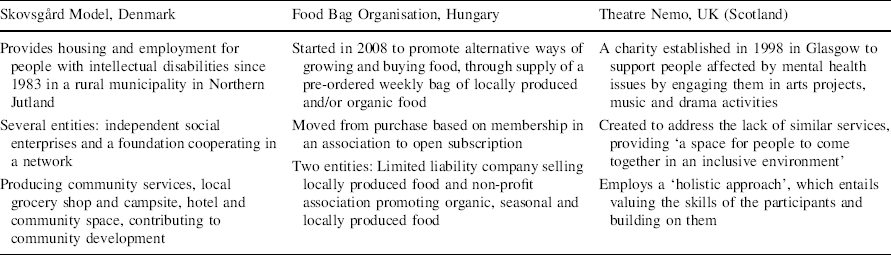
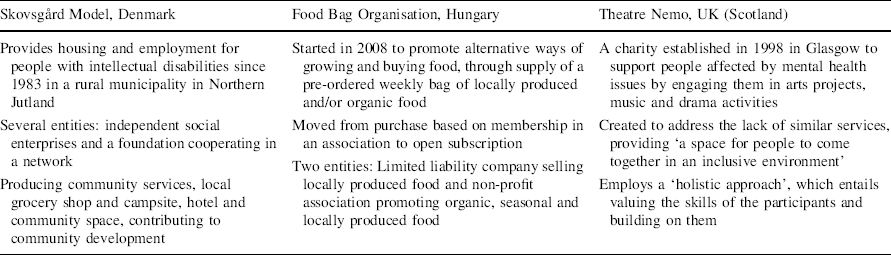
At first sight, the three cases investigated and compared in this article are very different. One began in the 1980s (Skovsgård Model, Denmark), the other appeared in the 1990s (Theatre Nemo, UK Scotland) while the final one has a more recent provenance (Food Bag Organisation, Hungary), which illustrates that neither solidarity initiatives nor social economy contributions is something new. The three actions provide workplaces for those with intellectual disabilities, support the recovery of psychiatric patients, whether in the community or in prison, developing new market ties and opportunities for depopulating villages, all the while providing more individual regarding benefits of self-help, status and healthier living. Legally, they include one legal unit (a UK-based charity), an initiative consisting of two entities (a company and an association constituting the Hungarian food bag case) as well as network of entities with different legal forms (the Danish Skovsgård Model). Table 1 reports the key characteristics of each initiative. Despite these differences, the three cases investigated and compared in this article are all social economy organisations, even Theatre Nemo that operates as a ‘charity’, a term not usually associated with social economy practice has been conceptualised as a health integration social enterprise (Roy and Hackett Reference Roy and Hackett2017).
Overview of cases (foundation year, legal form and activities of the three initiatives)
Skovsgård Model, Denmark |
Food Bag Organisation, Hungary |
Theatre Nemo, UK (Scotland) |
|---|---|---|
Provides housing and employment for people with intellectual disabilities since 1983 in a rural municipality in Northern Jutland Several entities: independent social enterprises and a foundation cooperating in a network Producing community services, local grocery shop and campsite, hotel and community space, contributing to community development |
Started in 2008 to promote alternative ways of growing and buying food, through supply of a pre-ordered weekly bag of locally produced and/or organic food Moved from purchase based on membership in an association to open subscription Two entities: Limited liability company selling locally produced food and non-profit association promoting organic, seasonal and locally produced food |
A charity established in 1998 in Glasgow to support people affected by mental health issues by engaging them in arts projects, music and drama activities Created to address the lack of similar services, providing ‘a space for people to come together in an inclusive environment’ Employs a ‘holistic approach’, which entails valuing the skills of the participants and building on them |
It should be noted that the spatial dimensions of solidarity vary across the cases. We have the example of a strong face-to-face network, operating in a relatively bounded location (Theatre Nemo), social and entrepreneurial networks that expand out of specific institutional parameters (Skovsgård) and thirdly, an emphasis on strong face-to-face encounters with an increasingly geographically dispersed network of suppliers and communities (Food Bag Organisation). The Skovsgård initiative combines social and economic goals. It shows practical care in the community, taking into account not only the needs of one group of beneficiaries, but successfully attuning itself to the requirements of the others living in the area, thereby supporting the political agenda of rural development and shaping the social economy orientation of the municipality. By way of contrast, from its base in Glasgow, Theatre Nemo reaches out to those in state run institutions such as prisons and psychiatric hospitals where it can demonstrate its practical care and empathy with those suffering mental illness. At the same time, the various activities help create new and potentially important social care ties between volunteers, patients, prisoners, and officials, that often transcend the original catchment area and thereby extend the social network of the group. The nature of solidarity expressed in the Hungarian case is perhaps lower key, but there are signs that the model of buying local is gaining in influence and, in that sense, there is growing degree of economic and political embeddedness beyond the original action. In the beginning, the organisers were concerned to create a tightly bounded community, committed to the values of low-impact farming and sustainable development. For example, unless a member had paid their small membership fee, they were not entitled to make food orders from the suppliers. The later decision to drop these criteria reflects the skill of the founders and staff in solidifying the business by expanding the range and quality of suppliers, but also shows the steady strength of interest in alternative, short supply chains.
Variations in Internal Democratic Functioning
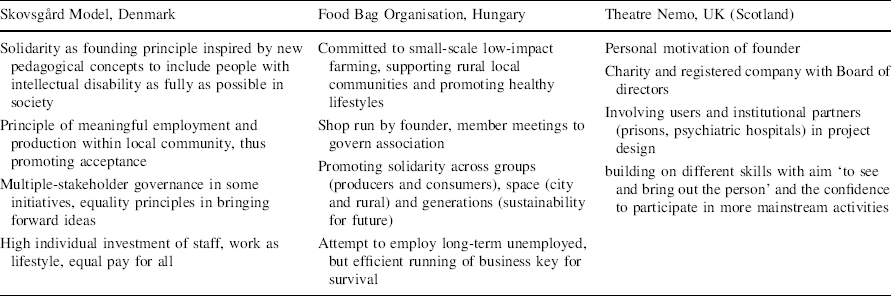
Although broadly ascribing their action to implement more inclusive quasi-economic initiatives, the mission of the three cases under consideration varies. The Danish and Scottish cases are both traditional civic responses to unmet needs, albeit both driven by a strong reformist mission to develop alternative therapeutic care. The Danish Skovsgård shows how citizens’ counter-actions go beyond their original purposes, whether this is giving local villagers opportunities to make income or simply offer opportunities to take a more active part in public life. The Hungarian Food Bag case combines market promotion for marginal rural communities and a more individual regarding concern for health, well-being and the ‘eco-conscious’ lifestyle. From an organisational perspective, the Hungarian and Danish cases are both examples of social enterprises, whereas the Scottish case is more typical of an NGO addressing the needs of vulnerable people.
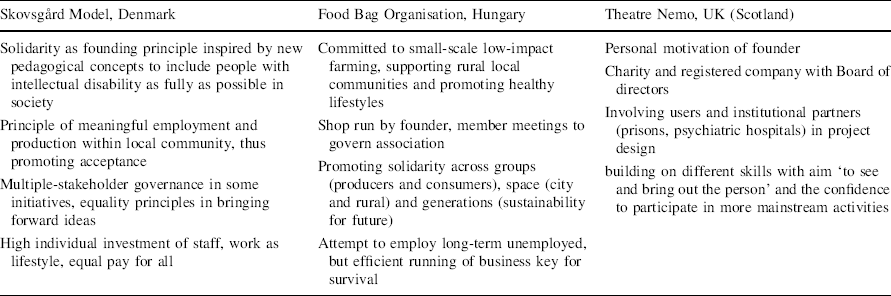
As argued above, participatory governance is a characteristic for social economy organisation in Europe, but these cases do not fully adhere to this vision. For the Scottish and Hungarian case, there is limited evidence of widespread involvement in strategic decision-making. Although the founder of the Hungarian group seeks to distance herself from operational questions, she remains an influential person in the venture. In the sister association, the background and ethos of the volunteers promotes a steady supply of input in decision-making on activities and future events, but this is relatively non-formalised. In Scotland, the members of the staff in charge of organising activities stress how important it is to hear from the target groups and to take their views into account. However, it remains the case that the principal decision-makers are few in number. In Denmark, participation in deliberation and decision-making is large scale and genuine, albeit rather limited and informal for the target group due to intellectual capacities. The fact that the various activities and enterprises have become so important to the local community is seen in the cooperative style of ownership and operation, where for instance the Skovsgård Hotel is owned jointly by people working there and stakeholders from the community. We would argue that this largely reflects the rural reality of the initiative, whereby the small local state relies upon the strong involvement of the local community for both legitimation and inspiration.
Table 2 summarises the findings for this category.
Motivation and internal democratic functioning
Skovsgård Model, Denmark |
Food Bag Organisation, Hungary |
Theatre Nemo, UK (Scotland) |
|---|---|---|
Solidarity as founding principle inspired by new pedagogical concepts to include people with intellectual disability as fully as possible in society Principle of meaningful employment and production within local community, thus promoting acceptance Multiple-stakeholder governance in some initiatives, equality principles in bringing forward ideas High individual investment of staff, work as lifestyle, equal pay for all |
Committed to small-scale low-impact farming, supporting rural local communities and promoting healthy lifestyles Shop run by founder, member meetings to govern association Promoting solidarity across groups (producers and consumers), space (city and rural) and generations (sustainability for future) Attempt to employ long-term unemployed, but efficient running of business key for survival |
Personal motivation of founder Charity and registered company with Board of directors Involving users and institutional partners (prisons, psychiatric hospitals) in project design building on different skills with aim ‘to see and bring out the person’ and the confidence to participate in more mainstream activities |
Choices Regarding Resources and Resource Mix
With regard to the type of resources employed, the cases vary. For instance, the economic role of Theatre Nemo is manifested in the provision of professional and volunteer welfare services that are non-public. As emerged in the interviews, Theatre Nemo provides a service that the state sector was not offering to people with mental health issues. As a result, it has provided forms of alternative (and parallel to medical and public) support for individuals with mental health conditions. To implement its projects, it receives funding from private trusts and foundations. However and this is by deliberate choice, it neither seeks nor receives any public funding.
The Food Bag has strived to stay independent of the ‘grant circle’Footnote 3 and rely primarily on its own income. In order to survive, it has increasingly become concerned with the success of the business side of the initiative. Thus, its main income comes via its shop, which is run as a private company. The recourse of volunteers is through its association and supported though the occasional small grants such as the European student/volunteer exchange.
The Skovsgård model relies on multiple resources: income earned through business activities, selling services to the municipality, selling services on the market, redistributive funding in the form of state-support for the target group and through reciprocity, i.e. in the form of cooperative-style community ownership of a hotel. Reciprocity plays a key role in its mission and practice, supported by social and political embeddedness and an economic resource mix that addresses both the needs of social and economic inclusion of intellectually challenged people and the challenges felt by rural areas characterised by decreasing and ageing population. The majority of Skovsgård revenue comes from the local municipality’s grant scheme for handicapped people, based on a law that guarantees protected employment financed by the municipality for people on early retirement who cannot enter the regular labour market. However, employees do have income from their respective activities on top of their retirement payments.
Legitimacy in Their Political Environment
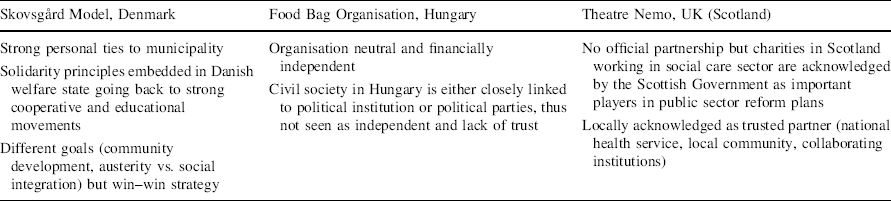
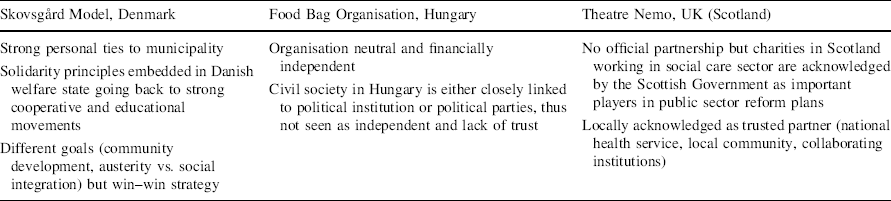
In order to understand how these SSE initiatives may strengthen solidarity through reciprocity in their reference community, it is necessary to analyse their relationships and interactions with the political environment where they are embedded (Table 3).
Legitimacy in their political environment
Skovsgård Model, Denmark |
Food Bag Organisation, Hungary |
Theatre Nemo, UK (Scotland) |
|---|---|---|
Strong personal ties to municipality Solidarity principles embedded in Danish welfare state going back to strong cooperative and educational movements Different goals (community development, austerity vs. social integration) but win–win strategy |
Organisation neutral and financially independent Civil society in Hungary is either closely linked to political institution or political parties, thus not seen as independent and lack of trust |
No official partnership but charities in Scotland working in social care sector are acknowledged by the Scottish Government as important players in public sector reform plans Locally acknowledged as trusted partner (national health service, local community, collaborating institutions) |
In this respect, in Hungary the promotion of short supply chains, seasonal consumption, low impact, organic farming might seem more of a metropolitan emulation of a generic middle class lifestyle, with little by way of political aspiration. Indeed, we heard little from suppliers, consumers and participants that would explicitly connect them to a political movement. There was a deliberate separation from those other active civic groups that campaign for changes in public opinion, policy or legislation. The emphasis here was on maintaining independence and self-sufficiency rather than exerting policy voice and influence. According to our observations and interviews, many of the shoppers at the Food Bag organisation had above average incomes, a heightened concern for healthy food but only a superficial interest in the fate of the supplying rural communities. On the other hand, the idea of a short supply sector does seem be to embedding itself in the wider market (Szabó and Juhász Reference Szabó and Juhász2015), and in a country where poor diet remains a serious health issue in both urban and rural areas, efforts to promote increased consumption of locally grown fresh fruit and vegetables and otherwise educating people of the benefits of a healthy lifestyle, arguably offer more than simply a class benefit.
How do these solidarity expressions relate to the wider political process? As mentioned above, there are some signs in Hungary that this movement is having both an economic and a political impact, even though the various participants would disagree on many issues. The nature of support to local farmers and the question of the future of shrinking villages connects to debates on the accountability of globalisation and the promotion of local sustainability, to questions of trust in the truthfulness of the market, but also to older movements for self-education and newer ones for exerting influence through consumption choices. Within the Common Agricultural Policy, several countries among those accessing in 2004 and 2007 have tried to advocate for supporting the interests of the many hundreds of thousands of small producers in the region. Although the economic viability of these farms might often be borderline, they are not involved in large-scale commercial activity; however, they form an important integrating element in the social and economic ties between town and country. In this perspective, they are starting to receive increasing prominence in EU structural and cohesion policies (DG Internal Policies 2016). At the same time, in Hungary as in many places in the eastern part of the European Union, the relation between civil society in its various manifestations and the government has deteriorated in recent years, with some groups finding themselves the object of intensive regulation. In 2017, for example, a new law increasing transparency obligations for NGOs receiving more than 20,000 Euros from abroad per year created widespread comment and controversy (anonym 2017).
In this regard, the Danish case can be offered as an important working model of the local SSE with valuable lessons for rural development policy in Europe. The model is both known and respected by local civil servants and politicians who consider it a win–win situation for both rural development and the social and work integration of people with intellectual disabilities. Locally, the concept of social economy has been put on the political agenda by leaders of the Skovsgård model. At the same time, it has also entered the national political discourse in a country that has a top-down tradition of working with civil society by providing funding to implement a range of services. Cuts in welfare spending are promoting new models like social economy and social entrepreneurship, which might tip the balance in favour of more equality between public sector and civil society, at least locally and within existing regulations.
In Scotland, although Theatre Nemo did emerge from individual personal tragedy and a strong sense of unmet needs, rather than working in isolation and independently from the state sector, the organisers and volunteers took a hard but perhaps more rewarding route and got inside state institutions and developed care work alongside the statutory authorities albeit without requiring financial assistance. By acting inside public institutions, the staff and volunteers are indirectly exposed to changes in state welfare policy since it effects their end-users, but they are not dependent on the state for their continuous work. Their solidarity towards not only the beneficiaries but the staff and officials makes them a trusted organisation, offering a valuable alternative in the range of available services in the community. They benefit from a strong and well-developed third sector, which traditionally has had good bonds with the public sector. Both the current and recent Scottish governments have emphasized the importance of co-production and collaborative governance in order to improve policy-making processes and policy outcomes.
Findings: The Solidarity Dimension of Reciprocity
The three cases cut across Gardin’s typology (Gardin Reference Gardin, Defourny, Hulgård and Pestoff2014, p. 118), in that they incorporate different elements of the three types of reciprocity. Theatre Nemo displays vertical reciprocity while promoting horizontal solidarity among users. The Food Bag organisation started with a strong vertical reciprocity approach but has moved to more geographically dispersed features of horizontal reciprocity, largely due to the lack of variety in the socio-economic background of producers, users and intermediaries. Finally, Skovsgård is an example of multilateral reciprocity, promoting as much civic autonomy as possible, including a range of stakeholders, through a mix of earned income and public redistribution. Below we elaborate on each of these dimensions.
Since reciprocity identifies a mutual exchange of help and support, then Theatre Nemo is not an example of equal and horizontal forms of reciprocity. The source of solidarity in this case study is found in the mission of Theatre Nemo and the vulnerability of targeted users, which places them largely, although not exclusively, at the receiving end in the relationship with Theatre Nemo members. Nonetheless, as noted by the respondents, some type of solidarity bonds developed among end-users. While these may or may not be long lasting, participation in Theatre Nemo’s activities clearly helps end-users to overcome the isolation often associated with mental health issues. This is something that is further driven by the organisation’s close working relations with public mental health institutions and its embeddedness in a strong tradition of volunteering in Scotland, which all lends legitimacy to Theatre Nemo’s actions. While the overcoming of isolation may be seen as an immediate and frail effect of volunteering, it nonetheless prompts end-users to engage in activities more generally, also outside the organisation, for instance by enrolling in further education courses.
The Food Bag organisation originally displayed features of vertical reciprocity; the group in charge of the initiative (volunteers, professionals, public authorities) differed from the users/consumers of a service or product. However, over time it has been transformed into more of a horizontal reciprocity arrangement due to both changing constituencies and the introduction of more participatory forms of governance. The organisation serves local farmers catering to a growing urban population who are aware of the importance of healthy and regional produce, mediated by the Food Bags vetting procedure of products that drives consumer trust and participation in the Food Bag association.
In the Skovsgård case, the grocery store illustrates how solidarity can be institutionalised in a hybrid complex manner: it is situated in a village that once had 38 small businesses, the last of which was about to close a few years ago. Citizens of the village came together with people from Råd & Dåd to run the store with a mix of volunteer staff members, a professional merchant as well as special needs employees, in line with the holistic approach of the model that you live and work in the same local area, creating a ‘whole’ life for the individual. Apart from individual commitment, Råd & Dåd received some funding from the Danish Social Capital fund, which was key to start operations in Bonderup.
Similarly, on the initiative of the founder, the hotel was discussed with the local community, whereby residents were persuaded to buy the place together. In 2009, Skovsgård Hotel generated about half of its earnings from the hotel’s main operations, while the other half came from services that the hotel sells to the municipality in the form of protected employment. In Råd & Dåd income from economic activity amounts to about a quarter of their income, the rest is revenue from social budgets (Social Virksomhed 2014). All employees in the hotel are shareholders, including those with disabilities or other social issues, giving employees on special terms a sense of ownership and equality.
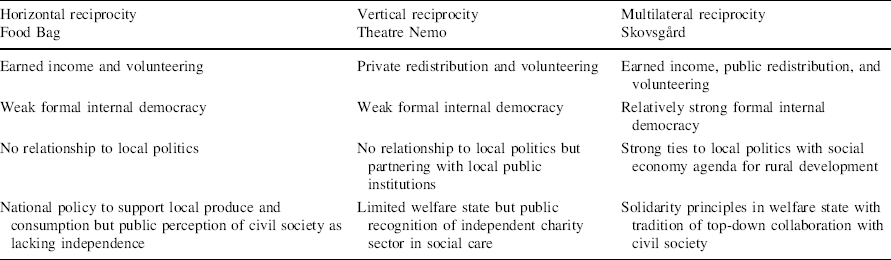
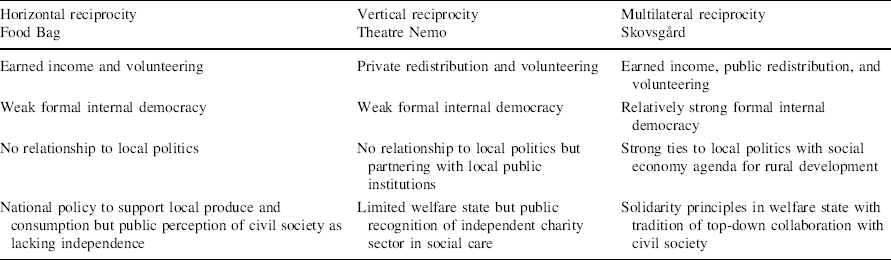
The comparison of cases suggests links between political environment, types of sources of income, and state of internal governance which results in varying reciprocity dimensions of solidarity. In a context of less legitimacy or public profile of the issue addressed as well as the image of civil society, initiatives must rely more on earned income, which leads to more managerial rather than participatory governance, and a more homogeneous group of beneficiaries (Food Bag).
A charity promoting vertical reciprocity in a context of a strong tradition of volunteering and new public management might prefer looking for private donors to fund their mission, while keeping ties with public institutions. The redistributive nature of activities leads to rather weak and informal participatory governance (Theatre Nemo).
Using a hybrid mix of resources involving members of local communities leads to strong participatory governance and supports multilateral reciprocity, especially when embedded in local political and administrative structures that support activities financially and politically.
Table 4 illustrates these relationships.
Environmental effects on solidarity as reciprocity?
Horizontal reciprocity |
Vertical reciprocity |
Multilateral reciprocity |
|---|---|---|
Food Bag |
Theatre Nemo |
Skovsgård |
Earned income and volunteering |
Private redistribution and volunteering |
Earned income, public redistribution, and volunteering |
Weak formal internal democracy |
Weak formal internal democracy |
Relatively strong formal internal democracy |
No relationship to local politics |
No relationship to local politics but partnering with local public institutions |
Strong ties to local politics with social economy agenda for rural development |
National policy to support local produce and consumption but public perception of civil society as lacking independence |
Limited welfare state but public recognition of independent charity sector in social care |
Solidarity principles in welfare state with tradition of top-down collaboration with civil society |
Conclusions
The body of academic research and practitioners’ materials on the European social and solidarity economy has grown steadily over the past few decades. Even so, this article was born out of the conviction that there is still a severe need for comparative studies, and that, at the level of theory building, the impact of political context on the reciprocity dimension of solidarity, including on internal dynamics, has been underexplored. The organisations in our case studies made conscious decisions on how to relate to the state and how to make every day and strategic decisions. We would argue that these decisions had an important influence on the ways in which they promoted solidarity. In the Danish and Scottish cases, the impact of their work on creating new forms of service delivery and, to some extent, promoting democratic development, emerged in the context of close ties with statutory authorities, whereas in Hungary, there was more operational independence but arguably much less direct policy influence.
Through the participation in a European research project on current expressions of solidarity, we could extract material on the nature of three very different social economy initiatives, working with mental health, supporting the cultivation and consumption of local and healthy food, or promoting workplace integration. Moreover, they differed significantly in terms of the resource mix they rely upon. For instance, the Food Bag courted neither state funds nor project grants, seeing more to lose in both sources. However, the organisations had commonalities at organisational level, in that they all offer a new service, they are driven by self-interest, exhibit high levels of trust within their networks and communities, and promote public awareness of certain issues.
Using a social and solidarity economy lens, we analysed these initiatives with reference to their short- and longer-term motivations, the nature of their internal democracy, their resources and their legitimacy in broader political settings. As reviewed, the literature suggests a strong socially integrating and democratising effect of SSE organisations. This can demonstrate a way back towards embedded markets, supported by democratic solidarity exercised by a redistributive state and active citizens who engage in mutual support, promoting transformative ideas and solutions.
Gardin’s typology of reciprocity appears to be linked to a weighting of political, economic and reciprocity factors, with supportive public legislation and redistributive systems favouring multilateral expressions of reciprocity that are more successful in integrating hybrid resources to promote solidarity and that allow for more internal democratic process. In some countries in Europe, for example, public procurement rules allow for a preference for local producers in supplying public institutions (Kersley Reference Kersley2011). The stability this provides can allow for longer-term decision-making as well as the possibility to experiment with less established partners, pursuing a mix of SSE objectives. On the other hand, where SSE organisations are more dependent on linking common good orientations to market-based resources, or building an alliance with state institutions but limiting themselves to private donations and mutual support, then in the cases studied here, the solidarity dimension of reciprocity was more reduced to horizontal or vertical expressions.
Hence, solidarity is not only an expression of support for those involved in alternative forms of production, it is an argument for creating a different kind of relationship between producers, sellers and buyers of goods and services, embedded in institutional notions of solidarity such as systems of preference and redistribution. It is also an argument for taking a broader look at just what are the different elements within the concept of institutionalised participatory democracy. These can be interlinked fora, overlapping actions, joint platforms and networks, all of which can shape citizen action, but whose constituent parts could be altered by introducing new ways of thinking of solidarity.
Based on the analysis, we argue that there is a strong link between political context, types of reciprocity and sources of income. In addition, this is linked to the state of internal governance, even though in our cases weaker participatory governance does not seem to directly impact on the successful running of the initiative. Partially nuancing the previous argument by Pestoff and Hulgård, we see that formal and informal internal democracy depends on both the organisation’s legal forms and, secondly, the target group’s capabilities. The case studies also confirm that SSE organisations can thrive with the support of political institutions (e.g. Nyssens and Petrella Reference Nyssens, Petrella, Laville, Young and Eynaud2015) in the form of stable public funding and collaborative partnerships. Further, trust in SSE organisation is linked to wider socially expressed trust in political institutions and the relative autonomy of these organisations. These statements should not be taken as empirically proven by this research study alone. For that, the empirical material should either have been bigger or selected with more stringent theoretical criteria in mind. From an external perspective, the relationship between public funding/public trust/legal frameworks, local conditions, geographical location, and type of reciprocity clearly warrants further investigation. From an internal perspective, we note that internal democracy is fairly informal in most cases, and that the relationship between type of reciprocity, internal democracy and networking could also be fruitfully explored. The study had its limitations in that questions were asked from material originally collected for a slightly different purpose, and the case selection does not fully ensure transferability of results across geographic and policy sectors. With this limitations in mind, we still see fertile ground for future research in terms of answering what this mean for organisations and initiatives which do not find supportive conditions outlined above in the Skovsgård case, and whether there are other strategies that can promote democratic solidarity and multilateral reciprocity regardless.
Acknowledgements
The authors wish to acknowledge the support of the European Union. This article was prepared within the larger framework of the project ‘Solidarity in European societies: empowerment, social justice and citizenship—SOLIDUS’ (http://solidush2020.eu), funded by the European Union under the Horizon 2020 Programme (Grant Agreement No. 649489), running June 2015 through May 2018. The project explored conceptually and empirically current and future expressions of European solidarity from an inter-disciplinary approach. The authors also want to thank Péter Balogh for excellent research assistance and the 6th EMES International Conference on Social Entrepreneurship, July 3–6, 2017, for helpful comments on a previous version of this paper.
Compliance with Ethical Standards
Conflict of interest
The authors declare that they have no conflict of interest.

 Open access

