

1. Introduction
L'opposition entre l’état libre (EL) et l’état d'annexion (EA)Footnote 1 caractérise en particulier l'alternance de l'initiale du nom et concerne toutes les langues berbèresFootnote 2, à l'exception des langues orientales et quelques langues du Sud comme le zénaga et le tetserret (Taine-Cheikh Reference Taine-Cheikh2005 et Lux Reference Lux2013)Footnote 3. Les formes de noms en berbère varient entre l'état libre et l'état d'annexation selon leurs contextes syntaxiques. Un nom est à l’état d'annexion lorsqu'il 1) est le sujet lexical postposé au verbe, 2) survient après un déterminant numéral et 3) suit la quasi-totalité des prépositions. Il prend la forme de l’état libre quand il est 1) sujet préverbal, 2) objet de verbe et 3) après certaines prépositionsFootnote 4.
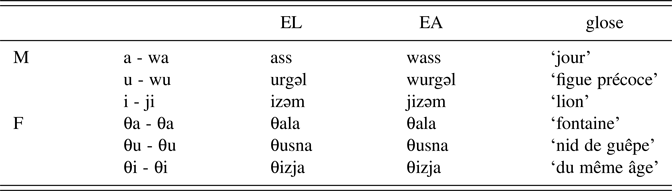
La quasi-totalitéFootnote 5 des noms en kabyle (et dans la plupart des langues berbères) commencent par une voyelle. Cette voyelle, qui est toujours présente à l’état libre (EL), peut se maintenir ou tomber à l’état d'annexion (EA). Dans les cas où la voyelle initiale est absente à l’état d'annexion, il y a aussi, au masculin, l'apparition de w/j en position #__CC, ou de u/i en position #__CV lorsque le mot précédent est à finale consonantique. Un schwa apparaît aussi entre le w/j et le CC suivant (je reviendrai sur ce cas en section 4.4).
Par ailleurs, au féminin, la voyelle initiale est absente à l’état d'annexion, mais le préfixe t (réalisé [θ] en kabyle) apparaît dans les deux états (EL et EA). Le tableau 1 illustre les phénomènes décrits.
La voyelle initiale instable (VII)

Les voyelles pleines u/i n'apparaissent en position #__CV à l’état d'annexion que si elles sont précédées par un mot à finale consonantique. Dans le cas contraire, c'est-à-dire après un mot à finale vocalique, on observe les glides w/j comme devant #__CC. Le tableau 2 en fait l'illustration :
L'alternance entre w/j et u/i

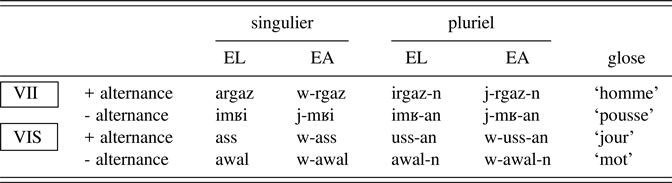
J'ajoute qu'il y a un certain nombre de noms masculins qui montrent les glides w/j à l’état d'annexion sans la chute de la voyelle initiale. Ce type de noms est considéré dans la littérature comme des noms à voyelle initiale radicale ou stable (VIS) par opposition aux noms qui perdent la voyelle initiale à l'EA, cas où celle-ci serait préfixale, ou VII (voyelle initiale instable) (Basset Reference Basset1945, Bendjaballah Reference Bendjaballah and Mettouchi2011). Quelques exemples du paradigme à voyelle initiale stable apparaissent dans le tableau 3.
Voyelle initiale stable (VIS)
Les données du kabyleFootnote 6 analysées ici sont issues du dictionnaire kabyle-français de Dallet (Reference Dallet1982) que j'ai transformé en base de données interrogeable sous AccessFootnote 7. Elle contient 2400 noms, qu'on peut consulter selon le genre (masculin/féminin), le nombre (singulier/pluriel), selon le type de pluriel (externe/interne/mixte) et selon que la voyelle initiale est stable (VIS) ou instable (VII).
Mon objectif dans cet article est de rendre compte d'une question qui n'a pas été traitée par les analyses précédentes, à savoir l'alternance w-u en sandhi externe dans les noms où la racine est à initiale CV. Je montre que cette alternance dépend du mot précédent (à finale -V ou -C) et que son effet en cascade de droite à gauche constitue une expression archétypique du fonctionnement prévu par le modèle CVCV (Scheer Reference Scheer2004, Ségéral et Scheer Reference Ségéral and Scheer2001). Mon analyse n'est possible que si le CV, épelé par K (Cas) dans l'analyse de Bendjaballah (Reference Bendjaballah and Mettouchi2011), est absent. Cette partie d'analyse me permettra aussi de montrer que le schwa présent après le w- dans l'EA (comme dans wəmʁar) n'est pas une réduction de la voyelle instable mais une vocalisation d'un noyau vide non gouverné.
2. Alternance vs non-alternance de la voyelle initiale
Tel que présenté dans l'introduction, la voyelle initiale peut être stable (VIS) ou instable (VII). Par ailleurs, entre le singulier et le pluriel, il y a des noms où la voyelle initiale alterne en timbre, et il y a des noms où elle n'alterne pas. Le tableau 4 résume la situation.
Alternations en timbre de la voyelle initiale
En ce qui concerne l'alternance de la voyelle initiale entre le singulier et le pluriel, toutes les VII qui alternent sont du type SG a ~ PL i Footnote 8, et toutes les VII qui n'alternent pas sont du type SG i ~ PL i. Quant à la VIS, quand elle n'alterne pas, les trois voyelles (a, i, u) sont attestées; dans les cas où elle alterne, je n'ai relevé, dans ma base de données, que 10 cas du type SG i ~ PL a, et seulement deux cas du type SG a ~ PL u.
Vycichl (Reference Vycichl1957) pense que les démonstratifs wa- (M.SG) et wi- (M.PL) ont été préfixés dans un état diachronique antérieur de la langue berbère. Cela explique l'alternance prédominante SG a ~ PL i de la VII : après préfixation, la semi-voyelle est tombée à l'EL et les voyelles a/i sont restées figées sur les noms SG/PL. En ce qui concerne la VII qui n'alterne pas (SG i ~ PL i), Vycichl (Reference Vycichl1957) considère que ces noms ont perdu la voyelle initiale au singulier et qu'elle a été ensuite reconstruite par rapport à celle du pluriel, qui est i.
Si l'on veut suivre le scénario diachronique de Vycichl en ce qui concerne les noms à l'EL, toutes les langues berbères ont connu la chute de la voyelle préfixée au singulier, pour la totalité ou une partie des noms. Pour les noms qui ont une VII, SG i ~ PL i, il faut alors supposer que les noms à voyelle initiale i au singulier ont connu l’évolution vue dans le tableau 5.
L’évolution des préfixes des noms à VII

Le scénario de Vycichl peut être interprété de la manière suivante : tous les noms à VII ont connu les étapes (1) et (2), et seulement les noms à voyelle i au singulier ont connu les étapes (3) et (4). Pour ces derniers, le kabyle instancie le cas général que l'on trouve dans les autres langues berbères qui ont perdu la voyelle préfixale a- au singulier, à savoir le tacawit (Algérie), tarifit (Maroc) et les langues berbères orientales. Ensuite il y a eu reconstruction d'un i, par analogie à celui du pluriel qui a survécu à l’étape 3. Cette dernière se révèle, en synchronie, dans beaucoup de noms dans les langues berbères orientales comme le nefousi parlé au Nord-Est de la Libye (Motylinski Reference de Calassanti1898). Des exemples du nefousi sont donnés dans le tableau 6:
La perte du préfix a- au singulier en nefousi

Quant aux noms à VIS, le tableau 7 montre les différentes étapes diachroniques qui caractérisent leur évolution à l'EL.
L’évolution de la VIS à l'EL

Les noms à VIS ont également connu la préfixation des éléments préradicaux à l’étape (1). Ensuite la voyelle préfixale tombe à l’étape (2) à cause de l'hiatus (Prasse Reference Prasse1974). Enfin à l’étape (3), la semi-voyelle tombe à son tour à l'EL. La VIS qui alterne a probablement subi une apophonie : i > a et a > u.
3. La voyelle initiale dans l'analyse de Bendjaballah (Reference Bendjaballah and Mettouchi2011)
La voyelle initiale en berbère a dans le cadre génératif produit un certain nombre d'analysesFootnote 9. Je présente ci-dessous celle de Bendjaballah (Reference Bendjaballah and Mettouchi2011), qui est l'analyse phonologique la plus récente qui concerne le cas du kabyle et pour laquelle je propose un raffinement. L'analyse de Bendjaballah (Reference Bendjaballah and Mettouchi2011) repose sur l'analyse syntaxique de Guerssel (Reference Guerssel1992), qui est introduite dans un premier temps.
3.1 Guerssel (Reference Guerssel1992)
Guerssel (Reference Guerssel1992 : 176) considère que le nom est à l’état d'annexion quand il est dominé par un KP (Case Phrase) dont la tête K est vide, sans exposant phonologique. Il propose que le w qui apparaît à l’état d'annexion pour les noms masculins et le t au féminin sont à considérer comme des déterminants, et qu'ils occupent la position D dans la structure syntaxique, comme le montrent les représentations suivantes sous (1) reprises de Guerssel (Reference Guerssel1992 : 177) où seuls les constituants ayant un exposant phonologique sont montrés.
(1)


Les représentations montrent également que Guerssel (Reference Guerssel1992) considère que les prépositions s / dy sont des exposants de la projection fonctionnelle du cas.
Pour l’état libre, qui présente au masculin une voyelle initiale a et l'absence de la semi-voyelle w, et au féminin, un ta, Guerssel (Reference Guerssel1992 : 178) propose que ces formes sont elles-mêmes l'expression du cas : [KP a-zru] ‘pierre’ et [KP ta-sirt] ‘moulin’. Autrement dit, a et ta à l’état libre sont des morphèmes porte-manteau qui expriment à la fois le déterminant et le cas. Guerssel (Reference Guerssel1992 : 188) propose les structures syntaxiques sous (2).
(2)

On voit que a et ta occupent à la fois K et D. C'est la raison pour laquelle, selon Guerssel, D n'a pas besoin d'autre exposant et n'est pas épelé en tant que w à l’état libre, en opposition à l’état d'annexion.
3.2 Le modèle CVCV
Cette section introduit le cadre théorique CVCV pour ce qui est des mécanismes présents dans l'analyse de Bendjaballah (Reference Bendjaballah and Mettouchi2011) dont je me servirai par la suite.
Le modèle CVCV a été fondé formellement par Lowenstamm (Reference Lowenstamm, Laks and Durand1996). Il est une suite de la Phonologie de Gouvernement Standard (Kaye Reference Kaye1990) qui avait commencé à remplacer les structures arborescentes par des relations latérales (Gouvernement et Licenciement) pour l'expression de la structure syllabique. Ce déplacement de fonctionnalité avait déjà appauvri la structure arborescente en Phonologie de Gouvernement Standard. Le modèle CVCV complète ce mouvement en éliminant totalement la structure arborescente. La structure syllabique est donc exprimée uniquement par des relations latérales, et il ne reste de la constituance que des unités attaques-noyaux (CV) non branchants.
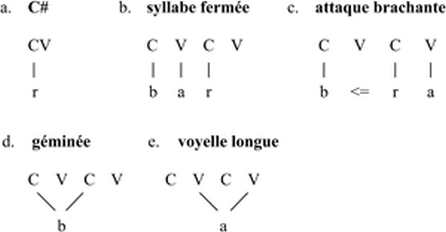
Dans le modèle CVCV, une consonne finale (3a), une syllabe fermée (3b), une attaque branchante (3c)Footnote 10, une géminée (3d) et une voyelle longue (3e) seront représentées de la manière suivante :
(3)
3.3 Longueur virtuelle des voyelles du kabyle
Dans l'analyse présentée dans cet article, j'adhère à la longueur dite virtuelle des voyelles en Kabyle : les voyelles périphériques (ou pleines) sont phonologiquement longues. Une voyelle qui branche sur une seule position structurelle apparaît en surface avec un timbre schwa (Bendjaballah Reference Bendjaballah2005). En effet, un cas particulier d'une distorsion entre la phonologie et la phonétique est la longueur virtuelle. Il s'agit d'une longueur phonologique qui n'est pas réalisée phonétiquement en tant que durée. La longueur, en phonologie, est bien toujours marquée en surface mais, d'une langue à une autre, la phonétique utilise des moyens différents pour l'exprimer. On dit qu'une voyelle est virtuellement longue lorsque sa longueur phonologique se manifeste autrement que par la durée en phonétique (Lowenstamm Reference Lowenstamm and Kaye1991, Hammond Reference Hammond1997, Bucci Reference Bucci2013, parmi d'autres).
Selon l'hypothèse de la longueur virtuelle, les voyelles pleines du kabyle ont les représentations sous (4) : les éléments A, I et U sont associées à deux positions vocaliques.
(4)

J'ajoute que les éléments I et U sont épelés j et w, respectivement, lorsqu'ils sont associés à une position consonantique (Kaye et Lowenstamm Reference Kaye, Lowenstamm, Dell and Vergnaud1984). Les représentations de I/U associés aux deux types de constituants syllabiques sont données sous (5).
(5)

3.4 Bendjaballah (Reference Bendjaballah and Mettouchi2011)
Revenons à présent à la voyelle initiale des noms en kabyle. Bendjaballah (Reference Bendjaballah and Mettouchi2011) l'analyse dans le modèle CVCV et en recourant aux voyelles longues virtuelles. Elle se base sur l'analyse syntaxique de Guerssel (Reference Guerssel1992) et se propose de rendre compte du comportement différent des voyelles initiales stables et instables.
3.4.1 Le radical des noms en kabyle
Bendjaballah (Reference Bendjaballah and Mettouchi2011) cherche d'abord à unifier la taille des noms à VIS et à VII. Les derniers sont des trilitères et donc, en première approche, possèdent une unité CV de plus que les premiers, qui sont des bilitères. Ceci se confirme par ma base de données, qui contient 220 noms bilitères à VIS et 1880 noms trilitère à VII.
(6)

En s'appuyant sur l'analyse de Basset (Reference Basset1945), Bendjaballah (Reference Bendjaballah and Mettouchi2011) propose d'isoler un radical dans les deux cas : la VII n'en fait pas partie, alors que la VIS est présente. Rappelons que l’élimination de la VII du radical reflète l'analyse diachronique qui postule que cette voyelle est préfixale, qui viendrait d'un démonstratif diachroniquement figé au nom. On voit sous (7) que cette hypothèse réduit les noms à VII à quatre unités CV, autant que les noms à VIS.
(7)

Cette analyse propose donc que la différence entre les noms à VII et les noms à VIS est le fait que les premiers ont un radical à initiale consonantique, alors que les derniers possèdent un radical à initiale vocalique. Par ailleurs, les deux radicaux (des noms à VII et à VIS) ont la même taille : quatre unités CV.
Bendjaballah propose que les noms à VIS sous (7b) possèdent une mélodie vocalique initiale, mais qui manque lexicalement d'un second noyau pour s'exprimer en tant que voyelle pleine. La VIS n'acquiert cette seconde position qu'au moment de la dérivation, lorsque le CV préfixal (en fait représentant le déterminant, voir infra) est concaténé à gauche du gabarit du radical.
3.4.2 L'exposant phonologique de K(cas) et de D(éterminant)
Bendjaballah (Reference Bendjaballah and Mettouchi2011) reprend l'idée de Guerssel (Reference Guerssel1992) selon laquelle l’état d'annexion (EA) et l’état libre (EL) représentent un NP dominé par une structure fonctionnelle faite d'un DP et d'un KP. Elle propose que chacune de ces deux projections fonctionnelles épèlent, en phonologie, en plus d’éventuelles unités mélodiques, une unité CV. Ces deux unités CV viennent s'ajouter à gauche du radical. La structure résultante pour tous les noms est montrée sous (8).
(8)

Pour les noms à VII, la concaténation avec le radical sous (8) produit les structures sous (9) pour le VII ‘vieux’.
(9)

À l'EL sous (9a), la mélodie de la voyelle initiale a (qui selon l'analyse de Guerssel épèle à la fois K et D (voir sous (2)), occupe les deux CV représentant K et D. À l'EA sous (9b), le w (qui selon Guerssel épèle D) occupe la position du déterminant (D), et la position K reste vide (voir sous (1)).
Signalons ici que la représentation sous (9b) pose un problème, car elle ne permet pas la réalisation du cas datif qui se réalise en tant que voyelle pleine à gauche du w-, comme dans i wəmʁar ‘pour/au vieux’. En effet, si une voyelle pleine a besoin de deux positions V pour se réaliser, sous (9b) K n'en offre qu'une seule et ne peut donc pas accueillir la voyelle i qui marque le cas datif et qui a besoin de deux positions V.
Considérons à présent les noms à VIS. La différence avec les items à VII réside dans le fait qu'ils commencent par une voyelle radicale, ce qui joue un rôle dans le marquage d’état. Pour les noms à VIS, la concaténation donne les représentations sous (10) pour la VIS (asif ‘rivière’), sachant que K et D épèlent toujours une unité CV chacun, et que l'exposant de l'EL est toujours A (masc.) / ta (fém.), les préfixes portemanteaux dans Guerssel (Reference Guerssel1992) et celui de l'EA, w (masc.) / t (fém.), les préfixes D dans Guerssel.
(10)

À l'EA sous (10b), le A radical peut s'associer à deux noyaux, et le w (U) représentant l'EA s'ancre dans l'attaque précédente. Il en est de même pour l'EL sous (10a), à la différence près que le w (U) est absent. À priori, le A flottant pourrait donc s'associer au noyau du K sans qu'il y ait croisement des lignes.
Les représentations sous (10) semblent contredire le tableau 9, puisque D est supposé épeler une mélodie (A) à l'EL. Or, on voit seulement l'association de la VIS. Je montrerai (en section 4.2) que l'absence de cette voyelle en surface est due à l'hiatus. Donc, même si elle est épelée par D, elle ne peut pas s'associer. Je propose que la représentation proposée par Bendjaballah (Reference Bendjaballah and Mettouchi2011) sous (10) peut être envisagée comme sous (11), où A épelé par D, qui est présent dans les ingrédients lexicaux, mais qui reste flottant à cause de l'hiatusFootnote 11.
(11)

Une constatation qui jouera un rôle important en section 4.4 est que dans l'analyse de Bendjaballah (Reference Bendjaballah and Mettouchi2011), le CV du K demeure inexploité dans trois des quatre situations montrées sous (9) et (10) : seule la VII à l'EL l'utilise.
3.5 La distribution des préfixes en synchronie
Passons maintenant à l'analyse de la voyelle initiale en kabyle. J'adopte l'analyse de Bendjaballah (Reference Bendjaballah and Mettouchi2011) qui dit que les noms à VII ont un radical à initiale consonantique, alors que les noms à VIS ont un radical à initiale vocalique. Dans ce cadre, la situation de l'initiale des noms est rappelée dans le tableau 8.
Noms VII et VIS, segment initial

Pour les noms qui ont un radical à initiale consonantique (partie gauche du tableau), au masculin, la distribution de la voyelle initiale et de w- est complémentaire.
Considérons à présent la partie droite du tableau 9. La situation est identique à la précédente pour le w-, mais le a- est totalement absent. Cette absence s'explique par le fait que le radical, ici, commence par une voyelle, et reflète donc l'état hiatique ancien.
Distribution complémentaire a/w pour les noms masculins

En ce qui concerne l'opposition masculin/féminin, comme on le voit dans le tableau 10, à l'EA, la distinction de w/t est aussi complémentaire : quand le t- du féminin est présent, le w- est absent.
Distribution des préfixes entre le masculin et le féminin

Nous pouvons dire de la distribution des préfixes en synchronie qu'elle est complémentaire pour a- et w-. Le préfixe du féminin t- est présent à l'EA et à l'EL, mais à l'EA il est aussi en distribution complémentaire avec w-. Ce qui fait de w- à la fois un marqueur d’état et un marqueur de genre.
4. Analyse de la voyelle initiale
Dans cette partie, je propose mon analyse de la voyelle initiale et de l'alternance initiale u-w.
4.1 Exponences et gabarit
Avant d'introduire ma propre analyse de la voyelle initiale en kabyle, rappelons les prémisses adoptées : 1) le modèle CVCV, 2) la longueur virtuelle des voyelles, 3) deux unités CV (K et D) à gauche du gabarit du radical comme il a été proposé par Bendjaballah (Reference Bendjaballah and Mettouchi2011), 4) les noms à VII ont un radical à initiale consonantique (√C-) et les noms à VIS ont un radical à initiale vocalique (√V-) et enfin 5) la distribution des préfixes que j'ai montrée supra.
Il s'agit maintenant de savoir de quoi les unités CV sont l'exposant. Je rappelle qu’à l'EL, la VII a besoin de deux unités CV préfixales. À l'EA elle est absente, mais le w- au masculin et le t- au féminin ont besoin d'un CV pour se réaliser. Quant à la VIS, à l'EL comme à l'EA, elle a besoin d'une position V (pleine) pour se réaliser: c'est la raison pour laquelle il y a toujours une unité CV, et ce même lorsque ni le t- ni le w- ne la demandent (cas de l'EL masculin).
Clarifions maintenant la situation, en considérant que le féminin est transparent puisqu'il est réalisé t- dans tous les cas. Par ailleurs, à l'EA, le t- est en compétition avec w- qui est un marqueur d’état.Footnote 12
Nous avons vu que deux unités CV sont nécessaires uniquement pour les noms √C- à l'EL. Un seul CV suffit partout ailleurs. On constate également que le w- apparaît seulement au masculin à l'EA.
La situation des radicaux à initiale C (VII) dans le système de Bendjaballah où K et D épèlent chacun une unité CV est montrée sous (12). Toutes les mélodies préfixales sont flottantes, et ce n'est qu'au moment de la dérivation qu'elles s'associent au gabarit.
(12)

Dans le système de Bendjaballah, à l'EL la voyelle a- branche sur les deux positions vocaliques offertes par K et D et t- branche sur la position consonantique de K. À l'EA, la voyelle a est absente, le t/w s'associe à la position consonantique de DFootnote 13, c'est-à-dire, ils s'associent à la première attaque vide.
4.2 Effet de l'hiatus en synchronie
Toujours dans le système de Bendjaballah, considérons sous (13) la situation des noms dont le radical commence par une voyelle (noms à VIS). À l'EL, il existe a priori trois façons d'associer les objets mélodiques aux positions syllabiques, mais une seule est bien formée (celle en d). Les autres (13a, b et c) sont exclues par la phonologie de la langue kabyle, vu que cette dernière ne tolère pas la succession de deux voyelles (Chaker Reference Chaker2000).
(13)

Considérons d'abord l'EA, qui ne pose pas de problème : la VIS du radical s'associe à la position vocalique du D et le t/w, à la position consonantique. Le CV du K demeure non-utilisé.
Quant à l'EL, la voyelle a- crée un hiatus avec la VIS du radical. Les trois configurations de l'EL montrées sous (13a–c) correspondent aux solutions logiquement possibles pour l'association du matériel mélodique au gabarit : sous (13a), le a- s'associe au V de D et la VIS à la position vocalique de son radical; sous (13b), la VIS en fait autant mais le a- s'ancre sur deux positions vocaliques, celle du D et celle du K; enfin sous (13c), la VIS s'ancre doublement, sur la position vocalique de son radical et sur celle de D, ce qui fait que le A de l'EL s'associe au V du K, puis le t/ø va dans le C du K. Ce qui fait un hiatus [əV] en surface.
Les propriétés générales de la phonologie du kabyle excluent les trois premières options et ne permettent que la dernière (13d). En effet, les représentations sous (13a–c) sont mal formées, puisque elles donnent lieu à des suites inédites en kabyle : la première (13a), produit une suite de deux schwas (*əə) et la deuxième (13b), une suite d'une voyelle et d'un schwa (*aə); et la troisième serait encore un hiatus *əV. Or əə, Və et əV sont absents de la surface du kabyle, et on a donc des raisons de penser que ces groupes de voyelles sont mal formés : ils instancient des hiatus. En revanche la représentation sous (13d) est bien formée : la VIS s'associe à deux positions, ce qui fait que le a- du préfixe reste flottant et par conséquent n'a pas de réalisation phonétique.
4.3 Gouvernement et Licenciement
Avant de présenter un argument montrant que l'existence d'unités CV non-utilisées par l'alternance initiale u-w est superflue, j'introduis deux outils théoriques dont je me servirai infra. En Phonologie de Gouvernement Standard (Kaye, Lowenstamm et Vergnaud Reference Kaye, Lowenstamm and Vergnaud1990), et en CVCV (Scheer Reference Scheer2004), la définition des positions syllabiques (attaque, coda, syllabe ouverte/fermée) est fonction de deux relations latérales : le gouvernement (Gvt) qui amoindrit l'expression segmentale de sa cible, et le licenciement (Lic) qui la soutient. Les alternances voyelle-zéro sont alors le résultat de l'action néfaste exercée par le Gouvernement : la voyelle est absente quand son noyau est gouverné, elle est présente lorsqu'il ne l'est pas. Par ailleurs, pour gouverner, un noyau doit être lui-même non-gouverné. Voici sous (14) une illustration de l'alternance voyelle-zéro en kabyle, fonction du gouvernement.
(14)

En (14a), V3 ne peut gouverner V2 puisqu'elle est gouvernée (et n'est donc pas exprimée phonétiquement). Comme V2 n'est pas gouvernée, elle se réalise phonétiquement et gouverne à son tour V1. Cette dernière est réduite à zéro à cause du gouvernement exercé par V2 et le résultat est CøCəCø. Comme le montre la représentation ci-dessus en (14a), V3 demeure non exprimée phonétiquement en vertu de son statut final (Kaye Reference Kaye1990, Scheer Reference Scheer2004).
En (14b), V3 est une voyelle pleine et peut donc gouverner V2, ce qui réduit ce noyau à zéro. Etant gouverné, V2 ne peut pas gouverner V1 qui donc est réalisé en schwa, le résultat étant CəCøCVCø.
Par ailleurs, le licenciement est une force latérale de soutien. L'alternance entre voyelles longues et voyelles brèves conditionnée par la structure syllabique est gérée par cette force latérale. L'exemple ci-dessous vient de l'allongement tonique en italien (Larsen Reference Larsen and Sauzet1998).
(15)

Larsen considère que l'accent est une unité [CV] insérée après la voyelle accentuée. L'idée que l'accent soit représenté en phonologie par de l'espace syllabique est également entretenue par Bucci (Reference Bucci2013), Chierchia (Reference Chierchia1986) et Ségéral et Scheer (Reference Ségéral, Scheer, de Carvalho, Scheer and Ségéral2008). Sous (15a), la position V2 qui sert de cible à la propagation de la voyelle tonique á doit être licenciée à cet effet par V3. Sous (15b) en revanche, la voyelle tonique á ne peut pas se propager sur V2 et par conséquent est réalisée brève puisque V3 est gouvernée par la voyelle finale V4 et ne peut donc licencier V2.
4.3.1 Principe de la catégorie vide (ECP) en phonologie
Pour réfréner la prolifération des noyaux vides, il a été proposé en phonologie du gouvernement (Kaye Reference Kaye1990) en dans le cadre CVCV (Scheer Reference Scheer2004 : 67) le principe de la catégorie vide, en anglais ECP (Empty Category Principle). Selon l'ECP, tout noyau vide résulte d'une action de gouvernement propre entre deux noyaux, l'un précédant, gouverné, et de ce fait phonétiquement absent; et l'autre succédant, exprimé, gouvernant. Autrement dit, pas de noyau vide si l'ECP ne peut en rendre compte.
4.4 Réfutation de l'existence d'unités CV non-utilisées par l'alternance initiale u-w
Revenons à présent à l'observation, déjà faite lors de la présentation de l'analyse de Bendjaballah (Reference Bendjaballah and Mettouchi2011), que le CV épelé par K est inusité dans trois cas sur quatre. Cette distribution est en elle-même suffisante pour que la question du bien-fondé de cette unité CV soit posée. Or il existe une alternance concernant l'élément qui jusqu'ici a été présenté uniformément sous la forme de w- qui proprement réfute l'existence d'un CV vide à sa gauche puisque sa réalisation en tant que w- ou u- dépend, entre autres choses, des propriétés du mot précédent.
Pour les noms à VII, l'alternance w- / u- que l'on rencontre à l'EA dépend à la fois du mot précédent (à finale -V ou -C) et de la racine (à initiale CV ou CC). Lorsque la racine commence par CC, on observe toujours le w-, quel que soit le mot précédentFootnote 14 (16b). En revanche, lorsque la racine commence par une seule consonne, on rencontre u- si le mot précédent est à finale consonantique, mais w- s'il est à finale vocalique
(16)

Considérons d'abord le cas où un mot à finale consonantique est suivi d'un radical à initiale CV (exemple sous (17a)) : le résultat est [u].
(17)

La représentation sous (17a) est mal formée puisque, si U est associée à la position consonantique de D, la voyelle du radical (V2) doit gouverner V1 qui reste vide. Cette dernière ne peut donc pas gouverner, à son tour, la voyelle finale (Vf) du mot1 qui reste non gouvernée (orpheline).
Comme nous savons que les deux mots communiquent, le noyau vide final du mot 1 ne peut demeurer vide du fait d'être final selon l'ECP, puisque, justement, il est au milieu du domaine phonologique qui est défini par les deux mots, ce qui fait qu'il n'est pas concerné par l'ECP. Le fait qu'il demeure non gouverné rend donc la structure mal formée.
Sous (17b), U s'associe aux deux positions vocaliques V1 et Vf, ce qui fait que la voyelle du radical (V2) n'a pas de noyau vide à gouverner (à sa gauche). Elle peut donc licencier V1 et ainsi permet le branchement de la voyelle longue (dont la tête est à gauche) sur son complément V1. Rappelons que le complément d'une voyelle longue doit être licencié. Sous (17b), les deux positions vocaliques (V1 et Vf) se réalisent donc en [u], et aucun noyau vide ne demeure : la structure est bien formée.
Considérons à présent le cas où comme précédemment, le mot précédent se termine par une consonne, mais où la racine est à initiale CC. Je reprends sous (18) l'exemple donné sous (16b) qui concerne la situation pour les noms à initiale CC.
(18)

Les représentations des données sous (18) sont données ci-dessous.
(19)

La représentation sous (19b) montre que U ne peut s'associer aux deux noyaux disponibles Vf et V1, puisque ce dernier ne peut pas être licencié par V2, qui est vide et lui-même gouverné. Sous (19a), U peut s'associer à la position consonantique de D, puisque V1 ici (et contrairement à la situation sous (17a) où il est gouverné) est vocalisé et ainsi il gouverne Vf.
La représentation sous (19a) est donc bien formée et le résultat de surface est #wəCC_. Le schwa entre w et CC est donc la vocalisation d'un noyau vide non gouverné, et non pas la réduction de la voyelle initiale instable (Bendjaballah Reference Bendjaballah and Mettouchi2011).
Enfin, la situation de l'EA lorsque le mot précédent est à finale vocalique est illustrée sous (20) et (21).
Ici le fait que le noyau vide final du mot 1 soit rempli enlève de la pression du système : V1 n'a pas de devoir de gouvernement et par conséquent pas besoin d’être vocalisée. Elle est en revanche sous le coup du gouvernement venant de V2 et ne peut donc être réalisée. Par conséquent le U ne peut s'y associer, ni remplir Vf puisque ce noyau contient déjà la voyelle finale du mot précédent. Il n'a donc qu'une position possible pour s'associer, la position consonantique de D: il est donc réalisé [w].
(20)

Sous (21) la situation est la même à ceci près que V2 est vide et gouvernée. Par conséquent V1 est vocalisée par un schwa et le U s'associe à l'attaque de celui-ci.
(21)

L'analyse de l'alternance w-u en sandhi externe qui vient d'être présentée n'est possible qu'en l'absence du CV épelé par K dans l'analyse de Bendjaballah. Car si le CV du K séparait le mot 1 du mot 2, le noyau vide final du mot 1 ne pourrait conditionner le comportement du U : il serait invisible à cause du CV du K intervenant. La computation en dominos de droite à gauche depuis V2 serait interrompue.
Ceci ne fait que confirmer la suspicion que nous avions concernant le fait que dans trois cas sur quatre, le CV du K demeure non utilisé. En réalité il n'existe pas, et par conséquent le problème disparaît.
4.5 La valeur morphosyntaxique de la VII
Si le CV du K n'existe pas, il faut déterminer l'origine du CV qui supporte la VII à l'EL, seule configuration dans l'analyse de Bendjaballah où le CV de K était occupé. La solution que je propose est que K à l'EL épèle la VII qui arrive avec son propre CV (VII = a + CV). La représentation lexicale afférente de la VII apparaît donc sous (22). Notons que la mélodie et l'unité CV ne sont pas associées.
(22) Représentation lexicale de la VII

Nous pouvons maintenant rendre les exponences données à la section 3.1 plus précises en combinant mélodie et gabarit. Le tableau 11 montre les items de vocabulaire pertinents associés aux valeurs morphosyntaxiques qu'ils représentent.
Exposants du Déterminant, Cas et Genre

Donc sous (11a), je propose que pour D, il y a une allomorphie : à l'EA et au masculin, D épèle un CV avec un w- associé dans le lexique et partout ailleurs, il épèle seulement un CV. Pour ce qui concerne K sous (11b), comme je viens de montrer qu'il ne sert à rien (contrairement à ce que dit Bendjaballah), ce constituant syntaxique est libre et il épèle donc la VII = a + CV à l'EL et zéro à l'EA. Et sous (11c), suivant Idrissi (Reference Idrissi2000), je propose qu'il existe en syntaxe du kabyle une projection du genre ‘Gender Phrase (GP)’ où la tête G° épèle zéro (Ø) au masculin et t au féminin. Idrissi (Reference Idrissi2000 : 30) propose la structure syntaxique sous (23), où la projection du genre vient au-dessous de KP.
(23)

La mise en commun des ingrédients sous (23) donne alors les représentations sous (24) pour les noms masculins et sous (25) pour les noms féminins.
(24)

Sous (24a), à l'EL le CV du D est libre et doit être identifié, et seul le A peut le faire, donc il branche pour que la structure soit bien formée. Sous (24a) à l'EA: il n'y a pas d'association, puisque le w est associé dans le lexique. Sous (24b) à l'EL: l'hiatus interdit au A de s'associer et tombe, puis la VIS s'associe sur le CV de D comme dans le système de Bendjaballah (Reference Bendjaballah and Mettouchi2011).
(25)

Au féminin sous (25), le t épelé par la tête G° s'associe à la position C du premier site CV disponible à gauche de la racine, c'est-à-dire, au CV épelé par D à l'EA et au CV + a épelé par K à l'EL. Pour la bonne formation de la représentation sous (25a), l'association des éléments préfixaux se fait en deux étapes : d'abord l'association de la voyelle a aux deux positions V, ensuite celle de t.
5. Conclusion
Après avoir discuté de l'analyse la voyelle initiale, je conclus en présentant l'apport de mon analyse à la question et en identifiant les problèmes et les questions laissées ouvertes par les analyses présentées ici.
J'ai proposé une analyse phonologique de l'initiale des noms en kabyle en m'appuyant sur l'analyse de Bendjaballah (Reference Bendjaballah and Mettouchi2011), que j'ai précisée en un point et modifiée en un autre. Par ailleurs, j'ai montré que l'alternance u/w, qui caractérise l’état d'annexion des noms à initiale #CV, est dérivée des relations latérales de gouvernement et licenciement entretenues par les segments, tel que proposé par le modèle CVCV (Scheer Reference Scheer2004).
En somme, mon analyse montre que :
i. l'alternance u/w en sandhi externe est conditionnée par la finale du mot précédent et la présence d'un CC / CV à droite.
ii. implications du sandhi externe: mot 1 et mot 2 forment un seul domaine computationnel, ce qui exclut la présence d'un CV vide au milieu.
iii. donc le CV qui chez Bendjaballah (Reference Bendjaballah and Mettouchi2011) épèle K est vide et ne peut exister. Dans ce cas, il faut modifier le système d'exponences comme suit : à l'EA, D épèle un CV avec le w associé dans le lexique, et à l'EL il épèle un CV vide. Quant à K, il épèle la VII avec son CV à l'EL, et zéro à l'EA. J'ai aussi proposé une tête de genre (G°) qui épèle t au féminin et zéro au masculin (voir le tableau 11).
C'est dans ce sens que l'analyse proposée dans cet article est différente de celle de Bendjaballah (Reference Bendjaballah and Mettouchi2011).
En plus de l'alternance w/u en sandhi externe, j'ai proposé aussi que la VII ne s'associe pas aux deux CV vides qui épèlent les têtes K (cas) et D (déterminant) proposées par Guerssel (Reference Guerssel1992), mais à son propre CVFootnote 17, vu que dans mon analyse le CV qui chez Bendjaballah (Reference Bendjaballah and Mettouchi2011) épèle K est vide et ne peut exister. Enfin, le schwa présent après w- à l'EA est interprété comme une vocalisation de noyaux vides non gouvernés et non pas comme une réduction de la voyelle instable.
Il reste à explorer, dans des recherches ultérieures, si l'analyse proposée ici prendra en compte la variation diatopique concernant l'initiale des noms en kabyle.



