


Since the 1980s, international organizations including the World Bank and the UN have grappled with the question of how to reintegrate ex-combatants after the cessation of civil conflict. The accelerated return of large numbers of young men and women into civilian life can have far-reaching and destabilizing consequences in settings where political processes and institutions have already been damaged by years of violent conflict. In response to this challenge, international organizations have developed a series of interventions grouped under the rubric of disarmament, demobilization, and reintegration (DDR).
Since their inception, DDR programs have become a centerpiece of peace-building efforts. They consist of multiple interrelated interventions aimed at promoting the peaceful and prosperous transition of ex-combatants back into civilian life. According to some estimates, international organizations deployed similar programs in over fifty postconflict settings between 1979 and 2006.Footnote 1 And as of 2020 the UN alone was sponsoring active programs in over twenty countries, including the Central African Republic, the Democratic Republic of the Congo, Haiti, Iraq, and Libya.Footnote 2
But despite the prominence of these programs in international peace-keeping efforts, there have been few studies of how economic forces shape their success or failure or the extent of civilian support for their aims. DDR emphasizes both training in new skills and the provision of start-up capital to draw insurgents away from conflict and back into peacetime society.Footnote 3 These reintegration efforts have met with varied success, in part because of the need for extensive community support. Without the buy-in of peaceful citizens, ex-combatants struggle to build the social ties and support needed to re-establish themselves as lawful members of the community.Footnote 4
In contrast, an extensive literature documents the role of economic considerations in combatants’ decisions to fight or to lay down their arms.Footnote 5 Empirical studies document a robust relationship between negative income shocks and the onset of conflicts: individuals are more likely to take up arms when their economic alternatives are bleak.Footnote 6 Conflict provides a means for individuals to improve their economic prospects by overthrowing existing regimes, gathering spoils of war, or opening up new opportunistic forms of revenue.Footnote 7
The present work fills this gap by asking how economic considerations shape civilian support for the disarmament and reintegration of former combatants. We argue that economic hardship may undermine support for peace-building through a novel channel. Citizens will be less likely to support and cooperate with DDR programs if they expect economic competition from former combatants re-entering the workforce. Thus economic conditions are a key determinant of civilian support for international peace-keeping efforts.
To analyze the impact of economic considerations on civilian support for rebel reintegration, we study a general equilibrium model with heterogeneous agents, and characterize agents’ preferences over the number of reintegrees in their sector. Our model predicts that an adverse economic shock leads to lower overall support for reintegration into agricultural occupations. Reintegration implies greater—and potentially less fair—economic competition as governments and international organizations alike subsidize ex-combatant re-entry, most often into agricultural sectors. An influx of new reintegrees increases competition, driving down prices and profits across the board. The benefits of conflict cessation may offset these costs during good times. Yet following destructive natural disasters, citizens will oppose reintegration if it threatens an increasingly precarious economic livelihood.
In the empirical part of our investigation we focus on the case of ex-Taliban combatants in Afghanistan. The nature of our substantive settings—and the questions at issue more broadly—raise immediate concerns about the appropriateness of standard regression techniques. Bad economic times may themselves be induced by high levels of conflict or, alternatively, by damage to local property which simultaneously undermines support for reintegration. In this context, traditional regression analysis is likely to deliver biased estimates as well as limited insights into the precise causal mechanisms at work.Footnote 8
For this reason, we adopt a quasi-experimental approach, leveraging localized economic effects of the 2015 Hindu Kush earthquake, which devastated Afghanistan’s northeastern provinces and disproportionately impacted citizens engaged in the agricultural economy. We combine geocoded data on earthquake severity with individual-level survey responses measuring support for Taliban reintegration into a range of economic sectors. By comparing the causal effects of negative economic shocks on support for reintegration into a range of sectors—some affected, some not—we are able to distinguish the economic-competition mechanism from other mechanisms, including psychological channels or changes in the conflict environment itself.
Statistical analysis supports our prediction that the earthquake reduced support for reintegration into adversely affected sectors. Using a difference-in-differences approach, we estimate a precise and substantively large negative impact of the earthquake on support for reintegration of Taliban fighters into agricultural occupations. Placebo tests indicate no change in support for reintegration into unaffected sectors of the economy. Shedding further light on the mechanism at work, we provide suggestive evidence that the reduction in support for reintegration to agricultural professions is strongest in the districts most reliant on cash crops and subsistence farming. We observe no impact of the earthquake on respondent perceptions of the security environment, suggesting our results are not driven by changes in patterns of combat or violence.
Our core results are robust to a battery of alternative specifications, including alternative treatment measures based on distance and remote sensor observations of seismic activity across the country. The nature of our survey data allows us to account for numerous potential confounders at both individual and province levels. We also use a novel spatial randomization technique that leverages geocoded fault-line segments to construct a counterfactual universe of earthquake epicenters. The resulting randomization inference provides additional support for our findings.
The rest of the paper is organized as follows. In the following section we introduce the substantive setting. We then describe our theoretical model. The sections after that describe our data and empirical strategy, and our main results. The last two sections discuss the robustness of the empirical results and offer some concluding remarks.
Public Support for Reintegration of Taliban Ex-combatants
We study the impact of the 2015 Hindu Kush earthquake on Afghan support for reintegration of former Taliban combatants.Footnote 9 Reintegration is one of three pillars—along with disarmament and demobilization—that together form the basis of contemporary efforts at conflict resolution. DDR programs have been studied extensively by experts in the field and widely implemented in conflict settings. Civilian and community support for reintegration represents a key precondition to the success of these efforts as such support provides ex-combatants with an accepted place within society, access to mentorship and knowledge capital in the community, and other informal benefits. Grants of agricultural equipment and livestock are some of the most common forms of reintegration assistance to ex-combatants following demobilization.Footnote 10
Reintegration policies have a long history in the Afghan conflict. One of the first attempts at reintegration, the Afghan New Beginnings Program, was initiated as early as 2003, before coming to an end in 2006. The DDR component of the program focused on the demobilization and reintegration of combatants via grants of agricultural capital and livestock; vocational training; temporary public-infrastructure jobs; and opportunities to join a demining corps, the Afghan National Police, or the Afghan National Army.Footnote 11 The program encountered early resistance, though, from the same local communities it was intended to serve. This resistance was rooted in economic conditions on the ground: according to State Department cables, community leaders and former commanders were concerned that “the agricultural and business sectors were unable to absorb [the] thousands of ex-combatants” that had recently completed demobilization training.Footnote 12 Subsequent efforts, such as the Afghanistan Peace and Reintegration Program, garnered stronger support from the population, in part thanks to the inclusion of national amnesty legislation and additional funds for the strengthening of community political organizations in parallel with reintegration efforts.Footnote 13
Concerns about the ability of Afghanistan’s agricultural and labor markets to absorb reintegrees are consistent with the poor macroeconomic conditions throughout the country during the conflict period. In 2014, the year before the Hindu Kush earthquake, GDP per capita was just USD 576—making it a low-income country according to World Bank classifications—with nearly half of the population (45 percent) employed in agriculture. In 2016, 54 percent of the population fell below the national poverty line according to official statistics, while unemployment exceeded 10 percent.Footnote 14 In the year before the earthquake, 64 percent of respondents in a nationally representative survey reported that unemployment was among the biggest challenges facing their district.Footnote 15
The 2015 Hindu Kush Earthquake
In October 2015 the northeastern provinces of Afghanistan were hit by a severe earthquake. While earthquakes are historically common in the region, this particular quake was notable for its intensity, at a magnitude of 7.5.Footnote 16 The epicenter of the quake, the village of Jurm, is in Badakhshan, one of the northernmost provinces of Afghanistan. UN incident reports indicate that most of the damage was in Badakhshan itself, along with neighboring provinces including Takhar, Baghlan, and Konduz.Footnote 17 It occurred in the midst of the winter planting season, with significant repercussions for agricultural activity in the region.
Afghanistan’s northeastern provinces rely heavily on cash crops and subsistence agriculture. In Badakshan, cash-crop farming provides 52 percent of local income.Footnote 18 Cash crops are similarly significant as an income source in Baghlan, Konduz, and Takhar. Wheat, rice, and corn make up the vast majority of crops, though nearly all households also raise livestock for supplementary income and food security.Footnote 19 Households are typically large, with an average of nine members and one to four income earners over the age of sixteen. In Badakshan and Baglan Provinces a two-room dwelling on average houses eight family members.Footnote 20 Moreover, agriculture is predominantly a family endeavor, with able-bodied household members helping with planting, reaping, and maintenance throughout the year.Footnote 21
The earthquake devastated infrastructure and housing in a wide region. Humanitarian organizations report that the partial or total destruction of family dwellings was among the most significant impacts, with over 20,000 homes either damaged or destroyed. Of the mentioned provinces, Badakshan and Baghlan suffered the greatest infrastructure losses. Early assessments noted that in the aftermath of the quake many families were forced to abandon their homes, moving in with extended family or friends in overcrowded and unsanitary living conditions.Footnote 22
The earthquake was a significant shock to the financial resources of many households. In surveys, families receiving humanitarian cash grants said that they spent the money mostly on building materials and, in some cases, unskilled labor to help them rebuild.Footnote 23 Costs of capital were further increased by damage to infrastructure, including roads, and the remoteness of impacted regions, which required the redirection of expensive, specialized vehicles to transport building materials to the affected communities.
Despite cash and other forms of assistance from government and nongovernmental sources, a large majority of affected households reported being unable to complete the necessary repairs. According to reports based on a survey of affected families, 29 percent of homes continued to lack doors, a roof, or both, while another 39 percent remained fully uninhabitable. In Badakshan Province, 53 percent of impacted dwellings were reported as still uninhabitable, months after the quake. Of the survey respondents who had not been able to complete their repairs, 92 percent said they could not afford the necessary building materials, and 83 percent said that they could not afford the necessary manual labor.Footnote 24
Theoretical Model
We model a simple agricultural economy in which agents produce a single good using productive capital and subsequently compete to sell that good in the marketplace. The structure of the economy reflects the predominance of household-based cash-crop farming throughout the region we study. Agents are strategic in their production decisions, taking into account their capital endowment as well as the anticipated equilibrium price of the good. In turn, equilibrium price reflects both supply and demand, varying with both aggregate capital in the community and the number of agents engaged in production of the good. While the number of agents is exogenously fixed throughout the game, analysis of equilibrium behavior provides insights into the likely impact of increases in the population of agents engaged in agriculture both before and after a negative shock to productive capital.
Let there be a continuum of heterogeneous agents $\left[ {0,1} \right].$
Each agent is exogenously endowed with productive capital
$\left[ {0,1} \right].$
Each agent is exogenously endowed with productive capital ${k_i}$
, where
${k_i}$
, where ${k_i} \in \left( {\bar k,\bar k} \right)$
and is distributed according to
${k_i} \in \left( {\bar k,\bar k} \right)$
and is distributed according to $f$
, which is continuous with full support. Agents select the amount of household labor,
$f$
, which is continuous with full support. Agents select the amount of household labor, ${l_i}$
, to devote to agricultural production, paying linear cost
${l_i}$
, to devote to agricultural production, paying linear cost $c \gt 0$
for each unit of labor. Parameter
$c \gt 0$
for each unit of labor. Parameter $c$
represents the opportunity cost resulting from the allocation of productive labor to agricultural activities rather than other household economic activities. Production is Leontieff and given by the function
$c$
represents the opportunity cost resulting from the allocation of productive labor to agricultural activities rather than other household economic activities. Production is Leontieff and given by the function $h\left( {{l_i},{k_i}} \right) = {\rm{min}}\left\{ {{l_i},{k_i}} \right\}$
.Footnote
25
Market demand for the agricultural good is exogenous and given by inverse demand
$h\left( {{l_i},{k_i}} \right) = {\rm{min}}\left\{ {{l_i},{k_i}} \right\}$
.Footnote
25
Market demand for the agricultural good is exogenous and given by inverse demand $q\left( p \right) = a - bp$
, where
$q\left( p \right) = a - bp$
, where $q$
represents aggregate production,
$q$
represents aggregate production, $a$
represents the size of the market, and
$a$
represents the size of the market, and $p$
represents the price.Footnote
26
We focus on the case in which
$p$
represents the price.Footnote
26
We focus on the case in which $a - bc \gt 0$
.
$a - bc \gt 0$
.
Utility for each agent is given by ${U_i} = u\left( {p\left( q \right)f\left( {{l_i},{k_i}} \right)} \right) - c{l_i} + \varphi \left( m \right)$
, where
${U_i} = u\left( {p\left( q \right)f\left( {{l_i},{k_i}} \right)} \right) - c{l_i} + \varphi \left( m \right)$
, where $\varphi \left( m \right) = \varphi \cdot m$
represents the common preference for investment in peaceful conflict resolution, represented by the presence of a continuum of reintegrees,
$\varphi \left( m \right) = \varphi \cdot m$
represents the common preference for investment in peaceful conflict resolution, represented by the presence of a continuum of reintegrees, $m \times \left[ {0,1} \right]$
with
$m \times \left[ {0,1} \right]$
with $m \in \left[ {0,\bar m} \right]$
, who may potentially (re-)enter the community; the reintegrees have the same distribution of productive capital.Footnote
27
The function
$m \in \left[ {0,\bar m} \right]$
, who may potentially (re-)enter the community; the reintegrees have the same distribution of productive capital.Footnote
27
The function $u$
represents each citizen’s utility for agricultural income, where
$u$
represents each citizen’s utility for agricultural income, where $u{\rm{'}} \gt 0$
,
$u{\rm{'}} \gt 0$
, $u{\rm{''}} \lt 0$
, and
$u{\rm{''}} \lt 0$
, and $u{\rm{'''}} \lt 0$
. Finally, we represent the earthquake as a change in the distribution of productive capital. Suppose that the earthquake destroys productive capital so that endowments are now distributed according to
$u{\rm{'''}} \lt 0$
. Finally, we represent the earthquake as a change in the distribution of productive capital. Suppose that the earthquake destroys productive capital so that endowments are now distributed according to $f{\rm{'}}$
, where we assume that
$f{\rm{'}}$
, where we assume that $f$
first-order stochastically dominates
$f$
first-order stochastically dominates $f{\rm{'}}$
.Footnote
28
$f{\rm{'}}$
.Footnote
28
Analysis
We first describe equilibrium behavior in the game, before analyzing how a shock to agents’ productive capital impacts their reaction to the entrance of new agricultural agents. For any agent with capital ${k_i}$
, optimal labor dedicated to agriculture is
${k_i}$
, optimal labor dedicated to agriculture is $l_i^{\rm{*}} = {k_i}$
. The resulting output for an agent with endowment
$l_i^{\rm{*}} = {k_i}$
. The resulting output for an agent with endowment ${k_i}$
is
${k_i}$
is $h\left( {l_i^{\rm{*}}\left( {{k_i}} \right),{k_i}} \right) = {\rm{min}}\left\{ {l_i^{\rm{*}},{k_i}} \right\} = {k_i}$
. Then, given a mass of reintegrees
$h\left( {l_i^{\rm{*}}\left( {{k_i}} \right),{k_i}} \right) = {\rm{min}}\left\{ {l_i^{\rm{*}},{k_i}} \right\} = {k_i}$
. Then, given a mass of reintegrees $m$
, aggregate output is
$m$
, aggregate output is $\;\left( {1 + m} \right)\int kf\left( k \right)dk$
. Equilibrium price is obtained by setting supply equal to demand:
$\;\left( {1 + m} \right)\int kf\left( k \right)dk$
. Equilibrium price is obtained by setting supply equal to demand:
 \begin{align} {p^{\rm{*}}}\left( m \right) = {1 \over b}\left( {a - \left( {m + 1} \right)\left( {\int kf\left( k \right)dk} \right)} \right) \end{align}
Note that ${p^{\rm{*}}}$
is decreasing in
${p^{\rm{*}}}$
is decreasing in $m$
, as additional production drives down the equilibrium price for all. Individual production decisions are independent of
$m$
, as additional production drives down the equilibrium price for all. Individual production decisions are independent of ${p^{\rm{*}}}$
. So as
${p^{\rm{*}}}$
. So as $m$
increases, individual production levels remain constant but profits decline, reflecting the lower market price. Since high-capital individuals produce more in equilibrium, a per-unit decrease in profits imposes significantly higher overall costs on well-endowed citizens than on their poorer counterparts. Yet since poor citizens have a higher marginal value for money (
$m$
increases, individual production levels remain constant but profits decline, reflecting the lower market price. Since high-capital individuals produce more in equilibrium, a per-unit decrease in profits imposes significantly higher overall costs on well-endowed citizens than on their poorer counterparts. Yet since poor citizens have a higher marginal value for money ( $u{\rm{''}} \lt 0$
), the lost income accruing from increases in the productive population may well hurt them more in utility terms: economic insecurity makes declining income all the more salient. Let
$u{\rm{''}} \lt 0$
), the lost income accruing from increases in the productive population may well hurt them more in utility terms: economic insecurity makes declining income all the more salient. Let $\bar a \gt a$
for some
$\bar a \gt a$
for some $\bar a \gt 0$
. Then:
$\bar a \gt 0$
. Then:
Proposition 1
A citizen’s desired level of reintegration is increasing in his endowment of productive capital: ${d \over {d{k_i}}}{m^i}\left( {{k_i}} \right) \gt 0$
.
${d \over {d{k_i}}}{m^i}\left( {{k_i}} \right) \gt 0$
.
Proposition 1 obtains when $a$
is low relative to other parameters. Since
$a$
is low relative to other parameters. Since $a$
is the intercept of the demand function, this condition suggests that in environments which are resource constrained—profits are low overall—poor farmers will be more concerned about reintegration than their wealthier counterparts. Precarity increases the salience of new economic competition like that posed by new reintegrees.
$a$
is the intercept of the demand function, this condition suggests that in environments which are resource constrained—profits are low overall—poor farmers will be more concerned about reintegration than their wealthier counterparts. Precarity increases the salience of new economic competition like that posed by new reintegrees.
Next we consider how a negative capital shock affects agents’ attitudes to reintegration, that is, the optimal number of reintegrees, ${m^i}\left( {{k_i}} \right)$
. As mentioned, we assume that the earthquake shifts the distribution of productive capital from
${m^i}\left( {{k_i}} \right)$
. As mentioned, we assume that the earthquake shifts the distribution of productive capital from $f$
to
$f$
to $f{\rm{'}}$
. First-order stochastic dominance of
$f{\rm{'}}$
. First-order stochastic dominance of $f$
over
$f$
over $f{\rm{'}}$
requires only that at least one citizen—though possibly many, as in our empirical case—experiences a loss of capital, while unaffected citizens (if they exist) maintain the same level of capital. This implies that the expected level of productive capital in the economy decreases. Then:
$f{\rm{'}}$
requires only that at least one citizen—though possibly many, as in our empirical case—experiences a loss of capital, while unaffected citizens (if they exist) maintain the same level of capital. This implies that the expected level of productive capital in the economy decreases. Then:
Proposition 2
Following a shift from $f$
to
$f$
to $f'$
, expected support for reintegration declines:
$f'$
, expected support for reintegration declines: ${\mathbb{E}_f}\left[ {{m^i}\left( {{k_i}} \right)} \right] \gt {\mathbb{E}_{f'}}\left[ {{m^i}\left( {{k_i}} \right)} \right]$
.
${\mathbb{E}_f}\left[ {{m^i}\left( {{k_i}} \right)} \right] \gt {\mathbb{E}_{f'}}\left[ {{m^i}\left( {{k_i}} \right)} \right]$
.
Proposition 2 expresses our core empirical prediction. Overall, support for reintegration into farming activities will decline following the 2015 Hindu Kush earthquake. As we will see, this prediction is supported by the data in our substantive setting. Before introducing our data and empirical strategy, we briefly discuss the scope conditions of our theoretical model.
There are two important scope conditions for our results. First, as mentioned, our results require conditions of relative scarcity, $(\bar a \gt a)$
. Afghanistan in the 2010s certainly matches this description, as do many other low-income or lower-middle-income states around the world. The second scope condition relates to the structure of agricultural production in rural Afghanistan. We assume in our theoretical model that all households supply both capital and labor, reflecting the prevalence of small-scale cash-crop farming and the widespread practice of recruiting labor from within the family unit rather than from formal labor markets. Still, in economies with greater differentiation, it is likely that similar results would obtain.
$(\bar a \gt a)$
. Afghanistan in the 2010s certainly matches this description, as do many other low-income or lower-middle-income states around the world. The second scope condition relates to the structure of agricultural production in rural Afghanistan. We assume in our theoretical model that all households supply both capital and labor, reflecting the prevalence of small-scale cash-crop farming and the widespread practice of recruiting labor from within the family unit rather than from formal labor markets. Still, in economies with greater differentiation, it is likely that similar results would obtain.
Consider an agricultural economy where citizens own either capital or labor. Owners of capital pay a wage for labor which is decreasing in the overall labor supply. In this context capital owners prefer a larger labor supply, which depresses the wage rate and increases returns to capital, while owners of labor prefer high wages. Thus capital owners prefer high reintegration, while laborers prefer low reintegration. If a natural disaster destroys an amount of productive capital sufficient to force some capital owners to enter the labor market themselves, the share of laborers relative to capital owners increases, and overall support for reintegration declines. Thus, while it was developed with a particular substantive context in mind, the insights of our theory can be adapted to a wide range of (low-income) economic settings.
Data and Empirical Strategy
We estimate the impact of the earthquake and its economic consequences by comparing changes in survey responses in affected areas. Our survey data consist of Waves 29 and 30 of the Afghanistan Nationwide Quarterly Research (ANQAR) survey collected in August and November 2015. NATO contracted with the Afghan Center for Socio-economic and Opinion Research (ACSOR) to design and implement the survey. ACSOR selected enumerators from the sampled regions and trained them in proper household and respondent selection, recording of responses, culturally appropriate interview techniques, and secure use of respondent information. The survey follows standard multistage randomized sampling procedures, and enumerators use random-walk and Kish grid techniques to select respondents. ANQAR survey respondents are representative of other nationwide data-collection platforms in Afghanistan.Footnote 29
The administrative district is the primary sampling unit, and districts are selected via probability-proportional-to-size systematic sampling. Like Condra and Wright, we rectify ACSOR’s sampling frame using the administrative map produced by the Empirical Studies of Conflict group.Footnote 30 Within the sampled districts, secondary sampling units (villages or settlements) are randomly selected from a sampling frame based on records from the Afghan Central Statistics Organization. A random-walk method is used to identify target households, and a Kish grid technique is used to randomize the respondent within each target household.Footnote 31
We use a difference-in-differences design to estimate the impact of the Hindu Kush earthquake on support for reintegration. Because no comprehensive data on damage exist, our main specification is a distance-based measure (a 300-kilometer buffer around the epicenter). This measure is informed by field reports and data on the damage radius of the earthquake.Footnote 32 As robustness exercises we supplement this specification with two other distance-based measures (linear and logarithmic), as well as a measure of shaking intensity made available by the Earthquake Hazards Program of the US Geological Survey.Footnote 33 The difference-in-differences design yields a causal estimate of the earthquake’s impact if trends in the outcome of interest in the control region represent a valid counterfactual for the treatment region (“common trends”).Footnote 34
Given the individual-level nature of our data we are able to further account for potential bias by including a range of covariates, such as ethnicity, gender, socioeconomic status, age, and educational attainment. We account for location (district)–specific factors that do not change between August and November (terrain ruggedness, agricultural reliance, conflict exposure, political leadership), as well as any country-wide factors that vary across survey waves. We use heteroskedasticity-robust standard errors, clustered by administrative district.
Our estimating equation is

where ${y_i}$
is the respondent’s sector-specific or—alternatively—overall support for reintegration. We use three questions for our primary and placebo analyses:
${y_i}$
is the respondent’s sector-specific or—alternatively—overall support for reintegration. We use three questions for our primary and placebo analyses:
-
Overall support: “Do you think it is possible for former Taliban fighters to join the Afghan society that the government is trying to build?”
-
Reintegration as farmer: “If an insurgent were to stop fighting against the government, would you accept him back into the community if he came back as a farmer?”
-
Reintegration in unaffected sectors: “If an insurgent were to stop fighting against the government, would you accept him back into the community if he came back as… [a shopkeeper/a member of the Afghan National Police/a member of the Afghan National Army/a member of the shura/an official in the provincial or district government administration]?”
The primary outcome of interest is support for reintegration as a farmer. Post takes the value of 1 if the respondent is surveyed after the earthquake occurred (Wave 30). Exposed
d
indicates that the respondent resides in a district that is classified as earthquake-affected. Post
d $\times$
Exposed
i
captures the difference-in-differences estimator of the change in
$\times$
Exposed
i
captures the difference-in-differences estimator of the change in ${y_i}$
of the exposed subjects after treatment (the earthquake). The interaction effect is the quantity of interest in this research design, and it is the coefficient reported.
${y_i}$
of the exposed subjects after treatment (the earthquake). The interaction effect is the quantity of interest in this research design, and it is the coefficient reported. ${D_i}$
are district-level fixed effects;
${D_i}$
are district-level fixed effects; ${W_t}$
are wave (time-period) fixed effects; and
${W_t}$
are wave (time-period) fixed effects; and ${X_i}$
is a vector of control variables. All models include age, age squared, gender, education, and ethnicity as demographic controls. Robust standard errors are clustered by district to account for potential spatial clustering in earthquake risk, exposure to localized economic shocks (our mechanism), and the sampling design (that is, correlation of survey timing within the primary sampling unit). All models are adjusted using population sampling weights.
${X_i}$
is a vector of control variables. All models include age, age squared, gender, education, and ethnicity as demographic controls. Robust standard errors are clustered by district to account for potential spatial clustering in earthquake risk, exposure to localized economic shocks (our mechanism), and the sampling design (that is, correlation of survey timing within the primary sampling unit). All models are adjusted using population sampling weights.
Parallel trends. For our difference-in-differences estimates to be valid it must be the case that both treated and untreated units were following a similar trajectory prior to treatment (parallel trends). If they diverge prior to treatment, our estimated effects will be confounded by the trend over time. Unfortunately, we lack the data to assess this assumption for our main outcome of interest—support for reintegration into farming—as this question was asked only once before treatment and once after. Instead, we evaluate the plausibility of the parallel trends assumption indirectly in a few ways.
First, we plot pretreatment trends in overall support for reintegration, which—in contrast to the sector-specific questions—was asked in a number of pretreatment rounds (Figure B-11A). We observe considerable similarity in trends, especially in the periods immediately before treatment (Waves 27–29). While we observe some divergence of trends following Waves 24 and 26, these appear to be driven by compositional changes in the respective survey samples: difference-in-differences estimates suggest that the ethnic makeup of survey respondents shifts significantly around these waves (see Tables B-1 and B-2, as well as Figure B-5). These shifts are unlikely to affect our estimates, given our use of survey weights and ethnicity fixed effects. The pre-trends analysis of overall support for reintegration provides important preliminary support for our identifying assumption of parallel trends in the outcome of interest (support for reintegration into farming).
To further assess the plausibility of our identifying assumption, we plot pretreatment trends for a wide range of macroeconomic characteristics and indicators of violence. If there is a divergence over time between treated and untreated groups in support specifically for reintegration into agriculture, the most likely source would be asymmetric changes in either economic fundamentals or security conditions between the two groups. Our macroeconomic variables include the share of respondents stating that economic conditions are worsening and the share of respondents identifying standard of living, high prices, lack of food, or unemployment as the biggest problem facing their district. To measure the security environment we use a question about security conditions in the respondent’s village. Pre-trends for all economic and security variables are shown in Figures B-6, B-7, and B-8. Here again the results provide strong support across the board for pretreatment parallel trends in both macroeconomic and security conditions.
In particular, we observe a positive and statistically significant treatment effect on the share of respondents who say that economic conditions are worsening (Figure B-6). As this is a key mechanism for our theory, we confirm the robustness of this finding using generalized synthetic control to balance pretreatment trends in reported economic conditions and re-estimating our difference-in-differences on the resulting weighted sample. Again we find a positive and statistically significant treatment effect, with a magnitude comparable to that shown in Figure B-6.Footnote 35
These analyses provide indirect support for the key assumptions of our theory and empirical strategy. Taken together they suggest no significant changes over time between treated and untreated groups during the pre-earthquake period. Later we perform one final test of this assumption, a sensitivity analysis of our main results to the presence of confounders. Again, the analysis suggests it is highly unlikely that our estimates are driven by an unobserved confounder.
Results
Panels B and C of Figure 1 show our primary treatment classification and the main results. We find consistent support for our argument across the board. First, we see no shift in overall public support for rebel reintegration after the earthquake ( $\hat \beta = - .001,p = .927$
). Second, we see a large and statistically significant decrease in public support for reintegration into the agricultural sector (
$\hat \beta = - .001,p = .927$
). Second, we see a large and statistically significant decrease in public support for reintegration into the agricultural sector ( $\hat \beta = - .054,p = .039$
). This represents a 5.4 percent reduction in public support for reintegration in the agricultural sector, against a pre-earthquake baseline of 59 percent.
$\hat \beta = - .054,p = .039$
). This represents a 5.4 percent reduction in public support for reintegration in the agricultural sector, against a pre-earthquake baseline of 59 percent.
Parallel trends, treatment classification, and main results
A. Comparison over time of overall support for combatant reintegration, treated versus untreated.
B. Treatment classification using 300 km radius from epicenter.
C. Estimated treatent effect of earthquake on overall support for reintegration, support for reintegration into agriculture, and support for reintegration into various non-agricultural sectors.

Third, we see no consistent effects of earthquake exposure on support for reintegration across sectors that were not impacted by the earthquake (merchants, army officers, police officers, government officials, and members of the local council, or shura). Although support for reintegration of rebels as police officers increases ( $\hat \beta = .047,p = .037$
), this result is not robust across treatment specifications, as we show. These three results are consistent with our predictions and the theoretical model: overall support for reintegration and support for reintegration in unaffected economic sectors were not impacted by the earthquake but support for reintegration declined significantly in the sector impacted by the earthquake.
$\hat \beta = .047,p = .037$
), this result is not robust across treatment specifications, as we show. These three results are consistent with our predictions and the theoretical model: overall support for reintegration and support for reintegration in unaffected economic sectors were not impacted by the earthquake but support for reintegration declined significantly in the sector impacted by the earthquake.
These results remain consistent across all three alternative treatment specifications (Figure 2). As mentioned, the primary change across treatment specifications is in the estimated effect of treatment on support for reintegration as police officers. We next introduce our supplemental controls. These include household characteristics, respondent’s level of comfort and comprehension, a measure of village security, whether the government controls the village, and the frequency of patrols by government forces. These supplemental specifications yield evidence highly consistent with the benchmark model (Figure B-9). In Table B-3 we re-estimate our difference-in-differences, this time interacting all covariates with post. Again, similar results obtain. Finally, to probe the sensitivity of our results to potential outliers we conduct an Oster test (Figure B-10). The results suggest that any unobserved confounders would need to be extremely large to produce spurious results of the magnitude we see in our estimates.
Coefficient estimates using alternative treatment classifications
Panel (A) illustrates a continuous measure of distance (arc degrees) that is inverted at the maximum.
Panel (B) plots the results employing the inverted measure. Inverting the scale eases interpretation.
Panel (C) illustrates the log of the measure in (A), with results plotted in (D). (E) shows a shaking-intensity measure from the US Geological Survey, with results plotted in (F).

Spatial-correlation-corrected randomization inference test
(A) True location of fault lines throughout Afghanistan. (B) Estimated treatment effects without correcting for spatial correlation. (C) Correction weights calculated using correlation of randomized versus true treatment status. (D) Estimated treatment effects with correction for spatial correlation. (E) Distribution of corrected versus uncorrected coefficient estimates; dashed vertical line is the estimate at the true earthquake epicenter. (F) Comparison of randomization-derived estimates with observed estimate. Gray points indicate epicenters with estimated effects less extreme than the observed estimate. Red points indicate epicenters with estimated effects more extreme than the observed estimate. Most are clustered in the vicinity of Kabul, which, despite its distance from the true epicenter, suffered large economic losses from the 2015 earthquake.

Finally, we also explore a possible alternative explanation for our results. If security conditions worsen asymmetrically across treated and untreated areas following the earthquake—for example, if violence ceases in the immediate aftermath—then our results could be confounded by changes in the perceived costs of continued conflict rather than the perceived costs of economic competition. To test this, we estimate a difference-in-differences model using the same specification as earlier, but using respondents’ perceptions of security conditions in their village (Figure B-8). We see no evidence of an impact of the earthquake on perceptions of the security environment.
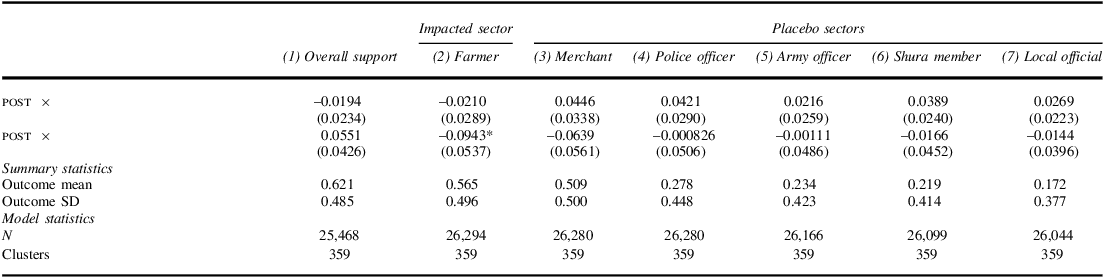
To further probe the mechanism at work, we next estimate the marginal effects of the difference-in-differences estimator, comparing districts where reliance on agricultural income is high versus low.Footnote 36 The quantity of interest is the marginal effect of (agricultural) income reliance, which we expect to further reduce support for agricultural reintegration in exposed districts after the earthquake. To estimate this quantity we rely on a triple difference regression model (difference-in-differences-in-differences). This allows us to test for marginal effects consistent with the theoretical mechanism. To do this, we estimate a fully interacted version of the earlier regression:

where ${y_i}$
and other comparable notations remain the same as in Equation (1).
${y_i}$
and other comparable notations remain the same as in Equation (1). $ {\rm{P} \scriptsize {\hbox{OST}_i} \times {\rm{E}\scriptsize {\hbox{XPOSED}}}_i} \times {\rm{\scriptsize {\hbox{FARMINGDEPENDENT}}}}_d $
captures the marginal effect of the difference-in-differences estimator when the additional parameter equals 1. In this case, it is the differential effect of the earthquake among subjects that reside in districts that are above the mean level of dependence on farming as a source of household income.
$ {\rm{P} \scriptsize {\hbox{OST}_i} \times {\rm{E}\scriptsize {\hbox{XPOSED}}}_i} \times {\rm{\scriptsize {\hbox{FARMINGDEPENDENT}}}}_d $
captures the marginal effect of the difference-in-differences estimator when the additional parameter equals 1. In this case, it is the differential effect of the earthquake among subjects that reside in districts that are above the mean level of dependence on farming as a source of household income.
The results are presented in Table 1. We find a large negative marginal effect, as hypothesized ( $\hat \beta = - .094,p = .080$
). This represents a 16 percent decline relative to the baseline level of support, suggesting that the overall observed decline in support for reintegration into agricultural sectors is driven by the respondents who were themselves most severely impacted.
$\hat \beta = - .094,p = .080$
). This represents a 16 percent decline relative to the baseline level of support, suggesting that the overall observed decline in support for reintegration into agricultural sectors is driven by the respondents who were themselves most severely impacted.
Heterogeneous impact of earthquake exposure on support for reintegration

Notes: Robust SEs clustered by district in parentheses. Outcome = 1 if respondent supports reintegration (varies by column). The quantity of interest is the marginal effect (highlighted row). All regressions include location and wave fixed effects and demographic controls (ethnicity, gender, socioeconomic status, age, education). Column 1 is overall support; column 2 is primary. Columns 3 to 7 are placebo sectors. * $p \lt .10$
; **
$p \lt .10$
; ** $p \lt .05$
; ***
$p \lt .05$
; *** $p \lt .01$
.
$p \lt .01$
.
Spatial Randomization Inference
To assess the robustness of our core results, we perform a novel spatial randomization test. Standard randomization inference tests are conducted by shuffling treatment classification in a manner that is orthogonal to the original treatment status and re-estimating the treatment effect.Footnote 37 The estimated treatment effect from the true data can then be compared to the distribution of estimates derived from the set of shuffled samples. Given independence of treatment status across units, the resulting empirical distribution will converge to a normal distribution with mean zero. This provides an empirical basis for comparison with the observed effect. These tests, however, are typically mis-specified where treatment status is spatially correlated across units, as in seismic and other environmental events.Footnote 38
To correct for the spatial correlation of treatment status, we gather data on all seismic fault-line segments in Afghanistan and recalculate the treatment effect for the universe of counterfactual earthquake epicenters using the distance-based measure from our main specification.Footnote
39
To adjust for spatial correlation induced by our distance-based measure, we reweigh estimated effects ( ${\hat \beta _{{\rm{random}}}}$
) using the inverse of the correlation between treatment status for each counterfactual epicenter and the true (that is, observed) treatment status.Footnote
40
We map the universe of seismic epicenters in Figure 3A. We present uncorrected estimates in panel B. The spatial clustering of red (negative coefficients) and green (positive coefficients) illustrates the failure of standard randomization inference due to correlation in seismic risk across units. In panel C, we visualize the novel spatial-correlation-corrected coefficient weights. The reweighted estimates are depicted in panel D. In panels E and F, we plot the distribution of the counterfactual estimates. Notice that our estimated effect is in the tail of the counterfactual distributions, with an empirical
${\hat \beta _{{\rm{random}}}}$
) using the inverse of the correlation between treatment status for each counterfactual epicenter and the true (that is, observed) treatment status.Footnote
40
We map the universe of seismic epicenters in Figure 3A. We present uncorrected estimates in panel B. The spatial clustering of red (negative coefficients) and green (positive coefficients) illustrates the failure of standard randomization inference due to correlation in seismic risk across units. In panel C, we visualize the novel spatial-correlation-corrected coefficient weights. The reweighted estimates are depicted in panel D. In panels E and F, we plot the distribution of the counterfactual estimates. Notice that our estimated effect is in the tail of the counterfactual distributions, with an empirical $p$
equivalent to our main estimate (values to the left of the vertical line in panel E; the red region in panel F).
$p$
equivalent to our main estimate (values to the left of the vertical line in panel E; the red region in panel F).
This novel methodology has potential applications in a range of observational studies of environmental and climatic events where spatial correlation in treatment classification can be modeled and corrected.Footnote 41
Conclusion
Natural disasters are economically disruptive and can prolong conflict by undermining public support for reintegration of fighters. Using individual-level data and a difference-in-differences approach, we present robust causal evidence that the Hindu Kush earthquake in Afghanistan reduced support for reintegration in one sector disproportionately impacted by the disaster: subsistence agriculture. These results also have broad implications outside the immediate study of civil conflict: the economic mechanism supported by our analysis has particular relevance for understanding the likely impact of climate change on future conflict.Footnote 42 Historically, economic losses due to drought and flood events have been similar to that of the disaster we study.Footnote 43 As the climate warms, these environmental disasters are expected to increase in frequency and intensity.Footnote 44 Climate-amplified disasters may similarly jeopardize the agricultural sector,Footnote 45 prolonging dozens of current and future armed conflicts.
Acknowledgments
We thank Anastasiia Nebolsina for research assistance and two anonymous reviewers for helpful comments.
Data Availability Statement
Replication files for this research note may be found at <https://doi.org/10.7910/DVN/GDXDRT>.
Supplementary Material
Supplementary material for this research note is available at <https://doi.org/10.1017/S0020818325101136>.




 Open access

