


The charismatic snow leopard Panthera uncia, the flagship species of the high mountains of Asia, is categorized as Vulnerable on the IUCN Red List (Jackson, Reference Jackson1979b; McCarthy et al., Reference McCarthy, Mallon, Jackson, Zahler and McCarthy2017). It is an apex predator in the Himalayas and an indicator of a healthy montane ecosystem (MoFSC, 2017). Snow leopards range along the northern frontier of Nepal (McCarthy & Chapron, Reference McCarthy and Chapron2003) and the country is believed to harbour 300–500 individuals, making it a key range country (WWF, 2018). In Nepal the snow leopard has been reported in Annapurna Conservation Area, Shey Phoksundo National Park, Kangchenjunga Conservation Area, Manaslu Conservation Area, Makalu Barun National Park, Dhorpatan Hunting Reserve, Sagarmatha National Park (Jackson, Reference Jackson1979a,Reference Jacksonb; Green, Reference Green1988; McCarthy & Chapron, Reference McCarthy and Chapron2003; WWF, 2018), Langtang National Park (Kyes & Chalise, Reference Kyes and Chalise2005; WWF, 2018) and Api Nampa Conservation Area (Khanal et al., Reference Khanal, Poudyal, Devkota, Ranabhat and Wegge2020).
Even though potential habitat for the snow leopard is continuous from east to west along the Himalayan range, studies on the species have been limited to Kanchanjunga and the Mt Everest region in the eastern Himalayas, Manang and Mustang in the central Himalayas, and Humla, Dolpa and Mugu in the western Himalayas. An estimated 39 snow leopards inhabit the eastern Himalayas of Nepal (from Kanchanjunga Conservation Area to Langtang National Park; WWF, 2012). There is a gap in information about the status of the snow leopard in Gaurishankar Conservation Area, part of the eastern Himalayas and potentially a key site for the species, as it connects Langtang National Park to the west and Sagarmatha National Park to the east with the larger contiguous Tibetan plateau to the north (Fig. 1). Ale et al. (Reference Ale, Thapa, Jackson and Smith2010) reported the presence of the snow leopard in Rolwaling area (c. 35 km south-west of Lapchi Village) in Gaurishankar Conservation Area, based on indirect signs (pugmarks, hair and faeces). Forrest et al. (Reference Forrest, Shrestha, Sindrof and Barlett2017), based on spatial analysis, suggested that the Lamabagar area in Gaurishankar Conservation Area may serve as a transboundary corridor for the snow leopard, hypothesizing that the area could connect local populations of snow leopards, creating a metapopulation. MoFSC (2017) speculated about the possible presence of the snow leopard in Lapchi Village in Lamabagar.
The study area, with Lapchi valley in Lamabagar and the location of the camera trap that recorded a snow leopard Panthera uncia in November 2018.

We conducted this study to assess the distribution and activity patterns of wildlife in Lapchi Village in the climatically diverse Gaurishankar Conservation Area (MoFSC, 2017; Sindorf, Reference Sindorf2017). This landscape comprises subtropical to nival bioclimatic zones, with 16 vegetation types and a reported faunal diversity of 235 bird, 34 mammal, 16 fish, 14 snake, 10 amphibian and eight lizard species (NTNC, 2013). The Conservation Area comprises six blocks: Gumba, Lamabagar/Lapchi, Rolwaling, Bigu/Kalinchowk, Marbu-Khare and Gumdel/Marbu (NTNC, 2013). Lapchi Village (formerly in Lamabagar Village Development Committee, which is now subsumed in Bigu Rural Municipality) is bounded by the border with China to the east, west and north, at the foot of the Lapchi Khang mountain range, which is an important pilgrimage destination for Tibetan Buddhists and is known for the meditation caves of the Tibetan saint and poet, Jetsun Milarepa. The caves surround the main monastery of Lapchi, Chöra Gephel Ling.
We set 11 infrared camera traps in the 32 km2 Lapchi Village for 7 months, during 22 October 2018–6 April 2019 (188 days), at a minimum of 2 km apart in randomly selected 2 × 2 km grid squares. We set three of the cameras above 4,000 m altitude near a possible snow leopard scat and the carcass of a blue sheep Pseudois nayaur, aiming to record movement of ungulates and snow leopards in the Lamabagar corridor below. These three cameras were installed in moraines with sparse vegetation of alpine grasses and patches of shrubs such as Rhododendron anthopogon and juniper Juniperus sp. This is an area of steep canyons above an alpine stream, surrounded by broken terrain of cliffs, scree slopes and rocky outcrops, covered by snow when we set the cameras.
We set two types of Bushnell Trophy Camera (Bushnell, Overland Park, USA): Model #119537C, set in hybrid mode, to take photographs and videos simultaneously, and Model #119405C, to take photographs only. Cameras were set to run continuously, with a time interval of one second between triggers and three shots per trigger. Of the 11 cameras, we lost two to theft, one from near the border with China and one from pasture near the village.
During installation of the cameras we observed individual musk deer Moschus leucogaster and multiple groups of blue sheep (Supplementary Plate 1) and Himalayan tahr Hemitragus jemlahicus, and also the possible scat of a snow leopard (Supplementary Plate 2) and carcasses of blue sheep possibly predated by a snow leopard (Supplementary Plate 3). Camera-trap records and direct sightings indicated a high abundance of Himalayan tahr, blue sheep and musk deer, suitable prey for the snow leopard. During installation and recovery of the cameras we observed a minimum of seven musk deer, three herds of blue sheep and multiple herds of Himalayan tahr around the area where the image of a snow leopard was later captured. The three herds of blue sheep comprised a minimum of 46 individuals. The cameras recorded 83 events of musk deer and 52 events of Himalayan tahr (an event is a series of images separated by more than 1 hour from other events); 17 species of mammals were recorded in all, including the westernmost record of Asiatic golden cat Catopuma temminckii.
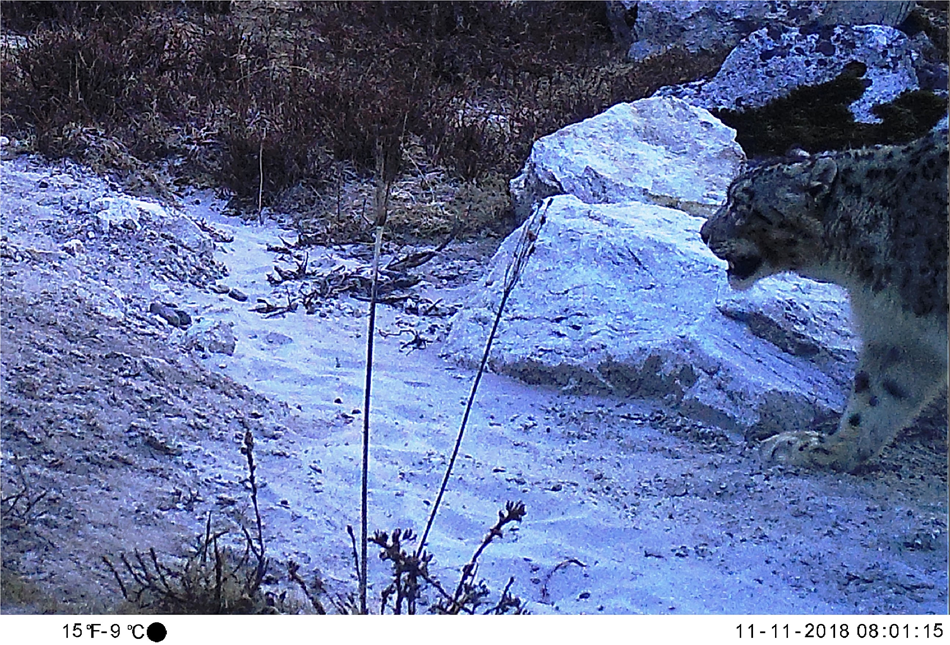
On 11 November 2018 at 8:01 a.m., a camera at 4,100 m altitude, 5 km south-west of Lapchi Village, recorded three photographs of a snow leopard, the first photographic evidence of the presence of the snow leopard in Lapchi Village and the Lamabagar corridor (Plate 1). Whether this snow leopard was a seasonal visitor or has a permanent home range in the area will require further study. The camera that captured the snow leopard recorded four other mammalian species: musk deer, blue sheep, red fox Vulpes vulpes and bobak marmot Marmota bobak.
Snow leopard photo-trapped in Gaurishankar Conservation Area (Fig. 1).
During fieldwork we also spoke with villagers and herders, and lamas in the monastery, about any conflict with wildlife and about mammalian diversity. None of the herders or villagers reported snow leopards in this area, but the oldest lama in the monastery shared a memory of seeing a snow leopard a long time ago near the village. Villagers reported they are facing threats from the Himalayan black bear Ursus thibetanus laniger, and the head office of Gaurishankar Conservation Area informed us that there were 16 incidents of wildlife attacks against people or livestock in this area in 2018, all reportedly by bears.
Lapchi Village comprises 33 households, all semi-nomadic pastoralists following traditional practices, rearing domestic yak as their livelihood, under a shifting grazing system. All are Sherpa people who follow the Beyul culture of Nyingmapa Buddhism, which emphasizes the sanctity of a landscape of sacred valleys (beyul). These beliefs may have provided protection for the wildlife and habitats of the region. Gaurishankar Conservation Area is being opened for tourists, with a home-stay policy to attract tourists as an alternative livelihood for local economic development. Two mega-hydropower projects are being planned, and the Government of Nepal is planning to open a road link across the border between Nepal and China, through Lapchi village.
Anthropogenic pressure is a major challenge for conservation of the snow leopard and could intensify negative interactions with people (Bagchi & Mishra, Reference Bagchi and Mishra2006; Jackson et al., Reference Jackson, Mishra, McCarthy, Ale, Macdonald and Loveridge2010; Li et al., Reference Li, Yin, Wang, Jiagong and Lu2013; Aryal et al., Reference Aryal, Brunton, Ji, Barraclough and Raubenheimer2014; Sharma et al., Reference Sharma, Bhatnagar and Mishra2015). The rich biodiversity of Lapchi Village, with musk deer, Himalayan tahr, blue sheep, Himalayan brown bear Ursus arctos isabellinus and snow leopard, may attract illegal hunting. Poaching and illegal trade (Li & Lu, Reference Li and Lu2014), combined with climate change (Forrest et al., Reference Forrest, Wikramanayake, Shrestha, Areendran, Gyeltshen and Maheshwari2012), are major threats to biodiversity in the Himalayas. There are thus both conventional threats and new challenges, but also opportunities to conserve the snow leopard. Spatial analysis of habitats (MoFSC, 2017) suggests that Tamakoshi River is a barrier to movement of snow leopards in Gaurishankar Conservation Area. The corridor in Lamabagar and Alampu links snow leopard habitat to the Quomolongma National Park in China, and may not be greatly affected by climate change under three emission scenarios (Forrest et al., Reference Forrest, Shrestha, Sindrof and Barlett2017). Lapchi Village could therefore be an important climate change refugium for the snow leopard. A transboundary conservation strategy for conservation of the snow leopard in this region is warranted, with active participation of Nepal, China and international agencies.
Acknowledgements
This study was a part of biodiversity research and monitoring programme run by Gaurishankar Conservation Area Project and the National Trust for Nature Conservation. We thank Gaurishankar Conservation Area Project for support, and for permission to conduct the survey and publish the findings.
Author contributions
Study design, fieldwork: NPK, BB, BPP, ST, SNS; data analysis, writing: NPK, BB, WVB.
Conflicts of interest
None.
Ethical standards
This research involved a non-invasive survey and otherwise abided by the Oryx guidelines on ethical standards.


 Open access

