




Introduction
Global labour historians have long pointed out that a broad variety of forms of unfree labour existed beyond slavery. Furthermore, wage payment did not necessarily imply completely free labour relations.Footnote 1 Lucassen and Heerma van Voss, among others, have studied the interplay between migration and unfree labour, especially in colonial contexts.Footnote 2 This article follows the tradition of this line of research by exploring the entanglements of migration and unfree labour in colonial Spanish America. Furthermore, it adds another factor to the complex interplay of labour and migration: fiscal categorization. Fiscal and labour categorizations tended to be closely associated, especially for the Indigenous population. More specifically, I compare two fiscal categorizations, the first being yanaconas, from the Viceroyalty of Peru, and the second being laboríos, from the Viceroyalty of New Spain. More specifically, I compare Cajamarca in northern Peru with Michoacán in western New Spain. So far, neither area has received much analysis with respect to labour relations in the colonial period. In the case of yanaconas and laboríos, labour and fiscal categorizations tended to coalesce, though in the former this was primarily in relation to the subtype yanacona de españoles.
Both economies studied here were characterized by Spanish enterprises producing textiles, and, in the case of Michoacán, also sugar. There was some influence of mining, but not to a degree comparable to the core mining areas of Peru in Charcas around Potosí, which was famous for forced labour in the form of the mining mita, or in the northern parts of New Spain, where repartimiento labour coexisted with free wage labour and African slavery. Livestock also played a role, but to a greater degree in Cajamarca. Both regions, moreover, were located on trading routes important for their respective viceroyalties, and there were parallels in their demographic structure.
As Raquel Gil Montero and I have shown elsewhere, in a comparison between the north of the Audiencia of Lima and Charcas, bonded labour and the attached fiscal categorizations varied not only between Spanish viceroyalties, but also within them.Footnote 3 But while the category yanacona existed in almost all audiencias (administrative districts) of the Viceroyalty of Peru, it did not in the Viceroyalty of New Spain. Nor did the New Spanish category laborío appear in Peru. This terminological divergence points to the influence of the organization of tribute, labour, and migration in the pre-Hispanic empires well beyond the Spanish conquest. In principle, the comparison of any region in both viceroyalties that lay within the territory of pre-Hispanic empires could serve a similar purpose, but the more similarity with respect to the regional economy and demography the better. Other Andean provinces in the Audiencia of Lima and Quito in the Viceroyalty of Peru and the provinces surrounding Mexico City, such as the regions of Puebla and Oaxaca, would likely be roughly comparable. The decision to study Cajamarca and Michoacán also reflected my knowledge of and previous work on these regions. It is this comparison that constitutes the prime contribution of this article, since it points to broader strategies for organizing labour in the Spanish Empire and shows how, post-conquest, the Spaniards adapted the organization they encountered on the spot and entangled it with colonial fiscal categorizations. This arrangement was additionally influenced by migration. Legal petitions constitute a good example of how the fiscal and labour categorizations were negotiated locally by the actors, thereby shaping Spanish colonial labour regimes. This is why I chose them as a key source for this analysis. Generally, the workers aimed to achieve greater freedom through the petitions, and, in the case of Michoacán, also to distance themselves from their African ancestry.
In the present article, I argue that yanaconas and laboríos were functionally comparable despite their different origin. People categorized as yanaconas and laboríos were not generally part of an Indigenous community/town, nor did they have access to communally owned land. They often, but not always, migrated to their workplace. Both groups can be categorized as dependent labourers, and their tribute – the amount of which was less than that of those Indigenous people belonging to a community – was often paid by their masters. One difference was that, in Michoacán, there was a clearer closeness between laboríos and free Afrodescendants than in Cajamarca, likely due to differences in demography and demographic structure – there were simply far fewer workers of African descent in Cajamarca. Towards the end of the colonial period, in the late eighteenth and early nineteenth centuries, there were indications that the degree of dependency among Peruvian yanaconas had increased. Seemingly, some of them became subject to a special form of dependent labour: debt peonage.Footnote 4 At the same time, as Riley showed decades ago, laboríos gained greater independence from their masters.Footnote 5
Methodologically, the article shows the negotiation of fiscal and labour categorizations as expressed in petitions to colonial authorities. It thereby adds to a long line of research that has shown how colonial categorizations were, to a certain extent, flexible, though few authors have explicitly and broadly addressed the aspect of fiscality.Footnote 6 I will ask how yanaconas and laboríos tried to negotiate their degree of dependency through fiscal petitions that often explicitly addressed questions of unfree labour.
There were two important dividing lines in fiscal and labour matters: the first separated those who had to pay tribute from those who were exempted and who received payment. In general, it was the non-noble Indigenous population as well as some of the free AfrodescendantFootnote 7 population who were categorized as tribute payers. The second dividing line separated those who had to render forced labour from those who did not, or who were even beneficiaries of forced labour. Broadly speaking, those subject to dependent, and generally temporary, labour were Indigenous, with some of the Indigenous nobility being exempted. Free people of African descentFootnote 8 were not usually subject to these periodic labour services. There were exceptions, mostly relating to those who had part-African, part-Indigenous ancestry. These two dividing lines were often, but not always, congruent. It is on the latter that this article will focus, setting aside African and Indigenous slavery in the narrow, legal sense of the word.Footnote 9
But even if most of the Indigenous population were not legally enslaved, their freedom was severely restricted, especially if they lived in rural towns and within Spanish enterprises. Refusal to comply with labour demands often led to coercion, being chained to their workplace or even sent to prison.Footnote 10 The non-payment of tribute could also lead to imprisonment, a punishment that could also befall the Indigenous nobility responsible for collecting and handing in the payments.Footnote 11
It was difficult, but not impossible, to change one’s fiscal categorization and therefore alter the degree of freedom one enjoyed. The two main ways to do so were through migration and by petitioning the local or regional authorities – often pursued in combination. In both cases, exemption from labour services tied to specific categorizations was a shared goal of the subjects of the Spanish Crown, especially Indigenous people.Footnote 12 However, too much mobility could also lead to a loss of freedom: those regarded as vagabonds were often imprisoned and later exiled.Footnote 13 The Spaniards wanted the Indigenous population to live permanently in rural towns or to live or work in private Spanish businesses, where they could be controlled and exploited.
In the following, I will first give a general introduction to Indigenous dependent labour in Spanish America and explain how that labour impacted the specific social, economic, and demographic structure in Cajamarca and Michoacán. I then describe the fiscal categorizations attached to Indigenous dependent labour and migration in these two regions. Finally, I will show how the degree of freedom was negotiated through petitions, often in combination with migration. In relation to petitions, I focus on the end of the colonial period, having earlier traced the development of such petitions since the late sixteenth century.
Indigenous Forced Labour in Spanish America
It is essential to understand that even if not all Indigenous people and Afrodescendants were subject to tribute payments or different forms of forced labour (or both), the mere fact that they were categorized into these broad groups meant they were potentially subject to these obligations and that their current exempt status could be changed at will by the colonizers.Footnote 14 Spaniards, on the contrary, could only be subject to dependent labour if they had committed a crime. Being categorized as a vagabond was considered a potential crime.
In the first century after the Spanish conquest of America, Indigenous labour services were dominated by the encomienda, an institution whereby the Castilian Crown allocated Indigenous tribute payments and manpower to Spanish settlers. There was much overlap with the labour service (repartimiento) that had been introduced in the Caribbean immediately after the arrival of Columbus. Following pre-Hispanic practices, the labour required to be provided to the Spaniards – first, in perpetuity and, later, for two lifetimes – was referred to by the Taino word naboría.Footnote 15 In 1542, however, under the New Laws, Leyes Nuevas, the encomienda was limited to tribute payments by the Indigenous people allocated in encomienda to someone. The New Laws were further concerned with the spatial and legal separation of the “two republics”, and also abolished the naborías in their existing form.Footnote 16 Despite the early official abolition, in Peru as well as in New Spain some encomiendas endured until the nineteenth century, albeit in a reduced number and limited to payments, not work.Footnote 17
In Peru, the repartimientos continued until at least 1662, with labourers assigned to textile mills, called obrajes, and other places.Footnote 18 In this viceroyalty, the mita was of particular relevance, alongside the repartimiento and encomienda. The mita had pre-Hispanic precursors. However, Viceroy Toledo, who held office between 1569 and 1581, institutionalized it in its Spanish colonial form.Footnote 19 Afterwards, a certain percentage of the Indigenous population aged between eighteen and fifty years of age had to perform periodic labour services.Footnote 20 Mita services in agriculture differed from those in mining; they also differed among cities, and from region to region. The infamous mining mita in the silver mines of Potosí was only performed by the population of the surrounding regions, totalling sixteen provinces.Footnote 21 In most other regions of the Viceroyalty Peru, there was no mining mita, but there were other forms of labour service that were directed to guarding herds, construction work, agricultural tasks in haciendas, and working in lodges and textile mills. This mita was generally called mita de plaza. The beneficiaries of this kind of mita were not only Spanish entrepreneurs and church-based institutions, but also Indigenous nobles and enterprises, such as textile mills owned by Indigenous communities.Footnote 22
The mita did not exist in New Spain. The repartimiento was officially abolished there in 1632, although this prohibition was not immediately implemented. In the northern mining areas, including Michoacán, the repartimiento persisted until the eighteenth century. It usually comprised four per cent of the population and took place every six months – a much lower percentage than for the mita in Peru.Footnote 23 Not surprisingly, the impact of periodic labour services was much greater in Peru than in New Spain.
In addition to these labour services, caciques and encomenderos both in Peru and New Spain demanded additional services – mostly personal services, servicios personales – from their subordinate Indigenous communities. The Catholic Church also benefited from these services, in the form of construction work on church buildings or chores/cooking for the local priest, often performed by women and with varying degrees of voluntariness. Furthermore, the church received contributions in money or kind that were linked more closely to the tribute obligation in its proper sense. Those included the costs of maintaining local priests and were sometimes even collected together with the royal tribute.Footnote 24 The official abolition of personal services in 1549 was not actually implementedFootnote 25 and had to be restated by the Cortes de Cádiz as late as 1812. The 1812 Constitution abolished all labour services, including the mita.Footnote 26
Despite all these different forms of dependent labour, which at least partially limited the freedom of movement of workers, Indigenous peoples, as free vassals of the Crown, in principle enjoyed freedom of movement, as shown by Zavala in his masterly study.Footnote 27
Labour Systems and Migration in Cajamarca and Michoacán
Exploring the set of fiscal categorizations and their entanglements with forced labour and migration in the northern Peruvian region of Cajamarca, and in the western Mexican region of Michoacán, demonstrates that the type of forced labour employed depended partly on the regional economic and demographic structure. In this respect, Cajamarca and Michoacán were similar enough to justify comparison, and the existing dissimilarities also explain differences in the forms of labour. Furthermore, they have not previously been studied much with respect to that topic. Both were part of pre-Hispanic empires (Inca and Tarascan respectively). In the Spanish colonial period, both were secondary colonial centres transversed by important routes to frontier regions. They shared haciendas, estancias, textile mills (obrajes), and mines as key economic enterprises that employed Indigenous (and Afrodescendant) labourers, but with varying significance. Michoacán additionally had sugar mills (ingenios).
Cajamarca’s economy was marked by cattle herding in estancias, agriculture on haciendas, and some textile mills. Several small mines had existed since pre-Hispanic times, but there was only one major one, Huelgayoc, which achieved significance from the second half of the eighteenth century.Footnote 28 Interestingly, in contrast to the far better known mines of Potosí and Huancavelica, this mine was not operated by mita workers but rather by employed free or semi-free labourers called quinteros.Footnote 29 The labour force working on the haciendas and in textile mills mostly comprised Indigenous people serving temporarily under the mita system as mitayos.Footnote 30 Some of these mitayos also moved across geographical and political provincial borders, with mitayos from Cajamarca serving in Trujillo. In addition, yanaconas de españoles worked in Spanish enterprises. Some of the workers were “freely” contracted, and had diverse fiscal categorizations, such as forasteros. These forasteros were migrants or descendants of migrants (see below). There were also African or Afrodescendant slaves, but in smaller numbers.Footnote 31
The colonial economy of Michoacán was similar to that of Cajamarca inasmuch as it comprised a mix of agriculture, cattle-farming, manufacturing, and mining. Furthermore, commerce played an important role in connecting Michoacán to the Pacific coast, Mexico City, and the mining areas to the north.Footnote 32 Unlike in Cajamarca, mining activities, especially copper mining, were the continuation of a long pre-Hispanic tradition.Footnote 33 However, copper mining never became as important as the silver mines of Zacatecas and Guanajuato more to the north.Footnote 34 With regard to the haciendas, it should be pointed out that, during the colonial period, many haciendas became important population centres, taking over some of the functions initially provided only by the Indigenous communities (pueblos de indios). For some migrants, on occasion, this also generated a sense of belonging and a form of de facto access to land,Footnote 35 which, in turn, made them less dependent. Sometimes, textile mills were associated with the haciendas, but these obrajes also existed in urban areas.Footnote 36 In all of these enterprises, the workforce comprised both free Afrodescendant and Indigenous people, the latter generally categorized as laboríos, who often migrated, but not always over long distances.
Especially in the early colonial period, both Peruvian and New Spanish workers could be sold together with the textile mill, and their work could de facto amount to slavery, despite an abundance of legislation outlawing these abuses.Footnote 37 This de facto slavery was felt and suffered by the workers, and emerges more or less directly in many sources. Some historians have even argued that they were sometimes treated even worse than slaves, in the sense that they were not bought and did not represent an economic investment but a labour force usable without any direct cost. At the same time, however, Spanish administrators worked to preserve the Indigenous communities so that they could continue to provide labour.Footnote 38
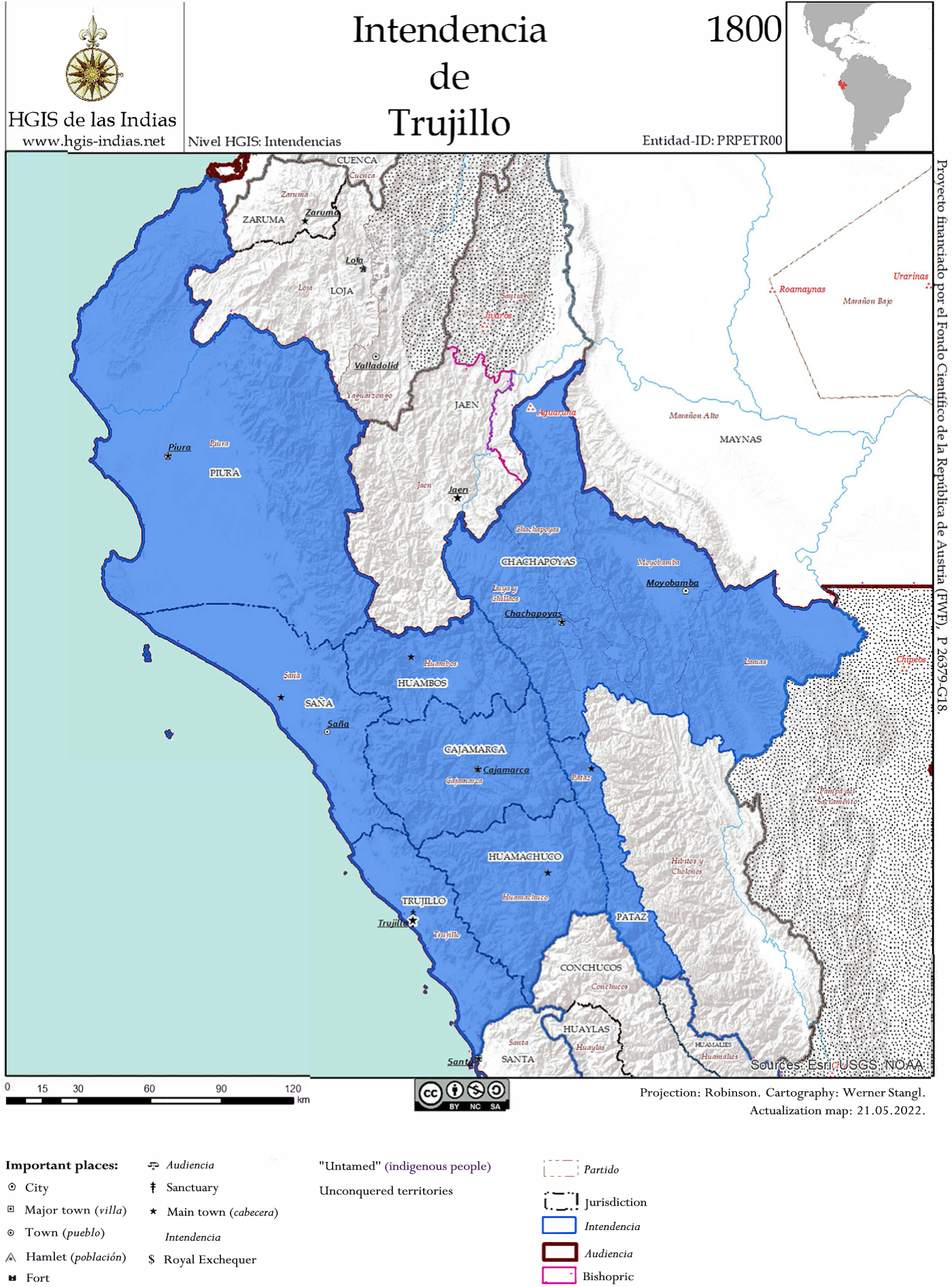
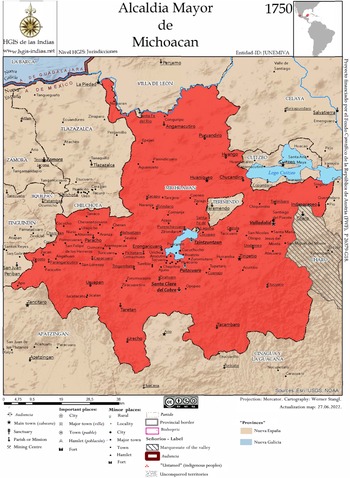
The respective provincial capitals were Cajamarca, which de jure was an Indigenous town (pueblo de indios), and Valladolid (today Morelia), which had been the regional capital since 1580 and had a city charter. The exact size of their respective jurisdictions varied over time, with the creation of the Intendencias in the 1780s being the most significant change. With that, the corregimiento and the homonymous province of Cajamarca became part of the larger Intendencia of Trujillo (Figures 1 and 2) and the province Michoacán part of the larger Intendencia of Valladolid (Figures 3 and 4). We only have comparable demographic data for the core regions (the provinces).Footnote 39 Uncertain estimates for Cajamarca at the time of the Spanish conquest suggest a population of around 60,000.Footnote 40 Undoubtedly, the province of Michoacán was more densely populated, with a realistic estimate of its population being around 250,000 at the same time.Footnote 41 The demographic collapse after the Spanish conquest was intense in both regions, but seems to have been more drastic in Michoacán. By the mid-seventeenth century, both regions had only a few thousand tributaries left – the tributaries as head of households often being the only ones on whom we have data. In 1651, the province of Cajamarca had 2,381 and the province of Michoacán 4,406 in 1657. As in many other regions of Spanish America, the demographic collapse led to more intense pressure on the local Indigenous population with respect to tribute exaction and labour service. This pressure led many Indigenous people to flee to other territories.Footnote 42 As migrants, they generally had to pay a lower tribute – this was true for both the laboríos in Michoacán and the yanaconas and forasteros in Cajamarca; furthermore, the Cajamarcan categorizations were exempt from the mita.
The corregimiento Cajamarca with its provinces Huambos, Cajamarca, and Huamachuco.

The Intendencia of Trujillo.
The Spanish province of Michoacán.

The Intendencia of Valladolid.

Although the population started to recover in the second half of the seventeenth century, that recovery became significant only in the second half of the eighteenth century. In 1789, there were 5,712 tributaries in Cajamarca and 12,863 in the subdelegación Valladolid. In the 1790s, Cajamarca’s Indigenous population had more or less recovered to its pre-conquest size, but it was not until Independence, and really only towards the end of the nineteenth century, that Michoacán’s population had fully recovered.Footnote 43 In 1827, the newly founded federal state of Michoacán, which comprised around 80 per cent of the territory of the pre-Hispanic Tarascan State, had 406,953 inhabitants.Footnote 44 This suggests that population size remained much more stable in Cajamarca than in Michoacán, a hypothesis already adduced for Cajamarca by Cook and Pereyra Plasencia based on data for specific parts or periods only.Footnote 45 On the percentage of migrant Indigenous peoples as well as people of part-African ancestry, we have comparable data only from the late eighteenth century onwards. In Cajamarca, the percentage of forasteros (Indigenous migrants and their descendants) varied throughout the eighteenth century, from between 33 and 49 per cent. The entire Intendencia (not the province) of Valladolid comprised around 13 per cent laboríos and vagos. This contrasted with almost 29 per cent of free mulattos and Blacks and almost 59 per cent of indios de pueblo in 1805.Footnote 46 In the 1795 general census, the corregimiento of Cajamarca comprised 12 per cent Spaniards, 59 per cent Indigenous people, 28 per cent mestizos, less than 1 per cent free Blacks, and less than 1 per cent enslaved.Footnote 47 Therefore, demographic characteristics are another argument for comparing the two regions, since the majority of the respective population was Indigenous, with very few enslaved Blacks and significantly different with regard to the free Afrodescendant population.
All the categorizations mentioned in the preceding paragraphs were not only social, but also legal and fiscal. Only by comparing regions in different Spanish viceroyalties can we see which aspects of the colonial organization of labour, mobility, and fiscality were generalized features and which reflected a different pre-Hispanic organization of tribute, labour, and migration, as well as local differences in social and economic structure.
Fiscal Categorizations and their Entanglements with Labour
When establishing fiscal categorizations, the Spanish administration made a distinction among its subjects.Footnote 48 The fiscal categorization assigned to a person or group determined how much money, goods, and labour they were required to surrender to the Spanish authorities; labour was an essential part of this requirement. The crown and its representatives in Spanish America often allocated this labour to private Spanish enterprises. Generally, in the first half of the colonial period, the place in which one had to pay tribute depended on to whom one was ascribed (personal association). From 1645 onwards, the Spanish authorities increasingly tried to privilege place of residence as the key factor determining where one had to pay (territorial association).Footnote 49
The broadest fiscal classifications were similar throughout Spanish America, namely: Spaniard/creole; mestizo; mulatto and free Black; enslaved; and Indigenous people (indios). However, there was a wide array of subcategorizations for those of Indigenous and African descent that differed from province to province and from viceroyalty to viceroyalty. As a general rule, categorizations were hereditary. This became complicated when people categorized differently had children together. In such cases, the offspring of a married couple were generally ascribed the father’s categorization; individuals born outside wedlock inherited the mother’s. The enslaved always inherited their mother’s categorization. However, these general rules were not always followed, and disputes about the “correct” categorizations involved questions of legitimacy, ancestry, official categorization, and public reputation. When people migrated, they often changed their categorization. It is the categorizations of migrants and their descendants as well as of people of “mixed” ancestry that saw the most differences between Peru and New Spain.15 As most categorizations were hereditary, not all those classified as “migrants” had actually migrated. Another factor of relevance was the question of landownership, since “migrants” were not supposed to have access to communal Indigenous land, which by law was collectively held by the “sedentary” indios.Footnote 50
The Peruvian Categorizations
The Peruvian fiscal system developed several categorizations for the Indigenous population. Besides the indio originario, tied to a certain Indigenous community, the most prominent classification was that of the indio forastero, applied to those regarded as not entirely belonging to the Indigenous community to which they were attached. Next in importance was the yanacona. The motive for becoming a forastero seems to have been primarily to obtain fiscal privileges consisting of exemption from the obligation to provide labour (mita) and exemption from the obligation to pay tribute – or at least to pay less than the indios originarios.Footnote 51
In contrast to the Spanish categorization forastero, yanacona was originally a pre-Hispanic classification denoting servants often relocated to carry out specific tasks.Footnote 52 Spanish colonial yanaconas were differentiated according to their assignment. They included those dependent directly on the king – the yanaconas del rey – and those working for other Spaniards on haciendas, in textile or sugar mills – the yanaconas de españoles.Footnote 53 In the eighteenth century, in some regions, yanacona came to be synonymous with Indigenous people unattached to an Indigenous community, often working as dependent labourers on private agricultural estates.
Despite the differences, in several regions yanacona became closely associated with forastero.Footnote 54 This shows how, in practice, different classifications overlapped when people from different categorizations shared similar socioeconomic positions. In several documents from Cajamarca from the seventeenth and eighteenth centuries, the terms forastero and yanacona, especially yanacona del rey, were used synonymously, or as two similar characteristics of one and the same person.Footnote 55 The association of forasteros with yanaconas del rey was probably due to the fact that, at least in Cajamarca in northern Peru, both paid their tribute directly to the king and not through the Indigenous lords (the caciques) and governors, who handed in the tribute of their subjects collectively and were also responsible for its completeness. In Cajamarca, the special tribute of the forasteros was called quinto, “the fifth part”, and the forasteros and yanaconas del rey were described as quinteros.Footnote 56 Quinto payers with “mixed” ancestry, including Indigenous and either Spanish or African elements, were denominated as mixto quintero. It was mostly yanaconas de españoles who worked as bonded labourers in Spanish enterprises, but this seems to have been less common in northern than in southern Peru and Charcas.
The New Spanish Categorizations
The term forastero, remarkably important in Peru, was used only rarely in New Spain’s sources and employed only in the sense of “stranger”. The term vago was used both for peoples of all calidades who had no known place of residence and occupation, and as a fiscal categorization. This latter usage referred only to tributaries and is often found in documents from the 1750s, the period of Bourbon reforms. According to Terán, three tribute categorizations were in use in New Spain at that time: indios de pueblo, indios laboríos and vagos, and free Afrodescendants (called free Blacks and mulattos in the sources).Footnote 57 To understand the differences between these classifications, I must first explain the term indio laborío.
Laborío denominated a classification that stressed one’s labour status, and with it one’s dependent relationship with the “Spanish” masters. In contrast to vago, the term laborío was applied only to Indigenous people. The word evolved from the Caribbean Taino word naborío, which referred to Indigenous people in the very early days of colonization, even before the conquest of Mexico. They were obliged to serve the Spanish for two lifetimes. In Peru naborío was replaced by the term yanacona.Footnote 58 In New Spain, the word naborío was gradually replaced by laborío, probably due to the work of these Indigenous servants in agriculture and mining, so called labores. Laborío designated a tribute categorization that referred to Indigenous people who were not indios de pueblo and therefore had no right to use the communal lands of the Indigenous communities. As such, they had to pay less tribute than the indios de pueblo. They worked mostly on haciendas and in mines, and were also known as gañanes in central New Spain.Footnote 59 Apart from Indigenous people, Afrodescendants also often worked on haciendas (as well as in textile and sugar mills), which explains the close association between the tribute categorization “mulatto” and laborío referred to below.
Laboríos can be functionally compared with the Peruvian yanaconas.Footnote 60 As with Afrodescendants working on haciendas, their Spanish masters paid their tribute for them.Footnote 61 These workers were supposed to be completely isolated from their home communities.Footnote 62 This isolation was certainly the characteristic that linked the laboríos to the vagos. However, not all laboríos were completely isolated from their communities, and not all were subject to Spanish masters. Some returned permanently to their home towns after having worked on a hacienda,Footnote 63 or worked only temporarily there and continued to be enrolled as tribute payers in their home towns. Especially for some mining regions in the north, there were cases of self-employed laboríos who supplied the mines with wood and coal. According to Cramaussel, the independence of these Indigenous people was more the exception than the rule.Footnote 64 In any case, the degree of isolation from their communities – and the degree of freedom – varied considerably.
The exact tribute rates varied over time and space, but mulattos usually paid more than indios laboríos, and laboríos paid less than indios de pueblo. However, laboríos seem to have been obliged to pay from the age of fourteen, while the indios de pueblo started paying at the age of eighteen.Footnote 65 It seems that the lower rate of tribute for laboríos was a strong incentive for Indigenous people to leave their towns.Footnote 66 Despite the lower tribute rates, many laboríos and mulattos – or rather their masters – seem to have evaded paying tribute.Footnote 67 To oversee all these tributaries, rules were adopted to ensure the authorities would be notified every time laboríos left or entered their respective haciendas, although one doubts whether these rules were obeyed.
The mobility and “un-rootedness” of the vagos were also mirrored in the procedures for tribute exaction. At least in Michoacán, vago tributes were, in most regions, handed in later than the tributes levied on the indios de pueblo. This was because these vagos left their jurisdiction during the planting and harvesting season and returned only after the dates generally applicable to tribute collection, a practice central authorities began to combat at the end of the eighteenth century.Footnote 68 This form of temporal migration was difficult to incorporate into colonial legislation, which aimed to tackle vagabondism by requiring everyone to have a fixed residence or a known master, while acknowledging the difficulties involved in implementing this comprehensively.
Compared with Peru, with regard to tribute categorizations the administration in New Spain seems to have made the mobility of its Indigenous population less visible and paid less attention to their differential role – at least before the eighteenth century – probably because in Michoacán no comparable categorizations existed in pre-Hispanic times, whereas in Peru there was a visible continuity with the pre-Hispanic yanaconas, albeit with obvious differences. Nevertheless, in Michoacán, too, laboríos constituted a labour force crucial to the region’s economy.
Struggles for a Greater Degree of Freedom in Cajamarca and Michoacán
Mobile individuals as well as dependent labourers (often one and the same) challenged their classification through migration and petitioning. Both actions were deeply entangled, since it was often migrants and their descendants who could most easily petition for a change in categorization – much like individuals whose ancestors had belonged to divergent categorizations. This was because the ability to change categorization reflected the link between categorization and public reputation. A categorization could therefore be altered more easily when a migrant moved to a new environment in which no or few people were aware of their background. In the petitions, public reputation is mirrored in witness accounts.
These petitions were directed at the colonial authorities and aimed at defending or changing one’s fiscal categorization, often with the aim of avoiding labour obligations. They initiated a legal procedure in the realm of fiscal law. Most petitioners were directed to the regional authority, the Corregidor or alcalde mayor – and, after the Bourbon reforms, to the subdelegado. In more difficult cases, the petition was forwarded to the Viceroy, or higher authorities of the Royal Treasury in Peru and New Spain. They were almost never sent to Spain. This explains why most of these petitions are found in local and regional archives and some in the respective national archive, and, at least for Cajamarca and Michoacán, none in the Archive of the Indies in Seville. The petitioners often argued that they had been incorrectly registered in the latest tribute list, and they would present evidence to substantiate their claim. The evidence requirements were not formalized until the eighteenth century, but even then they were not always respected. The petitions therefore included a selection of the following rather than all of them (as theoretically required): copies of parish records; copies from tribute lists; tribute receipts; and witness testimony. Often, the claim would be opposed by a local governor, cacique, or Spanish hacienda owner, again with evidence to support their case.
To better understand this process, I studied 133 petitions from Cajamarca and thirty-four from Michoacán that included a broad variety of disputed fiscal categorizations. In Cajamarca, sixty-three involved the categorization yanacona; in Michoacán, only three clearly mentioned laboríos – one an Indigenous vago and two unspecified “tributaries”. The petitions ranged in time from the late sixteenth to the early nineteenth century, but in both cases over half related to the eighteenth century. In what follows, I highlight some results regarding the yanacona de españoles and indios laboríos categorizations, with special emphasis on developments in the late colonial period.
I focus on these categorizations of Indigenous people because they were key in both regions studied, but other authors have shown that free and even enslaved Afrodescendants presented similar petitions. Especially interesting is the case of enslaved petitioners in seventeenth-century Lima studied by Graubart who tried, without success, to be equated with Indigenous people and thus freed.Footnote 69 They thereby underlined the freedom of the Indigenous population. As Pereyra Plasencia has shown in his study of an uprising against an obraje in seventeenth-century central Peru, Indigenous peoples could respond violently even to rumours that they might be legally enslaved.Footnote 70 Glave has pointed out that both Indigenous labour service and the exaction of tribute could provoke violence, but also that Indigenous people invested considerable effort when petitioning for their rights.Footnote 71
In Peru, obraje workers were generally Indigenous. In New Spain, this was not always the case, as shown, inter alia, by Sierra Silva and Velasco Murillo for seventeenth-century central and northern New Spain.Footnote 72 This was a characteristic feature also observed in Michoacán, where mulattos and laboríos worked side by side, something mirrored in the petitions.
Yanaconas in Cajamarca
In Peru, rotational labour shifts created a much heavier burden and lasted longer than in New Spain. Opponents were often more interested in labour service from the petitioners than tribute payments. Conversely, petitioners insisted either on not having to perform the mita or not being yanaconas de españoles.Footnote 73 Also in Cajamarca, almost all petitioners, regardless of categorization, generally insisted on their exemption from the mita, as well as a reduction in tribute payment. What is surprising, however, is that the first petition involving the categorization yanaconas de españoles (not to be confused with yanaconas del rey) from Cajamarca dates from as late as 1776.Footnote 74 This contrasts with the broad importance of this categorization from the late sixteenth century onwards in southern Peru and the Audiencia de Charcas.Footnote 75 As we know from other types of source, yanaconas de españoles existed earlier in Cajamarca, but their labour force was apparently less important than elsewhere and the need for dependent labour was apparently covered mostly by mita labour and more or less free “migrant” labour. Another probable explanation of why we do not have earlier petitions is that, prior to that date, there were fewer restrictions on the yanaconas de españoles, and thus less to petition against. Or, put differently, the degree of dependency of yanaconas de españoles seemed to increase in the late colonial period, in some cases making their status comparable to that of indebted peons.
For the period 1776 to 1817, I identified twenty-five petitions in which opponents tried to have individuals from various categorizations registered as yanaconas de españoles. These petitions show that the translocal belonging and free movement of tributaries was increasingly restricted not only by the royal authorities, but also by Spanish masters of haciendas and estancias. They tried to permanently retain the tributaries who had moved to work in their enterprises, getting them registered as yanacona de españoles.Footnote 76 Sometimes, they asked the authorities to return to their enterprise labourers who had fled,Footnote 77 or they forced them to stay, alleging debts.Footnote 78 These and other tributaries tried to resist restitution and petitioned the authorities, pointing to their belonging to the pueblos de indios and occasionally declaring that they had been forced to work for their master or that he had registered them as yanacona against their will and without their knowledge. Occasionally, they referred to being treated like slaves – something we never see in the New Spanish petitions. Especially interesting in this context is the 1817 petition by Santos Romero, who explicitly compares yanaconaje to slavery and insists on his free status as a tributary, in this case a quintero:
Santos Romero misto quintero from the town of Jesus […] has to justify his freedom […] says […] that there are occasions in which innocence is the cause of a man ending up in the net of slavery, but when it comes unjustly, there is no doubt that by the mercy of god his clamours will reach the compassion of the king and of justice. It has seemed to many that being born into the class of taxpayers degrades them: Of course there is some basis for this way of thinking, and it is because the powerful consider enslaving those of indigenous nature [“de naturalesa yndica”] in their haciendas, matriculating them without their consent with the name of yanaconas; but I say, it is happiness in the man to have been born into that class of contributors, because it implies the favour and protection of his M. who has conferred on him many privileges and exemptions, and for him there is no such slavery; but on the contrary much freedom.Footnote 79
In this example, we see the tributaries themselves linking their fiscal categorization to their degree of dependency and rejecting their status as dependent labourers. Santos Romero underlines, furthermore, that his migration to the hacienda was temporary since he had continued paying the tribute back in his home town and therefore rightfully belonged there and not to the hacienda. He was there only temporarily, to pay a debt. Furthermore, he did not descend from the yanaconas but from a mestizo father and a quintera mother. His opponents, however, argued that he had permanently settled at the hacienda, with his livestock and family. His case shows that there was a tendency towards debt bondage on haciendas in late-colonial Cajamarca. As early as 1795, the petitioner Juan Gómez Mendoza had made a similar case, “claiming his freedom”,Footnote 80 since he was wrongly claimed to be a yanacona by a hacienda owner and even put in chains. Like Santos Romero, he argued that he was in fact a free quintero and tribute payer in his home town. In 1814, Pablo Zavaleta also protested against being forced to work as a yanacona on a hacienda. In his case, opposition from the authorities and hacienda owners was even greater, and they cast doubts on his supposed ties to an Indigenous town.Footnote 81
In twenty-five of the analysed cases, one petitioner claimed to be a mestizo, and five petitioners self-identified as mixtos quinteros, one of them more specifically as mulato quintero. The remaining nineteen self-identified as indios, fourteen of them more precisely as indios originarios, four as forasteros or quinteros, and one as yanacona de españoles. The latter case from 1794 is interesting, since it is the only one in which the petitioners did not deny being yanaconas de españoles. Manuel Quispe, Juan de la Cruz, and Thomas Nuñes claimed they had relocated from the hacienda del Cardón to the hacienda Porcón three or four years earlier, where they were subsequently registered as yanaconas. However, they claimed to belong originally to the hacienda del Cardón and petitioned to be deregistered from Porcón. Neither its owner nor the authorities were willing to acquiesce, and their petition failed. Though here we can observe some initial freedom of movement, it seems to have been restricted at some point. Whether this was owing to a debt that they had contracted, the intentions of the owner of the hacienda Porcón, and/or his complicity with the authorities remains speculative.
The numbers of self-ascriptions in the twenty-five petitions indicate that the overwhelming majority of petitioners were Indigenous people – some of them possibly with a degree of African ancestry – who had formerly been free tributaries and later became yanaconas de españoles. In their petitions, they argued that, following this change in their categorization, they could no longer freely determine where to live and work and in which categorization to be registered, thereby clearly becoming trapped in the status of dependent labour that in some – though not all – cases was linked to indebtedness.
Regarding the percentage of yanaconas de españoles in the total population, we seldom have the quantitative data that would allow us to better evaluate the contextualization of the numbers of petitions by them.Footnote 82 What we generally find in the census/tribute lists for the entire area of the corregimiento Cajamarca is the tribute-paying Indigenous population but no subcategorizations such as yanaconas de españoles.Footnote 83 For the sixteenth and seventeenth centuries, the categorization yanacona de español is not defined in the tribute lists and inspections.Footnote 84 The most complete demographic data we have for the eighteenth century is from the 1786 Census by Bishop Martínez de Compañón who, according to Vollmer, based his data – with the exception of Huelgayoc – on the census by Miguel de Espinach from 1779, but he did not further subdivide the general categorization “indio” either. The same applies to the 1792 Census by Viceroy Gil de Taboada.Footnote 85 What we do have for some towns, or single haciendas and estancias, are lists of their yanaconas de españoles, though not enough to allow us to sketch a complete picture. However, a systematic analysis of these scattered lists, which is still pending, could give us at least some preliminary ideas.Footnote 86
Laboríos in Michoacán
Regarding petitions, in some respects the situation of indios laboríos in Michoacán resembled that of the yanaconas de españoles in Cajamarca. We know from other sources that laboríos had existed for much longer, but they appear in petitions only from 1756 onwards. In all three petitions clearly involving laboríos, the petitioners claimed to have been incorrectly registered as Afrodescendants.
What is different in these petitions, which are far fewer in number than in Cajamarca, is that, in all of them, the indios laboríos were closely associated with the free-Afrodescendant categorization of the mulatto, which, unlike the mulattos in Peru, was mostly subject to tribute payment. Petitioners placed a stronger focus on having to pay less tribute and on distancing themselves from their African ancestry, which had the social stigma of past slavery attached to it, more so than from their being forced to work in Spanish enterprises. In Michoacán petitions, the development towards a terminology of racialization is clearer than in the Cajamarcan ones.Footnote 87
Despite the official abolition of the repartimiento labour service in 1632, we have evidence from sources from the late eighteenth century in which Indigenous people from Michoacán were forced to migrate to the northern mines and work there in the “laborío de minas”.Footnote 88 However, this dependent labour seems to have been exclusive to mines and cannot be found in haciendas. With respect to haciendas, I do not have petitions from all the periods Riley covers. He stated that gañanes – which were more or less the central Mexican equivalent of the laboríos – were registered on hacienda tribute rolls in the early seventeenth century, but they were free to move once their tribute debt had been paid off. This changed during the late seventeenth century, when their status approximated debt peonage but reverted to a greater freedom of movement in the eighteenth century, and they started to disappear from the records in the late eighteenth century.Footnote 89
In Michoacán, we have very few late eighteenth-century petitions by laboríos, but in all three cases (which alluded to more than three individuals), the laboríos were not forced to work and stay on haciendas and in obrajes. So, though based on a small number of petitions and only with respect to haciendas, there seems to have been a development in Michoacán similar to the one that took place for the gañanes in central Mexico studied by Riley. However, more than the pursuit of greater freedom (which was, of course, also an aim), a distancing from African ancestry played an important role in Michoacán petitions. In all three of them, the categorization of indio laborío seemed more beneficial than that of mulatto since, as laboríos, they not only paid less tribute but were also further detached from the stigma of slavery. Again, they claimed this as their fiscal status. Victoriano Alvarado, a worker in a Valladolid obraje, stated in 1808 that he was an indio laborío as
[C]learly appears in the four letters of payment, which I solemnly present, on the day in question, to deprive me of this right by demanding it from me as a mulatto, not having the slightest foundation to infer me in a grievance that is not only detrimental to my person, but that will transcend as a contagion to all my descendants, since I, as well as they, besides being unjustly taxed with the difference that exists between what the mulattos pay and the penalty imposed on the yndios, are also deprived of the rights and privileges that the indulgence of S.M. has deigned to grant us.
It does not admit doubt that following the condition of the parents the children enjoy by necessary consequence the same privileges and rights granted to their class, and mine having been yndio as is sufficiently accredited without need of another proof than the document of reservation that I exhibit in a half quarter page with the due solemnity, it follows necessarily that I too am yndio and that enjoying the same privileges the royal right of the Tribute should be exacted from me.Footnote 90
It is noteworthy that he presents the fiscal status of an Indigenous person as a privilege, thereby stating his superiority vis-à-vis mulattos. Another petition, this time a collective one, defends the petitioners’ categorization as indios laboríos. It was presented in 1804 by Vicente Valdovinos de León, his brother, and some friends. They argued that they, too, had been incorrectly registered as free Afrodescendants and as such had to pay a larger tribute than the laboríos. They rejected this “infamous quality of being pardo”.Footnote 91 Like the above Cajamarcan petitioners, they had been living temporarily on a hacienda. However, unlike the Cajamarcans, they had not been forced to stay there as dependent labourers; “only” their fiscal status had been changed to free Afrodescendants against their will. The last of the three petitions was presented by a hacienda owner. He reported that the workers on his hacienda had fled because the Spanish authorities had registered them as free Afrodescendants instead of indios laboríos.Footnote 92 We have no record of the voice of these workers themselves, so we cannot be sure whether the hacienda owner had tried to force them to work, but at least we have no clear indication in similar documents that he did.
To better contextualize the three petitions mentioned here, it is interesting to look at quantitative demographic data on laboríos in Michoacán. Unfortunately, they were not comprehensively registered before the Bourbon reforms in the eighteenth century. We do, however, have some data based on two late eighteenth-century reports. According to Serrano Ortega, who reports the numbers collected by Antonio de Riaño, in 1792/1793 laboríos and vagos together comprised twenty-two per cent of the Indigenous population of the Intendencia of Valladolid.Footnote 93 The “Estados generales de Tributos” of 1805 by Juan Ordoñez show that in that year, laboríos and vagos comprised 13.22 per cent of the tributary population in the Intendencia of Valladolid, a smaller percentage than the mulatos y negros libres (28.49 per cent) and the indios de pueblo (58.29 per cent). The total number of entire tributaries was 45,235 in that year, which, according to Terán, meant 171,160 tributary individuals.Footnote 94 Though we cannot determine the exact number of individuals categorized as laboríos, the petitions we do have open only a small window into their world. However, since their voices are seldom heard in the sources, it is still an important glimpse into the past of these people.
Conclusion
The Spanish Empire provided a set of spatial and social categorizations and barriers for the purpose of ordering colonial society. The fiscal system played a crucial role in this hierarchical ordering and was inextricably linked to socioeconomic position and dependent labour. One’s fiscal categorization was an important indicator of one’s degree of freedom. Despite the aim of the colonial authorities to establish a durable and precise social ordering, the tribute categorizations were ambivalent, flexible, and changed over time. Furthermore, they were contested and negotiated from below. This negotiation happened on the ground as well as on paper: individuals migrated in order to change their categorization, and they contested their classification by means of petitions, processes that were often intertwined.
Within the Spanish American colonies, there was a wide array of regionally differing subcategorizations of tribute payers, which were closely entangled with various forms of bonded labour. However, one Peruvian categorization with pre-Hispanic roots, that of the yanacona, and especially the yanacona de españoles, is functionally comparable to the New Spanish categorization of the laborío. Both stressed the position of being labourers dependent upon “Spaniards”. But the degree and durability of the attachment to “Spaniards”, and the detachment from Indigenous communities, varied considerably within these categorizations – and with it the degree of freedom. This varied also across time and space. While Cajamarca saw a development towards debt peonage for yanaconas (de españoles) towards the end of the colonial period, in Michoacán debt peonage was seemingly employed only for mineworkers. On haciendas and in obrajes, one problem for indios laboríos was that they were often (in their view) wrongly registered as free Afrodescendants (mulattos), and so had to pay a higher tribute and bear the stigma of slavery – though that did not seem to involve actual forced labour.
The existence of translocal forms of belonging as well as the legal instrument of the petition opened up spaces of negotiation that were employed strategically not only to improve one’s social position, but also to achieve some very specific privileges or resources. Petitioners tried both to abolish labour obligations and to avoid being categorized as of African descent. However, the possibilities were limited, and the Indigenous as well as the Spanish authorities sometimes pushed back. Petitioners, and their opponents, shaped and modified the categorizations throughout the colonial period, showing a considerable degree of agency and making their voices heard. However, not all aspects of this agency left traces in the historical record. The documentation presented here provides a picture of either successful attempts to change categorization or of cases where petitioners felt obliged to defend their categorization. They tell us little about those individuals who changed their categorization without resorting to legal procedures, or who retained the same classification throughout their life.
Looking at the post-Independence period, it is interesting to see that, in Cajamarca, the yanacona categorization quickly disappeared, while the quintero persisted for several decades. For Michoacán, I have found no mention of the persistence of the term laborío, but in both regions many Indigenous and partly also Afrodescendant labourers gradually became indebted peons.Footnote 95 In Peru, this development continued a process that had already started before Independence, though not to the same extent as in Mexico.




 Open access

