





Non-technical Summary
Fossil remains of extinct relatives of cephalopods are known to occur in Peruvian strata of Ordovician age (~485–444 million years old) for a long time. However, they remain poorly known today. Here, we describe for the first time specimens that were collected from strata of the San José Formation of the Kimbiri and Inambari areas, southeastern Peru. The assemblage contains five species; one of them, Bactroceras cocafolium, is new to science. One other species is known from strata of the same age from elsewhere in the central Andes. The five species also show a relationship with cephalopod assemblages known from the old continents Gondwana and Avalonia.
Introduction
Ordovician cephalopods of Peru are poorly known, although they are not rare and were first mentioned by Lissón (Reference Lissón1911, p. 146). This early work lists a single orthoceracone cephalopod in the Ordovician strata of the Ambo-Huánuco region of the Eastern Cordillera in Central Peru (see also Lissón and Boit, Reference Lissón and Boit1924, p. 121), a place well known for its abundant Darriwilian graptolites (see e.g., Maletz et al., Reference Maletz, Reimann, Spiske, Bahlburg and Brussa2010).
Bulman (Reference Bulman1931, p. 99) identified a questionable endocerid cephalopod from Sandbian graptolitic shales of the Huichiyuni locality, south of San Juan del Oro, Eastern Cordillera (Fig. 1.1, loc. E). Douglas (Reference Douglas1933, p. 340, 341, pl. 29, figs. 1, 2) reported endocerid and orthocerid occurrences in Darriwilian graptolitic shales from west of Quincemil, Eastern Cordillera (Fig. 1.1, loc. B), and Laubacher (Reference Laubacher1974, p. 33, 35) mentioned cephalopods from presumed Darriwilian strata at the Inambari River section at Carcelpuncco (Fig. 1.1, loc. C). All of these records of cephalopods are from the San José Formation (late Tremadocian–early Sandbian) of central and southeastern Peru.
(1) Geological overview of SE Peru (inset map), showing the extent of the Ordovician sedimentary rocks and the location of some of the Ordovician localities with cephalopods cited in the text: A, Apurímac River valley (Kimbiri Alto, Libertad and Nueva Alianza sections, see detailed map in Fig. 2); B, Yanaorco River west of Quincemil; C, Carcelpuncco canyon, Inambari River; D, La Pampa River north of Santo Domingo; E, Yanahuaya area south of San Juan del Oro; F, Calapuja area. (2) Simplified stratigraphic section from Kimbiri (= Kashiroveni: Fig. 2, loc. 3), with vertical distribution of Floian taxa identified from four horizons. Data from Darriwilian cephalopods (black squares) come from the nearby Nueva Alianza locality, NW of Kimbiri (Fig. 2, loc. 2). Ae, Aeronian; Dp, Dapingian; Dw, Darriwilian; Fl, Floian; Fm, Formation; Gp, Group; Hi, Hirnantian; NPz, Neoproterozoic; Ord, Ordovician; Sa, Sandbian; Tr, Tremadocian.
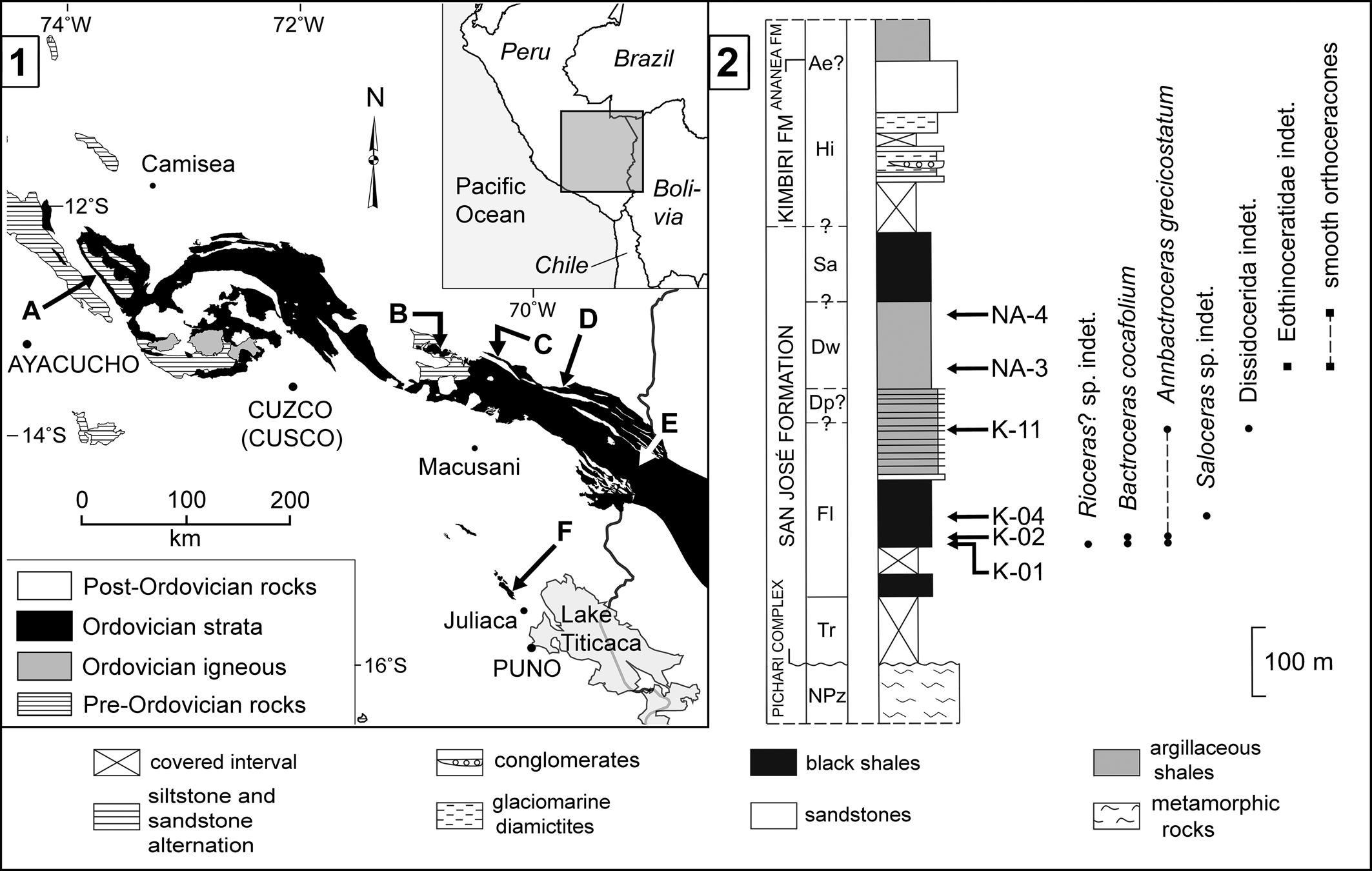
Orthoceracone cephalopod occurrences are also known from Darriwilian graptolitic shales of the Contaya Formation of the Contaya Arch in the Amazonian plains of northeastern Peru, close to the Brazilian border (Newell and Tafur, Reference Newell and Tafur1943, p. 8; Reference Newell and Tafur1944, p. 541; Hughes et al., Reference Hughes, Rickards and Williams1980, p. 15). Furthermore, Laubacher (Reference Laubacher1974, p. 36) recorded cephalopod occurrences in the Sandia Formation (Late Ordovician), in the La Pampa River valley, north of the Santo Domingo mining camp (Fig. 1.1, loc. D) yielding also ‘Caradocian’ trilobites and brachiopods. Pachendoceras sp. indet. was recorded by Romero et al. (Reference Romero, Aldana, Rangel, Villavicencio and Ramírez1995, p. 13) in Late Ordovician strata from the Calapuja Formation at the Hacienda Buena Vista fossil locality (Fig. 1.1, loc. F) within the Peruvian Altiplano west of Lake Titicaca. A small suite of cephalopods was collected by one of the authors (JCG-M) from Sandbian strata of the Calapuja Formation of the Peruvian Altiplano, west of Lake Titicaca, and awaits taxonomic description in a future paper.
The Peruvian Geological Survey/INGEMMENT mapping program led to the discovery of new localities with cephalopods in the San José Formation of the Eastern Cordillera. De la Cruz and Carpio Ronquillo (Reference De la Cruz and Carpio Ronquillo1996, p. 140) mentioned the occurrence of Endoceras sp. indet. and Protocycloceras cf. P. smithvillense Ulrich et al., Reference Ulrich, Foerste, Miller and Unklesbay1944 in two ‘Llanvirnian’ localities south of Yanahuaya, to the south of San Juan del Oro (Fig. 1.1, loc. E). In the Apurímac River valley northwest of Ayacucho (Fig. 1.1, loc. A; Fig. 2, loc. 4), Valencia Muñoz et al. (Reference Valencia Muñoz, Chero Inoquio and Chávez Machaca2021, p. 32) found a flattened external mold of a body chamber of an orthoceracone cephalopod, wrongly identified as Conularia sp. indet. From a neighboring locality (Fig. 2, loc. 5), Latorre Borda et al. (Reference Latorre Borda, Sipión Baltodano and Cueva Ccori2021, fig. 2.16a) illustrated a flattened body chamber in connection with the siphuncle, identified as “Endoceratida ind.,” which was obtained from a probable Darriwilian assemblage of graptolites, brachiopods, and trilobites.
Geological sketch map of the fossil localities in the Apurímac River valley bearing Ordovician cephalopods. 1, Libertad (LIB); 2, Nueva Alianza (NA-3 and NA-4); 3, Kimbiri (Kashiroveni stream) section (K-01 to K-11); 4, Cielo Punku 1 (fossil sample GR52A-19-53 of Valencia Muñoz et al., Reference Valencia Muñoz, Chero Inoquio and Chávez Machaca2021); 5, Cielo Punku 2 (fossil sample GR53A-19-10 of Latorre Borda et al., Reference Latorre Borda, Sipión Baltodano and Cueva Ccori2021). Base map modified by JCG-M after Gómez Cahuaya et al. (Reference Gómez Cahuaya, Lozada Valdivia and Cahuana Sairitupa2021), Valencia Muñoz et al. (Reference Valencia Muñoz, Chero Inoquio and Chávez Machaca2021), and Latorre Borda et al. (Reference Latorre Borda, Sipión Baltodano and Cueva Ccori2021). CH, Chirumpiari; KA, Kimbiri Alto; OR, Oroya; SR, Santa Rosa; TL, Tahuantisuyo Lobo. The Cambrian?–Early Ordovician ‘unnamed quartzite’ unit was correlated to the Ollantaytambo Formation in previous geological maps (Latorre Borda et al., Reference Latorre Borda, Sipión Baltodano and Cueva Ccori2021; Valencia Muñoz et al., Reference Valencia Muñoz, Chero Inoquio and Chávez Machaca2021), but later has been reassigned to the Pennsylvanian (late Carboniferous) in its type area north of Cuzco (Hodgin et al., Reference Hodgin, Gutiérrez-Marco, Colmenar, Macdonald, Carlotto, Crowley and Newmann2021).

The Darriwilian cephalopods of the San José Formation described by Douglas (Reference Douglas1933) were reviewed by Evans (Reference Evans2007). However, the poor and fragmentary preservation of the specimens allowed only relatively general determinations in open nomenclature. The revision showed that the assemblage is dominated by small orthoceracones, which were interpreted as representing open-water habitats with far-ranging paleogeographic affinities spanning from Western Gondwana to Avalonia and Armorica (Evans, Reference Evans2007).
Here, we describe an assemblage of relatively well-preserved cephalopods from the Floian part of the San José Formation. This allows for a comparison with coeval Eastern Cordilleran assemblages from Bolivia and Argentina and more generally contributes toward a better understanding of the cephalopod evolution during the Floian Stage, which is a critical interval for cephalopod evolution (Pohle et al., Reference Pohle, Kröger, Warnock, King, Evans, Aubrechtová, Cichowolski, Fang and Klug2022).
Geological setting
The material described herein was collected from the San José Formation, which is exposed in roughly northwest/southeast-oriented sedimentary belts associated with the Cordillera Oriental in southeastern Peru and Bolivia. The Cordillera Oriental continues southward into northwestern Argentina. During the Cambrian–Ordovician, these strata formed part of the Central Andean Basin (Astini, Reference Astini and Benedetto2003).
This feature formed as a vast retroarc foreland basin along the accretionary Proto-Andean margin of South America. During the Ordovician, its tectonic framework was strongly dynamic with regionally and temporally contrasting depositional rates and directions (see review by De la Puente and Astini, Reference De la Puente and Astini2023). Therefore, the Ordovician deposits of the Central Andean Basin are divided into several stratigraphical units depending on the country, paleogeography, and geotectonic position (see e.g., Benedetto et al., Reference Benedetto, Vaccari, Waisfeld, Sánchez and Foglia2009; Waisfeld et al., Reference Waisfeld, Benedetto, Toro, Voldman, Rubinstein, Heredia, Assine, Vaccari and Niemeyer2023).
The material described herein was collected from several outcrops of the San José Formation along the northeastern bank of the Apurímac River, between Pichari and Kimbiri (Fig. 2), and in a single fluvial section located in the Pongo (= canyon) of Carcelpuncco on the Inambari River, southeast of Cuesta Blanca (Fig. 1.1, loc. B). Ordovician fossiliferous localities in the first area (Fig. 1.1, loc. A) were discovered during the mapping of the Llochegua and San Francisco/Ayna quadrangles (Monge et al., Reference Monge, Valencia and Sánchez1998). The Inambari River section (Fig. 1.1, loc. B) has been known since the 1970s (Dávila and Ponce de León, Reference Dávila and Ponce de León1971; Laubacher, Reference Laubacher1974; see also Palacios et al., Reference Palacios, Molina, Galloso and Reyna1996).
Most of the studied specimens come from a single section located north of the village of Kimbiri Alto, along the trail parallel to the Kashiroveni Stream above its confluence with the Kimbiri River—one of the tributaries on the right bank of the Apurímac River, ~80 km northeast of the city of Ayacucho (Figs. 1.2; 2, loc. 3). The dominantly shaly San José Formation is up to 700 m thick and lies unconformably upon the metamorphic Pichari-Cielo Punku Complex (Neoproterozoic). Its lower (but not basal) part has yielded Tremadocian to earliest Floian graptolites (Gutiérrez-Marco et al., Reference Gutiérrez-Marco, Maletz, Chacaltana, Obut, Sennikov and Kipriyanova2019a). These strata are overlain by beds partially rich in shelly fauna, documenting Floian to lower Sandbian strata toward the middle and upper part of the formation (see references below).
The Kimbiri section (= ‘Quimbiri’ in older spelling) was exposed in 2006 along a new trail built by a gas exploration company that operates in the Camisea Field. Its eastern slope exposed a few hundred meters of Ordovician fossiliferous strata belonging to the San José Formation that were carefully sampled in 2006, 2016, and 2018, before small landslides, local erosion, and the tropical jungle climate concealed parts of the section.
This material has resulted in several paleontological descriptions of the faunal record of the Kimbiri section: Lower Ordovician conodonts (Carlorosi et al., Reference Carlorosi, Sarmiento, Gutiérrez-Marco, Chacaltana, Carlotto, Chacaltana, Tejada-Medina and Morales2014); trilobites (Gutiérrez-Marco et al., Reference Gutiérrez-Marco., Rábano, Aceñolaza and Chacaltana2015; Fortey and Gutiérrez-Marco, Reference Fortey and Gutiérrez-Marco2022); lightly sclerotized arthropods (Gutiérrez-Marco et al., Reference Gutiérrez-Marco, García-Bellido, Cárdenas, Chacaltana, Tejada Medina and Chacaltana Budiel2019b); graptolites (Gutiérrez-Marco et al., Reference Gutiérrez-Marco, Maletz, Chacaltana, Obut, Sennikov and Kipriyanova2019a); and ostracods (Gutiérrez-Marco et al., Reference Gutiérrez-Marco, Salas, Chacaltana, Carrera, Tejada Medina and Chacaltana Budiel2019c).
The cephalopods, reported herein, come from fossiliferous beds K-01, K-02, and K-04, ~170–190 m above the base of the San José Formation, within an interval yielding graptolites of the late Floian Baltograptus minutus Biozone (Gutiérrez-Marco et al., Reference Gutiérrez-Marco, Maletz, Chacaltana, Obut, Sennikov and Kipriyanova2019a). The same age is extended tentatively to the upper K-11 cephalopod horizon, which has so far yielded few graptolites (Pseudophyllograptus Cooper and Fortey, Reference Cooper and Fortey1982, Baltograptus? Maletz, Reference Maletz, Chen, Erdtmann and Ni1994), occurring in sand-dominated strata ~140 m above the K-04 horizon. The late Floian age indicated by the graptolites also agrees with the scarce conodont record indicative of the upper part of the Oepikodus evae Biozone, identified by Carlorosi et al. (Reference Carlorosi, Sarmiento, Gutiérrez-Marco, Chacaltana, Carlotto, Chacaltana, Tejada-Medina and Morales2014) in the K-02 horizon from the carbonate infilling of a single internal mold of the body chamber of an ‘endoceratid’ preserved in black shales.
Additional material from along the Apurímac River was collected from two localities northwest of the Kimbiri section: Libertad (LIB; Fig. 2, loc. 1), situated along the mountain trail between this town and the city of Pichari, which can be approximately correlated with the black shales placed slightly above the K-04 fossiliferous horizon, yielding graptolites of the B. minutus Zone (Gutiérrez-Marco et al., Reference Gutiérrez-Marco, Maletz, Chacaltana, Obut, Sennikov and Kipriyanova2019a). The second is the Nueva Alianza section (NA; Fig. 2, loc. 2), located along the mountain trail between this small village and Oroya. The upper part of the section (paleontological horizons NA-3, NA-4) consists of highly fossiliferous (brachiopods and trilobites) argillaceous shales, which weather to reddish colors. This part of the section yielded some middle Darriwilian cephalopods that complement the data of the Kimbiri section (Fig. 1.2). The strata from the main fossil site near Nueva Alianza are roughly coeval with the Yanaorco River locality, located 300 km further east (Fig. 1.1, loc. B), from where Douglas (Reference Douglas1933) and Evans (Reference Evans2007) reported the only previously published descriptions of Peruvian Ordovician cephalopods.
The locality of Douglas’ (Reference Douglas1933) collection west of Quincemil is briefly reviewed herein, because of discrepancies with Evans’ (Reference Evans2007, fig. 1) description: Douglas (Reference Douglas1933, fig. 1) indicated a point located on the right bank of the Yanaorco River (ex ‘Yanahurco’), upstream of its eastern confluence with the Quebrada Collpamayo (ex ‘Yuscamayo’). According to current geological maps (Palacios et al., Reference Palacios, Molina, Galloso and Reyna1996), the latter runs almost entirely through Quaternary sediments, whereas the lower Yanaorco valley would be the most probable place for Douglas’ (Reference Douglas1933) locality because it traverses a large outcrop of shales attributed to the San José Formation (erroneously attributed to the Devonian Cabanillas Group; León and Chumpitaz, Reference León and Chumpitaz2021). In Evans (Reference Evans2007, fig. 1) account, the Douglas’ (Reference Douglas1933) locality is placed less precisely, in an area spanning the left bank of the lower Yanaorco valley toward the Quebrada Collpamayo.
Finally, a single cephalopod, collected from the section in the Carcelpuncco canyon of the Inambari River (Fig. 1.1, loc. C), comes from the lower part of the San José Formation. It was recovered from the horizon CB-87 that is derived from Gutiérrez-Marco and Villas’ (Reference Gutiérrez-Marco and Villas2007) brachiopod horizon ‘D.’ This fossiliferous horizon lies ~20 m above a thin limestone bed that contains conodonts from the upper part of the Oepikodus evae Zone of Floian age (Gutiérrez-Marco et al., Reference Gutiérrez-Marco, Albanesi, Sarmiento and Carlotto2008). The position of locality CB-87 was marked as point ‘D’ by Gutiérrez-Marco and Villas (Reference Gutiérrez-Marco and Villas2007, figs. 1, 2).
Materials
The available material consists of recrystallized shells, steinkerns, and impressions preserved within limonite-rich, black lime-mudstone nodules and black shales. The shell material is preserved as recrystallized black calcite. The cross sections of the specimens are slightly diagenetically compressed to strongly flattened when preserved in the shales. The specimens within the nodules are in most cases only slightly diagenetically deformed. Imprints of bryozoan epizoans occur on the conch surface of one specimen (CPI-10097; Fig. 5.5).
Repository and institutional abbreviation
The material described herein is deposited in the paleontological collection of the Peruvian Geological Survey (INGEMMET) in Lima under the accession numbers CPI-10075 to CPI-10097.
Systematic paleontology
Order Dissidocerida Zhuravleva, Reference Zhuravleva1994
Dissidocerida indet.
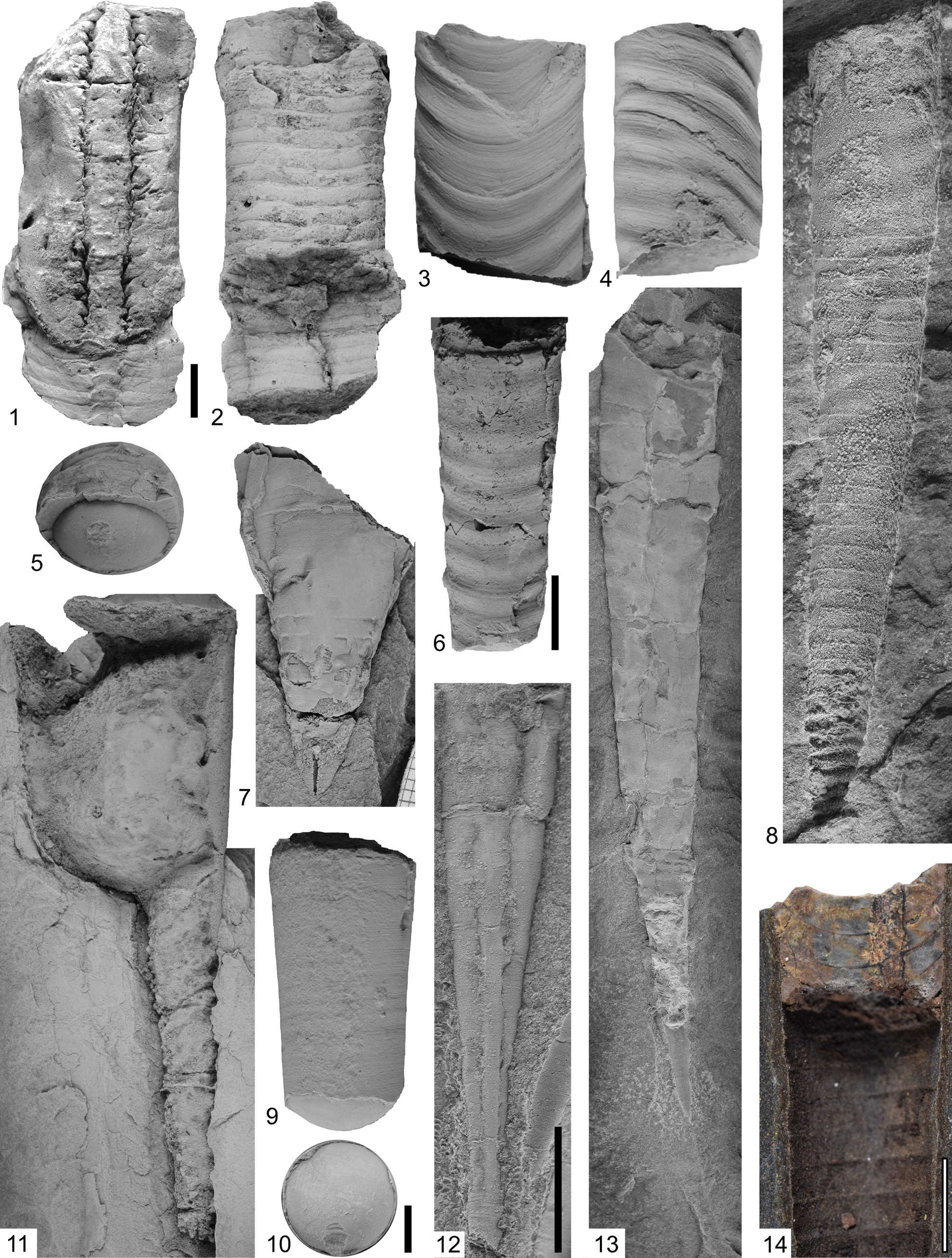
Figures 3.14, 4.1, 4.2
Cephalopods from the Kimbiri section, Apurimac River valley, Peru, Floian Stage, Ordovician: (1, 2) Saloceras sp. indet., CPI-10077, K-04 horizon: (1) ventral view; (2) dorsal view. (3–6, 8, 13) Annbactroceras grecicostatum (Kobayashi, Reference Kobayashi1937): (3, 4) CPI-10083, horizon K-02: (3) ventral view, note deep V-shaped, healed bite mark; (4) lateral view with venter toward right side; (5) CPI-10082, horizon K-02, adoral view; (6) CPI-10084, horizon K-02, ventral view; (8) CPI-10087, horizon K-11, lateral view; (13) CPI-10079, neotype, horizon K-01, lateral view. (7) Rioceras? sp. indet., CPI-10078, horizon K-01, ventral view. (9, 10, 12) Bactroceras cocafolium n. sp., holotype, CPI-10092, horizon K-02: (9) lateral view, venter toward right side; (10) adoral view; (12) CPI-10093a, horizon K-02, ventral view of apical portion (note the partly broken apex). (11) Saloceras sp. indet., CPI-10076, horizon K-04, lateral view. (14) Dissidocerida indet., CPI-10075, horizon K-11. Scale bars = 5 mm, same scale bar for specimens (1–5, 7, 8, 11, 13), for specimen (9, 10), respectively. Specimens (1–12) whitened with ammonium chloride.
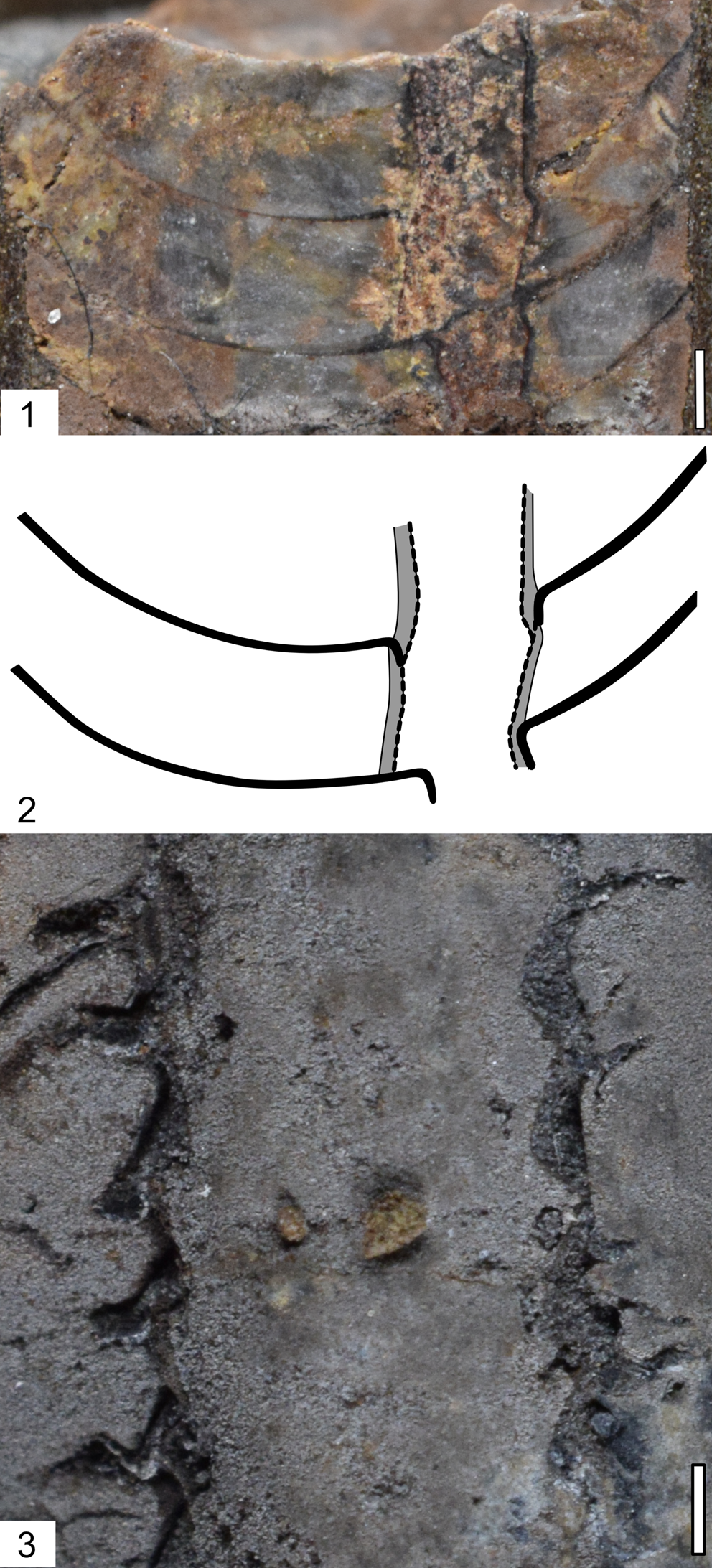
Details of the siphuncle of cephalopods from the Kimbiri section, Apurimac River valley, Peru, Floian Stage, Ordovician: (1) Dissidocerida indet., CPI-10075, horizon K-11, median section (same as Fig. 3.14); (2) interpretative drawing of (1). black = septa; gray = connecting ring; dashed line = inner surface of connecting ring. (3) Saloceras sp. indet., CPI-10077, horizon K-04 (same as Fig. 3.1, 3.2). Scale bar = 1 mm.
Description
The specimen consists of three fragments of a phragmocone embedded in sediment matrix. Details of the conch surface are not preserved. However, it was not or only very weakly annulated. The straight conch has a circular cross section and expands from 6–8.5 mm along a distance of 23 mm (angle of expansion ~6°). The largest diameter of the fragment is 10 mm. At a conch diameter of 8.3 mm, the septal distance is 1.6 mm (0.19 of corresponding conch cross section), the siphuncular diameter is 1.8 mm (0.22 of corresponding conch cross section), and the siphuncle is positioned 2 mm from conch margin (0.24 of corresponding conch cross section). The septal necks are orthochoanitic. The connecting rings are partly distorted and were originally either slightly concave or convex or concavoconvex. Parietal deposits occur at siphuncular margins directed toward the conch margin and toward the conch center.
Material
CPI-10075, Kimbiri section bed K-11, Baltograptus minutus graptolite Zone, Floian, Ordovician.
Remarks
The poor and fragmentary preservation of this single specimen does not allow for the erection of a taxon although it does not belong to any known genus and species. The specimen is most similar to a yet unnamed group of orthocones with parietal endosiphuncular deposits, which include: Destombesiceras zagorense (Kröger and Lefebvre, Reference Kröger and Lefebvre2012) from the Upper Fezouata Formation, Morocco (early to mid-Floian) and Glenisteroceras obscurum Flower in Flower and Teichert, Reference Flower and Teichert1957 from the Fort Cassin Formation, New York, USA (early Floian). The latter two genera have been previously classified within the Apocrionoceratidae Flower in Flower and Teichert, Reference Flower and Teichert1957 within the Discosorida (see e.g., Kröger and Lefebvre, Reference Kröger and Lefebvre2012). Glenisteroceras Flower in Flower and Teichert, Reference Flower and Teichert1957 differs mostly in having cyrtochoanitic septal necks, and in Destombesiceras Kröger and Lefebvre, Reference Kröger and Lefebvre2012 the siphuncle is positioned closer to the conch margin.
The family Apocrionoceratidae is poorly supported by Bayesian phylogenetic inference (Pohle et al., Reference Pohle, Kröger, Warnock, King, Evans, Aubrechtová, Cichowolski, Fang and Klug2022) and there is a high probability that it is paraphyletic. Moreover, the group of Destombesiceras + Glenisteroceras is a sister group to the clade containing actinocerids, orthocerids, and pseudorthocerids within the Dissidocerida (Pohle et al., Reference Pohle, Kröger, Warnock, King, Evans, Aubrechtová, Cichowolski, Fang and Klug2022). Therefore, the Kimbiri specimen described herein is classified within the Dissidocerida. The poorly preserved specimen gives additional evidence for the presence of a characteristic group of Floian orthocones with parietal deposits.
Order Cyrtocerinida Flower, Reference Flower1964
Family Bathmoceratidae Gill, Reference Gill1871
Genus Saloceras Evans, Reference Evans2005
Type species
Orthoceras sericeum Salter in Ramsay, Reference Ramsay1866, from the Tremadocian of North Wales, UK; by original designation.
Diagnosis
Orthoconic bathmoceratids with circular to slightly depressed cross section and moderate angle of expansion; sutures straight and directly transverse with ventral saddle over siphuncle; siphuncle marginal, most forms with diameter 0.2–0.5 of corresponding phragmocone cross section, less frequently smaller; septal necks achoanitic to weakly orthochoanitic; siphuncular segments strongly concave with connecting rings asymmetrically thickened, protruding into the siphuncle; siphonal diaphragms present (diagnosis after Cichowolski et al., Reference Cichowolski, Waisfeld, Vaccari and Marengo2015).
Saloceras sp. indet.
Figures 3.1, 3.2, 3.11, 4.3
Description
Specimen CPI-10077 (Figs. 3.1, 3.2, 4.3) is a slightly diagenetically compressed straight fragment of a phragmocone. The conch surface is not preserved and the prosiphuncular part area is partly eroded, exposing parts of the siphuncle along the longitudinal axis. The specimen has a total length of 38 mm, and the conch widths of 14–15 mm are 15 mm apart (angle of expansion is 4°). The septal spacing is tight with eight chambers at a length similar to the corresponding conch cross section. A weak annulation is visible at the antisiphuncular side with a distance between the shallow annuli of ~5 mm (approximately three chambers per annulation). The siphuncle is ~4 mm in diameter at a conch width of 15 mm (relative siphuncular diameter ~0.3). Connecting rings are 0.5 mm thick and form concave segments.
Specimen CPI-10076 (Fig. 3.11) is a fragment of a body chamber and phragmocone. The phragmocone is eroded roughly along the dorsoventral axis exposing the siphuncle. It is heavily distorted and does not allow for measurements. However, the steinkerns of the siphuncle and the body chamber are well preserved. At the base of the body chamber the conch height is 22 mm. The preserved part of the body chamber has a length of 24 mm and a maximum conch height of 25 mm (angle of expansion ~8°). The depth of the septal curvature is ~4 mm at the base of the body chamber. The conch surface is poorly preserved, but apparently lacks annulation or ornamentation. The septal distance directly adapical of the body chamber equals seven or eight chambers per distance, similar to the corresponding conch height. The siphuncle is marginal with a diameter of 6 mm at the base of the body chamber (relative siphuncular diameter ~0.27) and the siphuncular segments are concave.
Materials
CPI-10076 and CPI-10077, Kimbiri section bed K-04, Baltograptus minutus graptolite Zone, Floian, Ordovician.
Remarks
The fragmentary preservation of the two specimens, the lack of diagnostic conch surface characters, and the diagenetically distorted conch cross section preclude any species level determination. The weak or absent annulation of the two specimens is similar to that of Saloceras sikus Cichowolski et al., Reference Cichowolski, Waisfeld, Vaccari and Marengo2015, known from the Acoite Formation, Floian Stage, Jujuy, Argentina. The two Peruvian specimens also fall within the range of variation of S. sikus with respect to chamber spacing and siphuncle size. However in the latter, a distinctive adult adoral widening of the siphuncle occurs (see Cichowolski et al., Reference Cichowolski, Waisfeld, Vaccari and Marengo2015), which does not exist or is not preserved in the specimens described herein. Furthermore, S. sikus differs from the two specimens described herein in having a greater angle of expansion. The fragment of an indeterminate bathmoceratid from Darriwilian strata of the San José Formation at Río Yanaorco, Peru, described by Evans (Reference Evans2007), is similar in chamber spacing and general conch outline and possibly synonymous with the specimens described herein. However, because the internal characters of the latter are not known, it is not possible to provide a more detailed comparison.
Order Rioceratida King and Evans, Reference King and Evans2019
Family Rioceratidae Kröger and Evans, Reference Kröger and Evans2011
Genus Rioceras Flower, Reference Flower1964
Type species
Rioceras nondescriptum Flower, Reference Flower1964, from the Lower Ordovician of New Mexico, southwestern USA; by original designation.
Diagnosis
Small orthocones; cross sections circular to slightly compressed or depressed; shell smooth; sutures generally straight and directly transverse; camerae shallow with depth 0.1–0.2 mm of dorsoventral diameter of phragmocone; body chamber simple, tubular, or faintly fusiform; septal necks loxochoanitic-orthochoanitic; marginal siphuncle narrow, with segments concave with moderately thick connecting rings; no or strongly reduced endosiphuncular deposits (after Kröger and Evans, Reference Kröger and Evans2011).
Rioceras? sp. indet.
Figure 3.7
Description
The single specimen consists of a ~25 mm long fragment of a phragmocone. The distance between conch diameters 5–10 mm is 18 mm (angle of expansion is 16°). The outer shell is partly reserved and smooth. The cross section apparently was circular or nearly so. The sutures are straight and directly transverse, at a conch diameter of 8 mm with a spacing of 1.3 mm, and a conch diameter of 10 mm with a spacing of 1.5 mm. At the apical end of the specimen, an impression of the siphuncle is preserved; it has a diameter of ~0.5 mm at a conch cross section of 5 mm and appears to be tubular or nearly so. At a conch cross section of 10 mm, a poorly preserved trace of the siphuncle indicates a siphuncular diameter of ~1.5 mm.
Material
CPI-10078 (Fig. 3.7), San José Formation, Kimbiri section, bed K-01, Baltograptus minutus graptolite Zone, upper Floian, Lower Ordovician.
Remarks
The poor preservation of the siphuncular characters make determination of this specimen somewhat uncertain because it is unknown if the siphuncular segments were originally tubular, slightly expanding, or slightly concave. However, the relatively narrow marginal and nearly tubular siphuncle is indicative of the Rioceratidae. The straight shell, the nearly circular cross section, and the moderate septal spacing are similar to species of Rioceras, although the angle of expansion is relatively large compared with known species of the genus. The specimen is classified in open nomenclature within Rioceras because it is known only from a single specimen, revealing limited details of the siphuncle, as well as of the juvenile and adult growth stages.
Family Baltoceratidae Kobayashi, Reference Kobayashi1935
Genus Annbactroceras Kröger and Evans, Reference Kröger and Evans2011
Type species
Orthoceras martyi Thoral, Reference Thoral1935, from the upper Tremadocian of the Montagne Noire, southeastern France; by original designation.
Diagnosis
Slender, straight to slightly curved, annulated conchs; sutures directly transverse and widely spaced; siphuncle marginal to eccentric in position and closer to the concave side of the conch curvature; septal necks orthochoanitic; siphuncular segments tubular with a diameter 0.1 of the phragmocone diameter (diagnosis after Kröger and Evans, Reference Kröger and Evans2011).
Annbactroceras grecicostatum (Kobayashi, Reference Kobayashi1937)
Figures 3.3–3.6, 3.8, 3.13, 5.2, 5.3
- Reference Kobayashi1937
Cycloceras grecicostatum Kobayashi, p. 434, pl. 8, fig. 4a–c.
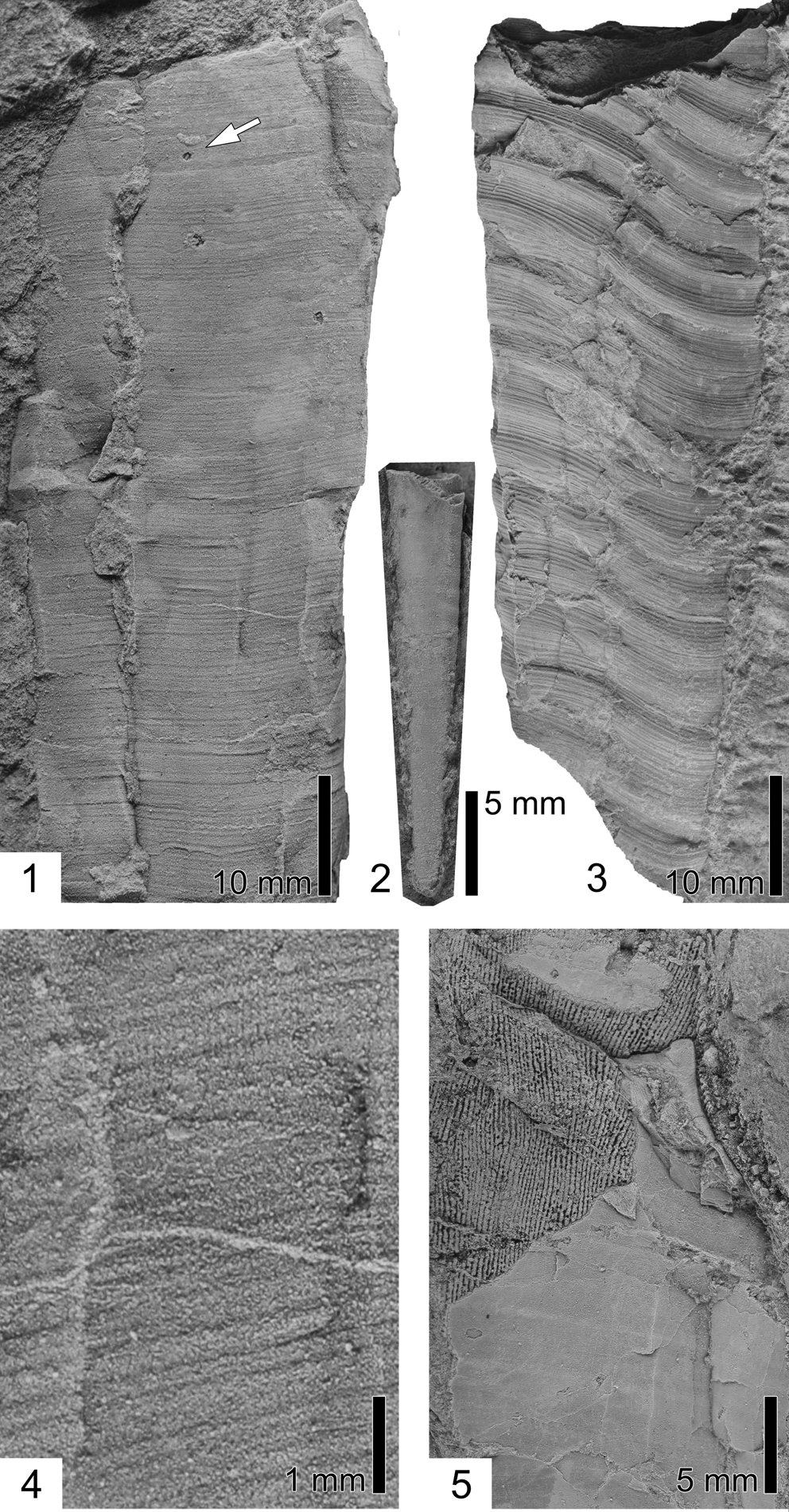
Ornamentation details of cephalopods from the Kimbiri section, Apurímac River valley, Peru, Floian Stage, Ordovician: (1, 4) Bactroceras cocafolium n. sp.: (1) CPI-10094, horizon K-01, diagenetically flattened specimen, note the shell borings (arrow); (4) detail of (1). (2, 3) Annbactroceras grecicostatum (Kobayashi, Reference Kobayashi1937): (2) CPI-10085, horizon K-02, approximate dorsal view of apical portion; (3) CPI-10081, horizon K-02, lateral view of strongly diagenetically flattened specimen. (5) Indet. cephalopod shell, CPI-10097, horizon K-02, with bryozoan epizoans. All specimens whitened with ammonium chloride.
Holotype
Cycloceras grecicostatum, from ‘`Knollenschiefer´ of Obispo,’ southern Bolivia (Kobayashi, Reference Kobayashi1937). Listed under PM 01588, Geological Collections of the University of Freiberg, Germany by Kobayashi (Reference Kobayashi1937), but missing from the repositories of the University Museum, University of Tokyo, Japan, and the Geological Collections of the University of Freiberg, Germany (personal communication, Ursula Leppig, Freiburg, 2023).
Neotype
CPI-10079 (Fig. 3.13), San José Formation, Baltograptus minutus graptolite Zone, Floian, Ordovician, Kimbiri section, bed K-01; designated herein.
Diagnosis
Slightly curved, gradually expanding, annulated longicones with circular conch cross section and angle of expansion of ~8–10°; annulated with four or five annuli within a distance similar to the corresponding cross section; distinctiveness of annulations increases with conch diameter; annulations laterally oblique forming broad sinus at antisiphuncular side and broad lobe at prosiphuncular side; additionally ornamented with distinct, irregularly spaced growth lines that trend parallel to the annuli; siphuncle tubular, narrower than one-fourth of corresponding conch diameter; positioned between conch center and concave margin of conch curvature; approximately three or four chambers per distance similar to corresponding conch diameter (diagnosis compiled from Kobayashi, Reference Kobayashi1937).
Occurrence
San José Formation, Peru; Capinota Formation, Bolivia.
Description
The neotype consists of a > 73 mm long fragment of the nearly apicalmost parts of the phragmocone. The most apical parts are only preserved as an impression with a diameter of ~1.5 mm and a maximum preserved diameter of 11 mm. The angle of expansion of the part ranging from diameter 3–11 mm has an apical angle of 8°. The conch is slightly endogastrically curved (siphuncle positioned closer to the side with concave curvature) with the siphuncle at a distance of 0.5 mm from conch margin where the conch diameter is 3.2 mm. There, the siphuncular diameter is ~0.6 mm (relative siphuncular diameter 0.19). The connecting rings are thin and form a barrel-shaped, slightly expanded siphuncle. The shape of the septal neck cannot be determined, due to recrystallization. The chamber length is 1.2 mm at a position of 3.3 mm conch diameter (relative chamber length 0.36). The conch is annulated with relatively shallow annuli, which have a distance of 2–3 mm at a conch diameter of 9 mm (relative distance of annuli 0.2–0.3). The amplitude of the annulation decreases toward the apex and the shell is virtually smooth at diameters < 4 mm. The annuli are laterally oblique forming a wide lobe at the prosiphuncular side and a wide sinus over the antisiphuncular side. The conch surface is additionally marked with distinct irregular growth lines, which trend parallel to the annulations.
Specimen CPI-10082 (Fig. 3.5) is a ~20 mm long, slightly diagenetically compressed phragmocone fragment with a diameter of 13 mm. The siphuncle is eccentrically positioned (distance from the conch margin = 0.29 of the corresponding conch cross section), and with a septal perforation with a diameter of 2.2 mm (relative siphuncular diameter 0.17). The annuli are ~3 mm apart (relative distance of annuli 0.23) and form a broad lobe at the prosiphuncular side and a wide sinus at the antisiphuncular side. The septa are deeply concave with a depth of 3 mm.
The largest specimen (CPI-10083, Fig. 3.3, 3.4) is a strongly flattened fragment consisting of a body chamber and likely parts of the phragmocone with a diameter ranging from 14–20 mm along a length of 42 mm (angle of expansion 10°). The internal characters are not preserved, but the conch surface shows the characteristic laterally oblique annulation with ~4 or 5 annulations per distance similar to the corresponding conch cross section and well developed irregularly spaced growth lines.
Specimen CPI-10085 (Fig. 5.2) is a weakly annulated, almost straight apical fragment of a phragmocone, preserving the conch apex. The specimen has a length of 18 mm and a maximum diameter of 3.5 mm (angle of expansion ~11°). At its adoral end, a septum is preserved with a septal perforation of 0.6 mm in diameter (relative siphuncular diameter ~0.17). The septal perforation is slightly eccentrically positioned at a distance 1.1 mm from conch margin. The apex is straight, blunt to hemispherical, and without a distinctive apical constriction.
CPI-10086 is very similar to CPI-10085 and has a diameter of 3.7 mm. Traces of a siphuncle with a diameter of 0.6 mm are preserved at a distance of 0.8 mm from the conch margin.
Materials
CPI-10079 (neotype) and CPI-10080 from the Kimbiri section bed K-01; seven additional specimens from bed K-02 (CPI-10081–10086) and K-11 (CPI-10087). Four specimens (CPI-10088–10091) from LIB. All from Baltograptus minutus graptolite Zone, Floian, Ordovician.
Remarks
The combination of a moderate angle of expansion and the presence of a relatively deep broad ventral lobe distinguishes this species from Annbactroceras martyi (Thoral, Reference Thoral1935). The latter has a very low angle of expansion (5° or less). Annbactroceras felinense Kröger and Evans, Reference Kröger and Evans2011 has a marginal siphuncle.
The holotype is missing (see above) and the only stratigraphic information given by Kobayashi (Reference Kobayashi1937, p. 434) is ‘`Knollenschiefer´ of Obispo,’ which probably refers to the ‘Geodenschiefer’ of Steinmann and Hoek (Reference Steinmann and Hoek1912, p. 200) and has been interpreted as the Capinota Formation (Evans, Reference Evans2007). This unit is poorly age constrained, ranging from Floian to Darriwilian (González Bonorino and González Bonorino, Reference González Bonorino and González Bonorino1994; Egenhoff et al., Reference Egenhoff, Weber, Lehnert and Maletz2007).
Genus Bactroceras Holm, Reference Holm1898
Type species
Bactroceras avus Holm, Reference Holm1898, from the Darriwilian of Öland, Sweden; subsequent designation by Glenister (Reference Glenister1952, p. 90).
Bactroceras cocafolium new species
Figures 3.9, 3.10, 5.1, 5.4
Holotype
CPI-10092 (Fig. 3.9, 3.10), San José Formation, Kimbiri section, bed K-02, Baltograptus minutus graptolite Zone, upper Floian, Lower Ordovician.
Diagnosis
Slightly endogastrically curved longicones with circular conch cross section and angle of expansion ~7°; ornamented with a fine reticulate pattern of transverse and longitudinal lirae with a distance of ~0.1 mm; transverse lirae form a wide and shallow lobe on the prosiphuncular side; siphuncle marginal with a diameter of ~0.18 mm of the corresponding conch cross section.
Occurrence
San José Formation, Baltograptus minutus graptolite Zone, Floian, Ordovician, Kimbiri section north of the village of Kimbiri Alto, along the trail parallel to the Kashiroveni stream (Fig. 2, loc. 3). Geographical coordinates for the type locality and stratotype K-02 are 12°34ʹ53.6ʺS, 73°44ʹ42.9ʺW.
Description
The holotype is a 20 mm long phragmocone fragment with a circular conch cross section of 10.5–13 mm (angle of expansion ~7°). The conch surface is ornamented with fine rounded growth lines or transverse lirae (~10 per 1 mm) and delicate longitudinal lirae (~10 per 1 mm). The transverse lirae form a wide and shallow lobe over the prosiphuncular side of the conch. On its adapical end, a septum is preserved and runs directly transverse with a concavity of ~4 mm. The marginal septal perforation has a diameter of 1.8 mm (relative siphuncular diameter ~0.18).
Specimen CPI-10094 (Fig 5.1, 5.4) is a strongly taphonomically compressed fragment of the conch. The maximum diameter of this specimen is 14 mm, and it has a well-preserved reticulate ornamentation of 0.1 mm spaced transverse and longitudinal lirae.
The apical parts are partly preserved in one specimen (CPI-10093a-b; Fig. 3.12). There, the siphuncle is marginally positioned, and the conch has a diameter of ~5 mm at a distance of 22 mm from the tip (angle of expansion ~7°). The conch appears to be slightly curved with the siphuncle on the concave side of the conch curvature. The apex is apparently blunt to hemispherical, without distinctive apical constriction, and is ornamented with rounded transverse lirae that have a distance of ~0.1 mm.
Etymology
Named after the coca plant (Erythroxylum coca Lamarck, Reference Lamarck1786) and folium (Lat., neutral gender), its leaves. The name refers to the coca crops that support many farmers in the Apurímac River valley.
Materials
CPI-10092 (holotype) and one additional specimen (CPI-10093a-b, part and counterpart) from bed K-02; two specimens from bed K-01 (specimens CPI-10094, 10095). All from Kimbiri section, Baltograptus minutus graptolite Zone, Floian, Ordovician.
Remarks
The only known species of Bactroceras with a fine reticulate ornamentation is the Late Ordovician Bactroceras interpolatum (Barrande, Reference Barrande1867), which differs in having a narrow, submarginal siphuncle with a relative siphuncular diameter of only 0.1 mm (see Aubrechtová, Reference Aubrechtová2015).
Order, family, genus, and species indet.
Figure 6
Cephalopod, order, family, genus and species indet., mold of a body chamber, CPI-10096, from a nodule from Inambari River section, Peru, Floian Stage, Ordovician: (1) lateral view, venter toward right; (2) ventral view; (3) lateral view, venter toward left. Scale bar = 10 mm. Whitened with ammonium chloride.
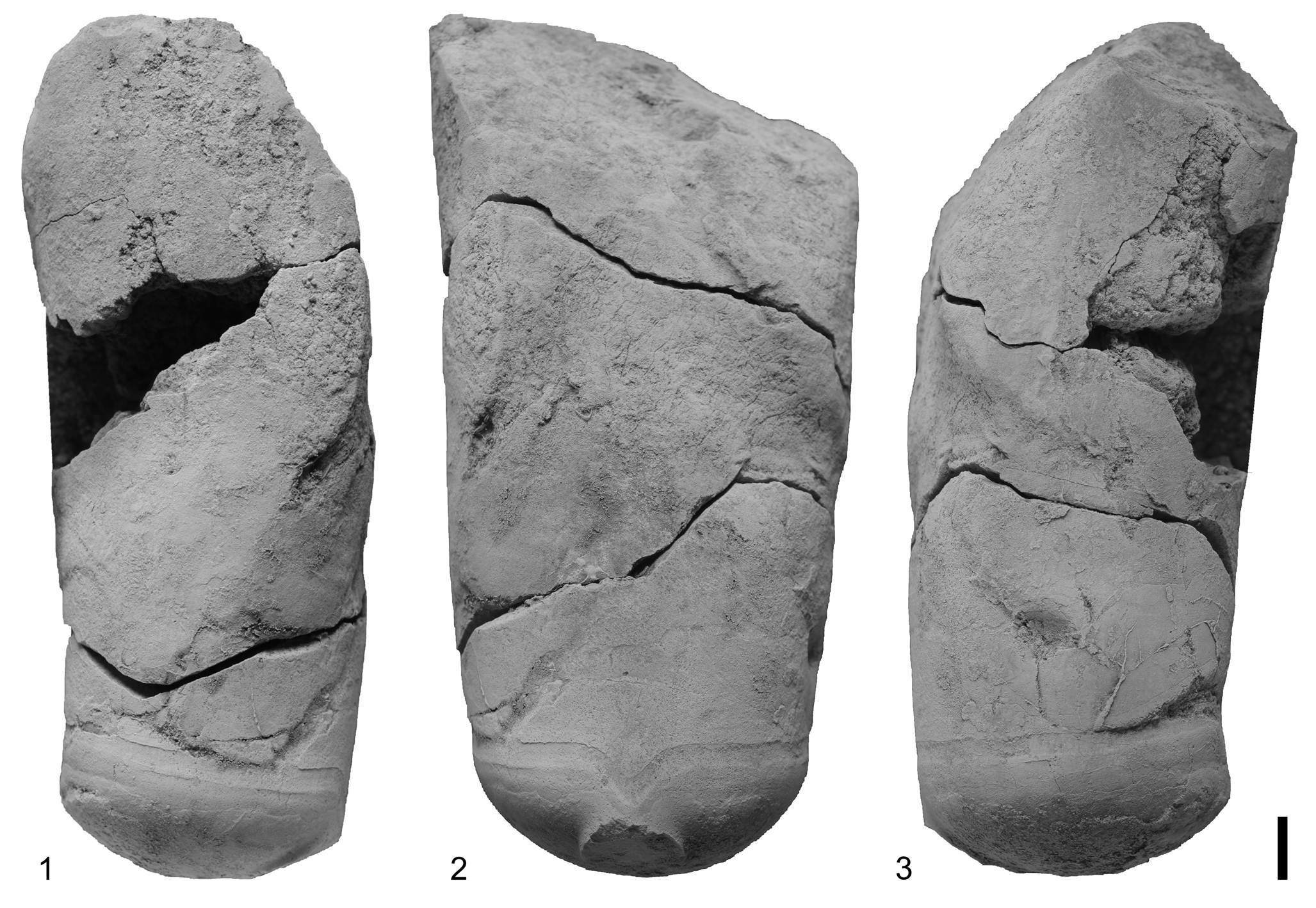
Description
The specimen consists of an internal mold of a body chamber fragment that includes the last septum of the phragmocone. The conch has a circular cross section with a diameter ranging from 44–62 mm along a length of 82 mm (angle of expansion ~13°) and reaches a maximum diameter of 67 mm; it is slightly curved with the siphuncle near the convex conch margin. The conch surface is not preserved; the mold is smooth without traces of ornamentation. At the base of the body chamber, a narrow contact band of the last septum with the external conch is visible (1.2 mm wide at venter). The suture is directly transverse and forms a very shallow marginal lobe and a deep (4.2 mm) U-shaped ventral lobe. The septal perforation is marginal and with circular cross section of 13 mm with traces of the septal necks only partly preserved indicating a length of at least 1 mm. The septal curvature has a depth of 3 mm.
Material
CPI-10096, from a nodule from bed CB-87, Inambari River section, San José Formation, southeastern Peru.
Remarks
The fragmentary character of the specimen does not allow for a more precise determination. However, the relatively large size, the large marginal siphuncle (septal perforation is 0.3 of conch diameter), and the shape of the preserved parts of the septal neck suggest that it belongs to an endoceratid. The relative narrow shape of the ventral lobe, which is part of an otherwise nearly straight transverse suture line, distinguishes the specimen from species assigned to Cyptendoceras Ulrich and Foerste, Reference Ulrich and Foerste1936 and Belloceras Cecioni, Reference Cecioni1965, by Cecioni (Reference Cecioni1965), and is suggestive of Protocyptendoceras Cecioni, Reference Cecioni1965. The last genus, which is known from middle Tremadocian to Floian strata of Argentina (Cichowolski et al., Reference Cichowolski, Vaccari, Pohle, Alfonso, Vaucher and Waisfeld2023) differs in having a straight shell (see review by Cichowolski, Reference Cichowolski2009).
Discussion
The composition of the cephalopod assemblage of the Floian portion of the San José Formation is typical for pelagic depositional environments given the dominance of small orthoceracones, e.g., rioceratids and baltoceratids (see Kröger et al., Reference Kröger, Servais and Zhang2009 and references therein). Floian assemblages from similar depositional environments have been described from the Pircancha Formation, Bolivia (Aubrechtová, Reference Aubrechtová2015), from the Montagne Noire, France (Kröger and Evans, Reference Kröger and Evans2011), from England and Wales, UK (Evans, Reference Evans2004), and from Spitsbergen, Norway (Kröger and Pohle, Reference Kröger and Pohle2021). The occurrence of genera in the San José Formation with global or very widespread paleogeographical ranges, e.g., Bactroceras and Rioceras, therefore, can be partly explained by paleoecology, i.e., representing a predominantly pelagic habitat. However, Annbactroceras, Rioceras, and Saloceras, which occur also in the San José Formation, are absent in Spitsbergen, and are important elements not only in pelagic depositional environments, but in more proximal settings, e.g., the siltstone of the Upper Fezouata Formation, Morocco (Kröger and Lefebvre, Reference Kröger and Lefebvre2012) and the upper Acoite Formation, Argentina (Cichowolski et al., Reference Cichowolski, Waisfeld, Vaccari and Marengo2015). These latter taxa display a clear peri-Gondwana-Avalonia paleogeographic affinity for the Peruvian assemblage, which is in alignment with the distribution of brachiopods (Gutiérrez-Marco and Villas, Reference Gutiérrez-Marco and Villas2007), conodonts (Gutiérrez-Marco et al., Reference Gutiérrez-Marco, Albanesi, Sarmiento and Carlotto2008), and trilobites (Hughes et al., Reference Hughes, Rickards and Williams1980).
The co-occurrence of Annbactroceras grecicostatum in the Peruvian strata of the San José Formation and in nodular shales of Obispo, southern Bolivia reflects their paleogeographical proximity within the Central Andean Basin. Furthermore, it could help constrain the age of the Capinota Formation to which the Obispo sequence has been correlated (Evans, Reference Evans2007). If true, this would give further evidence that the lower portion of this formation ranges into the late Floian (e.g., González Bonorino and González Bonorino, Reference González Bonorino and González Bonorino1994).
The occurrence of Annbactroceras grecicostatum therefore contributes toward a more complete picture of the Floian fauna of the Central Andean Basin. This fauna, which contains benthic species, e.g., brachiopods (e.g., Notorthisina Havlíček and Branisa, Reference Havlíček and Branisa1980, Paralenorthis immitatrix Havlíček and Branisa, Reference Havlíček and Branisa1980), trilobites (e.g., Branisaspis speciosa Pribyl and Vanek, Reference Pribyl and Vanek1980, Hoekaspis Kobayashi, Reference Kobayashi1937), and planktic graptolites (see e.g., Gutiérrez-Marco et al., Reference Gutiérrez-Marco, Albanesi, Sarmiento and Carlotto2008; Benedetto et al., Reference Benedetto, Vaccari, Waisfeld, Sánchez and Foglia2009), displays a distinct west Gondwanan signature (e.g., Benedetto et al., Reference Benedetto, Vaccari, Waisfeld, Sánchez and Foglia2009; De la Puente and Rubinstein, Reference De la Puente and Rubinstein2013).
No apparent species overlap occurs between our Floian assemblage and the assemblage described by Evans (Reference Evans2007) and collected by Douglas (Reference Douglas1933) from the San José Formation in Yanaorco River area, eastern Peru. As noted by Evans (Reference Evans2007), this latter assemblage likely represents Middle Ordovician strata within the San José Formation and thus is considerably younger than the assemblage described herein. However, it can be correlated with certain Darriwilian specimens from the Nueva Alianza locality NA-3 (like an unfigured Eothinoceratidae gen. indet. sp. indet. collected by JCG-M, which is virtually identical to a similar specimen described by Evans, Reference Evans2007, figs. 2A, 4F) and with undescribed material with fine transverse ornamentation derived from Darriwilian strata of the Inambari River section (unpublished data, B. Kröger and J.C. Gutiérrez-Marco, 2023, derived from the middle part of the San José Formation).
Conclusions
A cephalopod assemblage, collected from the Floian section (Baltograptus minutus graptolite Zone) of the San José Formation of the Kimbiri area, northwest of Cuzco, southeastern Peru allows for an initial report of Ordovician cephalopods with species-level determinations from this area. The assemblage contains five species of small orthoceracones belonging to four families of three orders: one indeterminate dissidocerid, one bathmoceratid (Saloceras sp. indet.), one rioceratid (Rioceras? sp. indet.), and two baltoceratids (Annbactroceras grecicostatum, Bactroceras cocafolium n. sp.). An additional indeterminate cephalopod is described from nodules within the San José Formation from the Inambari River in southeastern Peru. The assemblage, with its orthoceracone, baltoceratid dominance, represents a typical Floian pelagic cephalopod fauna. Annbactroceras grecicostatum is known from the Capinota Formation, Obispo region, Bolivia, which together with the Coroico Formation, are correlated with the San José Formation in its eastward extension to Bolivia within the northern sector of the Central Andean Basin (e.g., Suárez-Soruco, Reference Suárez-Soruco, Gutiérrez-Marco, Saavedra and Rábano1992; Mitchell et al., Reference Mitchell, Brussa and Maletz2008). The other taxa indicate a peri-Gondwana-Avalonia paleogeographical relationship of the cephalopod fauna. This is coherent with previously published data from brachiopods and trilobites (Hughes et al., Reference Hughes, Rickards and Williams1980; Gutiérrez-Marco and Villas, Reference Gutiérrez-Marco and Villas2007).
Acknowledgments
We are grateful to L.T. Medina (INGEMMET, Lima) for curation of material in the Peruvian Geological Survey. JCG-M wishes to express his gratitude to J.M. Sánchez (Madrid), A.S. Arana (Lima), A.T. Ccari (Lima), and S.L. Álvarez (Almadén) for their assistance in various field campaigns in the Apurímac River valley. S. Romero (Complutense University, Madrid) helped us with the drafting of Figures 1 and 2. We thank U. Leppig (Freiburg) for providing information on the (missing) holotype of Annbactroceras grecicostatum. We are grateful for careful reviews and constructive comments by M. Cichowolski (Buenos Aires, Argentina) and I. Percival (Sydney, Australia) of an earlier version of the manuscript. This research is a contribution to projects PDI2021-125585NB-I00 of the Spanish Ministry of Science, Innovation and Universities (funding to JCG-M), and IGCP 735 (Rocks n'ROL) of the IUGS-UNESCO.
Author contributions
The material for this study was collected by JCG-M and identified by BK. The manuscript was written by BK and JCG-M. CAC extensively discussed scientific literature and details of local geology with JCG-M and improved the manuscript. All authors read and commented on the final version of the manuscript.
Declaration of competing interests
The authors declare none.


 Open access

