The Mediterranean diet (MD), a dietary pattern typical of Crete, Greece and southern Italy in the early 1960s, has been increasingly considered a healthy diet that promises to protect against obesity and its related health problems(Reference Keys, Menotti and Karvonen1–Reference Garcia, Shook and Kerstetter3). Recently, MD has been recommended as a healthy diet pattern for Americans by the US Department of Agriculture and the US Department of Health and Human Services in the Dietary Guidelines for Americans 2015–2020(4). MD is a relatively new dietary pattern in the USA, and little is known about its adoption and adherence across the US regions as well as the drivers of its adoption among the adult population.
In the past two decades, the Geographic Information System (GIS) techniques, combining digital mapping capabilities with additional geographical databases and data analysis tools, have been increasingly applied in the public health arena(Reference McEntee and Agyeman5,Reference Yasnoff and Miller6) . These provide opportunities to assess the spatial distribution and patterns of health outcomes, and to link individuals’ experiences and health with the features of their local environment. For instance, hot spot analysis, which identifies statistically significant hot spots and cold spots using the Getis-Ord Gi* statistic, has been employed in investigating patterns of sexually transmitted diseases in Mexico and community-level overweight and obesity rates in Canada(Reference Rusch, Brouwer and Lozada7,Reference Penney, Rainham and Dummer8) . The application of GIS techniques can potentially provide opportunities to identify at-risk populations and places, promote a more robust understanding of how local environment and contexts interact with individual characteristics to produce variations in health behaviour and outcomes, and improve decision-making capabilities for public health efforts. Yet, few studies have used GIS techniques to investigate the geospatial distribution and pattern of MD adherence across the USA.
The current study uses geospatial mapping as well as logistic regression to describe the spatial distribution of MD adherence across the US regions and explore predictive factors for MD adherence among US adults. The results may extend our understanding of the current status of MD adoption and adherence among US adults, and provide valuable information for future research and intervention on MD promotion in the USA.
Methods
Data source and study participants
Data of individuals were drawn from the REasons for Geographic And Racial Differences in Stroke (REGARDS) study, a national, population-based longitudinal cohort study of non-Hispanic black and white community-dwelling residents aged ≥45 years, to investigate racial and geographic disparities in stroke(Reference Howard, Cushman and Pulley9). Participants who completed baseline assessment during January 2003 and October 2007, with MD adherence score and geocoded address, were eligible for the analysis. Individuals who did not have MD adherence score (n 8927) or geocoded address (n 11) were excluded from the analysis. Furthermore, participants whose geocoded address could not match with 2000 census tract (n 2) were excluded from analysis. Community food environment data were retrieved from the Centers for Disease Control and Prevention(10). Community data were drawn from Food Environment Atlas (2011) and Census of Population and Housing (2000)(11,12) . The census tract shapefiles (2000) were downloaded from the US Census Bureau(13). Data retrieved from these sources were linked and pooled using variables in common (e.g., the Federal Information Processing Standard and participants’ ID). Permission and approval were obtained from the REGARDS study executive committee and the University of Alabama at Birmingham’s Institutional Review Board, respectively, to conduct the current study.
Variables
Mediterranean diet adherence
The MD score was used to indicate diet adherence. Food intake data were collected using the Block 98 FFQ at REGARDS study baseline assessment. The MD score was derived according to previously published methods used in REGARDS(Reference Tsivgoulis, Judd and Letter14). In brief, food group contributors to the MD score included those designated as ‘beneficial’ (vegetables, fruits, legumes, cereals, fish) and those designated as ‘detrimental’ (meat, dairy). One point was assigned for consumption that exceeded the median for the ‘beneficial’ groups, or was below the median for ‘detrimental’ food groups. For fat intake (eighth food category), we used the ratio of daily consumption (in grams) of monounsaturated lipids to saturated lipids, and we calculated the median separately for each sex. Individuals with ratios at or above the sex-specific median were assigned a value of 1, and those with ratios below the sex-specific median were assigned a value of 0. Moderate alcohol (ninth food category) consumption was defined as >0 and ≤7 drinks per week for women, and >0 and ≤14 drinks per week for men. More-than-moderate consumption was defined as >7 drinks per week for women, and >14 drinks per week for men. Individuals were assigned a score of 1 for moderate consumption, and a score of 0 for the other two categories (0 and more-than-moderate consumption). Summing scores for the nine food groups resulted in a possible score of 0–9, with a higher score reflecting higher adherence to MD. The MD adherence score was treated as both a continuous and a binary variable in the analysis. The binary score was created by assigning a value of 0 or 1 to each participant to indicate low or high MD adherence using a median of 4 among the participants in analysis as a cut-off. Participants with an MD score ≤4 were considered to have low MD adherence, and participants with an MD score >4 were considered to have high MD adherence.
Sociodemographics
The following variables were included: age (years), gender (male v. female), race (non-Hispanic white v. non-Hispanic black), health insurance (yes v. no), marital status (single, married, divorced, widowed or other), education (less than high school, high school graduate, some college, or college graduate and above), annual household income (<20K, 20–34K, 35–74K, ≥75K, or refused), employment (employed for wages, self-employed, unemployed for ≥1 year, unemployed for <1 year, homemaker, students, retired, unable to work, or refused) and time lived in the current address (years).
Lifestyle
These factors included exercise (none, 1–3 times/week or ≥4 times/week), TV/video watching (none, 1–6 h/week, 1 h/d, 2 h/d, 3 h/d or ≥4 h/d) and smoking (never, past or current). To measure smoking status, the participants were asked two questions: (i) had they smoked at least 100 cigarettes in their lifetime, and (ii) did they smoke cigarettes now, even occasionally? Participants who answered ‘yes’ to both questions were considered as ‘current smokers’, while those answering ‘yes’ to the first question and ‘no’ to the second question were coded as ‘past smokers’, and those answering ‘no’ to both were classified as ‘never smokers’.
Community features
Six factors were included: (i) percentage of county residents that was non-Hispanic white (2008), (ii) percentage of county residents that was non-Hispanic black (2008), (iii) county median household income (2008), (iv) county poverty rate – percentage of county residents with household incomes below the poverty threshold (2008), (v) census tract population size (2000) and (vi) Rural–Urban Commuting Area Code (RUCA) (2000). RUCA codes were categorised and coded as 1 = urban, 2 = large rural city/town, 3 = small rural town, and 4 = isolated small rural town, according to Categorisation A by the University of Washington Rural Health Research Center (see Appendix in the online supplementary material for more details)(15).
Data analysis
Geographic Information System spatial analysis
Spatial mapping was implemented using ArcGIS 10·4 (ESRI Inc.). Individual data and other community data were integrated and imported into ArcMap for analysis. Hot spot analysis (Getis-Ord Gi*) was conducted to describe MD adherence distribution across the USA. Hot spot analysis identifies statistically significant high- or low-value clusters of a phenomenon of interest (e.g., MD adherence score) by evaluating individuals’ MD scores in the context of neighbouring features and against all features in the dataset(Reference Ord and Getis16). A hot spot is a feature with a high value surrounded by other features with high values, and a cold spot is a feature with a low value surrounded by other features with low values(17). Euclidean distance (the straight-line distance between two points) was chosen to measure the distance between two individuals, and inverse distance was used to conceptualise spatial relationship. False discovery rate correction was applied to account for both multiple testing and spatial dependence. Significance of local clustering was based on a P-value <0·05.
Statistical analysis
Statistical analysis was implemented using SAS (version 9.4) for Windows (SAS Institute Inc.). Descriptive analyses of individual and community features were conducted. Means and standard deviations (for continuous variables) and percentages (for categorical variables) were calculated. Multiple logistic regression (stepwise) models were developed to examine factors that predict MD adherence among the study participants. A significance level of 0·3 was required to allow a variable into the model, and a significance level of 0·35 was required for a variable to stay in the model(Reference Haldar, Pal and Datta18). OR and 95 % CI were used to estimate associations with MD adherence. Statistical significance (alpha level) was set at 0·05, two-tailed. Missing data were handled using listwise deletion. Supplementary analysis was conducted to compare the characteristic differences among MD score clustering groups (higher MD score clusters, lower MD score clusters and non-clustering group).
Results
A total of 20 897 participants from forty-eight contiguous states and Washington, DC constituted the analysis. The major characteristics of participants and their community are described in Table 1. Overall, the average age of participants was 65 years. Slightly less than half of the participants were retired. About half of the participants had an annual household income ≥$US 35K. Slightly more than half were female. The majority of participants were white (66·7 %), married (61·7 %) and had a high school diploma (64·9 %). Nearly all of the participants had health insurance. The majority of participants were non-current smokers (86 %), exercised ≥1 time/week (67 %) and watched TV/video <4 h/d (70 %). About four-fifths of participants (77 %) were residing in urban areas, having lived for an average of 29 years at their current address. On average, the participants were living in neighbourhoods with 60 % non-Hispanic white, 27 % non-Hispanic black residents, median household income of $US 48 182, poverty rate of 16 % and tract population of 5082. The mean MD score of the sample was 4·36 (sd 1·70), and 46·5 % of the sample had high MD adherence (score 5–9).
Individual and community characteristics of the REasons for Geographic and Racial Differences in Stroke study participants (n 20 897)

MD, Mediterranean diet; RUCA, Rural–Urban Commuting Area Code.
* Using a sex-specific median of 4 as cut-off, high MD adherence was defined as an MD score >4 on a scale of 0–9.
† Never smoker was defined as an adult who smoked <100 cigarettes per lifetime and not smoking at the time of interview; past smoker was defined as an adult who smoked at least 100 cigarettes in his or her lifetime but who had quit smoking at the time of interview; current smoker was defined as an adult who smoked 100 cigarettes in his or her lifetime and who currently smokes cigarettes.
‡ County-level data.
§ Refer to Appendix in the online supplementary material for details on RUCA code categories.
Hot spot analysis
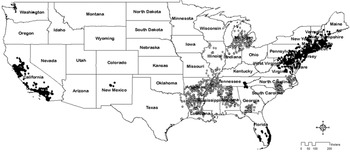
The results of local clustering analysis of MD adherence are depicted in Fig. 1. About 67·5 % of participants were in the non-clustering locations, which indicated that they were not surrounded by other individuals who were either having high MD scores or having low MD scores. Higher MD adherence clusters (hot spot; black points) were primarily located in, for instance, western coastal areas of California, southeastern Tennessee, northern Georgia, southern Florida, southeastern Pennsylvania, New Jersey, New York City, Connecticut and Massachusetts. Lower MD adherence clusters (cold spot; grey points) were primarily located in the south (e.g., Arkansas, Louisiana, northern Mississippi, north central Alabama, western Tennessee, southwestern Georgia and eastern North Carolina) and east-north-central regions (e.g., southern Michigan and northern Indiana). The participants in higher MD adherence clusters had significantly higher MD scores than those in lower MD adherence clusters (4·73 v. 4·18, P < 0·0001).
Hot spot analysis (Getis-Ord Gi*) for Mediterranean diet (MD) score among the REGARDS (REasons for Geographic and Racial Differences in Stroke) study participants (n 20 897). Black points (hot spots) indicate clusters of participants with significantly higher MD scores compared with the overall study areas. Grey points (cold spots) indicate clusters of participants with significantly lower MD scores compared with the overall study areas. The significance of local clustering was based on a P-value <0·05.  , state name;
  , cold spot – 95 % CI;
  , hot spot – 95 % CI. Source: US Census Bureau. Cartographic Boundary Shapefiles – States, Census 2000

Logistic regression
Stepwise logistic regression was conducted to identify the predictors of high MD adherence. The variables that remained in the final model after the stepwise method are presented in Table 2. Being older, black, not a current smoker, having a college degree or above, an annual household income ≥$US 75K, exercising ≥4 times/week and watching TV/video <4 h/d were each associated with higher odds of high MD adherence. The results of the supplementary analysis, which compared the participants’ characteristics among MD adherence clusters, were similar to those of the logistic regression. Moreover, the results of the supplementary analysis showed that higher MD adherence clusters were more likely to appear in urban neighbourhoods with higher median household incomes, lower poverty rates and lower percentages of both non-Hispanic white and black residents, whereas lower MD adherence clusters were more likely to be in rural communities with higher percentages of non-Hispanic black, lower median household incomes, higher poverty rates and smaller population sizes (Table 3).
Stepwise logistic regression of predictive factors for high Mediterranean diet (MD) adherence among the REasons for Geographic and Racial Differences in Stroke participants†

* P < 0·05.
† High MD adherence defined as an MD score >4; table only included significant variables in the final model.
‡ Never smoker was defined as an adult who smoked <100 cigarettes per lifetime and not smoking at the time of interview; past smoker was defined as an adult who smoked at least 100 cigarettes in his or her lifetime but who had quit smoking at the time of interview; current smoker was defined as an adult who smoked 100 cigarettes in his or her lifetime and who currently smokes cigarettes.
Comparing individual and community characteristics among the Mediterranean diet (MD) adherence clusters (n 20 897)

RUCA, Rural–Urban Commuting Area Code.
* Never smoker was defined as an adult who smoked <100 cigarettes per lifetime and not smoking at the time of interview; past smoker was defined as an adult who smoked at least 100 cigarettes in his or her lifetime but who had quit smoking at the time of interview; current smoker was defined an adult who smoked 100 cigarettes in his or her lifetime and who currently smokes cigarettes.
† County-level data.
‡ Census tract-level data; refer to Appendix in the online supplementary material for details on RUCA code categories.
Discussion
The MD adherence level detected in the current study – mean MD score of 4·36 (sd 1·70) and 46·5 % with high MD adherence (MD score >4) – aligns with those reported from previous studies including a similar age group of the US population. A study conducted among adults aged 45–75 years living in the Greater Boston area reported a mean MD score of 4·37 (sd 1·61)(Reference Ye, Scott and Gao19). Another study using data from elder participants (≥65 years) residing in northern Manhattan reported a high MD adherence of 45·1 % (score 5–9)(Reference Gu, Brickman and Stern20).
In addition to providing an initial insight into the current adoption of and adherence to MD across the US regions, the current study has identified the places and populations of lower MD adherence. The results of local clustering analysis showed that higher MD adherence clusters were mainly located in the northeastern and southwestern coastal areas of the USA. Moreover, higher MD adherence clusters were more likely to appear in urban neighbourhood with higher median household incomes, lower poverty rates, lower percentages of both non-Hispanic white and black residents. There are many potential explanations for these findings. For instance, coastal areas are usually more urbanised, affluent, have ethnically diverse populations and provide sufficient food supplies. These factors may influence local residents’ dietary behaviours by exposing them to cuisines of different cultures, and thus expanding their palates beyond the Standard American Diet. The recognition of higher and lower MD adherence regions provides an opportunity to explore the nature of MD adherence pattern, extending our knowledge of geographical disparity of MD adherence in the USA. Meanwhile, the study provides valuable information and guidance for directing the allocation of efforts and resources for future MD promotion in the USA. For instance, according to our findings, more local efforts are needed in those lower MD adherence regions, while lesser efforts may be placed in higher MD adherence regions. Future studies are needed to develop and examine specific MD-promoting interventions in these regions of disparity.
Logistic regression modelling and supplementary analysis illustrated that participants with higher MD adherence had certain characteristics that significantly differed from those with lower MD adherence. Being older, not a current smoker, having higher education and income, and living a more active lifestyle were associated with higher odds of high MD adherence. These results generally align with the findings of previous studies among the US populations, providing guidance for the development of population-tailored programmes to promote MD adoption in the USA(Reference Koyama, Houston and Simonsick21–Reference Patino-Alonso, Recio-Rodriguez and Belio23). Interestingly, the current study found that being black is related to higher MD adherence, while Koyama et al.’s study(Reference Koyama, Houston and Simonsick21) reported that being white is more likely related to higher MD adherence. Further examination found that compared with white participants, black participants in the current study were more likely to be younger (63·7 v. 65·5, P < 0·0001), female (65·9 v. 50·7 %, P < 0·0001), not married (45·5 v. 69·8 %, P < 0·0001) and living in urban communities (86·3 v. 72·4 %, P < 0·0001). Future studies investigating how race influences MD adherence among the US population are needed to confirm the findings of the current study.
Few studies to date have reported community sociodemographic features that relate to MD adherence clustering in the USA. The findings of the current study showed that higher MD adherence is more likely in urban neighbourhoods with higher median household incomes, whereas lower adherence is more likely in rural communities with higher poverty rates and smaller population sizes. Observations from European countries, especially Mediterranean countries, showed contrary conditions; that is, as incomes and urbanisation in the neighbourhood increased, adherence to MD tended to wane among the population as dietary pattern shifted towards a higher consumption of animal products and energy-dense foods(Reference Burlingame, Gitz and Meybeck24). Replication among the US populations is required to confirm the findings of the current study. Future studies also can examine other local individual and contextual factors, such as food-related culture, zoning policy and public transportation, which could uncover useful information to better understand the geospatial clustering of MD adherence.
The current study has several strengths. First, this nationwide study explored an otherwise neglected topic – the geospatial distribution and disparity of MD adherence across the US regions. Second, the use of a well-established MD adherence measure offers several advantages, including data reduction and allowing comparisons across studies. Third, the analysis used a geographically diverse and large sample size of >20 000 from the national REGARDS study, enabling the ability to yield precise estimates.
Several limitations of the current study should be noted. First, the MD score was calculated based on self-reported dietary intake data, which could introduce potential bias into the study. For instance, participants might misreport their dietary intake due to inaccuracy in recalls or a social desirability or tendency among individuals to overreport healthy food intake and underreport unhealthy food intake. Moreover, the dietary intake data was only assessed once at baseline. Therefore, the stability of a dietary pattern among the participants is unknown. However, a longitudinal study among an older adult cohort in northern Manhattan showed that MD adherence was stable during a 7–8-year follow-up, supporting the relative stability of diet patterns among elder populations(Reference Scarmeas, Stern and Tang25). Second, caution is required when interpreting and generalising the findings, due to sampling concerns of the parent study. Most of the participants were residing in urban and southern regions of the country; so the findings of the current study may not well estimate the experience among residents in rural areas or other regions of the country. Moreover, the current study only included two racial groups (non-Hispanic white and black) and mid- to old-age populations; so the generalisability of its findings to younger generations and other racial groups is limited. Third, although the results of geospatial analysis showed a statistically significant difference in MD scores between higher and lower MD adherence locations, the clinical implication of this difference is an open question. Future studies are needed to confirm the findings of the current study and determine their clinical significance. Lastly, the community features explored in the current study may not represent an individual’s actual experience in the community they live, and caution is needed when interpreting the results.
Conclusion
This nationwide study used geospatial analysis to investigate the little studied aspect of MD adherence, namely the geospatial distribution and disparity of MD adherence across the regions of the USA. The major findings of the current study suggest that there were significant disparities in MD adherence among US adults at both geospatial and population levels. Future research is needed to explore the causes of such disparities and develop effective MD-promoting interventions in the USA.
Acknowledgements
Acknowledgements: The authors thank the investigators, the staff and the participants of the REGARDS study for their valuable contributions, and The Mid-South Transdisciplinary Collaborative Center for Health Disparities Research. Financial support: The current work was supported by The Mid-South Transdisciplinary Collaborative Center for Health Disparities Research (grant no. U54MD008176). Conflict of interest: There are no conflicts of interest. Authorship: M.C. conceived the study, conducted literature review, analysed data and drafted the initial article. K.F. supervised the progress of the entire project and provided editorial support. T.C. provided GIS consultation. V.H. and S.J. obtained access to REGARDS dataset. V.H. and K.H. provided editorial support. Ethics of human subject participation: The current study was conducted according to the guidelines laid down in the Declaration of Helsinki, and all procedures involving research study participants were approved by the University of Alabama at Birmingham’s Institutional Review Board.
Supplementary material
For supplementary material accompanying this paper visit https://doi.org/10.1017/S1368980020001135.