


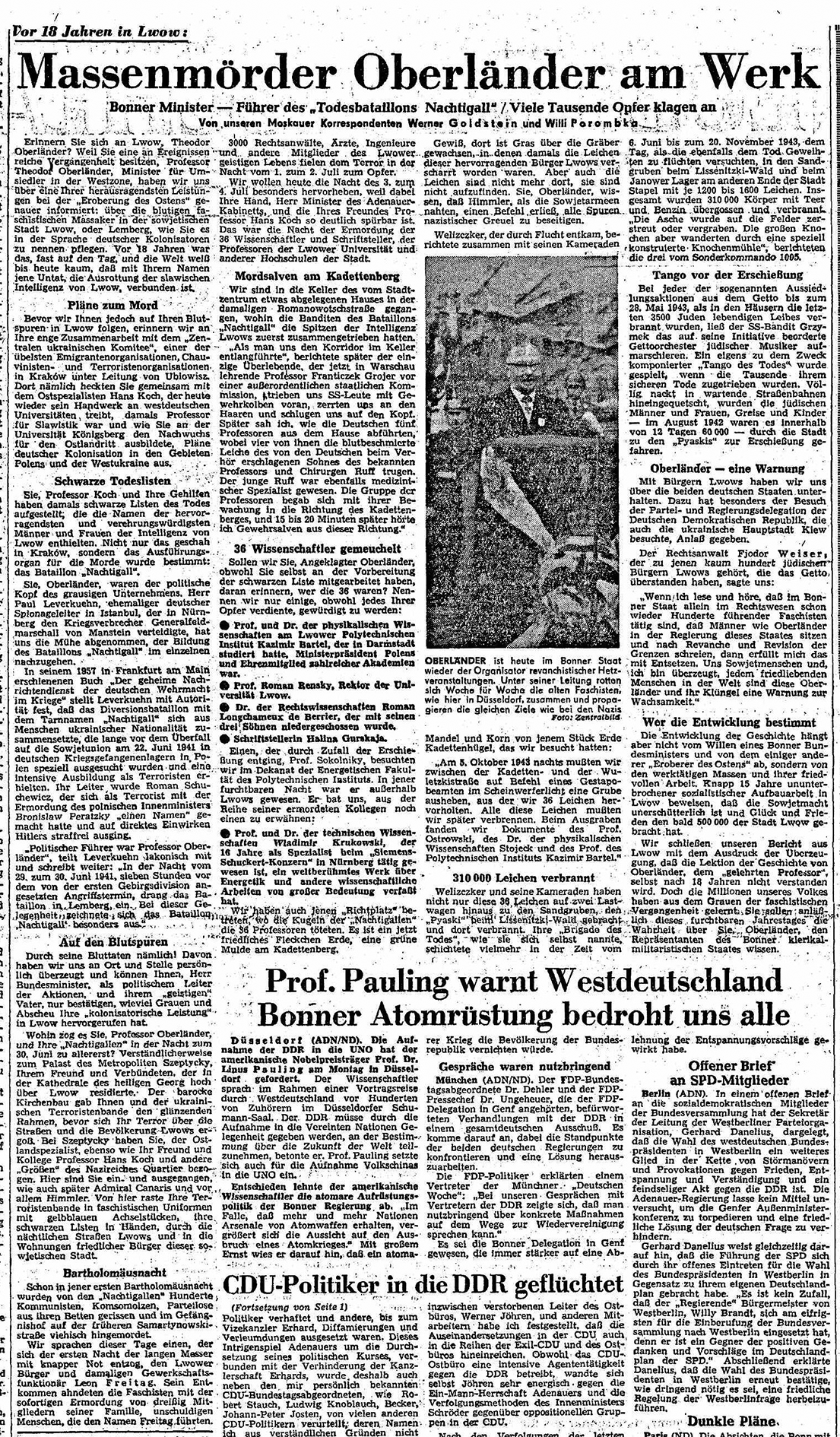
On July 1, 1959, the newspaper of the East German ruling Sozialistische Einheitspartei Deutschlands (Socialist Unity Party, SED), Neues Deutschland, published an article with the headline “Mass murderer Oberländer at work.” It began with the following sentences:
Do you remember Lvov, Theodor Oberländer? Because you have an eventful past, professor Theodor Oberländer, Minister for Resettlers in the Western Zone, we have gathered information about one of your outstanding achievements during the “conquest of the East”: about the bloody fascist massacres in the Soviet city L΄vov, or Lemberg, as you are used to calling it in the language of the German colonizers. It was eighteen years ago, nearly on this day, and the world until today hardly knows anything about the fact that your name is connected to that atrocity: the extermination of the Slavic intelligentsia of L΄vov.
More specifically, the article stated: “3,000 lawyers, doctors, engineers and other members of intellectual life became victims of the terror during the night of July 1 to 2.”Footnote 1 It accused Theodor Oberländer of having implemented these atrocities with the help of a Ukrainian battalion with the codename Nachtigall that the German military intelligence, the Abwehr, had deployed as part of their cooperation with Stepan Bandera's “Organization of Ukrainian Nationalists” (OUN) during the months before the German attack of the Soviet Union on June 22, 1941. Theodor Oberländer had been one of the German officers in command of this battalion. Since 1953 he had been a Federal Minister for Expellees and Refugees in Konrad Adenauer's cabinets.Footnote 2
Further, Neues Deutschland accused Oberländer and Nachtigall of the execution of thirty-six university professors during the night of July 3–4. The article closed with a report about the burning of 310,000 corpses of mostly Jewish victims of the city's German occupation that had been recovered from mass graves at the end of 1943 in order to eliminate traces of the crimes. Here the article mentioned Jews for the first time. It did not explicitly accuse Oberländer of having personally participated also in these later mass murders, but, apparently, intended to demonstrate the murderous character of the occupational regime in which Oberländer had served. (Figure 1)
“Mass murderer Oberländer at work. Bonn minister – leader of the death squad ‘Nachtigall’ / Many thousand victims accuse,” Neues Deutschland, July 1, 1959.
Only beginning in late September 1959 did these accusations receive larger attention in West Germany and the international public. Then a massive propaganda campaign in East Germany and other east European countries against Oberländer as a former Nazi and a war criminal unfolded. The Oberländer case was one of the major political scandals of the Federal Republic of Germany. Finally, in May 1960 he resigned from office.
The following article analyzes this campaign as an exemplary case of how the Cold War and east-west entanglements influenced the memory of the period of World War II and the Holocaust. These entanglements were complex and went beyond the relations between the two German states on which earlier research of the Oberländer case has focused.Footnote 3 This article also examines the crucially important involvement of the Soviet Union's propagandistic and political struggle against Ukrainian nationalism. Furthermore, it addresses the diverse impact of the campaign on critical reckonings and the remembrance of the Holocaust in the two German states on the one hand and the Ukrainian diaspora and the Soviet Union on the other. It argues that in the German context the campaign contributed to critical reckoning and spreading knowledge about the Holocaust, but that it did not do this in the Soviet Union or among the Ukrainian diaspora.
While in the German context the Oberländer case is mostly of historical relevance, it is not in the Ukrainian one. In the decades after 1959, Oberländer and Nachtigall became one of the most powerful elements of the Soviet enemy image of Ukrainian nationalists as brutal German henchmen during the German occupation of Soviet territories. Russia's current war against Ukraine demonstrates the continuing vigor of the Soviet enemy image of Ukrainian nationalism. In 2014 it contributed significantly to mobilizing fighters for the Russian led insurgency in the Donbas and to legitimizing Russian interference both domestically and internationally.Footnote 4 In February 2022, Russian President Vladimir Putin justified the invasion of Ukraine with the claim that it is ruled by “Nazis.” In following months the motif that Ukraine is occupied by fascists in the service of the US and NATO has become increasingly prominent in Russian media.Footnote 5 This article offers an analysis of the origins of one of the central motifs of this enemy image in the Soviet period. Based on recent historical research, the article starts with a short sketch of Theodor Oberländer's role during the Third Reich and the events in L΄viv in June and July 1941.
Theodor Oberländer, the Nazi Regime, and Mass Murder in L΄viv
Before his political career in West Germany, Theodor Oberländer had been deeply involved with the Nazi regime, especially during the 1930s. As a young ambitious expert on eastern Europe, he became one of the leading German activists of the revisionist Ostforschung, and for some years also served as head of the East Prussian branch of the Volksbund für das Deutschtum im Ausland (People's Union for Germans Abroad, VdA) and head of the Bund deutscher Osten (Union for the German East, BdO), a leading position in institutions propagandizing German claims to eastern European territories and working among the German minorities there. In March 1933, at the age of twenty-eight, he became the director of the Institute for the Economy of Eastern Europe at Königsberg University and simultaneously acquired a high position in the NSDAP in East Prussia. However, in 1937 he ran into conflicts with SS-related researchers on eastern Europe who had more radical and racist concepts than him, as well as with Erich Koch, the Gauleiter of East Prussia. Consequently he lost his positions in the VDA, BdO, and the East Prussian NSDAP. He had to leave Königsberg and became a professor at Greifswald University and, since 1940, at the German University in occupied Prague. In this period he intensified his work with Abwehr, the German military intelligence. Under its chief, Admiral Wilhelm Canaris, it was close to the military opposition: critics of Hitler and his regime in the German armed forces. As an Abwehr officer he participated in intelligence work before and during the German attack on Poland in September 1939, and he continued to work for Abwehr in 1941.Footnote 6
Oberländer's high-ranking NSDAP position and his support of an aggressive, expansionist German policy in eastern Europe during the 1930s should have disqualified him from a high level government office after the war, but the accusations of involvement in mass murder and major war crimes in 1941 and later clearly were false. In fact, since fall 1941 Oberländer became increasingly critical of the methods of German rule in the Soviet territories. As a result he was removed from the army in 1943.Footnote 7
The later public debate about Oberländer and Nachtigall focused strongly on the issue of a pogrom and mass murder of Jews in L΄viv during the first days of July 1941. Therefore, a surprising fact in the article in Neues Deutschland quoted above is that it did not mention Jews among the victims, but accused Oberländer of having been responsible for the “extermination of the Slavic intelligentsia” and the murder of “3,000 lawyers, doctors, engineers, and other members of intellectual life.”
In fact, there had been four different episodes of mass murder in L΄viv between June 22 and July 7, 1941, when battalion Nachtigall left the city. First, between June 23 and 29, NKVD personnel executed a large number of prison inmates who had been incarcerated for political reasons. The majority were Ukrainians, but there were also many Poles and Jews among them. Contemporary sources estimated their number was at least 3,000.Footnote 8 There are indications, as will be explained below, that this is the real origin of the number of 3,000 victims that appeared in Neues Deutschland.
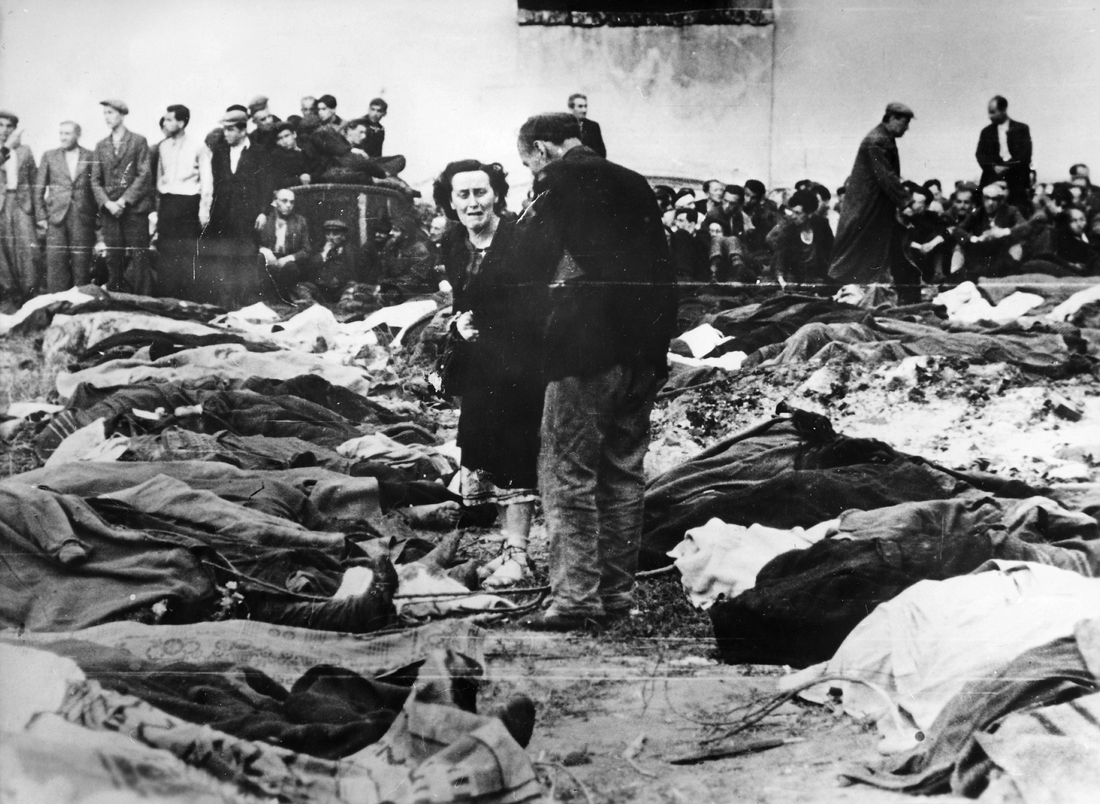
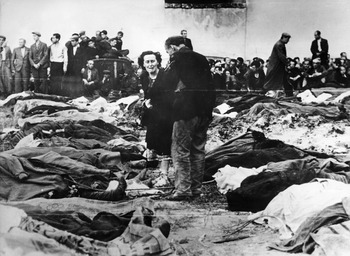
Second, on July 1, the day following the German occupation of L΄viv, a pogrom against Jews took place. A Ukrainian militia that had been established the day before by the OUN brought Jews, very likely on German orders, to the prison buildings where they had to retrieve the corpses of the inmates murdered by the NKVD. This was at the center of the violent excesses. Members of the militia as well as civilians attacked Jews on the streets and at the prison buildings. Many more Jews were led through the streets and brought to the prisons than actually could work there. Overall, several hundred Jews were murdered. There are hints that some members of Nachtigall, but not the unit as a whole and not on orders by their German officers, participated in the violence at the prisons. The perpetrators were mainly civilians or members of the Ukrainian militia.Footnote 9 (Figure 2) Third, during the night of July 3 to 4, Polish professors of the city's universities and some of their family members, more than forty persons, were arrested and most of them executed by the “Einsatzkommando Lemberg,” a unit of the German Security Police from the General Government.Footnote 10 There are no hints that the battalion Nachtigall or Theodor Oberländer were involved in these murders.
Yard of the prison at vul. Lonts΄koho in L΄viv, 1 July 1941. In the foreground are corpses of murdered prison inmates and inhabitants looking for relatives or friends among them, in the background Jews who had been driven to the prison yard during the pogrom; Ullstein-Bild sign. 00809375.
Fourth, on July 5, Einsatzgruppe C of the German Security Police shot about 2,000 Jews outside of the city. They had been arrested beginning July 3 with support of the Ukrainian militia. The Einsatzgruppe declared this mass execution to be a “reprisal” for the Soviet massacre of prison inmates.Footnote 11
Overall, in L΄viv in June and July 1941, Soviet and German mass crimes were more closely connected than presumably at any other place and time. This contributed to the fact that these events later became so deeply embroiled in the political conflicts of the Cold War era. Thereby, they not only refer to the question of Cold War influence on Holocaust remembrance, but also on the remembrance of Soviet crimes in the western public.
Substantial historical research on these events did not start before the 1990s.Footnote 12 Although some publications had already mentioned them before 1959, a clear understanding of relations, differences, and perpetrators of these various episodes of violence did not yet exist. This was a precondition for the accusations against Theodor Oberländer and Nachtigall.
Political Context and Sources of Knowledge
The article in Neues Deutschland resulted from larger political developments in east-west relations and contingent circumstances. The larger developments consisted of the fact that since the second half of the 1950s the GDR increasingly emphasized its anti-fascist character and accused the West German state of continuing fascism and harboring Nazi criminals when the economic recovery in West Germany created a difficult situation for the GDR.Footnote 13 In 1959, a renewed Soviet initiative aimed to conclude a peace treaty with the primary objective of separating West Germany from the western alliances, thus solving the problem of West Berlin and remedying the increasing problems of the GDR. The failure of these initiatives resulted in the building of the Berlin Wall in 1961.Footnote 14
The West German government under Konrad Adenauer strongly rejected any plans that would weaken a close integration with the west. Within the government, Theodor Oberländer was perhaps the most outspoken critic of any concessions to the east. This reflected his personal views of the communist regimes, but it was also a consequence of his political position as a representative of the interests of the German expellees and refugees from the former German territories. Any peace treaty would have required official resignation from the territories east of the Oder-Neisse border. This revisionist position and his Nazi past made Theodor Oberländer an ideal target for propagandistic attacks.
Apparently, a search for compromising material against Oberländer had already begun in spring 1959. In April, the West German journal Der Spiegel published, without giving any source, a short article stating that the Soviet embassy in Bonn was preparing a collection of documents with Oberländer's writings from the war period.Footnote 15
The contingent circumstance that ultimately led to the accusations of mass murder in L΄viv was that in 1957 the former Abwehr officer Paul Leverkuehn had published a short history of Abwehr. Here he mentioned that Theodor Oberländer had been the “political leader” of Nachtigall and that this unit—in fact, not totally correct—had entered L΄viv on the night of June 29–30 “seven hours before the fixed time of attack.” The article in Neues Deutschland quoted Leverkuehn's book as the most prominent evidence for its allegation that the unit under Oberländer's command had been responsible for the mass murder, even though Leverkuehn had not mentioned any atrocities of Nachtigall or other perpetrators during or after the German invasion of the city. Furthermore, Neues Deutschland also hid the reason that Leverkuehn gave for Nachtigall's alleged early attack, namely, that it had received information about ongoing Soviet mass executions in the city.Footnote 16 Based on the information from Leverkuehn's book, the authors of the Neues Deutschland article, the paper's Moscow correspondents, Werner Goldstein and Willi Porombka, looked for additional information from Soviet sources during a trip to L΄viv in June 1959. They then applied the information that they found there to Oberländer and Nachtigall. Their article reproduced the Soviet account of the German invasion, including elements of the Soviet propagandistic enemy image of Ukrainian nationalists, with the only major difference being that none of the earlier Soviet accounts had mentioned Oberländer or Nachtigall.
Soviet Descriptions of the German Occupation of L΄viv
Early postwar Soviet publications about the beginning of the German occupation of L΄viv were selective and distorted. They suppressed information about the Soviet massacre of prison inmates, but highlighted the murder of the Polish professors. They emphasized atrocities by German and later also of Ukrainian nationalists immediately after the occupation of the city, but did not give details and did not mention Jews as victims.
The distortions began as early as 1941. During July, German newspapers and the German newsreel Deutsche Wochenschau extensively reported on the Soviet mass murder of prison inmates in L΄viv and several other localities, presenting the Soviet regime as devilish and evil.Footnote 17 With some success, the Germans also spread information about Soviet atrocities to the international public.Footnote 18
The Soviet government denied these allegations as “malicious German-Fascist propaganda” and blamed the Germans for the massacre in the prisons.Footnote 19 On August 9, Pravda, the central newspaper of the Communist Party of the Soviet Union, published an article under the title “Beasts in the streets of L΄viv,” accusing German troops of violent excesses and denouncing the German publications about the Soviet massacre as the “work of Goebbels's henchmen.” It described the German troops as wild drunken hordes who broke into the city and killed and raped in acts of excessive violence.Footnote 20 Izvestiia, the Soviet government's paper, published an article of similar content.Footnote 21 Evidently, these descriptions were fabricated. The authors may have had some information from L΄viv—at least several witnesses are quoted—but the actual description did not conform to what had happened during the first days of German occupation, neither during the pogrom of July 1 nor in relation to the mass execution of July 5. Furthermore, the articles did not give any hints about local participation or on Jews as victims. In fact, they applied more general images of Soviet propaganda about the “German-fascist invaders” and their brutal treatment of the Soviet people to the case of L΄viv.Footnote 22
After L΄viv had been recaptured by the Soviet Army in July 1944 the Soviet Extraordinary State Commission for Ascertaining and Investigating Crimes Perpetrated by the German-Fascist Invaders and their Accomplices published its summarizing report for the L΄viv oblast in December 1944.Footnote 23 From among the different crimes of June and July 1941 in the city of L΄viv, the report mentioned only the murder of the university professors.Footnote 24 At about the same time, the writer and leading Soviet propagandist in western Ukraine, Vladimir Beliaev, who also participated in the work of the Extraordinary State Commission, published an extensive article on the murder of the professors in Radians΄ka Ukraïna, the journal of the Communist Party of Ukraine, which was also reprinted by other papers.Footnote 25
Obviously, the other crimes at the beginning of the German occupation were not addressed in order to avoid attracting attention to the Soviet mass murder of prison inmates. An additional factor for the omissions may have been that Soviet publications tended to hide that Jews were the main group of victims of German rule. The Commission's published report mentioned Jews only when it described the L΄viv ghetto, but not in its more extensive part on the Yanivs΄kyi camp, even though Jews had been by far the largest group of inmates. Moreover, in contrast to the published report, the testimonies that the Commission had collected clearly showed that Jews had been the main group of victims during the first days of the German occupation. But even in these testimonies no information about the Soviet massacre of prison inmates was recorded.Footnote 26
Since the beginning of the Soviet recapture of Ukrainian territories in 1943 and 1944, Soviet propaganda increasingly attacked Ukrainian nationalists, “the snakelike, slavish dogs of the Nazi hangmen,” as Nikita Khrushchev, at that time the First Secretary of the Communist Party of Ukraine, called them in 1944. They were presented as an alien force, as “German-Ukrainian fascists,” who had supported German rule in the Ukrainian territories and had committed brutal crimes in their service against the Soviet and Ukrainian peoples. In the immediate post-war years, this was also part of the propagandistic struggle against the Ukrainian Insurgent Army (Ukraïns΄ka Povstans΄ka Armiia, UPA).Footnote 27
In fact, the OUN had been responsible for large crimes during German rule, though rather not in its support, but as part of Ukrainian state-building efforts that the Germans tried to suppress. The initial cooperation broke down already in July 1941 after Bandera and his deputy Yaroslav Stets΄ko refused to revoke the declaration of a Ukrainian state on June 30, 1941. Soon afterwards Bandera and Stets΄ko were arrested. Nevertheless, during the first weeks after the German invasion OUN's militias murdered several thousand Jews, but also many Ukrainians and Poles, whom they considered to have supported the Soviets. Since August 1941, however, the Germans dissolved the militias and replaced them by a local Ukrainian police, though a significant number of OUN members also managed to get into these new units in defiance of German attempts to keep them out. There were no attempts by the OUN to prevent these units’ involvement in the mass murder of Jews. The other major crime were massacres of at least 60,000 Poles since spring 1943 by parts of the OUN founded UPA in Volhynia and later also in Galicia. This was closely related to the beginning of an active struggle against the German occupation.Footnote 28
UPA's main struggle, however, began when they resisted the return of Soviet rule to western Ukraine in a partisan war that lasted until the beginning of the 1950s. Fighting was very brutal from both sides and included, on Soviet side, mass deportations of parts of the civilian population. But also the Ukrainian nationalist forces killed several thousand civilians as “traitors.”Footnote 29
Soviet publications about the Ukrainian nationalists in this period and later did not include a serious examination of the complex issue of Ukrainian nationalist collaboration with the Germans or local participation in German rule and crimes in the Ukrainian territories. They created with hateful language an enemy image in order to mobilize against all strivings for independence and to legitimize their own brutal suppression of the nationalist resistance. Neither did they mention the early breakdown of cooperation between the Germans and the OUN; nor did they show Poles and Jews as the most important victims of nationalist crimes.Footnote 30
As a result of the intensifying propagandistic Soviet struggle against Ukrainian nationalism, the Ukrainian nationalists became integrated into Soviet descriptions of the early phase of the German occupation of L΄viv, as they existed in publications in Pravda and Izvestiia from August 1941. This, at least, is how Vladimir Beliaev's and Mykhailo Rudnyts΄kyi's pamphlet Under Foreign Banners presented the German occupation of L΄viv. This book, first published in Russian in 1954, was the most widely distributed account of the Ukrainian nationalists’ past and present of the late 1940s and 1950s.Footnote 31 About the first days of the German occupation of L΄viv they wrote:
“The mercenaries of the Hitlerites [the Ukrainian nationalists] fought with unprotected women and children on the streets of L΄viv and other cities of Western Ukraine; Ukrainian nationalists in Gestapo uniforms pushed the women and children of the fighters of the Soviet army from their apartments and killed them. They led the Hitlerites into the houses of the local intelligentsia, patriots of their Soviet fatherland, and watched how the Gestapo men settled scores with the defenseless. They rubbed their hands with glee because of the spoil that they could acquire after the death of the good people. They were true jackals”Footnote 32
Besides such general accusations, this publication also conveyed more concrete, detailed, and accurate information only on the murder of the professors. But in contrast to the report of the Extraordinary State Commission, it blamed the OUN for having provided the Gestapo with lists of those to be arrested.Footnote 33
The article in Neues Deutschland of July 1, 1959, also contained other elements of Soviet propaganda against Ukrainian nationalism. One of them was the accusation against the Greek-Catholic Church, and especially the late Metropolitan Archbishop Andrei Sheptyts΄kyi, of collaboration with the Germans. While in essence correctly reporting that the Nachtigall battalion—in fact, a part of it—first went to the St. George Cathedral and that Oberländer and Hans Koch, another expert on eastern Europe in Abwehr, met Sheptyts΄kyi, the article framed this in a way that served not only the denial of the Soviet mass murder of prison inmates, but also implicated the Greek-Catholic church and Sheptyts΄kyi in crimes the Germans and the Ukrainian nationalists perpetrated.Footnote 34 Directly addressing Theodor Oberländer, the article continued:
You have been going in and out of here [Sheptyts΄kyi's residence] as Admiral Canaris and, most of all, Himmler also did later. From here, your gang of terrorists in fascist uniforms with yellow-blue epaulets, their black lists in their hands, rushed through the nightly streets of Lvov and into the apartments of peaceful citizens of the Soviet city. Already during this first Bartholomew's night hundreds of communists, Komsomol members, and those not-party affiliated were torn out of their beds and murdered in a beastly manner in the prison of the former Zamarstynowska street by the “Nightingales.”Footnote 35
Obviously, this statement served to explain where the large number of corpses in the prisons came from. The article was hardly based on information of what actually had happened during the first days of the German occupation, but it reproduced the Soviet narrative that had developed in order to deny the Soviet massacre of prison inmates and applied it to Oberländer and Nachtigall.
The Campaign Unfolds
Initially, there were only a few reactions to the harsh accusations against Theodor Oberländer and Nachtigall in newspapers in other communist countries.Footnote 36 The next public attack on Oberländer came with a larger article in August 1959 in the Soviet journal Novoe Vremia. This specialized journal on international relations appeared simultaneously in several languages. Its German edition, Neue Zeit, published the article under the title “Der Fall Oberländer.” The author was Lev Besymenskii, the journal's expert on German affairs.Footnote 37 In fact, the report in Neue Zeit had little to add to what basically had been known and published already on Oberländer's involvement with the Nazi regime, most importantly in an article in the West German weekly Der Spiegel in 1954 on which, apparently, it strongly relied.Footnote 38 However, it presented documents from various archives supporting earlier information and some more details on Oberländer's activities. The only information that was really new came from Lithuanian archives about Oberländer's involvement in activities among the German minority in the Memel territory during the mid-1930s.Footnote 39
The article repeated the accusation of mass murder in L΄viv. However, in contrast to the article in Neues Deutschland, this article called it a pogrom and mentioned Jews as victims, though only very briefly: “Shortly thereafter [after the Nachtigall battalion had entered L΄viv], acts of violence, pogroms, looting, and shootings started. First of all, Soviet officials and Jews were ‘liquidated.’” The article continued, much more extensively, with a description of the murder of the Polish professors. It did not repeat the number of 3,000 victims that had appeared in Neues Deutschland, apparently as an artefact of the suppressed knowledge about the Soviet mass murder of prison inmates.
Still, the article in Neue Zeit had one point that caused additional trouble for Oberländer. It quoted Alexander Dallin's study German Rule in Russia, 1941–1945, published in English in 1957 and in German translation in 1958. Thus, a source unsuspicious of communist sympathies seemed to substantiate the accusations against Nachtigall: “During the following days of chaos [after the German occupation of L΄viv], it became obvious to the Germans that Bandera's followers, including those in the ‘Nightingale’ regiment, were displaying considerable initiative, conducting purges and pogroms.”Footnote 40 In fact, the references that Dallin added in a footnote had some information on the pogrom and the Ukrainian militia, but none of them mentioned Nachtigall.Footnote 41
Meanwhile, in West Germany the Vereinigung der Verfolgten des Nazi-Regimes (Association of Persecutees of the Nazi-Regime, VVN), an organization with close ties to East Berlin, had submitted a complaint against Oberländer and other German officers of Nachtigall to the newly founded Zentrale Stelle der Landesjustizverwaltungen zur Aufklärung nationalsozialistischer Verbrechen (Central Office of the State Justice Administrations for the Investigation of National Socialist Crimes) based mostly on information that had appeared in the article of Neues Deutschland, claiming that “the battalion ‘Nachtigall’ under Captain Prof. Oberländer” had been responsible for the murder of “3,000 lawyers, doctors, engineers, professors, scientists, church personalities, and other representatives of the Polish intelligentsia.” Specifically, it mentioned the murder of the Polish professors. It further claimed: “Already during the first night hundreds of Poles, Jews, communists, and trade unionists were taken from their homes by the battalion ‘Nachtigall’ and shot dead in the prison yard of Lemberg without a sentence.”Footnote 42
This complaint did not become public at that time, however. Neither was there any reaction to the accusations in West Germany in August 1959. This changed dramatically when Theodor Oberländer obtained, on a rather dubious legal basis, a court order to confiscate an issue of the VVN's weekly Die Tat of September 26, 1959, after the paper had indicated in its previous issue that in the following week it would publish “revelations” about the past of a “prominent personality,” adding a prewar photo of Oberländer.Footnote 43
Oberländer's action against this paper resulted in hundreds of journalistic inquiries sent to his ministry.Footnote 44 It was only now that he felt forced to counter the accusations publicly. During a press conference on September 30, 1959, he tried to redirect attention to the Soviet mass murder of prison inmates and to the fact that the German troops when entering L΄viv found several thousand corpses in the prisons. He denied any involvement of Nachtigall in atrocities. Moreover, pressured by journalists from East Germany, he refused to answer any questions about violence and murder in L΄viv in the days after June 30, 1941, and he uttered the unfortunate but obviously honest sentence that marching into L΄viv had been an “uplifting experience.”Footnote 45
The campaign against Oberländer and Nachtigall got another twist when on October 15, 1959, a KGB agent murdered Stepan Bandera in Munich. At the beginning, the cause of Bandera's death was not clear and circumstances suggested an accident or natural causes. Only on the morning of October 19, the Bavarian police released information that Bandera had died from cyanide poisoning and that he might have been murdered.Footnote 46 Nevertheless, already two days earlier, on October 17, East German newspapers blamed Theodor Oberländer for having ordered the killing of Bandera because the latter knew too much about his crimes.Footnote 47
Several days later, on October 22, 1959, Albert Norden, a member of the Politburo of the SED, held a press conference in his capacity as Secretary of the “Committee for German Unity” (Ausschuß für Deutsche Einheit). After the events of the previous weeks, more than one hundred journalists attended. Norden presented the documents that meanwhile had been collected from different archives and publications about Oberländer's activities between 1933 and 1945. He rejected Oberländer's claim that the prisons in L΄viv had been full of corpses when German troops entered the city as a continuation of Joseph Goebbels’ propaganda: “ the corpses that the fascists exhibited in the prisons as victims of the Soviets were corpses of Jews and Poles whom they themselves had shot and tortured.”Footnote 48
Compared to the article in Neues Deutschland from July 1, Norden's statement during the press conference displayed a significant change. He mentioned Jews (together with Poles) as the most important group of victims. In fact, the additional sources that journalists in East and West Germany had found in previous weeks clearly showed that nearly all the murdered had been Jews.
Public Debate
Both in East and West Germany further inquiry by journalists began when the confiscation of Die Tat and Oberländer's press conference increased interest in what actually had happened in L΄viv. The reports clearly showed that, except for the murder of the Polish professors, Jews had been the victims of violence and murder. In East Germany, however, all information was framed in a way that blamed Oberländer and Nachtigall for these crimes.
For example, some days after Oberländer's press conference, Neues Deutschland published a short excerpt from Leon Weliczker's memoirs about the mass execution by Einsatzgruppe C on July 5 that had appeared in the GDR in a German translation a year before.Footnote 49 Already by the end of September, the West German Jüdische Illustrierte had printed excerpts from the diary of the former SS-Hauptscharführer Felix Landau, who had belonged to the Einsatzkommando Lemberg. Here he described violence, mass arrests, and the mass execution of Jews as well as the murder of the Polish professors during the first days of July.Footnote 50
Since October 1959, every issue of Die Tat had material on the Oberländer case, mostly on the events in L΄viv. In November and December 1959, the paper published several articles based on interviews with surviving Jews from Israel who reported about the pogrom on July 1, 1941 and the German mass execution some days later, but also about the following years of German occupation and Holocaust. Emanuel Brand, a historian at Yad Vashem who had survived the German occupation in L΄viv and its vicinity, had contacted the paper and offered support to clarify what had actually happened. Apparently, the confiscation of Die Tat and Oberländer's refusal to talk about German crimes during his press conference had raised Brand's and Yad Vashem's concern that Oberländer tried to hide the mass murder of Jews during the first days of the German occupation.Footnote 51 But also other West German newspapers published or quoted memoirs of Jews or other sources about these atrocities and, thereby, spread knowledge about the Holocaust.Footnote 52
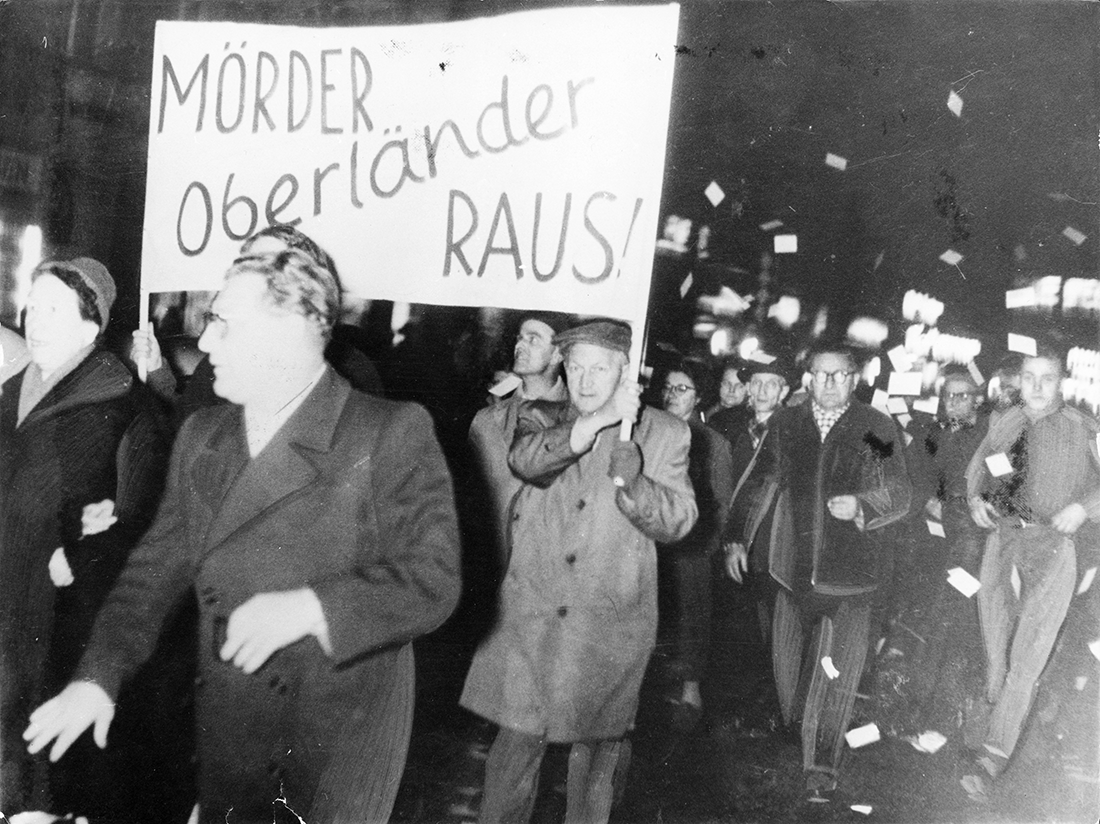
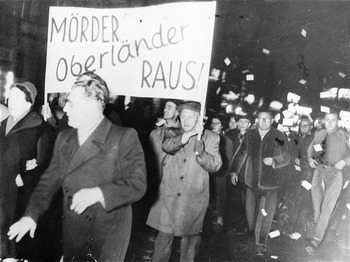
In the GDR, too, further investigation resulted in the publication of memoirs of Jews.Footnote 53 Among others, in November 1959 Neues Deutschland presented the volume Im Feuer vergangen. Tagebücher aus dem Ghetto that had been published in the GDR and included the memoirs of Janina Hescheles and Leon Weliczker about the beginning of July in L΄viv.Footnote 54 In January 1960, Albert Norden's Committee for German Unity published the materials against Oberländer in a volume titled Die Wahrheit über Oberländer after most of it had appeared before in newspapers.Footnote 55 (Figure 3)
Public protest during a visit of Theodor Oberländer in West Berlin, November 13, 1959, Bundesarchiv; sign. Bild 183-68855-0001.
Finally, in May 1960, Oberländer resigned from office. Some days earlier he had been sentenced during a public trial in East Berlin in absentia to life imprisonment.Footnote 56 His resignation was not primarily caused by the concrete accusation of participation in mass murder. The Social Democratic opposition considered these accusations to be false, though Oberländer's hapless attempts at defense had clearly raised doubts and suspicions in the public, especially among the more radical left. Nevertheless, Oberländer's resignation resulted also from the fact that his earlier involvement with the Nazi regime during the 1930s had attracted new attention.Footnote 57 This had been no secret before 1959, but it had not caused a larger scandal. Now his past became unacceptable for a person in a high government office. Thereby, Oberländer's resignation reflected also the fact that a critical reckoning with the Nazi past in West German society had moved forward.Footnote 58
Indeed, the controversy about Oberländer and Nachtigall contributed to this growing critical awareness of the insufficient investigations into the perpetrators of German mass crimes and to spreading knowledge about the Holocaust. But it also established, as will be shown below, a false image of Theodor Oberländer as a mass murderer. One might argue that this was a rather negligible negative outcome considering his actual involvement with the Nazi regime. It could also be argued that the same is true for the battalion Nachtigall considering the fact that the equally OUN-led local militia was strongly involved in the crimes. However, such an argument becomes highly problematic when the Soviet and Ukrainian context is investigated more closely.
Soviet Union
Since October 1959 Theodor Oberländer and the battalion Nachtigall received public attention in the Soviet Union as well, especially after the murder of Stepan Bandera.Footnote 59 Here, however, the accusations were integrated into the existing propagandistic enemy image of Ukrainian nationalists as cruel, alien, “fascist” enemies of the Soviet and the Ukrainian people.
In late October 1959, Vladimir Beliaev published a larger article in Literaturnaia Gazeta accusing Theodor Oberländer of being responsible for the murder of Stepan Bandera. When he described their relation, he focused on the deployment of the Nachtigall battalion before the German attack on the Soviet Union and blamed Oberländer and Nachtigall for acts of mass murder in L΄viv and other places, but described in more detail again only the murder of the professors.Footnote 60 Mykhailo Rudnyts΄kyi, Beliaev's former co-author, wrote an extensive article on Oberländer's and Nachtigall's alleged crimes for the L΄viv daily Vil΄na Ukraïna. He strongly rejected Oberländer's denial of his and Nachtigall's involvement in any crimes and described the events of the first days of German occupation—in strong contradiction to actual events—as mass murder by wild shootings in the streets directed mostly against Soviet activists, but basically against the whole population of the city, referring to the Pravda article of August 9, 1941. In a concrete way, Rudnyts΄kyi also sketched only the murder of the professors.Footnote 61
It was only at the beginning of October 1959 that the KGB began, apparently upon request from East German State Security, to look for witnesses and further evidence against Oberländer for the crimes of summer 1941 in L΄viv and other parts of western Ukraine. On October 2, 1959, Fedor Shcherbak, the deputy chief of the KGB's Second Directorate in Moscow, ordered the KGB of the Ukrainian SSR to collect materials that proved Nachtigall's crimes against the civilian population in the L΄viv region. Not surprisingly, the KGB was then able to produce witness testimonies and later also to present several witnesses who publicly testified having seen members of Nachtigall and Oberländer committing or ordering crimes against civilians.Footnote 62
In early April 1960, Theodor Oberländer and his alleged crimes were the subject of a press conference in Moscow. The presented report described the task of Nachtigall as the “destruction of Soviet workers [officials] and persons of Jewish and Polish nationality” and, thus, in contrast to earlier Soviet publications, also mentioned Jews as victims. However, the report's account of the events during the first days of the German occupation of L΄viv was rather short and focused, as had earlier Soviet publications, on the murder of the Polish professors. The other crimes were mentioned only briefly and, in fact, described with a kind of standardized wording about German atrocities: “According to witness testimonies the Hitlerites committed mass shootings of the peaceful population—women, children and the elderly, accompanied by mockery and cruelties.”Footnote 63
Actually, the materials focused mostly on Oberländer's later activities as a German officer in the so-called Sonderverband Bergmann, an Abwehr unit of Caucasian volunteers. Oberländer had served there after the Nachtigall battalion had been dissolved in mid-August 1941. This part of his activities had not featured prominently in previous East German or Soviet publications. The new accusations, however, did not attract wider public attention. Also, these accusations seem to have been either entirely invented or were crimes ascribed to Oberländer and Bergmann that had been committed by other German units.Footnote 64
Later Soviet publications continued to present the case of Theodor Oberländer and Nachtigall within the framework of the existing propagandistic image of the Ukrainian nationalists as brutal German-fascist henchmen and enemies of the Ukrainian and Soviet people. Jews as victims remained absent or they appeared only shortly in reference to the GDR publications, as in a book by V. Cherednichenko: “During the press-conference [of Albert Norden on October 22, 1959] it was stated that on July 1–6, 1941 Ukrainian nationalists from the Legion ‘Nachtigall’ under the command of A. Herzner and T. Oberländer killed 3,000 Poles and Jews in Lvov.”Footnote 65 No Jewish voices appeared in Soviet publications in this context.
The Ukrainian Diaspora
The campaign against Oberländer and Nachtigall was also highly important for the Ukrainian diaspora in the west. The pre-war centers of Ukrainian emigration in the United States and Canada had been amplified after WWII by Ukrainians from among the “Displaced Persons” in the western zones of occupation in Germany and Austria. Most of them were strongly anti-communist and nationalist, and the majority came from the former Polish territories of western Ukraine. Many had belonged to OUN or UPA or had served in the local administration, the Ukrainian police, or military units during the German occupation.Footnote 66
When at the end of September 1959 the question of Theodor Oberländer's and Nachtigall's role in 1941 received public attention in West Germany, the Ukrainian nationalist exiles, most prominently Stepan Bandera and Yaroslav Stets΄ko, who resided in Munich, offered Oberländer their support.Footnote 67 In November 1959, Oberländer established, together with the Dutch anti-communist former concentration camp inmate Joop Zwart an International Commission of Inquiry about the events in L΄viv. Officially, the Commission worked in the framework of an anti-communist organization of former members of resistance against German occupation, the Union des Résistants pour une Europe unie (URPE). In fact, it seems to have been strongly influenced by Yaroslav Stets΄ko. Stets΄ko himself had been a key actor of the events in L΄viv.Footnote 68 At the time, however, it was not this relation with the Ukrainian nationalists that damaged the Commission's reputation in public, but its close cooperation with Oberländer and URPE's simultaneous bid for financial support from the West German government.Footnote 69
Actually, the account about its work, published by the Commission in a booklet together with its concluding report, noted the “organizational and financial support” by Yaroslav Stets΄ko's Anti-Bolshevik Block of Nations (ABN).Footnote 70 The concluding report mentioned the participation of Ukrainian civilians in acts of violence against Jews and the mass execution by the Einsatzgruppe in the beginning of July 1941, although in a rather short and not very detailed way. Mostly correctly, it relieved Oberländer and Nachtigall from responsibility for these crimes and the murder of the Polish professors.Footnote 71 But it did not mention the role of the OUN-led militia. The main focus of the Commission's report was to expose the Soviet mass murder of prison inmates. The booklet included several testimonies about L΄viv and other localities in western Ukraine in summer 1941. In fact, all testimonies came from Ukrainian witnesses, including an extensive statement by Yaroslav Stets΄ko. None of them referred to crimes against Jews.Footnote 72
There was even an abridged version of the infamous Stella Krenzbach memoir among the testimonies.Footnote 73 This memoir of an alleged Jewish nurse serving with UPA had no concrete information on summer 1941 in L΄viv and, therefore, should not have been included in this publication. Even more, it was a fake account that served to counter accusations against UPA having murdered Jews, including those who had served as medical personnel in their ranks in 1944. It had been first published in Ukrainian newspapers in Canada and Argentina in 1954 and then reprinted in an edition of memoirs of UPA fighters in 1957. Later it was reprinted or quoted many times in other publications.Footnote 74
While Yaroslav Stets΄ko worked here—rather unsuccessfully—to propagate his highly deceptive view among the West German and international public, Mykola Lebed΄ spread a similar message among the Ukrainian diaspora. In 1941 Lebed΄ had been third in command of the OUN. He took over the leadership after Bandera and Stets΄ko had been arrested. Lebed΄ also had personal knowledge of the events in L΄viv, where he arrived in the first days of July 1941.Footnote 75 After the war, Lebed΄ broke with the more radical positions of Bandera and Stets΄ko and in the beginning of the 1950s he established, secretly funded by the CIA, the Proloh Institute in New York, advocating a more liberal version of Ukrainian nationalism.Footnote 76 In the post-war years he contributed strongly to a narrative of OUN and UPA as an anti-totalitarian force that had fought both against the Germans and the Soviets, rejecting the accusations of having collaborated with Nazi Germany.Footnote 77
In 1960, as a reaction to the allegations against Nachtigall, Mykola Lebed΄'s Proloh Institute published a Ukrainian language booklet with the title Crimes of Communist Moscow in Ukraine in summer 1941. It included excerpts from lectures held in New York on April 7, 1960 about the events of summer 1941 by Mykola Lebed΄ and Yuriy Lopatyns΄kyi, a former member of Nachtigall and later a leading member of OUN. In addition, the booklet contained several reports of former Ukrainian inhabitants of Galician cities and towns about the Soviet massacre of prison inmates. Most of them had been published in the same year in Ukrainian diaspora newspapers. Others were from Ukrainian newspapers from summer 1941.Footnote 78 Neither the lectures nor the memoirs gave any hint of violence against Jews. Unsurprisingly, there was nothing about the OUN-led militia and their role. Lebed΄ and Lopatyns΄kyi focused only on the Soviet killing of prison inmates and on the fact that the accusation against Nachtigall of having been involved in the murder of the Polish professors was wrong.
The remembrance of the crimes in L΄viv in summer 1941 during the following decades highlight the controversy about Oberländer and Nachtigall as a caesura with respect to different paths of remembrance of the period of World War II between the general public and the Ukrainian diaspora in the west. While Oberländer's and the Ukrainian nationalists’ attempts to redirect public interest to the Soviet crime failed with respect to the wider public, not much effort was needed to convince most Ukrainians in the west that the accusations were Soviet falsifications in order to conceal Soviet crimes and to justify the brutal suppression of anti-Soviet nationalism after WWII.
In the long run the Soviet and East German campaigns increased suspicions among the Ukrainian diaspora against any accusations of the Ukrainian nationalists for having committed mass murders of civilians as Soviet falsifications. The experiences with Soviet instrumentalizations and falsifications of such accusations as exemplified in the case of the battalion Nachtigall contributed to the lack of critical engagement with collaboration and crimes during WWII.Footnote 79
During the decades after 1960, the memory of the Soviet massacre of prison inmates remained largely restricted to the Ukrainian diaspora, while an image of Oberländer and Nachtigall having committed mass murder in L΄viv became influential in the western public, especially in critical left wing circles.Footnote 80 Here after 1959 Theodor Oberländer and Nachtigall became part of stereotypical images of Ukrainian nationalists as fascist German collaborators that in a way resembled the Soviet propagandistic enemy image of Ukrainian nationalism. However, the central difference remained that the Soviet discourse presented the “Ukrainian bourgeois nationalists” as alien enemies of the Soviet and Ukrainian people who served the Germans and later the Americans, while the central element of images in the western public was their participation in the mass murder of Jews.
So, for example, Götz Aly and Susanne Heim, in their influential 1991 book Vordenker der Vernichtung described, when discussing Oberländer's activities in Ostforschung, the first days of the German occupation in L΄viv in a way that echoed the Soviet descriptions, except for the fact that Aly and Heim highlighted Jews as victims: “According to witness testimonies members of this battalion [Nachtigall] committed massacres of the Jewish population and incited many inhabitants of L΄viv to pogroms. Several thousand people became victims of day- and night-long killings.”Footnote 81
Another example revealing the long-term impact of the campaign is that when Ukrainian President Victor Yushchenko visited Yad Vashem in 2007, he was confronted with the reproach that Nachtigall had been responsible for the murder of 4,000 Jews in L΄viv in early July 1941. The background was a controversial honor that Yushchenko had conferred to Roman Shukhevych. Shukhevych had been the highest Ukrainian officer in Nachtigall and later became the supreme commander of UPA. At the same time, the fact that these allegations were wrong served some Ukrainian historians and political activists even at that time with an argument to reject any involvement of Ukrainian nationalists in crimes against Jews in 1941.Footnote 82 In publications of the Ukrainian diaspora close to the OUN tradition, the rejection of the accusations against Oberländer and Nachtigall provides a pretext to relieve Ukrainian nationalists from participation in the pogrom until today.Footnote 83 Apparently, the Soviet instrumentalization and falsification of war-time history contributed to a certain blockade of critical discussions about Ukrainian nationalist participation in crimes against Jews in Ukrainian society even decades after the end of the Soviet Union.
The case of Theodor Oberländer and the Ukrainian battalion Nachtigall was a complex event of manipulation, denial, and instrumentalization of Soviet and German mass crimes. As complex as its origin was its outcome.
The accusations against Oberländer and Nachtigall contributed to a critical debate about a lack of the persecution of Nazi criminals in West Germany and to a critical reckoning with the Nazi past. The Oberländer case suggests a substantial impact of the Cold War context and the competition of the two German states on this process. To a certain degree the attacks and the resulting public debate also spread knowledge about the German mass murder of Jews, though in an ambivalent way. Journalistic inquiries after the initial accusations made clear that the core group of victims in early July 1941 had been Jews, and they published also general information about the Holocaust in the German occupied territories of the Soviet Union. At the same time, the campaign established an image of Theodor Oberländer and Nachtigall as having committed an act of mass murder, and, thereby, contributed to spreading a view of the Ukrainian nationalists as brutal perpetrators in German service. As has been shown above, the accusations in fact had their origin more in a Soviet attempt of suppressing knowledge about their own mass murder of mostly Ukrainian prison inmates than in the atrocities under German rule that followed immediately.
As a result, the campaign rather obstructed critical reckonings with Ukrainian nationalist mass crimes among the Ukrainian diaspora and also in independent Ukraine. Here, the Soviet manipulations and falsifications appeared much more obvious, raising doubts also with regard to cases of actual nationalist crimes; they were instrumentalized in order to avoid addressing the problem of the Ukrainian nationalists’ mass crimes altogether.
The analysis of reactions to the Oberländer case also reveals strong differences among the socialist countries. While in the GDR newspapers and other publications included information about Jews as the main group of victims of the German occupation, they were practically absent from reports about the Oberländer and Nachtigall case in the Soviet Union. In this respect the GDR was more similar to western countries than to the Soviet Union.
A close analysis of the controversy about Theodor Oberländer and Nachtigall shows that it was to a significant degree a conflict about public attention toward Soviet versus German mass crimes. Oberländer's and the Ukrainian nationalists’ attempts to direct attention in the West German and the western publics toward the Soviet massacres of prison inmates failed, though this was no lesser crime than those at the beginning of German rule in L΄viv. Here the Oberländer case points to a nexus in the western public that seems to have obstructed serious interest in Soviet mass crimes in a more general way. Oberländer and the Ukrainian actors did not only refer to the Soviet mass murder in order to reject the false Soviet accusations, but, apparently, they also obscured actual German and Ukrainian nationalist crimes. The case thus provides an example for instrumentalization of Soviet mass crimes in order to divert attention from mass crimes during German occupation as well. In western societies during the Cold War, references to Soviet mass crimes increasingly came under suspicion of serving to avoid a critical evaluation of crimes under German rule during WWII or to interrupt détente with the Soviet Union. Thus, the Oberländer case also demonstrates how conflicts in western societies about the remembrance of mass crimes under German rule and about détente policy encumbered a serious public evaluation of Soviet mass crimes of the Stalinist period.
Supplementary material
To view supplementary material for this article, please visit https://doi.org/10.1017/slr.2022.228


 Open access

