




I
While the broader field of modern Japanese history focuses on topics such as military atrocities, settler colonialism, and the mobilisation of resources and science and technology, wartime officials believed that the effectiveness of war finance was a paramount concern in maintaining and sustaining the empire’s order. A statement made by Fukai Eigo (Reference FUKAI1953, p. 415), a privy councillor (sūmitsu komonkan) and former governor of the Bank of Japan (BoJ), to Prime Minister General Koiso Kuniaki during the Privy Council meeting in February 1945 emphasised that inflation could not be solved without considering fiscal policies, such as the issuance of government bonds, the BoJ’s huge loans for production, and the exchange of currencies between Japan’s home islands and its colonies and collaborationist regimes. Fukai’s interpretation of the monetary causes of inflation illustrates that the failure of Japan’s war economy was an issue generated both at home and in the colonies, albeit initially in different ways.
This article uses ‘(hyper)inflation’ instead of ‘hyperinflation’ in the title because the rate of inflation varied across the Japanese Empire.Footnote 1 Hyperinflation in occupied China and Southeast Asia was driven by the issuance of several types of unbacked ‘military scrip-like currencies’ (gunpyō ruiji no tsūka) ‘borrowed’ by the Japanese government to support its colonial military expenditure (Ōkurashō Shōwa zaiseishi henshūshitsu 1955, pp. 167–88, 34–9 [in appendix]; Hara Reference HARA2013, pp. 117–26). Although Japan’s economy was closely linked to these regions, especially China, the hyperinflationary pressures in the colonies do not seem to have been transmitted, or at least not fully, to Japan’s home islands. This article argues that this phenomenon was due to the policy of financing military expenditures with colonial currencies not being implemented until April 1943 (Ono Reference ONO2022 [2021], p. 226), and the influx of colonial currencies into Japan’s home islands did not take place until 1944, a year and a half before the armistice. This was not just a side effect of Japan’s colonial economy during World War II; together with ballooning budget deficits and the increasing amount of government bonds, paper currency and bank loans in Japan’s home islands, it significantly heightened the risk of the empire’s war-financing mechanism imploding. Another factor that prevented the full exposure of colonial hyperinflationary pressures in the home islands was the Japanese government’s subsequent tightening of currency controls, and the third section will show that this in fact further disrupted the empire’s economic order and led to the break-up of the yen bloc.
Current literature has thoroughly demonstrated that Japan’s imperial expansion and its relations with other world powers were intertwined with money and finance (Inoue and Usami Reference INOUE and USAMI1951; Crowley Reference CROWLEY1966; Andō Reference ANDŌ and Andō1979, pp. 3–49; Barnhart Reference BARNHART1987; Myers Reference MYERS, Duus, Myers and Peattie1996, pp. 136–70; Nakamura Reference NAKAMURA, Duus, Myers and Peattie1996; Lee Reference LEE2004, pp. 57–116; Metzler Reference METZLER2006; Ishii Reference ISHII2012; Schiltz Reference SCHILTZ2012; Tanno Reference TANNO2017; Yanagisawa Reference YANAGISAWA and Asai2018, pp. 169–90; Takeda Reference TAKEDA2024). Other earlier works have examined Japan’s war financing tactics during World War II, for instance debt financing, money printing, savings programmes and the exploitative colonial economy (Cohen Reference COHEN1949, pp. 85–97; Itō Reference ITŌ and Oishi1994, pp. 115–52; Hara Reference HARA and Harrison2000 [Reference HARA and Harrison1998], pp. 256–63; Shibata Reference SHIBATA2011; Yamamoto Reference YAMAMOTO2011; Garon Reference GARON2012, pp. 221–54; Huff and Majima Reference HUFF and MAJIMA2013, pp. 937–77; (Huff Reference HUFF, Geyer and Tooze2017 [2015]), pp. 56–93; Huff Reference HUFF2022 [Reference HUFF2020]; Ono Reference ONO2022 [Reference ONO2021]; Sekino Reference SEKINO2021). Previous research, however, has not examined why the government continued to use debt financing throughout the war, even though it was well aware of the risk of money-printing inflation. This article argues that the government was forced to tolerate it because of a lack of capital and production needs. At the turn of the 1940s, the embargo of Japan from the global capital market marked a turning point in Japan’s war financing as the precursors of its colonial expansion were soon affected. For example, in early 1941, Ayukawa Gisuke, head of the Nissan zaibatsu, implemented his plan to withdraw from Manchukuo after failing to secure American and other foreign capital. Ayukawa and the Manchukuo government originally planned that at least one-third of the capital for the development of heavy industry would come from foreign investors (Udagawa Reference UDAGAWA and Tolliday2001, pp. 594–611). The Japanese Empire’s financial difficulties were compounded by wartime disruptions to production, labour and material shortages, and a dysfunctional planned economy (Cohen Reference COHEN1949, pp. 110–92; Ugaki Reference UGAKI1971, vol. 3, p. 1531; Matsumoto Reference MATSUMOTO1988, pp. 126–67). To deal with the ballooning budget deficits, the Japanese government demanded that the (central) banks at home and in the colonies supply unsecured credit (such as loans, unbacked fiat money, and government bonds) to fill its immense capital gap, and thus money-printing inflation was to be expected.Footnote 2 Drawing on parliamentary records and recent research, the second section of this article will explain why the Japanese government believed that a certain degree of inflation and the continued creation of unsecured credit were inevitable to supply sufficient funds for war production and its imperial ambitionsFootnote 3 – an aspect that has not been discussed in previous works.
Japan’s colonial economy in occupied China and Southeast Asia has often been characterised as haphazard, mismanaged, dysfunctional, and a violent exploitation and depredation of capital and resources (Saitō Reference SAITŌ1949, p. 394; Nakamura 1983; Kaneko Reference KANEKO and Oishi1994, pp. 399–440; Hikita Reference HIKITA1995; Yamamoto Reference YAMAMOTO2011, pp. 89–138; Hirai Reference HIRAI2017, pp. 29–47; Seow Reference SEOW2021, pp. 161–207).Footnote 4 The latter was evident in Japan’s money creation schemes in its colonies (Kobayashi Reference KOBAYASHI1993, pp. 153–67; Tatai Reference TATAI2020 [Reference TATAI2002], pp. 185–228; Metzler Reference METZLER2006, p. 264; Kobayashi Reference KOBAYASHI2012, pp. 77–107; Schiltz Reference SCHILTZ2012, p. 217; Cheng Reference CHENG and Cheng2024, pp. 180–93).Footnote 5 However, apart from the unsustainability of the extractive economy (Acemoglu and Robinson Reference ACEMOGLU and ROBINSON2012), a less explored aspect is how the domestic economy was affected, damaged, and gradually encroached upon by the exploitative colonial economy. For example, running the vast British Empire in the nineteenth century proved costly and futile for the British Treasury and taxpayers. Colonial development and investment also diverted capital from the domestic economy, making British industry increasingly uncompetitive and, consequently, less profitable (Davis and Huttenback Reference DAVIS and HUTTENBACK1986). Building on previous literature about Japan’s money creation schemes in its colonies, this article explores the impact of creating unbacked colonial currencies on the economy of Japan’s home islands, which is not yet available in English (and to some extent in Japanese literature, which tends to focus on the impact on the colonies). In fact, a colossal amount of unsecured credit – mainly in the form of BoJ banknotes and bank loans to munitions companies – was being created in the home islands at the same time. Drawing on Fukai’s observations about the impact of expansionary fiscal and monetary policies on Japan’s war economy, this article argues that even if there had been an adequate supply of raw materials and daily necessities in the mid 1940s, the ‘internal financing mechanism’ was at high risk of implosion because of the Japanese war economy’s reliance on unsecured credit that outpaced the empire’s production capacity; and also because of loose and incomplete exchange controls that allowed unbacked colonial currencies to flood into Japan and divert hyperinflationary pressures back home. As for the root cause of Japan’s economic catastrophe in the mid 1940s, it was widely believed that scarcity and starvation, partly caused by the loss of sea power and the Allied strategic bombing campaigns, had brought the empire to its knees. This view was shared by the Japanese in the 1940s, by contemporary Japanese social historians, and even by senior officers of the Kriegsmarine and the ‘Johnston Committee’, an American commission of inquiry into Japanese and Korean economic conditions in 1948, headed by Percy H. Johnston, chairman of the Chemical Bank and Trust Company.Footnote 6 Without intending to diminish the impact or importance of shortages in Japan’s war economy and, more generally, the severity of historical inflation outside Japan, this article expands our understanding of the monetary causes of (hyper)inflation, the inter-empire transmission of (hyper)inflationary pressures and the Japanese Empire’s downfall through the mass issuance of unbacked credit and disastrous currency controls.
This article is divided into two pieces of analysis. The first details the ‘internal financing mechanism’, in the words of Adam Tooze and Jamie Martin (Reference TOOZE, MARTIN, Geyer and Tooze2017 [2015] p. 45), which is an ‘organisational expression of the macroeconomic approach’ adopted by the Japanese government to finance the war. Through analysing the mechanism, this section explains why the Japanese government considered a certain degree of inflation and the endless creation of unsecured credit at home to be tolerable. It also demonstrates the unsustainability of the ‘internal financing mechanism’ under the immense issuance of unsecured credit. The growth of unsecured credit and taxes surpassed that of the nation’s production capacity (nominal GNP) and national income, the latter resulting in a financial burden on civilians. Despite the unsustainability of the mechanism, the absence of robust currency controls accelerated its collapse. The second piece of analysis will address this by examining how meeting military expenditures with ‘borrowed money’ (kari’irekin) significantly multiplied the risk of implosion of the mechanism, and eventually, the collapse of the yen bloc as well as the Japanese Empire’s economic order.
II
Debt financing was the main way in which the Japanese government raised funds to pay for its astronomical war expenditures. This tactic was first used by Takahashi Korekiyo in the early 1930s to recover Japan’s economy from the Great Depression, and then more radically (as this section will show) after the outbreak of the Second Sino-Japanese War in July 1937 to finance the ever-increasing military expenditure until August 1945, and even in the late 1940s to finance the costs of demobilisation and reconstruction (Nolte Reference NOLTE1987, pp. 291–305; Nakamura Reference NAKAMURA1999 [Reference NAKAMURA1994], pp. 53–77; Hara Reference HARA and Harrison2000 [Reference HARA and Harrison1998], pp. 256–63; Metzler Reference METZLER2006, pp. 240–56; Smethurst Reference SMETHURST2007, pp. 268–98). Japan’s debt financing consisted of three pillars: the issuance and absorption of government bonds, taxation, and interest rate intervention. These financing mechanisms facilitated the systematic seizure of civilian wealth, which was then converted into war funds, while a series of institutional reforms and legal restrictions were adopted to ensure their smooth implementation (Okazaki and Okuno-Fujiwara (Reference OKAZAKI, OKUNO-FUJIWARA, Okazaki and Okuno-Fujiwara2002 [1999], pp. 25–30).
First I will clarify the role of money printing, the suppression of private consumption and also the distribution of credit, in other words, the creation and allocation of bank loans, in Japan’s debt financing policy. Printing money and issuing government bonds are two sides of the same coin. The need to underwrite government bonds partly explains the growth of the monetary base and money supply in Japan’s homeland (Aoki Reference AOKI1943, pp. 26–9; Sekino Reference SEKINO2021, p. 208). In the early 1940s, the Japanese government, seeking to shift inflationary pressures to its colonies, decided to finance colonial military expenditures with ‘borrowed money’, the unbacked military scrip (gunpyō), and military scrip-like currencies issued in its wartime colonies and collaborationist regimes, which dramatically aggrandised the monetary base and money supply in the colonies, particularly in the Wang Jingwei regime and in Southeast Asia (Ono Reference ONO2022 [Reference ONO2021], pp. 212, 216).Footnote 7 Since 79 per cent of the newly issued government bonds were to finance military expenditure (Sekino Reference SEKINO2021, p. 169), the financing of military expenditure by colonial currencies can therefore be interpreted as minimising the financial burden on the main bond underwriter – the BoJ – and the risk of money-printing inflation, since the Bank often has to print money to fill the capital gap in underwriting bonds. The suppression of private consumption and the distribution of credit are indispensable for war mobilisation, as they enable the state to secure essential materials and funds for war production; the Japanese government achieved this in part through taxation and savings programmes. The distribution of credit is fundamental to understanding why the government tolerated the consequences of its expansionary fiscal policy and continued with it for a decade.
I call Japan’s debt financing tactic the ‘internal financing mechanism’, which is an ‘organisational expression of the macroeconomic approach’ adopted by the Japanese government to finance the war, but the Japanese government did not coin this term, nor did it use it during or after the war. Jerome B. Cohen (Reference COHEN1949, p. 85), a Japanese language officer in the US Navy who was assigned to the United States Strategic Bombing Survey and studied the files of the Japanese Ministry of Munitions in the late 1940s, used the term ‘internal financing circuit’ to describe the processes of issuance and absorption of government bonds by financial institutions in his 1949 book on Japan’s war economy. Gregg Huff (Reference HUFF, Geyer and Tooze2017 [2015], p. 63), who often cited Cohen’s book in his work, used ‘internal financing mechanism’ to summarise Japan’s approach to war financing. The phrase runs the risk of presenting an ex-post view, oversimplifying various fractional temporary financing policies and putting them under one umbrella term. Japanese policymakers may not have had a grand and unifying scheme such as the ‘internal financing mechanism’, but their directions for war financing nevertheless showed consistency. According to some shared principles in the issuance of credit and the BoJ’s monetary policy, the officials aimed to strengthen, or at least maintain, Japan’s war capability while stabilising the economic and financial order. They understood that inflation was inevitable due to the ever-increasing expenditures and the amount of government bonds, as well as increased demand for labour and raw materials, and thus their focus was on keeping inflation at a manageable level, as evidenced by parliamentary records. At a meeting of the House of Representatives in March 1939, Ishiwata Sōtarō, the Minister of Finance, stated: ‘it seems that you [Ōmoto Sadatarō] acknowledge that a certain degree of price increase is inevitable given the large-scale issuance of government bonds. To some extent, I agree with that view.’ Yet, Ishiwata believed that there was no severe inflation or hyperinflation at present.Footnote 8 At another meeting of the House of Representatives in January 1941, Kawada Isao, then Minister of Finance, in response to Sugiura Takeo’s question about the prices of raw materials and daily necessities, said: ‘it is clear that inflation is acceptable, but hyperinflation is problematic.’Footnote 9 In the later stages of the war, another Minister of Finance, Kaya Okinori, told the House of Representatives in January 1943 that ‘the most dangerous threat to economic order during wartime is the phenomenon of hyperinflation …We are working to suppress this threat through comprehensive measures, including the policies of taxation, savings, material control, and production increase’.Footnote 10 In January 1945, Ishiwata Sōtarō, who had been reappointed as Minister of Finance, acknowledged in the House of Peers that in a wartime economy, monetary expansion was ‘inevitable’, and also the ‘inflationary situation will inevitably arise to some extent.’ Ishiwata believed that the inflation problem was also rooted in wages and the supply of goods, but ‘to maintain economic order on the home front, it is essential to control it.’Footnote 11
Ministerial speeches in the Diet also give some indication of how Japanese wartime officials thought about the causes of hyperinflation or runaway inflation. They believed that it resulted from an imbalance between the supply of goods and money, and the circulation of excess capital. In March 1940, Sakurauchi Yukio, the Minister of Finance, told the House of Representatives that hyperinflation was ‘a situation in which the currency over-expands, leading to a loss of confidence in it, causing prices to rise uncontrollably, thereby destabilising the economy’.Footnote 12 In February 1941, Kawada Isao stated in the House of Representatives: ‘in the present situation, if materials are available and if the balance between materials and money can be maintained, I believe that hyperinflation will not occur. The real problem, I think, lies in the possible imbalance between resources and demand.’Footnote 13 The Japanese government therefore employed mechanisms of issuing and absorbing government bonds, tax collection, and keeping interest rates low to provide sufficient funds for war production and to prevent runaway inflation under an expansionary fiscal policy. These mechanisms were identical to the ‘comprehensive measures’ involving savings, taxation, production and material control that Kaya Okinori mentioned in his 1943 speech to the Diet.Footnote 14 Thus, by using the term ‘internal financing mechanism’, this article does not mean to imply that Japanese officials had such a comprehensive scheme in mind at the beginning of World War II. Rather, it shows that various temporary financing policies, albeit fractional and fragmentary, followed the guiding principle of mobilising the nation’s financial resources for the planned economic system and the war.
In addition, the idea of absorbing government bonds through bank deposits and postal savings, whether successful or not, demonstrated an intention to recycle surplus capital in the market to pay for the bonds. This intention was expressed in Ishiwata Sōtarō’s speech in the House of Representatives in February 1939, when he said: ‘there is the distribution of government funds, and as these funds are distributed, they are returned as savings. These savings are then used to cover the redemption of government bonds.’Footnote 15 Recycling of funds was another feature of Japan’s wartime circuit-like financing tactics, especially when the government lost its foreign reserves and was sanctioned by the Allies. As a side note, the term ‘internal financing mechanism’ has been used to describe the mechanism by which the zaibatsu families financed their businesses with their own capital (Teranishi Reference TERANISHI, Okazaki and Okuno-Fujiwara2002 [Reference TERANISHI, Okazaki and Okuno-Fujiwara1999], p. 69). Thus, the use of ‘internal financing mechanism’ in this article was an extension of its earlier use to characterise the tendency towards a self-sufficient, if not autarkic, war economy.
The Japanese government’s debt financing consisted of three pillars: the issuance and absorption of government bonds, taxation, and interest rate intervention. While detailing these components, this article will highlight the unsustainability of the system, namely: the scale of debt financing and tax increases exceeded the nation’s nominal GNP and the increase in national income respectively. Given that the maturity of the bonds issued during World War II was often more than a decade,Footnote 16 it is remarkable that Japan’s debt financing has become a financial burden not only for the current generation but also for their descendants (Ōuchi Reference ŌUCHI1949 [Reference ŌUCHI1947], pp. 60–1).
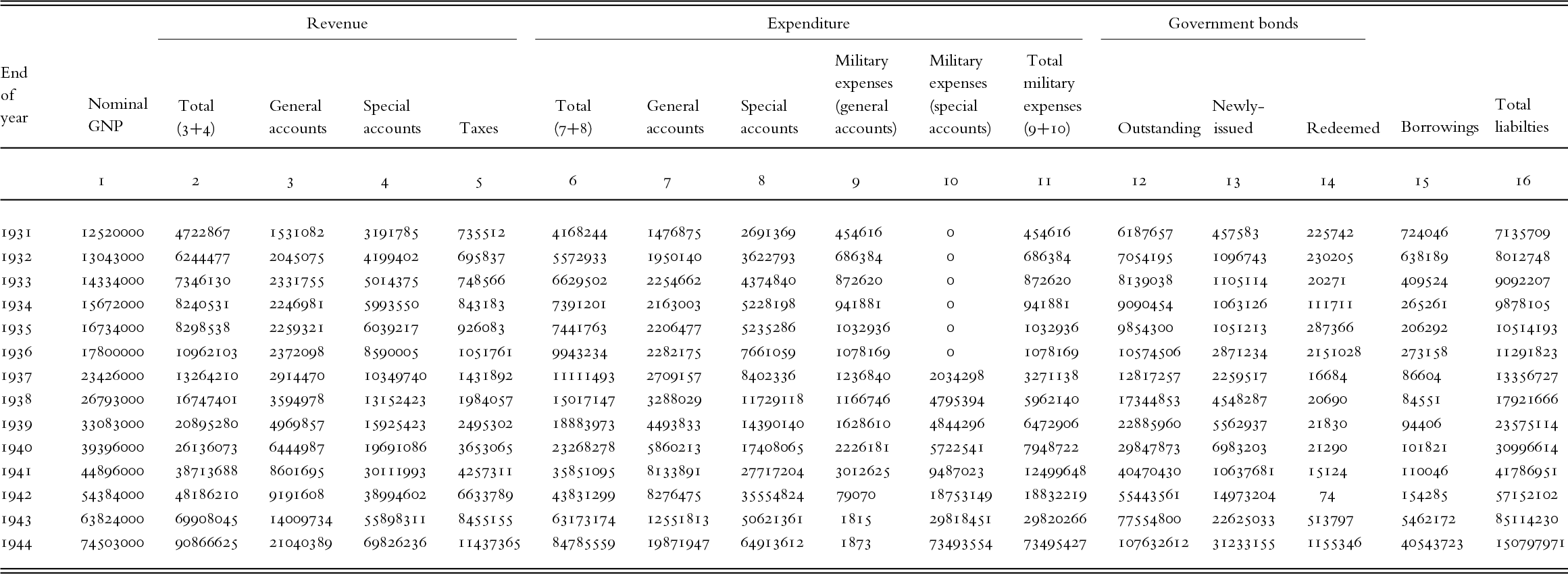
Even before the outbreak of war with China in 1937, Takahashi Korekiyo had experimented with debt financing during his tenure as finance minister. Table 3 shows the scale of debt financing in terms of nominal GNP, government expenditure, the amount of government bonds and the nation’s total liability. Total liability refers to the outstanding amount of government bonds, treasury bills, various government certificates and the ‘borrowed money’. During the war, government bonds remained the primary component of the nation’s liability, with more than 90 per cent of the liability stemming from the outstanding amount of government bonds by 1943. In 1944, however, an exception occurred, as the proportion of ‘borrowings’ increased to 26 per cent, most likely attributable to the substantial amount of ‘borrowed money’ from the colonies. By 1937, the government bonds-nominal GNP ratio had moderately increased, remaining at around 50 to 60 per cent. From 1937 to the outbreak of the Pacific War, the bonds-nominal GNP ratio began to increase at a more substantial scale compared to the previous six years, reaching 90 per cent of the nominal GNP in 1941. The onset of the Pacific War, as evidenced in Table 3, marked a point at which the amount of bonds surpassed the nominal GNP. In 1944, the amount of bonds reached 1.4 times the nominal GNP, and when including the ‘borrowed money’, treasury bills and government certificates, the nation’s total liability in 1944 was two times its nominal GNP. This indicates that during the Pacific War, the Japanese government possessed a liability that was greater than its production capacity.
An increase in government bonds and other forms of liability could be explained by the rise in military expenses. During his tenure as finance minister, as noted by Hara Akira (Reference HARA and Harrison2000 [Reference HARA and Harrison1998], p. 256) and Richard Smethurst (Reference SMETHURST2007, p. 274), Takahashi Korekiyo made efforts to control military expenditure. As shown in Table 3, from 1931 to 1936, military expenditure remained at less than 15 per cent of the total expenditure, while the military expenditure-nominal GNP ratio was between 4 to 6 per cent. When the war with China began, military expenditure steadily increased, equaling almost half the total expenditure in 1944. A similar trend is evident in the military expenditure-nominal GNP ratio, which reached 46.7 per cent of the nominal GNP in 1944. Moreover, as Table 3 shows, after the establishment of the special account for Emergency Armaments Expenditure (rinji gunjihi, EAE) in September 1937, the government began to divert most of its military expenses into this account. By 1945, 62 per cent of the EAE was covered by government bonds, a significant portion of which were underwritten by the BoJ and the Deposit Bureau of the Ministry of Finance. This observation would explain the relationship between government bonds and the nation’s monetary expansion.
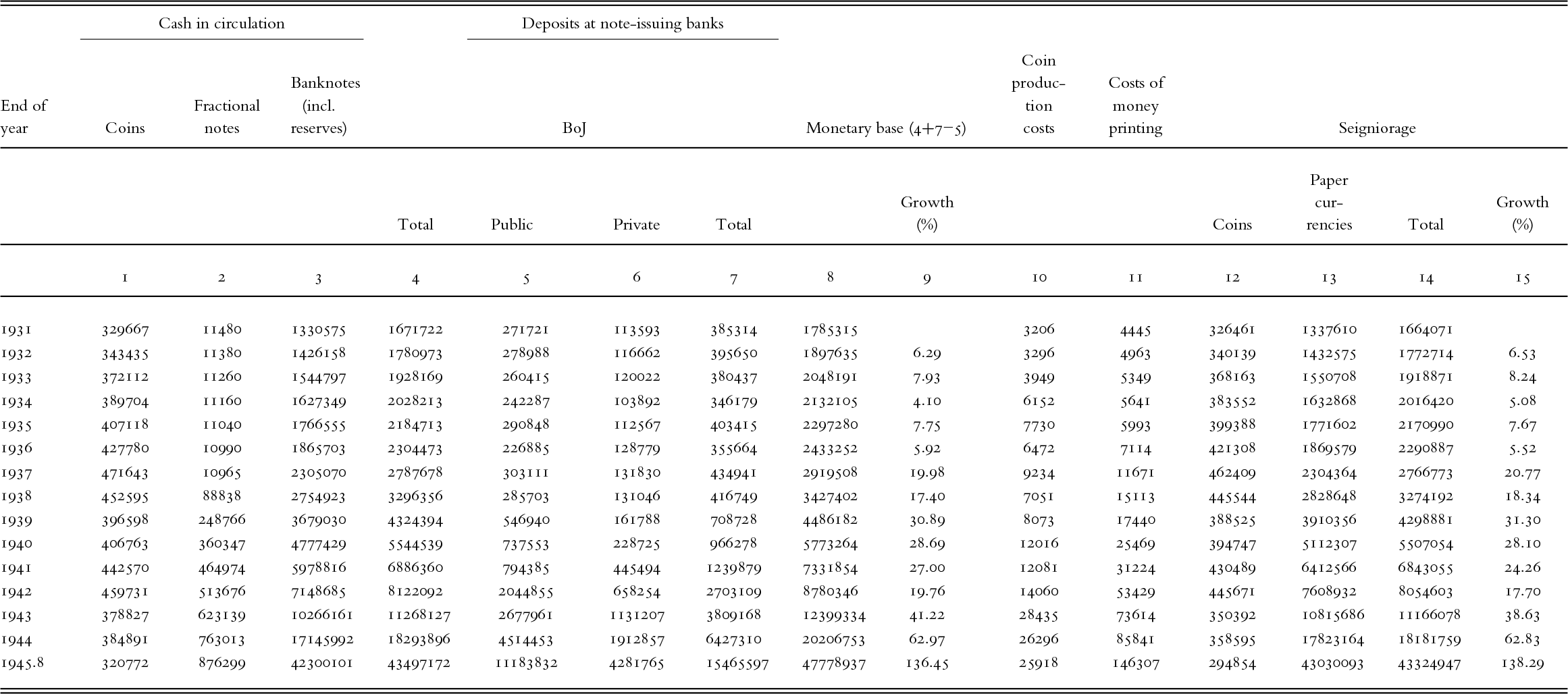
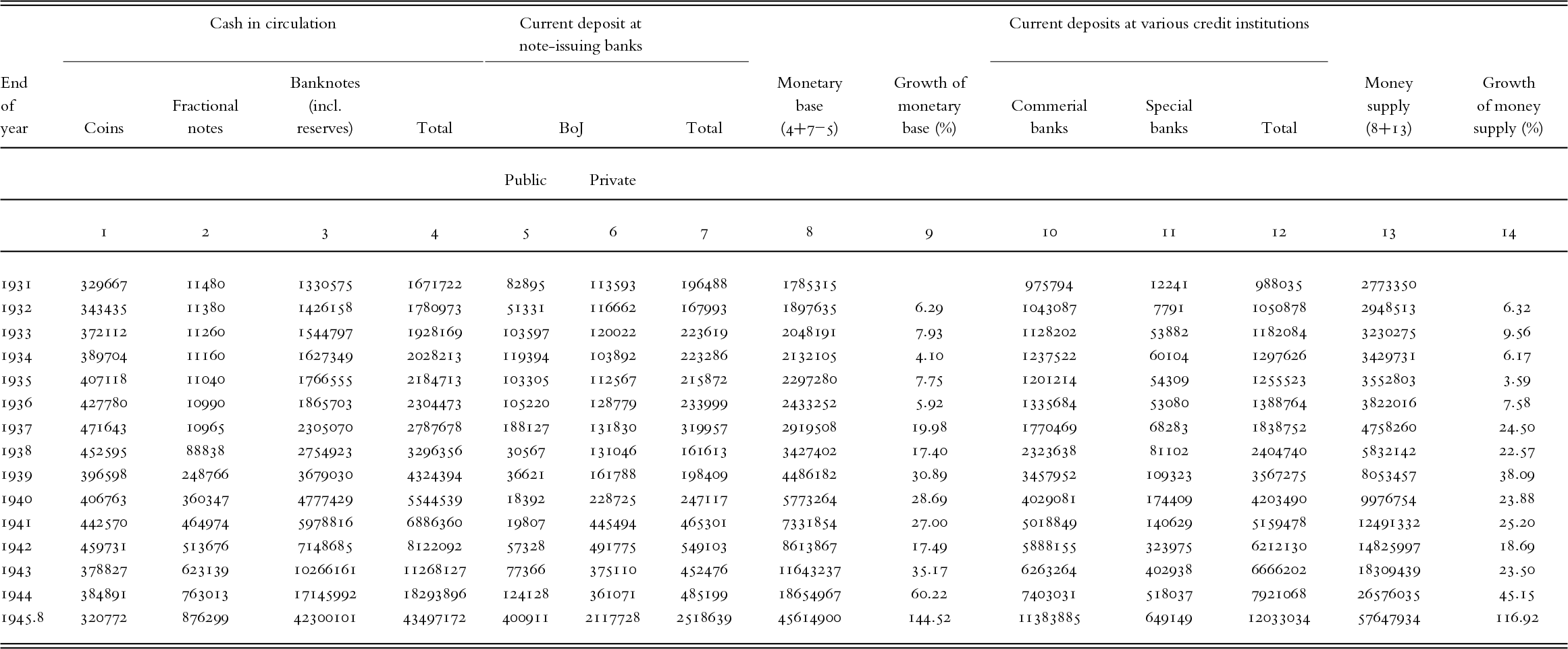
From 1937 to 1941, the BoJ and the Deposit Bureau underwrote an average of 68.7 per cent and 22.2 per cent of government bonds, respectively. From 1941 to 1944, the BoJ continued to underwrite 67.9 per cent of newly issued government bonds, while the amount underwritten by the Deposit Bureau increased to 31.6 per cent (Sekino Reference SEKINO2021, p. 173). Since the BoJ had to print money to underwrite the ever-increasing government, it therefore partly explained the growth of Japan’s monetary base and money supply. From 1937 to 1941, the amount of newly issued BoJ banknotes increased by 2.6 times (Ōkurashō and Nihon ginkō 1948, p. 259), while the monetary base and M1 increased by 2.5 and 2.6 times, respectively (Table 2). In 1944, the BoJ issued 17.7 billion yen worth of banknotes, representing a threefold increase compared to 1941. During this period, the monetary base and M1 increased by 2.5 and 2.1 times, respectively (Table 2), reaching levels comparable to those observed between 1937 and 1941. However, the nominal GNP increased by only 1.9 times between 1937 and 1941, and was further trimmed to 1.7 times between 1941 and 1944 (Table 3). In other words, the magnitude of monetary expansion exceeded the growth of production in the broader economy.
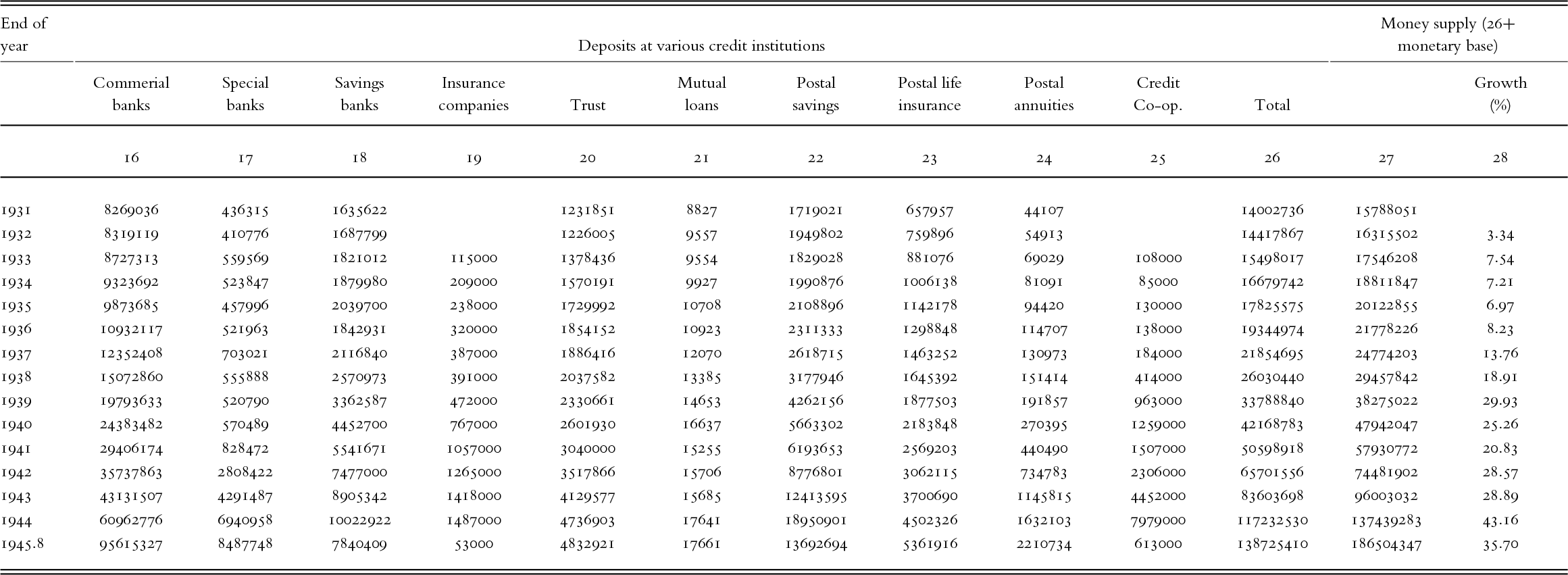
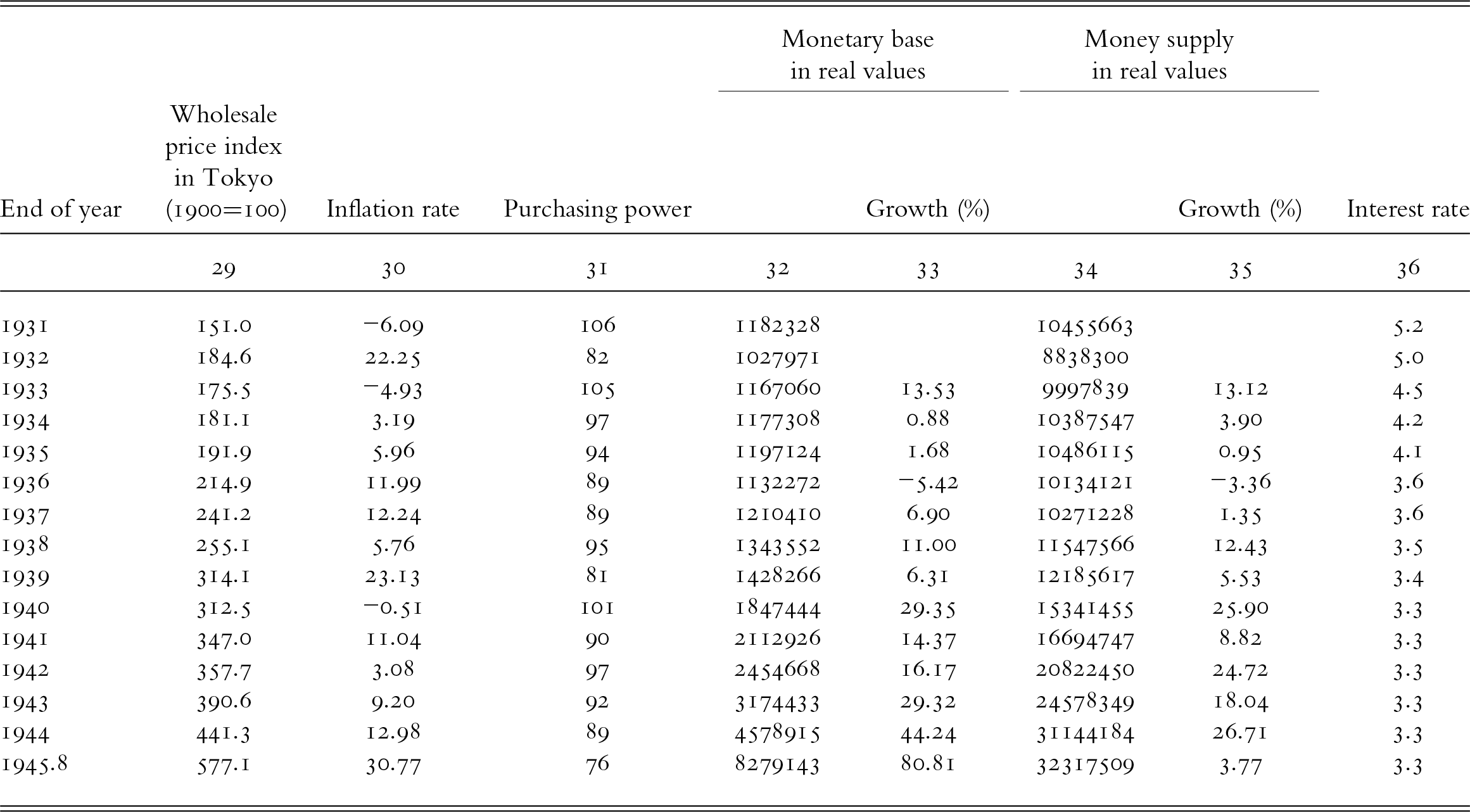
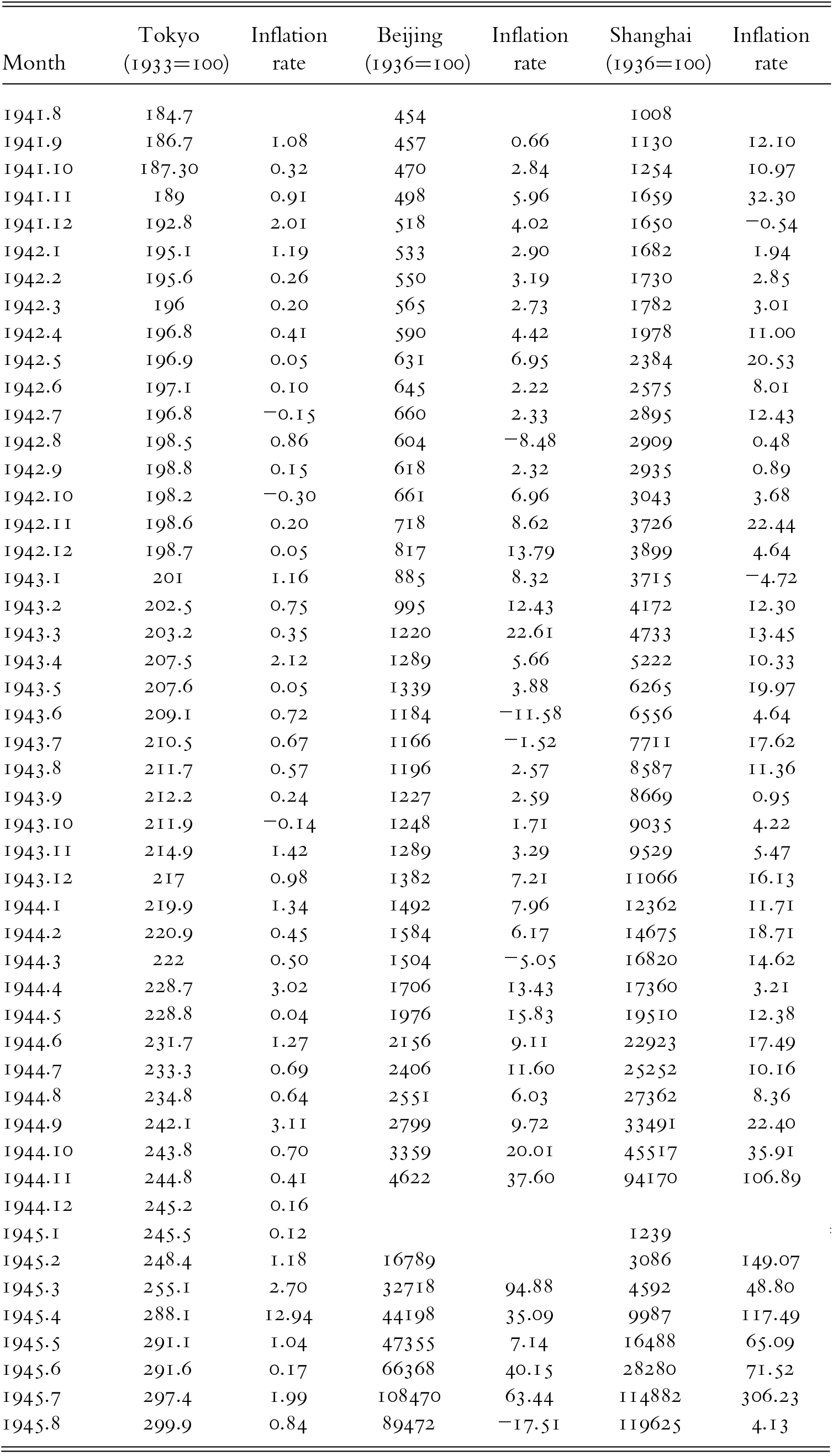
The Japanese government did not leave the expansion of the amount of government bonds, currency in circulation and money supply unchecked. The plan was to enrich the capital of financial institutions through savings campaigns, and then the financial institutions would purchase the government bonds previously underwritten by the BoJ, thereby minimising the inflationary pressure caused by the newly issued debt and absorbing surplus funds from the private markets (Aoki Reference AOKI1943, pp. 26–9). This seemed to have been successful, as the growth in the amount of government bonds was slower than the growth in the deposits at the BoJ, the Deposit Bureau and other financial institutions, including commercial and savings banks, trusts and insurance companies. As stated above, between 1937 and 1941, the government issued 7.55 times the amount of bonds compared to those issued between 1931 and 1936. From 1941 to 1944, the amount of newly issued bonds was 7.7 times greater than those issued between 1937 and 1941. Meanwhile, from 1937 to 1941, the deposits at the BoJ, the Deposit Bureau, and other financial institutions increased by 2.9 times, 2.5 times, and 8.2 times respectively. From 1941 to 1944, their deposits further increased by 5.2 times, 3.1 times and 2.3 times, respectively (Tables 1a and 1b).Footnote 17 However, if we compare the growth of government bonds, the BoJ’s paper currency and the monetary base for either 1937 to 1941 or 1941 to 1944 with the nominal GNP figures for the same period, even though deposits at various financial institutions grew faster than government bonds, the scale of monetary expansion exceeded the growth of economic productivity. As expected by Japanese officials, the uneven growth between production and government bonds, paper currency in circulation, money supply and monetary base led to inflation.Footnote 18 Yet inflation as measured by Tokyo’s wholesale price index was mild, rising by 43.9 per cent between 1937 and 1941 and 66.3 per cent between 1941 and 1945 (Table 1c). The average monthly inflation rate between August 1941 and August 1945 was merely 2 per cent (Table 6). This was an unusually low rate for a wartime state heavily reliant on debt financing, resulting in part from price controls that artificially suppressed raw materials and consumer goods at the turn of the 1940s, and also from strict regulations on consumption (taxation, rationing, and others) that left nothing to buy (Saitō Reference SAITŌ1949, pp. 90–1). The consequences of Japan’s expansionary fiscal policy were more evident in its wartime colonies, where price controls were poorly implemented, but this will be discussed in the third section of this article.
Japan’s monetary base, money supply, interest rate and inflation measures (1931–45.8) (in thousands of yen)

Japan’s monetary base, money supply, interest rate and inflation measures (1931–45.8) (in thousands of yen)

Japan’s monetary base, money supply, interest rate, and inflation measures (1931–45.8) (in thousands of yen)

Tables 1a, 1b and 1c source: Ōkurashō大蔵省 and Nihon ginkō 日本銀行(eds.), Zaisei keizai tōkei nenpō Shōwa 23-nen 財政経済統計年報 昭和23年 (Tokyo: Ōkurazaimu kyōkai, 1948).
Money supply in Japan (M1) (1931–45.8) (in thousands of yen)

Source: Ōkurashō and Nihon ginkō (eds.), Zaisei keizai tōkei nenpō Shōwa 23-nen.
Taxation was another pillar of debt financing, used to finance government expenditure, pay interest on government bonds, absorb public funds and encourage people to save. Driven by the enormous pressure for reform, both financial and social, a tax reform was introduced in 1940 (Revelant Reference REVELANT2015, p. 446). Citing Henry Shavell and Jerome Cohen, Gregg Huff (Reference HUFF, Geyer and Tooze2017 [2015], p. 62) stated that Japan ‘made no serious attempt to adapt the tax system to provide a large share of war finance’, and claimed that the 1940 Tax Reform Law did not apply to corporations. William W. Lockwood (Reference LOCKWOOD1974 [1968], p. 526), on the contrary, argued that the 1940 tax reform ‘overhauled’ the entire tax system and made the income tax ‘an effective revenue instrument’. The evidence suggests that Lockwood’s description is more accurate. Soon after the armistice, Saitō Eizaburō (Reference SAITŌ1949, p. 40) noted that the tax burden on a Japanese individual tripled from 1941 to 1945. Recent research has also revealed that the 1940 Tax Reform introduced a new progressive corporate tax (hōjin zei), and ambitious increases in the corporate tax, personal income tax (shotoku zei), and temporary income tax (rinji ritoku zei) were implemented (Sekino Reference SEKINO2021, pp. 50–3, 144–60).
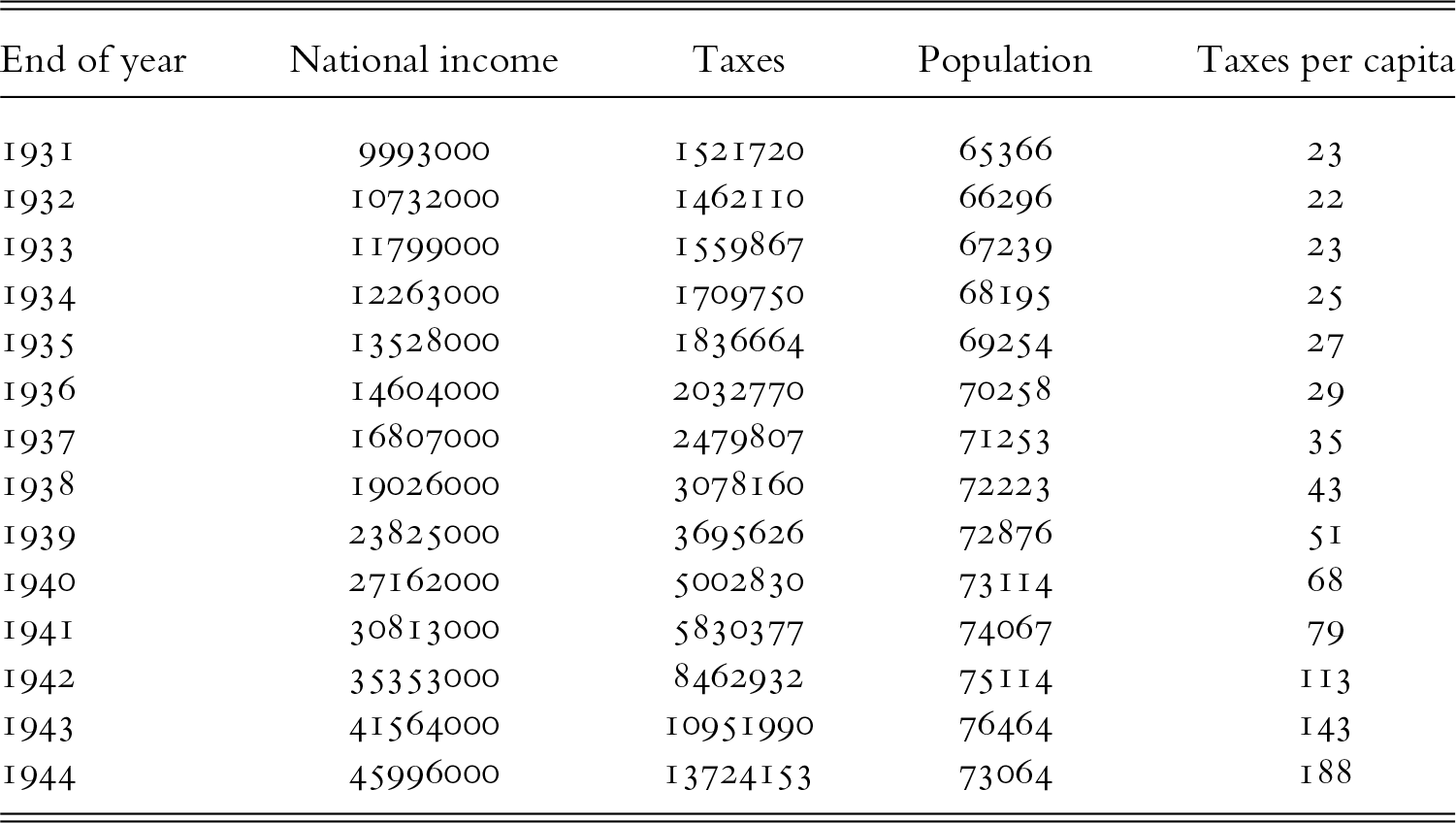
The increase in taxes led to significant growth in tax revenue, while the tax burden on Japanese civilians rose considerably (Tables 3 and 4). Tax revenues, however, remained at around 10 to 15 per cent of total government’s revenue. From 1941 to 1944, the corporate tax, personal income tax and temporary income tax contributed 61 to 69 per cent of the total tax revenue. All of these taxes had been significantly increased during the Pacific War. A new progressive corporate tax was introduced in 1940, ranging from 25 to 65 per cent. The corporate tax was further increased to 35 to 75 per cent in 1942 and to 40 to 80 per cent in 1945. The much more ambitious personal income tax was divided into ‘classified income tax’ and ‘integrated income tax’. The classified income tax ranged from 6 to 10 per cent in 1940 and rose to 16 to 27 per cent in 1945, whilst the integrated income tax ranged from 2 to 58.8 per cent in 1940 and shifted to 1.8 to 68.7 per cent in 1945. As a result, the income tax rate of the most affluent Japanese could be as high as 80 per cent. The temporary income tax was mainly targeted at industrialists and manufacturers who benefited from the wartime expansion of munitions production. The tax was first introduced in 1935, with an individual rate of 8 per cent and a corporate rate of 10 per cent. The individual rate was increased to 30 per cent in 1940 and a progressive rate was introduced for corporate taxpayers, ranging from 25 to 65 per cent. The individual rate was further increased to 35 per cent in 1942, while the progressive corporate rate was increased to 35 to 75 per cent in 1942 and 40 to 80 per cent in 1945 (Sekino Reference SEKINO2021, pp. 144–60).
Japan’s nominal GNP, the amount of government bonds, and government’s revenue and expenditure (in thousands of yen) (1931–44)

Source: Ōkurashō and Nihon ginkō (eds.), Zaisei keizai tōkei nenpō Shōwa 23-nen; Ryōichi Sanwa 三和良一 and Akira Hara 原朗, Kingendai Nihon keizaishi yōran (hoteiban) 近現代日本経済史要覧(補訂版) (Tokyo: Tōkyō daigaku shuppankai, 2021 [2010]), 2–3.
Japan’s national income, tax revenue and taxes per capita (1931–44) (national income and tax revenue: in thousands of yen; population: in thousands)

Source: Ōkurashō Shōwa zaiseishi henshūshitsu 大蔵省昭和財政史編集室 (ed.), Shōwa zaiseishi dai 5-kan sozei 昭和財政史 第5卷 租税 (Tokyo: Tōyō keizai shinpōsha, 1957).
The increase in taxes placed a financial burden on civilians. From 1931 to 1944, taxes per capita increased eightfold from 23 yen to 188 yen, while national income increased fourfold. In other words, the increase in taxes was twice that of national income. An identical trend can be found during the Pacific War. From 1941 to 1944, the amount of tax per capita increased by three times, while the national income increased by only 1.5 times (Table 4). The uneven growth between the amount of tax per capita and national income showed how the income tax, if not the entire tax system, had become ‘an effective revenue instrument’.
Taxation generated 10.3 billion yen in revenue for the Japanese government by the end of the war. The amount of taxation in 1945 was only about one-fourteenth of the amount of the government bonds, but it was still responsible for numerous expenses, including financing part of the EAE, regular (nenkin) and invalids’ pensions (onkyū) for military personnel, the cost of air defence, conscription, the development of the munitions industry and, most importantly, the payment of interest on government bonds (Sekino Reference SEKINO2021, pp. 35, 50–3), making the tax system an indispensable part of the ‘internal financing mechanism’.
The last pillar was interest rate intervention, which was closely linked to the issuance of government bonds and the creation of credit. Lowering interest rates was one of the core elements of Takahashi Korekiyo’s fiscal policy. Low interest rates allowed the Japanese government to issue government bonds cheaply, as the government needed to issue a considerable amount of bonds to cover the deficits caused by the recovery programme after the Great Depression. Takahashi also understood that, as the Japanese economy began to recover, people would spend more money, demand would increase and businessmen would begin to look for capital to expand production in order to meet that demand. Low interest rates were essential to this process, as it would be easier for businessmen to borrow money for industrial and commercial expansion. In addition, low interest rates drove up the stock market, which made it possible to raise funds for further growth (Nakamura Reference NAKAMURA1999 [Reference NAKAMURA1994], pp. 58–9; Smethurst Reference SMETHURST2007, p. 258). Interest rates remained low throughout the war, in order to maintain industrial production and war capacity. In July 1937, Kaya Okinori, then Minister of Finance, mentioned in his speech to the House of Peers that ‘it is expected that the demand for funds will continue to increase substantially in the future. To meet this demand, it is necessary to ensure the smooth supply of funds and to keep interest rates as low as possible.’Footnote 19 Under the planned economic system, the disparity between deposit and lending rates – the differences between the highest and lowest interest rates on deposits and loans – was trimmed considerably over the period from 1937 to 1945. In the words of the official history of the BoJ, it was ‘as if a world of finance had materialised in which interest rates were irrelevant. In other words, government control of fund allocation and credit rationing had become widespread throughout the economy’ (Ueda Reference UEDA, Okazaki and Okuno-Fujiwara2002 [Reference UEDA, Okazaki and Okuno-Fujiwara1999], pp. 50–1).
Under the Temporary Capital Adjustment Act, introduced in September 1937, government permission was required for the formation of new companies and for capital increases, mergers or changes of business. It required banks to adjust their lending policies to prevent the flow of funds into industries that were not critical to the war. In doing so, all industries were divided into three groups: Class I were munitions producers and directly related industries, which were given unconditional access to funds, while Class III were those industries with relatively low military priority, such as textiles, which were excluded from further new funding. Class II consisted of industries of intermediate military importance, which were treated on a case-by-case basis according to predetermined criteria (Nakamura Reference NAKAMURA1999 [Reference NAKAMURA1994], p. 90; Baxter Reference BAXTER2007, p. 175). State intervention in lending practices shows its aim to control and maximise funds for war production, which was prioritised over all other sectors.
In the first half of the 1940s, the scope for banks to make independent credit decisions continued to narrow. The major and regional private banks began to participate in syndicated loans arranged by the Industrial Bank of Japan. With the introduction of the Law on War Supply Companies in December 1943, a system of selected financial institutions for war supply loans was established. The government designated certain banks to provide funds and services to specific munitions companies. If more funds were needed than could be provided by the lead banks, which were usually major commercial banks, other banks would join the financing groups on the government’s instructions. (Baxter Reference BAXTER2007, pp. 179–80, 187). As a result, the amount of bank loans increased dramatically in the final phase of the war. In March 1945, Mitsubishi Bank lent a total of 7.26 billion yen, and also provided 2.95 billion yen to munitions companies for their own financing, which was 1.82 billion yen more than its deposits. Similarly, the Imperial Bank had lent 14.3 billion yen with only 13.3 billion yen in deposits. They filled the capital gap by borrowing from the BoJ, with Mitsubishi Bank’s 2.15 billion yen and Imperial Bank’s 5.43 billion yen coming from the BoJ. By the end of World War II, the commercial loans of BoJ accounted for 30.4 billion yen, three times more than the amount of government bonds it held. The BoJ financed itself by printing money, and had issued 42.3 billion yen worth of banknotes by August 1945, which inevitably increased inflation, and eventually led to a devaluation of people’s savings. Apart from the depreciation in the real value of Japan’s monetary base and money supply (Table 1c), the devaluation can also be seen in the face value of the new banknotes. In 1944, the BoJ issued a total of 526,880 notes, of which 319,290 were 10 yen notes and 159,290 were 100 yen notes. The amount of 100 yen was 824.9 times more than in 1943. In 1945, however, the BoJ printed 1,621,057 banknotes, including 664,467 of 100 yen, 20,747 of 500 yen and 12,830 of 1,000 yen (Cohen Reference COHEN1949, pp. 88–91; Ōkurashō Shōwa zaiseishi henshūshitsu 1956, p. 172; Sekino Reference SEKINO2021, pp. 205–8). Devalued notes were thus flooding the market, and while the consequences were obvious, the causes appeared mysterious to ordinary people.
Why did the BoJ tolerate the risk of inflation and continue to print money to support their loans to private banks? This is because Japanese industry, especially the war supply companies, became increasingly dependent on indirect financing as the war progressed. In June 1940, financial institutions lent 5.2 billion yen to industrialists (including textile, metal, chemical, mechanical, food, and electrical) and another 748 million yen to the mining sector, an amount equal to 47 per cent of the total loans made by financial institutions. The amount of loans increased significantly during the Pacific War. In June 1944, financial institutions extended a total of 35.6 billion yen in loans, of which 17.7 billion yen went to industrialists (50 per cent) and 1.8 billion yen to the mining sector (5 per cent) (Hara Reference HARA2013, p. 367). Furthermore, the proportion of zaibatsu using external capital to finance their businesses, such as bank loans, corporate bonds, and funds raised on the stock market, continued to grow during the war. In 1937, 39 per cent of the capital of the Mitsui zaibatsu was external capital, rising to 53 per cent in 1941 and 68 per cent in 1945. Similar trends can be observed in the Mitsubishi and Sumitomo zaibatsu (Takeda Reference TAKEDA2020, p. 193). Thus, even if the BoJ recognised the danger of printing money to lend, it would have to accept the risk. Indeed, the Shōwa zaiseishi edited by the Ministry of Finance and the official history of the BoJ show an awareness that this tactic led to inflation (Sekino Reference SEKINO2021, pp. 207–8). If the BoJ stopped lending to private banks, industrialists might not get enough credit for production, which would eventually lead to the collapse of Japan’s economic order and its war machine. At a time of national crisis, it was too big to fail.
III
Building on the previous analysis of the components of wartime Japan’s ‘internal financing mechanism’ and its unsustainability due to the inevitable creation of immense unsecured credit, this section explores the fiscal failure of the wartime Japanese Empire from another perspective – the impact of Japan’s exploitative colonial economy on the home islands.
A common explanation was that inflation in Japan’s home islands was caused by rising prices driven up by shortages of raw materials (see footnote 6). It is true that everyone in the Japanese Empire, regardless of status or wealth, suffered from shortages of necessities (especially food) and black market prices in the final stages of World War II.Footnote 20 This was anticipated by the Japanese government. From July 1937, when Japan was at war with China, goods became scarce and prices naturally rose. In order to curb inflationary pressures, the government, other than encouraging thrift, set official prices as ceilings. Originally, the official price was to apply only to selected major items, but it was later extended to all kinds of goods, and black markets began to flourish. When war broke out in Europe in September 1939, shortages became widespread both domestically and internationally, as there were only two major countries that were not yet involved in the war – the US and the Soviet Union. The Japanese government then promulgated an imperial order, commonly known as the 18 September Price and Wage Freeze Order (Kakaku-tō tōsei rei). According to the order, the government would freeze wages and prices to buy time to draw up comprehensive wage and price schedules. The official price list was drawn up in 1940, setting the official price for 40,000 items in the capital and 430,000 items in the regions. Meanwhile, in the autumn of 1939, there was a drought in western Japan due to a shortage of electricity, and the rice harvest in western Japan and Korea was poor. At the same time, shortages of other necessities such as sugar began to be severely felt. As a result, necessities such as rice, sugar, miso, and soy sauce were rationed, and ration coupons (haikyūken) were issued to the public (Nakamura Reference NAKAMURA1999 [Reference NAKAMURA1994], pp. 98–101). Official prices were of course well below the market prices, so Japan’s inflation, as reflected in the Tokyo wholesale price index, was indeed a ‘suppressed’ inflation. Similar to Germany in the second half of World War I, the maximum price regulations prevented the full impact of expansionary monetary policy from being reflected in price movements, or at least in official price movements (Holtfrerich Reference HOLTFRERICH and Balderston1986, pp. 12–13, 85–6). The impact of shortages on inflation could not be denied, and yet this article argues that there was an overlooked factor that contributed to Japan’s wartime inflation, namely: the influx of unbacked colonial currencies. These colonial currencies brought hyperinflationary pressures from abroad, and eventually disrupted the financial order in Japan’s home islands.
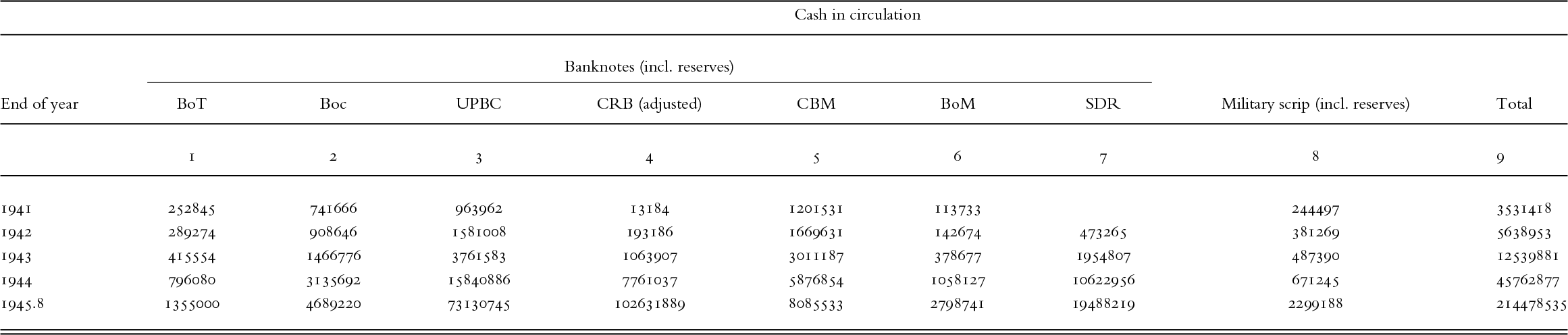
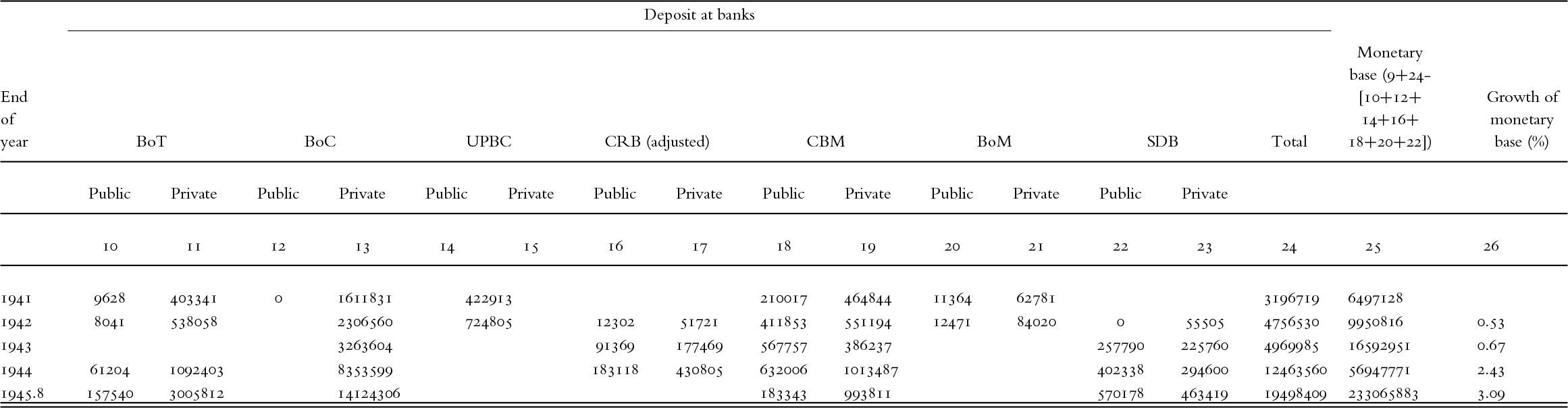
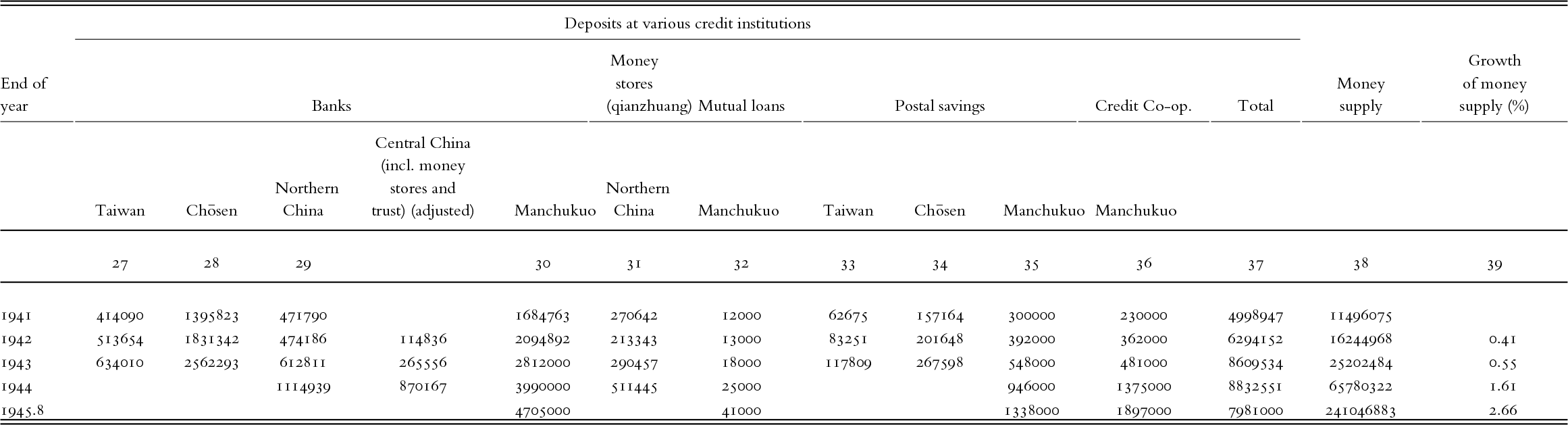
The previous section has shown that in Japan’s home islands, monetary expansion outstripped the growth of industrial production. The monetary base and money supply (M2) grew more rapidly in the colonies than at home (Table 5), as the Japanese government sought to shift the costs of expansionary monetary and fiscal policies to its colonies by financing military expenditure with ‘borrowed money’. Ironically, this attempt eventually led to the diversion of the colonial inflationary pressures to Japan’s home islands. Government bonds and ‘borrowed money’ contributed 61.8 and 24.6 per cent respectively to the EAE. From April 1943 to August 1945, the Japanese government borrowed a total of 42.7 billion yen from its colonies and collaborationist regimes (excluding Taiwan and Korea), but never repaid it. ‘Borrowed money’ refers to the Indochinese piastres, the Thai baht, the Manchukuo yuan, and three types of ‘military scrip-like currencies’ ‘borrowed’ by the Japanese government to support its colonial military expenditure. Military scrip or military scrip-like currencies are the unbacked banknotes used as new colonial currencies and payments for intra-imperial trade and investment. At total of 48.4 per cent of ‘borrowed money’ came from the scrip issued by the Central Reserve Bank (CRB) of the Wang Jingwei regime, 26 per cent from the Southern Development Bank (SDB) in Southeast Asia, 12 per cent from the United Preparatory Bank of China (UPBC), also associated with Wang’s regime. In other words, 60 per cent of the colonial wealth that funnelled into Japan’s war machine was extracted from occupied China (excluding Manchukuo) (Ōkurashō Shōwa zaiseishi henshūshitsu 1955, pp. 167–88, 34–9 [in appendix]; Ono Reference ONO2022 [Reference ONO2021], pp. 212, 226). All the banks were run by collaborationist regimes, except the SDB.
The monetary base and money supply in the Japanese Colonies (1941–5.8) (in thousands of yen)

The monetary base and money supply in the Japanese Colonies (1941–5.8) (in thousands of yen)

The monetary base and money supply in the Japanese colonies (1941–5.8) (in thousands of yen)

Sources: Zhongwai jingji huibao 中外經濟彙報; Ōkurashō and Nihon Ginkō eds., Zaisei keizai tōkei nenpō Shōwa 23-nen; Shin’ichi Gotō 後藤新一, Nihon no kin'yū tōkei 日本の金融統計 (Tokyo: Tōyō keizai shinposha, 1970); Yoshimasa Shibata 柴田善雅, Senryōchi tsūka kin'yū seisaku no tenkai 占領地通貨金融政策の展開 (Tokyo: Nihon keizai hyōronsha, 1999).
BoT: Bank of Taiwan 株式会社台湾銀行
BoC: Bank of Chōsen 朝鮮銀行
CRB: Central Bank of Manchukuo 満洲中央銀行
BoM: Bank of Mengjiang 蒙疆銀行
The SDB shows how a colonial institution gobbled up civilian capital and recycled it to the state and elites. The bank was established in April 1942 to fill the capital void in Southeast Asia after the Allied international banks, such as HSBC and the Mercantile Bank of India, were closed and subsequently liquidated under Japanese military occupation. The bank was set up to finance Japanese industry and long-term resource development in the area, but also to print military scrip (Huff Reference HUFF2022 [Reference HUFF2020], p. 88). The Tokyo government provided 100 million yen as its capital, but only provided 58.4 million yen (from the government bonds) when it was established. Like the financial intermediaries, the SDB had to rely on private and civilian capital, so it could provide billions to the military and Japanese enterprises. From 1943 until the armistice, it lent 11.1 billion yen to the Army and Navy, and 523 million yen to 161 business corporations. The former relied on the 20 billion yen of scrip printed by the SDB, while the latter was covered by bonds and loans from banks, insurance companies and the Deposit Bureau. The Deposit Bureau also bought 20 million yen of the SDB bonds (Takaishi Reference TAKAISHI1960, pp. 386–7, 390). All these tactics depended on the exploitation of civilian capital.
A colossal amount of unbacked scrip led directly to hyperinflation in occupied China and Southeast Asia. When the SDB issued 20 billion yen in unbacked scrip to meet military demands, it caused hyperinflation in Japanese-occupied Southeast Asia; for instance, the cost of living in Manila and Rangoon increased 143 and 1856 times respectively between December 1941 and August 1945 (Ono Reference ONO2022 [Reference ONO2021], p. 212). In order to meet the ever-increasing military expenditure, the CRB and UPBC also continued to print scrip in occupied China. In December 1941, the total amount of scrip issued by the UPBC and CRB was 966 million yen and 280 million yen, and on 10 August 1945 it was 84.9 billion yen and 2.1 trillion yen, an increase of 87.9 and 7,632 times respectively. According to the printed amount, the actual exchange rates between one Japanese yen and per 100 yen UPBC and CRB scrip were 0.41 and 0.1995 in December 1941, and depreciated to 0.0004 and 0.00001 on 10 August 1945. This eventually led to hyperinflation in Shanghai, the financial centre of China (Table 6) (Ōkurashō Shōwa zaiseishi henshūshitsu 1955, p. 304; Ono Reference ONO2022 [Reference ONO2021], p. 229). That is why, in June 1945, Zhou Fohai (Reference ZHOU2003, vol. 2, p. 1023), the mayor of Shanghai, told Tani Masayuki, Tsuchita Yutaka and Ogura Masatsune that ‘Japan cannot create hyperinflation and social unrest in China while it wants to maintain peace between two countries’. The scrip in Shanghai and other Japanese-occupied regions had already become ‘trash papers’ before the Japanese defeat.
Monthly wholesale prices and inflation in Tokyo, Beijing and Shanghai (1941.8–1945.8)

Sources: Shiken tōkei geppō 支研統計月報; Senshichū kin'yū tōkei yōran: Shōwa 12-nen kara Shōwa 20-nen (8-gatsu) made 戦時中金融統計要覧 : 昭和12年から昭和20年(8月)迄 (Tokyo: Nihon ginkō tōkeikyoku, 1947).
A mechanism was therefore put in place to prevent hyperinflation from spreading from the colonies to Japan. In August 1942, an agreement was made between the Yokohama Specie Bank (YSB)’s Shanghai branch and the CRB, which offered the Japanese military and government the opportunity to request an ‘unlimited amount’ of military scrip-like currencies. When the Japanese military or government requested CRB’s scrip, the YSB’s Shanghai branch would record yen funds as CRB claims, and accordingly the CRB would provide the Japanese with the equivalent amount of scrip at an exchange rate of 1:18. Initially, the Japanese Treasury in Tokyo would provide cash equivalent to the CRB’s scrip, which the YSB’s Shanghai branch would record as the CRB’s claims. However, this arrangement appeared to be too advantageous to the YSB, and could exacerbate inflation in Japan. It was thus decided to replace the cash with the 3.5 per cent interest bearing government bonds. This meant that the Japanese government would be able to repay the amount after a certain period of time, and that the financing of military expenditure would not depend solely on financial institutions in Japan and the BoJ banknotes. In the following two years, similar arrangements were applied to the EAE relating to the Wang Jingwei regime, Manchukuo, and Southeast Asia. The Japanese government intended to use this mechanism to reduce the risk of inflation at home while creating hyperinflation in its colonies (Ōkurashō Shōwa zaiseishi henshūshitsu 1955, pp. 301–3; Ono Reference ONO2022 [Reference ONO2021], pp. 226–9).Footnote 21
A mechanism was therefore put in place to prevent hyperinflation from spreading from the colonies to Japan. In August 1942, an agreement was made between the Yokohama Specie Bank (YSB)’s Shanghai branch and the CRB, which offered the Japanese military and government the opportunity to request an ‘unlimited amount’ of military scrip-like currencies. When the Japanese military or government requested CRB’s scrip, the YSB’s Shanghai branch would record yen funds as CRB claims, and accordingly the CRB would provide the Japanese with the equivalent amount of scrip at an exchange rate of 1:18. Initially, the Japanese Treasury in Tokyo would provide cash equivalent to the CRB’s scrip, which the YSB’s Shanghai branch would record as the CRB’s claims. However, this arrangement appeared to be too advantageous to the YSB, and could exacerbate inflation in Japan. It was thus decided to replace the cash with the 3.5 per cent interest bearing government bonds. This meant that the Japanese government would be able to repay the amount after a certain period of time, and that the financing of military expenditure would not depend solely on financial institutions in Japan and the BoJ banknotes. In the following two years, similar arrangements were applied to the EAE relating to the Wang Jingwei regime, Manchukuo, and Southeast Asia. The Japanese government intended to use this mechanism to reduce the risk of inflation at home while creating hyperinflation in its colonies (Ōkurashō Shōwa zaiseishi henshūshitsu 1955, pp. 301–3; Ono Reference ONO2022 [Reference ONO2021], pp. 226–9).Footnote 21
The mechanism, however, failed because there was no comprehensive currency control to block the flow of colonial currencies to Japan’s home islands in a timely and effective manner. The lack of currency control can be partly explained by the fact that Japan maintained strong economic and trade links with its colonies and collaborationist regimes until the end of World War II. In May 1944, Igarashi Torao of the Foreign Bureau of the BoJ mentioned that it was ‘practically impossible to completely prohibit the transactions between Japan and its colonies, and of course, it is not feasible to allow unrestricted transactions’.Footnote 22 A similar observation was later made by Fukai Eigo (Reference FUKAI1953, p. 415) at the Privy Council meeting in February 1945.
When did currency exchange between Japan’s home islands and its colonies become an issue? The significant devaluation of colonial currencies began in April 1943 when the policy of financing military expenditures with colonial currencies was implemented in occupied China (excluding Manchukuo, Hong Kong, and Hainan) and Southeast Asia (excluding Thailand and Indochina) (Ono Reference ONO2022 [2021], p. 226). However, the Japanese government maintained a fixed exchange rate (1:1) between the yen and all colonial currencies, except the CRB scrip (1 yen equalled 18 CRB yuan). This policy was assured in practice. The hyperinflated CRB scrip created an accounting problem for Japanese companies with headquarters in Japan and branches or subsidiaries in Shanghai to consolidate their Shanghai balance sheets with the yen-denominated balance sheets of the Japanese headquarters (Katano Reference KATANO1946). While the fixed exchange rate posed difficulties for trade between Japan and its closely linked colonies (Hara Reference HARA2013, pp. 119–24), it also presented an opportunity for Japanese in the occupied regions to subsidise the rising cost of living in Japan (especially black-market prices) or to leverage their profits by exchanging hyperinflated colonial currencies for Japanese yen (Shibata Reference SHIBATA and Kyōji1981, p. 362). Therefore, unrestricted transactions between the colonies and Japan’s home islands became an issue at the turn of 1944, and currency controls between China and Japan were imposed in March 1944. Critically, however, the controls did not cover Hong Kong and Hainan, the two regions which used military scrip but not CRB and UPBC scrip as their currencies, so some Japanese began transferring their capital in China back to Japan through these two conduits. Transactions from Hong Kong to Japan amounted to 5.4 million yen in 1943 and rose sharply to 10.6 million yen in the first half of 1944. Currency controls were not imposed in Hong Kong and Hainan until November 1944 and February 1945, when Japan’s home islands were already suffering from shortage-induced inflation (Kobayashi and Shibata Reference KOBAYASHI and SHIBATA1996, pp. 206–9).
Japan’s economy was also closely linked to that of Southeast Asia, with Indochina being the largest exporter of rice to Japan in 1943 (Huff Reference HUFF2022 [Reference HUFF2020], p. 134). Further, many of the SDB loans went to zaibatsu-linked companies, such as Asano Heavy Industry, Oji Paper, Japan Sugar Industry, Furukawa Mining Company, Mitsui Bussan, Iwai Industry, Kanegafuchi Industry, Sumitomo Mining Company, and Mitsubishi Corporation.Footnote 23 All of these companies were headquartered in Japan and had branches scattered throughout the empire, meaning that they often remitted colonial currencies (issued as military scrip or military scrip-like currencies) back to Japan.Footnote 24 In December 1944, statistics from the Overseas Capital Bureau of the Ministry of Finance showed that from January to August 1944, remittances (including remittances of corporate profits) from Manchuria, China and Southeast Asia to Japan increased by about 580 million yen over the same period in 1943 (an average of 72 million yen per month), of which 341 million yen came from China, 185 million yen from Manchuria and 51 million yen from Southeast Asia. This was due to inflationary surpluses and anticipation of future exchange rate depreciation against the Japanese yen.Footnote 25 The statistics reflected the flow of military scrip-like currencies into Japan’s home islands, and it was reasonable for the Japanese government to be concerned about this phenomenon. After all, 580 million yen was no small amount, representing 4.68 per cent and 0.6 per cent of its monetary base and money supply (3.18 per cent for M1) in 1943. Moreover, in 1943 Japan ran trade deficits with almost all the regimes in the ‘Greater East Asia Co-Prosperity Sphere’, except Thailand and Burma (Yamamoto Reference YAMAMOTO2011, pp. 118–19). Meanwhile, the nominal value of the monetary base in the colonies continued to grow in 1944 and 1945, being 2.82 times and 4.88 times larger than that in Japan, respectively (Table 5). Since the monetary base was calculated in terms of Japanese yen, the nominal value above has already been adjusted to reflect the exchange rate of the CRB scrip to the yen (1 yen equalled 18 CRB yuan).Footnote 26 Without this adjustment, the gaps between the Japanese and colonial monetary bases would have been even more exaggerated.
The influx of colonial currencies, especially those from occupied China, was discussed in the Diet on 28 January 1945. Kawasaki Katsu asked Finance Minister Ishiwata Sōtarō about the measures to prevent the hyperinflated CRB scrip from contributing to Japan’s inflation, emphasising that Japan ‘is being affected by the price fluctuation of the CRB scrip’. Ishiwata replied:
I will not allow Japan to be affected by the extremely high prices in China, and I will restrict the money made in China from being sent to the interior, and I will restrict such things by what is called ‘exchange control’, as I believe this to be the most effective way of doing so. We are currently exercising very strict controls on currency exchange.Footnote 27
The ‘very strict controls on currency exchange’ referred to the Local Special Measures Deposit System (Genchi tokubetsu sochi yokin seido) which had recently been introduced on 10 January 1945. The system intended to avoid the inflow of funds into Japan as much as possible and to adjust them locally. For repatriated funds over 200,000 yen, three-quarters of the excess was deposited in local currency, and 5,000 yen was paid in cash in Japan. The remainder was sealed as deposits in Japan. The local deposits (the deposits in local currency) were used for loans to the North China Development Corporation, the Central China Development Corporation, and others. Both were national policy companies. The restrictions caused financial difficulties for Japanese in the colonies, leading to measures on March 23 to protect overseas residents’ deposits and allow remittances of up to 10,000 yen for families of conscripts. On 19 April 1945, a Special Deposit System in Foreign Currency (Gaika hyōji Naichi tokubetsu yokinsei) was introduced and foreign currency remittances of repatriated funds were permitted, allowing foreign currency remittances, with part paid in yen and part deposited in local currency (Shibata Reference SHIBATA and Kyōji1981, pp. 362–3).
The draconian currency controls may have been more timely and effective in cutting off the flow of colonial currency to Japan’s home islands, but they also exacerbated the financial difficulties of civilians at home. This was due to the fact that many Japanese worked abroad with families at home and, as mentioned above, some Japanese in the colonies often exchanged the hyperinflated colonial currencies for yen to subsidise the rising cost of living in Japan (Shibata Reference SHIBATA and Kyōji1981, p. 362). In June 1946, Karasawa Toshiko, in her speech to the House of Representatives, cited a survey by the Central Association of Repatriates, stating that 10 million Japanese civilians had been sent to Japan’s colonies since the Manchurian Incident in 1931.Footnote 28 These Japanese remained strongly attached to their homeland, including financially. In December 1945, four months after the war, Nakayama Taichi mentioned in the House of Peers that:
During the war, due to the tightening of foreign exchange controls, the ability to send remittances to families at home was severely restricted. The families left behind in Japan faced considerable hardship, and since the end of the war their situation has worsened. With the complete cessation of remittances since August, these families have lost all sources of income.Footnote 29
In other words, the draconian currency controls imposed eight months before the armistice prevented the hyperinflated colonial currencies from being imported into Japan’s home islands at the cost of cutting off almost all remittances to and from Japan, undermining the financial support and livelihoods of many Japanese civilians. The cessation of cash flow and currency exchange within the Japanese Empire also signified the collapse of the yen bloc.
Therefore, on one hand, the ‘internal financing mechanism’ absorbed civilian wealth and depleted their savings to fuel Japan’s war machine. On the other hand, it created inflationary pressures in Japan’s home islands and hyperinflationary pressures in its colonies, both of which increased the risk of the war financing mechanism’s implosion. Despite efforts to block the influx of colonial hyperinflationary pressures to Japan’s home islands, the strict currency controls cut off almost all remittances. This exacerbated the financial difficulties of civilians at home, disrupted the economy, and eventually led to the break-up of the yen bloc.
IV
In terms of social development, Japan is no longer a thriving country; the war will not lead to the prosperity sought by her ruling classes but to the very reverse, the doom of Japanese imperialism … Japan is a comparatively small country, deficient in manpower and in military, financial, and material resources, and she cannot stand a long war. Japan’s rulers are endeavouring to resolve this difficulty through war, but again they will get the very reverse of what they desire; that is to say, the war they have launched to resolve this difficulty will eventually aggravate it and even exhaust Japan’s original resources.
– Mao Zedong (Reference MAO and Takeuchi1983, pp. 61–2)Footnote 30
In the summer of 1938, Mao was not alone in predicting that Japan would suffer financial hardship as a result of a protracted war with China. As early as February, Cameron Fromanteel Cobbold, the future governor of the Bank of England, said that Yanagita Seijirō, the then superintendent of the BoJ’s London agency, had told him in a telephone conversation that Japanese business circles were ‘anxious about the economic future’, and that they were ‘afraid that Japan’s support of [for] the Provisional Government in North China will prove costly’.Footnote 31 Soon after, Cobbold was informed that the Japanese had approached Swiss banks for loans, but had been turned down.Footnote 32 On 29 June 1938, Irie Sukemasa (Reference IRIE and Irie1994 [Reference IRIE and Irie1990] vol. 1, p. 244), chamberlain (jijū) of the Imperial Household, even claimed in his diary that Japan would go bankrupt if the war could not be ended within the year. Two months later, Kaji Wataru (Reference KAJI1938, p. 16), a Communist and founder of the Japanese People’s Antiwar League, stated in a magazine article published in Jiangxi on 30 August 1938 that Japan’s wealth had already been diminished by one year of total war.Footnote 33 Their views were shared by Westerners. In 1938, Freda Utley, an English political activist still inspired by Marxist and Socialist thought, like almost all foreign commentators, argued that Japan’s lack of capital meant that its war with China could not succeed and would quickly lead to financial disaster and the collapse of the entire production process (Schiltz Reference SCHILTZ2012, pp. 213–14). From late 1938 to early 1940, unaware that the YSB’s New York branch had secretly set up a custody account containing more than one million US dollars in cash and US Treasury securities, US government experts from the State Department, Army Intelligence, and the Federal Reserve Bank of New York boldly predicted that if Japan continued its war with China, its vault would be empty and the country would go bankrupt in one or two years (Miller Reference MILLER2007, pp. 53–5). In March 1941, based on a report from Shanghai, Joseph Goebbels (Reference GOEBBELS and Taylor1982, p. 272), the Reich Minister of Propaganda, wrote in his diary that ‘Japan has got herself stuck, she cannot hold down the huge areas she has already occupied. China is avoiding set-piece battles.’ Contrary to these predictions, which reverberated across the belligerent lines and political spectrums, however, Japan was able to maintain its economic order and financial stability until around mid 1943.
This article shows that Japan’s war economy depended very much on the effectiveness of its ‘internal financial mechanism’. By using civilian capital, the Japanese Empire was able to finance the war effort for a while. However, the consequences of this tactic were costly. As the Japanese government continued to expand its balance sheet by issuing government bonds and printing paper money, it also created inflationary pressures. The government was well aware of the risk, so it attempted to encourage civilians to save in order to minimise the BoJ’s underwriting of government bonds, and also to shift the costs of expansionary monetary and fiscal policies to its colonies by financing military spending with ‘borrowed money’. As shown above, the first tactic failed because the scale of monetary expansion and government bonds issuance outstripped the production capacity. The second tactic had a more serious consequence as it diverted colonial hyperinflationary pressures to the home islands. This failure was rooted in the loose and incomplete currency controls between Japan and other regimes in the yen bloc, with which Japan maintained strong economic and trade links throughout World War II. Although the more effective currency controls were introduced in the final days of the war, they successfully blocked the colonial inflationary pressures imported into Japan’s home islands and also effectively blocked almost all currency exchanges in and out of Japan. This caused financial hardship for civilians at home, disrupted the economy, and led to the collapse of the yen bloc.
Debt financing therefore helped Japan to fight a prolonged war after losing foreign loans and reserves and being sanctioned by the Allies. Paradoxically, the methods used to finance the war also led to the collapse of the empire’s economic order, and eventually, the empire itself. The case of World War II Japan shows that for a government waging total war, (hyper)inflation resulted from debt financing that outpaced the nation’s production capacity, excessive or even unlimited issuance of unbacked currency within the same trading bloc, and loose and incomplete currency controls. In short, all these factors originate from the government’s reliance on unsecured credit. Thus, (hyper)inflation in the wartime Japanese Empire can be considered a monetary phenomenon.
Sources
Bank of England Archives (BoEA)
Diplomatic Archives of the Ministry of Foreign Affairs, Japan
Heung Tao Jih Pao 香島日報
National Archives (United States)
National Archives of Japan (NAJ)
Teikoku gikai kaigiroku kensaku shisutemu 帝国議会会議録検索シ [Imperial Diet Proceedings Search System] (TGKKS)
Glossary
Asano Heavy Industry 浅野重工業株式会社
Ayukawa Gisuke 鮎川義介
Baba Eiichi 馬場鍈一
Bank of Japan (BoJ) 日本銀行
Borrowed money 借入金
Central Association of Repatriates 引揚者団体全国連合会
Central China Development Corporation 中支那振興株式会社
Central Reserve Bank (CRB) 中央儲備銀行
Chamberlain 侍従
Classified income tax 分類所得税
Corporate tax 法人税
Court adviser 御用掛
Deposit Bureau of the Ministry of Finance 大蔵省預金部
Emergency Armaments Expenditure (EAE) 臨時軍事費
Foreign Bureau of the BoJ 日本銀行外事局
Furukawa Mining Company 古河鉱業株式会社
Ichijō Sanetaka 一条実孝
Igarashi Torao 五十嵐虎雄
Imperial Bank 株式会社帝国銀行
Imperial Hotel 株式会社帝国ホテル
Income tax 所得税
Industrial Bank of Japan 株式会社日本興業銀行
Integrated income tax 総合所得税
Invalids’ pension 恩給
Ishiwata Sōtarō 石渡荘太郎
Iwai Industry 株式会社岩井産業
Japan Sugar Industry 日糖興業株式会社
Japanese People’s Antiwar League 日本人民反戦同盟
Kanegafuchi Industry 鐘淵工業株式会社
Karasawa Toshiko 柄沢とし子
Kawada Isao 河田烈
Kawasaki Katsu 川崎克
Kaya Okinori 賀屋興宣
Koiso Kuniaki 小磯国昭
Law on War Supply Companies 軍需会社法
Local Special Measures Deposit System 現地特別措置預金制度
Manchukuo 満州国
Matsumoto Gaku 松本学
Military scrip 軍票
Military scrip-like currencies 軍票類似の通貨
Minister of Finance 大蔵大臣
Ministry of Munitions 軍需省
Mitsubishi Bank 株式会社三菱銀行
Mitsubishi Corporation 三菱商事株式会社
Mitsui Bussan 三井物産株式会社
Nakayama Taichi 中山太一
National policy companies 国策会社
No rice to cook (wu mi ke chui) 無米可炊
North China Development Corporation 北支那開発株式会社
Ogura Masatsune 小倉正恒
Oji Paper 王子製紙株式会社
Ōmoto Sadatarō 大本貞太郎
Overseas Capital Bureau of the Ministry of Finance 大蔵省外資局
Price and Wage Freeze Order 価格等統制令
Prince Takamatsu 高松宮宣仁親王
Privy Councillor 枢密顧問官
Ration coupons 配給券
Regular pension 年金
Sakurauchi Yukio 桜内幸雄
Southern Development Bank (SDB) 南方開発金庫
Special Deposit System in Foreign Currency 外貨表示内地特別預金制
Special yen 特別円
Sugiura Takeo 杉浦武雄
Sumitomo Mining Company 住友鉱業株式会社
Takahashi Korekiyo 高橋是清
Tani Masayuki 谷正之
Temporary Capital Adjustment Act 臨時資金調整法
Temporary income tax 臨時利得税
Tsuchita Yutaka 土田豊
United Preparatory Bank of China (UPBC) 中國聯合準備銀行
Ushio Kenji 牛尾健治
Wang Jingwei regime 汪精衛政權
Wartime Finance Bank 戦時金融金庫
Yanagita Seijirō 柳田誠二郎
Yokohama Specie Bank (YSB) 橫浜正金銀行

 Open access

