


1.1 Introduction
International human rights law is a circle which is not easily squared: aiming at state accountability, it nonetheless depends on state consent for its emergence and continued existence.Footnote 1 This inherent contradiction explains the unwieldy legal architecture within which it has been developed at the United Nations (UN). A multitude of treaties have come to be adopted (or not) as the tribulations of politico-historical circumstances seemed to demand and to allow (or not). No less than nine core UN human rights treaties (so qualified because their provisions entirely relate to human rights) are currently in force. Each of these treaties creates its own distinct human rights treaty body (hereafter, UNTB or committee), organised as a committee of experts tasked with supervising its implementation (see Table 1.1 for their names).Footnote 2 Eight of these nine committees currently possess the power to receive and examine communications by individuals who allege violations of their parent treaty by a state party.Footnote 3
This individual communications procedure (hereafter, procedure or mechanism) is the mechanism with which this book is concerned. It is the closest to a judicial process that states could be persuaded to let emerge at the UN for the protection of human rights. The words formally used to describe it strikingly sit outside the common legal lexicon: UNTBs consist in ‘committees’ (not courts), made up of ‘experts’ (not judges), empowered to express ‘final views’ (not legally binding judgments) on ‘communications’ (not complaints) received from ‘authors’ (not applicants). This vocabulary intentionally emphasises the non-judicial character of the procedure, reflecting the reality that it has never been possible to create a world court of human rights.
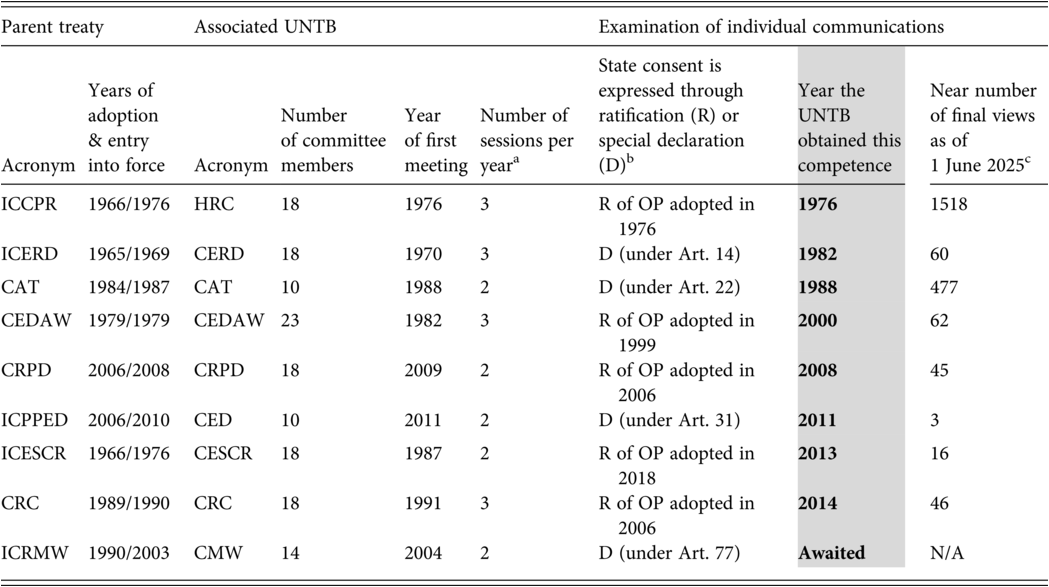
Although UNTBs’ final views are not legally binding, they carry authority. As such, they can offer some form of redress to victims of human rights violations who either are not legally entitled, or do not wish,Footnote 4 to turn to one of the three regional – African, European and Inter-American – systems of human rights protection. This is not to say that everyone around the globe has a legal avenue to complain when their human rights are violated: despite the ambition of the treaties to have a global reach, an individual can only address a communication to a UNTB regarding a state which has specifically accepted the procedure – through ratification or a special declaration to this effect, as dictated by the relevant instrument (see Table 1.2 as to which method is applicable for each body).

Table 1.2 Long description
I C C P R. Years of adoption and entry into force, 1966 and 1976. Associated U N T B, Acronym, H R C. Number of committee members, 18. Year of first meeting, 1976. Number of sessions per year, 3. State consent is expressed through ratification R or special declaration D, R of O P adopted in 1976. The year the U N T B obtained this competence, 1976. Approximate number of final views as of 1 June 2025, 1518.
I C E R D. Years of adoption and entry into force, 1965 and 1969. Associated U N T B, Acronym, C E R D. Number of committee members, 18. Year of first meeting, 1970. Number of sessions per year, 3. State consent is expressed through ratification R or special declaration D, D under Article 14. The year the U N T B obtained this competence, 1982. Approximate number of final views as of 1 June 2025, 60.
C A T. Years of adoption and entry into force, 1984 and 1987. Associated U N T B, Acronyms C A T. Number of committee members, 10. Year of first meeting, 1988. Number of sessions per year, 2. State consent is expressed through ratification R or special declaration D, D under Article 22. The year the U N T B obtained this competence, 1988. Approximate number of final views as of 1 June 2025, 477.
C E D A W. Years of adoption and entry into force, 1979 and 1979. Associated U N T B, Acronym, C E D A W. Number of committee members, 23. Year of first meeting, 1982. Number of sessions per year, 3. State consent is expressed through ratification R or special declaration D, R of O P adopted in 1999. The year the U N T B obtained this competence, 2000. Approximate number of final views as of 1 June 2025, 62.
C R P D. Years of adoption and entry into force, 2006 and 2008. Associated U N T B, Acronym, C R P D. Number of committee members, 18. Year of first meeting, 2009. Number of sessions per year, 2. State consent is expressed through ratification R or special declaration D, R of O P adopted in 2006. The year the U N T B obtained this competence, 2008. Approximate number of final views as of 1 June 2025, 45.
I C P P E D. Years of adoption and entry into force, 2006 and 2010. Associated U N T B, Acronym, C E D. Number of committee members, 10. Year of first meeting, 2011. Number of sessions per year, 2. State consent is expressed through ratification R or special declaration D, D under Article 31. The year the U N T B obtained this competence, 2011. Approximate number of final views as of 1 June 2025, 3.
I C E S C R. Years of adoption and entry into force, 1966 and 1976, Associated U N T B, Acronym, C E S C R. Number of committee members, 18. Year of first meeting, 1987. Number of sessions per year, 2. State consent is expressed through ratification R or special declaration D, R of O P adopted in 2018. The year the U N T B obtained this competence, 2013. Approximate number of final views as of 1 June 2025, 16.
C R C. Years of adoption and entry into force, 1989 and 1990. Associated U N T B, Acronym, C R C. Number of committee members, 18. Year of first meeting, 1991. Number of sessions per year, 3. State consent is expressed through ratification R or special declaration D, R of O P adopted in 2006. The year the U N T B obtained this competence, 2014. Approximate number of final views as of 1 June 2025, 46.
I C R M W. Years of adoption and entry into force, 1990 and 2003. Associated U N T B, Acronym, C M W. Number of committee members, 14. Year of first meeting, 2004. Number of sessions per year, 2. State consent is expressed through ratification R or special declaration D, D under Article 77. The year the U N T B obtained this competence, Awaited. Approximate number of final views as of 1 June 2025, Not Applicable.
a As indicated in each UNTB’s most recent rules of procedure or, when not indicated there (as for CEDAW and CED), in the information provided on the website of the OHCHR (under treaty bodies).
b Ratification is of the relevant optional protocol (OP) to the parent treaty; special declaration is as provided under the relevant article (Art.) in the parent treaty.
c As per the information provided in the OHCHR Juris database (which is not always exhaustive and sometimes contains duplications).
All UN member states have ratified or acceded to at least some core treaties.Footnote 5 The Convention on the Rights of the Child (CRC) has been almost universally adopted. Out of the 174 state parties to the International Covenant on Civil and Political Rights (ICCPR), 119 have ratified the Optional Protocol (OP) enabling individuals to bring communications to the attention of the Human Rights Committee (HRC).Footnote 6 By June 2025, the HRC had adopted some 1,500 views, representing by far the bulk of UNTB decisions on individual communications. In terms of volume of case law, the Committee against Torture (CAT) comes next with about 500 views, and then, following further behind, are the Committee on the Elimination of Discrimination against Women (CEDAW Committee, CEDAW) and the Committee on the Elimination of Racial Discrimination (CERD Committee, CERD), each with about sixty views to this day. With already more than 2,000 decisions overall, the UNTBs’ quasi-judicial output is increasingly subject to academic analysis.Footnote 7
Partaking in this trend, this book scrutinises one essential procedural aspect of the mechanism, namely the way evidentiary questions are handled. The topic is important. Evidence can make or break cases in any judicial, or quasi-judicial, proceedings. As the studies collected in this volume demonstrate, this truism applies equally to the UNTB communications procedure. The question of what is (to be) considered appropriate evidence within the context of the procedure is therefore crucial. As one starts to reflect upon it, it does not cease acquiring additional layers of complexity. It thus transforms itself into a series of sub-questions, including, in a non-exhaustive list:
1) How much evidence can/should be considered sufficient for finding factual allegations substantiated? Is it possible to give some measure of the evidentiary level that is to be reached, and this in various circumstances and at the different stages of the proceedings? (The short answer is, yes, this can be done, with the standards of proof developed in the Common Law tradition offering a useful avenue in this respect).
2) When the evidence before the adjudicator is not convincing enough, leaving the factual basis of the complaint uncertain, should the complainant necessarily stand to lose the case? (Short answer, not necessarily; there are circumstances where the burden of proof should be shifted to the respondent state, which, as a result, should lose the case if the shifted burden remains undischarged).
3) What evidentiary position should the adjudicator adopt when a state prevents the proof of its violating practices from emerging, including by refraining from engaging in the proceedings directed against it in a particular case? (Short answer, the evidentiary burden on the complainant should be lightened, which can be achieved in various ways that are worth distinguishing).
The three bullet points above are offered as teasers to make it clear that evidence in international human rights (quasi-)adjudication is a field that requires reflection and clarification. They are also meant to suggest that the resolution of evidentiary issues will often be a complex exercise. Hoping merely to be able to apply common sense will not do, the more so since ostensibly objective, scientific evidence is not always available and, even where it is, it is likely to remain subject to interpretation. What is required, therefore, is the construction of a fair and clear evidentiary normative framework. This should avoid the extremes of, on the one hand, unfettered flexibility,Footnote 8 leading to lack of consistency and fairness, and, on the other hand, undue rigidity that forecloses the possibility of delivering justice.
In this overall context, the collective ambition of this volume is, first, to highlight how clarity about evidentiary norms is currently in great part lacking in UNTB quasi-jurisprudence; second, to stress through concrete examples the importance of addressing this issue; and third, to recommend the adoption of specific legal principles and/or practical ways of proceeding, which can contribute to the building of an evidentiary system fit for international human rights adjudication.
1.2 The UN Treaty Bodies: Mandate, Composition and Mode of Working
As already mentioned, there are currently nine core UN human rights treaties, each of which has an associated committee supervising its implementation. For example, the Committee on the Elimination of Racial Discrimination (CERD) monitors the implementation of the International Convention on the Elimination of All Forms of Racial Discrimination (ICERD).
The nine treaties obviously differ in the nature of their coverage. The two so-called covenants are general, aiming to cover all civil and political rights on the one hand and all economic, social and cultural rights on the other hand. These covenants had originally been intended to follow swiftly the proclamation of the Universal Declaration of Human Rights (emphasis added) with legally binding provisions. However, the onset of the Cold War resulted in the covenants’ negotiation taking two decades, and their entry into force a third one. Three further conventions each address a specific type of human rights violation, namely: racial discrimination; torture and other cruel, inhuman and degrading treatment or punishment; and forced disappearance. Four other instruments are framed by reference to the persons whom they seek to protect, namely: women; children; migrant workers and their families; and persons with disabilities (for these instruments’ exact titles, see Table 1.1). One may imagine that additional human rights treaties may come to be adopted in the future.
In general, the core treaties not only create their supervising body but also define the latter’s mandate. The central function of the committees is the examination of periodic state reports. Every state party to a treaty is expected to submit, at periodic intervals, a report detailing ‘the measures they have adopted which give effect to the rights recognized herein and on the progress made in the enjoyment of those rights’.Footnote 9 Each submitted report is examined by the relevant committee, which, at the end of this process, issues ‘concluding observations’. Such ‘state monitoring’ is the key method through which the UNTBs discharge their supervisory function. It takes an enormous amount of committee time, as well as a lot of work on the part of the participating states, which must write a periodic report for each treaty to which they are parties. This situation has resulted in calls to avoid duplications and in the adoption of ‘mainstreaming’ measures.Footnote 10
UNTBs also have other functions, usually either outlined in the original text of their parent treaty or provided for in an additional protocol to the latter. The quasi-judicial competence to receive and examine communications from individuals who allege having suffered a violation of the parent treaty has become generalised across all treaty bodies. In addition, most committees are empowered to examine inter-state communications.Footnote 11 Admittedly, this function is almost irrelevant in practice due to states’ overall reluctance to institute proceedings against their peers.Footnote 12 Under the condition that the state party has agreed to the relevant provisions, most committees are granted the power to investigate a situation through an inquiry procedure,Footnote 13 early warning mechanismsFootnote 14 and/or urgent actions.Footnote 15 The Subcommittee on Prevention of Torture and other Cruel, Inhuman or Degrading Treatment or Punishment (SPT), created in 2002 by the Optional Protocol to the Convention Against Torture, has a specific mandate to visit places where people are deprived of their liberty (states willing).Footnote 16 Finally, all UNTBs have developed a practice of writing ‘general comments’ which interpret the rights guaranteed by their parent treaty.
It is not only each committee’s mandate but also the number of experts sitting on it, their conditions of eligibility and the broad terms of reference for their work which are set out in the relevant parent treaty. In a range going from ten (CAT and CED) to twenty-five (SPT) members, the majority of committees are made up of eighteen members, as indicated in Table 1.2.
The ICCPR mandates that the members of its committee be ‘persons of high moral character and recognized competence in the field of human rights, consideration being given to the usefulness of the participation of some persons having legal experience’.Footnote 17 Without being exactly reproduced, this formulation has a broad equivalent in the parent treaties that followed. The Addis Ababa Guidelines represent the most elaborate attempt so far to ensure that candidates for UNTBs have the required skills to qualify for membership, and importantly, that they are independent. In particular, the Guidelines provide that ‘Members [shall] avoid functions or activities which are … incompatible with the obligations and responsibilities of independent experts under the relevant treaties’.Footnote 18
There is no requirement for members to be legally trained, let alone to have legal or judicial experience. This arguably presents both advantages and disadvantages. For example, the Committee Against Torture has reportedly benefited from being able to rely on medical or psychological expertise within its membership.Footnote 19 On the minus side, those members who are not legally trained are dependent on others (such as the administrative staff who support the UNTBs’ work) to explain to them the significance of the legal intricacies that their quasi-judicial function inevitably generates.
The members of any given committee are elected by the states parties to the parent treaty. They serve in a personal capacity for four years, with elections staggered every two years. Members are elected in line with the principle of equitable geographical distribution, and two treaties (ICRPD and ICPPED) also explicitly mention balanced gender representation.Footnote 20 In practice, political considerations enter this electoral process, with a generalised practice of vote trading among states reported by some observers.Footnote 21 Despite this context, ‘the overall level of independent expertise possessed by committees [remains] surprisingly high’.Footnote 22
The rules of procedure of each committee outline the general conduct of sessions. For example, the Rules of Procedure for the HRC state that the Committee ‘shall hold sessions as may be required for the satisfactory performance of its functions’ and ‘normally hold[s] three regular sessions each year’.Footnote 23 It has become the norm for a committee to meet in Geneva two or three times a year for between two to four weeks, depending on the number of state reports received and communications registered. Some committees hold pre-sessional preparatory meetings.Footnote 24 Due to a number of UN member states not paying their financial contributions, funding for the organisation of these meetings has been under pressure.Footnote 25
Committee members are not remunerated for the time they devote to fulfilling their UNTB functions. They perform these functions on the side of their regular professional occupation. Only their expenses directly related to their obligatory attendance at in-person meetings are compensated by the UN through a daily subsistence allowance, with travel costs also borne by the UN.
Given their restrictive mandates and their composition of unremunerated independent experts meeting for limited periods, UNTBs were not expected to make much of a difference. It is precisely because of this predicted insignificance that states had originally agreed to their creation. In practice, however, UNTBs have grown to play an important role, including as quasi-judicial bodies. It is to this procedure, which is the focus of this book, which we now turn.
1.3 The UNTB Individual Communications Procedure: General Features
In addition to the eight UNTBs that currently fall within the purview of this book, we have decided to include a chapter in this book on a ninth body: the Working Group on Arbitrary Detention (WGAD). The WGAD is a special procedure created by the former Commission on Human Rights (predecessor of the Human Rights Council), with competence to examine individual communications related to a particular right – the right to be free from arbitrary detention. Although the WGAD is not attached to a specific treaty, it is concerned with an issue that cuts across the scope of a number of core human rights treaties. The procedure it follows is also akin to how the UNTBs proceed, with the difference that the respondent state does not need to have specifically accepted the WGAD’s competence. Many of the features outlined below may therefore also be shared by the WGAD, albeit with necessary nuances to be taken into account.
The UNTB individual communications procedure starts with one or more individuals sending a communication alleging they have suffered a violation of their rights, due to a particular action or omission by a state, under the parent treaty of the UNTB addressed. Nowadays, this communication is done online.Footnote 26
Instead of going directly to the UNTB concerned, this communication is first looked at by the Petitions Section, which fulfils the secretariat function on behalf of the Office of the UN High Commissioner for Human Rights (OHCHR). This small section, of which all members are currently legally trained, lends UNTBs the administrative support they need for their functioning. As such, it handles all cases that enter the individual communications procedure, whichever particular UNTB is addressed.
As is the case for the three regional human rights courts, the procedure is comprised of four distinct stages: (1) registration, (2) admissibility, (3) merits and (4) follow-up. RegistrationFootnote 27 is to take place on the simple verification that elementary conditions are fulfilled. Although the successful passing of this initial stage requires some facts to have been stated (such as the name of the complainant and the object of the complaint),Footnote 28 registration does not involve a thorough examination of evidence; at this stage, statements are meant to be taken at face value. This does not prevent, however, over eighty per cent of complaints from already being rejected at this stage,Footnote 29 and this without public trace (as there has been no registration of the case).
After registration comes the admissibility stage. Each UNTB sets its admissibility conditions in its rules of procedure. Whatever the exact phrasing under which they appear, these conditions are typical of international human rights adjudication. They may include that the complaint must be directed against a state which has specifically accepted the procedure; it must not be anonymous; it cannot have been submitted to the adjudication of another international body; domestic remedies must have been exhausted (with exceptions discussed in Chapter 6 of this volume); and it must be sufficiently substantiated (the normative meaning that this phrase should receive is explored in Chapter 3 of this volume).Footnote 30 The state is obviously the party that has an interest in claiming that one or more of the admissibility conditions are not fulfilled. It often does this. To determine whether such a claim is legitimate, the adjudicating committee may have to assess related evidence which has been submitted by the parties. Especially in regard to the last two conditions, this may give rise to complex issues and/or controversial decisions.Footnote 31
If a committee decides that the complaint is admissible, it goes on to address its merits. In such a case, the admissibility and merits of the communication are usually addressed within the same written decision. Until recently, a state could request proceedings to be ‘split’ between these two phases. However, this possibility disappeared in May 2024, when all eight committees with the power to examine individual communications announced that in the interests of efficiency, they would address admissibility and merits at the same time.Footnote 32
Unless the committee is persuaded that the facts underlying the complaint have been properly established by the domestic authorities prior to having been communicated, consideration of the merits inherently requires a determination of the facts. In turn, this almost inevitably involves the resolution of evidentiary questions, and therefore the application of evidentiary principles. As repeatedly observed in the chapters that follow, these are often and regrettably left implicit in UNTBs’ decisions.
The follow-up stage does not feature much in this book, but the few chapters addressing this nonetheless indicate that evidentiary issues can arise at this stage too.Footnote 33
The reader interested in learning more about the procedural aspects outlined above is invited to turn immediately to Chapter 11, which not only systematises the recommendations which the contributors to this volume have individually and collectively identified, but also puts these recommendations in the context of the procedure, thereby giving slightly greater detail on the latter than provided in this introduction.
Within the confines of the present chapter, we shall content ourselves with highlighting four major characteristics of the procedure. The first is that the procedure, usually conducted in English,Footnote 34 is typically written from beginning to end. The parties take it in turn to submit their arguments, including the evidence upon which they wish to rely. Whilst UNTBs’ rules of procedures tend to provide for how many rounds of exchange can take place before a decision is to be adopted, little regard seems to be given to these precepts in practice, putting especially the less resourced complainant under strain.Footnote 35 Importantly given the subject of this book, at least some committees may hold oral hearings. However, the avenues that exist to make this possible are rarely, if ever, applied.Footnote 36 In practice then, bar the occasional exception, only the information submitted in writing by the parties is before the committee. This may include third-party interventions (TPIs). (Although only twenty-six TPIs had been referenced in UNTB views up until 2021,Footnote 37 their number is increasing).Footnote 38
The second point we wish to stress is that the procedure relies heavily on the secretariat work accomplished by OHCHR through the Petitions Section. The fact that each committee meets for a limited period each year and that its members have other main professional activities means that the support provided by the secretariat is crucial. Committees generally base their deliberations in individual cases on, inter alia, summaries of the parties’ submissions and a draft decision which the committee’s rapporteur has prepared with the secretariat’s support. Draft decisions being confidential, it cannot be gauged how often committees (do not) follow them. Committee members have always been entitled to receive the parties’ submissions (including those regarding evidence) in full.Footnote 39 This, however, used to require proactivity on their part, in that this was subject to their specific request. This is no longer the case: members are now able to access case files directly on the intranet (with the possible exception, e.g., of documents that were not submitted electronically).
Our third point relates to the general under-resourcing of the procedure. The under-funding from which UNTBs have chronically suffered is getting worse as member states are increasingly refraining from paying (all of) their contributions to the UN. Anthropologists Niezen and Sapignoli have poignantly described how dependence on unforthcoming financial state support is ‘the most significant peril faced by international organizations’.Footnote 40 This conclusion applies in particular to the UNTBs, as may be illustrated by the superficially mundane but ultimately significant example of the time and word space within which they are expected to process individual communications. In 2014, the UN General Assembly decided that, in view of the need for greater efficiency, a committee would be allocated 1.3 hours of discussion time for each individual communication; a word limit of 10,700 words was imposed for the drafting of all UNTB documents, including final views on individual communications.Footnote 41 The time limit was expressly reaffirmed in 2022.Footnote 42 The aforementioned suspension of the consideration of ‘split requests’, announced in May 2024, is another example of a measure adopted to increase efficiency amid chronic budget shortfalls. Worst of all, in autumn 2024, the deepening funding crisis led to a shortening of UNTBs’ ordinary sessions, with uncertainty lingering as to whether they might be able to hold their next session.Footnote 43
These logistical conditions do not leave UNTBs’ functioning unscathed. They cannot but have knock-on effects all around UNTB work, including on the evidentiary examination in the individual communications procedure. Whilst we are not in a position to document this exact impact in this book, this is an important dimension which cannot be ignored.
1.4 Research Challenges and How This Volume Met Them
This collection is an output of the DISSECT research project devoted to the study of evidence in international human rights adjudication, and more specifically, of the work package within this project devoted to the UNTBs’ individual communications procedure.Footnote 44 This work package required eight institutions to be studied (with the addition of WGAD raising this to nine) – a number prone to daunt even the most experienced comparatist. An additional difficulty arose due to the difficulty of accessing data. Although the JURIS database was created by the OHCHR in 2022, the search results it generates are not comprehensive. These sometimes contain duplications, and other times miss some relevant cases due to keywords not always being consistently tagged. Furthermore, the database seems to suffer delays in its updating. Taking the HRC as example, the latest searchable views in June 2025 dated back to March 2024, thus excluding the views adopted over the then last three sessions.Footnote 45 Yet another issue exacerbated by funding constraints is the lack of translation, with decisions and guidance material not made available in all six official UN languages.Footnote 46
Whilst the UNTB work package of the DISSECT project was never going to be easy to complete, a fortunate serendipitous series of events led to the idea of completing it through the organisation of a symposium, followed by the publication of an edited collection. Of course, this way of proceeding did not make the research challenges of this study evaporate. Two elements nonetheless rendered them more manageable. The first is that it no longer fell upon one individual researcher to ensure sufficient mastery of a case law dispersed across a large number of bodies. Instead, each contributor could take advantage of the expertise which they had acquired prior to joining the project, in respect of either a particular UNTB or a jurisprudential issue. The second is that both our call for papers and the symposium generated a wide range of contributions of high quality, from which we were able to select studies that would collectively offer a remarkable breadth and depth of research.
The majority of our contributors hail from legal academia; many are (also) involved in legal practice, or straddle two academic disciplines. The chapters are geared towards providing a sustained case analysis, except for Chapter 8, of which the central argument is built normatively, and Chapter 11, which systematises the recommendations. The number of cases reviewed in the other eight chapters is explicitly communicated each time. It varies from over four hundred cases (Chapter 3) to just two cases arising from the same situation (Chapter 10). The ten chapters address evidence in the UNTB procedure from different angles: four studies analyse the evidentiary approach of one particular body; four studies consider how one specific evidentiary question is/should be addressed across the committees; and two case studies fall outside this categorisation.
Citing them in the order in which they appear in this volume, the four studies focusing on a particular body relate to:
CERD’s persistently weak evidentiary framework – even after four decades of adjudicatory practice (Chapter 4 by academic lawyer Klocker).
WGAD’s increasingly systematic evidentiary approach over time, traced through three successive phases (Chapter 5 by academic lawyer and WGAD member Gillett, together with Karukaya and Marzotto, two legal practitioners who had previously studied with Gillett).
HRC’s readiness to reverse the burden of proof when the state refrains from participating in proceedings against it, in an analysis based on the adjudication of torture complaints (Chapter 7 by academic lawyer McCall-Smith).
CEDAW’s pioneering willingness to identify and denounce stereotypes which could otherwise be mistaken for evidence (Chapter 9 by legal academic Ghidoni).
The four cross-body studies analyse how one particular evidentiary issue is and/or should be dealt with across the UNTBs, as follows:
How prima facie, the standard of proof that should apply at the admissibility stage, is often distorted in practice, to the complainant’s detriment (Chapter 3 by legal practitioner and lecturer Reinsberg).
How a complainant should not be expected to exhaust domestic remedies which are not accessible (thereby also ineffective), and how to best address the evidentiary questions which arise in this particular respect (Chapter 6 by academic lawyer Campbell).
The importance of the adjudicator identifying when a seemingly isolated violation of human rights actually reflects a general practice, therefore needing to be treated differently (Chapter 8 by academic lawyer and legal practitioner Roberts).
Which practical recommendations derive from the various studies collected in this volume, to be offered to the UNTBs for their consideration (Chapter 11 by human rights practitioners Hakiki, Ploton and Reinsberg).
In addition, two case studies open and close the collection:
The first, on pushback complaints, calls for the human rights adjudicator to defeat state-created evidentiary voids through adjusted, clear and fair, evidentiary principles (Chapter 2 by law/anthropology academic Dembour and border litigator Hakiki).
The second can be seen as a cautionary tale against the impulse for the adjudicator (in casu, the HRC) to accept the allegations of a complainant without properly reflecting upon the (im)plausibility of the evidence submitted (Chapter 10 by anthropologists Halme-Tuomissaari and Toivanen).
In Section 1.5, we provide a longer summary of each chapter, this time within the context of the part in which we have located it in the volume.
1.5 The Book’s Overall Structure
Following a logic which helps us to start exposing what we consider to be the volume’s main findings, the book is divided into five substantive parts. Part I highlights the lack of clarity that characterises UNTBs’ evidentiary norms and practices across the board. Part II contrasts the long-term evidentiary trajectories of two particular bodies. Part III proposes solutions to the perennial problem of the most powerful party in proceedings, that is, the state, often trying to evade accountability. Part IV provides crucial socio-legal insights about how evidence ‘really’ works (or not). Part V systematises our collective recommendations for evidentiary clarity, fairness and transparency.
1.5.1 Part I: Standards and Burdens of Proof in Need of Clarification
Part I starts by highlighting the lack of clarity in the evidentiary practice of the UNTBs. This weakness, present across the whole field of international human rights adjudication, is no doubt encouraged by the flexibility which is said to characterise the consideration of evidence in this field, thereby discouraging the ‘fixing’ of the principles that are applied.Footnote 47 The result, however, is that evidentiary concepts and principles (including their exceptions) are not clearly enunciated, let alone consistently applied. Vagueness ensues. Worse still, the wrong understanding and/or incorrect application of appropriate evidentiary principles mean that justice is not attained. Two studies have been selected to illustrate this point.
Chapter 2 by Dembour and Hakiki notes the acute evidentiary challenges which pushback complaints raise, due to states actively striving to suppress any evidence of their pushback operations. The authors of the chapter argue that, despite state denials, the four pushback cases so far decided by UNTBs see the adjudicating committees (HRC, CAT and CRC) invariably reaching the right conclusion about the facts. However, these findings are not accompanied by clear evidentiary reasoning. This produces two risks. The first is that a procedural establishment of the facts, achieved through a reversal of the burden of proof onto the respondent state which then fails to discharge this burden, does not get distinguished from a substantive establishment of the facts (which is preferable when it can take place). The second risk is that vagueness surrounding the standard of proof applied may create the impression that stronger evidence needs to be presented than is actually normatively required.
Chapter 3, by Reinsberg, concerns the requirement for complainants to have demonstrated that their allegations are ‘sufficiently substantiated’ or ‘not manifestly unfounded’ to pass the admissibility stage. Reinsberg argues that these expressions equate to a prima facie threshold, which is commonly understood – throughout all types of international adjudication – as requiring the complainant to make a plausible claim. Having reviewed over four hundred decisions, Reinsberg advances that UNTBs neither apply the prima facie standard consistently nor even seem to have a clear understanding of what it requires. She demonstrates that the UNTB case law often ends up distorting the widely accepted meaning of prima facie by (1) requiring the complainant to present not only plausible but actually convincing allegations; (2) taking into account the state’s arguments and evidence for deciding admissibility; and (3) even sometimes appearing to expect the complainant to have already at this stage pre-emptively responded to defences which the state might consider raising in the future. In short, Reinsberg shows the ‘sufficiently substantiated’ requirement to be a bundle of confusions.
1.5.2 Part II: Overall Trajectories of Evidentiary Systems in the Making
Part II consists of two chapters, each of which looks at the evidentiary approach of one single body over its entire lifetime. The two histories recounted could not offer a more striking contrast. On the one hand, CERD is shown in Chapter 4 to remain to this day without an evidentiary system worthy of the name, despite having exercised the procedure for four decades. On the other hand, Chapter 5 praises WGAD for having refined its evidentiary system throughout its short existence, to the point of constituting an example that the UNTBs should emulate.
Her familiarity with CERD allows Chapter 4’s author, Klocker, to observe that CERD rarely discusses evidence. She offers, as an extreme example of this, the case of Dawas and Shava v. Denmark (2012, concerning mob violence against refugees) in which evidentiary questions were left completely unaddressed by the Committee at the merits stage. These questions were then brought back to the table by the respondent state during the follow-up phase, at a time when they no longer could be properly dealt with, in an attempt to justify the state’s strong resistance to implementing the decision. Klocker identifies a case at the other end of the spectrum, Zapescu v. Moldova (2021, about discriminatory employment practices), where both the standard of proof for procedural violations and the submitted evidence were comprehensively and convincingly discussed. Her hopeful conclusion is that subsequent elaborations of the same kind in its case law will lead CERD to develop a clear evidentiary pathway.
Chapter 5 argues that the more recently established WGAD is already there. Benefiting from insider knowledge, Gillett and his co-authors identify three distinct phases of establishment, expansion and consolidation in the development of the evidentiary approach of the Working Group. Throughout these phases, the WGAD’s evidentiary approach was progressively formalised and standardised, improving its appropriateness and consistency. In the authors’ view, this process reflects the entrenchment of the Working Group in the ecosystem of human rights bodies, rendering the WGAD an appropriate point of comparison for the UNTBs.
1.5.3 Part III: Developing Evidentiary Techniques Capable of Holding States Accountable
The book opens by planting the theme, in Part I, that a lack of evidentiary clarity mars much of the UNTB case law, and that this is problematic. Part II follows, highlighting that lack of clarity can be remedied by bringing … clarity. Its message is that evidentiary clarity can be achieved, since both WGAD and CERD (the latter admittedly not yet consistently) have managed this. Part III moves to another attribute which high-quality adjudication must also exhibit, namely that it actually delivers on its intended aims, and does so in a way that is fair to all parties.
The core aim of human rights adjudication is to hold states accountable for human rights violations. Within the focus of this book, the greatest obstacle to achieving such accountability is possibly the inequality of evidentiary arms which exists between the parties. If human rights adjudication is not to fail in its core mission, this inequality must deliberately and effectively be redressed by the adjudicator. Part III accordingly sheds light on evidentiary principles which are not yet (widely) accepted, but whose universal recognition and application would help in ensuring that states do not wriggle themselves off the hook of human rights accountability.
Chapter 6, by Campbell, is concerned with the admissibility of complaints: more specifically, with the rule that domestic remedies must have been exhausted before bringing a case internationally. Campbell accepts that the rule exists for good reasons, having to do with the subsidiarity of international human rights mechanisms and the importance of recognising domestic justice systems’ crucial role in remedying human rights wrongs. She is concerned, however, that exemptions to this rule must be recognised in respect of remedies that lack effectiveness owing to their inaccessibility. Reviewing a large body of case law, Campbell detects a return by the UNTBs to a more formalistic application of the exhaustion rule. Taking an opposite stand, she pleads for an expansive consideration of the variety of barriers that prevent access to domestic justice. She also reflects upon how specific barriers may realistically be evidenced by a complainant. She argues that both the identification of barriers and their evidencing would be best achieved through the adoption of an individual-centred, contextual approach.
Chapter 7 addresses a question pertaining to the merits phase – namely how the adjudicator should proceed when a state chooses not to defend itself against a complaint. Shifting the evidentiary burden from the author to the state appears to be the appropriate response in such a case. How exactly should this happen, however? McCall-Smith’s analysis of the HRC’s case law dealing with torture allegations reveals an increasingly consistent approach over time. Whether the shift is operated depends on the nature of the allegations, the evidence used to corroborate the allegations, and the extent of the state’s (non-)engagement. The HRC now seems to proceed in three logical steps before finding a violation of the prohibition of torture: (1) it verifies that there is at least some evidence corroborating the allegations; if so, (2) it presumes that the author’s factual allegations are true; (3) it upholds this presumption, which is rebuttable, only if the state has not offered evidence counteracting the author’s allegations.
Part III’s last chapter (Chapter 8) has a more systemic and contextual outlook. Authored by Roberts, its underlying premise is that even though human rights violations often form part of a pattern or practice of violations, the nature of the individual communications procedure often leads the adjudicator to treat them as if they were isolated incidents. Roberts explores how awareness of contexts of violations could and should inform UNTB practice, and this at four different levels: the way UNTBs receive information and the types of sources they recognise in their decisions; their approaches to the exhaustion of domestic remedies and the burden of proof; their case structuring; and their findings, recommendations and follow-up procedures. Roberts ends by observing that UNTBs are not only receivers but also key disseminators of information, and suggests ways in which their findings on patterns and practices of violations could be more effectively disseminated.
1.5.4 Part IV: What ‘Evidence’ May Leave Unseen
The first three parts of the book are mainly written from a legal perspective. Their chapters grapple with aspects of which most lawyers would instantly recognise the importance, but to which non-lawyers may find it difficult to relate due to their legal technicality. Part IV continues to scrutinise case law and to engage with the law. However, it does so in order to bring to light elements which are beyond the legal horizon, in that they would not immediately catch a typical lawyer’s attention. One chapter addresses the polluting effect of stereotypes on evidence; the next, the dangers of what its authors call ‘distant evidence’.
Chapter 9 explains that stereotypes are generalisations about the behaviour or characteristics of a group’s members. Presuming how certain individuals will act or present themselves, they provide ready-made narratives as to why and how events unfold. When operating ‘undetected’, they hamper the capacity to objectively analyse a factual situation. In the courtroom, they may lead to relevant pieces of evidence being ignored, irrelevant circumstances being given weight and unduly high standards of proof being imposed. Ghidoni notes that the CEDAW Committee deserves praise for having been a pioneer in recognising the polluting effect of stereotypes on the assessment of evidence. She observes, however, that the Committee does not invariably detect the impact of gender stereotypes on the evaluation of evidence performed by domestic courts. Her in-depth analysis of the views adopted by the Committee in selected individual communications reveals a mixed record. Ghidoni concludes by calling on the Committee members to become yet more attuned to the effects and harms of stereotypes, so that they are in a better position to ‘see’ discrimination.
Chapter 10 is a fascinating study of just two cases decided by the HRC. It highlights the multiple processes of translation of evidence which are involved in the processing of a complaint before a UNTB: from human event to legal case, from original language to the English UN lingua franca, from the parties’ original submissions to summaries prepared by the Petitions Section for Committee members. In the process, evidence becomes ever more distanced from its original texture and meaning. The analysed communication emanated from a Sámi leader in Finland who alleged that ninety-three persons had been unduly added to the Sámi Parliament’s electoral roll by a domestic court, and that another half a million could well follow suit. The Committee accepted these allegations, which the authors of the chapter, Halme-Tuomisaari and Toivanen, argue were utterly implausible. They conclude that, far from protecting human rights, the Committee’s decision had the opposite effect, including on the Sámi. This prompts them to reflect on the way an evidentiary regime shapes and supports certain narratives whilst marginalising others.
1.5.5 Part V: Going Forward: Practical Recommendations
Finally, Part V, consisting of just one chapter, brings together the recommendations that both the discussions at the symposium and the preparation of this book generated. Written by three practitioners from the civil society sector, with experience of the procedure – namely Hakiki, Ploton and Reinsberg – Chapter 11 acts as a very good introduction to the procedure. It addresses technical aspects (e.g., which standard of proof should be applied in which circumstances and at which moment of the proceedings; how and when the burden of proof should be shifted) with great precision. It also brings forth general organisational issues, including the importance of proper resourcing to create a transparent and accessible system.
1.6 Cross-Cutting Themes
The chapters collected in this book can be read independently of each other. However, they constitute more than a mere collection of distinct elements. Together, they offer an encompassing and multi-layered analysis of how UNTBs have been/are/should be (in our view) engaging with evidentiary issues in the procedure. Not surprisingly, then, the ten chapters echo each other at multiple levels. To appreciate this, the reader may wish to consult the index, which has been carefully compiled to make it possible to follow up on particular interests but also to discover themes which run across various chapters. As for this introductory chapter, we end it by identifying three points which have come up again and again in discussions with our contributors.
The first is that having a good evidentiary system is an aspect of access to justice. A rather mundane observation, this nevertheless needs to be stated in a context where evidentiary issues often escape academic attention. This book keeps returning to the fact that a lack of conceptual clarity characterises UNTB evidentiary practice, be it on basic concepts (e.g., ‘prima facie’ and the other standards of proof), more complex operations (e.g., the conditions under which the burden of proof should be reversed), or through a multitude of statements which appear in the evidentiary reasoning (e.g., the pronouncement that an evidentiary submission must be given ‘due weight’ – an expression which appears in our index). If the various standards of proof applicable at different stages of the proceedings are not properly distinguished, this is likely to lead to individual communications being declared inadmissible which should have had their merits examined (as Chapter 3 so eloquently highlights). At a more general level, if facts are not found to be established, this will foreclose any possibility that the human rights violations which they constitute will be recognised. Even if other violations are found in the case in question, this cannot but weaken the impact of the decision (as Chapters 2 and 9 especially note). There are, of course, multiple ways in which justice ends up being denied due to evidence-related factors. Chapter 4, for example, recounts a case where the state refused to implement a UNTB decision by rejecting the factual findings, which rested on poor evidentiary reasoning.
The OHCHR webpage on ‘Individual communications’ starts by stating: ‘Anyone may bring a human rights problem to the attention of the United Nations and thousands of people around the world do so every year.’Footnote 48 The same page concludes its introduction to the procedure with the following words: ‘The complaint mechanisms are designed to be accessible to the layperson. It is not necessary to be a lawyer or even familiar with legal and technical terms to bring a complaint under the treaties concerned.’Footnote 49 Whilst such accessibility may well be the procedure’s honourable intention, the reality of its practice belies this. Firstly, there are many people who are under the jurisdiction of a state which has not agreed to the procedure, and who therefore cannot avail themselves of it. Secondly, the rule of the exhaustion of domestic remedies, in force in respect of the eight UNTBs empowered to examine communications, considerably restricts the procedure’s practical reach. Obstacles to domestic justice which are not recognised by a committee translate into an insurmountable barrier to UNTB justice (Chapter 6). Thirdly, this book amply demonstrates that, in contrast to the case of WGAD (Chapter 5), the evidentiary requirements laid down by UNTBs are difficult to ascertain even by practicing and/or academic lawyers, let alone the general public. It therefore appears unduly optimistic to think that a victim of human rights violations could routinely, without the benefit of legal advice, manage to identify the type and level of evidence they should submit in support of their substantive claim (which itself will also need to be couched in legal terms). Indeed, the general opacity of the evidentiary system is the reason why the recommendations chapter, which concludes this book (Chapter 11), puts a lot of emphasis not only on the need for the applicable evidentiary principles to be clearly enunciated, but also on their effective communication, including on the currently rather difficult-to-navigate OHCHR website.Footnote 50
We now turn to our second cross-cutting point, which seeks to amplify the message at the core of Part III of the book. Simply put, there are many ways in which the respondent state may (seek to) torpedo the proceedings. Some state strategies are transparent, such as a complete disengagement from the proceedings, or utter denials that the facts at the basis of the complaint ever took place. To the extent that these manoeuvres are obvious, they may be relatively easy for a determined adjudicative committee to counteract, for example, by shifting the burden of proof or drawing adverse inferences (as in the torture case law examined in Chapter 8). However, it is important to bear in mind that the state’s evidentiary conduct may compromise the fair adjudication of a complaint in more subtle or inadvertent ways, as per the case study offered in Chapter 10.
This chapter is concerned with the Näkkäläjärvi case, where Finland was found by the HRC to be in violation of the ICCPR for having included certain individuals on the Sámi electoral register.Footnote 51 The chapter explains that the individuals in the case had actually been rightfully registered. This is to say that any human rights violations which arose in connection with this case were due not to the impugned actions of the State, but to the HRC’s decision itself, as it provoked Finland to de-register the individuals concerned. This is an extraordinary upending of human rights adjudication.Footnote 52 Going beyond the reflections offered in the Chapter, it can be observed that it is the failure of the respondent state – which neither defended the decisions of its Court of Appeal before the Committee, nor pointed to the absurd character of the ‘mathematical’ evidence submitted by the complainants – which led the HRC astray. The core problem, then, is that Finland erred in leaving certain facts undisputed; HRC therefore accepted the complainant’s factual allegations as established, as per the relevant legal principle.Footnote 53 Had Finland fulfilled its role of enlightening the Committee properly, another conclusion may likely have been reached. As it is, the decision deprived a number of Sámi of their right to vote, at the same time as putting the UNTB procedure, if not the human rights system more broadly, in a questionable light.
The third and final point we wish to make is that our critiques are not intended to beleaguer the UNTBs. This is the more so since we recognise the value of the human rights work accomplished by the committees, under logistical conditions which can only be described as sub-optimal. We particularly commend the development of case law that manages to denounce human rights violations, even in the face of serious evidentiary obstacles. Still, it is important that the case law achieves legal precision, consistency and fairness, and this requires reflection and conceptualisation. During the Symposium from which this volume emerged, CEDAW’s former Chair Hilary Gbedemah recounted how she had been in the habit of instructing new committee members to read the academic ‘bible’ on gender stereotypesFootnote 54 (also cited in Chapter 9). Our hope is that the present volume may emulate this experience, and encourage both UNTBs and committee members to recognise the importance of dealing with evidentiary issues in a systematic way, with constant reference to sound normative principles. The technical character of the field may appear forbidding at first sight, especially to the non-legally trained expert. Evidence, however, is an essential part of the task of delivering justice to victims of human rights violations.
Grappling with evidence cannot and should not be avoided. On the positive side, as the book hopefully also testifies, many of its complications tend to dissipate once it is given proper attention, allowing its rationale and requirements to become increasingly obvious.

 Open access