

A. Introduction: Gold in the Depths
Sometimes terrible people create magnificent things. This was certainly the case of Richard Wagner, who despite some truly odious character flaws,Footnote 1 produced perhaps some of the finest, and certainly the most ambitious, musical works ever devised within the Western canon. Der Ring des Nibelungen (The Ring of the Nibelung; hereafter The Ring Cycle) is a tetralogy comprised of three epic Musikdrama (music dramas) in three acts, with a single act “preliminary evening.” It is that preliminary piece, Das Rheingold (The Rhinegold; hereafter Rheingold), which concerns me here. Wagner wrote the librettos for his tetralogy in reverse order, although Rheingold was the first he set to score.Footnote 2 Despite my very great love for this music, my focus in this Article is upon the legal-philosophical content of Rheingold, which I argue to be considerable. Indeed, as I detail in what follows, Rheingold contains in outline what the tetralogy as a whole goes on to develop: a discrete Wagnerian conception of legality and its troubled place within the world that merits serious philosophical attention from academic lawyers. This claim—that there is something of genuine jurisprudential depth to be found within Wagner’s Musikdrama—is not as strange as it may first appear. The Ring Cycle is an artistic triumph in part because its themes and symbols are so philosophically rich, and Wagner was unique amongst his musical contemporaries, not only insofar as he was a prolific writer on political and philosophical matters,Footnote 3 but also because he read extensively and was vocal about the impact of particular philosophers upon his work.Footnote 4 We know, for example, that the librettos for all four Musikdrama were heavily influenced by Ludwig Feuerbach,Footnote 5 whereas the score of the last two, with the exception of Siegfried Act 1, was composed under an increasingly obsessive preoccupation with the work of Arthur Schopenhauer.Footnote 6 These are two very different thinkers and the tensions their influences create within the libretto and score go some way towards explaining the extraordinary complexity of Wagner’s work.
Understanding the jurisprudential significance of The Ring Cycle amidst the resulting philosophical bifurcation is further complicated by two things. First, Wagner’s initial development of a distinctive dramatic and compositional theory, set out in detail within his Oper und Drama (Opera and Drama),Footnote 7 as well as his views on the relation of art to both culture and politics, set out in Die Kunst und die Revolution (Art and Revolution)Footnote 8 and Das Kunstwerk der Zukunft (The Artwork of the Future).Footnote 9 These theories were applied strictly by Wagner to both his composition and authorship of Rheingold. The second complicating factor is Wagner’s later modification of his principles of composition in favor of a more symphonic approach, heavily influencing the score, but not the libretto, of both Siegfried and Götterdämmerung.Footnote 10 In fact, Wagner changed his mind so drastically on these topics during the long process of creating The Ring Cycle that there is little point in trying to understand his creative process as unified by anything like a singular intention.Footnote 11 Wagner set out to create a modern myth, borrowing from old German mythological figures, but changed his mind so completely about that myth’s meaning that seeking definitive answers to interpretive questions from his own writing is to chase shadows.
This Article adopts a different approach. My concern is not so much with what Wagner was trying to do so much as with what he in fact did. I approach Rheingold as a living cultural artifact that is interpreted, contested, and reimagined by conductors, stage directors, and dramaturgs, and ask what this nexus of words, directions, and sounds can tell us as legal scholars when examined through jurisprudential eyes and ears. My aim in doing so is threefold. First, by teasing out the legal-philosophical meaning within Rheingold, I hope to demonstrate that Wagner was a serious jurisprudential thinker—an aspect of his intellectual and artistic contribution that has hitherto been almost completely overlooked. Second, I aim to outline the basic tenets of what might be called “Wagnerian jurisprudence” as a substantive take on the nature of law and its connection to concepts such as statehood, violence, and authority. Third, by locating this jurisprudential content within not only the libretto and dramatic visuals of Rheingold but also its score, I aim to illustrate by extended example the possibility of receiving complex legal-philosophical meaning through layered harmonies. This possibility enables a new form of jurisprudential cognition that is more visceral than the typical academic approach of reflecting upon concepts communicated by non-fiction prose.Footnote 12 Controversial and conflicting conceptions of law, the state, and injustice can be perceived within Wagner’s music, thereby invoking the beginnings of philosophical awareness within his listeners before conceptual reflection begins. The realization that such “auditory jurisprudence” is both possible and fruitful necessarily broadens our understanding of what counts as legal philosophy.
The method I employ to establish these points is “creative interpretation,”Footnote 13 and its aim is to understand Rheingold in its best light as a serious artistic engagement with legal-philosophical ideas, while acknowledging that such engagement is only one small part of what it can be made to achieve. As such, I do not pretend to disclose the meaning of Wagner’s work: only some meaning that can be found within it. By this token, I also hope to excuse myself for utilizing several philosophical works that Wagner himself could not possibly have contemplated, written as they were long after his death in 1883. Section B begins my analysis by further detailing my overall approach, explaining both the artistic format that Rheingold takes and the role of symbolism within its score and libretto. I endorse existing arguments for why we should resist allegorical, as opposed to symbolic, interpretations and detail the desiderata for plausible jurisprudential engagements with cultural artifacts of this kind. Section C examines two concepts that feature prominently within Rheingold—authority and legality—and engages with them through a symbolic analysis of the libretto and score surrounding the god Wotan, his sacred spear, and the mountain fortress of Walhall. Section D does the same but in relation to the concepts of domination and violence, focusing upon the dwarf Alberich, the giant brothers Fafner and Fasolt, and the tetralogy’s titular ring of power. Section E presents a brief conclusion, arguing that a larger interpretive project along similar lines could be undertaken quite fruitfully in relation to the entire The Ring Cycle. In so doing, I hope to provide readers with an outline of Wagnerian jurisprudence that not only motivates further reflection but that also illustrates the potential of Musikdrama as such to contribute towards the philosophical study of legal phenomenon.
First, however, a brief plot summary of Rheingold is in order.Footnote 14 Shortly after the curtain rises on the river Rhine, the dwarf Alberich is lusting after the Rhinemaidens—three water nymphs charged with protecting the shimmering Rhinegold. Harshly rejected, Alberich turns his attention to this treasure, which he is warned cannot be claimed other than by one who renounces love. Embittered by rejection, Alberich does indeed renounce love and snatches the Rhinegold away with him down to the dwarven realm of Nibelheim, with the intention of forging a ring from it that will give him power over all the world. The drama then shifts to the gods high above, where Wotan their leader is being reproached by his wife Fricka for his promise to give Freia, the goddess of youth and love, to the giants Fasolt and Fafner. Wotan has made a bargain with them to hand over Freia in payment for the construction of Walhall—a mighty fortress from which he can oversee the world. Wotan has no intention of honoring this bargain, such that when the giants demand payment, he elicits the help of the primordial spirit Loge, who suggests an alternative prize: the ring forged by Alberich and the other treasures its power has enabled him to claim. The giants accept this compromise, which sees Wotan and Loge descend to Nibelheim in search of these riches. There they meet Alberich’s brother Mime, who has forged a magical helmet called the Tarnhelm, which allows its wearer to adopt any shape they wish. Alberich, it appears, has used the ring to enslave the Nibelungs and force them to extract more gold from the bowels of the Earth. When Alberich appears, Loge plays upon the dwarf’s pride to trick him into using the Tarnhelm to transform into a frog, which Wotan captures. Victorious, they secrete Alberich away to the surface and force him to summon his Nibelung slaves to bring up the gold. Wotan then snatches the ring from Alberich’s finger, at which point the dwarf utters a terrible curse: All who possess the ring shall suffer misery and death. Returning on high, Wotan heaps up the gold and places the Tarnhelm on top but refuses to surrender the ring to the giants. At this juncture, the primal spirit Erda appears to him and warns that he must give up the ring. Wotan eventually agrees, at which point Fafner turns upon his brother Fasolt and murders him, claiming the entire bounty for his own. As Fafner departs, the god Froh creates a rainbow bridge to Walhall while Donner clears the sky of clouds. The gods enter the fortress together, as the Rhinemaidens scream outside for the return of their gold and Loge mocks the gods for their stupidity and inevitable downfall. The curtain then falls on the preliminary evening.
B. Jurisprudence and Gesamtkunstwerke: Allegory, Symbolism, and Creative Interpretation
My aim, as noted above, is to locate within Rheingold the central tenets of “Wagnerian jurisprudence” and to illustrate in so doing that Wagner was a serious jurisprudential thinker, gifted at conveying legal-philosophical meaning through various means, including layered harmony. To do this, I undertake “creative interpretation”: The fundamentally constructive exercise of interrogating meaning within an object by taking it seriously as an example of the form or genre to which it belongs.Footnote 15 For instance, to interpret creatively The Great Masturbator by Salvador Dalí is to reason how it might be understood as both a great painting and a great example of surrealist art.Footnote 16 Creative interpreters must view the painting in its best evaluative light, relying on higher order evaluative positions concerning the purpose and value of both painting and surrealism.Footnote 17 This exercise is naturally constrained by the object itself: It would be nonsensical to argue that The Great Masturbator is truly a commentary upon the discovery of the Higgs boson, just as it would be implausible to contend that Rainy Taxi is really a portrait of Donald Trump.Footnote 18 Therefore, although creative interpretation should always seek to make of its object the best that possibly can be made, it must also maintain plausible fidelity. This follows because, in normative terms, the very act of seeking meaning within an object assumes both the value of truth-seeking as such and the possibility of locating value within the object itself.Footnote 19
Rheingold presents a particular challenge for creative interpretation because its form and genre are so complex. Wagner thought of his Musikdrama as Gesamtkunstwerke (total artworks), insofar as they combined several discrete art forms—music, poetry, and theater—within a unified performance.Footnote 20 For this reason, it would demonstrate a problematic lack of fidelity to interpret the libretto of Rheingold in abstraction from its score or potential visual effect: It can only be interpreted as a musikdrama. This being so, any search for jurisprudential meaning within Rheingold cannot come at the expense of divorcing it from its essence as a performance to be seen, heard, and experienced emotionally. The hope instead must be that whatever legal meaning can be located within Wagner’s work will enhance these elements, rather than detract or distract from them. Moreover, insofar as Rheingold itself presents the opening of a modern myth, fidelity requires that its libretto, score, and potential for staging each be viewed as component mythological articulations, which means as primarily symbolic, rather than allegorical.Footnote 21 There are also important evaluative reasons for adopting this view, concerning the relationship between symbolism and drama. To quote from Scruton:
In allegory two stories are told, one the explicit story, involving character, action, place and time, the other the implicit or esoteric story, concerning abstract ideas, cosmic forces and moral doctrines…. Symbolism is distinguished from allegory in that the symbol both expresses a meaning and also adds to it, so that meaning and symbol are to a measure inseparable.Footnote 22
This additive nature of symbolism is crucial to the dramatic value of mythology because myths are necessarily informative and pedagogical. Their dramas tell us something about the concepts symbolized within them, as in the case of Heracles: an early Western exemplification of great power bringing with it great responsibility. Allegory, by contrast, necessarily involves the replacement of one story with another insofar as the explicit story is subverted, at the level of meaning, by its implicit counterpart. For this reason, symbolic works are always more than they appear, whereas allegorical works are very often less. This is the crux of Cooke’s powerful argument against Jungian interpretations of The Ring Cycle,Footnote 23 which is worth reproducing at length:
The fatal defect of Jungian interpretation is that it simply imposes its own categories on the work interpreted. Sieglinde and Brünnhilde have to be anima-figures, Hunding and Hagen have to be representations of the shadow, the dragon has to be the Terrible Mother, because these are the only categories available. Just so, in Hamlet, say, Ophelia would have to be Hamlet’s anima, Claudius his shadow, and Gertrude the Terrible Mother, and the whole work would have to be treated as a therapeutic development of the psyche; likewise, the last stage would have to be nobody’s actual death, but a general rebirth, reception for the shadow, which would disappear, leaving the psyche in one final healthful state of transformation—and the peculiar quality of the masterpiece Hamlet unilluminated.Footnote 24
The point here is not that wholly allegorical interpretations fail in terms of fidelity, although that may also be true. Rather, as Cooke’s comparison with Hamlet shows, allegory locates meaning externally, such that the artwork itself is only a receptacle of that supposed truth rather than a contribution towards it. Symbolic works, by contrast, always claim to tell us something new about the concepts with which they engage. It is the drama of Heracles’s labors that show us how it is through virtue and service, rather than physical might alone, that mortals obtain absolution. We learn about strength and its relationship with ethics by contemplating such tales. With allegory it is different: Once detected, allegory informs nothing more than the meaning of the particular work in question. Indeed, when faced with truly allegorical works, we cannot understand them without already comprehending the external matter to which their meaning is subservient. For this reason, to put matters crudely, works of symbolism are evaluatively superior, qua cultural contributions, to mere allegories.
When seeking to understand Rheingold as a work of legal philosophy, all of this means that we must be exacting in what we require from creative interpretation. Any plausible interpretation of this sort must engage with Rheingold as a work of symbolism that sits within a larger mythical tetralogy, which itself comprises a gesamtkunstwerk of unified music, poetry, and theater. Moreover, these sonic, literary, and dramatic components must be constructed in such a way that their contribution to our understanding of jurisprudential concepts is maximized, while at the same time not allowing this illuminating power to swallow whole the far broader symbolic and dramatic potential of the Musikdrama itself. In what follows, I attempt this by addressing my attention to four concepts—authority, legality, domination, and violence—as they arise within the libretto, score, and staging of Rheingold. In so doing, I focus on the representation of these four concepts through six symbols: the god Wotan, his spear, the fortress of Walhall, the dwarf Alberich, the giants Fasolt and Fafner, and the ring that Alberich creates from the stolen Rhinegold. At all points, I aim to show not only that Wagner creates significant jurisprudential content but also that, properly interpreted, Rheingold contains important insights of contemporary relevance to legal philosophy as a whole, delivering these insights harmonically, as well as semantically and visually. Wagnerian jurisprudence, or so I will suggest, is characterized by its pessimistic view of legality as an agent for social change and its commitment to law’s essential ambiguity. It sees legality as both a social fact and an ethical ideal, and as a space within which the better impulses of humanity clash with our darker natures. For these reasons, it cannot be neatly categorized as “positivist” or “non-positivist,” nor as “critical” or “constructive.” For Wagner, as I shall attempt to illustrate, law is fundamentally a deeply tragic thing, doomed to failure in its own lights by the tensions inherent within its own moral and conceptual structure.
C. Authority and Legality: Wotan, His Spear, and the Fortress of Walhall
In this section, I begin outlining the claims of Wagnerian jurisprudence by utilizing creative interpretation to locate discrete conceptions of authority and legality within three symbols that Wagner creates within the music, poetry, and drama of Rheingold. The first of these is the god Wotan, who along with the Valkyrie Brünnhilde and the chaotic hero Siegfried is as close to a protagonist as we come in The Ring Cycle as a whole. Wotan is only very loosely based upon his cognate deity in Germanic and Norse mythology, having far more in common dramatically speaking with the Ancient Greek Zeus.Footnote 25 But in addition to being a truly horrendous husband and father,Footnote 26 any plausible interpretation of his symbolic meaning ties Wotan closely to both authority and legality, the latter of which encompasses both the rule of law, understood as a normative ideal, and rule by law, in the sense of governance through norms. To quote Magee:
His is the first law, the beginning of law as such…. It is based entirely on peaceful consent, agreements, contracts and treaties. The symbol of this power is Wotan’s spear. He always carries it, not because he stabs people with it (he never does), but because the contracts and treaties that constitute the world-order that he has established are carved on its shaft, and he is their guardian…. But of course symbolism tells us that even the most consensual and minimal order can obtain only if it is backed by the possibility and the show of force.Footnote 27
Magee is essentially correct here, although he must be amended on one point: Wotan’s spear is a symbol of manifested practical authority and not of either political power or instrumental violence,Footnote 28 a fine yet important distinction.Footnote 29 A similar conflation is made by Kitcher and Schacht, who conceptualize Wotan’s practical authority in their analysis as “the ability to make things happen—the power (of one sort or another) to impose his vision of things and his designs upon others.”Footnote 30 The essential point, however, is that Wotan himself fulfils the role of “Mr. Law-and-Order” within Wagner’s myth,Footnote 31 symbolizing not only law itself but also elements of the modern state: a mode of political organization that developed, in Germany at least, during Wagner’s lifetime.Footnote 32 Indeed, many dark and sinister elements within The Ring Cycle can be read as reactions to contemporary statehood and economic-cum-social power that supports it. Interestingly, however, though Wotan is by his own admission deceitful and megalomaniacal,Footnote 33 his motivations are noble. To quote Kitcher and Schacht:
By the time we meet him, Wotan understands very well the force of dark instincts that motivate some of his fellows and the need for a comprehensive solution to the problems they present if things are ever to go differently. The rule of law he establishes is intended to tame them, to bind all in a covenant of light.Footnote 34
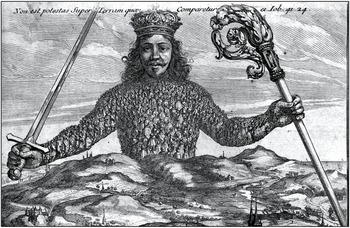
He is akin, in this respect, to the sovereign “head” of the Hobbesian leviathan, pictured in Figure 1 below, which brings order from chaos through an authority granted by contract—the power to do so being concurrently created through the collective force that such authority marshals.Footnote 36 Like Hobbes himself, Wotan recognizes that “the state of man can never be without some incommodity or other; and the greatest, that in any form of government can possibly happen to people in general, is scarce sensible, in respect of … that dissolute condition of masterless men, without subjection to laws.”Footnote 37
The top half of the original frontispiece to: Abraham Bosse, Leviathan or The Matter, Forme and Power of a Commonwealth Ecclesiastical and Civil.Footnote 35

Figure 1 Long description
The illustration features a giant figure, akin to a sovereign head, wearing a crown and detailed armor. The figure holds a sword in the left hand and a scepter topped with ornate designs in the right hand. The background shows a landscape with hills, buildings, and a body of water, suggesting a vast territory under the figure's dominion. The figure's imposing presence and regal attire symbolize power and authority, aligning with the concept of a Hobbesian leviathan.
This drive towards order and authority is essential to Wotan, as he tells his daughter Brünnhilde in Act 2, Scene II of Die Walküre: “When youthful love began to grow old, I longed to be lord of life. By bold ambition, driven and drawn, I won myself the world.”Footnote 38 Wotan’s longing, which he discloses in this scene, is reflected in his dream of Walhall, during Scene II of Rheingold, which sees him fantasize: “These halls of heavenly bliss are guarded by gates and bolts. Manhood’s honor, measureless might: promise of peerless renown.”Footnote 39 The darkly carceral image of “gates and bolts” is powerfully ironic, given the eventual fate of the gods in Götterdämmerung,Footnote 40 but it also evokes an aesthetic of artificial order that is central to the imposition of Wotan’s will upon the world. What precisely Wotan seeks within Walhall, over and above its physical security as a fortress, is a matter of great significance to Wagnerian jurisprudence as a whole. Indeed, to understand the conceptions of authority and legality that Wotan evokes within Rheingold, we must give attention to their manifestations: his spear and the fortress itself.
As Magee notes, the spear would be a visual symbol of violence were this not undermined by its use within the drama. The only time Wotan kills, he does so via a contemptuous wave of his hand, removing life from the murderer of his son Siegmund by way of restoring balance to the mortal world.Footnote 41 There is something vaguely pathetic in this—the spear, insofar as it also constitutes a phallic symbol, remains unused because Wotan, by his own admission, is impotent to attack his foes directly.Footnote 42 But this impotence, signified further when the spear is shattered in Siegfried Act 3, Scene 2 by the chaotic and virile titular hero of that piece,Footnote 43 itself betrays the jurisprudential subtlety of Wotan’s characterization. Unlike the dwarf Alberich, or the giants Fafner and Fasolt, each of which is discussed below, Wotan’s potency exists at the normative level of practical authority rather than the physical level of dominance or violence. He requires, rather than enforces, and obligates, rather than enslaves. This can be heard, for example, in descending scale of the leitmotif associated with the spear itself (Figure 2).
Wotan’s Spear Leitmotif

Figure 2 Long description
The image displays a musical score with a 9/4 time signature. The score features a series of notes, including eighth notes, sixteenth notes, and dotted notes, arranged in a complex rhythm. There are also various musical symbols such as slurs, ties, and dynamic markings that indicate the performance style. The score appears to be part of a larger musical composition, likely representing a specific motif or theme.
Leitmotifs are short, recurring musical phrases through which Wagner communicates layers of meaning, including jurisprudential meaning, to his listeners.Footnote 44 They are repeated and subtly augmented within the score to add non-linguistic context to the drama upon stage.Footnote 45 Each leitmotif evokes a concept—sword,Footnote 46 or arrogance,Footnote 47 for example—and each contains symbolic meaning within its own unique musical structure. In the case of the spear, its falling progression evokes the spear itself pointing down: a sonic representation of the physical object but also a symbol of command.Footnote 48 In the hands of Wotan, this symbol is one of rule by law—governance by means of norms—and evinces the practical authority of the god himself as a symbol for law and as an element of the state. In jurisprudential terms, Wagner communicates something discrete and important about the nature of legal authority through this component of his soundworld. The authority of law is normative, not physical: law itself merely instructs and requires, just as Wotan uses the spear to instruct and require. The actual enforcement of norms requires other techniques, symbolized musically by Wagner in quite different ways, as described below.
This interpretation of the score is corroborated by the dramatic use of the spear itself—Wotan brandishes it when he exerts authority in precisely this form—and by the poetry of the libretto on such occasions. For example, when in Rheingold Donner threatens to attack the giants with his hammer, Wotan holds forth the spear and proclaims: “Hold you hothead! Nothing by force! All bonds abide by my sacred spear. Strike not a single blow!”Footnote 49 The spear leitmotif accompanies this act, cementing the authority of Wotan within the mythological soundworld. The god’s abhorrence of violence by others signifies not only the Weberian proposition that states must claim a monopoly upon legitimate force, a point to which I return below,Footnote 50 but also that Wotan himself operates at the level of normativity alone. This is further reinforced by both his characterization of the spear as “sacred” and his reference to its physical form: upon the shaft of that weapon are carved the very treaties and contracts from which Wotan’s authority is derived. We first encounter this powerful imagery in the admonition of Fasolt that Wotan must honor “[w]hat [his] spear spells,” whereupon the giant warns: “Son of light, light of justice, listen and beware: to treaties be you true! What you are, you are only by treaties; and bound by rules, there are bounds to your reach.”Footnote 51 That Fasolt is correct about Wotan is confirmed by the god himself in his later admissions to Brünnhilde.Footnote 52 Yet perhaps more interestingly for present purposes, the giant’s remarks also track several important insights about the relationship between law, authority, and violence that can also be found in contemporary legal theory, developed long after Wagner’s own contribution.
Coercion, we now know, is only ever the law’s Plan B. Plan A is that its subjects should conform to it without further supervision.Footnote 53 Confirmed by Raz’s famous “society of angels” thought experiment,Footnote 54 this insight fits the mode of authority exercised by Wotan—the spear is brandished in expectation of compliance, not wielded to threaten with deadly force, and when finally met by a symbol of overwhelming force and total freedom in the form of Siegfried’s sword, it shatters. Moreover, the very idea of authority established, and so constrained, by treaty not only invokes the social contract tradition, which Wagner would have been familiar with through Kant,Footnote 55 but also reflects broader sensibilities that the acquiescence or tolerance of the governed is at least characteristically a necessary condition for the stability of political rule.Footnote 56 Furthermore, the notion of legal authority as necessarily self-limiting plays both upon Dworkin’s observation that “the most abstract and fundamental point of legal practice is to guide and constrain the power of government,”Footnote 57 as well as upon claims that constituted legal authority is so tied up with the constituent potential of multitudes coming together to form polities that it is difficult to draw sharp lines between these two things.Footnote 58
Wagner’s poetic, visual, and harmonic representation of these insights through Wotan’s use of the spear pulls them together into an accessible symbolism that is recognizable by his audience at the intuitive level. In these parts of the drama, legal philosophy is communicated viscerally, rather than conceptually, while losing none of its complexity. Indeed, the capacity of Gesamtkunstwerke to layer symbolic meaning within single scenes—or even within mere moments of musical expression—arguably makes it a more nuanced—if less explicit or precise—means for the communication of these ideas than philosophical prose. Given that Wagner is not burdened with the need to advance an argument, but only to suggest meaning through symbolism, he can move faster and maintain more concurrent conceptual tensions than those engaged in straightforwardly analytical work. As such, even audience members unfamiliar with academic jurisprudence will come to recognize Wotan as law and thereby understand law itself more clearly through an aesthetic and experiential process of symbolic recognition. Harmonies are, as the spear itself demonstrates, essential to this process.
Turning from the legality of the spear to the precise mode of practical authority it symbolizes, we learn in the Prelude of Götterdämmerung that it is fundamentally artificial. Wotan ripped the shaft from the World Ash, thereby killing that tree. As a Norn recounts:
From the World Ash Ttree [sic] Wotan tore a mighty branch, and a spear he shaped, a lordly spear from the stem. As time and tide grew old, sickness tormented the grove. Dry, leafless and ruined, worn, withered the tree…. Sacred runes of trusted treaties carved Wotan on the mighty shaft. It made him the lord all [sic].Footnote 59
Wotan’s contracts are marked by this artificial genesis. Unlike the oaths of lovers, which for Wagner always possess a kind of natural purity and bear the promise of redemption,Footnote 60 there is no richness or substance to the morality of Wotan’s agreements: They bind purely as a matter of form. It is agreement as such, rather than the intrinsic value of what is agreed, that supplies his practical authority. So it is, according to Wagner, with both law and the state: Skepticism arising from the artificiality of both supplies the first major tenet of Wagnerian jurisprudence. To put this insight in contemporary philosophical terms, we might say that Wotan obligates, and is obligated, by content-independent reasons that operate in an exclusionary manner, for both himself and others.Footnote 61 Wagner’s god of law, it seems, is fundamentally positivist.Footnote 62 However, this apparent endorsement of positivism on Wagner’s part is political, not analytical. Wagner is communicating a claim about the nature of law that, if true, should be of considerable ethical importance to his audience: that law is not only artificial but, as a direct result, fundamentally shallow or “thin” in terms of the moral demands that it places upon us. This attitude of suspicion towards legal authority is both illustrated and compounded by the fundamental betrayal underlying the constitution of Wotan’s positivist authority, symbolized by the genesis of his spear, which itself foreshadows the themes addressed in the following section. Wotan’s legal order begins in much the same way as Alberich’s regime of domination: with the raping of nature by a violent removal of something precious from its original state.Footnote 63 This perhaps not only explains Wotan’s willingness to wriggle out of his own contracts—he understands that their artificiality discloses their hollowness—but also the almost wretched naiveté with which he pursues Walhall, the symbol to which I now turn.
So far, I have concentrated largely upon rule by law and the practical authority that Wotan wields in order to affect its operation. But Wotan is clearly in search of something else—his quest for authority is incomplete when we first meet him—and before he learns of Alberich and the ring, this additional element is quite clearly the fortress constructed by Fasolt and Fafner. I consider the role of the giants in the creation of Walhall within the following section. For now, my focus is upon the fortress itself and what it means for Wotan, and therefore, to some extent, also to Wagner. At the physical level, Walhall provides security and a powerbase from which to rule.Footnote 64 However there is more to it than that; when asked about its name, he explains: “Audacious and free, Conceived by my will, Victorious life, That is what Walhall means.”Footnote 65 The fortress is clearly an apex achievement in Wotan’s eyes, but why? Understanding the answer to this question, and the tension it creates with the artificial, archetypically positivist characterization of law just canvassed, is essential to comprehending a crucial duality presented by Wagnerian jurisprudence.
For Kitcher and Schacht, Walhall is little more than one “instrument through which the rule of law can be universally accomplished and secured.”Footnote 66 But to view it as an “instrument” underestimates its symbolic significance. Indeed, qua fortress, this comes close to denying that it has any further significance at all. Magee makes a similar error, viewing the fortress as nothing more than a place from which to “[rule] the world in splendor.”Footnote 67 From a jurisprudential perspective, the difficulty with both views is their location of legality only in Wotan’s spear—only, that is, in rule by law, which they then conflate with the rule of law, thereby missing the discrete value of the latter. Wotan sees that value: a point that Scruton comes close to identifying when he speaks of “all the trappings of authority symbolized by the castle of Valhalla,” with its “hymn in D flat major,” pictured in Figure 3.Footnote 68 However, this is still not quite right. True, contemporary law is often surrounded with pomp; however, Wotan is a political pragmatist.Footnote 69 He would not risk so much for the appearance of splendor alone. When the god invites his wife—herself a symbol for both domestic harmony and conventional moralityFootnote 70 —to dwell within the fortress with him, he declares: “Hail, fortress, to you! Nevermore dread and care. Follow me, wife! Let Walhall harbor us both!”Footnote 71 But what could Wotan dread, having himself previously proclaimed: “When strength is called for, I need no one’s assistance?”Footnote 72 He dreads both Alberich and the ring, certainly, for the reasons I canvass below, however his apparent need for “gates and bolts,” not to mention his desire for “honor,” predate his fear of both.Footnote 73 Comprehending what motivates Wotan here is key to understanding both the depth of Wagner’s legal-philosophical insight and the extent of his hitherto unrecognized contribution to our understanding of law.
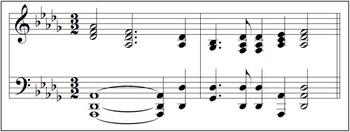
Walhall Leitmotif
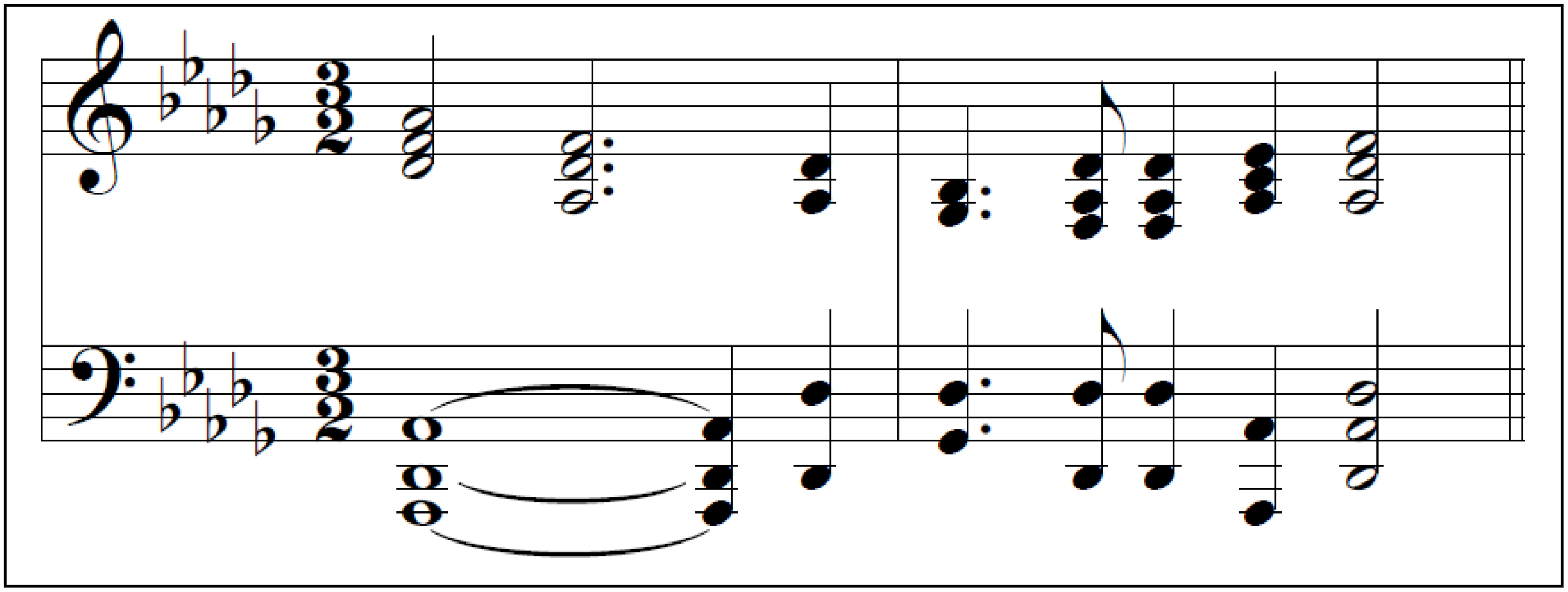
Figure 3 Long description
The image displays a musical score with two staves, one with a treble clef and the other with a bass clef. The treble clef staff contains a series of eighth notes, quarter notes, and dotted half notes, along with a few accidentals. The bass clef staff includes whole notes, half notes, and quarter notes, with some notes connected by slurs. The score appears to be part of a musical composition, likely representing a section of a larger piece.
I suggest that Walhall above all represents an ideal for Wotan, a completion of his original project of instantiating law and order within the world. This ideal is the true essence of legality—the rule of as opposed to by law—and is indispensable to Wotan because he believes that it will provide normative legitimacy to the hollowness of his treaty-based regime. Crucially for the Wagnerian conception of legality, this hope turns out to be illusionary. As Donington correctly observes, even in triumph Walhall seems somehow shabby, with the Rhinemaidens railing against injustice outside its walls;Footnote 74 and Wotan ultimately burns alive, unmoving upon its throne, smiling grimly at an end brought about by mortal beings both lesser and greater than himself.Footnote 75 But even in its shabbiness, Walhall tells us something indispensable about the relationship between law’s authority and its own normative ideal. This insight forms the second major tenet of Wagnerian jurisprudence. To understand it, we must turn from the libretto of Rheingold to its score, which conveys much of the meaning necessary to comprehend legality as an ideal within Wagner’s thought.
The Walhall leitmotif is a sweeping D flat major progression that falls and rises, ending tantalizingly close to where it began—pictured in Figure 3 below. Wagner’s use of the major key communicates stability and light, which stands in sharp contrast to the minor key setting of the ring leitmotif—pictured in Figure 5. There is a self-sustaining impression to the phrase, akin almost to sonic autopoiesis, even though, when heard in some dramatic contexts, it might be thought to end upon a question. The rhythm is steady and even, with ties in the first bar of the bass line that create an impression of solidity. It is, above all else, a fundamentally uplifting theme, which to my ears at least is less “hymnal”—contra Scruton—and more heady, almost ecstatic. If I were to put matters crudely, I would say that this is the sound that legality itself makes, at least when it is viewed as something to which we should aspire. Wagner attempts to give us something akin to a glimpse of law as a Platonic Form hereFootnote 76 —a sonic impression of law’s most abstract noumenal reality.Footnote 77
What should we draw from this fabulous piece of composition? In my view there are three connected things. First, its major key, bass line bridge, and steady rhythm, all suggest the form of law, in Fuller’s sense of “the enterprise of subjecting human conduct to the governance of rules.”Footnote 78 These musical features give Walhall an impression of clarity and stability that go beyond the physical security offered by even the mightiest fortress,Footnote 79 speaking instead to the formal virtues that Raz associates with the rule of law itself: the provision of greater certainty in human affairs and a guarantee against arbitrary power.Footnote 80 These formal virtues are indispensable to Wotan, who in this dimension symbolizes law itself, because they comprise the “inner morality” that legitimizes the project of imposing order through the authoritative application of impersonal norms.Footnote 81 They redeem his honor by justifying his enterprise and assuage whatever dread he may feel from the knowledge that he once violated the natural order. From this perspective, Walhall, and the rule of law it symbolizes, both stands in tension with the artificial nature of Wotan’s positivism and operates as a salve for its moral and ethical weaknesses.
Second, the self-sustaining quality of this leitmotif perhaps recalls Luhmann’s analysis of law as a uniquely self-referential social system,Footnote 82 which speaks to the normative hegemony Wotan seeks in his attempt to wrest order from chaos. Law, to borrow once again from Raz, claims not only practical authority but ultimate practical authority—legal institutions claim the role of final social arbiter on the (often false) premise that they are morally justified in so doing.Footnote 83 Wotan’s empty positivism of formal agreements needs something of this sort—some uniquely autonomous and apparently justified evaluative order—that is his and his alone, only then can he cement his position in the world as authority itself. Once again, Walhall as an ideal is both a point of tension with, and a cure for, law’s artificiality. Harmonically speaking, Walhall’s self-sustaining quality provides the necessary appearance of normative sufficiency and self-referentiality—an aptly haunting sonic promise that when perfect legality is achieved, no further justification for governance will be necessary. Law cohering with the spirit of legality will form an almost perfect circle, like the Walhall leitmotif itself, and need look nowhere else for normative, or harmonic, completion. Wagnerian jurisprudence is tempting us towards the idea that something like a natural law understanding of legality is politically essential both because of and in response to the positivist reality of law as a collection of social facts.
Third, the lightness and uplifting nature of the leitmotif, and in particular its sweep down and then up again in pitch, suggests that Walhall—and the rule of law it symbolizes—is not an empty ideal, even though it may seem shabby in the shadow of Wotan’s duplicities. As even Donington is prepared to admit, “we cannot give up all that Valhalla stands for and go back to the state of nature with which Rheingold began … we need its uncertain shelter and its overrated justice.”Footnote 84 Walhall, much like Dworkin’s virtue of political integrity,Footnote 85 may well be “Justice in Workclothes,”Footnote 86 but it symbolizes a genuine kind of justice nonetheless. The sense of the sublime we experience when listening to the music of Walhall is genuine, to no lesser an extent than our sense of dread is real, when we hear the leitmotif of the ring—pictured in Figure 5. On the Wagnerian conception, legality as an ideal appears to be a genuine human good, at least when experienced in isolation from the other phenomena symbolized within Wagner’s score. In dramatic terms, it is only by realizing that this mirrors something true and important about the concept of law that we can make sense of Kitcher and Schacht’s intuitively appealing claim that Wotan is fundamentally a noble antihero.Footnote 87 Underhanded and even abusive he might be, but his original ideal is one with which we can empathize, particularly in view of the many other, far darker beings with which the god shares his mythological corollary to our modern world.
Putting these three symbols—Wotan, the spear, and Walhall—together, and taking particular note of the complex thematic elements contained within Wager’s sonic representation of legality as an abstract ideal, we can begin to trace the outline of Wagnerian jurisprudence, which takes a very particular stance on the nature of law. Like more than one contemporary legal philosopher, Wagner conceived of law itself as more closely connected to normative authority than to either political power or violence. Moreover, his treatment of law in Rheingold creates a clear schism between the reality of rule by law, which is styled through Wotan and the spear to be both genealogically flawed and normatively insufficient, and an idealized rule of law, which through the music and poetic symbolism of Walhall is constructed to promise a self-referential and legitimate state of organized justice. Wagner’s insight here is that law, if understood in the first sense alone, will necessarily be incomplete: wherever the promise of Walhall is not fulfilled, legality as an ideal type is yet to be realized.Footnote 88 That this echoes conclusions within the mature thought of scholars such as Alexy,Footnote 89 Dworkin,Footnote 90 Finnis,Footnote 91 and FullerFootnote 92 might be unremarkable, but for the fact that Wagner was writing and composing without the benefit of a legal education and at a substantially earlier point in history, when the contemporary nation state and its associated legal traditions were just emerging in what is now the Federal Republic of Germany.Footnote 93 Moreover, although the rule of law, symbolized by Walhall, appears key to the Wagnerian conception of legality, it is telling that the fortress is never presented as somehow more essential or true than the artificial and flawed rule by law symbolized by Wotan’s spear. Rather, the two persist in uneasy coexistence with each other, in much the same manner that Wagner’s apparent positivism persists in tension with his awareness of the need for something like a natural law ideal. This is a jurisprudence of ambiguity, where law is neither neatly one thing, nor the other, but both at once. When combined with the complicating elements examined in the following section, it becomes clear that Wagnerian jurisprudence not only offers a unique object of study in both historical and methodological terms—presenting complex philosophical ideas viscerally in poetic, dramatic, and harmonic form—but also a serious contribution to the philosophy of law as such, with which contemporary scholarship would benefit from closer engagement.
D. Domination and Violence: Alberich, the Giants, and the Ring
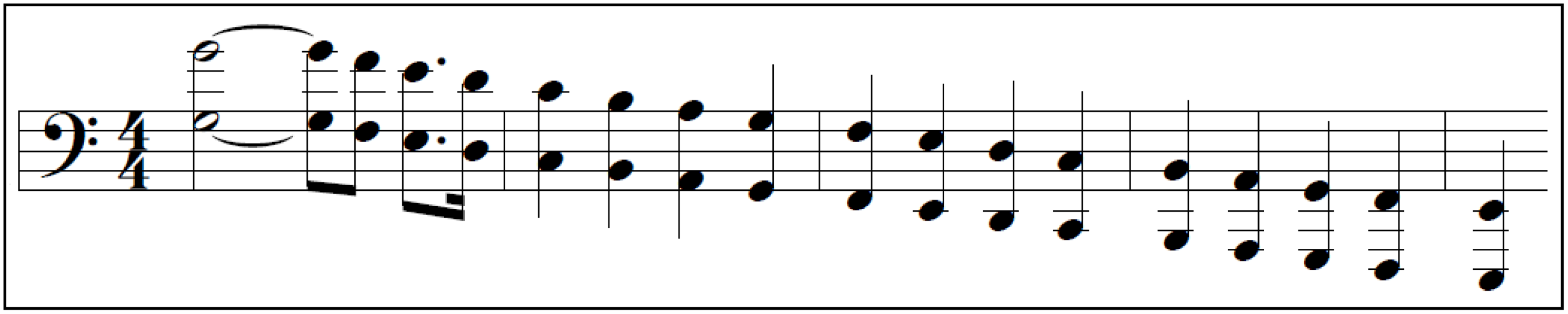
As noted above, Wotan shares his mythological world with several far darker beings. It is to some of these that I now turn. By far the most significant is the dwarf Alberich, however given the emphasis placed upon Walhall in the previous section, I want to begin by considering the giants Fafner and Fasolt, who build the fortress under contract with Wotan. The leitmotif of these brothers is one of the most recognizable within Rheingold, with its steady plodding rhythm and limited written range perfectly encapsulating the physicality of the giants themselves—pictured in Figure 4 below.Footnote 94
Giants Leitmotif

Figure 4 Long description
The musical score displays a rhythmic pattern with a steady, plodding beat and a limited range of notes. This pattern is associated with the giants Fafner and Fasolt, reflecting their physicality and strength. The score includes a series of eighth and sixteenth notes, creating a repetitive and grounding rhythm.
This physicality, I suggest, also captures their symbolic place within the drama. On one level, they symbolize raw strength, which, to borrow from Arendt, constitutes the singular potency of the individual human body.Footnote 95 In jurisprudential terms, it is illuminating that Walhall—the ideal of legality necessary to legitimize the practical authority that Wotan wields—was constructed, not by the god himself, but by these two brothers. Wagner reminds us here of both the artificiality of law. in the sense of its social facticity, and the need that all normative orders have to be made real by the efforts of individuals working in concert.Footnote 96 In this respect, the physicality of the giants mirrors the insistence of those such as Hart and Kelsen that legal orders must be made “effective” in some sense, if they are to exist at all.Footnote 97
On a more basic level, we must surely agree with Kitcher and Schacht that, within the mythos itself, these giants are “outsized creatures of elemental appetite and desire, who live by impulse and brute strength and who regard themselves—rightly—as vulnerable to those who are cleverer.”Footnote 98 They are, in this respect, not only representative of the teaming multitudes from which Hobbesian sovereigns like Wotan draw their authority and power, but also partly constitutive of the threats generated by the state of nature, upon which law must be imposed to avoid a life that is “solitary, poor, nasty, brutish, and short.”Footnote 99 This is confirmed when the ring passes from Wotan to the brothers: Fafner almost immediately turns upon Fasolt and murders him, in order to claim that prize for himself. Nonetheless, even this Hobbesian moment speaks to the human subtly of Wagner’s creation. Unlike Hobbes, who famously opines—contra ShakespeareFootnote 100 —that “the difference between men is not so considerable,”Footnote 101 Wagner’s giants symbolize quite different aspects of humanity. Fasolt, charmless though some find him,Footnote 102 labors hard in the hope of receiving happiness through love, in the shape of Freia. Indeed, his need for her seems almost childlike.Footnote 103 Fafner, by contrast, desires the goddess only for the power she offers—her golden apples, which supply the immortality of the gods. These he is only too happy to trade for the greater power of the ring. He is violent and grasping where his brother is brute and naïve. His fratricide is evocatively captured by Sabor, who notes in the margins to his translation: “Thus dies an entirely blameless and honorable character, for love.”Footnote 104 Whatever we may think of Fasolt,Footnote 105 there is poignancy to Wagner’s warning about what happens when law—Wotan—relinquishes power—the ring—to our baser natures—the giants. What is violent and selfish within us, he communicates, is liable to murder what is childlike and naïve. In this dramatic episode, Rheingold once again illustrates the capacity of symbolism within a Gesamtkunstwerke to convey complex insights concurrently, rather than consecutively, as is necessarily the case with pure prose. Moreover, although Wagner’s point is essentially Hobbesian, the visceral manner of its delivery offers us a level of intuitive emotional understanding unavailable from even the most evocatively written academic text.
Turning from the psychological to the economic, Fafner and his brother might also be thought to symbolize the power relations that exist between the state and its proletariat.Footnote 106 Within the Shavian allegorical-Marxist interpretation, “Godhead and Kingship,” in the form of Wotan,Footnote 107 are complicit with capitalism, in the form of Alberich,Footnote 108 in using greed and the monetary economy, represented by the ring,Footnote 109 to alienate the proletariat—here the Nibelungs as well as the giantsFootnote 110 —from the products of their labor: Walhall and the Nibelung gold.Footnote 111 Despite his celebrated insight into symbols such as the Tarnhelm,Footnote 112 Shaw’s overall view lacks interpretive fidelity: To make his allegory work, he is forced to dismiss the majority of Götterdämmerung as a poetic and compositional mistake.Footnote 113 There nonetheless remains an important sense in which he is correct. The material history of both positive law and Western statehood is one of class-based exploitation.Footnote 114 Precisely because Wagner’s work is symbolic, rather than allegorical, Wotan’s exploitation of the giants is capable of admitting this additional layer of meaning, notwithstanding its Hobbesian overtones and the positive connotations that seem inseparable from the appearance in the score of symbols like Walhall. Wagner’s social and political thought is, above all, complex.
Indeed, as noted above, it is the hallmark of legal symbolism within Rheingold that law has no singular essence but rather an overlapping set of different properties, many of which sit in fundamental tension with each other. This emphasis upon irreducible complexity and necessary conceptual conflict is the third distinguishing tenet of Wagnerian jurisprudence, sitting alongside the aforementioned opposition between law as social reality and justificatory ideal. In the face of such conceptual conflict, Wotan seeks coherence through global order, as all law must,Footnote 115 through his various schemes and political exchanges. However, he finally, and inevitably, fails. His dream of Walhall as an ideal is ultimately just that, which he comes to realize before the end.Footnote 116 With this in view, and before considering the dramatic role of Alberich, we must now consider the ring itself. Within the drama, the ring represents a potent threat to Wotan and the gods,Footnote 117 as well as the existential rejection of love by Alberich, who creates it in order to gain mastery over the world, in much the same way that Wotan crafted his spear. It symbolizes many things, including the Shavian monetary economy, but most importantly for present purposes, the power to dominate others—obliging, rather than obligating them to obey, to borrow a distinction from Hart.Footnote 118 Unlike the physical might of the giants, the power of the ring is an artificial one, emanating from the creation of something fundamentally wrong from the raw matter of the universe. This is symbolized by Wagner within the score, with the ring leitmotif sweeping down and then up again in the minor key, creating a sense of deep unease—pictured below in Figure 5.
The Ring (definitive) Leitmotif

Figure 5 Long description
The image displays a musical staff with the Ring leitmotif written in the minor key. The notation includes a time signature of 9/8, indicating a complex meter. The leitmotif features a series of notes with various rhythms and dynamics, creating a sense of tension and instability. The notes are arranged in a way that suggests a falling and rising pattern, characteristic of the Ring leitmotif. The minor key setting contributes to a darker and more dramatic musical expression.
It is no accident that the chord sequence of this phrase is the same as that of the Walhall leitmotif. The ring is Walhall’s sonic correlative: where the fortress inspires an ideal, the ring discloses a dark dystopian promise. It is the sound of law as it is used by the power-hungry and violent—an “anti-ideal,” or antithesis,Footnote 119 as it were. As put by Scruton, it signifies “the human disposition to see all things as means and nothing as an end in itself; it is a symbol of power and the lust for it, of exploitation, of the desire to possess.”Footnote 120 The features I noted above in relation to Walhall all find themselves mirrored darkly within the sound of this ring. The minor key gives the tempo of this phrase a halting, almost revenant-like sickliness, which speaks to an irresistibility in place of Walhall’s solidity. Its descending ties and upwards sweep convey a yearning covetousness where the fortress invokes self-reflexivity, and while both Walhall and the ring might be perceived as ending on a question, in the case of the ring this question is corruptingly solicitous.
The ring, in these dimensions, symbolizes domination of the Other through coercion, understood as an exploitation of our capacity to reason through alteration of our available options,Footnote 121 which contemporary states typically accomplish through the threat of collective force.Footnote 122 This power for coercion is evinced by the words of Mime, Alberich’s terrified brother, when he cries “With that ring he can lord it over Nibelheim’s hidden host … now he compels us to creep into caverns, for him alone to sweat and to slave.”Footnote 123 That Wagner makes the ring a sonic mirror of Walhall within the minor key displays not only dramatic and harmonic accomplishment but also jurisprudential insight; the symbolism of necessary connection that this creates communicates two claims central to the Wagnerian conception of legality. First, although it may be indispensable to us, the use or misuse of law can pose an almost overwhelming threat:Footnote 124 In the hands of those like Alberich, law and the state are always weapons of tyranny and oppression. Second, this danger is no less inherent to the concept of law than is the ideal of legality itself and it cannot be plausibly claimed that the “light” of Walhall is more essential to legality than the “darkness” of the ring.Footnote 125 Wagner is not, by any stretch of the imagination, an optimist when it comes law’s socially transformative potential. Indeed, he is deeply pessimistic.
It is precisely because it represents not just such a potent threat but also the dark side of legality itself that Wotan, the god of law, feels that he must possess the ring. “Mine the ring! Not yours but mine! Rant and rave as you will.” Wotan cries, as he rips it from Alberich’s finger.Footnote 126 But there is no sense in which we believe that Wotan seeks this prize for his own aggrandizement. True, in triumph he claims, “I hold what makes me supreme: of lords the omnipotent lord.”Footnote 127 However, from one perspective this invokes merely the Weberian notion that a state established by law necessarily claims a monopoly upon legitimate force: while the ring exists in the world, Wotan must seek to have it upon his finger.Footnote 128 The ring, when viewed in this light, is something to be kept safe by the master of Walhall, for only in the hands of an authority that binds by virtue of legality can the dominating power of the ring be held as a justifiable deterrent.Footnote 129 But this analysis, persuasive though it might be, comes close to committing the mistake of allegory. Wotan symbolizes both law and the state, however these concepts do not exhaust his meaning, nor does he exhaust theirs. To see the true nuance in Wagner’s myth, we must, finally, consider Alberich.
Alberich is the original lord of the ring, through which he masters the dwarven realm of Nibelheim, as Wotan is the master of Walhall and the wielder of the sacred spear. However, the parallels do not end there. Indeed, in Siegfried, Wotan goes so far as to call himself Licht-Alberich (Light-Alberich) and the dwarf Scwartz-Alberich (Dark-Alberich), acknowledging explicitly the extent of the connection between them. Magee is worth quoting from at length on this point:
Alberich and Wotan represent the two most familiar faces of political power, and are very much two sides of the same coin: on the one hand naked violence, administered with terror and the whip, the sort of brute force that treats other people as objects if not obstacles, the variables in Lenin’s question, ‘Who whom?’; and on the other hand civilized order founded on the rule of law, agreements, contracts, all of which embody respect for the Other. The reason they are two sides of the same coin is that even Wotan’s well-intentioned, non-violent rule involves him in perpetual injustice: he gets entangled in grubby compromises, he breaks promises, he cheats people, he steals, all in the attempt to establish and maintain what are essentially civilized values.Footnote 130
Correcting again for Magee’s conflation of power and authority, and further conflation of coercion and force, this argument goes to the heart of both Alberich’s symbolic importance and his dramatic relation to Wotan. Alberich is distinct from Wotan insofar as, unlike the god—who grounds his authority in the formal but nonetheless egalitarian bonds created by treaties—the dwarf “does not put his will into the other, so as to see the other as a free being like himself: he exerts his will over the other, whom he treats merely as a tool.”Footnote 131 He symbolizes law and the state at its worst and most unfeeling.
However, his relationship with Wotan once more teaches us something important about law as such on the Wagnerian conception. Just as the harmonic parallel between Walhall and the ring communicate a necessary tension within legality at the abstract level of ideal and antithesis, the poetic and dramatic mirroring of Wotan and Alberich imply the same at the concrete level of social instantiation. This is the fourth tenet of Wagnerian jurisprudence: law as it exists within our world is always both the ideal and its own betrayal; it exists nowhere as either one or the other.Footnote 132 In Götterdämmerung, when Walhall burns, the Rhine also floods, claiming the ring into the depths from whence it came; as Wotan dies, the splinters of his spear clutched in his hands, so too is Alberich’s son Hagen pulled into the river by the avenging Rhinemaidens.Footnote 133 Viewed in this codependent light, when Wotan proclaims of the stolen ring, “I hold what makes me supreme: of lords the omnipotent lord,” there is a sense in which he is literally correct—the ring always was what made him supreme, because it is the source of Alberich’s power, and the two cannot be neatly separated out.Footnote 134 The war between Wotan and Alberich, fought through mortal proxies throughout the remainder of The Ring Cycle, is from this perspective an eternal war for the soul of legality itself, which can only end when both aspects of law vanish altogether. This being so, at least as far as Rheingold is concerned, the ultimate substantive contribution of Wagnerian jurisprudence to contemporary legal philosophy is to remind us that, at both the abstract and the concrete levels, law is a phenomenon in constant tension with itself and those who rely upon it to the exclusion of all else are, for better and for worse, balancing upon a tightrope between the fire and the flood.
E. Conclusion: The Beginning of the End
The drama of The Ring Cycle is one of terrifying dragons, uncompromising heroes, secret love potions, and magic swords. Within that tetralogy, Rheingold is a tale of beginnings, invoking the ancient mythological figures of dwarves, giants, and gods to construct an entangled cosmology within which the characters of Die Walküre, Siegfried, and Götterdämmerung grapple in a seemingly hopeless struggle for purpose and resolution. However, it is also a quintessentially modern myth, possessing a layered symbolism that permeates not only its libretto and potential staging but also the soundworld created by Wagner’s score. There can most likely be no single meaning to any artistic work on this scale—in the doubtful event that the scale of any other art even remotely approximates it. In this Article, I have teased out just a few meanings from that broader Gesamtkunstwerk, utilizing creative interpretation to understand Rheingold as a Musikdrama with deep jurisprudential implications. My primary aim in so doing was to demonstrate that, notwithstanding the degree to which he has been overlooked in this respect, Richard Wagner was a profound jurisprudential thinker whose visceral portrayal of many familiar themes within contemporary legal theory merit far greater attention than they have hitherto received. Moreover, by using Rheingold to demonstrate that musical representation can achieve the symbolic communication of complex legal-philosophical ideas, I have sought to broaden our current understanding what might count as a serious work of legal philosophy. We should, as I have implied throughout, close our books from time to time and go to see an opera.
There is also value to be gained, or so I have argued, from the substantive content of what I called “Wagnerian jurisprudence.” This discrete perspective on the nature of law construes both statehood and legality as essentially conflicted practices and ideals, as well as sites of contestation between the darker and more noble aspects of authority and social control. Wagnerian legality is in one sense positivist, seeing law as built upon artificial and ultimately hollow foundations, but by virtue of this very weakness it necessarily longs for the kind of moral substance and deep internal justification characteristically claimed by natural law philosophies. From the heights of Walhall, Wotan points his spear tip down, dreaming of an ordered world he is forever impotent to realize. Thus, legal positivists are challenged by Wagner to accept the inescapable connection between law and the ideal. But the Wagnerian state is dangerous: it promises security but in so doing must wield the terrible power of the ring—domination and violence under the guise of order. From Nibelheim’s depths, the tyrannical Alberich rages in the dark: “Beware! Beware of my legions of night! For soon the Nibelung gold shall rise and ravish the world.”Footnote 135 Rheingold, in combination with the tetralogy’s subsequent Musikdrama, teaches us that we cannot have Licht-Alberich without opening the door to Schwartz-Alberich as well. In this way, those with natural law leanings are also challenged to grapple with recalcitrant social reality, which pulls our eyes away from the ideal and towards material injustice. In a letter to his friend August Röckel, Wagner wrote: “Make sure you understand Wotan, he resembles us in all respects.”Footnote 136 He was quite correct: we too have made treaties and contracts, both as lawyers and as citizens, in search of an ordered world. Faced with our plurality and vulnerability, we sign away our natural freedom to Hobbesian Leviathans,Footnote 137 and now we too dream of Walhall—a legality of which we can be proud, which rewrites this messy compromise as something noble and filled with light.Footnote 138 But the ring beckons, and all too often those in power heed its call. This is no mere mythical melodrama, but a keen dramatic rendition of the tragedies implicit in contemporary political life.
Many interpretive questions remain. The fruitfulness of pursuing the legal philosophy latent within Rheingold prompts us to wonder, for example, what might be the jurisprudential significance of Siegfried, the anarchic male protagonist of the tetralogy’s final two Musikdrama? In his wild freedom, he shatters Wotan’s spear, but what bestows upon him this potency and what meaning might we construct within that scene vis-à-vis the relationship between freedom and law? Perhaps more interestingly still, what might be said of Brünnhilde, in many ways the true hero of Wagner’s myth, who is otherwise a symbol of feminine power but also of compassion and love?Footnote 139 As Walhall burns, she hopes that her father Wotan will at last find some rest.Footnote 140 Can love, perhaps in the shape of Bell Hooks’ “love ethic,”Footnote 141 surpass the necessary evils of law and return the ring to the depths of the Rhine? Would Wagnerian jurisprudence, when completely articulated, be fundamentally feminist in some important dimension? I do no more than speculate here. What these indicative questions show, however, is the potential for even richer jurisprudential reflection if we interpret The Ring Cycle as a whole, rather than as context for the more particular themes raised within its preliminary evening. Rheingold is the opening part of a complex drama that is in large part about endings, with the downfall of law and order, in the form of both Wotan and Walhall, featuring prominently amongst them. This Article does little more than look at the beginning of that end. What it does suggest, perhaps, is that at both the dramatic and conceptual level, law and the state themselves might contain both the tinder and the spark for the fire in which both notions will eventually burn.
Acknowledgements
Thanks are due to Tobias Forsnacke, Timothy Green, Jennifer Hendry, Joshua Jowitt, and Emmanuel Voyiakis for their illuminating discussions and detailed comments. Thanks are also due to the participants of the 2024 WG Hart Workshop: Historicising Jurisprudence and to those of the 2024 SLSA Annual Conference Law and Humanities Stream. All mistakes remain my own.
Competing Interests
The author declares none.
Funding Statement
The finalization of this Article was in part facilitated by CUHK Direct Grant 4059073.



 Open access

