


Introduction
Molecular genetic and morphological techniques have revealed the extraordinary species diversity of the endemic mouse lemurs of Madagascar (Cheirogaleidae: Microcebus; Louis et al., Reference Louis, Engberg, McGuire, McCormick, Randriamampionona and Ranaivoarisoa2008; Groves, Reference Groves, Lehman, Radespiel and Zimmermann2016; Schüßler et al., Reference Schüßler, Blanco, Salmona, Poelstra, Andriambeloson and Miller2020). The genus was long considered to comprise just two species, one from the dry forests of the west and south and one from the rainforests of the east (Groves, Reference Groves and Wolfe-Coote2005), but today 25 species are recognized. One consequence of these taxonomic revisions is that the geographical distributions and conservation status of new species, and those from which they are distinguished, must be reassessed (Louis et al., Reference Louis, Engberg, Lei, Geng, Sommer and Randriamampionona2006; Rasoloarison et al., Reference Rasoloarison, Weisrock, Yoder, Rakotondravony and Kappeler2013), as splitting species often results in proportionately more threatened species with reduced ranges (Agapow et al., Reference Agapow, Bininda-Emonds, Crandall, Gittleman, Mace and Marshall2004). Several newly described mouse lemur species, however, have not been surveyed and population data are incomplete or absent (Setash et al., Reference Setash, Zohdy, Gerber and Karanewsky2017; Hending, Reference Hending2021). Population estimates are needed to support IUCN Red List assessments, to allow conservation managers to identify, prioritize and monitor vulnerable species and populations, and to help evaluate conservation programmes (Plumptre & Cox, Reference Plumptre and Cox2006; Kühl et al., Reference Kühl, Maisels, Ancrenaz and Williamson2008; Rylands et al., Reference Rylands, Williamson, Hoffmann and Mittermeier2008, Reference Rylands, Mittermeier and Williamson2020).
Claire's mouse lemur Microcebus mamiratra was first described in 2006 (Andriantompohavana et al., Reference Andriantompohavana, Zaonarivelo, Engberg, Randriamampionona, McGuire and Shore2006) and has been the subject of limited field research (Hasiniaina et al., Reference Hasiniaina, Scheumann, Rina Evasoa, Braud, Rasoloharijaona, Randrianambinina and Zimmermann2018; Webber et al., Reference Webber, Solofondranohatra, Razafindramoana, Fernández, Parker and Steer2020; Tinsman et al., Reference Tinsman, Volampeno, Ganas-Swaray, Gann, Andrianirina and Chamizo2022). Its geographical range is confined to the humid primary and secondary forests of the Lokobe National Park region on the island of Nosy Be in north-west Madagascar, as well as some small, isolated humid forest fragments on the Malagasy mainland near Manehoka and Ambakirano, east of Nosy Be (Olivieri et al., Reference Olivieri, Zimmermann, Randrianambinina, Rasoloharijaona, Rakotondravony, Guschanski and Radespiel2007; Sgarlata et al., Reference Sgarlata, Salmona, Le Pors, Rasolondraibe, Jan and Ralantoharijaona2019; Blanco et al., Reference Blanco, Dolch, Ganzhorn, Greene, Le Pors and Lewis2020). Threatened mainly by habitat loss and degradation, it is categorized as Endangered on the IUCN Red List (Blanco et al., Reference Blanco, Dolch, Ganzhorn, Greene, Le Pors and Lewis2020). Lemurs have been extirpated from small islands elsewhere in Madagascar, and the population of M. mamiratra on Nosy Be is at risk (Goodman, Reference Goodman1993; Hyde Roberts & Daly, Reference Hyde Roberts and Daly2014). No systematic surveys have been carried out anywhere across its restricted and severely fragmented range, and there are no population size or density estimates (Blanco et al., Reference Blanco, Dolch, Ganzhorn, Greene, Le Pors and Lewis2020). Although encounter rates have been reported for M. mamiratra (Tinsman et al., Reference Tinsman, Volampeno, Ganas-Swaray, Gann, Andrianirina and Chamizo2022), these provide only a relative abundance index and could be affected by differences in detection probability, such as those between observers or environmental variables (Anderson, Reference Anderson2001; Buckland et al., Reference Buckland, Marsden and Green2008; Campbell et al., Reference Campbell, Head, Junker, Nekaris, Wich and Marshall2016).
Distance sampling is a powerful method for estimating absolute population density (number of individuals per unit area) and population size (density multiplied by area). It comprises a set of standardized survey techniques, principally line transects and point transects, in which observers record distances to detected objects whilst traversing lines or standing at points that are placed randomly within a survey area (Buckland et al., Reference Buckland, Anderson, Burnham and Laake1993, Reference Buckland, Anderson, Burnham, Laake, Borchers and Thomas2001, Reference Buckland, Anderson, Burnham, Laake, Borchers and Thomas2004). The detected objects are usually animals of the target species but might be animal cues (e.g. calls) or signs (e.g. nests). Intuitively, we expect that objects become more difficult to detect with increasing distance from the line or point and that some objects might be missed. A key strength of distance sampling is that it accounts for imperfect detection: the distribution of observed distances is used to model a detection function that describes the probability that an object is detected as a function of distance from the line or point, thereby allowing estimation of the proportion of objects missed during the surveys (Buckland et al., Reference Buckland, Anderson, Burnham and Laake1993, Reference Buckland, Anderson, Burnham, Laake, Borchers and Thomas2001, Reference Buckland, Anderson, Burnham, Laake, Borchers and Thomas2004). This can be particularly advantageous for animals that are otherwise difficult to detect, such as small-bodied and nocturnal mouse lemurs (Meyler et al., Reference Meyler, Salmona, Ibouroi, Besolo, Rasolondraibe and Radespiel2012; Schäffler & Kappeler, Reference Schäffler and Kappeler2014). In primatology, line transects are the most popular form of distance sampling (Plumptre, Reference Plumptre2000; Ross & Reeve, Reference Ross, Reeve, Setchell and Curtis2003; Plumptre et al., Reference Plumptre, Sterling, Buckland, terling, Bynam and Blair2013). Proper inference in line transect distance sampling relies on the following key assumptions: (1) objects directly on the line are detected with certainty, (2) objects are detected at their initial location, prior to any movement in response to the observer, and (3) distances to detected objects are measured accurately (Buckland et al., Reference Buckland, Anderson, Burnham and Laake1993, Reference Buckland, Anderson, Burnham, Laake, Borchers and Thomas2001, Reference Buckland, Anderson, Burnham, Laake, Borchers and Thomas2004; Buckland, Reference Buckland2006; Plumptre et al., Reference Plumptre, Sterling, Buckland, terling, Bynam and Blair2013). A further assumption, relevant for group-living primates, is (4) group sizes (or clusters) are accurately recorded (Buckland et al., Reference Buckland, Plumptre, Thomas and Rexstad2010). Mouse lemurs are amenable to line transect surveys for several reasons: (1) their tapetum lucidum (reflective eye tissue) and preference for the understorey aid detection on the centreline (Lahann, Reference Lahann2008; Rakotondravony & Radespiel, Reference Rakotondravony and Radespiel2009), (2) they move relatively slowly and often become stationary when observed (Meyler et al., Reference Meyler, Salmona, Ibouroi, Besolo, Rasolondraibe and Radespiel2012), (3) they are mostly solitary, generally removing the need to estimate cluster size and spread (Buckland et al., Reference Buckland, Plumptre, Thomas and Rexstad2010; Bessone et al., Reference Bessone, Kühl, Hohmann, Herbinger, N'Goran and Asanzi2023), and (4) they are generally abundant, so adequate samples sizes can be obtained (Kappeler & Rasoloarison, Reference Kappeler, Rasoloarison, Goodman and Benstead2003). Line transect distance sampling also relies on two underlying principles of survey design: (1) randomization (i.e. the lines should be placed randomly, and not subjectively, in the survey area; e.g. systematically spaced parallel lines with a random start point; Marques et al., Reference Marques, Buckland, Borchers, Tosh and McDonald2010; Thomas et al., Reference Thomas, Buckland, Rexstad, Laake, Strindberg and Hedley2010; Hilário et al., Reference Hilário, Rodrigues, Chiarello and Mourthé2012), and (2) replication (i.e. an adequate number of lines (at least 10–20) should be placed; Buckland et al., Reference Buckland, Anderson, Burnham and Laake1993, Reference Buckland, Anderson, Burnham, Laake, Borchers and Thomas2001, Reference Buckland, Anderson, Burnham, Laake, Borchers and Thomas2004; Thomas et al., Reference Thomas, Buckland, Rexstad, Laake, Strindberg and Hedley2010). In practice, however, surveys are often compromised by time and resource constraints (e.g. rapid assessments), and the key assumptions are routinely violated or cannot be met (Buckland et al., Reference Buckland, Plumptre, Thomas and Rexstad2010; de Andrade et al., Reference de Andrade, Marques and Buckland2019). Recent meta-analyses of published density estimates of mouse lemurs have highlighted that non-standardized designs (e.g. using non-random established trails as transects) and analysis methods (e.g. not accounting for detection probability) are prevalent (Setash et al., Reference Setash, Zohdy, Gerber and Karanewsky2017; Hending, Reference Hending2021). Poor survey practices can bias results and inhibit rigorous inference; at worst, they can lead to incorrect conservation status assessments, inappropriate conservation management decisions or the misallocation of limited conservation funds (Elphick, Reference Elphick2008).
Here we provide the first reliable estimates of density and abundance for M. mamiratra using line transects, a systematic random survey design and best-practice field protocols. Population estimates will inform future status assessments and conservation actions for this threatened primate. We predict that density estimates for M. mamiratra are similar to those reported for other mouse lemur species from the dry and transitional forests of north-west Madagascar, consistent with large-scale regional patterns in mouse lemur densities (Setash et al., Reference Setash, Zohdy, Gerber and Karanewsky2017). We also predict that encounter rates at Nosy Be are higher in unprotected, anthropogenic habitats than in protected, primary forests, consistent with general patterns in mouse lemur abundance (Hending, Reference Hending2021).
Study area
Nosy Be is a 321 km2 island in the Mozambique channel to the north-west of Madagascar, c. 12 km from the mainland. It is part of the Sambirano Domain, a transitional area between the eastern wet and western dry forests (Sawyer et al., Reference Sawyer, Mena and Donati2015). The climate is tropical with a hot, wet season during October–April and a cooler, dry season during May–September (Cutler, Reference Cutler1965; Andreone et al., Reference Andreone, Guarino and Randrianirina2005). Mean daily temperatures range from 23 °C during July–August to 28 °C during January–February (Birkinshaw, Reference Birkinshaw1995), and mean annual rainfall is 2,250 mm (Andreone et al., Reference Andreone, Guarino and Randrianirina2005). Most of the original forest cover on Nosy Be has been converted to agricultural land, including rice and ylang-ylang crops (Andreone et al., Reference Andreone, Guarino and Randrianirina2005). The 7.4 km2 Lokobe National Park protects most of the remaining primary forest, which is classified as low-altitude humid evergreen forest (Hasiniaina et al., Reference Hasiniaina, Scheumann, Rina Evasoa, Braud, Rasoloharijaona, Randrianambinina and Zimmermann2018). The Park is surrounded by a mosaic of secondary and degraded forest, crop plantations and small villages (Birkinshaw, Reference Birkinshaw1995; Tinsman et al., Reference Tinsman, Volampeno, Ganas-Swaray, Gann, Andrianirina and Chamizo2022). Elevation across Nosy Be is 0–430 m, with the primary forests of Lokobe National Park occupying some of the highest slopes (Tinsman et al., Reference Tinsman, Volampeno, Ganas-Swaray, Gann, Andrianirina and Chamizo2022). The black lemur Eulemur macaco and the Nosy Be or Hawks' sportive lemur Lepilemur tymerlachsoni are the only lemurs sympatric with M. mamiratra on the island. Nosy Be has been identified as a priority area for lemur conservation (Schwitzer et al., Reference Schwitzer, Mittermeier, Davies, Johnson, Ratsimbazafy and Razafindramanana2013, Reference Schwitzer, Mittermeier, Johnson, Donati, Irwin and Peacock2014) and is also one of the most popular tourist destinations in Madagascar (Jędrusik, Reference Jędrusik2019).
Methods
Survey design and transect placement
We used the survey design function in Distance 7.5 Release 2 (Thomas et al., Reference Thomas, Buckland, Rexstad, Laake, Strindberg and Hedley2010) to superimpose a grid of points with a random starting position across a map of the extent of occurrence of M. mamiratra on Nosy Be, obtained from the most recent IUCN Red List assessment (Blanco et al., Reference Blanco, Dolch, Ganzhorn, Greene, Le Pors and Lewis2020). We then used the coordinates of these grid points to place a systematic set of segmented parallel transect lines in and around Lokobe National Park. We placed 16 transects in the survey area (Table 1), but only surveyed 15 of these because of safety concerns at one location (small flooded areas considered unsafe for nocturnal work; T9, Fig. 1). The mean transect length was 815 m (range: 633–1,125 m), which we measured in the field with an open reel tape measure. Some transects were shorter because they crossed impassable terrain such as ravines. Transects covered areas of primary, secondary and degraded forest, and plantations both within and outside the National Park boundaries. We cut the transects in straight lines in a north–south direction, only deviating to avoid dangerous (e.g. boulders) or inaccessible areas (e.g. paddy rice plantations) where necessary. We marked the transects with fluorescent flagging tape so that observers could identify the centreline during surveys. We then waited at least 72 h before surveying, to minimize the effects of disturbance from cutting the transects (Bessone et al., Reference Bessone, Kühl, Hohmann, Herbinger, N'Goran and Asanzi2023).
Summary of transects surveyed, including predominant habitat type, whether the transect was within the boundaries of Lokobe National Park (Nosy Be, north-western Madagascar; Fig. 1), transect length, number of times the transect was surveyed, total survey effort (L), total number of Microcebus mamiratra detected (n) and encounter rate (n/L).
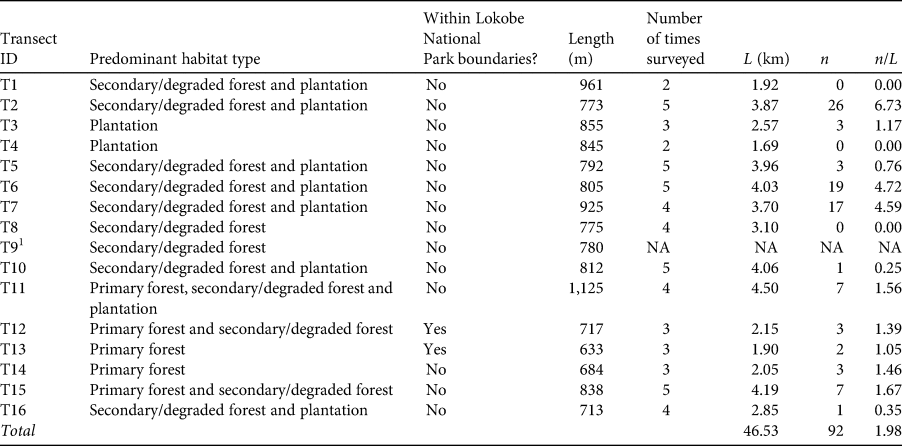
1 Not surveyed after placement because of safety concerns.
(a) Madagascar, showing the location of Nosy Be, and (b) the survey area and line transects (Table 1). Transect IDs: top row T1–T4, middle row T5–T10, bottom row T11–T16. VOI, Vondron'Olona Ifotony.

Line transect surveys
Author LDM provided training to all observers on distance sampling theory (e.g. survey design, key assumptions) and field protocols (e.g. equipment use, searching behaviour) at the start of the field season. We conducted nocturnal surveys in the wet season during 17 February–4 April 2023. Beginning at sunset (c. 19.00), teams of 2–3 observers walked a transect in single file at a mean speed of 1–2 km/h, pausing during heavy rainfall. Observers stopped to scan the survey area at regular intervals, concentrating search effort on and near the line. We used headlamps to locate mouse lemurs by reflective eye shine and binoculars to distinguish M. mamiratra from other wildlife. Observers would temporarily leave the transect line to confirm the identification of detections as required. For each mouse lemur detected, we recorded cluster size and perpendicular distance from the transect line on a standardized datasheet. We measured perpendicular distances with a laser rangefinder and paced distances < 4 m (the minimum range of the rangefinder). We recorded detections of each mouse lemur individually (i.e. cluster size of 1), including where we detected mouse lemurs in groups of 2–3 (Buckland et al., Reference Buckland, Anderson, Burnham, Laake, Borchers and Thomas2001, Reference Buckland, Plumptre, Thomas and Rexstad2010). We recorded only visual detections. We surveyed each transect 2–5 times. We regularly changed team composition to minimize between-team observer variability. We stored field data electronically and verified the data daily. Although M. mamiratra is not believed to undergo prolonged periods of torpor (Tinsman et al., Reference Tinsman, Volampeno, Ganas-Swaray, Gann, Andrianirina and Chamizo2022), we conducted our surveys outside the dry season, when mouse lemurs typically exhibit this behaviour (Dausmann & Warnecke, Reference Dausmann and Warnecke2016), hence there should be no torpor-related availability bias (Hending et al., Reference Hending, Randrianarison, Andriamavosoloarisoa, Ranohatra-Hending, Solofondranohatra and Tongasoa2023).
Data analysis: distance software
We used the conventional distance sampling engine in Distance to estimate M. mamiratra density and abundance. We pooled individual surveys and detections for each transect line, and recorded effort as line length multiplied by the number of times the line was surveyed (Buckland et al., Reference Buckland, Marsden and Green2008). We plotted histograms of the perpendicular distances as part of an exploratory data analysis phase. We then grouped distance data into suitable distance cut points for analysis and right-truncated 10% to remove outliers and facilitate modelling (Buckland et al., Reference Buckland, Anderson, Burnham, Laake, Borchers and Thomas2001; Thomas et al., Reference Thomas, Buckland, Rexstad, Laake, Strindberg and Hedley2010). We then fitted the following model and adjustment combinations: uniform key function with cosine series expansion, half-normal key function with cosine and Hermite polynomial series expansion, and hazard-rate key function with simple polynomial series expansion. We visually assessed the candidate models and compared them using χ 2 goodness-of-fit tests and the Akaike information criterion (Akaike, Reference Akaike, Petrov and Csaki1973).
Analysis of habitat on Nosy Be
The geographical range maps in the IUCN Red Lists are minimum convex polygons of the extent of occurrence of a species and not necessarily its area of occupancy, and as a result could include areas of unsuitable habitat (e.g. non-forest, villages; Schwitzer et al., Reference Schwitzer, Mittermeier, Johnson, Donati, Irwin and Peacock2014). We therefore estimated forest cover within the extent of occurrence of M. mamiratra on Nosy Be using Global Forest Watch (2023), and we used this forested area as a proxy for suitable mouse lemur habitat in our abundance extrapolation. Forest cover was calculated as the tree cover extent in 2000 (> 30% canopy density; Hansen et al., Reference Hansen, Potapov, Moore, Hancher, Turubanova and Tyukavina2013; see also Estrada et al., Reference Estrada, Garber, Mittermeier, Wich, Gouveia and Dobrovolski2018; Mekonnen et al., Reference Mekonnen, Fashing, Bekele and Stenseth2020; Markolf et al., Reference Markolf, Schäffler and Kappeler2022) within the range data shapefile obtained from the IUCN Red List (Blanco et al., Reference Blanco, Dolch, Ganzhorn, Greene, Le Pors and Lewis2020) plus or minus net tree cover change during 2000–2022 (Potapov et al., Reference Potapov, Hansen, Pickens, Hernandez-Serna, Tyukavina and Turubanova2022).
Results
We recorded 92 M. mamiratra detections in a total survey effort of 46.5 km (Table 1). This exceeds the recommended minimum sample size of 60–80 detections (Buckland et al., Reference Buckland, Anderson, Burnham, Laake, Borchers and Thomas2001).
Since 2000, c. 14.5 km2 (28%) of forest cover has been lost within the range of M. mamiratra on Nosy Be. We estimate that 37.3 km2 of forest cover remains, an area similar to the maximum area of occupancy of the species on the island.
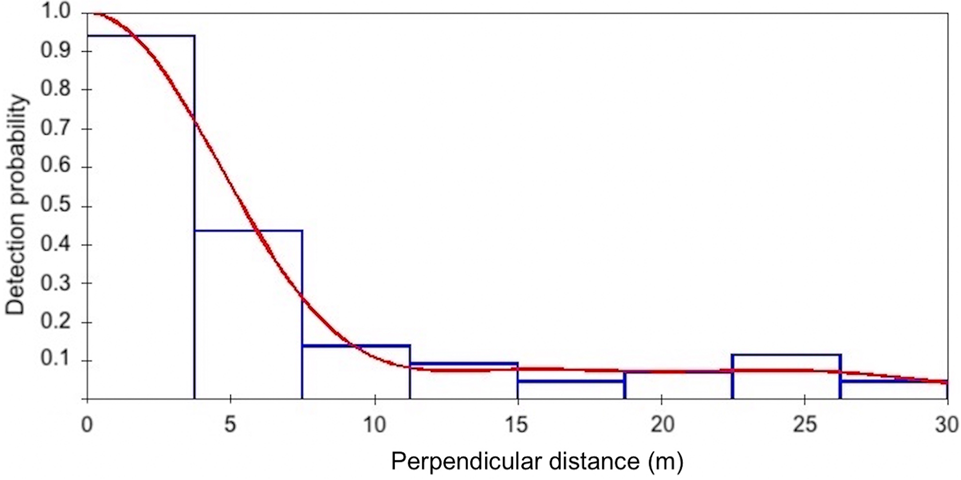
Our distance analyses generated a mean density estimate of 125.1 individuals/km2 (95% CI 65.3–239.5, coefficient of variation 0.32). The half-normal key function with cosine adjustment provided the best fit to the data (χ 2 = 2.06, df = 3, P = 0.56; detection probability = 0.23; effective strip width = 7.05; Fig. 2). Extrapolating this density estimate across the forested area within the extent of occurrence of M. mamiratra on Nosy Be yields a population of c. 4,700 individuals.
Histogram showing the detection probability of Microcebus mamiratra as a function of perpendicular distance from the transect line on Nosy Be, north-west Madagascar (Fig. 1). The columns represent grouped detections of M. mamiratra and the curve represents the detection function. Data were right-truncated by 10%.
Discussion
We report the first population estimates for M. mamiratra, an Endangered and little-known mouse lemur of north-west Madagascar. We applied randomization and replication in our survey design and employed survey protocols that ensured we met the key assumptions of distance sampling, allowing valid inference and extrapolation from our results. Our population data will inform future conservation status assessments and management decisions and provide a starting point for monitoring local population changes over time. More broadly, our study also helps to address the need for baseline population data for newly described mouse lemurs, and our use of standardized survey methods facilitates meaningful inter-site and interspecific comparisons (Setash et al., Reference Setash, Zohdy, Gerber and Karanewsky2017; Hending, Reference Hending2021).
Our density estimates for M. mamiratra (125.1 individuals/km2) are intermediate compared to those of other mouse lemurs (see Setash et al., Reference Setash, Zohdy, Gerber and Karanewsky2017, Hending, Reference Hending2021 and Hending et al., Reference Hending, Randrianarison, Andriamavosoloarisoa, Ranohatra-Hending, McCabe, Cotton and Holderied2022b for summaries of published Microcebus spp. population densities). Mouse lemur densities are generally higher for western dry forest species and lower for eastern humid forest species, probably driven by regional differences in habitat (e.g. increased fragmentation and seasonality in western dry forests), species richness and mouse lemur physiology, amongst other factors (Setash et al., Reference Setash, Zohdy, Gerber and Karanewsky2017). Consistent with these large-scale regional patterns, and as predicted, M. mamiratra densities were broadly similar to those reported for other species from the dry and transitional forests of north-west Madagascar. For example, densities of 30 individuals/km2 have been reported for what is probably the Sambirano mouse lemur Microcebus cf. sambiranensis at Sahamalaza-Iles Radama National Park (Hending et al., Reference Hending, Randrianarison, Andriamavosoloarisoa, Ranohatra-Hending, McCabe, Cotton and Holderied2022b), 378 individuals/km2 for Danfoss' mouse lemur Microcebus danfossi in the Sofia region (Randrianambinina et al., Reference Randrianambinina, Rasoloharijaona, Rakotondravony, Zimmermann and Radespiel2010; Hending et al., Reference Hending, Randrianarison, Andriamavosoloarisoa, Ranohatra-Hending, McCabe, Cotton and Holderied2022b) and 80 and 265 individuals/km2 for the northern rufous mouse lemur Microcebus tavaratra at various sites in the Daraina region (Meyler et al., Reference Meyler, Salmona, Ibouroi, Besolo, Rasolondraibe and Radespiel2012). Although M. mamiratra has been described, at least anecdotally, as rare within its range (Mittermeier et al., Reference Mittermeier, Louis, Richardson, Schwitzer, Langrand and Rylands2010; Blanco et al., Reference Blanco, Dolch, Ganzhorn, Greene, Le Pors and Lewis2020; see also McKelvey et al., Reference McKelvey, Aubry and Schwartz2008), our results indicate this is not the case, at least for the Nosy Be population, insofar as rarity relates to low abundance (Drever et al., Reference Drever, Drever and Sleep2012). The misconception that M. mamiratra is rare could relate to its low detectability; mouse lemurs are small, mostly solitary, inconspicuous and can be difficult to detect at distance, particularly in dense forest and wet weather (Fig. 2; Schäffler & Kappeler, Reference Schäffler and Kappeler2014; Deppe, Reference Deppe2020). This serves to highlight the value of distance sampling methods that model and incorporate detectability and only require perfect detection on the transect centre line or point.
Our survey area included protected and unprotected areas and several habitat types, covering much of the extent of occurrence of M. mamiratra on Nosy Be. As predicted, the transects with the highest encounter rates were in unprotected secondary and degraded forests in the north-west of our survey area, outside the Lokobe National Park boundaries and proximate to areas of human activity (Table 1; Fig. 1). This suggests that M. mamiratra, similarly to other mouse lemurs, may prefer disturbed forests and anthropogenic habitats. Mouse lemurs are generally highly adaptable and can be common in such habitats, including agricultural crops (Hending et al., Reference Hending, Andrianiaina, Rakotomalala and Cotton2018; Knoop et al., Reference Knoop, Chikhi and Salmona2018; Andriambeloson et al., Reference Andriambeloson, Blanco, Andriantsalohimisantatra, Rivoharison, Walker, Birkinshaw and Yoder2021). Unlike other cheirogaleids, mouse lemur density generally has a positive relationship with anthropogenic disturbance and a negative relationship with forest cover, and densities are generally higher in unprotected than protected areas (Hending, Reference Hending2021). Moreover, some mouse lemurs show tolerance to forest edges, a common microhabitat feature of the fragmented secondary and degraded forests in our study site (Lehman et al., Reference Lehman, Rajaonson and Day2006; Burke & Lehman, Reference Burke and Lehman2015). We also observed that the transects with high encounter rates were adjacent to transects where M. mamiratra was never or seldom observed (Table 1; Fig. 1). It has also been found that encounter rates of M. mamiratra are highly variable (Tinsman et al., Reference Tinsman, Volampeno, Ganas-Swaray, Gann, Andrianirina and Chamizo2022). This uneven spatial distribution may be explained by variation in forest microhabitat structures that are important to mouse lemur survival (Rendigs et al., Reference Rendigs, Radespiel, Wrogemann and Zimmermann2003; Fredsted et al., Reference Fredsted, Pertoldi, Olesen, Eberle and Kappeler2004).
Conservation recommendations and future directions
Nosy Be is a priority area for lemur conservation, and our results indicate that its population of M. mamiratra comprises c. 4,700 individuals at a moderately high density. Importantly, the highest encounter rates occurred in the unprotected secondary and degraded forests surrounding Lokobe National Park, some of which are managed by Vondron'Olona Ifotony (Fig. 1), a village-based association for forest management. We encourage conservation managers to continue to work with local communities and private landowners to preserve all remaining forest habitats. Several landowners and village presidents we spoke with during informal discussions expressed an interest in lemur conservation; for example, some landowners maintained small forested areas on their plantations having observed lemurs using them. Direct payments to households could help incentivize forest management and ensure local people are adequately compensated for the high opportunity costs borne through conservation restrictions (Milne & Niesten, Reference Milne and Niesten2009; Wendland et al., Reference Wendland, Honzák, Portela, Vitale, Rubinoff and Randrianarisoa2010; Gross-Camp et al., Reference Gross-Camp, Martin, McGuire, Kebede and Munyarukaza2012; Schwitzer et al., Reference Schwitzer, Mittermeier, Davies, Johnson, Ratsimbazafy and Razafindramanana2013; Poudyal et al., Reference Poudyal, Jones, Rakotonarivo, Hockley, Gibbons and Mandimbiniaina2018; Estrada et al., Reference Estrada, Garber, Gouveia, Fernández-Llamazares, Ascensāo and Fuentes2022). However, this would require significant, long-term investment, typically from international donors, and such schemes have so far achieved only limited success in Madagascar (Sommerville et al., Reference Sommerville, Milner-Gulland, Rahajaharison and Jones2010; Rasolofoson et al., Reference Rasolofoson, Ferraro, Jenkins and Jones2015). Because Nosy Be is a popular tourist destination, there is also potential for nocturnal lemur watching ecotourism to help protect lemur habitat, generate income for local communities and foster residents' appreciation of lemurs (Ormsby & Mannle, Reference Ormsby and Mannle2006; Schwitzer et al., Reference Schwitzer, Mittermeier, Johnson, Donati, Irwin and Peacock2014; Wright et al., Reference Wright, Andriamihaja, King, Guerriero, Hubbard, Russon and Wallis2014; Waters et al., Reference Waters, Hansen, Setchell, Cheyne, Mittermeier and Ang2023). Madagascar National Parks has recently commenced nocturnal tours at Lokobe National Park (G. Bakarizafy, pers. comm., 2023), and with the support of local stakeholders this could be extended to community-led initiatives outside the Park (Razanatsoa et al., Reference Razanatsoa, Andriantsaralaza, Holmes, Rakotonarivo, Ratsifandrihamanana and Randriamiharisoa2021). The conservation success stories of community-run organizations elsewhere in Madagascar (e.g. Association Mitsinjo in Andasibe and Anja Reserve in the south-central highlands) could be emulated in Nosy Be by integrating ecotourism with other initiatives, including forest restoration, scientific training and capacity building, and environmental education (Schwitzer et al., Reference Schwitzer, Mittermeier, Davies, Johnson, Ratsimbazafy and Razafindramanana2013; Dolch et al., Reference Dolch, Ndriamiary, Ratolojanahary, Randrianasolo and Ramanantenasoa2015; Gould & Andrianomena, Reference Gould and Andrianomena2015).
Currently, Lokobe National Park is the only protected area in which M. mamiratra occurs (Blanco et al., Reference Blanco, Dolch, Ganzhorn, Greene, Le Pors and Lewis2020). Although the Park has good infrastructure and is well resourced, it is small, and it is doubtful whether it alone can ensure the long-term viability of the species (Olivieri et al., Reference Olivieri, Zimmermann, Randrianambinina, Rasoloharijaona, Rakotondravony, Guschanski and Radespiel2007). Future surveys of the isolated mainland populations and their habitats, which are currently under no formal protection, could identify suitable locations for establishing additional protected areas (Olivieri et al., Reference Olivieri, Zimmermann, Randrianambinina, Rasoloharijaona, Rakotondravony, Guschanski and Radespiel2007) and restoring forest connectivity to maximize the capacity of the species to respond to future climate change (Hannah et al., Reference Hannah, Dave, Lowry, Andelman, Andrianarisata and Andriamaro2008; Hending et al., Reference Hending, Holderied, McCabe and Cotton2022a). Microcebus mamiratra is also reported to occupy mangrove habitats (Gardner, Reference Gardner2016), and although our surveys did not incorporate this habitat type, future research could elucidate the relative importance of mangroves to this species.
Lokobe National Park itself is difficult to survey. The terrain is steep, and slippery underfoot in the wet season, with several ravines and large boulders complicating access and transect placement. Although we were able to place transects in the northern parts of the Park, we abandoned attempts to do so in the south as it was too difficult to cut straight transects and potentially unsafe for nocturnal work. Future surveys in Lokobe National Park could consider point transect surveys, which would allow observers to use safe and accessible routes when navigating between points (Axel & Maurer, Reference Axel and Maurer2011).
In conclusion, Nosy Be harbours significant numbers of Claire's mouse lemur, an Endangered primate with a restricted and severely fragmented geographical range. To safeguard its long-term survival, we recommend: (1) a focus of conservation efforts in Nosy Be on the unprotected secondary and degraded forests, with consideration given to direct household payments for conservation and to ecotourism initiatives, and (2) future surveys of the mainland populations and their habitats, with a view to establishing additional protected areas and forest connectivity.
Author contributions
Study design: all authors; fieldwork: LDM, HR, ESN; data analysis: LDM; writing: LDM, AMB.
Acknowledgements
This research project was funded by Re:wild's Lemur Conservation Action Fund and the Australian National University's Primate Conservation Travel Grant, for which we are grateful. We thank the Ministère de l'Environnement et du Dèveloppement Durable for research permission and Dr Jean Freddy Ranaivoarisoa and the Mention Anthropobiologie et Développement Durable at the University of Antananarivo for their assistance obtaining the permit; the directors of Lokobe National Park, Gérard Bakarizafy and Landisoa Randimbison; the staff of Madagascar National Parks, Franck Tanasi Tombomanana, Omar Mohamad Assany, Said Mohamad Assany and Joël Tianjara; our guides from the Comités Locaux du Parc at Nosy Be, Udo-Heiss Jaozafy, Tavandra Mohibo Mamoudou, Avilaza, Kadra Odile, Alphonsine Tina and Mohammad; the landowners and village presidents of Marodoka, Antafondro, Ampasipohy and Ambatozavavy for permission to access and conduct our research on their lands; and two anonymous reviewers for their constructive comments.
Conflicts of interest
None.
Ethical standards
This research abided by the Oryx guidelines on ethical standards, was approved by the Australian National University's Animal Experimentation Ethics Committee (protocol #A2022/30) and was carried out in accordance with applicable national laws of Madagascar and Australia. Research permission was obtained from the Ministère de l'Environnement et du Développement Durable (#346/22/MEDD/SG/DGGE/DAPRNE/SCBE.Re).
Data availability
The data that support the results of this study are available from the corresponding author upon reasonable request.


 Open access

