


- CO2e
CO2 equivalents
- GHG
greenhouse gas
There is considerable interest in reducing humankind's impact on the climate, and much of the debate has focused around the contribution that food and dietary choices make to global warming. This debate ranges from papers in refereed scientific papers(Reference Friel, Dangour and Garnett1, Reference Stehfest, Bouwman and van Vuuren2) to websites (e.g. www.reduceyourcarbonfootprint.com), coverage in the popular press(Reference Frith3–Reference Usbourne5) and comments from eminent individuals (e.g. The Archbishop of Canterbury(Reference Webster6)). One strand of this debate has focused around the concept of local food, and positive claims about the environmental and social benefits of ‘local food’ systems are increasingly common(Reference Norberg-Hodge, Merrifield and Gorelick7, Reference Morgan, Marsden and Murdoch8). One presumption that seems to be held by the public and reflected in the media is that local food is responsible for releasing fewer greenhouse gases (GHG) than non-local food. This perception has been reflected through the wide-scale use of the phrase ‘food miles’, which describes the distance food has travelled between the original source of production and final consumption(Reference Edwards-Jones, Milà i Canals and Hounsome9) (the phrase ‘food miles’ was first used by Tim Lang in 1992 on a UK television programme but has become widespread since that time). A second presumption often made in the popular literature is that local food is more nutritious and less damaging to health than non-local food(10).
These issues have not been well studied in the scientific literature, and one reason for this relates to the issue of defining ‘local food’. Currently, there are no strict definitions of ‘local food’, but the most common definition relates to food that has been produced in the locality of the consumer. The actual size of the locality remains undefined. Within the USA, the relevant locality can be within a State(Reference Hinrichs11), while for some countries ‘local’ may coincide with that country's boundary. Both of these definitions are at odds with the public's definitions of local, which seem to suggest that to them local food is produced within a 50 km radius of their residence, or from within their county(12). However, alternative definitions of ‘local food’ may have more to do with the type of production than strict geographical definitions, and to some the phrase ‘local food’ suggests that it has been provided from an alternative production route represented by farmers' markets, community-supported agriculture and the like(10, Reference Hinrichs11, Reference Feagan13).
The purpose of this paper is to consider the theoretical case and empirical evidence for and against the propositions that the production of ‘local food’ has a lower environmental impact than the production of non-local food and that the consumption of ‘local food’ would enhance the health of consumers to a greater degree than would consuming a similar diet of non-local food. In this context, ‘consumer health’ is related to the nutritive content of the food and the presence of any chemical or biological agents that may adversely affect human health (e.g. pesticides and harmful bacteria).
The paper also considers the extreme situation where all food is local, as would occur under a policy of national self-sufficiency. Rather than focus on a range of environmental issues associated with food production, such as impacts on biodiversity, landscape and water quality, the analysis focuses on the emissions of GHG that have been at the heart of the debate surrounding food miles. Throughout the analysis it is assumed that the definition of local food is spatial, and relates to the distance between the point of production and processing of the food items and their final consumption. No strict definitions are provided on the scale at which a food system is local or not, but the general assumption is that a ‘locality’ would include a region in a large country (i.e. a State in the USA or several counties in UK) or a small country (e.g. Wales, Estonia or Slovenia). The paper is structured into five main sections. The first deals with philosophical issues related to localness, the second is concerned with environment, the third with health and the fourth with food security. The paper concludes with an overall discussion of these issues.
Philosophical issues
There are some interesting philosophical issues associated with claims that local food is the best environmental or health option. These relate to the relativistic notion of ‘local’ and how the ‘best choice’ of food varies with the location of the observer (consumer). Consider an individual who is a locavore (i.e. preferentially chooses local food over non-local food) and lives in Wick in the north of Scotland, UK. She visits a restaurant in her hometown and has to choose between a meal based around beef and potatoes produced in the north of Scotland and a similar meal based around beef and potatoes from Cornwall, in the extreme southwest of England (1270 km away). A choice based on pro-local grounds would favour the Scottish meal. Now imagine that after finishing this meal this individual travelled to Truro in Cornwall, and 24 h later was in a Cornish restaurant faced with same choice: beef and potatoes from northern Scotland or Cornwall. Again the pro-local decision rule would suggest purchasing the Cornish meal. Finally, imagine this individual chose to return to Scotland by car, and en route stopped in Westmorland, Cumbria, which is exactly halfway between Truro and Wick. This restaurant again presents two choices: a meal based around Scottish potatoes and beef and the same meal based around Cornish produce. In this situation, the heuristic of always choosing the local option is not available, so which meal is the rational choice to make? Assuming that both meals were priced similarly and she expects them both to taste equally good, she either has to make a random choice or to ask for some information of a more objective nature. This information may relate to the nutritive content of the meals, the welfare of the farmed animals and the environmental impacts of the two food production systems. She could then make her decisions based on her evaluation of the evidence produced.
Hence to be a locavore requires the assumption that knowledge about the locality of production is an adequate indicator of all other quality issues of importance, be they environmental, nutritional or sensory. Further, a true locavore does not associate a high level of attainment in these quality issues with any one location; rather they are assumed to change according to the location of the consumer. For example, our hypothetical consumer did not assume that Scottish food was always superior to Cornish food, rather she assumed that Scottish food was best when she was in Scotland, but second best when she was in Cornwall. This is an interesting situation to explore, and begs the question ‘Why would locavores assume that local food is automatically better, regardless of the precise place of origin?’
Environmental issues
The general presumption held by the public and reflected in the media is that local food is responsible for releasing fewer GHG than non-local food. As noted earlier this perception has been reflected through the widespread use of the phrase ‘food miles’, and a popular view is that greater food miles equate to higher levels of GHG emissions for food items. A problem with this viewpoint is that transport is only one part of the overall food system. All other parts of the food system are also responsible for producing GHG, and without further analysis it may be wrong to assume that the transport element of the food system is dominant in terms of GHG production. In order to understand the relative place of GHG emissions from transport in the food system, it is necessary to briefly review the origin and variation in GHG production of all elements of the food system. These are presented below under three main headings: production, transport and storage.
Production level factors
Greenhouse gases from soil
CH4, N2O and CO2 are all emitted by soils in varying quantities. CH4 tends to be released from water-logged soils, and particularly high emissions emanate from rice paddies(Reference Freibauer14). CO2 is released as a result of the respiration of the micro and meso flora and fauna in soils (including bacteria, fungi, protozoa and invertebrates). These processes occur in nearly all soils, but the amount of CO2 released can vary with the chemical and physical structure of soils, their temperature, their moisture status and their management(Reference Freibauer14). N2O is released from a series of biochemical pathways related to nitrification and dinitrification. The amount of N2O emitted from soils is again related to their chemical and physical structure and to the extent of anaerobic conditions in the soil(Reference Kasimir-Klemedtsson, Klemedtsson and Berglund15). A certain amount of N2O can be naturally emitted from soils, but emissions tend to increase according to the levels of nitrogen added. A general rule adopted by the International Panel on Climate Change in their tier 1 methodology for calculating N2O emissions is that 1% N applied to soils is subsequently emitted as N2O(Reference Eggleston, Buendia, Miwa, Ngara and Tanabe16).
The key point about emissions of GHG from soils in relation to this paper is that the level of emissions vary spatially, sometimes over very small distances (e.g. a single farm may contain mineral soils in its lowlands and organic soils in its uplands each of which may emit different amounts of GHG(Reference Edwards-Jones, Plassmann and Harris17)). GHG emissions can also vary across a country as soil types, weather and management vary(Reference Lilly, Bal and McTaggart18). As all soils are not equal in their capacity to emit GHG (or sequester carbon), producing the same food item on different soils, even if the agronomic management is the same, will not result in the emission of the same amount of GHG(Reference Koerber, Edwards-Jones and Hill19). To date, this variation has not been included in the life cycle assessments of food items that tend to assume constant levels of emission across large spatial scales(Reference Edwards-Jones, Milà i Canals and Hounsome9).
Yields, management and inputs
Within the UK, land is classified according to its capability to support different crops(Reference Bibby and Mackney20). The best land, the so-called Grade 1 land, is capable of producing all crops, but tends to be used to produce the most profitable crops, which in the UK tend to be horticultural crops. The next best land, Grade 2, is suited to produce some root crops and cereals, while Grade 3 land is only suitable for some cereals (e.g. barley and oats). It would be biologically possible to grow horticultural crops on Grade 3 land but the yields and quality would be lower than on better land. This variation in biological potential to produce crops is parallel to the economic concept of comparative advantage. In an agronomic sense, some locations are well suited to produce high quality and high yields of some crops and some are not(Reference Williams, Liebman and Edwards21). This is evidenced through a consideration of geographical variation in yields across a country, which show that within the UK wheat yields can be 10 t/ha or more in Eastern Scotland, but wheat is not grown at all in Snowdonia in NW Wales as no commercial yield could be attained in this location. Similarly, at a global scale, yields vary massively between regions. For example, within the UK the average wheat yields are approximately 7 t/ha(22), while in Western Australia the average yield is 1·5 t/ha(Reference Anderson and Smith23).
Yields are not solely a function of biological and edaphic factors, but they are also related to the management skills of the farmers. Several benchmarking studies have revealed quite large difference in the overall productivity and efficiency of different farmers(Reference de Snoo24, Reference Kaiser and Shaver25). Thus achieving high-yielding crops requires good biological and edaphic conditions as well as good management skills.
It is also important to note that yields are not constant between years, temporal variation in weather can impact yields and the level of inputs that crops require (e.g. level of pesticides applied may vary with the pest–disease burden, which is influenced by weather, and the amount of drying a cereal crop needs post-harvest will depend on the weather at harvest time). The production of these inputs is also responsible for the emission of GHG, often through the use of energy and fuel, which themselves are either directly or indirectly responsible for the emissions of GHG (e.g. burning of fossil fuels in a power station, combustion of diesel and removal of carbon stores during mining). Thus each input to an agricultural system has a certain level of ‘embodied carbon’ (a term that reflects the amount of GHG released during the manufacture of that input).
The carbon footprint of food is measured according to the relevant functional unit(26), which is typically defined as a weight (e.g. kg) or volume (litre) of product. Thus, all other things being equal, high-yielding crops will tend to have lower carbon footprints per unit of produce than lower yielding crops. As yield is a function of location, the carbon footprint of the same crop will vary between regions and counties, and also within such locations according to the skill of the individual farmers.
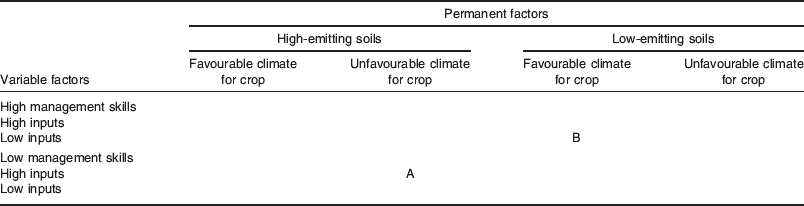
Consideration of these four factors, soil type, climate, management skill and levels of inputs, in a simple matrix enables the definition of 16 possible scenarios (Table 1). If we assume all other things to be equal, then the greatest carbon footprint of a hypothetical crop would occur in scenario A. Here the soils are emitting high levels of GHG, the climate is poor and the management skills of the farmer are low, both of which are suggestive of low yields. In addition, the crop receives high levels of inputs, which because of their embodied GHG will serve to increase the carbon footprint of the system. Compare this situation to scenario B, where there are low-emitting soils, a favourable climate and high management skills, suggestive of high yields and low inputs. Scenario B would probably have the lowest carbon footprint for our hypothetical crop, and the other 14 scenarios lie somewhere between the extremes described by A and B.
Matrix of production-related factors that can affect the size of the carbon footprint of a food item. ‘A’ is the scenario where the carbon footprint of any food item is likely to be highest, and ‘B’ is where it is likely to be lowest
The existence of this variation in the carbon footprint at the point of production serves to complicate the idea that the GHG emissions from transport alone render the carbon footprint of non-local food greater than that of local food. What becomes important is a consideration of the emissions from transport in relation to the emissions from production of the food item in one locality compared to another. The variation in emissions from transport is considered in the next section.
Transport level factors
Food is typically transported from the point of production to one or all of the points of processing, sale and consumption. This transport normally results in the emission of GHG, the source of which is related to five main factors:
(1) the embodied GHG in the materials used to construct the transport vehicle, i.e. the ship or the truck;
(2) the embodied GHG in the construction of the transport infrastructure i.e. the port or the road;
(3) the embodied GHG in the extraction/manufacture, processing and transport of the fuel (i.e. producing the diesel or petrol);
(4) the direct emissions related to using the fuel, i.e. emissions from burning petrol in internal combustion engine, or burning coal in steam engine;
(5) the direct emissions related to running any refrigerated system on board the transport vehicle refrigerated trucks.
These emissions are included in calculations of carbon footprints through the use of emission factors, which provide estimates of the amount of GHG emitted from burning 1 litre of a given petrochemical fuel, or more normally the level of emissions related to moving 1 tonne of goods 1 km in a specific sort of transport. Unfortunately, there is considerable variation in the published emission factors available for different forms of transport, and not all emission factors reflect the five factors noted above. Some only reflect direct emissions from combustion, while others reflect elements of the other sources of GHG. This variation can complicate the calculations(Reference Brenton, Edwards-Jones and Jensen27).
While recognising that there is still considerable debate surrounding these emission factors, the overall trend in emissions per tonne km for different forms of transport is uncontroversial, and some typical emission factors for different transport types are shown in Table 2. These data show that transport by ship is the most GHG-efficient form of transport, while the use of small road vehicles is the least efficient. So, as with the production factors, not all transport is equivalent, and because of this, a focus on a simple measurement of the distance a food has travelled during its lifetime is not necessarily going to provide an accurate indication of its overall environmental impact.
Direct emissions of CO2 and the global warming potential of all gaseous emissions for different modes of transport

* Includes all direct emissions of CO2 required to provide 1 tonne km (i.e. including the production and delivery of fuel and capital infrastructure).
† Also includes radiative forcing of emissions of other greenhouse gases (expressed as kg CO2 equivalents (kg CO2e)).
‡ It should be noted that the Royal Commission on Environmental Pollution highlights that ‘the total radiative forcing due to aviation is probably some three times that due to CO2 emissions alone’(58, Reference Spielmann, Kägi and Tietje59).
Storage level factors
There is a seasonality associated with the production of many foods, e.g. cereals, potatoes, lamb, fruit and many vegetables. For this reason, there is a need to store food in some way between the time of harvest and the time of consumption. The form of storage varies between food items, and most require the use of energy in some form, typically to cool, freeze or pack the food. The production of this energy is responsible for the emission of GHG, and because of this the storage of food has an impact on the climate.
A strategy of consuming local food throughout the year would require the locally produced food to be stored prior to consumption. The alternative strategy of consuming non-local food would require the food to be transported from the point of production to the point of consumption. Both these activities are responsible for the emission of GHG, and the overall best option will depend on the balance of the two sets of emissions. This balance is likely to vary over time, as the amount of energy needed to store a crop for 1 month is considerably less than that needed to store the same crop for 10 months.
As an example of this consider the case of apples produced and consumed in the UK, compared with those produced in New Zealand and consumed in the UK (Table 3). During the autumn months, UK-grown apples have been newly picked and not stored for long; as a result the total energy expended in supplying UK apples at this time is low. However, as the storage time increases into the UK spring and early summer, the amount of expended energy increases. The New Zealand apple harvest is seasonally converse to the UK harvest, and it occurs in March and April. At this time, apples from New Zealand are exported to the UK by ship, which has low GHG emissions per tonne km. During the subsequent months of early summer it may be more GHG efficient to import New Zealand apples than to store UK apples. This supposition is strengthened as the quality of stored UK apples tends to decline after 6 months in storage. Similar trade-offs occur with other storage methods such as freezing and chilling but calculating the emissions from refrigerated supply chains is complicated by the need to understand the losses of refrigerants, some of which have very large global warming potentials(Reference Calm28).
Energy use of apples grown in a European Union country and eaten in the same country in different seasons and for apples grown in New Zealand and eaten in the European Union (MJ/kg apples in retail outlet). (Adapted from the original source(Reference Milà i Canals, Cowell and Sim60))
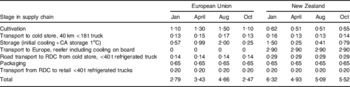
RDC, retail distribution centre; CA, controlled atmosphere.
Examples of emissions from local and non-local food supply chains
There are relatively few studies comparing the environmental impacts of supplying consumers with the same food product from different supply chains. Five of these studies are presented below in order to highlight the types of situation in which local food may not be the best environmental option.
Lettuce and tomatoes
The UK imports significant amounts of fresh vegetables from Southern Europe, particularly, but not exclusively, during the UK winter(Reference Edwards-Jones, Plassmann and York29). The commercial production of tomatoes in the UK occurs in glasshouses. The glasshouses are typically heated, and they burn some form of fossil fuel in order to generate this heat. Spanish tomatoes for export to the UK are grown in polytunnels or open fields. They do not require the use of fossil fuels for heating as ambient temperatures in Spain are warm enough for the fruits to grow and ripen. Spanish tomatoes are transported by road to the UK, which necessitates the burning of fossil fuels. At some times of the year, a UK consumer may be faced with the choice of buying a UK-grown tomato or a Spanish tomato. A life cycle assessment study suggested that the energy use and global warming potential (release of GHG) of Spanish classic loose tomatoes was less than from the production of similar UK tomatoes(Reference Williams, Pell and Webb30). However, a consideration of other environmental impacts suggested that the UK tomatoes were less environmentally damaging (Table 4).
Environmental burdens of classic loose tomatoes grown in the UK and Spain and supplied to the UK

RDC, retail distribution centre; GJ, giga joules; GWP, global warming potential (a measure of the impact on the climate expressed as CO2 equivalents (CO2e); EP, eutrophication potential (a measure of impact on water quality expressed as phosphate equivalents (PO4e); AP, acidification potential (a measure of air quality, expressed as SO2 equivalents (SO2e)(Reference Williams, Pell and Webb30)).
This study seems to suggest that the impact on the climate from Spanish tomatoes is less than that of UK tomatoes; however, several other factors are relevant to this debate. First, there is considerable variation in the energy use of UK tomato growers (Chris Plackett, FEC, Stoneleigh, UK, personal communication), and probably also in the footprint of the Spanish growers. For this reason, there is debate about the relevance of considering only one production scenario for each country. Second, neither this variation nor that related to seasonality is reflected in the results. Against this background it is perhaps not surprising that growers in the UK tomato sector are contesting these results (personal observation).
In a similar study comparing lettuce grown in the UK and supplied to the UK with lettuce grown in Spain and supplied to the UK market, it was found that the GHG emissions of lettuce grown in glasshouses in the UK winter were greater than that of Spanish lettuce grown in open fields and trucked to the UK at that time of year(Reference Hospido, Milà i Canals and McLaren31). However, the emissions from outdoor lettuce grown in the UK summer were much lower than that of glasshouse-grown lettuce, and at this time no Spanish lettuce were being exported to the UK as growing conditions in the south of Spain did not permit the commercial production of lettuce at that time of year.
Broccoli
Not all food imported from Spain competes with food grown in UK greenhouses; produce like broccoli is grown in the field in both locations, albeit in slightly different seasons. One study(Reference Milà i Canals, Muñoz and Hospido32) visited farms in both UK and Spain over a period of 2 years and sufficient data were collected to enable a detailed life cycle assessment to be undertaken for individual farms in the two countries. The results suggest that the GHG emissions from UK fresh broccoli (approximately 1·9 kg CO2 equivalents (CO2e)/kg) are lower than that of fresh Spanish broccoli (approximately 2·2 kg CO2e/kg). The main differences were related to the transport of the produce from Spain to the UK. However, the issue becomes more complicated when UK frozen broccoli is compared to fresh Spanish broccoli, as the acts of freezing the produce and maintaining a frozen supply chain through to the point of consumption are responsible for considerable emissions of GHG (range 1·1–2·6 kg CO2e/kg over three supply chains). As a result there may be little difference between the overall carbon footprints of some frozen UK produce and fresh Spanish produce.
Sugar
The GHG emissions for six different sugars sold in Switzerland were estimated using standard life cycle assessment methods(33). The types of sugar analysed included sugar cubes, granulated sugar and organic granulated sugar from sugar beet produced in Switzerland and Germany. The sugar cubes and raw sugar were made from sugar cane produced in Columbia and organic cane sugar from Paraguay. The highest carbon footprint of these six products was the sugar from sugar beet, while the organic sugar cane product from Paraguay had the lowest carbon footprint (approximately 0·34 kg CO2e/kg sugar). In a separate study, British Sugar determined the carbon footprint of sugar produced in the UK from sugar beet using the PAS 2050 methodology(34) as 0·6 kg CO2e/kg sugar up to the delivery of the product to food and drinks manufacturers(35). A separate German modelling study considered the life cycle stages of sugar from beet from cultivation to retailing and estimated the carbon footprint of sugar beet grown in that country to be 1·46 kg CO2e/kg sugar(Reference Stratmann, Teufel and Wiegmann36).
While these studies are not directly comparable, they do suggest that the footprint of sugar produced overseas and consumed in Europe may be lower than that produced and consumed in Europe. Several factors may explain this. First, the sugar derived from tropical countries is derived from sugar cane, while that grown in Europe is derived from sugar beet, and these crops have different yields of sugar per hectare of crop. Second, in some tropical countries the sugar industry produces several by-products such as bagasse and molasses, which share the environmental burden of growing and processing with the sugar, and thereby serve to reduce its footprint. Finally, sugar is shipped into Europe, and this form of transport has low emissions per tonne km.
Lamb
Debates around the advantages of local food are not restricted to crops and vegetables and several analyses have considered the environmental impacts related to red meat production(Reference Friel, Dangour and Garnett1, Reference Subak37, Reference Casey and Holden38). In one comparative study(Reference Williams, Pell and Webb30), it was suggested that the total footprint of lamb produced and consumed in the UK was 14·14 kg CO2e/kg, whereas that of lamb produced in New Zealand and consumed in the UK was 11·56 kg CO2e/kg. There is considerable room for debate around these figures, and again there are no estimates of physical variability within each country and no explicit measure of uncertainty. However, this study does highlight some of the factors that make New Zealand efficient producers of lamb meat: favourable climate, good genetics in the national flock and a very efficient slaughtering and processing sector that is free from much of the legislative burden imposed on UK slaughterhouses.
Local food can be the best environmental option
The above examples were purposely selected in order to demonstrate that local food is not always the best environmental option. However, it is clear that in some situations, local food will be the best environmental option. For example, it is likely that the best environmental option for Spaniards is to eat Spanish vegetables in preference to UK-grown produce. Similarly, New Zealand consumers are probably making the correct environmental option if they choose to eat New Zealand-bred lamb, and fresh UK-grown vegetables eaten in the UK in season are probably less environmentally damaging than imported produce. The differences between home-grown and imported vegetables become very apparent when considering fresh produce that is flown into the UK. Analyses of green beans grown in Kenya(Reference Edwards-Jones, Plassmann and York29) and pineapples grown in Mauritius(Reference Plassmann, Edwards-Jones, Sonesson, Berlin and Ziegler39) suggest that the emissions from flying these products from their points of production to the UK form the greatest proportion of the overall carbon footprint of the products (89 and 98%, respectively), and in the case of beans the overall footprint of Kenyan produce is 10 times greater than UK-grown produce.
Overall it is probably safe to assume that the lowest carbon footprints will be associated with eating fresh fruit and vegetables that have been collected from the farm without using a motor vehicle. So, in this sense, local food can be the best environmental option, but as demonstrated above, this is not always the case. Rather the specifics of the food chain need to be considered and compared to alternative supply chains. Also it should be noted that this assumption will hold true as long as the vegetables have been grown on land that has been under cultivation for many years; converting grassland, woodlands and other natural habitats to cropland will result in the emission of potentially large amounts of GHG, as discussed in later sections.
Human health
The chemical content and nutritional value of crops vary according to its genetics(Reference Hounsome, Hounsome and Tomos40) and the physical and biological environment in which it grows. This occurs as plants typically produce secondary metabolites in response to environmental stresses, which may include sunshine, periods of drought and challenge by pests and diseases(Reference Kumar, Imtiyaz and Kumar41). Because of these responses to their local environment, all other things being equal, we would expect to see both geographic and spatial variations in the chemistry of plants. Some of this variation may have an impact on the nutritional quality of the plant. So, for similar reasons to those discussed earlier for carbon footprints, it is unlikely that any given location in the world would have all of the most nutritionally beneficial crops growing within its boundaries. There will be some locations that in some years produced the most nutritionally beneficial crops of particular species, but clearly this cannot be the case for all locations in all years. So the relativistic assumption that the crops growing in the location in which a person happens to be at any one time are the most nutritionally beneficial at that time is logically flawed.
However, other factors in the food chain affect the nutritional quality of plants including handling, packaging and storage(Reference Goldman, Kader and Heintz42). Of these, storage is perhaps the most relevant to debates about local food. In a strategy that enhanced the consumption of local food, there would be a need to ensure that the local food was stored for relatively long periods, and was thereby able to act as a substitute for fresh food imported to the locality from regions with counter-seasonal production cycles. Significant amounts of research suggest that storage of fresh products such as onions(Reference Boettcher43), potatoes(Reference Marwaha, Kumar and Singh44), apples(Reference Tahir, Johansson and Olsson45) and cabbages(Reference Hounsome, Hounsome and Tomos46, Reference Tosun and Yucecan47) results in chemical changes and loss of nutritional quality. However, not all storage is of this type and food can also be frozen. Research shows that while freezing itself may be able to preserve the nutritional quality of many foods, the acts of preparing the food for freezing, such as blanching, may result in significant losses of some nutrients(Reference Lin and Brewer48–Reference Goncalves, Cruz and Abreu50).
The evidence to date suggests that the nutritional quality of the fruit and vegetables is probably highest straight after harvest and then declines with time. So if local food systems could supply fresh food to consumers within a very short time after harvest, then this food would be of high nutritional quality. Further, if local food systems could provide this high-quality food throughout the year, then a diet of local food may be better for consumers than a similar diet of non-local food. However, as noted above, there are two main complications with this argument. Firstly, the time from harvest to consumption is not necessarily related to distance from field to fork. Some vegetables that are sold locally may have been stored for a matter of days or weeks, while some vegetables grown in distant markets may be delivered to markets within a short time (e.g. 24–36 h from picking fresh vegetables in Kenya to delivery to stores in some parts of the UK). Secondly, at some times of the year, the nutritional quality of stored local food may be lower than that of freshly picked foods from distant places. So again it is not easy to justify generic claims that local food is nutritionally superior to non-local foods. The nutritional quality of the food will depend on the specific nature of the food supply chain(Reference Hounsome, Hounsome and Tomos46, Reference Rickman, Barrett and Bruhn51–Reference Tosun and Yucecan53).
Food security
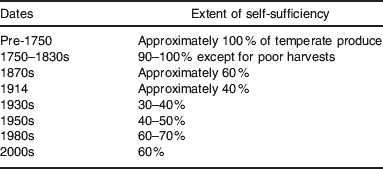
Food security is defined by DEFRA(54) as: ‘Consumers having access at all times to sufficient, safe and nutritious food for an active and healthy life at affordable prices. To enable this, our food supply must be reliable and resilient to shocks and crises. Food must also be produced in a way that is environmentally sustainable or we will set up problems for the longer term.’ This is a complete definition that clearly goes beyond a simple consideration of food self-sufficiency; however, some stakeholders may believe that enhancing self-sufficiency is an important element of food security. The UK is currently about 60% self-sufficient in food items; this represents a greater level of self-sufficiency than at any other time in the last 100 years (Table 5). In order to achieve full self-sufficiency there would be a requirement for a substantial increase in the home production of fruit (UK is currently about 10% self-sufficient), along with increased production of vegetables and sugar (UK is currently about 60% self-sufficient). There would also be a need to see a slight increase in potato production and bread wheat and a substantial increase in the production of animal feed (e.g. barley). As the UK is not a major exporter of crops and vegetables any increased production would need to occur without reducing current levels of production of any one crop.
Degree of food self-sufficiency in the United Kingdom from 1750 to 2000(54)
This requirement raises some problems. The first is one of land quality. As noted above, land in the UK is classified according its quality under the Land Capability Assessment. In order to achieve self-sufficiency Grade 1 land, which is the highest quality, would need to be allocated to vegetable production, as generally vegetables require good-quality land in order to achieve a commercial yield and an acceptable quality standard. However, most land of this quality is probably already allocated to vegetable production and it is not sufficient to meet the nation's needs, so there may be a requirement to grow some vegetables on less good land (e.g. Grade 2 land). Having allocated the vegetables to the best land there would then be a similar cascading allocation where the best available land would be allocated to bread wheat, sugar, potatoes and barley in that order. However, given that the need to grow more of each of these crops than we currently do, and the fact that yields/ha will fall as they are grown on sub-optimal land, it is inevitable that some grassland will need to be converted into arable land in order to meet the needs of the UK population. Generally, the best-quality grassland is currently utilised for dairy production, but in order to become self-sufficient in crops there would probably be a need to displace some dairy to less good grassland and to use the dairy land for cropping. The displaced dairy could in theory then use the less productive grassland that is currently used for beef and sheep production. However, as with crops, such a displacement would probably be accompanied by decreased yields, as the grass on this poorer land would be of poorer nutritional quality than land currently used for dairying.
Such decreases in yields per unit area, be they for crops or livestock, would probably result in decreased farm incomes, and one way to counter this would be to increase the sale price of the food items. In addition, and as noted previously, if yields decreased, then all other things being equal, the carbon footprint per unit of the product would increase. This trend would be exacerbated by any increased use of inputs. However, the yield effect on the carbon footprint may be less of a concern than the release of carbon that would occur as grassland and other habitats were converted to cropland. Permanent grasslands and woodlands tend to support large stores of carbon in their underlying soils. When these soils are ploughed, much of this carbon is released to the atmosphere. These emissions are widely recognised, and the Carbon Trust(34) suggest that the amount of GHG emitted over a 20 year period when a woodland in the UK is converted to annual cropland is 27 t CO2e/ha/year, whereas the emissions from converting grassland to annual cropland are 7 t CO2e/ha/year.
Given all of the above, and assuming other things to be equal, it is probable that the average C footprint of a food item produced in a ‘self-sufficient UK’ would be greater than that for the same food item produced under the land use system observed in the UK at the present time. However, this may not matter if the overall footprint of the food systems that feed UK citizens was lower than it is now. This could only be calculated by considering the footprint of the current food system and comparing this to the self-sufficient system. Any analysis of the current system would need to estimate the full extent of GHG emissions relating to the production, transport and storage of all food and drink items currently consumed in the UK. Such calculations would need to include the GHG emissions from soils and land use change in exporting countries.
In addition to considering the GHG emissions from a policy of self-sufficiency, it is also necessary to consider the origin of the inputs to the agricultural systems. Can a country claim to be self-sufficient if it needs to import tractors, machinery, fertilisers, pesticides and genetics? Currently these inputs are sourced from around the globe, and their production is responsible for substantial emissions of GHG(Reference Plassmann and Edwards-Jones55). A second issue to consider relates to the potential benefit that trade brings to less developed countries. At the macro-economic scale, trade in agricultural products can enable poorer countries to capture hard currencies, while at the micro level it can enhance the livelihoods of those farmers engaged in producing food for export(Reference Brenton, Edwards-Jones and Jensen56, Reference Cross, Edwards and Opondo57). So any analysis of a self-sufficient food system would need to consider the impact of sourcing inputs from within the UK and also the international impacts of withdrawing from trade. No such analyses are currently available, and in the absence of hard analysis it is difficult to guess whether or not a self-sufficient food system would be more GHG efficient than the current system.
Discussion
Relatively few comparative studies have been made between food supply chains from different localities that supply the same ultimate market. Those comparative studies that do exist tend to depend heavily on modelling of food systems(Reference Williams, Pell and Webb30) rather than on data collected in the different food supply chains. The nature of the data collection method may have large effects on the outcome of the footprint calculations(Reference Edwards-Jones, Plassmann and Harris17).
Most of the studies undertaken to date consider fresh produce such as horticultural products, and some meat products; relatively few have considered processed goods. Indeed the whole concept of local food is challenged by processed foods, as for these to be truly local all ingredients would need to be produced and processed locally. No studies yet published have considered the nutritional differences between local and non-local food, and none have considered the overall health benefits of eating a wholly local diet compared to a similar diet produced non-locally. The major differences in nutritional quality of local and non-local food will probably relate to changes in composition that have occurred in transport and/or storage, and the nature of such changes have been well described in the literature.
When faced with a consumption decision, consumers can probably never know if the particular local food available to them is a better environmental option than non-local options. However, arbitrary rules would suggest that fresh produce in-season such as fruit and vegetables would probably have carbon footprints that are lower, or at least comparable to, non-local fruit and vegetables. However, once these fresh produce are stored in some way and eaten out of season, these arbitrary rules may fail. The situation for unprocessed meat products is more complicated as so many environmental and agronomic factors combine to define the footprint of meat (e.g. soil type, levels of CH4 production, nature of animal feed, etc.). The data on processed foods are too scarce to enable evidence-based comment.
Conclusion
The concept of local food has gained traction in the media, engaged consumers and offered farmers a new marketing tool. All of these are to be welcomed as they enhance the level of engagement that consumers have with the food chain. Unfortunately though some of the marketing and other claims made about local food are difficult to support with the available scientific evidence. These claims are probably not harmful when they are made by producers at the local level; however, should claims start to gain traction in policy circles, then they could lead to pro-local decisions that may have unforeseen implications on the environment and developing countries engaged in the export of food items. Thus in order to ensure that policy-level decisions are based on evidence, there is a need to engage in some level of scientific research into the benefits and disadvantages of local food and to communicate these results widely.
Acknowledgements
Our work on the environmental and social impacts of food has been funded under a range of projects, and we are grateful to the following for their support: RCUK (RELU), Hybu Cig Cymru, Welsh Assembly Government, IIED and Horticultural Development Company. We are also grateful to the farmers, growers and consumers who participated in our studies. The author declares that there is no conflict of interest.



