


The world’s population is ageing and every country is experiencing a growth in the number of older adults, i.e. people aged ≥65 years(1). Two-thirds of them live in developed countries. Italy, after Japan, is the country with the highest percentage of elderly in the world(1). This growth is expected to accelerate in the coming decades. It is estimated that by 2050 more than 20 % of the world’s population and nearly one-third of EU citizens will be ≥60 years of age, with a particularly rapid increase in the number of the ‘oldest-old’, those aged ≥80 years(1).
Ensuring better-quality healthy ageing is an increasingly growing public health topic. ‘Active ageing’ is the process of optimizing the opportunities for health, participation and security with the aim to improve quality of life during the ageing process(2). Food safety as well as a healthy diet are essential to promote active ageing. In fact, older adults are more prone to develop food-borne illness (FBI) and hazardous nutritional behaviours. In people aged >85 years, there is a greater rate of hospitalization and death due to FBI than in other age groups. This is due to a weaker immune function, concomitant chronic diseases, malnutrition, use of drugs, immobility and other factors(3). The literature(Reference Wright, Canham and Masrani4) shows that the behaviours of older adults with respect to food safety and food consumption, such as consumption of ‘high-risk foods’ (meat, fish and poultry) and low compliance with information on the label, like the ‘best before’ date for highly perishable foods, often increase their risk to develop FBI. It is also clear that older adults have low knowledge about FBI, safe food handling practices (FHP) and nutritional needs, and are not aware of the link between specific food safety behaviours and the risk of FBI(Reference Redmond and Griffith5,Reference Langiano, Ferrara and Lanni6) .
In this regard, since the early 2000s, the increase in listeriosis in several European countries has occurred almost exclusively in patients aged over 60 years(7), in whom this serious disease is fatal in about a third of cases(Reference Milne8,Reference Evans and Redmond9) . Potential factors behind this increase could be unsafe food behaviours such as incorrect food storage and consumption of food past the ‘best before’ date(Reference Buckley, Cowan and McCarthy10,Reference Buffer, Medeiros and Kendall11) .
However, food safety alone is not sufficient to ensure active ageing; a correct diet is essential too. In fact, a healthy diet influences elderly people’s mental acuteness, energy levels and resistance to illness, as well as prevents nutrition disorders caused by nutritional imbalance, such as malnutrition (underweight, micronutrient deficiencies or insufficiencies) and overweight(Reference Bernstein and Munoz12).
Malnutrition is a critical health issue among older adults, caused by eating too little food and too few nutrients because of digestive problems, loss of appetite, anorexia, difficulty in chewing and poor health status(Reference Hickson13,Reference Margetts, Thompson and Elia14) . It is usually associated with adverse effects on general functions and clinical outcomes, such as a decline in functional status, decreased bone mass, immune dysfunction, anaemia, reduced cognitive function, delayed recovery from surgery, higher hospital readmission rates and mortality(Reference Ahmed and Haboubi15,Reference Stratton, Green and Elia16) . In Italy, the number of seniors as well as the percentage of elderly affected by malnutrition is constantly growing: nowadays, in fact, 50 % of elderly people entering a hospital ward are malnourished(17,18) . At the same time, overweight and obesity among older adults represent a serious public health problem. These extreme conditions increase the risk of chronic diseases such as diabetes, CVD, hypertension and metabolic syndrome, and contribute to a major and more frequent use of health-care services, raising the cost for the national health-care system(Reference Osher and Stern19). In the USA 41 % of adults aged ≥60 years were obese in 2015–2016(Reference Hales, Carroll and Fryar20) while in Europe 22·1 % of adults aged 65–74 years and 17·3 % of those aged ≥75 years were obese in 2014(21), with 32 million obese elderly in the European population in 2015(Reference Malthus-Vliegen22).
The present study aimed at investigating older adults’ knowledge, attitudes and practices with respect to food safety and healthy diet, with particular attention to unsafe FHP and nutritional behaviours to identify possible gaps that may be covered by tailored educational interventions. Furthermore, it had the goal to develop dietary and hygiene indices able to represent participants’ nutritional and food safety behaviours with the final aim of exploring their association with demographic and socio-economic characteristics.
Methods
The present cross-sectional study was conducted in Gemelli Teaching Hospital Foundation in Rome, Italy, over a 12-month period. The study was approved by the Ethics Committee of the Università Cattolica del Sacro Cuore, Rome.
Participant enrolment
Each Italian-speaking patient aged ≥65 years admitted to the geriatric ward or accessing the outpatient unit and the gym of the Centre of Ageing Medicine of the Gemelli Hospital was asked to voluntarily participate in the study, ensuring they provided their consent during a dedicated survey. The investigators, resident doctors of the Section of Hygiene, Institute of Public Health of the Università Cattolica del Sacro Cuore, explained the aim of the interview to each participant, collected the informed consent and interviewed each enrolled participant personally, explaining the questions when necessary.
Questionnaire
An anonymous questionnaire, based on the result of a literature scoping review, was developed by the Section of Hygiene, Institute of Public Health of the Università Cattolica del Sacro Cuore, to investigate demographic characteristics, socio-economic factors, and knowledge, behaviours, perceptions, practices and personal awareness in the matter of food safety and healthy diet. This questionnaire was previously tested in a pilot study on thirty participants, resulting in some minor modifications(Reference Laurenti, de Waure and De Meo23). The final questionnaire was made up of forty-five items divided into four sections.
1. General information, demographic and socio-economic aspects: age, gender, weight, height, work status, level of education, marital status, household (how many adults in the same house) and annual income.
2. Nutritional status and behaviour: questions about healthy nutrition, frequency of consumption of different types of food and number of times eating out were asked. BMI was calculated using weight and height data previously collected, by dividing weight in kilograms by the square of height in metres.
3. Food safety knowledge and FHP during food preparation and cooking, hand and dish washing and common risk factors (chemical, microbiological, zoonotic and other hazards), taking into account WHO recommendations(24).
4. Personal awareness in the matter of nutrition, dietary restriction and preference for quality or quantity.
The questionnaire consisted of structured, mutually exclusive closed-ended questions (except for some basic information such age, weight and height). It was in Italian language, self-administered and took about 20 min to be completed. In order to respect the privacy policy, no personal information such as name, surname or fiscal code was asked.
Dietary and hygiene indices
Selected responses from the questionnaire sections about dietary and hygienic habits were used to construct two indices: the dietary index and the hygiene index. These indices were computed as the distance between the answers provided by each respondent and the reference ideal answers, as indicated in equations (1) and (2).
The dietary index δ i, equation (1), was constructed taking into account the distance between each respondent’s answers and the optimal answers grounded on the diet guidelines from the Italian Ministry of Health(25). The index used a distance metric based on the inverse Euclidean distance to summarize this information, according to the following formula:
 $${\delta _i} = {\left( {1 + 2\sqrt {{{\sum\nolimits_{l = 1}^L {({Z_{il}} - {{\overline Z_l}} )} }^2}} } \right)^{ - 1}},$$
(1)
$${\delta _i} = {\left( {1 + 2\sqrt {{{\sum\nolimits_{l = 1}^L {({Z_{il}} - {{\overline Z_l}} )} }^2}} } \right)^{ - 1}},$$
(1)
where δ i indicates the dietary index for the ith individual, l is the dietary category (the total number of categories, L = 12, is given by: bread and cereals; dairy; red meat; white meat; fish; eggs; vegetable oils; animal fats; fresh fruits; fresh vegetables; sugar products; alcoholic beverages), Z il is the response of individual i in the category l, and $ {{\overline Z_l}}$
is the optimal score for the category. For each category, a score from 1 (worst behaviour) to 4 (best behaviour, i.e. the choice
$ {{\overline Z_l}}$
is the optimal score for the category. For each category, a score from 1 (worst behaviour) to 4 (best behaviour, i.e. the choice $ {{\overline Z_l}}$
) was attributed to each available choice. The index ranges between 0 (the maximum distance from the optimal dietary recommendations) and 1 (complete adherence to dietary recommendations).
$ {{\overline Z_l}}$
) was attributed to each available choice. The index ranges between 0 (the maximum distance from the optimal dietary recommendations) and 1 (complete adherence to dietary recommendations).
Analogously, the hygiene index η i, equation (2), was computed by using respondents’ answers to the questionnaire section related to hygienic habits and evaluating their distance from the optimal choice (again, for each available choice a score from 1 to 4 was attributed):
 $${\eta _i} = {\left( {1 + 2\sqrt {\sum\nolimits_{m = 1}^M {({Z_{im}}} - {{\overline Z_m})^2} } } \right)^{ - 1}},$$
where η i is the hygiene index for the ith individual, m is the hygienic category (the total number of categories, M = 11, is given by the eleven questions on hygienic habits in the questionnaire), Z im is the esponse of individual i in the category m, and ${\overline Z_{m}}$
is the optimal score for the category.
${\overline Z_{m}}$
is the optimal score for the category.
Statistical analysis
Data from the questionnaire were summarized in terms of absolute and relative frequencies and as mean and sd (or median, minimum and maximum when appropriate), for qualitative and quantitative variables, respectively.
A univariate analysis was performed to investigate the relationship between demographic and socio-economic factors (age, gender, work, education, marital status, annual income) and the dietary and hygiene indices. Further, an additional analysis was carried out to assess the relationship between the dietary index and BMI (kg/m2), respondent’s perception about his/her diet and sources of information about proper nutrition. Specifically, a set of non-parametric tests including Mann–Whitney, Kruskal–Wallis and Spearman correlation was run. The statistical software package IBM SPSS Statistics version 22.0 was used to perform the analysis and a level of significance of 0·05 was set.
Results
A total of 201 adults ≥65 years old attending the geriatric ward (n 54; 26·9 %), the outpatient unit (n 74; 36·8 %) and the gym (n 73; 36·3 %) were interviewed.
General information, demographic and socio-economic characteristics
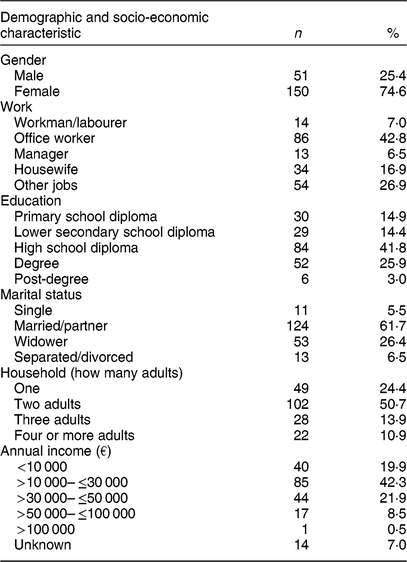
The mean age of the sample was 74 (sd 7·7) years and 74·6 % of respondents were female. A secondary school diploma or higher was declared by 70·7 % of respondents. Less than a quarter of respondents (24·4 %) lived alone, while 75·6 % with one or more adults. The annual income was less than or equal to 30 000 € for 62·2 %, while greater than 30 000 € for 30·9 % of respondents. Table 1 reports the main characteristics of the sample.
Descriptive characteristics of the sample of community-dwelling older adults (n 201) aged ≥65 years, Rome, Italy, 2016
Nutritional status and behaviours
The mean BMI was 25·8 (sd 4·25) kg/m2. In particular, two (1·0 %) respondents were underweight, seventy-two (35·8 %) were overweight and thirty-one (15·4 %) were obese.
About a third (35·8 %) of the respondents reported not to have a balanced diet, due to excessive consumption of sugar (11·4 %), fat (4·0 %) and food in general (10·4 %), or, on the contrary, because of not consuming an adequate quantity of food (9·5 %).
Older adults who were interviewed reported to get information about proper diet mainly from television, newspapers and the Internet (29·9 %) and from health professionals (34·8 %) such as dietitians and nutritionists, whereas 15·4 % from general practitioners.
Almost half (49·8 %) of respondents believe themselves to be overweight or obese, while only 4·5 % considered themselves to be underweight. Most of the respondents declared themselves to be trying to lose weight (39·3 %) or maintaining their current weight (29·4 %).
Food handling practices and food safety knowledge
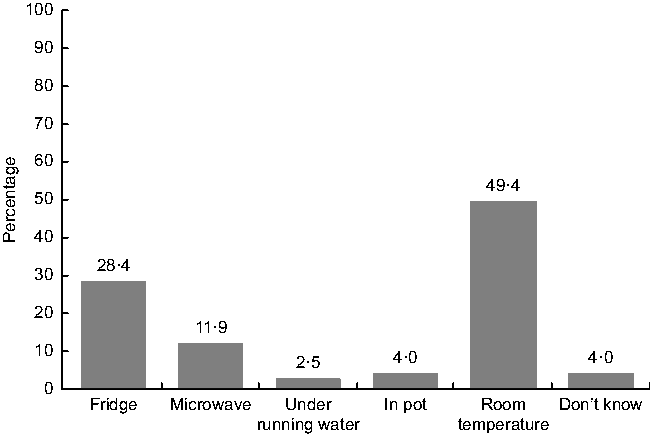
With reference to food safety, between 80 and 90 % of the participants stated they normally follow all the food safety practices during food preparation and cooking, even though 49·4 % defrosted food at room temperature before preparation (Fig. 1).
Answers to the question ‘Where do you defrost food?’ among a sample of community-dwelling older adults (n 201) aged ≥65 years, Rome, Italy, 2016
Most of the older adults (84·6 %) washed their hands when cooking (before, during and after) and after cleaning fresh vegetables, peeling fruit or shelling eggs (77·6 %). Almost all (92 %) washed fruit and vegetables under running water before use.
The majority of the sample (85 %) reported to properly cook food and about 80 % believed the guarantee of food safety came from the personal preparation of food.
The respondents referred to consume expired food (33·8 %) even more than once per month and to keep food leftovers in the refrigerator for more than 5 d (37·8 %). About a quarter (23·4 %) of the older adults declared to eat raw products (meat, fish, eggs, unpasteurized milk). A tenth (10·4 %) of the respondents believed they had gastrointestinal symptoms due to ingestion of some suspected food in the last year. Nearly all people (93 %) read the label of food products; in particular, 59·7 % read both the expiration date and the nutritional composition, while 32·3 % only the expiration date.
Personal awareness in the matter of food safety and healthy diet
About half of the respondents (49·7 %) declared nutrition practise as a way to get together with family and friends. With reference to food, 68·8 % of interviewed people referred that food quality is important whereas only 3·0 % referred food quantity as a relevant aspect; 25·6 % identified both elements as important. Almost all respondents declared to be willing to accept dietary restrictions for their health (30·2 %), but with some exceptions (54·8 %).
Dietary and hygiene indices
The two indices were compiled from analysing the data of 182 out of 201 respondents (90·5 %) and showed that older adults were far from having optimal nutritional and food security behaviours (Table 2). The dietary index did not show association with any of the independent variables, whereas the hygiene index showed a significant association with gender and annual income. In fact, women had a higher median hygiene index than men (0·183, min 0·098, max 1·000 v. 0·170, min 0·108, max 1·000) and people with annual income lower than 10 000 € had the lowest hygiene index compared with the other classes (0·159, min 0·098, max 0·333).
Distribution of scores on the dietary and hygiene indices among the sample of community-dwelling older adults (n 201) aged ≥65 years, Rome, Italy, 2016

Discussion
The present study’s results show that about one-third of older adults interviewed believed they did not have a proper diet and that half of them were overweight. Furthermore, albeit most of respondents thought they had a good level of knowledge about food safety issues, they did not follow correct FHP in everyday life. For example, the majority of respondents (between 80 and 90 %) stated they normally follow all food safety practices during food preparation and cooking, but when asked where they defrost food before preparation, almost half of them (49·4 %) answered to do it at room temperature, a practice with high health risks. This evidence suggests it is necessary to increase the awareness of older adults in the matter of healthy diet and food safety, in order to guarantee a better-quality active ageing.
As far as nutrition is concerned, a balanced diet is essential to prevent death and disabilities caused by major nutrition-related chronic diseases. These lifestyle-related diseases are very common in older adults, even though they often are not worried about nutritional risks coming from putting on weight or not having a balanced diet(26). In our study, instead, respondents were aware to be overweight or obese, as confirmed by BMI, and most of them declared to be trying to lose weight (because they wished to maintain a good health status) and to be willing to even accept dietary restrictions for their health benefit. Another important aspect arising from our study was that quality of food is more important than quantity: food quality, in fact, consistently affects physical and cognitive condition, bone health, vascular function and the immune system.
With reference to food safety, it is known that food stored, prepared, cooked and eaten at home is more prone to induce FBI, which represents a serious public health concern(Reference Wills, Meah and Dickinson27). Moreover, older adults are often unaware of the link between some behaviours and the risk of FBI; in fact they reported to follow recommended practices in domestic food preparation that do not correspond to real observed behaviours(Reference Redmond and Griffith5,Reference Langiano, Ferrara and Lanni6) . For example, in our study nearly all respondents (93 %) reported to read the label of food products, and, in particular, the expiration date, but then referred to consume expired food even more than once per month and to keep leftovers in the refrigerator for more than 5 d. These results suggest that there are important differences between what older adults say they do and what they actually do in their kitchen(Reference Dickinson, Wills and Meah28). A recent study(Reference Evans and Redmond9) about older adults’ self-reported practices showed that adults aged ≥60 years know that the ‘use by’ date indicates food safety but, when interviewed, they referred to eat food beyond ‘use by’ dates or consume food after the recommended 2 d after opening with high risk of FBI.
Dietary and hygiene indices calculated in the present study also confirmed that older adults were far from having optimal nutritional and food security behaviours. Moreover, the hygiene index showed a significant association with gender and annual income. In fact, women and people with higher income had a higher median hygiene index. Also the evidence suggests that older men may be particularly vulnerable to poor and unsafe nutrition and have more risky behaviours than older women(Reference Anderson, Verrill and Sahyoun29,Reference Cates, Kosa and Karns30) . Anderson et al.(Reference Anderson, Verrill and Sahyoun29), for example, showed how older women were more likely than men to follow recommended FHP such as washing their hands before preparing food or not eating meat after it was stored open in the refrigerator for more than 5 d. In the same way, older men from lower social classes seem to have neither an active interest nor economic possibilities to ensure proper and healthy eating for themselves compared with older adults with higher incomes(Reference Thompson, Tod and Bissell31). Some people could think that a quality diet is more expensive or that healthier food is less affordable; however, a recent study showed there is no evidence that balanced nutrition, such as a cardioprotective diet (high in vegetables, fruits, legumes, cereals, fish and unsaturated fats such as olive oil, that includes a low intake of meat and dairy foods), is more expensive than a conventional dietary pattern(Reference Reidlinger, Sanders and Goff32).
Nutritional and food safety behaviours are modifiable risk factors: an improvement in education strategies can be essential to ensure active ageing(Reference Keller33) and to reduce the risk of FBI(Reference Redmond and Griffith5,Reference Langiano, Ferrara and Lanni6) , such as listeriosis(Reference Evans and Redmond34). Specific and targeted educational interventions for older adults and their caregivers could be promoted in order to improve not only the knowledge but also the adoption of recommended food safety practices and safe nutritional behaviours at home(Reference Sahyoun, Pratt and Anderson35). For example, a multicomponent intervention including nutritional telemonitoring, education and follow-up made by a specialized nurse led to improved nutritional status, diet quality and physical activity levels of Dutch community-dwelling elderly(Reference Van Doorn-van Atten, Haveman-Nies and Van Bakel36). According to the process evaluation made by the authors, this intervention was well accepted by older adults; however, nurses’ satisfaction should be improved(Reference Van Doorn-van Atten, De Groot and Romea37). In this context, in our opinion, even general practitioners can play a key role in increasing older adults’ knowledge about healthy diet and FHP and to counteract possible incorrect or incomplete information coming from television, magazines, newspapers and the Internet that were reported as main sources of information by interviewed people.
Limitations
The present study has several limitations. First of all, participant recruitment was based only on age, language spoken and place of admission to the hospital. Mental state, the reason for hospitalization and co-morbidities that could influence participants’ responses were not taken into account. Furthermore, the questionnaire was previously tested but not validated. At least, generalizability of these results can be extended only to similar populations.
Conclusions
Our results show that there is a lack of knowledge in the matter of food safety and healthy diet among older adults and that it is necessary to achieve a major awareness of the issue through specific and targeted actions. The promotion of multicomponent interventions about healthy diet and FHP is a key measure for public health in order for older adults to be healthy and independent during old age. To prevent FBI and imbalanced nutritional behaviours and, by doing so, to promote active ageing, it is important to improve not only the knowledge of the value of FHP, but, first of all, to put FHP into practice.
Acknowledgements
Acknowledgements: The authors thank Gero Barbara, Olga Ramazzotti and Malgorzata Wachocka for proofreading the article. Financial support: This research received no specific grant from any funding agency in the public, commercial or not-for-profit sectors. Conflict of interest: None. Authorship: P.L. formulated the research question, revised the manuscript critically for important intellectual content and gave final approval. C.D.M. explained the aim of the interview to each participant, collected the informed consent, interviewed each enrolled participant personally, explaining the questions when necessary, contributed to design the study, collected the data, performed the literature search and wrote the article. D.S. elaborated the questionnaire, designed the study and drafted the manuscript. A.G.S. revised the manuscript critically for important intellectual content and gave final approval. D.M. elaborated the questionnaire, constructed the dietary and hygiene indices, contributed to the data interpretation and drafted the manuscript. A.V. elaborated the questionnaire, constructed the dietary and hygiene indices, collected and interpreted the data, and drafted the manuscript. F.L. elaborated the questionnaire, interpreted the data, revised the manuscript critically for important intellectual content and gave final approval. E.M.-G. collected the data and drafted the manuscript. A.S. collected the data and drafted the manuscript. R.B. revised the manuscript critically for important intellectual content. A.B. contributed to design the study, performed the literature search, collected the data and drafted the article. W.R. revised the manuscript critically for important intellectual content. C.d.W. designed the study, analysed and interpreted the data, and revised the manuscript critically for important intellectual content. All authors read and approved the final manuscript to be published. Ethics of human subject participation: This study was conducted according to the guidelines laid down in the Declaration of Helsinki and all procedures involving research study participants were approved by the Ethics Committee of the Università Cattolica del Sacro Cuore, Rome, Italy (ethics clearance number Prot. 9967/14). Written informed consent was obtained from all participants.



